




Abstract
Extant evidence suggests that the two self-conscious emotions pride and guilt guide people's behavior in the context of self-control dilemmas. Pride and guilt are both outcomes of and antecedents to how people resolve self-control dilemmas. However, evidence on how pride and guilt motivate individuals to exert self-control is inconsistent. Based on the Expectancy Value Theory, we propose a conceptual framework to predict when and how pride and guilt can lead to increased or decreased self-control. One particularly important factor is the relatedness of the past and focal dilemmas: whether pride or guilt arises from a success or failure to exercise self-control in a domain related or unrelated to a focal self-control dilemma may determine people's motivation to exert self-control.
Individuals make a myriad of decisions within and across multiple domains every day. These decisions serve to achieve multiple, and often competing, goals (Fishbach & Dhar, 2005; Giner-Sorolla, 2001). The pursuit of many of these goals requires sustained self-control. On the one hand, people strive to attain long-term, higher-order goals—such as saving money for a down payment or maintaining a healthier lifestyle. On the other hand, people also desire immediate rewards, which entices them to succumb to the temptation of short-term outcomes—such as spending money instead of saving, indulging in unhealthy foods, and partying instead of studying—usually at the cost of their long-term goals. Individuals must make trade-offs between their long-term interests and short-term impulses, across repeated decisions.
Acting in line with one's long-term interests at the expense of short-term impulses requires self-control (Loewenstein, 1996; Wertenbroch, 1998). The literature defines self-control as giving up immediate goals in favor of long-term goals (Kruglanski & Kőpetz, 2010). Self-control dilemmas arise whenever the attainment of a long-term goal conflicts with an immediate goal, where the short-term outcome tempts people to give up their long-term interests (Fishbach & Dhar, 2005; Fishbach & Trope, 2005). Long-term goals are associated with future benefits and short-term costs, whereas short-term goals are associated with immediate benefits and long-term costs. Self-control failures occur when people violate their superordinate long-term goals and expect to regret their choice (Vosgerau et al., 2020). For example, a goal to lose weight may motivate individuals to exercise regularly, but being a couch-potato tends to be more appealing than going to the gym. When individuals are faced with different options, a single choice oftentimes cannot simultaneously serve the attainment of their long-term goals and their short-term desires. For instance, people typically perceive high caloric, unhealthy foods as tastier and more gratifying than healthy foods (Raghunathan et al., 2006), suggesting that they need to make a trade-off between optimizing taste and compromising their health. Such self-control dilemmas are exacerbated by the fact that a given choice has different and conflicting implications for individuals’ well-being at different times. Across self-control dilemmas, the realization of the benefits of short-term goals is typically immediate, but the realization of the benefits of long-term goals (or the costs of not adhering to such goals) may vary significantly. As Giner-Sorolla (2001, p. 206) observes, “Examples of this kind of delayed-cost dilemma are all too common in everyday life: doughnuts taste delicious but are fattening, party going trades midnight euphoria for a morning hangover, cigarettes bring social camaraderie but take years off one's life.”
Furthermore, people do not make decisions in isolation. That is, past decisions can impact future decisions. When faced with self-control dilemmas, how do people choose when to behave consistently with their long-term goals and when to give in to short-term temptations? And how do people make decisions when confronted by repeated self-control dilemmas? For example, the success or failure in resisting a tempting dessert earlier in the day might impact an individual's decision in going to the gym or being a couch-potato later in the day. In the present paper, we develop a conceptual framework to predict how successes or failures of past self-control dilemmas influence future self-control dilemmas. The framework incorporates emotional responses resulting from the resolution of self-control dilemmas, as well as the perceived relatedness between the sequential dilemmas.
Emotions serve as an internal feedback system to support of these kinds of decision-making processes by helping individuals make inferences about their behaviors and guide their pursuit of goals (Baumeister et al., 2007; Giner-Sorolla, 2019). This article focuses specifically on the role that the two discrete emotions pride and guilt play in the pursuit of individuals’ long-term goals. Pride and guilt are self-conscious emotions that arise as a consequence of past successes or failures in adhering to long-term goals (Tracy & Robins, 2004). Pride arises in response to success achieved while acting in line with a self-relevant personal standard for which the self is credited. In contrast, guilt arises in response to a failure to act in line with a self-relevant standard, for which the self is blamed. Pride and guilt are not only outcomes of self-control successes and failures, but they also guide people's self-control in the face of subsequent temptations and signal appropriate courses of action based on previous events (e.g., Louro et al., 2007; Tangney et al., 2007). In other words, pride and guilt serve as both outcomes of past dilemmas and antecedents of future dilemmas. As such, it is important to examine both emotions within a single framework to understand and to predict when people will behave consistently with their long-term goals.
Based on past research, it seems as if pride and guilt lead to inconsistent effects on individuals’ motivation to pursue long-term goals. Sometimes pride and guilt motivate people to pursue a long-term goal (e.g., Fourie et al., 2011; Hurst & Sintov, 2022; Williams & DeSteno, 2008), but at other times these emotions lead people to prioritize their short-term goals over their long-term interests (e.g., Herman & Mack, 1975; Jiao et al., 2022; Wilcox et al., 2011). Taking into consideration that decisions are often made sequentially, we investigate these discrepancies and propose a framework, the Sequential Self-Control Resolution Model, to predict when and how pride and guilt can lead to increased or decreased self-control (see Figure 1). Our framework incorporates pride and guilt both as outcomes and antecedents in the self-regulation process. We posit that one particularly important factor is the perceived relatedness of the past and focal dilemmas: whether pride or guilt arises from a success or failure to exercise self-control in a domain related (i.e., sharing the same goal conflict) or unrelated (i.e., characterized by a different goal conflict) to a focal self-control dilemma may determine people's motivation to exert self-control. The active appraisals associated with each of the two emotions will be subject to different interpretations by individuals, depending on whether the self-control dilemma that elicited the emotion is related or unrelated to the focal dilemma. We explain the different appraisals through the lens of the Expectancy Value Theory (EVT; Atkinson, 1964) by examining how pride and guilt can influence the expectancy of achieving goals and the valuation of goals. Since decisions are rarely made in isolation, but rather are part of a larger sequence of choices, it is important to understand how the outcome of a self-control dilemma can inform how individuals resolve a subsequent self-control dilemma.
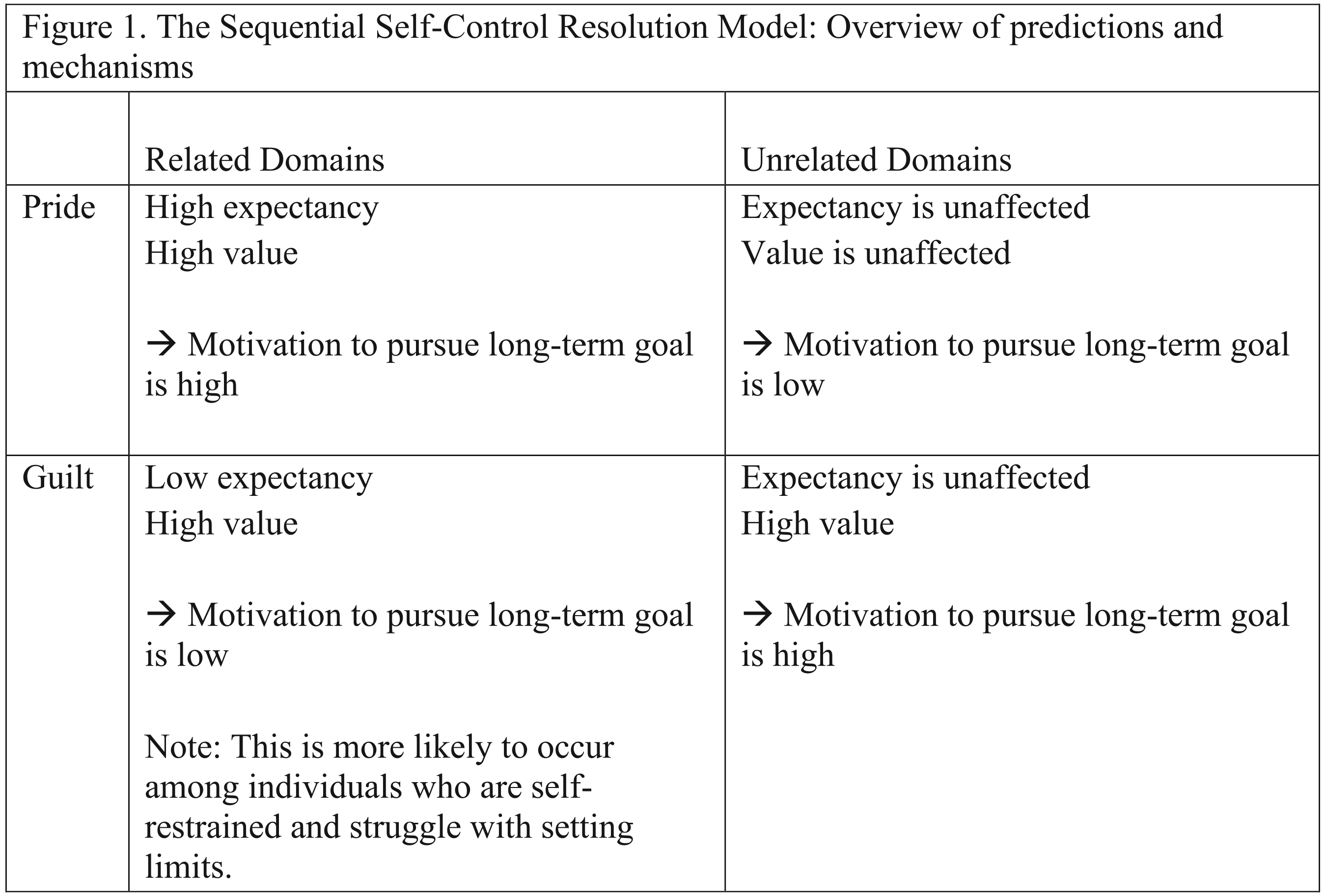
The sequential self-control resolution model: overview of predictions and mechanisms.
Our framework builds on and adds to prior work conceptualizing emotions as both outcomes of and antecedents to the self-regulation process. Much prior work has examined pride and guilt in the context of self-regulation without explicitly investigating the relationship between domains that elicited the emotions and the domains in which subsequent decisions are made. Hofmann and Fisher (2012) were the first to empirically demonstrate that pride and guilt arising from multiple domains can influence subsequent self-control, but since then little research has probed deeper into the role of domain matching. Drawing upon this initial evidence as a starting point, we integrate broader research from self-regulation, goal striving, pride, and guilt to construct the Sequential Self-control Resolution Model, with specific predictions about why pride and guilt lead to seemingly inconsistent outcomes at times and how individuals resolve sequential self-control dilemmas. We conclude this paper by discussing multiple avenues for future research based on our framework.
Pride and Guilt as Outcomes of Self-Control
Emotions are feeling states elicited from self-relevant events or behaviors (Scherer, 2005) and provide individuals with information about the emotional object's implications for their personal well-being (Lazarus, 1991). They also serve as a mediator between the external environment and the individual's responses and experiences (Mulligan & Scherer, 2012). In deciding whether to pursue a long-term goal or to indulgence in short-term rewards, individuals rely on the emotions they experience throughout their goal-pursuit process (Louro et al., 2007).
The two emotions pride and guilt play a particularly relevant role in helping individuals resolve self-regulation conflicts and “navigate the landscape of immediate, short-term desires” (Hofmann & Fisher, 2012, p. 682). Pride and guilt belong to the class of self-conscious emotions that are elicited when people evaluate themselves against their valued personal standards or goals (Tangney et al., 2007; Tracy & Robins, 2004). Pride and guilt are only elicited to the extent that the self is credited or blamed for a positive or negative outcome, respectively (Tangney & Tracy, 2012). As such, pride and guilt can provide people with immediate and salient feedback on the acceptability of their behavior (Tangney et al., 2007).
Pride is elicited upon appraisals of the achievement of difficult tasks that require a high degree of effort and when individuals manage to overcome their desire for short-term rewards in pursuit of long-term goals. Pride is associated with a sense of self-achievement and autonomy (Carver et al., 2010). For example, past research has shown that pride is elicited when individuals perform well on challenging tasks such as making training progress (Gilchrist et al., 2018) and solving cognitively complex problems (Williams & DeSteno, 2008), and also resisting temptations such as refraining from unintended purchases or other consumption opportunities (e.g., Mukhopadhyay & Johar, 2007; Patrick et al., 2009). Pride arising from achievement is known as “authentic pride,” which is distinct from a more global sense of pride in the self, known as “hubristic pride” (Tracy & Robins, 2007a). Hubristic pride is associated more with arrogance and conceit, and less with accomplishment. In this article, we examine pride resulting from past successes and achievements, and thus we focus only on the role of authentic pride.
Guilt relates to an “individual's unpleasant emotional state associated with possible objections to his or her actions, inactions, circumstances, or intentions” (Baumeister et al., 1995, p. 245). Guilt-inducing situations are often related to people's failure to reach standards they set for themselves. Guilt plays a significant role in decision-making contexts and can arise both from actions that contravene long-term goals as well as inactions in achieving long-term goals (Dahl et al., 2003). For instance, breaking a diet (i.e., consuming too many calories) or an exercise regime (i.e., not exercising) are among the most common antecedents of the experience of guilt (Keltner & Buswell, 1996). Individuals experience guilt after making hedonic instead of utilitarian consumption choices, such as choosing tasty but unhealthy foods over healthy foods, choosing luxury items over necessities, or vice over virtue products (e.g., Giner-Sorolla, 2001; Kivetz & Keinan, 2006; Mohr et al., 2012). Even considering options that go against one's personal standards can evoke guilt—for example, merely thinking about eating unhealthy foods (Durkin et al., 2012; Rozin et al., 1999) or considering purchasing products that are unethically produced (Gregory-Smith et al., 2013) may be sufficient to induce guilt.
Although pride and guilt also play a role in social and interpersonal contexts, to signal the successes and failures in acting according to social or moral standards (Antonetti & Baines, 2015; Dahl et al., 2003; Tangney et al., 2007), pride and guilt are particularly important in the context of self-control. Self-control dilemmas most often arise in contexts that involve the recognition of personal achievements or failures. The decision to adhere to or violate social norms can involve considerations other than pitting short-term indulgences against long-term goals (e.g., how visible the decision is to others, Antonetti & Maklan, 2014). As such, in our framework, we focus only on pride and guilt in the context of self-related decisions, in the absence of others. We return to the topic of interpersonal pride and guilt in the Future Research section.
Pride and guilt play an important role in translating people's personal standards and long-term goals into goal-directed behavior, and have been linked to a variety of outcomes across different domains of life (Tangney et al., 2007; Tracy & Robins, 2004). Next, we discuss how pride and guilt can motivate or discourage subsequent self-control.
Pride and Guilt as Antecedents to Self-Control
In addition to being the result of an evaluation of a decision outcome, emotions can also have subsequent causal effects of their own. They not only serve as appraisals of events that have happened in the past but also prepare one for actions appropriate for dealing with future events (Scherer & Moors, 2019). Emotions evoke specific profiles of action tendencies that can influence subsequent judgments and decisions, even if the cause of the emotion is not necessarily related to the judgment or decision at hand. Generalized feelings of positive and negative affect can arise from moving toward or away from self-regulatory goals, and this generalized affect can serve as feedback to inform subsequent decisions (Carver & Scheier, 2001). However, it is worth noting that this feedback loop requires a degree of self-focused attention, which is also a key component of self-conscious emotions. Building upon Carver and Scheier’s (2001) cybernetic self-regulation process, Tracy and Robins (2004) specify distinctive emotional experiences that arise from adhering to or failing to achieve self-regulatory goals when the cause of the experience is attributed to the self (versus an external cause). Self-conscious emotions such as pride and guilt involve self-awareness and self-evaluation, which in turn can inform people about how they are performing in relation to their personal standards (Tracy & Robins, 2004). In the following sections, we discuss the action tendencies specifically associated with pride and guilt, and review empirical evidence on how pride and guilt shape self-control when individuals are confronted by subsequent self-control dilemmas.
Consistency: Prioritizing Long-Term Goals
Both pride and guilt have been demonstrated to motivate people to exercise self-control to achieve their long-term goals. Extensive research suggests that experiencing pride leads people to increase their efforts toward a goal (Hurst & Sintov, 2022; Leary, 2007; Smith & Ellsworth, 1985; Soscia, 2007; Tracy & Robins, 2007b; Williams & DeSteno, 2008). Pride is a positive source of arousal that can reinforce current behavior (e.g., successfully exerting self-control) and encourage the persistence of that behavior (Tracy & Robins, 2007a). For instance, pride experienced from good performance on a task motivates individuals to persist longer on a subsequent cognitively complex task, even if the task requires a high degree of effort (Williams & DeSteno, 2008). Similarly, pride experienced after resisting to a temptation, such as spending money on luxury items, drinking alcohol, eating, or consuming media, can promote self-control and inhibition of indulgence subsequently (Hofmann & Fisher, 2012). Fourie et al. (2011) posit that the experience of pride should elicit future pride-eliciting behaviors and more approach-oriented behaviors toward positive self-rewarding goals.
Similarly, guilt can also increase behaviors consistent with long-term goals, but through different mechanisms. Unlike pride, guilt disrupts the current behavior and operates as a punishment cue rather than a reinforcement cue (Fourie et al., 2011). Guilt triggers action tendencies toward reparation and compensation following a negative outcome for which a person is responsible (Hurst & Sintov, 2022). The potential to both inhibit negative behavior and stimulate reparative behavior in response to self-regulation failures is unique to the experience of guilt and not akin to other negative self-conscious emotions such as shame or embarrassment (Tangney & Tracy, 2012). Guilt leads to behavioral inhibition of the negative behavior; if an opportunity for amendment arises, guilt leads to approach-oriented reparative behavior (Amodio et al., 2007). For example, individuals who experience guilt based on personal short-coming display a strong desire to better themselves and tend to choose self-improvement products as reparative behavior (e.g., vitamin water that boosts mental performance vs. vitamin water that increases hydration; Allard & White, 2015). Guilt also induces people to inhibit indulgence by choosing utilitarian over hedonic alternatives (e.g., Ramanathan & Williams, 2007; Zemack-Rugar et al., 2007).
Inconsistency: Prioritizing Short-Term Goals
Despite ample empirical support that pride and guilt can promote self-control, plenty of evidence suggests that pride and guilt can lead to behavior that is inconsistent with people's long-term goals. Although experiencing pride can encourage people to persist in the pursuit of long-term goals, it can also push them to exhibit decreased self-control and indulge in more tempting short-term goals, especially when they feel as if they deserve to reward themselves for their past, positive actions (e.g., Hofmann & Fisher, 2012; Jiao et al., 2022; Salerno et al., 2015). Pride is significantly correlated with motivation to approach rewards (Carver et al., 2010), and as such, pride resulting from past successes can justify future indulgences. For example, individuals who recall life events that make them feel proud are more likely to make indulgent choices such as choosing unhealthy French fries over a healthier salad or a gift card for entertainment over a gift card for school supplies (Wilcox et al., 2011). Similarly, students felt justified in indulging in unhealthy foods after recalling prior academic successes (Prinsen et al., 2019). When luxury shopping was viewed as a reward for previous achievements, pride elicited stronger preference for luxury goods (McFerran et al., 2014). Even children exhibit such behavior—delaying gratification for indulgence was reduced after children experienced incidental pride versus incidental joy (Shimoni et al., 2016).
While guilt does elicit the need for self-improvement as a way to alleviate the perceived distress, people do not always address previous failures as a way to cope with their guilt. Despite its unique quality to facilitate self-control through problem-focused coping strategies, guilt can sometimes cause people to respond with more avoidant behaviors, in which they try to rationalize, ignore, or deny their previous transgressions (Dahl et al., 2003). These strategies can prevent people from engaging in reparative behavior subsequently. Moreover, past research suggests that people sometimes try to address the negative feelings evoked after a self-control failure by engaging in more immediate gratification to make themselves feel better (Tice et al., 2001). Guilt stemming from limit violations such as the overconsumption of calories or alcohol can lead restrained eaters and heavy drinkers to violate their long-term goal of regulating their calorie or alcohol intake even further (Herman & Mack, 1975; Muraven et al., 2005). Restrained eaters who first consumed a milkshake (i.e., failed their goal to avoid unhealthy foods) subsequently ate more ice cream than unrestrained eaters, suggesting that restrained eaters prefer to prioritize hedonic consumption over their long-term dietary goals once they have already consumed more than their allotted number of calories a day (Herman & Mack, 1975). This effect was also observed in the domain of alcohol consumption. Heavy drinkers who violated their self-imposed limit to their alcohol intake experienced more guilt and distress than other drinkers and showed greater intentions to drink subsequently (Muraven et al., 2005).
In sum, past research suggests that in the context of self-control dilemmas, pride and guilt can lead people either to behave consistently with a long-term goal after an initial success or demonstrate a failure to exercise self-control, respectively. Alternatively, pride and guilt can lead individuals to behave consistently with a short-term goal at the cost of their long-term interest. In the next section, we propose a framework to reconcile these seemingly inconsistent responses to pride and guilt.
The Role of Domain Relatedness in Self-Control Dilemmas
Pride and guilt can arise from previous self-control dilemmas, and people rely on these emotions to resolve subsequent self-control dilemmas. These past and subsequent self-control dilemmas may arise from related or unrelated long-term goals, and they may share the same core conflict or different core conflicts. Prior successful or unsuccessful self-regulation can be in a domain perceived as either related or unrelated to the domain of a focal self-control dilemma. The perceived relatedness of the domains of these self-control dilemmas may account for some of the inconsistent downstream effects of pride and guilt on self-control found in past literature (e.g., Hofmann & Fisher, 2012). For instance, someone faced with the dilemma of choosing between a healthy or an unhealthy snack (i.e., health domain) may rely on his or her guilt experience from eating a tempting dessert option at lunch earlier that day (i.e., related dilemma in the health domain), or rely on his or her pride experienced by resisting the temptation of ordering a new electronic gadget the day before (i.e., unrelated dilemma in the domain of spending). In the former situation, the two self-control dilemmas are in related domains: they both share the same core conflict (choosing between healthy vs. unhealthy foods) and draw upon the same long-term goal (desire to be healthy). In the latter situation, the dilemmas are in unrelated domains: resisting spending money is an unrelated conflict—serving a different long-term goal (i.e., saving money)—from healthy eating. We do note that the degree to which sequential dilemmas are drawing upon the same or different long-term goals may be subjective. The level of similarity between domains is up to individuals’ interpretation. For example, some individuals may construe that resisting a tempting dessert and resisting the temptation of buying a new gadget are part of the same overarching, long-term goal: being a responsible person. While we recognize that perceived domain relatedness is likely continuous in nature, in the present framework we refer to domain relatedness as a dichotomy for the sake of simplicity. It is also in line with past research (e.g., de Witt Huberts et al., 2012; Hofmann & Fisher, 2012; Soman & Cheema, 2004; Wilcox et al., 2011) that focuses more on individuals’ proximal goals in relation to self-control (e.g., healthy eating, money saving, exercising) rather than abstract overarching goals (e.g., being a good person or responsible person).
In sum, we posit that considering domain relatedness is important when studying sequential self-regulation. Pride and guilt elicited in response to a decision within a related versus an unrelated domain as a focal self-control dilemma may provide individuals with different information regarding their long-term goal pursuit, and may therefore affect their motivation to pursue the focal goal differently. Specifically, acting in accordance with one's long-term goals (i.e., exerting self-control) requires the suppression of more gratifying, immediate short-term goals. This is a process that requires motivation.
Motivating Goal Pursuit Through Expectancy and Value
Appraisals associated with emotional elicitation prepare individuals to take subsequent actions (Scherer & Moors, 2019). How individuals interpret their emotions resulting from past behaviors determines their subsequent course of action. The appraisal information associated with a prior emotional experience might not always be relevant to the focal self-control dilemma (e.g., success at adhering to a money-saving goal is not relevant to healthy-eating goals). Even so, in sequential self-regulation contexts, the appraisal information that elicited the emotion remains salient and may influence subsequent decisions in other domains. Past emotional experiences can influence how individuals appraise the likelihood that a focal long-term goal can be achieved and how important this goal is.
We borrow from the Expectancy Value Theory (Atkinson, 1964) to explain how the motivation to act in line with long-term goals arises. In this theory, motivation for a given behavior is the multiplicative function of two appraisals: expectancy—how likely a wanted outcome can be attained through a behavior or action—and value—how much a desired outcome is valued. Motivation to pursue a long-term goal depends on whether individuals think the goal is attainable, and given attainability, whether they care enough about the goal to exercise self-control to achieve it. As such, when either expectancy or value is low, individuals will likely experience a stronger preference for the more pleasurable short-term goal. In other words, short-term indulgences are more likely to be chosen when the long-term goal seems unattainable or if the long-term goal is not valued.
In the following sections, we elaborate on how the appraisal information related to past pride and guilt experiences can influence people's expectancy and value appraisals in domains related and unrelated to a focal self-control dilemma, and thereby lead to behaviors consistent or inconsistent with long-term goals. We conclude this section with a model of our conceptual framework.
Pride from a Related Domain
The elicitation of pride is based on behavior that is congruent with a self-relevant personal goal (Tracy & Robins, 2004). Pride arises when one feels responsible for an action that is valued (Hurst & Sintov, 2022; Tracy & Robins, 2007b). As such, pride experienced in a domain that is related to a focal self-control dilemma (i.e., shares the same conflict) alerts individuals as to how much they value an achievement in the focal domain. Pride arises as a result of achievement and provides the necessary motivation for the pursuit of further success (Fredrickson & Branigan, 2001). Perceived attainability of a subsequent goal in a domain related to a previous pride-eliciting event should, therefore, also be high. Taken together, pride arising from a related domain should increase both expectancy and value of the focal goal.
The experience of pride from a past success reinforces current behavior (Tracy & Robins, 2007a), enhances performance at subsequent related tasks (Herrald & Tomaka, 2002), and increases efforts toward the achievement of future goals (Williams & DeSteno, 2008). Within the self-control context, an experience sampling study by Hofmann and Fisher (2012) suggests that pride experienced from previous resistance to a temptation leads to increased appraisals of goal importance and sustained self-control in the face of subsequent temptations within the same self-regulatory domain. In sum, pride from past experiences related to the focal self-control dilemma can motivate individuals to persist in pursuing their long-term goal, rather than give in to a short-term temptation.
Pride from an Unrelated Domain
Unlike pride from related domains, pride resulting from a domain that is unrelated to the focal goal does not provide individuals with information on the attainability of the focal goal and how much they should value the focal goal. It is possible that appraisals of the focal goal's expectancy are unaffected by the experience of pride. Furthermore, the value of the focal goal cannot be reinforced by a past achievement unrelated to the focal long-term goal in the current self-control dilemma. Because individuals cannot easily appraise expectancy and value from their prior success, pride elicited in such contexts may not lead to persistence in the pursuit of long-term goals. Rather, unrelated pride may even lead to behaviors inconsistent with long-term goals because pride can operate as a form of justification for indulgence (de Witt Huberts et al., 2012). As mentioned earlier, self-control dilemmas arise when people must choose between their long-term goals versus short-term temptations, and the choice of a short-term temptation leads to anticipated regret (Vosgerau et al., 2020). Pride can allow individuals to indulge without regret, especially if they feel as if they have made a substantial sacrifice (Park, 2018).
Self-rewarding and self-gifting often occur after a pride experience because the past success leads people to feel more deserving of rewards (Mick & Faure, 1998; Park, 2018). People who experience pride from an unrelated domain, compared to happiness, are more likely to make an indulgent choice (i.e., (a) French fries vs. salad; (b) $25 gift certificates for entertainment vs. for school supplies; Wilcox et al., 2011). Similarly, people are more willing to spend money on frivolous goods (e.g., luxury products, movie tickets) over functional goods (e.g., gasoline) after recalling an event where they succeeded through hard work (Jiao et al., 2022). In other words, individuals are willing to undermine their higher order goal of saving money after experiencing pride from an unrelated event.
While it is possible the urge to justify indulgence is activated after a pride-eliciting event in a related domain, the importance and value of a focal long-term goal may discourage the desire to self-reward. Indeed, increasing the value of long-term goals can even attenuate the indulgence effect following unrelated pride. For example, past research suggests the importance of adhering to personal values and long-term goals, over giving in to short-term temptations, is heightened when people direct their attention toward themselves (Alberts et al., 2011; Verplanken & Holland, 2002). In line with this reasoning, Wilcox et al. (2011) show that videotaping participants with a webcam heightened participants’ sense of self-awareness, leading them to make less indulgent choices (i.e., choosing salad over fries) and display greater motivation to achieve their long-term goal (i.e., a health goal), even though the pride they experienced was unrelated to the goal.
In sum, predicting how unrelated pride influences the ways in which individuals resolve subsequent self-control dilemmas may be more difficult than predicting how related pride influences the resolution of these dilemmas. The pride experience from an unrelated domain does not directly reinforce the long-term goal from the focal dilemma, and hence, appraisals of expectancy and value of the focal goal may be unaffected. Furthermore, pride may even be used as a justification for a reward. Giving into a temptation in this case would be pleasurable and would not evoke guilt or regret (Vosgerau et al., 2020). Compared with the pleasure of indulging in a short-term reward, the value of the long-term goal in a focal self-control dilemma may be less salient. If the value of the long-term goal is evoked through some other means (e.g., increased self-awareness), outside of the pride experience, then individuals may behave more consistently with their long-term goals.
Guilt from a Related Domain
Although pride and guilt are elicited upon parallel cognitive appraisals of an event as being a success or failure of one's own making, respectively, they may not influence self-control through the same mechanisms. Compared to pride, there may be a stronger emphasis on expectancy following guilt, as the perception of attainability is likely undermined by a previous failure. While guilt typically increases the desire to self-improve and repair the situation (Dahl et al., 2003; Tangney & Tracy, 2012), the opportunity to do so may be perceived as fully lost in some cases. People tend to stay committed to a goal only when they perceive that they can still attain it (Kruglanski et al., 2015). When people appraise the attainment of their long-term goal as unfeasible (i.e., goal failure), they may switch to an opposing goal instead of making pointless attempts to compensate for past self-control failures (e.g., Louro et al., 2007). As such, guilt arising from a previous domain sharing a conflict with a subsequent self-control dilemma may more readily lead to an appraisal of reduced expectancy, thus hindering reparative behavior.
Interestingly, although attainability may be threatened, the value of the focal long-term goal could still be high. Hofmann and Fisher (2012) demonstrate that guilt experienced from a related domain led to reduced behavioral inhibition within the same choice domain although guilt increased participants’ perceptions of goal importance and goal conflict. This suggests that individuals may recognize the value of their long-term goal, but still not always find effective ways to deal with their guilt when faced with similar subsequent self-control dilemmas. People with restraint problems (i.e., those who have a strong goal to restrain from consuming something, but struggle to exert restraint) may be particularly likely to show this effect: They value the long-term goal, but feel that expectancy of success is low, and as a result, they opt for the short-term temptation. Such individuals are particularly sensitive to the conflict between indulging in the substance they try to restrain from and the need to self-regulate (Herman & Mack, 1975). Research on the “What-the-Hell” effect (Polivy & Herman, 1985) supports the notion that guilt from previous failures in a related domain hinders individuals’ ability to exercise self-control when opportunities to make up for the initial failures do not exist. Specifically, the “What-the-Hell” effect describes situations in which prior failures to self-regulate lead individuals to abandon their long-term goals subsequently and may even lead to binging behavior. Individuals who define their goals in terms of consumption limits that must not be crossed are particularly prone to the “What-the-Hell” effect (e.g., dieters; Herman & Mack, 1975, or heavy drinkers; Muraven et al., 2005). The abstinence violation effect is a similar phenomenon documented in addiction research. For individuals struggling to cope with issues such as problem gambling, alcohol consumption, and drug use, violating a personal goal to abstain from consumption can lead to relapse and engagement in behaviors that deviate from individuals’ long-term goals (Marlatt & George, 1984; Sharpe, 1998). When abstinence is violated, such individuals experience guilt and reduced self-efficacy; they then turn to drugs or alcohol to cope with these negative experiences (Neighbors et al., 2013). Relatedly, in the financial domain, when individuals believe that they have violated their monthly savings goal, they are more likely to continue spending rather than curtailing this behavior (Soman & Cheema, 2004). Self-regulation failures from limit violations (i.e., not consuming more than a certain number of calories, alcohol, cigarettes, or money within a specific time span) cannot be undone with subsequent reparative behavior. After all, one cannot “uneat” calories, “unsmoke” cigarettes, or “unspend” money.
Due to a lack of perceived opportunities to compensate for such limit violations (i.e., “point of no return”), guilt arising from related self-control dilemmas can cause individuals to prioritize short-term pleasures over the attainment of their long-term goals. Giner-Sorolla (2001) points out that guilt elicited from a past self-control failure can result in people overindulging subsequently as a form of mood repair and this may be particularly prevalent among people who believe they have violated their strict behavioral standard. The value of a long-term goal may be high when guilt arises from past failures in a related domain—otherwise, failing to achieve it in a previous self-control dilemma would not evoke guilt. However, the expectancy of the long-term goal may vary among individuals. For example, the “What-the-hell” effect does not emerge for non-restrained eaters (Herman & Mack, 1975; Polivy & Herman, 1985); these individuals do not see the focal goal as irrevocably lost, following a self-control failure in the healthy eating domain, and they may be able to make up for the failure in the future. Similarly, prudent (i.e., conscientious and non-impulsive) individuals who experienced guilt from eating cookies were less likely to choose unhealthy food items like cheesecake subsequently (Ramanathan & Williams, 2007). For people who do not perceive their focal long-term goal as lost, a guilt-evoking experience in a past related domain may still motivate their pursuit of their long-term goal. But for those who view the long-term goal as unattainable (e.g., high-restraint people who are sensitive to limit violations), it is likely that, even though the value of the goal is high, guilt from a related domain can lead to increased behavior inconsistent with the focal long-term goal.
Guilt from an Unrelated Domain
In contrast with guilt from related domains, the attainability of a focal long-term goal is not threatened by past failures in unrelated domains. After all, no actual violation of the long-term goal has occurred in the focal domain (i.e., the domain of the focal self-control dilemma), and thus, individuals would not perceive that the opportunity for reparation has been lost due to the past failure. Appraisals related to the expectancy of a goal in an unrelated domain would not be affected. However, appraisal of the value of the goal may increase. As mentioned previously, guilt typically triggers approach-oriented compensatory behavior (Amodio et al., 2007; Hurst & Sintov, 2022), and individuals would be more likely to engage in self-improving, reparative behavior as a way to address the negative experience from guilt rather than indulgence in short-term rewards. The value of the focal long-term goal in the subsequent dilemma may be boosted through the individual's need to compensate and repair. As such, individuals may view the subsequent decision-making context as an opportunity to make amends for their previous failure. For example, individuals who experienced guilt based on personal shortcomings exhibited a strong preference for products focused on self-improvement as a way to compensate for their past failure (Allard & White, 2015). Similarly, people primed to experience guilt unrelated to the subsequent consumption decision exhibited stronger preference for necessities (e.g., school supplies) than more indulgent options (e.g., recreational CDs and DVDs; Zemack-Rugar et al., 2007). Hofmann and Fisher (2012) demonstrate that guilt can increase the importance of self-regulation following self-regulatory failure; the inhibition of impulsive behavior is particularly strong in domains unrelated to the initial failure.
Past research on incidental guilt (i.e., guilt elicited from an unrelated past domain) is more limited compared to research on integral guilt (i.e., related guilt). Given the broader evidence on guilt and self-regulation (e.g., Antonetti & Maklan, 2014; Dahl et al., 2003; Tangney & Tracy, 2012), we can safely conclude that guilt increases the valuation of self-regulation overall. Guilt unrelated to a focal long-term goal does not hinder the perceived attainability of this goal. As such, individuals are less likely to switch goals (i.e., pursue more short-term temptations) and are likely to persist in their pursuit of their long-term goals.
Sequential Self-Control Resolution Model
In this paper, we attempt to reconcile the seemingly inconsistent effects of pride and guilt on sequential self-control dilemmas by examining domain relatedness within self-control dilemmas. In our Sequential Self-control Resolution Model, we posit that long-term goal-consistent behavior arises following pride from related self-control domains and guilt from unrelated domains; long-term goal-inconsistent behavior arises following pride from unrelated self-control domains and guilt from related domains. Figure 2 illustrates the interaction of emotional responses with domain relatedness of self-control dilemmas at different times.
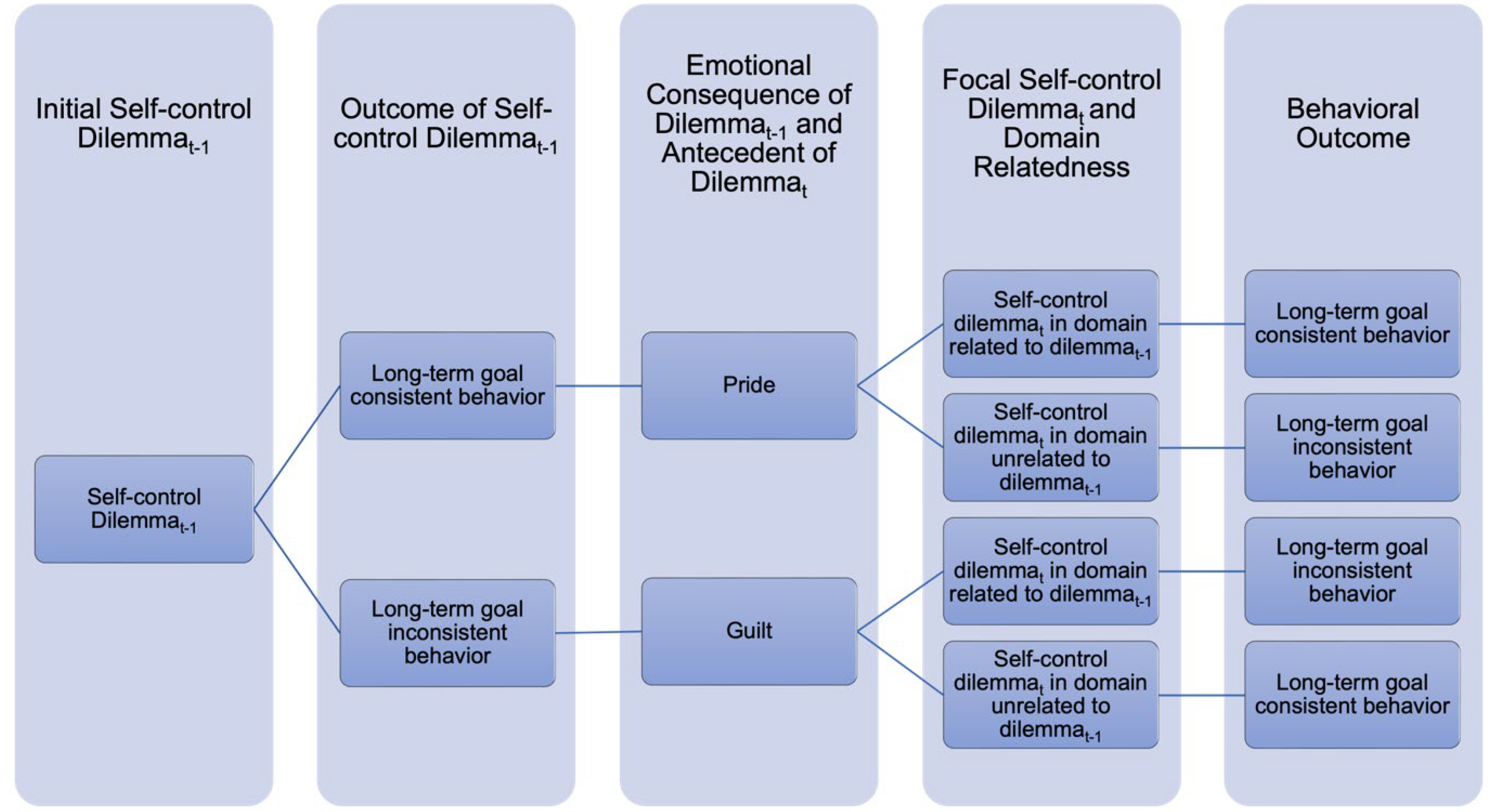
The sequential self-control resolution model: conceptual framework.
Discussion
Pride and guilt can be the consequences of previous actions and decisions, providing individuals with immediate feedback on how well or poorly they are regulating their behavior toward achieving their long-term goals. Pride and guilt can also serve as antecedents to subsequent decisions. Depending on the relatedness of the previous decision and the focal decision, pride and guilt can increase or decrease people's motivation to pursue long-term goals when confronted by self-control dilemmas. Drawing upon the EVT (Atkinson, 1964), we posit that the appraisals people draw from past successes and failures have implications for the expectancy and value people place on long-term goals, which are central to focal self-control dilemmas. More specifically, our Sequential Self-control Resolution Model predicts that pride leads to stronger subsequent self-control when expectancy and value for the focal long-term goal are both high—which is the case when pride arises from the same domain as the focal self-control dilemma. When value for the focal long-term goal is not elicited (i.e., pride from an unrelated domain), preference for the short-term indulgence as a reward increases. Our framework predicts that guilt leads to stronger subsequent self-control when value for self-regulation increases and expectancy is not threatened—that is, when guilt arises from an unrelated domain from the focal self-control dilemma. Guilt can increase preference for short-term indulgences when individuals feel their opportunity for reparation has been lost (i.e., low expectancy), which can occur when individuals have previously violated their strict behavioral limits within the same domain.
Past research on self-regulation suggest discrepancies between the actual and ideal self lead to negative emotions, and the emotions these discrepancies arouse motivate individuals’ to engage in self-control (Carver & Scheier, 2001; Higgins, 1987). Relatedly, reducing these discrepancies can offer individuals a sense of progress, allowing them to slow down their pursuit of self-control goals (Carver & Scheier, 2001). These self-discrepancy theories suggest that negative emotions should increase self-control, whereas positive emotions should reduce self-control. Research in self-conscious emotions (e.g., Tangney & Tracy, 2012; Tangney et al., 2007; Tracy & Robins, 2004) differentiates pride and guilt from other, basic positive and negative emotions. Literature on self-conscious emotions and self-regulation suggests that pride and guilt have specific—and at times, inconsistent—influences on individuals’ decisions to exert self-control (e.g., Hofmann & Fisher, 2012; Ramanathan & Williams, 2007; Salerno et al., 2015). Our framework builds upon and extends all these lines of research. By integrating expectancy and value of long-term goals, our framework offers a more nuanced understanding of how pride and guilt can influence decision making. We propose that the relatedness of domains between past and subsequent dilemmas interacts with pride and guilt to influence perceived expectancy and value of the focal long-term goal. More specifically, following a pride experience, factors such as self-awareness can influence the perceived value of a long-term goal. Following a guilt experience, restraint and limit violations can influence the perceived attainability of a goal. The Sequential Self-control Resolution Model provides a theoretical and testable explanation for why pride and guilt have seemingly inconsistent effects on self-control.
Future Research
In the following sections, we discuss several avenues for future research, which will offer insights into how pride and guilt influence individuals’ long-term goal pursuit, including how pride and guilt may be applied as motivational “tools” in people's daily lives.
Dispositional Factors
The effect of guilt on self-control, more so than pride, appears to depend on individuals’ dispositional level of restraint within a specific domain. Although past guilt research has considered dispositional factors such as an individual's level of prudence, impulsiveness, or restraint concerning the self-regulatory domain of interest (e.g., Herman & Mack, 1975; Polivy & Herman, 1985; Ramanathan & Williams, 2007), this did not happen systematically. We suggest that these factors are critical in determining the effect of a guilt experience on a given choice and should, therefore, be better understood. We propose that dispositional factors may determine the extent to which individuals are motivated to pursue long-term goals after experiencing guilt. For instance, guilt arising from past unrelated domains may motivate self-control in individuals who are naturally guilt prone or have high levels of self-restraint, such as dieters or heavy drinkers. These individuals may be more attuned to negative, discrepancy-amplifying emotional feedback from past or imagined lapses in self-control. However, for such people, guilt arising from related domains may to be too difficult to cope with, especially if the guilt-evoking event exceeded a strict self-imposed limit. Similarly, individuals low in trait impulsiveness may be particularly susceptible to the influence of guilt in their goal striving because of their inherent future orientation and their inclination to avoid behavior that jeopardizes a valued long-term goal.
Furthermore, the seemingly inconsistent effects of guilt on the pursuit of long-term goals could be explained by an underlying non-linear relationship between an individual's level of self-restraint and self-control in response to a guilt experience (Giner-Sorolla 2001). We posit that the relationship between people's level of self-restraint and subsequent level of self-control may have an inverted U-shape: individuals with low levels of self-restraint may be less susceptible to the negative affective experience of guilt, whereas individuals with high levels of self-restraint may react more strongly to the experience of guilt from a given self-regulatory failure, and address this negative affect by seeking out more pleasurable short-term indulgences (cf. Herman & Mack, 1975; Muraven et al., 2005).
Another dispositional factor that may influence how people respond to pride and guilt could be the lay beliefs they hold relating to their perceived ability to change their personal characteristics (Dweck, 2000; Dweck & Leggett, 1988). Individuals who believe they can change their personal characteristics (e.g., intelligence, body weight) may cope differently with their pride and guilt experiences than individuals who do not believe they can do anything to change their characteristics. Individuals who perceive they have no influence on their personal characteristics may struggle to cope with guilt from previous self-regulation failures than those who perceive their personal characteristics can be developed. In the weight loss domain, we find that lay theories influence how individuals respond to pride: Participants who perceived their body weight as changeable made more indulgent food choices after experiencing pride unrelated to health, but not after experiencing health-related pride, presumably because their belief that successes are based on personal effort make them more prone to reward-seeking behaviors (Storch et al., 2020).
Future research may investigate the extent to which different dispositional characteristics interact with the source of guilt (i.e., domain related vs. unrelated guilt) in determining the influence of guilt on subsequent self-control. This could enhance our understanding of how individuals’ dispositional characteristics influence the way they interpret past self-regulatory failures, and how guilt arising from past failures affects individuals’ decisions when they face new self-control dilemmas.
Self-Conscious Social Emotions
In our framework, we focus on pride and guilt arising from and influencing individuals’ personal successes and failures in self-control contexts. It is also worth systematically examining when pride and guilt lead to more prosocial decisions (which shares parallels with long-term goal striving) versus self-beneficial decisions (sharing parallels with short-term indulgences), and understanding the appraisals that lead to these decisions in interpersonal contexts.
Besides the self-control context, guilt also motivates people to seek out opportunities to make reparations in social contexts. For example, recalling one's own immoral behaviors encourages more subsequent donations to charities and fewer self-interested choices in social dilemmas (Sachdeva et al., 2009). Similarly, people who experience guilt from violating social standards subsequently display greater cooperation in social bargaining games (de Hooge et al., 2007; Ketelaar & Tung Au, 2003) and higher intentions to donate or volunteer (Jordan et al., 2011). These examples show cross-domain compensatory behavior. Interestingly, if making amends in the same domain is not possible, guilty individuals are more likely to inflict self-punishment and deny themselves pleasure (Nelissen & Zeelenberg, 2009). This result seemingly deviates from our framework regarding self-control dilemmas (i.e., when someone has failed, they are more likely to indulge in the same domain because amends can no longer be made). Individuals are more likely to engage in self-punishment (e.g., applying electric shocks to themselves) when the target of the violation can observe this action, but self-punishment is less likely to occur when uninvolved others are present or if the individual was alone (Nelissen, 2012). Prosocial behavior and self-punishment are both responses to social guilt, and serve as signals of remorse. Individuals who have violated social standards need to consider not only the trade-off between the immediate benefit to the self versus harm (or lack of benefit) to others, they also need to consider how observers perceive their behavior and how they can recover their social standing.
The social aspect of pride leads individuals to seek recognition from others for their successes and achievements (Gaines et al., 2005; Webster et al., 2003). People are motivated to maintain this social acclaim, which influences their subsequent behavior. For example, pride increases donation intentions, but only when individuals feel that their donation would be recognized by others (Paramita et al., 2020). Pride also leads people consume products that allow them to socially differentiate themselves (i.e., increased consumption of publicly visible products; Griskevicius et al., 2010). Luxury consumption is an interesting area to examine, as indulgence and social acclaim may go hand-in-hand. Luxury products signal social status and at the same time, luxury products tend to be hedonic in nature and more of an indulgence. This is a situation in which social and self-centered aspects of pride coincide. Pride resulting from an unrelated domain may actually increase indulgence-seeking subsequently, if such indulgence signals social standing to observers.
Our present framework focuses on self-control contexts in the absence of social others. Future research can expand on our framework by examining how successes and failures in social contexts can lead to different appraisals that influence subsequent behaviors. Resisting temptations and upholding superordinate goals are not the only relevant considerations for individuals when they make decisions about subsequent behaviors; social signaling also plays a significant role. Resisting or giving into an indulgence may have additional implications (e.g., signaling remorse, signaling status) when guilt and pride are evoked or expressed in social contexts.
Anticipated Pride and Guilt
In this framework, we specifically examined how pride and guilt shape self-control across sequential decision making. Therefore, we took a backward-looking approach, focusing on the role of pride and guilt elicited by past self-regulatory successes or failures only. Pride and guilt may also be elicited from predicted self-regulatory successes or failures in a given choice situation. Both anticipated pride (cf. Katzir et al., 2010; Patrick et al., 2009; Shimoni et al., 2022) and anticipated guilt (cf. Giner-Sorolla, 2001; Kotabe et al., 2019) can positively affect individuals’ self-control. For instance, Patrick et al. (2009) demonstrated that participants who were induced to report their anticipated pride from resisting the urge to eat cookies displayed greater behavioral inhibition than participants instructed to focus on anticipated shame from giving in to their desire to eat the cookies. Children behave similarly when experiencing anticipated pride. Children who imagined experiencing future pride (vs. joy) were better able to resist an immediate temptation for the sake of long-term goals (Shimoni et al., 2016). Similarly, anticipated guilt from giving in to a temptation was found to be accompanied by higher self-control when the temptation was associated with negative long-term consequences (Giner-Sorolla, 2001). When forming self-control judgments, anticipated guilt is weighed more strongly by individuals (Kotabe et al., 2019).
Given that both anticipated and experienced pride and guilt could influence the subsequent self-control, the question is: on which of these emotional feedback cues do individuals rely more strongly throughout the goal-striving process? Research on self-licensing and justifications suggests that individuals may anticipate guilt from engaging in indulgent consumption at the cost of their long-term goals, which then induces them to come up with compelling reasons to justify indulgent choices (e.g., de Witt Huberts et al., 2012; Kivetz & Simonson, 2002; Kivetz & Zheng, 2006; Okada, 2005). Since pride elicited from previous self-regulatory successes can instill a sense of deservingness in individuals, it may provide them with a justification to indulge, thereby canceling out the deterring effect of anticipated guilt. Currently, we know relatively little about the interplay between emotional feedback from past behavior and affective forecasts from predicted behavior. Future research may shed more light on how different types of affective feedback interact in shaping self-control.
Practical Applications
The conceptual framework we propose also has practical implications for assisting people in their long-term goal pursuit in their daily lives. People have to exercise self-control constantly to resist the pull of their immediate desires and pursue long-term goals. Due to the inherent capability of pride and guilt to inform individuals on how well or poorly their behavior aligns with their long-term goals, these emotions play a critical role in guiding individuals through their goal-striving process. With the rise of mobile technologies, an increasing share of consumers entrust their mobile devices, apps, or fitness trackers with their self-monitoring process. This opens up new ways for policy makers, companies, and app developers to interact with consumers throughout their long-term goal pursuit in real time (Van Ittersum et al., 2013). The visual representation of individuals’ past goal striving may increase the strength and salience of their emotional experiences. This tracking technology may increase the salience of limit violations. For example, exercise apps often show people's “streaks” (e.g., “you have exercised five days in a row”) and encourage them to pursue an activity daily. The salience of this information may inadvertently cause the “What-the-Hell” effect in people who are sensitive to limit violations—if they break their streak, their motivation to pursue their high-order goal may be significantly reduced. Given that pride and guilt may not always motivate people to adhere to their long-term goals, we need to improve our understanding of how these emotions shape people's goal pursuit.
While pride and guilt can motivate people to pursue their long-term goals, we need to consider the effects that these emotions have on people's well-being. Guilt is an inherently negative emotion, associated with discomfort and distress (Tangney & Dearing, 2002). Its motivational power comes from people's desire to return to a less negative affective state by making amends (Izard, 1991; Kubany & Watson, 2003). However, high levels of guilt can evoke behaviors that are maladaptive or even pathological—for example, exercise addiction (Sicilia et al., 2022) and eating disorders (Craven & Fekete, 2019). Conversely, pride instills a sense of accomplishment and promotes individuals’ confidence in their abilities, thereby increasing self-worth and subjective well-being (Diener et al., 1995; Tangney et al., 2007; Tracy & Robins, 2004, 2007). Although both are powerful motivational tools in self-regulation, pride may have more positive implications for individuals’ well-being than guilt.
Conclusion
To conclude, this framework synthesized existing evidence of how pride and guilt shape self-control after previous self-regulatory successes or failures. While the emotions literature provides evidence that pride and guilt play a role in self-regulation, this evidence seems inconclusive as to whether these emotions motivate or inhibits self-control in the face of subsequent dilemmas. We attempt to resolve these inconsistencies by offering a more holistic view on emotions as internal feedback and motivating mechanism within the goal-striving process.
Footnotes
Declaration of Conflicting Interests
The authors declared no potential conflicts of interest with respect to the research, authorship, and/or publication of this article.
Funding
This work was supported by the Netherlands Organisation for Scientific Research (grant number: 406.18.547). The funding source was not involved in conducting the research, the preparation of the manuscript, or the decision to submit the article for publication.
