




Abstract
Although convergence in emotion expressions within small groups is well documented, the motives that explain why members converge are rarely explicated. We approach expressive convergence from a conformity perspective and introduce the Emotional Conformity Framework, in which we posit that members match their groupmates’ emotion expressions because they are motivated to gain an accurate understanding of reality (informational conformity motive) or to form and maintain social relationships (normative conformity motive). These motives determine members’ standards for correctness, social responses, and plausible convergence mechanisms, while members’ personalities and situational properties shape the relative strength of the two motives. By explicating these motivational underpinnings, the Framework improves our capacity to understand, predict, and regulate expressive convergence and emphasizes its functionality.
Whether it is for the pursuit of task goals or to meet social needs, people tend to organize in groups. Employees work in units; athletes play on teams; friends gather in cliques. These groups influence their members’ attitudes (Santee & Maslach, 1982), motivation (Karau & Williams, 1997), behaviors (Levy Paluck & Shepherd, 2012), and emotions (van Kleef et al., 2017). The question of how people's emotions are shaped by the groups to which they belong has a rich history in affective science, dating back at least to Le Bon (1895). Evidence abounds that emotional dynamics are key predictors of the behaviors of individual group members and the functioning of groups as a whole (Barsade & Knight, 2015; van Kleef & Fischer, 2016). Despite this longstanding interest and mounting evidence, the nature of these emotional dynamics remains imperfectly understood. One fundamental question that has proven particularly elusive is why members of the same group often converge in their emotional expressions. We argue that existing accounts of this phenomenon are limited in their explanatory power, and we offer a complementary theoretical framework that can account for a wider range of empirical observations. Specifically, we suggest that expressive convergence can be explained by conformity theory and conceptualized as members’ motivated alignment with the group majority (Cialdini & Goldstein, 2004). Taking this motivated view, we argue, can help explain, predict, and regulate expressive convergence and group emotions, and ultimately suggest new ways to enhance group functioning.
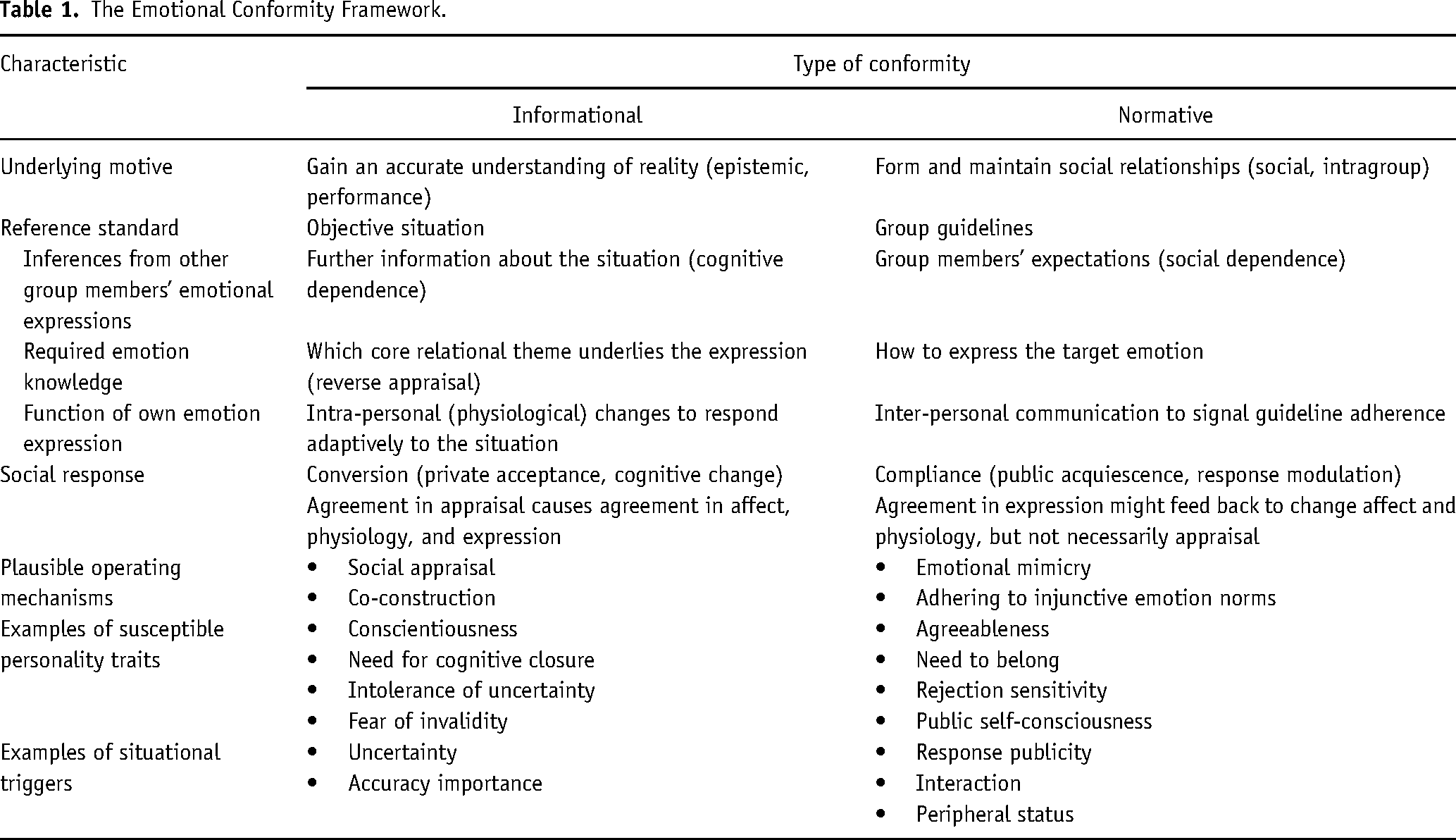
Our paper focuses on the convergence of emotional expressions in small groups. As such, we do not focus on larger, less interactive collectives, instantaneous expressive agreement to an event, divergent responses, or covert emotional experiences. In the following, we provide an overview of the conceptualization and relevance of convergence in emotion expressions within groups and identify previous advances and limitations. Against this background, we introduce our motivated view and the Emotional Conformity Framework (see Table 1). We close by discussing theoretical and empirical implications, limitations, and future directions.
The Emotional Conformity Framework.
Convergence in Emotion Expressions Within Groups
To delimit the scope of our framework, we first explicate what emotional convergence is, why we focus on emotion expressions over experiences, and in which respects existing accounts of expressive convergence are limited.
The Concept and Prevalence of Emotional Convergence
Emotional convergence refers to the phenomenon that “the emotions of individuals in relationships […] become increasingly similar over time” (Anderson et al., 2003, p. 1054). Thus, individuals initially differ in their expressive and/or experiential emotional responses, yet over time, reach greater similarity. Emotional convergence can be distinguished from (primitive) emotional contagion, which was introduced as “the tendency to automatically mimic and synchronize facial expressions, vocalizations, postures, and movements with those of another person and, consequently, to converge emotionally” (Hatfield et al., 1992, pp. 153–154). Since then, emotional contagion has been used in reference to a variety of emotional convergence processes, emotional and even non-emotional states (e.g., Elfenbein, 2014; Hess, 2021; Prochazkova & Kret, 2017). However, “contagion” innately carries the notion of passivity, indiscriminateness, and close contact (Oxford University Press, n.d.) and hence implies associated convergence mechanisms (e.g., mimicry; Du et al., 2014; Hatfield et al., 1994; Peters & Kashima, 2015). We consider emotional convergence a more precise and mechanism-neutral term that denotes increasing emotional similarity without assuming a particular underlying mechanism and allows for motivation, selectivity, and variety (see Supplemental Table S2 for a tabular distinction). As such, emotional convergence has been documented in numerous group settings such as work units (Bartel & Saavedra, 2000), school classes (Fischer et al., 2004), sport teams (Tamminen et al., 2016), and recreation groups (Anderson et al., 2018) and found to predict groups task-related and social functioning (e.g., cooperation, cohesion, performance; Barsade, 2002; Knight & Eisenkraft, 2015).
Focusing on Convergence in Expressions Over Experiences
Although group members can converge in both their expressions and experiences, we focus on convergence in emotion expressions (i.e., expressive convergence) because these are particularly relevant to coordination and group functioning (Keltner & Haidt, 1999; van Kleef, 2009). Emotion expressions are an inherent part of the emotional response and link to internal response components (e.g., appraisal, affect; Shariff & Tracy, 2011). Expressions have developed specifically to address adaptive challenges (e.g., pervasive environmental stimuli, social coordinative tasks; Ekman, 1992; Shariff & Tracy, 2011) and function as signals that communicate information (Keltner & Haidt, 1999; Parkinson, 1996; van Kleef, 2009). For example, fear expressions communicate environmental threat (Sorce et al., 1985), pride suggests high social status (Martens et al., 2012), and moral outrage indicates socially unacceptable behavior (Crockett, 2017). Consequently, such signals can facilitate group functioning by coordinating members’ social responses (Crockett, 2017).
Beyond the signaling functions of members’ individual emotional expressions, group functioning is shaped by the degree to which members agree in their emotional expressions. Specifically, due to their communicative content, collective emotion expressions are potentially functional (cf. Goldenberg et al., 2020; Walle et al., 2017) in that they delineate group boundaries, strengthen social identity, help predict groupmates’ behaviors, and facilitate group coordination and performance (Hopkins et al., 2019; Knight & Eisenkraft, 2015; Livingstone et al., 2011; van Kleef et al., 2017). Therefore, it is important to understand what drives convergence in emotional expressions within groups.
The Limits of Current Accounts of Expressive Convergence
Previous research on convergence in emotion expressions within groups has made great advances in uncovering the mechanisms of convergence such as emotional mimicry – “the imitation of the emotional expression of another person” (Hess & Fischer, 2013, p. 142) – and social appraisal – “the appraisal by an individual of others’ emotional reactions to a stimulus or event, which then informs the individual's own emotions and behaviors” (Manstead & Fischer, 2017, p. 262). This body of research has contributed substantially to our understanding of the mechanisms underlying expressive convergence, that is, how group members converge. Current advances to expressive convergence cannot explain, however, why group members converge, that is, what purpose expressive convergence serves and what members hope to gain from it. Thus, although research has been extremely helpful in identifying the behaviors and cues that may lead to expressive convergence (i.e., what group members do and when), it has not focused much on the motivations that underlie these behaviors (i.e., why members engage in certain behaviors at certain times). As such, our current understanding of expressive convergence and our ability to predict and regulate it are limited. The purpose of our Emotional Conformity Framework is to illuminate the motivational underpinnings of expressive convergence.
The Emotional Conformity Framework
Addressing the current lack of knowledge regarding underlying convergence reasons, we conceptualize convergence in emotion expressions within groups as a motivated act in line with principles of conformity theory (Cialdini & Goldstein, 2004; Deutsch & Gerard, 1955). Our Emotional Conformity Framework (see Table 1) enhances our understanding of expressive convergence because it explains why convergence occurs, which personal and situational attributes facilitate convergence, and in which ways convergence is functional for individual group members (i.e., to satisfy basic epistemic and social motives) and the group as a whole (i.e., to foster integration and coordination). Based on these explanations, the Emotional Conformity Framework generates a parsimonious, universal, and unifying set of principles that cannot be derived from existing frameworks and that allows for predicting and managing convergence.
Conformity as a Position-Shift and Result of Social Comparison
Conformity is characterized by a position of pre-exposure disagreement, a position-shift, and a resultant position of post-exposure expressive agreement (Willis, 1963). As illustrated in Figure 1, applied to emotions, this could be a group member initially expressing sadness while the rest of the group expresses happiness, the focal group member changing her sadness to a happiness expression, and collective happiness expressions as the result. What matters in this context is the emotion that members express, not the expressive modality (cf. functional equivalence hypothesis, van Kleef, 2017). That is, the focal group member would still conform if she expressed her happiness verbally although her group showed happiness via facial and bodily expressions. Conformity differs from congruence, which describes a state of initial, pre-exposure agreement that remains stable over time, for example, all group members expressing happiness instantaneously due to shared social identities and group-based appraisals or homophily and similar response tendencies (see Figure 1; Mackie & Smith, 2015; Shalizi & Thomas, 2011). Because conformity focuses on increasing similarity, it further differs from independence or anti-conformity, which indicate states of post-exposure disagreement, for example, the focal group member retaining her sadness expression or a group member changing from collective happiness expressions to an expression of sadness while the rest of the group remains stable (see Figure 1).
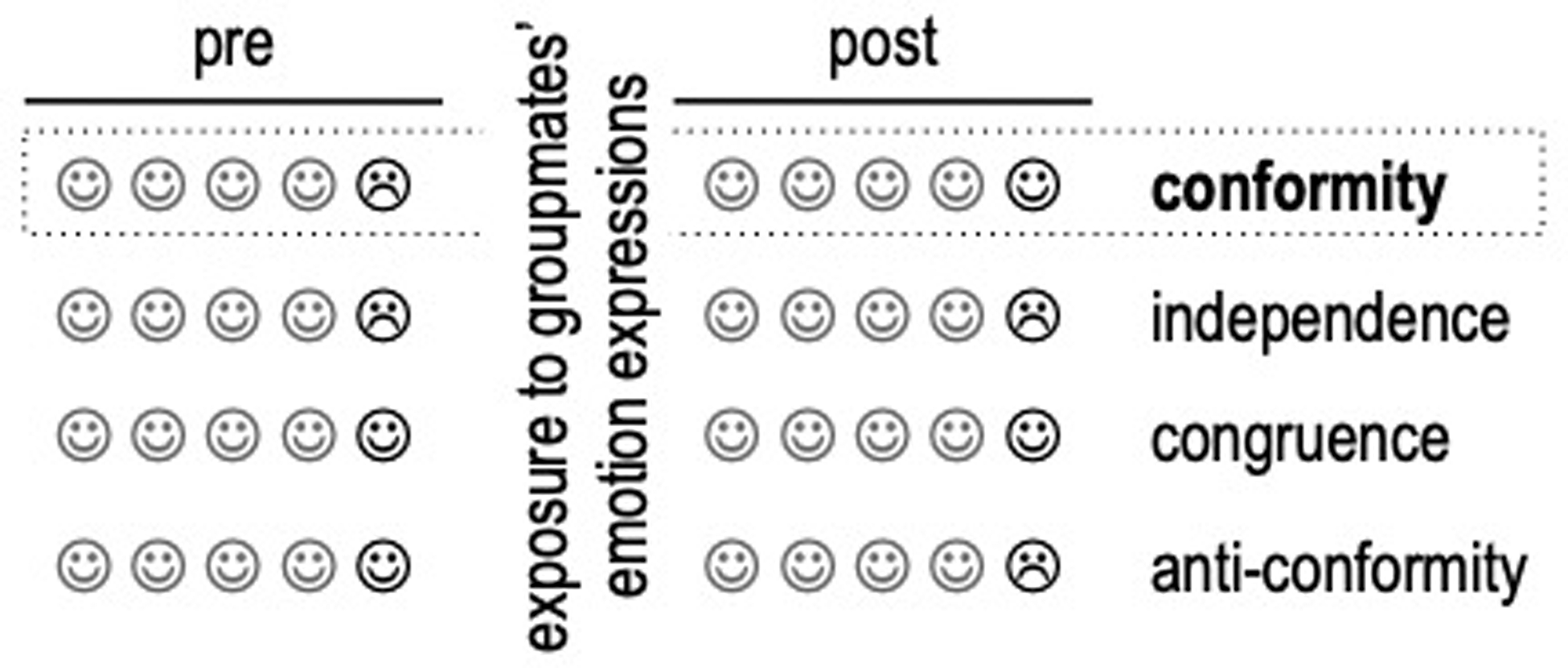
Social response dimensions (Willis, 1963) applied to emotions.
Conformity is well established as an explanation of convergence in attitudes and non-emotional behaviors. For example, individuals align their evaluations of police shootings with others’ opinions (Buehler & Griffin, 1994) or defend others from harassment if their social referents model such advocacy (Levy Paluck & Shepherd, 2012). Although a conformity perspective on expressive convergence is novel, existing findings suggest that the same social comparison processes which define conformity (Cialdini & Goldstein, 2004; Deutsch & Gerard, 1955) also contribute to emotional convergence. Notably, as in conformity (Cialdini & Goldstein, 2004; Deutsch & Gerard, 1955), social similarity, for example due to personal attributes, seems to foster emotional convergence, whereas dissimilarity seems to block or even reverse it (i.e., anti-conformity, see Figure 1; Epstude & Mussweiler, 2009; Goldenberg et al., 2020; Sullins, 1991). Empirical evidence further shows that conformity and emotional convergence share a number of moderators (e.g., group attraction, Bartel & Saavedra, 2000; Kiesler & Corbin, 1965; majority size, Du et al., 2014; Nordholm, 1975; group identification, Over & Carpenter, 2012; Tanghe et al., 2010), which suggests a close connection between the two phenomena. Finally, empirical evidence demonstrates that emotions, like attitudes and behaviors, are shaped by social norms (e.g., display rules, Ekman, 1973; feeling rules, Hochschild, 1979; mood-regulation norms, Bartel & Saavedra, 2000). Although rarely explicated, the concept of emotion norms implies individuals’ conformity to these group guidelines and their underlying motivation to adhere to them.
Advantages of and Need for a Motivated Account of Expressive Convergence
Understanding convergence in emotion expressions from a conformity perspective and hence as motivated means that it is behavior that serves a particular goal and is (intended to be) functional with regard to higher-order strivings (Heckhausen & Heckhausen, 2018). It acknowledges group members as active agents in the pursuit of personal goals rather than reactive recipients of environmental stimuli (as is the case in emotional contagion). This does not mean that group members need to change their emotion expressions consciously and with effort (e.g., by deliberate acting), however. They can also do this without conscious awareness and perceptible effort (Heyes, 2016; Lakin et al., 2003), yet not indiscriminately.
A motivated understanding aligns with mounting evidence that convergence in emotion expressions is a selective process which does not always occur. Although some perspectives postulate automatic mimicry as an explanation of emotional convergence (Hatfield et al., 1994; Kelly et al., 2016; Prochazkova & Kret, 2017), even for behaviors like automatic imitation (Cracco et al., 2018), motor mimicry (Chartrand & Lakin, 2013), or infant imitation (Heyes, 2016) recent research has moved away from an inborn and automatic view and started to acknowledge moderators like situational goals, individual differences, and social constraints (Heyes, 2016; Lakin et al., 2003; Over & Carpenter, 2012). Emotion expressions in particular carry universal communicative content (Shariff & Tracy, 2011; Van Kleef, 2016) and evidence accumulates that people rarely mimic these passively, automatically, or invariably (Hess & Fischer, 2013). Rather, the imitation of emotion expressions is qualified by social-contextual factors such as interdependence structures (i.e., less mimicry of competitors; Lanzetta & Englis, 1989), group membership (i.e., less mimicry of outgroup members; van der Schalk et al., 2011), and relational closeness (i.e., less mimicry of stangers compared to friends; Fischer et al., 2012). This suggests that expressive convergence and its underlying mechanisms are subject to motivational influences, with group members varying in the degree to which they are motivated to modify their emotion expressions to fit those of other members in the group.
Conceptualizing expressive convergence as motivated further aligns with current views of adjacent phenomena. With regard to convergence mechanisms like social appraisal, recent advances emphasize individuals’ active (albeit not necessarily conscious) roles in directing these processes to achieve underlying goals (Walle et al., 2017). Similarly, Zaki (2014) has conceptualized empathy as a motivated response that individuals avoid or approach depending on underlying personal and situational constraints. Finally, with regard to the regulation of emotional experiences, the current view is that individuals utilize and strategically regulate their emotions in order to satisfy superordinate motives (Goldenberg et al., 2016; Porat et al., 2020; Tamir, 2016).
Responding Correctly as the Fundamental Motive
As in classic theories of conformity (Cialdini & Goldstein, 2004; Deutsch & Gerard, 1955; for an alternative view see Turner, 1991), our conformity perspective on expressive convergence builds on the assumption that individuals are fundamentally motivated to operate effectively and adaptively within their environment and respond correctly to environmental challenges, and that they turn to others (e.g., their groupmates) to infer which response is correct in a given situation. As Schachter (1959) suggested, this evaluative need and social comparison process (Festinger, 1954) also applies to emotions, with group members evaluating and adjusting their emotional responses by comparing them to those of the rest of the group, potentially resulting in emotional convergence (Dror, 2017; Schachter, 1959). Responding correctly in this context can have two meanings: a response that is right given the factual reality or one that is proper given the situation's social standards (Oxford University Press, n.d.). Congruently, conformity theory differentiates between two central underlying motives for group members’ convergence behavior: to (a) gain an accurate understanding of reality (i.e., informational conformity) or (b) form and maintain social relationships (i.e., normative conformity; see Table 1; Cialdini & Goldstein, 2004; Deutsch & Gerard, 1955; Garcia et al., 2021; Toelch & Dolan, 2015). In practice, these two motives can be challenging to disentangle empirically (Campbell & Fairey, 1989; Turner, 1991), however, and members likely pursue these and other motives simultaneously (Legros & Cislaghi, 2020).
Nonetheless, group members’ salient underlying motive, that is, the type of correctness for which they strive, determines which reference standards they attend to (a) the objective situation or (b) group guidelines (see Table 1; Cialdini & Goldstein, 2004; Deutsch & Gerard, 1955). Moreover, these motives shape members’ social responses in terms of agreement between public and private response components (see Table 1 and Figure 2; Forsyth, 2010; Nail et al., 2000). In the context of expressive convergence, members would exhibit conversion (or private acceptance) if they agreed with their groupmates both in public emotion expressions and private emotional experiences (i.e., situational appraisals, physiological responses, and affect). Conversely, group members would show compliance (or acquiescence) if they agreed with their group in public emotion expressions but disagreed in private emotional experiences. Public (i.e., expressive) agreement is essential to conformity and may be complemented by corresponding changes in experiences (i.e., situational appraisals, physiological responses, affect), resulting in a coherent emotional response (see Figure 2; Nail et al. 2000). Yet, private agreement does not always occur and is not essential to conformity (e.g., students can match social referents’ harassment behaviors without changing their personal beliefs about harassment; Levy Paluck & Shepherd, 2012). Thus, group members’ responses would count as conformity regardless of whether their expressions diverged from their experiences (e.g., frowning and feeling happy), they actively worked to change their expressions, or their expressive changes were a mere byproduct of their changed appraisals.
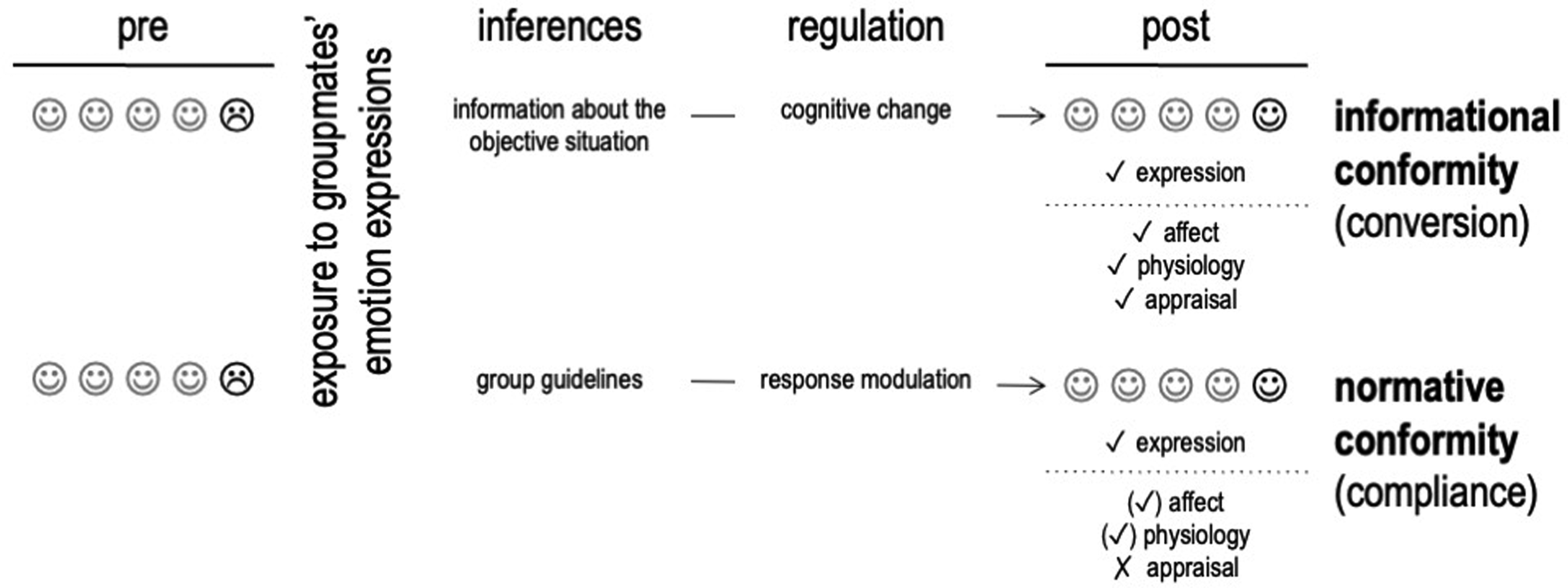
Paths of expressive convergence for informational versus normative conformity.
As we elaborate below, we further argue that members’ underlying informational and normative motives determine the operating mechanisms of expressive convergence. Notably, each type of conformity will activate more strongly those mechanisms that align more closely with its underlying motive. In addition, a motivational account allows novel predictions regarding which personality traits would be particularly susceptible to which type of conformity and which situational properties would be likely to trigger which conformity type. In summary, we built the Emotional Conformity Framework on the following basic propositions (see Supplemental Table S1 for a tabular overview):
Convergence in emotion expressions is driven by group members’ fundamental motivation to respond correctly to their environment. The particular type of correctness (i.e., informational or normative) that members strive for, that is, the underlying motive that is salient for them, determines
(1) the reference standard for the correct emotion expressions,
(2) members’ social responses, and
(3) the operating mechanisms of emotional convergence.
(4) members’ personality and
(5) properties of the situation.
The (relative) strength of group members’ motives depends on
Below and in Table 1, we apply each of these propositions to the two specific conformity motives and explicate how informational and normative motives, respectively, determine which standards group members use for guidance, on which levels and how their emotional responses change, which mechanisms plausibly mediate these changes, and which personalities and situational constellations lean towards which motive.
Expressive Convergence via Informational Conformity
Underlying motive and reference standard
In line with conformity theory (Cialdini & Goldstein, 2004; Deutsch & Gerard, 1955), we posit that the underlying motive of expressive convergence via informational conformity is to gain an accurate understanding of reality in order to respond correctly with regard to the objective situation. Such a response is crucial for effective and efficient goal pursuit (Cialdini & Goldstein, 2004) and aligned with group members’ general desire to validate their understanding of a situation (Festinger, 1954; Schachter, 1959). Emotion expressions in particular may further such adaptive responding because they prepare the organism physiologically to optimally utilize the situation's opportunities and avoid any situation-innate harm (Ekman, 1992; Shariff & Tracy, 2011).
As outlined in Table 1, the informational conformity motive is similar to epistemic and performance motives for emotion regulation (Tamir, 2016), with emotions providing information about oneself and the world and supporting goal pursuit. Consequently, individuals cognitively depend on other group members (Levine & Prislin, 2013) and use their behavior to infer further information about the situation, which they then integrate into their own appraisal of the situation. For example, when asked to judge the humorousness of ambiguous cartoons, individuals use others’ ratings to inform their own evaluations, as manifested by both public and private matching responses (Kosloff et al., 2017). Thus, for expressive convergence via informational conformity, we propose the following (see Supplemental Table S1 for all propositions):
(1.1) If group members’ salient motive is to gain an accurate understanding of reality (i.e., informational conformity motive), members aim to express the correct emotion in reference to the objective situation.
Social response
Because group members’ primary aim in informational conformity is to accurately understand the situation at hand, they use groupmates’ emotion expressions to learn more about the situation and draw on this additional knowledge to inform their own appraisal of the situation, which then changes their emotional response to align with those of the other group members. As an example, consider an exerciser who attends a boot-camp class for the first time and is unsure whether he will be able to live up to the class's demands and should be excited or anxious about it. As a consequence of this uncertainty and motivated by his desire to brace himself for what lies ahead, the exerciser observes how the other class members behave. Seeing them smiling and laughing while preparing for the class, he interprets this as excitement and infers that they must be appraising the class as a challenge, that is, as demands that can be met. Considering himself similar to the other class members, the exerciser estimates that he, too, will be able to complete the class successfully, hence appraises the class as a challenge, and consequently shows the same sort of excited response (e.g., smiling and getting ready) as the rest of the class. That is, he displays a coherent emotional response, agreeing with the group in private situational appraisal and, consequently (Lazarus, 1999), affect, physiology, and public expression (i.e., conversion; see Figure 2).
Due to these updates in appraisal, the social response in informational conformity resembles the emotion regulation strategy of cognitive change in which individuals also modify their emotional responses by changing their appraisals (Gross, 1998). In contrast to active emotion regulation, however, under the Emotional Conformity Framework, it is not group members’ primary objective to change their emotional responses. Rather, these changes are byproducts of them trying to gain an accurate understanding of reality and updating their appraisals accordingly. Consequently, matching groupmates’ emotion expressions, albeit functional for coordination and collective goal pursuit (Crockett, 2017; van Kleef et al., 2017), is a byproduct of members converging in their appraisals. Accordingly, we posit:
(2.1) If group members’ salient motive is to gain an accurate understanding of reality (i.e., informational conformity motive), convergence results from members responding with conversion (i.e., cognitive change and private acceptance of their group's emotion expressions).
Plausible operating mechanisms
We suggest that one plausible mechanism which an informational conformity motive activates is social appraisal. In social appraisal, members (consciously or unconsciously; Walle et al., 2017) reversely appraise their fellow group members’ emotional responses (i.e., they try to estimate what has caused their groupmates to respond in a certain way; Hareli & Hess, 2012) and use the acquired insight to inform their own understanding of the situation (Campos & Stenberg, 1981). Thus, the target of members’ appraisal is the situation, and the other group members (i.e., their emotional expressions) function merely as informants thereof. Empirical evidence supports the informational value of others’ emotion expressions and integration into individuals’ own appraisal (e.g., de Melo et al., 2014; Scherer & Grandjean, 2008; van Doorn et al., 2015) as well as emotional convergence as a consequence of such integration (Fischer et al., 2004; Parkinson & Simons, 2009). This research has established social appraisal as one of the central mechanisms underlying emotional convergence and hinted at its motivational underpinnings (e.g., others’ expressions have opposing effects in competitive vs. cooperative situations; de Melo et al., 2014; Lanzetta & Englis, 1989). Importantly, social appraisal can apply to both group members’ representations of the objective situation (e.g., demands, resources) and, potentially prompted by the salient group expression, their frames of reference (e.g., extension of identity from personal to collective; Livingstone et al., 2011; Parkinson, 2020).
Besides this personal social appraisal, an informational conformity motive may activate a more interactive form of social appraisal, namely co-construction. During co-construction, as a type of interactive cognition (Cooke, 2015), group members conduct their appraisal not separately and internally but interactively and through open communication (Butler, 2015; Parkinson, 1996). Thus, it is likely that group members converge in their appraisals and, consequentially, in their emotional responses (Lazarus, 1999). Initial evidence supports these ideas in that increased communication related to enhanced agreement in individuals’ risk perceptions (Muter et al., 2013) and group discussion influenced members’ appraisals and emotional responses (Yzerbyt et al., 2016). Unlike other forms of social appraisal, however, co-construction requires active communication and exchange among group members.
Naturally, expressive convergence via informational conformity may involve additional mechanisms (e.g., social category activation, i.e., the specific trigger of a collective frame of reference; Seger et al., 2009). Nonetheless, all of these phenomena describe mechanisms, not motives of emotional convergence (see Supplemental Table S2). Even if they are construed as active and goal-directed mechanisms (Walle et al., 2017), the type and nature of the underlying goals remain implicit. By linking these mechanisms explicitly to an informational conformity motive, we can explain why group members would engage in social appraisal or co-construction and predict for whom and when convergence in emotion expressions would be most likely to operate via these as compared to other mechanisms (see Table 1). This knowledge (e.g., accepting that group members engage in social appraisal to gain an accurate understanding of reality) will enable us for example to prevent social appraisal and subsequent emotional convergence if a group displays an undesirable (e.g., performance-debilitating) response because we can take measures to disambiguate the situation (e.g., provide extra information and instruction) and satisfy members’ motives in alternative ways. In consequence, we postulate the following:
(3.1) If group members’ salient motive is to gain an accurate understanding of reality (i.e., informational conformity motive), this activates convergence mechanisms like social appraisal and co-construction.
Susceptible personality traits
Due to the underlying motive of gaining an accurate understanding of reality, group members who are predisposed to crave correctness and certainty and engage in thorough information processing would be particularly susceptible to expressive convergence via informational conformity. For example, conscientious individuals tend to be diligent, dutiful, and concerned with organization (McCrae & Costa, 2003). Hence, it makes sense that they are inclined to validate their understanding of reality by social comparison and conform as a consequence (DeYoung et al., 2002). Similarly, individuals who are intolerant of uncertainty want to define situations and their consequences (Carleton, 2012), whereas those who fear invalidity strive specifically to define situations correctly and accurately (Clarkson et al., 2013). Congruently, group members high in these traits can be expected to be especially motivated to gain a definite and accurate understanding of reality and turn to their groupmates to obtain this, consequently converging with their appraisals and emotion expressions. Finally, individuals with a low need for cognitive closure are open to supplementary information and willing to spend the time and cognitive energy to process such information (Webster & Kruglanski, 1994). Hence, such group members likely are also more inclined to update their appraisals with information conveyed by their groupmates’ expressions and to converge with these as a consequence. Accordingly, we expect that group members with these or similar personality traits are more susceptible to expressive convergence via informational conformity:
(4.1) Group members’ motivation to gain an accurate understanding of reality (i.e., informational conformity motive) is stronger to the extent that they are predisposed to value accuracy, certainty, and thorough information processing.
Situational triggers
Similar to the susceptible personality traits, likely situational triggers of expressive convergence via informational conformity are properties such as uncertainty and accuracy importance. Specifically, if group members are unable to conclusively appraise a situation on their own, because of either too little information or too much ambiguous information, yet a situationally appropriate response is crucial for their goal attainment, we would expect them to be particularly motivated to seek further insight from their groupmates’ behavior.
The role of situational ambiguity has been investigated extensively in conformity research. For instance, obvious and certain situations prevent conformity in helping and test responses (Clark & Word, 1972; Coleman et al., 1958), whereas greater ambiguity increases informational conformity on various types of judgments (Bond & Smith, 1996; Davis, 1984; Ng et al., 2017). Likewise, a strong accuracy motive reduces normative conformity (Quinn & Schlenker, 2002) but enhances informational conformity (Baron et al., 1996). Ambiguity also plays a role in emotional convergence as articulated in Bruder et al.’s (2014) uncertainty hypothesis, which states that uncertainty in particular motivates individuals to attend to others’ emotion expressions and engage in social appraisal, a notion that is also central to emotions as social information (EASI) theory (van Kleef et al., 2011). Naturally, uncertainty can only be expected to trigger informational conformity if group members are unable to clarify the situation in another way, for example, in the case of the fictional exerciser above, by speaking to the boot-camp instructor and learning what exactly the class entails. Given this lack of clarification, we expect the following:
(5.1) Group members’ motivation to gain an accurate understanding of reality (i.e., informational conformity motive) is stronger to the extent that the situation demands but does not provide accuracy and certainty.
Expressive Convergence via Normative Conformity
Underlying motive and reference standard
In normative conformity, the underlying motive is to form and maintain social relationships (including group memberships) by responding correctly with regard to group guidelines (Cialdini & Goldstein, 2004; Deutsch & Gerard, 1955). Such a response is critical because only behavior that matches the expectations of the group is rewarded with acceptance and inclusion, whereas deviant behavior is penalized with rejection and alienation (Marques & Páez, 1994; Tata et al., 1996). Emotion expressions in particular may be relevant in this context because they signal individuals’ intentions, attitudes, and values (Ekman, 1992; Shariff & Tracy, 2011; van Kleef, 2009). Accordingly, individuals who fail to express normative emotional responses (i.e., affective deviants) risk being perceived as holding divergent moral values and hence being devaluated (e.g., in terms of personality, social and professional success) and avoided (Szczurek et al., 2012). Consequently, in normative conformity, individuals socially depend on the other group members (Levine & Prislin, 2013) and use their responses to infer behavioral expectations, which they then attempt to meet.
The motive to form and maintain social relationships (i.e., wanting to be a part of a social group) permeates affective processes including empathy (Zaki, 2014), emotional sharing (Brady et al., 2020), and emotion regulation. As outlined in Table 1, these similarities are especially pronounced with regard to social motives for emotion regulation, where individuals strategically regulate their emotions to improve their social relationships (Miyamoto & Ma, 2011; Tamir, 2016), and intragroup motives for group-based emotion regulation, where members use their emotions to increase their sense of belongingness (Porat et al., 2020). This goes so far that individuals may up-regulate unpleasant emotions (Porat, Halperin, & Tamir, 2016) or down-regulate pleasant emotions (Miyamoto & Ma, 2011) if they perceive the resultant states to be socially beneficial, suggesting that social motives surpass hedonic motives. Indeed, these hedonic sacrifices might be worthwhile because the expression and regulation of emotions along group guidelines, for instance when the overt display would hurt others (Kalokerinos et al., 2014) or when the majority expresses the emotion (Porat, Halperin, Mannheim, & Tamir, 2016), yields social benefits such as feelings of enhanced belonging (Porat, Halperin, Mannheim, & Tamir, 2016), more positive interpersonal evaluations, and greater friendship potential (Kalokerinos et al., 2014). These benefits are similar to those obtained as the result of conformity (Marques & Páez, 1994) and hinge upon public emotion expression, rather than private affective experience (Kalokerinos et al., 2014) and the expression of the target emotion, rather than the particular expressive modality (van Kleef, 2017). Thus, for expressive convergence via normative conformity we propose the following:
(1.2) If group members’ salient motive is to form and maintain social relationships (i.e., normative conformity motive), members aim to express the correct emotion in reference to their group's guidelines.
Social response
As a result of their efforts to infer and meet behavioral expectations, group members seek to emulate their groupmates and display public responses that agree with those of the other group members. In order to satisfy their underlying motive, however, it is not necessary that individuals also agree with their groupmates in their private evaluations (i.e., compliance; see Figure 2). For example, if individuals believe others can hear them, they may emulate the extent of others’ laughter in response to jokes regardless of their own perceptions of funniness; conversely, if individuals believe others cannot hear their responses, their extent of laughter matches their actual funniness perceptions (Nosanchuk & Lightstone, 1974). Nonetheless, under certain conditions, the changed emotion expressions may cause congruent changes in the affective and physiological response components (yet not situational appraisal) via afferent feedback (Coles et al., 2019; Noah et al., 2018; Olszanowski et al., 2020; Strack et al., 1988; Yu & Kitayama, 2019).
An example of expressive convergence via normative conformity would be a hockey player whose team just lost the game that eliminated them from the season's play-offs. Because she thinks they gave their best effort and played well, yet lost against an overpowering opponent, the player still feels satisfied. In the locker room, however, her team members move lethargically, their faces frowning or devoid of any expression, and their conversations subdued. Through this, the player recognizes that her teammates are sad rather than satisfied. In addition, the player estimates that her teammates would not appreciate her feelings of satisfaction and fears she would be reprimanded for displaying them. From observing her teammates, she judges that sadness would be the desired response, and hence she keeps her satisfied feelings to herself and joins her teammates in their expressions of sadness. That is, she displays an incoherent emotional response, agreeing with the group in emotion expression but not situational appraisal, affect, or physiology (although the latter two may converge as well due to subsequent afferent feedback; see Figure 2).
In terms of emotion regulation strategies, the social response in normative conformity resembles response modulation, in which the (expressive) components of the emotional response are modified directly without changing the associated appraisal (Gross, 1998). Thus, in normative as compared to informational conformity, group members converge with their groupmates’ emotion expressions purposefully instead of this being the byproduct of underlying appraisal alignment. Accordingly, we posit:
(2.2) If group members’ salient motive is to form and maintain social relationships (i.e., normative conformity motive), convergence results from members responding with compliance (i.e., response modulation and public acquiescence with their group's emotion expressions; changes in members’ affective and physiological response components are possible but not necessary; changes in members’ situational appraisal are unlikely).
Plausible operating mechanisms
We suggest that one plausible mechanism which a normative conformity motive activates is emotional mimicry because of its focus on forming and maintaining social relationships and its associated agreement in public (but not necessarily private) responses. Although it has been researched mostly within dyads, emotional mimicry extends to groups (Anderson et al., 2018; Fairbairn et al., 2015). Importantly, in contrast to some views (e.g., Kelly et al., 2016; Prochazkova & Kret, 2017), although mimicry can occur unconsciously and spontaneously, individuals engage in it only if they intend to affiliate with the senders and mimicking them will further their affiliative goals (e.g., by helping to understand the senders or as a signal of such understanding; cf. emotion mimicry in context view, Hess & Fischer, 2013). As such, individuals mimic others’ emotion expressions (more) if they are friends (Fischer et al., 2012), under cooperative conditions (Lanzetta & Englis, 1989), or after having been excluded previously (Hühnel et al., 2018). Conversely, emotional mimicry is reduced or absent when individuals dislike the sender (Blocker & McIntosh, 2016), under competitive conditions (Likowski et al., 2011), or if the emotion itself is non-affiliative (e.g., disgust; Fischer et al., 2012).
Another plausible mechanism that a normative conformity motive may activate is the more cognitive phenomenon of adhering to injunctive norms (i.e., members attending to their groupmates, engaging in the cognitive process of inferring the prevalent norm from their expressions, and changing their own behavior to communicate that they also adhere to this norm). Injunctive norms reflect which behaviors others typically approve or disapprove of (Cialdini & Goldstein, 2004). As such, injunctive norms are central to normative conformity because they imply “that if we engage in behaviors of which others approve, others will approve of us, too” (Cialdini & Goldstein, 2004, p. 598). In the context of emotions, injunctive norms can apply to emotion expressions (i.e., display rules; Ekman, 1973) as well as emotional experiences (i.e., feeling rules; Hochschild, 1979; see also Kelly & Barsade, 2001). Nonetheless, individuals also communicate appropriate experiences via appropriate emotion expressions (Anderson et al., 2018; Shields, 2005; van Kleef, 2016). This is especially apparent in the emotional labor strategy of surface acting in which employees hide their authentic responses to express emotions that meet organizational norms (Hochschild, 1983). Returning to the example above, from observing her teammates’ sad emotion expressions after the game, the hockey player may infer that her teammates approve of expressions of sadness whereas they disapprove of and potentially sanction expressions of satisfaction in this situation. To avoid such sanctions, she regulates her expressions to display sadness.
Naturally, expressive convergence via normative conformity may involve additional mechanisms and, like social appraisal (Parkinson, 2020) and emotion regulation (Goldenberg et al., 2020), can operate on personal and collective levels depending on the facet of identity the emotional event addresses (e.g., pride in response to above average exam grades vs. anger in response to changed grading policies in one's university class). Moreover, mechanisms like emotional mimicry and adhering to injunctive norms operate not only in face-to-face settings and based on non-verbal expressions. They also extend to digital networks, written statements, and emotionally laden symbols (e.g., emoticons; Brady et al., 2020; Lohmann et al., 2017). In consequence, we postulate the following:
(3.2) If group members’ salient motive is to form and maintain social relationships (i.e., normative conformity motive), this activates convergence mechanisms like emotional mimicry and adhering to injunctive norms.
Susceptible personality traits
Because the underlying motive is to form and maintain social relationships, we expect that group members who are predisposed to consider and value social bonds and harmony would be especially receptive to expressive convergence via normative conformity. For example, agreeable individuals show strong concern for others and the tendency to acquiesce to avoid or reduce interpersonal conflict (McCrae & Costa, 2003). Comparably, individuals with a strong need to belong strive for social acceptance and devote substantial effort to maintaining interpersonal relationships (Baumeister & Leary, 1995). Similarly, individuals who are sensitive to rejection readily feel dismissed and excluded by others and are particularly motivated to avoid such rejection (Downey & Feldman, 1996). Finally, on a more basic level, individuals with high public self-consciousness are generally chronically aware of their public appearance and behavior (Fenigstein et al., 1975). In line with this, individuals who score higher on these traits are more prone to ingratiation (Romero-Canyas et al., 2010) and more likely to align their opinions with others (Santee & Maslach, 1982), conform to group norms (Steinel et al., 2010), and exhibit conformity (DeYoung et al., 2002). As a consequence, we expect that group members who possess strong manifestations of these or similar personality traits are also more susceptible to expressive convergence via normative conformity:
(4.2) Group members’ motivation to form and maintain social relationships (i.e., normative conformity motive) is stronger to the extent that they are predisposed to value social relationships and judgments.
Situational triggers
Situational properties that likely trigger expressive convergence via normative conformity are aspects such as response publicity, interaction, and peripheral status. Notably, conformity can only fulfill an affiliative function if the group observes the member's conforming response. In addition, we expect group members to be more motivated to maintain social relationships the longer these exist already, and more motivated to form social relationships the more they anticipate future interaction with the group. Finally, we expect members on the periphery of the group network or those that have previously been rejected to have a greater need to (re-)affiliate by way of conforming to the group's majority emotion expression.
Consistent with these ideas, normative conformity is greatest under face-to-face conditions (Bond, 2005), and individuals imitate emotion expressions more strongly if the sender can observe it (Nosanchuk & Lightstone, 1974). Moreover, whereas informational conformity should be relatively independent of the presence of an audience, normative conformity likely is triggered by public membership displays (Goldenberg et al., 2020). Further, individuals exhibit more normative conformity to the degree that they have existing (intimate) relationships (Du et al., 2014; Kimura et al., 2008) or expect future interaction (Huntsinger et al., 2009). Finally, individuals who occupy low status or insecure positions in the group (e.g., due to low power, lack of prototypicality, or previous exclusion) attend to, mimic, and conform to others’ behaviors and judgments more readily (Hühnel et al., 2018; Kimura et al., 2008; Lakin et al., 2008; van Kleef et al., 2013; Williams et al., 2000). In order for individuals’ low status to trigger normative conformity, however, it is important that conformity actually promotes affiliation (DeWall & Richman, 2011) and that affiliative needs cannot be satisfied by alternative groups (Heerdink et al., 2013). Given such lack of alternatives, we expect the following:
(5.2) Group members’ motivation to form and maintain social relationships (i.e., normative conformity motive) is stronger to the extent that the situation emphasizes social relationships and evaluation.
Theoretical Implications
The Emotional Conformity Framework furthers our understanding of emotional dynamics in groups by approaching convergence in emotion expressions from a conformity perspective. This novel perspective moves beyond the description of convergence and complements existing work on mechanisms (i.e., how members converge) with insight into the motives behind such convergence (i.e., why members converge). Specifically, the Emotional Conformity Framework posits that convergence in emotion expressions does not occur automatically or arbitrarily, and group members are not passive recipients of environmental influences. Rather, the Framework conceptualizes members as active agents working to fulfill underlying goals and engaging in expressive convergence strategically. Naturally, emotional convergence, like any type of conformity, can be costly if a group settles on an overly cohesive and skewed appraisal of reality (cf. groupthink; Janis, 1972), the majority emotion is performance-debilitating, or members’ compliance strains their internal resources (cf. costs of emotional labor, Grandey & Melloy, 2017). However, as the Framework emphasizes, expressive convergence (like emotion regulation, emotional sharing, or empathy; Brady et al., 2020; Porat et al., 2020; Zaki, 2014) can be functional if it helps members satisfy underlying motives (i.e., disambiguate their understanding of reality, further their social connections), and thereby facilitates group bonding and performance (e.g., by strengthening social identity and improving group coordination; Crockett, 2017; Livingstone et al., 2011). Non-convergence (e.g., independence) in these instances would be costly if it led members to respond inefficiently or experience exclusion and reduced member commitment, or undermined group norms.
In addition to this novel general perspective, the Emotional Conformity Framework generates more specific principles to understand, predict, and optimize expressive convergence that no other current framework provides. The Framework is parsimonious in that it postulates only two basic assumptions, namely that group members’ underlying motives drive their emotional behavior (Propositions 1 to 3), and that the relative strength of these motives depends on personal and situational properties (Propositions 4 and 5). The Framework is unifying in that it connects with conformity theory, emotion regulation motives and strategies, convergence mechanisms, and personality traits. Only few advances have attempted such links (e.g., Goldenberg et al., 2016) or tried to organize and integrate existing emotional convergence research (e.g., Elfenbein, 2014; Kelly & Barsade, 2001; Menges & Kilduff, 2015; Peters & Kashima, 2015; von Scheve & Ismer, 2013). Finally, the Framework is universal in that its assumptions can be applied to any small-group context and hence may help explain why for example employees change their emotional expressions in the workplace (cf. emotional labor; Ashford & Humphrey, 1993; Hochschild, 1983) or groups of friends respond to events not only with the same behavior but also with the same emotions (Jung et al., 2019).
Empirical Implications
Building on its two general assumptions, the Emotional Conformity Framework advances a series of concrete and testable propositions. Existing research (e.g., regarding the moderators of expressive convergence; Bartel & Saavedra, 2000; Du et al., 2014) generally supports the Framework's propositions but has some limitations. Several studies documented convergence in emotion expressions and its operating mechanisms but provided inconclusive insight into the motives that prompted these processes. That is, we cannot infer why workers (Bartel & Saavedra, 2000), students (Fischer et al., 2004), athletes (Tamminen et al., 2016), and recreationists (Anderson et al., 2018) converged with their respective groups. Furthermore, several investigations documented conformity and even tapped into different underlying motives, but focused on ratings of emotional stimuli such as the arousing properties of pictures (Prehn et al., 2015; Willroth et al., 2017) and the ascribed levels of arousal and valence of music excerpts (Egermann et al., 2013) rather than emotional expressions as the subject of convergence. Moreover, this evidence is limited to arousal and valence rather than discrete emotions. The expression of discrete emotions carries more specific information (about the situation or group guidelines; Sorce et al., 1985; van Kleef, 2009) that group members can use to satisfy their conformity motives.
Going forward, research should thus focus on group members’ expressions of discrete emotions in response to self-relevant events and the underlying motives that guide these expressions. In this respect, we believe the Emotional Conformity Framework is a helpful structure because it advances general propositions that can be translated into specific hypotheses, which, in turn, can be tested empirically. In fact, this sequence innately suggests concrete methodological approaches, as we explicate exemplarily in Supplemental Table S1. The first approach is to include pre- and post-exposure measurement points to document the conformity-defining position-shift (see Figure 1; Cialdini & Goldstein, 2004). The second approach is to measure both overt and covert components of the emotional response to distinguish between conversion and compliance (see Figure 2; Nail et al., 2000). The third approach is to track brain and muscular activity to gain insight into the underlying regulatory and operating processes (cf. Deng & Hu, 2018; Ochsner & Gross, 2008). The fourth approach is to test for moderation by personality traits or situational properties as outlined in Table 1. Methods such as measuring members’ appraisals and expressions and testing which change first or mediate the link to groupmates’ expressions better (Deng & Hu, 2018; Parkinson & Simons, 2009) further provide opportunities to distinguish the two conformity motives and their consequences, such as the relative salience of convergence mechanisms, empirically. Finally, if our propositions hold and convergence in emotion expressions within small groups can be understood from a conformity perspective, previous research and hypotheses regarding conformity in attitudes and non-emotional behaviors (e.g., greater conformity under expanding majority size or stronger group identification; Nordholm, 1975; Tanghe et al. 2010) may extend to emotions.
Limitations and Future Directions
Naturally, the Emotional Conformity Framework has limitations and generates new questions. First, the Framework is a theoretical structure and hence parsimonious but also simplifying (Kuhn, 1977). As such, it presents the conformity motives as separate entities although they likely coincide and interact empirically. For example, in the context of attitudes and behavior-change there are indications that normative conformity outweighs informational conformity (Egermann et al., 2013). Similarly, in the context of emotional convergence (Parkinson & Simons, 2009), emotional mimicry (i.e., a plausible operating mechanism of normative conformity) seems to overrule social appraisal (i.e., a plausible operating mechanism of informational conformity). In addition, the afferent changes group members may experience as a result of their normative conformity (Coles et al., 2019; Yu & Kitayama, 2019) may prompt further informational conformity if they use their groupmates’ emotion expressions to infer logical explanations for these changes (Dutton & Aron, 1974; Schachter, 1959) and resolve dissonance between their conforming emotion expressions and independent appraisals (Festinger, 1957; Griffin & Buehler, 1993), as would be the case in the emotional labor strategy of deep acting in which employees work to align their experiences with their normative expressions (Hochschild, 1983). Such change-of-meaning effects, however, likely are slower and less universal than the private acceptance that informational conformity induces. Finally, normative conformity may facilitate informational conformity because emotional mimicry not only promotes affiliation but also facilitates the understanding of groupmates’ emotion expressions (Hess & Fischer, 2013).
Second, the Framework does not specify how conformity compares with other sources of group emotions (e.g., social identification, homophily). Initial evidence (Anderson et al., 2003) suggests that mechanisms of conformity (i.e., social appraisal, emotional mimicry) might strengthen the effects of other sources (e.g., socialization) and vice versa. Social identification in particular may moderate conformity because self-concept- and identity-related goals are underlying motivations that determine to what extent and to which groups individuals conform (Cialdini & Goldstein, 2004). Generally, we expect identification (i.e., knowing that one is a part of a social group and valuing this membership) to reinforce conformity (e.g., Blocker & McIntosh, 2017; Toelch & Dolan, 2015), to the extent that without identification, groups do not exert any influence (Turner, 1991). The moderating effect of identification would apply to both types of conformity because more identified group members tend to ascribe greater credibility to their group (Parkinson, 2020; Turner, 1991) – thus reinforcing informational conformity – and value their relationships with groupmates to a greater extent (Hogg & Hains, 1996; Parkinson, 2020) – thus reinforcing normative conformity. Extending this role of identification, work on referent informational influence (Turner, 1991) even suggests that the desire to belong to valued groups could replace responding correctly as the fundamental motive driving conformity behavior. This is an intriguing idea that may extend the theoretical scope of the Emotional Conformity Framework (e.g., to intergroup dynamics). For the purposes of anticipating, predicting, and regulating emotional convergence, however, the particular fundamental motive is less important than the informational and normative manifestations of this motive because these allow us to distinguish social responses, operating mechanisms, susceptible personality traits, and situational triggers (see Table 1).
Third, the Framework focuses primarily on small and interdependent groups. Yet, the idea of expressive convergence being driven by conformity motives might also extend to larger collectives such as protest movements or religious communities. In particular, the collective effervescence that members of such collectives may experience, that is, an amplified positive emotional response resulting from openly expressing and receiving emotions during intense and often ritualized group interactions (Durkheim, 1995) seems to fulfill functions similar to those underlying conformity. Specifically, collective effervescence can provide validation (Durkheim, 1995; Hopkins et al., 2019), which is similar to informational conformity, and recognition (Durkheim, 1995; Hopkins et al., 2019), which resembles normative conformity. Hence, it is plausible that emotional convergence in larger collectives follows the same principles and mechanisms as expressive convergence in small groups.
Fourth, the Emotional Conformity Framework focuses on instances in which group members shift their emotion expressions to match those of their groupmates (see Figure 1). As such, it addresses other social response dimensions (i.e., congruence, independence, anti-conformity; see Figure 1) only implicitly and does not account for other affective linkage phenomena (e.g., divergent or complementary linkage; Elfenbein, 2014; van Kleef et al., 2017). The Framework also does not account for small groups’ social (e.g., intergroup) context and other goals group members may pursue that may compete and interact with their conformity motives. For example, members may not only be motivated to maintain social relationships with their groups and hence conform to the groups’ emotion expressions; they may also be motivated to protect their self-esteem (e.g., cutting of reflected failure; Snyder et al., 1986; maintaining a positive group image; Porat et al., 2020), feel good (i.e., hedonic motives for emotion regulation; Tamir, 2016), or manage their relationships with other groups (i.e., intergroup motives for group-based emotion regulation; Porat et al., 2020), which may counteract their conformity motives (e.g., members care more about feeling good than fitting in) and lead them to respond with independence or even anti-conformity, potentially aiming to change the expressive group norm (e.g., to more performance-conducive group emotions). Lastly, group members may be driven to outperform their groupmates (i.e., exhibit more prototypical emotion expressions than other members; Goldenberg et al., 2020) or compensate for less prototypical group expressions (Goldenberg et al., 2014), resulting in overconformity. Going forward, the conceptualization of emotional convergence as motivated and subject to social comparison processes invites the more explicit consideration of other motivational processes that may impact collective emotions, such as leaders’ strategic use of emotional expressions to provoke conformity, members’ deliberate independence to exert minority influence, or groups’ polarization towards or away from a group norm (Goldenberg et al., 2020; Moscovici et al., 1994; Turner, 1991).
Finally, although conformity works across expressive channels (van Kleef, 2017), it does require that members observe, decode, and reproduce their groupmates’ emotion expressions accurately. Thus, any factors that qualify these processes (e.g., emotions lacking distinct expressive components; Sauter, 2017; cultural differences between members; Cordaro et al., 2017; personal limitations such as low emotional intelligence and aperture; Sanchez-Burks & Huy, 2009) likely also moderate the occurrence and effectiveness of conformity. Even if group members enact conformity accurately (i.e., infer the correct appraisal, display the normative emotional expression), this does not guarantee satisfaction of their underlying motives. This likely also depends on groupmates appraising the situation correctly in the first place and rewarding a normative emotional expression with acceptance. Going forward, we hope the Emotional Conformity Framework provides a helpful theory-based foundation to investigate such questions empirically and further define the links among affective linkage phenomena.
Conclusion
In our Emotional Conformity Framework, we re-conceptualize convergence of emotion expressions in groups as an active and functional process driven by group members’ underlying informational and normative conformity motives. Our Framework integrates previous insights into convergence mechanisms and yields new predictions regarding how group members’ underlying motives determine their reference standards, social responses, operating mechanisms, susceptible personality traits, and situational triggers. As such, the Framework informs our understanding of expressive convergence, its effective and efficient empirical investigation, and our ability to predict and regulate both the convergence of emotion expressions and group emotions. Group emotions have pervasive consequences for groups across all spheres of life, influencing the behavior of individual members, social interactions between members, and the functioning of groups as a whole. To optimize group and member functioning, knowledge of the motivational foundations of group emotions is essential.
Supplemental Material
sj-docx-1-emr-10.1177_17540739231182241 - Supplemental material for A Motivational Account of Convergence in Emotion Expressions Within Groups: The Emotional Conformity Framework
Supplemental material, sj-docx-1-emr-10.1177_17540739231182241 for A Motivational Account of Convergence in Emotion Expressions Within Groups: The Emotional Conformity Framework by Svenja A. Wolf, Marc W. Heerdink and Gerben A. van Kleef in Emotion Review
Footnotes
Acknowledgements
Svenja A. Wolf thanks the German Academic Exchange Service (DAAD) for a research fellowship that enabled the present work; Katharine H. Greenaway, Amit Goldenberg, and Lisanne Pauw for discussions and feedback that strengthened the framework; Petra Wolf, Meagan Dargavel, Sebastian Harenberg, M. Blair Evans, and Emily Driscoll for the emotional and tangible support that facilitated the writing process; and her co-authors for their unbroken support, challenge, and encouragement.
Conflict of Interest Statement
All authors declare that there is no conflict of interest.
Funding
The authors received no financial support for the research, authorship, and/or publication of this article.

Supplemental Material
Supplemental material for this article is available online.
References
Supplementary Material
Please find the following supplemental material available below.
For Open Access articles published under a Creative Commons License, all supplemental material carries the same license as the article it is associated with.
For non-Open Access articles published, all supplemental material carries a non-exclusive license, and permission requests for re-use of supplemental material or any part of supplemental material shall be sent directly to the copyright owner as specified in the copyright notice associated with the article.
