




Abstract
Climate change intersecting with complex socio-economic and political processes has produced distinctive patterns of crisis migration. However there exists a significant gap in understanding and theorizing these forms of migration creating significant policy challenges. Using a case study of an interstate migrant settlement in Bengaluru, India this article unpacks migration as an adaptation strategy through the lens of emotions. The article offers significant insights into how emotions affect the choice of migration as an adaptation strategy and shapes the differential experiences of risks and vulnerability for different groups of people. Emphasizing such relational aspects of migration, the article calls for more research that develops a nuanced understanding of the emotional landscapes of migrants across migration pathways.
Introduction
Climatic uncertainty and increasing disaster risks coupled with the unequal and discriminatory development process that excludes certain socio-economic groups have resulted in distinctive patterns of human migration from rural hinterlands to urban spaces in the Global South (Chu & Michael, 2019; Singh & Basu, 2020). While existing studies have largely documented traditional forms of migration from rural to urban areas in search of better economic opportunities, over the past two decades there has been increasing incidence of new forms of crisis migration mediated by environmental stress, disasters, and climatic changes (Cundill et al., 2021; Parsons, 2019; Tacoli, 2009). However, there is a gap in understanding and theorizing these new forms of migration, which are often outside such normative patterns, often mediated by socio-political, economic, and ecological intersections. These includes a combination of rising socio-economic inequalities, political unrest, a systemic neglect of the agricultural sector, climatic changes, and environmental degradation making rural agriculture based livelihoods unsustainable for the socio-economically marginalized groups in the Global South (Chu & Michael, 2019; Rao & Vakulabharanam, 2019). Scholars have documented that viewing migration and adaptation through the lens of emotions/affect helps to comprehend complex socio-economic and ecological aspects in a relational manner (Boccagni & Baldassar, 2015; Nightingale et al., 2021). Emotions provide a lens to deconstruct the relations and entanglements between socio-economic and ecological processes, through multiple subjectivities and intricate feelings that emerge across migratory pathways. For instance, emotions such as fear, hope, resilience, and attachment can influence people's perceptions about their changing socio-economic and ecological environments and potentially affect their decision to migrate. As such, research and policy on climate change migration needs to move beyond direct causal attribution of migration often relying on abstract yet objective climate models and engage more with the human experiences of climate change and mobility which are emotionally mediated (Parsons, 2019).
In this article, I use a case study of an 1 interstate migrant settlement in Bengaluru, India as an illustrative example to understand (i) how emotions affect choice of adaptation strategies and (ii) how it defines differential experiences and perceptions of risks and vulnerabilities across mobility pathways.
Case Study: The Story of Interstate Migrant Waste Pickers in Hebbal
This case study delves into the story of an interstate migrant community residing in an informal settlement in Bengaluru, India known by the name “Hebbal Settlement.” The settlement comprises of migrants from the state of West Bengal, predominantly of the 2 Muslim religion. The case study adopted qualitative research techniques like Focus group discussions and semi-structured interviews to map the migrants’ experiences at source and destination. A qualitative research output generated in this process involves a 3 live sketch of perceptions shared by the settlement dwellers as shown in Figure 1. Using the data from various qualitative exercises, I trace the emotional landscapes of these migrants who adopted migration as an adaptation strategy to respond to the intersecting socio-economic crisis and disaster risk experienced in their homelands.
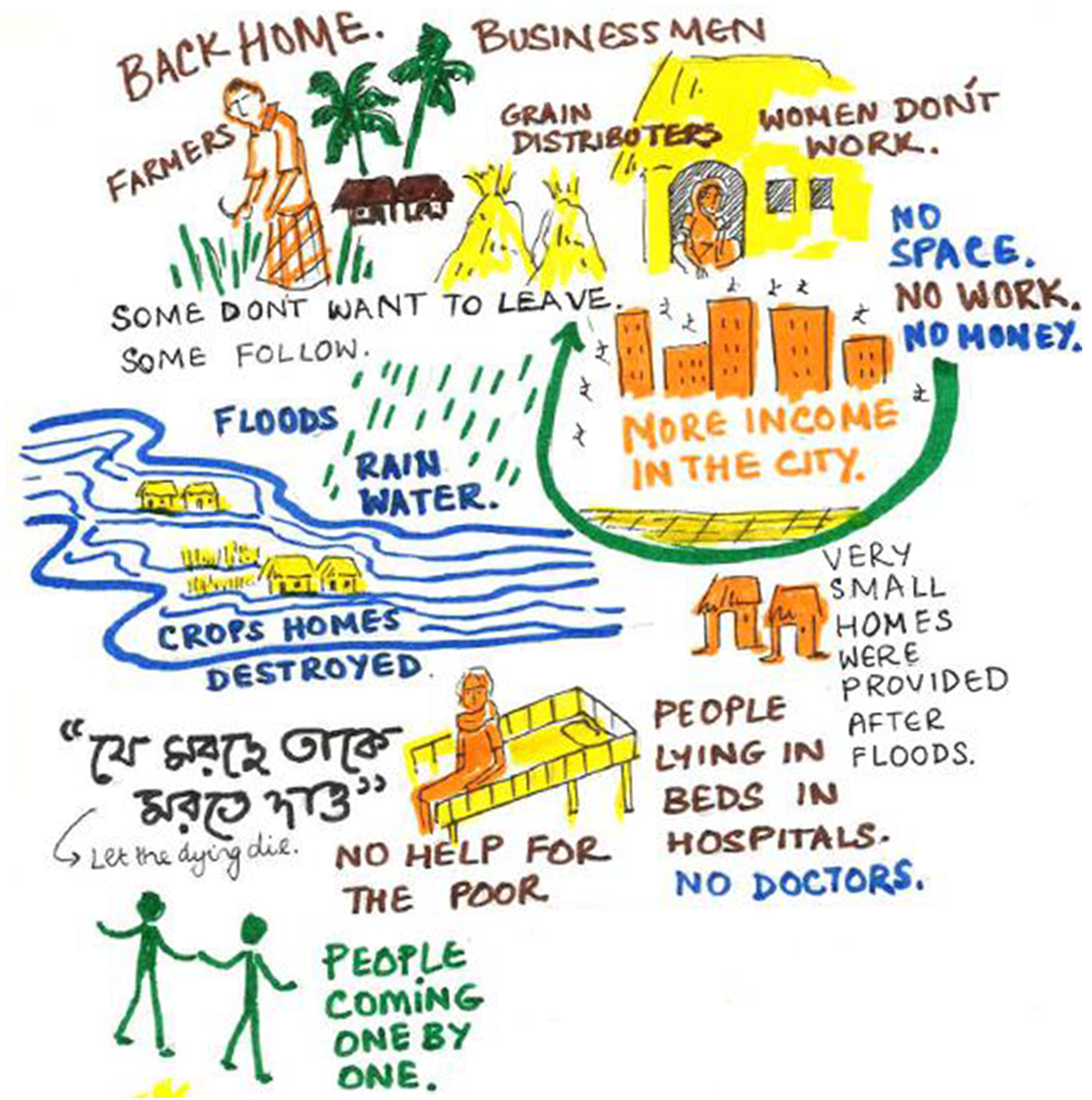
A graphical sketch of the premigration story shared by the migrant workers during a focus group discussion conducted on February 17, 2017.
In West Bengal, the men were engaged in agricultural wage labor while the women performed care activities including cooking and taking care of the children. The deeply ingrained gendered and cultural norms in the villages restricted their access to employment opportunities outside their houses. As indicated in Figure 1 as well as during the focus group discussions and interviews, the narratives about their premigration contexts were filled with despair, helplessness, anger, and sometimes apathy to the state policies and programs. An overwhelming sense of powerlessness and inability to take control over their situation was visible throughout the conversations. Quote 1: “There was a flood in 2002. We lost everything, our crops and our homes.” Male Respondent, Focus Group Discussion, February 17, 2017, Hebbal Settlement
Quote 2: “Now many people in village have pakka home and they make multiple levels and terrace to fight the water flooding. The good people donot leave.” Female Respondent, Semi-Structured Interview, October 1, 2016, Hebbal Settlement
While the respondent in Quote 1 elaborates on the damage wreaked by the flood, the respondent in Quote 2 brings out the differential experiences of risk and vulnerabilities. The emotions such as helplessness and misery visible in the sketch above stems from several structural elements that define the vulnerability of the interstate migrant community. This includes the agrarian crisis experienced in West Bengal, lack of employment opportunities, disaster events like floods, and inadequate disaster relief support (Michael et al., 2019). The hope for better incomes in the city is the only positive aspect of this migration, as depicted in Figure 1. The decision to migrate here is an outcome of complex intersections of socio-economic factors causing feelings of misery and emotional destitution. The flash flood that occurred in 2002 deprived this community of any choices to sustain their lives and livelihoods in West Bengal triggering the decision to migrate.
In addition to the feeling of helplessness and misery experienced by the interstate migrants in West Bengal, their experiences in Bengaluru adds an additional layer of affect, a feeling of alienation, and marginalization documented by the language divide and the inability of the host community to understand them. Figure 2 clearly depicts the feeling of lack of belongingness experienced by the migrants. The images also depict a relinquishing of the hope in terms of increased incomes they expected while migrating. Pointing to the increased cost of living they indicate that migration has not led to any sort of improvement in their socio-economic status. In Bengaluru most of the male members worked as waste pickers and their living space also doubles up as their work locations where the waste is sorted and processed. This process involves the women and the children in the family. Even though the women in the settlement indicated that they were not involved in any sort of income generating activities in the villages there was a dilution of these norms post-migration when they had to work as domestic help in the nearby high rise buildings. Both men and women attributed this shift in norms to the necessity of the additional incomes required to survive in the city. Quote 3: “It is true that we earn money here, but we are overworked.” Female Respondent, Focus Group Discussion, October 1, 2016, Hebbal Settlement
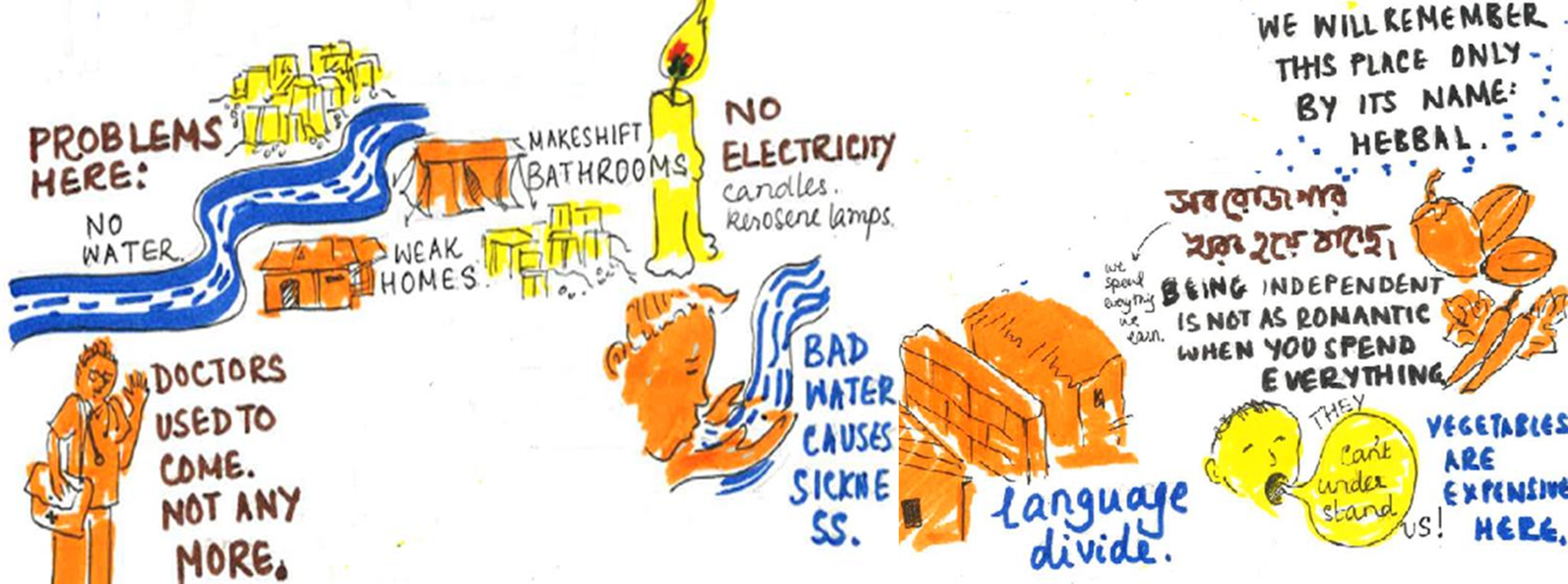
Experiences of the interstate migrant communities in Bengaluru.
The women indicated that in the settlement they had to engage in numerous activities which in addition to their already care related responsibilities now included sorting of the waste and working as domestic help.
In the post-migration narratives feelings of alienation and fear dominated as depicted in Quote 5. Quote 4: “We sometimes get beaten by police. We are Bengalis, we don’t speak their language and neither understand it.” Male Respondent, Focus Group Discussion, October 1, 2016, Hebbal Settlement
The precarious livelihood and living conditions, language disconnect, and the harassment from the police perpetuates fear and anxiety leading to extremely precarious living conditions in Bengaluru. The case study depicts shifting/replicating emotional states of destitution across migratory pathways for this migrant community undermining the effectiveness of migration as an adaptation strategy.
Discussion and Conclusion
The Hebbal case study is an ideal analytical template to understand new and emerging forms of internal migration in the Global South that are “involuntary” defined through interconnected socio-economic and ecological relationships. The emotional dimensions of migrants as indicated in the Hebbal case study are largely determined by complex cross-scalar socio-economic and political processes including the larger development logics, absence of fall back mechanisms including ownership of land or assets in source areas, and lack of support experienced in destinations (Chu & Michael, 2019; Michael et al., 2019; van der Geest et al., 2020). One can surmise that for the Hebbal settlement dwellers the destitution in their homeland drew them out to the precarious living conditions in Bengaluru. The post-migration experiences add additional layers of emotional dislocation, fear, and anxiety.
Envisioning migration as an adaptation strategy, the Hebbal case study depicts that emotions are a powerful indicator of the adaptation decision-making processes of individuals and communities affected by climatic changes. For instance, a perceived lack of agency or control over their lives experienced by people in their homelands while responding to climatic risks affects their ability to make informed choices about the migration process. Using the case of interstate migrants as an archetype of climate mediated migration I argue along with scholars like Brosch (2021) that there needs to be more research that develops an understanding of causal pathways from emotions to climate action including choice of adaptation strategies. The potential of migration as an adaptation strategy to be effective requires multidisciplinary bottom-up, relational approaches that considers the emotional experiences and lived realities of the migrant communities across mobility pathways. An understanding of the differential experiences and perceptions around climatic risks and vulnerabilities shaped by the emotional landscapes of migrants can potentially serve as useful inputs into a just and equitable adaptation planning process.
Footnotes
Acknowledgments
This work was supported by the Adaptation at Scale in Semi-Arid Regions (ASSAR) (grant number 107640-005), which is a consortium under the Collaborative Adaptation Research in Africa and Asia (CARIAA) programme of International Development Research Centre (IDRC), Canada and the UK Department for International Development (DFID). The author acknowledges the contribution of Ladies Finger.co in creating the illustrative graphic sketches.
Declaration of Conflicting Interests
The author declared no potential conflicts of interest with respect to the research, authorship, and/or publication of this article.
Funding
The author disclosed receipt of the following financial support for the research, authorship, and/or publication of this article: This work was supported by the Department for International Development, UK Government, International Development Research Centre (grant number 107640-005).
