




Abstract
Climate anxiety refers to persistent, difficult-to-control apprehensiveness and worry about climate change. Research to better understand the prevalence, indicators, causes, and consequences of climate anxiety is needed, to which emotion researchers can make substantial contributions. First, emotion theory can inform an integrative and functional theory of climate anxiety, mapping interactions between its cognitive, emotional, behavioural, and physiological indicators. Second, appraisal theories can help to understand the reasons why people experience climate anxiety. Third, emotion researchers can contribute to theorizing when climate anxiety motivates climate action, accounting for non-linearity, interactions with other emotions and cognitions, and temporal dynamics. Fourth, emotion researchers can contribute to developing strategies to cope with climate anxiety, for example, by building on emotion regulation theory.
Climate change threatens people, animals, and nature at an unprecedented scale and scope (IPCC, 2022). These looming impacts, and lack of progress in reducing greenhouse gas emissions, cause many people to worry about climate change (Pew Research Center, 2021), potentially leading to distress and affecting mental health. Negative mental health impacts caused by the apprehension of climate change are referred to as ‘climate anxiety’ (Coffey et al., 2021). Simply being aware of climate change could trigger climate anxiety, even if people are not directly affected themselves (Clayton, 2020). Because it may affect many people, it is critical to understand the prevalence, indicators, causes, and consequences of climate anxiety (IPCC, 2022).
Core characteristics of anxiety are negative feelings such as apprehension, fear, nervousness, and worry (Amstadter, 2008; Penninx et al., 2021). Affective science has improved our understanding of anxiety and the clinical treatment of anxiety disorders (Dillon et al., 2011; Kring, 2010; Mennin et al., 2002). For example, key theories on anxiety, such as the Contrast Avoidance Model (Newman & Llera, 2011), specifically focus on the relationship between negative affect and emotional (dys)regulation to explain why anxiety occurs (Hofmann et al., 2012). We propose that emotion researchers could therefore make substantial contributions to our understanding of climate anxiety and ways to cope with it. Below, we outline four outstanding questions about climate anxiety, and highlight potential contributions emotion researchers could make to each.
A first key question is: what is climate anxiety? While many definitions, indicators, and measures of climate anxiety have been proposed (e.g., Ágoston et al., 2022; Clayton & Karazsia, 2020; Coffey et al., 2021; Hogg et al., 2021), an overarching theoretical framework that subsumes and explains the different indicators of climate anxiety has not been developed yet. In addition, the conceptualisation of climate anxiety differs considerably across studies, which hinders gaining a clear understanding of what climate anxiety is, and comparing and integrating findings. For example, while some studies explicitly measure emotional responses as indicators of climate anxiety (e.g., Ágoston et al., 2022), others focus primarily on cognitions and behaviours (e.g., Clayton & Karazsia, 2020). We propose researchers adopt a definition of climate anxiety that aligns with internationally recognized professional standards for defining and conceptualizing anxiety in general (American Psychiatric Association, 2013; World Health Organization, 2019). Table 1 provides our proposed working definition of climate anxiety, and its cognitive, behavioural, emotional, and physiological indicators. 1 This definition integrates core elements of previous definitions of climate anxiety (see Coffey et al., 2021). A shortcoming of these professional standards however is that they do not supply a theoretical perspective on how the experience of climate anxiety starts and develops over time, nor on how different cognitive, behavioural, emotional, and physiological responses reflecting climate anxiety relate and interact. Theories of emotions offer sophisticated accounts of possible interactions between feelings, cognitions, behaviours, and physiological responses (Feldman Barrett et al., 2016; Scherer, 2022; Scherer & Moors, 2019), and of the adaptive and social functions of these processes (Keltner et al., 2022; Lench, 2018). Such theorizing can be used to develop an integrative and functional theory of climate anxiety. Notably, previous efforts that employed emotion theories to explain responses to climate change in general could also serve as relevant starting points (Brosch, 2021; Brosch & Steg, 2021; van der Linden, 2014). Theorizing on emotion regulation may also be relevant to describe how incidental emotional responses to climate change can lead to the experience of anxiety and persistent worrying (Salters-Pedneault et al., 2006; Turk et al., 2005). For example, deficits in emotion regulation skills may lead people to use maladaptive strategies such as suppressing climate-related emotions or ruminating about climate change, which can inadvertently increase negative affect, leading to a vicious cycle that results in the experience of more and more anxiety (Salters-Pedneault et al., 2006).
Working definition and indicators of the concept climate anxiety.
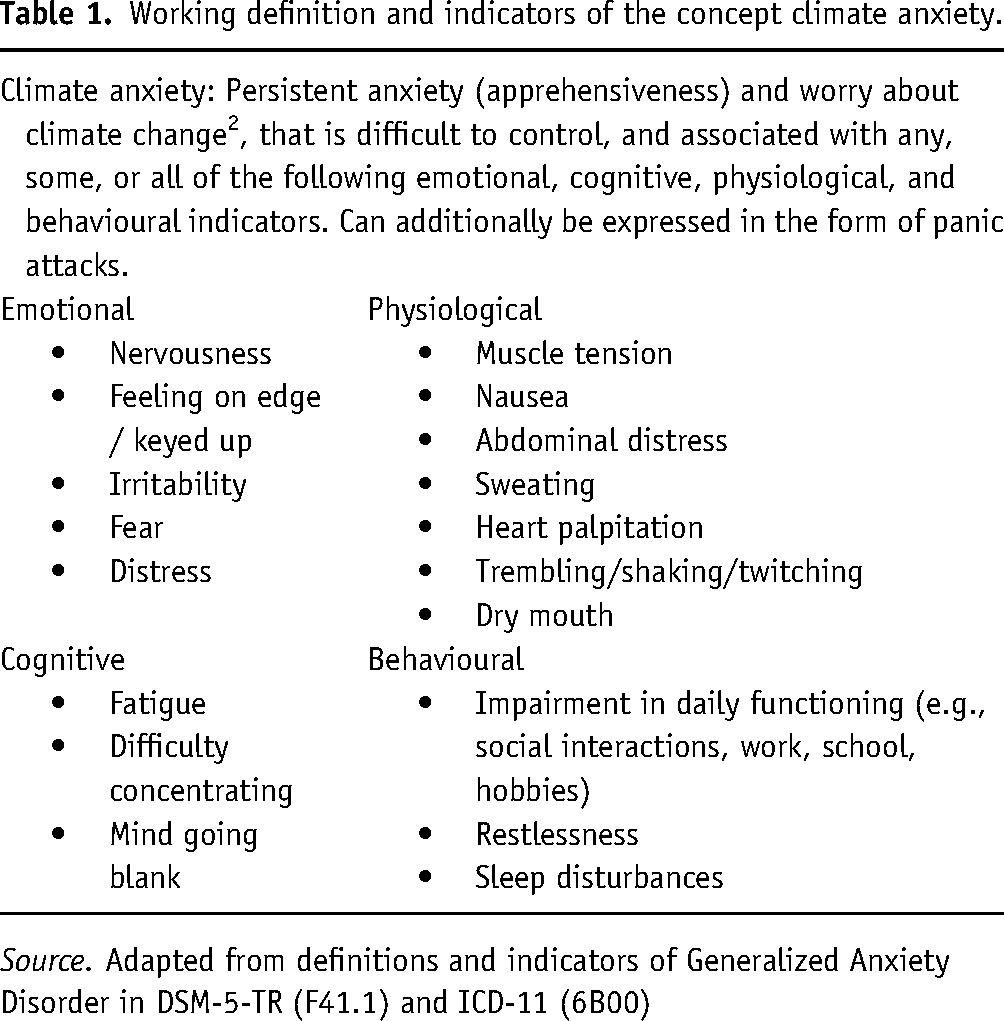
Source. Adapted from definitions and indicators of Generalized Anxiety Disorder in DSM-5-TR (F41.1) and ICD-11 (6B00)
Second, what are the reasons people experience climate anxiety? Several studies indicate that people, at least in the Global North, primarily experience climate anxiety not out of concern for the self, but rather out of concern for others or the environment (Ágoston et al., 2022; Budziszewska & Jonsson, 2021; Schwartz et al., 2022; Verplanken et al., 2020). Correlational studies also indicate that factors such as concern for the environment, nature relatedness, identification with nature, and media exposure to climate change content are associated with stronger climate anxiety (Clayton & Karazsia, 2020; Helm et al., 2018; Ogunbode et al., 2022; Whitmarsh et al., 2022). Other reasons for climate anxiety have been hypothesized but not empirically explored, including perceiving a threat from climate change for (future) offspring (Benoit et al., 2022), perceiving uncertainty about the future (Doherty & Clayton, 2011), experiencing a lack of control (Pihkala, 2020), fearing societal collapse (Dodds, 2021), perceiving it is too late to address climate change (Dodds, 2021), the lack of collective progress in solving the problem (Hickman, 2020), and perceiving the consequences of climate change (and the lack of response in addressing it) as violating moral principles (e.g., protecting nature and people; Hickman et al., 2021). These proposed reasons underlying climate anxiety seem to map onto dimensions identified in appraisal theories to explain when and why people experience different emotions (Scherer, 1999). For example, people may experience stronger climate anxiety if they appraise climate change as catastrophic, uncontrollable, unpredictable, morally unjust, threatening their values, needs, and goals, and perceive a lack of efficacy to cope with climate change. Appraisal theories can thus inform theorizing on when, why, and how people experience climate anxiety. This information is also critical to developing effective interventions that help people cope with climate anxiety by addressing relevant sources of climate anxiety. We return to this point below.
Third, does climate anxiety motivate or hinder climate action? While some studies find that climate anxiety encourages climate action (Heeren et al., 2022; Whitmarsh et al., 2022), other studies find no significant correlation (Clayton & Karazsia, 2020), or that climate anxiety inhibits climate action (Stanley et al., 2021). One explanation may be that this relationship takes an inverted-u shape: while moderate levels of anxiety may be conducive to climate action (Clayton, 2020), overwhelming levels of anxiety could paralyze people and inhibit climate action (Albrecht, 2011), but experiencing no climate anxiety could mean people are also not motivated to act (Dodds, 2021). The relationship may also depend on other climate-related emotions (Brosch & Steg, 2021). For example, while anger could galvanize climate anxiety into action (Stanley et al., 2021), shame could conversely weaken this relationship, as it is associated with negative and stable attributions about the self, for example perceiving the self as a failure, which could lead to withdrawal and avoiding situations where it is possible to act (Swee et al., 2021). Cognitions, like people's perception of efficacy and responsibility, could moderate or mediate the relationship between climate anxiety and climate action, too. For example, stronger climate anxiety may be more likely to motivate climate action if perceived efficacy is also high, and when people feel personally responsible (cf. Steg & de Groot, 2010). Emotion literature further demonstrates that engaging in behaviour can also affect emotions (Baumeister et al., 2007), highlighting the necessity of examining the reciprocal relationship between climate anxiety and climate action over time. A comprehensive theory of the relationship between climate anxiety and climate action that accounts for non-linearity, interactions with other emotions and cognitions, and temporal dynamics thus presents an important next step.
Fourth, how can healthcare professionals respond to climate anxiety (Bingley et al., 2022; Heeren & Asmundson, 2023)? While some scientists argue that climate anxiety represents a healthy, normal response to the threat that climate change poses, and should therefore not be considered a mental disorder (Bhullar et al., 2022; Clayton, 2020; Dodds, 2021), others propose that severe levels of climate anxiety should be considered at least a mental health risk (Cunsolo et al., 2020; Hrabok et al., 2020; Sampaio & Sequeira, 2022). Regardless, climate anxiety could cause considerable distress for which people may seek professional treatment (Budziszewska & Jonsson, 2022). Which interventions are effective in reducing climate anxiety? Suggestions to promote coping with climate anxiety often include taking personal action to reduce the risks of climate change, including personal and collective mitigation behaviours (that limit CO2 emissions) and adaptation behaviours (that reduce vulnerability to climate change impacts) (e.g., Australian Red Cross, 2023; Collier, 2022; Sweco, 2023). Yet, since the risks of climate change cannot be solved immediately and by actions of a single individual alone, interventions aimed at helping people psychologically cope with anxiety are likely also needed. Traditional therapies for anxiety disorders, such as Cognitive Behavioural Therapy, tend to focus on the emotional regulation strategy of reappraisal: re-interpreting anxiety-inducing situations as less threatening and/or as unlikely to occur (Hofmann et al., 2012). This strategy may be inappropriate in the case of climate anxiety, as climate change already poses unavoidable and severe threats. In addition, reappraising climate change as more benign may inadvertently demotivate people to act on climate change, since people may no longer perceive climate change as an urgent threat. Emotion regulation theory may serve as a source of inspiration to explore alternative ways to cope with climate anxiety. For example, future research could examine whether emotion regulation strategies such as acceptance, mindfulness, or behavioural avoidance (e.g., avoiding distressing media content about climate change; Naragon-Gainey et al., 2017), and by extension therapies such as Acceptance and Commitment Therapy (Hayes et al., 2006), can be more effective in helping people cope with climate anxiety than reappraisal.
Climate anxiety could negatively affect many people's mental health, and may motivate or hamper climate action. Emotion researchers can contribute to our understanding of the prevalence, indicators, causes, and consequences of climate anxiety through theory and research, in order to promote well-being and climate action in the face of climate change.
Footnotes
Declaration of Conflicting Interests
The authors declared no potential conflicts of interest with respect to the research, authorship, and/or publication of this article.
Funding
The authors received no financial support for the research, authorship, and/or publication of this article.
