




Abstract
Although emotions play a crucial role in understanding and encouraging sustainable behavior and decision-making, many open questions currently remain unanswered. In this review, we advance three broad areas of particular theoretical and applied importance that affective science and emotion researchers could benefit from engaging with: (1) “sustainable emotions” or empirically testing the possibility of positive reinforcing feedback loops between anticipatory and experienced emotions following the adoption of sustainable behaviors, (2) “non-Western emotions” or exploring the extent to which people's understanding and experience of climate-relevant emotions differs across non-WEIRD populations, and (3) “impactful emotions” or the need to carefully differentiate the conceptual and empirical role of emotions in encouraging the adoption of low-impact (e.g., recycling) versus high-impact (e.g., flying less) environmental behaviors.
Introduction
Tackling and mitigating the consequences of human-caused climate change and environmental degradation is one of the biggest global challenges of our time (IPCC, 2022). Effective solutions will need to consider both underlying climate science and relevant technology, as well as key psychological and behavioral aspects (Aron, 2022; Nielsen et al., 2021a, 2021b; van der Linden et al., 2015). It has long been established that emotions and affect play an important role in shaping human behavior and decision-making (Lerner et al., 2015), and emotions have specifically been identified as relevant drivers of climate and sustainability-related perceptions, attitudes, and behaviors (Brosch, 2021; Roeser, 2012; Schneider et al., 2017; Schneider et al., 2021; Smith & Leiserowitz, 2014). Yet, there is much more that could be done. In this review, we identify several distinct open theoretical and methodological questions regarding the role of affect and emotion in the context of sustainable decision-making, including a call to explore emotions as part of a larger complex system with dynamic feedback mechanisms rather than a simple linear model, the need to learn more about how emotions impact sustainable decision-making in non-WEIRD cultures, and a greater focus on more applied dimensions such as greater consideration of the emissions reduction potential of the behaviors being studied. We think that affective science and emotion 1 researchers could help address these questions to advance research on the psychology of sustainability and climate change.
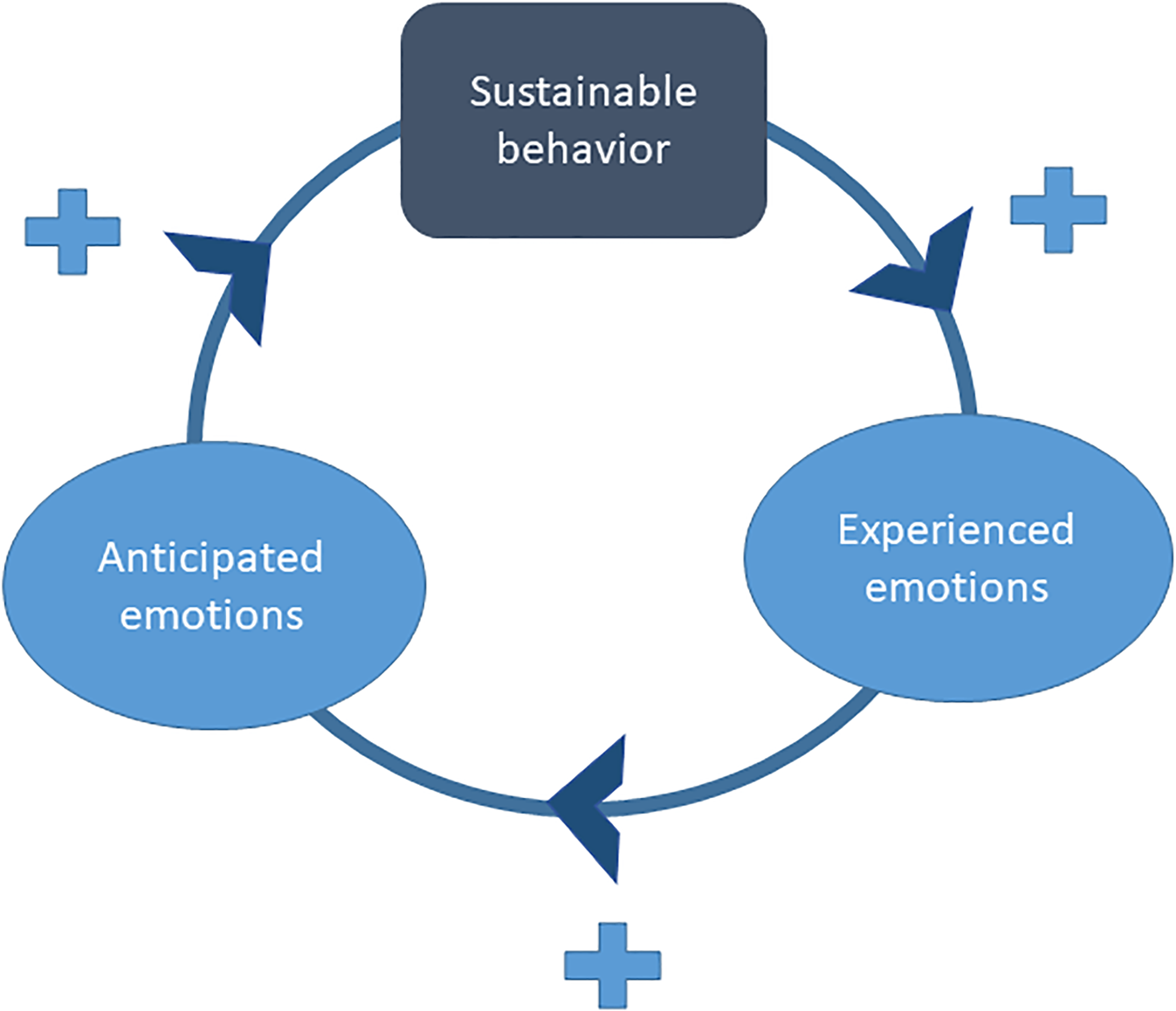
Self-reinforcing feedback loop.
Sustainable Emotions: The Positive Spiral or “Feedback Loop” Hypothesis
Although scholars often model the emotion-behavior link linearly, we think that one interesting area for emotion researchers will entail shedding further light on emotion-behavior reinforcement mechanisms, which have been highlighted in recent reviews, for example, the so-called “positive upward spirals” (see Schneider et al., 2021) or a “virtuous cycle of positive affect” (see Brosch, 2021). Does the anticipation of positive emotions from engaging in sustainable behavior lead to the subsequent experience of positive emotions, which in turn generates more positive anticipatory emotions? Given that emotions can motivate and drive behavior both as antecedents (e.g., anticipating positive emotions from acting sustainably) as well as consequences of action (e.g., experiencing positive emotions after engaging in a sustainable behavior), a positive feedback loop has been suggested in which anticipation and experience of emotions iteratively drive behavior forward and “upward” (Brosch, 2021; Fredrickson, 2001; Hartmann et al., 2017; Schneider et al., 2021; van der Linden, 2015, 2018; Figure 1). To date, research testing the mechanisms of such feedback loops, their (spontaneous) occurrence in natural settings, as well as their potential in driving meaningful behavior change in the real world is rather lacking. Given that one-off behavior change campaigns are limited in their timescale and might need regular reinforcement, a “self-sustained” feedback loop would hold potential for long-term impact. Specifically, if people derive intrinsic emotional and affective benefits from sustainable conduct (Taufik et al., 2015; Venhoeven et al., 2020) in a way that is ultimately self-reinforcing, this could have significant long-term benefits (van der Linden, 2018). We thus encourage research to investigate ways in which to test this loop empirically and produce evidence for (or against) it. Testing the loop also touches upon another important aspect which would benefit from more research: the relationship between anticipated and experienced emotions (Bohm & Pfister, 2008; Schneider et al., 2017). Do higher or more intense anticipated emotions lead to more experienced emotions which then translate into sustainable behavior? What if the anticipation of positive emotions does not produce the same level of experienced intensity, that is, what if there is a “prediction error”? The affective forecasting literature points to issues that humans have with predicting affect and emotions and that the accuracy of predictions depends on many factors (e.g., Ayton et al., 2007; Levine et al., 2018; Nisbet & Zelenski, 2011; Wilson & Gilbert, 2003, 2005). If people don’t feel as much positive emotions as they had anticipated to feel after adopting a pro-environmental behavior, could this lead to disengagement or a “negative downward spiral”? In fact, positive feedback loops are relatively rare and often described as instable because the system rapidly expands on itself (Malinowski, 2019) and, without the regulation of negative feedback, could eventually “spiral out of control” (p. 1). The question of what happens “when the chain breaks” is thus a legitimate one. Affective researchers could investigate whether such breaks in the chain happen, if so under what circumstances, and what the potential impacts for behavior would be. Testing the loop hypothesis empirically would require repeated observations from the same individuals under different levels of exposure to both anticipatory and experienced emotions, preferably over time to establish cause and effect and the ability for experienced emotions to impact anticipatory emotions and vice versa. It is unclear what the appropriate time lag would be as this might well differ for different emotions and behaviors so we think it is most beneficial if considered from a variety of methodological angles. For example, self-reported surveys can provide one piece of the puzzle; experimental designs can manipulate emotions, longitudinal designs offer temporal benefits and neurophysiological methods could allow for more objective measurement of emotions. A powerful avenue would be to consider and combine several of these methods.
Non-Western Emotions: The Importance of Non-WEIRD Research
The debate around the universality of emotions has been long-standing, including the increasing recognition that the expression and interpretation of even basic emotions are culturally sensitive (Jack et al., 2012; Russell, 1994). Interestingly, this debate has not necessarily translated to work on emotion in the context of sustainability research. A cursory glance of the literature would suggest that most research findings in this domain are exclusively based on Western samples, consistent with observations from systematic reviews which have found that the area of environmental psychology lacks diversity both in terms of its participants and its authors (Tam & Milfont, 2020). Accordingly, an area that seems under investigated, yet hugely important for a global and effective response to climate change, is a focus on cultural and group differences in how individuals understand, experience, and respond to emotional stimuli about climate change and the environment. Can we assume that emotional reactions to climate change or the role that emotions play in judgments about climate change is the same across diverse groups around the world? Although climate change is more spatially and temporally removed for many people in the Western world, it is much closer for a farmer in Africa experiencing droughts or indigenous communities affected by glacial retreat. Davidson and Kecinski (2022) speak of a “general absence of consideration for the social positions of the individuals who become the subjects of studies on emotion” (p.12). Other work, investigating psychological research on climate change and sustainability more broadly, highlights the general focus on the Global North and a lack of cross-cultural comparison (Brügger et al., 2021; Tam et al., 2021). Because climate change is a global phenomenon, it seems crucial to understand the impact of emotions on human judgment and decision-making in different geographical, cultural, and socioeconomic contexts. People in different parts of the world and with differing demographic make-ups might not link the same emotions to climate change or might not experience emotions in response to messaging and interventions in the same way, which can be reflected in differing behavioral responses (du Bray et al., 2019; Davidson & Kecinski, 2022; Tam & Chan, 2017; Tschakert et al., 2019). More recently, some work has started to look at emotions and climate change in non-WEIRD samples, with a focus on climate problems, such as anxiety (e.g., Hickman et al., 2021; Simon, Pakingan & Aruta, 2022; Tam, Chan & Clayton, 2023), which is a promising starting point. We thus encourage emotion researchers to bring their experience in the field's long-standing debate over the universality of emotions to the context of sustainability and investigate the role of emotions for people in more diverse settings, culturally, geographically, socially, and situationally; and with a focus on climate solutions.
Impactful Emotions: Low- Versus High-Impact Behaviors
Although from a basic science perspective, it may not matter which behavior is the focus of emotion research, scholars in environmental psychology have called for an “impact-focused” research program where theories ought to be tested on behaviors that matter most for protecting the environment and mitigating climate change (Nielsen et al., 2021b). So far research has mostly focused on the role of emotions in low- to medium-impact environmental behaviors, such as recycling or energy-efficient light bulb use, with only some research into more high-impact behaviors such as reducing meat eating (e.g., Taufik, 2018). However, there is a lack of research investigating factors that influence and motivate high-impact sustainable behavior, such as purchasing electric vehicles, green energy, or reducing transatlantic flights (Nielsen et al., 2021a, 2021b; Schneider, Zaval & Markowitz, 2021; Wynes & Nicholas, 2017). These mitigation behaviors are of high importance for tackling the climate crisis. Given the complex picture of the role of emotions in sustainable behavior (Chapman et al., 2017), it is conceivable that the role of emotions might also differ for higher versus lower impact behaviors (Schneider, Zaval & Markowitz, 2021). Some indications to this effect have been evidenced. For example, van der Linden (2018) found that anticipatory positive affect significantly predicts low-cost actions (such as changing light bulbs) but not high-cost green actions (such as purchasing an electric vehicle)—where “cost” typically refers to time or money (we recognize that “cost” is a multidimensional concept). If the role of emotions indeed differs, it will not be possible to extrapolate findings in the context of low-cost behaviors to high-cost behaviors (and indeed generalizing across different low-cost and high-cost behaviors in itself comes with problems as research has shown that effects can vary considerably across behaviors and contexts (Schneider, Zaval & Markowitz, 2021)). Furthermore, given that high-stakes behaviors involve more complex decision-making, the role that emotions play might also be more complex and mediated. Understanding the role that emotions play in climate change mitigation behaviors with differing levels of environmental impact is thus of high practical as well as theoretical relevance and seems a promising avenue for emotion researchers to pursue.
Conclusion
In this review, we have identified three broad areas that emotion and affective science researchers could benefit from contributing to, including (1) exploring the existence of positive self-reinforcing feedback loops between the anticipation and experience of positive emotions following engagement in sustainable behavior, (2) how the understanding and experience of emotions varies across Western and non-Western contexts when making sustainable decisions, and lastly, (3) how the role of emotions might differ for behaviors with varying levels of environmental impact.
Footnotes
Declaration of Conflicting Interests
The author(s) declared no potential conflicts of interest with respect to the research, authorship, and/or publication of this article.
Funding
The author(s) received no financial support for the research, authorship, and/or publication of this article.
