




Abstract
Nasal obstruction is a common symptom of various diseases, allergies, and structural deformities and a ‘stuffy nose’ is one of the most common reasons that patients seek a physician’s aid. Drugs that affect the autonomic nervous system are also expected to have a vasoactive effect on the nose. Nasal obstruction in the absence of infectious rhinitis or allergic symptoms may be due to drug use. With the chronic use of a medication, nasal obstruction can change over time and can be underestimated. Very little is known about this topic and very few publications to date solely devoted to drug-induced rhinitis. To prevent complications, obvious nasal obstruction due to drug intake should be treated with appropriate medication(s) or surgical intervention(s).
Introduction
Rhinitis, nasal obstruction, or a ‘stuffy nose’ is one of the most common reasons that patients seek a physician’s aid [Scadding, 2001; Ogrady, 1987]. The Joint Task Force Parameters on Allergy, Asthma, and Immunology defines rhinitis as inflammation of the mucous membrane lining the nose, and it is characterized by nasal congestion, rhinorrhea, sneezing, itching of the nose, and postnasal drainage [Dykewicz et al. 1998]. Nasal obstruction and rhinitis are used interchangeably in many articles. Rhinitis is an inflammatory state that includes nasal obstruction rhinorrhea, sneezing, itching of the nose, and postnasal drainage, as noted above. Drug-induced nasal obstruction does not always refer to an inflammatory state, except where there is inflammatory mediator release due to drug intake (Figure 1).
Algorithm for nasal obstruction caused by different pathways.
Drugs causing nasal obstruction
Drug-induced nasal obstruction.

Inflammatory drug interactions
‘Aspirin-exacerbated disease’ and cross-reacting nonsteroidal anti-inflammatory drugs
Cyclooxygenase 1/cyclooxygenase 2 inhibitory ratio and selectivity of nonsteroidal anti-inflammatory drugs for cyclooxygenases.

Nonsteroidal anti-inflammatory drugs cross-reacting in majority of patients with aspirin exacerbated respiratory disease.

Noninflammatory drug interactions
Antihypertensives and vasodilators
These drugs modulate the autonomic nervous system and erode noradrenaline stores, blocking sympathetic innervation and the relatively predominant parasympathetic activity.
Antihypertensives
Side effects of angiotensin-converting enzyme inhibitors include chronic cough, urticaria, and rhinitis. Antihypertensives that block autonomic preganglionic nicotinic receptors, α-1 adrenergic receptor antagonists (doxazosin, silodosin, prazosin, tamsulosin, alfuzosin, terazosin), α-2 adrenergic receptor antagonists (mianserin) and some β-adrenergic receptor antagonists (carvedilol) have all been associated with nasal obstruction [Settipane and Charnock, 2007; Curb et al. 1988]. Methyldopa is an alpha-adrenergic agonist psychoactive drug used as a sympatholytic or antihypertensive. Methyldopa is capable of inducing a number of adverse side effects including nasal congestion, which range from mild to severe [Mah et al. 2009]. Nevertheless, they are generally mild when the dose is less than 1 g per day. Reserpine is an indole alkaloid, antipsychotic and antihypertensive drug that has been used for the control of high blood pressure and for the relief of psychotic symptoms, although because of the development of better drugs for these purposes and because of its numerous side effects, it is rarely used today. At doses of less than 0.2 mg/day, reserpine has few side effects, the most common of which is nasal congestion [Curb et al. 1988]. Guanethidine is an antihypertensive drug that reduces the release of catecholamines, such as noradrenaline. A relatively common respiratory system complaint, nasal stuffiness in up to 30% of patients, is related to increased parasympathetic tone [Finnerty and Brogden, 1985].
Many patients do not recognize nasal obstruction as a side effect of these medications. These drugs are often used after the beginning of conchal degeneration, which causes conchal growth and nasal congestion. Nevertheless, physicians should consider all of these medications to have degenerative and structural consequences when dealing with nasal obstruction. Topical nasal steroids can help both conchal degeneration and congestion due to these medications. If the degeneration is more pronounced or nasal steroids do not have sufficient effect, surgery can be considered.
cGMP-specific phosphodiesterase type 5 inhibitors
Phosphodiesterase type 5 (PDE5) inhibitors used to treat erectile dysfunction, such as sildenafil citrate and tadalafil, cause vasodilation and nasal congestion. Sildenafil (a selective PDE5-I approved for the treatment of erectile dysfunction) is relatively well tolerated, but is associated with undesirable effects, including headache, flushing, dyspepsia, nasal congestion, and visual disturbances [Motamed et al. 2003]. The main action of sildenafil is the enhancement of the effect of nitric oxide (NO), by inhibiting cGMP-specific PDE-5. NO is present in the nasal mucosa and is responsible for vasodilation, causing congestion and nasal obstruction. Kiroglu and colleagues reported that 13 of 16 patients had a sensation of nasal obstruction after using sildenafil [Kiroglu et al. 2006]. Short-term nasal decongestants can be sufficient when used infrequently. Topical nasal steroids can be sufficient with consistent use. Surgery may rarely be necessary if irreversible changes develop in the inferior conchae.
Psychotropic drugs and immunosuppressants
Psychotropic drugs (tranquilizers), such as chlorpromazine, thioridazine, chlordiazepoxide, amitriptyline, gabapentin, reserpine, and alprazolam, tricyclic antidepressants, and the immunosuppressants cyclosporine and mycophenolic acid have also been implicated in activating the parasympathetic autonomic nervous system [Levin, 1982; Mabry, 1982; Petrie et al. 1982; Sliwowska, 1972]. Short-term nasal decongestants and long-term topical nasal steroids can be sufficient for transient therapy. Surgery may be necessary if irreversible changes develop at the inferior conchae.
Rhinitis medicamentosa and glaucoma medications
Local decongestants causing rhinitis medicamentosa.
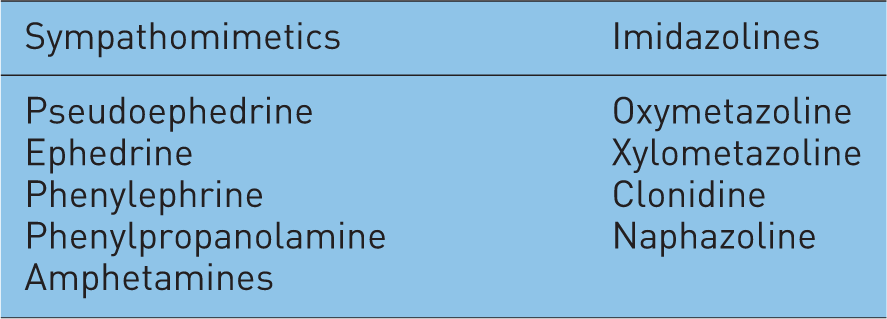
Graf and colleagues studied the effect of the preservative benzalkonium chloride (BKC) on the development of RM [Graf et al. 1995a]. In healthy subjects receiving oxymetazoline nasal spray (0.5 mg/ml) three times daily with and without BKC (0.1 mg/ml) for 30 days, rebound swelling was found in both groups, but it was significantly less marked in the group receiving oxymetazoline without BKC. These same two groups of subjects then had no nasal spray for 3 months and again were treated with the same nasal spray as before, but this time for only 10 days [Hallen and Graf, 1995]. Only the group pretreated with oxymetazoline containing BKC for 1 month, 3 months earlier, developed rebound mucosal swelling after 10 days. This was seen objectively using rhinostereometry and in the symptom scores. In the group receiving oxymetazoline without BKC, no rebound swelling was found. These results indicate that BKC has long-lasting adverse effects on the nasal mucosa. Similarly, Graf and Hallen reported that in patients with RM, 1 year after successful treatment (when these patients were without any nasal symptoms for 7 days), the use of oxymetazoline nasal spray containing BKC induced rebound swelling and nasal hyperreactivity [Graf and Hallen, 1997]. In another study of healthy subjects, groups were given oxymetazoline nasal spray without BKC, BKC nasal spray alone, or placebo nasal spray for 1 month. The results showed that long-term use of BKC induced mucosal swelling, whereas oxymetazoline induced nasal hyper-reactivity [Graf and Hallen, 1996]. Graf and colleagues stated that rebound congestion was a result of interstitial edema, rather than vasodilation [Graf et al. 1995b]. Edema can be an outcome of vasodilation, direct transudation, or changed permeability. Long-term use of α-adrenergic agonists for glaucoma patients can also cause rhinitis symptoms. After entering the nose through the nasolacrimal canal, they act like topical decongestants and RM can develop [Lieberman, 2001]. In the management of rebound rhinitis, the inducing drug should be discontinued and oral or parenteral corticosteroids should be administered to relieve the patient’s complaints. The treatment should be supported with topical nasal corticosteroids. Surgery may be necessary if irreversible changes have developed in the inferior conchae [Songu and Cingi, 2009].
Hormones
Estrogen, progesterone, or other pregnancy-related hormones
The theory that estrogen causes nasal congestion is based primarily on the results of Toppozada and colleagues from biopsy studies of nasal mucosa obtained during pregnancy [Toppozada et al. 1982], and from women taking contraceptive pills [Toppozada et al. 1984]. However, it is unclear whether estrogen causes congestion [Gluck, 2004; Nappi et al. 2004; Boulay and Boulet, 2003; Kircher et al. 2002; Ellegard et al. 1998]. The increased circulating blood volume, enhanced by the vasodilating effect of progesterone, was postulated to be responsible for pregnancy-induced nasal congestion [Zacharisen, 2000; Schatz and Zeiger, 1997]. However, the serum progesterone levels were similar in groups of women with and without pregnancy rhinitis, which does not support this theory [Ellegard et al. 1998]. As prolactin production increases in the course of pregnancy, it may play a role in the pathogenesis of pregnancy rhinitis. Bromocriptine and quinagolide, which reduce prolactin, have nasal congestion as known side effects, but this effect may be caused by the substances themselves. Neuropeptides, such as vasoactive intestinal polypeptide (VIP), are associated with other sorts of rhinitis [Fischer et al. 2005], and are thought to mediate vasodilatation in the nasal mucosa during pregnancy.
Postmenopause hormone replacement
After 6 months of hormone-replacement therapy in postmenopausal women, there was increased immunopositivity for VIP, substance P (SP), estradiol, and estradiol receptor in nasal biopsies, while neuropeptide Y (NPY) was reduced. Thus, estrogen action in the nasal mucosa could be mediated by neuropeptides, with increased gland secretion and vasodilatation caused by VIP and SP and a decrease in NPY-induced vasoconstriction.
Placental growth hormone and growth hormone
After the first trimester of pregnancy, episodic bursts of growth hormone are replaced by continuous secretion, with increasing levels of the placental growth hormone (PGH) variant [Eriksson et al. 1989]. Serum PGH levels were significantly higher in the pregnancy rhinitis group at all times throughout pregnancy [Ellegard et al. 1998]. It is possible that PGH stimulates mucosal growth in a similar way as proposed for growth hormone (GH) in acromegaly, thereby inducing pregnancy rhinitis. The cause of pregnancy rhinitis is not simply estrogen or progesterone, but seems to be multifactorial, and may be associated with PGH. No reported study has examined the relationship between hormone-replacement therapy and serum PGH levels as an explanation for the nasal congestion during postmenopausal replacement therapy, although PGH hormone-replacement therapy affecting vasoactive amines can cause vasodilation in the sinusoids and result in nasal congestion. As stated previously, GH stimulates mucosal growth, and its use for body building and other purposes after the growing phase can cause irreversible conchal growth, resulting in nasal obstruction. Short-term nasal decongestants and long-term topical nasal steroids can be sufficient during hormonal-replacement therapy. Irreversible changes need to be treated surgically.
Antithyroid medication
Hypothyroidism results in a predominance of parasympathetic effects, resulting in nasal congestion [Staevska and Baraniuk, 2007]. Common complaints, such as long-standing nasal congestion, interminable colds, and excessive nasal discharge, are not specific for patients with hypothyroidism, but should remind the physician to evaluate thyroid function. Increased amounts of connective tissue in the mucosa and hypertrophic mucus-secreting glands are thought to underlie the congestion symptoms [Gupta et al. 1977; Ritter, 1967; Proetz, 1950]. Hypothyroidism and untreated acromegaly cause irreversible conchal hypertrophy, giving rise to nasal obstruction [Scadding, 2001]. Overuse of antithyroid preparations (methimazole and propylthiouracil) also causes iatrogenic hypothyroidism and can cause persistent nasal obstruction with myxedema formation in the concha. Multiple doses of radioactive iodine without replacement therapy can also cause hypothyroidism. Iatrogenic hypothyroidism and drug abuse can be prevented with periodic checkups and repeated measurements of blood TSH, T3, and T4 levels. If nasal obstruction has developed and does not respond to short-term (1–2 weeks) oral or parenteral corticosteroids or long-term (1–2 months) topical nasal steroid therapy, these irreversible changes may need to be treated surgically. Radiofrequency ablation or surgical resection can be necessary to obtain nasal patency.
Vasomotor rhinitis
Vasomotor rhinitis is a diagnosis of exclusion, that is nonallergic, noninfectious, non-drug-induced, nonmetabolic, nongustatory, and nonoccupational, with no eosinophilia [Settipane and Charnock, 2007]. Idiopathic etiologies causing nasal obstruction are also seen in vasomotor rhinitis. The most common form of nonallergic rhinitis is vasomotor rhinitis, a diagnosis of exclusion. Vasomotor rhinitis is characterized by an abnormality in the vascular control of the vessels in the nose. Unlike other areas of the body, the nose has large venous sinusoids located between the arteries and veins. These are most prominent in the inferior turbinate. Parasympathetic stimulation results in vasodilation and an increase in congestion and mucous production, while sympathetic stimulation causes a decrease in the size of the sinusoids, with a consequent increase in nasal patency. Neuropeptides, nitric oxide, ozone, cigarette smoke, and other environmental factors, and gastroesophageal reflux are associated with vasomotor rhinitis. Autonomic dysfunction is significant in patients with vasomotor rhinitis, which favors parasympathetic activity [Ayar, 2009; Loehrl et al. 2002].
Conclusions
Nasal obstruction in the absence of infectious rhinitis or allergic symptoms may be due to drug use. Drugs that affect the autonomic nervous system are also expected to have a vasoactive effect on the nose. With the chronic use of a medication, nasal obstruction can be underestimated. Very little is known about this topic and very few publications to date have been solely devoted to drug-induced rhinitis. To prevent complications, obvious nasal obstruction due to drug intake should be treated with appropriate medication(s) or surgical intervention.
Footnotes
Funding
This research received no specific grant from any funding agency in the public, commercial, or not-for-profit sectors.
Conflict of interest statement
The authors do not have a financial relationship with any organization or company, nor has the research been sponsored by any commercial organization.