




Abstract
Professor Krystyna Kotełko was working as a microbiologist at the University of Łódź (Poland). Her main object of study was the LPS (endotoxin) of opportunistic urinary pathogens from the genus Proteus. She demonstrated, for the first time, the presence of uronic acids and amino acids, as well as two heptoses (
Professor Krystyna Kotełko was born on 7 November 1920 in Grodzisk Mazowiecki, Poland. She graduated from the Maria Konopnicka State Junior High School in Warsaw, passing the matriculation exam in 1938. In the same year, she began studies at the University of Warsaw at the Faculty of Mathematics and Natural Sciences. These studies were interrupted by the outbreak of the Second World War. In 1940, she started working at the Municipal Hygiene Institute in Warsaw, first as a volunteer and then as a lab technician. She worked in this institute until the outbreak of the Warsaw Uprising in 1944. In the Hygiene Institute in Warsaw, under the guidance of Prof Aleksander Ławrynowicz, she got to know microbiology in practice and conducted her first research, the results of which were included in her Master’s thesis and in a joint publication published after the war in 1949.1,2 After the war, in 1945, she came to Łódź. She was enrolled to the emerging University of Łódź, were she started her second year of biological studies. She obtained her MA in philosophy in the field of microbiology in 1947. After graduation she took her first job at the Department of Bacteriology of the National Institute of Hygiene in Łódź, where she was a head of the Intestinal Infection Laboratory. While working in this institute, she prepared her PhD thesis entitled ‘Serological classification of haemolytic streptococci isolated from cases of scarlet fever’. She obtained the degree of Doctor of Philosophy in 1951; a year later she started working as an Assistant Professor at the University of Łódź at the Bacteriology Department (later the Institute of Microbiology), headed by Prof Bernard Zabłocki. At the University of Łódź, she was awarded habilitation in 1961 on the basis of the dissertation entitled ‘Chemical basis of serological specificity of O-antigens of the genus Salmonella’. In 1969, she received the title and position of Associate Professor and in 1976 Full Professor. 2
At the beginning of her scientific career at the University of Łódź, Prof Kotełko took part in the work of the team of Prof Zabłocki. This research group concentrated on the isolation of new chemical symplexes from streptococcal cells. Prof Kotełko published a series of papers devoted to the use of antigenic fractions isolated from group A streptococci in the serodiagnosis of rheumatic diseases, confirming the opinion about the importance of these bacteria in the immunopathogenesis of these diseases. The subsequent research results of Prof Kotełko, published with her co-workers, concerned Staphylococcus hyaluronidase, typing Corynebacterium diphtheriae isolated from patients from the city of Łódź and the Łódź region, as well as the phase variation of the Shigella sonnei. 2
In the following years, Prof Kotełko undertook research on Proteus bacilli. These bacteria are widely distributed in the natural environment, where they are involved in decomposing organic matter of animal origin. They are also present in the intestine of humans and animals. Proteus species are Gram-negative bacterial opportunistic pathogens that most often cause urinary tract infections (UTIs) and wound infections. Proteus rods are a frequent cause of UTIs in patients with a urinary catheter in place, with structural/or functional abnormalities in the urinary tract or who had surgical intervention in the urogenital system. Strains of Proteus mirabilis cause UTIs with the highest frequency among Proteus species. This microorganism mainly causes complicated urinary tract infections and especially contributes to catheter-associated UTI.3–5 Professor Kotełko studied surface compounds of Proteus rods including LPSs both from S-forms of bacteria as well as from R-mutants. S-Forms of bacteria produce LPSs containing three parts: an O-specific polysaccharide (O-Ag), core oligosaccharide (core region) and lipid A. R-Mutants form LPSs devoid of O-Ag and depending on classes contain a different type of oligosaccharide linked to lipid A. 6
The greatest scientific achievement of Prof Kotełko was the organization in Łódź of a scientific school of immunochemistry of bacterial antigens. Using her experience from research scholarships at the Department of Chemistry of Bacterial Antigens in the Pasteur Institute in Paris, France, and in the Max Planck Institute of Immunobiology in Freiburg, Germany, she initiated studies on the chemical structure and serological specificity of surface Ags, particularly Proteus LPS and its biological importance as an endotoxin. She devoted almost all her scientific life to this research, contributing to the knowledge on the molecular basis of the serological classification of Proteus rods. During scientific scholarships in the above-mentioned research institutes, she met the pioneers of research on the chemical structure, biological activity and Ag specificity of LPS of Gram-negative bacteria: Dr Otto Westphal, Dr Anne Marie Staub and Dr Otto Lüderitz. She collaborated with them for many years, visiting them in Paris and Freiburg, and hosting them at the University of Łódź. Cooperation with Dr Anne Marie Staub led to the demonstration of the dominant role of O-acetyl groups in the specificity of O-Ag Salmonella O:5. 7 The friendship established in the 1950s between these scientists survived for several years, and their co-operation established at that time resulted not only in joint publications, but also in further collaboration of their co-workers and students.1,2
During her work in the Institute of Pasteur in Paris and in the Max Planck Institute of Immunobiology in Freiburg, Prof Kotełko showed the presence of uronic acids and amino acids for the first time, as well as two heptoses (
An important achievement of the team guided by Prof Kotełko was also obtaining rough mutants (R). The LPS analysis of these forms of Proteus bacteria allowed them to get to know the other two parts of the LPS, the core region and lipid A, the biological center of endotoxins. These studies were done in collaboration with the above-mentioned research centers, as well as with the Forschungsinstitut Borstel near Hamburg in Germany (currently Research Center Borstel - Leibnitz Lung Center).13–18
The results of Prof Kotełko’s studies have often been cited in the LPS research literature. She has been recognized and respected, not only in Poland but also abroad, as a scientist who made a significant contribution to the research on bacterial endotoxin.
With time, Professor Kotełko, with her own team, extended her research profile and started to study pathogenic factors of the Proteus rods other than LPS. She paid a lot of attention to the haemolysins of Proteus that are associated with the cell, which are produced by all species of these bacteria, and extracellular (free) haemolysin, which is synthesized by P. vulgaris and P. penneri. 19 Prof Kotełko and her colleagues confirmed the invasive properties of Proteus bacteria and showed the strong cytotoxic properties of free haemolysin that is produced by P. penneri strains.20,21
Prof Kotłeko raised a group of scholars who now continue the research on the LPSs and bacterial pathogenicity of Proteus rods with their students. New research tasks were developed concerning the formation of urinary stones during Proteus infections, swarming growth of these bacteria, resistance to the human serum action, biofilm development and bacteriophages specific for P. mirabilis, as well as the genetic diversity of O-Ags of Proteus LPS and further studies of its core region.22–27
The rich and diverse scientific achievements of Prof Kotełko include the authorship or co-authorship of two monographs on Proteus bacilli, 62 experimental works and seven review articles. She participated in many scientific congresses, conferences and symposia. She promoted eight doctors, took care of 7 postdoctoral students, and prepared many reviews of PhD and habilitation theses, as well as applications for Professor positions. In 1961, she organized the Department of General Microbiology at the University of Łódź, and she was a head of this Department until 1991. In the periods 1977–1984 and 1988–1991 she was the Director of the Institute of Microbiology, and in the years 1969–1972 the Pro-Rector in Charge of Didactics of the University of Łódź. She was a member of the editorial boards of Polish microbiological journals, as well as of scientific councils of the Institute of Immunology and Experimental Therapy of the Polish Academy of Sciences (PAS) in Wroclaw, and the Center of Microbiology and Virology PAS. She was also a member of the Microbiology Committee of the PAS and the Chair of the Immunochemistry Section of this Committee. Prof Kotełko was elected to the International Endotoxin Society and as an honorary member of the Polish Society of Microbiologists.
Prof Kotełko was also a talented scholar and instructor of many generations of students, successfully combining her research goals with teaching. She liked academic youth and treated students’ education as a very important duty. She was a very good pedagogue and was very erudite, who could ignite interest in audiences with the most difficult subjects. She lectured lightly, colorfully and beautifully in Polish. In conducting lectures, she found a great satisfaction and the opportunity to communicate not only her knowledge and passion, but also her own thoughts and personal experiences. She educated over a hundred of microbiology masters at the University of Łódź. She was also a co-author of three valued academic books: Exercises in Microbiology, Microbiology for Pharmacists and Biology of Bacteria.
Prof Kotełko was a great patriot. During World War II and the German occupation, she was active in the Polish resistance movement. She was also a member of the ‘Solidarity’, which was a free trade union and social movement fighting with the communist regime to regain Poland’s sovereignty and freedom. She supported and protected her younger co-workers active in the ‘Solidarity’ movement in the 1980s. During the martial law introduced in Poland between 1981 and 1983, she supported the activities of the opposition and organized assistance for internees and their families. The most important principles that guided Prof Kotełko were independence and tolerance, as well as respect for other people’s views.
Prof Dr Krystyna Kotełko.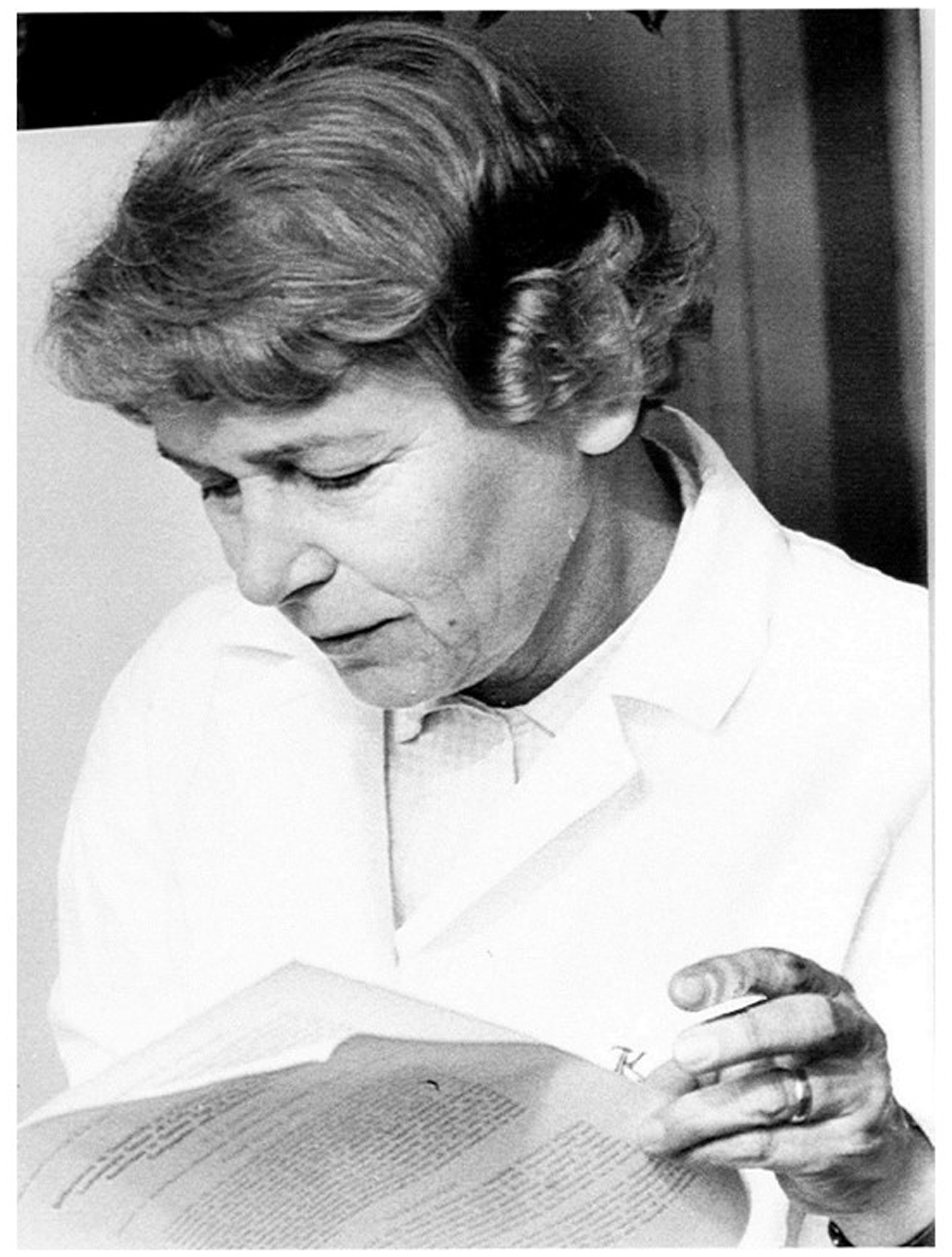
Prof Kotełko was a true humanist. Particularly, she was interested in literature, especially French literature. She often spent her leisure time listening to classical music. She was a great admirer of Chopin’s music. She also enjoyed trips to the mountains. As long as her health condition allowed for hiking, she would go to the Polish mountains for short or long stays. She remains in the memory of the research community of the Institute of Microbiology of the University of Łódź as a person devoted to science and students, who always supported her co-workers and colleagues. Prof Kotełko died on 14 November 2003. She was buried in Łódź.
Footnotes
Declaration of Conflicting Interests
The author declared no potential conflicts of interest with respect to the research, authorship and/or publication of this article.
Funding
The author received no financial support for the research, authorship, and/or publication of this article.