




Abstract
Enhanced recovery after surgery (ERAS) programmes are well established across many surgical specialties. Successful implementation requires both multidisciplinary engagement and active patient participation. At our hospital, many patients were unaware they had a role in their recovery. To improve education, we developed a poster highlighting seven key elements using the acronym PROMOTE: Pain relief, Respiratory exercises, Own clothes, Mobilisation, Oral hygiene, Taking away attachments, and Eating and drinking. Feedback from patients in the post-operative critical care unit showed the resource was well received, easily understood, and most wished they had received it pre-operatively to help manage expectations and reduce anxiety.
Introduction
ERAS programmes for elective surgery are well established across multiple specialties internationally, reducing complications, length of stay, and healthcare costs. 1 Examples include the DrEaMing study, which showed early drinking, eating, and mobilisation post-operatively significantly reduced hospital stay, 2 and the I-COUGH programme targeting pulmonary complications. 3 While multidisciplinary team engagement is vital, patient participation is equally critical. A patient-focused study in colorectal surgery found that understanding the rationale behind ERAS elements increased patient motivation. 4 Higher engagement is also linked to lower pain, improved physiotherapy adherence, and greater satisfaction. 5
Issue
At our 700-bed tertiary centre, we observed that many patients in the post-operative critical care unit had received limited pre-operative education about their recovery role. This may be because the existing prehabilitation programme at our hospital has defined referral criteria and primarily focuses on pre-operative optimisation rather than post-operative education. For many, certainly the idea of being proactive was unexpected. We aimed to empower patients through improved peri-operative education.
Methods
Drawing inspiration from the I-COUGH programme, we developed a user-friendly poster to highlight seven key components of recovery, using the acronym PROMOTE (Figure 1). Due to limited success with incentive spirometers and concerns about their practicality, we focused on tasks patients were more likely to engage with. Patient motivation to return to normality informed elements like wearing personal clothes and early removal of attachments. Each PROMOTE component was accompanied by brief explanations and supportive imagery to enhance understanding. Before wider rollout, we sought patient feedback through a short questionnaire (Supplemental Appendix 1) addressing poster clarity, usefulness, and perceived ability to complete each task. Thirty-two post-operative patients from various surgical specialties participated.
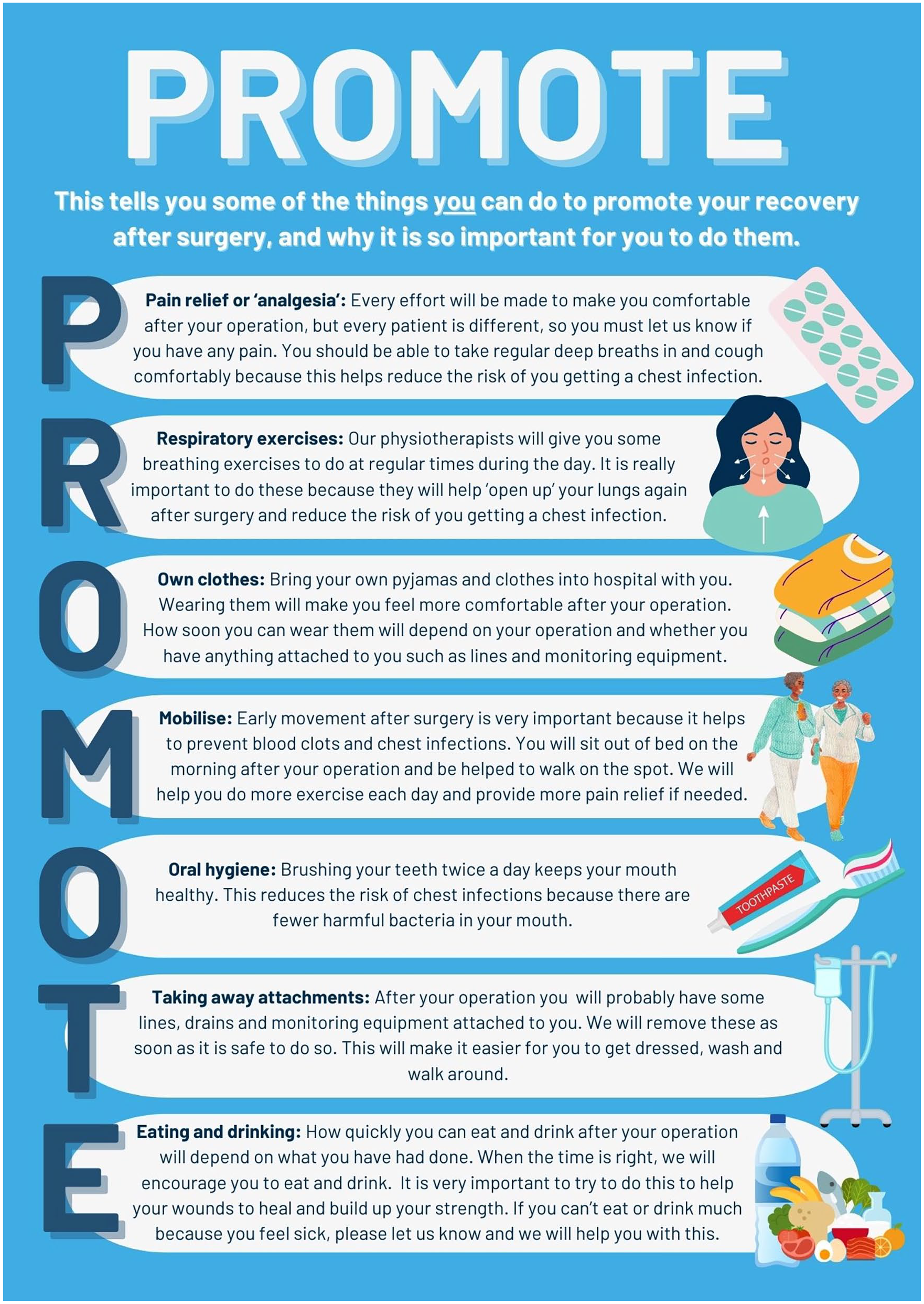
The PROMOTE poster.
Results
Thirty-two patients completed the survey: six pancreatic, five hepatic, eight upper gastrointestinal, eight colorectal, two urological, and two endocrine surgeries. Eighteen had participated in a prehabilitation programme. Patients were already aware of around half the PROMOTE elements, particularly pain relief, respiratory exercises, and mobilisation. Wearing personal clothes and the importance of oral hygiene were less commonly anticipated by patients. In terms of perceived difficulty, 46% anticipated that mobilisation would be challenging, and 16% were apprehensive about eating and drinking. Few patients expected difficulties with maintaining oral hygiene, or with the removal of attachments such as lines, catheters, or drains. All patients found the poster visually clear, with 97% reporting it was helpful. One commented it would have eased pre-operative anxiety if received earlier. Around 80% wished they had seen the poster before surgery. When asked about tailoring the resource to specific operations and adding daily goals, 90% agreed this would be beneficial.
Discussion
This patient-focused quality improvement initiative demonstrated that the PROMOTE poster is a well-received, effective educational tool. It was considered clear, relevant, and easy to understand. Most patients expressed a desire to have received it pre-operatively, suggesting its potential to improve preparedness and reduce anxiety. Although some patients supported personalised, operation-specific guides, a minority were concerned such resources might be demoralising during complicated recoveries. These insights highlight the need to frame recovery goals flexibly and communicate that progression varies. Given the positive feedback, we plan to implement the PROMOTE poster trust-wide and develop tailored resources to guide daily recovery. Clear messaging will emphasise that recovery is not linear, and individual experiences may differ.
Conclusion
This quality improvement project aimed to enhance patient education by developing a clear, practical resource to support engagement in post-operative recovery. Patient feedback affirmed its clarity and usefulness. The PROMOTE poster will now be introduced more broadly, with future work focusing on tailored, surgery-specific recovery tools.
Supplemental Material
sj-docx-1-inc-10.1177_17511437251372019 – Supplemental material for PROMOTE: A patient-centred poster to support engagement in post-operative recovery – A quality improvement initiative
Supplemental material, sj-docx-1-inc-10.1177_17511437251372019 for PROMOTE: A patient-centred poster to support engagement in post-operative recovery – A quality improvement initiative by Annie Rylance, Tom Syratt, Lauren Townsend and Ned Gilbert-Kawai in Journal of the Intensive Care Society
Footnotes

Funding
The authors received no financial support for the research, authorship, and/or publication of this article.
Declaration of conflicting interests
The authors declared no potential conflicts of interest with respect to the research, authorship, and/or publication of this article.
Supplemental material
Supplemental material for this article is available online.
References
Supplementary Material
Please find the following supplemental material available below.
For Open Access articles published under a Creative Commons License, all supplemental material carries the same license as the article it is associated with.
For non-Open Access articles published, all supplemental material carries a non-exclusive license, and permission requests for re-use of supplemental material or any part of supplemental material shall be sent directly to the copyright owner as specified in the copyright notice associated with the article.
