




Abstract
In 2013, a group of clinicians on behalf of the National Institute for Health Research, collaborated with ICU Steps to produce guidance about people being enrolled in more than one critical care trial. This is referred to as “co-enrolment” and can be where a person takes part in one study at the same time as another study (or one after the other in a short time-frame). For instance, being part of a study looking at sepsis drugs and a mechanical ventilation weaning study. The drivers for developing this guidance were a lack of any existing guidance, nationally and internationally, at that time, and a desire to ensure high quality research is conducted. The emphasis was on making trials as safe as possible for patients and ensuring robust trial outcomes. Critical care was seen to lead in this, with our exemplar guidance used across all health research. We wish to revisit this guidance now that there is more experience of coenrolment in critical care trials. There is also more awareness of different consent models, such as deferred consent (taking consent when a person is awake and able to give consent) and consultee consent (asking families or independent professionals to consent). Consenting to coenrolment is an important ethical consideration for the revision of this guidance.
Keywords
Lay summary
In 2013, a group of clinicians on behalf of the National Institute for Health Research, collaborated with ICU Steps to produce guidance about people being enrolled in more than one critical care trial. This is referred to as “co-enrolment” and can be where a person takes part in one study at the same time as another study (or one after the other in a short time-frame). For instance, being part of a study looking at sepsis drugs and a mechanical ventilation weaning study.
The drivers for developing this guidance were a lack of any existing guidance, nationally and internationally, at that time, and a desire to ensure high quality research is conducted. The emphasis was on making trials as safe as possible for patients and ensuring robust trial outcomes. Critical care was seen to lead in this, with our exemplar guidance used across all health research.
We wish to revisit this guidance now that there is more experience of co-enrolment in critical care trials. There is also more awareness of different consent models, such as deferred consent (taking consent when a person is awake and able to give consent) and consultee consent (asking families or independent professionals to consent). Consenting to co-enrolment is an important ethical consideration for the revision of this guidance.
Co-enrolment to UK Critical Care Studies – A 2019 update
High quality clinical research is essential for improving long-term outcomes for critically ill patients. The UK Critical Care community has embraced the importance of clinical trial delivery with over 150 UK Intensive Care Units recruiting participants to clinical trials. However, many challenges exist which limit the recruitment of critically ill patients to clinical trials. Barriers to recruitment include
1
Limited numbers of critically ill patients Relatively low incidences of diseases particularly as specific disease endotypes are described Time sensitive identification of participants in an acute care setting Extensive time-consuming data collection particularly related to long-term outcomes Potential for a participant to be included in multiple studies within a care pathway (from Primary care to the Emergency Department, ward and theatre prior to Intensive Care)
What is co-enrolment?
Co-enrolment is defined as the enrolment of a participant in two or more clinical trials either concurrently or sequentially. In December 2012 a multidisciplinary group of research-active Critical Care researchers and patient/public representatives completed an excellent guidance document which details the process and benefits of co-enrolment. The 2012 document was published in The Journal of The Intensive Care Society 2 and is available via the Intensive Care Society website. Here, we aim to update the guidance document and produce a template Co-enrolment Agreement for future trials.
What are the potential advantages and disadvantages of co-enrolment?
The impact of co-enrolment to clinical trials has been studied in a number of healthcare settings. Typically co-enrolment agreements are initiated by the investigators of a new trial seeking co-enrolment with a trial which is already underway. Importantly, co-enrolment has been shown not to influence participant safety or the outcome of clinical trials.3,4 Potential participants in clinical trials, including parents of children and the next-of-kin of critically ill patients, support co-enrolment in clinical trials.5,6 Co-enrolment of participants in multiple clinical trials is also supported by researchers. 7
Potential advantages of co-enrolment include: Increased research capacity through increased numbers of eligible participants resulting in: ○ A greater number of trials completing on target and on time ○ A faster throughput of clinical trials allowing clinical practice changing research to be available earlier Improved research efficiency and cost effectiveness of research delivery teams More efficient data collection – this advantage would be maximised through development of core outcome sets Reduced competition between trials potentially reducing selection bias between competing studies Improved collaboration between researchers and clinical trial teams
Potential disadvantages of co-enrolment include: Increased burden for participants and their surrogate decision-makers around the time of consent and during follow up Possibility to reduce the study power with high rates of co-enrolment Bias due to unexpected interactions between interventions Logistical issues agreeing co-enrolment arrangements between trial teams and the trial sponsors
Where are we now?
Co-enrolment is widely utilised by academic trials but infrequently adopted by commercially funded studies.
8
A number of co-enrolment guidance documents have been produced by national critical care organisations including: UK Critical Care Research Group: Co-Enrolment to Intensive Care Studies – A UK Perspective
2
Canadian Critical Care Trials Group: Enrolment of 1 ICU Patient into 2 Randomized Trials Guidelines of the CCCTG
9
Australian and New Zealand Intensive Care Society Clinical Trials Group. Co-enrolment policy
10
What factors need to be considered when developing a co-enrolment agreement?
Specific issues which need to be considered when developing a co-enrolment agreement include those related to the (a) research participants; (b) the ethical and legal framework governing trial conduct; (c) issues of trial design and potential for interactions; and (d) logistical and organisational matters. A response from both Trial Management Groups (TMG) should be documented to all of these issues within a co-enrolment agreement (see Table 1 for a template Co-enrolment agreement).
Trial co-enrolment agreement.
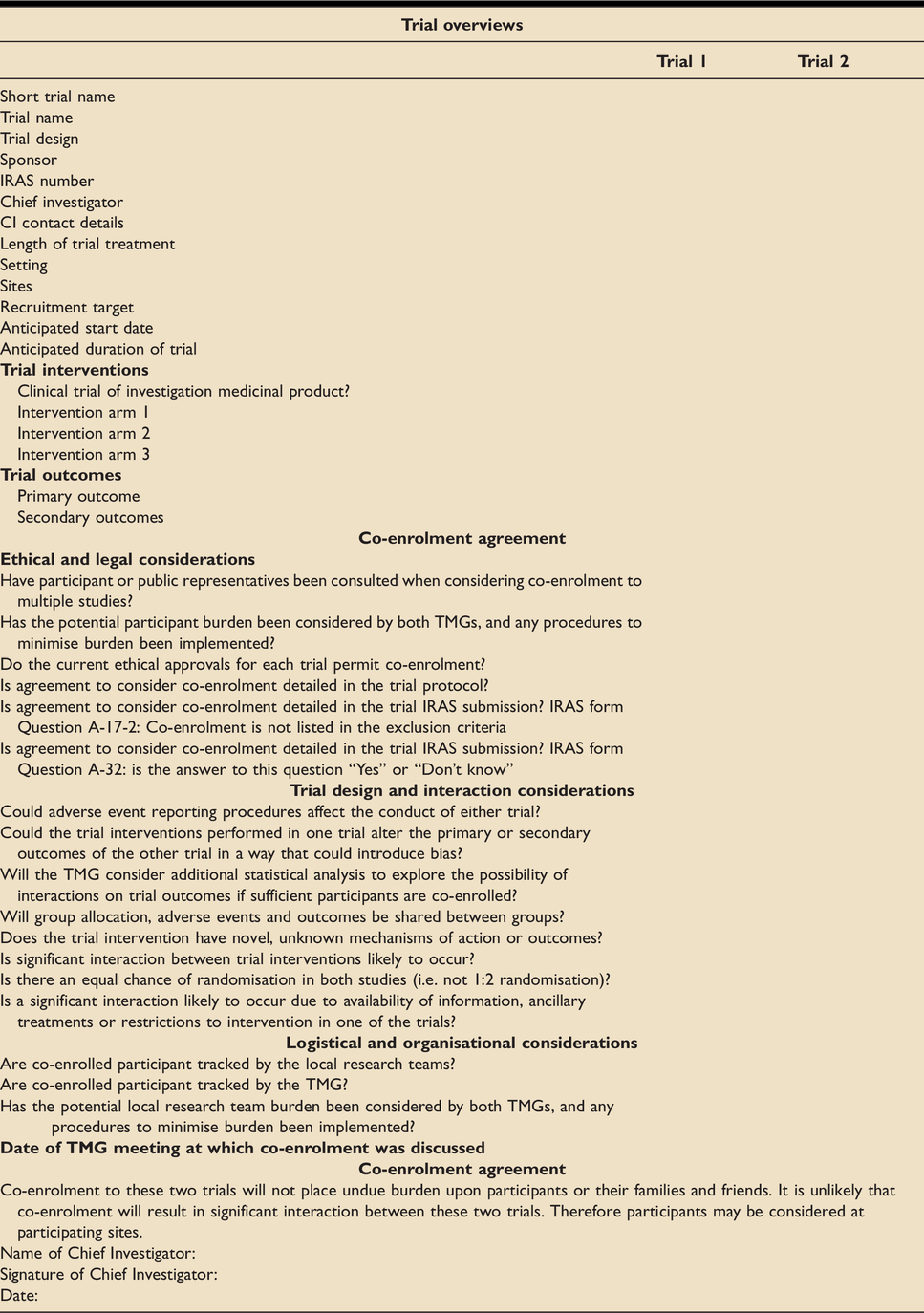
Ethical and legal considerations
Research trials are conducted under the ethical framework defined by the Declaration of Helsinki. 11 The fundamental principle of the Declaration of Helsinki is the participants’, or their surrogate decision-makers’, right to self-determination and to make informed decisions. Therefore, providing issues related to trial design and participant safety have been addressed, research participants have the right to decide whether they want to be enrolled in more than one clinical trial. Local research teams should be sufficiently aware of clinical trials and co-enrolment strategies so they can help participants and their relatives make decisions.
The potential burden of co-enrolment on participants and their relatives needs to be considered when formalising co-enrolment. 12 During trial design, and when agreeing co-enrolment, ways to reduce any burden associated with co-enrolment should be attempted. This may include the agreement of core outcomes, for both clinical and economic outcomes.
Prior to agreeing co-enrolment to clinical trials, consideration should be made regarding discussion with Patient and Public Involvement groups (or PPI representatives within individual trials).
In the UK the Research Ethics Committee (REC) and the Medicines and Healthcare products Regulatory Agency must be aware that co-enrolment will be considered for both trials. Potential for co-enrolment must be detailed in each trial protocol and the IRAS on submission to Health Research Authority (via the Integrated Research Application System (IRAS) [https://www.myresearchproject.org.uk/]. Co-enrolment must not be included as an exclusion criteria in the trial Protocols and IRAS submission (Question A-17-2). On the IRAS form, question A-32 should be answered as “Yes” if a co-enrolment agreement is in place at the time of submitting the form. The trial names and REC numbers of the other trials in the free text box of the IRAS form. Answer “Not Known” if co-enrolment may be considered in the future. Suggested text to be included in trial protocols and as a response to IRAS form Question A-32 – “A co-enrolment agreement will be established between co-enrolling studies. Co-enrolment will be agreed by Chief Investigators (and TMGs) of each trial. The co-enrolment agreement will consider issues related to trial design, the scientific basis of the studies, burden to participants, ethical issues and biological interactions between studies. The policies of trial sponsors will also be considered. Co-enrolment agreements will be signed by the Chief Investigators of both studies with a copy kept by the Sponsor of each trial (if required by the sponsor).”
Trial design and interaction considerations
With co-enrolment occurring more commonly, investigators are reporting their experiences and highlighting areas of trial design which need to be considered to maximise the positive advantages of co-enrolment.12,13 Co-enrolment in two observational studies should not raise significant co-enrolment problems. Prior to co-enrolment into interventional trials, a number of issues related to the interventions, standard care and outcomes should be considered. Safety of participant in clinical trials in paramount. When considering co-enrolment the procedures for dealing with adverse events should not affect the conduct of either trial. The TMGs of both studies need to consider the risk of combination treatment in trials which are co-enrolling.
Common outcomes in two trials should not be considered a barrier to co-enrolment particularly if the interventions do not interact and there are high quality randomisation procedures in place. If a significant number of participants are expected to be co-enrolled then an a priori statistical analysis plan may be required to examine the impact of co-enrolment. For this analysis to occur details of the enrolment and randomisation will need to be shared between trials.
Clinical trial interventions may interact, resulting in a dilution or enhancement of the outcome being assessed, in either or both trials. However a detrimental effect on the power of a trial will only be seen with a large interaction between the two trials associated with substantial co-enrolment. 14 If researchers feel significant interaction will occur or that the interventions are novel with unknown mechanisms of action, or outcomes, then co-enrolment should not be sought. The risk of co-enrolment may be mitigated through high-quality randomisation procedures to ensure bias is not introduced through unequal distribution between groups. Delivery of platform trials utilising a factorial trial design or allowing sufficient time between interventions may reduce the potential for interaction between studies. 15 In addition to considering the main trial interventions it is important to ensure that no interactions occur due to restricted availability of information, ancillary treatments or restrictions to intervention in one trial affecting the conduct of the second trial.
Logistical and organisational considerations
The Chief Investigator and TMG from both trials must consider and approve the co-enrolment agreement. A copy of the co-enrolment agreement and related protocols should be held by the sponsor, TMG and local research delivery teams involved in co-enrolment. Substantial and non-substantial amendments should lead to a review of the co-enrolment agreement to ensure the agreement remains valid.
Depending on the trial design (especially intervention versus non-intervention designs), participants who are co-enrolled may need to be tracked by the TMG, including randomisation group if required, to ensure participant safety and allow statistical analysis to investigate potential interactions between interventions. Local research delivery teams should also track co-enrolled participants to ensure communication between individuals taking consent, ensure consistency and minimise participant or relative burden/stress. It is considered good practice to clearly document co-enrolment of a participant in the source data.
Co-enrolment of participants may place an additional burden on local research delivery teams particularly during the long trial follow up. This should be considered by the TMG and any procedures to minimise burden implemented. 12 Agreeing core outcomes for clinical trials (both the intervention and the timing of the intervention) should allow unified data collection relevant to more than one study and help to minimise burden of long-term follow to participants co-enrolled in one that one trial. 16
The policies of individual sponsors should be clarified prior to agreeing co-enrolment. For example, some sponsors may have a policy of not allowing co-enrolment between a Clinical Trial of an Investigational Medicinal Product (CTIMP) and other intervention trials (CTIMP, non-CTIMP, or both).
An example of co-enrolment
An agreement was put in place, early in trial development, to allow co-enrolment of participant into both The Hypothermia or Normothermia-Targeted Temperature Management After Out-of-hospital Cardiac Arrest (TTM-2) trial and the Targeted Therapeutic Mild Hypercapnia After Resuscitated Cardiac Arrest (TAME) trial. 17 Many aspects of both trial protocols were harmonised including the enrolment criteria, the data collection and management systems. Using a single secure online electronic case report allows the local research delivery team and blinded assessors to reduce duplication. Stratified randomisation into both trials ensures balanced allocation of participants into each trial. Finally statistical analyses will be performed to check that any interaction between the trials has not occurred.
Summary
Co-enrolment of participants in multiple clinical trials should increase the output of clinically relevant research. The perceived additional burden to participants needs to be considered, but some participants may wish and choose to be co-enrolled in multiple studies. The TMGs of both trials have a number of issues to consider but most importantly to identify any possible interaction between interventions which should preclude co-enrolment. Here we propose a model co-enrolment agreement for future clinical trials (Supplementary Material).
Footnotes
Supplemental material
Supplemental material for this article is available online.
Declaration of conflicting interests
The author(s) declared no potential conflicts of interest with respect to the research, authorship, and/or publication of this article.
Funding
The author(s) received no financial support for the research, authorship, and/or publication of this article.
