




Abstract
Social representations of history are the ways in which lay people recall and think about their collective past. Rather than provide us with an objective view of the past, they highlight present-day subjectivities. The current study assesses social representations of history from three Canadian provinces: Québec, Nova Scotia and Ontario. We catalogue historical events freely recalled by our participants, observing a distinct narrative of Québec nation-building and cultural conflict among our Québécois participants and a narrative built around Canadian progressivism among our Nova Scotian and Ontarian participants. In addition to codifying these narratives, we provide evidence of a historical bias among our participants, whereby events that frame Canada in a positive progressive light are more likely to be considered true than events that conflict with this narrative. Altogether, our results offer a snapshot of social representations of Canadian history and show how historical narratives interact with contemporary identity concerns.
Assessing social representations of history differs from the study of history itself. While history is the attempt to preserve and interpret historical records as accurately as possible, social representations of history, or collective memories, tell us less about the past than they do about the present. Collective memories are widely shared knowledge of past events that weren’t necessarily experienced by those who hold them (Paez et al., 2016[2015]). Rather, they are created and transmitted through interpersonal and institutional discourse, and they are often adjusted to meet the needs and perspectives of those responsible for crafting them (Liu and Hilton, 2005). As such, they are not just the ways in which groups make sense of their collective past, but they also are often motived by, and deeply entangled with, contemporary perspectives and identity concerns (Hirst et al., 2018; Wertsch and Roediger, 2008).
In the current paper, we assess the social representations of Canadian history among three regional-linguistic groups within Canada: Ontario, Nova Scotia and Québec. We also closely consider the regional differences of these memories in a country that has marked historical and foundational cultural-linguistic lines. Finally, we consider the role bias plays in these historical narratives and how that bias relates to national identity concerns.
Collective historical memories and identity
Collective memories are often dispersed through cultural tools such as history textbooks, memorials or political speeches, providing carefully crafted ‘official’ narratives about a group’s past (Rosoux, 2001). Care is taken in crafting these historical narratives because they tend to serve societal functions such as defining norms and values or enhancing group cohesion (Paez et al., 2016[2015]). In other words, collective memories are intentional narratives, often developed and distributed by powerful stakeholders, that offer a group a biased account of where they have been and where they should aspire to go.
These historical narratives often reflect social identity concerns, specifically the need to maintain a positive group identity (Tajfel and Turner, 1979). This can be done through two complimentary means: (1) accentuating a glorified past, particularly one that focuses on conflict and highlights either heroism or victimization of the group, and (2) concealing or reframing events that are embarrassing, shameful or generally paint the group in a negative light (Hilton and Liu, 2017; Klar and Bilewicz, 2017; Rosoux, 2001). In some instances, confrontation with historical misdeeds can result in disidentification (Mukherjee et al., 2017), but those who have a strong national identity are sometimes simply less willing to acknowledge the more nefarious aspects of their country’s past (Doosje et al., 2004) or are more likely to frame events where their group was an aggressor in a positive light (Cabecinhas and Feijó, 2010). Similarly, those with a strong sense of national identity show a tendency to recall more nation-glorifying events and fewer shameful events than those with a weaker sense of national identity (Choi et al., 2021; Muckherjee et al., 2017). Furthermore, causal links in both directions have also been observed, with artificially heightened identity decreasing recall of negative events (Sahdra and Ross, 2007), and presentation of negative events lowering one’s sense of identity (Mukherjee et al., 2017). Thus, not only are past positive events privileged over negative ones in collective memories, but they are intertwined with group identity in a way that is consistent with Social Identity Theory’s expectations about positive identity maintenance. Social Identity Theory assumes that people have two primary means of viewing themselves and interacting with others which exists along a spectrum, from total individual to fully entrenched group member, and when this latter form of group or ‘social identity’ is activated, beliefs and attitudes about the relevant group can inform the individual’s self-concept (Tajfel and Turner, 1979). As such, when an individual has a strong sense of group identity, or a particular social identity is made salient, they may search for means of positive distinction regarding their group in order to satisfy their own need for positive self-assessment.
What constitutes a positive versus a negative event, however, can differ between individuals and even at the country level. Though in general, it seems that events related to progressive policies and politics (e.g. democracy, strong economic systems) or cultural and technological advancement (e.g. the industrial revolution, space exploration) are considered positive, while events that reflect discrimination or extensive harm to a group (e.g. slavery, the Holocaust) are considered negative (Choi et al., 2021). Some events, like war and colonization, however, can be more ambiguous depending on who is recalling it (Cabecinhas and Feijó, 2010; Techio et al., 2010). And while war may generally be considered negative, social representations of war often present the group as valiant victors or innocent victims in conflicts (Abel et al., 2019), thereby justifying or otherwise positively framing their role.
Yet just because an event may be considered positive or frame the group in a glorifying way, doesn’t mean the event automatically becomes situated in the collective memory cannon. As Paez et al. (2016[2015]) point out in their review of the social representations of history literature, for an event to be fomented into collective memory, it should be emotionally laden. Collective emotions often arise out of significant or ritualistic events, such as war and conflict. However, even massive sporting events, such as the World Cup, can act as meaningful avenues for inspiring national pride and happiness and can create powerful myths that form important collective memories (Beyer et al., 2014; Kuhn, 2014; Moller, 2014). As such, by cataloguing the collective memories of a group we can learn much about their values and what constitutes their sources of pride, shame and identity.
In the current study, we are interested in the social representations of history that have been formed by Canadian students at the undergraduate level. We are also interested in the accuracy of their historical knowledge and any biases they may hold about Canadian history and how such biases are entangled with their Canadian identity. Assessing what undergraduate Canadians consider to be important historical events should not only tell us about their formal and informal historical education, but also about the types of historical issues and events that likely have strong emotional ties in the Canadian consciousness and are important aspects of Canadian identity.
Canadian historical memories
When people are asked to recall what they consider to be the most important events in world or their country’s history, the events most frequently recalled revolve around war, conflict and politics (e.g. Huang et al., 2004; Liu et al., 2005; Özer and Ergün, 2013; Pennebaker et al., 2006). Within Canada, extensive research has been conducted in Québec that suggests Francophone participants from this province share a fairly consistent historical narrative that centres these themes. This narrative begins with a discussion of the New World era, i.e. the coming of the French to the St Lawrence valley, which is typically presented as a golden age; this period is followed by the Conquest of New France by the British in 1759, marking the fall of the French in North America and initiating persistent conflict between Francophones and Anglophones that continue to this day; and finally the Quiet Revolution period, which is marked by a fierce push towards Québec independence (Bougie et al., 2011; Létourneau, 2006; Létourneau and Moisan, 2004).
While this research provides us with good insight into the Québecois perspective on Québec’s history, less is known about narratives that might exist in other regional-linguistic groups in Canada. Although there is less extant empirical data examining such perspectives, we can consider some prominent cultural tools to glimpse which events might be most familiar to Canadians more broadly speaking. Canadians claim to get their understanding of history from a variety of sources, including media (news, books, films, tv shows), museums, historical sites and their schooling (Conrad et al., 2009, 2013). Taking a look at some of these tools, we see many of them align with our discussion on Social Identity Theory in that they highlight how narratives of national progress and uplift seem to be favoured (Morgan, 2016).
One prominent cultural tool is the ‘Heritage Minutes’ videos that have been produced by Historica Canada, a registered charity organization in Canada, for over three decades (Historica Canada, n.d.). These Heritage Minutes are 60-second short films about various moments in Canadian history which were widely prevalent on Canadian television in the 1990s and early 2000s, and which continue to be developed and shared both on television and online today. Early videos, most of which are still available on the website, often paint a rosy image of Canadian settlement and peaceful integration with Indigenous people, with images of White Saviours and the Noble Savage abounding (for example, see the episode about Maple Syrup). Notably, the first mention of residential schools wasn’t depicted until 2016 (i.e. the episode about Chanie Wenjack). More recent videos engage with uglier parts of Canadian history, but these are often framed as stories of heroism and how an individual triumphed over adversity (e.g. Viola Desmond), and while wrongdoing on behalf of the state may be implicitly acknowledged, a positive message about resilience is often the driving narrative.
Textbooks are another essential cultural tool in the transmission of social representations of history, and while presented to students as objective records of the past, are often quite biased depending on the author and intended audience. In a brief history of Canadian textbook content from the mid-19th century to the late 20th century, Morgan (2016) outlines several shifting patterns. For example, she notes the prominence of the ‘Heroic Period’ (1534–1663) in early Québec textbooks while early English-language textbooks encouraged loyalty to Britain. First Nations’ students, on the other hand, were taught about the superiority of European people, language and customs. Indigenous people have either been represented as bloodthirsty savages or docile children for most of Canadian history and representations of women and workers was largely absent until the late 20th century. In a thematic analysis of two more recent history textbooks from Québec, Briscoe (2005) explores discrepancies in the historiography, whereby one text ignores Indigenous perspectives and instances of resistance to colonial rule and the other offers detailed accounts of diplomatic and more violent confrontations. Research on history teachers in Québec likewise highlights the influence of their own biases and attitudes on the way they teach standardized curriculum materials to their students (Zanazanian, 2008).
These examples highlight how varied cultural tools and people’s access to them can be, even within the same province let alone the same country. It follows that this diversity would subsequently influence the collective memories that are formed. In this study, we are interested in regional differences of collective memories of university students throughout Canada. Specifically, we assess how the historical narratives of French Canadians from Québec differ from the narratives of those from two English-speaking provinces, Ontario and Nova Scotia. Québec’s history is marked by a strong desire for autonomy over their own governance and a fierce protection of Québécois identity, culture and the French language. According to Winter (2007), The British North America Act of 1867 which Canada dates to its origin as a nation, was interpreted as ‘provincial pluralism’ by English Canadians and ‘national dualism’ by French Canadians. These two camps have largely maintained their perspectives in the ensuing 150 or so years, with pluralism broadening into multiculturalism within English-speaking Canada and bilingualism and biculturalism being the preferred line in Québec (Winter, 2007). Thematic analyses of historical narratives produced by French-Canadian students from Ontario and Québec indicate the persistence of adversity, struggle and victimhood of French Canadians within the broader Canadian context in these narratives (Lévesque, 2017; Lévesque and Croteau, 2022). We expect that the strength of nationalism in Québec and the cultural tools to enforce this narrative will have a distinct influence on the collective memories held by this group compared with our English-language participants. Further, we expect Ontarians and Nova Scotians to share similar collective memories, despite being from different provinces, as a result of them having access to more similar cultural tools.
Current study
The focus of this paper is to outline how Canadian undergraduate students think about Canadian history. This work builds on the growing body of social representations of history literature within social and cultural psychology that commenced with large multi-country studies assessing what individuals from different cultures considered to be the most important events in world history (Liu et al., 2005; Pennebaker et al., 2006). More locally, this work also builds on the large body of literature from the academic disciplines of history and education within Canada that has considered the historical narratives of primarily French- and English-speaking students in Québec and French-speaking parts of Ontario (Bougie et al., 2011; Létourneau, 2006, 2014; Létourneau and Moisan, 2004; Lévesque, 2017; Lévesque and Corteau, 2022).
In the current study, we categorize the historical events freely recalled by our participants into broader themes and consider how they differ between three regional-linguistic groups within Canada: French Canadians from Québec and English-speaking Canadians from Nova Scotia and Ontario. It should be noted that these group categories were assigned by the researchers based on location and primary language of participants surveyed, rather than presenting participants’ explicit self-selection or self-identification into such categories. As alluded to previously, it is particularly worth noting that social identity in Québec is a complex and historically dense issue, but for the purposes of this study, we are broadly interested in people who would likely consider themselves Québécois, or Francophones in Québec (see Lalonde et al., 2016, for a broader discussion of the intergroup context of Québec and Québécois identity). In addition to cataloguing these historical events, we also directly assess our participants’ knowledge of specific historical facts from Canadian history and whether they hold a biased understanding of Canadian history. We further consider whether such potential biases are related to their sense of Canadian identity.
As this is broadly a descriptive and exploratory study in nature, we have no direct hypotheses about the specific events that will be recalled. Following previous work on French-speaking students in Québec, however, we might expect our Québec participants to recall similar events to those reported in previous decades, such as the age of discovery, the British conquest and the Quiet Revolution. However, it is possible that a contemporary cohort may recall different events or that discussion of a broader Canadian perspective, rather than a Québec-centric one, will also produce novel results. Furthermore, research from national groups outside of Canada indicate that events related to politics, war and nation-building may be prominent. Our brief assessment of cultural tools and expectations of positive identity maintenance suggest events may represent a positive sense of progress and perhaps multiculturalism. We do expect that there will be some distinctions between Québec and the two English-language provinces in terms of which events are recalled and the frequencies with which they are recalled. Specifically, we expect participants from Québec to recall more Québec-centric events, whereas those from Ontario and Nova Scotia are expected to recall events that represent a broader Canadian narrative.
Based on previous literature (e.g. Choi et al., 2021; Liu et al., 2020; Mukherjee et al., 2017), we do expect Canadians to show a glorification bias for Canadian history, such that they will be more likely to believe an event is true if it reflects positively on Canada and more likely to be false if it reflects negatively. We also expect there to be a relationship between historical bias and Canadian identity, such that those who have a stronger sense of Canadian identity will have an even stronger glorifying bias about Canadian history than low identifiers.
Method
Participants
Undergraduate students were recruited from three universities in Canada between 2017 and 2019: York University in Toronto (Ontario), Saint Mary’s University in Halifax (Nova Scotia) and Université Laval in Québec City (Québec). Students from the Toronto and Halifax samples were recruited through undergraduate research participant pools, whereas the Québec City students were recruited from online postings, flyers and announcements made in classes. To be included in the study, participants had to be Canadian citizens or permanent residents, and they had to be in-province students. After removing participants based on these inclusion criteria, sample sizes were as follows: Ontario (n = 254), Nova Scotia (n = 118) and Québec (n = 142).
Ontario participants ranged in age from 17 to 40 (M = 19.94, SD = 2.95) with 70% identifying as female. Most were Canadian citizens (88%) with the rest being permanent residents. Of the 32% who were not born in Canada, their average age of arrival was 9.72 (SD = 6.65) years. The Ontario sample was diverse in terms of ethnic and racial identification: South Asian (24.8%), White (23.6%), Black or African Canadian (15.7%), East Asian (4%), Jewish (4%), Latin American (4%), Southeast Asian (4%), Biracial (4%), Aboriginal (0.8%) and Other (4%).
Nova Scotia participants ranged in age from 18 to 38 (M = 20.64, SD = 3.38) with 72% identifying as female. Two participants indicated that they were permanent residents rather than Canadian citizens and four indicated that they were not born in Canada with average age of arrival being 9.25 years (SD = 2.63). The large majority identified as White (81.3%). Of the remaining respondents, 8.5% were bi-racial, one was South Asian, one identified as Southeast Asian, two were Black or African Canadian and three were Indigenous.
Québec participants ranged in age from 19 to 62 with a mean age of 24.95 (SD = 7.99). The majority identified as female (77%), and only two indicated that they were permanent residents rather than Canadian citizens. Nine indicated that they were not born in Canada with average age of arrival being 10.39 (SD = 9.36). Ethnicity was not collected for this sample, but only nine participants indicated that they were the children or grandchildren of immigrants or refugees. Thus, we assume that the Québec sample, like the Nova Scotia sample, was quite ethnically homogeneous.
Procedure
The data for this study were pulled from a large online survey. The Nova Scotia and Ontario participants completed the survey in English whereas Québec participants completed a translated version that was adapted by one of the authors into French. After consenting to participate in the study, participants were asked to list what they considered to be the three most important events in Canadian history and to write 1–2 sentences describing the event. Next, they completed a Canadian history quiz (details below), followed by a measure of Canadian identity. 1 Finally, respondents completed a set of demographic questions.
Measures
Canadian identity
Participants’ Canadian identity was assessed using Cameron’s (2004) three factor social identification measure. It assesses three components of identity: ingroup ties (e.g. ‘I feel strong ties to other Canadians’), cognitive centrality (e.g. ‘In general, being a Canadian is an important part of my self-image’) and affective ties (e.g. ‘In general, I’m glad to be a Canadian’). All 12 items were rated using a 7-point Likert-type scale, and a higher mean score indicates a stronger sense of Canadian identity.
Historical events
Participants in Nova Scotia and Ontario were asked to list and describe three events that they considered to be the most important in Canadian history. During development and pilot testing of the survey in Québec, an important amendment was made to the French instructions. Participants were asked to list what they considered to be the three most important events in Canada’s or Québec’s history (rather than just Canadian history). This amendment to include the province specifically was made when pilot testing indicated confusion among Québec participants as to whether they should include events related to general Canadian history outside of Québec, or if Québec-specific events were also appropriate. Despite this amendment introducing a discrepancy between our Québécois sample and our anglophone samples, we felt the added clarity it provided for the Québécois participants was necessary. 2 However, all results should be interpreted with this discrepancy in mind.
A codebook was developed by the authors to represent common categories that occurred in the open-ended responses. Due to the large number of responses and the immense variety of events recalled, we organized participant responses into higher level categories that represent the most common topics, themes and events. Some of these categories can be more directly tied to specific events (e.g. The War of 1812) as such events were mentioned with enough frequency as to warrant their own category. Other categories are broader as they contained multiple events, or in some cases represent responses that did not speak to a specific event but to an issue more generally. For example, the comment ‘Another important event in Canadian history was when the Aboriginal community rights were removed’, does not speak to a specific event but to Indigenous issues more broadly. This approach allowed us to capture as much of the data as possible while providing a relatively succinct set of categories.
The English-language data were all coded by the same two research assistants while the French-language data was coded by two different French-speaking research assistants. Inter-rater reliability was calculated using kappa coefficients (copies of the codebooks as well as the kappa coefficients for each province can be found in the Supplementary Materials).
Canadian history quiz
Participants completed a 16-item True/False quiz on Canadian history that was developed by one of the authors of the paper. Two primary variables were extracted from the quiz data, an accuracy score which represents participant’s knowledge of specific events from Canadian history as measured by our quiz and a bias score which indicates whether participants showed a bias in their responses towards certain types of items. Building on previous work that has considered the types of events that are positively or negatively evaluated (e.g. Mukherjee et al., 2017), we included items that were glorifying, highlighting the good, progressive things Canada has done in the past (e.g. ‘Canada was the first country outside of Europe to legally recognize same-sex marriage’; True), and events that put Canada in a more critical light, representing some form of the country’s wrongdoing (e.g. ‘Following the end of the Vietnam War, Canada turned away thousands of Vietnamese (boat people) refugees’; False). Our bias score is derived from how participants respond to these specific glorifying and critical events. For a full list of the quiz items, please see our Supplementary Materials.
To calculate the accuracy score, participant’s scores for each item were simply summed, so that a score of 16 would indicate a perfect score representing a very broad and strong awareness of historical Canadian events, and a score of 0 would indicate very poor awareness of the aspects of Canadian history covered in the quiz. The biased score was a composite of the five glorifying and three critical events. For this variable, we were not interested in accuracy, but rather the degree to which participants would consider glorifying events to be true and critical events to be false, regardless of their actual veracity. As such, we added the number of glorifying events marked as true, indicating a willingness to consider positive things about Canada to be true, with the number of critical events marked as false, indicating an unwillingness to believe negative things about Canada. Therefore, a score range of 0–8 is possible, where 4 is the midpoint, 8 indicates a strong glorification bias and 0 indicates a strong critical bias.
Results
Categories of historical events and topics
We originally created 17 categories to represent the events and topics presented in the Ontario data. We used the same categories for Nova Scotia with the addition of one category (The Halifax Explosion) that was particularly frequent in this group. There were 18 categories for the Québec data; six of the categories from the Ontario/Nova Scotia codebook did not occur in Québec and six codes were unique to the Québec data (see Supplementary Materials for a detailed list and description of the codes). Once again, it is important to keep in mind the alternate instructions provided for the Québécois participants, which may partially explain the number of Québec-centric events for this group. After all the data had been coded, some of the categories were further condensed so that there was a final total of 14 categories for Québec and Ontario and 15 for Nova Scotia. For example, the original coding made a distinction between WWI and WWII, but in the final edition we combined these into one code referred to as ‘World Wars’. A list of the final categories, along with a few examples of the types of comments that would have been coded under that category can be found in Table 1.
Final list of historical categories & examples of comments.
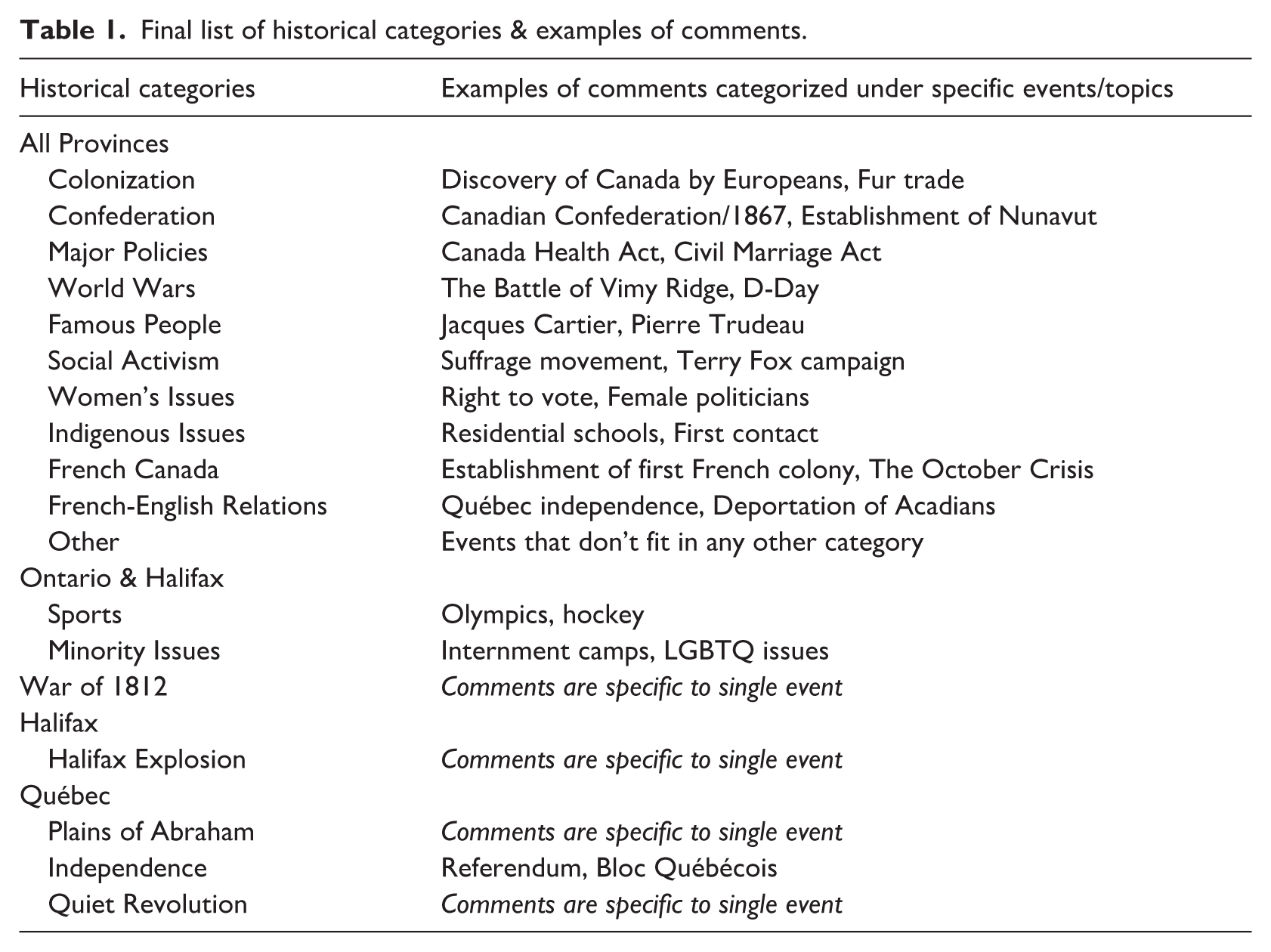
As can be seen from Table 1, it was possible for participant responses to be coded under multiple categories. For example, the following comment would have been coded under Major Policies, Women’s Issues and Social Activism: ‘When women won the right to vote: After the efforts of the women involved in the sufferage [sic] movement, parliament decided to take their opinions and demands to mind and agreed to let women vote’. Furthermore, all participants provided up to three comments and it was possible for these to be coded with a given category more than once. For instance, in the Québec data, many of the events participants mentioned were specific to French Canada and as a result, a single participant may have been coded for French Canada three times, once for each comment. Given the nature of our data (three comments per individual) and our coding process (the allowance of multiple codes per comment), we decided to present the frequency of events per respondent. That is, we have removed any redundancies, so if a participant mentioned an event related to the World Wars in each of their three comments, we would only count that event once for that person. As such, Figure 1 and Table 2 represent the percentage of participants in a province whose comment was placed in a given category at least once (e.g. in Québec, 50% of the participants mentioned something related to colonization).
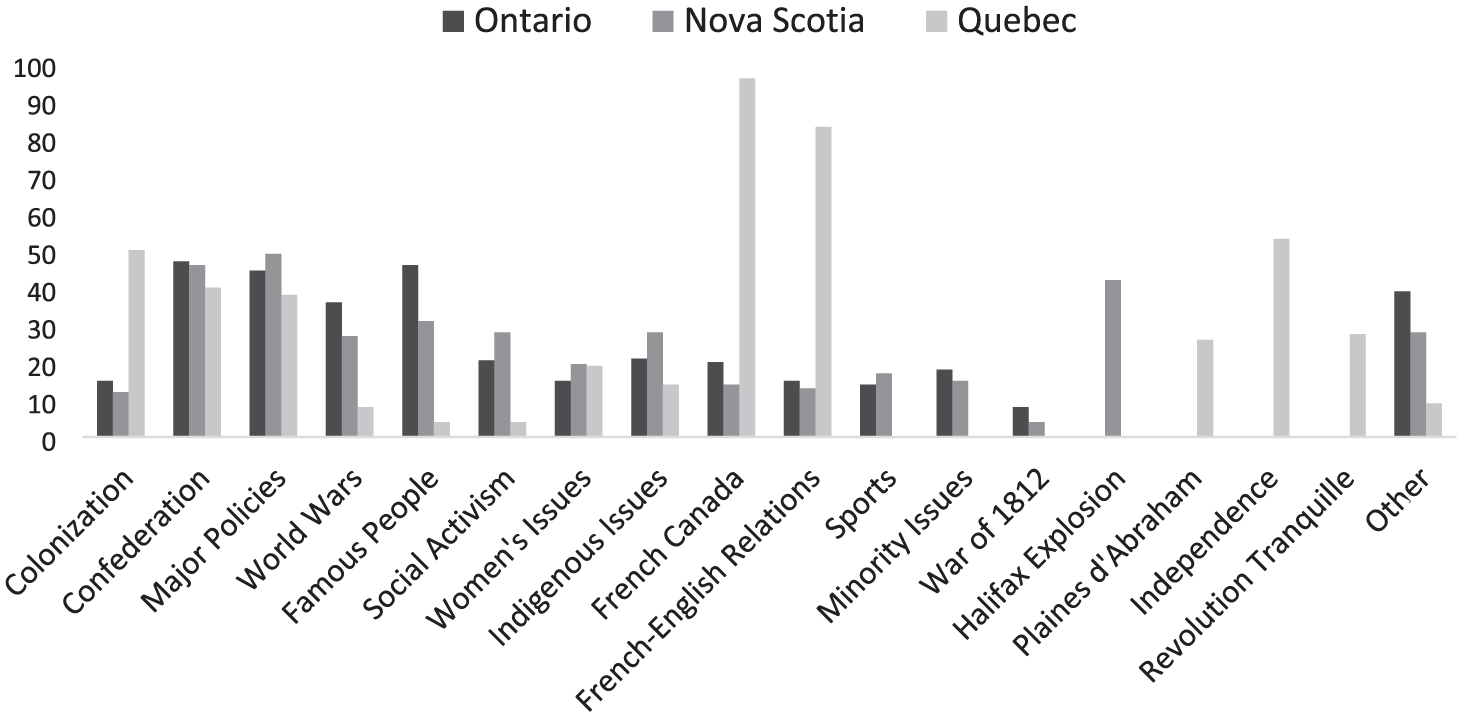
The percentage of participants who were coded into a given category at least once, per province.
Top 10 most frequently mentioned categories per person per province.
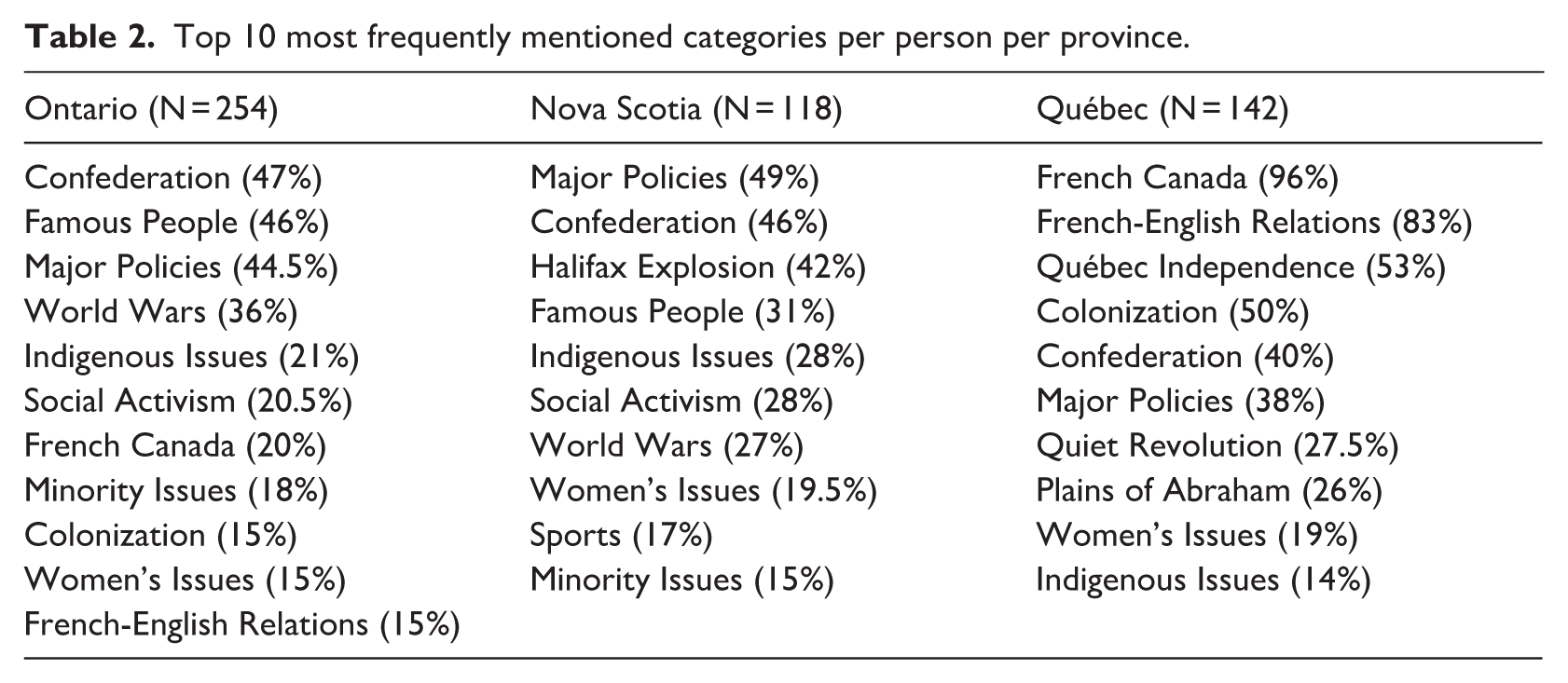
Table 2 provides a list of the top 10 most frequent categories by province. There was more uniformity in Québec compared with the other provinces. Almost all the Québec participants mentioned at least one event or topic related to French Canada, the vast majority included an event related to French-English relations, and over half mentioned Québec’s Independence. By comparison, in Nova Scotia and Ontario, a few topics came close to 50% but none surpassed that mark. In both Ontario and Nova Scotia, close to half of the participants mentioned confederation and major policies. In Ontario close to half also mentioned famous people in their comments while in Nova Scotia, the Halifax Explosion was mentioned more frequently than famous people. Altogether, the Nova Scotia and Ontario groups show similar patterns, whereas many of the popular topics coming from the Québec sample tended to be Québec-specific.
Between-province comparisons of historical events
Chi-square analyses were conducted on each category to offer a statistical analysis of the differences between provinces. As can be seen in Figure 1, there were three categories that Québec participants were more likely to mention than the other provinces. The first is colonization, χ2(2) = 73.679, p < .001 (V = .38). Both Ontario and Nova Scotia participants were similarly unlikely to indicate colonization as one of the three most important events in Canadian history. Québec participants, on the other hand, were much more likely to mention it, with half mentioning it at least once. Unsurprisingly, Québec participants were also more likely to mention events related to French Canada (χ2(2) = 265.29, p < .001, V = .71) or French-English relations (χ2(2) = 219.63, p < .001 (V = .65). Indeed, 96% of the participants in the Québec sample indicated at least one event related to French Canada was among the most important, compared with 20% in Ontario and 14% in Nova Scotia.
There are several other instances where Nova Scotia and Ontario are much closer to one another than either are to Québec. For mentions of the World Wars, χ2(2) = 35.305, p < .001 (V = .26), Ontario had the highest percentage of mentions (36%) followed by Nova Scotia (27%). Comparatively, a much smaller number of participants mentioned either of the World Wars in Québec (8%). A similar pattern was found for how often participants mentioned a famous person in their comments, χ2(2) = 77.167, p < .001 (V = .39). Almost half of the Ontario participants and a third of the Nova Scotia participants mentioned a famous person in one of their comments. In Québec, however, a famous person was only mentioned by 4% of the participants.
There were also significant differences in Social Activism, χ2(2) = 27.571, p < .001 (V = .23), this time with Nova Scotia having the most instances (28%) followed by Ontario (20.5%) and once again with Québec being much lower than the other two groups (4%). A similar pattern was found for Indigenous Issues, χ2(2) = 7.605, p = .022 (V = .12), with Nova Scotia again having the highest percentage (28%), followed by Ontario (21%), and finally Québec (14%).
The three groups did not differ in terms of how many participants mentioned confederation (V = .07), major policies (V = .08) or women’s issues (V = .06). Likewise, Nova Scotia and Ontario did not differ in any of the three categories unique to them: sports (V = .04), minority issues (V = .04) and the War of 1812 (V = .07).
History quiz
Means for the accuracy and bias scores can be found in Table 3. Overall, accuracy was quite low for all three groups, all scoring an average of 9/16 (or 56%) correctly. The bias scores were above the midpoint for all three groups, indicating that across the groups, participants tended to have a more biased view of history, wherein they were somewhat more likely to perceive of glorifying events as true and critical events as false. ANOVAs were run to test for group differences for accuracy and bias, but they were found to be non-significant. We also looked at the relationship between Canadian identity and accuracy and bias. There was a moderate negative relationship between Canadian identity and accuracy for the Québec (r = -0.19, p = .03) and Ontario (r = -0.13, p = .04) samples, but no relationship for the sample from Nova Scotia (r = -.01). Thus, participants from Québec and Ontario with a higher sense of Canadian identity were more likely to do worse on the quiz, indicating lower levels of knowledge for Canadian historical events. All three groups did show a positive relationship between Canadian identity and bias: Ontario (r = 0.16, p = .01), Québec (r = 0.10, p = .26) and Nova Scotia (r = 0.13, p = .17), though due to its larger sample size, only the Ontario group’s correlation is statistically significant. This suggests there may be a pattern whereby those who have a stronger Canadian identity are more likely to have a more biased view of historical events (i.e. they are more likely to believe that glorifying events are true as compared with critical events).
Identity, accuracy and bias scores.
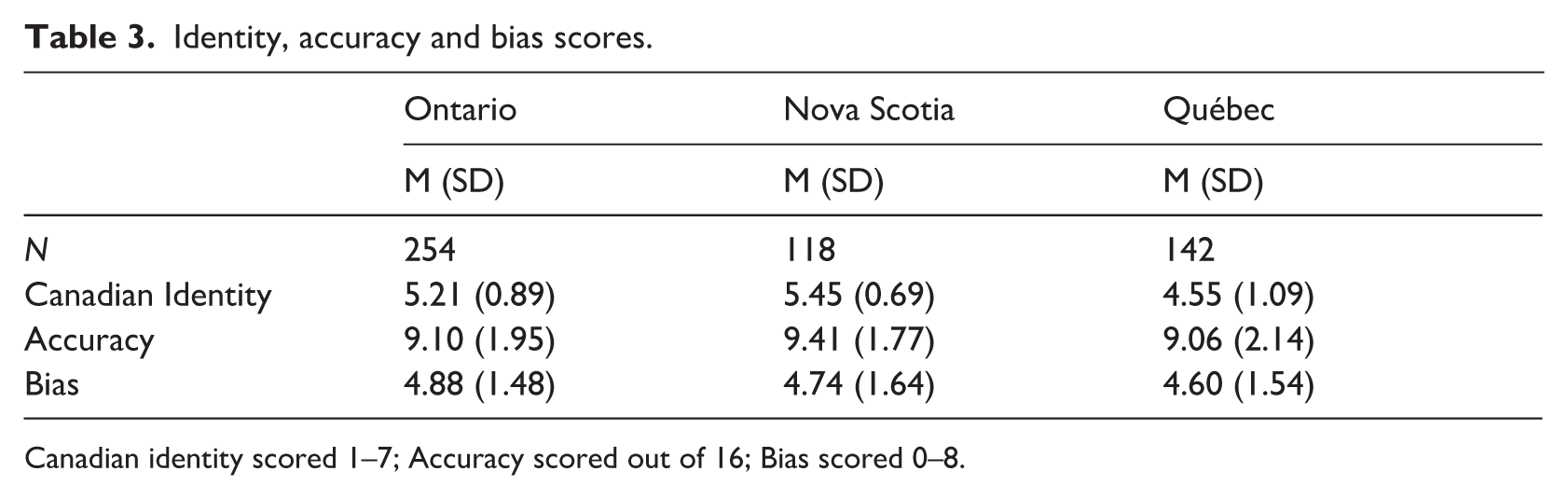
Canadian identity scored 1–7; Accuracy scored out of 16; Bias scored 0–8.
Discussion
In this study, we assessed the social representations of Canadian history among three distinct regional-linguistic groups within Canada: Québec, Ontario and Nova Scotia. Our samples consisted of undergraduate students most of whom had recently finished their high school education in Canada, giving us insight into the social representations of history that were prominent in their education and the collective memories they developed through general cultural osmosis. We also considered how these groups’ knowledge of specific events from Canadian history was intertwined with identity concerns, finding evidence for a slight glorification bias that is related to Canadian identity.
Social representations of Canadian history
Previous research on social representations of history has consistently found themes of war, major political events and nation building to dominate the narrative. In general, our study suggests that Canadians’ views of history also tend to centre political issues and nation building, but war is less frequently mentioned, and events that align with Canada’s modern-day progressive narrative are prevalent. There are, however, notable provincial differences in this pattern. When considering these provincial differences, it is important to keep in mind a major difference in the surveys completed by our English-speaking and our Québécois participants, whereby the latter were instructed to consider historical events related to Canada or Québec, while the former were only asked to consider events related to Canadian history. We will discuss this limitation in more detail later, but it is important that our results be interpreted with this in mind.
Confederation was among the most frequently recalled topics in Ontario and Nova Scotia and while it was fifth on the list for Québec participants, it was mentioned by 40%, indicating its relevance if not its pre-eminence. As an alternative to Canadian confederation, events related to Québec’s independence were mentioned by over half of the Québec participants, suggesting that nation-building is important, but insofar as it relates to Québec, not Canada. If anything, the fact that confederation was not mentioned more frequently is notable. Less than 50% of all participants indicated it as one of the most important events in Canadian history despite its definite inclusion in all Canadian curriculums. This finding perhaps speaks to the relevance of other cultural tools, outside of curriculums and textbooks, for fomenting historical narratives. It may also speak to the lack of perceived drama surrounding Canada’s confederation which does not make it a particularly emotionally laden event compared with the nation building projects in other cultures, or indeed the nation-building of Québec. This could make it less notable to Canadians at the undergraduate level and less likely to maintain a prominent place in the collective consciousness due to its low emotional impact.
Another unique finding among Canadian social representations of history is a lack of focus on war. In Ontario and Nova Scotia, the only prominent mention of wars referenced World Wars I and II, but these mentions were infrequent. In Québec, on the other hand, there was even less reference to the World Wars, but the Battle of the Plains of Abraham (a decisive battle that preceded the dominance of the British in Canada) was highlighted with some frequency. This latter battle was never mentioned by the other two groups despite its importance in shaping the future of the country. In spite of the differing focus on wartime events, our participants from all three provinces do not seem to count war as a major factor in Canadian history. Unlike those from the two English-speaking provinces, however, our Québécois participants do show a stronger spirit of revolution and conflict (between the French and the English) in their collective memories, highlighting events related to colonization and the Quiet Revolution (a transformative period in Québec’s social and political organization which largely moved power that had been held by the Catholic church into the hands of the state). This focus on nation-building and conflict within Québec speaks to the importance of Québec’s historical and continuing struggle to protect their culture and language within Canada (see Lalonde et al., 2016) and is consistent with others studies that have focussed on historical memories or narratives in Québec (Bougie et al., 2011; Gani, 2014; Létourneau, 2006, 2014; Létourneau and Moisan, 2004), highlighting the strength and persistence of the Québécois narrative.
For Ontario and Nova Scotia, rather than focus on war and nation-building, the recalled events seemed to reflect the progressive nature of Canada’s contemporary politics. The most common category in Nova Scotia (third in Ontario, sixth in Québec) was major policies. This category reflected all kinds of policies unrelated to confederation or state-building within Canada, such as the Canada Health Act, the Canadian Multiculturalism Act and the Civil Marriage Act. In general, the narrative that coheres these acts focuses on the progressive nature of Canada’s politics (universal healthcare, promotion of multiculturalism, protection of LGBTQ rights). In Nova Scotia, issues related to Indigenous people and mentions of social activism were more frequently recalled than either world war. It is perhaps not surprising that a country that promotes messaging about multiculturalism and progressivism has established a historical narrative less focused on war and conflict, and more on progressive policies and movements that have heralded social changes.
It is interesting to place these results in the context of another study that was conducted recently on Canadian history teachers from across Canada, from elementary to college and university level educators, which asked them to rate a list of 100 historical events in terms of their significance to Canadian history (Gibson et al., 2022). The highest rated event across all participants was Canada entering WWII. The top 12 events following from this (in order of rated significance) were the Indian Act, WWI, the Great Depression, residential schools, confederation, the Canadian constitution, Louis Riel and the Red River Resistance, women winning the right to vote in Manitoba provincial elections, status Indians being given the right to vote, universal health care and Japanese internment. While the Gibson study did not consider regional differences specifically, they did look at differences between English- and French-speaking participants (who largely taught outside and inside of Québec respectively) and they noted discrepancies between the two groups. Francophone teachers tended to consider events like European contact and colonization, military and political upheaval and events related to Québec of particular importance, while Anglophone teachers see events related to Indigenous peoples, migration and immigration and more social aspects of history to be of particular significance. This aligns strongly with our results, showing a consistent pattern of narratives among educators and those they educate.
Variability and distinction in collective memories
Our findings show that there was a great deal of variety in the events and topics recalled, both within and between provinces. While Ontario and Nova Scotia had a lot of categories in common between them, none of the events or topics were recalled by more than 50% of the participants and only seven were recalled by more than 20% of the participants. There was more consistency among our Québec participants, who had four categories that were recalled by more than 50% of the participants. Despite this higher internal consistency, they did not show much commonality with our two English-speaking samples. While this does align with findings from previous literature and our prediction that there would be a marked distinction between the events recalled by our Québec participants and those from our Ontario and Nova Scotia participants, we must also consider that this difference may be an artefact of the different survey instructions between our groups. Regardless, it does seem to suggest that there may be more consistency in the Québécois collective memory than there is for Ontarians and Nova Scotians, who may have a more vague and disparate sense of Canadian history. Though, our chi-square comparisons highlight that Ontario and Nova Scotia participants’ disparate sense of history is similarly structured for both groups.
All three groups discuss women’s and Indigenous issues; however, our Québécois participants do not discuss issues related to other minority groups. This finding was essentially predicted decades ago by Tajfel and Turner (1979) in their seminal work on Social Identity Theory where they used Québec as an example of some of their theoretical principles. They argued that as Québec gained a more assertive identity in Canada, the province became less keen on other minority groups within the country as a means of bolstering their own status. In other words, minority groups who share a superordinate identity may compete with one another for status and as a means of positive social identity maintenance. Our findings do seem to suggest that people from Québec are more concerned with their own distinctiveness and footing on the national stage and thus pay less attention to other minority groups in Canada (see Lalonde et al., 2016). Those from Ontario and Nova Scotia, on the other hand, don’t feel the same threat and so can more readily attend to the narratives of multiple minority groups. Gani (2014) similarly found that Québecois respondents focussed more on cultural duality (French vs English), whereas respondents from other Canadian provinces focussed more on cultural diversity in their historical narratives.
Biased historical narratives
In addition to this catalogue of collective memories, we also found interesting patterns related to knowledge of specific historical events and bias. In general, our participants did not do well on our Canadian history quiz, with a pass rate not much higher than chance. Such assessments of knowledge are limited in scope, and we should be hesitant to draw conclusions of general knowledge of Canadian history from the results of this quiz. However, the bias scores produced from this quiz are certainly worthy of further consideration. Despite participants’ generally low accuracy rate on the quiz we still observed a moderate yet consistent pattern of glorification bias across all three groups, a positivity bias which aligns with previous findings (e.g. Mukherjee et al., 2017). The items that reflect this bias were similar to the events recalled by our participants (e.g. Indigenous issues, minority issues, progressive policies). Notably, this glorification of Canada did not highlight valour during wartime or revolutionary conflict as it might in other nations, but rather Canada’s progressivism (e.g. acceptance of refugees). This suggests that the events that are emotionally laden for Canadians are not war and conflict (Paez et al., 2016[2015]), but those that enshrine Canada as a peaceful, progressive, multicultural nation.
As predicted, and in line with Social Identity Theory, we also observed evidence of a relationship between this progressive glorification bias and Canadian identity, whereby the higher an individual’s Canadian identity, the stronger their glorification bias. This relation was moderate for all three groups and was only statistically significant for our Ontario participants, but it does align with previous findings that have linked high identity with recall of positive or glorifying events (Choi et al., 2021; Liu et al., 2020; Mukherjee et al., 2017), suggesting a robust finding for this effect. Such findings suggest the value of a historical positivity bias in terms of bolstering national identity. That is, it is likely easier to foster a strong sense of national identity when that identity is positively framed, and history is one tool which stakeholders may be inclined to utilize to this end.
Finally, we also found a negative correlation between accuracy and Canadian identity, whereby those in Ontario and Québec who were higher in Canadian identity provided a less accurate awareness of the historical events presented in our quiz. Previous studies suggest that people’s cultural contexts can diminish their accuracy of historical knowledge if that knowledge is at odds with their social identity (e.g. Abel et al., 2019) or undermines a positive group identity (e.g. Nelson et al., 2013). It follows that accuracy and bias are likely related in maintaining a positive identity, whereby in order to maintain a biased narrative, accuracy is necessarily diminished. Although our assessment of knowledge in this study was limited by the true/false quiz format, the consequences of lessened accuracy and increased bias for the sake of national identity offer an important line of future inquiry.
Limitations and future directions
The greatest limitation in this study lies in the complexity of making cross-cultural comparisons using blunt quantitative assessments. As discussed in the methods, cultural translation issues occurred when transcribing the survey from an Anglophone Canadian context to a Francophone Québec context. During piloting of the study in Québec, we discovered that participants were frequently confused about the content they were being requested to provide when asked to list what they considered to be the most important events in Canadian history. To many, asking about Canadian history meant history not related to Québec specifically. In other words, they automatically drew a distinction between Québec and Canadian history which was not drawn among our participants from Ontario and Nova Scotia. In order to ensure a fulsome response from our Québec participants that incorporated history from both Québec and Canada, we made an amendment to their survey instructions which requested them to indicate the events they considered most important to Canada’s or Québec’s history. Unfortunately, this amendment could not be made to the Nova Scotia or Ontario surveys, as these had already undergone collection at the time when Québec data collection was underway. Certainly, this difference in survey instruction is a major limitation that may have influenced how Québec participants responded to the prompt compared with Ontario and Nova Scotia participants and may help to account for the large number of Québec-focused events in that group.
We believe, however, that this is not just a limitation of our particular study. Rather, it is a limitation relevant to all cross-cultural research and in itself is a remarkable finding. From the outset, our goal was to assess variations in collective memories among Canadians from distinct regional-linguistic backgrounds. We do not feel that this discrepancy in instructions undermined our findings, but in fact provides evidence for the very phenomenon we wished to capture: the collective memories one possesses rely heavily on the cultural context and cultural tools available to them. That participants from Québec drew a line between Canadian and Québécois history that our English-speaking participants did not, highlights the comparatively prominent Québécois identity and perspective. As such, we believe that even if this amendment had been made to the English-province data (e.g. record the most important events in Canadian or Ontarian/Nova Scotian history), it is unlikely to have influenced the responses as strongly as it did the Québec participants as these groups do not have as strong a sense of regional identity or as clear an attachment to its history as the Québécois do for Québec. Evidence of this can be found in the book ‘Canadians and their Pasts’ (Conrad et al., 2013) which presents the results of a national survey of Canadian adults on their attitudes towards and interest in history. Survey respondents from Québec considered the history of their province to be more important than the history of Canada, while respondents from Nova Scotia seemed to consider both being of similar importance, and participants from Ontario viewed the history of Canada as more important than the history of their province. Gani (2014) also reported that when Québecois respondents were asked to summarize the history of Canada in a few phrases, they primarily wrote about the history of their province. While perhaps somewhat incomplete, we still believe the responses contained within our study constitute an important contribution to the understanding of social representations of history both within Canada and more broadly by highlighting the diversity of narratives that can exist within a country.
As mentioned previously, a great deal of work has been done on the historical narratives of young Anglophone and Francophone students in Québec and French-speaking parts of Ontario. The findings from our Québécois participants largely aligns with this literature, while the incorporation of data from Ontario and Nova Scotia and the comparison among all three groups, as well as the assessment of bias and identity, adds a novel contribution to this already substantial body of work. However, this is still a very limited assessment over such a nationally diverse and complex country. As the results of the Canadians and their Pasts survey indicates, distinctions can be made between at least five regional groups in Canada, between urban and rural populations, between first-generation and native Canadians and between various First Nations and Acadian populations, just to name a few. Newfoundland and Labrador, for instance, shows just as much national distinctiveness as Québec (if not at times more) in terms of the historical value and strength of identity participants ascribe to provincial rather than Canadian matters (Conrad et al., 2013). It will be important for future work to continue adding to this body of literature in the Canadian context specifically by considering the perspectives and historical narratives of all the sub-national and cultural groups that make up this country. Indeed, this work highlights the importance of considering the perspectives of notable regional and cultural groups within any geopolitical nation state when investigating historical narratives at a country level.
Conclusion
In this paper we provide a rich dataset that highlights the prominent categorizations of historical events shared by undergraduate Canadians from three provincial groups: Ontario, Nova Scotia and Québec. We found that our Québécois participants tended to prefer events centred around Québec, whereby a narrative of Québec nation-building and struggle for maintaining Québécois cultural identity and language emerged. Nova Scotians and Ontarians showed a great deal of parity in their responses, where recall of wartime events or conflict in general was minimal and the types of events that were recalled tended to coincide with the popular current-day narrative that Canada is a progressive, multicultural country. Despite these differences between our Anglophone and Québécois participants, we found that all participants, regardless of provincial group, showed a slight glorifying bias of Canadian history, whereby they prefer historical events that paint Canada in a positive progressive light. Furthermore, this bias showed some association with Canadian identity, whereby a stronger sense of identity was related to a stronger bias. Altogether these results paint a picture of the types of historical charters promulgated throughout Canada and the types of events that hold emotional resonance with undergraduate Canadian students. It also highlights the role historical narratives play in identity maintenance, reinforcing the need to attend to our social representations of history as a means of understanding our current-day perspectives, biases and identities.
Supplemental Material
sj-docx-1-mss-10.1177_17506980261425563 – Supplemental material for Social representations of Canadian history
Supplemental material, sj-docx-1-mss-10.1177_17506980261425563 for Social representations of Canadian history by Jessica K Padgett, Glenn Adams, Maya A Yampolsky, James E Cameron, Jorida Cila and Richard N Lalonde in Memory Studies
Footnotes

Ethical considerations
This study received ethical approval from three universities: York University Human Participants Review Committee (approval no. 2017 – 021) on 01/18/17 and renewed approval was provided on 01/08/18; Université Laval comité sectoriel d’éthique de la recherche en psychologie et en sciences de l’éducation (approval no. 2017-078) on 09/27/2017; and Saint Mary’s University Research Ethics Board (approval no. 17-357) on 06/07/2017.
Consent to participate
All participants provided informed written consent prior to completing the online survey.
Consent for publication
N/A
Funding
The authors disclosed receipt of the following financial support for the research, authorship, and/or publication of this article: This work was partially supported by the Social Science & Humanities Research Council of Canada Joseph-Armand Bombardier Canada Graduate Scholarship (application no. 752-2019-2780) which was held by the first author (JKP) during their PhD.
Declaration of conflicting interests
The authors declared no potential conflicts of interest with respect to the research, authorship, and/or publication of this article.
Data availability statement
The datasets generated during and/or analysed during the current study are not publicly available due to constraints imposed by the associated ethic boards and participant consent forms but are available from the corresponding author on reasonable request.
Supplemental material
Supplemental material for this article is available online.
Notes
Author biographies
References
Supplementary Material
Please find the following supplemental material available below.
For Open Access articles published under a Creative Commons License, all supplemental material carries the same license as the article it is associated with.
For non-Open Access articles published, all supplemental material carries a non-exclusive license, and permission requests for re-use of supplemental material or any part of supplemental material shall be sent directly to the copyright owner as specified in the copyright notice associated with the article.
