




Abstract
The auditory dimension of memory offers a compelling lens for understanding how Sri Lankan migrants in Melbourne reconstruct cultural memory and belonging through everyday sound practices. The study draws on collaborative arts-based methods – including sonic ethnography, autoethnography and a/r/tography (the interconnected practice of artist, researcher and teacher). It involves the co-production of a sound artwork by participants entitled ‘Sounds from the Past’, involving listening, voice and collaborative composition. It introduces the concept of ‘sonic counter-memory’ to describe how everyday soundscapes function as affective sites of resistance, identity-making and intergenerational transmission. Through three dimensions of anchoring cultural memory, collective sonic practice and sonic sovereignty, the article shows how Sri Lankan migrants in Melbourne create sound practices that challenge dominant cultural soundscapes. The research contributes to memory studies by demonstrating how auditory practices enable new forms of transcultural belonging while maintaining cultural distinctiveness.
Introduction
The Sri Lankan civil war 1 (1983–2009) displaced hundreds of thousands of people, creating significant diaspora communities in countries like Australia, Canada and the United Kingdom (McDowell, 1996; Meier, 2023). This movement accelerated after the end of the White Australia policy in 1958, with many arriving as skilled migrants and refugees, particularly following the 1983 anti-Tamil riots known as ‘Black July’, 2 which marked a significant escalation in ethnic tensions in Sri Lanka (Cheran, 2003; Fuglerud, 1999). By June 2024, nearly half of Australia’s 172,800 Sri Lankan-born residents lived in Melbourne, forming vibrant and ethnically diverse communities shaped by experiences of conflict, migration and cultural displacement (Australian Bureau of Statistics, 2025; Gamage, 2019). This diaspora carries not only the trauma of war and separation but also the challenge of preserving cultural memory across generations in new urban environments, navigating what Brah (1996) terms the ‘diaspora space’ where multiple subject positions intersect and where questions of home, belonging and identity are continuously negotiated.
This article explores how Sri Lankan migrants in Melbourne use sound to remember, reconstruct and reassert their sense of cultural belonging. Drawing on interview data, sound cartography and a collaborative sound artwork, it explores the role of auditory memory in shaping transcultural identity. In doing so, the article contributes to debates on vernacular memory, mediated post-memory and sensory heritage within diasporic contexts.
The analysis focuses on three key dimensions of ‘sonic counter-memory’:
The anchoring of cultural identity through personal and ritual soundscapes;
The emergence of collective memory through collaborative listening practices and
The assertion of sonic sovereignty within contested auditory environments in both public and private spaces.
Dominant narratives of migrant integration emphasise visual assimilation and economic participation, but the sensory dimensions of cultural memory – particularly sound – remain overlooked. Research on Sri Lankan migrants highlights television viewing, digital media and spatial narratives, yet the role of auditory memory in shaping identity and resistance remains underexplored. Public discourse celebrates visible cultural markers while overlooking embodied sonic practices that sustain belonging. Traditional memory studies’ scholarship (Ernst, 2013; Müller, 2012) has emphasised visual and textual archives, leaving sound’s unique properties as an affective, mobile medium undertheorised in understanding how marginalised communities construct counter-narratives.
Overview of research
Specifically, this article examines Sri Lankan migrants in Melbourne, focusing on families from diverse regional and ethnic backgrounds – Tamil from Jaffna 3 , Sinhala from Kandy and Colombo – whose varied pre-migration experiences converge within Melbourne’s multicultural landscape. The research comprises sound artwork creation and interviews with ten participants from five Sri Lankan migrant families, conducted between November 2011 and January 2012, where individuals and communities engage in dialogue, form opinions and negotiate cultural presence (Fraser, 1990; Habermas, 1989).
The focus of this study is on how soundscapes function. In particular, it questions:
How do soundscapes function as both individual anchors and collective resistance practices in shaping transcultural identity among Sri Lankan migrants?
How does auditory memory operate across the three dimensions of personal cultural grounding, collective spatial assertion and community media activism?
Building on scholarship in memory studies (Hirsch, 1997; Rigney, 2021) and migration research (Vertovec, 2009; Yuval-Davis, 2011), this analysis introduces the concept of ‘sonic counter-memory’, referring to embodied auditory practices that challenge dominant narratives through everyday cultural negotiation. Drawing from sound studies (Feld, 2012; Truax, 2001) and theories of cultural counter-memory (Bold et al., 2002), it is examined how sound’s mobility and affective impact make it particularly effective for forms of cultural resistance that operate below the threshold of formal political action. This research extends McDermott’s (2024) work on ‘transcultural memory’ 4 by demonstrating how auditory practices enable memory-making beyond nation-state boundaries.
This study contributes to memory studies and migration research in three key ways:
It introduces ‘sonic counter-memory’ as a theoretical framework for understanding how everyday auditory practices function as embodied resistance among displaced communities;
It demonstrates how collaborative sound creation reveals ‘emergent collective memory’ – insights about shared cultural adaptation that become visible only through collaborative listening (Conquergood, 2002; Lassiter, 2005; Springgay et al., 2005); and
It shows how auditory practices constitute forms of ‘sonic citizenship’ (LaBelle, 2010) that enable cultural participation in multicultural societies while maintaining distinctiveness.
These findings challenge binary frameworks of assimilation versus resistance by revealing how migrants actively create new forms of transcultural belonging through sound.
The analysis in the next sections reveals how individual nostalgic memories provide foundations for collective practices that create ‘counter-acoustic territories’, culminating in explicit sonic sovereignty through community radio activism that asserts Sri Lankan cultural presence within Melbourne’s public sphere (LaBelle, 2010).
Literature review and conceptual framework
This section reviews key scholarship on cultural memory, migration and sound studies, outlining the conceptual framework that informs this analysis. It positions the examination of the Sri Lankan community’s auditory memories within broader debates on transcultural memory, counter-memory and the politics of belonging, emphasising how sound operates as both a medium of remembrance and a site of cultural negotiation.
Memory, migration and the politics of remembering
Contemporary scholarship in memory studies increasingly recognises memory as both individual and collective, as well as official and vernacular, with particular attention to how marginalised communities construct alternative narratives to dominant historical accounts. Hirsch’s (1997) concept of ‘post-memory’ reveals how traumatic experiences are transmitted across generations through embodied practices rather than conscious recollection, while Assmann’s and Czaplicka’s (1995) work on cultural memory demonstrates how communities actively sustain collective identity through shared symbols, rituals and practices. The term counter-memory originates from Michel Foucault’s (1977) reflections on how marginalised histories resist dominant regimes of truth. For Foucault, counter-memory is not simply remembrance but a critical practice that reconfigures relations between knowledge, power and historical continuity. This study draws on that theoretical foundation, extending the concept into the auditory domain to explore how sound itself can act as a medium of resistance and remembrance within diasporic life. Building on Foucault’s research, scholars like Bold et al. (2002) expand these ideas through frameworks of ‘cultural counter-memory’, understood as embodied, collective practices that challenge dominant histories.
Recent scholarship has extended these insights into migration contexts, where displaced communities must negotiate between homeland memories and new cultural environments. Rigney (2021) and McDermott (2024) show how migrants reconstruct cultural heritage across borders. Yet this work focuses on visual and textual archives, leaving auditory memory largely unexamined – even though sound is uniquely powerful as a mnemonic medium. For Sri Lankan migrants, Gamage’s (2019; 2020) research provides valuable insight into media engagement and diasporic identity, focusing on visual consumption of teledramas and the social interactions around these narratives rather than auditory dimensions of memory (Gamage et al., 2023).
These debates show how memory and migration shape identity. Yet they focus mainly on text, image and space. The next section turns to sound, asking how listening creates belonging and counter-memory.
Sound studies and sonic citizenship
Sound studies provide critical theoretical foundations for understanding how sonic environments shape cultural identity and community formation. Schafer’s (1977) foundational work on soundscape ecology demonstrates how sonic environments constitute meaningful cultural texts, while Truax’s (2001) research on acoustic communication illustrates how sound creates social bonds and collective identity. Sonic ethnography, including Feld’s (2012) ‘acoustemology’ and Samuels et al.’s (2010) ‘sounded anthropology’, uncovers forms of cultural knowledge that remain inaccessible to conventional ethnography.
The affective and embodied dimensions of listening are central to this research. Nancy’s (2007) emphasises sound’s bodily resonance, Sterne (2003) examines how listening is culturally constructed and Ahmed (2004) explores how emotions circulate through embodied sonic practices to generate forms of belonging. Sound’s mobility and multisensory nature enable forms of memory and resistance that escape regulation, forming what this study terms ‘sonic counter-memory’.
The concept of ‘sonic citizenship’ (LaBelle, 2010) proves particularly relevant for understanding how Sri Lankan migrants participate in Australian multicultural frameworks while maintaining cultural distinctiveness. Building on Yuval-Davis’s (2011) work on everyday bordering, this study understands sonic citizenship as enacted through daily auditory practices rather than through state-centred political participation. Together, these foundational concepts establish the analytical lens through which the sonic practices of Sri Lankan communities are examined in the subsequent sections.
Sound studies demonstrate how listening shapes culture and politics. Building on this, recent work shows that diasporic sound practices create new spaces of belonging. The following section explores this link between sound, memory and migrant life.
Diasporic soundscapes and sonic belonging
Emerging scholarship on diasporic sound practices reveals how migrant communities use auditory experiences to negotiate cultural belonging across transnational spaces. Kun’s (2005) research work on ‘audiotopia’ demonstrates how sound creates alternative spaces of belonging that transcend geographic boundaries, while Saldanha’s (2007) research on electronic music scenes shows how sonic practices enable new forms of cultural citizenship. Recent work by Nataraj and Keightley (2025) on diasporic voice uncovers how singing performances enable migrants to navigate multiple cultural frameworks simultaneously.
Community radio emerges as especially significant, functioning as what Kunreuther (2018) terms ‘democratic performance’ where marginalised voices claim sonic territory within broader public spheres. However, these sonic citizenship practices must be understood within power structures that shape whose voices are heard and how sonic spaces are controlled. Porcello et al.’s (2010) work on ‘cultural acoustics’ reveals how sound technologies and practices reproduce social hierarchies, while Daughtry’s (2015) research on military soundscapes demonstrates how acoustic control functions as a form of cultural domination. For migrant communities, creating sonic territories requires navigating these power dynamics while asserting cultural presence.
Although research in memory, migration and sound studies has expanded understanding of identity, the auditory dimensions of diasporic counter-memory remain underexplored. This article introduces ‘sonic counter-memory’ to explain how auditory practices act as embodied resistance, reveal ‘emergent collective memory’ and contribute to ‘sonic sovereignty’. In doing so, the study underscores how Sri Lankan communities in Melbourne use sound’s affective and mobile qualities not only to preserve but also to transform cultural traditions, generating new forms of transcultural belonging that challenge historical erasure.
The importance of broadcasting
During successive waves of Sri Lankan migration, the growing community established crucial infrastructure to maintain cultural connections while navigating integration into Australian society. Community radio development began in 1979 with 3EA 5 , expanded by Dr Karu Liyanarachchi, and by 1985–1989 evolved into Special Broadcasting Service (SBS) 6 and 3ZZZ 7 Sinhala-language programmes that became essential platforms for cultural preservation (Dissanayake, 2019: 340).
The significance of these early broadcasting efforts was particularly notable in shaping diasporic auditory spaces. Radio enabled the creation of sonic territories accessible from homes, cars and workplaces across Melbourne’s suburban landscape. This accessibility proved vital for a community dispersed across the city, creating shared temporal spaces through collective listening.
Methodology
This study adopts an arts-based qualitative research design grounded in sound ethnography (Samuels et al., 2010), autoethnography (Uotinen, 2010) and a/r/tography (Springgay et al., 2005). As Uotinen (2010) notes, autoethnography offers a means of articulating embodied and affective engagements with media technologies, allowing the researcher’s sensory and emotional experiences to become central to cultural analysis. My father, Austin Munasinghe, was a composer, and the connection with sound and music has been embedded in my life since childhood; this personal grounding informs how I listen, interpret and compose within the research process. The methodology integrates creative practice with reflexive inquiry to explore how auditory memory operates within migrant experiences of belonging. Through combining artistic production, collaborative listening and research analysis, the study positions sound both as a method and as a medium of knowledge.
Research philosophy and positioning
This research employed reflexive, autoethnographic a/r/tography methodology, integrating artistic creation, research inquiry and collaborative pedagogy through sound work. As a Sri Lankan composer, migrant researcher and sound ethnographer, I drew on both insider residual cultural knowledge (Williams, 1977) and collaborative artistic skills to contribute to this research. This positioning enabled the employment of a/r/tography to integrate my dual identity as both cultural insider and academic researcher, facilitating collaborative knowledge creation where participants became co-creators rather than passive research subjects.
The collaborative nature of a/r/tographic practice (Springgay et al., 2005) helped distribute interpretive authority among all participants, with participants making decisions about which memories to include, how sounds should be layered and what meaning the final artwork should communicate. This approach proved particularly valuable for migration research because it enabled participants to engage memory affectively and creatively, especially where verbal articulation proved insufficient for capturing embodied experiences of displacement and belonging.
All interviews and sound recordings were conducted with informed consent under the University of Melbourne’s Human Research Ethics guidelines. Participants are referred to by pseudonyms unless they are public figures or explicitly consent to being identified. Identifying details have been modified where necessary to protect confidentiality while maintaining ethnographic and cultural accuracy.
Participant recruitment and family-based sampling
Melbourne’s Sri Lankan community reflects the island’s own diversity, including Tamil populations from Jaffna, Sinhala populations from Kandy and Colombo, as well as Burgher and hill-country Tamil groups.
Participants were recruited through community networks and snowball sampling, beginning with contacts at Sri Lankan cultural organisations, temples and community radio stations. The family-based approach proved crucial for understanding intergenerational memory transmission. Families were recruited as units to examine how auditory memories operate differently across generations – from first-generation migrants carrying direct homeland experiences to second-generation participants negotiating inherited sonic memories. This approach revealed how cultural adaptation occurs through family negotiations around sound, radio control and participation in cultural events.
As illustrated in Figure 1, participants originated from diverse regions across the island, reflecting both northern Tamil and southern Sinhala migration trajectories that shaped Melbourne’s diasporic soundscape. The final participant group comprised 10 individuals from five families, representing diverse regional origins, generational positions and migration experiences spanning from the 1970s through the 2000s. This diversity proved crucial for understanding how different regional soundscapes converge within Melbourne’s multicultural space while revealing shared patterns of cultural adaptation.
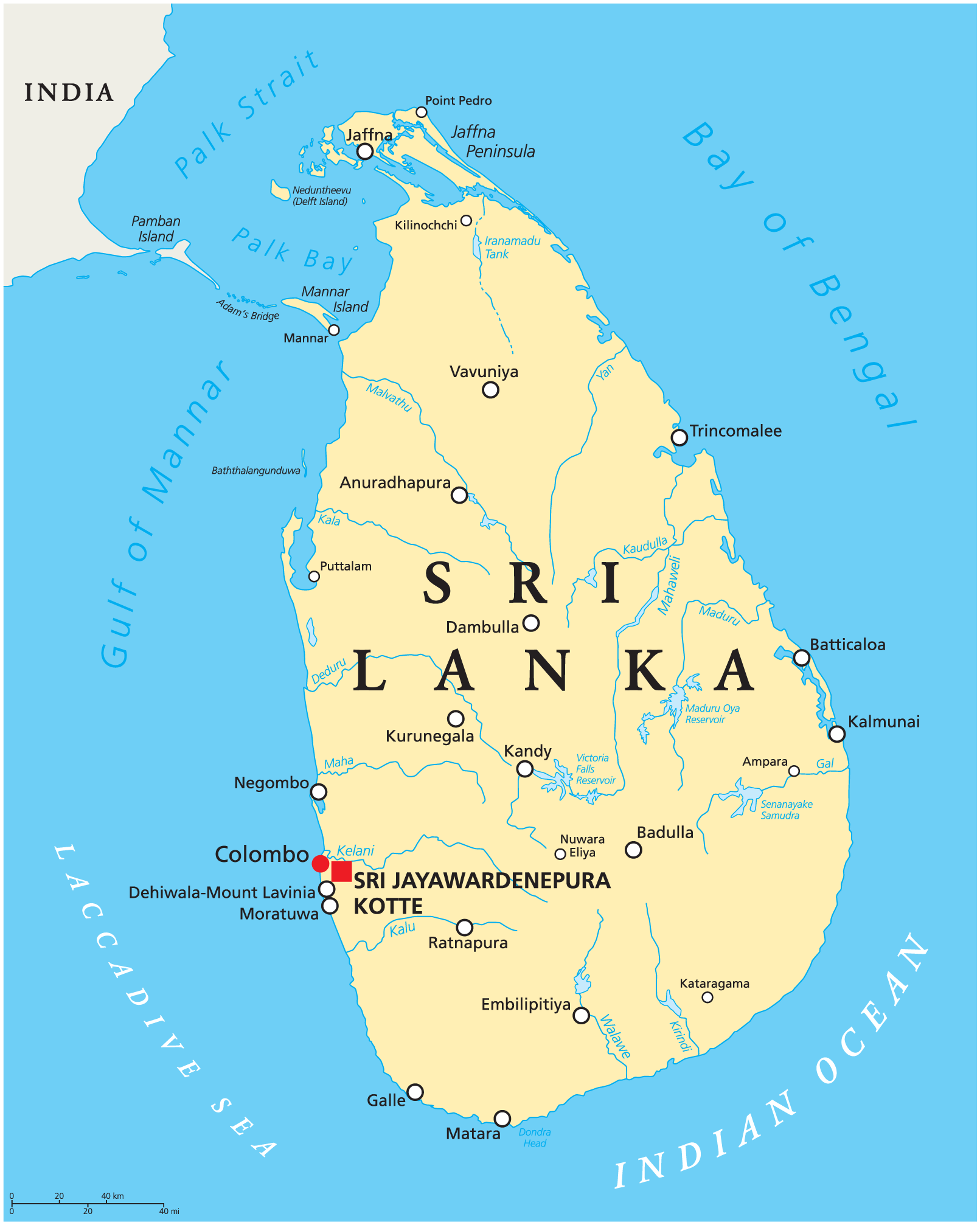
Map of Sri Lanka. © Getty Images/ iStock. Reproduced with permission.
As Figure 2 demonstrates, the participant group spans Tamil and Sinhala speakers from varied regions, full family units and diverse professions, reflecting intergenerational sound practices and skilled Sri Lankan migration to Melbourne.
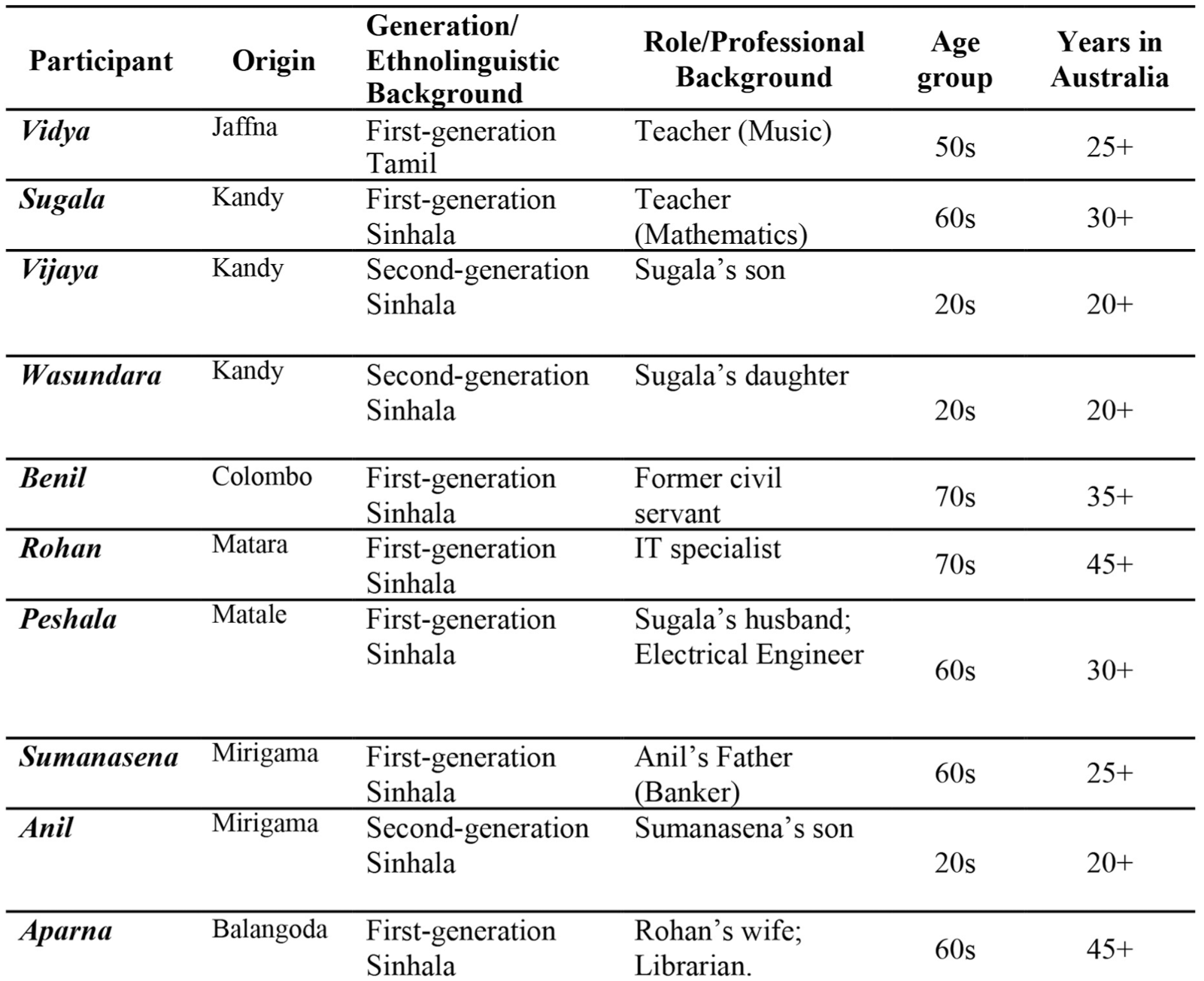
Participant demographics.
Collaborative sound methods
The research involved three interconnected stages that emerged organically through the collaborative process. Individual memory elicitation formed the foundation through in-depth interviews where participants shared childhood and homeland memories, focusing particularly on significant sounds that anchored cultural identity. Rather than simply describing sounds, participants were encouraged to recreate or demonstrate auditory memories, creating ‘sonic sketches’ of remembered experiences (Gallagher, 2014). These personal recollections revealed the intimate ways sound operates as a cultural anchor across displacement.
Building on these individual memories, collective listening sessions brought participants together to share their sound memories with the broader group. These gatherings proved transformative, revealing unexpected connections and resonances between different regional experiences. Participants discovered shared patterns of adaptation and creativity that transcended ethnic and geographic boundaries, generating what this study identifies as ‘emergent collective memory’ – insights about shared cultural adaptation that became visible only through collaborative listening. These sessions typically took place bi-monthly, ensuring that participants maintained regular sonic engagement over an extended period. This regularity helped to strengthen the shared listening experience, allowing memory exchange and collaborative creativity to build progressively across sessions.
The final stage involved collaborative sound artwork creation using digital audio software to layer individual memories into collective soundscapes. Working with participants, the creation of ‘Sounds from the Past’, 8 a 25-minute sound artwork, was facilitated that weaves together temple drums from Kandy, war sounds from Jaffna, urban noise from Colombo and Melbourne’s suburban soundscapes. This creative process functioned as both artistic expression and analytical method, enabling participants to hear their individual experiences within broader patterns of diasporic memory.
Sound operated not merely as illustrative material but as a core medium of memory expression and analysis. The collaborative creation process revealed how individual auditory memories, when experienced in dialogue with others, generate collective discoveries about cultural adaptation and resistance that remain invisible in traditional interview-based research.
Analytical approach
The interpretive process was informed by an autoethnographic sensibility, recognising how my own listening practices and compositional choices shaped both the analysis and the collaborative artwork. Interview transcripts were coded thematically using concepts from memory studies, sound studies and migration research. Reflective memos written after each listening session captured participants’ emotional responses and moments of recognition that emerged through shared auditory experience. The process of layering sounds during the creation of the sound artwork functioned as collaborative analysis, revealing how different temporal and spatial experiences could be held simultaneously within diasporic consciousness. In this sense, the creative process also functioned as an autoethnographic inquiry, where my interaction with recording and mixing technologies became a means of reflecting on how digital tools mediate affective and cultural memory (Uotinen, 2010).
The interpretive process drew on three interrelated dimensions of sonic counter-memory that structure the analysis presented in the following sections. As shown in Figure 3, this conceptual framework comprises anchoring cultural memory, emergent collective memory and sonic sovereignty, which together generate transcultural belonging and cultural resistance among Sri Lankan migrants in Melbourne.
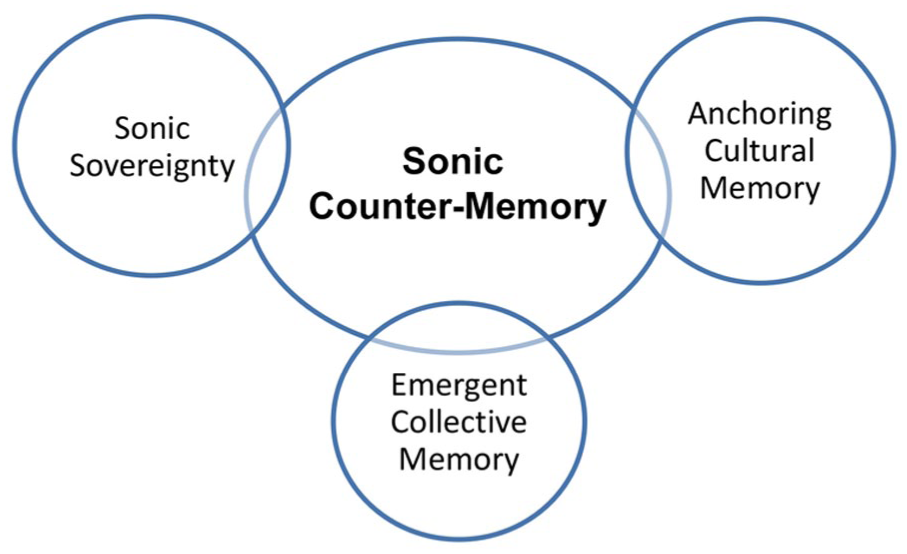
Conceptual framework of sonic counter-memory.
The conceptual framework illustrates the three interrelated dimensions of anchoring cultural memory, emergent collective memory and sonic sovereignty, which together constitute sonic counter-memory and generate transcultural belonging among Sri Lankan migrants in Melbourne.
Empirical findings
The following sections outline key findings from the collaborative sound ethnography (Samuels et al., 2010). Drawing on interviews, listening sessions and the co-created sound artwork, the analysis explores how auditory memory shapes cultural belonging through three dimensions: anchoring, collective memory and sonic sovereignty.
Anchoring cultural memory through personal and ritual soundscapes
Participants consistently described how specific sounds from their homeland regions serve as profound emotional anchors that maintain cultural grounding across geographic displacement. These auditory memories operate as embodied understanding that connects sound, place and identity in ways that resist cognitive processing alone.
Vidya’s recollection of her childhood soundscape in Jaffna illustrates how peaceful auditory memories become particularly precious when disrupted by conflict: The most you will hear is bicycle bell sounds. That’s the most you will hear it. There was no big road like freeway anything like that. You won’t hear any car sound anything like that.
These gentle memories later intertwined with the sounds of war, as she recalled: My teenage memories have lot of gunshots and bombing and all that. We can differently hear for the normal plane and the bomber plane sound. Because you had to know it, when you hear that sound you have to run to the bunker.
Even in Melbourne, auditory memory continued to anchor her sense of belonging. She describes seeking the sound of waves at Brighton Beach as a way of reconnecting with her childhood by the sea in Jaffna: When I was here in Melbourne, especially when I was in university of Melbourne, on my way back home, I would take the Sandringham line train for that reason, just to listen to the waves at Brighton Beach.
For Vidya, the sound of the sea – ‘exactly like the voices in my head’ – became an aural bridge between past and present, transforming listening into an act of remembering.
This layering of peaceful and traumatic soundscapes within individual memory demonstrates how auditory experience carries both cultural grounding and historical trauma. Even in Melbourne, Vidya recalls: ‘I was scared of helicopter sound for a year’. Such responses show how sonic memory operates affectively, transmitted through the body rather than narrative.
Participants from Kandy describe different forms of sonic anchoring embedded in Buddhist ceremonial tradition. Sugala’s profound connection to traditional drumming illustrates how religious soundscapes provide spiritual grounding that travels across borders: One of the most significant events I experienced soon after coming to Kandy was seeing Kandy Perahera (the Festival of the Sacred Tooth Relic of the Buddha). The sound of the up-country drums fascinated me more than anything else in the Perahera.
These ceremonial sounds embody intergenerational knowledge, connecting present experience with ancestral traditions. She further reflected on how deeply music is interwoven with her personal and emotional life: Music had been a big part of my life from day one. Singing, listening and writing lyrics and all the things associated with music were a big part of my life. When I was going through the very difficult periods of my life, music helped me to stay alive. I think if I didn’t have this opportunity to live in this musical environment, my life would have been somewhat empty.
This articulation of music as a life-sustaining force exemplifies the affective dimension of anchoring cultural memory, where sound mediates the relationship between trauma, continuity and resilience. Further, Sugala recalls a memory that illustrates how auditory sensitivity itself becomes inherited cultural capital: My father had a very good ear for music. He could tell from a distance if someone is singing a song and he could tell what the song is about, even from a far distance.
This inherited auditory sensibility represents more than individual talent. It signifies a culturally grounded sensitivity to sound that enables the recognition of traditional musical forms and their social meanings. When relocated to Melbourne, such listening capacities become valuable resources for maintaining cultural continuity while navigating new and unfamiliar environments.
Benil from Colombo describes sonic foundations characterised by cultural mixing and commercial energy. The everyday sound of preparing kottu roti
9
captures urban vibrancy that participants recreate in Melbourne Sri Lankan restaurants and public Sri Lankan events: The sound when you make kottu roti, that metallic sound when the spatulas hit the heated griddle, that takes me straight back to the nights in Colombo Pettah.
These domestic sonic practices demonstrate how everyday sounds become vehicles for cultural transmission that operate independently of formal institutions or community events. The ability to recreate homeland soundscapes within private spaces enables daily cultural grounding that supports participation in broader Australian society.
Peshala reflects on his childhood relationship with radio and how it shaped his understanding of cultural belonging: As a child in Matale, I listened to the radio constantly. The voices of Milton Perera, Mohideen Beg
10
. . . these singers became part of my identity. When I came to Melbourne, the absence of these familiar voices was like losing a part of myself. That’s when I understood how much sound means to who we are.
Similarly, Sumanasena describes his memories of rural soundscapes and their contrast with urban Melbourne: In Mirigama, I could hear everything: the wind whispering through coconut palms, the layered chorus of birds at dawn, and the soft percussion of rain on Cadjan roofs. Each sound seemed woven into the rhythms of daily life, carrying the memory of place and kinship. In Melbourne, too, there are sounds such as trams gliding along tracks, distant traffic, and the hum of electric appliances, yet they speak a different language, one shaped by migration, distance, and adaptation.
Sumanasena’s observation that Melbourne’s sounds ‘speak a different language’ captures the profound challenge of sonic displacement, where familiar auditory environments that once provided unconscious comfort are replaced by foreign urban soundscapes. His experience of having to learn to listen again illustrates how migration involves not merely adapting to new environments but developing entirely new forms of auditory literacy. This process of sonic recalibration demonstrates how homeland soundscapes continue to function as reference points for evaluating new acoustic environments, while simultaneously requiring migrants to develop bicultural listening competencies.
These individual accounts illustrate how regional soundscapes operate as foundational cultural anchors that persist across geographic displacement while requiring constant negotiation and re-negotiation within new urban contexts. The diversity of sonic memories, from Jaffna’s bicycle bells to Kandy’s temple drums to Colombo’s commercial energy, demonstrates how participants carry distinct regional identities that converge within Melbourne’s multicultural space. Yet common patterns emerge across these different experiences: the embodied nature of sonic memory, its resistance to conscious control and its capacity to provide both comfort and challenge within diasporic contexts. These findings demonstrate how individual forms of auditory anchoring provide the foundation for collective practices of cultural assertion and community formation.
Emergent collective memory through collaborative listening
The collaborative listening sessions revealed how individual auditory memories, when experienced in dialogue with others, generate collective insights about shared cultural adaptation that remain invisible in separate interviews. Participants discovered connections across regional and ethnic boundaries that surprised them, creating what this study identifies as ‘emergent collective memory’.
During the collaborative sound creation process, unexpected emotional responses emerged when participants heard unfamiliar sounds from others’ experiences. Sugala’s response to hearing her Kandy temple drums layered with Vidya’s war sounds from Jaffna illustrates this emergent understanding: When I heard my childhood temple sounds with the helicopter noises from the war, I felt something I can’t explain. It was like understanding that we’re all carrying each other’s Sri Lanka, the peaceful parts and the broken parts together. That’s what we brought to Melbourne.
This moment of recognition reveals how collaborative listening enables participants to understand their individual migration experiences as part of broader patterns of displacement and adaptation. The temple drums and helicopter sounds – representing spiritual tradition and military conflict – become recognised as complementary rather than contradictory aspects of Sri Lankan diasporic experience.
Second-generation participants demonstrated particularly complex responses to inherited sonic memory. Wasundara’s journey from teenage embarrassment about her parents’ music to a profound emotional connection illustrates how cultural inheritance operates on delayed temporal rhythms: As a teenager I was so embarrassed when Mum played those temple songs in the car. But during the listening session, when I heard those drums . . . I started crying and I couldn’t understand why. It was like my body remembered something my mind had forgotten.
This delayed recognition of cultural connection challenges linear models of cultural transmission, suggesting that sonic memory operates through embodied channels that may remain dormant before suddenly surfacing through particular auditory encounters. Wasundara’s realisation that she was ‘carrying all these sounds together’ rather than choosing between Sri Lankan and Australian identities reflects how second-generation migrants develop transcultural competencies unavailable to either their parents’ generation or mainstream Australian peers.
The layering process during the creation of a soundscape revealed shared strategies for creating music from available materials that transcended regional differences. Participants recognised common approaches to improvisation and adaptation – whether using makeshift drums, environmental sounds or radio broadcasts – that demonstrated collective cultural resilience. As Benil reflected, When we layered all our sounds together, I could hear that we all had this same thing . . . we all found ways to make music even when we didn’t have proper instruments. That’s something Sri Lankan, I think.
This discovery about shared adaptive strategies became evident through the collaborative listening experience, demonstrating how creative methodologies can reveal collective cultural knowledge that individual interviews cannot access. The recognition of common resourcefulness across different regional backgrounds suggests that diasporic identity emerges through shared practices of creative adaptation rather than common geographic origins.
Sugala, reflecting on the intergenerational transmission of cultural knowledge, explains his motivation for preserving sonic traditions: Because I want my children, whether they’re growing up here or in Melbourne . . . to understand where they come from . . . because I haven’t taught them personally, they have to pick it up . . . The sounds, the music, the language of our prayers, these are the threads that connect us across time.
Sugala’s metaphor of sounds as ‘threads that connect us across time’ encapsulates how sonic practices function as intergenerational bridges that transcend formal pedagogical structures. Her acknowledgement that children ‘have to pick it up’ rather than being explicitly taught reveals how cultural transmission operates through ambient exposure and embodied absorption rather than conscious instruction. This process of cultural inheritance through sonic immersion demonstrates how second-generation migrants develop cultural competencies that may remain unconscious until activated through specific auditory encounters.
The collective practices as described in this section reveal how collaborative listening creates opportunities for cultural discovery that exceed individual memory work. Through shared sonic experiences, participants developed what this study terms ‘emergent collective memory’ – understandings about cultural adaptation and resilience that became visible only through collaborative engagement (Halbwachs, 1992; Olick, 1999). These findings demonstrate how ‘sonic counter-memory’ operates not merely through individual nostalgia but through active community practices that generate new forms of transcultural knowledge while maintaining connections to homeland traditions.
Asserting sonic sovereignty in public and domestic soundscapes
The third dimension of ‘sonic counter-memory’ operates through community practices that assert Sri Lankan cultural presence within Melbourne’s public sphere, creating what this study terms ‘counter-acoustic territories’ that challenge dominant soundscapes while claiming space for cultural difference (LaBelle, 2010).
Community radio emerges as the most explicitly counter-mnemonic practice, enabling direct intervention in Australian mediascapes. The establishment of Sinhala programming demonstrates active resistance to cultural erasure through media infrastructure creation. Rohan’s involvement in establishing Sinhala broadcasting hours at SBS illustrates this as a conscious political strategy: We felt that it would help our cause if we had a radio program of our own here. We began to imagine how meaningful it would be if we could actually make it happen.
As discussed earlier in relation to other diasporic sound-making practices, these radio initiatives form part of a broader strategy that spans public performances, domestic listening and collaborative cultural events. Together, these interconnected practices assert Sri Lankan presence within Melbourne’s multicultural soundscape while simultaneously fostering spaces for cultural adaptation. Radio thus sits alongside public performance and domestic sound practices as part of an interconnected strategy for asserting Sri Lankan presence within Melbourne’s multicultural soundscape. This infrastructure creation represents community control over mnemonic production and circulation that operates independently of state-controlled institutions. Interviewees described the launch of SBS Sinhala programmes in 1985 as a crucial means of sustaining cultural ties while affirming their visibility in Australian media.
Sugala’s emotional response to hearing the Sri Lankan national anthem on community radio illustrates the affective power of achieved sonic sovereignty: I remember listening to this programme for the first time and having tears and goose bumps when they played the National Anthem of Sri Lanka. Then I realised how much I had missed all that. That was a very emotional moment.
This emotional response signals more than nostalgia – it represents the successful assertion of cultural presence within Australian mediascapes that had previously excluded minority voices. The tears and physical response indicate recognition of achieved sonic sovereignty, where community-controlled media enables cultural expression that challenges dominant broadcasting paradigms.
Public cultural events demonstrate how private sonic practices expand into collective spatial assertion. Sugala’s organisation of Vesak Bhakthi Gee
11
events illustrate how community members use shared musical knowledge to create public performances that claim space within Melbourne’s cultural calendar: In 1993 we did a huge Vesak Bhakthi Gee event . . . We had a group of about 40 people to whom Saman and I taught Bhakthi Geetha . . . A few thousand people attended this event and even one of the Australian radio channels talked about this that night as they had never seen such a big crowd of Sri Lankan people gathering together in Springvale.
The surprise expressed by Australian media reveals how these collective practices make visible cultural communities that might otherwise remain invisible within dominant representations of Australian multiculturalism. These events function as sonic citizenship by demonstrating Sri Lankan cultural presence to both community members and broader Australian audiences, claiming belonging through cultural sound production rather than conventional political participation.
Domestic sonic practices also operate as daily resistance that asserts cultural presence within private spaces while preparing for public participation. Rohan’s systematic collection of Sri Lankan music represents more than personal enjoyment – it constitutes cultural infrastructure that enables broader community activities: I brought cassettes of Pandit Amaradeva, Victor Rathnayake, and Nanda Malini
12
etc. . . . I bought heaps of music cassettes every time I went to Sri Lanka. It helped immensely in starting a radio programme here and provided us with an opportunity to get acquainted to Sinhala music constantly once again.
This daily engagement with homeland music provides the foundation for collective activities that assert Sri Lankan presence within Melbourne’s multicultural landscape. The progression from private listening to radio programming to public events demonstrates how domestic cultural maintenance enables broader forms of sonic sovereignty.
Discussion
This discussion examines how the sonic practices and narratives emerging from this research reframe migration not as a process of cultural loss but as an active negotiation of identity and belonging. By analysing participants’ creative listening practices, it highlights how auditory memory unsettles established frameworks of assimilation and nostalgia.
Challenging assimilation narratives
The findings of this study fundamentally challenge dominant narratives of migrant assimilation by revealing how auditory memory operates as active resistance rather than nostalgic retreat. The research shows how sonic practices resist simplistic trajectories from cultural preservation to assimilation. The discovery that participants create ‘counter-acoustic territories’ within Melbourne’s urban environment reveals migration as a process of active cultural negotiation rather than passive adaptation (LaBelle, 2010).
The concept of ‘sonic citizenship’ emerges as particularly significant in challenging conventional understandings of belonging and identity (Hirschkind, 2006; Pakulski, 1997; Rosaldo, 1997). Disparate formal citizenship, which depends on legal recognition and political participation, sonic citizenship operates through everyday auditory practices that assert cultural presence while negotiating new forms of belonging. This finding extends Yuval-Davis’s (2011) work on everyday bordering by demonstrating how cultural boundaries are maintained and crossed through embodied sonic practices rather than formal political processes.
Contributions to memory studies
The tripartite framework of ‘sonic counter-memory’ provides new analytical tools for understanding how marginalised communities resist historical erasure. Sonic memory resists regulation in ways that visual and textual archives cannot, operating through lived, embodied experience rather than official channels. This finding extends recent scholarship on ‘counter-memory’ by positioning sound as uniquely effective for resistance work that operates below the threshold of formal political action.
The research illustrates how:
Diasporic spaces can generate new forms of national belonging that transcend homeland geographic and ethnic divisions.
Radio programming enables participants to discover Sri Lankan cultural traditions from regions they had never visited, illustrating how diaspora creates opportunities for internal cultural exploration unavailable in the homeland. This finding complicates nationalism studies by showing how transnational spaces can strengthen rather than weaken connections to homeland culture.
The concept of ‘emergent collective memory’ discovered through collaborative sound creation provides new insights into how collective memories are negotiated across generations and ethnic differences. The intergenerational tensions revealed through collaborative listening – where second-generation participants discovered connections to homeland traditions they had previously rejected – demonstrate how memory transmission involves active negotiation rather than passive inheritance.
These theoretical contributions emerged directly from the innovative methodological approach employed in this study.
Methodological innovations
By incorporating an autoethnographic dimension, the research foregrounded my own sonic and cultural experiences as part of this shared inquiry, blurring boundaries between researcher and participant. The method revealed forms of embodied, affective memory that words alone could not capture – how temple drums evoke spiritual belonging or how war sounds create lasting hypervigilance. The research functioned simultaneously as academic inquiry and community intervention, with the collaborative artwork ‘Sounds from the Past’ continuing to circulate within Melbourne’s Sri Lankan community as both research output and cultural resource.
The concept of ‘sonic sovereignty’ developed in this research provides new theoretical tools for understanding how marginalised communities assert control over their historical representation and cultural transmission. Unlike concepts of cultural preservation that imply static maintenance of tradition, sonic sovereignty 13 emphasises community agency in transforming and reimagining cultural practices within new contexts.
Power relations and limitations
However, this analysis also reveals how practices that challenge external dominance may reproduce internal hierarchies around gender, generation and class. The celebration of ‘resistance’ and ‘agency’ must be balanced against recognition that these practices operate within rather than beyond existing power structures. Family negotiations around radio control, gendered divisions in cultural events and class-based access to cultural resources suggest that sonic citizenship creates new forms of belonging while potentially reproducing certain exclusions.
Conclusion
This study fundamentally reconceptualises how migrant communities negotiate cultural belonging by demonstrating that sound operates as a powerful counter-mnemonic force enabling Sri Lankan migrants to resist assimilationist pressures while forging new forms of transcultural identity in Melbourne. Through the tripartite framework of ‘sonic counter-memory’ – anchoring, collective practice and sovereignty – this research reveals that auditory memory functions not as passive nostalgia but as active, embodied resistance that challenges dominant linear narratives of cultural adaptation and integration.
Theoretical contributions
The concept of ‘sonic counter-memory’ makes three significant theoretical interventions:
It extends memory studies scholarship by demonstrating how everyday auditory practices enable marginalised communities to assert historical agency through embodied rather than discursive resistance. Where visual and textual archives are bound by institutional control, sonic memory circulates through embodied, affective practices that evade regulation and foster new spaces of cultural exchange.
The framework reveals how sound’s mobility and collective resonance make it especially effective for what this study terms ‘sonic counter-memory’.
The research demonstrates how collaborative sound creation can reveal ‘emergent collective memory’ – insights about shared cultural adaptation that become visible only through participatory artistic practice, challenging methodological assumptions about how collective knowledge is produced and accessed.
For migration studies, this research fundamentally challenges binary frameworks of assimilation versus resistance by revealing transcultural adaptation as creative transformation rather than cultural loss or preservation. The participants’ ability to maintain distinct regional sonic identities while creating new forms of Australian belonging demonstrates that successful integration can strengthen rather than weaken cultural distinctiveness. This finding directly contradicts deficit models of multiculturalism that position cultural maintenance as an obstacle to integration, instead revealing how diasporic communities actively create new forms of national belonging that transcend homeland geographic and ethnic divisions.
The concept of ‘sonic sovereignty’ provides new analytical tools for understanding how marginalised communities assert control over their historical representation and cultural transmission within settler colonial contexts. Sonic sovereignty departs from preservationist notions of culture by foregrounding community agency in adapting and reinventing traditions across new social and spatial terrains. This framework has particular relevance for understanding Indigenous and migrant resistance strategies that operate through cultural rather than legal or political channels.
Community impact and ongoing significance
The collaborative sound artwork ‘Sounds from the Past’ continues to circulate within Melbourne’s Sri Lankan community as both a research output and a cultural resource. It demonstrates how creative methodologies can foster cultural healing, intergenerational transmission and collaborative knowledge production. The emotional responses generated through listening, such as tears, surprise and recognition, show how arts-based inquiry can facilitate community reflection and connection that extend beyond the conventional researcher–participant relationship. This ongoing engagement challenges extractive research models by positioning community members as co-creators rather than subjects, generating outcomes with social, cultural and affective value.
The project highlights how sound ethnography can serve as both scholarship and social practice, producing living cultural archives that continue to evolve through public engagement. These continuing interactions underscore the potential of creative research to sustain community memory, stimulate dialogue and support culturally grounded forms of belonging within multicultural contexts.
Policy and social implications
The findings have clear implications for multicultural and media policy frameworks that often privilege visual markers of cultural identity while neglecting sound’s role in belonging and social cohesion. Supporting community-based sonic infrastructures such as radio, musical events and domestic sound practices strengthens civic participation by allowing migrants to engage in Australian multicultural life while maintaining distinct cultural identities.
The concept of sonic citizenship expands conventional understandings of participation beyond legal or political definitions, illustrating how everyday listening and performance practices enable forms of democratic belonging. At the same time, attention must be paid to internal power dynamics around gender, generation and class, which influence access to cultural resources and representation. Policy initiatives that acknowledge these sonic and social dimensions can foster more inclusive multicultural frameworks, enabling communities to preserve heritage while participating in collective cultural life on their own terms.
Limitations and future directions
This study focuses on one migrant community in a single urban setting, which limits the broader applicability of its findings. The family-based approach was valuable for exploring intergenerational memory but may have excluded individuals without family connections or those affected by displacement.
Future research could compare sonic memory practices across different postcolonial migrant groups to examine how history, conflict and migration shape auditory belonging. Longitudinal studies would help trace how these practices evolve across generations and social contexts. Further attention should also be given to how sonic sovereignty interacts with structural inequalities such as racism, gender and class.
Expanding arts-based and digital methods may enable wider community participation, though such initiatives must address access and technological divides. These directions highlight the need for ongoing research into sound as a medium of memory, identity and cultural resilience.
Broader significance
By centring sound as a mnemonic medium, this study draws on the ‘sonic turn’ in the humanities (Holger, 2018; Ochoa Gautier, 2012), foregrounding listening and auditory experience in understanding culture and power. The findings demonstrate how auditory practices constitute forms of historical agency that enable communities to resist cultural erasure while creating new forms of transcultural belonging. The collaborative artwork continues to function as a living research output (given its ongoing circulation in Melbourne) that evolves through community engagement, demonstrating the ongoing relevance of arts-based approaches to migration research and community-engaged scholarship. Ultimately, migration emerges not as loss but as creative cultural work generating new belonging while sustaining ancestral ties.
Footnotes
Acknowledgements
This article is based on research undertaken for my Master of Sound Design by Research degree at the Victorian College of the Arts, University of Melbourne. I am deeply grateful to Dr Roger Alsop, my supervisor, for his invaluable guidance and encouragement throughout the development of this research project. I also thank Dr Shashini Gamage, Dr Jayanath Ananda and Mrs Lakshika Bogoda for their ongoing collegial support, and Dr Christine Lisov for her careful editorial assistance. Finally, I acknowledge the Sri Lankan migrant participants who generously shared their sound memories and experiences that informed this study.

Funding
The author received no financial support for the research, authorship and/or publication of this article.
Declaration of conflicting interests
The author declared no potential conflicts of interest with respect to the research, authorship and/or publication of this article.