




Abstract
This article maps two grids of city walking tours, conceptualizing them as expressions of transcultural memory activism. The first are walking tours in Berlin, guided by Syrian refugees, which use memorials of local traumatic history to testify to the refugees’ current traumas. The second are walking tours in an impoverished neighbourhood of south Tel Aviv, that inter-weave African asylum seekers’ travelling memories as part of the story of those streets. Analysing these tours, the article probes how references to histories of urban migration and traumatic legacies might inform contemporary political projects asserting the rights of refugees, and redefine the parameters of urban belonging. It therefore proposes a dual theoretical contribution: (1) advancing the transcultural turn in memory studies by paying greater attention to the materiality and performativity of transcultural memory and (2) enhancing research on the agency of refugees by demonstrating how they affect and expand the public memory of the contested national and urban contexts in which they travel or inhabit.
Introduction
The Memorial of the Book Burning is the starting point of a tour of Berlin for 15 German youths, guided by Wael (a politics student, tour guide and Syrian refugee). Designed by artist Micha Ullman in 1995, it comprises an underground room with empty bookshelves. Wael explains that the memorial commemorates events that took place in the very same square in May 1933, when Nazis burned the works of hundreds of authors and academics. This is a highly affective and symbolic setting for what he tells us next: Wael describes how gradually Syria became a dictatorship and that protesters, opposition leaders and intellectuals were tortured and killed. Wael further notes that the Syrian government imprisoned and tortured his own brother. In a similar analogical testimonial exchange, during a walking tour for 20 Israeli youths in the impoverished neighbourhoods of south Tel Aviv, Asim (an activist, politics postgraduate student and asylum seeker from Darfur) references the story of a woman who saved her daughter from being sent to the gas chambers during the Holocaust by dressing her in adult clothes. He notes that his mother used a similar tactic to save him in 2008, ‘when the Sudanese armed militias that attack villages in Darfur came’. These militias had killed Asim’s father and brother, yet, before they broke into their home, Asim’s mother dressed him in his sister’s clothes. When they entered, she denied having any more sons and so that, saved his life.
This article focusses on such tactics, whereby refugees use the genre of city walking tours to mix traumatic memories from different places and times, and contextualizes them as a mode of transcultural memory activism. Memory activism refers to political actions that expand and criticize the dominant collective memory narrative (Gutman, 2017; Gutman and Wüstenberg, 2022). Adding the descriptive noun ‘transcultural’ to this term further indicates political actions that reframe culture and heritage as derived from histories of movement and migration. The focus on guided tours and the motion of walking provides a means for unpacking the importance of the body, place and architecture to this mode of activism. Through this, the article proposes a dual conceptual contribution: first, by highlighting the spatial and embodied repertoires of transcultural memory and, second, by recovering the voices of refugees and their spatial and mnemonic agency. The recent transcultural turn in memory studies demonstrates the importance of considering the reach of memory across and beyond territorial and social borders (Crownshaw, 2016; Erll, 2011; Rothberg, 2009). Yet, it remains focussed on archives of transcultural memory (such as books and visual art). As this article will demonstrate, paying greater attention to what Sierp and Wüstenberg (2015) describe as the ‘simultaneous groundedness’ of travelling memory can illuminate subaltern and counter-hegemonic transcultural memory narratives.
As a point of clarification, the ‘refugee’ legal and cultural categorization is subject to shifting public opinion, political agendas and the perceived ‘authenticity’ of refugees’ life stories (Hagelund, 2020). Given this contestation, the article uses the term ‘refugee’ as an all-encompassing label for those who claim refuge – irrespective of their official status. While greater public and academic attention is currently directed towards refugees, too often their own perspectives are absent from the very organizations, decision-making processes, research and representations that concern them (Fine, 2019). Furthermore, the inclination for a temporal focus on acute moments of disaster abstracts the structural causes behind their traumatic stories (De Genova, 2018; Tazzioli, 2016). This reduces the subjectivity of displaced people into mere victims or a threat. In contrast, this article joins a multi-disciplinary trend that utilizes participatory methodologies to register the voices and acts of agency of refugees. A key discussion within this trend examines how refugees disrupt pre-existing formulations of citizenship (Ataç, 2016; Darling, 2017). Important debates have further emerged around the spatial agency of refugees to impact the environments they inhabit (Katz, 2017; Yassine et al., 2019). The article seeks to advance these debates by examining the agency of refugees to impact urban heritage and memory politics by leading or participating in city walking tours.
Walking holds a dual significance to the article, as both a topic of study and a research method. It demonstrates a methodology of a ‘walk-along’ ethnography in Berlin and the officially named Tel Aviv-Jaffa municipality. In both cities, official heritage tours were studied alongside tours guided by or facilitated in collaboration with refugees. As cities that encompass multiple histories of migration and share a strong orientation towards traumatic memories – which nonetheless involves mechanisms of forgetting and denial – Berlin and Tel Aviv offer a rich ground for analysing the complex interactions between the agency of refugees and the seen and unseen local and global aspects of urban memory. The differences between these cities allows for an exploration of how the different political-cultural contexts of cities – such as their variable attitudes towards refugees and the internal divisions and memory politics that shape them – affect the place of refugees in different ways. Through this plurality, the article aims to stress the multiplicity of voices and agencies of refugees as they impact urban and mnemonic spheres. Studying these walking interventions from different geographies in one analysis further aims to suggest a larger global significance to this practice.
The structure of the article evolves as follows. First, it will stress the importance of the lens of memory studies to researching the agency of refugees and the need to better analyse the spatiality and performativity of transcultural memory. Subsequently, the article will chart the official heritage trails of Berlin and Tel Aviv, and the memories they reveal or conceal. The following section will then focus on the refugee-guided tours’ use of commemorative sites and performances to address recent traumas of war and dictatorship from elsewhere. It will then expand the analysis of the activism enacted in the tours by considering their tracing of local transcultural paths. The article will conclude by theorizing the notion of transcultural memory activism and discussing the importance of politicizing the transcultural turn in memory studies.
Notes towards the spatiality of transcultural memory
In order for academic research to give greater consideration to the experiences and agency of displaced persons, it is necessary to devote greater attention to the memories they carry and transfer across time and place. First, since migration from and into cities is intertwined within geographic histories of violence (Gilroy, 2005; Hall, 2012; Johnston and Pratt, 2019), memory is also a vital resource for refugees to maintain attachments to remembered environments that they can no longer access. It serves as an anchor for longing, identity preservation and commemoration (Bender and Winer, 2001). As Edward Said (2013) writes: ‘both the new and the old environments are vivid, actual, occurring together contrapuntally’ (p. 148). With time, remembered sites are charged with altering emotional and symbolic attributes, and places of misery become sites of desire (Hirsch and Miller, 2011). Memory is also crucial in refugees’ attempts to navigate their acceptance in host-lands. For instance, they are required to retell their traumatic memories to receive an official refugee status (Coffey, 2003; Griffiths, 2012). Beyond official recognition, host-societies are more sympathetic and welcoming towards refugees when their life-memories are publicly acknowledged as truthful (Glynn and Kleist, 2012). Hence, refugees engage in different tactics to voice their traumatic memories in the public domain, for instance, by giving interviews in the media, launching online campaigns and speaking at public events (Butler, 2017; Tirosh, 2018; Tirosh and Klein-Avraham, 2017).
The transcultural turn in memory studies provides an avenue for analysing the exchange, transmission and appropriation that occurs as memories travel across time and place (Crownshaw, 2016; Erll, 2011). For instance, by tracing a transcultural archive that consists of the travelling of Holocaust memory within anti-colonial writings, Michael Rothberg (2009) formulates a theory of ‘multidirectional memory’ that consists of borrowing and dialogue between seemingly distinct traumatic memories. Daniel Levy and Sznaider (2002) thus speak of a ‘cosmopolitan memory’ that transcends national and ethnic boundaries, founded on the memory of the Holocaust and offering a cultural foundation for global human rights politics. The travelling metaphor that underpins these debates is influenced by Edward Said’s (2007) essay ‘Traveling Theory’, in which he explores the ways that ideas and theories travel and circulate between persons, geographies and periods, which James Clifford (1997) further applied to the realm of culture. Nevertheless, as Clifford himself observed, the notion of ‘travel’ has associations with adventure and as a middle-class recreational activity. In contrast, studying travelling theory from the perspectives of migration and/or activism initiatives complicates these imaginations. It demonstrates how tourism can be used as a political act to voice marginalized perspectives and how cosmopolitan memories can help expand urban belonging (Huss, 2020).
Kelly Butler (2017) illustrates how the transcultural mnemonic practice of survival testimony can reiterate divides informed by colonial legacies, by analysing how presentations of testimonies of Aborigines and asylum-seekers in Australian literature and media reduce them to objects for White settlers’ compassion. Yoon and Alderman, 2020 analyse a trans-local campaign to commemorate the atrocities committed against Korean women by the Japanese to further illustrate how memory activism initiatives assume new meanings and scales as they circulate across geographies. Adopting a transcultural approach to memory studies is therefore useful for examining the ethical constraints and possibilities related to the travelling of memory cultures and practices. Yet, the current scope of analysis focusses on archives of transcultural memory, thereby overlooking its spatial and performative manifestations. Tourism studies suggest a fruitful way to address this lacuna, as it successfully theorizes the dialect between performance, space and memory. Studies show how touristic performances mediate between the voided past and the material present (Dekel, 2009; Feldman, 2002). Studies on the geopolitics of tourism further demonstrate how touristic performances reiterate nationalistic formulations of place and memory, colonial power-hierarchies and oriental constructions of ‘otherness’ (Feldman, 2016; Rowen, 2014; Shtern, 2022). They often invite the consumption of urban migratory and marginalized segments – while depoliticizing the histories that produce urban inequality (Maitland, 2013; Matoga & Pawłowska, 2018).
Yet, as Alena Pfoser and Keightley (2021) observe, although tourism performances are key facilitators of memory politics and encounters with the traumas and histories of ‘others’, they remain understudied within the literature on transcultural memory. Addressing this gap, the article seeks to theorize how refugees appropriate a touristic performance of city walking tours to enact a transcultural mode of memory activism. Indeed, relevant studies demonstrate how tour guides/activists tactically manipulate the strategies of official tourism to illuminate the marginal histories of the city and/or histories of resistance and political action (Obrador and Carter, 2010; Wang and Kao, 2017). Walking tours can also generate antiracist portrayals of the urban margins by inverting the host–visitors power relations, generating structural analysis of histories of institutional discrimination and illuminating the everyday resistance to it (Drew, 2011; Huss, 2024, 2023). These debates probe the importance of the city and the moving body as relevant for a future-oriented debate in memory studies that examines how activists voice silenced memories (Gutman, 2017), and/or commemorate histories of activism (Reading and Katriel, 2015; Rigney, 2018). As Rebecca Sheehan et al. (2021) further demonstrate in their analysis of memorial landscapes in the American South, promoting just socio-spatial futures requires a regenerative memorial paradigm constituted through the geographic and affective mobility of networks associated with people, ideas and materiality.
This study seeks to contribute to these debates and highlights the importance of place, architecture and performances to advancing a transcultural mode of memory activism. The following section expands on the unique methodology developed to further this line of inquiry.
Walking as a method for memory studies
This study utilized the qualitative method of walk-along ethnography that refers to being in situ while on-the-move. Between 2018 and 2020, I joined ten official heritage walking tours and tours guided by refugees in Berlin, and ten in Tel Aviv. I conducted walk-along interviews with tour guides and informal interviews with participants during the tours (17 in Berlin and 19 in Tel Aviv). In Berlin, I joined two networks of tours guided by refugees, facilitated by the non-governmental organizations’ (NGOs) Querstadtein (a play on words which means ‘off the urban beaten track’) and Refugee Voices. Querstadtein initially came up with the idea to tactically manoeuvre city walking tours as a tool for political education in relation to the theme of homelessness. In 2015, they decided to develop another strand of tours to voice refugees’ perspectives. Refugee Voices’ formation, also in 2015, was more informal, initiated by a group of friends who met through the OPlatz Protest movement (advocating for refugee rights in Germany). In Tel Aviv, I joined tours that address the much-disputed presence of asylum-seekers in south Tel Aviv, facilitated by youth movements, creative freelancers and NGOs that work with refugees. Refugee collaboration in these tours includes delivering a testimony at the beginning and end of the tours.
In both cities, tours are available for individual and group booking on a weekly basis, and their audiences comprise students, members of professional organizations, and international and domestic tourists. Individual participants tend to be liberal and well-educated, while group attendees come from diverse backgrounds – which allows tour guides to reach a broader audience. The refugees that participate in the tours or lead them are well-resourced in terms of education and political experience – especially in comparison with the broader refugee populations in these cities. I utilized a collaborative approach and joined tours as an active participant to gain insights into the ways this shared walking experience impacts on perceptions of place and memory (Ingold, 2016b; Pink, 2008). Indeed, existing research probes the potential of walking ethnography for memory studies as a productive means to uncover onsite layers of secluded or overlooked memories within conflicted, colonial and post-colonial environments (Degen and Rose, 2012; Robinson, 2020; Robinson and McClelland, 2020). When practised collaboratively, as Back (2017) further demonstrates, walking pedagogy helps groups to feel and sense the traces of history and the hidden archives of the streets. This framing of walking as a multi-sensory pedagogical tool that can inform new understandings of unresolved traumatic histories is useful in contextualizing my methodology, and in theorizing the potential of walking tours to enact a mode of transcultural memory activism.
In contrast to existing research focussing on everyday usages, experiences and senses of place, this article develops the method of walking ethnography using it to study strategic performances and their political impacts on participants and on the city. Towards this end, I extended traditional participatory methods through sketching participants’ bodily activities during tours and by photographing the architecture and materials the tours referenced. To deal with the ethical issue of consent, I coordinated my participation, maintained transparency and protected participants’ anonymity using drawings (rather than photographs) and altering their names. The communicative nature of walking tours was useful in this regard: participants intended to undergo a collaborative reflective experience and refugee activists arrived with the intention of publicly educating people, and both were happy to extend these intentions towards my research. To subvert binaries between refugees and more settled populations, the study was orchestrated around the performative event of a walking tour as it affects public conceptions of the city and its memory politics. Place, architecture, tour leaders and participants were all considered as equally important components within it. The following two sections will provide a close reading of official walking tours in Berlin and Tel Aviv to contextualize the sites and memory cultures that the refugee-guided tours subvert.
(In)visible memory lanes in Berlin
On a grey April morning I arrive at the Hackescher Markt train station, a babble of languages fills the air as a multitude of tourists try to locate their assigned tour guides from a variety of tours offered by various companies, all with different themes and conducted in several different languages. I locate the tour I have booked, a half-day Jewish Heritage Walking Tour of Berlin, which is available in English three times a week. Our tour guide Nimrud introduces himself as an Israeli philosophy student whose grandmother was a Holocaust survivor whose family came from Berlin. Over the next 4 hours, we walk across the central district of Mitte visiting commemorative sites related to the Holocaust. Numerous other guided walking tours follow the same paths and at each stop many other tourists surround us. Through a close analysis of the tour and the memory sites, it incorporates, this section maps out some of Berlin’s visible and invisible memory lanes, and the political and representational conflicts they encapsulate.
The heritage tours a city offers reveal a great deal about its public memory, its self-proclaimed story and the tensions that exist within them. Jewish heritage tours and Cold War history tours are especially popular in Berlin. Indeed, the city is world-renowned for its engagement with what Sharon Macdonald (2010: 1) names ‘difficult heritage’; specifically, ‘a past that is recognised as meaningful in the present but that is also contested and awkward for public reconciliation with a positive, self-affirming contemporary identity’. As we follow Nimrud across the streets of the old Jewish quarter – a bustling area packed with businesses, restaurants and commercial shops – we are faced with a representational paradox, as such tours seek to render a traumatic absence visible and comprehendible. As one anonymous reviewer on the Jewish Heritage Tour website notes, the tour is ‘sparse on landmarks’. To counteract this absence, Nimrud leads us through architectural attempts to mark Berlin’s absent-present voids. For instance, we visit one of the city’s first monuments to the Jewish victims of Nazism – an expressionist-style sculpture consisting of 13 bronze figures, designed by Willi Lammert in 1985. The memorial is placed on the site of an old Jewish cemetery, and a Jewish school and home for the elderly that was built besides it. Nimrud describes how the Gestapo destroyed the cemetery and turned the school and elderly home into a transit station from which Jewish Berliners were deported to extermination camps.
We also visit efforts to challenge the iconography of traditional memorials, such as the Stolpersteine produced by artist Gunter Deming, which consist of raised plaques with the names of Nazi victims’ placed near their former houses, forcing pedestrians to stumble into acts of commemoration (Cook and van Riemsdijk, 2014). Yet, despite the tour’s promise to teach us about the city’s Jewish heritage, this is hardly mentioned. Instead, the tour mainly focusses on the violent destruction of that heritage, catering to a touristic obsession and fetishization of traumatic history that occurs at the expense of a more critical reflection on its socio-political causes (Sturken, 2007). The excessive marking of Berlin’s difficult past also becomes a means for sterilizing local traumatic memories by sealing them in a concrete structure and linear narrative that articulates a trajectory of redemption (Till and Kuusisto-Arponen, 2015). The extensive construction of memorials and their dramatization through tourist practices thus supresses the awkwardness of dealing with Berlin’s difficult heritage, by affirming its identity as a city that has sufficiently dealt with its traumatic past. This contributes to Berlin’s international appeal as cosmopolitan, liberal and an acceptable member of ‘a global moral order’ (Till, 2005: 22). However, while the New Berlin champions a cosmopolitan history associated with its Jewish history, it struggles with the representation of more recent minorities and migratory histories (Mandel, 2008).
The German excessive reckoning with the Holocaust also serves as a form of reference for belonging through the rejection of the Nazi past, which excludes those who migrated to the country afterwards and non-White populations that are exempt from the moral obligation to remember (Huyssen, 2003). Nevertheless, migrants, especially those identified as Muslims, are often blamed for their alleged indifference to the topic of the Holocaust (Rothberg and Yildiz, 2011). For similar reasons, newcomers are also excluded from the new post-unification German identity that focusses on the traumatic memories of the Cold War. Hence, paradoxically, the focus on guilt within Germany’s collective memory disseminates key elements of this past, reinforcing the self-conception of German identity as culturally specific. Moreover, the German memory culture overlooks the difficult colonial heritage that does correlate to its non-White population (Engler, 2013). 1 The need to pluralize and diversify notions of belonging to the German memory culture have only intensified since 2015, when Germany accepted over 1 million refugees escaping the Syrian Civil War. Consequently, Berlin is now the home of over 30,000 Syrian refugees. The German grappling with its difficult heritage was a driving force for its Willkommenskultur (welcoming culture) towards these refugees – exhibited through acts, such as cheering the arrival of refugees at train stations.
Reports of border guards at the south-eastern boundaries of Europe firing on refugees drew comparisons in the German media with the ‘shoot to kill’ policy directed at those trying to cross the Berlin Wall during the Cold War (Borneman and Ghassem-Fachandi, 2017). Welcoming refugees was also framed as an atonement for the Nazi past (Bock and Macdonald, 2019). Nevertheless, while the basic needs of refugees have mostly been met, new concerns are emerging around coexistence, integration and belonging. Over time, the German welcoming culture was shown to be subjected to ‘mood shifts’ that swing between indifference, ambivalence, xenophilia and xenophobia, and hierarchies between ‘grateful’ and ‘ungrateful’ refugees (Borneman and Ghassem-Fachandi, 2017; Holmes and Castañeda, 2016). Muslim newcomers are especially ‘othered’, and this new wave of refugees has been deemed harder to integrate due to ‘cultural differences’ (Borneman and Ghassem-Fachandi, 2017). Yet, the very notion of integration is inherently unequal since it positions newcomers as solely responsible for adapting to German society and heritage.
As the article will now illustrate, in the context of ambivalent welcoming and hierarchical integration, walking tours guided by refugees provide a more promising meeting point between cultures and a path to redefine the parameters of urban belonging.
(In)visible memory lanes in Tel Aviv
On a pleasant April morning, I arrive at the Tel Aviv Founders’ Monument and Fountain, the starting point of a Hebrew-speaking tour entitled White Cube Houses: A Tour of the Bauhaus and the White City, which is facilitated by Tel Aviv-Yafo municipality on a weekly basis. Our tour guide Shlomit explains that the story of Tel Aviv begins with 66 Jewish families, residents of Ottoman-ruled Jaffa, who in 1906 purchased a nearby plot of land in to build a garden suburb named Ahuzat Bayit – later renamed Tel Aviv. 2 She adds that we are standing where Akiva Arieh Weiss, a Zionist architect and city planner, held a lottery to divide the land between the founding families. As Shlomit details, the monument is engraved with a relief, made by sculptor Aharon Freiber, which illustrates the city’s evolution in three layers: the conquering of sand dunes through manual labour; the establishment of Ahuzat Bayit with its low-rise houses and the formation of high-rise buildings in the acclaimed modern International Style during the 1940s. Presenting a close reading of the tour, this section maps the official scripting of Tel Aviv’s memory along with the fragmentations and layers of forgetting within it.
In their dramatization of the city’s landmarks, heritage tours continually affirm and disseminate this story. Yet, the story of Tel Aviv emerging out of sand dunes, as vocalized during our tour, forgets that it was built as a suburb of the flourishing Palestinian city of Jaffa, in the heart of a cultivated district of villages, farms, roads, vineyards and orchards. 3 In the attempt to forget Palestinian Jaffa, this story of Tel Aviv also overlooks the Jewish neighbourhoods that had been established on Jaffa’s outskirts since 1869, consisting of Mizrahi (Jews of Asian and North African origin) working-class populations (Rotṭbard, 2015). Like Jaffa itself, the Zionist establishment deemed these Jewish neighbourhoods an ‘unmodern’ threat to ‘ordered’ Tel Aviv (Golan, 2009; Marom, 2014). Following the 1948 war and the profound and violent change it brought to the region, these neighbourhoods were officially annexed as Tel Aviv’s southern segment – along with Jaffa. Nevertheless, a continual lack of planning, investment and services solidified the urban frontier between Tel Aviv and its southern part (Margalit, 2013). This paradoxical spatial inclusion/exclusion mirrors the cultural inclusion/exclusion of the Mizrahi identity, which in its proximity to Palestinian culture is regarded a threat to the ethno-separation system of the Zionist project (Shenhav and Hever, 2012). The preservation and renovation of the northern and central segment of Tel Aviv have further solidified its ‘mythography’, both as the ‘the first Hebrew city’, a model of Jewish separation and self-rule and simultaneously as the ‘the White City’, a symbol of Western modernity and a world cultural heritage site (Azaryahu, 2020).
During our tour, Shlomit explains that the Zionist leadership commissioned Sir Patrick Geddes, a Scottish town-planner, to design a masterplan for Tel Aviv in 1921. She further points our attention to a change in the ‘architectural dictionary’ of houses built in the 1930s and 1940s. She notes that their beaming whiteness – which gave Tel Aviv its moniker the White City – follows the design philosophy of Le Corbusier, one of the forefathers of modern architecture in France, who ‘emphasizes that the shell of the house is just a casing of space that curates it’. Shlomit stresses that Jewish architects who fled the Nazi terror formed a synthesis in Tel Aviv between avant-garde architectural approaches named International Style that developed across Europe, in the German Bauhaus and other avant-garde schools. At our next tour stop, Shlomit directs our gaze downwards to an engraving on the ground that reads: ‘The White City of Tel Aviv, World Heritage Site 2003’. She says excitedly: ‘here, an official ceremony was held to mark the declaration of the White City as World Heritage Site’. In 2015, the German government donated 2.8 million euros towards the preservation of the White City; ever since, she says, ‘hotels and restaurants are filled with tourists from Germany and around the world who come to view our White City’. The tour’s celebration of the International Style emblemizes Tel Aviv’s desire to receive global prestige as well as to mimic a European modernity. The celebrated White City also offers a means to overcome the spatial paradox inherent to the role of the Holocaust as Israel’s founding trauma, even though it occurred in a different time and place (Feldman, 2011).
Due to its centrality, the Holocaust is also invoked within the conflicted discourse around the presence of refugees from Sudan and Eritrea who began arriving to Israel in 2005, fleeing persecution, lifelong national service, civil wars and genocide. Those who oppose their presence appeal to the entrenched Israeli perception of fear and victimhood, which charts a common trajectory between the Holocaust, Israel’s formation and the wars against its Arab neighbours, to frame refugees as additional threat (Kalir, 2015). Equally, campaigns for solidarity with refugees appeal to the Jewish history of persecution and refuge to facilitate identification with displaced Africans through slogans, such as ‘we were all refugees’ (Ram and Yacobi, 2012). Tel Aviv’s economic, cultural and spatial divisions also impact the conflicted reception of refuges, who mostly reside in south Tel Aviv (Huss, 2024). Upon their arrival, state officials deliberately directed them to the south Tel Aviv, which constitutes the urban ‘other’, intensifying ongoing infrastructural and cultural problems, especially since Israel does not properly assess asylum requests, leaving refugees without work permits or access to essential services. Some older southern residents have therefore initiated a campaign against these newcomers, and against the NGOs working for refuges, which are associated with the middle- and upper-class Ashkenazi (Jews of European origins) north of the city (Cohen and Margalit, 2015). Residents use the memory signifiers of ‘ghetto’ and ‘terror’ to describe life in the south since the arrival of refugees.
Hence, despite the assumed de-territorialization of refugees, they are entangled with the local map of economic, racial and ethnic divisions, and its associated memory cultures. As the following expands on, the tactic of guided tours suggests an avenue for tracing this overlooked spatial-historical context. For refugees, it offers a stage to politicize their memories and weave them within this conflicted arena.
Witnessing and mixing trauma
During a walking tour of Berlin guided by Yasmin (an urban planner and refugee from Syria), we visit a small stainless-steel Holocaust memorial plate placed on the entrance to a block of flats, designed by Helga Lieser in 2014 (Map 2, Stop 4). Yasmin explains that this was one of the first concentration camps in Berlin, where hundreds of trade unionists, communists, Jews and social democrats were imprisoned. She decided to include it as a tour stop after Nazi-sympathizers temporarily removed the memorial plaque in early 2018. Yasmin sees the memorial and the story of its removal as a fitting setting to discuss the current rise in xenophobic sentiments that makes refugees feel unwelcome. The removal of the memorial and Yasmin’s own narration of it both illustrate how sites of memory can facilitate a constantly evolving public stage for mnemonic negotiations. This section will study such site-specific mnemonic negotiations enacted by refugees, stressing their agency to open a space for transcultural solidarity and exchange, and also to revise and problematize existing mnemonic scripts.
Invoking another chapter in Berlin’s traumatic legacy, during Wael’s and Yasmin’s tours we visit the permanent exhibition space Tränenpalast (the Palace of Tears) that served before unification as Friedrichstraße railway station’s customs and immigration checkpoint. They both chose the site since borders, divisions and departures constitute important and painful signifiers in their own life stories. As Wael explains during his tour, the name Tränenpalast refers to the tearful partings that took place onsite between Western visitors and East German residents who were not permitted to travel to West Berlin. He shows us an image of the train station before reunification. Showing us additional images of his currently divided hometown Aleppo, and of the city before the war, Wael describes how those who try to cross checkpoints risk being shot at from either side. Heritage tour guides commonly use visuals as ‘portable exhibitions’ to elicit emotions and imaginations and inspire historical empathy (Till, 1999). Through his ‘representational strategy’ (Drew, 2011), Wael creates empathy and proximity between the past and the present and between sites of trauma from multiple geographies. The tours therefore engage in an ‘analogical framework’ through which ‘the juxtaposition of different histories reorganizes understandings of both’ (Rothberg, 2011: 538).
As one participant describes: ‘the tour guide connects his personal experiences with the city and its history; this is unique because it is not only fact and history but also you learn on a different level, a more emotional level’. Not being able to access sites related to their traumatic memories of war and dictatorship, tour guides channel the sensations, symbolisms and auras of authenticity generated by local sites of traumatic memory to testify to their own traumas, moving across time and place and effectively moving tour participants. Another participant says during Yasmin’s tour: ‘it’s gone to the heart. I feel it, I feel with her’. Key to the tours’ emotional impact and mnemonic exchange is the experience of walking that entails sharing a pace and direction of movement as well as a mutual perceptible field, creating a sense of bond and solidarity that allows participants to become habituated within the performance. As another participant observers: ‘It is not only about talking and listening but involving all of our body, and this kind of nonverbal communication, I think, makes it more of an experiential event, an experiential situation where you participate’ (in the work of Huss, 2022: 10). This experiential participation invites participants to ‘see’ Berlin and its memory-scape from a new perspective.
Ahmed (a politics student, activist and refugee from Syria) explains:
So, it’s this idea: we are going to walk around, see the sights of Berlin and in a way, how I see the sights of Berlin; I’m here, I know what happened in this place and for me it’s something else, it reminds me of certain things.
Whereas the tours in Berlin voice refugees’ unique interpretations of the local clearly marked memory-scape, the tours in south Tel Aviv illuminate an untold history of uneven developments that produces an unequal urbanization. We do not merely hear about it through tour guides’ narration, we sense it as we walk across the streets of south Tel Aviv and smell the stench of running sewage. Here tour guides’ ‘representational strategy’ amounts to pointing at different elements, which signify a history of inequality, such as the deterioration of houses. In both cases, the tours engage in a ‘place-based ethics of care’ that involves political forms of witnessing and recognition of past injustices to imagine alternative futures (Till, 2012). In fact, the testimonial exchange enacted during the tours is another performative manifestation of their multidirectional engagement with the Holocaust, and testimonies with Holocaust survivors are a central pedagogical resource in both the German and Israeli commemoration cultures (Gutman, 2017; Pagenstecher and Wein, 2017).
During a tour for a group of Israeli youngsters guided by an Israeli youth movement worker, we meet Baric (activist, MA student in Politics and asylum-seeker from Darfur) and spend 40 minutes listening to his life story. Baric begins by recounting his childhood in a small village in Darfur, violently disrupted by the government-supported Janjaweed militias, who came to his village and killed his sisters and grandparents. Baric and his parents managed to escape, yet, after the militias kidnaped three of his friends to recruit them to the army, his mother begged him to run away. Hence, says Baric, ‘at the age of nine I took myself and left with other children who became like brothers to me’. The group headed to Libya with the intention of reaching Italy. However, when they learnt how dangerous a sea voyage would be, they decided to travel to Israel on foot instead. Baric then describes the crossing of the Israeli–Egyptian border, under the fire of Egyptian snipers, which killed a member of their group. On the other side, the Israeli border police were waiting, and the group were sent to a prison in the southern Negev desert. Baric stresses how upon his release police officers instructed him to go to south Tel Aviv: ‘This is why there are so many asylum seekers in the area now’. Baric explains his choice to engage in activism, ‘because the Israeli community does not know us and our story’. He says, ‘Israel is a democratic state, it was one of the first countries to sign the refugee convention because of Holocaust Jewish refugees, but the Israeli government does not respect this, and you as citizens can influence it’.
As such, Baric turns his traumatic life story into a political performance to claim the legal and culture recognition that is actively denied to refugees in Israel. Baric’s performative and vocal multidirectional reference of the Holocaust and Jewish refuge articulates a call for solidarity from across geographical, cultural and historical barriers. The notion of solidarity is enhanced by the dynamic and collaborative nature of the testimonies enacted in the tours through participants’ questions. During numerous tours, in both cities, participants repeatedly seek to comprehend the practicalities of the journeys that refugees had undergone, learn about their everyday life in the city and inquire into the safety of their families. They ask questions, such as: ‘How did you get here?’, ‘Did you come alone?’, ‘Why did you leave, was there a particular event?’, ‘What will be the requirements for you to stay here longer?’ and ‘Where do you work?’. These recurring questions speak to an attempt to comprehend an intangible geopolitical situation that is usually represented theoretically. As a tour participant from Berlin observes, ‘hearing a personal story that you can identify with, instead of theoretical information about refugees, makes it easier to understand . . . we all know the reasons for the arrival of refugees here, but less about their experience of the city’. The appeal to the local memory culture further constitutes a strategic means for refugees to translate their struggle into terminology and values that their audiences understand.
As Taj, an activist, tour guide and asylum-seeker from Darfur explains: ‘A lot of people immediately relate this to the Holocaust . . . that’s very important to us because if someone relates to it, they take responsibility’. The effects of this transcultural memory mixing are not always planned and involve ‘the awkward, unequal, unstable, and creative qualities of interconnection’ (Tsing, 2011: 4). For example, by appealing to the Holocaust, refugees reinforce the dominance of this memory culture in both cities. Nevertheless, the reference to hegemonic memory narratives and gestures also challenges them, for instance, by questioning the particularity of the Holocaust to Jews and Germans. As Baric tells me during our interview, ‘the history of the Jewish people is my personal story’, detailing how ‘my village, for example, it was completely burned, my grandmother and my older sister were killed there . . . and that’s something that happened to the Jews’. Nevertheless, he adds, ‘I’m not saying it’s the same, it’s different . . . but it’s really this connection that I try to make people understand’. Furthermore, by testifying to similar yet different experiences from other places and times, the tours in Berlin and south Tel Aviv link the past with a present-day notion of responsibility. As a tour participant in Berlin observes: ‘I think it is very interesting to connect the past with now, and the guides’ personal experience connected to the past; it shows that there are no differences between the past and now, and this is sad’. As such, refugees offer a more personalized and heterogeneous transcultural reading of the Holocaust and other national traumas and precipitate the reproduction of urban public memory.
This reproduction further involves the tracing of urban trans-local history, as discussed by the following section.
Tracing paths of transcultural memory
Yasmin patiently waits while tour participants take ‘selfies’ with the striking Memoria Urbana Berlin, designed by Spanish artist Juan Garaizabal in 2012 (Figure 1). She explains that it commemorates the Bohemian Bethlehem Church that was destroyed by air raids during the Second World War, through a to-scale reconstruction of the destroyed church’s silhouette with lines made from steel tubes. Showing us an image of the original site, Yasmin notes that the church was built in 1732 by Bohemian refugees to thank King Frederick William I of Prussia for welcoming them to the district. ‘They were invited to practice their religion and bring their culture’, she emphasizes. As such, her tour articulates a continual history of migratory movement as inherent to Berlin’s development. In Yasmin’s words: ‘I think this mirroring is a good way to show, this is nothing new, this is part of history, part of human development, people move’. Similarly, this section argues that the reframing of urban heritage as inherently mobile is an important aspect of the refugee-guided tours’ transcultural memory activism.
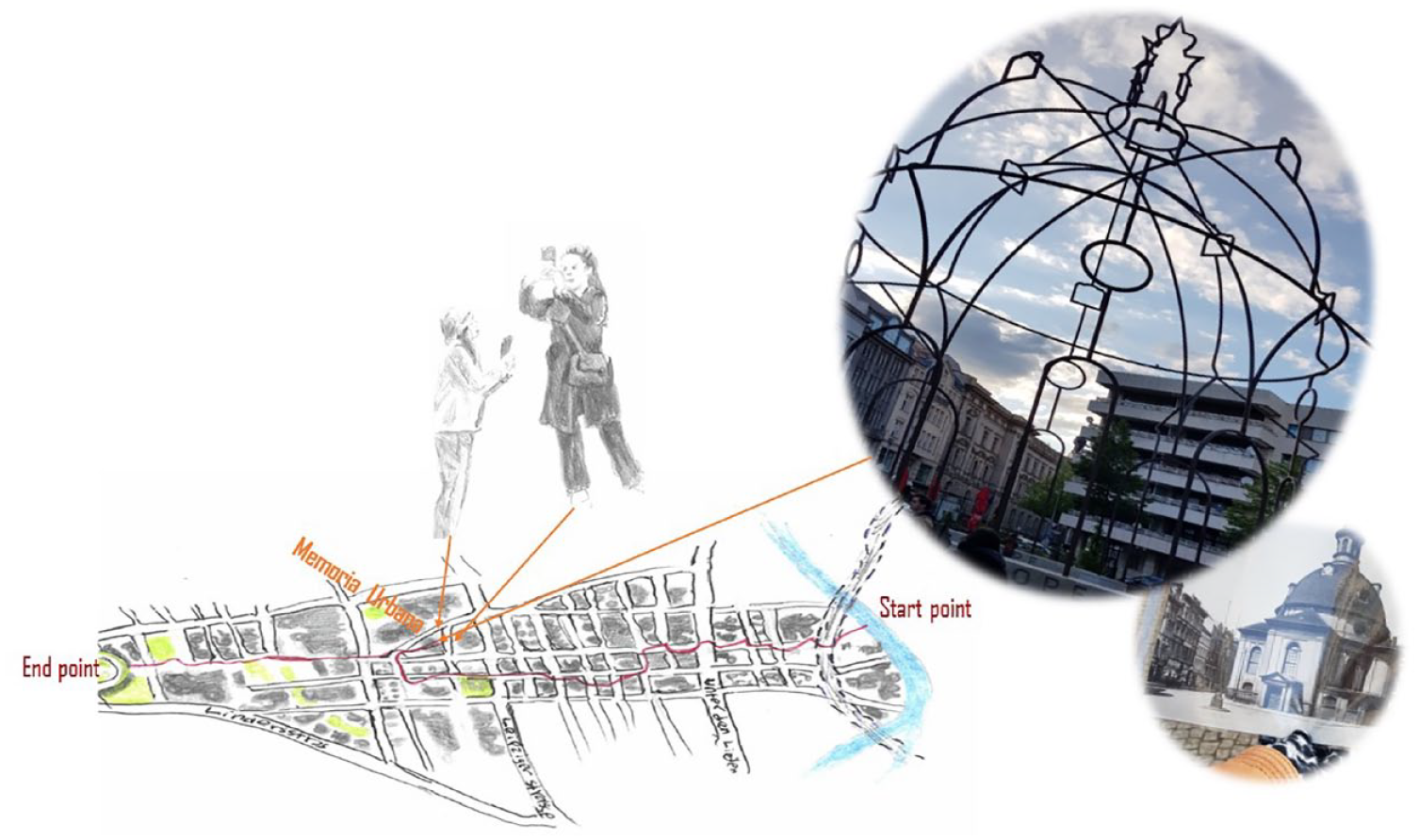
A snapshot form Yasmin’s Tour.
The last stop of a tour guided by Amir (a refugee from Iraq who works at a call centre) is a vista of the Berlin Museum of Islamic Art within the south wing of the Pergamonmuseum. The Museum, located in the much-visited Museum Island, presents the art and archaeology of Islamic societies ranging from the Eighth to the Nineteenth centuries. Showing us an image of the original Ishtar gate from Babylon (an ancient city located in current day Iraq), Amir describes his first encounter with the gate, in the Berlin’s Museum of Islamic Art:
I didn’t come to the gate until I felt ready, I knew it would be difficult. When I was learning German, they took us on a tour of the city, we visited the museum, and I wasn’t sure if I should walk into the room to see the gate. Finally, I came in and saw the gate and stood there for an hour without words.
Amir’s account of his ambiguous connection to a cultural object in a German museum undermines an essentialist reading of German culture by pointing to its adaptation and appropriation of other cultures. Moreover, it points to the difficult European legacy of imperial looting and dispossession. This is another means by which the tours expand and problematize local public memory: as mentioned, German hegemonic heritage practices largely disregard the German colonial legacy and the history of migration from the colonies to the metropole.
The final stop of a tour guided by Ahmed is the middle of Gendarmenmarkt Square, where we can gaze at the French and German Cathedrals, standing across from one another, appearing identical from the outside (Figure 2). Ahmed explains that the French Cathedral was built for French Huguenot refugees who were welcomed into the city over a 100 years ago, and the German Cathedral was built for Germans who felt ‘threatened’. Yet, he says, ‘both cathedrals are nearly identical, and I see it as: OK, we are going to stand here, tall, on an equal level, as part of this land’. In much of the discussion around the arrival of refugees into European cities, they are understood as homogeneous entities, erasing important ethnic, cultural and religious differences. The refugee tour guides deconstruct this assumption, demonstrating that European borders have always been subjected to the flow of people, cultures and goods. As Ahmed stresses, that aim is to reflect that ‘this is not something new, to Europe, to Germany, and particularly to Berlin’. This problematizing of the conception of the so-called ‘refugee/reception crisis’ as unprecedented is politically crucial, since the framing of forced mobility as ‘exceptional’ justifies authoritarian remedies and violence against refugees (De Genova, 2018).
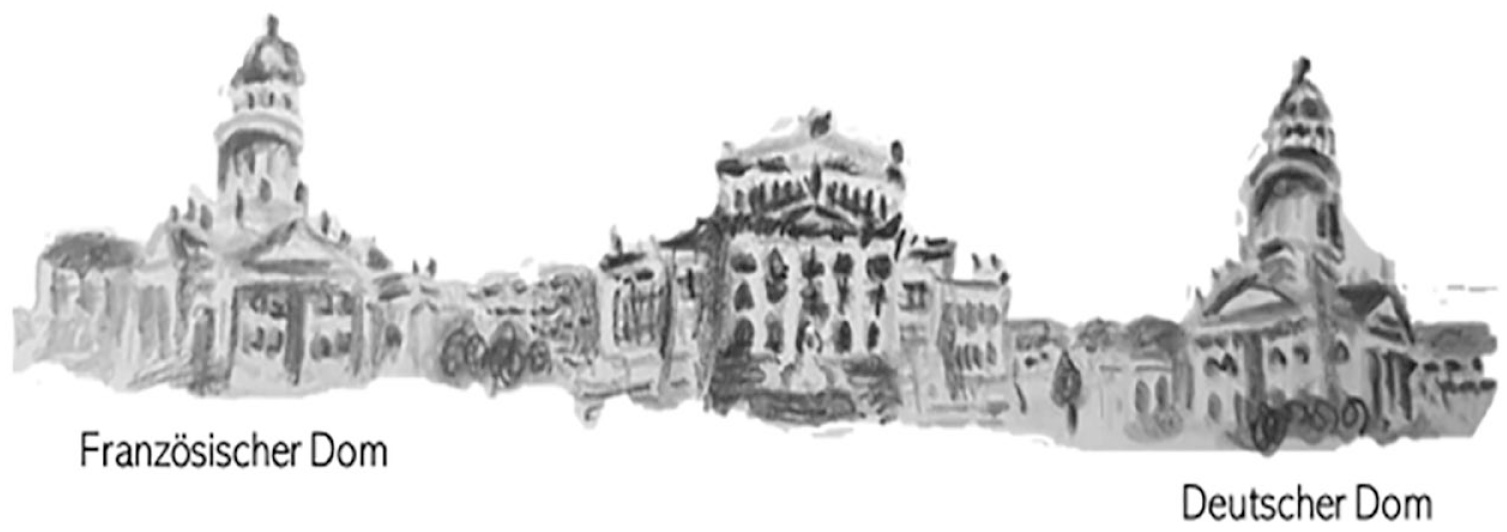
A panorama of Gendarmenmarkt Square.
The tours further stress the importance of migratory flows to the formation of cities.
A tour participant tells me: ‘I am from Berlin, and I did not know any of the things Yasmin taught us about the buildings; it is nice to know that there is a long history of welcoming refugees in the city’. By appropriating the city walking tour genre, refugee guides challenge nationalist and static notions of locality, place and belonging, as well as the division in the tourism industry between locals and guests. Another tour participant captures the importance of this tactical appropriation:
For me it is very interesting the way she found a way to appropriate the city; it is my city, my story and I know about these places. All that is very powerful. It is always such a struggle; I am an immigrant myself in another country. It is a special moment when you feel that the place you are living is also your place.
As these participants convey, there exists a need to expand the framings of urban heritage and memory to account for the movement of people and cultures. In a similar vein, Hila (an Israeli artist and urban activist) begins her tour of Tel Aviv’s southern neighbourhood Neve Sha’anan by mapping the waves of migrants that accumulated in the area to highlight its migratory nature (Figure 3): in the 1960s and 1970s, it became the home of Jews from Yemen and Uzbekistan, joined in the 1980s by Iranian Jews; in the 1990s came Jewish immigrants from the former Soviet Union and foreign workers from the Philippines, Romania and Thailand and; then finally, African asylum-seekers.
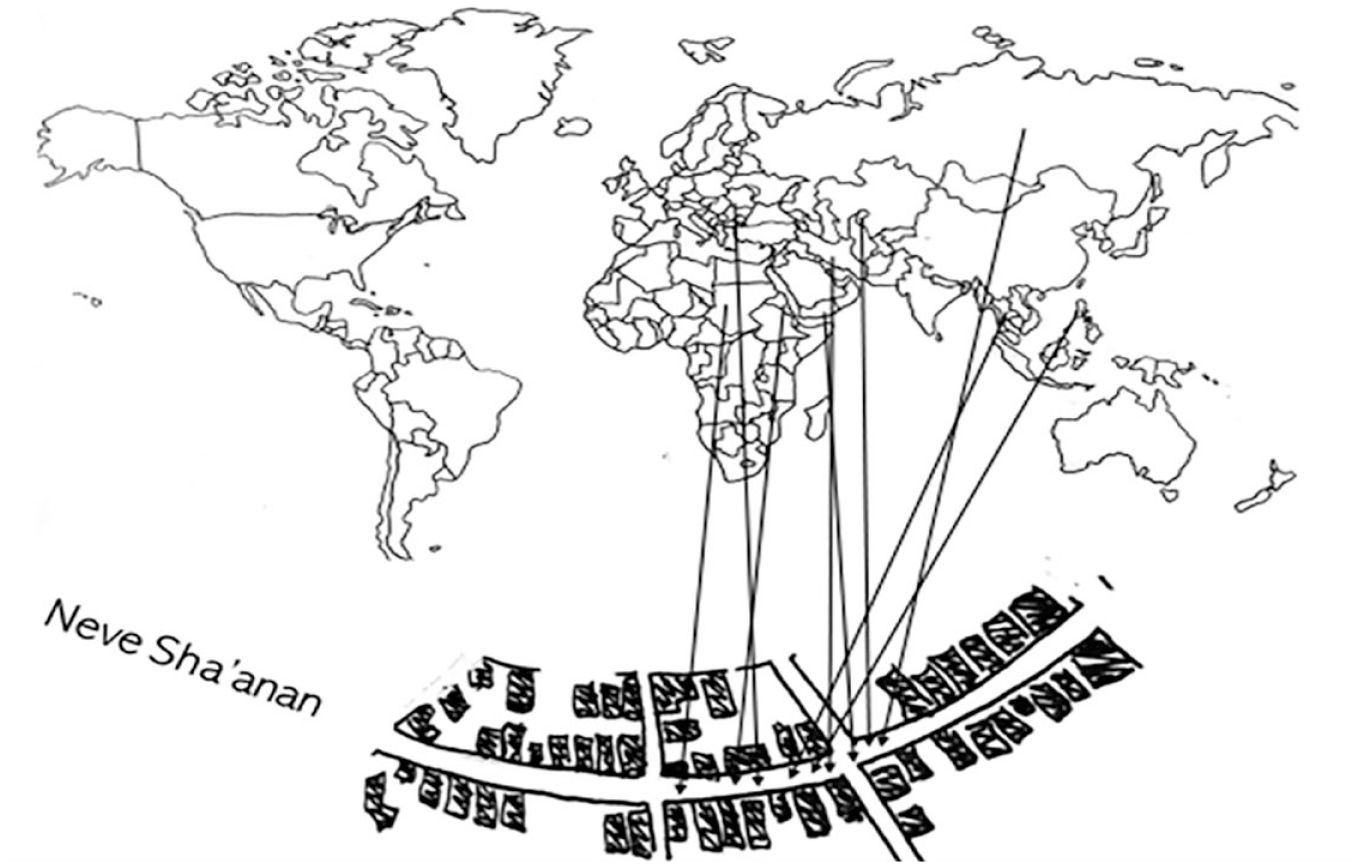
The origins of Neve Sha’anan residents.
Unlike the capital of memorials, Berlin, the neglected area of south Tel Aviv is empty of official commemorative designs, such as monuments. Nevertheless, the tours, through their slow pace and attentive mode of observation, show this area to be a fertile ground for a memory that is transcultural, associative and overlapping. For instance, Hila point out the first non-kosher butcher in Israel, opened by Jewish migrants from the former Soviet Union, and says, ‘the information is in the street and every store here has a story to tell’. The tours mark such overlooked memory carriers implicated in the making of a sense of place and community. In his tour, Togod (hi-tech worker, activist and Sudanese asylum-seeker) stresses the ‘strong social role’ of cafés in Neve Sha’anan during his tours. As he explains, ‘if we have an activity, then we get there, turn off the TV screen and say: “we have a demonstration tomorrow at ten o’clock, you all have to come together”’. Hila highlights that the municipality and national government are not concerned with solving the problems of south Tel Aviv. However, she says, ‘through inhabitants’ improvisations, it is slowly becoming a more friendly place, even for tourists’. To demonstrate her point, Hila directs our gaze to a community library in the garden that offers free Hebrew lessons for refugees.
The tours’ successful undoing of stereotypes about south Tel Aviv and its inhabitants comes across in participants’ comments during our walk-along interviews. One student says: ‘I got a hit of reality and gained awareness about this place and about Sudanese and Eritreans that are really murdered in their own countries and the state really abandons them’. Another student observes: ‘I learned about definitions, what does it mean someone who is foreign . . . the issue of rights, I didn’t know, I thought everyone had their basic rights’. He adds, ‘I was once afraid of south Tel Aviv, but it’s OK to walk around here, there are communities and life here’. Interestingly, when approaching various tour agencies in south Tel Aviv to collaborate with them for this research, they would often stress that refugees are not the key theme of their tours; rather they tell the story of a place. This alludes to an important politicized gesture enacted during tours that are guided by or held in collaboration with refugees: in contrast with the ontological marking of displaced people as ‘placeless’ or ‘outsiders’, the tours regard them as part of the story of the city. Much like Time Ingold (2016a) phenomenological theory, the tours hint at the replacement of the ontology of ‘locals’ with a notion of ‘urban wayfarers’ whose paths inform its ever-shifting identity and story.
Conclusion
Through analysing a landscape of official and subversive walking tours, the article has analysed some of the mixed spatial processes that construct the public memories of Berlin and Tel Aviv, derived from conflicting desires to remember, forget, transform, preserve, overcome and re-write history. Closely mapping how walking tours guided by or facilitated in collaboration with refugees use urban space to critique, reform and diversify their public memory, the article puts forward the notion of transcultural memory activism. The notion of transcultural memory activism helps to understand transcultural memory-making in three significant ways: It draws attention to deliberate mnemonic political action that drives the circulation of memory. Second, it shows how memory activism is not only limited to confronting state-led atrocities where they have been committed but also work within a larger transnational arena, travelling and having impacts across different scales and geographies (Sheehan et al., 2021; Smit et al., 2018; Yoon and Alderman, 2020). Third, it focusses on the political character of memory work, in this case by demonstrating how memories from different periods and geopolitical contexts can be brought together and deployed as a tactic to draw public attention to current human rights violations.
The transcultural memory activism enacted during the walking tours in Berlin and Tel Aviv was shown to utilize two key strategies. First, mixing and drawing analogies between traumatic memories from different places and times to make a political statement around the recurrence of human rights violations and open a space of transcultural solidarity. The second strategy involves tracing a hidden history of the mobility of people, memories and cultures as inherent to development of the urban sphere. The political outcome of this action is twofold, as it challenges narrow national conceptions of the past and the present statues of refuge within the city (Huss, 2023). Yet, some of the spatial and mnemonic strategies and impacts of the tours differ in both cities, indicating the diversity of political demands, legal framings and experiences of refuge. In Berlin, the tours aim to tackle the cultural and political tensions that arise for those allocated an official status of refugees in a seemingly welcoming city. Refugee tour guides therefore appeal to the clearly marked official sites of the city’s memory and weave their own perspective and culture within them. In south Tel Aviv, refugees that are denied legal and cultural recognition focus their political performance on narrating their experiences of forced mobility. Tour guides further appeal to mundane infrastructure to illuminate a chronicle history of urban neglect and the resistance of migratory communities to this neglect. Studied together, these tours offer insights – relevant in other cities – into how to renegotiate urban heritage and identity to extend belonging and political participation in the city and address continual and intersecting histories of injustice.
Walking tours suggest a useful methodology towards these goals. Their mobile and collaborative style of presentation helps articulate the plural spatiality and non-linearity of the urban sphere. Through the sharing of a common movement, direction and dialogue, the tours further record a constant movement from the individual experience to a collective perception, and from personal trauma to public memory. The article therefore offers two theoretical contributions. First, the article contributes to the understanding of how public memory plays an integral role in shaping conflicting attitudes towards refugees, and demonstrates the agency of refugees to reclaim, destabilize and insert ‘frictions’ within it. As demonstrated, rather than being mere recipients of an ambivalent welcome or hostility inspired by local traumatic memories, refugees appropriate, revise and re-contextualize them by appealing to their performative and spatial manifestations. Second, the article advances a spatiality-grounded reading of transcultural memory and contributes to a ‘mobility turn’ in memory studies. Debates on the mobility and transculturalism of memory successfully undermine an assumed static and singular bond between nationality, place and memory; however, they tend to overlook the spatiality and performativity of memory, thereby negating a range of transcultural practices and interactions, especially ones that are more informal and marginalized. By theorizing a dynamic and transcultural (re)making of urban heritage the article therefore encourages memory scholars and practitioners to critically attend to the fluidity and mobility of memory, tourism and urban spaces. There remains much scope to analyse other creative and communal practices that might inform modes of transcultural memory activism, such as artworks, exhibitory practices, protests, housing struggles and solidarity initiatives – along with the intended and inadvertent mnemonic interactions they foster.
