



Abstract
Postsocialism brought about a massive reconfiguration of the memorial landscapes in Central and Eastern European countries. While the removal of monuments and renaming of places were thoroughly researched by social memory scholars, how these mnemonic changes were received by ordinary people has not piqued academic attention. Drawing on an original quantitative dataset derived from a nation-wide sociological survey (N = 1156), this article sets out to examine the factors shaping people’s attitudes toward the removal of socialist symbols from public space in Romania. Statistical modeling of these data through regression analysis highlights that participants’ coming to terms with the memorial de-communization of public space in Romania varies in terms of the latter’s political values, local embeddedness, and socio-demographic characteristics. Such a quantitative approach contributes to a better understanding of postsocialist transformations of public space and opens up previously unexplored avenues of inquiry into how citizens relate to the coming to terms with a controversial past.
Introduction
“Coming to terms with the past” (Vergangenheitsbewältigung) has established itself as a trademark term within memory studies. Research on how individuals, groups, and societies writ-large manage to reckon with a difficult past has been one of the most dynamic strands of inquiry in the last decades across the social sciences and the humanities (Adorno, 1986; Connerton, 1989; Elster, 1998). Although it emerged in the context of West Germany’s postwar struggle to deal with the burdened legacy of the Holocaust and the Third Reich (Kansteiner, 1999), after the demise of state-socialisms across Central and Eastern Europe the term has come to inform theoretical discussion and public debates in postsocialist settings as well (Petrescu and Petrescu, 2007).
The term was also a key concept and played a crucial role in articulating memory studies scholarship. The interdisciplinary field of memory studies emerged and was subsequently consolidated around works that have critically engaged with the aftermath of political violence, whether in grappling with the legacies of fascist and communist dictatorships (Kaufman, 1998; Olick, 1998), colonialism (Lawson, 2014), patriarchalism (Reading, 2016), or other forms of oppression, subjugation, and subalterization (Ciobanu and Şerban, 2021; Niziołek, 2022). The approaches developed to study this issue ranged widely across disciplines, as political scientists and legal scholars worked out the “transitional justice framework” (Stan, 2013a; Teitel, 2000), while cultural geographers charted the “dissonant landscapes” littered with unwanted artifacts, symbols, and memories inherited after a regime change (Lähdesmäki et al., 2019; Tunbridge and Ashworth, 1996).
In contrast, the question of how people come to terms—if this is even the case—with the memorial policies implemented upon the past has not been raised so often (see, however, Ochman, 2025). Moreover, from a disciplinary perspective, sociology has been an arguably inconsistent contributor to the scholarship in memory studies. Although some of the major voices in the field come from sociology (e.g. Coser, 1992; Olick, 1999; Zerubavel, 1996) and the conceptual framework they developed are rooted in sociology’s theoretical tradition, sociology has thus far not contributed to memory studies with one of its most powerful assets. Consequently, quantitative sociological studies based on large scale samples of respondents are largely missing from the field. It is through such a quantitative approach, which enables statistical analyses to be performed on nation-wide survey data collected from ordinary people, as opposed to the prevailing qualitative approaches based on interpreting legal documents and analyzing public policies, that the limitations of existing studies can be overcome.
Therefore, in this article, we aim at pushing the research on memory studies beyond these limits by developing a quantitative approach grounded in sociology to analyze the popular reception of memorial policies enacted to de-communize the public space in postsocialist Romania. As such, this article brings a dual contribution to the existing scholarship done in social memory studies: first, it moves the analytical focus from the already saturated topic of coming to terms with the past to the less examined ways in which ordinary people come to terms with the memorial policies implemented by government officials to reckon with a problematic past. And second, it advances a novel methodological approach rooted in quantitative sociology to examine through multivariate statistical models the social attitudes held by ordinary citizens toward the de-communization of public space.
Geo-temporal context
The temporal context and geographical setting in which our research is situated provide exceptional circumstances. The ongoing Russo-Ukrainian War dramatically changed the memorial landscape across the Central and Eastern Europe. In Ukraine, the purging of the Soviet symbols that still scattered the territory after the dissolution of the USSR in 1991 was re-launched forcefully after Russia’s annexation of Crimea in 2014 and the subsequent war in Donbas. After the Ukrainian Parliament passed the so-called “memory laws” in 2015, thousands of Soviet-era monuments were dismantled and tens of thousands of place names were changed (Pshenychnykh, 2020). The Russian Federation’s full-scale invasion of Ukraine on 24 February 2022 has also produced broad-ranging memorial ripple effects throughout the former Soviet republics and socialist countries. In Poland and the Baltic states (Estonia, Latvia, and Lithuania), political authorities have reacted swiftly to Russia’s invasion by completing the process of removing the communist symbols from public space. Included among these purged memorial artifacts were also the Soviet war memorials dedicated to the “Liberating Red Army” (Dunkley, 2023; Gabowitsch, 2024), whose removal was encountered by loud protests voiced through Russia’s diplomatic channels. These changes in the mnemonic landscape came in the aftermath of more than three decades of de-communization of public spaces across the post-Soviet and postsocialist societies, that unfolded at different paces and temporalities depending on various local circumstances (Czepczynski, 2008).
Postsocialist Romania constitutes a particularly different situation. The most contextually contrasting aspect lies in the fact that, while the surrounding region (CEE and especially the post-Soviet bloc) as well as the Western world are entrapped in identity politics underpinned by memorial controversies, Romania presents a much quiet picture in this regard. In Romania, the contentious process of coming to terms with the memorial legacy of the communist regime, as it was inscribed toponymically on the landscape and materialized in public monuments, has largely completed before the country’s accession to the European Union in 2007 (Ciobanu, 2009; Rusu, 2017; Stan, 2013b). Since then, the country experienced fierce debates on the public memory of Marshal Ion Antonescu (Hitler’s wartime ally and Romania’s de facto leader responsible for the Army’s massacre of Jews) (Zavatti, 2021). Other controversies surrounded the statues and place names (schools and streets) honoring intellectuals associated with the fascist Legionary Movement who were sentenced for war crimes (e.g. Mircea Vulcănescu, a nationalist philosopher and sociologist who also served as an official in Antonescu’s government) (Cârstocea, 2021). These monuments and memorials commemorating Romania’s far right pantheon of heroes began to be erected across the country during the “long” 1990s and its convoluted transition to democracy, which also provided the fertile ground for the resurgence of an aggressive ideology of ethno-nationalism rooted in anticommunism.
However, the status of the communist-era monuments, street names, and other memorial artifacts that remained in place decades after the violent 1989 regime change have not made the subject-matter of passionate public debate. While this may be read as a sign of cultural apathy and memorial numbness, underpinned by what seems like an overarching, prevailing political consensus over the recent past, in this article, we argue that this actually constitutes an epistemic opportunity: the socio-political calmness characterizing Romania’s current politics of memory creates the ideal conditions for taking stock, through a quantitative sociological methodology, of how ordinary people make sense of the memorial de-communization of urban landscape. Both the grass-root activist memory politics of the Black Lives Matter movement and the top-down state-ruled memorial governance though memory laws enacted in Ukraine and other post-Soviet countries (e.g. Poland and Estonia) are still ongoing affairs. Instead, Romania provides a much static picture that places this country in an ideal position for analyzing the citizens’ attitudes toward the politics of memory implemented by political authorities after the fall of communism. In our approach, we benefit from the privilege of Romanians’ historical distance and emotional detachment toward the communist past to chart their attitudes on the removal of communist-era monuments and the renaming of places bearing communist meanings.
Focusing on how ordinary people received these memorial changes, long after the process of purging the symbolic landscape from the symbols of communism ceased to be a political priority for the ruling parties, contributes to the existing literature in several ways: first, it shifts the interest from the memorial objects and the politics concerning their removal, relocation, and renaming to the social attitudes toward these decisions. Second, this article pushes for the methodological shift from qualitative studies dealing with documenting the political actions concerning monuments and toponymy performed by authorities in particular locations (usually, case studies done on a single city) to a quantitative approach intended to grasp statistically how individuals relate to changes brought in their memorial landscapes at the national level. This study draws on previous research that was focused on establishing the scope and nature of toponymic change and monuments’ removal in postsocialist Romania and continues this line of inquiry by charting the social attitudes toward these changes based on conducting a nation-wide survey. Drawing on this empirical material, the study employs advanced analytical techniques (ordinary least squares [OLS] multiple regression analysis) to model statistically the factors that shape people’s attitudes toward the postsocialist purging of the socialist symbols displayed in the public space.
In the subsequent sections of this paper, we begin by providing an overview of the mnemonic reconfiguration of public space in postsocialist Romania. This historical contextualization presents what happened with the communist-era monuments and place names after the regime change of 1989 and thus establishes the factual background against which we examine the (inter)subjective reality codified in ordinary people’s attitudes toward this memorial purging of public space. Next, after discussing the data and the methodological aspects underpinning this research, we proceed with presenting the results obtained via conducting a multiple regression analysis designed to predict the specific factors that shape people’s attitudes toward the de-communization of symbolic space carried out in Romania after the dramatic 1989 regime change restructured the political economy of the country.
Memorial de-communization of public space in Romania
Monuments and place names matter, and so do all the controversies surrounding their erection and toppling, as well as their naming and renaming (Gensburger and Wüstenberg, 2023). Scholars working in interdisciplinary fields such as social memory studies and critical toponymies—emerged at the multiple crossroads between a branch of intellectual traditions such as cultural geography, semiotics, history, and political sociology—have compellingly made the case that monuments and toponymy are powerful political means of appropriating space (Mitchell, 2003; Rose-Redwood et al., 2010). Unveiling statues and naming places perform more than just constructing lieux de mémoire: by engaging in such commemorative practices and deploying such memorial artifacts into the territory, public authorities institute a spatial “regime of memory,” understood here as “a set of cultural and institutional practices that are designed to publicly commemorate and/or remember” a more or less imagined past in connection to a particular space (Bernhard and Kubik, 2004: 14). Within such a topo-mnemonic regime, landscape is rendered into a politicized geography of memory suffused with a self-legitimizing ideological ethos expressing the political values, collective identities, and historical memories endorsed by the ruling power (Dwyer and Alderman, 2008; Hubner and Dirksmeier, 2023).
After the communist dictatorship of Nicolae Ceauşescu was overthrown in the winter of 1989, the postcommunist governing power inherited a country littered with public monuments and street names celebrating the defunct regime, its symbols, and heroes. Romania endured one of the longest and most turbulent transformative periods from dictatorship and planned economy to liberal democracy and market economy in the Central and Eastern Europe (Stan and Vancea, 2015). The convoluted period of postsocialist transformations was proclaimed as completed in 2007 with Romania joining the European Union as member-state (Gross and Tismăneanu, 2005). To mark symbolically the final break with the past, the Romanian state—via the voice of its president—condemned the communist regime as “illegitimate and criminal” days prior to the country’s formal acceptance in the EU (Comisia Prezidenţială pentru Analiza Dictaturii Comuniste în România, 2007). It was during these almost two decades following the regime change of December 1989 to the state sentencing of the communist regime in December 2006 that the postsocialist political authorities handled the process of coming to terms with the past.
Under intense pressure exerted by a resurgent civic society, authorities were pressed into taking monumental action. As ostentatious material incarnations of the defunct regime, statues were the first to suffer the blow of the iconoclastic thrust. In Bucharest, V. I. Lenin’s monumental statue erected in 1960 was taken down after several weeks of intensifying protest. The reluctant authorities were finally convinced to allow the toppling only after an Orthodox priest staged a performative protest in front of the statue which included rituals of purification as well as hunger strike. Eventually, the seven-tone statue was removed from its pedestal with a crane on March 5, 1990. The enthusiastic crowd then went and removed Dr. Petru Groza’s statue erected in 1971, honoring the prime-minister of the first communist-dominated government (Preda, 2023).
The spectacular fall of Lenin and Groza’s statues in the capital-city came to symbolize the downfall of the regime. In other places, public monuments glorifying communism endured a variety of material fates and experienced a diversity of memorial afterlives, which can be classified in a typology ranging from material destruction, to relocation and creative adaptation, to in-situ preservation (for other post-Soviet and postsocialist settings, see Forest and Johnson, 2002; Saunders, 2018). Many were subjected to violence and vandalism. Some of these were completely destroyed during the revolutionary rage unleashed in December 1989. Others were mutilated and defaced but left in their place: a paradigmatic example of this category is the statue of Ilie Pintilie, one of the heroes of the communist working-class pantheon. In the wake of regime change, his statue placed in front of the co-op building in a rural settlement near the border with Hungary was beheaded by an angry villager, who afterwards took home the head as a trophy. The decapitated statue still stands tall in the village center and can be admired as memorial wrecks that carry the scars of the violent regime change in Romania (Rusu, 2025). Another way of dealing with these unwanted relics was to relocate them to peripheral locations. This was the case with another statue of Dr. Petru Groza, which was transferred from the main square of Deva to the courtyard of his birthplace house in the village of Băcia (Light and Young, 2011).
Similarly, Soviet memorials to the Red Army inaugurated in the aftermath of the Second World War were discretely retreated from the cities’ public squares inside remotely-located military cemeteries, where their preservation is protected by international laws. At the other end of the spectrum going from physical destruction to in situ preservation, scattered across the country some statues and busts that survived untouched are still standing in their original location. However, these are minor monuments dedicated to some rather obscure figures of the working-class pantheon of heroes celebrated during the communist regime, such as the statue of Vasile Roaită in Bacău, honoring a rail worker who was shot dead during a strike in 1933. Although still present in their original locations, decades of indifference and neglect from both public authorities and citizens have defined the status of these abandoned artifacts as fluctuating between memorial vestiges and paradoxical monuments of oblivion.
Street nomenclature and other places (schools, theaters, hospitals, stadiums, but also seemingly banal places such as shops, bakeries, and grocery markets) went through similar reshaping during the period of postsocialist transformations. Although less spectacular and lacking the dramatism of demolishing a monument, renaming the streetscape produces much more overarching consequences. Whereas monuments are limited in number and are regularly located in the central squares of cities and towns, street names are part of ordinary individuals’ residential identities and administrative addresses. Therefore, despite lacking in the iconoclastic spectacularity characteristic to the toppling of a monument, changing the street nomenclature runs wide into the social system and deep into citizens’ life-worlds, redefining their everyday living space, and reshaping their personal identities inscribed in identity cards (Azaryahu, 1996).
Street renaming in postcommunist Romania was not completed in a single, all-encompassing stroke. It was also a largely uncoordinated process. Several days after the dismantling of Lenin and Groza’s statues, on 14 March 1990 the government issued a decree-law that set the juridical framework for purging the landscapes from the symbols of the defunct regime. The decree proclaimed in its preamble the political necessity to change the place names referring to “political and historical events from the period of the dictatorship, as well as the names of some persons of the former regime, which are not in accordance with the renewal of political and social life in Romania” (Consiliul Provizoriu de Uniune Naṭională, 1990). However, despite this abstract statement of principles, the law failed to provide specific guidelines on which names should be changed and which names should replace them. It also missed the opportunity to set a precise timeline for implementing the changes. Consequently, public authorities at the level of each county—invested by the law with the jurisdiction over (re)naming the landscape—implemented the changes with varying levels of anticommunist intensity and at different paces, depending on the public authorities’ hierarchy of political priorities and administrative capacities (Rusu, 2019a).
The great bulk of changes were made during the early 1990s, when the most explicitly ideological street names promoting communism and the former regime—Soviet and domestic leaders (e.g. V. I. Lenin and Gheorghe Gheorghiu-Dej), historical dates (e.g. 7 November [1917] and 30 December [1947]), and places (e.g. Stalingrad and Moscow)—were replaced with symbols celebrating the anticommunist Revolution as well as Romania’s national identity. Additional revisions, albeit fewer in number, were made throughout the mid-1990s and early 2000s, when the power of renaming the street nomenclature was transferred from the county level to the local councils (Ordinance no. 63/2002 regarding the attribution or changing of names). The cumulative outcome of these serial changes that unfolded during a decade consisted of a confusing mixture of symbols celebrating national identity, liberal democracy, anticommunism, the monarchy, as well as the myths of the interwar period as Romania’s “golden age” (Light, 1997).
Overall, by the time Romania joined the EU in 2007, more than 4500 streets were renamed out of the over 37,000 streets existing in the country’s cities and towns (Rusu, 2024). This indicates that the scope of the postcommunist toponymic change in urban Romania can be established at 12 percent (roughly, one in eight streets was renamed). The percentage varies with a road’s symbolic importance and topographic centrality, as the main targets of renaming were public squares and boulevards located in central parts of the cities (Rusu, 2020). On the other hand, this percentage of 12 percent calculated as the national average also meant that some streets bearing communist names had survived the purging. Along with the material remnants of communism—buildings ranging from the People’s House/Palace of the Parliament to prefabricated panel blocs and especially monuments—and the communist-era statues and busts that were kept in place despite celebrating heroes of the working-class pantheon, these “toponymic residues” form what geographers Duncan Light and Craig Young have called “the left-over spaces of state-socialism” in post-1989 Romania (Light and Young, 2010, 2014).
While these material and symbolic changes brought about to memorial landscapes in the aftermath of the regime change have been thoroughly documented in Romania (Light, 1997; Light and Young, 2014; Rusu, 2020, 2024) as well as in Central and South-Eastern Europe (Bădescu, 2019; Palonen, 2008; Šakaja and Stanić, 2011), less attention has been paid to how ordinary citizens feel about these transformations. It then comes as no surprise that even less covered is what determines people’s attitudes toward the postcommunist reconfiguration of a country’s public memoryscape.
Data and method
Set against this historical background, what this paper sets out to do is to fill a part of this staring void in the literature by examining how ordinary individuals received the memory policies concerning the de-communization of public space enacted during the period of postsocialist transformations in Romania. Considering the spectrum of changes brought about in Romania’s memorial landscape, we are interested in charting individuals’ opinions about the memory policies implemented within the country. These include the renaming of places (streets and public institutions) bearing names associated with the communist past and the removal of monuments erected during communism (statues, busts, and memorial plaques). Then, shifting the temporal horizon from past to future, we are interested in ordinary individuals’ assessment for continuing this process through a legislation that forbids communist symbols in public spaces and the necessity for reconstructing monuments removed and/or destroyed during the communist period. Consequently, in this paper we pose two major questions: (1) How does the population assess the postcommunist memorial de-communization of Romania’s public space achieved through the removal of monuments and the renaming of places? And, (2) Which are the individual-level factors (political and cultural values, attitudes, and beliefs, as well as socio-demographic characteristics) that determine one’s stance toward the purging of communist symbols from public space?
The data used for answering these questions were collected through a nation-wide web-survey conducted in early 2021 (January–February). This came three decades after the country’s contested anticommunist Revolution and one year prior to the Russian Federation’s invasion of Ukraine which severely impacted how Romanians (and other Eastern Europeans) relate to their country’s communist past. Collecting the data in 2021—after the de-communization process was largely completed and before Russia’s 2022 full-scale invasion of Ukraine—we were able to survey Romanians’ sedimented attitudes, at that time still unaffected by the emotional wave of anti-Russian sentiments unleashed by the onset of the war in Ukraine (Ghigiu, 2023).
The data gathering process was carried out via a specialized online platform (QuestionPro) and resulted in a nonprobability sample of 1156 respondents from Romania. In gathering the data, we paid close attention to achieving a relatively homogeneous urban geographical coverage of the entire country as well as to ensure that the ethnic minorities are also included in the sample. To this end, we used a bilingual questionnaire that was available in both Romanian and Hungarian. Due to practical reasons—which we acknowledge as one of the limitations of this research—the questionnaire was not translated into other languages spoken by ethnic minorities living in Romania, such as German and Romani, which may have limited their representation in the sample. Before performing the statistical analyses, the data were weighted in terms of age so that the nonprobability sample to closely reflect the age structure of Romania’s adult population.
The questionnaire was structured in several modules designed to collect relevant information about individuals’ political values, beliefs, and socio-demographic characteristics. As a rule, topics were covered through sets of logically connected items as opposed to addressing single questions to the respondents. This strategy enabled us to combine answers into composite measures and thus to achieve a multidimensional understanding of how ordinary Romanians come to terms with the memorial policies adopted for the de-communization of public space. The indexes thus constructed are detailed below along with the other measures introduced in the analyses.
As dependent variable, we constructed a composite measure we call the “Memorial De-Communization of Public Space Index” (MDPSI). In constructing this multidimensional index, we included items pertaining to three distinct, yet interrelated, categories of aspects in terms of which the process of redefining the spatial memory regime during the period of postsocialist transformation can be accounted for: the symbolic dimension (street renaming and institutional renaming); the material dimension (removal of monuments, removal of memorial plaques, and the reconstruction of removed monuments); and the legal dimension (anticommunist law). The six variables included in the index were measured on a Likert-type-type scale that varied between (1) strongly disagree and (5) strongly agree, and its values were computed as the average of these six Likert-type items. Consequently, the Memorial De-Communization of Public Space Index takes values between 1 and 5, where higher scores indicate stronger support for eliminating and prohibiting the communist symbols from public space as well as a higher desire for a symbolic reconnection with the pre-communist past achieved through the reinstalment of previously removed monuments (Table 1).
The memorial de-communization of public space index (dimensions and items).
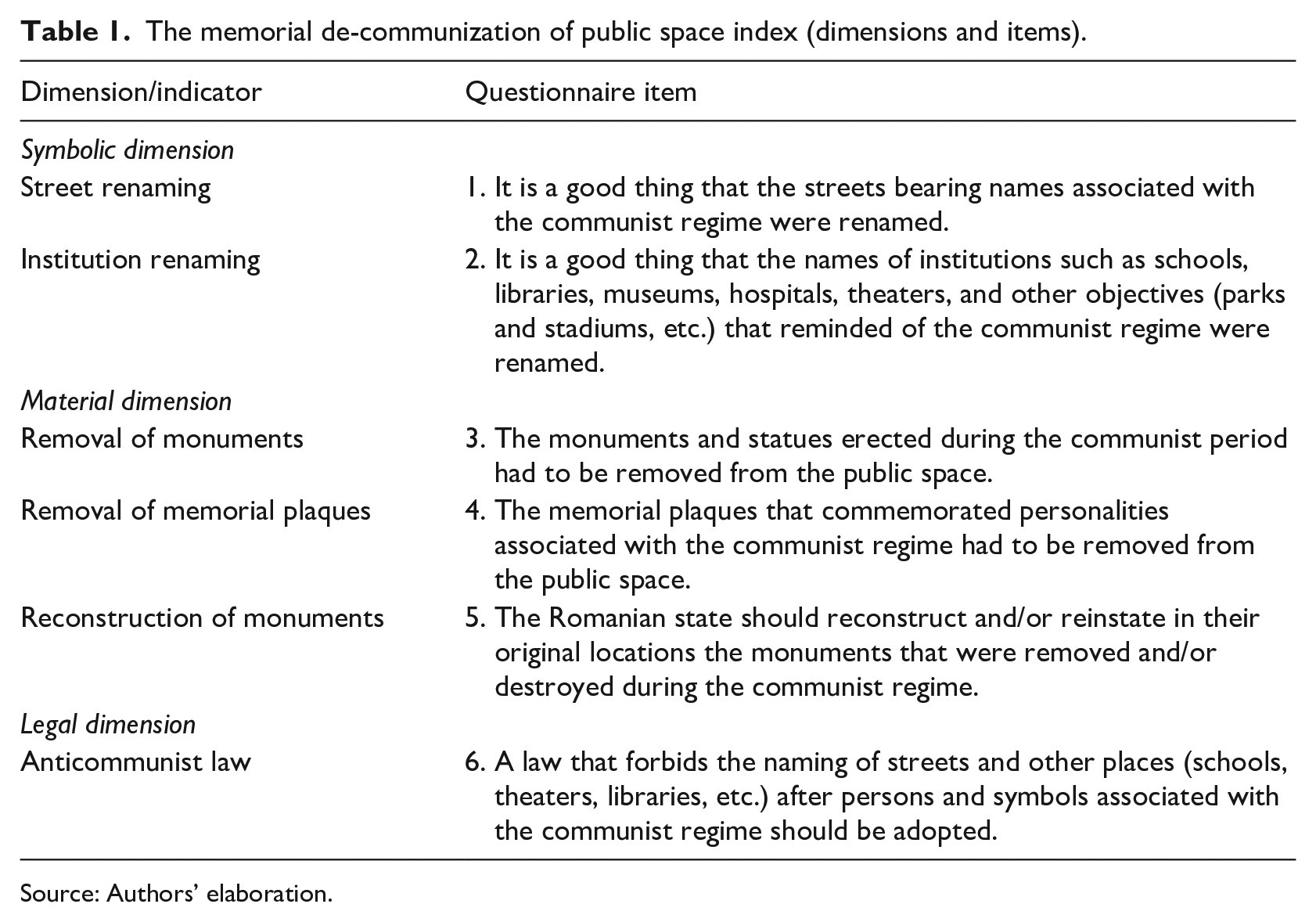
Source: Authors’ elaboration.
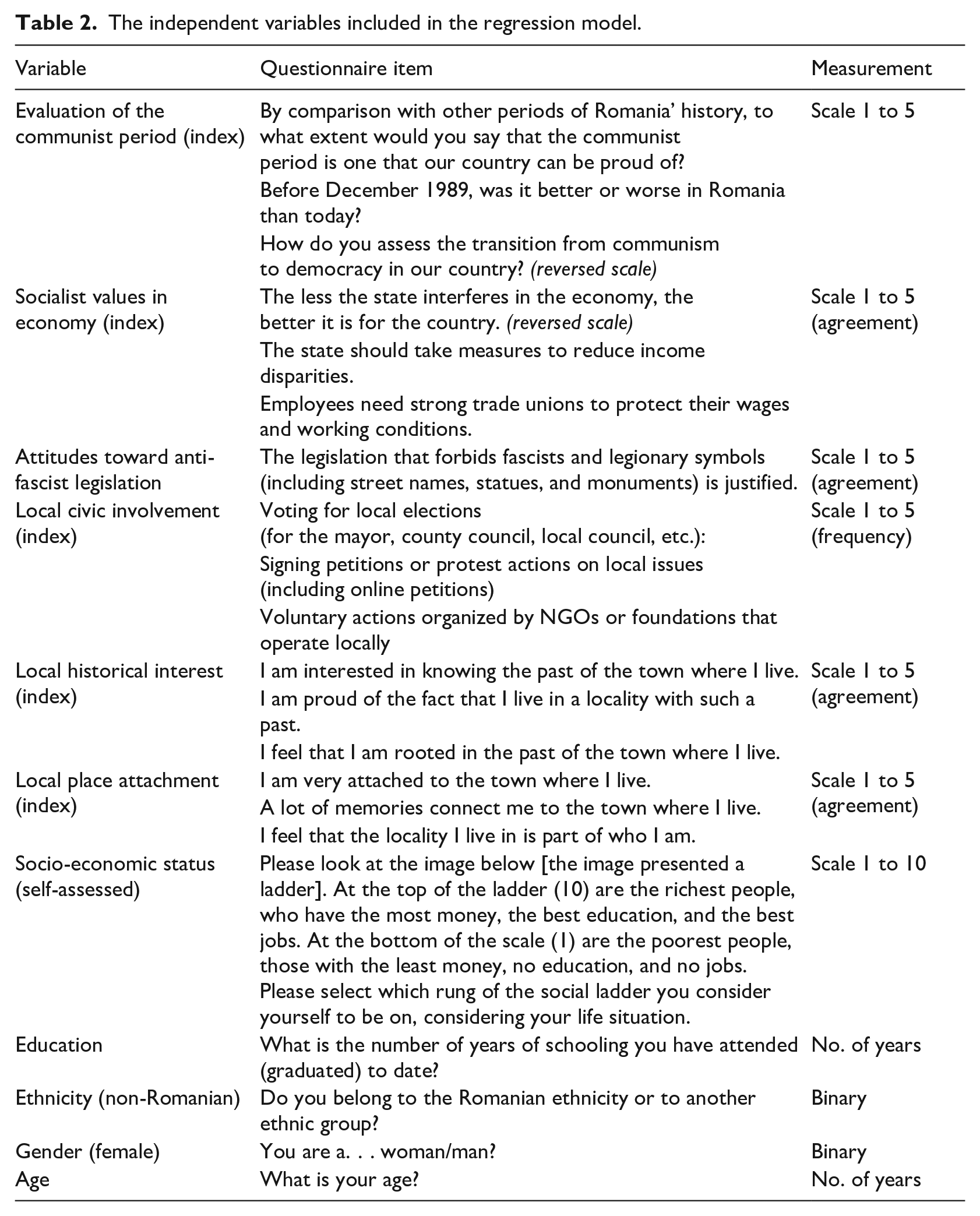
The independent variables employed to predict the variance within the MDPSI values include individual-level data regarding respondents’ evaluation of the communism period, political values, their local embeddedness in the community, as well as socio-demographic characteristics such as their socio-economic status, education, gender, and age. Details about the measurement of these variables and the precise wording of each of the questionnaire items are presented in Table 2. For estimating the factors responsible for the variation of the dependent variable (i.e. the MDPSI), we carried out an Ordinary Least Squares (OLS) multiple linear regression model.
The independent variables included in the regression model.
Findings
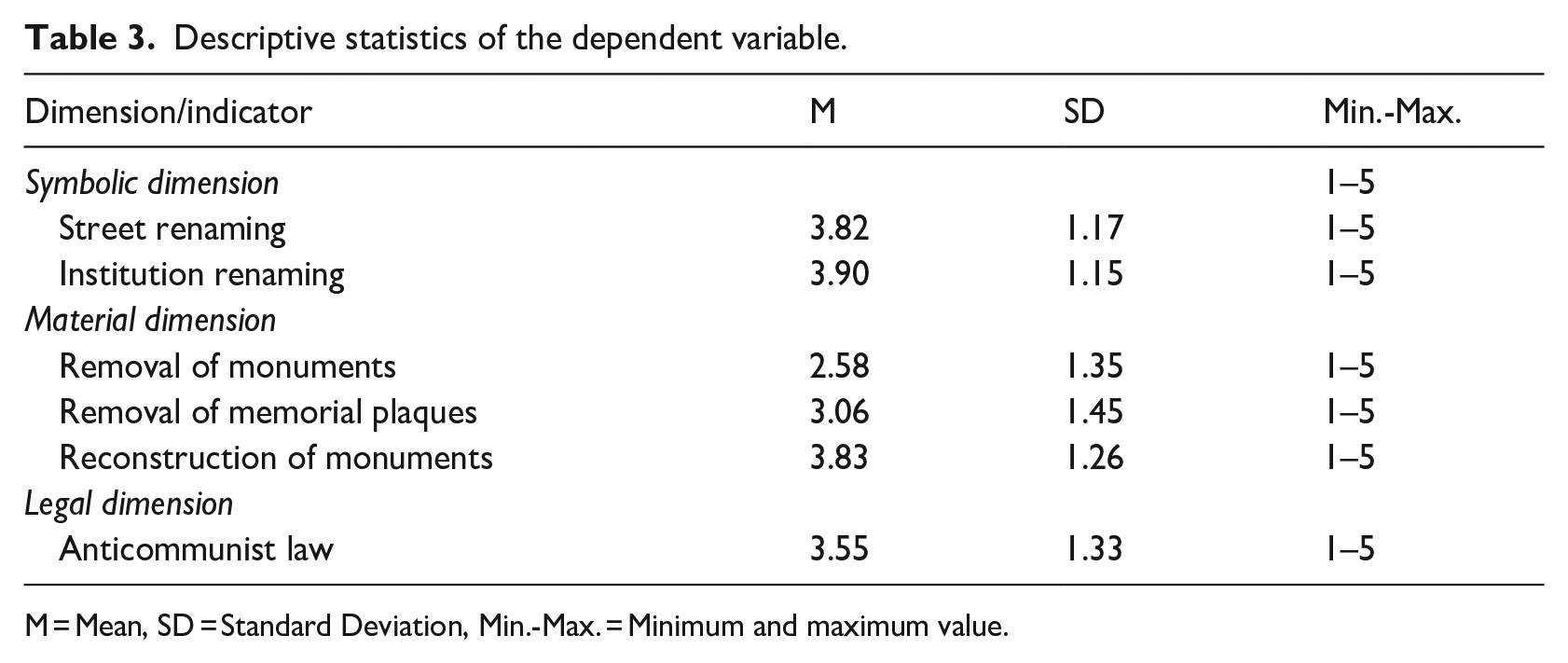
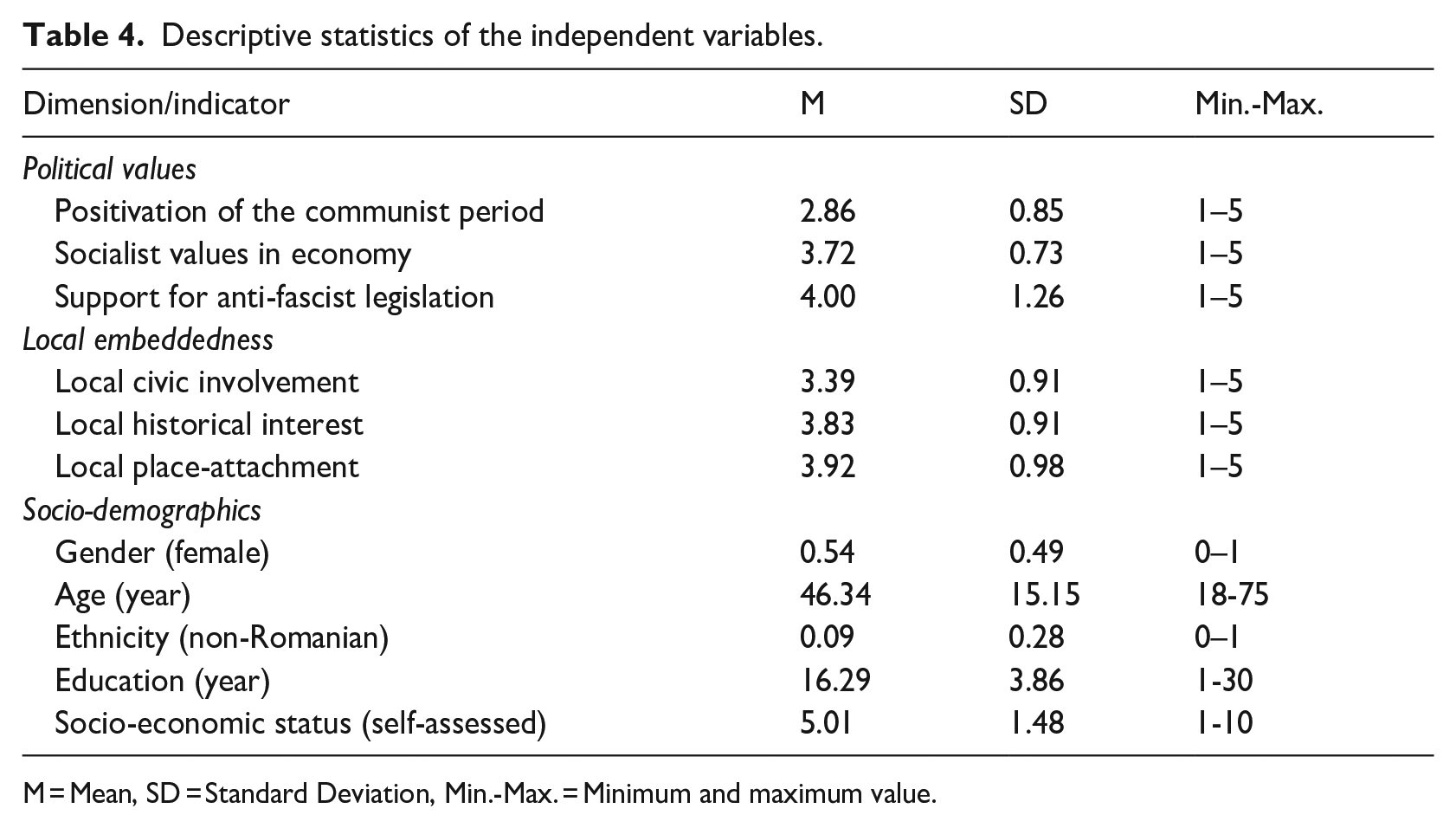
The presentation of the results is structured in two sections. We start with detailing the descriptive statistics for the dependent variables and the predictors, based on which we analyze respondents’ attitudes toward the postcommunist renaming of places, the removal of monuments, as well as their beliefs on the adoption of a law prohibiting the display of communist symbols in public space (Tables 3 and 4). Then, we move to the regression model, where we present the findings on what influences individuals’ positions regarding the postcommunist revision of the country’s memorial landscape.
Descriptive statistics of the dependent variable.
M = Mean, SD = Standard Deviation, Min.-Max. = Minimum and maximum value.
Descriptive statistics of the independent variables.
M = Mean, SD = Standard Deviation, Min.-Max. = Minimum and maximum value.
Table 3 points out the descriptive statistics for the three dimensions that constitute the dependent variable, i.e. The Memorial De-Communization of Public Space Index (MDPSI). The memorial revisions made on the symbolic dimension present the highest levels of popular support, with street renaming averaging 3.82 and renaming of institutions averaging 3.90. When expressed as percentages obtained after combining the categories “strongly agree” and “agree,” a sharp majority of respondents support the renaming of streets (62.7%) and an even greater one the renaming of institutions (67.4%). Moving to the material dimension, the mean values are 2.58 for the removal of communist-era monuments, 3.06 for the removal of memorial plaques, and 3.83 for the reinstalment of monuments destroyed during communism. These values translate to support percentages of 27.2% for the removal of communist-era monuments, 40.6% for the removal of communist-era memorial plaques, and 66.6% for the reinstalment of monuments displaced during the communist period. Finally, on the legal dimension, support for introducing a law to forbid the naming of streets and other places after persons and symbols associated with the communist regime averaged 3.55, which translates into a cumulative support of 55.7%.
The set of independent variables presented in the Table 4 allow us to grasp a general overview of the political values, the local embeddedness and socio-demographic features characterizing the respondents’ sample. Regarding the former, the descriptive results indicate a slightly negative attitude toward the communist period (mean value of 2.86), but a somewhat stronger preference for socialist values in economy (mean value of 3.72). However, the public backing for anti-fascist legislation is even higher (mean value of 4.00). Local embeddedness reveals a slightly above-average level of local civic involvement, with a mean value of 3.39, a higher level of local historical interest (mean value of 3.83), and a rather strong local place attachment (mean value of 3.92). Taken together, these findings indicate a strong individual anchoring in the local community’s history and identity, through actions pertaining to civic involvement. Regarding the socio-demographic characteristics, the sample comprises 54% females, with an average age of around 46 years. Roughly 9% of the participants belong to national minorities groups in terms of ethnicity. The sample is also characterized by a relatively high educational level (mean value of 16 years) as well as by a self-assessed socio-economic status slightly below the midpoint on a scale ranging from 1 to 10 (mean value of 5.01).
The descriptive analyses carried out in the previous section provide a synthetic account on how individuals have come to terms with the changes brought in the postcommunist Romania’s memorial landscape. These results highlight that ordinary people largely endorse authorities’ policies of purging the communist past by renaming places and, to a lesser degree, support the measures of removing the communist-era monuments. The forthcoming OLS multiple linear regression model enables us to move beyond empirical descriptivism and to identify the precise factors that shape people’s attitudes toward the reconfiguration of Romania’s public memoryscape after the fall of the communist regime (Table 5).
Linear regression model of MDPSI (dependent variable).
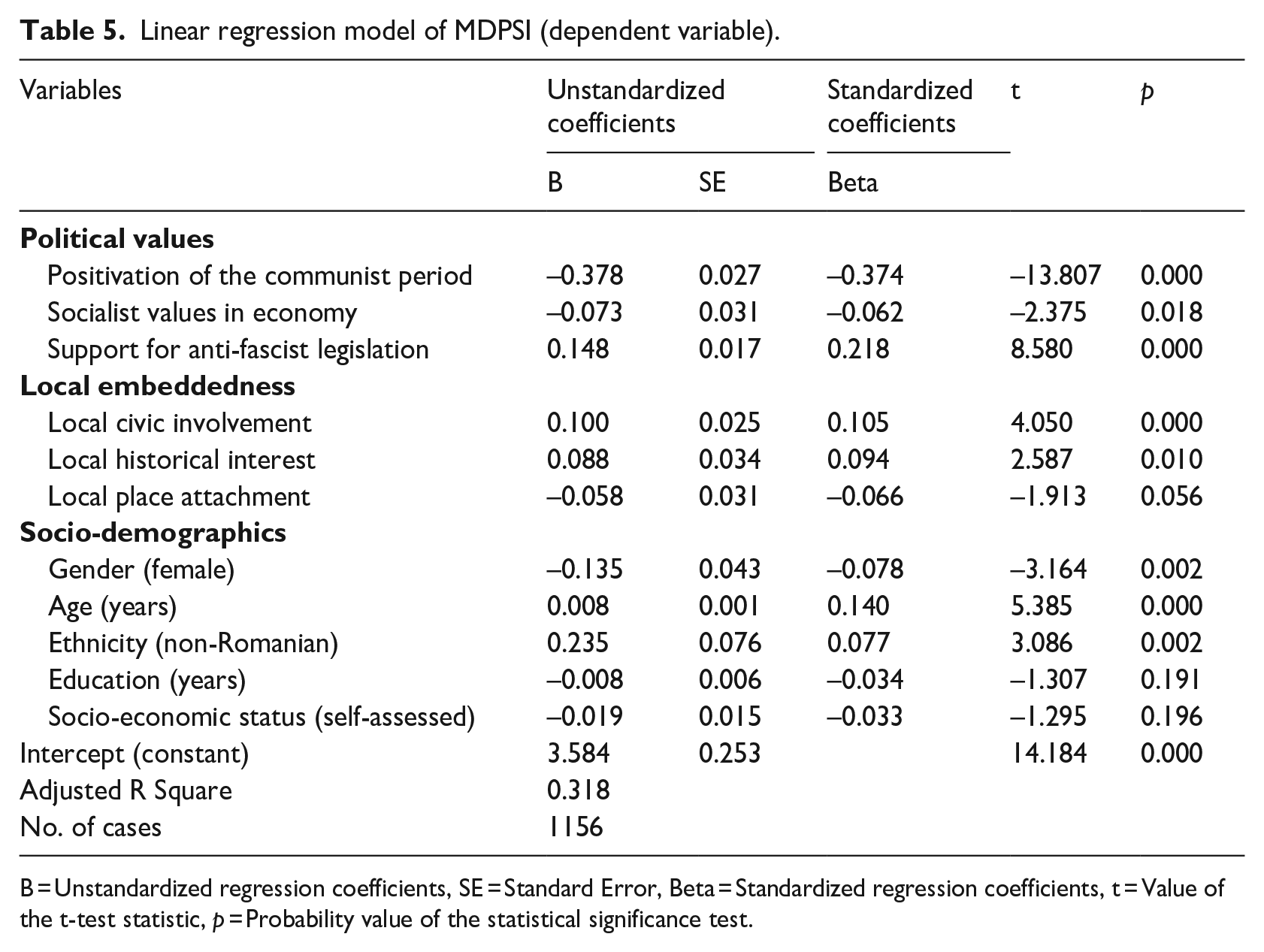
B = Unstandardized regression coefficients, SE = Standard Error, Beta = Standardized regression coefficients, t = Value of the t-test statistic, p = Probability value of the statistical significance test.
Overall, the regression model’s coefficient of determination (adjusted R2 = 0.318) indicates that the model explains about 32 percent of the variance observed at the level of the dependent variable, which constitutes a solid goodness-of-fit. Given this measure, we can proceed with detailing the regression coefficients for the predictors introduced in the model. In the subsequent presentation, these are grouped under the headings of “political values,” “local embeddedness,” and “socio-demographics.”
Political values
Positive values conferred upon the communist period constitute an important predictor for individuals’ attitudes toward the postcommunist revision of the memorial landscape. In particular, the model suggests that those who assess the communist period in positive terms are characterized by lower levels of support for the memorial policies of cleansing the public space from communist names and monuments. Consequently, a negative evaluation of the communist period is therefore associated with higher values of the Memorial De-Communization of Public Space Index (p < 0.001) (Figure 1). A similar relationship was found between individuals’ socialist values in economy and their anticommunist views in terms of memorial policies. Specifically, individuals who believe that the state should intervene to correct the market are characterized by statistically significant lower levels of MDPSI (p < 0.05), reflecting their weaker support for the political measures taken to clear the public memoryscape from communist symbols. The third predictor classified under the rubric of “political values” consists of individuals’ attitudes toward the existing anti-fascist legislation. Somewhat curiously, the regression coefficients indicate that participants who endorse such anti-fascist legislation also embrace favorably the purging of public space from communist symbols (p < 0.001). This finding suggests that what ground individuals’ stance on the memorial de-communization of the public space in Romania cannot be restricted to the left-right political divide. Participants’ support for the removal of communist symbols is also driven by a shared anti-authoritarian/totalitarian political outlook.
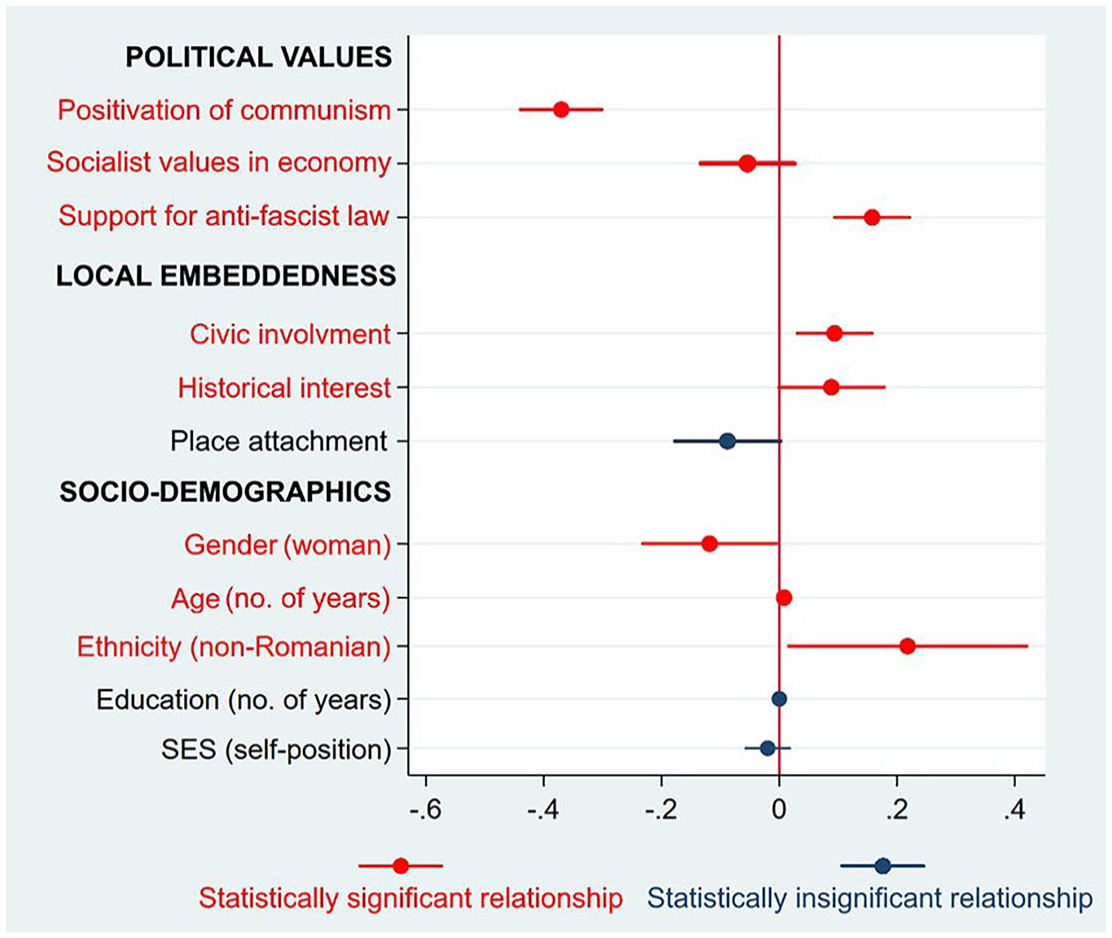
Beta coefficients of the regression model.
Local embeddedness
The communist-era memorial artifacts addressed in this study were ingrained into individuals’ local milieu, as place names, monuments, and memorial plaques marked the symbolic geography of cities and towns. Moreover, individuals’ local embeddedness—their involvement in local civic actions, their local historical interest, as well as their place attachment—were introduced in the model as relevant predictors. We found, first, that local civic involvement is a strong predictor for individuals’ attitudes toward the revision of the postcommunist urban memoryscape. The statistically significant positive relationship (p < 0.001) indicates that those who are actively engaged in the life of their local communities tend to endorse the de-communization of public space. Second, individuals’ interest in local history also features as a statistically significant predictor of anticommunism regarding the former regime’s memorial legacy (p < 0.05), as higher support for cleansing the public space of communist symbols was espoused by those who reported higher levels of interest in the history of their local communities. On the other hand, when controlling for these two factors of an individual’s local embeddedness, place attachment turns out to be a statistically insignificant predictor for the Memorial De-Communization of Public Space Index (p > 0.05).
Socio-demographics
The regression model also includes a series of socio-demographic characteristics in terms of which we can understand the variation of social attitudes toward the postcommunist revision of Romania’s public urban memoryscape. First, the model indicates statistically significant gender differences between respondents. In particular, male participants reported higher values for the Memorial De-Communization of Public Space Index (p < 0.01), which suggest the masculine underpinnings of anticommunist attitudes when it comes to the purging of memorial landscapes. The latter also vary by age: it is the older respondents, especially those who have had direct personal biographical experiences with the communist period, who endorse the memorial de-communization of public space (p < 0.001) (see also Rusu and Croitoru, 2021). This finding challenges the idea that older people are more “nostalgic” and emotionally attached to a past that is part of their biography, who should thus be more reluctant to embrace the changes brought in the memorial landscape after the regime change. Third, when analyzing the variation of these attitudes in terms of respondents’ ethnicity, the regression coefficients indicate that individuals belonging to national minorities (Hungarians, Germans, and Roma, among others) tend to endorse the de-communization of spatial memory, as opposed to the ethnic Romanians (p < 0.01). Such a result makes sense considering that, starting with the 1970s, the communist regime undertook a major turn toward ethno-nationalism and promoted aggressive policies of Romanization aimed at the assimilation of ethnic minorities (Petrescu, 2009). Surprisingly, no statistically significant effects were identified in relation to respondents’ level of education and their self-assessed socio-economic status.
Discussion and conclusions
Central and Eastern Europe’s memorial landscape is undergoing a late refashioning. The Russian Federation’s 2022 invasion of Ukraine has prompted former socialist countries and ex-Soviet republics to remove the left-over communist symbols and artifacts that survived the first purging carried out during the 1990s. In contrast to the anti-Soviet memorial upsurge from countries such Ukraine, Poland, and the Baltic states, Romania’s post-1989 politics of memory with regards to its communist past had already been settled. Here, the process of coming to terms with the past has been largely completed by the time Romania had joined the European Union (2007). By this time, the campaign of renaming places (street nomenclature and public institutions) and removing communist-era monuments was largely over, and the Romanian state settled the scores with its recent past by officially condemning the communist regime as “illegitimate and criminal” (Comisia Prezidenṭială pentru Analiza Dictaturii Comuniste în România, 2007).
Whereas the postcommunist transformation of the memorial landscape have been thoroughly documented regarding the legal and discursive politics of memory (Ciobanu, 2011; Rusu, 2017; Stan, 2013b), place renaming (Rusu, 2019b, 2024), and the removal of monuments (Preda, 2023), the popular reception of these changes was not properly addressed in academic literature. This paper shifts the analytical perspective from the study of coming to terms with the past to understanding the process of coming to terms with the memorial policies enacted by political authorities in the aftermath of the regime change. It is through enacting such an analytical shift that we can grasp how citizens feel about the de-communization of public space that refashioned the symbolic geographies of cities and town via the renaming of places, the clearing of monuments, and the re-installment of other memorial artifacts.
Our empirical research, grounded on a national sample of Romanian respondents (N = 1156), is the first to examine, through a quantitative methodology, the social attitudes toward the refashioning of a postcommunist country’s memorial landscape after the 1989/1991 regime changes in Central and Eastern Europe. The results obtained in our analysis highlighted that, overall, Romanians largely endorse the top-down memorial de-communization carried out by postcommunist political authorities during the 1990s and early 2000s without engaging in broad public consultation with citizens. Such a finding challenges the theoretical consensus regarding the societal consent and legitimacy of political measures being conditional on democratic debate and broad public consultation (Beran, 1987; Fishkin, 2009). In postcommunist Romania, this was not the case, as political actors did not engage with their constituents on the question of how to deal with the memorial remnants of the former regime. However, although authorities acted without consultation, this does not prevent most Romanians from being happy with the purging of the urban landscape from communist names, monuments, and other memorial artifacts.
The multivariate quantitative approach employed in this paper based on a linear regression modeling of survey data further outlined the specific factors that underpin the variation of social attitudes regarding the memorial de-communization of public space. First, political values such as individuals’ negative assessment of the communist period, their liberal orientation on the state’s market intervention, and their support for the legal prohibition of fascist symbols and organizations determine individuals’ support for memorial de-communization. Second, individuals’ embeddedness in their local communities through civil engagement and local historical interests also favor greater support for the spatial policies of de-communization. Finally, socio-demographic characteristics are also important: aspects such as gender (being a male), age (being elderly), and ethnicity (belonging to a national minority group) are all associated with greater endorsement for the spatial de-commemoration of public memory.
Our approach is not without several limitations. The quantitative survey-based approach focused on a national sample of Romanian respondents did not allow us to grasp the repertoire of subjective reasons and motivations that ground individuals’ attitudes and beliefs concerning the spatial policies of public memory undertook during the period of postcommunism. Tapping into these (inter)subjective motivations may be achieved by engaging into a qualitative approach based on in-depth interviewing with ordinary citizens, starting from the statistical findings established in this quantitative endeavor. Such a qualitative extension of our quantitative framework would enrich our understanding by bringing forth a broader palette of nuances regarding the coming to terms with these memorial policies of spatial de-communization. Equally important, although Romania provides an excellent setting for conducting such an analysis, our results are nevertheless bound to a single national context. A transnational understanding of how ordinary Central and East Europeans have come to terms with the spatial policies of memorial de-communization would place our findings focused on Romania in a comparative framework covering multiple national settings.
Footnotes
Declaration of conflicting interests
The author(s) declared no potential conflicts of interest with respect to the research, authorship, and/or publication of this article.
Funding
The author(s) disclosed receipt of the following financial support for the research, authorship, and/or publication of this article: The work was supported by HORIZON EUROPE European Research Council, Grant 101079282 (ELABCHROM) and by Lucian Blaga University of Sibiu (Knowledge Transfer Center) & Hasso Plattner Foundation research grants LBUS-HPI-ERG-2023-08.
