




Abstract
Despite being a crucial field for the public production and circulation of memories, tourism remains underexamined in memory research. This is reflected in the small number of publications dedicated to tourism and their thematic narrowing to difficult heritage sites. This article makes the case for an expansion of research in three areas: sites, modes and scales of remembering. First, the article argues for an examination of less researched heritage sites alongside considering non-site-based forms of memory production. Second, we contend that memory-making in tourism can contribute to a ‘positive turn’ in memory studies by foregrounding memories of joy and entertainment. Finally, we argue for a multiscalar perspective that draws attention to personal memories and memory’s interscalar movements in tourism. Taken together, these shifts allow us to gain a fuller and more differentiated perspective on memory-making in tourism, informed by current debates in memory studies and insights from heritage and tourism studies.
Introduction
Tourism and memory are closely intertwined: tourist destinations have been promoted as providing a journey into the past, promising an experience of a time stood still or turned back (Groebner, 2018; Stach, 2021). Iconic heritage sites and museums are major tourist attractions, visited by millions of tourists each year. Alongside well-preserved old towns, iconic architecture, or ancient cultural sites, more recent and obscure pasts – such as memories of communism, recent revolutions and industrial heritage – have been incorporated into the tourism industry, as heritage tourism has become ‘one of the most popular and globally widespread forms of special interest tourism’ (Light, 2015: 144). At the same time, tourism is also driven by individual memories of past visits, personal and family ties that make places meaningful and can stimulate a desire to (re)visit them. Moreover, tourism of course also creates new memories in the form of memorable stories, photographs and souvenirs that are taken back home and shared with others.
This brief outline indicates tourism’s significance as a field for the production and circulation of memories in today’s societies. However, in contrast to media and communications technologies, educational offers, commemorative rituals, and memory policies that have received significant attention in memory studies research, tourism remains notoriously underexamined. Marschall (2012a) noted already 10 years ago a ‘dearth of scholarly literature on tourism and memory’ (p. 322), especially when considering that the connection between tourism and memory is ‘far more complex and multifaceted’ (Marschall, 2012a: 321) than research on heritage sites suggest. The lack of sustained research on tourism is particularly surprising in the context of the transnational or transcultural turn which has raised awareness for the need for memory to ‘‘travel’, be kept in motion, in order to ‘stay alive’, to have an impact both on individual minds and social formations’ (Erll, 2011: 12; for a critique, see Pfoser and Keightley, 2021). In addition to the small number of studies, existing research is thematically limited as publications have tended to focus on difficult and painful pasts. While adjacent fields of tourism and heritage studies have a broader orientation, examining for example iconic heritage sites (Edensor, 1998), nostalgia or roots tourism (Basu, 2005), or the creation of personal and collective memories in tourism (Rickly-Boyd, 2010), there has been surprisingly little cross-fertilisation between these fields and memory studies.
Against this background, this article makes the case for aninvigoration and expansion of memory scholarship on tourism to account for both the significance of tourism for memory-making and the multilayeredness of the tourism-memory nexus. We acknowledge that memory, tourism and heritage studies are large scholarly fields; work is being conducted in many countries and languages, and there are certainly counterexamples of research on memory-making in tourism that go beyond the study of difficult pasts. The article does not claim that no research has been conducted in these areas. Instead, it seeks to identify less studied routes and makes the case for a thematic expansion of the scholarship, focusing on three key areas: sites, modes and scales of remembering. First, we advocate for an expansion of the range of sites and forms of tourism offers examined, going beyond museums, memorials and other heritage sites associated with difficult pasts. Second, we contend that memory-making in tourism can contribute to a ‘positive turn’ in memory studies by foregrounding memories of joy and entertainment. Finally, we argue for a multiscalar perspective that draws attention to personal memories as well as considering the mnemonic movements between scales. By opening up the examination of tourism memories for new questions and research perspectives, we argue for a broader, yet more differentiated understanding of tourism as a complex field of memory production. We show how this expansion of scholarship can be achieved through a cross-fertilisation of memory studies with tourism and heritage studies as well as by connecting the research on tourism memories to current debates in memory studies.
The article is structured as follows: drawing on a bibliometric analysis of English-language articles published in memory studies journals, we first provide an overview of existing work related to tourism in memory studies research. This is followed by a discussion of the three proposed shifts in the research agenda and a reflection on their implications for future research.
Tourism in memory studies: a bibliometric analysis
To get a better picture of existing scholarship on tourism in memory studies research, we conducted bibliometric research in the most significant peer-reviewed journals in the English language in the field: Memory Studies (2008-), History & Memory (1998-), Memory, Mind and Media (2022-). The search period stretched from the first issue of the journals to 30 June 2024; only research articles were included in the search. Using the search term ‘touris*’, we identified an initial total of 271 articles, 172 in Memory Studies, 99 in History & Memory, and 0 in Memory, Mind and Media, respectively. We subsequently reviewed all articles and removed those that did not make any substantial references to tourism and tourists, that is articles that usually mentioned tourism or tourist(s) only once or twice. We were left with a total of 134 articles, 89 in Memory Studies and 45 in History & Memory. Out of these articles, 19 mentioned ‘tourism’ either in their title, keywords, or abstract (14 in Memory Studies; 5 in History & Memory). Most of the remaining 115 articles did not have tourism as their focus, but examined for example the creation of heritage sites or city branding processes and dedicated a smaller part of their analysis to tourism planning or promotion. Other articles focused on museums and memorials and discussed visitor practices and/or the reception of sites as part of the analysis. As a rule, these articles did not explore tourists’ meaning-making in detail nor addressed questions of touristification or the economic significance of visits to heritage sites.
All 134 articles – including those with tourism as a main and a secondary focus – were coded according to their main theme(s), with up to two themes being chosen per article. The themes ‘difficult past / dark tourism’, ‘national or urban memory’, ‘commodification / branding processes’, ‘nostalgia’, and ‘other’ were identified inductively based on an initial coding of a sample of 30 articles. Out of 134 articles, 91 articles (68%) fell under the code ‘difficult past / dark tourism’ (e.g. articles on battlefield tourism, concentration camps, prisons, and war memorials); 19 (14%) focused on national or urban memory (e.g. representations of particular cities and national heritage sites); 13 (10%) were dedicated to commodification and branding (e.g. city-branding, shopping malls, and museum shops); 8 (6%) discussed nostalgia (e.g. return tourism and souvenirs), and 15 (11%) articles had other themes, examining, for example kitchen gardens, industrial or religious heritage and pilgrimage tours (cf. Figure 1).
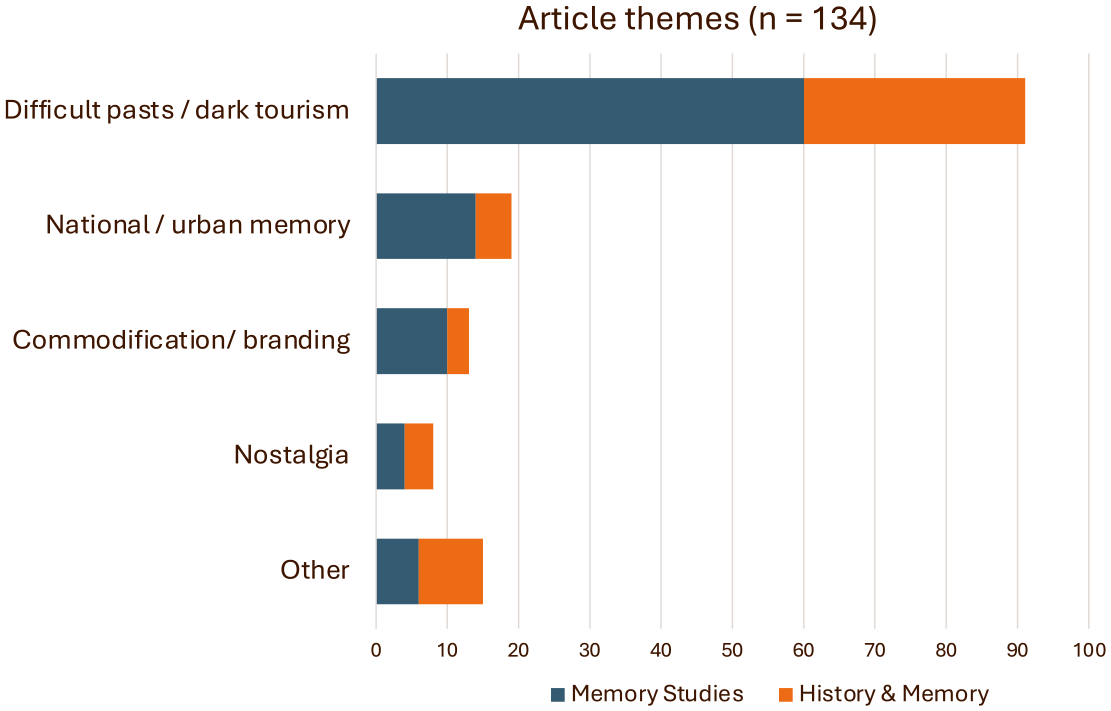
Themes of tourism-related articles in memory studies journals.
The analysis of the 19 articles that had tourism in their title, keywords or abstract showed similar patterns, with 63% (12) focusing on difficult pasts, and the remaining ones evenly divided between the other themes (2 articles each). The bibliometric analysis shows first the small number of articles directly focused on the topic reveals a limited preoccupation with tourism in memory studies. Second, despite tourism’s intimate association with fun, relaxation and entertainment, when memory scholars discuss tourism, a large majority (over two-thirds) focuses on sites associated with ‘difficult’ pasts. The numbers are particularly small when limiting the analysis only to those articles that have tourism as their primary focus.
The preoccupation with difficult pasts is in line with a larger trend in the field. Memory studies has, as Rigney (2018) put it, ever since ‘been dominated by a traumatic paradigm’ (p. 369); the exploration of collective memory seems to have an unquestioned focus on violence, genocides, victimhood and tragedies (cf. Katriel and Reading, 2015). This is also due to the fact that the ‘memory boom’ itself, the rise of public interest in the past over the past three or four decades, is connected to a boom of traumatic memories. Scholars have noted the rise of negative identity narratives that acknowledge national guilt (Giesen, 2004) and a politics of regret (Olick, 2007) that have influenced how the past is dealt with in national politics and international relations. Macdonald (2015) points to a general valuing of transparency, similar to the rise of confessions at the individual level – which has increasingly become a gesture of moral strength in the nation. In tourism research, the rise of ‘dark destinations’ is seen primarily as a reaction to the lack of other ways to confront mortality in late modernity (Stone, 2009b: 25). Another factor is the accessibility of sites of Nazi atrocities in Poland, Czechoslovakia, Hungary, and the GDR after the fall of the Iron Curtain as well as the fall of the apartheid regime in South Africa (Hartmann, 2014).
This focus on difficult pasts is however questionable for two main reasons. First, it reveals a little-reflected self-limitation within memory studies. As understandable as this priority is, it is equally important to question the seemingly natural link between memory and trauma because it leaves out alternative modes of remembering, including ‘the transmission of positive forms of attachment’ (Rigney, 2018: 370). Echoing Rigney’s (2018) plea for a ‘positive turn’ in memory studies, Sindbæk Andersen and Ortner (2019) trace different forms of joyful and pleasant memories, of enthusiasm and positive emotion as an ‘essential part of our mnemonic landscapes’ (p. 7).
Second, scholars in tourism research have critically interrogated ‘dark tourism’, showing that ‘darkness’ itself is a construction (Bowman and Pezzullo, 2010; Light, 2017: 278–279). They have also started to question the empirical accuracy of its rise. Bowman and Pezzullo (2010) note that ‘the perception that tourists’ interest in death has increased may be due to the fact that there are simply more tourists and accessible places to tour now than there were a century ago’ (p. 190). We need to consider whether the alleged rise of difficult heritage is also a reflection of the tendency to include different destinations in one’s itinerary. From the perspective of visitors, it can be the result of a past-oriented omnivorousness (Macdonald, 2015), a term referring to an interest in a diverse range of heritage, including but not limited to dark tourism offers. Moreover, even when we recognise the significance of dark tourism, a focus on this phenomenon only provides a conceptually and empirically diminished understanding of memory-making in tourism. The subsequent sections outline the avenues that can be taken to widen the scholarly inquiry to capture the diversity of sites, modes and scales of memory-making.
Expanding the range of memory sites
The above-mentioned ‘trauma boom’ in memory studies is particularly evident in the spectrum of sites studied. ‘Dark sites’, such as former battlefields, prisons, labour camps and memorials form the subject of the majority of articles published in memory studies journals. Built on authentic sites, such destinations are undoubtedly of great importance to the tourism industry. They are visited daily by international tour groups and individual tourists alike. Paradigmatic for this is the multitude of studies on Auschwitz, which usually discuss its anchoring in mass tourism extremely critically (Bowman and Pezzullo, 2010: 198f; Feldman and Musih, 2023; Graburn, 1989). However, Auschwitz is also visited by many Krakow tourists who tour the Wieliczka salt mine or other tourist attractions. In this respect, it must be asked how representative ‘dark’ destinations are quantitatively when it comes to touristic sights more generally. What about all those attractions that can be found in the ‘For the whole family’ section of a guidebook?
With its focus on reconciliation, decolonisation or coming to terms with the past, memory research paradoxically seems to ignore these mainstream offers. To explore the memory-tourism nexus we therefore propose, first, to consider those sites that have a high tourist appeal but are not prominent subjects of current public debates about history. This includes ancient, medieval or early modern heritage, which despite its popularity with families is usually only discussed in work on monument preservation and heritage management. Castles, city fortifications, rulers’ residences or townhouses seem to belong to an unproblematic, picturesque ‘distant past’ that can be touristified in whatever way one likes (Groebner, 2013: 412–414). To overlook such mainstream sites would be to ignore an entire sector that cannot be underestimated in terms of memory-making. The same goes for the ‘lighter’ side of the dark tourism spectrum and sites that researchers have been reluctant to classify as representations of history at all, including dungeons, escape rooms, or theme parks (Carlà and Freitag, 2015; Stone, 2009a). There is no doubt that these sites readily play with collective images of the past and stimulate reflections on historical contingency, social progress or the timeless characteristics of human life.
Second, it is important to more explicitly reflect upon the ‘tourist component’ of sites already in the focus of memory research. In fact, as our bibliometric research shows, museums and other sites are all too often seen as places of negotiation and mediation of local or national memory, without considering them as destinations anchored in the (international) tourism industry. There is a fundamental interrelation between tourism and heritage spaces, as Markham has shown in the example of paramilitary museums (Markham, 2018). Museums also see tourists as an important target group simply because, like many public institutions, they experience increasing commercial pressure (Cento Bull et al., 2019). In this context, the question arises as to which tourists heritage managers have in mind in terms of ethnicity, class, or generation and – maybe equally important in order to understand eventual dissonances – who the ‘imagined non-visitors’ (Carnegie and Kociatkiewicz, 2019) are. Moreover, research hardly ever addresses the question of to what extent the anticipation of a particular tourist gaze or the, sometimes trivial, requirements of mass tourism feed into the architectural design or curatorial concepts. In order to do justice to the characteristics of tourism, we also need to go beyond an analysis of exhibition content to consider sites as experiential tourist stages where visitors perform their temporary role as tourists (Edensor, 2000; Reynolds, 2018). This involves a whole bundle of practices, including taking photos, writing in the guest book, eating, drinking, lounging and shopping. Consumer infrastructures such as restaurants and museum shops are part of the museum experience (Feldman and Peleikis, 2013; Hochmuth et al., 2024; Kent, 2010; Macdonald, 2011); the capacities and offerings of gift shops will be different in small local museums than in larger institutions. Analysing memory sites through the lens of tourism also means to analyse souvenirs and kitsch objects sold there (Markham, 2021; Sturken, 2007) and asking whether a museum shop’s product line might be as relevant for tourists’ encounters with cultural memory as, say, educational programmes and other events.
Finally, we argue for a broader understanding of toured sites that encompasses memory processes that refer to multiple visited places, including non-institutionalised sites. While the latter have been addressed in regard to community museums and grassroot heritage initiatives within museum and heritage studies (Crooke, 2010), and studies on ephemeral memorials (Haskins and Rancourt, 2017), the vast literature on tourism in memory studies journals deals with historic places, archaeological sites, museums, or memorials. However, vacation sightseeing is not limited to these. Public squares, freely accessible buildings, particular streets, lines of houses and whole neighbourhoods can also be analysed as tourist sites. At the same time, not all sites of memory are also sights considered worth visiting and, conversely, there are numerous objects and places that are charged with meaning by tourists without being of interest to the local population. Following this line of thought, we need to consider that not only is heritage a main driver for tourism but that there is also an inverse relationship: tourism is a significant heritage-producing machine (Gravari-Barbas, 2018).
An expansion of research sites could draw on tourism studies’ knowledge about sight sacralisation as a semiotic operation in which many actors are involved (Culler, 1981; MacCannell, 1976) and thus enrich the current discussion of heritagisation processes. It would also allow us to more deeply explore the role of non-institutionalised memory, that is what goes beyond the ‘authorised heritage discourse’ (Smith, 2006). Of great significance are, for example, the activities of guidebook and travelogue authors, tour operators, and tour guides, who often perform as freelancers and may have their own agendas. In fact, guided (city) tours seem one of the most popular forms in which memory is mobilised and negotiated; in addition, there are mobile apps and analogue route descriptions that direct visitors’ steps and gazes to create particular memory lanes. Guided tours have been described as performances of spatial stories, that create and shape sites (Overend, 2012); by putting sites in an order and making them part of an overarching narrative, new meanings are produced. Accordingly, another potential lies in the consideration of entire itineraries (Wang, 2006), both on the macro-level of individual journeys or packaged tours and on the micro-level of walking tours across cities or other heritage landscapes. In our own research, we have examined commercial tour offers and highlighted the strategies guides use to navigate difficult pasts and to evoke feelings of authenticity by using immersive environments and inviting certain bodily engagements (Pfoser and Keightley, 2021; Schlegel and Pfoser, 2021; Stach, 2021, 2024). By studying guided tours in terms of narration, negotiation, embodiment, and performance of memory, we suggest bridging various lines of scholarship on tourism, heritage, memory, and place-making. Including non-site-based memory in the analysis also removes the all too rigid division between different actors (official vs vernacular; producers vs visitors; locals vs tourists) and to do justice to the diversity of tourist cultural consumption, which does not necessarily distinguish between serious and funny, between high culture and the trivial.
Accounting for different and entangled modes of remembering
The variety of sites in tourist memory-making is reflected in a variety of modes of remembering. In general understanding, a vacation is supposed to bring relaxation, entertainment, and positive experiences of hospitality and happiness (Nawijn and Strijbosch, 2022). Tourism criticism has also underlined the notion of tourism as a hedonic, light, joyful, and somewhat superficial experience. It is reasonable to ask whether this discredits tourism as an object of research, or whether entertainment and fun should not instead be brought into its focus. As Gibson (2010) notes: ‘Holiday escapism may well tempt ignorance of unethical practices, but does that mean dismissing fun as a possible site of analysis?’ (p. 525)
The ‘traumatic paradigm’ of memory studies (Rigney, 2018: 369) seems to run counter to this concern. As indicated earlier, memory studies usually follow a normative approach; considerations of memory cultures often centre around practices of mourning and learning and focus primarily on three modes of remembering – the antagonistic, the cosmopolitan (Levy and Sznaider, 2001) and the agonistic (Cento Bull et al., 2019). What seems to be of less interest are the hybrid, complex modes of remembering that are situated between these poles and are neither state-controlled nor developed by civil society actors in a bottom-up manner. This includes individual, joyful and playful but also voyeuristic, escapist and entertainment-centred modes of remembering. We argue that tourism offers a unique opportunity to engage more fully with these modes, as well as their interconnections with others, allowing us to move beyond a normative approach that implies a division between legitimate, i.e. empathic and reflective, and less legitimate, that is self-centred, hedonic modes of remembering.
A dichotomous view of remembering has also been perpetuated by research on nostalgia, which undoubtedly forms a ‘key point of convergence in the tourism-memory nexus’ (Marschall, 2012a: 327), and was one of the themes identified in the bibliometric research. Indeed, nostalgia seems to be part of the intrinsic logic of modern tourism; since its inception, tourism has been described as an escape from the complex, modern lifeworld: With some exceptions (Cohen, 1979), the modern tourist was said to be driven by the longing for the less alienated lifeworld of pre-modernity (MacCannell,1976). In fact, the tourism/heritage industry can be seen as a ‘nostalgic semiotic economy’ (Coleman and Crang, 2002: 4) widely advertising opportunities to (re-)encounter long-lost objects and practices, for example in reconstructed buildings, retro styles, living history museums, reenactments, or themed environments (Bruner, 2004; Hochbruck, 2013). Nostalgia obviously is an important driver of tourism’s commodification of the past.
Nostalgic practices can be particularly observed in tourism that involves lost or former homelands. Such forms of memory-driven travel are often dealt with under the term ‘roots tourism’ (Basu, 2005; Marschall, 2015: 878) and include ‘migrant return travel’ (Coles and Timothy, 2004), ‘homesick tourism’ (Marschall, 2015), or ‘genealogy tourism’ (Meethan, 2004) while the concepts of ‘personal heritage tourism’ (Timothy, 1997) and ‘personal memory tourism’ (Marschall, 2015) are somewhat broader conceived. A common thread that unites these types of travel is the desire to (re-)visit places to connect with one’s own life or ethnic communities, to re-experience a sense of belonging. What makes roots tourism a particular insightful object of research is its ambiguity: Scholars working in this area have started to show how such forms of travel are not just about nostalgia in the sense of an affirmative and wistful retrieval of positive memories. On the contrary, especially when undertaken by displaced persons and involuntary migrants, they are highly contested and complex as great joy can be intertwined with great anguish (Demshuk, 2012; Marschall, 2015: 881). These studies also link with the exploration of a wider range of emotions in dark tourism scholarship (Koleth, 2014; Light, 2017).
Nevertheless, the attribute ‘nostalgic’ is often used to criticise joyful memories as naïve and even regressive or dangerous. In line with the normative approach of memory studies, most researchers are interested in the ‘problematic’ nature of the phenomenon including the regressive effects of orientalist, imperialist or colonial nostalgia that reproduces myths of the unchanged or the uncivilised (cf. Buettner, 2006; Salazar, 2013). Yet the question remains, how do nostalgic practices relate to other modes of remembering such as joy or mourning? And how do these modes play into a wider framework of cultural memory?
Tourist practices lend itself well to examine these questions because they highlight the intertwining of different modes of remembering. Two types of studies, on the tourist use of objects, and on remembering in the family context, help to understand these connections. In particular, Sturken’s (2007) work illuminates the meaning of tourist objects such as souvenirs and photographs. Sturken (2007) uses the example of Ground Zero to show how memory souvenirs and comfort objects like the FDNY teddy bears enable a ‘kitsch culture of sentimentality’ (pp. 5–8) that influences how individuals (mis)remember 9/11. Although Sturken is highly critical of the US comfort narratives perpetuated in tourism, she does not reject nostalgic modes of remembering in general. Instead, she is interested in the function of private needs within larger cultural frameworks. Describing the seemingly trivial purchase of a souvenir as part of a complex negotiation of narratives and values, she also highlights that tourist ‘memory kitsch’ can enter a second phase through ironisation and ‘playful engagement with history, a kind of humorous pastiche’ (Sturken, 2007: 21). Even seemingly superficial-consumerist and ludic practices associated with nostalgia and kitsch thus create meaning and contribute to the emergence or transmission of collective memory (Markham, 2021). It therefore seems promising to take a closer look at the different modes of play that can be observed in tourists’ engagement with the past (Bruner, 2004: 164). As existing studies show, tourists are by no means passive recipients of retro spectacles but rather blur the all too often implied binary patterns between educational and entertaining, authentic and inauthentic (Bowman and Pezzullo, 2010: 195).
A similar entanglement of modes becomes apparent when examining memory-making in the framework of a family holiday. As Smith (2021) has pointed out, heritage sites play an important role as ‘arenas for intergenerational communication and socialization of children’ (p. 10). Visits to museums and other sites are not primarily about the reception of exhibition content, but rather statements of belonging through which children learn values and family history. By emphasising that emotional modes of reception can also lead to critical reflections on the past, present, and future, Smith opposes the widespread view that affective approaches tend to result in paralysing, regressive forms of nostalgia (Smith and Campbell, 2017). Turning to the emotional practices of tourists thus shows that family travel never is a full escape into a tourist counterworld. Although several researchers highlight the importance of tourism for familial relationships (Haldrup and Larsen, 2003; Noy, 2007) and, vice versa, the role of social or familial relationships for tourist experiences (Wang, 1999), one can hardly find any attempts to examine familial sociality in relation to past-related travel. Using the example of trips made by Israeli descendants of Holocaust survivors together with their survivor parents, Kidron (2013) examines ‘dark family tourism’ and shows how co-presence at sites of former suffering can enable the performance of emotions and the building of new we-relationships. Although she too focuses on sites of atrocity, her contribution is relevant for other forms of tourism because Kidron (2013) aims to ‘demystify’ dark tourism, pleading for an expansion of ethnographic research into ‘emotion work in all forms of heritage tourism’ (p. 191). In doing so, she inscribes her work in a research tradition that rejects a binary division between Home and Away and instead views the tourist experience as an integral part of everyday experience (Richards and Wilson, 2004; Urry, 1990). Obviously, ‘tourist’ modes of remembering are inevitably linked to ‘domestic’ sociality.
Adopting a multiscalar perspective
One of the strengths of the field of memory studies has been its broad conceptualisation of ‘memory’, using it as an umbrella term to capture a range of processes at different scales. While an understanding of scales has often been implicit – with studies focusing on one scale only, or examining, for example the interrelations between official and vernacular memory – more recent research in memory studies has seen more preoccupation with the concept of scales and their interrelations, drawing on geographical scholarship. This has been particularly pronounced in the scholarship on transnational memory. While researchers initially emphasised memory’s mobility beyond and across national borders (Erll, 2011), the prioritisation of movement over memory’s locatedness has been criticised; as a response, transnational approaches have increasingly turned into multi- or interscalar examinations of memory. In an early critique of the scholarship, Radstone (2011) argued that a focus on movement should ‘direct us to attend to those processes of encountering, negotiation, reading, viewing and spectatorship through which memories are (. . .) brought down to earth’ (pp. 110–111) and warned not to lose sight of memories that remain fixed in place, and, for different reasons, don’t flow. Wüstenberg (2019) builds on this critique when exploring the ‘tension between the production of remembrance through transnational processes and its grounding in concrete locations’ (p. 371).
Discussions on memory-making in tourism can effectively draw on and contribute to these debates. Tourism lends itself well to analysis of transnational remembering and its different outcomes (Pfoser and Keightley, 2021) but it is also suitable to explore a broad scalar spectrum of remembering from the personal to macro-scales as well as memory’s movements across scales. We argue that first, more attention needs to go into the scale of personal and autobiographical remembering. Personal memories, mentioned in the previous section in relation to roots and nostalgia tourism, also offer a particular scalar perspective on memory-making. As Marschall (2012b) argues, memory-making in tourism ‘does not necessarily require the presence of monuments and precious cultural objects, but relies on embodied memories that evoke emotions’ (p. 2217). Memories of past events and periods are actively used by tourists to construct particular images of self and others. Prior to their trip, when making decisions of where to travel, and during and after their trips, tourists draw on their own past experiences as well as socially and culturally transmitted understandings of the past. Recollections of previous journeys, longing for a homeland and personally significant places, shape travel choices and direct the tourist gaze towards the past, comparing what once was to the present (Marschall, 2016: 194). Holidays are also an important part of biographical memories that are integrated into one’s narrative of self and acquire new meanings in this process (Rickly-Boyd, 2010). Family albums and social media posts as well as the use of souvenirs and photographs as personal memory objects linked to past travel (Bærenholdt et al., 2017) underline the significance of travel for the understanding and performance of personal and family identity, which deserve further examination.
The personal and familial memories produced in tourism are never solely limited to the individual/biographical level but are in different ways embedded in collective, national, religious or ethnic, memories. Marschall (2016) notes how homesick tourism is shaped by social frames of remembering:
The presence of different types of audiences – that is the company of other expellees, (grand)children or complete outsiders – will influence not only how the homesick tourist narrates the story of his or her personal past, but in fact how she or he remembers it (p. 192).
Kidron’s (2013) analysis of family root trips by descendants of Holocaust survivors emphasises a constant movement between scales from personal to cultural to personal memories. Descendants ‘undertake personal and familial secular pilgrimage to the ethnic and Israeli national past’ but also ‘domesticate’ this pilgrimage (Kidron, 2013: 189) by highlighting emotive experiences and familial co-presence at sites of atrocity that allowed the expression of repressed traumatic memories. Kidron argues that family visits in this sense differ from travel by non-descendants which primarily engage with collective/national historical events, an observation that could be followed up by further research.
Work on personal and familial memories already points us to the transscalar mnemonic movements through which personal memories draw on and rework secondhand memories and narrative frames. Keightley et al. (2019) capture this idea in their notion of interscalarity, arguing that memories are ‘mutually interactive even as they are influenced and mediated by differential sources of power and authority, endorsement and legitimation’ (p. 28). Individual memories are never simply based on individual experience alone but incorporate shared or secondhand knowledge, ‘shuttle(ing) back and forth between our own experience and that of others (. . .), and in doing so move(s) across and between individual, collective and cultural scales’ (Keightley et al., 2019: 28), a movement that necessarily involves translations and frictions.
Building on these ideas, we can consider memory-making in tourism in relation to transnational memories. Two movements with different starting points are of particular interest here: first, the deterritorialisation and transnationalisation of memory in tourism institutions and practices, and second, the reterritorialisation and grounding of transnational memories. In relation to the first point, we can start from a particular location and examine how (local and non-local) practices transnationalise memory: as Wüstenberg (2019) argues, while remembering processes occur in specific sites, ‘transnationality is manifested in the performances and mental connections made in the process’ (p. 375). Björkdahl and Kappler (2019) for example examine how museums and memorials of genocide transnationalise commemoration through processes of commercialisation and professionalisation. Focusing on Robben Island Memorial in South Africa and the Galerija 11/07/95 in Bosnia Herzegovina, they analyse how the production of collective memory in museums relates to global normative discourses of ‘never again’ and the global political economy of dark tourism. Based on an analysis of Russian-language city tours in Tallinn, Pfoser and Keightley (2021) discuss how international tourism enables a transnational negotiation of memory, leading to pragmatic interpretative adjustments and selective silences as a response to mnemonic difference rather than the creation of cosmopolitan frameworks.
Second, tourism can also help to understand another direction of movement – the grounding and reterritorialisation of memory in particular places, highlighting spatial and embodied performances of transnational memory. Work on guided tours by Brunow (2019) and Huss (2024) examines how memory sites are created through active memory work that draws on regional, national and transnational frameworks. Brunow’s (2019) work on post-Punk heritage in Manchester analyses guides’ remediation of memory as a project of place-making where social media images are used as a means of ‘bringing home’ transnational memories, by connecting them to local urban landscapes. Focusing on refugee-led tours, Huss (2024) analyses how refugees connect stories of displacement and discrimination to urban sites and inscribe themselves in the city space. Studies such as these are also of general importance for the concept of cultural heritage: they demonstrate that heritage is by no means a vehicle of local resistance to global mobility, but equally a product of it (Gravari-Barbas, 2018), including migration, displacement and also recreational tourism.
Conclusion: towards a fuller understanding of memory-making in tourism
Against the background of a so far limited engagement with tourism in the memory studies literature, this article has demonstrated that tourism is a rich field for the production and circulation of popular knowledge about the past. We have particularly drawn attention to a diversity of sites and spaces where memory-making can be studied, as well as the different, intersecting modes of remembering in tourism, especially those associated with joy, playfulness and entertainment. Moreover, the article emphasises the importance of considering different scales of remembering and the interscalar movement to understand configurations of remembering in tourism. Through this discussion, we have made the case for a richer and more differentiated understanding of memory-making in tourism and have outlined several avenues that scholars can use to further explore the multifacetedness of the tourism-memory nexus.
In doing so, we have drawn attention to existing scholarship in areas that have so far received less attention in memory studies. Some of this work originates in heritage and tourism studies that deserve to be brought into closer dialogue with the field. In particular, engagement with the performative turn in tourism studies can help to better understand the embodied and spatially situated character of memory-making in tourism. Memory production in tourism is usually grounded in particular places, based on face-to-face encounters with places, people and material and immaterial heritage, these embodied and material dimensions of memory-making are often disregarded when focusing on the (re)mediations of transcultural memories or representations of the past in museums and heritage sites. Studies on tour guiding, sight sacralisation, family travel as well as souvenirs and personal memory objects offer different approaches to studying how memory can be set in motion or located. Tourists’ engagements with the past deserve attention not just as receivers of memories (Smith, 2021) but as memory-makers who have complex and shifting ways of engaging with the past.
Following this path, the article has also shown how the study of tourism can be linked to broader conceptual debates in memory studies. Current discussions on the reception or ‘grounding’ of transnational memories as well as a ‘positive turn’ in memory studies can be fruitfully explored in relation to memory-making in tourism. Moreover, studying tourism can make a distinct contribution to these debates – for example by showing the role commodification and consumerism play in the transnationalisation of memory, by illuminating the relations between site-based and mobile memory. A sensitivity towards these scalar movements can also help to advance debates on memory in tourism and heritage studies that have often focused on the production and circulation of national memories in specific places or on personal memories without considering transnational memories or movements between scales.
Finally, our hope is to destigmatise tourism as a research subject and to question its often all too bad image. While works by Sturken (2007), Landsberg (2004) and, more recently, Reading (2014) and Allen (2016) have provided more positive and nuanced discussions around the productivity of commodification processes, tourism continues to be conceived implicitly or explicitly as diminishing memory, detaching it from the past and rendering it inauthentic and trivial. Such a conception limits engagement with the complexities of memory and processes of remembering in tourism. In fact, modes of remembering in tourism often are politically more ambiguous, different from the memories of hope that have been at the centre of a ‘positive turn’ in memory studies. Yet, we believe that they should not be easily dismissed. Memories based on direct (touristic) encounters can challenge hostile conceptions of the other, and the idleness that tourism enables can act a transformative force (Fazito and Vargas, 2023) and counterweight in a world driven by the demands of speed and efficiency. We hope that by making connections to wider scholarly debates and outlining significant lines of investigation this article encourages future empirical research and conceptual discussions on memory-making in tourism.
Footnotes
Funding
The author(s) disclosed receipt of the following financial support for the research, authorship, and/or publication of this article: This work was supported by the UK Economic and Social Research Council [grant number: ES/R011680/1].
