




Abstract
Contributing to the growing literature on the memory-activism nexus, this article analyses how activists remember past activism. For social movements and activists, memories of past mobilisations represent both an asset and a burden. This article seeks to contribute to existing research on memory in activism by identifying recurrent patterns of how activists remember and forget previous mobilisations across different movements. Based on interviews with activists of the Global Justice Movement (1998–2007) and the Blockupy movement (2012–2015), four mnemonic modes are identified. These entail two types of mnemonic adoption, which highlight continuity with a positive or negative valence attached, and two types of mnemonic rejection, which highlight discontinuity with a positive or negative valence attached. I show how similar patterns of these mnemonic modes can be found across the two movements and their diverse subgroups. At the same time, however, these mnemonic patterns differ depending on the degree of activists’ identification with the overall movement; while activists who strongly identify with the movement in question remember failures of past mobilisations and their differences to current ones more clearly than similarities and successes, the opposite is the case for activists with low identification attachments.
Introduction
Social movements may seem to appear suddenly but often build on a long history. They are embedded in an extensive set of prior experiences of collective action. More often than not, they draw on pre-existing practices, knowledge and strategies from previous mobilisations. In past years, scholars of activism and social movements have drawn (renewed) attention to the continuities and discontinuities between different cycles of mobilisation (Amenta and Polletta, 2019; Daphi and Zamponi, 2019; Zamponi and Daphi, 2014). This interest builds a crucial bridge between social movement studies and memory studies and raises the question: how do activists remember past mobilisations?
For social movements and activists, memories of past mobilisations represent both an asset and a burden. They can be enabling and empowering, for example by giving legitimacy and weight to current activism. But memories of past mobilisations may also constrain later movements, for example by stigmatising certain topics or forms of activism as outdated or dangerous. As such, claims to novelty and continuity both have their specific advantages. In this vein, Eyerman (2015) highlights how ‘rhetorical claims [of past movements] add emotional force to movements by raising the stakes of their current practice, by connecting to history or by denying that connection’ (p. 79, emphasis added). Activists of a particular movement may hence decide to either associate themselves with or disassociate themselves from previous mobilisations. This may also happen unconsciously, for example in instances of implicit memory, that is, schematised memorata that remain ‘not intentional, non-conscious, and not visible’ for most (Erll, 2022: 5) or with respect to memories that are embedded in certain adopted protest symbols, practices, and settings (Zamponi, 2018).
This article aims to identify some common patterns in how activists remember and forget previous mobilisations. For this purpose, it will analyse activists’ memories of two different progressive social movements in Germany: The Global Justice Movement (1998–2007) and the Blockupy movement (2012–2015). By drawing on interviews with activists from both movements, the article seeks to contribute to the literature on memory in activism by highlighting social movements and activist groups as specific mnemonic communities. The analysis reveals similar mnemonic patterns across the two movements and their various subgroups, including across the different generations and ideological orientations within these groups. However, in doing so, it also shows how these mnemonic patterns differ depending on the degree of activists’ identification with the overall movement; while activists who identify strongly with the movement remember failures of past mobilisations and their differences to current ones more clearly than similarities and successes, the opposite is the case for activists with low identification attachments.
The article sets out by giving an overview of the growing literature on the interaction between memory and activism and continues by delineating its specific contribution to research on memory in activism. Thereafter, I introduce the two case studies and the interviews that will be analysed in this article. In the analysis section, I first identify the four modes in which activists remember and forget past mobilisations before going into detail regarding the distribution of these different mnemonic modes and their recurring themes across the two movements and across diverse subgroups.
Collective memory in activism and social movements
In past years, research into the interconnections between collective memories and social movements has grown considerably (Chidgey, 2018; Daphi, 2017; Della Porta et al., 2018; Gutman and Wüstenberg, 2023; Hajek, 2013; Merrill, 2017; Reading and Katriel, 2015; Zamponi, 2018). This growth draws on developments within both social movement studies and memory studies (for an overview of these developments, see Daphi and Zamponi, 2019).
Within this body of literature some scholars focus on activism (Gutman and Wüstenberg, 2023; Rigney, 2018), while others refer to social movements (Daphi and Zamponi, 2019; Zamponi, 2018). The meaning of these concepts differs somewhat: the term social movement typically refers to a social entity, that is, informal networks of individuals and groups that seek to promote or oppose social change based on collective action (Della Porta and Diani, 2006). Social movements have a certain degree of continuity even though the exact duration of their activities may vary – as does the size of the collective. In contrast, activism typically refers to a mode of action that can encompass a broad range of activities that may be collective as well as individual, short-lived as well as continuous, and disruptive as well as everyday (see also Gutman and Wüstenberg, 2023: 9). While these terms have slightly different emphases in terms of their focus, there are considerable overlaps in the social phenomena they study, which invites us to think about both in conjunction. First, they both address actions and actors seeking to effect (or hinder) political, social or cultural change through a variety of activities outside of institutionalised channels such as voting or party engagement (Della Porta and Diani, 2006). Second, both terms acknowledge that while not all instances of activism are part of a social movement, many individual and loosely organised cases of activism are still embedded within and impacted by discourses and traditions of larger movements. For this reason, this article will refer to both activism and social movements or will use the term mobilisation to refer to activities in the context of both activism and social movements.
The growing body of literature on memory and mobilisation covers different dimensions of the interaction between both elements. In particular, three strands of research have been distinguished (see Daphi and Zamponi, 2019; Rigney, 2018, 2021). First, memories of movements and activism, which explores how certain past contentious periods are remembered (or forgotten) in broader society. Second, movements about memory or ‘memory activism’, which focuses on forms of mobilisation that centre on (re)shaping and changing the existing cultural memory of a particular event. Third, memories in movements and activism, which focusses on memory as a resource and condition for collective action in and beyond social movements. Of course, empirically, these dimensions may overlap. For example, a memory of a movement can be closely linked to the role of memories in a movement (see also Rigney, 2016), as is the case when contemporary activism draws on and appropriates previous mobilisations’ slogans or symbols, which can be of a similar or different ideological orientation (as in the case of right-wing movements appropriating slogans from past pro-democratic movements, e.g. Richardson-Little and Merrill, 2020; see also Blom, 2024). Nonetheless, a distinction between these three dimensions remains analytically fruitful, particularly because of the fact that while overlaps between the three dimensions may occur, they do not necessarily do so. In addition, it is this very distinction that allows one to identify and disentangle the different ways these dimensions interact.
This article contributes in particular to the third strand of research, which looks at memory as a resource for activism and social movements or, in other words, in mobilisation. As I will focus specifically on memories of prior activism from later activists, the research also speaks to the first strand: memories of mobilisation. The rationale for focussing on memories in movements and activism is that within this sub-strand of the literature, research on memories of past mobilisations is still relatively rare. Memories that affect activism and social movements may concern rather different pasts. Several studies have examined the uptake of memories of (national) historical events by activists (Farthing and Kohl, 2013; Harris, 2006), and some have addressed their own movement’s past (Daphi, 2017). While research on the role of memories of previous (related) phases of mobilisation in new instances of mobilisation is still relatively small (Baumgarten, 2016; Daphi and Zimmermann, 2021; Zamponi, 2018), it has provided interesting insights into the variety of ways in which current activists remember previous mobilisations. It has shown how (successful) framings of activists’ demands, slogans or symbols have been appropriated from earlier movements (Baumgarten, 2016; Jansen, 2007; Kornetis, 2019; Zamponi, 2018) as well as how previous mobilisations – or elements of these – have been strategically rejected and ignored in order to stress the current movement’s novelty and noteworthiness (Flesher Fominaya, 2015; Polletta, 2006) and to facilitate coalition-building (Zamponi, 2018). However, this research tends to be very case-specific, focussing on a single movement or comparing different manifestations of a social movement across countries. This makes it difficult to assess to what extent identified patterns of the remembering and forgetting of previous mobilisations are more widely applicable. Hence, this article aims to overcome this by analysing the uptake of memories of past movements across two different movements with the aim of identifying recurrent mnemonic patterns across them.
The article is therefore interested in collective memories in a specific sense. Drawing on Maurice Halbwachs’ (1992 [1925]) seminal work on the social construction of collective memory, I understand collective memory to be actively produced and shaped within ‘social frameworks’, that is, in social interactions embedded in particular societal structures and relationships with specific systems of meaning, language and points of reference. In particular, I understand collective memory to be collective in the sense of it being the result of collective actions and a specific group’s ‘memory work’ (Jansen, 2007: 953) that in turn shapes social practices as it constitutes part of the ‘patterns of publicly available symbols objectified in society’ (Olick, 1999: 333–336). At the same time, such collective memory is never static but always in a constant state of reformulation. This article focuses on collective memories as they relate to a specific network of people – namely, social movements – rather than on collective memories of large social units and with possibly more significant degrees of institutionalisation, such as cultural memories (Erll, 2011) or public memories (Tota, 2004). The article considers movements and other activist collectives as particular mnemonic communities (Zerubavel, 1996) that interactively create group-specific interpretations of the past, including past mobilisations, which in turn shape new mobilisations (see also Daphi, 2017; Zamponi, 2018).
If movements remember collectively, they also forget collectively. All memory is inevitably selective and as such involves not only remembering but also forgetting (Schudson, 1995). Recent years have seen a growing interest in forgetting within memory studies. Seminal contributions distinguish between different forms of forgetting, thus highlighting that it may be accidental or structural, planned and strategic, repressive and restrictive or liberating and emancipatory (Assmann, 2016; Connerton, 2008; Plate, 2016). In addition, scholars have highlighted how forgetting is not only a loss but also a resource, for example for groups’ collective identity building (Connerton, 2008), their reassurance, encouragement, appeasement, and their handling of differences in experience, orientations, and interests (Assmann, 2016). Zamponi (2018), in relation to this, has described the role of apostasy in social movements. That is, how activists downplay or break with certain traditions – such as their use of certain symbols – in order to facilitate broader mobilisation and build coalitions. Therefore, it is necessary to analyse collective patterns of remembering in conjunction with collective patterns of forgetting when analysing memories in movements.
The following analysis seeks to identify such collective patterns of remembering and forgetting across two movements. Due to their different impetuses and mobilisation dynamics, these two movements have different relations to the past. Furthermore, memories of past mobilisations are also likely to differ within the context of a specific social movement. In fact, social movements are usually heterogeneous actors and each subgroup may have very different views of the past. Activists’ varying interpretations of the past may also be shaped by various factors, including ideological orientation or age as existing research suggests (e.g. Daphi and Zimmermann, 2021; Kornetis, 2019). This raises the question: can we find shared mnemonic patterns across diverse subgroups and movements and, if so, what do these patterns look like?
Cases and data
The following analysis draws on interviews conducted with activists from two progressive movements in Germany: The Global Justice Movement (1998–2008) and the Blockupy movement (2012–2015). The two movements addressed different issues but are both characterised by the mobilisation of a diverse set of political groups, including both radical and moderate groups as well as groups with different degrees of formalisation (e.g. political parties as well as loose initiatives).
The Global Justice Movement (GJM) refers to a particular phase of mobilisation against neoliberal globalisation, between roughly the late 1990s and late 2000s. The diverse groups of the GJM predominantly protested against growing economic, social and environmental injustice connected to intensified neoliberal globalisation. The GJM received significant public and scholarly attention. In particular, scholars noted its unprecedented transnational scope and its ability to bring together varying groups and causes – ranging from radical leftist and anarchist groups to highly institutionalised NGOs, and from peace and environmental groups to trade unions (Della Porta, 2006, 2007a). While the GJM in Germany united different groups, just like the GJM movements did elsewhere, it included a larger proportion of institutionalised groups and NGOs than in other countries (Della Porta, 2007b; Rucht et al., 2007). The anti-neoliberal association ATTAC 1 was especially prominent here. Mobilisations in Germany overall were smaller than in other European countries such as Italy and gained in size later compared to others, as it was not until the late 1990s that German mobilisations for global justice took place on a larger scale (Rucht et al., 2007). This is reflected in particular in the protests against meetings of the European Union (EU) and the G8 in Cologne in 1999, which counted between 30,000 and 50,000 participants each (Rucht et al., 2007). In the following three years, German activists primarily participated in various international counter-summits and social forums. In 2003, large protests took place again in Germany, with about 500,000 people protesting against the war in Iraq (Rucht, 2003), and in 2007, protests against the G8 summit in Heiligendamm brought up to 60,000 people to the streets (Rucht et al., 2007). After this second event, however, the broad coalition lost momentum, as did the large joint mobilisations for global justice (Daphi, 2017).
The Blockupy movement (Blockupy) in Germany mobilised against austerity measures in support of more democracy – especially with respect to more democratic accountability and direct democracy 2 – in the aftermath of the 2007 financial crisis, just like anti-austerity movements across the world. While much smaller in scale than anti-austerity movements in other countries, Blockupy received considerable public and scholarly attention (Mullis et al., 2016). The Blockupy alliance was formed in 2012, bringing together different groups – including established political organisations such as trade unions as well as radical grassroots groups – with the shared goal of challenging the European ‘crisis regime’ (Mullis et al., 2016). The alliance organised several protest events in Frankfurt and other German cities against the financial policy and democratic deficits of the EU and participated in related events across Europe. In addition to their ‘days of action against the European crisis regime’ in 2012 and 2013, their most central events took place in 2014 and 2015. Particularly, the demonstrations on 18 March 2015, which marked the occasion of the opening of the European Central Bank (ECB) in Frankfurt, received national and international attention and represented the peak of mobilisations with around 20,000 participants. Afterwards, the Blockupy coalition somewhat shifted its focus to Berlin and to immigration policies.
Narrative interviews
The analysis below draws on interviews with activists from both movements, as this is a tool commonly used in social movement studies to explore collective meaning making (e.g. Blee and Taylor, 2002). Through these interviews, the article demonstrates how individual interviews allow insight into collective patterns of meaning making – including with regard to the past – as individual remembering is always embedded in collective meaning-making processes. Even though they are told by individuals, these memories thus reflect broader collective patterns of interpretation, which are shaped by them in turn. Accordingly, the analysis searches for collective patterns in the interviews across different activist groups (see further details below). In doing so, the article explores memory work within the movements, focusing specifically on internal discourses about the past, rather than on other forms of remembrance such as cultural products, practices, or rituals (Zerubavel, 1996).
In both cases, narrative interviews were conducted a couple of years after each movement’s main phase of mobilisation: in the case of GJM, this resulted in 26 interviews from 2011 and 2012 and in the case of Blockupy, 16 interviews were conducted in 2016 and 2017.
Interviewee sample
In both cases, interviews were held with a purposefully diverse set of activists who occupied central positions within the GJM and Blockupy movements, in order to identify not only recurrent patterns of remembering and forgetting across these two movements but also across specific subgroups within each movement. Interviewees differ in age (between 20 and 70 years old at the time of the interview), ideological orientation and degree of identification with the overall movement (with some experiencing high degrees of identification and others rather low ones).
For Blockupy, the interviewed activists came from groups with different ideological orientations. Half of the interviewees (8) are more moderate left-wing activists (Moderate/M) largely from established political organisations, including the trade union ver.di, the German left-wing party Die Linke and the association ATTAC. The other half (8) come from more radical left-wing groups (Radical/R) like the Interventionist Left (IL) and the group All or nothing! (‘ums Ganze!’, UG) (see Figure 1). Seven interviews out of sixteen were conducted with an older generation of activists, most of whom were in their sixties and seventies during the Blockupy mobilisation and were involved in the ’68 protests (Generation 1). The other nine interviews belonged to a younger generation of activists who were in their twenties and thirties when Blockupy happened (Generation 2) (see Figure 1). While all interviewees were actively involved in their respective movements, they expressed different degrees of identification with the movement overall. About two-thirds of the interviewees (10) strongly identified with the movement overall (identification/ID), while the remaining third (6) primarily identified with their specific subgroup (no identification/NID) (see Figure 1). 3
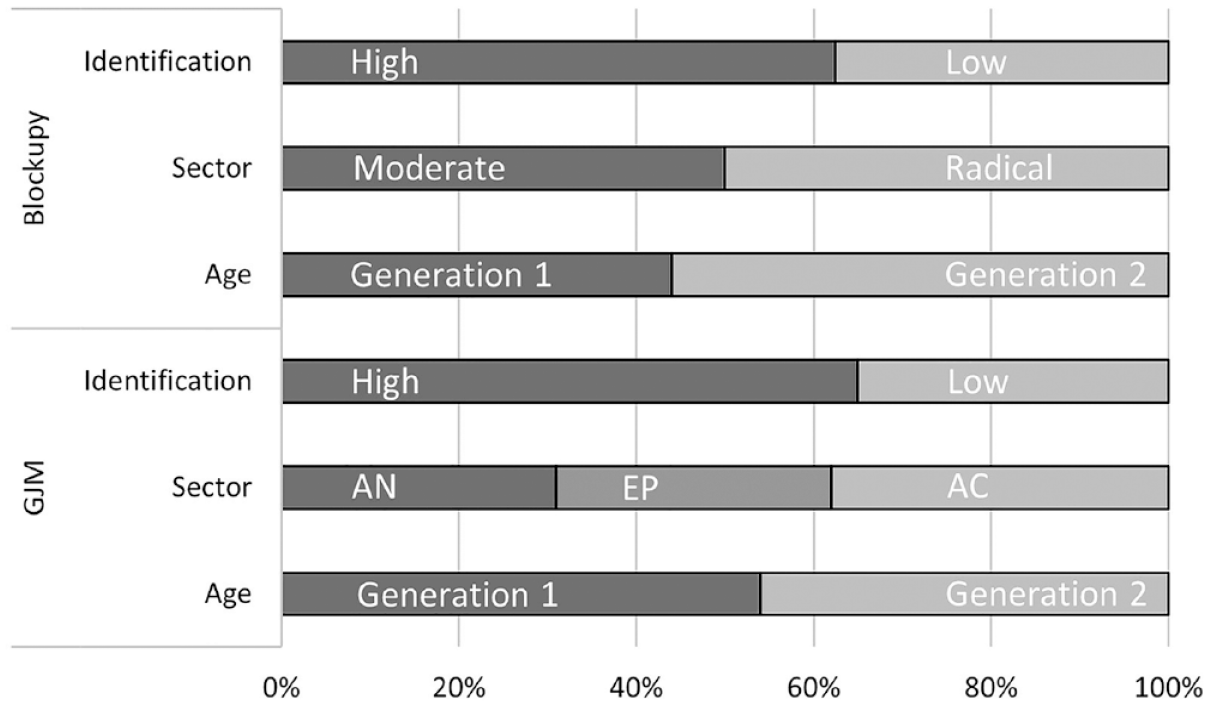
Overview of interviewees and their subgroups.
The interview sample for the GJM also covers groups with different ideological orientations (following existing distinctions, see in particular Andretta et al., 2003; Della Porta, 2006). Interviewees come from two moderate left sectors: first, anti-neoliberal groups (AN; eight interviewees) mainly consisting of reformist groups that aim to control the market through politics, which include trade unions, left political parties, the anti-neoliberal association ATTAC and other NGOs. A second moderate sector encompasses eco-pacifist groups (EP; eight interviewees), which include largely environmentalist groups and organisations as well as secular and religious peace and solidarity groups. A third sector encompasses more radical anti-capitalist groups (AC; 10 interviews) that range from squatters to anarchist and Trotskyist groups, which oppose capitalist structures more intensely and seek radical changes instead of reform. Roughly half (14) of the interviews were conducted with an older generation of activists born between the 1930s and 1950s, many of whom were involved in the ’68 protests (Generation 1). The remaining twelve interviewees were younger and had not personally experienced the mobilisation of ’68 (Generation 2, born between the 1960s and 1980s). Just like with Blockupy, all interviewees were actively involved in their respective movements, but they expressed different degrees of identification with the movement overall. Here again, about two-thirds of the interviewees (17) show a high identification with the movement (ID), while the remaining nine interviewees identified primarily with their specific subgroup (NID, see Figure 1).
Interview analysis
The following analysis draws on elements of the conducted interviews, which started with a few open questions about the origin of the social movement, how it developed over time, and what its main characteristics were. In these questions, interviewees were not asked about specific prior movements and their relevance to the current movement. The advantage of these open questions is that they allow for the assessment of references to earlier mobilisations as they emerge inductively without the interviewees being primed with questions about specific previous movements. 4 At the same time, this does not allow an assessment of activists’ overall memories of past mobilisation, but rather of how those are believed to be related to present activism and movements, as is the focus of this article. The answers to these questions were analysed drawing on a combination of qualitative and quantitative content analysis methods (Mayring, 2012). Particular attention was paid to general statements regarding novelty or continuity and to the way past mobilisations were remembered and represented. The following analysis of the interviews will focus on identifying collective patterns in how the diverse activists in both movements remember past mobilisation. This means that the following analysis will put much less emphasis on the varied differences and nuances in activists’ narratives, for example between activists with different ideological orientations and ages (Daphi, 2017; Daphi and Zimmermann, 2021). Since the primary interest of this article is shared mnemonic structures, the analysis will focus on recurrent patterns that are most prominent and most consistently shared across the two movements and their diverse subgroups. The aim is to identify collective mnemonic patterns at different levels: (1) across both movements and (2) across the diverse activists in each movement (i.e. across different generations and ideological orientations).
Remembering and forgetting past activism in the GJM and Blockupy
Distinguishing different mnemonic modes
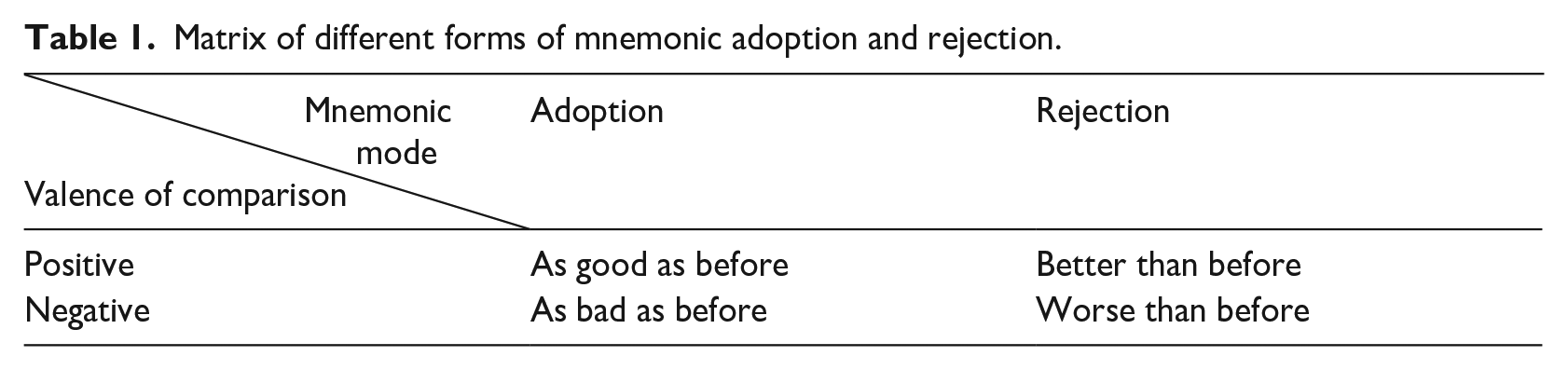
When activists refer to past mobilisations in the interviews, their memories take specific forms. In particular, their statements about past movements always fall into one of four different mnemonic modes (see Table 1). As a first level of distinction, activists either distance their present mobilisation from previous mobilisations and remember them as different (mnemonic rejection) or they remember them as similar (mnemonic adoption). As a second level of distinction, the modes of mnemonic adoption and rejection each entail two subtypes (see Table 1), depending on whether activists describe them with positive or negative valence. In the mode of mnemonic rejection, activists frame discontinuities with previous movements either with positive valence, highlighting how present activism represents an improvement on past mobilisations (positive rejection) or in terms of a deterioration in comparison to previous mobilisations (negative rejection). Conversely, in mnemonic adoption activists may consider past mobilisations either as just as good as the present one (positive adoption) or as bad as past mobilisations (negative adoption).
Matrix of different forms of mnemonic adoption and rejection.
Identifying these four modes does not mean that the content and frequency of each mode are necessarily universally shared within a movement – different subgroups within a movement may share some elements but interpret others differently (see Daphi, 2017). A central goal of this article is to identify overlaps. Such mnemonic adoption or rejection does not have to concern a previous mobilisation as a whole – as we will see in the next section – but instead, activists may choose to adopt or reject certain elements of past movements and activism. They may, for example, adapt a past movement’s forms of action but reject that movement’s claims. At the same time, certain past mobilisations may not be mentioned at all.
In fact, forgetting is part of all four mnemonic modes. Forgetting here is specific and explicit, as it does not refer to what activists (as individuals) can or cannot remember about past mobilisations in general, but what they forget very concretely when they think about relevant and significant predecessors to their own activism – both in terms of good and bad examples. Furthermore, forgetting here takes on different forms: on the one hand – following Vinitzky-Seroussi and Teeger’s (2010) distinction between overt and covert silences – forgetting here may concern whether a prior mobilisation is not mentioned at all or whether only certain elements of it are remembered, while others are not (e.g. its forms of action could be remembered but its outcomes forgotten). On the other hand, forgetting is linked to attributions of similarity and difference: one may forget similar past mobilisations (or elements thereof), or one may forget dissimilar past mobilisations (or elements thereof) – or one may remember some mobilisation (or elements thereof) as different overlooking similarities or vice versa.
Distribution of different mnemonic modes
The four modes of mnemonic relations to past mobilisations can be found in the interviews to different extents. Positive rejection overall constitutes the most frequently used mnemonic mode as the activists often emphasised how their movement is doing things in a new and improved way (making up half of activists’ explicit or implicit statements about past mobilisations, see row ‘all activists’ in Figure 2). This is followed by statements of positive adoption in which activists highlight similarities to and continuities with previous mobilisations (making up 41% of all statements, see ‘all activists’ in Figure 2). Modes of negative adoption and negative rejection are much less frequent (3-6%, see ‘all activists’ in Figure 2). As I will show in the next section, activists relate to a variety of past movements here.
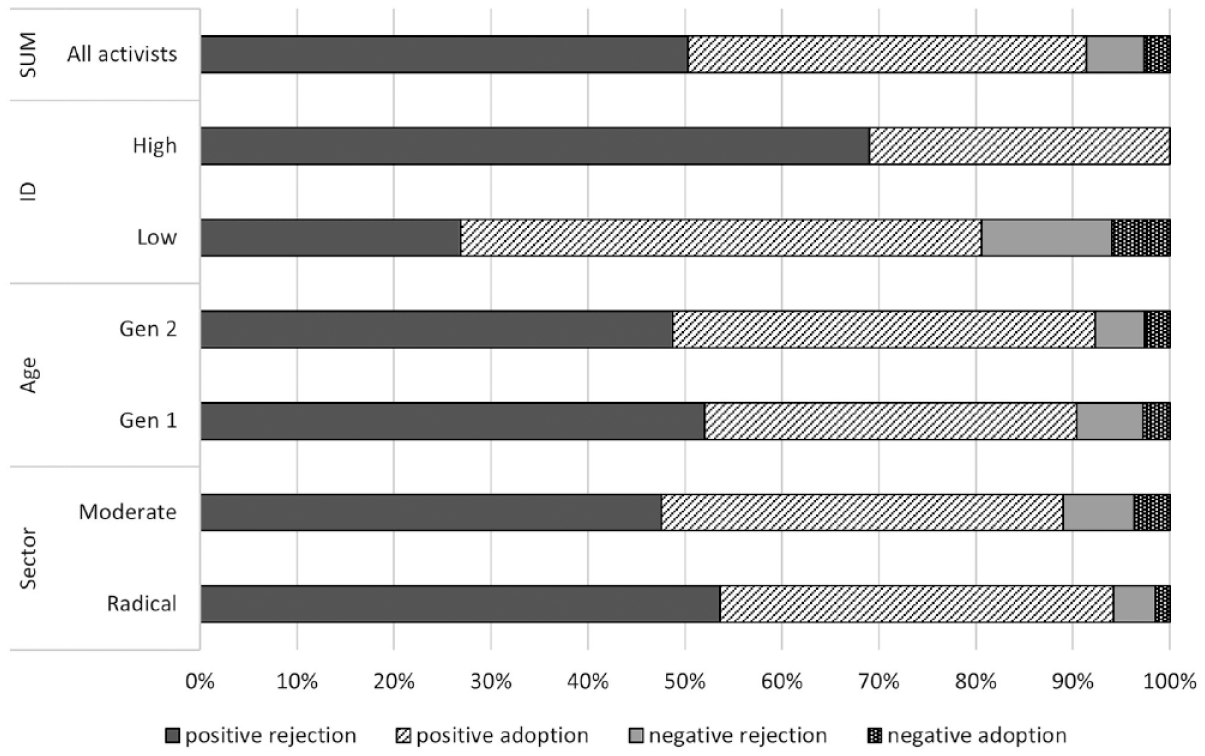
Distribution of different mnemonic modes across subgroups in GJM and Blockupy. 5
This overall structure of remembering and forgetting past movements is shared across both movements and their different ideological orientations and generations. Accordingly, the distribution of the different modes of remembering is similar across generations and movement sectors – as in all cases, statements of positive rejection make up the largest part, positive adoptions the second largest and other statements are rare (see Figure 2). However, there is a notable difference between activists who express high identification with the overall movement and those who express low identification. Activists who identify strongly with the movement make statements of positive rejection much more frequently than activists with a low identification with the movement (69% and 27% respectively, see ID High and ID Low in Figure 2). Activists with low identification attachments to the overall movement, instead, frequently draw on statements of positive adoption (47% see ID Low in Figure 2) – highlighting the continuities between earlier mobilisations and present ones. In addition, activists with low identification are unique in that they also employ the modes of negative rejection and adoption (13% and 6%, respectively). Hence, activists with low identification draw on a greater variety of mnemonic modes than activists who strongly identify with the movement. The following sections will examine each mnemonic mode in detail.
Recurrent types of positive rejection
There is a striking resemblance in how both GJM and Blockupy activists distance themselves from previous mobilisations. 6 Their arguments are similar, even though the past events they refer to may differ. In the following section, I outline the most frequently used modes of positive rejection among activists with high identification, which are widely shared by activists in both movements across different age groups and ideological orientations. Other statements of positive rejection are less widely shared and more specific to certain subgroups, in particular groups of different ideological orientations. 7
Past oversights
First, in both cases activists highlight the novelty and unprecedentedness of their movement. On the one hand, this is achieved by juxtaposing their respective movement with the dearth of action on what they consider the most pressing contemporary problem prior to their own mobilisation. Hence, the failure of previous progressive movements to properly pay attention to this problem is implied in these statements.
Activists of the GJM share a notion of inertia before their time, a notion that can also be found in activist narratives in Poland and Italy (see Daphi, 2017). They highlight how neoliberal globalisation was largely uncontested prior to their movement. Activists describe how neoliberalism diffused rapidly and became the only legitimate way of thinking with ‘unsurpassable [. . .] arrogance’ (Interview 9, G1/EP/ID)
8
and with seriously detrimental effects on people’s lives. Despite these effects, progressive groups failed to mobilise, as the following quote underlines:
So, the experience [. . .] in the 90s of the complete collapse of all larger left [groups], this experience of Schröder’s dictum ‘there is no alternative’, this in fact was the spirit of the left in the 90s. (Interview 11, G1/EP/ID)
This lack of contestation of the neoliberal hegemony is in part linked to the collapse of the Soviet Union as the public notion of overcoming Cold War divisions complicated alternative, especially left-wing, visions for the future, as the following quote highlights:
We came together because the 90s were a valley of tears for the left in Germany, in Europe [. . .] linked to the collapse of the Soviet Union. (Interview 22, G2/AC/ID)
The emphasis on the uncontested hegemony of neoliberalism underlines the GJM’s successful challenge of it. However, it exaggerates the weakness of the left prior to the GJM as it ignores some prominent leftist mobilisations from earlier decades, including protests against trade agreements as well as pro-democratic movements around the world. As such, if mentioned at all, mobilisations against neoliberal institutions and policies prior to the GJM, for example the protests against the International Monetary Fund and World Bank meeting in Berlin in 1988 (see Rucht et al., 2007), are understood to have been limited in their ability to fundamentally question the legitimacy of neoliberalism because instead of a broader critique they focused on specific (sub)topics and regions.
In a very similar way, Blockupy activists highlight either the absence or limitations of activism in Germany against austerity and the financial crisis prior to their movement. The period of inertia they describe covers five to ten years (i.e. early- or mid-2000s to 2012). Similar to GJM activists, Blockupy activists identify a hegemony of neoliberalism and austerity – albeit specifically within the context of Germany. They describe how the situation in Germany was characterised by a ‘big void’ (Interview 8, G1/M/ID) in contestations against austerity. This void is attributed to a mentality prevailed of putting ‘a lid on things’ (Interview 17, G2/R/NID) and of ‘political normalisation in which the scandalisation of the bank bailouts was impossible’ (Interview 12, G1/R/ID). The following quote also expresses this sentiment:
The issue of the European crisis was treated in Germany like a law of nature. There was absolutely no political debate and contestation about this, no fundamental differences, among political elites as well as among activists [. . .] in 2008, 2009, 2010. (Interview 9, G1/M/ID)
The limited contestation in Germany is contrasted with the lively anti-austerity protests in other European countries. This comparison is frequently used to add a sense of urgency. The activists’ reasoning here is not just that activists in Germany should mirror the mobilisations elsewhere, but also that they have a special responsibility to become active. According to the Blockupy activists, Germany represents ‘the heart of the beast’ (e.g. Interview 2, G1/R/ID, Interview 7, G2/M/ID) because of the German government’s support of European austerity politics in the context of the financial crisis.
There was this authoritarian implementation of the austerity politics in Greece and Spain and the people went on the streets. In Germany, nothing was going on. And back then we said, [. . .] that’s it, it’s unacceptable that nothing is happening in Germany. (Interview 3, G2/R/ID)
To summarise, Blockupy activists show a similar tendency as GJM activists to highlight the limitations of previous mobilisations in order to underline the own movement’s successful challenge of existing paradigms. This also involves some exaggeration, in particular with respect to previous inactivity. In fact, activists here often fail to mention previous activism on issues of austerity that did take place about European financial policies and (undemocratic) modes of decision-making. Examples for this are the protests by the network ‘we won’t pay for your crisis’ in Berlin and Frankfurt in 2009 (and following years) and other protest events inspired by Occupy protests in other European countries. If previous mobilisations against austerity and the financial crisis are mentioned, activists highlight their differences from Blockupy in various ways, particularly in terms of their ability to build a broad coalition, which I will turn to in the next section.
Considerable improvements: overcoming divisions
Another very prominent, recurrent type of positive rejection among the activists from both movements (and especially among those with high identification) is that of improving previous mobilisations, particularly with respect to overcoming past divisions within the left. In both movements, activists contrast the successful broad coalition of their movement with the divisions and limited cooperation of previous mobilisations.
For GJM activists, the 1960s, as well as some more recent mobilisations are a central point of reference. GJM activists contrast the GJM most prominently with conflicts between moderate and radical leftist groups in the German ‘68 movement.
9
The late 1960s and early 1970s are thus considered a period of constant “turf battles” (Interview 2, G1/AN/ID) and “dreadful clashes” (Interview 22, G2/AC/ID) between different leftist groups such as the social democrats, the Trotskyists, Maoists, anarchists and autonomist groups. The activists describe such divisions as being a constant since the 1980s and particularly prominent in the 1990s because of the fall of the Soviet Union, which made coalition-building across the different groups difficult. This is exemplified in the following quote:
The special feature that distinguishes [the GJM] from earlier movement cycles is that there was a trusting communication between the moderate and radical left; this did not exist before, neither in the historical workers movement nor in the new social movements from ‘68 till the ‘80s. (Interview 21, G1/AC/ID)
The division between the moderate and radical left is believed to have continued well into the 1990s. In this vein, the interviewed activists mention that broad coalitions failed to be realised during a counter-summit in Cologne in 1999, and they contrast this with successful later GJM mobilisations:
The coalition back then [in Cologne] went wrong; it classically diverged then into a left-radical and autonomist milieu and into a, let’s say, moderate left milieu centred around NGOs, among others. And also this, back then, did not correspond with the [. . .] later GJM, where one did politics together across diverse ideological borders. (Interview 22, G2/AC/ID)
Blockupy activists also contrast their movement’s success in building a broad leftist coalition with divisions in earlier mobilisations. While this is particularly prominent among activists with a strong identification with the overall movement, it can also be found among activists with low identification (but here, it coincides with more emphasis on continuities of cooperation). All activists describe how their broad coalition goes beyond ‘classic left politics, union politics on the one hand and civil disobedience or occupations on the other’ (Interview 3, G2/R/ID), ‘managing to do the balancing act between a traditional left spectrum and a radical left position’. (Interview 6, G2/R/NID). Most activists stress that the improved collaboration was inspired by the anti-austerity protests in Spain and Greece and their ability to forge broad coalitions. In this vein, activists from all subgroups stress how ‘we learned a lot in terms of collaborating in more solidarity’ (Interview 9, G1/M/ID) as the following quote exemplifies:
Blockupy brought different left structures into a process of discussion that did not exist in this way before. Since then, we refer to each other much much more; it is much easier to plan joint actions and to reach agreements. (Interview 12, G1/R/ID)
Blockupy activists’ main point of comparison here are mobilisations of the previous five to ten years – not the ’68 movement.
10
In particular, they contrast the GJM’s counter-summits with Blockupy’s broad coalition, especially their protests against the G8-summit in Heiligendamm in 2007, which is described as ‘complicated in terms of its alliances’ (Interview 8, G1/M/ID), and where working together closely ‘was not the case yet’ (Interview 6, G2/R). Accordingly, one activist concludes:
The [GJM’s] counter-summits did not diffuse into the broader left. . . And Heiligendamm was a big and broad mobilisation [. . .] and knowing each other for some time helped. But accommodating each other across the political differences and necessities [in Blockupy] was not predestined [by Heiligendamm]. (Interview 7, G1/M/ID)
To sum up, this section has shown that activists of the GJM and Blockupy movements have similar patterns of positive rejection. In both cases, activists clearly distinguish their respective movement’s achievements from earlier failures, in particular the failure to voice a substantial critique of neoliberal capitalism and austerity politics, and to build coalitions across different leftist groupings.
Recurrent types of positive adoption
As mentioned above, overall statements of positive adoption are much less frequent among activists with patterns of high identification in both movements. But among activists who score lower on identification, this is a very common mode of remembering past mobilisations (see ID Low in Figure 2). The latter stress continuities with previous waves of mobilisation over differences. This is not to say that they do not see differences in comparison to previous mobilisations or innovations through the current one 11 – after all, they are actively involved in the GJM and Blockupy, respectively; they value this experience and consider it specific and new in certain ways. However, highlighting the novelty of the current movement is much less important for them than highlighting continuities with previous mobilisations; this goes for activists with a low identification score from both generations identified in this study and for activists from different movement sectors. Consequently, the current mobilisation is not as clearly demarcated from earlier ones as it is in the memories of the activists with high identification. In what follows, I will discuss the most common statements of positive adoption among activists with low identification.
First, one of the most frequent statements of positive adoption stressed by activists with low identification in both the GJM and Blockupy movements is that of building and maintaining broad (progressive) movement coalitions. Blockupy activists with low identification highlight how Blockupy built on continuous collaborative work over the years, spanning decades. Some activists here refer to the counterprotests in Heiligendamm as a ‘breakthrough because they succeeded in building a broad coalition’ (Interview 17, G2/R/NID), on which Blockupy could build. Others highlight the role of earlier anti-austerity campaigns in Germany (and beyond) in the late 2000s and early 2010s such as the ‘we won’t pay for your crises’ campaign which ‘had good coalitional dynamic’ (Interview 11, G1/M/NID). One activist also highlighted this:
[Blockupy builds on] a relatively successful attempt to collaborate on a long-term base, to get to know each other, and build trust, and on that basis of trust make agreements to mobilise jointly at certain events. (Interview 6, G2/R/NID)
With GJM, activists with low identification highlight the collaboration of different left sectors prior to GJM, for example in the context of the 1980s peace movements or campaigns against trade agreements, or for debt cancellation in the 1980s and early 1990s. Of course, this contrasts with the strongly identifying activists’ emphases on the novelty of the GJM’s coalitional work, as discussed in the previous section. Indeed, activists with a low identification here contradict activists with a high identification by pointing out similar coalitional work in previous mobilisations. Those with low identification do not highlight the current movement’s improvement in terms of overcoming the divisions of 1968 and other prior mobilisations as much. This is also illustrated by the following quote:
I find it hard to pinpoint the GJM’s starting point because we cooperated with various groups on these issues [debt cancellation and trade injustices] at different points in time [over the last decades]. (Interview 14, G1/EP/NID)
Second, activists stress continuities with previous mobilisations with respect to the issues addressed by these movements. Activists from Blockupy particularly stress continuities with previous mobilisations’ critique of neoliberal capitalism (in particular in the GJM), as well as earlier protests’ attention for austerity and social inequality (the latter of these is also the most frequently occurring motive for positive adoption among the strongly identifying activists). With respect to the latter, activists mention the protests in 2004 in Germany against the ‘Hartz IV’ reforms of the welfare provisions, which also ‘dealt with issues of austerity that Blockupy then took to the international level’ (Interview 8, G1/M/ID). Other activists emphasise continuities by mentioning early protests that erupted after the financial crisis of 2009, such as the ‘we won’t pay for your crises’ campaign and the protests against the ECB in 2011, highlighting how these early protests and campaigns ‘triggered an idea in many sectors of the left . . . to further work on a broad critique on the bailout of banks and general dissatisfaction with capitalism’ (Interview 5, G2/R/ID). In this vein, one activist points out:
In Frankfurt, the ‘Georg-Büchner-Initiative’ [. . .] had a clear focus on Banks [and their bailouts] [. . .]. Out of this a line of debate emerged that remained urgent (Interview 17, G2/R/NID)
A few of the activists with a low identification score also mention continuities with previous mobilisations in how they experimented with more radical repertoires (e.g. by blocking Nazis 2007 in Dresden or by protesting against nuclear energy).
GJM activists – and particularly those with low identification scores – stress that protests critical of globalisation ‘started a long, long time ago’ (Interview 3; G2/M/NID). In this vein, many activists point out how the GJM continued and picked up on earlier debates and campaigns about global inequality, poverty, and developmental aid (Interview 14, G1/EP/NID; Interview 25, G2/R/NID). Furthermore, activists identify predecessors closest to their own immediate activist environment: for example, activists from international solidarity groups (with moderate as well as radical political views) point to continuities with liberation movements against (neo-)colonial rule, apartheid and related international solidarity mobilisations, for instance in 1970s Nicaragua (Interview 26, G2/AC/NID; Interview 12, G1/EP/ID) or the Mexican Zapatista Rebellion. In this regard, an activist stresses:
[Anti-colonial activism] was not yet called [the] Global Justice Movement but content wise it was on this line. (Interview 14, G1/EP/NID)
To sum up, this section has shown how GJM and Blockupy activists identify several continuities with previous movements. Activists with low identification, especially, highlight continuity in terms of central issues and coalitional dynamics in comparison to previous movements. In doing so, they diverge from activists with high identification who – as discussed in the previous section – do not do so nearly as much.
Negative adoption and negative rejection
As mentioned above, negative adoption and negative rejection were not mentioned by activists with patterns of high identification with the overall movement. Only those with low identification employ this mode of remembering past mobilisations and even here, they make up a small part of their statements relating to past mobilization – 6 and 13%, respectively (see ID Low Figure 2). Due to their small number, no recurrent patterns across the different subgroups of each movements emerge and hence, these statements mostly remain specific to particular subgroups of activists, especially with respect to their sectors’ ideological orientations and previous causes.
In the GJM, for example, some activists from the moderate, AN sector (included in Figure 2 as part of the moderate sector) – especially those longer engaged in campaigns against trade agreements and market liberalisation – refer to continuities in the limited success in integrating and working together with trade unions (Interview 3, G2/AN/NID; Interview 8, G2/AN/NID). Furthermore, a few activists refer to continuing divides between radical and moderate groups (Interview 25, G2/AC/NID). In Blockupy, a few activists similarly highlight continuing divisions and mistrust between radical and moderate leftist groups, which are described as ‘overshadowed by an inherent defect’ (Interview 11, G1/M/NID) since the protests in 2007 in Heiligendamm and the time leading up to it.
Statements of negative rejection draw very strongly on sector-specific prior mobilisations and campaigns. In the GJM movement, for example, some activists from the moderate EP sector (included in Figure 2 as part of the moderate sector) and those involved in international solidarity work in particular, refer to a better inclusion of the Global South in previous anti-colonial movements (Interview 15, G1/EP/NID). Some GJM activists from the anti-capitalist sector with a grassroots approach to international solidarity consider previous mobilisations to be better due to their more horizontal and diverse organisational structures. They mention that this is a quality that was largely lost in the main phase of the GJM, due to its centralised organisation and some groups’ attempts – in Germany, especially ATTAC – to speak as ‘one voice’ (Interview 26, G2/AC/NID).
In the case of the Blockupy movement, both more radical and moderate activists highlight that previous instances of activism against austerity were better at connecting with trade unions and ‘linking political mobilisation with everyday struggles’ (Interview 1, G2/M/NID; Interview 17, G2/R/NID). Furthermore, some of the more moderate activists highlight that earlier campaigns were better at involving trade unions (Interview 10, G1/M/NID). To illustrate this point, one activist recalls:
In contrast to the ‘we won’t pay for your crisis’ campaign earlier, the participation of trade unions was largely missing in Blockupy. (Interview 11, G1/M/NID).
Conclusion
The article set out to identify recurrent patterns in how activists remember past mobilisations across different movements. For this purpose, I compared activists’ memories of two social movements in Germany: the GJM and Blockupy. The interviews with involved activists showed how their memories of past contention are framed in light of their current mobilisations. In particular, I distinguished between four mnemonic modes: mnemonic adoption, in which activists highlight similarities and continuities with prior mobilisations (with a positive or negative valence); or mnemonic rejection, in which activists stress differences and discontinuities with prior mobilisations (again with a positive or negative valence). I showed that positive rejection is the most frequently occurring mnemonic mode overall, with activists considering current mobilisations to fare much better vis-à-vis previous ones. Activists from both the GJM and Blockupy clearly demarcated their respective movement’s achievements from earlier movements’ failures, in particular with respect to addressing the most pressing issues – neoliberal capitalism and austerity politics – and with regard to building coalitions across different leftist sectors. The second most frequent mode was that of positive adoption, which shed light on the extent to which activists considered previous movements to have done similarly well, identifying various continuities. Modes of negative adoption and negative rejection are rare, as activists generally did not consider current mobilisations to be as bad as or worse than past ones. this mode only appears for example in activists’ reflections on the movement’s failure to involve trade unions in present or previous endeavours.
The analysis showed how this overall mnemonic pattern – with positive rejection as the most frequent mode closely followed by positive adoption – is shared across activists with different ideological orientations and generations. I did, however, find a notable difference between activists who demonstrated high or low identification with the overall movement: while among the former, positive rejections clearly dominate and positive adoptions are less evident, among the latter, the opposite is the case, as positive adoptions dominate and positive rejections remain sparse. This means that while activists with a strong identification attachment to the overall movement largely consider past mobilisations worse than present ones or sometimes equally good (but never better), activists with low identification predominantly consider previous mobilisations to be just as effective as current ones. Activists with low identification are also the only ones drawing on mnemonic modes with a negative valence (albeit rarely), which either emphasise continuing problems (negative adoption) or consider current movements as worse than previous ones (negative rejection).
Overall, this analysis underlines the embeddedness of social movements and activism in past mobilisations: activists situate themselves in and compare their present activities and achievements to previous political struggles. They identify continuities and discontinuities and adopt or discard existing forms of action, organisation and framing. The analysis also draws attention to the malleability and strategic employment of collective memories in social movement. I have shown that activists with a strong identification with the overall movement in particular share a rather specific interpretation of the past that tends to overlook past successes in mobilisation and their similarities to present ones. Here, memories of past movements are very strategically and selectively used to present current mobilisations in the best possible light, highlighting their success and uniqueness. This stands in stark contrast to activists with a low identification, who identify considerably more continuities than discontinuities in comparison to previous movements, and also address the failures of the current movement more explicitly. Hence, they consider the current movement to be much less unique than activists with high patterns of identification. Furthermore, the fact that these two versions of the past can be found across activists of different generations and ideological orientations points to the capacity of these movements to create a joint outlook on the past (and present), at least with respect to this general mnemonic pattern of adoption and rejection. Indeed, widely varying memories of past movements across the different subgroups would not have been unlikely given their diverging experiences of past activism. In particular, the older generation of interviewed activists may well have remembered past activism, including the ’68 movement, in a more positive or even nostalgic light (as existing studies suggest, e.g. Accornero, 2019), yet they do not – at least not those with a strong identification with the current movement.
Furthermore, these findings contribute to some current debates in memory studies. First, the analysis adds to the recent interest in certain positive and negative ‘attachments’ to collective memories, showing how past failures can be remembered in a positive light (Rigney, 2018), but also how past success can be remembered in a negative light or even be ignored. Second, the article adds to current debates on forgetting. In particular, the analysis shows how not only remembering, but also forgetting can be a central resource and crucial element in collective identity building (Assmann, 2016; Connerton, 2008). In their memories, especially the activists with strong identification attachments create and share a version of the past that is characterised by several notable omissions. In particular, this involves forgetting past successes and similarities compared to previous mobilisations, as this allows for the current movement’s distinctiveness and achievements to be highlighted. Assmann (2016) emphasises the role of forgetting in leaving behind losses, setbacks and atrocities to foster reassurance, appeasement and creativity. The present analysis shows that this creative and constructive potential can also be found in forgetting past successes.
Finally, there are several reasons to assume that the mnemonic pattern identified in this study is similar across and, to an extent, even beyond different movements. While the specific content of each mnemonic mode may differ (i.e. which elements of past mobilisations are rejected), the particular characteristics of social movements and activism make it likely that the overall mnemonic patterns identified in this article are similar in various other movements and activist groups: strongly identifying activists remember more differences and failures than similarities and successes with regard to past mobilisations. Social movements and other activist collectives require a shared version of the past that underlines the necessity and urgency to act. This is because, in order to affect change, social movements and activism need to draw public attention to their causes through protests, since – in contrast to other interest groups – they do not have established channels of influence at their disposal. When remembering previous movements, an emphasis on too many continuities and existing successes can be counterproductive for stimulating collective action. Demarcation and downplaying existing successes hence serve as a crucial motivational factor. They are also crucial building blocks for activists’ collective identity as those allow them to draw boundaries between their own efforts and earlier phases of mobilisation. Consequently, a predominance of negative rejections can be expected to occur in other movements as well, including more regressive movements that generally share a more nostalgic outlook on the past. For future research, it would be interesting to explore mnemonic rejections and adoptions across a wider range of social movements, focussing more on implicit memories and other sources, such as slogans and activist publications, and even beyond social movements.
Footnotes
Acknowledgements
I would like to thank the reviewers and editors for their very helpful and constructive comments.
Funding
The author(s) disclosed receipt of the following financial support for the research, authorship, and/or publication of this article: This research was supported by grants from the German National Academic Foundation, the Humboldt Foundation (Feodor Lynen Research Fellowship) and the German Federal Ministry of Education and Research (in the context of ERA.Net RUS Plus funded by the European Union’s Seventh Framework Programme).
