




Abstract
This article aims to discuss the ethical–political responsibility of constructing a memory of 1915 through Fatih Akın’s The Cut (2014). The film explores the Armenian Genocide, which Turkey’s official historiography denies, and sparked heated debates on its release in Turkey. Based on the claim that constructing a memory of genocide is an ethical–political issue, I argue that The Cut’s aesthetic of remembrance fails to lead to an ethical questioning of historical denial and it thus leaves 1915 in the past. In order to discuss the film’s failure to fulfill its ethical responsibility, I explore the following questions: What is the ethical responsibility of remembering the devastating past? What does The Cut’s way of remembering 1915 accomplish and fail to accomplish in terms of ethical memory? By examining the limitations and possibilities of cinema in memory construction, this study seeks to contribute to discussions on the aesthetic and ethical dimensions of memory studies.
Introduction
During the 2000s, criticism began to increase in Turkey of the one-dimensional and oppressive construction of national identity, and voices arose, demanding a confrontation with past and present injustices. As these demands filled the public sphere, narratives of the physical and symbolic violence of the past began circulating on television and in newspapers. Testimonies, films, and documentaries on long-suppressed and denied events began to appear. It was in this environment that Turkish–German director Fatih Akın’s Kesik [The Cut] (2014) was released. The Cut tells the story of the Armenian Genocide which has long been denied by Turkey’s official historiography. On its release in 25 theaters, despite open and racist threats, the film sparked heated debate. While the film has been welcomed by some for its message of confronting 1915, it has also faced a great deal of criticism. This has, directly or indirectly transformed the film into a tool for the reproduction of denial, and ultimately drowned out its message.
The controversy sparked by The Cut, and similar efforts to confront denied or ignored crimes in Turkey, as well as the reactions to these demands, have given way to a new question: If we are to begin to remember the denied or ignored past, how should we do this? In 2015, the arts and politics blog Azad Alik published an editorial on how publications had reported on the centenary of the genocide. 1 The editors note that, in these anniversary publications, the denial of 1915 has been associated only with the state, but ongoing denial cannot be attributed solely to state policies. They argue that the practice of commemoration should also involve questioning the broader consensus, including the opinion leaders (2015). As such critiques point out that constructing a memory of 1915 based on ethical responsibility requires a language of remembering that also includes ongoing denial and its consequences. The question of how to remember is not only the basis for thinking about the ethical dimensions of constructing a memory of past crimes, it is also the starting point of this article that focuses on cinema and ethical memory: What is the ethical responsibility of remembering the devastating past such as genocide through cinema? What does The Cut’s way of remembering 1915 accomplish, and what does it fail to accomplish in terms of ethical memory?
The debate around ethical memory and cinema, which also causes cinema to confront its own limits, first sprang up around representations of the Holocaust. Efforts to construct the memory of the Holocaust go back further than that of 1915, as it is an acknowledged and confronted past. These debates revolve around Theodor W. Adorno’s (1967) well-known claim, “To write poetry after Auschwitz is barbarism” (p. 34), which suggests that such a devastating trauma delegitimizes narratives, aesthetics, and representations (Saxton, 2008: 7). It is argued that the very foundations of representation are shaken by the impossibility of narrating the Holocaust using everyday vocabulary and an orderly and consistent narrative. More recently, discussions have focused on the need for a different kind of representation rather than its absolute impossibility. Shoshana Felman (1992) argues that Adorno revisited his words and that he did not imply that poetry should not be written at all, but rather that the arts must be performed with the awareness of this impossibility (p. 34). Searching for a different kind of representation ultimately leads to a discussion of the ethical dimensions of representation and memory. For example, Libby Saxton (2008) claims that representing concentration camps is a matter of ethical responsibility, and what determines the ethical and political preferences of films is how they fulfill their “responsibility to witness” (p. 15). Ultimately, the debate on the impossibility of representation evolved into the view that the representation of catastrophes such as genocide involves an ethical responsibility and that films differ radically from each other in the way they remember the past.
Based on this claim, that constructing a memory of genocide is an ethical-political issue, in this article I will discuss the way that The Cut seeks to remember 1915. I will begin by engaging with discussions on ethical memory and representations of the Holocaust by examining how films differ ethically from each other in the ways they represent the past. After putting forward the aesthetic and ethical dimensions of the construction of memory, I will analyze The Cut with new questions, raised by the specific context of the Armenian Genocide, around historical denial, Turkishness, and responsibility. By providing an overview of the historical denial surrounding films about the Armenian Genocide, including The Cut, I will discuss how films about 1915 have historically been blocked. Finally, I will ask what The Cut’s way of remembering 1915 accomplishes—and what it fails to accomplish—in terms of ethical memory.
The crisis of representation: can the disaster be narrated?
With his statement, “It is barbaric to write poetry after Auschwitz,” Adorno (1967: 34) refers to an ethical–political debate on representations of the Holocaust. While making it clear that destruction cannot be narrated through traditional means, as Nurdan Gürbilek (2015) indicates, Adorno is also convinced that it cannot be thought of independently from the culture in which we live (pp. 123–127). It is no coincidence that the sentence quoted above appears in Adorno’s “Cultural Criticism and Society,” Gürbilek writes in The Share of the Silent (2015: 123). Adorno believes that if the conditions that made Auschwitz possible remain unchanged, the danger of a similar disaster at some point in the future persists, and objects to literary or, more generally, artistic works that ignore the conditions that brought about the disaster (Adorno, 1967, 2007). Moreover, Adorno notes that a critical consciousness limited to satisfaction with its own contemplation will ultimately be complicit in rendering the relationship between culture and disaster invisible and, in so doing, complement the terror itself (Adorno, 2007: 367). Therefore, Adorno defines representation that hides the share of our culture in such disasters as barbaric. The German philosopher Karl Jaspers also echoes Adorno, noting in The Question of German Guilt (2000) that Germans have a collective responsibility to reflect on how the intellectual conditions of German life made possible such a regime (pp. 73–75). He proposed that we replace a belief in innocence with a call to take responsibility—a sense of “co-responsibility” (p. 73). Reflecting on the relationship between being German and the crimes of Nazi violence, what Jaspers refers to as historical self-examination demands critical inquiry: “What we think of as German is never mere cognition but an ethical resolve, a factor in German growth” (p. 19). This ethical resolve makes every citizen responsible for the injustices caused by the state (pp. 86–87); it also requires inquiry not only into “what is done at present—thus being co-responsible for the deeds of our contemporaries—but in the links of tradition” (p. 73). This call—a call to take responsibility and to reflect on socio-historical existence—can only be voiced in a linguistic act aware of its own catastrophe.
Like literature, cinema, in trying to transform the Holocaust into representation, has faced its own limits and became involved in ethical debates on representing the past. Cinema’s first response to the Holocaust was documentary footage. These early documentaries raise ethical concerns as they create an illusion of providing an objective view through their aesthetic choices, such as rhetorical editing and voice-of-God-style commentary (Hirsch, 2004: 33). For example, documentaries shot by the Allies are criticized for positing the viewers as innocent third-party witnesses who exempt from what they see on the screen, and as lacking contemplation on the limitations of simply witnessing a genocide (Hirsch, 2004: 39). These early documentaries have also been employed with a presumption that the terror can be fully represented, with no blind spot where our view is inadequate, and instead with an omniscient viewer (Hirsch, 2004: 21). This stance, from outside of history, produces a safe distance and turns the past into something “visible and judgeable” from today’s point of view (Hirsch, 2004: 21). For Claude Lanzmann, who elaborates on the ethical problems of archive footage, it is not acceptable to use these images as they lead to a misconception that the disaster is limited to what is seen: “I would have never included this (archive footage) in the film” says Lanzmann, “it is not visible, you can’t look at this” (Lanzmann et al., 1991: 99). As he underlines, in these documentaries, archive footage simultaneously offers a lot and something that is not adequate: “while they transform the past into something portrayable, they diminish the real terror this past includes” (in Saxton, 2008: 29–30). These early documentaries thus function as a shield, protecting us from terror, taming what cannot be looked at, and positing us, the viewers, to be innocent witnesses.
Thus, even when cinema tries to narrate a disaster using real footage, its relationship to its reality and terror raises ethical problems. When cinema tries to imagine what was experienced, it can be blamed for rendering the incident banal. Then, how can a traumatic past be represented without banalization, and without producing complicity with the trauma itself? This question requires addressing the ethical and political dimensions of representation and the responsibility of cinema as witness (Sarkar, 2009; Saxton, 2008). Since, cinema can easily turn into a sort of curtain of innocence by positing the viewers as innocent external witnesses. Consider, for instance, how Schindler’s List (Steven Spielberg, 1993) remembers the Holocaust. Criticisms of the first documentaries, which do not ethically question the possibility of witnessing genocide, are also applicable to Schindler’s List, which uses fictional images instead of real footage. The biggest objection to the movie, which is based on the belief that camps can be neutrally represented, comes from Jean-Luc Godard (Wheeler, 2009: 185). Godard believes that cinema fails to represent the camps and betrays the very reason for its own ethical and aesthetic existence (Wheeler, 2009: 186). Regarding films on the Holocaust as ethical and aesthetic failures for their ignorance of what is unspeakable, Godard’s opposition to them is rooted in their belief that the Holocaust can be recreated in its entirety (Wheeler, 2009: 187). Therefore, in Godard’s view, Schindler’s List is not successful as it does not seem to suspect that the disaster cannot be fully represented. In seeking to represent the Holocaust as something that can be seen, and thus into an ordinary incident, it is an ethical failure.
Lanzmann also objects to the notion that the Holocaust can be recreated through images. Instead, he turns his lens toward the present and focuses on the traces of the past in the documentary film Shoah (1985). His aesthetic choices aim to reveal the relation between the past and the present and what is left of the disaster: “(. . .) the disappearance of traces: noting remains a void and it was necessary to make a movie out of this void” (cited in Saxton, 2008: 30–31). Lanzmann does not use archive footage to fill this void or turn it into a visible existence. On the contrary, he portrays the void itself and looks at what is left of the Holocaust in the present. In doing so, he makes the “limitations of representation” visible, moving the discussion on representation from an aesthetic context to an ethical one (Langford, 1999: 28–29). By showing that even the testimonies of survivors fail to fully narrate the disaster, the documentary makes it possible to realize how the past exists as a void in the present.
Like Shoah, Alain Resnais’ Night and Fog, constructs “an aesthetics, ethics, and politics of the post-concentration-camp era,” and calls its viewers into ethical questioning about current responsibility for the Holocaust (Silverman, 2011: 207). Resnais uses black-and-white archive footage from the Auschwitz and Birkenau concentration camps, together with coloured images from the present, to emphasize the past (genocide) “which can no longer be found in today’s footage” (McGowan, 2012: 296). The viewer is reminded by the voiceover of the responsibility that is to be assumed in the present: “We act like what happened occurred only once at a given time and space. We are blind against the things that surround us, and we are deaf in the face of the incessant cries of humanity.” The protests after the screening of Night and Fog at the Cannes Film Festival in 1956, and the heated discussions it entailed have something to do with this ethical call. Andrew Hebard (1997) states that what led to the scandal at Cannes is the movie’s way of representation, which gave way to a contemplation of the distinction between crime and responsibility and made Germans reevaluate their crimes (p. 111). What led to this evaluation is the fact that Resnais turns his camera not only to the past, but also to the present. This aesthetics and ethical choice units Resnais with Godard, Lanzmann, and Adorno who object the representation that renders invisible the fact that the culture we live in gives rise to the crimes of the past, trivializes it, and leaves it in the past, and thus ignores our responsibility for the present. The debate about the inadequacy of representation in the face of major traumas such as the Holocaust has ultimately led to the idea that representation has an ethical–political dimension.
Debates on the ethical representation/memory are not unique to the Holocaust. The question of how to represent the traumatic past with an ethical responsibility is also applicable to disasters such as the Armenian Genocide. Here, the issue is further complicated when we speak of constructing a memory of the Armenian Genocide in Turkey. After all, we are talking about a past that is surrounded by denial, where speaking of, remembering, and mourning the genocide has long been prohibited. As such, it is impossible to ignore the consequences of denial while discussing the aesthetics and ethical–political undertaking of films about 1915. Therefore, as Marie-Aude Baronian (2004–2005) argues, “in the Armenian case, the effacement is twofold: there is the effacement of the event and its reality, but also that of its posterity, its (non)trans-misson” (p. 101). We should consider narrating the Armenian Genocide together with the impossibility of communicating something that “does not exist”. How, then, can one narrate what has permanently vanished but is still in the process of disappearing? (p.101). Baronian states that representation must contain the traces of this twofold extermination:
Representation must therefore make visible, at one and the same time, its fiction and disappearance (that of the represented event as well as its characteristic representative mode), but, simultaneously, its opening, ex-position, and engagement. In a word, it must show the possibility of its impossibility (p. 101).
She (2004–2005) rightly reminds us that the distance between representation and what is represented, and the inadequacy of representation, are not new themes in the relationship between cinema and representation. What is novel here is how the reality of genocide forces positioning this dichotomy (of representation and the represented) within an ethical viewpoint (p. 94). In other words, Baronian reaches the same conclusion as Adorno, Saxton, Lanzmann, and Godard, and takes the discussion of genocide and representation into its aesthetic and ethical contexts.
What, then, does The Cut’s way of remembering 1915 say about ethical memory? I will discuss where the film stands in the debate on ethical memory, meaning a way of remembering that does not trivialize 1915, but makes visible the traces of ongoing denial, and confronts viewers with responsibility in the present.
Remembering genocide in the Turkish memory screen
Turkey’s century of denial of 1915 has determined any attempt to construct a memory of the Armenian Genocide and has prevented confrontation with its consequences. This denial is not limited to state policy; rather, a wide range of actors, from nongovernmental organizations to film critics, directly or indirectly, contribute to the perpetuation of this denial. One of the consequences of ongoing denial is that visual representations of 1915 appeared only after the Holocaust, even though the former far predated the latter. Moreover, censorship attempts by Turkish governments to block the production and distribution of films on genocide more generally, as an extension of the policy of denying the Armenian Genocide, “enabled Holocaust films to establish a cinematic iconography of the genocide” (Baron, 2014: 289). Turkish governments typically begin such interventions during the scripting stage of the films, and if those interventions fail, suppress the distribution and screenings of the films. This is why, unlike the Holocaust, attempts to construct a memory of the unrecognized and systematically denied Armenian Genocide have constituted an archive of blocked films. The cinematic history of 1915, which started with the silent film Ravished Armenia, directed by Oscar Apfel in 1919, is filled with productions that were interrupted, abandoned, or prevented from being produced until the outbreak of World War II (Baron, 2014). As Baron (2014) discusses films on the Armenian Genocide could be produced and screened only after the 1950s (p. 289), prominent among them are the films Assignment Berlin (Hrayr Toukhanian, 1982), The 40 Days of Musa Dagh (Sarky Mouradian, 1982), Yearning (Frunze Dovlatyan, 1990), Ararat (Atom Egoyan, 2002), The Lark Farm (Paolo and Vittorio Taviani, 2007), and The Promise (Terry George, 2016).
Thus, amid the ongoing policy of denial, Turkey made vigorous attempts to prevent Eurimages, the Council of Europe’s cinema support fund (Ergan, 2006), from financially supporting the Taviani brothers’ The Lark Farm. The film was deemed as an “impending threat” and perceived as a “second Ararat incident” (Boyacıoğlu, 2007). Such reflexes, built upon a century of denial, are not uncommon and have a long history (Baron, 2014). Screenings of Atom Egoyan’s Ararat in Turkey were canceled outright “upon the will of the people” (Belge Film, 2004), on the pretext that the movie would be biased and generate hatred. Critiques of Ararat began to emerge even before the script was finished, and prominent film critics described it as a “campaign against Turks” well before its screening at the Cannes Film Festival in 2002. 2 Ultimately, Ararat was only screened in Turkey in 2006, on television, and after being censored.
As these examples show, behind The Cut lies a deep heritage of denial and censorship. The Cut’s director Akın frequently referred to this historical and discursive legacy by saying: “I had a burden. I left it to the viewer” (Dink, 2014). This denial is not limited to state policy, but is based on a broader consensus on the concept of Turkishness. Offering an analysis on The Cut within the context of ethical responsibility and ongoing denial, Umut Tümay Arslan (2015a) argues that this is exactly why a film on 1915 must involve “the ethos of Turkishness” in the dialogue. After all, the Disaster will inevitably be forgotten, through a framework that does not force the viewers to rethink their complicity in ignoring it and the process of erasing the traces of the Disaster (Arslan, 2015a). Arslan (2015) points out that The Cut allows space for genocide within “the screen of Turkishness,” it speaks about it, yet fails to confront us with our share in the denial that continues to this day (p. 57). The denial of so many years, which exempts us from crime and responsibility, has historically been constructed through the “Turkishness Contract” (Ünlü, 2018). As Barıs Ünlü (2018) argues, this unwritten contract, which forms the basis of establishment of a nation-state on the rubble of the Ottoman Empire, entails “a lack of seeing, feeling, learning or sensing” the crimes against Armenians and Kurds (p. 218). The Turkishness gaze, which is constructed through the Turkishness Contract, is based on forgetting and/or denying past crimes and refers to certain ways of (not) thinking, (not) remembering, and (not) seeing. So, considering the inherited share of responsibility and the culture of denial that Turkish viewers are born into, what does Akın’s aesthetic choice accomplish and fail to accomplish for Turkish viewers in confronting their Turkishness gaze constructed by denial and their responsibility in the present?
The Cut starts with Nazareth, an Armenian ironsmith from Mardin, being taken from his home at night by Ottoman soldiers during World War I. 3 The film tells the story of Nazareth’s survival after forced deportation, his search for his family, and in the end, his partial success in finding them. After forced labor in road construction and exile, Nazareth survives a massacre thanks to a Turk. Mehmet finds himself unable to kill Nazareth, but makes a small slit in the Armenian’s throat to hide this. Nazareth loses his voice after his throat is cut. He can no longer speak. We, the viewers, accompany him on his search for his family, and witness the violence of the past. Believing that 1915 can be fully represented, Akın portrays death marches, rapes, death camps, massacres, forced labor, and homicides. Employing cinematic means of epic spectacle, including a widescreen, anamorphic lens, Akın attempts to turn the Armenian Genocide, which has been silenced and denied for a 100 years, into an image in its entirety.
We can start thinking through the ethical and political meanings of Akın’s formal preferences with “the cut” on Nazareth’s throat. Nazareth first loses his voice and then his belief in God after witnessing the death camps. What does his silence mean? In other words, can we interpret “the cut” on the throat as a symbol of the silence that Armenians are condemned to, and at the same time the silence of the Turks?
I will return later to the silence of the Turks. Let us first focus on the question, Is Nazareth’s silence, which is a trace of 1915, and which constructs the movie, transformed into the symbol of the impossibility of fully narrating the genocide? It could have turned out this way, but the way Akın thinks of genocide does not allow it. Akın could have turned his movie into a depiction of the impossibility of narrating what was experienced by turning Nazareth’s silence into a trace of 1915’s destruction of representation and 100 years of denial. Instead, with his belief in the adequacy of representation in the face of the disaster, the director attempts to voice and dispose of the silence. With a belief that one can speak on behalf of those who cannot, Akın tries to speak in Nazareth’s stead and to be his voice, ultimately ignoring the unspeakable nature of genocide.
By Akın’s belief in his ability to be Nazareth’s voice, I mean the director’s belief that the Armenian Genocide can be fully represented, and therefore brought to a narrative closure, under the pretext that events can be narrated on behalf of those who cannot speak. For Akın, if Nazareth cannot speak, representation or cinema (and of course Akın himself) can tell the story on his behalf. “Everything,” from death camps to massacres, can be screened, giving voice to Nazareth’s silence (Image 1).
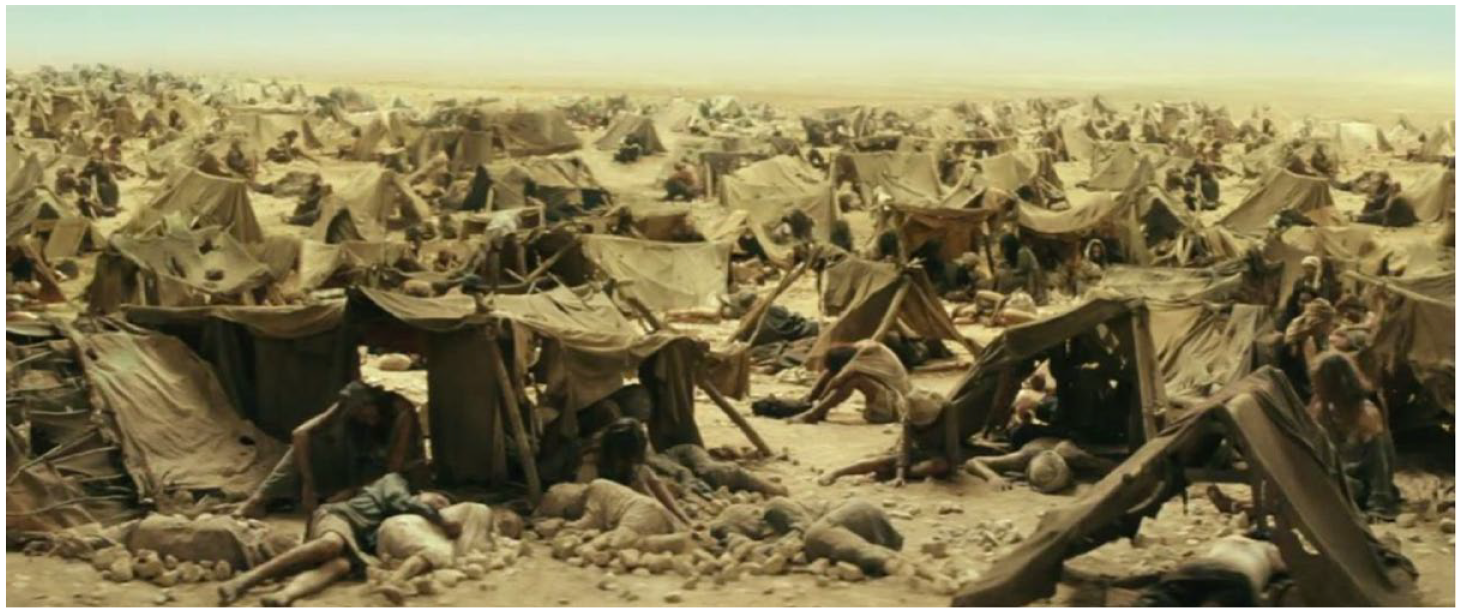
Scene of death camp, The Cut, Fatih Akın (2014).
This takes us back to why Godard finds Schindler’s List unsuccessful, for presuming that everything about the Holocaust can be narrated, and for failing to consider the inadequacy of representation in the face of disaster. Godard also points to how the film’s aesthetic preference turns into a way of evading ethical questioning. For Godard, a film that overlooks this judgment cannot be regarded as successful or good just because it reminds us of the Holocaust (Wheeler, 2009: 190–195). For him, it is not right to choose between aesthetics and ethics, and whichever is chosen, we are doomed to find the other in the end (Wheeler, 2009: 193). This means that, in its capacity as an ethical–political preference, the way we remember the past determines our relationship with the present. For Godard, who opposes the idea that the Holocaust can be reconstructed, Spielberg turns Auschwitz into an ordinary incident, one which can be directly represented. In doing so, Spielberg ignores the ethical–political responsibility of representing the Holocaust (Wheeler, 2009: 187). Schindler’s List understands the genocide as an incident “that occurred and ended” in the past. Moreover, this aesthetic preference embodies the crime and the evil in the Nazi soldiers, and constructs for its viewers positions that are exempt from the crime (the figure of the heroic German as savior), therefore bypassing ethical judgments on the present about the Holocaust (Wheeler, 2009: 200).
The criticisms of Schindler’s List can also be applied to The Cut, and especially the claim that “while making the past portrayable, the film diminishes its real terror” (Saxton, 2008: 29–30). While Akın argues that his film does not belong in the same tradition as Schindler’s List or The Lark Farm by the Taviani brothers, Arslan places the film within the Spielbergian tradition for failing to transform into an ethical questioning of our relationship with the Disaster in the present, or thinking of the limitations of representation (2015: 64). She argues that we cannot think of the film as belonging to the “haunting cinematic tradition” which leaves its viewers with a sense of crime and responsibility by “seeking ways to haunt them” (Arslan, 2015: 64). Instead of constructing an ethical position of witnessing, Akın turns genocide into something that can be left in the past.
Leaving 1915 in the past through remembering
In the interview, Akın asks viewers to think of his story not as a film about genocide, but as a film on genocide: “a genocide film” must start before the disaster itself and tell everything (Gökçe, 2014). I argue that Akın’s definition of a genocide film reveals the very truth he ignores when he speaks of the genocide. Is it possible to tell “everything” when we speak of a genocide, or what can a film/representation of a genocide tell? According to Marc Nichanian (2011), who discusses the representation of the 1915 Disaster 4 through testimonies of the victims, it is only possible to tell the Disaster through the failure of representation: The only way to talk about the Disaster is to find a new language that “can describe how it was destroyed by the perpetrator” (p. 177). What can a language that embodies its own destruction tell us about 1915 and the possibility of representation? An ethical representation that does not banalize the genocide or lock it up in the past; an understanding of representation which does not ignore the historical consensus that enabled 1915 and destroyed the possibilities of depicting it, let alone the destruction within the language itself. As such, let us rethink the relationship between representation, responsibility, and 1915, while also including historical denial. Doesn’t historical denial continue today, through the Turkishness Contract, which is based on forgetting, denying, or ignoring the crimes experienced in the past? In this sense, Slavoj Žižek’s (1996) take on the representation of genocide in Shoah is also applicable to representations of 1915: “the reason behind the impossibility of showing the genocide is not that it is far too ‘traumatic,’ it is the fact that we the observing subjects are still within it and parts of the process that made is possible” (p. 72, emphasis added). Therefore, a language of remembrance that ignores the consensus of denying the past crimes not only leads to the supposition that 1915 is only an event in the past, it also renders the viewer blind to how the genocide continues today. This is why Brown (2010) draws attention to the relationship of memory with the present by asking what a relationship with the past covers or symptomizes in the present. “How does it elide the most difficult questions about the bearing of the past on the present?” (p. 140). This involves doing away with the understanding of a “lived/closed” past, to think instead about how past traumas are experienced in the present (Brown, 2010: 140). Thus, what is narrated is no more than a historical text, and a belief in the possibility of telling “everything” itself prevents a narrative of genocide from emerging. By ignoring the fact that the Armenian Genocide is “an event with no witnesses” 5 The Cut believes in its ability to testify on behalf of the survivors. Therefore, Nazareth’s silence (the limit of representation) is further silenced behind the voices (witnesses, cinema itself) speaking on his behalf.
Unable to turn into a representation of the fact that 1915 cannot be fully narrated, can “the cut” on Nazareth’s throat turn into a representation of Turkey’s century-long denial? To answer this, let us consider Akın’s own words. Akın tells us that he spent a long time thinking on how to portray “which Turks.” This thinking provides an opportunity for self-reflection on Turkishness and responsibility. Akın continues:
I am a Turk after all. I said to myself, I would not accept a portrayal of a “Turkish Schindler.” If there were two, three, four, five, or more Turks, if there were only a bunch of bad Turks, one of them could have been good. In testimonies about genocide, we frequently come across a narrative about Turks saving Armenians. (Gökçe, 2014)
6
But by portraying a Turkish character, Mehmet—who does not want to kill Nazareth during the massacre, and lets him live with a cut on his throat—as a “good Turk,” Akın constructs a refuge for the Turkish audience and himself, which is free from questioning about Turkishness and responsibility. In fact, the director says Mehmet reflects his own position: “Mehmet is actually me. He is giving his shoes and asks for forgiveness. He actually represents me and others that think the same way” (Gökçe, 2014). As such, Akın involves himself once again with the Spielbergian tradition that blocks the means of thinking about the relationship between being German and the Holocaust through the introduction of a good/savior German character. In the cosmos that Akın builds through testimonies and documents, we and the director witness the past from a position where we can identify with an “innocent” character: Turkish Mehmet who saves Nazareth’s life. The film’s language of remembrance does not force us to think of our complicity by ignoring the limitations of representation in the face of genocide and by overlooking how the traces of the Disaster are erased by persistent denial that leaves the Disaster behind and causes it to fall into oblivion (Arslan, 2015). Only after we think of the 100 years of denial as a historical and collective contract, can we start discussing how privileged subject positions contribute to reproducing the conditions that made violence possible in the first place. Instead of thinking of past crimes based on a duality between perpetrators and victims, Micheal Rothberg (2019) offers the concept of “implicated subjects,” with a reference to the role of privileged subject positions in the dissemination of the legacy of historical violence and reproductions of today’s unequal relations (pp. 1–2). According to Rothberg (2019), “what we consider the present is itself the outcome of historical processes that have created the world in which we live” (p. 9). However, the aesthetics of The Cut, which treats 1915 only as a matter of the past, does not allow for the questioning of subject positions or the Turkishness legacy of guilt and responsibility.
The film ends with Nazareth’s reunion with his only surviving daughter. In this way, Akın’s The Cut cannot become a “stain” that undermines our established gaze or that makes us question our belief in our own reality. On the contrary, it ends with a belief that “the cut” resulting from the genocide can be healed. We could define film’s way of remembering as an “aesthetics of compensation” which tells the story of 1915 as a narrative in which a complete universe (the family) is torn down and then re-formed, albeit only partially. I borrow the term from Nurdan Gürbilek (2015), who argues that Adorno’s assertion, “to write poetry after Auschwitz is barbaric,” stands as “a formidable wall against all kinds of aesthetics of compensation” (p. 115). Adorno gives writing “the impossible mission of speaking of the unspeakable.” However, he does not refer to a language that presupposes a complete or direct healing through speaking; he is referring rather to a style that neither “forgets nor attaches a meaning to the terror or seeks to provide consolation” (Gürbilek, 2015: 125). In trying to remove the irreparable loss caused by the past through a father–daughter reunion, The Cut provokes us to think about the idea of compensation cinema. The Cut believes that the cut caused by the Armenian Genocide can be repaired through reconstruction of the fragmented whole (family) and tries to console its viewers (and itself) with the help of this belief. I therefore argue that the film can be categorized along with Schindler’s List in what I call, following Gürbilek, the cinema of compensation. What makes The Cut an example of the cinema of compensation is the fact that it enables its viewers to pass through the terror with what Adorno (2009) calls “a self-satisfied contemplation” (p. 179), consoling them with a universe constructed on the belief that the past can be fully represented. In The Cut, the loss caused by the Armenian Genocide is compensated with a consolatory narrative of wholeness (Image 2). The film implies that Mehmet, who begs for forgiveness—and the viewers who identify with Mehmet (and of course Akın himself)—will be forgiven, and that what happened is now a matter of the past. Failing to enable a confrontation with 1915 itself, or with the fact that “the cut” continues to exist in our social reality today, the film covers the loss with a melodramatic resolution that reassures the viewer, who leaves the cinema believing they are safe (Kaplan, 2001: 203). This safe position of witnessing reproduces a subjectivity that is exempt from the responsibility of the past and a language that leaves 1915 behind.
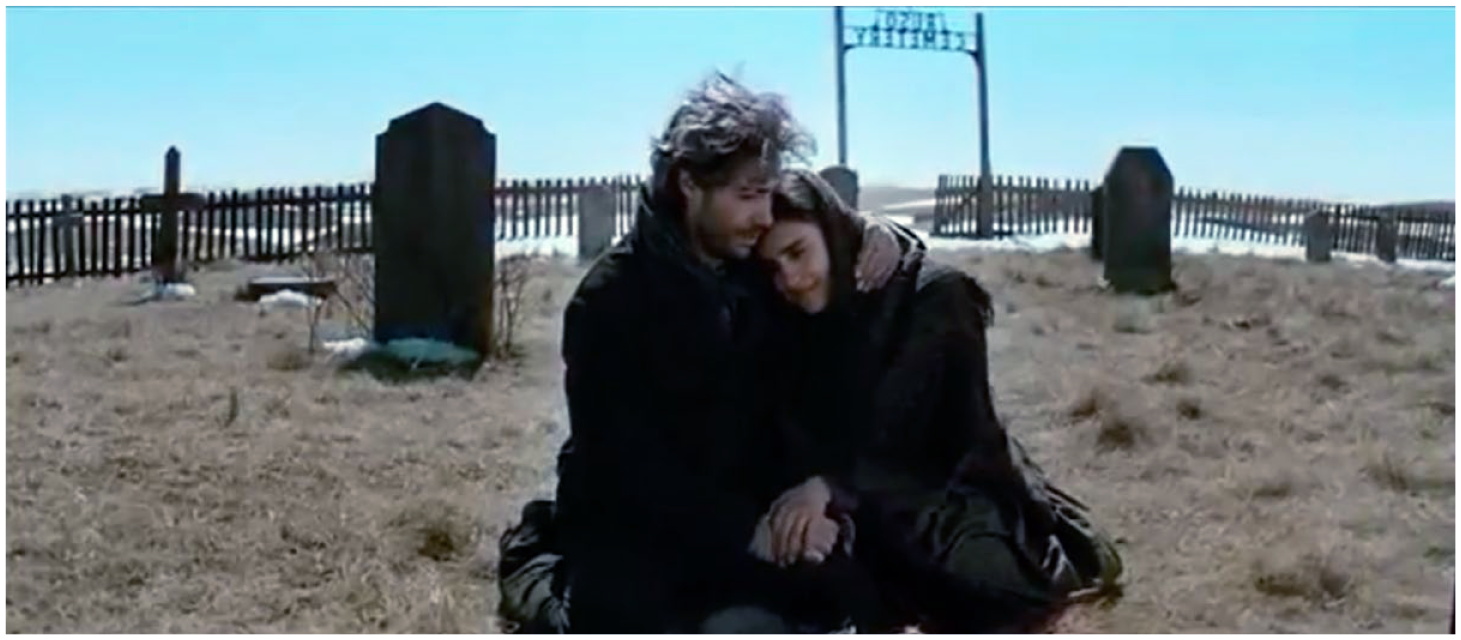
In The Cut, the loss caused by 1915 is compensated with a consolatory narrative of wholeness.
Although Akın claims that his film does not belong in the tradition of Schindler’s List or The Lark Farm (in Kaya, 2014), this secure position, exempt of responsibility, puts him in the Spielbergian tradition. For example, The Lark Firm frames the genocide through a melodramatic story in which a whole universe is fragmented and then restructured, albeit with missing pieces. Throughout the film, which depicts the impossible relationship between a Turkish officer and a young Armenian woman, we see the former, who is in love with the latter, silently object to the massacres and try to stay away from them. Even if the film—however superficially—mentions the social agreement that enabled the massacres, it is still structured around the binary of good and evil. Eventually, the film betrays its audience: the “innocent” Turk, whom the audience can identify with, has to kill the Armenian woman. At the end of the film, the Turkish officer testifies that he has witnessed the massacres with his own eyes. Asked whether anyone specific is to blame, he answers by mentioning himself before anyone else. The film ends with the message, “TheArmenian Community still awaits justice” in the ending credits. With this ongoing call for justice, the story concludes with a semi-open ending. However, with its melodramatic story of good and evil, the film fails to construct a language of remembrance that can call for the rethinking of the legacy of guilt and responsibility.
In Ararat, Egoyan—as opposed to Akın—is partaking of a “haunting cinematic tradition” (Arslan, 2015: 64), and constructs a memory about 1915 with the belief that he is talking of a “past that is not past.” Therefore denial is the central concern that Egoyan addresses in the film and he emphasises “the deeply personal consequences of living with this denial” (Markovitz, 2006: 242). Egoyan also underlines that Ararat is “not so much about the past, as it is about the present. It is about the responsibilities of the people living now” (Egoyan, 2004: 893). With his aesthetics, director portrays the century-long denial and the destruction of the possibilities of the Armenian Genocide’s portrayal by this denial. In Ararat, Raffi takes us on a journey to see what is left of the disaster: “I saw how much I have lost upon seeing all these” he says, as what we lose is not only lives and land, but even the possibility of remembering: “There is nothing here to prove that something happened.” While Akın’s compensation aesthetics fill the void left by 1915 through representation and leaves it in the past, Egoyan puts the void on stage and provokes the confrontation with the genocide in the present and the legacy of responsibility of remembrance.
Two stitches on “the cut”: “I Did Not Feel Guilty . . .”
In an interview, Akın says that he made the film with a sense of responsibility toward the past. He also says that we have to confront our traumas and feel responsible for what happened in the past: “A film cannot apologize. But my society must feel responsible for what happened. This is not a sense of guilt. . . [It is] a responsibility. I felt this responsibility” (Dündar, 2014). When asked: “the Turk who wounds Nazareth apologizes to him [for doing this]. Is this supposed to represent an apology to the Armenians?” he replies:
This is not only a genocide of you, but also ours. This is a part of my daily life; I am telling my own story through this film. Only a lame girl and a mute father remained from a big family. I think this is where we should place our emphasis. (Ozinian, 2015)
Let us consider Akın’s distinction between crime and responsibility further. Jaspers (2000) also analyzes the way Germans relate to the Nazi past in the context of crime and responsibility, saying that people are jointly responsible to oppose injustice: “This, involving the deeds of statesmen and of the citizenry of a state, results in my having to bear the consequences of the deeds of the state whose power governs me and under whose order I live” (p. 25). Our silence or indifference toward any kind of past or present injustice makes us not only co-responsible, but also co-perpetrators: “If I fail to do whatever I can to prevent them, I too am guilty” (Jaspers, 2000: 26). Therefore, indifference, ignorance, assuming the role of the victim, or coming up with justifications for what happened is to be a partner in the crime (pp. 7–9). To call for responsibility while excluding being a partner in the crime is to believe that we can get rid of our responsibility through an apology.
Indeed, journalist and director Can Dündar’s encounter with The Cut corresponds to this ethical–political position. He contrasts the viewing with his experience of watching another film, one with a notoriously negative portrayal of Turks:
I was shocked when I saw The Midnight Express. When the film was over, I felt like everyone else in the room noticed that I was a Turk and were looking at me as if I were guilty. This [The Cut] was different. I was again shocked. But this time I did not feel guilty. (Dündar, 2014)
What makes it possible for Dündar to not feel guilty is that Akın regards 1915 as an “external evil” and provides a position as a witness that is exempt from crime. Dündar can thus easily assume the position of an “innocent” witness watching a film on 1915. Dündar says that the film makes us “look in the mirror,” however, what he sees in the mirror is not a share in a historic crime, but reasons to be proud:
[The Cut] gives domestic viewers a chance to identify not with murderers but with those who risk their own lives to refuse to take part in a collective insanity. “Do not embrace the murderer saying they are our kin, those who tried to save their neighbors from this disaster are your kin, too” is the film’s message. “If you have to take pride in anyone, take it in them.” (Dündar, 2014)
But from Hannah Arendt’s (2009) understanding, each generation comes from a historical continuity and, as such, the crimes that happened before still constitute a part of the responsibility. “Each government assumes responsibility of acts and blames the past governments, and each nation assumes those of its past” (p. 302). Similarly, according to David Miller (2007), who argues for including responsibility for the national past within the idea of national responsibility, each generation which benefits from the advantages of its predecessors has to admit responsibility for injustices and crimes, both to the people within their national community, and to those who are outside (p. 151). The way Dündar relates to the film can be regarded as a direct example of how The Cut does not lead to questioning the legacy of crime and responsibility. Telling the story of 1915 as a tale of good and evil, Akın enables viewers to evade an ethical decision on the film and to be rid of an unalienable burden by declaring themselves free from the crime (Arslan, 2015: 62). Not only does the film fail to prompt viewers to question their own position, it enables them to find reasons to be proud of witnessing 1915. As we can see from other viewers’ comments, this can easily lead to a nostalgic take on the past:
I remembered the old days when I heard people speaking Armenian in the film.
7
I remembered my neighbours Aram, Şake, Arto and Nadya from Emirgan; my co-workers Norayr, Hrant, Kirkor, Harutyan, Garbis Vayk, and I felt sad. I will never understand why we meddle with pain and past grudges and not shoot films on love and peace. (İrdelmen, 2015)
8
This nostalgic witnessing position that the film puts its viewers into is exempt from guilt and responsibility. Thus the film’s aesthetic choices determine the viewer’s witnessing position and correlate with its ethical choices regarding the relationship with the past. The “aesthetics of compensation” in The Cut enables us to find reasons for consolation by leaving 1915 behind, instead of thinking about why Arto and Nadya (two Armenian characters) no longer exist. This nostalgic take on the past prevents critical thinking by romanticizing the gaze of the other which would remind the Turkish viewer of their responsibility. 9 The viewer comment quoted above reintroduces the initial question of this study into the text: Can Akın’s aesthetic choices enable viewers from Turkey to confront the responsibility of the present of which they are a part? If we identify with Mehmet, we can ignore our responsibility in the ongoing denial and our complicity may be eluded. Therefore, The Cut’s aesthetic cannot turn into a questioning of the responsibility of Turkishness for 1915.
Conclusion
The question of how to represent the traumatic past with ethical responsibility is a difficult one. In this article, I have tried to answer it by engaging with debates on ethical memory and representations of genocide. Representing disasters requires ethical responsibility, and films differ in the ways they recall the past and in their aesthetics. Based on this discussion, I suggest that films that do not reflect on the limitations of cinema in the face of catastrophe trivialize genocide and allow the viewer to witness the past in “self-satisfied contemplation.” However, films that reveal how the past is rendered invisible, and thus invite the viewer to confront their responsibility in the present, differ radically in terms of the ethical–political. The first category of films, which I define as the cinema of compensation, fails to fulfill their ethical responsibility by exempting the viewer from responsibility and allowing the past to remain in the past through a belief in innocence. Whereas films with an aesthetic that exposes the inadequacy of representation reveal how the past continues today in different forms, and thereby remind viewers of their responsibilities in the present.
As I have tried to show through this analysis, by relying too much on the potential of representation and ignoring its limits in the face of catastrophe, The Cut cannot fully fulfill its ethical responsibility of remembrance. It is undoubtedly extremely challenging to construct a memory through a cinematic representation of the Armenian Genocide, which is systematically prevented from being remembered, discussed, and mourned. Akın undertakes this difficult challenge with The Cut and breaks the silence of 1915, calling on his Turkish audience to recognize the denied truth and bear witness to the past. But, to return to the question posed at the beginning of the article, remembering the past necessitates an ethical–political inquiry that encompasses the question of how we remember. This requires us to reflect not only on the limits and potentials of cinema as a medium of memory, but also on the ethical dimension of memory construction. However, the construction of memory of 1915 through The Cut does not include an ethical questioning of the fact that, through its denial, 1915 continues even today, and is therefore not a matter of the past but of the present. Instead, the film allows the viewer to leave 1915 safely in the past and to come away with a belief in their own innocence. By leaving unanswered the critical question of denial and responsibility that persists in the present, The Cut fails to provoke self-questioning about the relationship between an unconfronted past and present injustice. Drawing on discussions of ethical memory, therefore, I have described the film as an aesthetics of compensation. As the quoted audience commentary has shown, this aesthetic ultimately results in either the direct reproduction of denial, or the relegation of 1915 to the past through nostalgic remembrance.
The idea of the cinema of compensation in the context of ethical memory is, of course, open to further development and reflection. Thinking about the language of memory is critical to ethically question the culture of remembering. Since the turn of the century, we have been confronted with numerous studies on memory. As the potential of visual media in the field of memory research is investigated, their importance in memory studies is growing (Collenberg-Gonzalez: 2016: 247). From popular culture to art cinema, from oral testimonies to TV series, traumatic events of the recent or distant past are transformed into memory in different ways. However, before embracing or rejecting any work that deals with the past simply because it remembers the past, we need to keep in mind that memory always involves an ethical responsibility with a critical distance. What kind of witnessing position are we called to through film? Does the act of remembering ultimately turn into a protective veil that allows us to leave things in the past, to trivialize them? Or does it turn into a critical questioning that leads us to confront the inequalities of the present; all forms of violence, direct or indirect; or the denied responsibility for an inherited past? Such questions can be multiplied, which is the ultimate aim of this study. Further reflections on ethical memory will contribute to memory studies by extending to a wider field that is not limited to the limits and potentials of cinema or art as a memory tool, but also encompasses the relationship of memory to justice, ethics, aesthetics, apology, guilt, and historical responsibility.
Footnotes
Author’s note
This article is an expanded version of a chapter from my book, Kayıp Hafızanın İzinde: Sinemada Geçmişle Yüzleşme, Yas ve İnkâr (On The Trace of Lost Memory: Confronting the Past, Mourning and Denial in Cinema) (2021, Metis).
