




Abstract
This article introduces the concept of mnemonic reciprocity to examine the dynamics of exchanges between local memory activists and other community members after a Comfort Women statue was installed in 2016 on the grounds of Sydney’s Ashfield Uniting Church. Contributing to the scholarship on grassroots memory activism and on the global travels of the Comfort Women statue, we take a feminist, decolonial approach that identifies points of connectivity between the disparate communities that have come together in the semi-public location of the church for selected commemorative events. Based on an analysis of the ways in which mnemonic reciprocity is fostered through exchanges between Korean-Australians and Indigenous Australians, we suggest that the statue’s commemorative functions, when activated on the level of the local, are doubly decolonial. The Comfort Women statue activates the memory of Japan’s imperialism in South Korea and beyond in the semi-public locality of suburban Sydney. In addition, when articulated critically, the Peace Statue can help to decolonise memory in Australia, contributing to intimate, small-scale acts of a reconciliatory and reparative nature. This case, we argue, demonstrates first that it is crucial to identify the particularities governing the place in which a carrier of memory, such as a statue, is re-territorialised. Second, by showing that localised acts of mnemonic reciprocity can strengthen community relations, it offers an alternative to the nationalist memory wars between South Korea and Japan that have been repeated in many diasporic communities where statues have been erected.
Keywords
Introduction
In recent decades, the ‘comfort women’ – a euphemistic term for the estimated 50,000–200,000-plus women and teenage girls from Korea, Indonesia, China, Taiwan, East Timor, the Philippines, the Dutch East Indies and Japan who forcibly served in Japan’s military brothels during World War II – has become a site of national, regional and global memory (Mackie, 2016). By the 1990s, the sexual slavery experienced by the Comfort Women had accrued significance beyond a regional East Asian dispute, to become an iconic case of crimes against humanity that could be mobilised for international human rights campaigns (Gluck, 2021: 94). The status of the Comfort Women as a ‘travelling trope’ (Gluck, 2021: 100) has, we argue, been facilitated by the viral spread of a commemorative statue, first erected outside the Japanese Embassy in Seoul in 2011, to protest Japan’s denial that the ‘comfort women’ were coerced into sexual slavery. The Comfort Women statue, named the ‘Statue of Peace’ by its designers, is one of those ‘singular artefacts’ (Rigney, 2015: 72) that has had an unusually heightened impact in our era of global interconnectedness. As a material carrier of memory across borders, it provides an accessible vehicle for circulating the memory of the Comfort Women globally. Taking Ann Rigney’s (2015: 72) call for examining such ‘game-changers’ as a starting point, we explore an Australian case of statue politics that has, to date, received little attention in the literature on the Comfort Women or on memory activism (see Morris-Suzuki, 2018 for an exception). While sharing features of the ‘memory frictions’ (Shaw, 2007) that emerged in other transnational cases where the statue was installed, including San Francisco, Glendale and Berlin, the Sydney case provides new insights into the local solidarities the statue can facilitate when it is activated under felicitous conditions.
Before delving into our analysis of the Sydney Peace Statue politics, we would like to clarify the use of the term ‘comfort women’ throughout our article. Due to its euphemistic connotation, the expression ‘comfort women’ has been rejected by some of the surviving women; it has also been questioned by some researchers who, like Vera Mackie (2016), use the term ‘grandmothers’, or ‘halmōni’ in Korean instead, to avoid ‘the offensiveness of “(former) comfort woman” or the demeaning “(former) sex slave” [emphasis in the original]’. We use ‘comfort women’ in quotation marks to indicate its difficult connotation when we refer to the survivors and/or the past. We use Comfort Women (capitalised) when we refer to this history as a site of social justice and memory.
The installation of the Comfort Women statue outside of South Korea, usually propelled by members of a Korean diasporic community, has often ignited ‘memory frictions’ – tensions that emerge when local memory practices clash with purportedly universal norms (Kennedy, 2018; Shaw, 2007). Memory frictions emerged when a coalition of Korean-Australians and Chinese-Australians sought to commemorate the Comfort Women past by having a replica of the statue installed in a public garden in Sydney. They appealed for backing to the local council, which originally expressed support (Morris-Suzuki, 2018: 159). After a campaign protesting the installation of the statue, spearheaded by Japanese-Australian memory activists, the Council withdrew permission for the statue to be erected on public land, ostensibly aiming to forestall ‘hate nationalism’ (Gluck, 2021: 102) between the Korean and Japanese communities in Australia. In the aftermath, local pastor Reverend Bill Crews, active in a range of community-building initiatives, offered to instal it on the grounds of the Uniting Church in Ashfield, which serves as a community hub in an inner Sydney suburb with a large Chinese and Korean population. 1 It remains in this semi-public location today. While it is available to be seen by members of the public who regularly congregate on the site, or happen to be there, or make a special trip, its semi-public location places it outside the institutions of the state and a nationalist politics of memory. Instead, as we argue, the statue becomes part of a collaborative mnemonic engagement by members of civil society whose memory work, guided by Crews, constitutes a form of memory activism. Like statues in public places, it remains inert until it is activated for particular purposes, including both remembrance of past atrocities and campaigns for social justice in the present.
In the first half of this article, we trace the actors and the conditions that enabled the Peace Statue to travel beyond national and regional borders, thereby laying the groundwork for a global memory. The statue’s viral uptake, we argue, was facilitated by two significant precursors: the strategic circulation of testimonies 2 by former ‘comfort women’ in the 1990s, and a targeted memory activism campaign after the first Peace Statue was erected in Seoul in 2011. In both generations of memory – the 1990s and post-2011 – a feminist non-governmental organisation (NGO), Korean Council for Justice and Remembrance for the Issues of Military Sexual Slavery by Japan (hereafter the Korean Council), played a key role, mobilising memory for social justice and activism. In the 1990s the Korean Council, pursuing justice for the former ‘comfort women’, sought a formal apology and financial compensation from the Japanese government, the legal punishment of the perpetrators and the inclusion of the sexual war crimes issue in Japanese history textbooks. After 2011, in light of the failure to have its demands met, it aimed to bring the memory of the Comfort Women into transnational circulation to amplify the matter in the present and commemorate the past struggles of the former ‘comfort women’ (Korean Council, n.d.). These precursors shaped the way in which testimonies of ‘comfort women’, and later the Peace Statue, travelled to Australia, and how they were received.
In the second half, we explore not simply what the Statue of Peace means, but what it can do when it is activated by the local community. To that end, we discuss selected events in Sydney that centred on the statue, arguing that they constitute examples of what we call mnemonic reciprocity. While informed by affiliated concepts such as ‘multidirectional memory’ (Rothberg, 2009: 3) and ‘mnemonic solidarity’ (Lim and Rosenhaft, 2021: 2), our concept of mnemonic reciprocity emerges from the dynamics of exchanges between memory actors and community members, including members of the Korean-Australian diaspora and Indigenous Australians in Sydney, where the Statue of Peace is re-territorialised on unceded Aboriginal land. We explore the specific ways in which mnemonic reciprocity is activated in commemorative events at which Korean-Australians and Chinese-Australians come together with First Nations Australians involving protocols of welcome, acknowledgement and shared remembrance. We suggest that the Australian case demonstrates why it is crucial, especially in an era of transnationalism, to pay close attention to the local particularities governing the place in which a carrier of memory, such as a statue, is situated (Radstone, 2011). Before turning to this case, we identify our feminist approach to memory activism, and analyse the rhetoric and aesthetics of the Peace Statue that enabled it to carry the Comfort Women narrative beyond national and regional borders.
Memory activism and statue politics
In the past several years, a growing body of scholarship has explored the Comfort Women issue through the lens of national, regional and transnational memory politics. We identify three dominant lines of enquiry: first, researchers have explored the changing conditions in public memory that have enabled the memory of the Comfort Women to travel transnationally (Gluck, 2021; Mackie and Crozier-De Rosa, 2019); second, they have investigated the divisive, nationalist memory wars between South Korea and Japan, including how these impact on diasporic communities (Morris-Suzuki, 2018; Ushiyama, 2021) and how they are sometimes fuelled by international political organisations such as the United Nations Educational, Scientific and Cultural Organisation (Lee et al., 2023: 906); third, they have tracked how the Comfort Women are commemorated, especially by Korean-Americans in the diaspora (Hasunuma and McCarthy, 2019; Ward and Lay, 2016). At roughly the same time as the Comfort Women issue was gaining traction in memory studies – valued as a new paradigm of global memory with Asian rather than European roots (Lim and Rosenhaft, 2021: 4) – memory activism was emerging as a vital new research focus. Our analysis builds on and contributes to recent developments in both Comfort Women scholarship and memory activism. The visibility of the Comfort Women as a global memory has, we argue, been brought about in large part through the work of memory activists, and particularly women and feminist activists, in South Korea and in the Korean and Japanese diasporas, working both for remembrance and for forgetting. While the term memory activism appears in some of the Comfort Women scholarship, it has not often featured as a central conceptual framework (see McGregor, 2023 for an exception).
Memory activism offers new frameworks for studying the role of activists in shaping the ways in which contested pasts are remembered and/or suppressed. In defining memory activism, Yifat Gutman and Jenny Wüstenberg (2021: 3) deliberately limit it to activists who, working outside state channels, target memory as a means of bringing about change in policy and/or politics. With this tight definition, they seek to provide the basis for comparative research on memory activism across different contexts. While this approach is conducive to examining the Comfort Women statue politics in Sydney in relation to the Korean-Australian and Japanese-Australian diasporic communities’ activism, with one side advocating for remembrance and the other for forgetting, it does not fully capture community-based interactions, such as those that take place around the statue on the Ashfield Uniting Church grounds.
The more open framework provided by Women Mobilizing Memory, which explores how women activists, artists and academics have mobilised memory in their works, sometimes with an explicit focus on campaigns advocating for social justice, invites exploration of other aspects of our case. Rather than prioritise a comparative approach, Marianne Hirsch (2019: 4, 14) argues for the value of connectivity across divergent and dispersed sites, while also attending to the frictions that may emerge as feminists seek to work across global North and global South locations unequally impacted by histories of privilege and precarity. With attention to both frictions and solidarities, this framework inspires our own investigation of how women activists and their allies mobilised the memory of the Comfort Women to change the way the past is remembered and to campaign for justice. Indeed, as we argue below, activism on behalf of the ‘comfort women’ originated initially as a struggle for justice focused on demanding legal accountability, an official apology and financial reparations from the Japanese government. In addition to analysing the role of actors affiliated with the Comfort Women through gender, ethnic and national identity, and who champion remembrance or forgetting, we also explore the role of non-affiliated Australian Indigenous and non-Indigenous memory activists.
Precursors: testimony and transnational memory activism
After decades of silence surrounding the ‘comfort women’ in Korea post-1945, the South Korean feminist movement took up the issue in the 1980s, fuelling public debate about the sexual violence endured by Korean women at the hands of the Japanese (Ueno and Sand, 1999: 137). At the heart of the movement is the Seoul-based Korean Council, founded in 1990 by a feminist collective of university-educated South Korean women. The transnational travels of the remembrance of the Comfort Women in the 1990s were enabled, at least in part, by the movement’s calling on survivors to speak out publicly (Gluck, 2021: 82). Their testimonies were strategically brought into international circulation by the Korean Council at a time when, following the Eichmann Trial in 1961, individual testimonies had ‘become one of the main currencies of public memory’ (Gluck, 2021: 81). In 1991, one year after its establishment, the Korean Council publicised the first Korean survivor testimony by Kim Hak-sun, whose account generated shock when it was aired on South Korean television. In the years following Kim Hak-Sun’s testimony and its circulation in video and print, survivors from South Korea, the Philippines, Taiwan, China, Indonesia and the Netherlands began sharing their stories (Howard, 1995; Mackie and Crozier-De Rosa, 2019: 4).
Among the witnesses who came forward was Dutch-Australian Jan Ruff O’Herne who had been abducted and forced into sexual slavery by the Japanese Army in Java, Indonesia, in 1944. Ruff O’Herne, who emigrated to Australia after the war, spoke publicly of her ordeal as a ‘comfort woman’ in 1992 and published her memoir, Fifty Years of Silence, in 1994 (Muller, 2020). The Korean Council, in collaboration with the Friends of the ‘Comfort Women’ Australia (hereafter FCWA), validated Ruff O’Herne’s testimony in line with a post-Holocaust understanding of survivor testimony as a unique source of knowledge and insight into contested, traumatic pasts (Gluck, 2021: 81; Kennedy, 2001: 51), thereby facilitating the public memory of the Comfort Women in Australia. Ruff O’Herne soon became the face of the movement in Australia, giving interviews on television and, in the following decade, speaking at tours organised by Amnesty International Australia and FCWA, which was founded in 2007 by two feminist Korean-Australian activists. The feminist politics of ‘comfort women’ activism has also been evident in the Korean-American diaspora (Hasunuma and McCarthy, 2019; Ushiyama, 2021: 1258). Advocating for diasporic activism on behalf of the ‘comfort women’, FCWA (2011) strategically publicised ‘comfort women’ testimonies to spur the Korean diasporic community into action, and was later involved in bringing the Comfort Women statue to Sydney. By that time, the organisation had changed its name to the Friends of the Comfort Women Sydney (FCWS). Since 2021, the Melbourne Comfort Women Memorial Task Force, which succesfully mounted a Comfort Women statue in 2019 at the Korean Society of Victoria’s Oakleigh headquarters, changed its name to the Friends of the Comfort Women Melbourne (FCWM, 2021).
Soon after its establishment in 2007, the FCWA teamed up with Ruff O’Herne, whose personal testimony left an impact at the highest level of Australian politics (Song, 2013: 284). It was her testimony at the FCWA’s 2007 International Women’s Day Rally in Sydney which moved John Howard, then prime minister, to repudiate ‘[a]ny suggestion that there was not coercion’ in the recruitment of the ‘comfort women’ (Song, 2013: 385; Sydney Morning Herald, 2007). His remarks were in response to the then Japanese prime minister Shinzo Abe’s 2007 denial that the Comfort Women had been coerced, indirectly calling Ruff O’Herne’s account into question (Song, 2013: 385). Subsequently, several Australian parliamentary motions urged the Japanese government to override Abe’s dismissal and issue a renewed apology, but they failed (Song, 2013: 385). Nonetheless, Howard’s support for Ruff O’Herne’s account is noteworthy. While he accepted her testimony as a form of historical truth telling (Sydney Morning Herald, 2007), a decade earlier, when the Bringing Them Home Report was released in 1997, he doubted the credibility of the Stolen Generations testimonies (Kennedy, 2001: 125). In addition, he notoriously refused to apologise for the forced removal of between 1 in 10 to 1 in 3 Aboriginal children from their families by Australian governments, churches and welfare organisations between 1910 and 1970 (Parliament of Australia, n.d.). While he kept the two bodies of testimonial evidence strictly separate 3 in his public statements, the violent pasts of the Comfort Women and the Stolen Generations would intersect on a community level almost a decade later with the erection of the Peace Statue in Sydney.
Rather than remembrance, recognition, apology and compensation had been the Korean Council’s core focus in the 1990s. Building on the momentum fuelled by Kim Hak-Sun’s televised testimony, on 8 January 1992 the Korean Council held the first Wednesday Demonstration opposite the Japanese Embassy in Seoul, demanding that Japan formally apologise, provide compensation and punish the perpetrators (Mackie and Crozier-De Rosa, 2019: 4). This demonstration coincided with the state visit of the then Japanese prime minister Kiichi Miyazawa, and was attended by former ‘comfort women’, their supporters, concerned citizens, and feminist activists from various civil society organisations (Kim, 2012). Following the successful circulation of ‘comfort women’ testimonies into the new millennium, however, the Korean Council began to expand its social justice campaign by increasingly engaging in memory activism – that is, using activist tactics to transform the disputed memory of the Comfort Women in Korea, Japan and around the world (Gutman and Wüstenberg, 2021: 2).
At the centre of the emerging campaign, memory activists lobbied to erect a statue in the national capital, Seoul, designed specifically to commemorate the ongoing struggle for justice endured by the ‘comfort women’ over the previous two decades (Kim and Kim, 2016). The first Statue of Peace in Korea was symbolically unveiled at the 1000th Wednesday Demonstration on 14 December 2011 (Kim and Kim, 2016). In 2012, the Korean Council opened the War and Women’s Human Rights Museum (n.d.) in Seoul to remember and educate the public about the history of the Japanese military ‘comfort women’, with the overarching aim of resolving the matter. In the same year, it introduced an International ‘Comfort Women’ Day to be held on 14 August every year in memory of 14 August 1991, the day that Kim Hak-sun gave the first public survivor testimony. In 2016, it officially incorporated remembrance into its mission, changing its name from Korean Council for the Women Drafted for Military Sexual Slavery by Japan to Korean Council for Justice and Remembrance for the Issues of Military Sexual Slavery by Japan.
The transnational memory activism campaign instigated by the Korean Council relies on the affective currency of the Seoul statue, which features the figure of a girl. Since 2011, over 100 replicas of the Seoul statue, as well as differing designs featuring survivors, have appeared around the world. Given that the statue in Seoul, designed by sculptors Kim Seo-Kyung and Kim Un-Seong, and the Korean Council, is the prototype for these variations and the version erected in Sydney, we focus on its iconography. The statue depicts a seated adolescent girl draped in a traditional Korean hanbok. Her fists lie clenched in her lap and her facial expression is defiant. However, several visual markers indicate vulnerability: her hair appears to have been carelessly cut and her heels are raised off the ground to denote uneasiness (Kim and Kim, 2016). As the sculptors explain, the initial idea of designing a statue based on a former ‘comfort woman’ in her old age was abandoned in favour of the figure of the adolescent girl, which condensed the emotions of vulnerability, sadness and anger (Kim and Kim, 2016). The chair next to her is empty, serving as an invitation for members of the public to take a seat. Through the action of sitting next to the girl, the memorial turns ‘passive bystander[s]’ into ‘active participant[s]’ who partake in embodied acts such as ‘commemoration, consolation, mourning, reflection, and/or protest’ (Shim, 2021: 9). The shadowy outline of an older woman on the ground behind the girl signals the passing of time and points to the unresolved nature of the issue today. The bird on her shoulder, a symbol of peace, offers hope for the future.
While the artists designed the ‘Girl of Peace Statue’ to solicit an empathic response to suffering from immediate onlookers, the Korean Council exploits its potential affective connections on a political level to stimulate a national and transnational response and impact (Kim and Kim, 2016). Referring to the statue as a ‘Peace Monument’ (Kim and Kim, 2016), the Korean Council taps into what Wendy Hesford (2021: x) describes as the ‘humanitarian figure of the child-in-peril’, used on both sides of the political spectrum to push for changes that do not necessarily advance the rights of children. In employing this iconography, the statue’s makers solidified South Korea’s national narrative about Japanese imperialism. The national Korean imaginary, which, as gender studies scholar You-me Park (2011: 205) remarks, depicted ‘Korea as a virgin nation being raped by the Japanese colonial power’ during and after the Japanese occupation of Korea, found ‘a perfect [. . ..] symbol in young, virgin Korean women being forced to serve Japanese soldiers’. She describes the branding of former ‘comfort women’ almost exclusively as young and innocent as an oppressive rhetoric that enforces patriarchal notions of chastity in relation to women in general. The statue’s portrayal of a young Korean woman arguably endorses this national imaginary and, in fact, provides a visual, material representation of it.
At the same time, the figure of the vulnerable girl is sufficiently open that it is readily mobilised in transnational memory activism campaigns to protest the suffering of all women and girls subjected to sexual abuse. We contend that the universal legibility of the vulnerable child, whose perceived need for adult protection becomes an absolute truth that cannot be questioned (Baird, 2008: 294), propelled the movement of the statue into Western countries. The statue’s travels have not only amplified the Comfort Women as a global trope, giving commemorative currency to the widely circulated body of testimonies. The travels have also bestowed the Comfort Women with a material, visual form that can be replicated and re-territorialised around the world. In building on the trope of the vulnerable child, the statue thus lends itself to invoke other histories of child removal (Kennedy, 2008) and child sexual abuse that transcend the Comfort Women past when erected in other localities, including in Australia.
Diasporic memory activism and memory frictions
In many Western countries, members of the Korean diaspora have been active in instigating initiatives to keep the memory of the Comfort Women alive. To that end, they have sought permission from local councils to erect Comfort Women statues in public parks in their localities. In most cases in the United States (Ward and Lay, 2016: 260), and in Berlin (Tagesspiegel, 2022), local governments granted permission, sometimes temporary, to erect the statues despite opposition from Japanese diasporic memory activists. In these instances, questions of government-sanctioned remembrance and forgetting regarding the colonial violence inflicted on the former ‘comfort women’, which lies at the heart of the matter, were decided in favour of Korean diasporic memory activists. In Sydney, a similar friction between Japanese-Australian and Korean-Australian memory activists led to the opposite outcome (Morris-Suzuki, 2018). Strathfield Council, which received a proposal for the erection of a Comfort Women memorial from the local Korean-Australian community in 2014, rejected their request. It did so based on concerns about disturbing existing community relations in its municipality and being implicated in the competitive memory politics regarding the Comfort Women issue between Japan and South Korea (Strathfield Council, 2015a: 5.3).
One reason for the rejection of the Sydney Korean and Chinese community’s proposal was a memory activist campaign mounted by members of the Japanese diaspora in Sydney. Historian Tessa Morris-Suzuki (2018: 161–162) observes that in recent years a feminised, national ‘Japanese far-right grassroots activism’ has emerged that is anti-reconciliatory. She contends that such organisations are behind the two main memory activism campaigns in Sydney that demanded the removal of the statue based on concerns over racial vilification. For example, Japanese Women for Justice and Peace posted an online petition in 2014 opposing the erection of the statue in Sydney, which raked up over 16,000 supporters (Morris-Suzuki, 2016). Also in protest, the Australia-Japan Community Network submitted a racial vilification complaint to the Human Rights Commission – ultimately rejected – over the installation of the Peace Statue on Uniting Church grounds in 2016. The nationalist activism of members of the Japanese diaspora exemplifies Gutman and Wüstenberg’s (2021: 5) insistence on a ‘value-neutral’ definition of memory activism. As they explain, ‘memory activism’ not only describes initiatives that aim to strengthen egalitarian and socially progressive values, but also encapsulates those that openly work against them (Gutman and Wüstenberg, 2021: 5).
The Peace Statue was brought to Australia through the memory activism of the Korean Council and its connections to local Korean and Chinese memory activists, including Korean-Australian Vivian Pak, the co-founder of the FCWA and now a leading member of the FCWS, and Si-Hyun Paik, spokesperson of the Comfort Women statue erection committee in Australia (Friends of the Comfort Women Sydney (FCWS), n.d.; Song, 2013). Hence, the ‘route’ the statue took (Erll, 2011: 11) to reach Australian shores was similar to its travels to other transnational locations, including in the United States, Canada and Berlin. But the way it has been received in Australia and in the United States is markedly different. In the United States, Korean-American diasporic memory activists operating in areas where citizens of Korean descent have enough voters to swing local elections – such as in Glendale, California; Palisades Park, New Jersey; and Fairfax, Virginia – were able to elicit support from local governments to instal Comfort Women memorials (Hasunuma and McCarthy, 2019: 148). As Linda Hasunuma and Mary McCarthy (2019: 148) suggest, the political inclusion of Korean-Americans into local governments in these areas coincides with a heightened effort by members of the local Korean community to increase its public visibility through the erection of memorials and activities surrounding the Comfort Women past. In such cases, it is fair to argue that the Comfort Women statue campaign became a means not simply for remembering the ‘comfort women’, but also for enabling the Korean-American community to assert moral legitimacy as the keepers of a memory now recognised as an international human rights violation against women, in an era in which crimes of sexual violence and sexual slavery are gaining more visibility in the public sphere. In short, the politics of memory fuses with the international morality of memory – ‘never again’ – so that commemorating suffering can show a community’s alignment with an international and cosmopolitan position on human rights. By contrast, the Peace Statue’s installation in Sydney is significantly shaped by the fact that it operates outside the confines of the federal and municipal Australian governments and has instead become attached to a local church community.
Forging mnemonic solidarities: re-territorialising the Comfort Women statue in Sydney
After Strathfield Council (2015b) rejected the application of the Korean Committee of United Australian Korean-Chinese Alliance to instal the statue, Reverend Bill Crews, acting on behalf of the Exodus Foundation, a charity run by the Mainline Protestant Uniting Church, the third-largest Christian denomination in Australia, agreed to display it on church grounds in suburban Sydney. The Peace Statue (see Figure 1), unveiled in 2016, sits in an outside alcove of the Ashfield Uniting Church, where it cannot be seen from the street (see Figure 2). This semi-public location indicates that the commemorative events surrounding the Sydney Peace Statue follow different protocols than if it had been erected in a public park. In fact, the statue’s re-territorialisation (Lim and Rosenhaft, 2021: 4) on church grounds has meant, in practice, that the transnational memory of the Comfort Women has become part of located acts of remembrance connected to memory actors from the local community, who are willing to participate in commemorative events on church grounds even if they are not members of the congregation. These memory actors engage, at least in part, with the Comfort Women past as – to borrow Michael Rothberg’s (2009) productive formulation – a ‘multidirectional memory’ in which, as memory travels, it can facilitate the articulation of memories of other histories of injustice and atrocity (see also Ushiyama, 2021: 1257). In remembering the sexual abuse endured by women and girls during wartime and in other historical and social contexts, past and present, the Comfort Women trope, we argue, constitutes the basis for a new multidirectional memory paradigm that explicitly expresses the gendered, colonial violence experienced by these women (see also Kennedy and Graefenstein, 2024: 173). In particular, through ‘ongoing negotiation, cross-referencing, and borrowing’ (Rothberg, 2009: 6), commemorative events surrounding the Comfort Women statue in Sydney draw attention to historically unrelated incidents and victims of sexual violence.
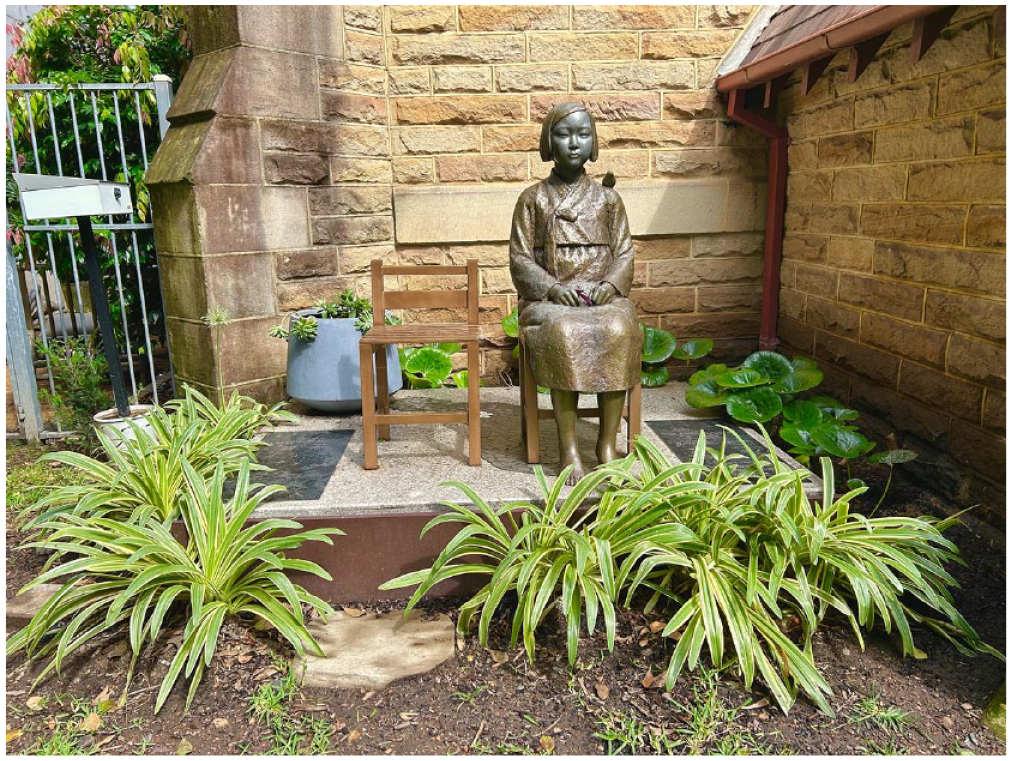
The Comfort Women statue on Sydney’s Ashfield Uniting Church grounds. Photograph: Robert Magrath.
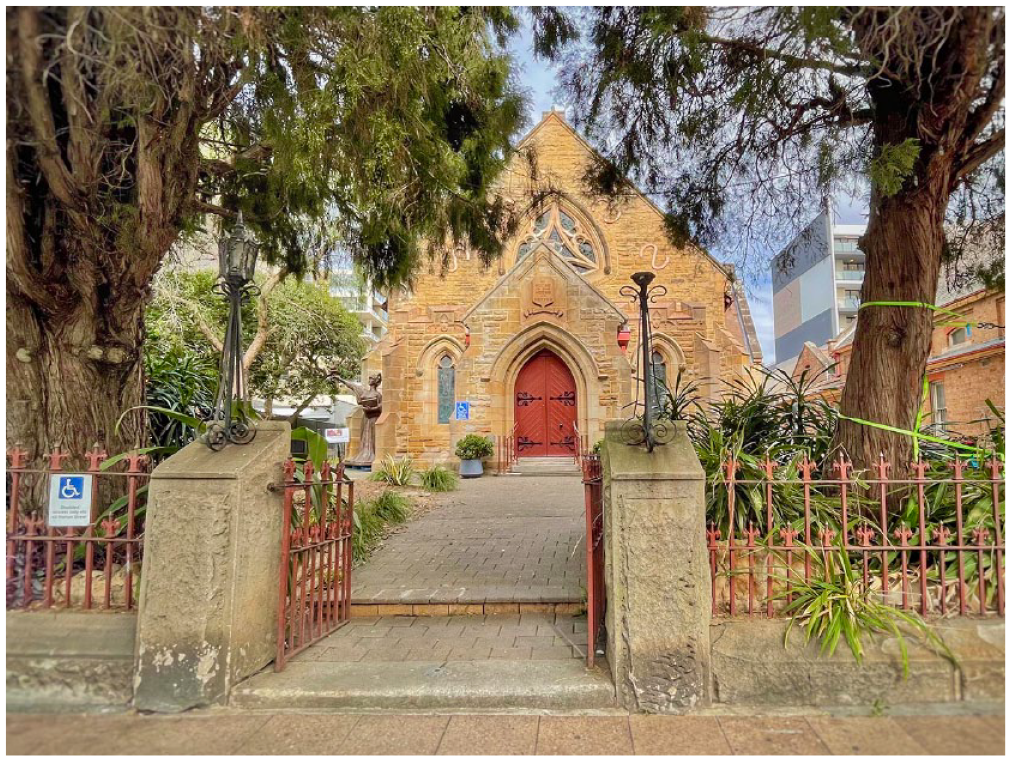
Front façade of Sydney’s Ashfield Uniting Church photographed from the street. The Comfort Women statue is located in an alcove on the back left.
In a speech Reverend Crews (2018) gave to mark International Memorial Day for Japanese Military Sexual Slavery in 2019, he reiterates that the abuse endured by the former ‘comfort women’ should ‘never happen again’ while acknowledging that ‘it’s happening today [. . .] in different countries where women are [. . .] used as sex slaves’. Pointing at the Peace Statue behind him on the Ashfield Uniting Church grounds, he shared his memory of interacting with the statue: I actually sat on that seat in the ‘comfort women’ statue in Seoul, South Korea, which is right opposite the Japanese Embassy. But my argument is not with the Japanese. My argument is with those who want to put women into slavery [. . .] these women represent [. . .] all women [. . .] we have to [. . .] create a world where all women are equal (Crews, 2019a).
In these statements, Crews invokes the Comfort Women past as ‘a global referent for the violation of the human rights of women’ (Gluck, 2021: 100) that can be borrowed to articulate other histories of sexual abuse. Hence, Crews states that the Comfort Women past matters, in part, because it enables expressions of solidarity with other victims of sexual abuse, helping to ‘construct and [possibly] act upon visions of justice’ (Rothberg, 2009: 19) that transcend the victims of the Japanese Imperial Army.
Mnemonic reciprocity: the peace statue in Sydney
While the transnational memory of the Comfort Women past is symbolically significant, it does not fully capture the dynamics of the Peace Statue in the specific Sydney context. Facilitated by church members such as Crews, and Aboriginal Elder of the Gamilaroi and Waka Waka Aboriginal nations, Shirley Lomas, as well as Korean diasporic ‘comfort women’ activists like Pak, the statue becomes an agent of mnemonic reciprocity. The statue is activated as a facilitator of reciprocal memory work through the way different groups in the local community engage with one another around it. Rather than participating in a process of cross-referencing characterised by ‘dynamic [memory] transfers that take place between diverse places and times during the act of remembrance’ (Rothberg, 2009: 11), this reciprocity is based on a direct, personal encounter of community groups in a particular place and time. As Susannah Radstone (2011: 117–118) reminds us, memory travels transnationally but it is ‘only ever instantiated locally’ through ‘memory events’ organised by individuals and/or groups embedded in a particular local context, ‘however hybridized, complex, multiform’ [emphasis in the original].
In developing the concept of mnemonic reciprocity, we take inspiration from Jie-Hyun Lim and Eve Rosenhaft (2021: 3) who introduce the term ‘mnemonic solidarity’ to find ‘common ground for articulating the hurts of the past in ways that are productive for the future’ but with a focus on voices of the global South. In decentring Holocaust memory in the face of rising global articulations of suffering by formerly colonial subjects, they focus on the role of specific actors, a crucial aspect of their approach. The value of this approach lies in the observation that the transnational is easily claimed, but not necessarily easily activated. In such cases, the language of globalisation carries the risk of denoting disembodied forces (Lim and Rosenhaft, 2021: 10). By contrast, in focusing on memory actors involved in specific memory events surrounding the Peace Statue, we aim to uncover the potential for solidarity through mnemonic reciprocity on the small scale of communal exchanges. In examining the unique contributions of different memory actors and the mutual exchanges between them, we begin by exploring the central role Crews, as a religious leader, plays.
By way of his affiliation with the Uniting Church, Crews provides a sheltered space for community-based interactions, cultivating a memory activism from below under his faith-based guidance (see also Powers, 2010: 317). While acknowledging Crews as the initiator of reciprocal memory work at Ashfield Uniting Church, we do not suggest that mnemonic reciprocity can only be facilitated by spiritual leaders within a semi-public religious space for communities in and outside their congregation. Other non-religious, educational and civil organisations, including NGOs, are also well placed to undertake this work, provided a physical space and/or commemorative framework is put in place to encourage and proactively nurture exchanges between communal memory actors who are willing to engage with one another. It is nevertheless crucial to acknowledge that the semi-public space which the Sydney Peace Statue occupies is not a secular place.
A rich body of literature engages with religious organisations’ involvement in helping promote peace as well as advance reconciliation processes in post-conflict societies (see, for example, Powers, 2010; Sandal, 2019: 2; Zartmann, 2007). As political scientist Nukhet Sandal (2019: 3) observes, faith-based approaches to mediation are often employed in bilateral conflict resolution processes where secular tactics have failed to resolve existing tensions and religious actors are perceived as more neutral than political representatives. This does not mean, however, that Crews position in the church makes for a frictionless contribution to conflict resolution. Indeed, his role in facilitating the memory of the Comfort Women in Australia was perceived by some Japanese Australians as fuelling rather than easing tensions between Japan and South Korea and disturbing community relations in Australia (Strathfield Council, 2015b). In the face of this opposition, Crews stood by his decision to host the statue. Significantly, as an ordained minister, and a local celebrity due to his highly publicised charity work, he had the material resources and the authority to create a space where community members of differing cultural and ethnic backgrounds can come together and engage with one another. Crews’ personal motivations to create this space are informed by his religious beliefs as well as his personal involvement in political issues such as the dispossession and discrimination experienced by Aboriginal Australians. As we discuss below, Crews’ self-identification as an activist informed his decision to host the statue despite pressures to remove it.
Local memory actors
Crews (2020) does not identify specifically as a memory activist, but has come to act as one today, inspired by his work at the Wayside Chapel, a parish mission of the Uniting Church in Australia, in the 1970s. Located in Sydney’s Kings Cross, the ‘mecca of disaffected youth’, ‘the home of the red light district’ and an ‘illegal gambling and drug culture’, the Wayside Chapel (n.d.) was also a centre of activism, which promoted social justice issues of the day and aimed to give a voice to the voiceless. In the aftermath of the Freedom Rides, which protested for Aboriginal equality, Crews formed relationships with prominent Indigenous activists, including Charlie Perkins, Gary Foley, and Billy Craigie, who he spoke alongside at various events. At the Wayside Chapel, he worked with homeless children and youth, including children of the Stolen Generations who sought shelter from sexual abuse and violence experienced in institutional care and in foster families (Crews, 2020; Rev. Bill Crews Foundation, n.d.). His continued work with the Aboriginal community eventually led to a friendship with Stolen Generations survivor, Lomas, who has become a memory actor not only in relation to addressing Australia’s settler (neo-)colonial past and present, but in connection with the Korean Peace Statue.
To gain local significance, the Korean-Australian community members who brought the statue to Australia chose to become part of the social assemblage shaping the church community by proactively endorsing a decolonial approach to Australia’s past. Thus, since the 2016 establishment of the Peace Statue on the Sydney church grounds, a total of three smoking ceremonies have been conducted, which all included an Acknowledgment of Country honouring Traditional Owners. For instance, members of FCWS reached out to the Ashfield Uniting Church committee to request the arrangement of a Welcome to Country from the local Indigenous community in Sydney to mark the 10th International Memorial Day for Japanese Military Sexual Slavery Victims held at the statue in August 2022. The diasporic Korean memory activists considered it vital to be welcomed by the Traditional Owners of the unceded land upon which the church and statue reside – the Wangal and Gadigal peoples of the Eora Nation – given that like the former ‘comfort women’, Australian Aboriginal peoples experience(d) violence and suppression. In line with Crews’ (2019b) decolonising and reconciliatory mission and initiated by FCWS (2022a, 2022b), Lomas gave a speech and Gamilaroi man, Terry Olsen, performed a smoking ceremony to welcome participants to Country on Comfort Women Memorial Day. Only Traditional Custodians of the land on which an event takes place are permitted to deliver a ‘Welcome to Country’ (National Indigenous Australians Agency (NIAA), n.d.). The rules around how visitors are welcomed to Country have been an integral part of Aboriginal and Torres Strait Islander cultures for tens of thousands of years (McGrath et al., 2023). The modern adaptation of this Welcome to Country still carries the significance of welcoming visitors and requesting their respect for Country. At the 2022 commemorative Comfort Women event, Olsen and Lomas helped activate the statue for the explicit remembrance of the ‘comfort women’ and implicitly, through the Welcome to Country, of the dispossession of Aboriginal people and acknowledgement that the land on which the church stands ‘always was, always will be’ Aboriginal. Through these rituals of remembrance, they participated with the Korean-Australian community as co-creators of memory.
Although initiated by Korean memory activists, this engagement is not one-sided but reciprocal, as Lomas explains in a radio interview with Crews about the events associated with the 2022 NAIDOC-week, overseen by the National Aboriginal and Islanders Day Observance Committee, held at the Ashfield Uniting Church. When Crews asks her to elaborate on what NAIDOC-week, organised annually to ‘recognise the history, culture and achievements of Aboriginal and Torres Strait Islander peoples’ (National NAIDOC Committee, n.d.), means to her, she replies: [I]t stands for National Aboriginal and Islanders Observance Day, but it is much more than that. [. . .] What is different about your [Uniting Church] NAIDOC-day [. . .] is that it is inclusive [. . .] we have had non-Aboriginal people perform [music] with us. [. . .] maybe the Korean people perform next year because it’s inclusive. It’s not them sitting in the audience and seeing this, they are actually a part of it. (Lomas, 2022)
This response suggests that Lomas perceives the Korean-Australian community as proactive co-creators of a decolonising commemorative approach in Australia. As she explains: You can’t have a future without acknowledging the past [. . .] but I think big steps will go towards being at the type of celebrations that we’ll do, where we mix with people of different cultures on the grassroots level. And that way [. . .] you’re not dictated [. . .] by something top-heavy from government. I want people to [. . .] accept me because they want to, not because there is some actor that’s forcing them to do it. (Lomas, 2022)
Lomas’ analysis of the dynamics of the event articulates the principals of memory activism as actions initiated by actors at the grassroots level who aim to change dominant public perceptions about the past, and create possibilities for the future. She stresses that the location of the exchange – on the site of a church that is relatively independent of governmental structures, and that promotes a bottom-up rather than top-down, dogmatic approach to reconciliation – leads to genuine connection between communities on the grassroots level. 4 Lomas’ description thereby reflects Jeffrey C. Goldfarb’s (2006: 4) observation regarding the ‘politics of small things’ that ‘[w]hen people freely meet and talk to each other as equals, reveal their differences, display their distinctions, and develop a capacity to act together, they create power’. This community-based power is different from coercion (Goldfarb, 2006: 4), which can be exerted through state-authorised approaches to prescribing a certain understanding of the past, as Lomas’ observations imply. This power, which provides an alternative to political mainstream responses to representing or refraining from representing the past, can help foster genuine small-scale connections between community members affecting gradual small-scale changes.
Crews’ decision to host activities in honour of NAIDOC-week is not unique in the context of the Uniting Church in Australia, which also celebrated ‘Australia’s First Peoples and their place at the heart of our nation and our church’ as part of the 2022 NAIDOC-week (Uniting Church in Australia Assembly (UNCAA), 2022). In fact, the church’s decolonising mission has a longer tradition. It places a fairly strong emphasis on its advocacy work, making regular public statements about social justice issues (Pepper et al., 2019). The Uniting Church has advanced social justice in the name of Indigenous communities since 1985 through its Uniting Aboriginal and Islander Christian Congress, and its involvement in the Sorry-Book campaign of the 1990s, which saw community members issue apologies as a response to Howard’s refusal to do so (see Kennedy, 2011). In addition, the Uniting Church declares that it was the first church in Australia to recognise Aboriginal and Torres Strait Islander peoples as the ‘First Peoples of Australia’ in its constitution in 2010 (Uniting Church in Australia (UCA), n.d.). What is important about Crews’ approach, however, is that events like NAIDOC-week and the International Memorial Day for Japanese Military Slavery Victims foster engagements of mnemonic reciprocity among members of disparate communities in the localised setting of Ashfield Uniting Church.
As a leader in the Ashfield community, Crews encourages community exchanges between the Korean diaspora and local Indigenous community leaders which not only foster mnemonic reciprocity among members of disparate communities. Such events also facilitate ‘small acts [of repair] attuned to small claims’ (Hirsch and Spitzer, 2022: 44). As Hirsch and Leo Spitzer (2022: 44) explain, reciprocal acts of repair in which the arts may serve as a medium of healing, take on added importance in contexts in which official, legal forms of reckoning with the past perpetration of acts of violence are largely lacking. For example, the Peace Statue is activated in accordance with the affective responses it generates in community members of varying backgrounds, and as such takes place on ‘the intimate scale of reading and viewing – in the eyes, ears, and bodies of people who are [. . .] moved by what they see [emphasis in the original]’ (Rigney, 2021: 18). The reparative acts carried out by local Korean and Aboriginal community members around the Sydney Peace Statue are thereby grounded in a mutual acknowledgement of each other’s pain endured during colonial times and at the hands of different oppressive regimes.
While we emphasise the small-scale reparative value of these acts of mutual exchange, we do not suggest that they replace the need for additional acts of repair extended towards the victims of both crimes. We recognise that the emphasis on linking the suffering of communities through practices of mnemonic reciprocity comes at the expense of a detailed account of the particular experiences of suffering endured by Indigenous Australians and the former ‘comfort women’, past and present. We thus note that a sole focus on the comparability of past abuses, even if this connection is made with the intention to increase levels of empathy between different communities of suffering, does not necessarily encourage wider engagements with the present-day negative legacies of these violent histories. In addition, confronting ongoing inequalities is essential to advancing reconciliation. Reconciliation not only calls for official commemorations as a form of symbolic reparation but also aims to improve the current living conditions of those affected by the violent pasts addressed (see also Graefenstein, 2019). For instance, Reconciliation Australia (n.d.), the leading national body for reconciliation in Australia, states that it works not only towards ‘historical acceptance’ among the wider community of past acts of settler-colonial violence, but also intends to improve economic equity for Indigenous Australians today. For Australia to be called a truly ‘reconciled’ country, the NGO argues, Indigenous children would have to have ‘the same life chances’ as non-Indigenous Australians which they currently do not have (Reconciliation Australia, n.d.). It is therefore important to highlight that these small reparative acts do not bridge the divide between governmental players such as South Korea and Japan nor do they decolonise Australia as a nation. Instead, they give rise to reciprocal memory work that has a positive, doubly decolonial effect in a localised context.
As our analysis demonstrates, in Sydney the Comfort Women past has become entangled with the local history of settler colonialism, and Aboriginal representatives have been included in the statue’s activation by Crews and members of the FCWS. The mnemonic reciprocity that is activated around the Peace Statue thereby engenders a doubly decolonial memory. The Comfort Women statue activates the memory of Japan’s imperialism in South Korea and beyond – in East Asia and the Asia-Pacific – in the semi-public locality of suburban Sydney (Ushiyama, 2021: 1255). In addition, when articulated critically, the Peace Statue can help to decolonise memory in Australia, contributing to intimate, small-scale acts of a reconciliatory nature. This memory work takes place outside state-sanctioned public memory projects. Even though Crews’ congregation is part of the Uniting Church, the Peace Statue is not hosted by its head organisation but by the Ashfield Uniting Church congregation, and it is within its midst that it does its most crucial memory work. In this sense, the mnemonic reciprocity that the statue currently produces is not one of monumental or grand-scale (trans-)national value. It affects the scale of the local, the personal and interpersonal. This localised approach to confronting Japan’s and Australia’s colonial pasts models a form of shared remembrance that is inclusive rather than competitive, bottom-up rather than top-down, reciprocal rather than prescribed.
Conclusion: valuing localised circuits of connectivity
Our analysis of the Sydney Peace Statue demonstrates that its semi-public location fosters community-based interactions outside of Australian federal and local state governments. Perhaps because the statue has not become part of Sydney’s state-funded memorial landscape, as it has in the United States, Canada and Germany, other connective forms of mnemonic reciprocity have emerged around it. Unearthing localised connections, as we have done here, is significant for future research on the Comfort Women past, as it provides an alternative to the nationalistic and competitive narratives dominating public debates and scholarship in other geographical locations where Peace Statues were granted state-approval.
As has been observed widely, the installation of statues in public places fuels existing diplomatic tensions between Japan and South Korea. While this is an unavoidable corollary of the global ‘politics of regret’ (Olick, 2007: 14) it has led to what Rin Ushiyama (2021: 1267) calls an ‘impasse’, as the divisions along nationalist fault lines between Japan and particularly South Korea, but also other East Asian countries, have created a political deadlock. While reconciliatory measures at the Japanese and South Korean state level are set to fail in this hostile environment, even as attempts are made to resolve the issue, 5 Ushiyama suggests that a diversifying approach to commemorative narratives surrounding the Comfort Women may help resolve the deadlock, at least in some geographical locations and for some communities invested in this memory. We suggest that the location and activation of the Sydney statue – in a semi-public place where it has been activated specifically for the purpose of community-based reciprocity, rather than polarisation – contributes to this vision. Not that the memory frictions surrounding the nationalistic divisions do not feature at all – in fact, they have informed the political decision to banish the statue from public parks in Sydney setting a precedent in Australia (Wikramanayake, 2019). 6 Nevertheless, the doubly decolonial effect that the Peace Statue has had in the particular locality of Ashfield’s Uniting Church, involving local Korean and Indigenous memory actors, has circumvented this conflict at least in relation to how local memory actors interact with one another.
While the mnemonic reciprocity fostered by the activation of the Peace Statue has a localised, small-scale effect, the implications of our findings for the field of memory studies are nevertheless significant. They highlight the need both to critically evaluate the effectiveness of fixed memory tropes in promoting reconciliation (see also David, 2020; Hirsch, 2019; Lim and Rosenhaft, 2021) and to explore how alternative forms of local connectivity emerge in places where universally endorsed, normative approaches to remembrance seem to have failed. Diasporic memory activists lobbied Western countries’ governments to erect Peace Statues in public places specifically to exert pressure on Japan to face up to its wartime abuses (Song, 2013). This approach attempts to further universalise the Western ‘politics of regret’ (Olick, 2007: 14) that emerged post-1945. However, these attempts have not achieved the desired outcome (Korean Council, n.d.), namely an official apology by Japan that the majority of survivors are willing to accept, along with the provision of reparations that are exclusively state-funded, the punishment of perpetrators, and an inclusion of the Comfort Women past into official commemorations and educational text books in Japan (see also Zolkos, 2019 for the Taiwanese context). The Sydney Peace Statue has not received local governmental support to formally endorse the duty to remember as a form of symbolic compensation for the victims (see also David, 2020: 1). In this sense, the Sydney Peace Statue has failed to fulfil its intended purpose, but we suggest that this is not the only contribution it could possibly make.
Focusing on the reception of the Sydney Peace Statue by diverse local community groups, we have unearthed how, through complex processes of re-territorialisation, the Comfort Women memory can transcend the competitive national memory politics that brought it into transnational circulation in the first place. Hirsch (2019: 4) fruitfully observes that artistic expressions, including mnemonic performances, and the intimate encounters they engender, can mobilise political action in ways that critique national narratives. She suggests that in the aftermath of mass violence acts of historical justice, which may include the erection of large-scale, state-funded monuments dedicated to the victims of past state-sanctioned violence, are viewed as compensatory but do not necessarily have the desired reparative effect. In fact, they can enforce nationalist and ethnocentric visions of mnemonic solidarity (Hirsch, 2019: 8). By contrast, memory activists who engage in informal and nonhegemonic forms of remembrance can help forge new ‘circuits of connectivity’ that do not replicate these nationalistic divisions on the ground (Hirsch, 2019: 3–4). We might add that these circuits of connectivity and repair have an important localised dimension, as the Sydney case exemplifies.
Through our exploration of small-scale reparative acts grounded in the community-based interactions of mnemonic reciprocity in Sydney, debates in memory studies can be productively lifted out of the dominant frames of national and transnational memory, and instead direct our focus to ‘local histories and their movement and import, their connections to other small stories’ (Hirsch and Spitzer, 2022: 44). Our findings thus align with Radstone’s (2011) advocacy, over a decade ago, for memory studies scholars to examine more carefully how exactly travelling memories, in this case Comfort Women memories, are received locally, and proactively reshaped with unintended outcomes by local memory actors. Tracing these processes as we have done here is vital to understanding how mnemonic solidarity and connectivity emerge through reciprocity between particular community members on the ground. As a felt reality, and not only an abstract ideal, mnemonic solidarity is always embodied; it is forged through real-life encounters and acts of reciprocal exchange between local, national and transnational memory actors that are linked to the global memoryscape and influenced by its aspirations, but in practice remain embedded in localised structures of commemoration and community-based entanglement.
Footnotes
Acknowledgements
The authors would like to extend a warm thank you to Bill Crews and members of the Friends of the Comfort Women Sydney for sharing online resources and insights about their memory work regarding the Peace Statue located at the Ashfield Uniting Church. Many thanks also to the two anonymous reviewers for their constructive feedback and to Shameem Black and Lia Kent for their helpful suggestions.
