




Abstract
This article examines how a recent multi-media requiem sought rest for Khmer Rouge victims and connected audiences in the Cambodian post-conflict diaspora. Composed by Him Sophy, the requiem takes its name from a funeral ritual that assists re-birth: Bangsokol. Performed in various international cities throughout the years 2017–2019, Bangsokol, with a libretto by researcher Trent Walker, combined chanting and singing in Khmer and Pali with the music of a traditional Cambodian orchestra blended with that of a Western chamber orchestra. The performance was backlit by projected film images by Cambodian filmmaker Rithy Panh, and accompanied by stage performance elements such as procession, drumming, and dance. I draw on interviews with the key creatives involved in the Bangsokol Requiem, visual documentation of the Requiem in development, and experiences of its premiere performances at the Melbourne Festival in October 2017. I follow Elizabeth Grosz on art to consider the Requiem in terms of its capacity for ‘activation’ and trace three of its micropolitical alter-accomplishments. I argue that the performances deterritorialised existing memorial refrains and reconnected diasporic and wider audiences through an experience of affective intensification.
Keywords
Introduction
Bangsokol: a Requiem for Cambodia is a major new symphonic work that premiered in Melbourne in October 2017. The artists and commissioning organisation that developed the Requiem intended it to be a contemporary masterpiece that would honour and bring rest to the victims of the Khmer Rouge regime of 1975–1979. They also sought to recognise experiences of post-conflict exile by performing the work across the Cambodian diaspora – in Melbourne, New York, Boston and Paris – followed by a homecoming performance in Cambodia. While widely lauded as a cultural accomplishment and artistic achievement, this article follows Elizabeth Grosz to consider the Requiem in terms of its capacity for ‘activation’. From this, and in the interest of extending ideas of memory activism, I explore ‘memory activation’ as a kind of agency distributed between bodies that, while having no author, direction or explicit demand, nonetheless links a present experience to traces of past experiences.
Grosz (2008) writes that ‘all art is an art of sensation’, and that art activates ‘the perceptions and sensations of the lived body’ (p. 22). Grosz understands art to be a making-habitable of chaos. By ‘chaos’, she does not mean a specific social or political chaos of the kind that memory scholars might be attuned to, but the chaos out of which all systems of cosmological ordering are drawn. Conceiving of the art of music in this way allows a consideration of what music achieves in and between bodies: vibrations that are often pleasurable, exciting, soothing or intriguing. Like all music, works through these forceful and shared sense registers. The work specifically blended the sounds of Khmer Buddhist ritual and remembrance with other musical traditions to great novel effect. Moreover, the nature of the activation that Bangsokol offered was therapeutic. As Candice Boyd establishes, the therapeutic ‘has less to do with perception than with what is perceptively felt’ (Boyd, 2016: 92). This idea of ‘feeling a way’ into something, of feeling-sensing as leading perception, allows critical attention to be paid to what changes – potentially, what heals – during the forceful intensities of making and encountering art.
Much of the current discussion of the role of the creative arts after conflict is focused on macropolitical perception and the perceivable, or representation and the representable, and how this is or might be cognitively received and debated. In these discussions, art is instrumentalised, relegated to ‘a realm of useful, ameliorative, and ultimately modest gestures’ (Bishop, 2012: 23), which fails to adequately account for its forcefulness and efficacy. In a neoliberalised present, the creative arts are seen as a professional sector capable of value-adding artistic outputs to largely separate and more important processes, like legal trials, economic development, nation-building or archival documentation (see Thompson, 2013). The organisation that commissioned Bangsokol, Cambodian Living Arts (CLA, n.d.), strategically adopts aspects of this instrumentalist discourse. In 2019, CLA wrote of its mission as encompassing ‘running scholarships, fellowships and professional development training, while creating job opportunities and encouraging cultural entrepreneurship, [envisioning] arts and cultural expression as essential to a thriving future for Cambodia’ (Cambodian Living Arts, 2019). The premise of this article is that – despite funding applications, workshops and websites peppered with instrumentalist terms – creative arts approaches, especially in post-conflict contexts, potentially afford something far more profound.
My analysis of Bangsokol is an attempt to enquire into art’s moment-to-moment activation, or what has also been termed the ‘micropolitics’ or ‘affective politics’ of creative action and reception (Katz, 2017: 596; see also Manning, 2016). To enquire into the micropolitical or ‘the minor’ is to attend to interstitial emergent practices (Katz, 2017: 598), to that which may ‘unmoor or problematise’ the major (Sumartojo and Graves, 2018: 334). In the case of Bangsokol, the major structures that were ‘minored’ were extant political, musical, performance and memorial traditions, both in its performance and throughout its development as a work. By unmooring these major structures, Bangsokol offered performers and audiences an experience of affective intensification, deterritorialising and reterritorialising existing musical and memorial practices and refrains in ways that echoed diasporic experiences. After a background discussion of the work and its emergence, I discuss the memory activation afforded by Bangsokol via three micropolitical ‘alter-accomplishments’: rest, re-imaging and repair.
Background
Bangsokol was composed by Him Sophy, a Cambodian-born survivor of the Khmer Rouge regime of 1975–1979. He sought to ‘blend’ Cambodian and Western music and have this accompanied by the chanting and singing of a chorus and Cambodian soloists. The composer wished to bring Cambodian music and ritual to a wider audience, and to avoid the insularity and sterility of cultural preservation. 1 The Requiem’s libretto was written by American researcher Trent Walker. Walker drew from his experience as a Khmer Buddhist novice monk and practitioner of smot (funereal singing), and his extensive knowledge of traditional Pali and Khmer language texts (Walker, personal communication, 2017). Later additions to the work included visual projections developed by French-Cambodian filmmaker and fellow survivor of the Khmer Rouge regime, Rithy Panh, as well as stage performance elements. The three principal artists – Him, Walker, and Panh – worked closely with each other and with additional artists and performers in the development and staging of Bangsokol. 2 Some of the artists interviewed about the work also considered themselves to be directly attending to the ‘wandering souls’ for whom the Requiem seeks rest. For example, vocalist Chhorn Sam Ath shared that it was the performers’ ‘duty to [perform bangsokol] for those unfortunate souls [. . .] especially [as] our artist group possesses a strong awareness of our culture and tradition; we are very happy to assist’ (Chhorn interview 2017).
Bangsokol is one of several large creative works about the Khmer Rouge past to have emerged in some relation to the current United Nations-supported criminal tribunal, the Extraordinary Chambers in the Courts of Cambodia (ECCC). Over this internationalised court’s investigations and trials – beginning in the mid-2000s and ending in 2022 – the Khmer Rouge regime has been recalled anew, albeit through specific legal framings. The legal process of guilt-finding necessarily focused on specific periods, events and ‘crime sites’ that could be connected to former regime leaders. At the ECCC, victim-survivors’ experiences of daily fear, suffering and persecution by way of disappearances, executions, sexual assault, urban evacuation and work camps, have been translated into findings of murder, rape, forced labour, forced transfer of population, forced marriage and other crimes against humanity, war crimes and genocide (see ECCC, 2016, 2022). The Khmer Rouge ‘Super Great Leap Forward’ has been exposed as a brutal and xenophobic regime that, over nearly 4 years, cost the lives of around 2 million Cambodians.
As well as establishing the guilt of three key defendants and a legal historical record, the ECCC generated and reactivated questions of memory in partnership with Cambodian artists. 3 This mainly came about under the court’s capacity to support and recognise ‘moral and collective’ reparations. After changes to the court’s internal rules in 2010, the civil party 4 Lead Co-Lawyers were able to submit – for the judges’ recognition – ‘reparation projects’, provided they were supported by victims, thematically tied to international legal conventions, and had already found external funding (see Sperfeldt, 2022). A series of individuals, organisations, donors and supporters, as well as a diverse set of existing and new creative and interpretive practices, were activated by these opportunities. 5 International donors and their local nongovernmental organisation partners, including artists and creative arts organisations, began to come forward, many with an interest in having recognised as reparative work they were already engaged in or poised to deliver. These included: testimonial storybooks, a theatre play, a history education ‘app’, a major new dance performance, a song contest, textbook chapters and other publications. The artistic reparation measures can be understood as both an instrumentalist take-up of the creative arts into international legal and development practice (see Sperfeldt and Hughes, 2021) and as a fostering of work that generated – as all art has the capacity to generate – novel and unpredictable effects.
While Bangsokol was not ultimately proposed as an ECCC reparation, it was considered for proposal, and its lengthy creative development and world tour (2008–2019) was contemporaneous with the ECCC (2006–2022). The possibility that Bangsokol would be proposed as a tribunal reparation was still current when I conducted interviews about the Requiem and at the court in Phnom Penh in 2016 and 2017. Another connection between the Requiem and the court was provided by filmmaker Panh, who was involved with the ECCC as a filmmaker and via his audiovisual resource centre. 6
Had it been proposed, Bangsokol would have joined two other reparation projects that spoke explicitly from and to the Cambodian diaspora. Although ‘overseas Khmer’ were not a large proportion of the victims formally participating in ECCC Case 002 – they numbered only 125 of more than 3 800 – they gave one in five of the ‘victim impact statements’ in a series of special opening hearings. The combined testimonies of these ‘overseas Khmer’ provided a brief but compelling counternarrative to the major discourse in Cambodia that conflates the national territory with Khmer Rouge harm. Overseas Khmer spoke of how their suffering had not ended when they left Cambodia, of how they suffered new and old traumas in the border camps and in their lives as migrants in new countries. Their transnational and multicultural voices and stories also countered the nationalistic and xenophobic discourse of the defendants. These testimonies were part of and further informed what Cambodian American researcher Ly Boreth (2019) has termed the ‘double creative return’ – a return to the arts, and artists returning to Cambodia – that preceded and has post-dated the tribunal. 7
The two ECCC reparation projects generated by overseas Cambodians’ participation in Case 002 were a memorial in Parc de Choissy, Paris, dedicated to the victims of the Khmer Rouge policy of forced transfer of the urban population, and a sculpture by French-Cambodian artist, Sera, designed for central Phnom Penh. The second memorial proved to be more controversial and illustrates how even formal reparations of the court remain unpredictable and always political. 8 Unlike the diaspora-related memorials in Paris and Phnom Penh, the Requiem was not ultimately proposed or recognised as a reparation of the ECCC. There were several stumbling blocks, some of which are illuminating of the meaning of reparation in the context of the court. First, the court’s Lead Co-Lawyers for victims, who vetted and submitted the proposed reparations for the judges’ ultimate recognition, required that civil parties (participating victims) be involved at all stages of the development and delivery of any reparation project. Since Bangsokol had already been a long time in development, it may have been challenging for CLA to show that it met this criterion. 9 Second, when presenting the idea of Bangsokol to a 2016 civil party forum in Phnom Penh to gauge support for its being a proposed reparation, CLA encountered some resistance to the idea of the Bangsokol ritual reimagined as a secular performance. After hearing from Him (see Figure 1) and watching a short video about the Requiem in development, a prominent civil party in the audience offered the view that since there were to be no monks or offerings made to monks, the artwork should not be called ‘bangsokol’. She feared the work would promote an inauthentic cultural form to audiences overseas, and others spoke up to agree with her. In time, these two impediments may have been overcome, but a third challenge for CLA was the court’s conceptualisation of reparation as a realm separate from financial transaction. Most reparation projects supported by the Co-Lawyers and recognised by the judges were free access public events, initiatives, texts or programmes. Bangsokol was costly to stage. The production’s artists were paid, and their travel and rehearsal hours in different parts of the world were also funded. The Requiem had always been envisaged as a ticketed and commercially viable enterprise (while also remaining financially accessible to Cambodian community members in the diaspora).
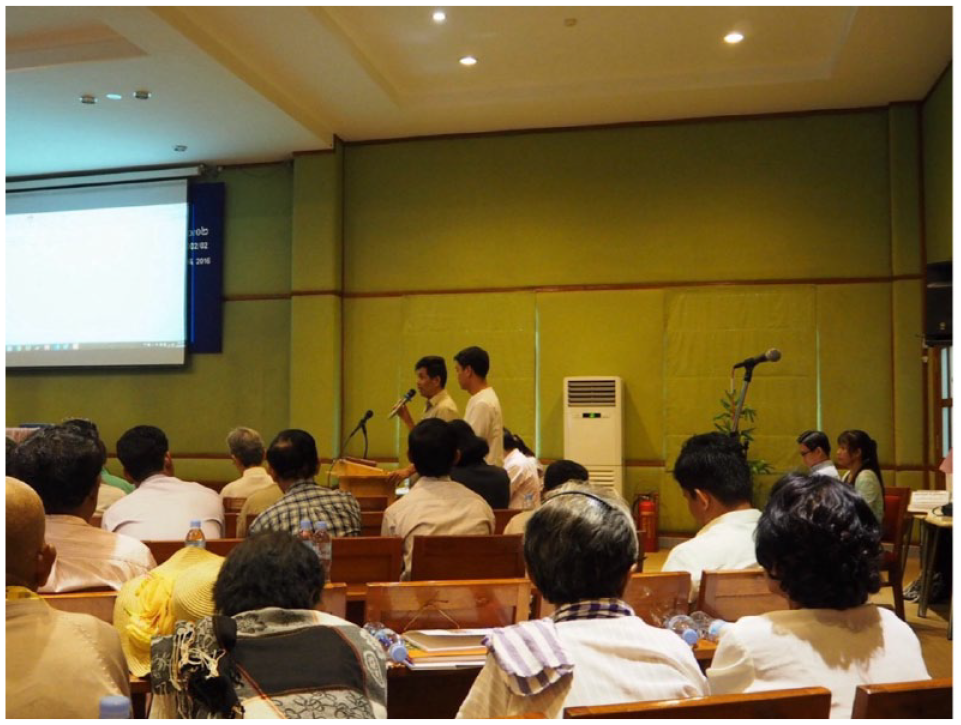
Composer Him Sophy speaks to an ECCC Civil Party Forum, December 2016, Phnom Penh (photo by author).
My research approach comprised key-player interviews and observation of live and recorded performances, including various audiovisual recordings of the Requiem in development. 10 In Phnom Penh during a 2016–2017 fieldwork period, I interviewed the work’s librettist, the Executive Director of CLA, a CLA Executive Assistant and a CLA board member. In Melbourne for the Bangsokol premiere, I organised, chaired and recorded a public panel of three speakers, one of whom was Panh. I attended the two 2017 Melbourne Festival performances of the Requiem and the post-premiere speeches and after party. The music of the Requiem was released as an album in 2022, which has provided repeat listening opportunities. 11
Rest and ritual
After 9 years in development, the world premiere of the Requiem drew hundreds of people into the warm glow of Melbourne’s most prestigious concert hall (see Figure 2). In the foyer, there was excited talk and high anticipation on the part of families, academics, critics, dignitaries, students, and local performers. Prior public events had built expectations in both academic and creative arts circles, and significant community outreach by CLA and Melbourne Festival had brought many Cambodian Australians to the event. The performance was opened by a procession made up of monks, around 50 Cambodian Australian community members, and Bangsokol musicians. They walked single file into the lower level of the hall, down an aisle between seating areas, and up onto the left-hand side of the stage. Their bodies wound across the stage to leave a small object-offering at the front of the stage. After completing this small journey, the musicians took their places on stage and the community members walked off the right-hand side of the stage into a reserved seating area in the audience.
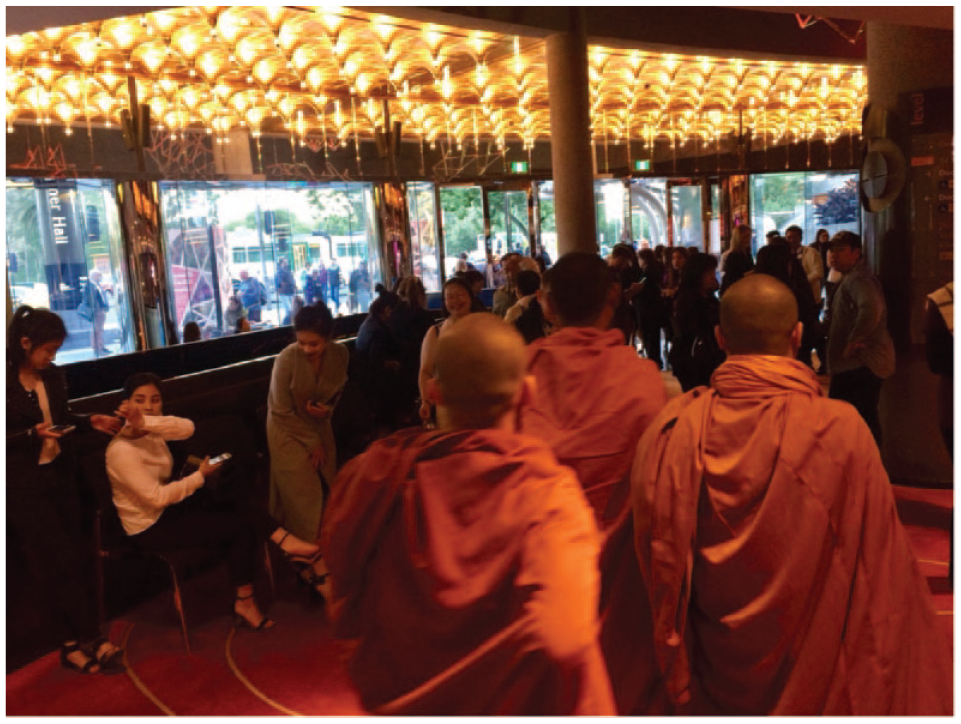
Khmer Buddhist monks in the foyer of Hamer Hall, Bangsokol premiere (photo by author).
In this carefully choreographed opening, the space of the temple was recalled by the quotidian giving of offerings. Traditionally, food and more elaborate gifts are presented to the monks during most Khmer Buddhist ceremonies. Even for an audience member entirely unaware of Khmer Buddhist practice, the solemn movement of bodies in procession would likely have been recognised as a sanctifying ritual. As Leticia Robles-Moreno argues, ‘performing restored behaviour, especially in public and communal spaces, reminds people that they [too] have a body and can put it in motion, this having a transformative role in how the past is remembered’ (Robles-Moreno, 2023: 386). The involvement of audience members in an embodied performance that was artistic and yet also reminiscent of a Khmer Buddhist funeral, invited these performers to consciously remember lost loved ones (in some performances, community members carried portrait photographs of the dead). But Robles-Moreno also points to the ways in which ‘memories are tied to our bodily practices’ such that moving one’s body and witnessing others’ embodied movement may equally provoke involuntary remembering.
Meanwhile, audience members had been provided with a white cloth neatly folded over each seat back, which the ushers encouraged us to wrap around our shoulders (see Figure 3). A small, printed card on each seat explained: How transient the elements of life! Their nature is just to arise and pass away. Although it was not stated on the card, the white cloth symbolised the shroud in which the dead are wrapped, and which is unwrapped during a traditional Khmer Buddhist Bangsokol ceremony. In his recent study of Khmer Buddhism, Erik Davis argues for the centrality of the Bangsokol ceremony to the religious and social authority of monks in Cambodian society. By virtue of their proximity to death, their acceptance of the ‘gift’ of the shroud from the family of the deceased, and their ability to attend and assist the dead to a better re-birth through ritual chanting, monks gain the authority that Davis terms ‘deathpower’ (Davis, 2016: 134). This is consistent with an ideology in which:
renunciants [accept] a ritual and social ‘death’ for their ordination and the shaved-headed, orange-clad ascetic as socially dead, and thus prepared as a corpse (Davis, 2016: 140).
Untroubled by death, monks may wash, dye and re-purpose the shroud as a part of their robes. Davis also argues that the patchworking of shrouds into workable robes, a practice of seaming sections of fabric together, connects symbolically and materially to the foundational agricultural practice of binding water into fields for rice cultivation. The forces of water, life and fertility, and the related forces of decay, death and re-birth, intimately link family, farmer, lay attendant, monk, nun, buffalo, rice plant, the dead and spirits. The material and energetic connections of Cambodian lifeworlds illustrate what Grosz (in Yusoff et al. 2012) describes as:
[t]he encounter of life with a world [which] produces an intensity that leads to attraction, pleasure, art, which themselves are capitalisable by other kinds of forces, religious forces and economic forces in particular (p. 987).
The religious system of Khmer Buddhism can be understood in this frame as capturing – capitalising on – the intensities of the already artful encounter between life and world.
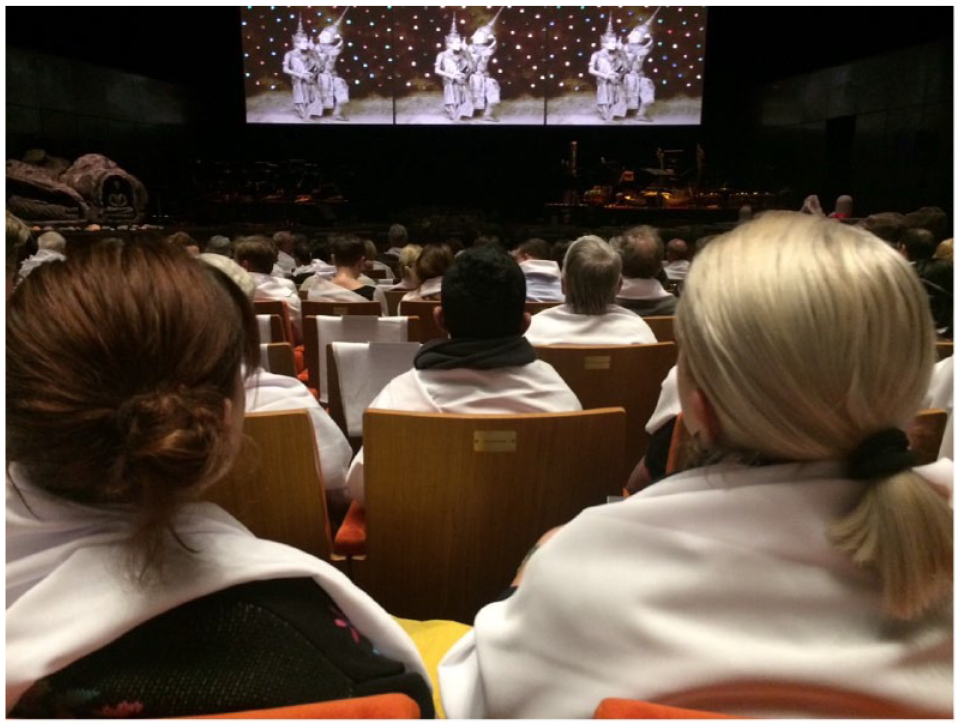
Audience members wrapped in ‘shrouds’ at the Bangsokol premiere (photo by author).
Bangsokol was not simply a Cambodian Buddhist ritual put on stage. As librettist Walker (2017) wrote in the production notes, it was also:
a specific response to the immeasurable loss of life and dignity under the Khmer Rouge (1975–1979) and an artistic monument to the memory and memorializing of Cambodians mourning these losses since 1979 (unpublished).
In contrast to what Lea David has diagnosed as ‘standardised memorialisation policies, rooted in the notion of universal human rights’ (David, 2017; see also Kidron, 2020), Bangsokol emphasises suffering, interconnectedness, impermanence, and death. It calls upon the living to acknowledge the limits of human agency:
The arc of the libretto is important [. . .] it begins [. . .] by recognising that things are impermanent, that suffering is difficult to avoid, that death is the end of every living being. But also that our ignorance, our anger, our greed, continue to drive the cycle of suffering in the world, and if we can release some of [this] then we can move to a place of peace [. . .] (Walker, 2017: unpublished).
In the performance, this arc begins with an appeal to the gods, before invoking a countryside funeral that extends into a remembrance of the specific horrors of the Khmer Rouge period. In the third movement, the acceptance of impermanence and the path to peace emerges from metta (loving kindness), as the Bangsokol ceremony gives solace to the dead and helps the living to heal (Walker, 2017: unpublished). The performance closes with a celebratory and inclusive drumming dance performance known as chayam. To Cambodian ears, the composition and libretto likely offered a novel weaving together of words, phrases, chant forms, poems, and melodies drawn from familiar rituals and ceremonies. It also contains aural mnemonics for the ‘Pol Pot times’, including strains of the national anthem of the Khmer Rouge state of Democratic Kampuchea (Spotify Album track 4 at 3:55).
For Walker, Bangsokol in these ways acknowledges the composite nature of all Khmer Buddhist ritual and remembers and honours the ritual practices that Cambodians have been engaged in during the 40 years since the end of Khmer Rouge rule:
Khmer Buddhist rituals are always composites; they are woven together from many threads: texts, sounds, objects, and people. Indeed, for any Khmer ceremony, you cannot find a single person who can explain every step involved. The monks have their role, the lay ritual specialists theirs, the laywomen theirs, and so forth. The ritual is not complete if it is missing any of these roles (Walker, 2017).
These practices – ceremonies that honour the dead – are often overlooked in contemporary scholarly and ‘dark tourism’ accounts of Cambodia which emphasise sites and stories that are understood to be unmediated or unresolved. Tourists to Cambodia’s national genocide museum, for example, appear to desire to be haunted (Hughes, 2008). Sometimes this desire is underpinned by an Orientalist mind-set that sees Cambodia as economically and socially unresolved and enmired in continuing ‘cultures of violence’ (see Springer, 2009). Bangsokol implicitly addresses these imagined geographies of post-genocide Cambodia as a place of unrelenting trauma and unreconciled parties by staging extant ritual practice as everyday healing and by elevating these practices within a high art form.
Bangsokol acknowledges the need for rest and nourishment for wandering spirits and their living relatives. As Davis (after Shulman) argues, practices of material and symbolic binding and unbinding lie at the heart of most Khmer Buddhist ceremonies (Davis, 2016: 138). In the case of Bangsokol, the shroud that has bound the body after death is physically removed by the monks, leaving the body unbound and the spirit transferred away from the body. As Davis also sets out, in one sense the spirit moves into the shroud itself, only to be re-corralled by the monks in their repurposing of the cloth as a part of their robes. In another sense, the spirits move into the realm of re-birth by virtue of the monks’ chanting. Where this sending on occurs is important and specific. Although the spirit has moved to another realm, it retains a relationship to the place where it received Bangsokol that works like a kind of metaphysical tether.
The temple or area where a Bangsokol ceremony takes place is also where ancestors can be found and fed during the festival of the ancestors, pchum ben. Ancestors become hungry, wandering souls over this brief period in the rainy season, but those properly put to rest know where to meet their families and so can be nourished. Many who died during the Khmer Rouge period did not receive Bangsokol and this becomes problematic at pchum ben. The souls of these dead have no tethering, their families are obliged to feed them but know not where to do so. The Khmer Rouge made ‘forced transfers’ of the population, including an initial emptying of the cities in 1975 that sent the urban population to work in agricultural and forested areas. Many families were separated, and the whereabouts of family members who died often remain unknown. The disappeared and unhappy dead are increasingly recognised as important agents in the lives of the living in Cambodia, and in other post-conflict nations in Asia (see Bennett, 2018; Guillou, 2012; Kent, 2024a, 2024b; Leong, 2023).
For those who left Cambodia after 1979, this situation produces additional challenges. Reflecting on the living, and particularly women dancers, Toni Shapiro-Phim (2008: 57) describes a ‘negotiation of the contemporary clouded divide between “here” and “there”’. Khatharya Um (2015) writes that for many exiles ‘it is not the past but the present, not the “there” but the “here” that is ephemeral’ (p. 252). While the living may physically move across or negotiate this divide, ancestors remain in place in Cambodia, or indeed without a place, and so pchum ben may generate an impossible demand of transnational return. Temples are found in diasporic communities, and some wealthier overseas Khmer support temples in Cambodia from afar, but many lack the economic means to meet more specific ritual demands. The Requiem offered Bangsokol to these scattered and untethered dead.
In addition to providing a ritual of rest and repair, the international tour of Bangsokol over 2017 and 2018 also sought to contribute to a moment of wider justice-seeking, cultural revival, and international visibility for Cambodians. This coincided with the culmination of much of the work of Cambodia’s internationalised criminal tribunal, the ECCC. The tribunal had retributive, reparative and procedural justice intentions. In the next section I suggest that, while not a formal reparation of the tribunal, the Requiem is reparative in a broader sense. Like the ECCC trials, the Requiem acknowledged and drew on the experiences and creative energies of the Cambodian diaspora. It enacted a kind of re-imaging and reconnection – across national borders and generations – of histories and communities. Yet it did so in ways that challenged the dominant periodisation of the ‘Khmer Rouge regime’, usually limited to the years 1975–1979, and fixed subject positions related to the regime.
Re-imaging
Bangsokol is a significantly visual work. Above the choir at the rear of the stage, still and moving images were projected in a triptych (three-panel) form. As discussed below, these projections added to the immediate experience of the performance. They also augmented the visual archive of public ‘memories’ of the genocide and emphasised how Khmer Rouge rule was multifaceted and has had continuing effects. Even as the projections returned to the most iconic sites and film sequences of Khmer Rouge trauma, it showed these sites as they are now, acknowledging the changes brought by decades of memorialisation:
Three moons repeat across three panels/ the Independence Monument (in two panels we approach the monument, in the middle panel it retreats)/ black-and-white Khmer Rouge-era propaganda film of hundreds of tiny figures criss-crossing the rubble of a construction site / footage framed by the open back hatch of a B-52 bomber flying low over fields and wooden houses as bombs are seen falling from the plane, exploding on impact, causing white and red explosions and black smoke against a green landscape (author, performance notes).
These projections were often disconcerting since their explicit or implied violence was set against the pleasing sounds of an orchestral score. They also troubled dominant or major historical and legal periodisations given for the regime, with footage showing events, people and suffering before, immediately after and long after the regime.
Spatially too, the images opened new sites for public debate and consideration as sites of repression and harm. For example, moving footage shot from the front of a travelling train was shown. For many non-Cambodians this was likely their first awareness of Cambodia’s rail system as having been used for the forced transfer of people. As the ECCC trials established, long after the first forced transfer that emptied Cambodia’s cities and major towns, many Cambodians were subjected to further phases of forced transfer. As Savina Sirik (2014) writes:
People were repeatedly and forcibly moved from one place to another – from their place of birth to a different zone and from one cooperative to another. [. . .] People were transported on foot as well as by boat, truck, train, and oxcart.
The lonely sounds of a train carriage rocking over tracks were a rare moment of synchronicity between sound and image and heightened affective engagement. In another series of projections, Panh incorporated images produced by humanitarian organisations in the post-regime refugee camps. These images press the point that the suffering caused by the Khmer Rouge continued beyond Cambodia’s borders. As well as these spaces being meaningful to many in the diaspora (who would have experienced them firsthand), they also reference the spiritual limbo of the wandering souls for whom the Requiem seeks rest.
Last, Panh included timeless, dream-like sequences of figures in procession, and an autobiographical section of film in which Panh seems to follow a younger version of himself across a landscape. These are Panh’s ‘missing pictures’, forceful yet fleeting images that exist in memory or in dreams and that demand to be visualised. Panh has spoken publicly of these demands, observing that he makes essentially the same film repeatedly, almost ritualistically. In Melbourne for the premiere, he responded publicly to my question about his experience of generating images for existing music (rather than images to which a soundtrack would later be added) by saying:
I want people to listen to [the] music first [. . .] [So] it’s like walking on the egg; it’s [a] very fragile thing [. . .] like a dialogue between me and the soul of the music, or the soul of the dead, dialogue, and images come [to me] little by little.
In making images in this highly sensitive way, Panh imagined the audiences of Bangsokol might be enabled to stay with the feeling of the music, and of this experience enacting a kind of revitalisation. In the context of talking about Cambodian Australian audiences attending Bangsokol he shared:
When you talk about [historical] genocide or massacre, it’s not only [about the] killing. It’s [being] dead inside. I’m dead. In fact, I try to live, but I’m dead already. And I just don’t want the next generation to be dead [too].
This stark response was articulated in relation to the next generation and diasporic communities; in another interview Panh voiced a hope that Bangsokol would leave audiences with ‘a fighting spirit’. 12 It is to themes of hard-fought repair and reconnection in the diaspora, and to Bangsokol as a diasporic and deterritorialising work, that I now turn.
Repair and diasporic reconnection
Composer Him Sophy’s professional and creative skill arises from his diasporic lived experiences – including his years as a student in the former Union of Soviet Socialist Republics, his return to Cambodia and his travel to other places. After the end of Khmer Rouge rule, Cambodia became a new socialist state known (but not recognised internationally) as the People’s Republic of Kampuchea (PRK). The PRK supported many young Cambodians to travel and study throughout the socialist world. As one of a small number of musicians to survive the Khmer Rouge regime, Him was supported to attend the prestigious Moscow State Tchaikovsky Institute, where he stayed for nearly 14 years (Him interview 2017). His musicological and compositional skills were developed in Moscow during his study and doctoral research (Him and Petocz, 2020), after which time he returned to Cambodia.
The commissioning organisation for Bangsokol – and supporter of Him’s earlier rock opera Where Elephants Weep – also emerges from diaspora experiences and real and imagined composites and returns. CLA founder, Arn Chorn-Pond, was a young child orphaned during the Khmer Rouge regime. Chorn-Pond survived because he quickly learned to play musical instruments and revolutionary songs (Chorn-Pond, personal communication, 2019). Chorn-Pond was later adopted by a member of the United States Peace Corp and emigrated to the United States in 1980. On a return visit to Cambodia in the late-1990s, Chorn-Pond reconnected with a former musical Master and established the Cambodian Master Performer Project, which later evolved into CLA. The organisation retains this diasporic nature, for example, the current Executive Director of CLA, Phloeun Prim, was born in the Cambodian American diaspora, and the organisation is supported by donors and philanthropists worldwide. CLA’s mission is diverse and includes research and cultural salvage operations in Cambodian villages, the Cambodian national touring company The Khmer Magic Music Bus, international workshops, and global productions such as Bangsokol.
Arising in part from its time and from the capacities of those physically, spiritually, or creatively deterritorialised in the conflict and post-conflict era, Bangsokol is a thoroughly modern musical work. Ronald Bogue (2013), following Deleuze and Guattari, schematises modern music as characterised by ‘passage components’. The predominance of these components can be contrasted with the ‘directional components’ and ‘dimensional components’ of Classical and Romantic musical forms, respectively. Passage components, creative deterritorialisations, allow for subsequent reterritorialisations that are at once musical and political. Where Bogue’s example is John Cage’s experimental improvisational modern compositions, in the case of Bangsokol, Him’s experiments are between Cambodian and Western musical forms, including what he describes as ‘the singers sing[ing] without the beat, [where] the orchestra has to follow the singers’. These parts of the composition are taken from the tradition of smot, which the composer explains ‘is sung according to the emotion blended with the talent of the smot singers’ (Him interview 2017).
13
The vocalist Chhorn Sam Ath concurred:
When we perform, we want our audience and the world to know about our feeling which we connect to the performance. We concentrate our energy to help free the souls who tragically died through our performance for this Requiem (Chhorn interview 2018).
Librettist Walker also included the rarer funereal form of kontoamming
14
in Bangsokol, a form in which familiar melodies that are drawn from other ceremonies (even weddings) but are played in a ‘purposely disjointed manner’ and are meaningful precisely because they are ‘out of step with one another’:
Kontoamming is a very haunting sound for a funeral and when it is performed with words, the words are [. . .] often more like lullabies. So sometimes this music is described as a lullaby for the end of life (Walker, personal communication, 2017).
Kontoamming might be thought of as ‘emitting [. . .] interruptive signs, triggering the cues that attune bodies while activating their capacities differently’ (McKim and Massumi, 2015: 58). If micropolitics, affective politics, seeks the degree of openness in any situation in the hope of priming an alter-accomplishment (McKim and Massumi, 2015: 58), then the interruptive capacities of Bangsokol comprised a kind of invitation to a more auspicious reterritorialisation of souls, memories, thoughts, and connections. Acknowledging moment-to-moment processes of becoming in concert – micropolitical processes of subjectivisation – an experience of Bangsokol put pay to singular and fixed subject positions such as victim, survivor, Cambodian, non-Cambodian, refugee, artist, musician, audience member, observer, performer.
As an affective experience, Bangsokol was generative, producing forceful intensities and sensations in the bodies it enrolled. While Grosz acknowledges that ‘music cannot be considered universal or culturally unmediated’, she also writes that:
[o]f all the arts, music is the most immediately moving, the most visceral and contagious in its effects, the form that requires the least formal or musical education [. . .] for appreciation [. . .] (Grosz, 2008: 29).
Bangsokol principal artist Panh spoke in a panel interview about how a simple pop tune became a refrain that provided him with an intimate territory of calm within his otherwise harmful experience of Khmer Rouge rule:
It’s very important to go deep inside of you and to take something very precious, it can be a song, it can be a smile [. . .] it’s [an] action like art [. . .] you imagine it. [. . .] sometimes [during the regime] I [took] the Bee Gees song, I just adapt it and put [my own] word[s] on this tune (Panh, personal communication, 2017).
CLA founder, Arn Chorn-Pond, further explained how music can viscerally reconstitute a peaceful, social space for those who share an experience of war:
Music [is] sort of the reverse of [a] bomb. The bomb blew them away [. . .] disembowelled them [. . .]. Music then calm people down. Brings people [to] come back together, it’s like [a] slow motion reverse. Bring people down and sitting with each other and smile and play music and be able to connect through music (Chorn-Pond, personal communication, 2019).
In these (inter)personal accounts, a simple tune generates a refuge, and music establishes a home, a known territory, a meeting place of calm and repair.
While not a recognised reparation of the ECCC, Bangsokol nonetheless emerged from the same period and locales as the tribunal and shared in the reparative intent of the court’s formal measures. Like the Paris and Phnom Penh memorials discussed above, the Requiem arose in part out of a desire to remember and honour those killed or harmed by the regime. Bangsokol gives voice to experiences and harm caused by the regime, including those of the post-conflict diaspora, but not so directly as the testimonies and reparation project efforts of local and overseas Cambodians at the ECCC. As Amanda Rogers has recently argued, contemporary art works need not resort to performative formats such as the testimony-witnessing dialectic for their power and effect (Rogers, 2022: 162; see also Kennedy, 2018). Recognisable performative gestures can be seen in the Requiem, such as that of intergenerational learning and dialogue, an oft-stated priority of restorative justice. In final moments of Bangsokol, for example, two children joined the performers on stage, where they were briefly tutored in Khmer dance movements. This symbolised intergenerational, embodied cultural knowledge transfer of the kind suppressed under the Khmer Rouge. Overall, however, Bangsokol is most powerfully reparative beyond these more obvious representations. Like Rithy’s new images and some contemporary Cambodian dance, the Requiem took ‘a step sideways’, eschewing testimony and other didactic forms, to ‘create new, parallel histories for the future’ (Rogers, 2022: 162, 173).
Conclusion
This article has sought to mobilise the concept of memory activation and foreground the affective intensities of art as a contribution to discussions of the role of art in memory, transitional justice and international criminal justice. In the case of Bangsokol, two affordances of memory activation can be discerned. First, in an atomised present, Bangsokol provided an experience of shared affective intensity. This shared experience saw the ‘summoning and directing [of] fears and pleasures onto the plane of music’ Grosz (in Yusoff et al. 2012: 58). The performance oscillated between the skin-pricking pin, 15 soaring solo voice virtuosity and grounding, heavy, meditative chant. At all times, two significantly different musical traditions were in respectful and easeful dialogue. 16 The intriguing timbre and syncopation of the Cambodian instruments were sometimes heard in isolation, while at other times they punctuated the swell and fall of a larger symphonic tide. From this complex blending a kind of euphoria emerged, one that joined the space of the concert hall to imagined geographies of home and abroad, the bodies of performers, objects, gestures, images and sounds. This affective activation is a kind of shared memory activism that is powerfully felt but remains largely un-authored, un-formed and un-thought. In this and other ways, Bangsokol minored the memorialisation rooted in universalising human rights discourses.
Second, and building on this shared affective intensity, Bangsokol invited different participants into new relations with being ‘out of place’. This occurred on various levels. As a piece of modern music, the passage components of Bangsokol echoed a modernity marked not only by musical experimentation but also by unprecedented mass violence, physical deterritorialisation and diasporic scatterings. The production was also deliberately and dedicatedly transnational, spanning 3 years, four cities and three continents, before returning to Cambodia in 2019 to mark the 40th anniversary of the end of Khmer Rouge rule. More than simply touching down in each of these locations, each Bangsokol performance was constituted of that place, as it enrolled musicians and community members who were local to each city. In this way, the work was translocal as well as transnational, and it even addressed locales beyond those of the living, places where wandering spirits wait. In enchanting and soothing living bodies, it invited new capacities of response to extant feelings and politics of being ‘out of place’. As the audience drained from the hall in Melbourne, many of us shared a sampeah, a traditional salutation of bowed head with palms pressed to heart, and a smile of thanks. Organisers and artists had sought the engagement of Cambodian Australians beyond simple participation and, as the composer himself later wrote, ‘the response was strong’ (Him and Petocz, 2020).
Footnotes
Acknowledgements
Sincere thanks all those who gave their time to be interviewed about Bangsokol. Thanks also to Aviva Ziegler and Margaret Murphy for their film, and for sharing materials and interviews of its making. The kernel of this article was presented to the inaugural MemoryHub@ANU workshop at the Australian National University, where organisers and co-participants gave valuable feedback. Finally, thanks are due to Kai Brennert, Phloeun Prim, the Bunsen Burners, the Melbourne Micropolitics Reading Group, Kynan Hughes, Cynthia Hughes, the special issue editors – Lia Kent, Rosanne Kennedy and Shameen Black – and an anonymous reviewer, for their expert and generous suggestions on the penultimate version.
Funding
The author(s) disclosed receipt of the following financial support for the research, authorship and/or publication of this article: This research was funded by Australian Research Council Grant DE160100501.
