




Abstract
This article examines how young women conceptualize memories within their language use. Through a microanalysis of how the term ‘memories’ and related expressions are mobilized by participants in interviews and digital traces shared on platforms, the study offers insight into everyday articulations of memory. The term ‘memories’ not only denotes the selective reconstruction of the past in the present but also signals how certain experiences, moments and feelings are assessed as worth remembering. Talking about ‘memories’ becomes a way for young women to signify and anticipate the value of experience in the present and future. In making this argument, the article contributes to existing debates on metaphors of memory and the production of memories through mediated objects by demonstrating how mnemonic language is reconfigured within digital culture.
Introduction
The global Covid-19 pandemic, associated lockdowns and social distancing restrictions altered everyday rhythms of living, working and socializing. This included the practices of sharing and remembering on social media platforms. Reflecting on the experience of lockdown in the United Kingdom in May 2020, in a research interview, one of my participants noted ‘we’re looking more at capturing moments and trying to create memories’. Within this statement, not only does she position the role of sharing in a time of change, but her use of the term ‘memories’ also exemplifies a conceptualization of memory. Articulating a desire to ‘create memories’ situates memories as a prospective experience. It diverges from an academic understanding of memories as active (re)constructions of the past in the present. Instead, she suggests that memories are particular types of experiences that should be sought after.
Drawing on interview data and digital traces shared by young women on Instagram in 2020, this article unpacks how the use of such mnemonic language reveals conceptualizations of memories in relation to social media platforms specifically. I use mnemonic language to refer to the use of the term ‘memories’ as well as words and phrases that rely on concepts, practices and processes of memory. Social media platforms including Instagram mobilize mnemonic language, exemplified by the ‘On This Day’ feature that resurfaces previously shared digital traces as ‘memories’ for users. Similar to how the terms ‘sharing’, ‘friending’ and ‘liking’ are ascribed with techno-economic meanings in the social media context (van Dijck, 2013), the meaning of ‘memories’ is inscribed in the platform. While research in digital memory studies has critically interrogated this articulation of ‘memories’ (see Jacobsen and Beer, 2021; Prey and Smit, 2019; Robards, 2014), I propose turning to everyday narratives, in which the term ‘memories’ is deployed by people to make sense of their social media practices, for insight into how meanings of ‘memories’ are accepted, contested and negotiated by young women.
The microanalysis of narratives in which participants mobilize mnemonic language builds on the long-standing interest in how media-based metaphors of memory are embedded with assumptions about how memory operates (Assmann, 2011; Brockmeier, 2015; Draaisma, 2000; Erll, 2011; Hoskins, 2011; Neisser, 2008) within the context of social media platforms and sharing practices. First, I examine how the abbreviated term ‘memz’ connotes a positive assessment of past experiences. Second, I focus on three mnemonic metaphors (‘vault of memories’, ‘time capsule’ and ‘memory bank’) applied to Instagram, considering how the label ‘memories’ is restricted to experiences that should be remembered according to social norms. Third, I consider how ‘memories’ are part of the justification of sharing practices. Fourth, I address the assumptions underlying the desire to make ‘memories’ as an orientation towards a cultural classification of experiences with perceived value. Across these interconnected themes, I demonstrate how a shared understanding of ‘memories’ among young women holds currency in their interactions and sense-making processes on and about Instagram.
Articulations of memories in digital memory studies
Resonating with how the terms in the social media context refer to human forms of interaction and socializing, as well as automated connections between nonhuman objects (van Dijck, 2013), ‘memories’ takes on techno-economic meanings on platforms. The ‘On This Day’ feature, launched in March 2015 on Facebook and adopted by Instagram in 2019, algorithmically resurfaces ‘memories’ for users. The label is attached to selected content shared on the same day in previous years. This digital anniversary mechanism echoes traditional public commemorative practices, in which the marking of dates ‘offer[s] the chance to bring a historic event back into the present’, usually as part of constructing national memory (Assmann, 2021: 14). By using the anniversary mechanism in the feature, platforms continue to entrench annual rhythms, with the temporal structure of the year functioning as a social marker for remembrance.
The resurfacing is based on algorithmic anticipation of what users want to re-engage with. In other words, there is an ontological promotion of certain content as ‘memories’. Jacobsen and Beer (2021) identify how a pre-existing classificatory framework of what is memorable underpins the relevant algorithms. Machine learning software situates a user’s digital traces in the taxonomy and determines the meaningfulness of ‘memories’ for them. These processes assume that memories can be ‘quantified, classified, ranked, predicted and ultimately, targeted at users’ (Jacobsen and Beer, 2021: 46) asserting for users what is ‘worthy of our reflection’ (Prey and Smit, 2019: 220). Thus, the meaning of ‘memories’ as inscribed by platforms is centred on the promotion of positive past content and cueing users to engage in happy remembering.
Outside of this articulation of ‘memories’ by platforms, digital memory scholars have considered how the sharing and automatic archiving of digital traces is part of memory-making. Hoskins (2011) refers to social media as generating ‘a continuous, accumulating dormant memory’ (p. 26), which is constructed on-the-fly. This is picked up by Drakopoulou (2017) with the practice of geotagging images on platforms. As soon as an image is shared, it ‘becomes past and a memory’ with the geotag functioning as a memory tag (Drakopoulou, 2017: 7). Within this work, an archival model of memory is alluded to. This metaphor of memory assumes that experience can be encoded, stored within a structure and then retrieved, and is influenced by the development of media technologies over time (Assmann, 2011; Brockmeier, 2015; Draaisma, 2000).
Metaphors of memory based on media forms have been critiqued as inadequately capturing the experience of remembering (Brockmeier, 2015; Pickering and Keightley, 2015). The assumption that memory can be accessed through stored representations of experience conceals the fluidity of memory in which the past is reconstructed. Synthesizing earlier work on memory, Erll (2011) proposes that memories are ‘subjective, highly selective reconstructions, dependent on the situation in which they are recalled’ (p. 8). In line with this understanding, scholars make a distinction between mediated objects playing a role in prompting and shaping remembering and offering direct access to memories. Following Barthes’ (1981) assertion that photographs are not memories, van Dijck (2007) argues that photographs are ‘mediated building blocks that we mold in the process of remembering’ (p. 24). Extending this to digital technologies, I argue that the claim made by the platform that digital traces are ‘memories’ must be treated with caution. Rather, the digital traces shared and stored on platforms have the potential to play a role in remembering.
There is limited research that considers how understandings of memory are mobilized within everyday interactions through the experiences and perspectives of people. Pickering and Keightley (2015) noted the tendency for photographs to be treated as forms of external memory. Similarly, Van House (2011) found that middle-class American photographers perceived photographs as durable and infallible compared to their human memory, seeking to offload memories to their photographic archives. Drawing on focus groups with young people in the United Kingdom on memory and mobile phones, Garde-Hansen (2011) proposed that memory was understood as tangible: ‘they capture it, archive it, hold it, carry it around, play with it’ (p. 140). These studies indicate a perception of memory in which there is a conflation between the representation and memories of the past. While this obfuscates how memories are reconstructed and shaped by the conditions of the present, it indicates how individuals position their mediated objects, which has implications for their media and memory practices. This also becomes consequential when considering how digital traces are labelled as ‘memories’ by platforms as briefly flagged in focus groups with users of memory products. Jacobsen and Beer (2021) identified how people at times experience a mismatch between their understanding of memories and what the platform promoted as ‘worthwhile of the label memory’ (pp. 4–5). However, this restricts the discussion of meanings of memory to how individuals respond to and receive ‘On This Day memories’. As such, dialectical processes in which individuals classify and rank the past and use the term ‘memories’ within and beyond the context of the platform are left underexamined.
Methodological approach
By examining how young women use the term ‘memories’ and related expressions in the context of Instagram, I contribute to a gap within digital memory studies concerning the conceptualization of memories (including the platform’s ‘memories’) by people in everyday settings. I propose that the use of mnemonic language in narratives can reveal taken-for-granted assumptions about the relationship between memory and platforms, as well as how metaphors of memory are mobilized in the social media context. Selecting young women as the group under investigation offers an alternative perspective on the gendered discourse on social media practices, in which the practices of young women, in particular, are trivialized and subject to moral panic (Dobson, 2015; Kanai, 2019). It also provides an opportunity to highlight how gendered subjectivities intersect with the performances of memory, which is largely absent in digital memory studies.
I draw on qualitative interviews and the digital traces of 16 young women (aged 18–21 years) living in London. Within the interviews, I employed the scroll back method inviting participants to narrate and co-analyse their digital traces as they navigated through their profiles (Robards and Lincoln, 2017). I followed each participant for 6 months on Instagram, capturing how they shared stories and posts and edited their profiles. In line with feminist scholarship, I draw on participants’ perspectives on their own experiences and practices, which is reflected in the dominance of interview data in the analysis. During the fieldwork period (December 2019–December 2020), the participants had to navigate the global Covid-19 pandemic and restrictions brought in to manage the spread of the virus. This cultural context shaped how participants engaged with Instagram, as will be discussed in the analysis below.
Within the analysis, I ‘zoom in’ on narratives in which participants use the term ‘memories’ and related expressions. This builds on the methodological approaches of Lohmeier and Pentzold (2014: 796) in their research on mediated memory work and Georgakopoulou (2016) in her small stories research. The close analysis of interview excerpts and digital traces is informed by the principle that narratives shape and are shaped by the context in which they are embedded. The study of narrative-in-context rather than narrative-as-text positions storytelling as a complex process of sense-making and pays attention to micro- and macro-levels (De Fina, 2021; De Fina and Georgakopoulou, 2008). In this article, stories are told by participants in two interactional contexts: research interviews and social media platforms. My analysis of Instagram posts and stories also uses analytical tools from small stories research (Georgakopoulou, 2016). As I have previously argued (Annabell, 2022), this framework can be applied to digital traces involving the past to understand how the performance of remembered experience is part of sharing-in-the-moment.
Labelling of positive (past) experiences
The term ‘memories’ is used by participants in relation to positive moments experienced in the past. For example, one of the Instagram posts that Arianna discusses during the scroll back interview includes a series of photos from across her freshers’ week
1
and is captioned ‘best memz w the best people’ and includes the smiling face with hearts emoji. When I ask about her use of ‘memz’, she indicates how an understanding of memories is entangled with the evaluation of experience: It just seems – It’s something – I don’t know. It’s like memz is like ‘aw memz’. It’s like kind of like jokey, like a fun thing. It’s like you’re not too serious like because to me obviously these are memories but they’re not, you know like, insane memories. We’re only going out. Whereas if it was something like a really, this sounds weird but, if it was like a memory that was like amazing, like say I’d won the lottery or something like that then I would be like, ok that’s a bad example but if something that really, really amazing happened to me, I would say memory probably. But because it was just us having fun, it’s like ‘aw memz’. Like it’s just more light-hearted and just yeah less serious. (Arianna, 18 years, 21 April 2020)
This excerpt opens with a series of incomplete sentences as Arianna struggles to define memz. First, she uses it within the phrase ‘aw memz’, locating this in everyday speech through her use of a jokey voice. It reinforces how the sentiment of ‘memz’ is core to its meaning. Second, she presents ‘memz’ as ‘jokey’, ‘fun’, ‘light-hearted’ and ‘not serious’, referring to experiences of ‘just us having fun’. The adverb ‘just’ contributes to the downplaying as Arianna contrasts ‘memz’ with ‘insane’ and ‘amazing’ memories, referring to instances in which ‘something really, really amazing happened to me’. Yet, she struggles to think of an example of what would constitute such a ‘memory’, acknowledging that winning the lottery was a ‘bad example’ to turn to. As such, she sets up that assessment and evaluation of experiences are part of how memories are conceptualized. She suggests that ‘memz’ is mobilized as an alternative to the loaded meaning of ‘memories’, which connotes a serious and impactful experience. When Arianna uses ‘memz’ in her caption, although she uses the superlative best to ascribe value to her freshers’ experience, she situates it within the classification of fun experiences.
Ava refers to ‘best mems’ in an Instagram Story (Figure 1), demonstrating how the abbreviated form of memories is also part of her language use on Instagram.
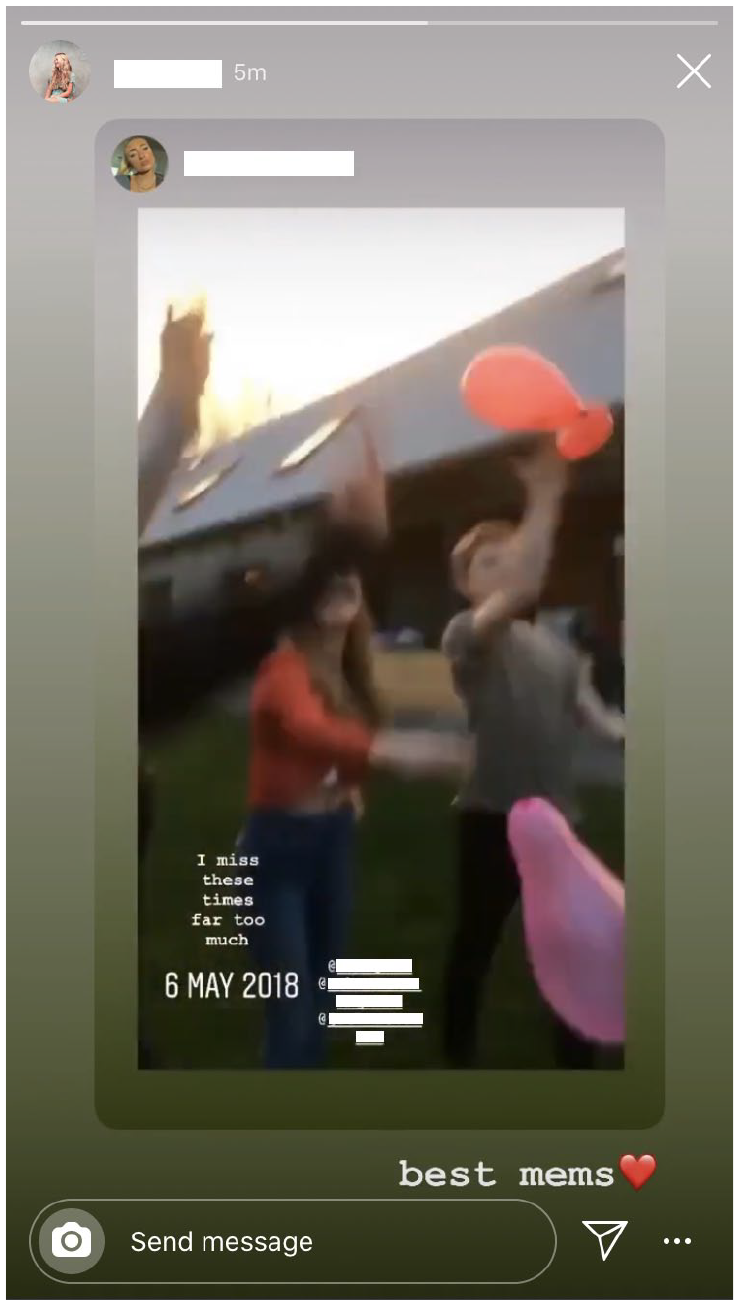
Instagram Story shared by Ava on 24 March 2020 from her friend’s story. The original story is a video with the written text ‘I miss these times far too much’ and the date stamp: 6 May 2018.
In the original story, Ava’s friend constructs a narrative involving the performance of remembered experience with the date stamp indicating when the video was captured. The deictic ‘these’, referring to the experience in the video, is used to position the digital trace as an example of fun occasions possible before the lockdown beginning in March 2020. Ava co-constructs the positive evaluation of the past using the superlative ‘best’ to emphasize the quality of this experience. Like Arianna, Ava labels a representation of a playful fun moment in the past as ‘mems’. While the video in Figure 1 is from 2018, Arianna shares ‘memz’ immediately following freshers’ week. Thus, there is a range of temporal distances between capturing the experience and understanding how this representation functions as a memory of it. It seems that the use of the abbreviated form ‘memz’ is due to the way that digital traces represent moments that fall within the shared classification of ‘memz’ regardless of how recently they were captured. This means that moments can potentially be understood as ‘memz’ immediately after they are experienced.
The selection of happy images and moments as ‘memz’ by Arianna and Ava is consequential in how it reproduces the logic of the platform that happy digital traces should be prioritized as ‘memories’ (Jacobsen and Beer, 2021) and expression of positive emotions (Wahl-Jorgensen, 2018). Such interpellation into happy remembering and performing by young women, I argue, is significant because it becomes another set of practices in which the postfeminist expectation directed at young women to display confidence, resilience and positivity as the ‘right feelings’ (Gill, 2017; Kanai, 2019) are reinforced. The networked interaction of Figure 1 exemplifies how identity and girlfriendship are performed and maintained through sharing and remembering happy images from the past. This is heightened within the Covid-19 lockdown context in which restrictions limited such experiences, fostering a sentimental longing for the past and increasing the circulation of mutual appreciation through sharing of ‘memz’.
Archival metaphors of memory
The term ‘memories’ is also part of the metaphors presented by participants about platforms. Indiana refers to ‘memories’ in her comparison of Instagram to storage spaces in our first interview: My Instagram feed is like this vault. It has become, in like the last two years, has become like this vault where I keep my memories and my pictures. It is just like this time capsule of memories. Um, to me like my Instagram has never been for anyone else. So, for me, my Instagram is a place for me to keep my memories and like be able to look back on it. (Indiana, 20 years, 14 April 2020)
Indiana uses the vault as the model for how she conceives of her Instagram, proposing that this function has developed through her use of the platform over time. She also adopts the metaphor of the time capsule. Both metaphors indicate how Indiana approaches her profile as a space that preserves and safeguards her stored digital traces. There is an assumption that what is shared are her ‘memories’, which aligns with the platform’s use of the term. Yet, Indiana, like many participants, indicates how it is the platform as a whole that is approached as a space for ‘memories’ rather than the specific feature of ‘On This Day’ where the platform mobilizes the term. Indiana also suggests that the storage metaphors of memory (Assmann, 2011; Brockmeier, 2015; Draaisma, 2000) continue to resonate within the digitally networked environment. Indeed, she indicates feelings of safety and security about her digital traces or ‘memories’ being stored there, which differs from a theoretical position. Hoskins (2017) argues that because memory objects are subject to algorithmic resurfacing and infrastructures beyond the control of the individual, the conventional understanding that externalizing memory brings stability and security is undermined.
The understanding the Instagram as a storage space for memories is also expressed by Chloe in Figure 2.
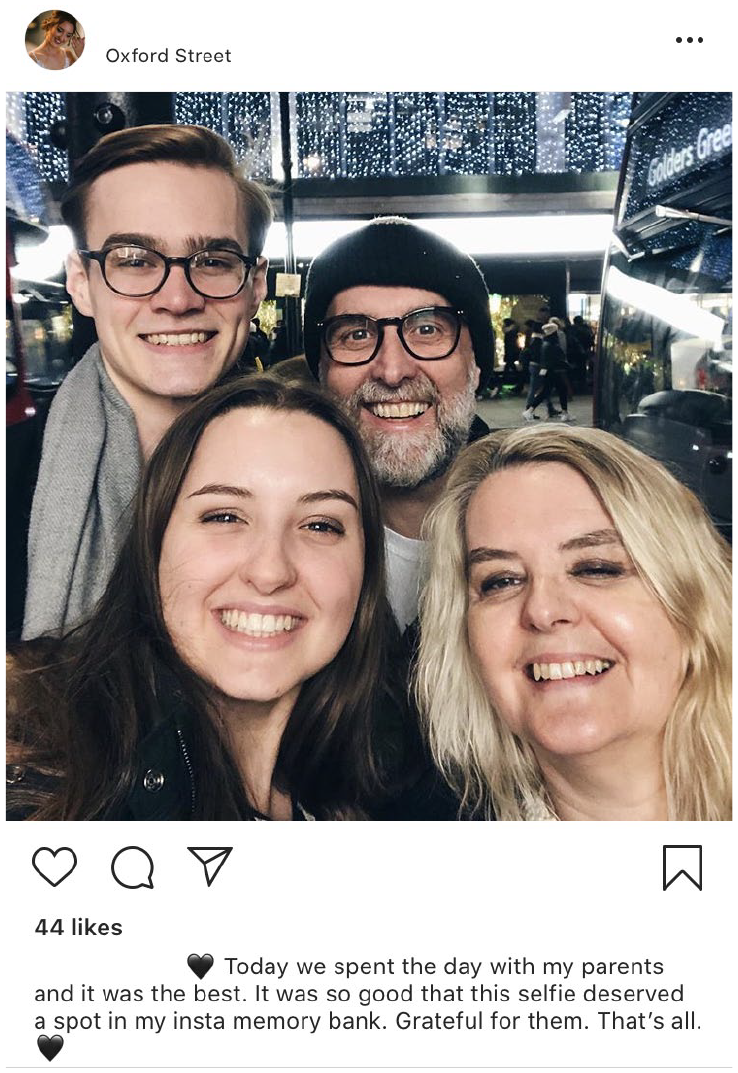
Instagram post shared by Chloe on 14 December 2019.
Within the caption, Chloe presents a narrative that reflects on the experience of spending the day with her parents. The temporal deictic ‘today’ anchors the telling to the recent past. By constructing her Instagram profile as a ‘memory bank’ and using the verb ‘deserved’, Chloe recapitulates how Instagram is a vault of memories, explicitly asserting the expectation for posts to act as representations of ‘best’ experiences. As was flagged in the previous section, evaluative terms (‘so good’ and ‘the best’) are used in relation to memories, indicating an expectation for moments to be assessed close to the time they are experienced. Furthermore, Chloe alludes to an entanglement of experiencing, sharing and remembering in which the act of sharing functions as a meaningful way to publicly mark how the day was the best and express gratitude towards the specified individuals, her parents.
The expectation that Instagram functions as a ‘vault of memories’ in which only some representations (of experiences) deserve to be stored is also evident in Indiana’s practices. Indiana created a finsta between our first and second interviews on 23 May 2020 during the first lockdown. A finsta is a secondary Instagram account, which is often considered more personal because it is followed by a smaller group of users. Although the word finsta is a conflation of the words fake and Insta, fake does not refer to the nature of content but underscores how this account is not the main (real) account. It is used by young people to ‘project a more “realistic” version of their daily lives’ (Duffy and Chan, 2019: 131). For women, the practice enables them to ‘break free’ from the gendered expectations and regulations that shape visibility and their performance of the self on their main account (Ross, 2019: 361). The experience of ideologies underpinning Instagram’s sharing culture is part of how Indiana describes her finsta in contrast to her main account: I just wanted a space where I could just like post and still like connect with my friends in that way but not have to like, not put stress on it, but like ruin like this space where all my like beautiful memories of like all this stuff us with like all of this random stuff that I just wanted to pile onto the internet. (Indiana, 20 years, 23 July 2020)
While Ross (2019) emphasizes the value of accruing likes, Indiana refers to the need for digital traces on Instagram to represent ‘beautiful memories’. She strongly asserts that digital traces shared during Covid-19 would ‘ruin’ her curated past but also identifies a need to have ‘space’ to share and connect. Extending Duffy and Chan’s (2019) argument that finstas are used as a form of boundary work, Indiana uses her finsta to manage the boundaries of what constitutes her ‘memories’. For Indiana, representations of her experiences of lockdown during the global pandemic of Covid-19 are not deserving of the label memories. This is further reinforced by her use of the time capsule metaphor to describe her finsta, which differs from its deployment in the first interview, to describe her finsta but detaches it from memories: I think, it’s definitely going to be like a little time capsule from being locked down. And so maybe in a couple of years, I’ll look back at it, the beginning of my finsta and be like ‘oh that was what was going on’. But I really think it’s just somewhere where like, it doesn’t have to be a memory to like go online, if that makes sense, because yeah. It’s not necessarily stuff I wanna remember. It’s just stuff I wanna share in-the-moment that it’s like got probably like less of a shelf life on it. (Indiana, 20 years, 23 July 2020)
By using the future tense, Indiana anticipates her finsta functioning as a ‘time capsule’ of ‘what was going on’ during the pandemic. Despite expecting returning to these digital traces, this is a time capsule of ‘stuff’ not ‘memories’. She indicates how her understanding of memories is detached from the process of remembering and is instead centred on what ‘I wanna remember’. Thus, memories are moments and experiences she wishes to remember. This understanding contributes to her assessment that her finsta digital traces have ‘less of a shelf life’. By suggesting that she will not access these representations of her experience of Covid-19 long term, Indiana indicates these moments fall outside of her personal and social expectation to engage in remembering happy past moments and reinforces how negative memories should not appear on Instagram.
Posting for the memories
The conceptualization of memories as moments that should be remembered is also mobilized to justify sharing on platforms. A shared understanding emerges across interviews that the act of capturing a moment through photography and sharing can be conceived as a form of intentional memory-making. There is a recognition in-the-moment that an experience is worth remembering: When I post something, I don’t really think about what’s, like who’s going to like or who’s going to comment because it’s a memory for me and I don’t really put something on there to show that I’m doing something . . . I post it for my own enjoyment and memories, and this is what I’m doing. I don’t really expect much back from it. (Robin, 20 years, 29 May 2020)
Robin positions posting for memories in opposition to sharing for others and publicizing her experiences. She seems to pre-empt the cultural expectations that sharing is motivated by external validation and interpreted as a way to show off by repeatedly repudiating these motivations. The possessive adjective ‘own’ and the use of first-person and singular personal pronouns contribute to her emphasis on sharing as personal as she presents memories as the sole reason why she shares on Instagram. Robin’s understanding of ‘memories’ differs from Arianna’s use of ‘memz’, discussed earlier in which the exchange of moments from the past and celebration of shared memories is central to the interaction. Although the same public connective environment is being invoked by Robin, her use of ‘memories’ is directed towards the self and becomes a way for her to claim agency over sharing. Again, it relies on the intersection of individual and cultural assessments of what is worth remembering in-the-moment. Notably, Robin chooses to post happy experiences with friends and family, travels and adventures and enjoyable moments within the everyday routines ‘for the memory’.
Several participants similarly referred to ‘sharing for memories’ as a justification for their practices. This phrase reinforces John’s (2016) argument that the metaphor of sharing has been extended from digital artefacts like images and posts to fuzzier concepts such as ‘your life’ or in this instance ‘memories’. Not only is sharing a type of communication associated with positive social ties but the preposition ‘for’ indicates how ‘memories’ is a motivation underlying the practice. I argue the use of this phrase by participants suggests that ‘memories’ are positioned as a socially acceptable reason for sharing within the context of trivialization (Dobson, 2015; Kanai, 2019). Thus, Robin’s perspective can be situated within the history of memory-making using personal photography (Kuhn, 2002; Pickering and Keightley, 2015; Sarvas and Frohlich, 2011), which is reconfigured by the networked environment of peer surveillance. While photo albums also involve processes of capturing and selecting happy representations of life to construct an idealized version of the family ‘for the memory’, young women engage in these practices on social media platforms while navigating the expectations and feedback they receive from others.
Creating memories in-the-moment
The conceptualization of memories as experiences and moments that the individual wishes to remember also emerges in the phrase ‘creating memories’. The active making of memories in-the-moment does not rely on the reconstructive process of attributing meaning to the past. Instead, it reveals an assumption that certain moments, experiences and feelings are assessed as valuable and fall within a shared classification of moments that should be remembered. To return to the quotation in the introduction, Jada refers to memory-making as she reflects on why she has been sharing more over Covid-19: [In] this sort of strange situation we find ourselves in, I think we’re looking more at capturing moments and trying to create memories around this time, trying to turn that as positive as possible. Um, so I think that’s probably why it’s increased. (Jada, 19 years, 13 May 2020)
By asserting that she was ‘trying to create memories’ and for these to be ‘as positive as possible’, she suggests that intentional effort is required to ‘create memories’. Although any experience during Covid-19 could be remembered and reflected on as ‘memories’ of the time, Jada implies there are certain types of positive that constitute memories. Mikoski (2021) suggests that the experience of ‘noticing small, beautiful things’ (p. 5) is a contemplative practice of Covid-19. Jada takes it further by transforming the appreciation of moments into positive memories to be shared.
Chloe mobilizes ‘memories’ in a similar way through her digital traces from a lockdown doorstep photoshoot.
The photoshoot is positioned within Chloe’s caption in Figure 3 as a way to ‘help us remember these extraordinary times’ and as ‘memories to keep forever’ with the latter collapsing experiencing and remembering the moment. Chloe constructs the experience of Covid-19 as ‘extraordinary times’. This positive (re)framing of lockdown is reinforced through the selection of adjectives (cute, handsome, fun) to describe the experience of the photoshoot and images, which project a happy image of lockdown. It is these staged images, which are selected as memories to represent lockdown and return to in the future. They are assumed to function as a vehicle for remembering lockdown rather than the represented moment. Collectively, this points to a careful curation of how the present should look for remembering in the future.
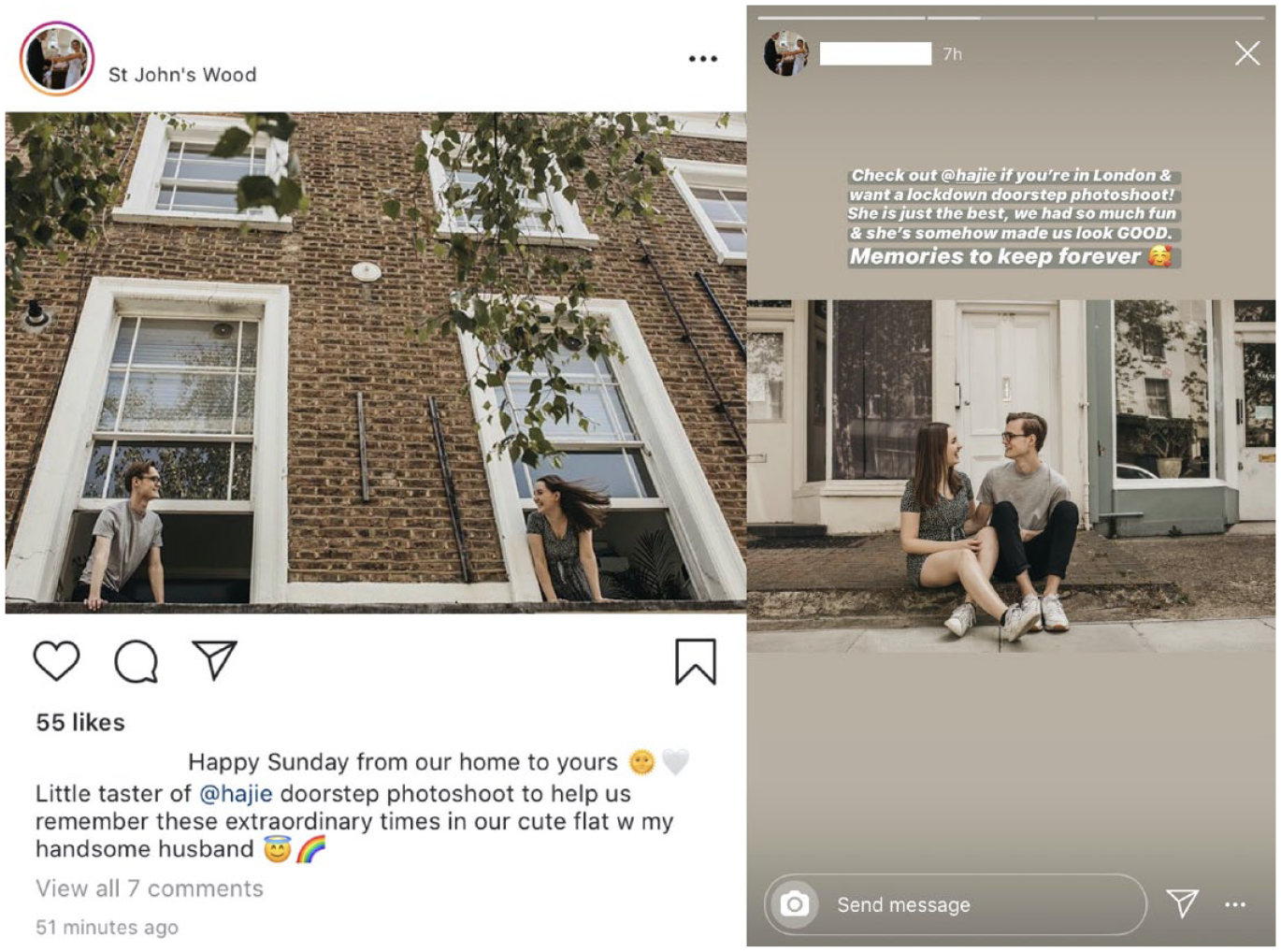
Instagram post and story shared by Chloe on 10 May 2020.
The understanding of ‘memories’ as referring only to moments worth remembering also emerges in Meredith’s reflection on her lack of sharing during Covid-19: I didn’t share a lot. But I wasn’t doing anything either so. Like, so I mean, this year, all I’ve done is I’ve finished my masters. And then I’ve been trying to, um, I’ve been suffering with a bit of chronic fatigue, which just kind of left me with like, no energy to do anything any day. So there wasn’t really much for me to share in terms of memories. Like there’s not, there weren’t many memories in real life that happened in order for me to share them. (Meredith, 21 years, 9 December 2020)
Meredith switches in this excerpt between referring to online sharing practices and offline lived experiences. She constructs a relationship between the two through her use of conjunctions in which sharing is expected to reflect and represent ‘real life’. Gerrard (2017) argues that the real/virtual and online/offline binaries were drawn upon by teens to position enactments of their fan identities as distinct from their offline lives. These categories remain meaningful. Meredith locates memories in ‘real life’. Her use of Instagram online re-affirms the status of a moment as a ‘memory’ offline.
Because memories are not reconstructions of the past in the present but a category of the ‘right’ type of experiences that should be remembered, Meredith can conclude that the absence of ‘memories’ (cause) has led to an absence of digital traces (effect). The reasons she presents for this, ‘I wasn’t doing anything’, ‘I’ve just finished my masters’, ‘I’ve been suffering with a bit of chronic fatigue’, indicate a narrow conceptualization of what constitutes meaningful experiences to remember and label as ‘memories’. Her provision of these justifications potentially alludes to an underlying pressure to be ‘creating memories’ in ‘real life’ even during a period marked by Covid-19.
Conclusion
This article engages with long-standing interests in memory studies concerning the term memory (Brockmeier, 2015), metaphors of memory (Assmann, 2011; Brockmeier, 2015; Draaisma, 2000; Erll, 2011; Hoskins, 2011; Neisser, 2008) and the performance of memories in relation to the production of mediated objects (Barthes, 1981; Erll, 2011; Kuhn, 2002; Lohmeier and Pentzold, 2014; Pickering and Keightley, 2015; van Dijck, 2007). It has been argued that understandings of memory are meaningful in how young women approach their social media practices as well as justify the personal value of sharing and counter the cultural expectation that sharing is enacted only for external validation. The term ‘memories’ and related expressions are part of how young women choose to describe their use of Instagram in interviews and perform aspects of their lives in the digital traces shared on the platform.
Looking closely at how young women use the term ‘memories’ in relation to sharing on social media platforms, I have indicated how articulations of memory are framed by what experiences, moments and feelings are assessed as worth remembering. The use of superlatives and evaluative adjectives within interviews and captions and the time capsule metaphor in relation and opposition to memories speak to a culture of consistently assessing and celebrating aspects of the past. This reinforces an infrastructural environment in which interaction and socializing hold technological and economic meanings (van Dijck, 2013) and the meaning of ‘memories’ is entangled with algorithmic classification and ranking (Jacobsen and Beer, 2021; Prey and Smit, 2019; Robards, 2014).
While memory is conceived of as inherently selective and shaped by the present (Erll, 2011), what is new about articulations of memory within digital cultures is how narrowly experience is understood and how unbound to the past it is. I argue that ‘memories’ are happy positive moments with friends and family, connected to a social consumerist lifestyle. Experiences of Covid-19 are relegated outside this normative model and subsequently denied the label ‘memories’. This enables young women to assess which experiences are mnemonically significant close to the time in which they are experienced, as well as signal what types of experiences they wish to engage with. In other words, there is a shared understanding of how certain lived experiences in the present, past and future can be labelled as ‘memories’. This means memories can be exchanged in interactions on platforms, captured in-the-moment, and actively sought after to be experienced and shared. It implicates the interplay of past, present and future differently because this conceptualization of memories does not necessitate a temporal orientation towards the past but is a way to signify and anticipate the value of experience.
Footnotes
Acknowledgements
Sincere thanks are due to Dr Magdalena Saryusz-Wolska, Dr Zofia Wóycicka, Professor Donna Chu and Professor Astrid Erll for their insightful and generous comments during the reviewing process. Thanks also to the Memory Studies Association for the Best Paper Award and the opportunity to be part of the Special Issue.
Funding
The author(s) received no financial support for the research, authorship, and/or publication of this article.
