



Abstract
Over two decades in mid-century America, the professional approach to sites endangered by post-war construction and development projects was to excavate and “save the data” from certain loss. Archeologists led such salvage efforts from 1945 to 1970, first meeting the increased demand for their labor and skills. Then, in seeing the permanence of destruction, they shifted by extending their concept of safe preservation into the future: an early conservationist archeology. One broad impact of the River Basin Surveys was in memorializing tribal histories and relationships to the land environment by the recovery of large swaths of biological, ecological, palynological, and geological data from excavations coordinated from branch offices in Nebraska, Oregon, California, Washington, D.C., and Texas. With funding from the National Science Foundation, Texas professor E. Mott Davis created a meticulous record of such archeological practices through a film series which captures that shift from the perspective of one of its practitioners. Spadework for History (1964), subtitled “Salvaging American History,” seeks to document the country’s anthropological archeology through a pioneering academic collaboration between film and archeology. Weighing scholarship on the production of archives—including an awakening to power in their production of history—this article considers the power of film in creating a memory text. In retelling Davis’s contribution, evidence from the films’ reception and memory studies perspectives together expand the temporal framework available to support further audiovisual collection-based analyses of professional work.
Keywords
Introduction
Standing 10 feet “down in a pretty deep hole, sweating because of the mirrors used to get light down there and enduring multiple takes because of planes flying overhead,” Dr Mott Davis pointed to the burned rocks, mussel shells, and projectile points around him as he projected his voice upward to a small crew rolling film tape. As recalled later by his son Hugh (personal correspondence, 1 December 2020), this is one of the clearest memories of Mott making Spadework for History, a film series released in 1964 that sought to introduce archeology as a discipline of science—one where, in the words Mott spoke from that hole,
[such] evidence helps us determine what life was like for the prehistoric people who lived here. Just as important, is where we find these materials, how they relate to other evidence and to the results of investigations at other sites. (The University of Texas at Austin, 1995: Film No. 6 “Salvaging Texas Prehistory”)
What may add clarity if not some poignancy to the memory is the knowledge that the Oblate site—which in July 1963 then welcomed trained excavators and cameramen seeking to document the foodways of Native inhabitants along the Guadalupe River—is now itself under fifty feet of water in Canyon Lake, a reservoir completed months later by the US Army Corps of Engineers near Austin, Texas. “Salvage” work effectively thematizes all six titles comprising the Spadework for History film series; in fact the series’ precision in capturing the prevailing “culture-history” approach used by archeologists of that era lends it the ability to function as a temporal marker, in an ever-expanding archive. The films offer evidential value of a period in America when post-war archeologists, especially in studies of the paleoenvironment and subsistence systems (Watson, 2008), developed systems such as classification, typology, periodization, and taxonomy to organize archeological data which they then relied on to articulate culture process through generalizations and functionalism (Binford, 1962).
As a work of its time, the films will operate now not just at one but at multiple levels of meaning for modern viewers, serving as an authentic and memorializing record both of its considerable geographic subjects as well as the educational aims of its creator E. Mott Davis (1918–1998). A congenial and gregarious man, Davis created a memory of archeological practice in the 1960s through a series that represents a pioneering collaboration between archeology and film. Subtitled “Salvaging American History,” Spadework documents anthropological archeology in the United States through the power of the moving image. By co-analyzing film sequences as exemplars of an overall narrative framework—one informed by Davis’ career teaching archeology—and theories of memory-making in professional spaces, this article aims to relate how Davis’ Spadework for History constructs an experiential memory of salvage archeologists working in mid-century America. It thereby reclaims a primacy role for the practitioner to actively shape their profession’s public image. It extends our subject’s own contemporaneous theoretical context of (culture-history) activity theory—which is a descriptive toolkit for applying a “you are what you do” approach (Wilson, 2008: 123) to see actors, practices, and artifacts embedded in a wider world or socio-cultural activity system with practical needs and scientifically demanding priorities like heritage conservation—in order to speak most directly to archeological memory workers tasked with the transmittal and integration of their discipline’s memory texts across generations.
Memory studies perspectives provide a conducive framework with which to contemplate the professional practice of salvage archeology, an American era spanning the years 1945–1970. “Spadework” as traditionally defined refers to the preparatory or preliminary work carried out in the service of some final product (Thornton, 2018: 2). In that sense, the title Spadework for History can be read as a commentary by its author E. Mott Davis on one possible role for archeology in the production of history: as a physical tool to our understanding of the historical past. Memory scholar Paul Connerton (1989) has pioneered the understanding of bodily performances-as-rituals as ways of transmitting memory as a cultural concept. Connerton privileges bodily acts and behaviors (to include the acts of excavating and digging) even above texts and inscription, as he argues the body offers a means to turn-away from the “great narrative” approach to history. The semantic range in the series title also accommodates the culture-historical perspective of archeology of that era, when archeologists’ goals were to create a kind of scaffolding of history, excavating materials to fill in the unknown gaps in a specific area. Spade work thus supports their professional goals of describing the foundations and history of a region’s development; “seeing past life through the media of space and form inserted within the linear models of time” (Yentsch and Beaudry, 2001: 215). As we will see in the reflective writings of archeologists, their work—digging, and planning digs—can indeed become routine or even ritualized, but it is also very difficult, and it must involve consideration of a multitude of situational factors so as to fulfill a clear vision and purpose. E. Mott Davis clearly embodied the practice of archeology in both body and mind, as attested by the many roles he fulfilled in creating his series: writer, technical director, and principal performer.
Film offers a visually rich medium for seeing such embodied practices and facilitating their transmission over time, perhaps to become cultural “memory texts”—montages whose key characteristic is that “time rarely comes across as continuous or sequential” (Kuhn, 2010: 299)—especially when that film’s subjects are widely relevant and continuously shared with new audiences. Spadework for History documents the work of the National Park Service/Smithsonian Institution’s decades-long River Basins Survey (RBS) through capturing and narrating archeological work carried out in its Texas regional office. Despite the unique perspective of this series and the lasting impacts of the RBS on how archeological work now proceeds in America (Jennings, 1985), it has received scant scholarly attention. Like the rare other examples of public archeology on film that depict real-life or authentic practice (Grant, 2005: 6), Spadework for History emphasizes the importance of scientific accuracy and the outcomes from exploratory digging. 1 Thusly it is the purpose of our study to reclaim the contribution of Spadework for History to the record as part of a broader historicizing of the archeology profession and ongoing reckoning with its physical material legacy in American archives.
Research methodology
The story of E. Mott Davis—archeologist, professor, and filmmaker—and Spadework unfolds here within a temporal framework of professional memory construction (even excavation) through audiovisual material. Spadework for History (1964) is a documentary film series we examine as both an American cultural artifact and an example of reflexive practice in archeology. The research draws together and interprets two archival collections at University of Texas documenting the films’ creation, production, and distribution to illuminate the films’ historical context: the original films and documentation archive housed at the Dolph Briscoe Center for American History (The University of Texas at Austin, 1989; 1995), and related materials plus the bulk of Austin’s River Basin Survey site records including collections and photographs that are found in the Records at Texas Archeological Research Laboratory (TARL, 1999). 2 In addition, an analysis of the films’ reception as a medium for educational instruction is presented alongside perspectives regarding the shaping potential of film in the historical record, through public screenings and visual analyses anew. The study demonstrates how a film about archeological practice can eventually contribute a formative narrative about a profession’s contemporary era, and how prevailing aims shifted therein from salvage to future-facing conservancy.
E. Mott Davis: archeologist in the director’s chair
Born in 1918 into a family of apple farmers, scholars, and social activists, Edward Mott Davis’ grandfather was William Morris Davis, the “father of American geomorphology”—whose own grandparents were James and Lucretia Mott, leaders of the fight for abolition. A Massachusetts accent as well as his family’s ancestral Quakerism remained with the younger Mott throughout his life and informed his demeanor; he and his four siblings also used Plain Language among themselves (Knudson, 2000). Mott entered Harvard University in 1937 and received an education in archeology that was advised by J.O. Brew, Harvard professor and director of its Peabody Museum as well as a champion of reservoir salvage archeology. Mott worked at Brew’s excavations at Awatovi Pueblo in Arizona as did his sister, kiva murals recorder and later silhouette artist for the U.S. Navy Penny Davis Worman; another sister Hester Ashmead received an archeology degree as well and she later became the first State Archeologist in Arkansas (Sabo, 2015; University of Massachusetts Amherst, 2008). Mott’s work on his doctorate was delayed by civilian service with the Air Transport Command and Army Map Division, and in February 1943 he married Beth Ogden. Mott then returned to run Davis Orchards, the family apple farm in Shirley, Massachusetts, upon the passing of his father. With the end of World War II, many of the federal Works Progress Administration (WPA) projects of the 1930s expanded into salvage archeology programs, in anticipation of flooding those river basins during the construction of reservoirs, dams, highways, canals, and other infrastructure projects across the United States. Mott had been casting about for a dissertation topic when the pivotal RBS project established four regional offices: in Lincoln, Neb.; Eugene, Ore.; Austin, Tex.; and Berkeley, Calif. In 1947 Mott agreed to supervise the Medicine Creek Reservoir salvage project and moved with his wife and their infant son Jonathan to Nebraska. Mott took up a position as Curator of Anthropology at the University of Nebraska State Museum as well as Instructor in the Department of Sociology (Anthropology) in 1948 as he resumed work on his doctorate (Bailey, 1997: 8; Davis, 1950; Hester et al., 2001; Knudson, 2000: 115). Mott and Beth’s son Hugh was born in 1951, and the family accompanied and assisted Mott on his field projects. While in Nebraska, Mott began to make a name as a documentary filmmaker in his field, serving as co-writer and co-principal performer with Marvin F. Kivett on their television films, Great Plains Trilogy, Series II: Nomad and Indian–Early Man on the Plains (1954) in black-and-white for KOLN-TV in Lincoln.
When Mott Davis moved with his family to Texas in 1956, he was a thrice-graduate from Harvard University (PhD, 1954; MA, 1942; BA, 1940) as well as a professional archeologist with significant field experience on sites in Arizona, the Mississippi River, Wyoming, Massachusetts, Florida, and Nebraska. Davis was hired as the new Director of Research in Anthropology in Austin (a post previously held by Alex Krieger, director of the university’s WPA Laboratory) (Story, 1993: 615). Dr Davis was soon performing important archival work in beginning to organize “the scattered records, files, and maps from earlier archeological projects at the University” (Hester et al., 2001) dating to the late 1800s, prior to the establishment of the TARL in 1961 and the hiring of Dorris Olds as its first Curator of Collections in 1963 (Johnson, 2003). As TARL’s collections grew, Carolyn Spock then served as Head of Records from 1971 for 40 years, joined in 1988 by a Head of Collections in Laura Nightengale, and in 1992 an Archivist (Gail Bailey, personal communication, 28 February 2014). When at leisure, Davis spent time sailing with his family and TARL colleagues in his green and white “Whistler” sailboat on the Highland Lakes, where he would sing and play his tatterbug mandolin (Bailey, 1997: v). Davis would remain connected to TARL for the rest of his life, later as director of its Radiocarbon Dating Laboratory. In 1960, Davis’ name and his previous experience making archeological films reached the ears of colleagues in the Radio-Television Department (Robert Schenkkan and Hugh Greene in particular), who were eager to establish a film unit. Davis soon found himself the director of a new project.
Filming a memory with Spadework for History
Davis’ colleagues in the Radio-Television Department had only just completed their first film project—a videotape television series for the Texas Commission for the Blind and the National Educational Television and Radio Center (NETRC, the predecessor to the Public Broadcasting Service, PBS)—when Davis was appointed the film project’s director. As to the topic, Davis selected the work of the RBS that was taking place in reservoir areas all across the United States. (The RBS regional offices were then in various states of transfer from the US Bureau of Ethnology to the National Park Service, though the Austin office, led by Robert L. Stephenson from 1947 and Ed Jelks from 1951, had already been taken over in 1958 by University of Texas (Davis, 1998: 1; Jennings, 1985: 284)). Davis’ choice of topic corroborates the centrality of the RBS to the practice of American archeology; one scholar notes that archeologists’ ongoing acceptance of the RBS concept demonstrates the field’s active commitment to “preservation of a national as well as an intellectual resource” (Jennings, 1985: 281). Cultural resources management (CRM), which today dominates archeological practice in the United States, is indeed the direct legacy of RBS begun in 1945. Davis wrote the film project proposal and a 2-year budget, and secured the participation of fellow archeologists, Texas cinematographers Shields Mitchell and Earl Miller, producer Hugh Greene, and distributors of the films in print through the Film Booking Office of the Visual Instruction Bureau, Division of Extension, University of Texas (additionally, the NETRC made a supplementary grant of about US$20,000 to Davis for out-of-state television distribution rights). As Davis wrote in his synopsis of the project, the intended audiences of the films were
senior high school and college freshman students. The basic purpose of the films is to challenge the kind of student we would like to see going into scientific work, by showing one type of scientific activity as it actually takes place, affected by everyday problems of budgets, deadlines, personalities, and the like, as well as by scholarly considerations.
3
Above we can see Davis’ clear desire that the films serve a lasting pedagogical goal: to provide (and improve) educational instruction in archeology, especially at the high school and college levels. Davis also calls attention to the management skills necessary in archeology, which might broaden the field’s appeal to all individuals who are attracted, in-the-now, to problem- and puzzle-solving. He further articulated in the proposal that
Very few of the numerous films now available on archeological subjects relate the study of prehistory to an understanding of mankind today. Archeology is seldom presented as a field of scientific activity, but rather is usually presented as a body of interesting, romantic, and often disconnected facts.
4
Davis is promoting the storytelling potential of his subject matter across generations, and earlier the extensive reach his films would achieve by means of public viewings and classroom showings across state secondary schools and universities. We may also sense some early dissatisfaction with the culture-history approach and the stirrings of cultural ecology and other aspects of the early processualism championed by Binford. In those planning stages of Spadework for History, Davis alleged a dearth—though not absence—of peer films that present the scientific techniques of archeology for general audiences. We investigate such comparanda depicting archeology (training) below, after which we return to Davis’ experiences in making his series.
Archeological seeing: comparative digs on film
And the story may never be read, the clues may never be revealed, the testimony may never be given, unless the people who know how to read that story, to follow those clues, to understand and interpret that testimony, get there first. We are archaeologists. —Spadework for History: Part 1: Salvaging American Prehistory (1964), E. Mott Davis
In the above opening lines of the series, Davis articulates a clear need for archeologists to be included in the planning and action stages of development projects—they must “get there first” before sites are disturbed and the historical artifacts within them forever robbed of valuable provenience and context. The lines aim to justify archeologists’ work and compel listeners to situate such work centrally in storytelling activities. Kuhn’s (2010) study of a Scottish film trilogy broadly clarifies how the visual medium constitutes a performative narrative, one that more readily feeds into social or collective memory, than does autobiography. Viewings and screenings of film, Kuhn maintains, artfully construct memory. Yet few research studies examine the filmic depiction of archeology technique or such films’ potential uses in higher education; just one short educators’ guide produced by the British Universities Film & Video Council (Grant, 2005) introduces several online resources for moving images depicting archeological practices, with a focus on British-led excavations.
Beyond Davis’ words, moving images remain a mostly untapped resource within archeological education. While broadcast media play a celebrated role in shaping memory (e.g. McElroy, 2015), such media have frequently been dismissed by archeological educators in favor of a focus on skills and on tools one could commonly encounter in fieldwork (Bender and Smith, 2000; Bustard, 2000: 10; Neiger et al., 2011). Morgan’s (2014) study of archeological film—that is, film made by archeologists to communicate an aspect of archeological research—takes an inclusive approach in its outline of expository, direct testimonial, impressionistic, and phenomenological categories for “gray literature” films and formalized productions alike. The Spadework series, given its use of expert interviews and a didactic script heavy on technique demonstration, might be considered a mostly expository work; more significantly its existence serves to counteract the “problem of [communicating] professional vision” that Morgan (2014: 324) contends is endemic to the field as a whole. Finally Spadework’s wide breadth and geographic coverage make it quite conversant with a collective memory formation that, over time as Rosaldo (1989) contends, nurtures agents of power.
However tenuous, Morgan’s divide between professional visions and popular media can be historicized: a vast gulf between academic archeological practices and their depictions on television began to develop in the 1950s, reflective of the reluctance of archeologists to engage in publicizing their work through the television medium. More simply, “archaeology did not produce a David Attenborough” (Clack and Brittain, 2007: 91). Those archeologists who did find success in the media—including Sir Mortimer Wheeler with Pathé newsreels and later with Glyn Daniel on “Animal, Vegetable or Mineral?” (1952–1959) (Perry, 2017), and Froelich Rainey of the Penn Museum on “What in the World?” (1950–1966) (Shepard, 2017)—were often met with hostility or castigation from their academic colleagues (Stoddart and Malone, 2001: 459). With many archeologists of the day more concerned with academic accuracy than with making “good TV,” television programmers responded to perceived public demand for historical programming by producing programs focused on treasure-seeking, exotic travel, and superficial treatment of serious scholarship. In short time though, a few well-researched archeological programs had been produced—including Spadework for History and the radio series “Archaeologists on Site” (1967)—even if their reception became far overshadowed by flashier counterparts at the cinema (Corbishley, 2011: 48). Archeologists seeking today to prioritize outreach during active excavations have short-term options such as “brochures, posters, visitor days, websites, trails, and museum exhibits” but as Carrell (2015: 135) illustrates, films that are prepared for showing in visitor centers, school classrooms, or via YouTube reach dramatically more viewers especially when afforded high production value by experienced filmmakers. Spadework for History has become an exemplar of reflective professional practice because of such a partnership, while revealing a notable era for American archeology through the RBS and its regional base at Texas.
Filmic memory performance and memory-telling
The Spadework for History film series was funded as a “Course Content Improvement Project in the Field of Archeology” on 13 March 1961 in the amount of US$90,700 from the National Science Foundation (NSF-G16936), set to be completed in April 1963. Soon after receiving funding approval, Davis became engrossed in the making of the films, as evidenced by his personal travel documentation and fieldnotes. From July to September 1961, Davis and his cinematographer Shields Mitchell filmed in the Western (of the Mississippi River) states of South Dakota, Washington, Wyoming, Colorado, and Texas and on the Snake River in Missouri; “traveling 9,000 miles . . . total field footage to date is 11,200 [feet]; proportion of field footage to final film is about 4 ½: 1.”
5
Davis attended the Society for American Archaeology (SAA) annual meeting in May 1962 where he conferred with colleagues about the project. He spent July and August of that year on location, traveling to ten states plus the District of Columbia. In November 1962 Davis himself premiered the first film of the series, “Salvaging American Prehistory,” at the Plains Conference for Archeology in Lincoln, Nebraska, where he also participated in a panel on pre-ceramic horizons.
6
Davis, Mitchell, and Earl Miller completed the first five films during 1961 and 1962, and the sixth film, “Salvaging Texas Prehistory”—which Davis considered his most accomplished—wrapped outdoor filming in the summer of 1963. In corresponding with a colleague, Davis described his feelings at having completed the sixth film, writing,
We have just finished doing the final filming for the final film. It involved a site about 60 miles from here, and climaxed in some torrid filming at the bottom of a 10 foot square hole where there was no breeze and nothing but hot sun. I’m glad that’s over.
7
Completing the studio work on the sixth film took some additional time, and it reflects the richness of the Texas experience Davis sought for this film (Figure 1). As an example of the caliber of expertise shown in the sixth film, no less than John Corbett, Chief Archeologist of the National Park Service, and Frank Roberts, Director of the RBS in the Smithsonian Institution—both of whom were named in the proposal as “men of prominence in the field . . . among the original planners of the national salvage archeology program”—were filmed personally by Davis and Miller. Davis later wrote the following thank-you to Roberts, tinged with his usual sense of humor:
You’ll be glad to know the time spent under the hot lights was well spent. It looks genuine, natural, and clear, and will fit neatly into the general story of the film. The Hollywood offers will soon start rolling in!
8
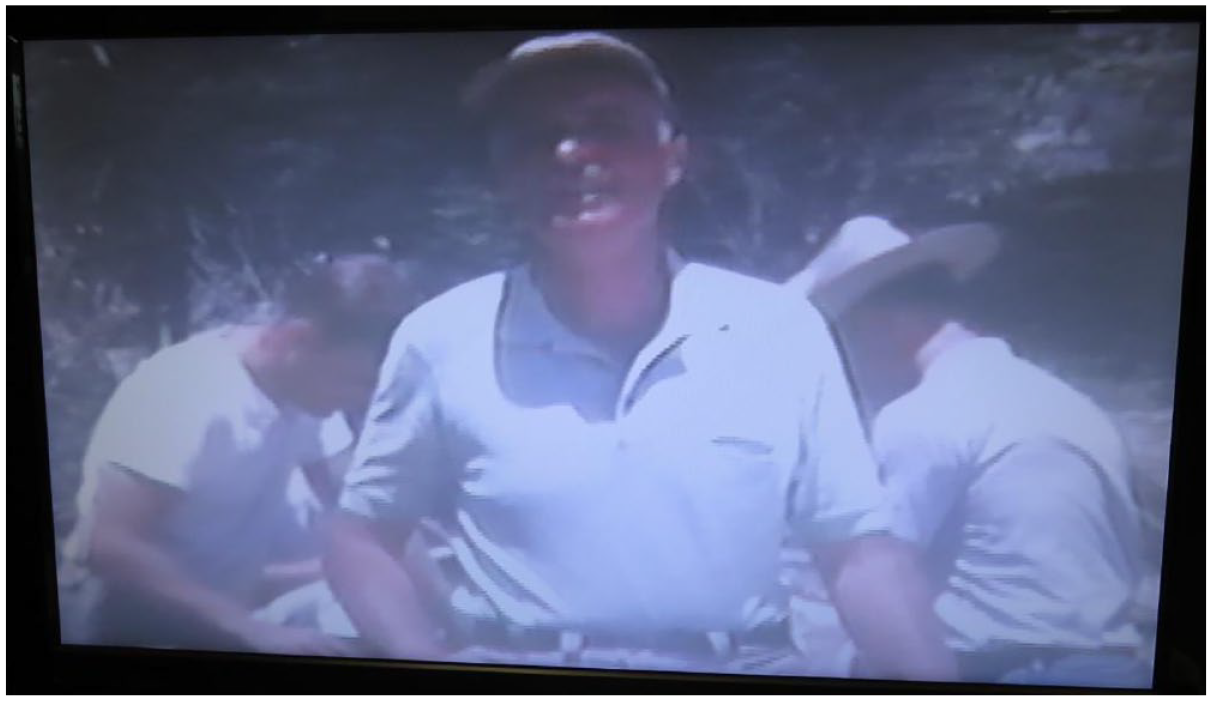
Dr E. Mott Davis in a still from Spadework for History: Part 6: Salvaging Texas Prehistory (1964).
In addition to the insights from Davis’ correspondence with colleagues, Davis also prepared notes for his talk given at the SAA annual meeting in 1963. He writes of his guiding objective,
In the case of educational films, as contrasted with those produced purely for entertainment, it also takes a degree of integrity, because, as in writing, it is only too easy to put across erroneous ideas by presentations subject to erroneous interpretation. . . . The reservoir salvage story would be used as a vehicle to convey the message that science is an integral part of modern life, not something separate. The object would be to challenge the kind of young minds we would like to have going into research–minds at once intellectual and practical.
The first sentence above sees Davis addressing his readers’ presumed familiarity with films for entertainment and meeting them there with regard to knowledge of archeology. He continues in that vein by noting that the science of reservoir salvage impacts people’s everyday lives and should not be elevated further apart from everyday engagement—rather participation in science is a practical and approachable pursuit to which young individuals should give serious career consideration.
The criterion I wanted to apply was that the films should feel genuine to those in the know. This is a pretty rigorous criterion, and the only way I could see of fulfilling it was to use the case history technique; case histories of research. By using case histories, we would also be inhibiting our own natural inclination to doctor things up a bit when they didn’t look the way we would prefer them to look; in other words, the case history technique might keep us from fostering the perpetuation of our own misconceptions.
9
Here we appreciate Davis grounding his series in real research, as well as the ambitious reach he envisioned the series to have, appealing as it would to scholars versed in specific “case histories” of archeology. Davis nods toward the reality of his scholarly peer network at the time, who might recoil from the “misconceptions” of non-research-based treatment of archeological work and be reluctant to entertain genuine archeological storytelling on film at all. Certainly such scholars existed among the viewing audience, but as we recount below, the films did enjoy repeat viewings by audience members based in higher education and across professional practice. Finally Davis’ recognition both of films for entertainment and of the diverse academic pursuits of fellow archeologists—and where Spadework might one day sit beside that entire domain—represents his level awareness of gaps that the films’ eventual release will leave in their wake. Of all the expert individuals, site locations, index artifacts, and digging activities he could have captured, Spadework successfully does so with but a select few, a natural constraint that opens the door for future creative archiving and storytelling work. In their piquant depictions of archeological practices from New Mexico to Washington, the films not only captured the consciousness of leading-edge practitioners on-screen, but as activity theory can illustrate their many-hundred rentals and bookings enable a true situation of such practices in a dynamic mediation nationwide. Today, that is, the films ought to inform our ongoing relationships to the land. The series is a created memory site, a lieux de mémoire from Nora (1989), and locus for communing with the future. Regarding the “genuine” feeling imparted through visiting various sites, experts, and office and field settings, film archives allow for performative viewings and studies of sequences where the central message is clearly conveyed. Two such analyses are presented below.
Sequence 1 analysis: salvage
Over the full 3-hour span of the Spadework series, we see a perspectival shift on the part of archeologists: from a cleareyed belief in the necessity of salvage work to recover and identify artifacts soon to be lost to development, to an appreciation of conservation as the best means for addressing the infeasibility of such recovery for the vast expanse of land areas needing such attention. The former view, salvage, is effectively depicted in an opening sequence set in the Navajo Lake reservoir in northwestern New Mexico, southwestern United States (Table 1). The sequence’s audio and onscreen visuals are excerpted below from Davis’s typed scripts; filmmaking abbreviations in the original are glossed.
Opening sequence of Spadework for History Part IV—The Desert Southwest (emphasis added).
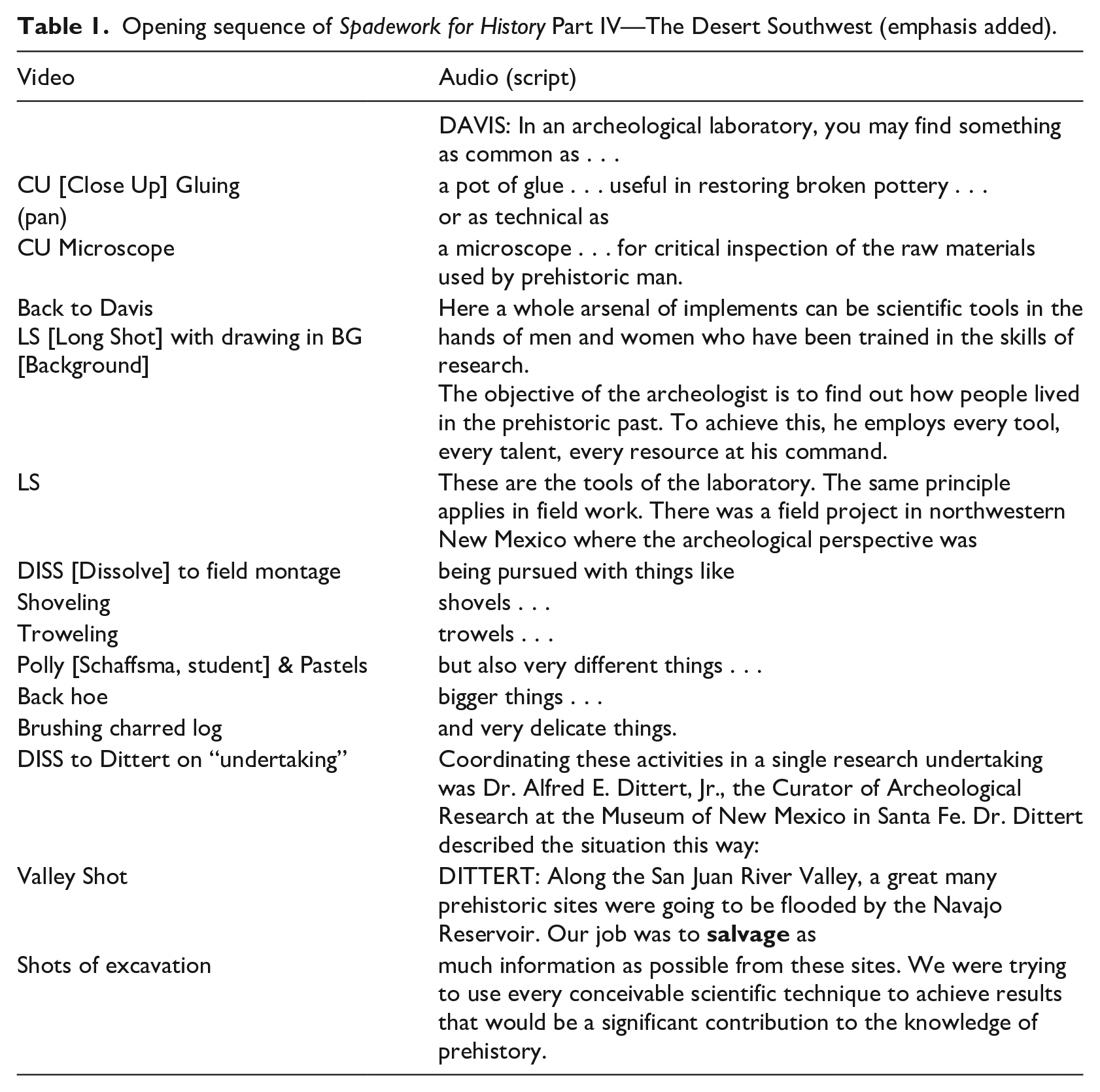
The fourth film, which examines the excavation of the Navajo Dam Project, now known as Navajo Lake, draws attention to the variety of handheld tools and heavy machinery that are put to work in conducting salvage archeology. Davis shows examples of “every tool, every talent, every resource at his command” including trowels, shovels, adhesives, brushing, illustration with chalk and mylar by Polly Schaffsma (a Colorado art history major), and research coordination by Alfred Dittert. Both experts serve to demonstrate the need for documentation and legible presentation of the results from scientific salvage work. Dittert notes explicitly that “salvaging as much information as possible from these sites” calls upon “every . . . scientific technique” so that no artifact escapes awareness evermore. His later assertion of “working against time” likewise underscores that sense of urgency which infused the salvage program during its active years. The sequence in this way functions as a memory text of the salvage archeology era. The entirety of Dittert’s statewide program is condensed into a few wide-angle shots from 1962 of the New Mexican excavation sites he managed from Santa Fe, just a few team members and index artifacts are glimpsed in passing, and the views of Davis and of his experts commingle. It is the memory of salvage work operations that persists after the film concludes, making the film much more a memory text than a faithful documentary.
Sequence 2 analysis: conservation
The growing acceptance of conservation as a path forward for archeologists is also illustrated in a sequence with a group of Washington students excavating on a dig (Table 2).
Ending sequence of Spadework for History Part I—Salvaging American Prehistory (emphasis added).
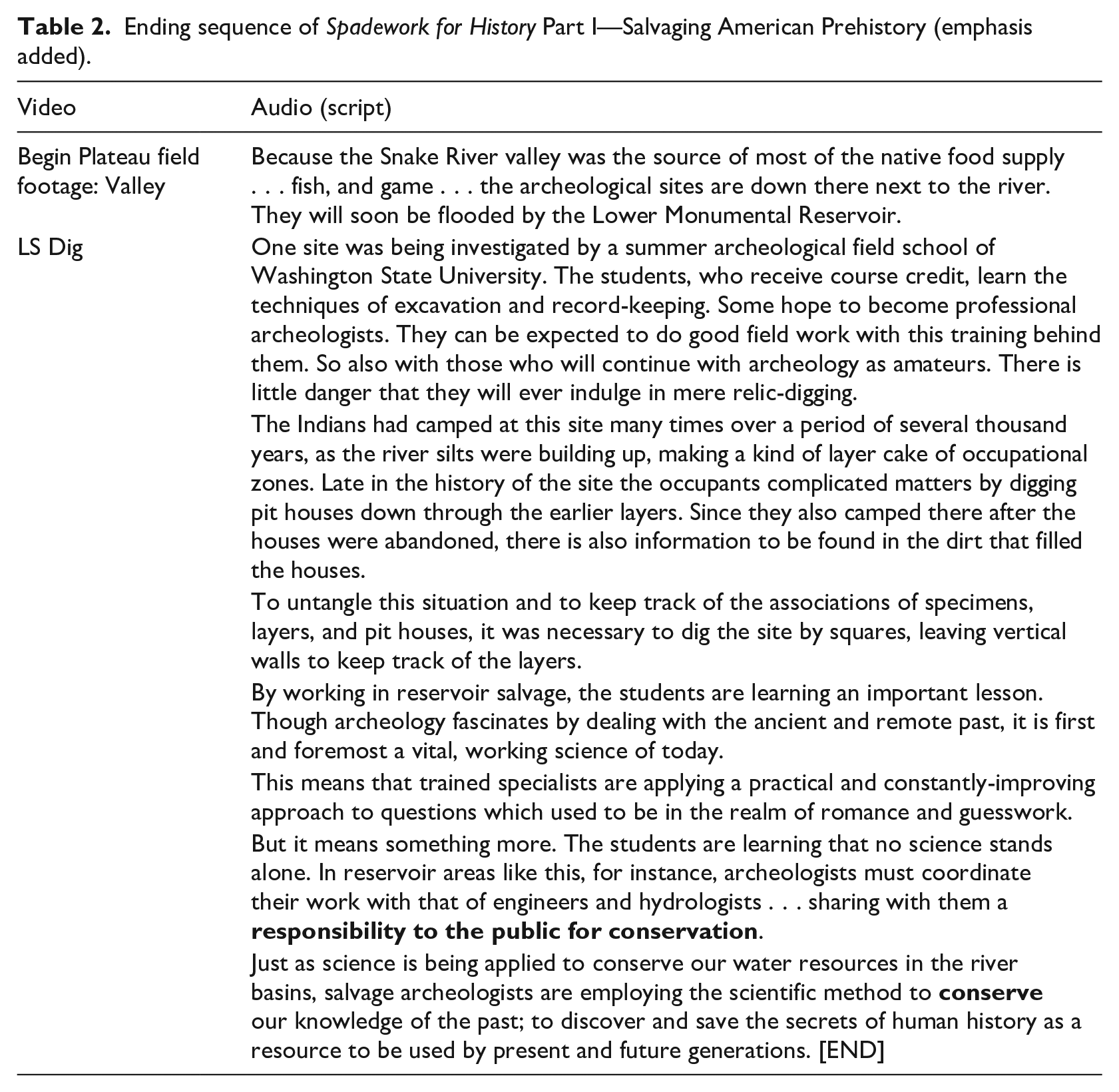
In detailing the aims and complexity of the salvage work planned for the site, Davis references the value of keeping specimen “associations” well-tracked so that future researchers can contextualize the recoveries. Such “record-keeping” work, the film conveys explicitly here, facilitates cross-professional communication to achieve what is a larger, shared socio-cultural goal of conservation. The sequence reinforces one of Davis’ guiding principles that he stated in his informal report submitted to the NSF at the midpoint period of 13 February 1962:
I have gone under the assumption that one reason the grant was given was because of the bearing of the proposed films on the general story of scientific research as part of modern culture, and we are therefore trying to make this general story implicit (and occasionally explicit) throughout the script.
10
At the point in his career of making Spadework, Davis professed a sort of wizened knowledge of “the general story of scientific research” in archeology and more specifically: the field’s long-standing emphasis on salvaging as many material remnants of past civilizations as possible before developers reshaped the landscape for good. But in so doing, Davis had also grown passionately aware of those changes’ permanence and worked to impart that concern to each of his viewers. Now we will delve into the extent of that viewership in the period immediately following the films’ release and promotion.
Reception and memory work
The success of the films can first be appreciated through the words of Davis himself:
The project, which involved travel all over the U.S. in 1961 and 1962, turned out successfully, and by the time the series was released in 1964 the film personnel, who had been hired on the grant funds, were on the University payroll and R-T had become R-T-F. The films were in circulation through the Film Library for many years thereafter. . . . This was the project that started your [RTF] film work. It also was one of the early successful educational film series on archaeology.
11
Davis reminds his reader of the series’ successful internal role in “starting” a film program at the university and retaining the project contributors after its completion. The films’ circulation, a key grounding for our analysis and broadly introduced earlier with Kuhn’s (2010) ideas on memory (re-)performance, is treated in separate remarks below. Spadework for History, created on 16 mm film, comprises six half-hour color films, titled “Part I. Salvaging American Prehistory,” “Part II. The Woodlands,” “Part III. The Plains,” “Part IV. The Desert Southwest,” “Part V. The Plateau and Pacific,” and “Part VI. Salvaging Texas Prehistory.” The titlecards shown at the beginning of each film read,
The University of Texas Presents . . . Spadework for History: Salvage Archeology in United States Reservoirs . . . Supervised and Narrated by: Dr. E. Mott Davis: Director of Research in Archeology at The University of Texas.
12
Even before their completion, Davis began receiving inquiries from a range of individuals, organizations, and institutions interested in purchasing the films for uses of all kinds; he responded to all with information on how to acquire a copy of the films. Copies of such correspondence populate two collections accessioned each by archivists at the Briscoe Center and TARL. Relatedly, a news promotion prepared in advance of the films’ release in 1963 declares that
in seeing the whole series [viewers] will have been given a brief review of the prehistory of the United States, a summary of archeological techniques in field and laboratory, a look at the personal side of the archeologist’s work, and an appreciation of the fact that science not only affects the rest of life, but is in turn affected by it.
13
As echoed in the second sequence detailed above, the tools of greatest use to archeologists are personal skills (whether for illustration, record-keeping, mending, excavating, or analyzing under a microscope) and a professional ethos toward conservation.
The following initial reception study gives an indication of the scope of Davis’ achievement and the recognition he received for his work. A press release announcing receipt of the NSF grant, dated 29 March 1961, notes that publicity was sent via “Wire services, local papers, radio/TV stations, radio/TV publications and science editors.” 14 The series was listed in Science Course Improvement Projects (1962), a catalog by the NSF that was distributed to high schools around the country. It is interesting to note that in its listing, the series was slightly re-titled as Science Under Pressure: Archeological Salvage in the United States. Perhaps this retitling served Davis’ intended aim well in showcasing archeology as a scientific discipline with broad ramifications for everyday American life. It may have also expressed that burgeoning, processualist emphasis on environmental drivers he had explored from the start. Spadework for History was made available both for rental (from the Visual Instruction Bureau at Texas) or purchase (directly from the Radio-Television Department), and many requests were fulfilled by staff, who sent copies regularly to secondary schools and higher education institutions. The film usage reports (Table 3) that were maintained by both offices provide a valuable sense of the films’ impact on archeological education. The items in parentheses are selected institutions to which the films were sent.
Selected Film Usage Reports from the Visual Instruction Bureau for Spadework for History (SC_7556).
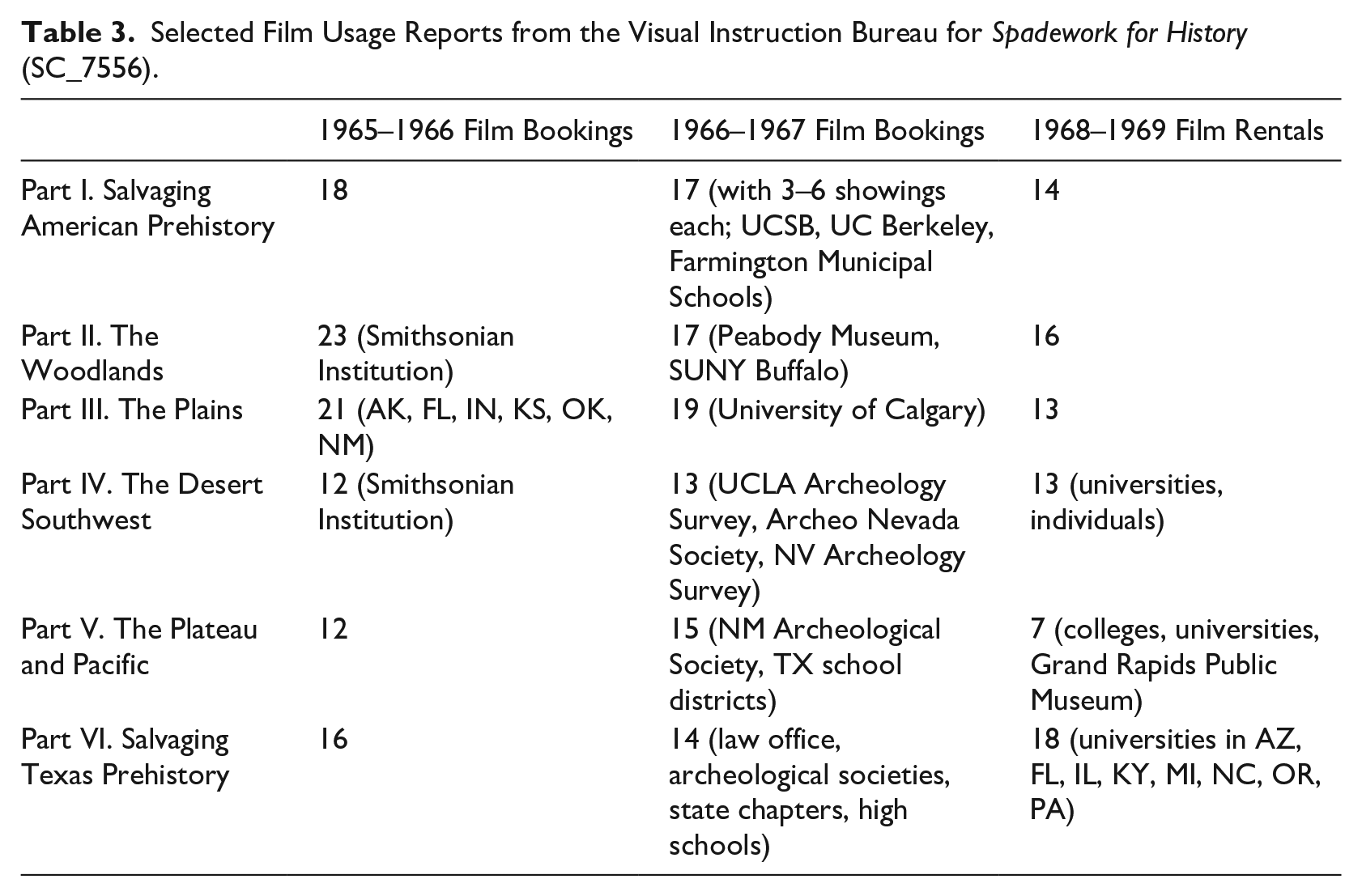
Many of the users above rented the entire set of six films, as Davis had intended for them to be shown (together)—and often multiple times (e.g. three to six). Along with the non-dominance of any one film, the ranging size and geographic scope of the viewer groups bears mention. Membership societies, state and local offices, and indeed high schools and universities promoted the films within their networks. The supplemental NETRC funds ensured regular public broadcasts of the series on local educational television channels for several years. In another measure of his success, in 1965 Davis was promoted from Lecturer to Associate Professor in Anthropology. He was also instrumental in establishing a Graduate Concentration in Museum Studies in the department in the Fall of 1981. Graduate study in museum anthropology persists today, attracting students trained in information science, art history, classical archeology, and other areas.
E. Mott Davis retired as professor of anthropology at Texas in 1989, but remained active in the Texas Archeological Society as founder of its Field School and in the SAA. Following somewhat of a long period of relative quiet after the initial “release” of his films, the Texas Archeological Society showed the sixth film of the series, “Salvaging Texas Prehistory,” at its 1992 annual meeting in Corpus Christi, where it was well-received. That screening refocused community attention on the films and paved the way for the planning of a “major retrospective” in the summer of 1995 which to my understanding, may have been the (home institution’s) first showcase of all six films together. The event was planned as part of the TARL Brown Bag Lecture Series and at each screening (held on 12 May, 26 May, 23 June, 21 July, 18 August, and 29 September 1995 at the Commons Building on the Pickle Research Campus) the director himself, E. Mott Davis, provided introductory remarks. Synopses for each of the six films in the series were prepared by archivist Gail Bailey (1997) as part of the finding aid she wrote to describe the archival materials of the TARL. One more proud moment for Davis came shortly thereafter, on the occasion of his 80th birthday in 1998, with the publication of Chapters in the History of Texas Archeology: Selected Papers by E. Mott Davis.
Discussion: between shifts: considering chronosophy to mitigate archival gaps
While Spadework for History diligently exposes the decision-making underpinning an archeologist’s concern for site recovery and preservation—first for the past artifacts and later toward the general future landscape—some stages of that decades-long shift in disciplinary thinking are better captured than others. Zemon Davis and Starn (1989) observe that one way in which historians conceive of memory is through “[memory’s] institutionalization in archives and museums” (p. 1). Through their placement of Mnemosyne on the pedestal of memory, Zemon Davis and Starn present the view that history is a physical outgrowth of memory; history is memory’s genealogical child. In Preziosi’s (2009: 47) view, modern historical museums are inherently performing, or staging, a kind of dramaturgy with objects by abstracting or styling them into a national narrative. While the institutionalization of memory can be said to occur via the formal process of first acquiring and then formally accessioning archives (Flynn, 2020), its activation by a storyteller or two is just as crucial. Archivists here subsequently become intergenerational locutors in completing the critically important memory work of creating physical and digital spaces—lieux de mémoire per Nora—where students, youth, depicted family, and new cultural critics can react and respond to the purported historical record. Paul Ricoeur’s (2004: 17, 19) discussion of the Greek concept of mnēmē—that is, simple memory, a content-driven record of an event—proves very relevant; this is the “raw” material present in a collection. Archivists encounter mnēmē in their daily work with multimedia sources that may be hidden literally (boxed and unopened), or more figuratively (ignored or marginalized in favor of other sources). By describing those collections and making them available for research, archivists actively contribute to the production of our historical record.
In addition to textual documents, archival moving images make up the creation of social memory through visual communication, a sensory experience that can transcend cultures and languages. Film archives such as the Human Studies Film Archives at the Smithsonian Institution, the Briscoe Center for American History at University of Texas, and the Peabody Museum film archives at Mott’s alma mater preserve that evidence. Renato Rosaldo (1989: 107) posits that the moving image can wield influential sway over how we recall and portray people’s behaviors in our collective memory (he goes on to encourage historians to awaken to the roles that power dynamics play in the production of history). To wit a television broadcast shortly after Mott’s passing, of part of the Indiana Jones film trilogy—originally released in the 1980s, starring Harrison Ford and directed by George Lucas—was watched by an audience of more than 10 million British people (Holtorf, 2007: 73). Ray Hatley (1997: 14–15) connects the “Indiana Jones effect” to a near-doubling of student university applications for archeology courses during the years of 1986–1995.
Yet apart from the depictions greenlit for wide distribution (fictional or documentary), Susan Crane has argued that there is an immense quantity and variety of lived experiences that are yet available for close analysis. Since in Crane’s view historians play the role of witnesses to the past, they should draw upon those diverse experiences to support further articulation of both historical and collective memory. Crane (1997) asks, “Do we write history because we have experienced it ourselves, or do we see ourselves as looking at something that is distant and virtually lost to us?” (p. 1374). Archeologists who participate in a professional community, as Mott did at the 1962 Plains Conference for Archeology with the first Spadework film, do so to transmit the training and wisdom received from those who came before. Again we recall Ricoeur’s (2004) claim that “concrete exchanges operate between the living memory of individual persons and the public memory of the communities to which they belong” (p. 131). Ricoeur approaches archiving from a collective, societal perspective, whereas below Pierre Nora does so from an individual perspective.
Archives do not create themselves, nor do archives emerge fully formed as Clio (Muse of history) might have appeared to the ancient Greeks to have emerged from her mother Mnemosyne (goddess of memory). Rather, archives are incomplete, and it is only through conscious work like that of Mott in 1956 that we can fill in gaps in the known historical record by creating narratives of the kind that will be held up by succeeding generations as documentary evidence. (Recall that consciousness is a central tenet of early activity theory. Consciousness even unifies memory, intention, speech, and so culture: “you are what you do.”) Pierre Nora (1989: 7) in discussing the space between history and memory introduces the concept of lieux de mémoire (sites of memory), arguing that such sites are the remnants of what once were, in an earlier time, much larger milieux de mémoire (environments of memory)—histories that are no longer immediately accessible to us (e.g. museum cultures of the 1800s, or the first American archeologists). History’s exponential expansion (with each passing day) and absorption of all our disappearing thoughts compels us, like Davis did in 1963 at the SAA, to glean a sense of the vastness of experience that remains undocumented—how to address? A method of ethnographic methodologies alone, reliant on the presence of research subjects actively involved in tasks at hand, arguably closes off the experiences of individuals from the past. Hence, some (Fabian, 2002; Hastrup, 1990) instead use ethnoarchaeology, the present-day study of material culture, for cultural comparison and limited speculation and inference. Thus the archive of a profession must at least make space for a chronosophic shared memory beyond the immediate worldview a researcher could gather today.
The chronosophic approach was identified by Krzysztof Pomian and further articulated by Ricoeur (2004: 155) in his consideration of multiple representations of time in memory and history. While chronometry (recurring cycles) and chronology (linear time and its punctuation) make use of calendars and cyclical time, Pomian’s chronography is an amorphous linkage between event and its author, and chronosophy is the most limitless concept of all. Chronosophy accepts a multi-temporality-based approach to history construction as well as the validity of imaginative and speculative dream-times within the work of the historian. Archivists and librarians’ perceived dependency on the existence of a documentary record would limit starkly the scope of what they transmit to the next generation of professionals: a delimited world. Instead, there is space to include creative, engaging storytelling that is more chronosophic than chronologic because it ensures the presence of an audience invested in those professional memories. We already see such creative archiving today, particularly in subject and federated portals (Shenton, 2009; Smith, 2017), cross-institutional reunification efforts (Green and Lampron, 2017) that adopt such a premise, and other applications of reparative or rebellious principles to address collecting (Carpio, 2020; Crowe, 2019; Sheffield, 2020; Sutherland, 2019). Contemporary historiography might otherwise forget, unfortunately, the contributions made by successive archivists and preservation librarians to the creation of memory.
The series does rely on didacticism and its narrative delivery by experts who might not at all represent the entire American archeological participant experience: while we see Polly creating illustrations in chalk we only know her by her output; her name is elided and uncaptioned in the dialogue about her site’s discoveries. Despite such features, the series clearly merits archival preservation so it can be critiqued by Indigenous, youth-centered, visual, universal accessibility, and/or feminist scholars who will place its contributions inside a fuller contextual picture of knowledge that could take form as biomythographies, testimonies, or countermemories (Hirsch and Smith, 2002), attending not to Mott’s aims but new ones. It is a memory text whose inclusion in those future archeological analyses will be generative and revealing. Studies of professional practice using audiovisual-evidence lenses can prompt a deeper reading of positionalities, materialism, and embodiments (Česálková, 2017; Nardi, 1996: 7; Lee, 2021). Spadework for History, created by an archeologist, reveals the perspective of one such professional from inside the field. In recovering and interpreting Spadework, the preserved filmic evidence joins with historical contexts of its creation to interrogate the recording of archeological history, and thus the process of making a professional-past.
Conclusion
Applying perspectives from memory studies to the study of archeological film permits the researcher to understand how memory is created—in this case, a memory of archeological practice as seen in the RBS carried out in the United States. Analysis of the archival record associated with Spadework for History (1964), a six-part film series, reveals the depth of care, dedication, and scholarship that characterized E. Mott Davis’ production of the films during his academic career. In our later discussion, the methods and sources employed in this article—archival research, sequence and reception analysis, close reading—conversed with broader depictions of archeological practice that are preserved on film and in associated records by archivists, and the “powerful” (Rosaldo’s sense) way film transmits memory. Through historicizing the production of Spadework and its archive, including its arranged audience screenings, the essay illustrates how memory work must take on many forms—together the activated memories will succeed in overcoming the natural constraints of our tangible, collectible media.
Footnotes
Acknowledgements
Thank you to Professor Ruramisai Charumbira for teaching the history and memory course in 2014 in which this article developed, Dr. Hugh Davis for his time and recollections, Professor Caroline Frick, Archeologist Jonathan Jarvis, and Archivist Gail Bailey both of TARL: Texas Archeological Research Laboratory, and Stephanie Malmros of the Briscoe Center for American History for their generous assistance with this research; additionally, I thank colleagues for commenting on an early version of this paper presented at the Archival Education & Research Institute: AERI 2018 at University of Alabama.
Funding
The author disclosed receipt of the following financial support for the research, authorship, and/or publication of this article: Open-access funding has been made possible by the Institute of Museum and Library Services (US IMLS), grant RE-246339-OLS-20. Spadework for History was generously supported by the US National Science Foundation, grant number NSF-G16936 (1961-1963), awarded to PI E. Mott Davis, at The University of Texas at Austin.
