




Abstract
In the midst of the activism outburst after the Ayotzinapa crisis, the Mexican collective ‘Rexiste’ wrote the phrase ‘It was the state’ in Mexico City’s main square. I define such action as an embodied practice of memory, which re configurates Mexico’s history of violence. Based on an affective approach, I delve into the kinaesthetic of the performance to show how the action is summoning archived repertoires of Mexican activism post-1968. I first refer to the foundation of human rights committees in the late 70s and their main repertoire of action, hunger strikes, to then consider the funeral re-enactments of the late 1990s after the Aguas Blancas and Acteal massacres. Through this unarchiving I want to analyse how the unresolved past re-emerges in the creation of a non-teleological temporality of state-fostered violence.
During the night of 26 September 2014, the local police, the Mexican Army and members of a criminal organisation attacked a group of students from the Escuela Normal Rural ‘Raúl Isidro Burgos’ in Ayotzinapa, in the Mexican state of Guerrero. That night, aside from the disappearance of 43 students, 9 people were killed, more than 40 injured and more than 110 were attacked. The total number of victims (direct and indirect) is calculated (Grupo Interdisciplinario de Expertos Independientes, 2015: 313–315) to be over 700. The case rapidly gained international publicity due to numerous protests, which were particularly important within the digital sphere.
One specific artistic action became an icon of the protests over Ayotzinapa: the collective writing of the phrase fue el estado (‘it was the state’) in the Zócalo, Mexico City’s main square. This was organised by the Mexican collective Rexiste, on 22 October 2014, a few months after the Ayotzinapa crisis. It is described by Rexiste (2015a) as a ‘monumental painting’ or as a ‘tag action’. The action was carried out after a massive march towards the Zócalo; organisers and spontaneous participants wrote the phrase fue el estado on the floor with 30 litres of white paint and four paint rollers, after which they lit candles around the tag. Then, around 100 people formed a circle by holding hands around the tag and stayed in this position for a couple of minutes. As the participants left the square, public workers came and erased the tag from the floor. The whole sequence was video-recorded by a public surveillance camera (Hidalgo, 2014) and the organisers themselves, videos which became viral on the internet soon after, sparking a substantial debate.
After the critical tragedy of the disappearance of the 43 students, activism became a central catalyser of the memory struggle in Mexico. Confronted and diverse interpretations of the enforced disappearance appear throughout the whole cycle of protests over Ayotzinapa, and are still active today. Fue el estado is a central landmark in this contention: it shifted and contested the government’s version of events by placing state responsibility at the centre of attention, while at the same time proposing a novel interpretative frame to the crescendo of violence in the country that differs from previous mainstream interpretations, which centred attention on ‘narco-violence’. In doing so, the action inadvertently connected Ayotzinapa with other traumatic events in Mexican history, summoning archived repertoires, affects and meanings. This article considers fue el estado as an embodied practice of memory, and as such, as an action that has reshaped temporality through corporeality and performance.
I argue that fue el estado allowed participants to rehearse a different social order within aesthetic of the performance. Participants in fue el estado staged an alternative organisation of corporeality creating, through affect, a community of victims across history. Activist repertoires and archived affects of the human rights movement after the 1968 Tlatelolco massacre, of the so called ‘dirty war’ and of certain human rights crimes of the 1990s (the massacres at Aguas Blancas in 1995 and Acteal in 1997), re-emerged and were shaped in a new genealogy.
My focus will be the kinaesthetic of the performance – how participants move, and the bodily organisation of the participants, how they are organised, set, in the space. Both approaches will allow me to show how fue el estado drew on previous cycles of human rights activism, thus constructing a new genealogy of violence in Mexico. From a kinaesthetic point of view, ‘coordinated movement’ and ‘passive defiance’ are the two main bodily tropes to which I will refer, in order to show how both bring about the archived corporeality and affectivity of the first human rights committees and of the Comité Pro Defensa Presos, Perseguidos, Desaparecidos y Exiliados Politicos (1978) hunger strikes, which were central to the human rights movements of the late 1970s and 80s. Considering too the organisation of bodies in space, I’ll refer to the ‘performative funeral’, and show how such specific repertoire emerges from the funeral re-enactments of the 90s that followed the Aguas Blancas and Acteal massacres.
Embodied practices of memory
I start by defining fue el estado as a embodied practice of memory and thereby focusing on the re-temporalising function of memory. The analysis of activism as memory is nowadays gaining a prominent place in academia. Ann Rigney (2018: 372) has recently proposed that the link between memory and activism could be centred on the idea of ‘how actors struggle to produce cultural memory and to steer future remembrance . . . how earlier struggles for a better world are culturally recollected . . . and how cultural memory of earlier struggles informs new movements in the present’. The aforementioned link between memory and activism was also approached by other recent works in the European context (Chidgey, 2018; Treré, 2018; Zamponi, 2018).
As much as considering activism as memory may be a novelty in the field, it has already become a central issue in Latin American memory studies. The contributions of Argentinian sociologist Elizabeth Jelin’s are crucial to understanding the importance of activism in memory transmission. Jelin (2002) emphasises the active role of individuals in memory construction, and especially that of activist networks originally created by family members of the disappeared. Jelin (2002) also emphasises the transformative role of activism, as constructing memory is intended to transform the social world. The role of activism in memory struggles in Latin America is also approached by Gatti (2008), when defining the relatives of disappeared as ‘activists of meaning’. Also from the Latin American context, similar concepts have been proposed to link activism and memory, like ‘teatralidades de la memoria’ (‘teatralities of memory’ [translation]) (Campo, 2004), ‘teatralidades liminales’(‘liminal teatralities’ [translation]) (Diéguez, 2009) and ‘acciones colaborativas’ (‘collaborative actions’ [translation]) (Olalde Rico, 2015), among others. In the specific context of Mexico in the aftermath of Ayotzinapa, Zicari (2018) has analysed how the use of traditional repertoires in Latin American human rights protests after Ayotzinapa has successfully placed Mexico’s violent present in line with the history of military dictatorship in the Southern Cone.
Drawing on the foregoing tendency, I approach activist practices, namely fue el estado action, as memory. In doing so, I propose to focus on the immanent side of memory transmission fostered by such practices, in such a way that my analysis is mainly based on an affective approach to activism. While affect theory presents a variety of scopes and focuses, they converge in the ‘call to attention to alternate ways of understanding our engagement with . . . the world around us beyond representationalism, as well as beyond the subject and object divide’ (Hasselberth and Horsman, 2017: 29). The affective approach is also described as a ‘diversity of issues, questions, concepts and relationships deriving from and centring on the body and bodily life’ (Sheets-Johnstone, 2011: 1). I develop my study of activist practices of memory transmission informed by an affective framework and vocabulary.
My way into the affective dimension of memory transmission comes from an author not generally considered as part of such tendency, Paul Ricoeur. Ricoeur (2009: 6) states that the temporalising capacity of memory is grounded in the fact that it establishes a particular relation with temporality, which differs from historiography or simple recollection. Memory enables reinterpretation. This is to say that, when remembering, we are tracing new lines between the past and our present, lines directed to an imagined future. The openness in temporality is what Ricoeur finds singular of memory.
Moreover, when analysing how memory works, Ricoeur (2009: 427) differentiates the ‘external traces’ of memory from what he defines as ‘affective marks’. The external trace of memory, which he also defines as documentary or cortical trace, is the lost object which one remembers. However, underlying that external trace, it ‘remains the most problematic but the most significant’ form of inscription, which is ‘affect’. He writes: ‘I contend that it is a primordial attribute of affections to survive, to persist, to remain, to endure, while keeping the mark of absence and of distance’. He continues, ‘In this sense, this inscription-affections would contain the secret of the enigma of the mnemonic trace: they would be the depositary of the most hidden but most original meaning of the verb “to remain”, synonym of “to endure”.’
Centring the attention on such ‘affective marks’ in the transmission of memory, Ricoeur simultaneously places affect at the source of the temporal reconfiguration of memory. Memory, as an action, as a projection towards a desired future, is mainly grounded in the power of affective inscriptions.
The reconfiguration of temporalities through affect and memory is a central aspect in the article: I intend to analyse how the embodied practice of fue el estado proposes a new temporal relation. As I have already advanced, fue el estado reframes temporality by placing the Mexican state at the centre of attention, allowing a series of repertoires and affects from the Mexican activist cycle of the 1970s to 1990s to reemerge from the obscurity cast by the ‘war on drugs’ of the previous 10 years. In this direction, using the lens of affect theory allows me to trace the new genealogy created by the performance, looking for non-linear temporalities and the unforeseen connections between activists traditions.
Present–past: The rewriting of Mexican violence
Beginning with the 1968 Tlatelolco massacre, through the 1970s and for a large part of the 1980s, with significant albeit circumspect resurgences in 1995 and 1997, Mexico was the site of intense and important cycles of contention blaming the state for serious human rights crimes. With the declaration of the ‘war on drugs’ in 2006, the situation shifted. Gonzalbo and Ibarra (2019: 59) state how, due to the levels of violence reached during the war on drugs, the systematic presence of the army throughout the country and above all for the effectiveness of the law and order discourse, the ‘war on drugs’ provided a way for the Mexican state to renew its legitimacy, along with the legitimacy of the use of force, since, in the context of organised crime, any type of violence was justified. I argue that this renewed state legitimacy buried a significant portion of traditional activism against human rights abuses, and with it buried affections and repertoires which were central to those traditions. But they did not remain buried for long.
The renewed legitimacy the ‘war on drugs’ gave to the Mexican state was based on describing the growing violence as a consequence of the operations of organised criminal groups, with non-state actors signalled as the principal perpetrators. Anaya Muñoz (2013: 180) writes about this period: ‘the bulk of the executions, torture and disappearances have been perpetrated by members of transnational drug cartels. Furthermore, a majority of the victims of violence are male adults presumably involved in drug-related activities’.
Schedler (2015), alongside a large number of writers, also emphasises the narcos’ responsibility for violence. Many Mexicans perceive the current violent environment as a consequence of criminal activities, as shown by the National Poll on Organised Violence (ENVO), conducted during October and November 2018. Of those polled, 39.8% responded that drug cartels were mainly responsible for the violence in Mexico, compared to only 15% who thought the Mexican state responsible. Despite the proven participation of state forces in alleged organised-crime-related crimes, and the upsurge of violence following the deployment of military forces to fight drug cartels, the Mexican state was generally not perceived as responsible and when its participation in human rights violations was proven, it was attributed to certain individual ‘corrupted’ officials. Following the disappearance of the students from Ayotzinapa, fue el Estado proposed a new structural reading of violence in Mexico.
The most immediate impact of this action was to contest the government’s version of events, which was known as ‘the historic truth’, coined after a highly polemical media intervention of the state attorney general (Castillo García, 2015). The ‘historic truth’ was the intention of state officials to force plausibility in the aftermath of the crisis. It only accepted the involvement of municipal agents in the crimes, without acknowledging the direct participation of state and federal police agents or the Mexican Army. Moreover, the responsibility of municipal forces was watered down by allegations that the attack on the students was related to a criminal dispute, and that some of the students belonged to a criminal group fighting over territory. The government further alleged that the students’ bodies had been burnt in a landfill close by, where burnt human remains were found. All of the state’s allegations were denied by the victims’ families, and disproven by a group of independent experts that the Inter-American Commission on Human Rights sent to Mexico to participate in the investigation (Grupo Interdisciplinario de Expertos Independientes, 2015, 2016). Recent found of forensic remains which managed to confirm the identity of another Mexican student also contribute to the dismantling of the ‘historic truth claims’. 1 In the face of the monolithic message which drew on the aforementioned legitimacy of the ‘war on drugs’, the Ayotzinapa crisis found a counter-narrative in the fue el estado action.
According to a Mexican blog on technology and politics (Gutiérrez, 2016), the hashtag ‘#FueElEstado’ became the fourth most important hashtag on Twitter 1 day after the performance, and remained one of the most used hashtags for 6 months. Moreover, the analysis of Meneses Rocha and and Castillo-González (2018: 275) of the civil society’s narratives on YouTube and Twitter after the attack concluded that the Mexican state, as a whole and not individual officers, was constructed as the responsible actor, with the phrase fue el estado taking a leading role in online conversation. Mandolessi (2018), in her analysis of books, documentaries, digital platforms and photographic projects around the topic of Ayotzinapa, arrives at the same conclusion. The phrase was also transformed into a popular slogan that was written on posters and signs and which was rapidly incorporated into artwork circulating on digital media. The performance was recorded and uploaded to the internet and was re-enacted a few months later by Rexiste (2015b) at the National University of Mexicoa after declarations by the head of the university about the Ayotzinapa case, as well as by several other collectives (see, e.g. Girón, 2014).
In addition to the immediate impact on the media dispute, I argue that the performance transcended an episodic reading of Ayotzinapa by proposing a structural explanation Mexico’s history of violence, reshaping past–present temporality. The culpability of the state was set on a continuous line from 1968 to the present, dismantling the little legitimacy that the government still retained in fighting the ‘war on drugs’.
Since the aftermath of the Ayotzinapa crisis, activists and journalists have connected the Ayotzinapa case to a series of previous violent acts committed in Mexico, of which the Tlatelolco massacre has become the most referenced. This connection has emerged from the simple fact that the Ayotzinapa students were attacked while organising their participation in protests on the anniversary of Tlatelolco ’68. Moreover, several academics (Aguayo, 2015; González Villarreal, 2015; Mastrogiovanni, 2014) have already pointed out to the connection between both traumatic events. The renowned Mexican writer Elena Poniatowska (in Gutiérrez Ruelas, 2014) also stressed the connection. These writers, alongside critical voices in journalism (see, e.g. Canton, 2015; Castellanos, 2018; Colombo, 2014), cemented the connection, ever-since inalienable.
The shift of attention towards the state allowed for a new history of violence to emerge, and the reactivation of confronted memories of the past that had seemed settled. While the connection was rapidly made in the discursive sphere (media, journalism, academia, museums, etc.), in what follows I want to focus on the immanent side of transmission, fostered by embodied actions performed by activists.
Unarchived affects and repertoires
As I have advanced before, I consider fue el estado as an activist action that creates a deeply affective moment which connected the present with previous activists repertoires. Such affective connection was theorised as ‘comunidades afectivas efímeras’ (‘ephemeral affective communities’) (Carreira, 2017) or as ‘affective solidarity’ (Hemmings, 2012). Hewitt et al. (2005) proposed the concept of ‘social choreographies’, which is also useful as it was later used by several critics to analyse contemporary social movements as social choreographies, and to discuss how they are grounds of temporal relationships (Cvejić and Vujanović, 2012; Foster, 2003; Klein, 2000, 2011). Choreography can be thought of in terms of rehearsal, that is ‘as the working out and working through of utopian, but nevertheless “real”, social relations’ (Hewitt et al., 2005: 17). Through this utopian, yet real, organisation of bodies entailed in fue el estado an enlargement of the community of victims and a new genealogy of Mexican violence takes root.
As already demonstrated, since the start of the ‘war on drugs’, victims of violence were usually rendered as second-degree victims, as somehow part of the criminality the army was trying to eradicate. Fue el estado proposes the state as the perpetrator of the Ayotzinapa massacre: its victims thus now become part of a new ephemeral community, and the progressive teleological temporality of the Mexican democracy is highjacked through unforeseen (might we say, sometimes unconscious?) links to unresolved and violent past events.
I am not interested in thinking of the intentionality of the action, namely, to analyse if the organisers or participants were aware of the historical connections, or were purposefully tracing a new genealogy. Leaving such considerations behind, I consider the action itself as unarchiving affects of previous human rights activist milestones, connecting activists’ experiences of the hunger strikes and concentration actions of post-1968 human rights activism, in addition to remediating the ‘funeral’ bodily set-up used in the 90s after the Aguas Blancas and Acteal massacres.
I will support this argument by focusing on the kinaesthetic aspect of the performance. I argue that the kinaesthetic of fue el estado, as they gather in the square and collectively write the tag on the square’s floor, refers affectively to the foundations of the human rights committees in the early 1970s and their denunciation of the state’s responsibility for human rights abuses. This is followed by a moment of ‘active stillness and defiant passivity’; after writing the message, participants surround the tag, light candles and hold hands for a few minutes. The kinaesthetic affectivity of ‘active stillness and passive defiance’ could be thought of as a result of the unarchiving of the hunger strike which were a fundamental repertoire of the late 1970s. Finally, I analyse the whole scene as a ‘performative funeral’ connected to the funeral re-enactments of 1995 and 1997. As I unpack these idea, I’ll delve further into the implication of kinaesthetics, both on notions of vulnerability and the agency of the victims’ relatives.
The (re)foundation of the Mexican human rights movement
I will tackle the post-1968 activism first. During these formative years, from 1970 to 1985, citizens, family members of victims of human rights abuses and political parties formed committees that developed a vocabulary, a repertoire and an specific affectivity in their fight against human rights abuses, which ultimately could be summarised as the process of getting together as a community and naming the state as the perpetrator. In 2014, in the context of the ‘war on drugs’, where violence had become this empty signifier, where different actors assigned changing responsibilities, with the state the preponderant symbolic winner, gaining legitimacy through its fight against the cartels, the act of writing ‘it was the state’ directly connects to this first occasion that Mexican citizens organised themselves to blame the state for human rights abuses.
To begin with, I want to go back affectively to the incipient human rights movement of the first half of the 1970s. In 1972 the first action days for the political prisoners were organised by the seed of the human rights movement in Mexico, the Comité de Defensa Moral y Física de Presos Políticos (‘Committee for the Moral and Physical Defence of Political Prisoners’), composed mainly of family members of revolutionary activists who became active after the state’s violent repression of the student movement in 1968 and 1971. As stated in a pamphlet (Comité de Defensa Moral y Física de Presos Políticos, 1972), handed out at a committee rally their aim was to ‘denounce and demonstrate that against the state’s official statements, illegally detained political prisoners do exist in Mexico’. 2 In the following years, several committees would be formed to address the same issue, among them the Comité Pro Defensa Presos, Perseguidos, Desaparecidos y Exiliados Politicos (‘Committee for the defence of political prisoners, politically persecuted, disappeared and political exiles’, from hereon Comité Pro) which since 1974 organised various rallies, press conferences and similar actions.
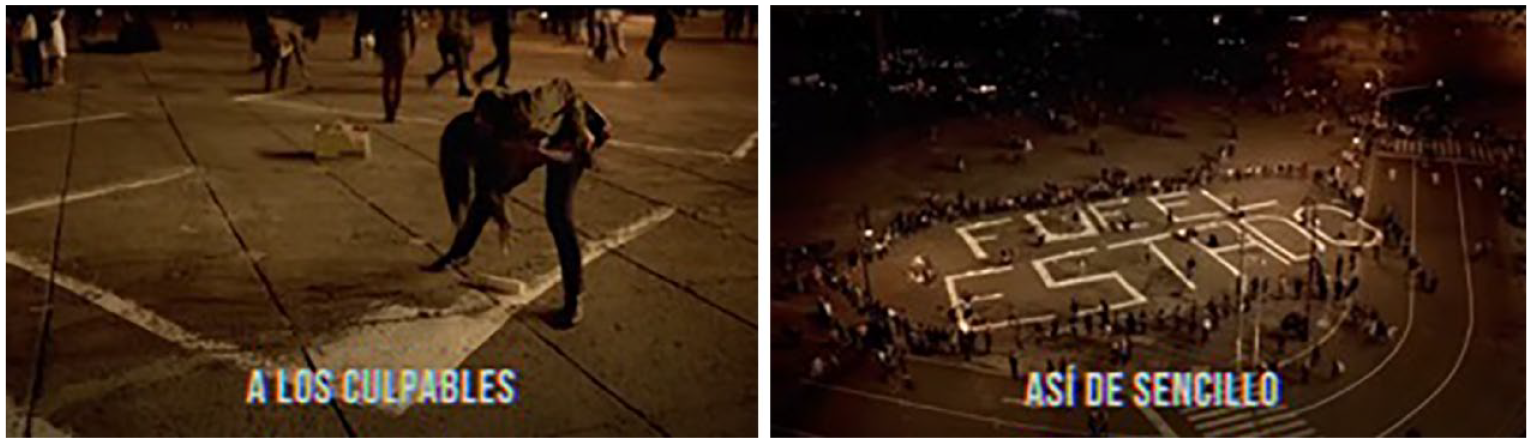
Stills from Droncita Rexiste (2015).
What we see during these years is the victims’ family members coming together and beginning to elaborate a vocabulary and a discourse around human rights abuses, as well as starting to develop a specific activist repertoire. Committees were formed at the beginning only for ‘political prisoners’ rights’, then, as knowledge of the repressive context broadened, started to incorporate other human rights abuses like political persecution, political disappearance and political exile. The names of the committees changed frequently; there were regional committees in each state, and national ones, adapting the vocabulary of human rights crimes as they faced up to them. Some of these committees were so-called ‘independents’ – those that didn’t allow members of political parties to join – while others had close ties with left-wing parties. 3 Notwithstanding such differences, they usually worked together towards the same goal, as well as sharing rallies and strategies.
The purpose of the committees in the first half of the 1970s was to conceive, write, publicise and pressure for an ‘amnesty law’ to be passed, in order to free revolutionary activists who had been disappeared and who were thought to be, and were sometimes known to be, illegally imprisoned. Two amnesty laws were passed thanks to the pressure of the committees. The first of these laws was passed in 1976, and granted amnesty for various crimes committed only during the student uprising of 1968. This law proved to be insufficient for the committees, as a substantial number of detentions and disappearances happened after 1968. This led to another phase of activism for a new amnesty law, which was passed in September 1978, this time granting amnesty to all prisoners imprisioned for political crimes up to that date. The committees achieved the passing of both laws by maintaining pressure on top political leaders through multiple coordinated actions. Committees worked locally, visiting prisons where political detainees were known to be held, looking for family members, drafting lists of prisoners, at the same time enlarging their memberships as they met with new families in similar situations. 4 Family members were also constantly visiting state institutions like the Procuraduría General de la Nación (National Persecutor’s Office), talking personally with top-ranking state officials, demanding information and answers to their demands. 5 Another typical action was the holding of press conferences, where committees addressed local, national and international media; these were characterised by rhetoric celebratory of the revolutionary character of family members and highly contestatory of the state’s inaction and responsibility for human rights crimes. Internationalisation of the committees was a strategy adopted during the second half of the 1970s, and which proved to be highly influential for the Mexican human rights movement. 6 Aside from this broad repertoire of actions, the committees’ other main actions were, as obvious as it may sound, public rallies and protests. To describe these activities, committees used the words ‘Mitines’ or ‘paradas’, which could be translated as ‘public meetings’ or ‘gatherings’. Their action scheme was to gather outside state buildings and directly blame state officials for human rights crimes, demanding meetings with them. One example is the mitín held on November 1976 at Los Pinos, the presidential residence in Mexico City, in reaction to the insufficiency of the first amnesty law, passed in May of that year.
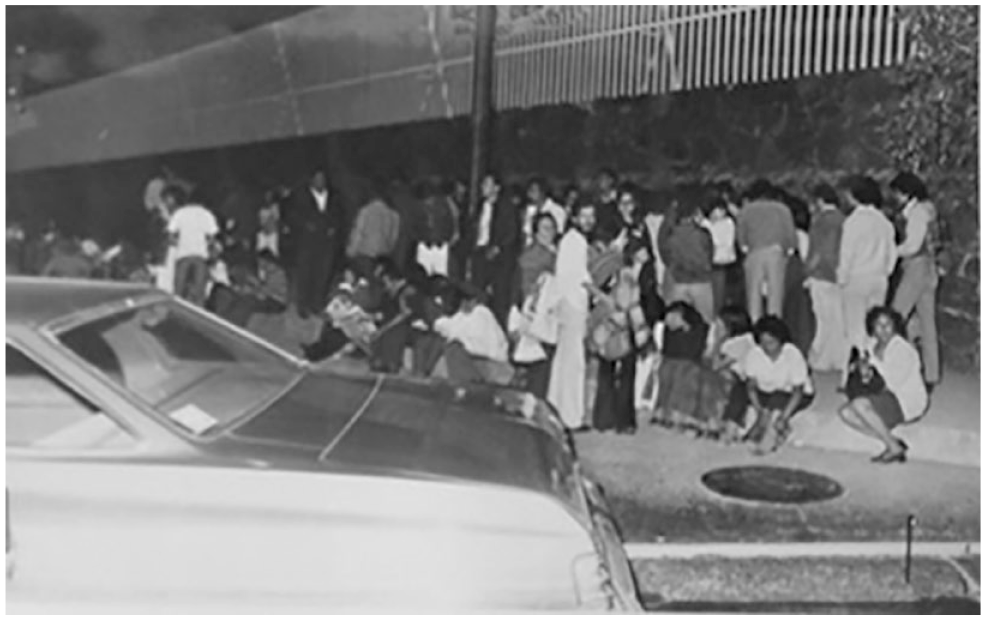
Mitin at Los Pinos, November 1976 (Dirección Federal de Seguridad, 1976a).
Several political forces participated in the gathering, led by the Comité Pro. 7 Activists remained for a whole day outside the presidential residence, asking for a private meeting with him. These kinds of mitin became a central repertoire of human rights activism during the early 1970s, and they condensed a specific affectivity which can be described as the public appearance of a community of victims of human rights abuses getting together to face and denounce the state as the perpetrator of such crimes.
Within the mitines, the hunger strikes held by the Comité Pro through 1976 to 1984 were the most influential action carried out by the committees. I propose that fue el estado draws on the affective potential of ‘active stillness and passive defiance’ from the hunger strikes. Moreover, by tracing the history of the hunger strikes I also want to show how negative affective inscriptions, usually associated with passivity and suffering, can act as a kind of agency, transforming and transmitting memory
The picture above shows a group of women in front of a banner that reads ‘Huelga de Hambre’ (‘Hunger Strike’). They are in the main square of Mexico City on 15 November 1978, at the first hunger strike, organised by the Comité Pro. Those who fasted were all woman, relatives of victims of human rights abuses; fasting simultaneously took place in at least seven other major Mexican cities, as well as in foreign cities such as Los Angeles and Paris. The action scheme of the hunger strike, constructed around the exposure of bodies to power itself, fused vulnerability and strength into the ‘active stillness and passive defiance’ of fasting. For the 15 days that the hunger strike lasted, medical students were in attendance to check participant’s vital signs. By the eighth day there were two women on IVs, and by the end of the strike several participants had been hospitalised. During the 1970s and 80s, from this first hunger strike on, the deployment of the body’s vulnerability in bargaining with the Mexican government would be central; hunger strikes would become a regular action for the committees. Following Butler et al. (2016: 22), we can understand the ‘deliberate exposure to power as part of the very meaning of political resistance as an embodied enactment’. However, as Butler et al. (2016: 22) states, ‘vulnerability is not exactly overcome by resistance’; vulnerability or stillness, as supposed negative affects, are not transformed into happy or positive ones, into hope, celebration or heroic figures. Nonetheless, they act as a kind of agency, becoming ‘potentially effective, mobilising force in political mobilisations’.
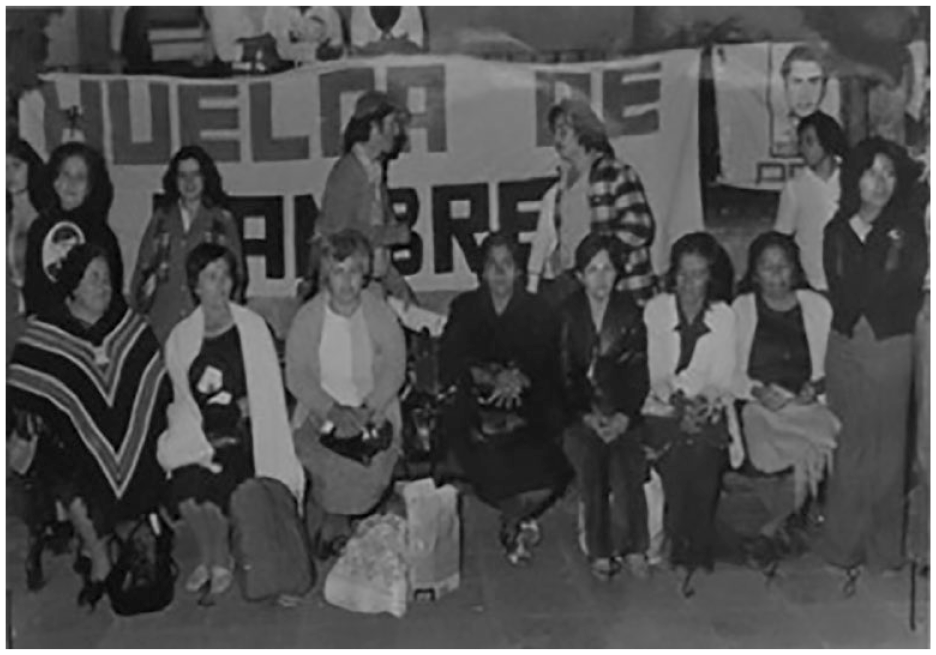
Hunger strike, November 1978 (Dirección Federal de Seguridad, 1978).
Macón (2013) proposes to turn to queer or feminist approaches of affect, namely the works of Ahmed, Berlant and Sedgwick, to understand the logics of agency and victimhood. According to Macón (2013: 16), these authors recognise that the affective is key when assessing political agency, but it is not possible to define affect as an authentic dimension associated with emancipatory possibilities. A queer conception of affect critically assesses affects in political analysis to determine if they are conservative or progressive, getting around the danger of romanticising emancipatory possibilities. In this direction As state by Macon, Ahmed and Berlant, among others, show how negative affects, usually associated with passivity and suffering, act as a kind of agency, while supposedly positive affects, like optimism and happiness, are mainly conservative (Macón, 2013: 16). The human rights discourse and legal framework, with its approach to protection, care and control, compassion and support, is one clear example of the reifications of conservative affects around human rights abuses which need to be critically assessed. Contrary to this idea of ‘victimhood’, one can see how family members of the disappeared become activists and political leaders through vulnerability; the hunger strikes and the passing of the amnesty laws after committee pressure are examples of this.
The readings of Macón (2013) are profoundly productive in the context of activism against human rights abuses, as they abandon the traditional binaries (agency/trauma, past/present/future) by which actors are mainly analysed. Under this queer reading of affects, suffering and trauma could be conceptualised as key to empowerment and agency, without essentialising victims.
In the same direction, Foster (2003: 412) considers ‘active stillness and passive defiance’ not as a state of non-action but rather as a kind of motion, filled with kinetic potential that deepens the sense of participants’ personal political agency. She writes, ‘The process of creating political interference calls forth a perspective and responsive physicality that deciphers the social and then choreographs an imagined alternative.’ (Foster, 2003: 412). The moment when participants in fue el estado hold hands and remain still is a call for agency and action, through stillness and togetherness.
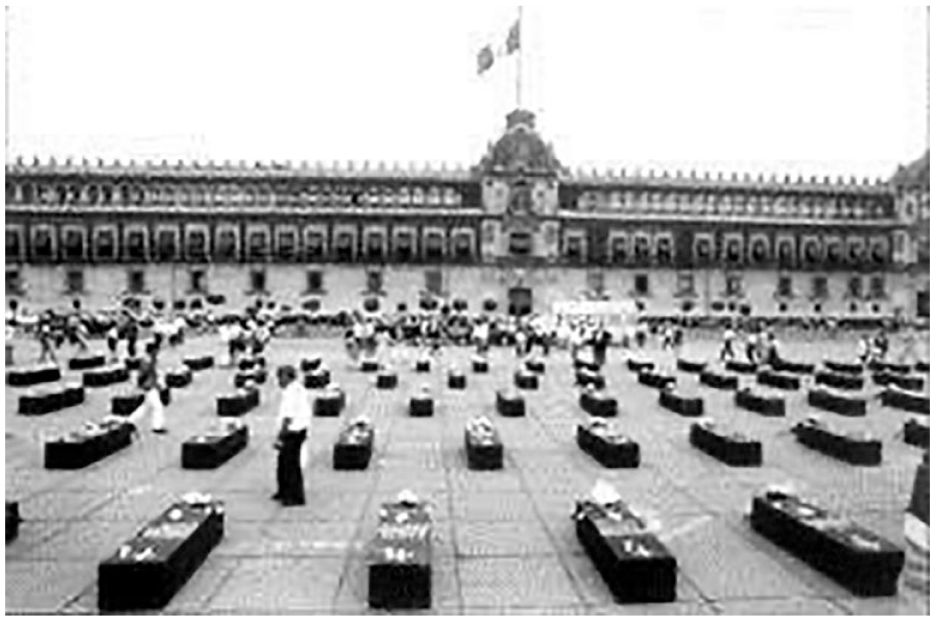
Action at Zócalo, Mexico City, from Guzmán Martínez (2015: 100).
By joining forces and writing fue el estado on the floor, the participants, inadverently, create an extended community of victims of the unsolved violent Mexican history of post-1968 state repression . The strength and clarity of the message, but also its profoundly subversive reading of violence in Mexico (in the context in which the state is gaining legitimacy through the ‘war on drugs’) summons the contesting affective force of the foundations of the human rights movement. Victims’ family members united at the door of the presidential residence in 1976 to unmask the state’s narrative, its denial of the existence of such crimes. The affective force of the enlarged community of victims allowed them to face the state as a perpetrator; in 2014, this affective force is summoned by fue el estado. The foundational human rights movement, its repertoire and its vocabulary allowed in 2014 for an easy and apt explanation of the Ayotzinapa case: it was the state. The historical rupture of the Ayotzinapa crisis, which demonstrated that the affective and conceptual framework of the ‘war on drugs’ was insufficient to deal with the effects of violence, allowed for a non-lineal temporality to be constituted with unexpected links to the 1970s.
The ‘funeral’ repertoire of the late 1990s
I now want to focus on two specific outburst of activism in the late 1990s; in doing so I want to trace the emergence of the specific repertoire of the ‘performative funeral’, and how it might be connected to the organisation of bodies in fue el estado.
On 28 June 1995, in Coyuca de Benítez in the state of Guerrero near the town of Aguas Blancas, 17 peasants were killed and 21 were wounded by members of the state’s motorised and judicial police to prevent them from participating in a demonstration. The peasants were heading to Atoyac de Álvarez, the neighboring municipality on Guerrero’s Costa Grande. There they were going to demand both information on the whereabouts of one of their companions, Gilberto Romero Vázquez, who had been disappeared, and agricultural products for poor families in communities in five municipalities. The massacre happened in the context of increasing tensions in Guerrero around the PRI-led state office and the growing power of the opposite party, the PRD, which, with the support from the OCSS (Sierra del Sur Peasants Organisation), was threatening the status quo of the region. Due to the conflict in the region, there had been five other murders and two disappearances in the month before the massacre (see Gutiérrez, 1995).
After the massacre, victims’ family members started an intense cycle of protest and mobilisation during which a specific type of action was widespread: the ‘performative funeral’. The action started locally, the day after the killings. Press coverage (Medina, 1995) shows how family members protested and marched with the coffins of the dead in the city of Coyuca de Benítez before a private ceremony in their local villages.
Only 6 days later, performative funerals were held in the context of protests in the main cities of the state of Guerrero. In the state’s capital, Acapulco, 4000 people marched with fake coffins marked with the names of each of the dead. In Mexico City similar actions took place, one in which protesters placed black crosses with bags full of earth and veladoras (candles which are paradigmatic of funerals) at the entrance of the Mexican Senate (see Ortega, 1995), and the most significant, when activists filled the Zócalo, Mexico City’s main square, with coffins (Guzmán Martínez, 2015: 100).
The same repertoire was used by activists after the 1997 Acteal massacre. The massacre was a paramilitary raid in the town of Acteal, in the municipality of Chenalhó, located in the Los Altos region of Chiapas in southeastern Mexico, on 22 December 1997. During this incursion, indigenous Tzotziles from the organisation Las Abejas, who were praying inside a small Christian Protestant church, were attacked. The attack resulted in 45 deaths, including children and pregnant women, with the whole community forcibly displaced in its aftermath. While the Mexican government described the massacre as an ethnic conflict between communities, opposition parties and human rights groups saw it as part of a government strategy to dismantle the social base of the town of Acteal, which had close ties with the Zapatist uprising in nearby towns.
The cycle of protest that followed the massacre was also centred around coffins, veladoras, public mourning and the organisation of ‘performative funerals’ throughout the country. Following the real funeral in San Cristobal de las Casas, in Chiapas, which was highly mediatised and reported, similar actions were organised in Mexico City. Human rights organisations and protesters organised a funeral simulacrum for the victims of the massacre in different public spaces (see García, 1997b; González, 1997; Rodríguez, 1997); likewise, actions were also reported (García, 1997a) in the city of Monterrey.
The artistic group Proceso Pentágono, founded in the late 1970s which had a great concern about the role public space and social demands in the development of their artwork, organised a ‘performative funeral’ in the Zócalo at the end of 1997. They created a circular set of adult- and child-sized coffins, one for each of the dead, filling them with earth, names and sometimes images of the victims. An inner circle was created, where passersby and activists left flowers, messages and candles.
The set-up in all these actions is that of the classical Mexican funeral, with coffins, candles, crosses and the community gathered to mourn, only that in the case of the performative funeral, the community is extended to the general public: by bringing the funerals to the public space, victims’ relatives and human rights activists were addressing the state as responsible for those deaths, and calling the attention of the public to this. Pamphlets and banners demanding ‘justice’ or with phrases like ‘Murderer and coward government’, ‘Zedillo’s responsible for the massacre’, ‘State: Stop with the massacres!’ were part of the funeral performances too (see Martínez Suárez et al., 1997; Ramírez, 1998; Tellez, 1995).
I want to focus on the bodily organisation of these ‘performative funerals’ to show how the organisation of bodies in fue el estado stems from the aforementioned repertoire, at the same time substantially transforming it.
The above image shows a painting of one of the many Acteal funerals (Ruiz-García, 1998: 20). The community surrounds the coffins and the ever present veladoras complete the scene. The still from the video of Fue el Estado’s action (below) also shows the configurations of a space of public mourning, where the community gathers and lights candles in a funeral-like fashion. The passivity, the silence, the enlarged community, all factors seen in the repertoire of the 1990s, are also present.
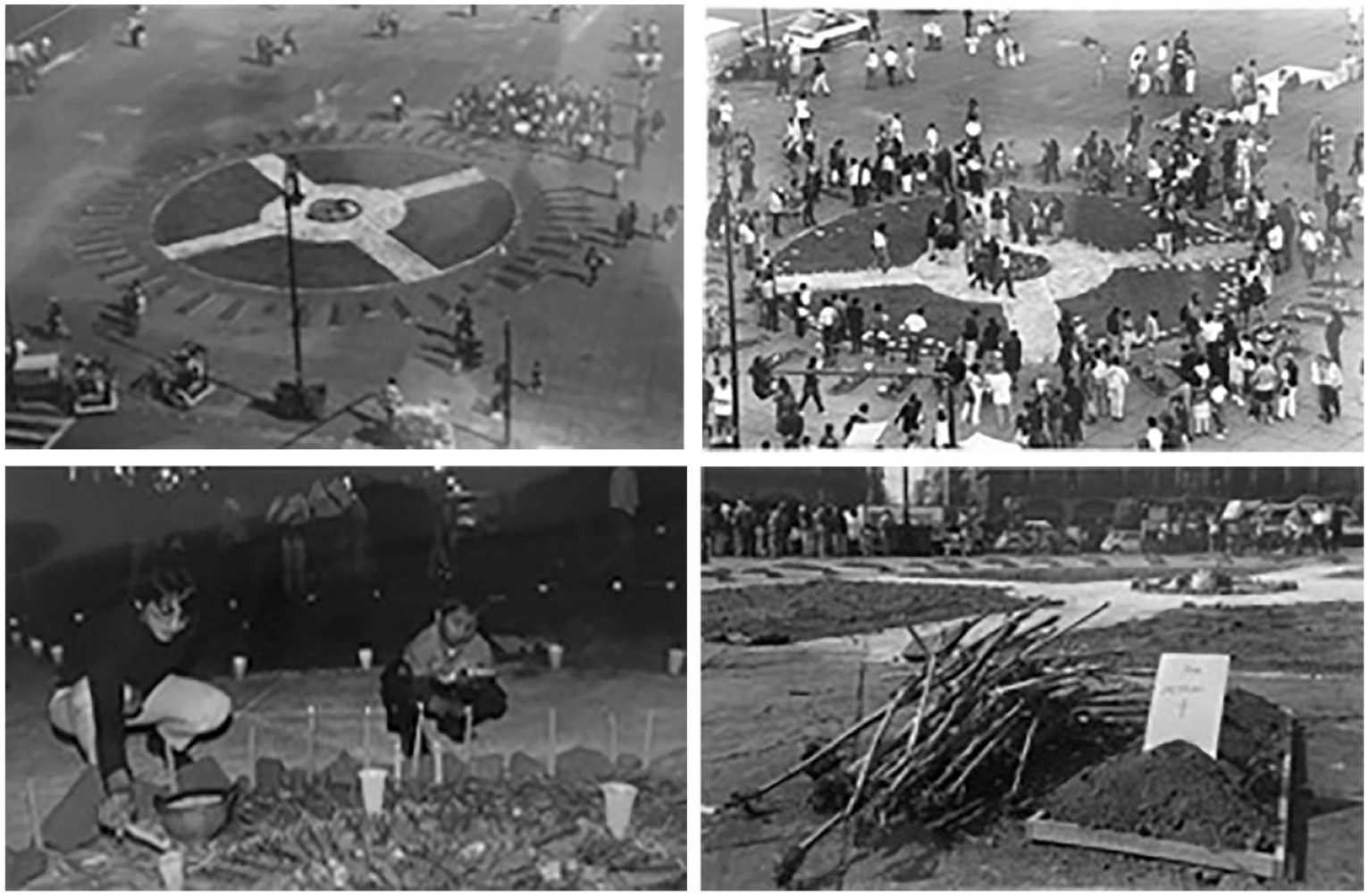
Action for Acteal at the Zócalo, Mexico City (Anon, 1997).
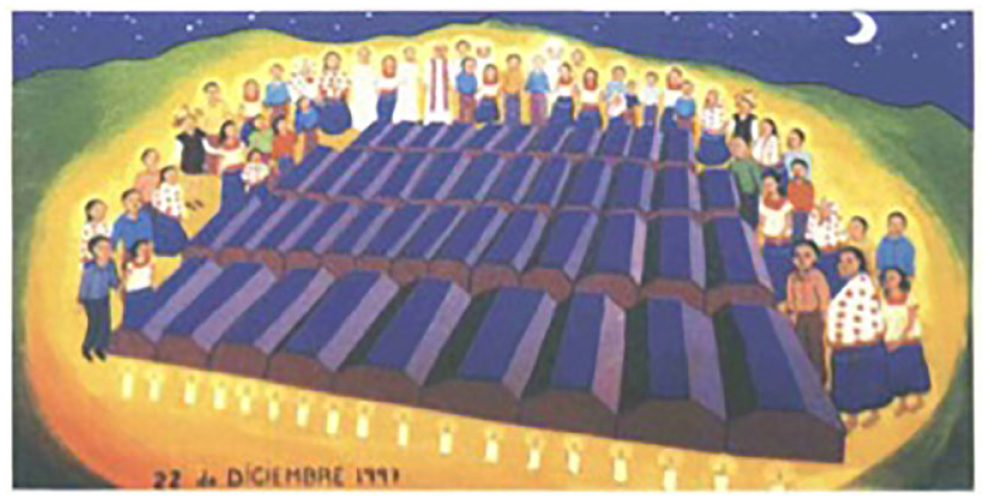
Drawing of the funeral for Acteal’s victims (Ruiz-García, 1998: 20).
However, the coffins are missing. The crime of enforced disappearance, with its particularity of the lack of victims’ bodies, creates a void that transforms the repertoire. If the bodies are absent, if the demand is ‘We want them alive’, who then does the community mourn? I argue that the conceptual crisis that enforced disappearance entails as a crime causes the public to replace the victims’ bodies with the death of the teleological narrative of democratic progress of the Mexican state. ‘It was the state’ is then not only a tag, a phrase that assigns blame, but becomes the epitaph of a narrative arc that has failed; the citizens, therefore, stage its funeral. As I have shown, the Mexican state constructs a narrative of itself as ’more democratic’, ’more safe’, specifically since the ’democratic transition’ of 2000 and the fighting of the ’war on drugs’, ’Fue el Estado’ proposes a temporality that is non-lineal, non-progressive, but that on the contrary, it cyphers the PRI-PAN ruling as a strechted-out failure. In this sense, the funeral is staging the end of the legitimacy of the Mexican state in the fighting against dissidence and narco criminality.
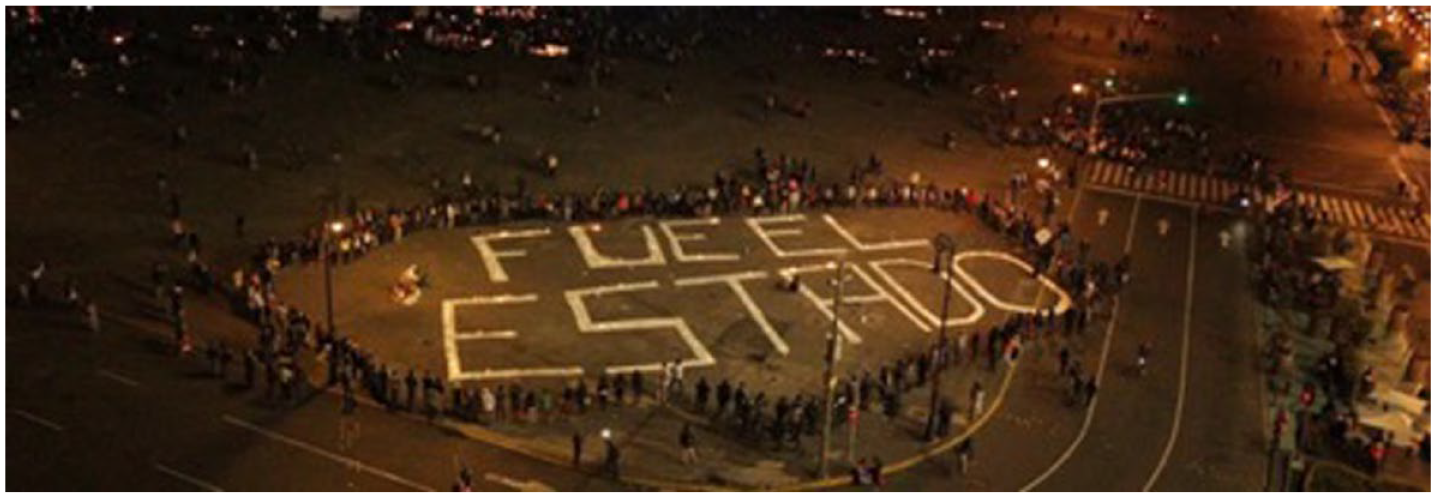
Fue el estado action (taken from Rexiste.org 12/5/2020).
I argue that the state’s funeral is an embodied practice of memory; it is a summoning through affects (mourning, togetherness, defiant passivity, vulnerability – past repertoires), altogether transforming them. Coming back to the re-temporalising function of memory, we could see the creation of a non-teleological temporality, where the unresolved violent past re-emerges to stage the death of the state. The committees of the 1970s, the activism around Aguas Blancas and Acteal, and the Ayotzinapa massacre are set in a continuous present, the perpetrator named and blamed and the community of victims enlarged.
Conclusion: Present–present
Embodied practices of memory, as a mnemonic affective inscription, one which remains and endures, are exteriorised in a particular actions, yet refer to more-fundamental affections. These practices of memory not only condense and transmit specific meaning, specific constructions and affections, but at the same time negotiate a new relationship between the past, the present and the future.
Fue el estado was one action among thousands amidst the cycle of protest for Ayotzinapa. Focusing on its kinaesthetics has allowed me to delve into certain affects stemming from participants’ corporeality, presence and agency, which I have traced back to the human rights committees and the activism of the late 1990s. I argue that this community of activists survives affectively beneath the images and aesthetics circulating among the Ayotzinapa cycle of protest.
After the almost complete supremacy of the PRI in Mexican presidential elections, on 1 December 2018 Manuel López Obrador (known as AMLO), of the Morena political party, took office in Mexico. At the voting booth, AMLO voted symbolically for someone who was not running for president. He had placed a picture of Rosario Ibarra de Piedra on his envelope (Rodríguez García, 2018). Rosario Ibarra de Piedra, mother of Jesus Ibarra de Piedra, who was disappeared in 1974, is one of the founders of the Comité Pro. I find this sequence highly representative of the hypothesis of this article. It has been discussed how much the Ayotzinapa crisis helped AMLO to win power, with Mexicans tired of the PRI’s handling of the country’s violence, along with the former president’s other major political scandals. In the paradigmatic moment of the casting of votes, AMLO, the personification of the new state, who at that point was already the clear winner, cast his vote for Rosario Ibarra de Piedra; that is, cast his vote for the history of the Mexican human rights movement, bringing the committees to the present. Ayotzinapa as an event, thanks to the conceptual and phantasmagoric power of the crime of enforced disappearance, re-configurated Mexican temporality, allowed past activist repertoires to emerge and radically ‘highjacked’ the legitimacy of the Mexican state in fighting against dissidence and narco criminality.
Supplemental Material
sj-pdf-1-mss-10.1177_17506980211017959 – Supplemental material for Fue el estado (‘It was the state’): Embodied practices of memory and the re-writing of Mexico’s genealogy of violence
Supplemental material, sj-pdf-1-mss-10.1177_17506980211017959 for Fue el estado (‘It was the state’): Embodied practices of memory and the re-writing of Mexico’s genealogy of violence by Martín Zícari in Memory Studies
Footnotes
Funding
The author disclosed receipt of the following financial support for the research, authorship, and/or publication of this article: This project has received funding from the European Research Council (ERC) under the European Union’s Horizon 2020 research and innovation programme (grant agreement no. 677955).

Supplemental material
Supplemental material for this article is available online.
Notes
Author biography
References
Supplementary Material
Please find the following supplemental material available below.
For Open Access articles published under a Creative Commons License, all supplemental material carries the same license as the article it is associated with.
For non-Open Access articles published, all supplemental material carries a non-exclusive license, and permission requests for re-use of supplemental material or any part of supplemental material shall be sent directly to the copyright owner as specified in the copyright notice associated with the article.
