




Abstract
What does it mean to represent trauma, heritage and/or terror-related landscapes in the present day? This article aims to offer a new perspective on the ability of such representations to initiate a journey by means of artistic creation; the author refers to such artworks as ‘Artscapes’, claiming that Artscapes make feasible a seemingly contradictory act: on one hand, ‘time travel’ that assists in commemorating the past(s), and on the other, ‘space travel’ that has the ability to challenge collective memories, narratives and even myths associated with that past(s). By focusing on a growing trend towards diasporic Artscapes within Israeli art as a test case of this genre, the article explores the potential possessed by such works to negotiate ‘diasporic memories’ within Zionism’s national ethos.
(Re)Turning to Europe, appropriating its landscapes
In many senses, despite a long-standing ‘invisibility’ (Katz-Freiman, 2003; Manor, 1998; Rosen, 1996), the Holocaust has always been present in Israeli art, as has the pre-Holocaust European Diaspora (Manor, 2015). However, it is only since the turn of new Millennium that a definite artistic diasporic turn can be identified. This turn has been characterised by the (re)turn of leading Israeli Jewish artists – the majority of whom come from Ashkenazi families with roots in pre-1945 Europe 1 – to Central and Eastern Europe. Such direct encounters have made these landscapes highly visible in the works of contemporary Israeli artists, who photograph them, map their topography, search them for archaeological artefacts, work with archival sources, paint them, perform on them and interact with local residents. The resulting works generally involve the landscapes of Germany and Poland, although ‘new’ landscapes are constantly ‘(re)discovered’ as Europe experiences a geopolitical shift towards Eastern Europe (van der Laarse, 2013). But why European landscapes? What is found (or found absent) in them that is so intriguing to Israeli artists? Bearing in mind that European landscapes still hold an iconic status in western memory culture (Zelizer, 1998), and within Israeli politics (Raz-Krakotzkin, 1993), the immediately obvious answer is that by (re)presenting European landscapes these works commemorate the pre-1945 Jewish past, in particular the Holocaust. But why then do images of contemporary landscapes, with no explicit connection to Jewish history, appear in such works, alongside landscapes with clear links to the Holocaust?
With studies on the phenomenon of Israeli emigration to Europe already available (Atshan and Galor, 2020; Cohen and Kranz, 2018; Hochman and Heilbrunn, 2018), and memory studies assured of its place in Israeli academia, it is somewhat surprising that this bottom-up phenomenon in Israeli art has not yet been thoroughly examined in either national or transnational contexts. This is especially intriguing when one considers the intensified academic discussion around Holocaust representation, as well as the more specific aspects of representing this memory in ‘memorial museums’ (Williams, 2007) or ‘trauma site museums’ of terror (Violi, 2012) – a discourse that has taken a huge spatial turn in light of Nora’s (2001 [1984]) work on the French lieux de mémoire. While it is debatable whether that turn arrived late in Jewish studies, or actually reached the field long before the 1980s (Brauch et al., 2008; Shiff, 2015), contemporary studies propose thought-provoking invitations to reassess the notion of ‘diasporism’ in respect to Jewish identity. Above all else, such studies offer to view the Diaspora not only as a place or as a cultural landscape but also as an aesthetic condition (Baronian, 2015; Kirshenblatt-Gimblett and Karp, 2008) of implicated subject positions (Rothberg, 2019). Through this prism, the resources of diasporic spatiality have the potential to inspire much more than a ‘simple’ commemoration of a past that has ceased to exist – as Zemel (2008: 176) points out, ‘unlike the effort of contemporary Israeli art to distinguish itself among national cultures, diaspora art has a very different project: to push at or interrogate national cultural limits and to embrace or transmit its fluidities’. It therefore seems logical that the recent turn in contemporary Israeli art has the same potential for fluidity.
Exploring this diasporic turn within Israeli art, this article introduces the concept of ‘Artscapes’ as a key element within this critical process. I define Artscapes as artworks born out of a physical encounter with a heritage and/or terror-related landscape that evokes traumatic memories, in which that landscape is appropriated (as either image or material). Thus, Artscapes always fulfil two basic conditions: a concrete physical encounter of the artist with a landscape of traumatic memory, and an artistic encounter that makes that landscape the ‘star’ of the work (even if people appear in the image). On this basis, the potential of Artscapes lies in their ability to take that landscape on a ‘journey’ through time and space in a manner that brings the past into the present, thereby allowing us to begin reflecting on the possibility that this genre is able to (re)present modes of implication that go well beyond the black-or-white categorisation of victim/perpetrator (Rothberg, 2019). After all, if images can ‘migrate’ (Ebbrecht, 2010) and memories can ‘travel’ (Erll, 2011), then why would landscapes not share these fluid capabilities?
In order to delineate the scope of spatial appropriation offered by Israeli Artscaping artists as well as to learn more about its potential, an examination of Israel’s tangled relationship with diasporic spatiality – a complex relationship that plays a significant role in Israeli Jewish identity – is required. It is imperative to look at the ways in which memories, and to some extent what Hirsch (2012) calls ‘postmemory’, associated with pre-1948 Jewish diasporic spatiality in Europe are ‘hijacked’ in the Israeli public sphere for nationalist purposes beyond Holocaust commemoration (van der Laarse, 2013). To illustrate this process, I draw on Rob van der Laarse’s work on Europe’s many terrorscapes; namely, landscapes that were the site of violence and terror, and which consequently trigger memories and narrative struggles that are used – and sometimes abused – by various appropriators for a variety of reasons; the framing of such landscapes according to specific ‘spacetime’ settings of terror leads to a situation in which traumatic memories compete with other memories, the latter often being left with no room to be collectively remembered and commemorated within the public realm. Thus, terrorscapes are fundamental to Artscapes (they already resonate within the concept), for terrorscapes encourage us to examine the ‘spacetime’ use of ‘past-landscapes’ and their associated memories and narratives in political debate and contemporary culture, as well as their historical, religious and symbolic meanings (van der Laarse et al., 2014).
Reflecting on Israel’s terrorscape politics, the article reveals the tangled here–there relationships at its core that participate in shaping Israel’s approach towards both biblical Zion (here) and the European ‘landscapes of the Holocaust’ (there). Against this theoretical background, a more detailed and descriptive exploration of the strategies employed by Israel’s Artscaping artists refers to selected works. This exploration demonstrates how diasporic landscapes function not only as the material representation of the Jewish traumatic pre-1948 past but also as a material – even a medium (Mitchell, 2002) – implicated in Israel’s terrorscape politics within this here–there frame (Rothberg, 2019: 119–145). In other words, it shows how diasporic Artscapes commemorate the Holocaust due to their spatial quality but can also appropriate the same ‘spacetime’ landscape as a ‘hijacked’ and abused material in the form of traces of old Europe’s antisemitic spaces and, in the process, challenge Zionism’s associated memories, narratives and myths. This will shed new light on the role Artscapes have in – and for – (post)conflict societies.
Israel’s tangled here–there relationship
Many scholars point to the role the Jewish Diaspora in pre-Holocaust Europe plays in the collective Israeli imagination (Shiff, 2015),
2
yet academic research on the issue tends to ignore that in spoken Hebrew, this huge spatiality has been ‘compacted’ into the portmanteau term ‘there’ (sham), meaning: in that place. To complete the equation, there is often contrasted in Hebrew with the word ‘here’ (kan) – in this place, synonymous with Zionism’s national landscape, realised in the post-1948 State of Israel.
3
Evidence of the political instrumentalisation of this here–there relationship appears as early as Israel’s 1948 Declaration of Independence:
The catastrophe which recently befell the Jewish people – the massacre of millions of Jews in
It is already clear in this founding document that the distinction between there and here is not only geographical but also bears an emotional signature that allows diasporic spatiality to be appropriated for Jewish ethno-political purposes. To be sure, given the significance of the Exodus story to Jewish memory (Assmann, 1998), Israel’s tangled here–there relationship has a much longer history than the Jewish State or Zionism – indeed, performing liminality as a formative event is an important halakhic value of Judaism (Hasan-Rokem, 2012). One example of the expression of this is in the different ways Jewish holidays are celebrated in Israel (here) and the Diaspora (there); for instance, Yom tov sheni shel galuyot (‘the second festival day in the Diaspora’) – an extra day added to the holiday in the Diaspora due to its geographical distance from Jerusalem. The distance from Jerusalem has also often found material expression within the liturgy of the feast days, as in the case of the Hanukkah dreidel (i.e. the holiday’s iconic spinning top) – a tradition originating in Germany. Symbolising the miracles of the victory over Antiochus and the prodigiously enduring cruse of oil experienced in Zion’s Jerusalem, the Hebrew-Yiddish letters on the ‘diasporic’ dreidel served as an acronym for the Hebrew words: Nes Gadol Haya Sham (‘A great miracle happened there’). Yet, with the strengthening of the Jewish Yishuv (settlement) in pre-1948 Israel in the early twentieth century, the letter Shin (ש) was replaced with the Hebrew letter Pei (פ), signifying that ‘a great miracle happened
Inextricably linked to nineteenth-century Europe – the birthplace of political Zionism, and the landscapes on which the belief in a Jewish ‘return’ was assigned its ethno-territorial meaning, yet also the home of the widespread antisemitism that culminated in the Holocaust – the metamorphosis of European pre-war Jewish spaces into the setting for the greatest trauma in Jewish modern history ensured that the Diaspora functions as a collective spatial marker of past(s) crucial to the construction of Jewish social belonging to post-1948 Israel as a new-biblical heritagescape (Stiassny, 2020). Correspondingly, reference to the Diaspora as a spatial carrier of traumatic memories that must be rejected yet remains essential to the evocation of a biblical memory has become a fundamental part of the Israeli indoctrination experience. One example of the framing, or even sentimentalised staging, of the diasporic spatiality in the Israeli experience is the youth voyages to former Nazi extermination camps and other heritage/atrocity sites in Poland, known as ‘roots-journeys’ (Masa Shorashim). These voyages are designed to memorialise the Jewish past and to commemorate the Holocaust. However, keeping in mind that heritage is never neutral, but is made by someone, and for someone (Kirshenblatt-Gimblett, 1998), especially heritage that is a product of war and conflicts – in this case, heritage that participates in the transformation of ‘holocaustic’ landscapes into tourist terrorscape-destinations (Kirshenblatt-Gimblett, 1998; van der Laarse, 2013, 2018) – the in-situ encounter with European landscapes included in Israel’s many roots-journeys can also be interpreted as nationhood (re-)appropriation by the national community of Jewish survivors. As part of this ‘pilgrimage of national identity’ (Feldman, 2008: 254), diasporic landscapes are consumed and reclaimed by acts such as the carrying of Israeli flags by the youthful participants. The curation of the on-site walking route fulfils the same purpose; alongside security regulations, the corporeal performance of mass ‘togetherness’ isolates the voyagers from their contemporary Polish surroundings (Feldman, 2008: 257). Performed and gazed at in a limited context of the pre-1948 Jewish reality, and supported by an emotive redesign of the multilayered spatiality according to a Jewish national narrative, Polish landscapes have become an ‘extension of the classroom’ 5 ; as Israelis walk in the footsteps of their murdered forebears there, re-discovering their private and collective past(s), the imbuing of national symbols with value and emotion reinforces forms of social solidarity. As a result, these roots-journeys define ‘the borders of the national collective vis-à-vis the non-Jewish/Diaspora other’, making the voyagers ‘witnesses of witnesses’ here in the present (Feldman, 2008: 3, 258). 6
Another example of the ‘hijacking’ of (post)memories associated with the pre-1948 Jewish Diaspora in Europe from the individual to the Israeli collective realm is the Eichmann trial (1961–1962). Often considered the first transition from ‘communicative’ into ‘cultural memory’ (Assmann, 2008) within Israel’s collective memory, the trial underlined the difference between the exilic past and a present in which Israel existed as the Jewish homeland (Kenan, 2003). However, when viewed through a landscape prism, it was not the trial itself but the decision not to bury Eichmann’s ‘unholy body’ in the ‘holy’ Zionist landscape that best demonstrates how diasporic spatiality is perceived in Israel. Instead, following Eichmann’s execution, his body was cremated, and the ashes scattered beyond Israeli territorial waters – a course of action widely perceived as an act of revenge in the name of all Jews burned in Nazi crematoriums. Like the decision to transport human bones and ashes from extermination camps to Israel for burial, this choice is a good (counter-)example of the Zionist wish to nationalise ‘its’ landscape, morally contrasting the here-landscape in which one must be worthy of burial with the there-landscape from which Eichmann and his ilk sprang.
The examples mentioned above illustrate Israel’s national framing of Europe’s many landscapes as a monolithic, immoral spatiality of atrocities, offering the Israeli public one generic, all-inclusive diasporic there, where neither Jewish existence nor even Jewish death is ever truly secure. The framing of the Diaspora according to one iconic period, which stands in stark contrast to the divine promise of inheriting the Holy Land, renders those ‘landscapes of the Holocaust’ terrorscapes that are required to justify post-1948 Israel, itself a multitude of terrorscapes lying at the centre of the Israeli Palestinian Conflict. In other words, while everything reminiscent of ‘Diaspora’ has a negative ‘charge’ in the Israeli mindscape (Shiff, 2015), diasporic landscapes aid Israel in justifying the Zionist political path in Israel/Palestine and ‘whiten’ the Israeli failure to ‘expand’ Holocaust memory towards a more pluralistic, multidirectional approach that embraces coexistence, especially as regards the Palestinians (Rothberg, 2011, 2019). Accordingly, this tangled here–there relationship is the key to comprehending Israel’s terrorscape politics: the Holocaust is not only a past trauma that needs to be commemorated (there) but also a place-making tool to be (ab)used in Israel/Palestine (here). For this reason, the ‘landscapes of the Holocaust’ cannot be confined exclusively to the historical period they reference, but must always return to the nineteenth century, when the Zionist movement formulated a there counterpart to the national landscape of here (Bashir and Farsakh, 2020; Stiassny, 2020).
Multiple here–there relationships: internal here–there complex versus external here–there complex
Considering the Germanic geocultural background from which political Zionism emerged, in its characterisation of the Jewish ‘return’ Zionism has also projected its own internal here–there complex, complicating matters further. This is why Zionism’s internal here–there complex should be evaluated with the nineteenth-century German Empire’s ‘fatal attraction’ to ‘its’ ‘Nordic’ landscapes in mind (van der Laarse, 2015). Seen in individuals as early as the 1870s (e.g. Simcha Südfeld’s adoption of the ‘Nordic’ name Max Nordau; van der Laarse, 1999), 7 Germany’s fascination with ‘Nordic’ landscapes (Wilson, 2012) echoes the views of those who guided the Zionist movement’s political side, who saw Zionism’s internal here in Germany’s new national landscape. 8 Accordingly, akin to Nordau’s denial of his own Ostjuden-‘hidden’ Jewishness (van der Laarse, 1999), Zionism’s internal there came to be represented by everything not included in the Germanic here and, in particular, by Eastern Europe. This German Zionist patriotism with its anti-Polish attitude translated into the Zionist approach towards ‘its’ ‘biblical landscape’, viewed as an exclusively Jewish heritagescape (Stiassny, 2020). As a result, the same fatal attraction to a so-called ‘authentic’ national landscape – linked to a unique, highly specific, collective heritage that guided the new German Empire (1871; Wilson, 2012) and later drove the Nazi (re)branding of Eastern occupied territories as part of a much older German Heimatscape (van der Laarse, 2015) – gave birth in Israel to the same pre-Holocaust division between east and west that masked the ‘other’ within the Jewish diasporic community (Stiassny, 2020; van der Laarse, 1999).
Influenced by Romantic imagery, this division was expressed in the Zionist response to rising antisemitism and the failure to assimilate in pre-war Europe; rather than give up on being Jewish, the Zionist answer was to ‘improve’ the existing Jew. Zionism’s New Jew, configured in the mould of the Jewish German pioneer/soldier (here), became the embodiment of Nordau’s ‘making of the Muskeljudentum’ (van der Laarse, 1999). Like his German counterpart, the New Jew had to ‘fight’ against the internal (there) enemies who (allegedly) prevented ethno-uniformity (here). Correspondingly, while certain Holocaust landscapes are more deeply embedded in Israel’s collective memory than others, perceived almost exclusively in the spatial context of Germany and Poland, 9 Zionism’s tangled here–there relationship, as both internal and external complexes, continued to shape the Jewish attitude towards the Diaspora after – and because of – the Holocaust. Divided according to an inconsistent hierarchy of victimhood, with Nazi death camps primarily located in Poland, Germany’s prioritisation as the Romantic birthplace of Nordau’s inner-here and the backdrop to the evolution of the idea of ‘return’ to an external-here has cast Poland’s post-war national landscape as the ‘lower’ ‘corporeal’ representation of both the external- and internal-there. The Polish national landscape – in fact, the entire Eastern occupied zone – became a Jewish synonym for the ‘biggest Jewish graveyard’: Auschwitz. The ‘passive’, ‘weak’ Old Jew of Eastern Europe is symbolic of the essence of the spatiality thus incorporated – spatiality with which political Zionism did not wish to be identified, but simultaneously needed in order to configurate itself (Shiff, 2015; Shohat, 2017).
The Cold War–shaped geopolitical reality, in which Israel generally had very poor or non-existent diplomatic relations with Iron Curtain states, also contributed to Israel’s here–there terrorscape politics. Unlike its Eastern neighbours, which did not have decades of collective memory experience to match western Holocaust education (van der Laarse, 2013), West Germany publicly supported the young Jewish state, its actions gradually building the impression that Germany had taken full responsibility for past crimes. 10 In parallel, while eastern European Jews were perceived as Old Jews, Jews from Arab countries were too similar to Zionism’s ‘external’ enemy (i.e. Palestinians and Arabs), making them an even lower there. To differing degrees, both ethnic groups – representatives of the ethnic diversity of the Jewish collective – stood as testament to what Nordau understood as social and cultural degeneration (Entartung) but was in truth a manifestation of his own self-hating Jew complex (van der Laarse, 1999). As a result, the tensions that existed in Nordau’s own identity continued to leak into biblical Zion, shaping Zionism’s national landscape de facto.
Given that the belief in landscape authenticity has yet to complete the de-Nazification process (van der Laarse, 2015), these here–there tensions have defined the borders of the collective Jewish Zionist landscape on one hand, and the Israeli identity on the other, aiding in the establishment of an unbending hierarchy of social organisation. Biographical links to pre-war Europe determined who ‘belonged’ to the national landscape and might therefore settle in big cities or on the Kibbutzim, rather than in poorer, marginal ‘development towns’, with the result that around 700,000 Palestinians were pushed out of the Zionist landscape amid the destruction of around 530 Palestinian sites in an ongoing process, known to many today as al-nakba. Much has been written about the consequences of continuing al-nakba and how it still shapes the modern Palestinian – and Israeli – imagination (Bashir and Farsakh, 2020; Bashir and Goldberg, 2018; Sa’di and Abu-Lughod, 2007; Saloul, 2012; Shohat, 2017). What is crucial to our discussion is that as a result of the physical and symbolic appropriation of land that forms Israel’s terrorscape politics, the Palestinian landscape(s) has become a fragmented ‘diasporic’ there as well: on one hand, a Palestinian landscape(s) that constitutes an external there
On such grounds, where pre- and post-war here–there tensions continue to shape both Israel’s authorised heritage narrative and its landscape ‘makeability’, multiple manifestations of here and there, both within and outside Israel, can be identified: here Israel versus there Diaspora; here Germany versus there Poland (New Jew vs. Old Jew); here Ashkenazi Jews versus there Mizrahi Jews; here Israelis versus there Palestinians; here Israel as far as the Green Line versus there the settlements/the Palestinian Occupied Territories; and finally, here Israel and there ‘Israeli-Arabs’ and their ‘forgotten’ spaces within Israel. This spatial complexity shapes – and is shaped by – Israel’s local politics, in accordance with the dynamics of Holocaust memory on one hand, and of the Israeli Palestinian Conflict on the other, for without a there spatial-biography as a backdrop, the Israeli here landscape biography cannot be (re)written (Stiassny, 2020; van der Laarse, 2018). The same here–there complexity, however, also shapes – and is shaped by – Israeli art.
Towards a diasporic turn
While the nineteenth-century Jewish Zionist Germany-focused Oedipal complex found its visual expression in early Israeli art, creating a legacy of German Jewish Romantic representation that depicted the figure of the pioneer/soldier or the biblical landscape, sometimes both (Ofrat, 2009), following the Six-Day War (1967) and the Yom Kippur War (1973), and the resulting annexation of territories, Israeli artists began to refuse to contribute to the construction of an emotional legacy of a modern Jewish ‘return’. Such artistic ‘demands’ had appeared before the 1970s (particularly in Hebrew literature), but for the visual arts, the 1970s mark an iconic ‘spatial turn’ (Ginton, 1998). Instead of producing Romantic depictions of the Land of Israel that reinforced Zionism’s national narrative, as was generally the case up until that time, leading Israeli artists of the 1970s left their ateliers to meet the local here–theres and the associated histories that emotionally shaped their own private and collective identities. Confronting the visual legacy of Israeli art’s founding fathers, including the after-effects of the national propagandisation of the figure of the macho-fighter New Jew, this decade is considered the beginning of a visual and material opposition to the here–there within Israel/Palestine. One example that should be mentioned here, often considered the peak of this formative period, is the series of actions, installations and performances that took place in 1972 between the Israeli Kibbutz Metzer and its neighbour Arab village Messer, known as the ‘Metzer-Messer events’. As part of these events, leading Israeli artists (among them Avital Geva, Moshe Gershuni, Micha Ullman, Nahum Tevet, Dov Or Ner and Yehezkel Yardeni) gathered to rethink the role of the Israeli artist. One specific action, which would become a defining moment in the short history of Israeli art, involved Micha Ullman, who – with the help of youth from both sides – exchanged soil between the Kibbutz and the Arab village. The changing of soils re-materialised the partnership between Palestinians and Israelis and at the same time de-materialised its feasibility. The rich visual (and spatial) heritage left to Israeli art by the post-1967 artistic generation includes references to the Palestinian Occupied Territories, refugee camps, Israel’s (unstable) borders, and images of East Jerusalem or the Golan Heights. Images of Old Jews and Mizrahi Jews can also be found (though in comparatively meagre numbers). This continues in critical representations of heritagescapes within Israel, especially those associated with heroic Zionist myths. The result was an engagement with a so-called ‘biblical landscape’ already turned to ‘scar tissue’, to borrow W.J.T. Mitchell’s (2002: 20) description. And as this internal here–there confrontation firmly established itself on a regional level in Israeli art, Israeli artists were ready to confront similarly tangled here–there relationships on a transnational level, through the representation of European landscapes.
To some degree, the first signs of this turn began to appear in the period surrounding the assassination of PM Yitzhak Rabin (4 November 1995), with the globalisation of Holocaust memory on one hand and the failure of the Oslo Accords on the other. During this period, the presence of Holocaust-related imagery intensified in the Israeli public sphere, especially in the context of the Israeli Palestinian Conflict. 11 In response, Nazi-related iconography established itself within Israeli art (Stiassny, 2018a). Around the same time, with Germany marking the 50th anniversary of the liberation of the Nazi camps, Israeli art received its first ‘green light’ to (re)turn to Europe. The new challenges facing the German nation were met by representatives of the victims, as leading Israeli artists, most with a strong personal connection to pre-1933 Europe, were invited by the newly unified Germany to submit proposals for the design of Holocaust memorial monuments (e.g. Micha Ullman’s A Memorial for the Book Burning (1995) at Berlin’s Bebelplatz; Breitberg-Semel, 1995).
Setting aside the monuments – as a form of public art, they have their own ‘texture of memory’ (Young, 1993) – the first disorganised wave of a physical (re)turn to Europe should be dated to the same period, when Holocaust landscapes started to appear in artworks created primarily by Second-Generation Israeli artists (e.g. Simcha Shirman or Ha’im Maor), although in some exceptional cases this occurred even earlier (e.g. Moshe Gershuni’s Europe (1980)). To some extent, it is possible to argue that the memory of the Diaspora has loomed over Israeli art from the very beginning (Manor, 2015). 12 However, it is only since the 2000s, in the wake of the Second Intifada (2000–2005) and the maturation of ‘third generation’ artists that a growing trend towards representing the ‘landscapes of the Holocaust’ in Israeli art can be clearly identified as a genre based not solely on personal (post)memory, despite being created primarily by artists with a family connection to Europe. 13 Meeting with European landscapes – terrorscapes that play an important part in Israeli identity – the phenomenon of Artscapes began to take form.
Time travel: commemorating the past
After years of Israeli art researching, examining, confronting and challenging Israel’s terrorscape politics within the local context of Israel/Palestine, diasporic landscapes have entered the mainstream of Israeli art in the form of Artscapes. While Artscapes allow multiple entry points to European landscapes that are unique to the individual artist and the medium in which they choose to work (in relation to their family history, their experiences, the story they want to tell), on a more collective level, these traumatic European landscapes function as a meeting point for many leading Israeli artists. By physically being there, and artistically appropriating such there-landscapes, this phenomenon inhabits the spaces of the former Jewish diasporic community in Europe, thereby commemorating the Holocaust and the Jewish loss.
David Campany (2008) argues that in order to differentiate themselves from the rapid flow of images in an era of visual inflation, contemporary photographers are forced to arrive ‘late’ at the ‘event’, when the crime has already been committed. Following on from Campany, Donna West Brett (2016) compares this situation to the experience of ‘astigmatism’ – although the past may fall beyond the range of sight, it nevertheless leaves ‘something’ in the (diasporic) landscape, as does the artist, when he or she creates a tension between what appears ‘within the frame’ and what remains ‘outside’. This paradoxical viewing experience of gazing at a landscape in the present while ‘(un)seeing’ traces of its past resonates with post-traumatic memory and its dissociative experience (Stiassny, 2018b). Intensifying this line of thought in light of the temporal distance of the Holocaust and the impossibility of Israeli artists being present at the moment of the crime (i.e. the Holocaust), but instead arriving ‘late’ in Europe, imprisons symbolic traces of the Jewish traumatic past within diasporic landscapes, particularly when many such landscapes do not physically match Israeli preconceptions of their iconic, memorialised appearance. To overcome this distorted gaze, as part of their aspiration to commemorate the Holocaust, Israeli Artscaping artists ‘transport’ the ‘past-landscape’ (there) through time. This action transforms the image of contemporary Europe into many memorial sites of re-enactment, giving visibility ‘within the frame’ to a past(s) that is not necessarily visible from outside the image, but when viewed through ‘Israeli eyes’ is always there. This approach is typical of all Artscapes, in which there is a tendency to avoid the depiction of atrocities, precisely because the ‘late-arriving’ artist did not experience these in person. In addition, as part of this commemorative intention, many Artscapes share a number of postmemorial aesthetic strategies of (spatio)temporal ‘transportation’.
Identifying the specific landscape as part of the official title is an extremely popular practice among Israel’s Artscapes – a choice which can be interpreted as a means of ‘shaming’ the past there for the unseen/‘seen’ crimes committed upon it: Shai Ignatz’s Looks like a Forest (
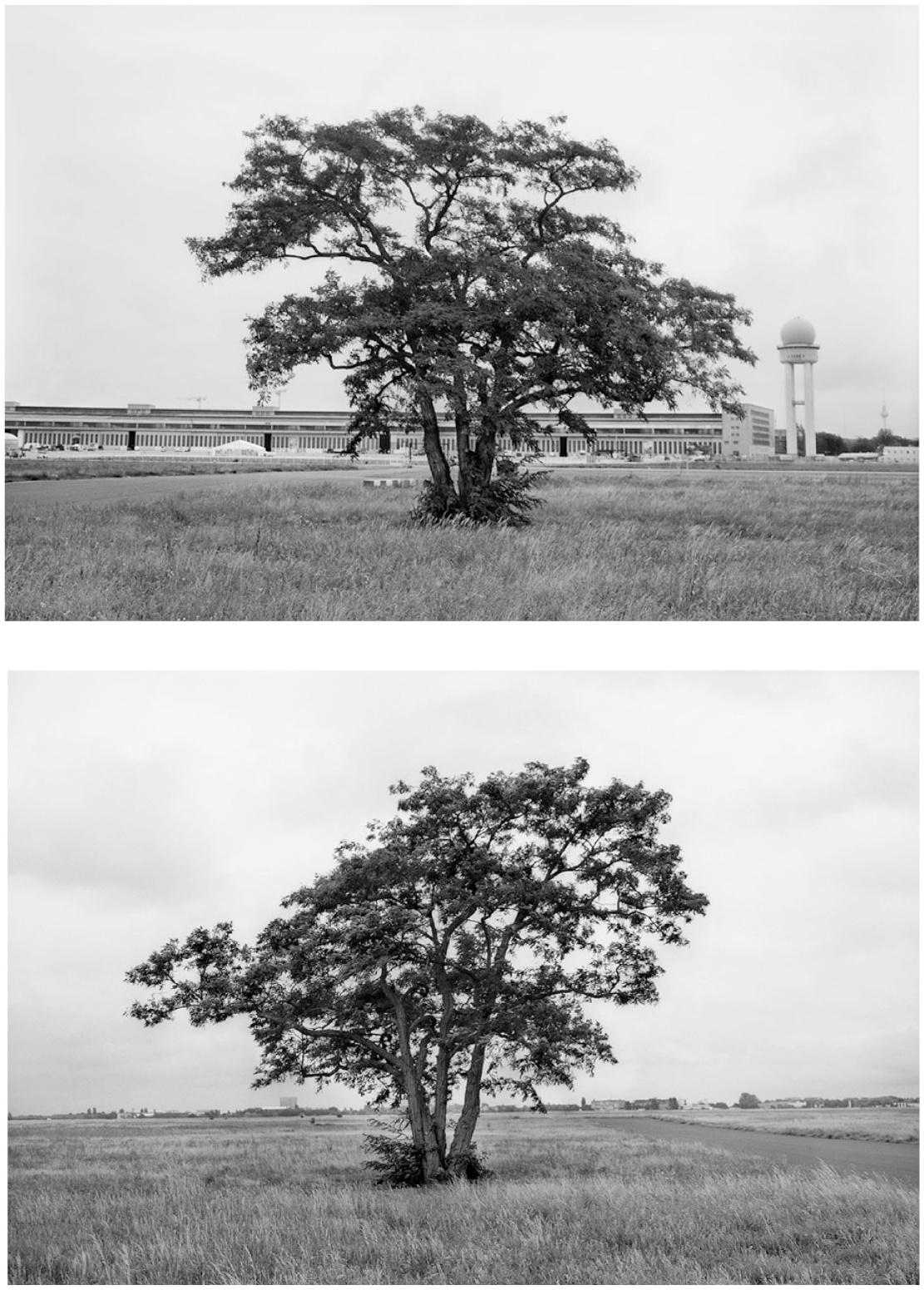
Yair Barak, She Was the First to Understand (Tempelhof), 2011, Archival Pigment Print, 160/110 cm (each). Courtesy of Yair Barak.
Another common strategy is the depiction of deserted landscapes, empty of any human presence, as seen in Arieli’s ongoing Nazi Phantom project (2009–present), Daum’s Don’t Trust Security Arrangements (Berlin) (2010), Barak’s She Was the First to Understand (Tempelhof) (2011) (Figure 1), Tapuchi’s Transforming (Berlin) (2013), Yael Atzmony’s Tracing oblivion (2013) and Ilit Azoulay’s Implicit Manifestation (2013). Through the image of the deserted landscape, Israeli Artscaping artists confront the difficulty of representing something as ‘abstract’ as ‘genocide’ (although genocide itself is unfortunately not abstract at all) – in this case, the challenge is the (im)possibility of representing the Holocaust. Further confronting this challenge, some Artscapes impose a melancholy feeling on the spatial image by using a very narrow tonal palette (primarily black and white) or deliberately working during the cold winter season. Examples include Eldar Farber’s Winter in the Tiergarten, 2008, Yehudit Sasportas’s Swamps of the Subconscious (c. 2008), Ori Gersht’s Hide and Seek (2009), Atzmony’s Tracing oblivion (2013), Ella Litwitz’s Habit/At (2012–2015), Nir Evron’s Geist und Blut (2015) and Gershuni’s The White Lady (2015) (Figure 2).
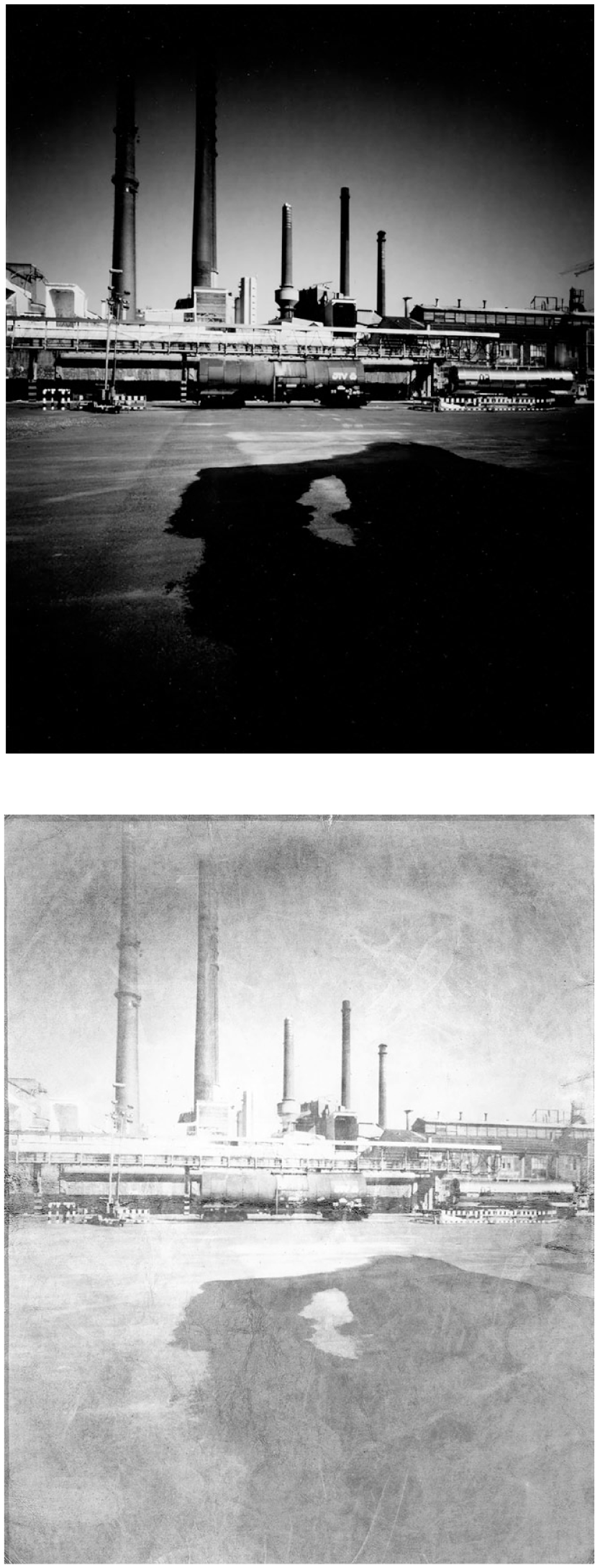
Uri Gershuni, Untitled, form the series: The White Lady, 2015, diptych: silver print+silver print washed in a washing machine with Persil washing powder. Courtesy of Uri Gershuni.
Working with motifs/objects associated with the Holocaust or pre-Holocaust Jewish diasporic life as mnemonic visual aids designed to ‘awaken’ the memory of the past in the (Israeli) viewer is also a popular practice. For instance, trees and forests are a common visual motif in Israel’s Artscaping art, resonating with the transnational iconography of the Holocaust, and therefore perceived as a ‘memory image’ of there, evoking images of fugitive Jews, partisan fighters and mass graves (Stiassny, 2020; West Brett, 2016). Trees and forests appear in the first part of Yael Bartana’s famous Polish film trilogy, And Europe Will Be Stunned (2007–2011) (in Mary Koszmary (Nightmares), 2007), which engages with the long, tangled Polish-Jewish history, as well as in her new piece Malka Germania (2021) or in Ignatz’s Looks Like a Forest (2008), which accompanies a Pole’s personal recollection journey in Warsaw’s neglected Jewish cemetery. Forestial imagery and arboreal motifs also appear in Farber’s many oil paintings of German woodlands, in Nir Evron’s One Forest (2005) and Daum’s Don’t Trust Security Arrangements (Berlin) (2010), Barak’s She Was the First to Understand (Tempelhof) (2011) (Figures 1 and 2), Sasportas’s Swamps of the Subconscious (c. 2008) and Gersht’s Hide and Seek (2009), in the video that accompanied Sala-Manca’s Absentee Landscapes (2017) (a project in collaboration with Nir Yahalom, Ktura Manor, Max Epstein, Adi Kaplan and Shachar Carmel) and in Evron and Omer Krieger’s photographic Journey to the Far East (2017). Forests appear on film in Dani Gal’s White City (2018) and in Gil Yefman’s video (a collaboration with Holocaust survivor artist Dov Or Ner) shot within the territory of the Buchenwald Memorial, focusing on the Goethe Oak that used to stand there and which today serves as an improvised monument to the Holocaust.
Alongside reference to such ‘evocative [spatial] objects’ (Turkle, 2007), 16 some Artscaping artists collaborate with local residents (often marginalised populations or local artists) as part of their commemorative act. Although people are present in these Artscapes, the landscape remains at the forefront of the piece. Once again, one can look to Bartana’s Mary Koszmary (2007), and Ignatz’s Looks Like a Forest (2008), but these are not the only examples: Uri Gershuni extended his hand to numerous anonymous male visitors at Berlin’s famous Memorial to the Murdered Jews of Europe in his photographic series Yad (2007); joined by Polish nationals, Public Movement led a walk in the territory of the former Warsaw Ghetto (Spring in Warsaw, 2009); Krieger collaborated with artists from Hamburg in his performance NOW (THE CAMP) (2015) at the Neuengamme Memorial (Figure 3). 17 The video for Sala-Manca’s Absentee Landscapes exhibition (2017), and Evron and Krieger’s Journey to the Far East (2017) both utilise this strategy.
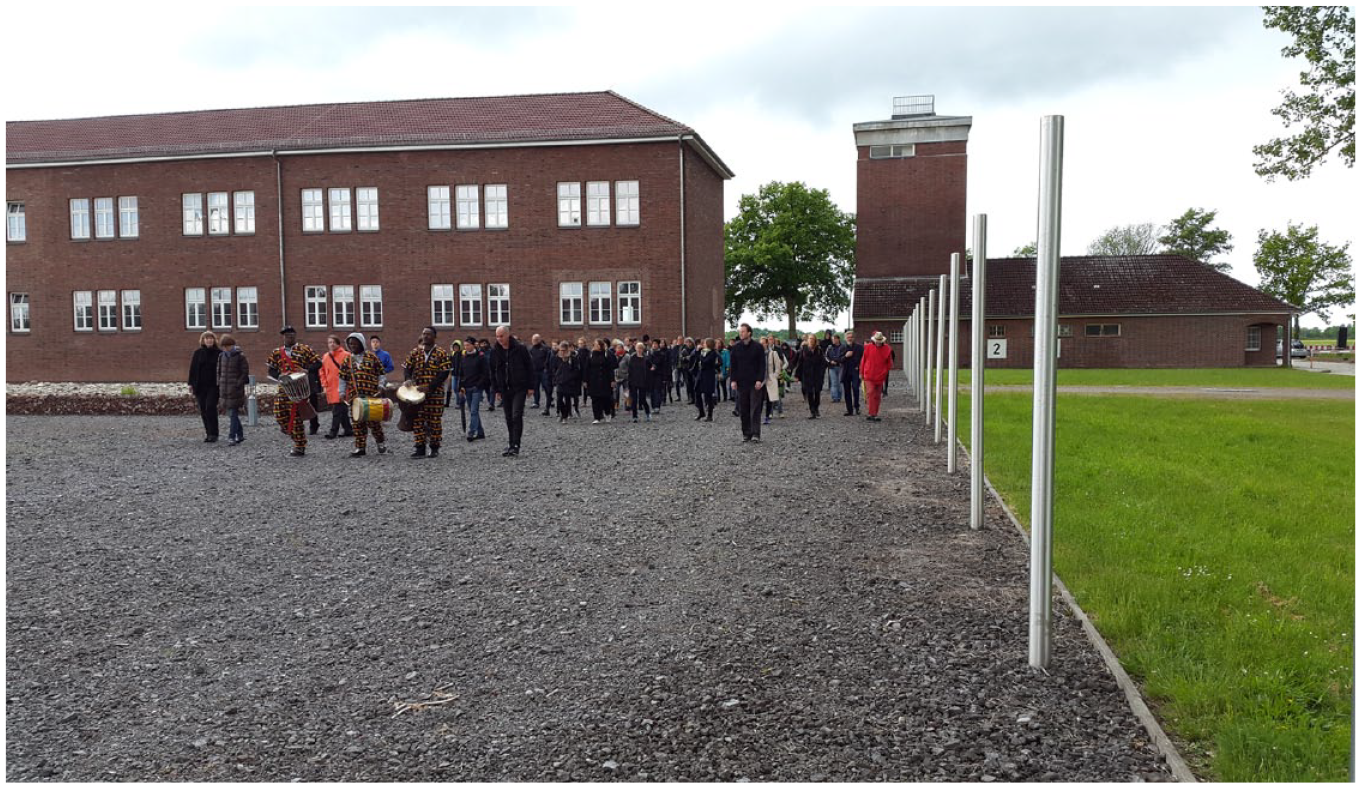
Omer Krieger, NOW (THE CAMP), 2015, Performance, ca. 150 minutes, Neuengamme concentration camp memorial. Commissioned by Stadtkuratorin Hamburg. Artistic Director: Sophie Goltz. Performers: Claudius Franz, Filomena Krause, Katja Lah, Alexey Markin, Anna Sophie Schönbeck, Monika Schröder, Lena Theis. Music performance: Yakawubu, Hamburg. Courtesy of Omer Krieger.
The examples mentioned above are only representative instances of a much larger phenomenon in Israeli art. However, there is often a variation in artists’ engagement with European landscapes. The dual role played by Eastern Europe as Zionism’s there – both the pre-Holocaust there of the Old Jew, and the there of the sacrificial Jew who ‘rises’ to heaven through the chimneys of the crematorium – and the reinforcement of this duality through the agency of collective (post)memory ensures that Eastern European landscapes evoke darker times in the Israeli mindscape much faster than their German equivalents, which still retain a degree of Israeli Zionist fascination. Therefore, Israeli Artscaping artists who work with Eastern European landscapes tend to choose subjects directly related to the memory of the Holocaust – landscapes that even a non-Israeli viewer will immediately recognise as connected, whether the connection is implicit in the location or explicit in the work’s title or content. By contrast, in Germany – Zionism’s external there, yet also its internal here – hints are often presented with such subtlety that non-Israeli viewers may struggle to recognise the link to the Holocaust. 18
To illustrate the difference, in 2012–2013, Yael Atzmony made several visits to the location of the former death camp Sobibor in Eastern Poland, where her father was imprisoned. Since this terrain has none of the obvious characteristics of a Nazi extermination camp (as culturally engraved in the western visual canon), Atzmony decided to create her own porcelain and stoneware maps, based on ‘testimonies and findings unearthed by archaeologists working at the camp in recent years’ (Tracing Oblivion, 2013). 19 Around the same time, Hadas Tapuchi mapped ‘the material ghost of circa 3,000 forced labour camps that operated in Berlin and Brandenburg between 1939 and 1945’, later comparing these maps with photographs she took of the contemporary sites (Transforming (Berlin), 2013). 20 Although both artists mapped atrocity sites, the degree of astigmatism experienced by the late-arriving artists is different. Atzmony (re-)created up-to-date artistic maps of the past topography of a site that lacks the material traces of atrocity but is still a familiar (post-1960s) memory ‘icon’, while Tapuchi needed to compare ‘sites of normality’, where traces of the traumatic past are more hidden and the ‘astigmatism’ is much stronger, with their present-day appearance, in which the past is no longer visually or materially evident.
Landscapes with no clear connection to the Holocaust also allow the Israeli framing of the there-Diaspora to appear within this genre of diasporic Artscapes. Gershuni’s series The White Lady (2015) is a good example (Figures 2). In 2015, Gershuni visited Düsseldorf as a participant in the Bronner Residency programme. 21 While looking for photo-ops in his new temporary ‘home’, Gershuni learned that the factory he saw daily was the Henkel factory, famous for producing the washing powder Persil. 22 Exploring Henkel’s official homepage, Gershuni noticed that two decades were omitted from Persil’s official timeline; from the 1920s Persil’s timeline skips to 1950, when Persil could ‘come back to life’ (‘1950: Der Krieg ist vorbei, Persil wieder da’). 23 Despite this optimistic statement, the missing years identified this as a typical site of what Assmann (2014) calls ‘involuntary memory’ – a landscape that lacks any material evidence of past events, yet nevertheless ‘awakens’ their memory. Gershuni did not know that Henkel was a wartime producer of glycerin (used for explosives) and employed forced labour in accordance with Nazi state policy (Hayes, 1998; Wiessen, 2001: 60–65). Of course, this fact alone neither confirms the presence of Jews among the forced labourers nor points to the working conditions at the site. Nevertheless, Gershuni intuitively ‘knew’ that he faced a ‘guilty landscape’, to paraphrase the Dutch artist Armando’s term (1976; in van der Laarse, 2015: 369). Despite the lack of any concrete evidence, this awareness motivated Gershuni to confront Henkel with its ‘hidden’ past. Duplicating each still-image taken with his large-format pinhole camera, the result is a series of diptychs in which the viewer always gazes at two identical photographic representations of one moment. However, these representations are not identical; Gershuni laundered one side of each diptych in his washing machine using Persil detergent. Subsequently, ‘hidden’ traces of a crime supposedly committed on that site gained a material visibility within the frame. The viewer is enabled to overcome their astigmatism, by comparing Henkel’s site ‘as it is’ and as the Israeli artist sees it, creating tensions between the ‘cleaned’ photograph and the cleansed landscape.
These examples reveal the gaze Israeli artists have at European landscapes, and how their physical presence there results in their Artscapes ‘transporting’ the past-diasporic-landscape into the present work as a means of commemorating the Holocaust. However, the ability of Israeli Artscaping artists to observe (indeed, art’s ability in this domain in general) also invites a critical examination of the ways in which they were ‘trained’ to ‘see’ these landscapes, for Artscapes frequently provide interpretations that go beyond Holocaust commemoration.
Space travel: the potential of Artscapes
All Artscapes engage with ‘trauma site museums’ (Violi, 2012). However, as time passes and the memory of the Holocaust ‘travels’ (Erll, 2011), already being gazed at as at a ‘foreign country’ (Lowenthal, 1985), the Israeli occupation is not yet a ‘foreign country’ of the past, certainly not for Palestinians
24
but also not for post-1967 Israeli art.
25
The high dependency that exists between these two contradictory astigmatisms points to this article’s central claim: due to participation in Israel’s here–there terrorscape politics, encounters with European landscapes activate an emotional struggle between here and there, as expressed by artist Eldar Farber: ‘It is as if when you are
It is true that the travel of Israelis to contemporary Europe might express an act of nationhood (re-)appropriation. However, this travel also embodies an act that counteracts that of Aliya (ascent) – a term indicating the ‘return’ of Jewish exiles. Instead of a movement from the there-Diaspora to here-pre-1948 Eretz Israel, we face a movement from the post-1948 Jewish State here to pre-war Zionism’s there, that is, to where (and when) these here–theres originally took their current form. This opposite-direction ‘return’ challenges the national birth myth of post-1948 Israel and the notion of ‘return’ embraced by Israel’s Zionist founding fathers as well as the founding fathers of Israeli art (this challenge sometimes extends to the artist’s family history; Stiassny, 2020). 27 Essentially, when abroad, Israeli artists not only physically meet Holocaust landscapes but also symbolically encounter ‘earlier’ (‘Ashkenazi’) landscapes, their roots in the nineteenth century but their ‘branches’ part of Israel’s here–there terrorscape politics, thereby giving this genre of Artscaping art the potential to transmit a message from – and through – there to here (Stiassny, 2020). 28
The first artistic strategy in conveying this critical message is to incorporate non-Israelis/Jews in an alternative memory ritual conducted by the Artscaping artist. The participation in the commemorative act of individuals who do not belong to the Israeli collective undermines demands for exclusive control over the narrative of the Holocaust. For example, when Gershuni reached out his hand to random visitors at the Memorial to the Murdered Jews of Europe, he reached out not only with his ‘personal’ hand but also the collective ‘Israeli hand’. The title of the series, ‘Yad’, means both ‘hand’ and ‘memorial monument’ in Hebrew, as seen in the name of Israel’s official memorial to the victims of the Holocaust, Yad Vashem. Gershuni’s invitation to be photographed with him – ‘Yad be-Yad’ – against the backdrop of the ‘Yad’ of Berlin was deliberately inclusive. 29 Gershuni’s act of extending a hand – a universal act of greeting and acceptance – on German soil to visitors to the memorial site that day, regardless of age, religion or nationality, suggests that while the Holocaust needs to be universally remembered, it is also time to forgive, even to reunite.
The desire for a more complex, multilayered memory in respect to the Holocaust exposes Europe as a multitude of terrorscapes also in respect to other nationalities and communities. This is notable in Bartana’s Mary Koszmary (2007) and Ignatz’s Looks Like a Forest (2008). Alongside commemorating the Holocaust, through the diasporic landscape both artists recognise the losses inflicted on the Polish people, emphasising the price paid for the ‘disappearance’ of the long-established Jewish cultural life in Poland as a result of the Holocaust. Bartana even deliberately subverts the Zionist ‘return’ narrative when the video shows the imagined Jewish Renaissance Movement in Poland (JRMiP) calling on Jews to ‘return’ to the land of their forefathers (Lingwood and Nairne, 2012). However, it is the second part of Bartana’s Polish trilogy – Mur i wieża (Wall and Tower) (2009) – that best expresses the implication of the diasporic landscape within Israel’s terrorscape politics, when a new Kibbutz (here) is erected in the heart of Warsaw (there). On 8 April 2009, the day before the official anniversary of the Warsaw Ghetto Uprising, Public Movement members initiated a collaborative performance that offered an alternative to the Jewish narrative as told by the Israeli voyagers who walk the site annually. Locals, visiting Jewish youth groups, and members of the art group gathered at the site where Jews were assembled for deportation, then marched past the Ghetto Uprising command bunker at 18 Mila Street, the former home of Ludwik Zamenhof, the inventor of the pan-European language Esperanto. The route ended at the Monument to the Ghetto Heroes, created by Jewish Warsovian Nathan Rapoport in 1948 (the year Israel was founded), and before which German Chancellor Willy Brandt famously knelt in atonement (1970). By disrupting exclusive Israeli ‘authorship’ over this Polish landscape, a multilayered landscape biography is constructed, supported by the ideal of creating an international language that would bring people together (i.e. Esperanto). This multilayering undermines Israel’s memory culture – a culture that differentiates Israelis from all other victim communities, and consequently prevents the celebration of ethnic diversity. Similar confrontations between Israel’s national memory (here) and traumatic Holocaust landscapes (there) also appear in other Artscapes, for example, Krieger’s collaboration with local artists in his performance at the Neuengamme Memorial (NOW (THE CAMP), 2015; Figure 3). By linking the history of that specific Holocaust landscape with the history of the Sinti and Roma refugees housed at the site in the 1980s, including their famous 1989 civil rights protests (Matras, 1998), the complexity of this landscape biography challenges the limiting of terrorscapes to one memorial narrative and/or specific period as an act that others those who do not ‘fit’ the hegemonic spatial narrative (van der Laarse et al., 2014).
The second strategy employed in transmitting a critical message is ‘spatial montage’ (Manovich, 2001). Artistically, this is achieved by displaying duplicated images on a split screen that navigates between two locations/time frames, creating a diptych or triptych (or trilogy) that often involves overlapping or superimposition, as well as through the evocation of visual features associated with contesting landscapes (Figures 1 and 2). In his video Arbeit macht frei (2009), Amir Yaziv ‘zigzags’ between Israel (here) and Poland (there). Having learned that both Yad Vashem and the Auschwitz-Birkenau Memorial and Museum were working to produce a replica of Auschwitz I’s iconic sign (1:1 scale), Yatziv’s decision to navigate between the two filming locations results in an exploration of the ways past trauma is communicated to the generations that follow. Aided by this (in)famous Holocaust trope, by placing Israel and Poland in the same photographic sequence and exposing the ‘backstage’ of memory production/consumption, Yatziv’s Artscape raises questions about the authenticity of a past landscape, when it has undergone a musealisation process. In addition, while viewing Arbeit macht frei, doubts arise about the decision to produce this Holocaust-evoking sign to stand on Israeli soil: why does Israel need an ‘Auschwitz’ in the heart of holy Jerusalem? What does this transposition of a there to here mean for Israeli memory culture? Without providing any explanation for the sign’s duplication, the visual intersection between Israel and Poland becomes a metaphor for two memory cultures competing for the exclusive ‘right’ to represent the community of victims of Nazism. Presented as an Israeli Polish contest to reproduce the original sign, and lacking any real dialogue between the two teams, the film points to the lack of ‘multidirectional memory’ (Rothberg, 2009). This exposes the absence of solidarity and a lack of communication, with Israel doing everything it can to ‘win’ control of the narrative that will inhabit this still highly contested terrorscape. 30
As this trend towards conveying a message through the image of European landscapes gains momentum in Israeli art, artists have begun to convey a more blatant and direct message to Israel and its here–there complex in regard to the Palestinian territories. Because ‘commemorative artistic practices can themselves function as the connective tissue between divergent but related histories of violence and their transmission across generations’ (Hirsch, 2019: 174), by using the diasporic spatiality as an artistic resource, Israel’s diasporic Artscapes have begun to offer an alternative framework based on the implicated subject position of the Artscaping artist (Rothberg, 2019): the successor of the Holocaust victim who nonetheless inherited a privileged position within the post-1948 Israeli realm (which nowadays also means a European passport). Sala-Manca’s video (as part of Absentee Landscapes) (2017), filmed in Fischach, home to many Jews from the sixteenth century until the early 1940s, traces the story of a liturgical object dated to the second half of the nineteenth century, now displayed at the Israel Museum in Jerusalem – the Painted Wooden Sukkah of Fischach, also known as the Deller Sukkah. One of the few sukkahs to survive two world wars, the Deller Sukkah’s uniqueness lies in the excellent preservation of the paintings that decorate its inner walls. The paintings that depict the landscapes of Jerusalem and Fischach are especially well preserved. To interlink these key elements and draw from them as much contemporary meaning as possible, the Sala-Mancas ‘entered’ the paintings. Using a split screen, the artists juxtaposed the landscapes of Jerusalem (here) with those of Germany (there), and the past with the present. The left side of the screen shows the group’s journey through Fischach and its surrounding forest, as the viewer follows their attempt to compare the nineteenth-century paintings with the contemporary terrain. On the right side of the screen, the contemporary scenery of Jerusalem appears, including its surrounding trees. Through the agency of the split screen, the viewer joins this symbolic journey in time and space, with the opportunity to reflect on the title: Absentee Landscapes. Which landscapes and for whom exactly are they absent? Germans or Israeli Jews? Or has Jerusalem become an absentee landscape for the Palestinians? By indicating the negative contribution of Holocaust (post)memory to Israeli identity, the film brings to light the impact this has had on Israel’s here–there complex: an internal identity complex but also one that influences the status – and collective memory – of the Palestinians.
Another filmographic journey began almost in parallel: Evron and Krieger’s Journey to the Far East (2017) was shot in Birobidzhan, capital city of the Jewish Autonomous Region (JAR) in the Russian Federation, the first Yiddish-speaking Jewish State (1928) to be founded. The film offers a visual stroll through Birobidzhan and its forested surroundings, presenting evidence of the rich Jewish community that once lived there (Kotlerman, 2009), alongside contemporary attempts to preserve, even revive, this lost culture. The Holocaust joins the work as a ‘missing image’ when the Israeli artists who ‘went East’ read notes written in German by the Swiss architect, and former director of the Dessau Bauhaus school, Hannes Meyer, who visited the area in 1933. Referring to Birobidzhan through both past and present prisms exposes the failed anti-Zionist attempt to establish a Jewish autonomous homeland in exile, but simultaneously serves as an ode to the Zionist dream of ‘return’, just as artistic engagement with the ‘rejected material’ that symbolises the Old Jew as an evocative object of migration rather than with Nordau’s aspirational Muskeljudentum, constitutes an alternative to Zionism’s founding myth (here).
A preoccupation with the year in which the Nazis seized power (1933) can also be seen in Gal’s White City (2018), the title immediately pointing to a spatial connection between Germany and Israel – the international style of architecture promoted by the Bauhaus school, which greatly influenced the design of Tel Aviv, known as ‘the White City’ (Figure 4). Gal’s film draws out a much deeper connection based on a shared (pre-1945) preference for Caucasian appearance. Unlike the Artscapes previously discussed, this is an on-site fictional work, allowing Gal to imagine a meeting between Arthur Ruppin, a Zionist enthusiast and researcher of race who briefly supported the idea of a binational state, and the German eugenicist Hans F.K. Günther, considered to have had a major influence on Nazi racial thought. This imagined meeting takes place in 1933 – the year engraved in Israeli memory as the beginning of institutionalised persecution of Europe’s Jews. Unsettling to watch, the film implies a similarity between Ruppin and Günther’s research, as they meet on the Weissenhof Estate – a 1927 Bauhaus-inspired neighbourhood in Stuttgart (there) reminiscent of many neighbourhoods in Tel Aviv (here). The film’s last scene drives the message home through the interplay of two landscapes, re-enacting a famous Nazi postcard – a collage of the Weissenhof area and Arabs with camels. Originally intended to present the internationalist Bauhaus style as a form of cultural degeneration (Entartete Kunst), the re-enactment of a postcard designed as Nazi propaganda against buildings reminiscent of early pictures of Israel (into which Gal ‘plants’ hints for the al-nakba), creates a multilayered inter-temporality and inter-locality that, again, challenges the Zionist national birth myth, as the Palestinian right/demand (depending on perspective) to return to Palestine hovers above this Artscape as a meta-here-there-narrative.
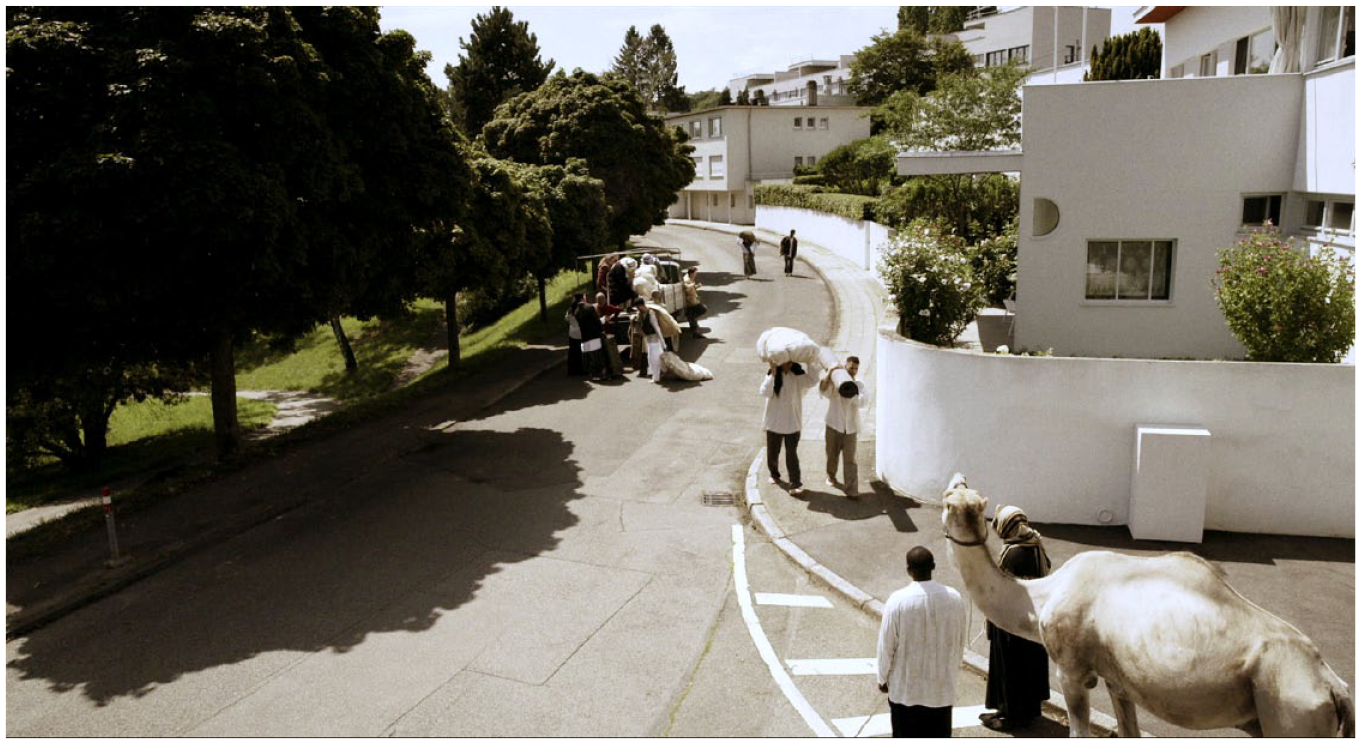
Dani Gal, Still from White City, 2018, 2k, 25 minutes. Camera: Itay Marom. Courtesy of Dani Gal and Pong Films.
Conclusion
This article has analysed Israel’s tangled relationships with traumatic European landscapes, while exploring the ways Israeli artists use the paradigm of ‘diasporic landscapes’ as an anchor in the exploration of their emotional sense of belonging to both there and here. In the process, they create what I call (diasporic) Artscapes. However, Israel’s diasporic Artscapes function within this article as a peripheral case study of the potential of this genre to ‘transport’ landscapes through time and space as a means of commemorating the past(s), while challenging that past(s) from a contemporary perspective. With this seemingly contradictory act in mind, the contribution of Artscapes to the field of memory studies should be further examined in relation to issues such as gender as well as in respect of other identity groups and nationalities; in today’s global era, the use of terrorscapes and their related here–there memory and narrative struggles are reserved neither to the Jewish Zionist story nor to Israeli artists alone.
Footnotes
Acknowledgements
I would like to express my deep gratitude to Petra Lange Berndt (Hamburg University), Rob van der Laarse (University of Amsterdam) and Tobias Ebbrecht-Hartmann (Hebrew University of Jerusalem); I have been extremely lucky to have them all by my side in my many journeys to the Diaspora and beyond.
