



Abstract
The Greenlandic oral story-telling tradition, Oqaluttuaq, meaning “history,” “legend,” and “narrative,” is recognized as an important entry point into Arctic collective memory. The graphic artist Nuka K. Godtfredsen and his literary and scientific collaborators have used the term as the title of graphic narratives published from 2009 to 2018, and focused on four moments or ‘snippets’ from Greenland’s history (from the periods of Saqqaq, late Dorset, Norse settlement, and European colonization). Adopting a fragmentary and episodic approach to historical narrativization, the texts frame the modern European presence in Greenland as one of multiple migrations to and settlements in the Artic, rather than its central axis. We argue that, in consequence, the Oqaluttuaq narratives not only “provincialize” the tradition of hyperborean colonial memories, but also provide a postcolonial mnemonic construction of Greenland as a place of multiple histories, plural peoples, and heterogenous temporalities. As such, the books also narrativize loss and disappearance—of people, cultures, and environments—as a distinctive melancholic strand in Greenlandic history. Informed by approaches in the field of cultural memory and in the study memorial objects, Marks’ haptic visuality and Keenan and Weizman’s forensic aesthetics, we analyze the graphic narratives of Oqaluttuaq in regard to their aesthetic dimensions, as well as investigate the role of material objects and artifacts, which work as narrative “props” for multiple stories of encounter and survival in the Arctic.
Keywords
Introduction
The Greenlandic oral story-telling tradition, Oqaluttuaq, meaning “history,” “legend,” and “narrative,” is recognized as an important entry point into Arctic collective memory (Damm, 2005). Recently, the term has been used as the title for four graphic narratives created collaboratively by visual artist Godtfredsen, writer Valgreen, and an international group of scientific experts and institutions, 1 with the aim of public dissemination of local ethnographic and archeological knowledge, especially among young people (Gronnøw and Sørensen, 2009: 52). The project references the Greenlandic story-telling tradition through its creative approach to the amalgamation of factual and fictional material (Quanga—Tegnet fortid, 2012), focusing on four distinct moments in the history of Greenland: Saqqaq (2500 BCE); late Dorset (12th c.); Norse settlement (14th c.); and 18th century colonization. In this article we analyze these texts from theoretical perspectives on graphic memory as a way of “re-imagining” postcolonial cultural memory of Greenland/Kalaallit Nunaat.
The Oqaluttuaq books adopt a fragmentary and episodic approach to historical narrativization, which places the history of modern European presence in Greenland, including that of Danish colonization, into a different perspective, as only one of its multiple strands. It subsequently de-centralizes Europe in Arctic cultural memory discourses (cf. Lynge, 2006; Pedersen, 2014; Thisted, 2017a). We argue that Oqaluttuaq makes a notable contribution to literary post-colonial memory studies for its active resistance against the representations traditionally used to exoticize the Arctic 2 including the Danish romanticized narratives of Greenland as a vulnerable place with a “unique aura” (Beukel, 2009: 14) and “pristine environment” (Andersen et al., 2016: 95). By challenging the homogenizing colonial figuration of the indigenous people in the Arctic as precarious populations in need of protection, the Oqaluttuaq books resist the paternalistic and protectionist framework of Danish colonial and postcolonial politics (cf. Graugaard, 2009; Jensen, 2018). As McMillan (2019) has recently argued, artistic engagements with colonial and settler-colonial history often undertake a political task of “unforgetting violence,” whereby they counter collective processes that erase or veil the imperial pasts through amnesiac procedures.
The wider artistic, literary, and political context of Oqaluttuaq is the growing field of visual story-telling, including comics and graphic novels, animated documentaries, and video games, produced by indigenous artists and authors (Steward and Wilson, 2008), which attempt to render visible native peoples’ collective memory of (settler-)colonialism, as well as contribute to the on-going efforts at decolonizing knowledge and history (Hemmer, 2020; Mallon, 2012). Concerning the histories and traditions of the indigenous populations of the Arctic region, there has been in the recent years an increased volume of scholarship produced within the field of memory studies (see e.g. Ghaddar, 2016; Kilbourn, 2020; Sejersen, 2004; Stammler, 2017; Stern and Stevenson, 2006; Pratt and Heyes, 2021). Similarly to Oqaluttuaq, many of the visual narrative texts by indigenous artists and authors incorporate a montage of fictional and non-fictional material, critiquing colonial power differentials that have often drawn on the colonizers’ capacity to define epistemic categories of “truth” and “objectivity” in highly structured Western knowledge systems of religion, philosophy, or science. The organizing logics of Oqaluttuaq are cultural and geographic decentralization, fragmentation of history, temporal heterogeneity, localism, and connections between a diversity of Arctic dwellers. It situates Greenland at the axis of centuries’ long human migration, settlement, and habitation; the multi-directionality and historical recurrence of the influx of multiple groups—some chronologically separate, some overlapping.
Oqaluttuaq “props” its graphic depiction of Greenlandic history on material artifacts from archeology and historiography, weaving these traces of the past lives of peoples into the graphic narrative as “memory objects” and thus layering the non-fictional elements with creative imagination and aesthetic choices that build a distinctly postcolonial mnemonic narrative. Two events in recent Greenlandic history illuminate further the connection between Oqaluttuaq and the attempts at construing postcolonial collective memory. First, its publication follows the collaborative infrastructures developed in the Utimut Process of repatriation of cultural heritage between Danish and Greenlandic national museums in the years 1983–2001 (Qanga—Tegnet fortid, 2012). The objects incorporated in the graphic narrative are those that currently remain at the Danish National Museum, which raises the question what their inclusion in the text means. Could the artist be performing a kind of epistemic reclamation and resignification of these objects through indigenous narrativity? Second, the publication of the Oqaluttuaq series coincided with the work of Greenlandic Reconciliation Commission, focused primarily on documenting violations in the 1953–1979 period, when Greenland ceased to be a Danish colony and became a county (Thisted, 2017b). Aiming to understand the social impact of colonial history in the present, the commission recommended the promotion of local Greenlandic perspectives on the colonial and post-colonial period and identified a strong link between national reconciliation and native knowledge productions (Therklidsen, 2017).
The Oqaluttuaq project has been exhibited in museums in Greenland, Denmark, and beyond Europe as Qanga—Illustrated Past. Through accompanying video installations the exhibitions highlighted Godtfredsen’s creative process, drawing attention to his technical and stylistic choices and his accurate representations of excavated items, as well as the cinematic, multi-sensory, and emotive qualities of images in the books, including, hapticity and thermoception. 3 We analyze the graphic narrative of Oqaluttuaq as a multi-sensory and affective construal of collective memory, which closely involves the reader/viewer, focusing on the way the text elicits tactile and proprioceptive perceptions (Carter, 2019; Scherr, 2013; Viljoen, 2019). Drawing on Marks’ (1996) concepts of “tactile memory” and “haptic vision” we analyze how Oqaluttuaq questions, and creates alternatives to, the established supremacy of visuality in dominant (Western) mnemonic narratives of the Arctic. To this we add a theoretical approach to memory-objects to allow us to analyze the Oqaluttuaq graphic narratives in relation to the themes of encounter and survival.
Our approach identifies the irreducible plurality of Greenlandic peoples, past, and present, who remain connected within the environmental frame of the hyperborean landscape and seascape as their dwelling place as the key motif in Oqaluttuaq. In consequence, the European settlement in Greenland by the Norse people and during the modern colonization feature as only two of its many histories of migration and habitation, initiated from diverse geographical locations—not only by Europeans traveling north-west, occupying the southern shore of Greenland, but also by different Paleo-Inuit groups, arriving from the (present-day) Chukotka region, through the Nunavik and Labrador and undertaking multi-directional journey’s through the high Arctic. These plural Arctic peoples left material traces and residues of their lives, which in Oqaluttuaq acquire the status of ghostly reminders, signifying the peoples’ organic and spiritual continuity with the land. Against the Western monologic imaginary of Greenland as “the land of Beyond” and of the hyperborean sublime (Hastrup, 2007: 789), in Oqaluttuaq the Arctic is a heterogenous and heterochronous space of travel and dwelling, centered on human relations to land and its non-human inhabitants (cf. Mccoy, Tuck and McKenzie, 2016; Tuck and McKenzie, 2014). We follow Chakrabarty’s (2000) suggestion (p. 16) that “pluralization of history leads to the ‘radically questioning of the nature of historical time’.” This disrupts colonial temporal imaginaries, which equate European arrival to non-European lands with the land’s historical beginnings and aid our reflection upon the cultural and political ramifications of Oqaluttuaq as an example of a graphic narrative of postcolonial collective memory of the Arctic.
Haptic visuality and memory-objects
Oqaluttuaq draws upon formal techniques of “haptic visuality” in comics. Aside from engaging the reader/viewer’s mind, by inviting them to order the sequence in which to read/view the panels, comics also elicit active bodily responses. These formal techniques draw the reader/viewer into a close encounter with the text and its thematic concerns, which, as Chute (2008: 462) argues, through “rigorous, experimental attention to form” endows them with a critical potential. The inclusion of both words and images as dual forms of expression, arranged in panels allows comics to achieve a multilayering of time and space in the construction of rich inflections of meaning. McCloud (1993, p. 20) defines comics as juxtaposed pictorial and other images arranged in a deliberate sequence in space, intended to convey information and/or evoke an esthetic response in the reader/viewer. McCloud (1993: 74) further argues that comics uniquely manifest what remains invisible in the dominant structures of representation by including blank gutters, which the reader/viewer must imaginatively fill. By incorporating blank spaces into their formal structure, comics can deal with silenced histories and suppressed collective memories. Groensteen (2008) claims that in comics there is a close relationship established between the reader/viewer and the artist, since the bodily practices of drawing leave material traces of the artist’s subjective perspective. This involves the reader/viewer in the representational process and connects them to the artist’s body. 4 Walton (2009: 101) argues that the reader/viewer is situated in an embodied relationship with the text: “[. . .] the act of reading comics practically forces the intertwining of our senses [. . .] comics structured around the simultaneous co-presence of multiple panels, their juxtaposition of images/texts/panels (not to mention their shifting configurations) forces the eye to scan and to kinaesthetically follow the narrative trajectory [. . .]. Optical scanning in tandem with manual handling helps enact the flow of comics, as an intersensory experience that is physically performed by the reader.”
We argue that the representational process in Oqaluttuaq facilitates an active and embodied envisioning of marginalized histories. Drawing on Marks’ theory of haptic visuality, we address them as “haptic memory.” For Marks (2000) haptic visuality implies viewing where eyes function like organs of touch, “brushing against the skin of the image,” and rely on touch and proprioception (and, in Oqaluttuaq, on thermoception). 5 Haptic images evoke senses other than sight, which they cannot represent directly. Specific visual techniques construct haptic images including under-exposed images, extreme close-ups, series of close-ups, highlighted texture, and foregrounding objects’ contact with human skin. These techniques feature in Oqaluttuaqq, encouraging close engagement with the images.
Marks develops the idea of haptic visuality in her work on global cinema. She argues that haptic images (as opposed to spectacular images, associated with visual excess) act as “transnational” objects. They can connect different cultures and are able to reconfigure vision beyond the objectification of voyeurism. This structure of vision facilitates equality between spectator and object and is particularly suitable for analyzing representations of political marginalization as it makes visible what is deliberately omitted by the colonial order, and its officially sanctioned modes of memorialization. Paying attention to the embodied and evocative aesthetics of Oqaluttuaq helps to recognize it as a work of postcolonial re-imagining of collective memory (see e.g. Bond and Rapson, 2014), because of the way it narrativizes loss and disappearance, as central to Greenlandic history.
In addition to hapticity and the graphic narrative form, Godtfredsen’s graphics also draw from traditional themes in Kalaallit Inuit story-telling and visual art (including the watercolor paintings by Aron from Kangeq and Jens Kreutzmann, and contemporary sketches by Johan Markussen, see Barkman, 2012). Godtfredsen uses of watercolors to create moods and evoke emotions, and encourage a multi-sensory reception of the images, draw the reader/viewer in and inspire immersion into the process of rendering distant history visible. In contrast to the esthetic tropes of the “Arctic sublime,” Godtfredsen’s images emphasize the presence of humans in the Arctic environment, as its inhabitants and companions, even when their diminutive depiction also emphasizes the vastness of these surroundings. The effect of the artist’s techniques is the interplay of differentiation and similitude, whereby the foreground figures simultaneously stand out from the hyperborean environment and appear to converge with it. In Didi-Huberman (2017) imaginal dialectics, this exemplifies “a cooperating relationship,” where humans adapt to and morph with the environment, and a “differential relationship,” where they distinguish themselves from their surroundings by undertaking an action or movement. The dynamic scale of the graphics offers a constantly shifting perspective, which oscillates between close-ups of the human protagonists (in enclosed domestic settings) and long-shots (in natural surroundings). The variation between extreme long-shots and close-ups minimizes the human importance within the hyperborean scenery. It resembles nested narratives, whereby the history of human presence in Greenland is inscribed within the larger eco-poetics of the Arctic.
We also draw on scholarship on memory-objects to consider the significance of archeological items foregrounded in Oqaluttuaq. The detailed depictions of archeological finds of domestic items and hunting equipment suggest that these object are not mere “exhibits” (passive and external to the narrative); instead, they are woven into the narrative in as anaclitic organizers, or what Didi-Huberman (2017) calls “vital remains [of] residual energy in the representation process.” The graphic narrative leans on these items to instigate broader socio-political, cultural, and psychological investigations—including human desire, perseverance in the face of adversity, loss, love, loneliness, and despair—which exceed scientific discourse. We show that these items function as memory-objects, facilitating “acts of memory transfer” (Connerton, 1989), and construe memories of trade relations, sexual encounters, violent pasts, communing with spirits or with the dead (cf. Assmann, 2008). 6 In The First Steps cultural memory is based on reconstructions of fossils, artifacts, and eco-facts (Godtfredsen, 2009); in The Ermine, genomic information and the oral tradition, as well as a plethora of material objects (figurines, bronzeware, carved shamanic wands), (Godtfredsen and Appelt, 2012). These effects function as “evocative objects” (Bollas, 2008), endowed with the capacity to call forth a people—and grant them historical visibility—insofar as people have come together around these objects as makers, users, consumers, explorers or destroyers.
Our approach to memory-objects also draws on Keenan and Weizman’s (2012) theory of forensic esthetics. In their essay on forensic methods for identification of Mengele’s remains, they theorize the historical agency of inanimate objects, which accumulates through plasticity—because material objects are impressionable and malleable, they are able to imprint and “fossilize” past events. Speaking about bones, and scientific “capacity to read them,” Keenan and Weizman define memory-objects as things “from which the trace of the subject cannot be fully removed” (pp. 13, 17). Tools, equipment, and ruins featuring in Oqaluttuaq do not simply “record” “events and effects of [past] life,” but also “instigate them in the present” (p. 18). Creating Oqaluttuaq appears as a process akin to forensic anthropological construction through “chains of associations” that “emanate from [the object],” and are imaginatively embedded in networks “between people and things, humans and non-humans, be they documents, images, weapons, skulls, or ruins” (p. 65). Images of forensic objects stand in for witnesses and provide a way of connecting with the past because they are some of the most embodied forms of representation possible as they not only record but also instigate the subjective and collective experiences in which these objects were embedded. We show that as a comic using haptic visuality and based upon memory objects Oqaluttuaq, is able to facilitate a powerful and embodied connection between past and present, reader/viewer and writer/artist, subject, and object, invisible and visible in its portrayal of encounter and survival.
The motif of encounter in Oqaluttuaq
The motif of human encounter with spirits, animals, natural environment, and memories is prominent in the books. The First Steps foregrounds meetings and collective undertakings within the frame of journey (Godtfredsen, 2009; for historical context see Gronnøw, 2016). Meetings can be violent and tender, anticipated and unanticipated, arranged and spontaneous, due to human needs or spiritual guidance, and can happen in sleep or awake. A Saqqaq man, Nanu has recurrent dreams and visions about a figure emerging “behind the ice,” who is eventually revealed to be childhood memory (Godtfredsen, 2009: 20, 29, 46). The dream apparitions of what is to come (the “not yet”) connect with what had passed (the “no longer”). Nanu’s meeting with the person from his dreams brings about mutual recognition, premised on the shared language and shared past.
The moments of encounter and connection generate new knowledge: Nanu’s meeting with his dream-figure leads to the realization that Greenland is an island. The narrator’s statement “it would take a lifetime to travel the entire way around [it]” suggests that a dynamic overlap of spatial and temporal imaginaries is at play (p. 51). Greenland’s topography is articulated not through a distant geographic measurement, but through a reference to a lived human experience. This affirmed connection between the land, movement and hyperborean inhabitants (present and past) is underwritten by a different “imaginative geography” (Said, 2014 [1978]: 54) than the colonial one (cf. Harbsmeier, 2002). There emerges an Arctic memory trope as a site of human traversal of vast spaces, which is undertaken not to conquer or explore, but to dwell and develop living relationships with land and others. Indigenous philosophy of encounter articulates a complex notion of sociability; encounters are arduous, transformative, and participatory. They cannot be subordinated to the goals of territorial expansion, extractivism, or unification. They are precarious moments of coming-together; acts of fashioning “common ground” by “scattered people”; “a conjunction of different lifeworlds” that carves out shareability (Carter, 2013: 10). The final scene in the book narrativizes Greenland as a space of co-existence by heterogenous peoples.
The Ermine narrates events occurring at the end of the Dorset culture and the arrival of the Inuit. A Tuneq woman, Ukaliatsiaq undertakes a journey into the High Arctic and Northern Canada with her shamanic teacher, Umimmak. This enables her spiritual transformation and brings her into contact with the Inuit inhabitants (Gulløv, 2005: 175–218). The memory of that encounter has been preserved in the Inuit oral traditions through 30 generations (McGhee, 2001; Onciul, 2015). The Inuit mythological depictions of the Tunit, including their enormous size and their strength, physical agility, hunting and fishing techniques, and their shyness are included in The Ermine (cf. Bennett and Rowley, 2004; Martin, 2012). Their encounter pivots upon an unresolved question about the circumstances of the expiry of the Dorset culture, and The Ermine suggests both the possibility of the Tunit’s outperformance by the more technologically advanced Inuit, and a likely epidemic that broke out when the groups came across each other. The Inuit cross-generational transmission of that memory functions as a way of recording and preserving the historical presence of the Tunit after their disappearance. That memory is embodied by a figure emerging from and vanishing into the polar landscape. Ukaliatsiaq’s Inuit husband, Aarluk, declares “[t]hey call you the Tunit because you show up from the mainland and disappear into it again” (Godtfredsen and Appelt, 2012: 43). The Tunit are memorized as people who appear and disappear in history. This accords them a spectral quality of being simultaneously gone and present and surviving through generational mnemonic transmission of past encounters. Barreiro and Johnson (2005) argue that the ancient encounter with the Tunit has for the Inuit status of a “foundational memory,” perhaps even a memory of traumatic loss. That memory imbues a collective sense of self of the Inuit with a narrative of indebtedness (Tunit transformed the Arctic into a habitable place), 7 as well as a narrative of abandonment (being “the only ones left”).
The Gift focuses on Greenlanders’ 18th century colonial encounters with European whalers, traders and missionaries, and is based largely on sources from colonial historiography, which it creatively re-works and re-situates to highlight local Greenlandic perspectives. It creates a life-narrative of a legendary Inuit man, Qajuuttaq (Sørensen and Kundsen, 2019), at the backdrop of Denmark’s establishment of political and administrative control over the region. While the thematic and temporal focus is historical, it also has contemporary political resonance due to the critical light it casts on Denmark’s “benign colonialism.” This term used not only as a description of the history of Danish colonial presence in the North Atlantic, but, more importantly, by postcolonial critics interrogating the discursive pillars of the contemporary “grønlandspolitik.” Here the “soft power” practices of cooperation, protection, non-coercion and financial assistance provide avenues for the exercise of control (Jensen, 2016; Naum and Nordin, 2013; Neumann, 2014; Petterson, 2014). Seen from this perspective, The Gift shows that the colonial relations in Greenland are established and perpetuated through elaborate fictional constructs, including those of the otherness of the indigenous populations or the figure of benevolent colonizer, and what Hoydal (2006) calls “the myth of the gift”.
In The Gift colonialism is woven into, and articulated through, localized narratives, quotidian practices, and intimate relations. This includes Qajuuttaq’s fictional relationships with historical figures: Hans Egede (1686–1758), Niels Egede (1710–1782), and Anders Olsen (1718–1786). These colonial administrators are introduced in deliberately and ironically “benign” language: Niels Egede is Qajuuttaq’s “substitute big brother” and a source of “advice and [. . .] good stories”; Olsen is a “good friend” and “calm [and] thoughtful” supporter of the Inuit” (p. 5). Hans Egede is described as an “energetic and sometimes strict missionary who wanted to propagate his Christian ideals of piety among the Inuit”—a stark euphemism, given the historical record of his of disciplinary and punitive violence (Rud, 2017). Bhabha’s (1984) notion of colonial mimicry and ambivalence helps to interpret this reproduction of the colonial language of civility and beneficence as its parody: while the native repetition of “the authority of colonial discourse” risks normalizing colonialism’s “civilizing mission,” it is simultaneously affirmation and negation. It is a mockery that turns the “[colonial] observer [into] the observed,” while “[fixing] [. . .] the colonial as a form of cross-classificatory, discriminatory knowledge [. . .], [which] necessarily raises the question of the authorization of colonial representations” (pp. 129, 131).
The discourse of colonial benevolence is critiqued throughout the book in its representation of trade relations. It is effected by the juxtaposition of the natives’ interest in the trade with images depicting resource extraction by the European (Figure 1). There is no explicit critique of the endemic inequalities of the colonial exchange, yet the seemingly beneficent description of the barter is accompanied by haptic images of the European man’s hand presenting glass beads and a needle (and another holding a single tool) in exchange for fox skins, and highlights the imbalance and exploitative nature of trade. Groensteen (2010) has argued that comics are a particularly powerful form because they accommodate complex meanings when they allow images and words to go out of alignment and work against each other, enabling the construction of intricate political critiques through complex layers of irony as it does here. Chute also notes that comics ability to set words and images in deliberate disjuncture enhances their ability to reveal what is invisible or suppressed. She remarks that comics use “[h]ighly textured in its narrative scaffolding” that “doesn’t blend the visual and the verbal – or uses one simply to illustrate the other – but is rather prone to present the two nonsynchronously [. . .]” thus revealing aspects of the narrative that would otherwise have remained “invisible” (Chute, 2008: 452) as occurs in Figure 1.
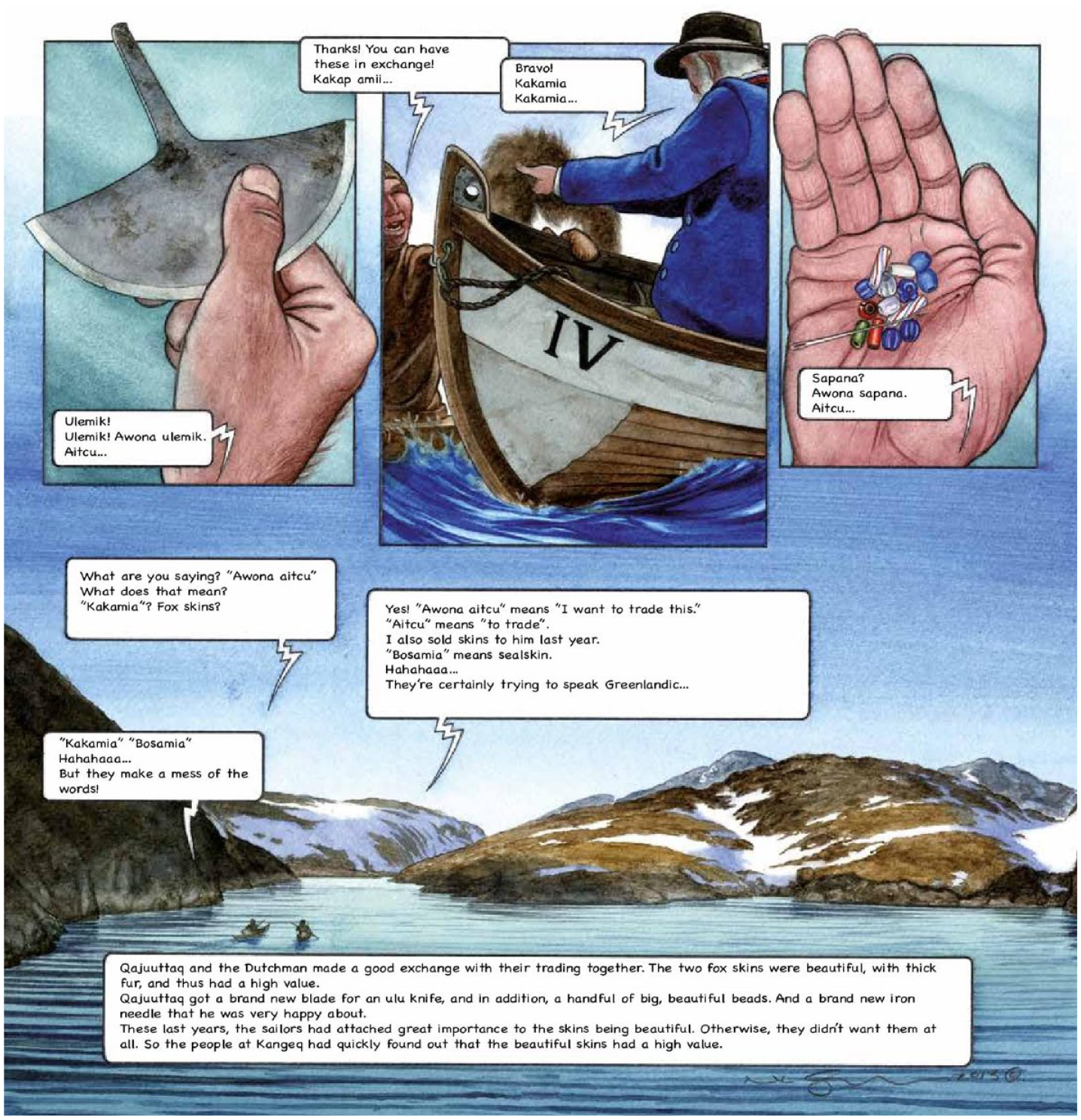
Trade encounter, The Gift (p. 15).
The image critiques the European trading model from an Inuit perspective. It does this by mobilizing comics as “a ‘language’ that relies on a visual experience common to both creator and audience” (Eisner, 1985: 7). This visual “language” shows no touching or physical relations between humans is involved. The panel, in which Qajuuttaq gives fox skins to the trader, depicts him from a distance. A cold, distant blue of a vast sky or ocean predominates in these images within the panels, which matches with the surrounding blue gutters, as if this quality of distance permeates the relations depicted within the frames. Furthermore, the position of the people in relation to each other symbolize colonial power relations—which the colonizer in the boat and the colonized low-down and in the water. By contrast, the objects offered to Qajuuttaq (panels 1 and 3) are shown in close-up, in striking color and detail. This shows the connection between colonial trade and creation of commodity desire, and the severance of economic exchange from the social and cultural settings, within which these objects are embedded.
The Gift portrays the gradual incorporation of northern Europe’s technologies and religion into Greenlanders’ lives. The establishment of colonial trade shifts the dynamics of population movement, familial and communal institutions, patterns of consumption and production of knowledge, including linguistic knowledge (cf. Toft and Seiding, 2013). It is depicted as a perilous endeavor, including dangerous travel conditions, as exemplified by the stranding of a Dutch merchant ship (near Pisuffik). The detrimental effects of the natives’ encounter with Europeans includes epidemics: Qajuuttaq’s parents succumb to smallpox that broke out in Nuuk in 1730s (Gulløv, 1997: 354–363). The references to the injurious effects of colonialism are important, given that the authors refrain from depicting direct physical violence, which included suppression of local shamanic traditions, subordination of the native populations to Danish laws, and the devastating effects of commercial whaling on their sustenance capacities (see e.g. Finley, 2001).
The Scar focuses on the encounters between the Norse people and the Thule people, the ancestors of the Greenlandic Inuit people (Valgreen and Godtfredsen, 2018; for historical context see Gulløv, 2005). The book dramatizes the co-existence of plural populations in Greenland in Middle Ages by highlighting the dynamics of stereotyping and othering. The Inuit are subjects of the Norse projections of what is prohibited by Christian morality, especially regarding denied sexual desire. The Scar documents the existing network of exchange between these two societies, but also highlights their separation, different values, and potential for conflict (cf. Lynnerup, 1998). Underpinning their isolation in Greenland and their separateness from the Inuit communities is the Norsemen’s fear of overt comradery with the non-Christian others and the church’s demand that the settlers renounce their pagan past (see discussion of Figures 2 and 3 below).
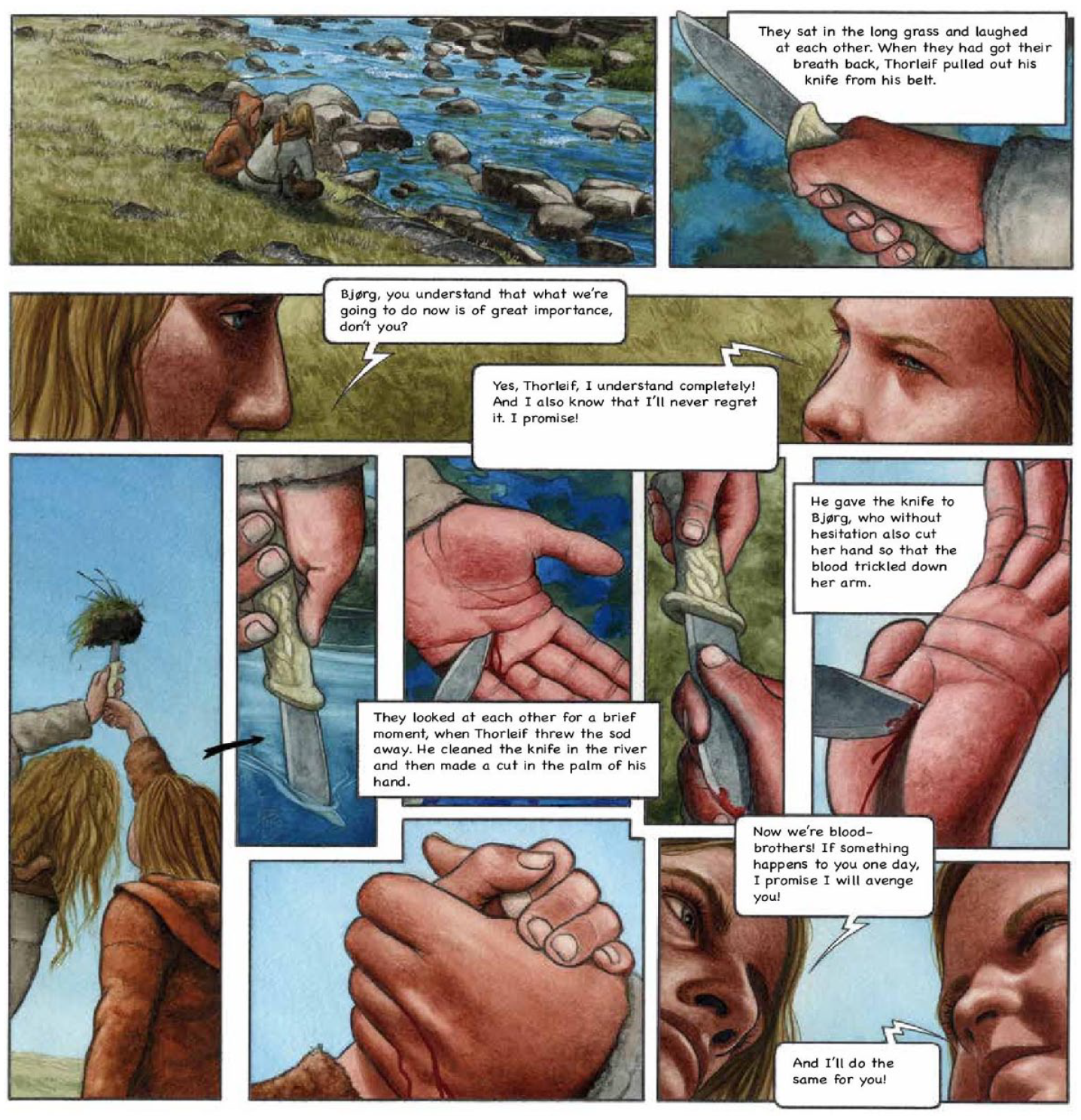
Violent encounter, The Scar (p. 15).
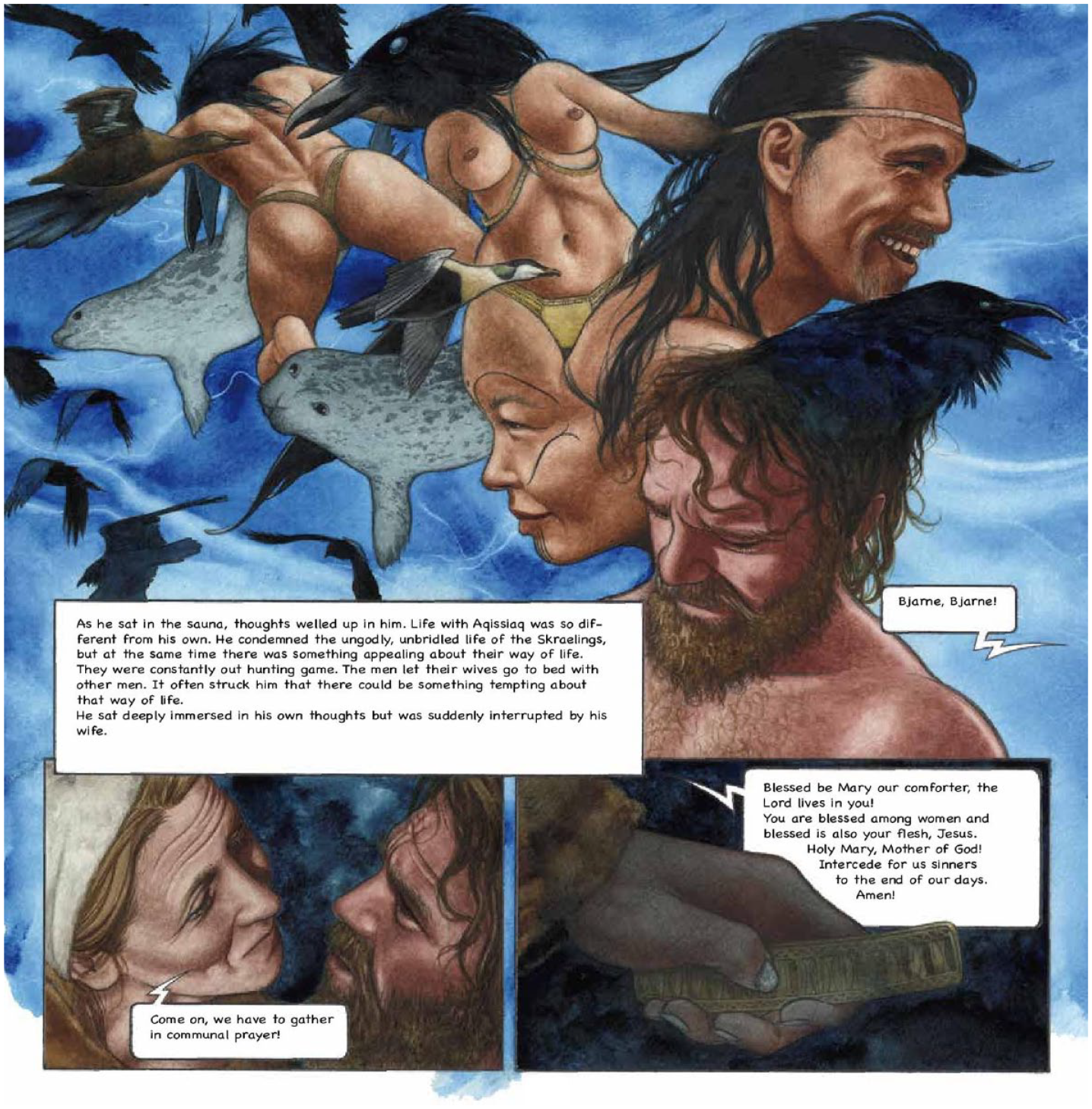
Sexual encounter, The Scar (p. 19).
The Scar narrates Bjarne’s infidelity to his wife, Bjørg, a Norsewoman living in southern Greenland. It establishes a parallel between the prohibition of extra-marital sex in Christian societies (transgressed by Bjarne who has sexual intercourse with an Inuit woman during his trading trips), and the Christian disavowal of the pagan past, which Bjørg violates as a child by establishing a blood pact with her brother, Thorleif (Figure 2). The titular “scar” is a mark of their life-long bond, as well as a source of Bjørg’s guilt. Not only does the blood-ritual imply incestuous desire but the scar remains as an anachronistic mark of Bjørg’s pre-Christian subjectivity, etching her pagan past permanently onto the body, despite her subsequent performance of Christian restraint and modesty. Fearing the loss of Bjarne, Bjørg later asks “Could it be my scar that’s responsible for this severe punishment?” (Valgreen and Godtfredsen, 2018: 31). An important motif of the return of renounced ancestral past is a raven; circling ravens signify the impossibility of total repudiation. The ravens feature when an action motivated by strong passions takes place (Thorleif’s revenge murder of Bjarne), or when Bjørg as a child engages in imaginative thinking, and during storytelling and dreams about the ancestors. The ravens are omens of illness or disaster (pp. 9, 12, 16, 48, 49).
The images in the top of Figure 2 are unequal in size, with some overlapping and separated by stark, contrasting-colored gutters. The only indication of where the reader/viewer should begin the sequence is a single black arrow after the first panel. The effect on the reader/viewer is of some discomfort in the reading/viewing process, even before the content of the images is decoded. The several partial images of the scene convey meaning by haptic techniques, including close-ups of the children’s warm hands touching and trickling blood after cutting with the cold metal blade plunges into the furrowed skin on their palms. These images emphasize texture and thermoception, and the bodily sensations of sharpness, pain and stickiness, which also makes the reader/viewer imagine what the scene does not show.
Furthermore, the Inuit become a repository for the Christians’ forsworn desires, suggesting that the repressed does not perish, but returns through dreams and visions, and manifests in moments of passion. Figure 3 foregrounds the importance of dreams as a channel of prohibited encounters. It contains three panels, contrasting visions that feature voluptuous and uninhibited native female bodies, and Arctic animals, with Bjarne’s domestic life and his austere Christian wife (p. 19).
Panel one of Figure 3 depicts Aqissiaq, Kajaaq, and Bjarne, close-up. Feeling guilty, Bjarne imagines himself transforming into a raven, surrendering to forbidden passions, and desires. His pagan past forges a connection between him and the Inuit. The bright and sensuous depictions of native people and animals are juxtaposed with the past-tense narration of Bjarne’s tormenting thoughts, the only indirect speech depicted on this page (in the European tradition of comics, which are sometimes less action-oriented than American comics, indirect speech (sometimes in the past tense) may be more common). 8 This speech balloon is visually depicted as transcending all the panels on the page. It expresses the voice of a third narrator in the story (Groensteen 2010), one who highlights Bjarne’s inner thoughts which are thus literally superimposed upon the panels in which a direct conversation occurs between Bjarne and his wife. The effect of bringing this distinctive narrative voice to our attention allows us to discern an enunciator who knows more than we do and is on the side of the person telling the story (in this instance Bjarne). This highlights the lag between (Bjarne’s) seeing or experiences and the process of coming to know or evaluate that experience, which comics are able to perform in addition to the content they depict. The dream imagery brings into the frame the repressed and subdued contents. The surrealistic images of hybridized avian-human native bodies and of Bjarne-becoming-raven pivot on the identification of native female sexuality and pleasure as a source of danger. Surrealism is an apt visual strategy that “reach[es] beyond the limits of the ‘real’,” and “break[s] down the boundaries between rationality and irrationality, exploring the resources and revolutionary energies of dreams, hallucinations, and sexual desire” (Baldick, 2004: 250). As the images of the ominous raven-headed women are “welling up,” Christian morality (personified by Bjørg) intervenes and provides a restrained monogamous boundary. Bjarne’s desires and Inuit morality are interpreted as offending. A speech balloon indicating Bjørg’s voice interrupts his musings and plunges Bjarne’s back into the present. The two remaining panels are dark and difficult to make out, yet they clearly show the tension in Bjørg and Bjarne’s faces. The contrast between the first, and second and third panels, also depict the reasons for the separations between the Inuit and Norse peoples, the Norsemen’s fear of non-Christian others. This and the church’s demand that the Norse renounce their pagan past is expressed visually through the contrast between the orderliness, uniformity, and subdued colors of the panels illustrating the Norse life and the dynamic and unruly depictions of the Inuit world. The former images invoke Christian modesty and parsimony; the latter express wildness, savagery and uninhibited sexuality (common othering tropes for indigenous groups).
The motif of survival in Oqaluttuaq
In Oqaluttuaq memory objects often feature as “things-in-motion” (Appadurai, 1986: 4). They circulate between different protagonists and are used to “prop up” the collective memories of those who have exchanged goods (trade objects), departed (grave gifts/keepsakes), or invoked spirits (shamanic wands, healing figures). The objects are material residues of the past; tangible indications of survival, and markers of phantasmal appearance. They help expand the meaning of memory beyond the mere recollection of historical facts to include transmission of relations, dreams, and identities across generations and cultures. Drawing on these material figures of memory we suggest that such mnemonic traces articulate what has survived and disappeared. These memory-objects are depicted haptically, emphasizing their texture and embodied connection to a specific person/people, situated, and localized. We emphasize the possibility of enhancing the mnemonic experience by imaginatively reconstructing from fragmentary physical objects, larger sites or milieus that the objects relate to, through the “warmth of tradition,” “the silence of custom,” or the repetition of the “ancestral” (Nora, 1989).
An important object The Gift is a wooden kayak figurine (Figure 4). Given that the text shares its title with Mauss’ analysis of forms and functions of gift-exchange and reciprocity, it is worth noting that the relations generated by the object’s circulation are conspicuously asymmetrical, and result in mutual indebtedness among the protagonists. The Gift narrates the European newcomers to Greenland as recipients of the Inuit’s assistance and knowledge of the land. The Inuit are portrayed as historical agents and initiators of relationships, not the passive recipients of colonial beneficence. Qajuuttaq makes the kayak in the wake of his parents’ untimely death and places it on their grave (the image is based on the reconstruction of an ethnographic item from 18th century from the Nuuk fjord), (Valgreen and Godtfredsen, 2015: 13). The importance of kayaks for the Inuit has been frequently identified (Graburn, 2006), and its miniature in the book can be interpreted as enabling a journey. In The Gift kayaks are omnipresent; they not only provide means of transport, territorial access, hunting, and trade, but also connect people residing in a different location (unlike stereotypical Western depictions of Inuit hunters or travelers in kayaks as primitive, “exotic” and “closer to nature”). The plot pivots upon the social, economic and psychological effects of its circulation as it enters a sequence of events and generates new relations being stolen, traded, re-appropriated, gifted, and (belatedly) returned.
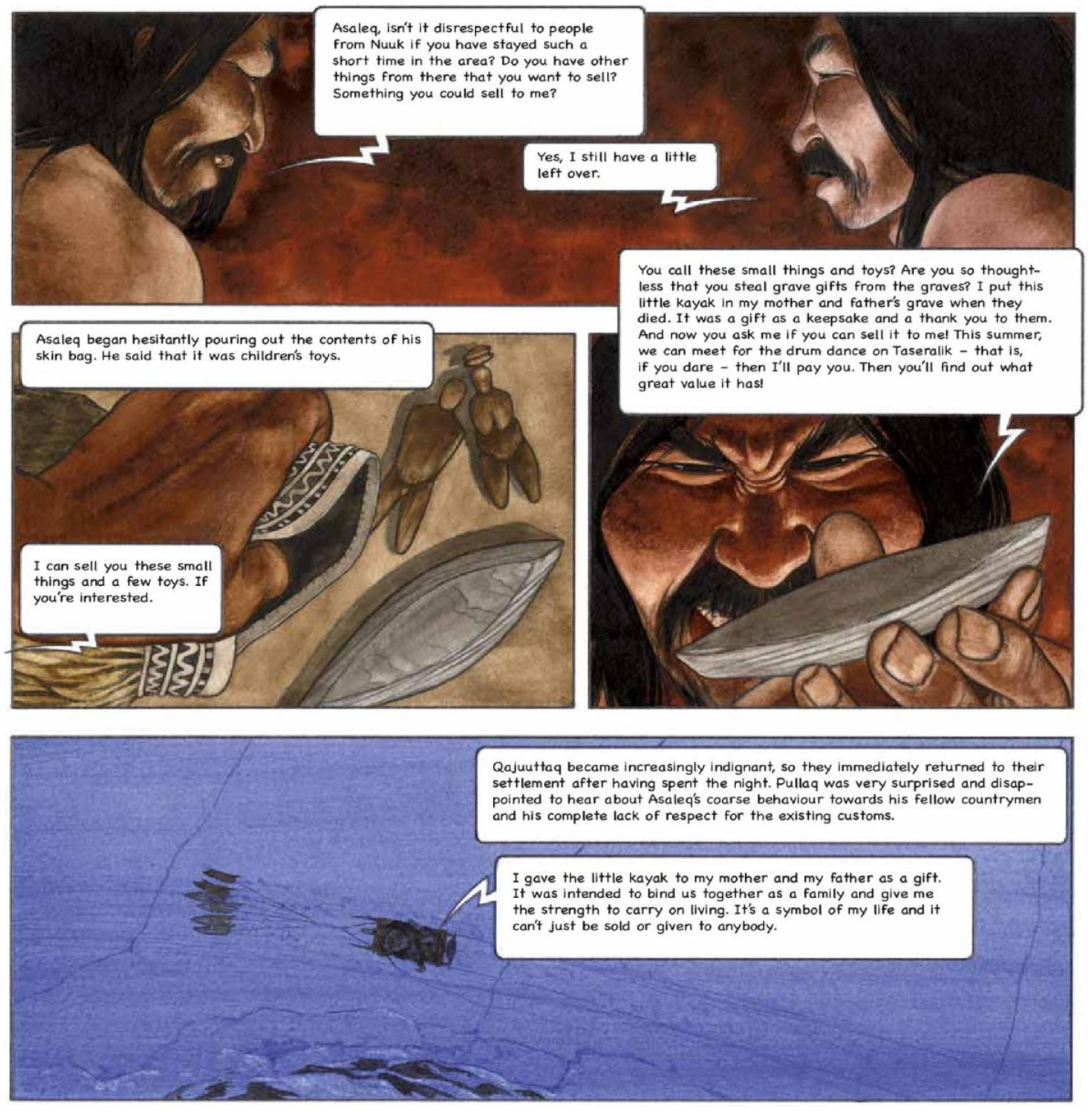
The kayak as transactional object, The Gift (p. 25).
Another Inuit man, Asaleq, steals the figurine from the grave of Qajuuttaq’s parents and thus reduces its status to a transactional item (Figure 4).
In the dispute about the object’s value between Asaleq and Qajuuttaq, Qajuuttaq’s indignant response (panel 3) suggests that the mnemonic affordance of the object is not simply because it helps preserve mental images of the past, but because it signifies survival of those that have died. The contrast between perspective and color in these panels is striking. The top panels are warm, brown and depict encounters with other people and objects, in close-up detail. The last panel features a wide-angled shot of Qajuuttaq by himself against the vast, dark, cold landscape. It is also comparatively text dense, making the reader/viewer work hard at interpretation of the narrative. The reader/viewer is encouraged to fill the highly visible blank gutters with imagined meaning that has slipped through the cracks of the images—when human relations are subsumed by commercial value, a striking disengagement ensues.
The moment of Qajuuttaq’s recognition of the object (panel 3) echoes the earlier panels depicting him making the boat, as well as earlier scenes of finding safety and protection in his mother’s boat as a child. The resonance between the sensations of “being held” by a boat and being contained within the maternal womb articulate further the depth and reciprocity of the human-object relations in Oqaluttuaq. These reciprocal relations, mediated by objects, anticipate the events from Qajuuttaq’s later life and his friendship with a group of Dutch whalers and Emiel, a boy to whom Qajuuttaq awards the figurine, in a gesture solidifying their relationship and as a source of inspiration and empowerment (Figure 5).
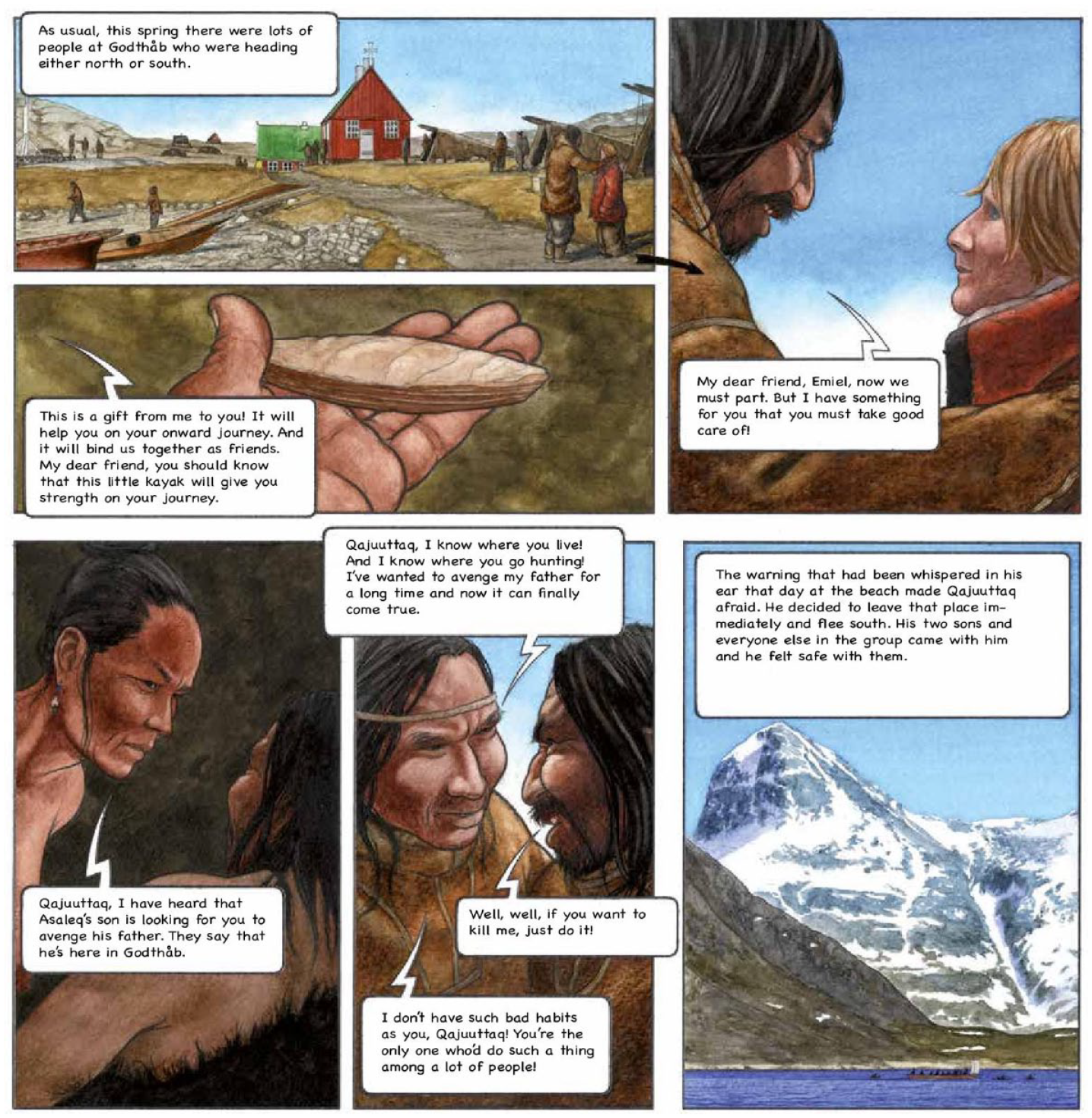
The kayak as gift, The Gift (p. 39).
On two occasions, using his real kayak, Qajuuttaq saves Emiel’s life. He socializes Emiel into aspects of Inuit life describing kayaks as central to his people’s survival: “[the] kayak is the main reason that we’re able to survive. We pursue our quarry in our kayaks. We go on journeys in our kayaks and meet other people. Like when I met you! The kayak gives us the inner strength to be able to live our lives!” (p. 33). In the panel depicting the object’s presentation (Figure 5), Qajuuttaq’s open hand and the figurine are clearly visible against a dark indistinct background. By depicting it haptically, and inserting it within embodied relations, the narrative inflects what is ostensibly an inanimate object with a kind of afterlife. The object binds people together and outlasts their physical separation, including the divide between the living and the dead. Emiel returns to the Tunulliarfik after Qajuuttaq has died and places the figurine on his grave (Figure 6).
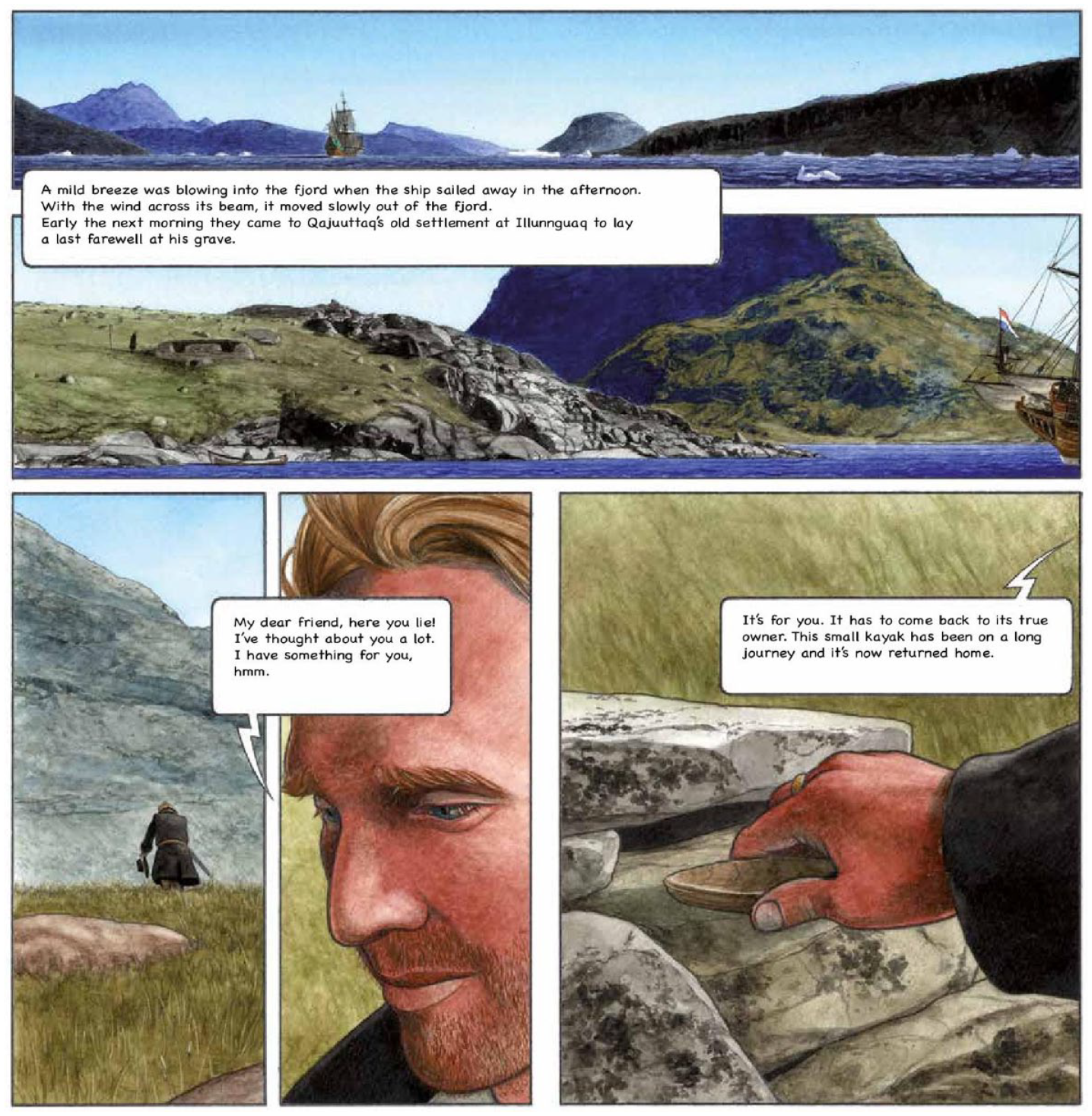
The kayak as grave object, The Gift (p. 50).
The last panel contains a haptic close-up of the kayak. The first two panels depict the landscape, and the last three show different aspects of Emiel. The fragmentariness of the images emphasize that the reader/viewer cannot gain total access to Qajuuttaq’s story but, through memory, obtains partial and palimpsestic knowledge. In the last panel, the object is central and tangible (though not fully visible behind Emile’s hand as it melds with the background, perhaps signifying new emerging relations). Marks (1996) suggests that “such objects may call forth buried cultural memories by eliciting the memory of the senses” (pp. 14–19). The haptic depictions of the object augment the imaginative capacity of the readers/viewers to trace its trans-national and trans-historical connections and evoke relational memories.
The memory-object in the book The Ermine is a shamanic wand, which Ukaliatsiaq carves from a reindeer antler. Umimmak gives it to her after Ukaliatsiaq’s disturbing dreams and visions. He says that she should “[c]arve their faces into this piece of antler! And when you are flying through the air, you’ll meet frightful, inhuman spirits! Carve their faces. Don’t be scared of them! When you meet them, you must approach them even though you fear them! Only then will you get to know them and benefit from them. They’ll return to you as your helpers when you become a shaman!” (p. 16). The inscription of the visions is a way of taming extreme experiences. In panels depicting the supernatural beings in Ukaliatsiaq’s dreams (Figure 7), first the sharp, grasping bony hands of a black skeleton, and subsequently a polar bear that cradles her, Ukaliatsiaq manages to keep carving their depictions onto the antler. By channeling the spirits into the form of visual signs, imbued with her artistic style, Ukaliatsiaq undertakes the action of rendering them visible for others.
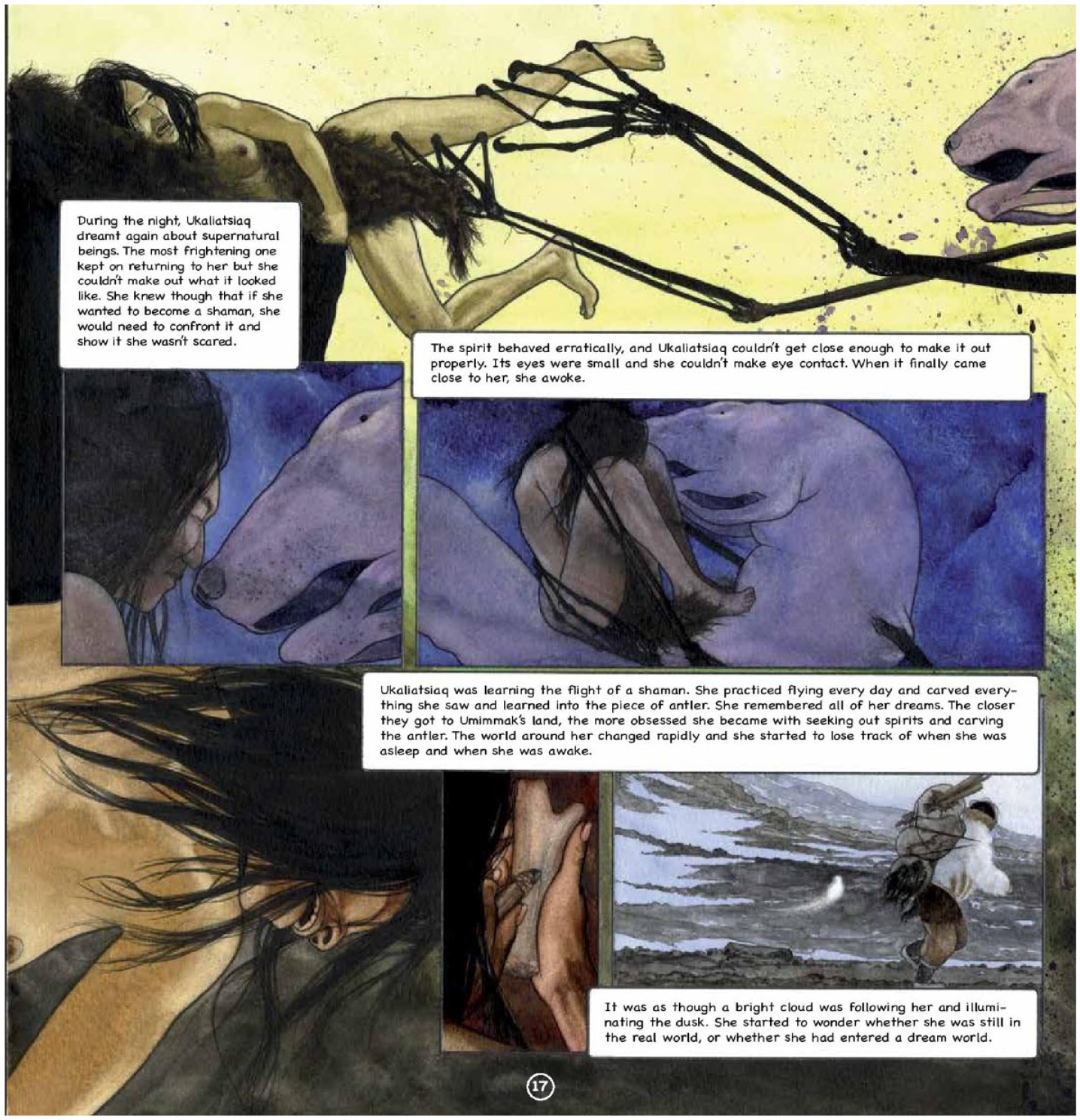
Ukaliatsiaq’s spirit wand, The Ermine (p. 17).
An accompanying caption states: “[the] most frightening [spirit] kept on returning to her but she couldn’t make out what it looked like. She knew though that if she wanted to become a shaman, she would need to confront it and show it she wasn’t scared” (p. 17). As a shaman, Ukaliatsiaq’s role is linked to the capacity of rendering visible those aspects of experience that, because of their affective impact, have been understood as “unrepresentable” or “unimaginable.” While visual depiction of objects in The Ermine suggests that the focus is on the relation between the social world and spiritual life, a link is also formed between the mnemonic and meta-mnemonic: Ukaliatsiaq’s recording of her secret dreams mirrors Godtfredsen’s creative process of producing the images in The Ermine, based on the archeological material that the drawing animates. While the image (Figure 7) of Ukaliatsiaq in the grip of the skeleton spills over the gutters and dominates the whole page, a small center-bottom panel provides an evocative close-up image of her hand, cutting into the dry, chalky-gray antler. This creates uncertainty about who the graphic enunciator is, Ukaliatsiaq or Godtfredsen, and what the sequence of events is, do the material objects construct the memories or do the memories mold the material objects. As Ukaliatsiaq sets out on her journey toward the Inuit, she appears to be caught in between the “real world” and the “dream world” (p. 17): just as her memory emerges at the interstices of dreams and waking life, the decolonial memory of the Arctic in Oqaluttuaq also concerns the interplay between artistic imagination, narrative history, archeological objects, and scientific data. By arranging these forms of expression and experience non-hierarchically, the text takes a critical position in relation to epistemic models that equate scientific data with certainty and knowledge.
Insofar as Ukaliatsiaq’s spiritual and geographical journey is circumscribed by the objective of the “return to [her] people” (p. 9), both memory and knowledge are situated within a communal context. The community as the point of orientation for Ukaliatsiaq’s journey is evidenced when her carving of spiritual images becomes part of a healing ritual that she performs on Sassi, one of the Inuit residents of the camp, in which she “had carved a small wooden figurine that would hold the spirit once it left Sassi’s body” (Figure 8 below). From a visual perspective the page is presented in two vertical halves, with the panels on the left, depicting what happens in the imagination, colored in contrasting blue to the warmer, browner, panels on the right in which Ukaliatsiaq is depicted literally driving the evil spirit out of Sassi’s body and into the figurine, and “killing it by cutting through the figurine” (p. 45). The gutters on this page are distinctively black, again adding to the contrast between the panels on the left and right sides of the page and also making the panels stand out and emphasizing the way they are strewn across the page. The black gutters in Figure 8 (depicting what may variously be interpreted as Ukaliatsiaq successful integration of her spiritual experiences in her material life or her entering a trance-like state where she momentarily loses touch with reality) are perhaps more opaque to western readers/viewers, than are suggested by the white gutters in the comparable image in Figure 2 of Bjørg and Thorleif’s suppression of their encounter with the pagan ritual of the blood pact in their past. This might suggest the comparative impenetrability of shamanistic spirituality to a western audience, which may hamper their ability to project their imagination into these gutters in the same way they would had the gutters been white.
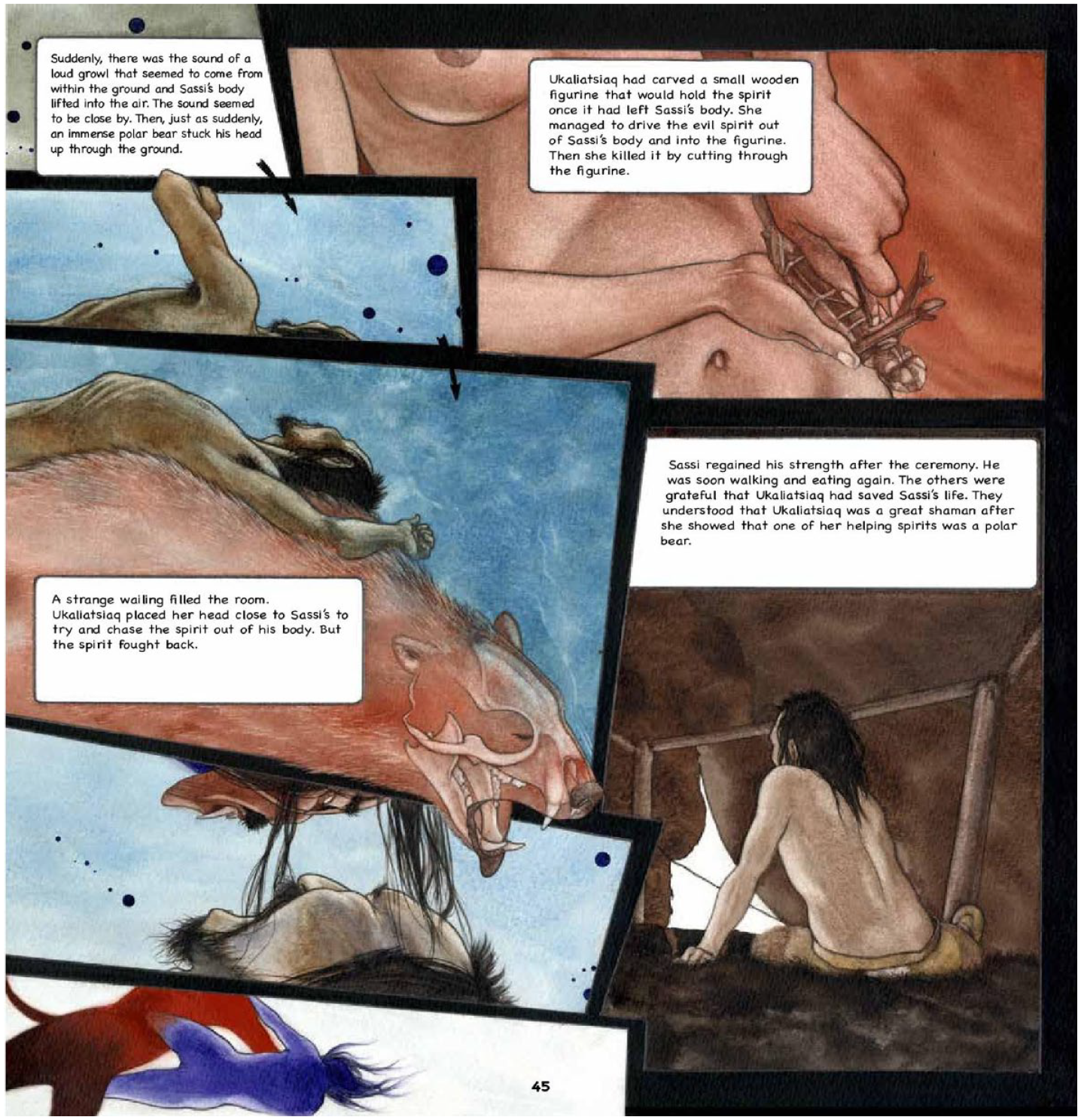
Ukaliatsiaq’s healing figure, The Ermine (p. 45).
The blue panels on the left side of this page, conventionally read/viewed first, by western readers, are given further precedence because the text in them is joined by arrows guiding the readers’ eye down the whole left side of the page before moving onto the right. This lends prominence to the Ukaliatsiaq’s spiritual life and her Shamanic traditions over material reality in this ritual so that when the above caption accompanies a close-up image of Ukaliatsiaq’s naked torso (on the right hand side of this page) as she carves the healing figurine, her muscles straining as she presses down on it with the knife, this is experienced by the reader/viewer as an explanation overlaid afterwards to structure a seemingly jagged and striking spiritual experience, which is primary . It is as if this page epitomizes McCloud’s (1993) claim for the representation process in comics that they ask their readers/viewers to “join in a silent dance of the seen and the unseen. The visible and the invisible” (McCloud 1993, p. 92, Panels 1–2).
However, the close up of Ukaliatsiaq’s body on the right hand side of the page at the same time highlights her embodied investment in this successful healing ceremony demonstrates her role in linking past and present, history and memory, mind and body, image and experience that is mirrored in the representation process itself.
In this way this Ukaliatsiaq’s carvings become a representation of the process of materializing dream-figures and spirits, which she successfully integrates as part of her present waking life. Later, Ukaliatsiaq carves a figurine of Ummimak after he has died; the words that accompany this embodied image of her hands, close-up, carving, epitomize this: “now you are also here Ummimak,” show how this memory-object also materializes his continued presence, and thus becomes a vehicle of his survival (p. 51). This is in contrast to Bjørg and Thorleif’s suppressed encounter with their violent past, depicted in Figure 2, upon which a disavowal of their pagan spiritual beliefs is based and which adversely affects their survival.
Conclusions
Through the lenses of haptic visuality and memory objects, all of the images analyzed in this paper focus on colonial encounters and survival in ways which allow us to closely examine and reimagine the process of colonization itself. The colonial encounters and survivals that these images depict may be summarized as: encounters between the colonized and the colonizers (both sexual and in terms of trade) as well as encounters between the physical world and people’s spiritual life in both the Tunit and Inuit and also the Norse). The notion of whether these encounters and survivals draw on patterns of transactional relations or the relations constructed around gifting was further explored. Overall a more equal encounter between both: people, where gifting is valued over merely transactional relations (Qajuuttaq, Asaleq, and Emiel; Aqissiaq, Kajaaq, and Bjarne) and the physical and the spiritual, where one does not suppress the other but both survive interdependently (in terms of the influence of Bjørg’s pagan past and Ukaliatsiaq’s shamanic practices) was found to be depicted in the graphic narratives under investigation.
Undertaking a haptic and object-oriented analysis of Oqaluttuaq’s narration of Arctic migrations and settlements, based as it is upon archeological remains, we have argued that the books tell a “new and different” history of Greenland and generate a “resonance” between the history and the present (Gronnøw and Sørensen, 2009: 52), including social and cultural issues of Greenland’s autonomy. As such, these narratives demonstrate the importance of the comics medium for memory studies, in particular as regards questioning and disrupting the dominant Western colonial representations of indigenous peoples in the Artic. Regarding the hapticity of collective memory representations in Oqaluttuaq, we have suggested that the narrative encourages multi-sensorial engagement, which in turn problematizes the customary association between “memory-image” and the Western philosophical and hermeneutic category of the gaze. These combined approaches applied to comics enabled our analysis of the themes Oqaluttuaq of encounter and survival. These themes offer trajectories for analysis of form and content by way of re-imagining and decolonizing the cultural memory of the Arctic. As a work of post-colonial collective memory, the graphic narrative of Oqaluttuaq re-imagines loss and disappearance—of people, cultures, and environments—as a vital to Greenlandic history. As such, this history is marked by a vacillating dynamic between discontinuity and continuity. Against the common settler-colonial motif, found also in Hegel, that the indigenous people are always already on the brink of extinction and in need of protection by the “Western civilization” (Lowe, 2015: 146), it also affirms survival and perseverance of peoples in the Arctic in face of natural and historical challenges to their collective existence, partly by way of their imbrication and connection with ancestral others (as well as with future generations). Although these collective mnemonic relations embedded in the text are established via material remnants and use different yet repeating stories of encounter and survival as signposts, yet rather than supporting any homogenous sense of communality, the anti-colonial imaginative historiography used affirms the plurality and heterogeneity of Arctic dwelling.
Footnotes
Funding
Magdalena Zolkos’ research for this article has been supported by Alexander von Humboldt Stiftung as a recipient of the Humboldt Research Fellowship for Advenced Researchers (2019-2021).
