




Abstract
This article builds on efforts to connect visual culture, social movements, and memory studies. It introduces the concept of visual public memory through a study of the circulation of photographs of the Dutch anarchist movement Provo between 1967 and 2016. It demonstrates that the visual public memory of a movement can be captured in a network composed of carriers of memory (newspapers, magazines, exhibitions, books), memorata (the remembered events), and mnemonic actors (actors that circulate the carriers of memory). Based on a qualitative interpretation of this network, the article follows four routes through it, uncovering the role of seemingly a-political mnemonic actors, such as municipal governments and museums, in the visual public memory of Provo. Showing how photographs are uniquely able to carry political possibility into memory, this article argues that visual representation plays a crucial role in how social movements are remembered.
“Social movements and the protests they launch are essentially visual phenomena.” To question the textual focus of social movement studies, Mattoni and Teune (2014) start their article on the role of images in social movements with this provocative statement. Visual representations play an essential role in three key aspects of social movements: they mobilize and create a sense of common purpose within a group; mass media represent the activities of movements in multimodal forms that are primarily visual; and, social movements achieve symbolic visibility through the images they create themselves and which are made of them (Doerr et al., 2013; Memou, 2015). The political agency of social movements, their political power, is chiefly derived from this visibility, because it forces other political actors, such as politicians or political parties, to acknowledge and act on their demands (McGarry et al., 2020).
Since the early 2000s, memory studies scholars have studied “mnemonic processes” through social movements, while, roughly at the same time, social movement studies scholars started looking at memory to shed light on “protest dynamics and outcomes” (for an overview see: Merrill et al., 2020). In the last 2 years, scholars from both fields attempted to reconcile these approaches in a “memory-activism nexus” (Rigney, 2018), a “movement-memory nexus” (Daphi and Zamponi, 2019), or a “movement-memory interface” (Merrill et al., 2020). They describe the nexus as consisting of roughly the same three elements: memory activism, the struggle to steer future remembrance, memory in activism, which describes how the memory of earlier movements shapes the tactics and demands of movements in the present, and memory of activism, which deals with how movements are remembered. Merrill et al. (2020) rightfully note that the three elements should not be seen as disjointed entities. For example, activists demanding reparations in the United States seek to reformulate the memory of the Civil Rights Movement (memory activism and memory of activism) in order to bolster support for their central political demand of reparations (memory in activism).
Why are some movements able to “penetrate the visual memory” with “iconic images,” while others quickly become, or are rendered, invisible (Mattoni and Teune, 2014: 871)? Combining the two strands of research sketched above, this article sheds light on the role of visual representation in the memory-activism nexus. It primarily studies when, why and how specific photographs of a social movement become representative of it and what kind of mnemonic function these pictures fulfill (memory of activism). It also looks at how different mnemonic actors circulate different photographs of a social movement to keep it in the public eye (memory activism) and examines how new movements use photographs to connect with older movements (memory in activism). Instead of taking a single picture as its starting point, which is, often a priori, assumed to be representative or iconic, this article charts the visual public memory of a social movement over a longer period. Using the circulation and remediation of photographs of the Dutch anarchist movement Provo (from the Dutch word “provoceren” [to provoke]) in newspaper articles, exhibitions, (photo) books, magazine articles, and a documentary between 1967 and 2016 as a case study, it demonstrates that the visual public memory of a movement can be captured in a network composed of these carriers of memory, memorata (the things, persons, or events remembered) and mnemonic actors (individuals and collectives that circulate the carriers of memory).
The memory of social movements has often been conceptualized as a site of (political) contention (Daphi and Zamponi, 2019). At first glance, the public memory of social movements might indeed seem to be shaped more by “crises and controversies” than by “consensus and canon-building” (Erll and Rigney, 2012: 2). This article uncovers the role of seemingly a-political mnemonic actors, such as municipal governments and museums, in the visual public memory of a social movement. Rather than a battle between competing political narratives, it argues that the true stake in the visual public memory of a social movement might be to keep it political, or politicized, at all.
After a short description of the Provo movement, a definition of visual public memory, and a section on methodology, the first empirical part of this article gives an overview of the visual coverage of the movement in the Dutch press (1965–1967) and notes which pictures migrated from this coverage to the visual public memory of the movement. The second part describes the visual public memory of Provo (1967–2016). After some general characteristics, it presents four routes through the network, which explain the changing shape of the visual public memory of the movement. Showing how photographs are uniquely able to carry political possibility into memory, this article argues that visual representation plays a crucial role in how social movements are remembered.
The Provo movement, 1965–1967
Most historians have described Provo as a set of protests and events between May 1965 and May 1967 in the center of Amsterdam that laid bare a conflict between the baby-boom generation and the post-war governing elites (Hietland, 2016). Using new and deliberately playful forms of protest, Provo became an international media-hype and an example for youthful dissent and revolt around the world, inspiring John Lennon and the soixante-huitards of Paris alike (Buelens, 2018; Pas, 2015). The name Provo came from a magazine, published by a group of friends (Pas, 2003). Loosely anarchist in orientation, articles in the magazine called on the “provoteriat” to rise up against the “establishment.” Van Duijn, who coined the name Provo and is often described as its main ideologue, had become disillusioned by the conformism and lack of revolutionary fervor of the proletariat, in the Marxist-sense of the word. The opening article of the first issue of Provo gloomily noted that the battle was probably already lost: empty, authoritarian consumerism was ruling the world—there was little hope for change. However, this did not mean that the provoteriat, the young, creative, and urban, in “a final act of defiance,” should not provoke the establishment and the “klootjesvolk” [little people] one final time (Van Duijn, 1965).
Provo found a form for their provocations in the street-art performances of Robert Jasper Grootveld. Similarly distressed by the rise of consumerism, Grootveld had started writing large K’s (from the Dutch word “kanker” [cancer]) on smoking advertisements around the city (Duivenvoorden, 2009). He found a totem in the Lieverdje [little darling], a statue on a central square in Amsterdam of a young boy gifted to the city by a major tobacco firm. Grootveld started organizing “happenings” at the statue, where he called on the spirit of “publicity” to deliver the Lieverdje from its addiction. Drawing symbolic circles around it, he hoped that the reverberations of the happenings would envelop the entire city of Amsterdam and that, in its turn, this “Magisch Centrum Amsterdam” [Magical center Amsterdam] would change the entire world (Van Reeuwijk, 1965: 24).
After Provo politicized Grootveld’s happenings by selling their anarchist magazine, the Amsterdam police force started to violently suppress them. Fueling the fire, the Dutch and international press provoked the Provos and the police by extensively covering the happening’s (Pas, 2015: 10). The city government reacted by banning the Provo magazine several times and jailing prominent members of the movement. Next to the playful demonstrations, Provo also proposed anarchist-inspired solutions to the social ills of society. Of the several “white” plans, the white bike plan, which entailed the placing of unlocked, free-to-use white bikes around Amsterdam to combat air pollution, received the most attention (Otten, 1984).
The tension between Provo and the police culminated in the protests during the wedding of the Dutch princess Beatrix with the German minor-noble Claus von Amsberg on 10 March 1966. Twenty years after the German occupation of the Netherlands, the lavish wedding of the couple in Amsterdam was highly controversial. Riding a wave of popular unrest, Provo announced that it would disrupt the wedding by any means. Several rumors were spread, one involving the lacing of the city water supply with LSD. In the end, the Provos decided on igniting white smoke-bombs, a reference to their white plans, during the parade of the royal couple through the city. After the smoke bombs went off, making international headlines, the police violently arrested anybody suspected of being a Provo. In order to shed light on the excessive police violence, the group, together with other left-leaning magazines, hosted an exhibition of photographs made by four photographers during the wedding day. The crowds gathered at the opening of the exhibition provoked another violent police response. Following the public outcry and the publication of an inquiry into the conduct of the police force, the mayor and the police commissioner of Amsterdam were forced to step down (Pas, 2015).
The wedding riots proved to be the peak of the influence of Provo. Because of its unorganized nature, everybody could claim to act in the name of the group. The inability of the founders to control the message, combined with a power struggle following a successful campaign to get a seat in the city parliament, resulted in deep divisions within the movement. A group of Provos around Rob Stolk pressured the other members of the movement to publicly declare the death of the movement on 13 May 1967, 2 years after the first issue of Provo was published.
Visual public memory
Since the early 1990s, public memory has become a “familiar term” in the humanities and social sciences (Houdek and Phillips, 2017). In most definitions, the concept is delineated from other forms of memory, such as individual, social, or collective memory, by the fact that it is deliberately and openly communicated, discussed, and debated with others. While the past is its subject, disputes about public memory often essentially revolve around present-day concerns (Casey, 2004). While the mnemonic activities of states and other official actors have been the prime focus of the study of public memory, Bodnar (1994: 13) has shown that it emerges from the “intersection of official and vernacular cultural expression.”
Traditionally, “tenacious media,” such as statues, monuments, and museums, have been the prime focus of studies of public memory (Casey, 2004). However, scholars increasingly concluded that it is not so much the materiality of media, but rather their “decidedly public and visible” nature that makes them distinctive carriers of public memory (Houdek and Phillips, 2017). Despite this emphasis on visibility, Zelizer (2004) notes that “for as long as collective memory has been an area of scholarly concern” the role of photography as a “vehicle” of memory has been “asserted rather explicated.” In contrast to statues and monuments, which set public memory into stone, Zelizer (2004: 164) argues that ability of photographs to capture the contingency of moments in the past makes them powerful mnemonic carriers. Coming to similar conclusions, Shevchenko (2014: 6) notes that photography is “fundamentally constitutive of remembering in the modern age” and Olick (2014a: 21) argues that the medium is “mnemonic at its core.”
In About to die, Zelizer (2010) demonstrates the mnemonic power of photography in relation to the memory of “unsettled” and traumatic events. While social movements are certainly remembered through photographs that display tragic and traumatic events, such as the violent repression of protest or even the death of protesters (Rigney, 2020), this article argues that visual representations of hopeful moments can similarly become potent carriers of memory. As a result of their ability to capture contingency, photographs play a vital role in the “cultural transmission of positivity” (Rigney, 2018): they carry political possibility into memory. Similar to the role of visual representation for social movements in the present, this article argues that photographs play a crucial role in the memory-activism nexus. To study this process, it introduces the concept of visual public memory: the changing constellations of photographs that are publicly used by “official” and “vernacular” actors (Bodnar, 1994: 13) to remember social movements in public.
Studying visual public memory
How can we shed light on the changing shape of the visual public memory of Provo? First, as Olick (2014a: 29) argues, “journalistic archives are particularly rich laboratories” to study changes in public memory, because journalistic remembrance always connects the past to the present (Zelizer and Tenenboim-Weinblatt, 2014: 1). Second, the visual public memory of a movement is often presented to be “ultimately inseparable” from its visual journalistic coverage (Olick, 2014a: 28). Hariman and Lucaites (2014) argue that photographs taken at the time of the original event will be its only visual documentation. In contrast to texts, there will be no “second or third” visual drafts of an event: all later recollections necessarily rely on (combinations of) photographs taken during the original event. It is the shape of these constellations, the changes in them, and the reasons for these changes that this article seeks to reveal.
The article is based on two sets of systematically studied journalistic corpora (Table 1). First, the visual journalistic coverage of the movement was retrieved through a key-word search for “Provo” in the Dutch digital newspaper archive Delpher in the period between 25 May 1965, when the publication of the first issue of its magazine officially launched Provo, and 13 May 1967, when several of its leaders proclaimed the death of the movement. Of the 6059 hits, 197 articles contained 144 different photographs of the movement. Because opposition to the press was as vital part of Provo’s protest, their efforts to counter the prevailing image of the movement, the 15 issues of the Provo magazine, published between 12 July 1965 and 17 March 1967, 18 pamphlets (Provokaties), published between 21 June 1965 and 20 August 1966, a photo exhibition (19 March 1966), and the catalogue of this exhibition were also studied. These publications contained a total of 59 different photographs. Some of these pictures were copied from Dutch newspapers but were given different captions in the publications of Provo.
Corpora of digitized newspapers used to study the visual journalistic coverage (1965–1967) and the visual public memory of Provo (1967–2016).
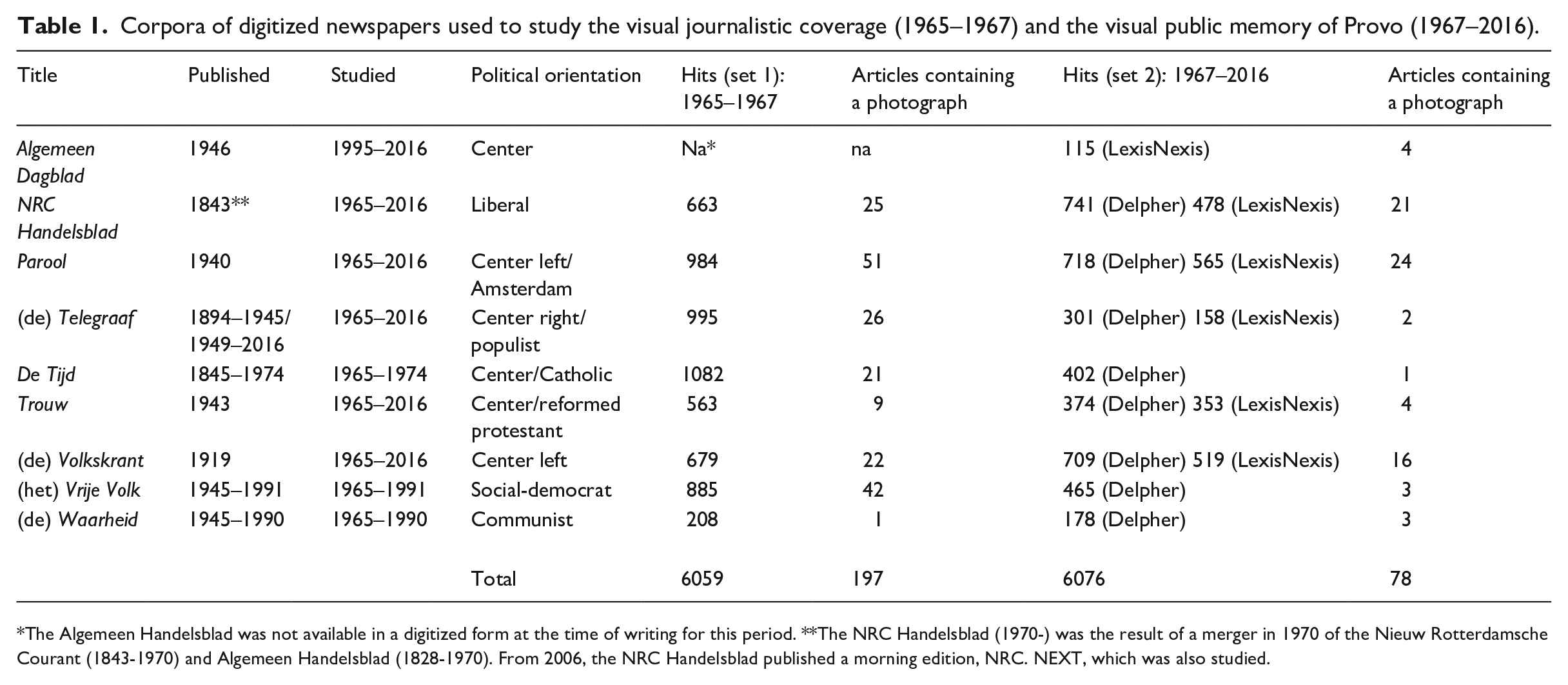
The Algemeen Handelsblad was not available in a digitized form at the time of writing for this period. **The NRC Handelsblad (1970-) was the result of a merger in 1970 of the Nieuw Rotterdamsche Courant (1843-1970) and Algemeen Handelsblad (1828-1970). From 2006, the NRC Handelsblad published a morning edition, NRC. NEXT, which was also studied.
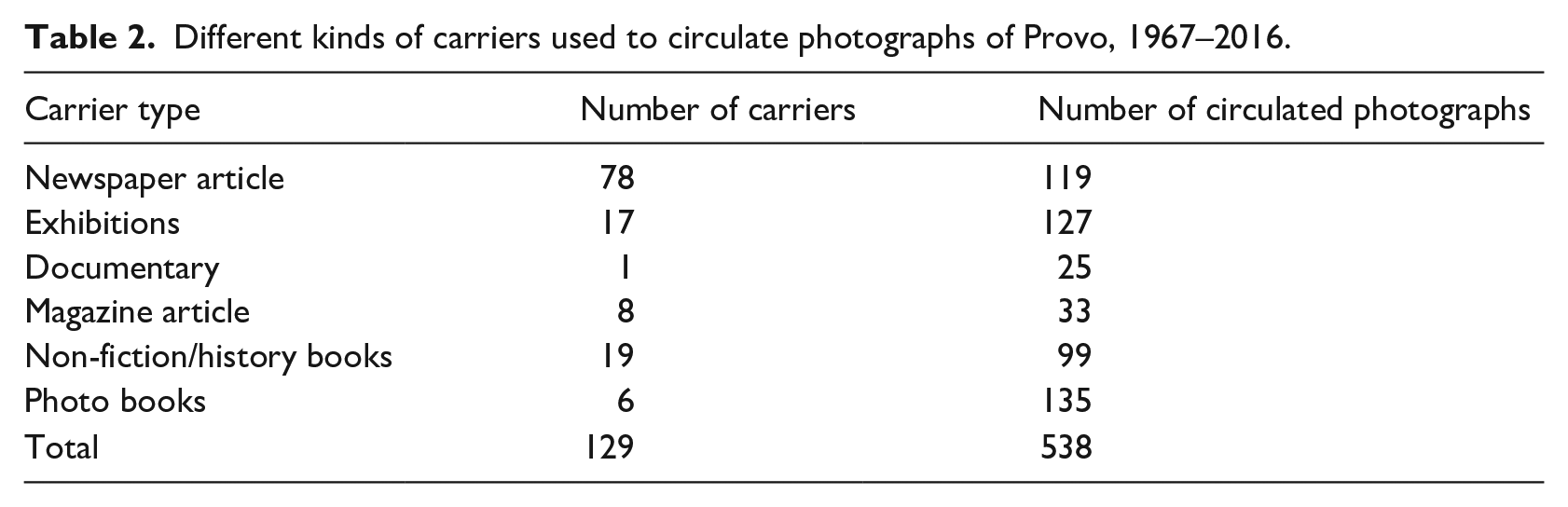
The visual public memory of Provo was studied via a key-word search for “Provo” in the digital newspaper archives Delpher (1967–1995) and Lexis Nexis (1995–2016) in the period between 14 May 1967 and 25 May 2016, a year after the 50th anniversary of the movement. Of the 6076 hits, 78 articles contained at least one photograph of the movement. About 51 other carriers of Provo’s memory, such as exhibitions, non-fiction books, photo books, magazine articles, and a documentary, were recorded that were discussed in these newspaper articles (Table 2). In all these carriers, both the newspapers articles and the carriers mentioned in them, 138 different photographs were circulated 538 times.
Different kinds of carriers used to circulate photographs of Provo, 1967–2016.
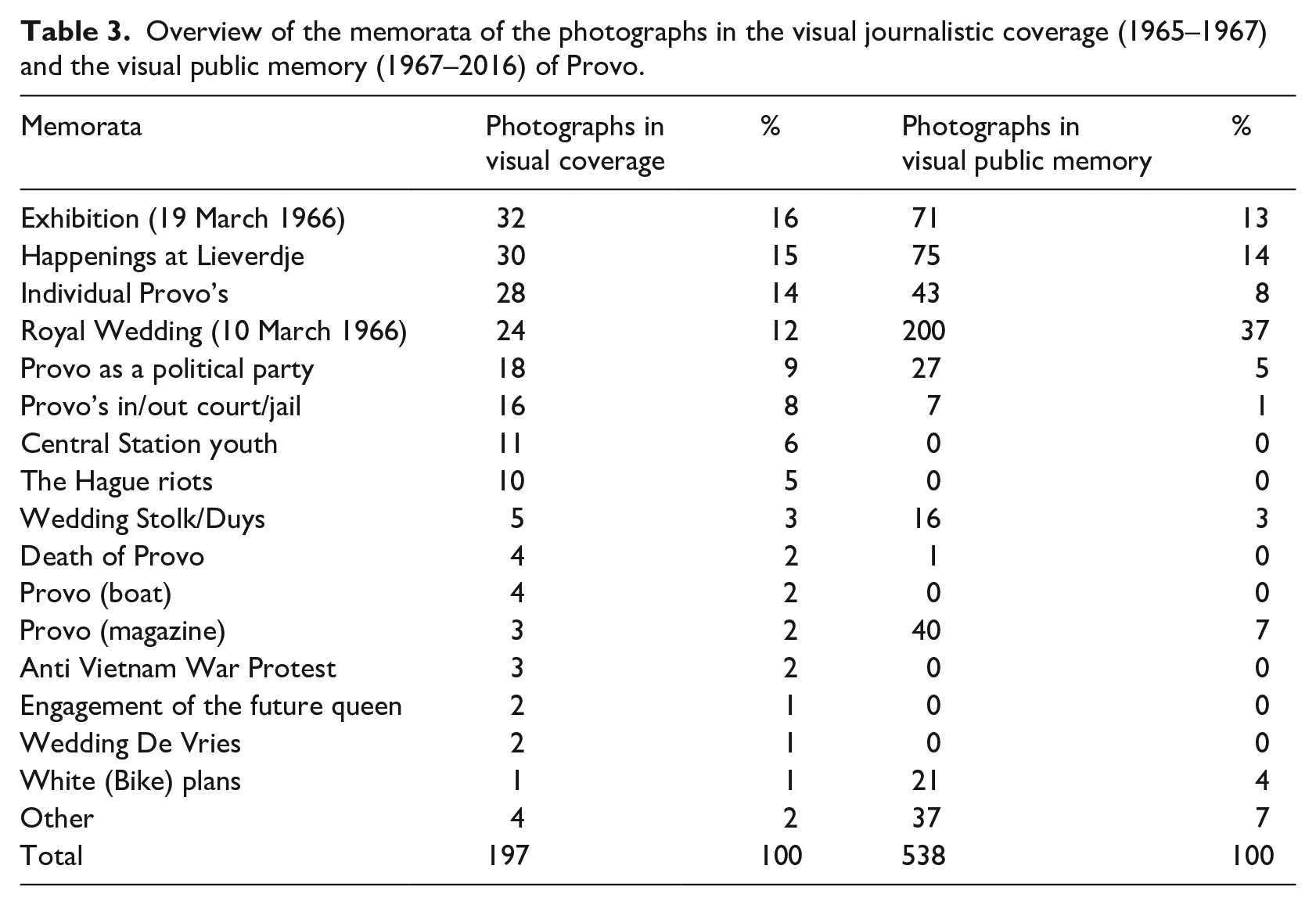
Building on Hoskins’ (2009) notion of “network memory,” the photographs found in the second set were connected to two other aspects—memorata (the specific events of the movement that were remembered) and mnemonic actors (the individual, collective, publisher, museums responsible for the circulation)—to map the visual public memory of Provo. The choice for different memorata was based on important events in the short existence of the movement, identified via an overview of scholarly work on Provo (Hietland, 2016; Pas, 2015). Table 3 gives an overview of the connection between these memorata and the 197 photographs of the original journalistic coverage and 538 circulated photographs of the visual public memory of Provo. Using the database and network visualization program Nodegoat, the connection between these three aspects of the network were visualized in Figure 1. The four threads that run through the visual public memory were identified after a qualitative interpretation of the network.
Overview of the memorata of the photographs in the visual journalistic coverage (1965–1967) and the visual public memory (1967–2016) of Provo.
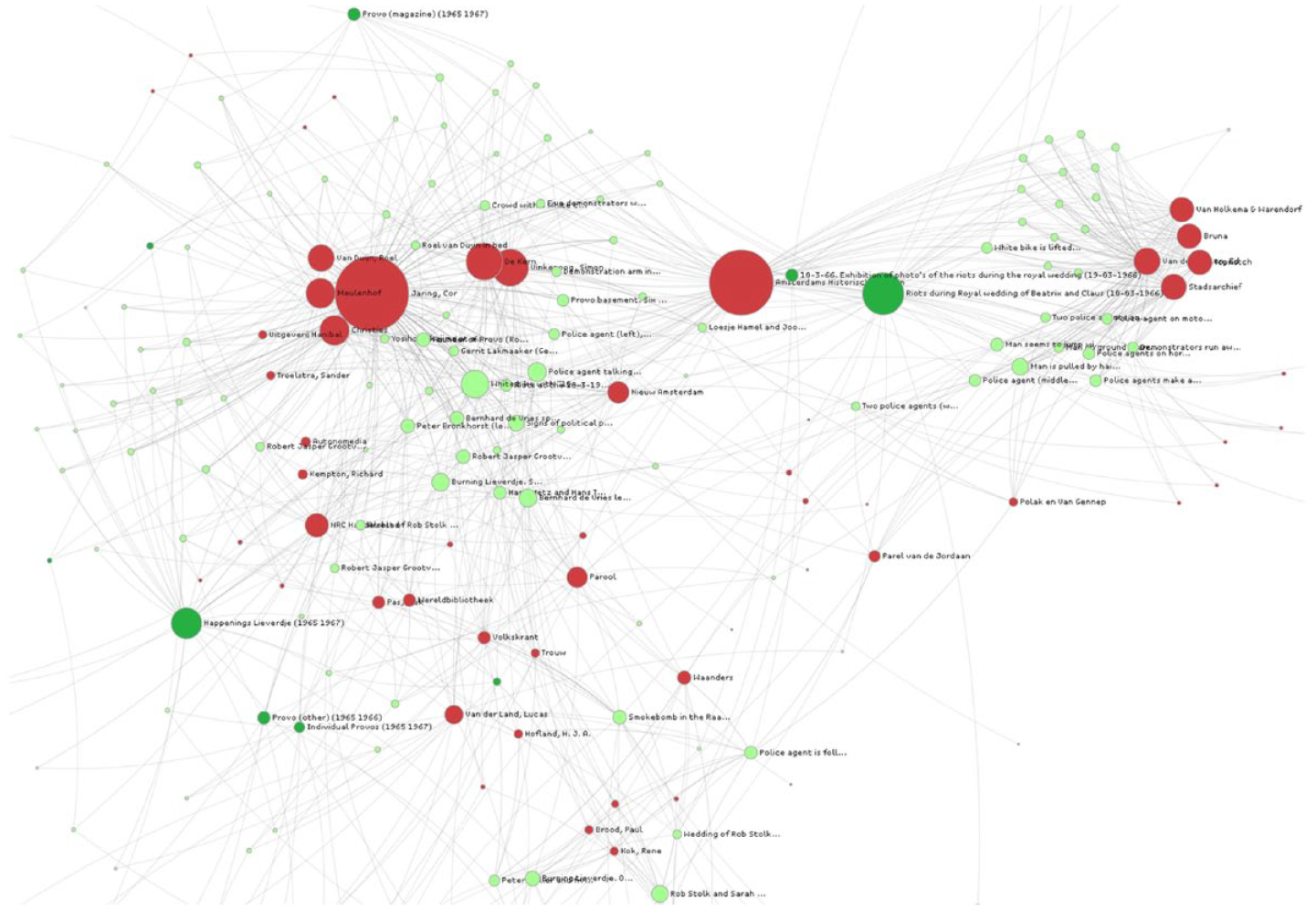
The figure shows the central part of the visualization of the network of circulated photographs, mnemonic actors and memorata. The photographs are represented by light-green nodes (dots). The mnemonic actors are represented by red nodes. The memorata are represented by green nodes. The visualization was produced in the program Nodegoat by a standard Force D3 algorithm on the basis of a database containing 538 circulations of 138 photographs in 129 different carriers (1967–2016).
Visual coverage of Provo, 1965–1967
Pas (2011, 2015) argues that the media played a central role in the success of the Provo: without an audience, their provocations and happenings would not have had any effect. However, getting the right kind of press attention proved to be difficult. While some newspapers, like the Amsterdam-oriented Parool and right-wing Telegraaf, paid ample attention to the movement, Van Der Hoeven (2012) notes that other papers, such as the liberal NRC Handelsblad purposefully ignored their protests. While Pas (2003, 2015) and Buelens (2018) have studied the textual coverage of the movement in the press, its visual representation has not received systematic attention. This section discusses the overlap between the visual coverage (corpus one) and the visual public memory of the movement (corpus two).
Between May 1965 and May 1967, eight national Dutch newspapers published 144 different photographs across 197 different articles. Table 3 connects these pictures to the memorata of the Provo movement and shows that Dutch newspapers were primarily interested in covering the skirmishes between Provo and the Amsterdam police at the ‘t Lieverdje, the royal wedding of 10 March 1966 and the photo exhibition, which was organized to highlight the police violence on the wedding day (19 March 1966). However, the Dutch press also followed the activities of individual Provo’s and the political campaign of the movement in the municipal elections in the summer of 1966.
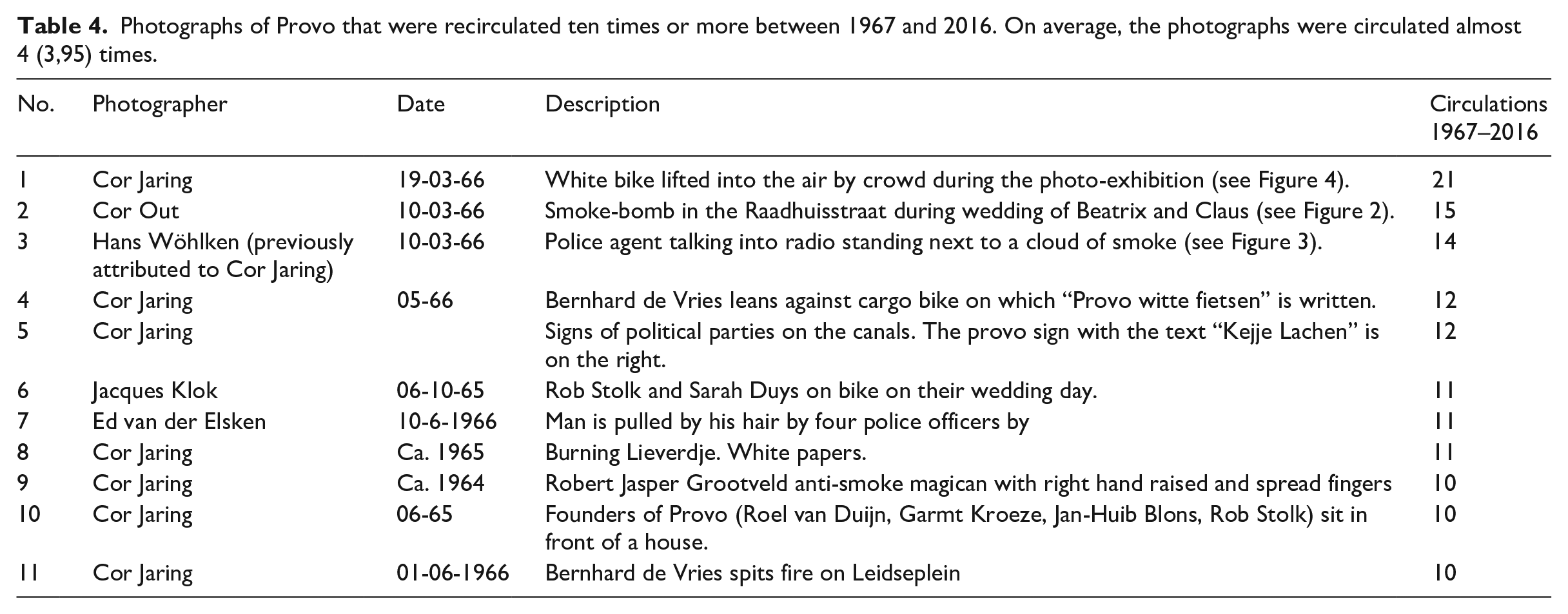
Only 23 of the 144 different photographs published by the Dutch press between 1965 and 1967 appear in the visual public memory of Provo (1967–2016). Of the pictures that were circulated more than 10 times in the visual public memory of Provo (Table 4), we can find the photograph of the smoke bomb during the Royal wedding (Figure 2), published seven times, and the wedding of Rob Stolk, published three times, in Dutch newspapers between 1965 and 1967. The most frequently used picture to cover Provo, which depicts a police officer being followed by a group of Provos (published 10 times), did make it into the visual public memory of Provo, but it was circulated only four times (Figure 3).
Photographs of Provo that were recirculated ten times or more between 1967 and 2016. On average, the photographs were circulated almost 4 (3,95) times.
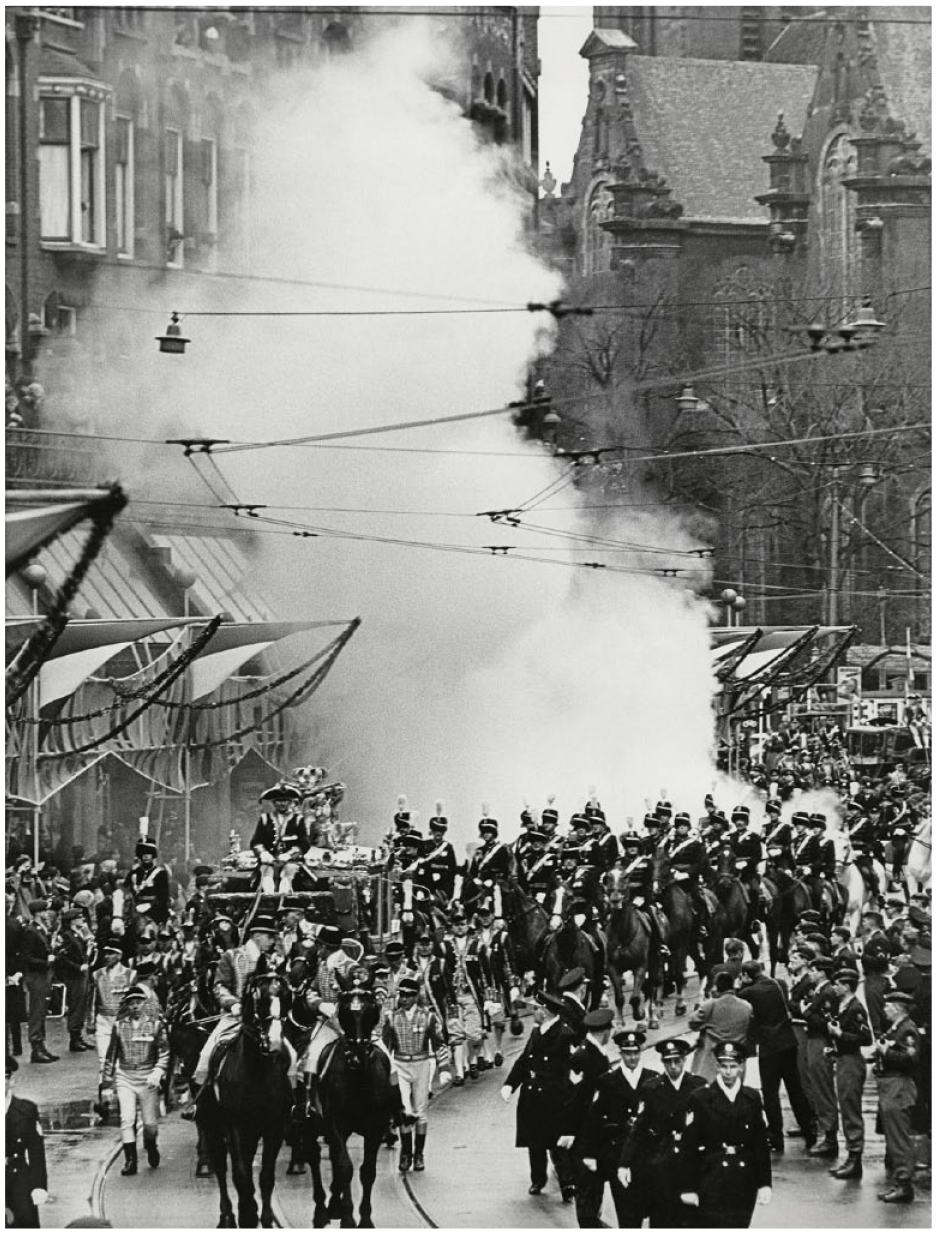
Smokebomb at the Royal Wedding, 10-3-1966. Nationaal Archief/Collectie Spaarnestad/ANP/Cor Out.
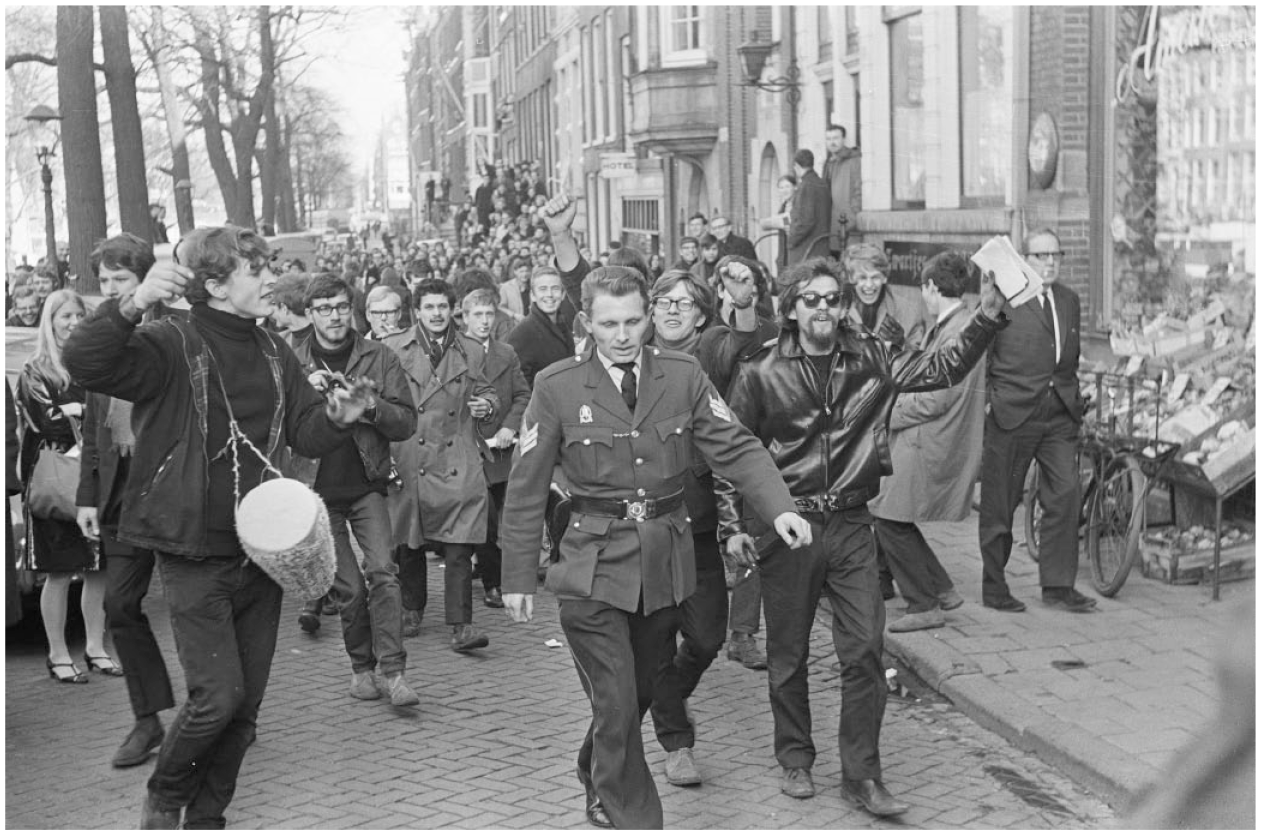
Police officer is followed by a group of Provos, 19-3-1966. Joost Evers, National Archive of the Netherlands, Anefo.
Table 4 shows that Provo was successful in producing the imaginary that would come to dominate its visual public memory. Of the 12 most circulated photographs of the movements, only two were made by regular press photographers. Nine of the remaining pictures were made by the photographer Cor Jaring and one by the documentary photographer Ed van der Elsken, who also was sympathetic to the movement. Reflecting on the influence of Provo in 1985, Van Duijn noted: “Only now do I understand that Cor [Jaring] was one of the people who made Provo, because, in contrast to other movements, Provo communicated with images” (Van Duijn and Jaring, 1985: 8). This connection between Provo and photography explains the prominence of pictures that the movement produced itself in its visual public memory. More directly, it also explains the centrality of its most frequently circulated picture: Jaring’s photograph of a white bike being lifted into the air (Figure 4).
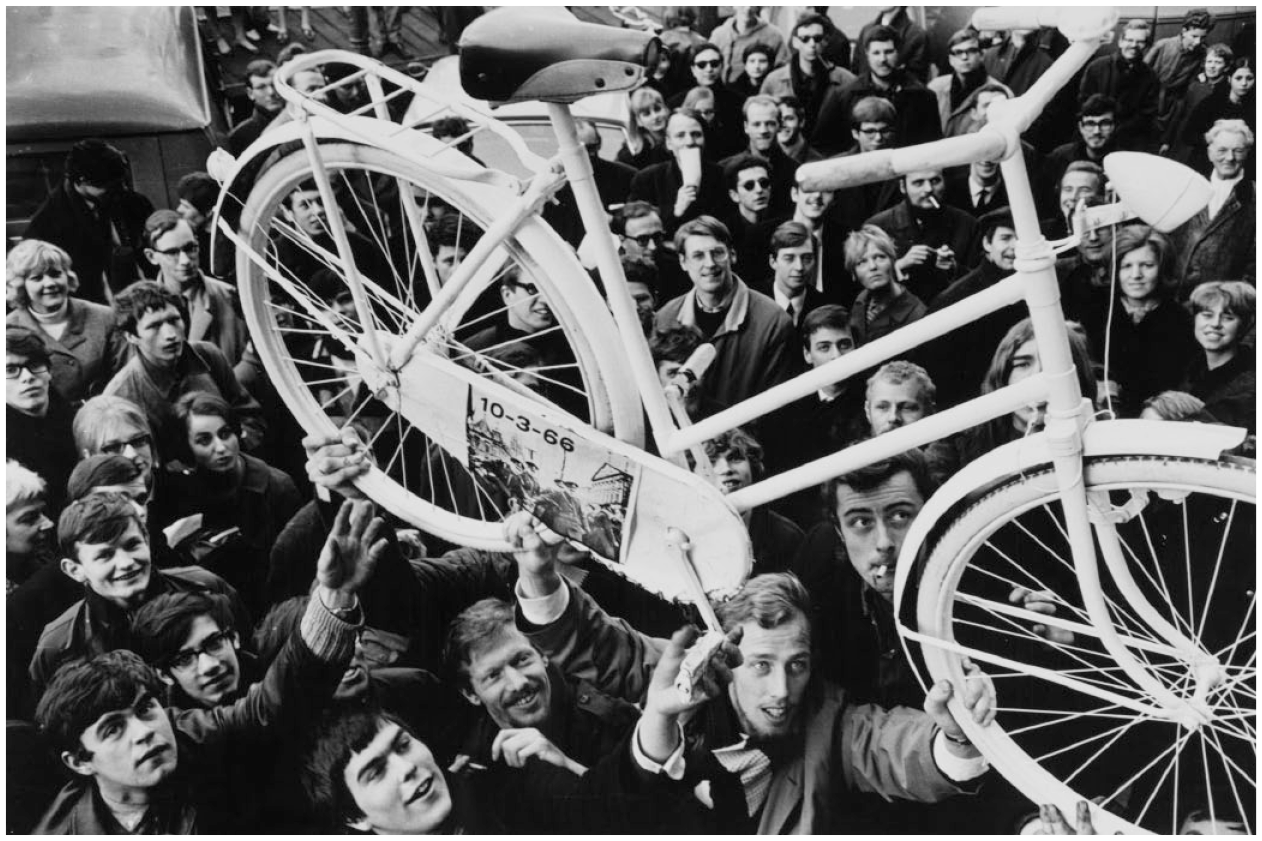
White bike is lifted into the air, 19-3-1966. Cor Jaring/Stadsarchief Amsterdam (010004008047).
Jaring’s picture of a group of young and smiling people lifting a white bike in the air, a direct reference to the imaginative political solutions of Provo, shows how photographs can carry political possibility into memory. However, an analysis of its original context reveals that the moment that the photograph “captures” was far from contingent. The people lifting the bike were there to attend a staged and purposefully visual media event: the photo exhibition. A picture of Van der Elsken, who was standing in the crowd, shows the photographers Koen Wessing, Cor Jaring, Gerrit Jan Wolfensperger, and Hans Wöhlken standing in the window of the Prinsengracht 820, where their work was being exhibited. The crowd was lifting the bike in the air for them. In this sense, Jaring’s photograph can be seen as a “meta-picture”: a picture about pictures (Mitchell, 1994: 35). In this case, a photograph that shows how movements produce powerful photographs.
While the visual journalistic coverage and visual public memory of other movements might be more directly connected, this case-study shows that Provo produced the majority of the photographs that would later be used to shape its visual public memory. The centrality of the white bike photograph in the visual public memory of Provo reveals that contingent moments, which are so central to the mnemonic function of photography, are not only coincidentally captured by journalists, but can also be purposefully produced by actors who are already thinking of its memory.
The visual public memory of Provo, 1967–2016
Figure 1, a network visualization of the connections between the circulated photographs, mnemonic actors and memorata, highlights different aspects of the visual public memory of Provo. The light-green dots, or nodes, represent the circulated photographs of Provo that, in different formations, form its visual public memory. The red nodes represent the actors responsible for the circulation of these pictures. The green nodes represent the memorata to which the photographs are connected. The algorithm that produced the visualization makes nodes relatively bigger and places them in a more central position the more they are connected to other nodes. Furthermore, the visualization only displays the labels of nodes that have a relatively central position. The visualization shows how several mnemonic actors played a central role in the visual public memory of Provo. On the left of the visualization, the large red node represents Cor Jaring, who made 72 of the total 138 pictures (the light-green nodes that surround Jaring’s red node). A slightly smaller red node, similarly surrounded by light-green nodes, on the right of the visualization represents Ed van Elsken, who made 21 of the total 138 pictures.
What kind of mnemonic actors circulated the photographs of the Provo movement? Although newspaper articles are the most often-used carrier in the visual memory of Provo, they mostly circulate one or maybe two photographs per article (Table 2). While the work of Van der Elsken is an important pole in the visual public memory of Provo, Figure 1 shows that newspapers almost exclusively used the work of Jaring. As a result, several titles, such as the NRC Handelsblad, can be found below Jarings node in Figure 1. Exhibitions and books carry entire corpora of photographs into public memory. This explains the centrality in Figure 1 of the Amsterdam Historisch Museum, which hosted solo exhibitions of both Jaring and Van der Elsken. In another example, we find the three publishers of Van der Elsken’s photo-book Amsterdam! Oude Foto’s, 1947–1970, Van Holkema and Warendrof, who published it in 1979, Bruna (republication in 1988) and the hip-hop label Topnotch (republication in 2014) closely together on the right side of Figure 1.
In the visual public memory of Provo the work of Jaring and Van der Elsken is connected to different memorata. Jaring’s node is not only placed in a central position because his photographs were circulated often, but also because his pictures documented both the happenings at ‘t Lieverdje, but also the riots during the wedding day (10 March 1966) and the events surrounding the photo exhibition (19 March 1966). Van der Elsken’s photographs, on the other hand, can only be connected to the last two of these memorata.
Figure 1 gives an overview of the visual public memory of Provo for the period 1967–2016. However, the constellations of pictures that were used to remember the movement change over time. Figure 5 shows the number of circulations per year of the 11 most circulated photographs of the Provo movement. Below the importance of the link between the work of Jaring and the Provo movement will be discussed in detail. For now, it suffices to note that his photographs started to be republished in the 1980s when his work was (re)discovered and reached prominence in 2015: the year when the 50th anniversary of the birth of Provo was celebrated with two exhibitions of his work. In this year, the photograph of a white bike being lifted into the air (Figure 4) was published no less than 10 times, half of the total number of circulations. In the same year, newspapers started describing Jaring’s photographs as “iconic” of Provo (Groene Amsterdammer, 2015; Parool, 2015; Volkskrant, 2015b).
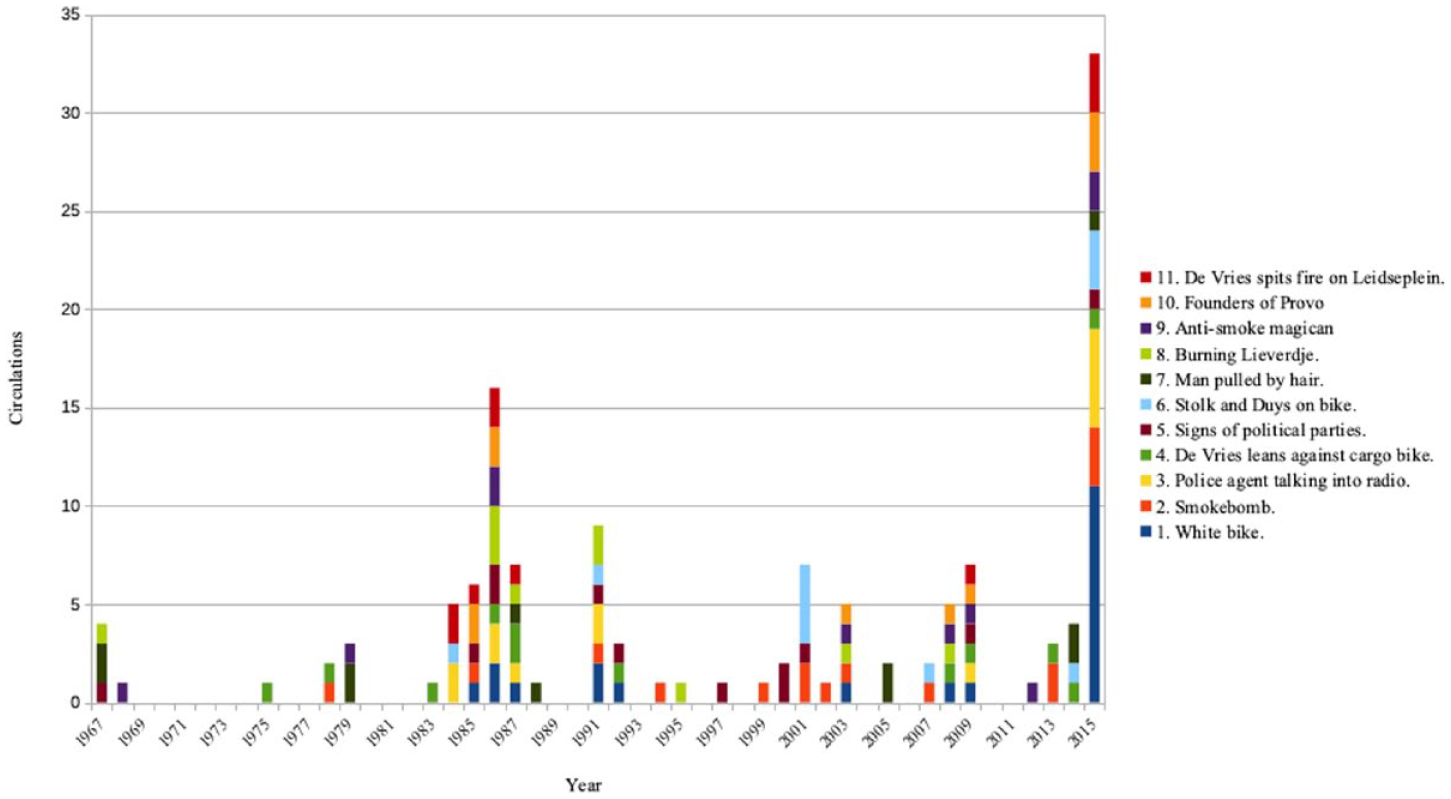
Circulations per year of the 11 most frequently circulated photographs of Provo (Table 4), 1967–2016.
Navigating the network: Four routes
After giving a general overview of the visual public memory of the Provo movement, the section below follows four different routes through it. Based on a qualitative interpretation of the network, it describes these four threads that hold it together.
Setting an example?
Mamadouh (1992) describes the continuities between several urban social movements in Amsterdam: the Provos, the “kabouters” [gnomes], and the squatting movement. Based on her work, it was expected that the visual public memory of Provo was primarily shaped by mnemonic actors with ties to activism, trying to control how the movement was remembered in order to draw visual connections between Provo and themselves. New movements, such as the squatter movement of the mid-1970s to mid-1980s, and journalists describing them, certainly established links to the visual public memory of Provo. For example, during the squatter demonstrations of the 1980s, several national newspapers published a photograph, depicting a large demonstration and a large cloud of smoke. The Vrije Volk noted: “The parallel is clear. Everybody remembers the clouds of smoke in the Paleisstraat where [queen] Beatrix and Claus had to drive through . . .” (Vrije Volk, 1980). Only days before the inauguration of Queen Beatrix in 1980, squatters made the same connection, publishing a pamphlet called Provo [19]80 (Trouw, 1980). Five years later, newspapers again connected squatters to Provo. The Parool published two photographs, one of a smoke bomb in 1966 and one of smoke bomb in 1985, noting the squatters seemed to have “traded in the street stone for the firebomb” (Parool, 1985).
After the forced clearing of squats and large demonstrations in the 1980s, Amsterdam did not experience comparable large-scale urban protest until the Occupy movement. In 2011, a commentator in the NRC Handelsblad noted that both movements lacked “clear strategies or tactics.” The article was accompanied by a photograph of Provo’s feeding the Lieverdje, the statue in the center of Amsterdam, white sheets of paper (NRC Handelsblad, 2011). In the Telegraaf former Provos Van Duijn and Luud Schimmelpennink described the occupiers as a “pampered generation” (Telegraaf, 2011).
In 2015, in the year that, as will become clear below, the whole of Amsterdam seemed to celebrate the 50th anniversary of the founding of Provo, students occupied the Maagdenhuis, the central administrative building of the University of Amsterdam, demanding, among other things, more democratization and an end to the Neo-liberal policies of the university’s board of directors. The occupation itself reflected the legendary occupation of the same building in 1969. However, the students also tried to generate attention to their cause by staging happenings at the Lieverdje, located directly next to the Maagdenhuis. A columnist of the NRC noted: “[I saw] photographs of Maagdenhuis-activist setting the Lieverdje on fire. That had been done before, by Provo in the sixties, who wanted the imagination to rule. This copy-cat action proves the lack of originality of the younger generation. Demonstration-plagiarism!” (NRC Handelsblad, 2015c). The examples above reveal the interplay between visual representation and two elements of the memory-activism nexus: memory in and memory of activism. Squatters, occupiers and students hoped to generate attention for their protest by recreating or reenacting visual moments of Provo, such as the happenings at the Lieverdje. However, it proved to be difficult to latch on to the image of Provo. While the most well-known photograph of the movement was staged, both the press and formers Provo’s quickly derided attempts of later activists to recreate or re-stage these moments as inauthentic.
The three deaths of Provo: Movement to archive, archive to museum
Pas (2011) notes that even after Provo publicly declared its death in May 1967, the fame of the movement continued to rise, mainly because it was seen as an inspiration for protests in other countries in the late-1960s. As a result, everything Provo, especially its ephemeral publications, became highly sought after. In July 1968, the library of the University of Amsterdam announced its intention to buy the archive of the movement. It would collaborate with the Stedelijk Museum of modern art, which was interested in the “artistic merits of Provo” (Trouw, 1968). The institutions had to act fast because several American universities were rumored to have their eye on the archive (De Tijd, 1968). In the end, the library paid 13,000 guilders for the archive.
In February 1969, the university library opened the first exhibition on Provo (Volkskrant, 1969b). On a photograph, a display case is visible with “A selection of the Provo archive” written above it. Commentators described the selling and prominent display of the archive as the second, or true, death of Provo: “Provo is entirely liquidated. Provo is dead, stored in the archives of a library” (Algemeen Handelsblad, 1969). The selling of the archive also led to bitter divisions in the movement. Van Duijn, excluded from the “provolikwiedatiekomissie,” the self-appointed foundation that had negotiated with the library, noted: “That foundation is a scam. The people of Biafra need the money more! It is disgusting. It leaves a bitter taste in my mouth. I never wanted to make one cent with Provo” (Volkskrant, 1969a). Ten years later, Van Duijn sold his personal archive to the same library (Sanders, 2019: 383).
As the university library had already prophesied, Dutch modern art institutions were indeed interested in the artistic merits of Provo. In 1979, the Boymans van Beuningen museum in Rotterdam hosted the exhibition “Action, Actuality and Fiction in the art of the sixties in the Netherlands.” Two years later, the Amsterdam Stedelijk Museum hosted the exhibition “The Art of Protest, 1965–1975.” Judging by the catalogues, both exhibitions contained photographs of the actions of the Provo movement but were mainly focused on the graphic work of the movement, such as the well-known cartoons by “Willem” [Bernard Willem Holtrop], the poster, flyers and magazines, and the happenings of Robert Jasper Grootveld (Beeren, 1980; Davidson and Janssen, 1981).
The emphasis on the aesthetics of Provo, instead of its politics, led to mixed reviews. A writer in the Volkskrant was dismayed by the “cold and business-like character” of the Boymans exhibition. Confronted with photographs of the happenings at the Lieverdje, which were “laid bare like corpses” in “cold display cases” he remembered the radical nature of Provo’s protests, how cheerful and full of hope for change the actual happenings had been. The clinical nature of the exhibition provided a sharp contrast to his own memory: it “wiped the smirk” from his face (Volkskrant, 1979). Similar metaphors were used in the reviews of the Stedelijk Museum exhibition: “Who could have thought that protest posters from that time would be exhibited by a museum of the establishment?” The exposition was not a celebration of Provo, but rather an “in memoriam” (Volkskrant, 1981).
After the exhibitions in the Stedelijk and the Boymans van Beuningen, it would take until the early 2000s for the musealization of Provo to continue. Instead of seeing it as a radical political movement, the traveling exhibitions Jong! [Young!] and the smaller exhibition The Sixties!, hosted by the International Institute of Social History in Amsterdam, primarily described Provo as a part of the youth culture of the 1960s. The photograph of an 18-year-old Rob Stolk, wearing an all-white denim suit, and his 17-year-old bride Sarah Duys on a white bike on their wedding day, often accompanied this (visual) narrative of Provo (De Leeuw, 2000; Markus et al., 2001).
While two exhibitions on the work of Cor Jaring were organized in 2015, the year of the 50th anniversary of Provo, these were not used as an opportunity to host an exhibition on the movement as such. However, the Amsterdam Museum hosted an event and launched an app to commemorate the occasion. Commentators in 2015 shared an uneasiness over the aestheticized and depoliticized nature of the public memory of Provo with their predecessors in the late 1970s and 1980s. Describing her fascination with Provo in a richly-illustrated essay, young journalist Floor Rusman described the event in the Amsterdam Museum in the liberal NRC Handelsblad: “This spotless display - in a museum no less! – was far removed from what I liked about Provo” (NRC Handelsblad, 2015b). During its life, Provo created visibility for its political program through powerful imagery. After its death, this strong link between politics and aesthetics became a mixed blessing. It kept Provo in the public eye, but, at the same time, resulted in the fact that mnemonic actors could easily present photographs of the movement in depoliticized settings.
I Amsterdam: Provo and city-branding
Provo has often been described in terms of conflict: a conflict between generations, a confrontation between an authoritarian police force and young playful protesters, or a clash between old elites and the post-war baby boom generation (Righart, 1995). Although Provo was all of these things, Kennedy (1995) has pointed out that Dutch elites also quickly accommodated the movement by co-opting its rebellious and creative image. This process started directly after the death of the movement. At the end of 1967, Delta, a review of “art life and thought in the Netherlands,” bankrolled by the Dutch minister of culture, announced that it would devote an entire issue to Provo. Next to a short essay by the former Provo Bernard de Vries, it contained articles, short stories, poems, photographs and graphic work by renowned Dutch authors (Van Der Land, 1968). Directly after the introduction, we find the photograph of a policeman being chased by a group of Provo’s: the most widely reproduced photograph of the movement in contemporary coverage (Figure 3). Similar to the aestheticization of Provo, the invocation of the movement in a “mouthpiece of the government,” as a commentator in the Vrije Volk called Delta, was mainly received negatively: “there is always some square who wants to ride the wave of success of the inexhaustible image of the late Provo movement” (Vrije Volk, 1967).
The municipal government of Amsterdam similarly tried to benefit from the “inexhaustible image” of Provo. Following slightly decreasing numbers of tourist and the successful branding campaigns of other cities (I <3 New York), the city of Amsterdam began a city marketing campaign in 2002. A foundation, consisting of the city government and several for-profit partners, became responsible for keeping Amsterdam competitive on the international market for tourist and transnational companies. Each year, Amsterdam Partners, as the foundation was called, translated the “core values” of Amsterdam—“creativity, innovation and commercial spirit”—into several themes (Amsterdam Marketing, 2014). In 2015, the primary theme was the celebration of the 50th anniversary of Provo. A policy document noted that the “core values” of Provo, “stubbornness, rebelliousness and creativity,” would be used to highlight the “rougher edges” of Amsterdam’s “brand.”
Although unclear to what extent, in 2015, Amsterdam Partners played a role in the making and promoting of a documentary, Rebelse Stad [Rebellious City] made by Willy Lindwer, two exhibitions on the work of Cor Jaring, one in the city archive and one in the FOAM photography museum, and a special Provo app, made by the Amsterdam [Historisch] Museum. Through its connection with the documentary, the foundation also played a role in the frequent circulation of Jaring’s white bike photograph in 2015 (Figure 5). The increased circulation of the photograph can, at least partly, be explained by its inclusion the press-folder of the Rebelse Stad, which also noted how the photograph could be obtained from the Stadsarchief (Doc.Eye Film, 2015). In one of the 2015 articles on Provo, the NRC Handelsblad (wrongly) credited the photograph to “Doc.Eye Film,” the production company of the documentary (NRC Handelsblad, 2015a).
Similar to aestheticization of the Provo in museums, the municipal government of Amsterdam used the image of the movement without engaging with its political objectives, such as a car-free city. Former Provos were far from happy with the publicity campaign of Amsterdam Partners. At the premiere of Lindwer’s documentary, mayor Eberhard van der Laan provided the kick-off of the year of “stubbornness and creativity,” as Amsterdam Marketing had decided to label it (Amsterdam Marketing, 2014). The right-wing Telegraaf noted how the speech of the director of Amsterdam Marketing was “roughly interrupted” by a couple of “hardened Provos that felt that they were being ‘held hostage by the tourist speech of the advertising man’” (Telegraaf, 2015).
Activist becomes artist: The work of Cor Jaring
Over the years, photographer Cor Jaring increasingly insisted that he “made” Provo. While he had distanced himself from the movement in the late 1960s and early 1970, noting in an interview with the Telegraaf “I was never a true Provo or communist. I am neither left nor right” (Telegraaf, 1969), Jaring became tied to the movement in the following decades. In the 1980s, newspaper articles began referring to him as the “court painter” of Provo and, more generally, the Dutch 1960s (Volkskrant, 1986). Over time, the photographer adopted this narrative, which led to frequent tensions with former Provos and other photographers. In 1992, the Parool quoted an inebriated Jaring: “I made Provo!” After somebody else in the room suggests that Ab Pruis, a photographer who worked for the Dutch press agency ANP, made just as many pictures, Jaring responds: “That intrigant?! I don’t want to hear his name anymore, I made Provo!” (Parool, 1992).
In the period 1965 to 1967, the Dutch press had not connected Jaring to the Provo movement. Only four of the 197 photographs published by Dutch newspapers in this period were made by him and he was credited for only one. The link between Jaring and the movement started to be made in the mid-1980s. In 1984, the photography museum Fodor [FOAM] hosted the first solo exhibition of his work (Jaring and Hofland, 1984). In interviews, Jaring started to link his work to Provo: “I was lucky to be the only photographer that was there from the start. Others did not believe in the movement. When Provo gained international notoriety, I was the only one who could supply pictures. . .” (Parool, 1984).
In 1985, commemorating the 20th anniversary of the birth of the movement, the Amsterdam [Historisch] Museum hosted the first exhibition which explicitly connected Jaring to Provo and, more generally, the 60s. In the exhibition Jaring’s Jaren Zestig [Jaring’s 60s] and the accompanying photo-book, we can find all of his photographs in Table 4. Just like Van der Elsken’s Amsterdam!, the exhibition carried an entire corpus of photographs into the visual public memory of Provo. The Volkskrant noted how the photographs had become emblematic of the movement: “Some images are bombarded into history, while others are only a soon-to-be-forgotten shot in a continual process” (Volkskrant, 1986). However, it was precisely the exhibition and the Volkskrant which were doing the “bombarding.” The majority of Jaring’s Provo photographs were neither printed in the Dutch press between 1965 and 1967, nor were they circulated in carriers of the visual public memory of Provo before the mid-1980s.
In 1987, the self-fulfilling process of seeing Jaring’s photographs as iconic representations of Provo continued. Christie’s, a British auction house, auctioned 200 signed prints, including the photograph of the white bike being lifted into the air, which were expected to fetch between 200 and 500 Dutch guilders. Instead of seeing him as a photojournalist or an activist, the catalogue referred to Jaring as “the artist,” noting how Christie’s had never auctioned “more extensive collection of a living photographer” (Jaring and Christie’s Amsterdam BV, 1987). Similar to the inclusion of Provo in museums and the co-opting of the movement by the municipal government, Jaring’s transformation from activist-photographer into an artist provoked negative responses from former Provo’s. During the auction, which was styled as a Provo happening, one former Provo left the room making loud puking noises and angrily shouting “I cannot stand this [charade]” (Telegraaf, 1987).
To celebrate his 50th anniversary in 2009, the publisher Nieuw Amsterdam released a large coffee photo-book of Jaring’s work. The book and a small accompanying exhibition in Pakhuis de Zwijger contained all the Provo photographs of the exhibitions in the 1980s. Although the book boasted introductions by the mayor of Amsterdam, Job Cohen, and former minister of culture, Hedy d’Ancona, it was largely ignored by the Dutch press (Jaring, 2009). Just before his death on 17 November 2013, Jaring handed all his photographs over to the Stadsarchief, which promptly announced it would host a large exhibition in 2015.
As became clear above, 2015 saw a surge in the circulation of photographs of Provo. This can be largely attributed to the two exhibitions devoted to Jaring’s work in the Stadsarchief, which focused on him as the chronicler of Amsterdam in the 1960s, and the Huis Marseille Museum, which focused on the artistic aspect of his work (Jaring and Troelstra, 2015). Moreover, the documentary Rebelse Stad figured Jaring as one if its protagonists and circulated many of his Provo pictures. In the year that Jaring’s work received the most attention and at the moment that the visual public memory of Provo was firmly being tied to him, Anneke van Veen, the photo conservator of the Stadsarchief, discovered that some of his “iconic” photographs were not taken by him. Between 1965 and 1967, Jaring often worked with the photographer Hans Wöhlken. After the Provo movement declared its death, the latter decided to find a steady job and focus on his family (Volkskrant, 2015a). In 1969, he gave Jaring all his negatives to make a book about Provo, which never materialized. After careful study, Van Veen concluded that Jaring’s photograph of the police agent talking into the radio, which was, according to the Volkskrant, “an iconic photograph that symbolizes the revolt of the sixties generation against the post-war elites” (number three in Table 4), was made by Wöhlken and not by Jaring (Volkskrant, 2015b).
Conclusion
Building on recent efforts to connect visual culture, social movements, and memory studies, this article has introduced the concept of visual public memory. The mnemonic power of photography has often been discussed in relation to the memory of traumatic events. While social movements might certainly be remembered through images of violence and defeat, this article has shown that photographs are also uniquely able to carry contingent moments of political possibility into memory. Rather than focusing on a single picture, which is often declared to be “iconic,” this article has conceptualized visual public memory as the changing constellations of photographs that are used by a wide array of mnemonic actors to publicly remember something.
Based on systematic research in two corpora of digitized newspapers, this article has studied the original visual coverage of Provo, its visual public memory and the overlap between these two sets of photographs. While previous research has suggested that the visual journalistic coverage of an event is often directly connected to its visual public memory, this article has shown that social movements, which have an active interest in influencing how they are perceived in the present, can be successful in producing the pictures that sustain their visual public memory. This shows that photography, as a mnemonic medium, not only captures contingent moments that acquire a mnemonic function after the event but that these kinds of photographs are often purposefully produced. Furthermore, while photography, in contrast to textual media, only ever produces a first draft of an event, mnemonic actors can shape the visual public memory of an event by discovering new photographs in the archive, for example, those made by a movement itself, or by presenting pictures different constellations. This article has shown how a network methodology can be fruitfully applied to chart and analyze the changes in these visual constellations over a long(er) period of time.
As a social movement, Provo was very much concerned with its image. However, while creating powerful imagery can lead to visibility for the demands of movements in the present, aesthetically-pleasing photographs can become a mixed blessing for activists that are concerned with controlling their visual legacy. What aspect of Provo remains visible through the circulation of the pictures of Jaring and Van der Elsken? They have kept Provo in the public eye, but, at the same time, they have also dissociated the movement from its political program. This explains the unease, felt by former Provo’s and sympathetic commentators alike, when photographs of Provo were used in all sorts of depoliticized settings. While the public memory of social movements has often been described as a site of political contention, where mnemonic actors try to define its specific political legacy, this article has shown that the true stake in the visual public memory of a social movement might be to keep it political, or politicized, at all.
Supplemental Material
sj-docx-1-mss-10.1177_17506980211037282 – Supplemental material for A network of photographs: The visual public memory of the Dutch Provo movement, 1967–2016
Supplemental material, sj-docx-1-mss-10.1177_17506980211037282 for A network of photographs: The visual public memory of the Dutch Provo movement, 1967–2016 by Thomas Smits in Memory Studies
Supplemental Material
sj-pdf-1-mss-10.1177_17506980211037282 – Supplemental material for A network of photographs: The visual public memory of the Dutch Provo movement, 1967–2016
Supplemental material, sj-pdf-1-mss-10.1177_17506980211037282 for A network of photographs: The visual public memory of the Dutch Provo movement, 1967–2016 by Thomas Smits in Memory Studies
Supplemental Material
sj-rtf-1-mss-10.1177_17506980211037282 – Supplemental material for A network of photographs: The visual public memory of the Dutch Provo movement, 1967–2016
Supplemental material, sj-rtf-1-mss-10.1177_17506980211037282 for A network of photographs: The visual public memory of the Dutch Provo movement, 1967–2016 by Thomas Smits in Memory Studies
Footnotes
Acknowledgements
Next to the anonymous reviewers, whose detailed and constructive criticism I greatly appreciated, I would like to thank Meritxell Espona for her thoughtful editing, my colleagues in the Remembering Activism project, Ann Rigney, Emilia Salvanou, Daniele Salerno, Sophie van den Elzen, Tashina Blom, Duygu Erbil, and Clara Vlessing for their insightful comments, and Anneke van Veen at the Stadsarchief for helping me sift through Jaring’s negatives.
Funding
The author(s) disclosed receipt of the following financial support for the research, authorship, and/or publication of this article: Research for this article was financially supported by the European Research Council (ERC) under grant agreement 788572: Remembering Activism: The Cultural Memory of Protest in Europe.

Supplemental material
Supplemental material for this article is available online.
Author biography
References
Supplementary Material
Please find the following supplemental material available below.
For Open Access articles published under a Creative Commons License, all supplemental material carries the same license as the article it is associated with.
For non-Open Access articles published, all supplemental material carries a non-exclusive license, and permission requests for re-use of supplemental material or any part of supplemental material shall be sent directly to the copyright owner as specified in the copyright notice associated with the article.
