




Abstract
The field of memory studies rarely deals with commercial enterprises, which, as we argue in this article, play just as prominent a role in shaping collective memories as state actors or nongovernmental organizations. The aim of our study is therefore to discuss the role of private entrepreneurs and their businesses in the context of GDR memory. We focus on the privately run GDR Museum in Berlin and its best-selling products. Through the lens of the museum store, we analyze the exhibition, an iconic eggcup, and a book on the history of the GDR that has enjoyed sustained sales over a lengthy period. By tracing the intertwined distribution chains of these memory goods, we emphasize the importance of private entrepreneurs and their networks in the current German memory culture. We argue that economic interests and developments are just as important as political decisions and public institutions regarding the memory of the communist past. Thus memory studies should also focus on enterprises of memory by analyzing business data. This poses an empirical challenge that is worth tackling, since it broadens our understanding of current memory culture.
Keywords
Preface
Coming from Hackescher Markt in Berlin, we walk through the elegant “DomAquarée” business center, following the signs to the “DDR Museum.” Right on the banks of the River Spree, we see a sign saying “DDR shop” with its logo in the shape of a chicken on top (Figure 1). We enter the shop and start to discover a range of everyday East German products—including shopping bags and breakfast utensils but also miniature Trabant cars. We flick through books on GDR topics, among them the GDR Museum’s special edition of Stefan Wolle’s book Die heile Welt der Diktatur (The Ideal World of Dictatorship). The book is placed below lines of hundreds of colorful plastic eggcups shaped like chickens (Figure 2)—obviously the inspiration for the shop’s logo outside. There are also illustrated books and calendars with covers bearing the iconic chicken. We leave the store, buy tickets, and stroll through the exhibition. In it, we encounter the chickens a fourth and fifth time. Finally, our visit ends back in the store.
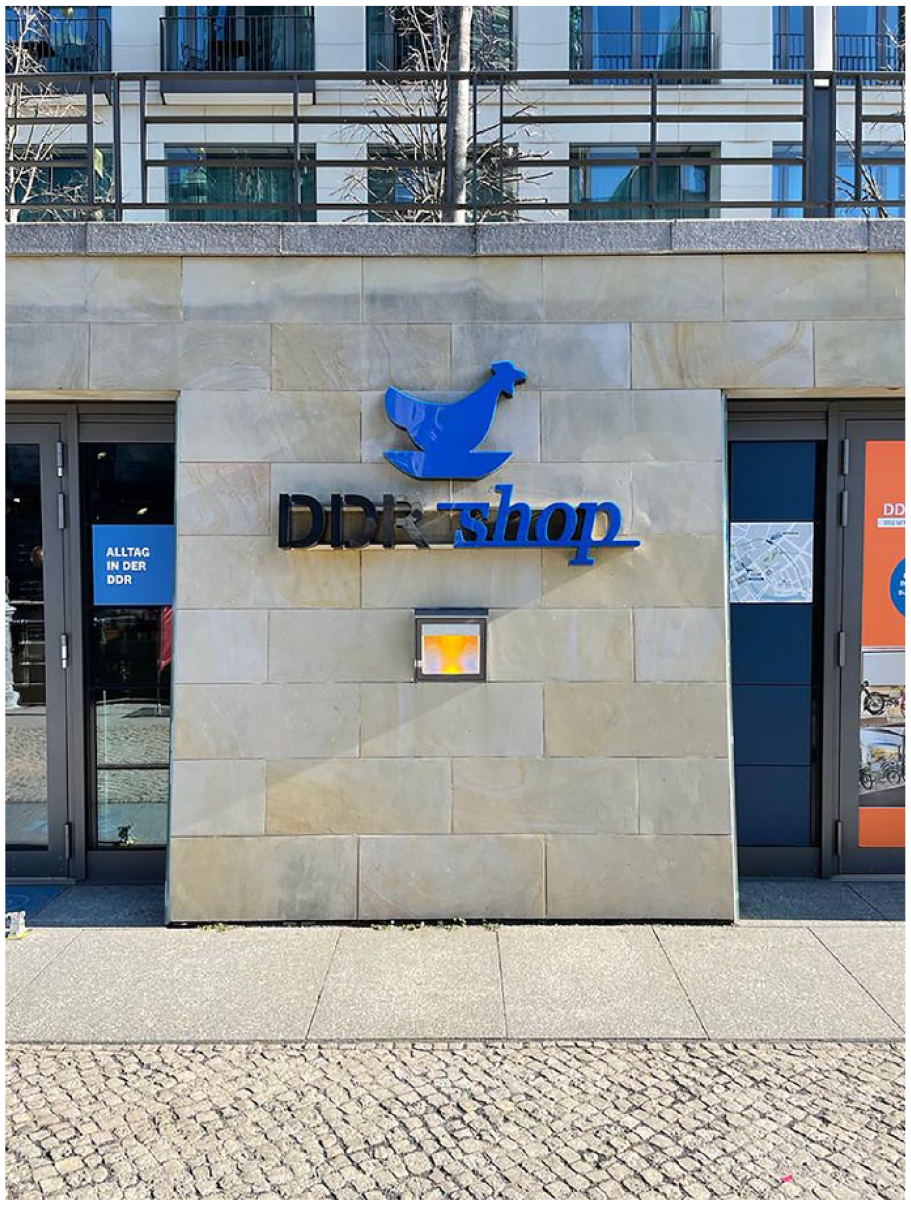
Entrance to the GDR Museum and its shop with the logo in the form of the chicken-shaped eggcup.
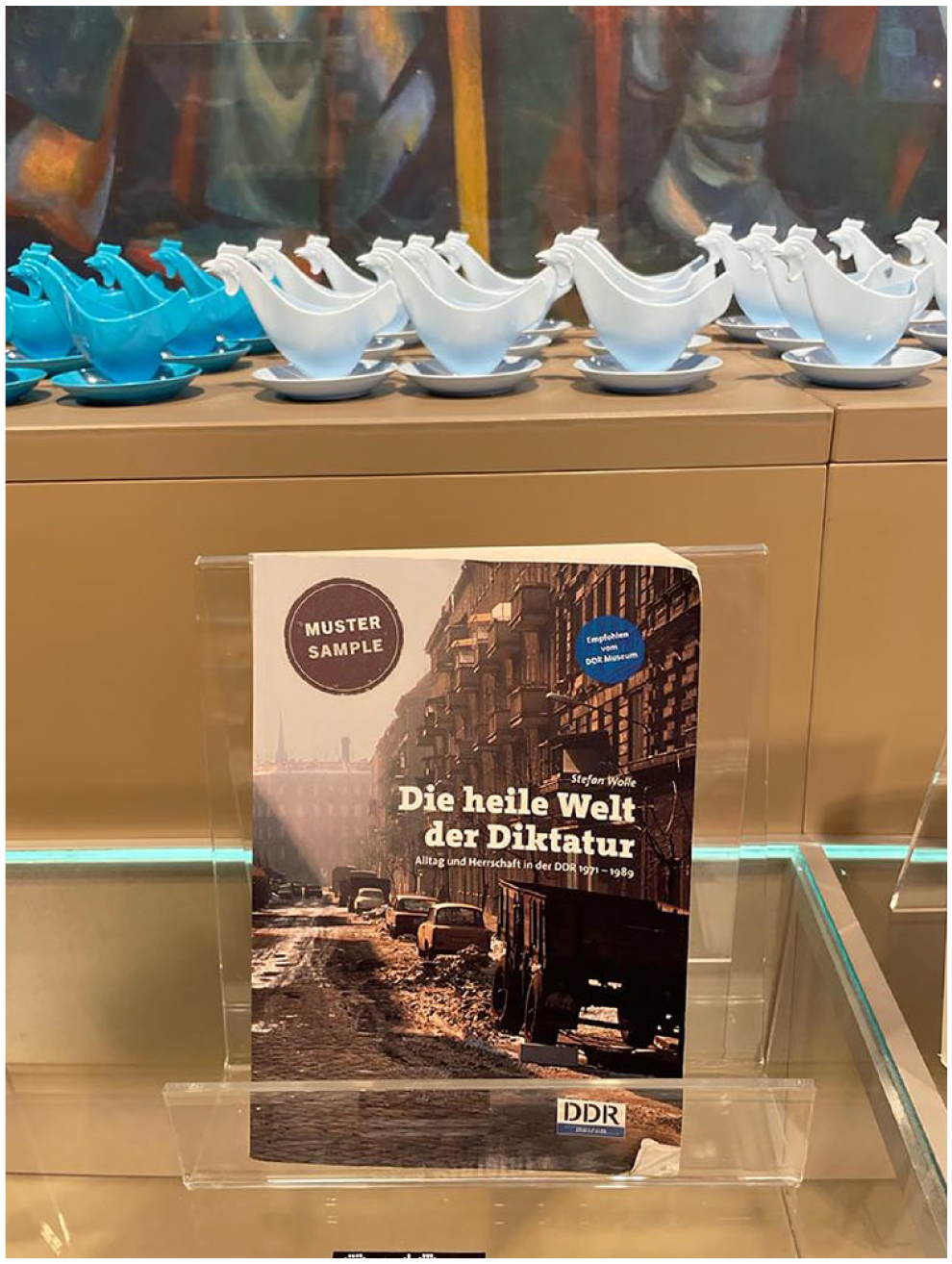
Special edition of Stefan Wolle’s book Die heile Welt der Diktatur with plastic eggcups above, in the GDR Museum shop.
Introduction: memory as business
Historical exhibitions, historical books, and retro-style objects are more than just representations of the past. They are market-driven products that are contributing to economic growth, shaping the labor market, and responding to consumer needs. Yet collective memory is rarely seen from a business perspective, despite the transdisciplinary nature of memory studies (Erll, 2011: 38). We are thus aiming to make a methodological intervention to demonstrate the advantages of approaching collective memories from perspectives taken from marketing research—an approach that, as we claim, opens up new opportunities for memory studies. We do so by analyzing the GDR Museum in Berlin as a “memory entrepreneur” on the “memory market,” that is, in the space where goods and services with an impact on collective memories are produced and consumed, exchanged and monetized.
Although the term “memory entrepreneur” is not new in memory studies (Jelin, 2003), the idea is rarely applied to entrepreneurial intentions in the literal sense of profit-oriented business. In the academic literature, “memory entrepreneurs” usually appear in a metaphorical sense. Robyn Autry (2017), for instance, defines them as “those individuals and organizations that create and seize opportunities to shape collective memory” (p. 23), which is a concept very close to the broad idea of the “agents in commemoration processes” (Wüstenberg, 2020: 9). The metaphorical reference to memory entrepreneurship is especially apparent with the French notion of entrepreneurs de mémoire. Introduced by Michael Pollak (1993), it was developed further by Marie Buscatto (2006), Sarah Gensburger (2010: 51–71) and Anélie Prudor (2017), all of whom follow Howard Becker’s (1963: 147–153) concept of moral entrepreneurs. Consequently, the memory market is quite often understood in the sense of a “moral economy” (Bilbija and Payne, 2011: 11).
Another good example of the metaphorical use of business vocabulary in memory studies is the discussion between Patrick Joyce (2007), who concludes his manifesto on history with the sentence “History is not a commodity” (p. 97), and Jerome de Groot (2016), who attempts to “respond [to] Joyce’s worries” (p. 6) in his book Consuming History without scrutinizing the concept of “commodity.” Neither does de Groot elaborate on his choice of the verb “consuming” for his title, as if its connotations in relation to history were self-explanatory. Likewise, Tim Cole’s (1999) successful book Selling the Holocaust is more about the contents of the Holocaust memory than its sales performance. Even Jonathan Bach (2017), who highlights the commodification of everyday socialist life as the essential origin of nostalgia for the GDR, focuses on material objects rather than products created for profit.
Although the issues that we subsume under the notion of the memory market have occasionally been debated in relation to cultural and heritage industries (e.g. Bendixen, 2011; Henley, 2016; Hewison, 1987; Thornsby, 2015; Towse and Khakee, 1992) and to political economy (Allen, 2016), we favor the terminology taken from marketing research. This is because “industry” is mainly approached from a critical perspective, based on Adorno’s and Horkheimer’s (2002 [1947]) notion of cultural industry. Most of the scholars are therefore interested in ethical conflicts associated with profit-making (Novak, 2016), whereas we are seeking an analytical tool that would aid an understanding of the cost–benefit calculations at the heart of the memory market.
The GDR Museum would seem a good starting point to think about the entrepreneurs of memory, for both topical and structural reasons. First, remembering the GDR provides a good illustration of how political, social, and business aspects of memory are entangled yet do not mirror each other. As part of a wider discourse on post-communist nostalgia, the correlation between material culture, politics, consumption, and memory practices has been touched upon from several different angles (Boym, 2001; Nadkarni and Shevchenko, 2004; Pobłocki, 2010; Todorova and Gille, 2012). In her work on East Germany’s transformation society, Berdahl (2010b) addresses the political and symbolic dimensions of consumption and conceives Ostalgie as both an industry and a mode of resistance. Born out of people’s experiences of the asymmetry between East and West (Berdahl, 2010a), the marketizing of certain “ostalgic” goods was long seen primarily as a problem in reunified Germany. Nowadays, affirmative modes of remembrance no longer seem contradictory to the general condemnation of the GDR as an authoritarian system to any great extent, if at all. Products labeled as “designed in the GDR” sell very well—they are successful “icons” that do not articulate a “pathetic longing for but rather savvy sampling of the past” (Bartmanski, 2011: 227). Despite his plausible observation of a “move from politics toward culture and business,” (Bartmanski, 2011: 218), Bartmanski discusses post-communist nostalgia as a cultural rather than business phenomenon.
Rethinking the discourse surrounding Ostalgie, we argue that the market-focused approach enables a more nuanced debate on phenomena that other scholars of GDR memory usually discuss from semantic and political perspectives (Führer, 2016; Rechtien and Tate, 2011; Rudnick, 2011; Saunders, 2018; Saunders and Pinfold, 2013). Developments and turning points in GDR memory turn out differently depending on whether one adopts a political or business perspective, which is why the two should be seen as complementary approaches that reveal the complexity of collective memories. Since the early 1990s, political decisions have usually supported the critical memory of the GDR, shaped by numerous publicly funded institutions. These include: the Stasi Records Agency, established in 1990; the Berlin-Hohenschönhausen Memorial in the former Stasi prison, opened in 1994; the Federal Foundation for the Reappraisal of the SED Dictatorship (Bundesstiftung zur Aufarbeitung der SED-Diktatur), inaugurated 4 years later; and the Berlin Wall Foundation, set up in 2008. 1 The trajectories taken by the commodified nostalgic memories have followed other watershed moments: the establishment of Ampelmann GmbH 2 in 1997 to protect and sell East German pedestrian signals; the commercial success of Leander Haußmann’s film Sonnenallee (1999); or the hugely positive reception enjoyed by Wolfgang Becker’s film Good Bye Lenin! (2003). However, scholars who write about the “Ostalgie market” (Hogwood, 2001: 74) do not really engage with its mechanisms or with the entrepreneurial networks behind them; as is the case with the rest of the research on GDR memory, they usually focus on the semantics and political background of Ostalgie (Ahbe, 2001; Boyer, 2006; Moller, 2015; Simine, 2013: 160–183). The sheer lack of attention paid to the business side of Ostalgie is even more striking, as Bartmanski (2011) observes “a focus on the commodification of memory” (p. 227) (original emphasis) and S.D. Chrostowska (2010) claims that “nostalgia became increasingly bound to the flow of capital” (p. 52). Even though its potential for business has occasionally been an issue in marketing research (Goulding, 1999), the intriguing problem is not only why nostalgia—and, more broadly, memory—sells well but also how this happens.
Second, the GDR Museum is an example of a purely market-based company. Unlike other non-state museums, it rejects any public funding as a matter of principle. 3 Studies that have looked at actors like this have either centered on political aspects of the transformation of the GDR memory (Wüstenberg, 2011) or have emphasized a contrast between “official,” state-sanctioned modes of memory, on one hand, and vernacular, resistant ones, on the other. In general, memory and museum studies usually focus on organizations “somewhere in between the polar cases of purely public and purely private museums” (Frey and Meier, 2006: 405). Indeed, publicly funded institutions often charge entrance fees to visitors, while private enterprises are eligible to apply for public grants or tax relief. This means that public institutions are also under pressure to meet demand, and private enterprises are rarely free of political and public influence. We are taking the GDR Museum’s non-public funding model as an opportunity to scrutinize the market-driven aspects of memory-making by highlighting the importance of business and marketing factors. Who actually invests money on the memory market? What do the business networks look like, and who are the relevant business partners of the entrepreneurs of memory?
Within the broad range of entrepreneurs of memory involved, we take a look at selected companies that contribute to the GDR memory offered up by the GDR Museum. We begin our reflections in the gift shop, which is introduced as an integral part of the museum. From here, we trace the production and distribution chains of three of the museum’s bestsellers. As we will show, these are quite different in terms of their experiential, material, and narrative potential for producing memories. First, we examine the exhibition itself. We then take a closer look at the plastic eggcup, which, according to the managing director and based on a brief period spent observing customers, is the museum shop’s absolute bestseller. 4 Finally, we focus on the book by the exhibition’s curator Stefan Wolle, Die heile Welt der Diktatur, which is also available in the museum store and exists in several editions. In doing so, we scrutinize the histories and legal forms of the various entrepreneurs involved in selling these memory goods. Our objective is to use these examples, all of which are interwoven with the museum store, to reveal the complexity of a business network in which memories are produced, distributed, and sold.
Memories for sale: the gift shop
The gift shop is the place where memories are sold in the most literal way. For many private museums, they are important funding streams (Hütter and Schulenburg, 2004: 13). At the same time, shops must be considered integral parts of the museum spaces (McIntyre, 2010). Often set up as “exit stores,” gift shops can be thought of as extensions of the respective exhibitions, intended to contribute to a museum’s goal of mediation (Günter, 2000; Kent, 2010; Peleikis and Feldman, 2013: 324–331). In this respect, De Groot (2016) is right: The institution of the museum shop has inserted the institution of the museum “into a marketing discourse of competition and branding” (p. 298). By entering the museum shop, the visitor becomes a consumer in a dual sense—of an intangible service and of tangible products; by leaving the shop with its bag of merchandise, the visitor turns into an advertiser for the museum. Thus museum shops tear down “the simple dichotomy of objects as culture versus objects as commodities” (Macdonald, 2012: 52). From an ethnological perspective, they perform a compensatory function: In contrast to the purely visual perception of objects during a visit to the exhibition, the objects in the shop can be experienced in a multisensory way and, above all, can be transferred into one’s own possession (Peleikis and Feldman, 2013: 324).
The store represents an intrinsic part of both the museum experience and the museum space in the case of the GDR Museum too. Around 90% of customers come from the exhibition, although the shop is also easy to access directly from the street—as we ourselves did during our visit. 5 As in any store of this kind, there are three types of products on offer: books, non-books, and items of merchandise (Hampel, 2017: 115). In the non-book section, customers of the GDR Museum can purchase typical ‘East German products’—small, everyday objects that were popular before 1989 and are still (or again) being produced today. The curators of the museum and the managers of the shop coordinate the product range in close consultation with one another: 6 A visit to the shop is designed to extend visitors’ experience of “everyday life in the GDR” into their own everyday life. The vast majority of items are thus thematically linked to the GDR rather than being general souvenirs from Berlin, as is the case in many other gift shops in the city. Products related to the kitchen and cooking, such as baking and cookery books, food, and kitchen utensils, are among the bestsellers. Apart from the bricks-and-mortar shop, the GDR Museum also runs an online store. Its revenues are hardly worthy of mention, however, because purchases made in museum stores are primarily impulse purchases, as the relevant management literature also indicates (Zarobell, 2017: 37). 7
The core product: the exhibition visit
Berlin’s GDR Museum 8 is located in the basement of the DomAquarée 9 business center on Karl-Liebknecht-Straße, close to the famous Museum Island and a firm fixture on the tourist trail. In fact, tourists are the main target group: Since it opened in 2006, the exhibition has attracted more than 6 million people, about one third of whom came from abroad (Ludwig et al., 2012: 117). 10 The museum recorded its sharpest increase in visitor numbers—up by more than 25%—in 2008 despite the global financial crisis (Gaubert, 2019: 133). Most visits are spontaneous, that is, made individually and without booking in advance. 11 The museum’s direct competitors are other tourist landmarks rather than other exhibitions on GDR history. This is demonstrated by the arrival of the exhibition entitled “Everyday Life in the GDR” in the Kulturbrauerei cultural center. It is operated by the government-run House of History (Haus der Geschichte) and thus publicly funded. Offering free admission, this exhibition initially attracted great skepticism from the managing directors of the GDR Museum. However, its opening in 2013 had no significant impact on visitor numbers to the existing GDR Museum. Clearly, the public exhibition, located 2.5 kilometers away in the district of Prenzlauer Berg, was simply too far away to become a serious competitor.
The context in which the museum operates is Berlin’s vital tourism industry. Employing over 235,000 people, tourism is the single most important economic factor in the German capital, which is otherwise economically weak. 12 Significant momentum for the growth of Berlin’s city tourism was injected by the low-cost airline EasyJet, which established a hub in Berlin in 2004 (Hoffmann and During, 2019). Since then, the number of visitors has grown strongly from year to year. The city supported tourism by establishing visitBerlin as an agency to promote Berlin all over the world. In 2018, that is, before the COVID-19 pandemic, there were 33 million overnight stays and 13.5 million visitors to Berlin. 13 Among Berlin’s great advantages are its rich cultural life and “unique history,” as it is usually presented in advertisements for tourist attractions. The city’s historical museums are thus among the most frequented, which is especially true for twentieth-century history, including its communist (and Cold War) heritage (Raab, 2010).
The GDR Museum’s main product is an experience, specifically a visit to the exhibition on everyday life in the GDR. The area of about 1000 m² is divided into three themed sections: “Public Life,” “State and Ideology,” and “Life in a Tower Block.” In all three of these, visitors can view objects and pictures, watch films, use multimedia stations, touch items, and hold them in their hands. The marketing focus is on the high experiential value of a visit to the museum. By promoting a “lively and interactive exhibition based on sound academic research,” 14 the museum emphasizes its claim to facilitate a multimedia and multisensory transfer of knowledge. Indeed, with its many hands-on stations and haptic experiences, the GDR Museum can be described as an example of today’s “experience-centered tourism” par excellence (Oh et al., 2007; Pine and Gilmore, 1999; Uriely, 2005 Weiler and Black, 2015).
From a business perspective, this hands-on principle turns out to be more than just a successful marketing model. Letting visitors touch original objects has a trivial material background: Following the broad response to its call for collections in 2005, the museum created a huge depository and can easily replace items in the exhibition. Its success is thus built on the abundance of discarded everyday objects from the GDR that individuals have donated to the museum (Ludwig et al., 2012: 111). Moreover, the “hands-on” principle proves the fusion of exhibition and museum store. The compensatory function as described above is no longer restricted to the gift shop. By allowing people to live out their sensory desire to touch things while they are in the museum, the proposal made by the shop—that they can actually take them home—gains even greater significance. The boundary between memory practices and shopping is finally dissolved here.
The museum’s main sources of income are entrance fees, which started at EUR 4.50 in 2006 and currently (2022) stand at EUR 9.80 per adult, and revenue from the store. According to the store operator MUSON GmbH, revenue has been successively increased since 2015 “through individual shop control, renovation efforts, in-house production, and further training measures.” 15 Of the 600,000 museum visitors in 2018, 17%, that is, more than 100,000, decided to purchase at least one item (Ludwig et al., 2012). Both the shop and the exhibition itself are thus proving profitable businesses. To anchor the “GDR Museum” brand in the minds of both Berlin locals and visitors with lasting effect, the company invests between 3% and 10% of its costs in marketing and advertising every year. An important role is played by the museum’s distribution partners, including travel agencies and websites such as Booking.com or GetYourGuide, as well as other types of cross-promotion. For example, the museum is a member of INTOURA e.V., a trade association of Berlin tourist service providers, which represents the interests of the city’s biggest attractions, as well as BERLIN STARS, an association of 13 major tourist businesses that pass visitors on to each other via discount vouchers. The museum is also involved as a discount partner in the Berlin Welcome Card, a product offered by the city’s tourism marketing agency visitBerlin. All of this contributes to its success: In 2020, the museum came 8th in the list of most-visited museums in Berlin and as high as 1st among international visitors. 16 These business networks also influence visitors’ choices. By means of discounts and common advertising, they are encouraged to visit particular exhibitions and are thus presented with certain mnemonic narratives rather than the many others that are available in Berlin.
The museum has always been structured as a GmbH, that is, a limited company. Details of its sales figures are not made public because the GDR Museum is only a small company and not a joint-stock corporation under German law. However, the balance sheets, which are available, prove that the company is constantly growing. Total assets on its 2020 balance sheet (the most recent one available) amount to EUR 2.6 million, some EUR 1.6 million more than a decade earlier. Headcount is also increasing: According to the commercial register, the museum employed 18 staff on a regular basis in 2022, seven more than in early 2020. 17 Following a change of operator in 2016, the museum has been owned by two shareholders. Neither the founder, Peter Kenzelmann, nor the new shareholders, director Gordon Freiherr von Godin and managing director Quirin Graf Adelmann von Adelmannsfelden, had any previous museum experience. Instead, the current shareholders were active in the hotel business and real estate sector respectively. The museum is thus managed by two men with an aristocratic background and extensive investment experience (Strauß, 2016). There are other personnel links between the museum and the shop operator MUSON GmbH. The museum’s content, meanwhile, is the responsibility of Stefan Wolle, a historian, former GDR dissident, and author of Die heile Welt der Diktatur. In addition to the exhibition visit itself, the museum also offers guided tours and special events; school classes and other groups can use an event room free of charge to prepare for and follow up on their museum visit and for talks with contemporary witnesses (Zeitzeugen).
The fact that the museum does not seek public funding despite rising rental and marketing costs is part of its entrepreneurial philosophy. Precisely because the “raw material” of the product, that is, the history of the GDR, is a highly political topic, the directors stress the need for their museum to be politically independent. As they are running a private museum, they are not beholden to any advisory board. At the same time, they devote little attention to the market-driven dependencies that arise as a consequence of refusing any public funding. Unlike many historians, politicians, or political commentators, the directors evidently see no contradiction between making a profit and embarking on a clear educational mission (Ludwig et al., 2012: 122). For them, converting the history of the GDR into a product for different target groups seems to be more of a complex management task. In fact, the breadth of the audience, who come from all over the world and have very different expectations, causes a dissonance in principle (Tunbridge and Ashworth, 1996: 21–23). How can customers who have their own experience of life under state-sponsored socialism (whether in the GDR or in Eastern Europe) and young or foreign visitors with no connection to the GDR be offered an equally attractive product? With regard to the exhibition, the dilemma is solved by presenting several narratives—particularized and generalized, nostalgic and critical of the dictatorship—at the same time. Alongside objects that transmit familiar images of the GDR, there are also consumer items from everyday life that will only ever strike a chord with people from the GDR. “I had one of those too,” many visitors from the GDR or the former Eastern Bloc will say in the exhibition. The explanations given in German and English also permit different interpretation depending on one’s background. For those who have experienced life under communist rule themselves, the often ironically worded texts evoke memories of the specific humor of late-era socialism (Yurchak, 2005); for visitors without this specific background, everyday life in the GDR becomes accessible as a kind of grotesque—austere, exhausting, and unfree, but also funny and entertaining.
Apart from the obligatory fragments for sale in the shop, the Berlin Wall plays only a minor role in the exhibition, mainly because it is covered by other institutions in Berlin: the Berlin Wall Foundation, the Wall Museum at Checkpoint Charlie (Bach, 2016; Hochmuth, 2017), and the newly opened Berlin Wall Exhibition on Leipziger Platz. In fact, as it has developed, the GDR Museum has actually sharpened its focus on the exhibition on everyday life. In both 2010 and 2016, the museum expanded to include new exhibition areas; in 2016, the store space was also made four times larger. 18 These changes were prompted not only by the growing interest shown by visitors, whom the museum wanted to offer “more exhibition,” but also a close monitoring of the Berlin market (Ludwig et al., 2012: 122). For example, the restaurant Domklause, which had served “genuine GDR cuisine,” fell victim to the museum’s second wave of expansion. 19 Considering the numerous restaurants in the area around the museum, the decision to expand the exhibition and store was only logical from a business point of view. Although the museum can still be hired as an event location, that is clearly not part of its core business.
The bestselling souvenir: the chicken eggcup
The plastic eggcup in the shape of a chicken appears twice in the exhibition. First, we saw it in the section on the plastics industry, and then in the fully equipped kitchen in the household section, where we could hold the original item in our hands. Finally, we could buy a modern version in the museum shop, where the eggcups cost EUR 3.00—not much of a bargain, in fact, as they can be purchased online for less than EUR 1.50. This relatively cheap object has become a widely recognizable icon of retro design, showcased not only at the entrance of the museum but also on the covers of numerous books as well as in various design exhibitions related to the GDR.
Unlike other East German household products designed by professionals who had been educated at one of the state-run design schools—for plastic objects, this was primarily the Burg Giebichenstein in Halle (Rubin, 2009: 52)—the eggcup was created by Josef Böhm, a descendant of the founder of the factory that later produced it. Initially conceived as an export product, the cup was launched in the late 1960s by the Willibald Böhm factory in Wolkenstein, Saxony. The enterprise was founded in 1925 and focused mainly on making buttons (Zschiesche and Errichiello, 2009: 161). The Böhm factory launched the Sonja Plastic brand for their household products in 1953. When it was nationalized in 1972, Willibald Böhm GmbH became “VEB Plaste und Chemie Wolkenstein,” with the abbreviation “VEB” standing for “Volkseigener Betrieb,” or “nationalized enterprise.” In 1990, after the reunification of Germany, it was re-privatized and regained its original name. However, the history of the eggcup is inextricably linked to the history of another Saxon enterprise. As long ago as 1880, Georg Rheinhard Franz had begun to produce chemical materials in his factory in the small town of Annaberg-Buchholz, which was likewise nationalized in 1972. The Franz family took back ownership of their factory in 1993 and transformed it into Reifra Kunststofftechnik GmbH. Reifra acquired Willibald Böhm GmbH in 2001, though retained the latter’s name for branding purposes. With this transaction, the descendants of Georg Rheinhard Franz and now managers of Reifra, Jasmin Franz-Klutz and her brother Norman Franz, aimed primarily to secure the rights to the Sonja Plastic household design line (Müller, 2011). Investing in the rights for GDR-designed plastic goods proved a good business strategy. Although Reifra took out loans to finance the transaction, as its balance sheet shows, the company’s leverage ratio had fallen back to its previous level within just 2 years. 20
The current success of the eggcup, a million of which have been sold so far, 21 is down to the marketing strategies being employed at Reifra. When the company obtained the rights to the plastic chicken, the wave of Ostalgie was at its peak, and the fondly remembered products turned out to be a resource of great commercial value. Reifra’s financial statements show that the company expanded in the 2000s and remained stable despite the economic crisis in 2008 and thereafter. 22 Although they also sell synthetic materials for the machine and automotive industry, the easily recognizable eggcup has appeared in almost every public statement mentioning Reifra, thus serving as the company’s best advertisement. It also helped to establish a positive corporate image: In response to problems with illegal copies being made in China, Reifra’s managers emphasized the high quality of the products that met all the necessary standards and were produced in Saxony (Müller, 2011). The Franz siblings drew on the long tradition enjoyed by the Saxon chemical industry to strengthen the Sonja Plastic brand, for which the eggcup is the main icon.
In the realities of the socialist economy, the two companies—Böhm and Franz—produced their goods without competing with each other. Böhm was larger, whereas Franz was incorporated into another state combine, apparently because it was too small to be transformed into a VEB of its own. In the neoliberal realities of the early 2000s, their roles were reversed. Now, Reifra (formerly Franz) was the larger company, which acquired its competitor Böhm and obtained the rights to the eggcup. Its history is thus inseparably linked to the high costs of the economic transformation in East Germany. While the socialist VEB Plaste und Chemie Wolkenstein employed between 120 and 140 people (Zschiesche and Errichiello, 2009: 161), only 20 staff worked for Reifra in 2021. 23 In fact, southern Saxony, where Reifra has its headquarters, is among the regions that have been affected most severely by the hardships imposed by the economic transformation after the collapse of the GDR.
What do the histories of the eggcup’s manufacturers tell us about the memory market? The patents and designs from the GDR turn out to be resources of high monetary value. It is not the technology or the material that makes the highest profit but the memories associated with particular products. The mnemonic discourses related to the eggcup comprise issues of individual nostalgia and generational change (memories of everyday life), political and economic history (memories of the chemical industry), post-1989 transformation (memories of unemployment and social deprivation), and, finally, regional traditions (emphasizing the eggcup’s Saxon roots). People’s negative memories of the social and economic hardships of the 1990s are rarely visible in the eggcup’s appearances in museums, albums, or shops. Instead, the eggcup is usually presented as an “innocent” everyday object from the GDR and a product that has successfully survived the economic transformation of the 1990s. It is thus an example of what marketing researchers call “brand nostalgia,” which is said to create effective incentives to buy products associated with the past (Jensen and Ohlwein, 2020 [2019]: 10). As Jensen and Ohlwein argue, brand nostalgia targets consumers from particular generations (Jensen and Ohlwein, 2020 [2019]: 22). One important audience for the eggcup is middle-aged people who grew up in the final years of the GDR and now collect retro objects: “Here you will receive the original: the egg cup in chicken shape” notes the seller at amazon.com, although this description relates to the item currently being produced. The GDR Museum’s online shop advertises the eggcup as “trendy, a bit shrill and funny.” 24 This is how it is presented in exhibitions: as a “cult object and common souvenir.” 25 Stories about the hardships of the economic transformation, the politicized chemical industry, and the nationalization of private property are usually omitted from such descriptions. After all, they are hardly conducive to generating a profit.
A constant stream of new editions: the ideal world of dictatorship
In 1998, the historian Stefan Wolle, now the GDR Museum’s academic director, published the first edition of his bestselling book Die heile Welt der Diktatur. In it, he tells the history of the GDR by portraying and explaining everyday life under the dictatorship. Focusing on the years between 1971 and 1989, Wolle first describes change and continuity in the early years of Erich Honecker’s regime and the GDR’s position in Europe during the Détente. He then goes on to focus on structures of power and means of maintaining control employed by the SED, the ruling communist party. The book places a strong emphasis on a critical analysis of the society in the GDR and its economy. Finally, Wolle describes the crisis that engulfed the GDR in the 1980s and the events leading up to its collapse in 1989. In a little over 300 pages, he sets out to recount the comprehensive history of the late GDR, its failed ambitions, and its ultimate downfall. Particularly notable is the book’s vivid style. Rather than being solely for experts, the book is written for a broader readership, both contemporaries who experienced the GDR and Western and younger readers who did not.
The book was published by Berlin-based publishers Ch. Links Verlag, the first independent publishing house founded in East Germany shortly after the fall of the Berlin Wall. Publisher Christoph Links (2019: 15), born in 1954, had started his career as a journalist for the East Berlin newspaper Berliner Zeitung but was removed from the editorial staff by the Stasi due to his “revisionist thoughts.” Links started writing a PhD thesis, but, in early 1989, he sought to establish an independent publishing house for non-fiction. His unconventional efforts failed due to a “lack of paper,” which is how the head office for publishers and book trade (Hauptverwaltung Verlage und Buchhandel) justified their decision to reject Christoph Links’ proposal. After the fall of the Berlin Wall on November 9 and the end of censorship in the GDR on 1 December 1989, however, Links applied once again. Now the Ministry for Culture replied that, from 1 January 1990, he would no longer require a license in any case. Hence Links founded his publishing house, Links Druck, on 5 January 1990. In 1991, Links Druck was renamed Ch. Links Verlag GmbH (Ltd.). The publisher became a successful East German entrepreneur, specializing in publishing books about the history of the GDR. Ch. Links Verlag has published almost 500 works to date. Although Christoph Links sold his publishing house to Aufbau Verlag GmbH in 2019, “Ch. Links” remains a brand name under the new owner, an East German publishing house with a long tradition.
One of the first authors published by Ch. Links was Stefan Wolle, whose first book on GDR history appeared in 1992 (Florath et al., 1992). Born in 1950 and raised in East Berlin, Wolle studied history at the Humboldt University in Berlin until he was expelled in 1972 for political reasons. After a year-long “probation” in a factory, he was allowed to resume his studies. From 1976 to 1989, he worked as a historian at the East German Academy of Sciences, where he obtained his PhD in 1984. He sat on a committee to dissolve the Stasi in 1990 and was among the founders of the Independent Association of Historians (Unabhängiger Historikerverband) in East Germany. Wolle became one of the most prominent critics of the unification of German historiography, arguing fiercely against previously loyal GDR historians who wanted to continue working under the new academic structures (Thijs, 2016). As a research assistant at the Humboldt University from 1991 to 1996, he specialized in the history of the GDR, favoring an approach that sought to combine the critical analysis of totalitarian power structures with the study of everyday life in the GDR.
One of the results of his studies was the book Die heile Welt der Diktatur, which was first published by Ch. Links in 1998. All 5000 copies of the first edition soon sold out, and a second edition with another 3000 copies followed shortly after. The book has enjoyed sustained sales ever since. Warsaw-based publishing house Wiedza Powszechna released the Polish translation 5 years after its initial publication. As with the German original, the 800 copies—an average number for the Polish market—were soon sold out. However, it is unlikely that the publication would have been profitable were it not for the funding provided by the German Historical Institute Warsaw to cover the translation costs. Interestingly enough, the book appeared in a series dedicated to “classics” of German historiography. Its “classic” status was eventually confirmed by the success of the third German edition, in 2009, which ran to another 2000 copies. This time, the manuscript had undergone substantial changes and included several photographs by the famous East German photographer Harald Hauswald, probably to make the book more accessible to non-academic readers and thus boost sales. Besides the general third edition, a number of special editions were also printed, some for the State Agencies for Civic Education (Landeszentralen für politische Bildung), which are major distributors to teachers and students.
Ch. Links Verlag also published a special edition for the GDR Museum in 2009. 2000 copies were printed to be sold for less than half price (EUR 13.00 instead of EUR 30.00) in the museum shop. The discount is significant because, in Germany, book prices are fixed and cannot be altered by bookstores. Hence the only way to offer discounts is to publish special editions. The deal with the GDR Museum did not come about purely by chance, since the book’s author had become the curator of the self-same museum 3 years earlier. Even more so, the exhibition follows the narrative that he had already developed in his book. It was therefore no surprise that it became the main book on the museum’s topic in the new museum shop.
Spurred on by the book’s success and encouraged by the great popularity of the exhibition, Wolle published two more books on the history of the GDR: Both Aufbruch nach Utopia (2011) and Der große Plan (2013) focus on the earlier decades of the GDR. Together with Die heile Welt der Diktatur, they make up a trilogy that is sold in a special three-volume edition. In 2014, Ch. Links Verlag published a fourth edition of Die heile Welt der Diktatur, which is now out of print, although the GDR Museum shop still has copies available. In addition, in 2019—that is, more than 20 years after the first German edition—Ch. Links Verlag published an English edition, translated by David Burnett. Quite interestingly, this was published by the German publishing house itself rather than an American or British publisher as is usually the case. This may indicate that the translation is not directed at the international book market but rather at tourists visiting Berlin and the GDR Museum. It is therefore also stocked by the museum shop, which sells it for EUR 20.00.
It is less so the number of copies sold than the sheer longevity of its career that makes Wolle’s book an outstanding example of what is known in German as a “Longseller,” that is, a work of exceptionally sustained popularity with sales figures to match. Despite not initially being published for the GDR Museum shop, the book went on to become one of its core products. The exhibition and the book lend each other mutual support. Although another edition is not on the cards, the book is still being sold. Its long career demonstrates that product life cycles should also be analyzed with regard to memory goods. Meanwhile, as social media has become more and more important, Wolle has progressed to another medium and now shares his in-depth knowledge via his “Frag Dr. Wolle” (“Ask Dr. Wolle”) YouTube channel. 26 The short video clips on different aspects of GDR history were shot in the exhibition at the GDR Museum, with Wolle presenting as an expert in front of the old furniture. The product mixes the successful features of the book and the exhibition: The authority of the author and historian is combined with the visuality and interactivity of the exhibition. Here again, the cross-media strategies of the GDR Museum become evident.
Conclusion
While not underestimating political influence, we believe that memory scholars should take into consideration the role of entrepreneurs as agents of memory and of the memory market in which they operate. For research in the field of memory studies, this has two relevant consequences. First, seen from this perspective, history turns out to be nothing more (and nothing less) than one resource which profit-oriented entrepreneurs draw upon. As we have shown by the transformations of the GDR Museum, the Böhm and Reifra GmbHs and the publisher Ch. Links, all entrepreneurs constantly vary their products, networks, and sales channels based on economic considerations. The exhibition at the GDR Museum is inextricably linked to other products marketed and sold by the company, as we have sought to demonstrate with the examples of the retro eggcup and Wolle’s “Longseller” Die heile Welt der Diktatur. These networks demonstrate that “the business of history is not simply selling history to a customer, applying a set of skills and experiences, and delivering what the client wants. It is also about establishing and sustaining a business enterprise,” in the words of Brian W. Martin (2017: 134). The GDR Museum focuses its activities squarely on current market conditions and thus successfully keeps its business going—even during the COVID-19 pandemic. Founded and managed not by academic historians but by career entrepreneurs, the museum owes its success to constantly enhancing its own brand and adapting its product portfolio on an ongoing basis. Products of only peripheral relevance to the portfolio, such as the event restaurant Domklause, were taken off the market in favor of the core brand—the exhibition.
Second, our idea of profit-oriented memory entrepreneurs implies that analyses of memory goods should not focus solely on questions of moral and political economy, but can also shed light on their intersections with business trends. Working in interdisciplinary teams would therefore be highly beneficial for future research. In particular, collaboration between experts in memory studies and those in economics may well deliver new insights into the way business interests interact with other factors that shape memory narratives, such as politics, identity, or material culture. Even though our first attempt showed that it is not an easy exercise to make use of sales figures or commercial registers as sources, and that many contexts remained obscure due to the nature of trade secrets, it seems more than worthwhile to include financial considerations, product life cycles, and entrepreneurial networks in the analysis. Most likely, the results of such analyses will turn out differently than those revealed from a symbolic or political point of view. The eggcup, for instance, appears not only in the GDR Museum but also in the Haus der Geschichte and the Museum of Utopia and Daily Life in Eisenhüttenstadt. In addition, it was a prominent feature of the 2021/22 exhibition entitled “German Design 1949–1989. Two Countries, One History,” presented first in the Vitra Museum in Weil am Rhein and then in the Kunstgewerbemuseum in Dresden. To analyze it through the lens of how it has been exhibited and showcased provides information on just one specific part of its memory-forming effect. The entrepreneurial perspective completes the picture by asking not only how products become museum objects, but also how objects circulate as marketable products and how these two aspects are intertwined. The case of the eggcup demonstrates more so than virtually any other object how permeable the boundary between the museum and the shop can be and how broad the entrepreneurial network is that is involved: The GDR Museum’s business partners are neither the museums that have displayed the eggcup nor the publicly funded institutions that commemorate the GDR, such as the Berlin Wall Foundation (Stiftung Berliner Mauer). Rather, they are tourist attractions and discount partners such as Madame Tussauds. In the same vein, the establishment of the EasyJet hub in Berlin in 2004 may have had an impact on the development of the GDR Museum that was no less significant than any curatorial decision or political recommendation.
The number of entrepreneurs involved in the construction of GDR memory is hard to gauge. This is all the more true since the question of whether memory agents actually need to be aware of their role is open to debate. By making the GDR Museum’s gift shop the starting point for our reflections, we have focused on a small set of actors all linked to one another. Visitors coming from the exhibition put on by DDR-Museum GmbH enter the museum shop run by MUSON GmbH. Once there, they can buy the eggcups designed for the VEB Plaste und Chemie Wolkenstein and now produced by Reifra GmbH. Beneath the eggcups, there is Wolle’s book published by Ch. Links Verlag GmbH. The museum shop is the main trade company for both the eggcup and the book. At the same time, they are connected to the exhibition, where the eggcup is showcased prominently and the narrative follows Wolle’s findings. From a business perspective, the three products would seem to be the essence of the marketable memory of the GDR. In fact, we can even calculate the price that the customer pays to obtain that memory: the entrance fee to the GDR Museum and the two bestsellers in the shop, namely, the eggcup and Wolle’s book, cost EUR 25.80 in total.
Footnotes
Funding
The author(s) disclosed receipt of the following financial support for the research, authorship, and/or publication of this article: Work on this article was supported by the Leibniz Research Alliance “Value of the Past.”
