




Abstract
This paper discusses the material rhetoric of the Statue of Peace built in front of the Japanese Embassy in Seoul, South Korea. Installed in 2011 to commemorate so-called “comfort women”—the former sex slaves forced to work in brothels during Korea’s occupation by the Empire of Japan—, several identical-looking copies of the statue have since spread throughout the country and beyond. While many observers have noted the symbolic politics of the sculpture, I argue for taking into account its material dimension too—with the aim of furthering our understanding of how commemorative practices are enabled by mnemonic installations. Building on the scholarship that has addressed the rhetoric of objects and places of remembrance, I ask how the statue acts on and engages with its viewers. Among others, site visits, observations, own experiences, interviews, and visual documentation serve as the basis of the discussion.
Keywords
Introduction
This paper discusses the material rhetoric of the so-called Statue of Peace—a memorial intended to commemorate the women who were forced into sexual slavery during Korea’s occupation by the Empire of Japan (see Image 1 below). Erected first in front of the Japanese Embassy in Seoul, South Korea, in 2011, several identical-looking copies of the statue have since spread throughout the country and beyond.
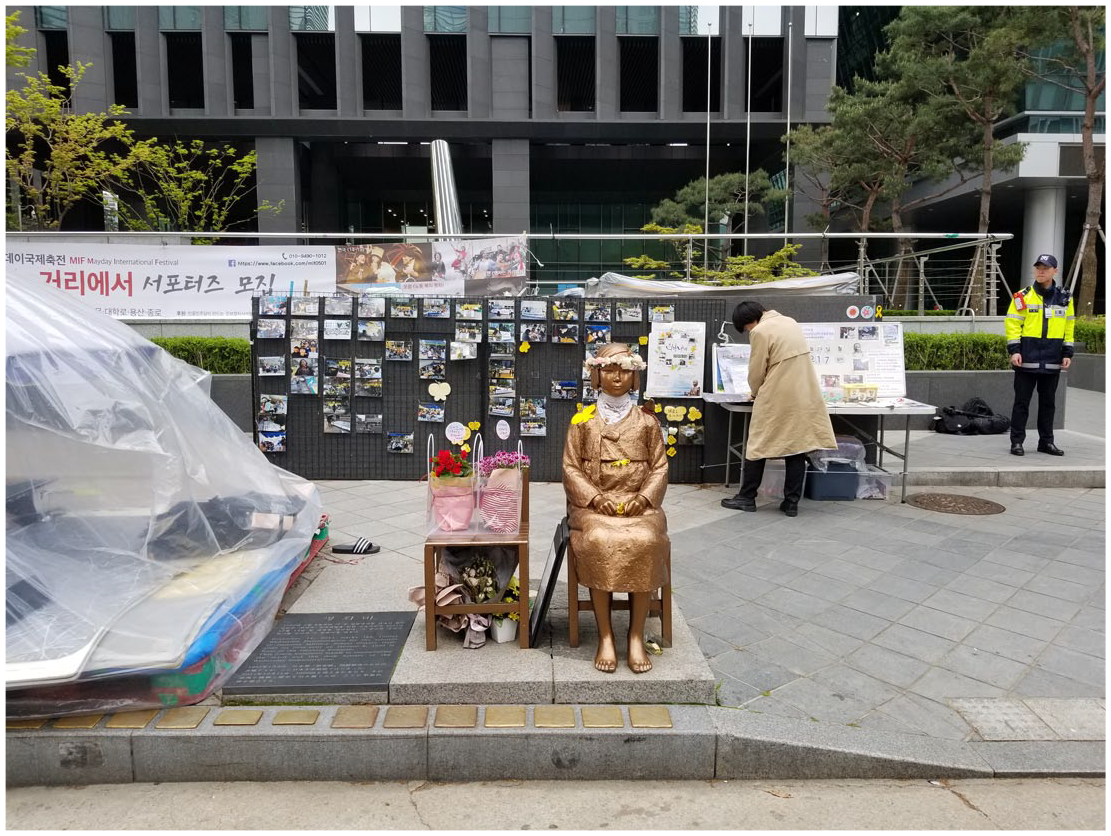
Statue of Peace memorial in Seoul, South Korea Note: All photographs taken by the author himself, April 2019.
The construction of the memorial would have grave consequences for the bilateral relations of Japan and South Korea. The Japanese government strongly condemned the statue and demanded its removal. It even withdrew its ambassador and cancelled high-level economic negotiations after another statue was built in 2016 in front of the Japanese consulate in Busan, South Korea’s second-largest city. Becoming the focal point of a contentious memory politics between Japan and South Korea—both of who are democracies, market economies, and key allies of the United States as confronted with a nuclear-armed North Korea as well as the rise of China as a global power—the case of the Statue of Peace warrants deeper analysis of its rhetorical materiality; something which also helps explain Japan’s strong opposition to it.
Building on the scholarship that has engaged with the rhetoric of objects and places of remembrance (Blair, 1999; Marinelli, 2017; Maurantonio, 2017; Zagacki and Gallagher, 2009), I argue for taking into account the material dimensions of the statue too. The goal here is to better understand how commemorative practices are enabled by mnemonic installations. Using, among other things, site visits, own experiences, observations, interviews, and visual documentation as the basis of the discussion, I ask how the memorial acts on and engages with its viewers. In this way, I understand material rhetoric as a bodily mode of experiencing with physical objects, in this case memorials (Biesecker and Lucaites, 2009; McGee, 1982). This research complements current studies on the Statue of Peace, which have focused specifically on the symbolic politics of the memorial to date (see, for instance, Kwon, 2019; Mackie, 2017; Matsumoto, 2017; McCarthy and Hasunuma, 2018; Son, 2018).
In this piece, however, I seek to look beyond the symbolism of the statue, and contend that the politics of memory cannot be fully understood in isolation from memory’s materialized enactment (the statue). At the same time, existing scholarship on memory’s material rhetoric has rather neglected commemorative spaces and sites in (East) Asia (examples from the North American context include, for instance, Blair, 1999; Gallagher and LaWare, 2010; Marback, 1998; Maurantonio, 2017). The paper demonstrates how material critiques of place travel across the familiar spaces of Memory Studies. It also furthers the debates in the journal Memory Studies on Korean memory, with scholars having explored local experiences of victimhood partly stemming from Japan’s colonial occupation while, perhaps surprisingly, leaving out an examination of the repercussions of past sexualized violence (see Bong, 2013; Choi, 2014; Kim, 2013).
The text proceeds as follows: The next section outlines what makes the Statue of Peace worthy of study for Memory Studies scholars. Herein, I contextualize the contentious memory politics of the memorial and build on existing scholarship to outline the particular contribution of the paper. Afterward, I offer a material-rhetorical account of the statue in which, among other things, I focus on the memorial’s empty chair. In the conclusion, I summarize the findings and point to some avenues for future research.
Memory politics of the Statue of Peace
Context
Known in Korean as pyeonghwaui sonyeosang, which translates as “The Statue of a Girl for Peace,” the memorial in question was first erected by South Korean activists in Seoul in December 2011 (Choe, 2011; Kwon, 2019). The statue represents a bronze, barefoot girl, who is seen wearing traditional Korean clothing. The teenage girl has her fists clenched in her lap, and her eyes fixed on the Japanese Embassy across. An empty chair is placed beside her. Built with the help of private donations, the statue’s installation marked the 1000th so-called Wednesday Demonstration by women who had been forced to work in brothels during Japan’s colonial rule of Korea between 1910 and 1945. These protests have been taking place outside the Japanese Embassy every Wednesday since January 1992 (Han and Griffith, 2017). Often euphemistically called “comfort women,” an investigation by the United Nations found already in 1996 that about 200,000 women were enslaved in military brothels run by the Japanese Imperial Army (United Nations Economic and Social Council, 1996). 1 While these “comfort stations” had been in use as early as 1932, most of the women are thought to have been from Korea—but also to a lesser extent from China, the Philippines, and elsewhere.
The Wednesday Demonstration was initiated by the Korean Council for the Women Drafted for Military Sexual Slavery by Japan; an advocacy group of survivors and supporters demanding justice and an official apology from the Japanese government (Kim and Lee, 2017; Lee, 2014). Founded in 1990 as an association of more than thirty local women’s groups, the Council has become South Korea’s most influential movement for redress on the issue of military sexual slavery (Kim, 2015; Min, 2003). Among its longstanding demands were the building of a memorial for survivors. Originally, the group had envisioned a commemorative stone until the South Korean sculptors Kim Seo-kyung and Kim Eun-sung proposed a bronze statue resembling a girl (Kwon, 2019: 3).
The main achievement of the Council is the raising of awareness on the national (and international) level about the issue at a time when it was taboo to speak about the organized sexual abuse taking place during Korea’s colonial occupation. The women’s movement was part of dramatic changes occurring in South Korea in the 1980s and early 1990s—the end of military dictatorship, the beginning of democratization, and the strengthening of civil society—and constituted by Christian and feminist activists, students, and writers, who shed light on the stories of former “comfort women” (Kang, 2003; Lee and Chin, 2007; Shin, 2014; Soh, 1996; Tanaka, 2002).
In May 2020 a survivor and member of the group, Lee Yong-soo, called for an end to the weekly protests outside the Japanese Embassy and accused the Council of exploiting former “comfort women” for financial and political gain (Jun, 2020). Lee claimed the group had failed reconciliation between Japan and South Korea and declared she would stop participating in the Wednesday Demonstration. She further blamed the Council for embezzling donations intended to support aged survivors. While these allegations led to what The Guardian called the “biggest crisis” of the Council’s 30-year history, the former head of the group apologized for “banking errors” (McCurry, 2020). The Council also said that it would continue its weekly protests until its demands were fulfilled.
For this, it is important to know that a number of attempts have been made by the governments of Japan and South Korea to address the legacies of Japan’s colonial rule on the Korean Peninsula. For instance, in 1995 the Japanese government set up the “Asian Women’s Fund” to compensate former sex slaves and facilitate reconciliation. However, most of the women rejected the scheme saying that atonement should come from the Japanese government and not from private donations. The fund was eventually dissolved in 2007 (Kim, 2018).
More recently, in December 2015, Japan and South Korea reached an agreement to settle their dispute over the “comfort women” issue (Ministry of Foreign Affairs, 2015). In this arrangement, considered a “landmark agreement” (Choe, 2015), the Japanese government acknowledged the involvement of the Imperial Army in managing the brothels where Korean women were forced to work as sex slaves. It also issued an official apology and agreed a payout of USD 8.3 million to the surviving women. The South Korean government, in return, agreed to refrain from criticizing Japan publicly over the matter and consented to discussing with the activists the removal of the Statue of Peace.
While both sides considered the agreement a “final and irreversible resolution” of the issue (Ministry of Foreign Affairs Japan, 2015), the settlement was, however, not accepted by South Korean civic groups including the Council and former sex slaves—with them saying that the Japanese government still had not admitted legal responsibility. After another Statue of Peace memorial was erected in December 2016 in front of the Japanese consulate in Busan, Japan withdrew its ambassador in protest and suspended negotiations regarding a bilateral currency swap agreement. It also cancelled high-level economic talks between the two countries. Even though the diplomat returned in April 2017, these events point to the grave consequences of the memorial’s rhetorical materiality.
Important to note is that the “comfort women” memorial has remained a source of geopolitical tension until today. At the end of 2018, after a change of government, South Korea effectively cancelled the 2015 agreement by closing down the Japanese-funded foundation responsible for compensating former victims (Choe, 2018). Moreover, attempts by local municipalities to remove the memorials in Seoul and Busan have drawn wide media coverage and fierce protests by citizens and advocacy groups. As a matter of fact, due to public pressure the memorial in Busan had to subsequently be reinstated after originally being removed by the police (Choe, 2016).
Peculiarity of the Statue of Peace
The demand to take down a particular memorial is not unusual in the contentious politics of memory. Heated debates and violent clashes as part of what have been called “statue wars” (Seargeant and Giaxoglou, 2019; Stiem, 2018) have taken place in many regions and countries around the world. In South Africa, for instance, the protest movement Rhodes Must Fall demanded the removal of a statue at the University of Cape Town that commemorated Cecil Rhodes, an avowed white supremacist. In many municipalities in the US public disputes have emerged over the removal of Confederate-era monuments (Stiem, 2018). In the wake of the Black Lives Matter movement, in parts of Europe statues have been attacked or torn down that celebrated individuals playing a key role in the suppression of indigenous cultures or people of color (Grovier, 2020).
However the insistence of the Japanese government on removing a commemorative statue devoted to wartime victims in a foreign country makes the statue wars surrounding the Statue of Peace peculiar as Alexis Dudden argues (see Hu, 2017; Shin, 2017). While public controversies in other countries reflect the opposition to (and likewise the support of) the iconography of perpetrators of colonialism, war and other forms of violence, Japan is thus the only state seeking to take down a statue remembering victimhood. As Noriko Matsumoto adds: “What makes the case of comfort women memorials different is that the challenge to state violence takes place at a location far beyond the original site of the atrocities” (2017: 2701).
Furthermore, the erection of the “comfort women” memorials in Seoul and Busan would also inspire the construction of numerous other, mostly one-to-one copies elsewhere in South Korea and beyond—including in countries like Australia, Canada, China, Germany, and the US (South China Morning Post 2017). The spreading of the statue beyond national borders has prompted scholars to explore “comfort women” memories as global human rights issues (Gluck, 2019; Kim, 2014; Matsumoto, 2017; Yoon and Alderman, 2019).
Diaspora communities play a particularly crucial role in globalizing these “local” memories of atrocities (McCarthy and Hasunuma, 2018; Ward and Lay, 2019). For instance, Matsumoto (2017) examines the implications of erecting a “comfort women” memorial for the social relations of the Korean diaspora community in New York. She finds that these “comfort women” have become part of the transnational memory of World War II (ibid.: 2700). McCarthy and Hasunuma (2018), meanwhile, explore how local communities in the US have become the site of contested debates over “comfort women” memorials.
What adds to the memory politics of the Statue of Peace, originally an immobile structure, are the questions that it raises about the interrelation between memory and mobility (Yoon and Alderman, 2019). As copies of the memorial have been placed along a public transportation line in Seoul—with the buses involved passing near the Japanese Embassy, and audio excerpts of former victims’ testimonies being played en route (Japan Times, 2017)—the statues are literal memories on the move. This points to the multilocal dimension of memory (see Palmberger and Tošić, 2016).
Symbolicity of the Statue of Peace and beyond
Many observers have noted the symbolic memory politics of the Statue of Peace (see, for instance, Han and Griffith, 2017; Kwon, 2019; Mackie, 2017; Mackie and Crozier-DeRosa, 2019; Matsumoto, 2017; McCarthy and Hasunuma, 2018; Son, 2018). Activists, journalists, and scholars have provided detailed explanations about the symbolic meaning of (particular components of) the statue.
For instance, the bird on the shoulder of the girl is, according to the sculptors of the memorial, a symbol of freedom and liberation, and represents a link between the victims who passed away and those who are still alive (Korea Herald, 2016; see also, Han and Griffith, 2017; Mackie, 2017). The shadow of the memorial depicts an old woman and stands in contrast to the young, sitting girl. The shadow is meant to symbolize the enduring hardship of the “comfort women” (Mackie and Crozier-DeRosa, 2019). As a whole, the statue stands for the victims of sexual slavery, for peace, and/or for human rights.
While the focus on meaning and symbolicity is certainly a viable way to account for the memorial’s memory politics, other scholars point to the added value of further attending to the material dimension of memorial sites and commemorative objects (see, for instance, Crooke, 2017; Dickinson et al., 2010; Munteán et al., 2017; Schlunke, 2013). They contend that commemorative artifacts are not only meaningful but also performative.
In particular, studies on the material rhetoric of places and objects of remembrance provide powerful arguments for looking beyond the symbolic politics of public memory (Blair, 1999; Marinelli, 2017; Maurantonio, 2017; Zagacki and Gallagher, 2009). According to this body of work, rhetoric should not only be understood narrowly as oral speech or written text but seen to encompass events, objects, and/or practices too (Dickinson et al., 2010). In other words, memorial sites and artifacts can be theorized as “texts” as well. With regard to commemorative texts such as memorials and monuments, Carole Blair notes that, “no text is a text, nor does it have meaning, influence, political stance, or legibility, in the absence of material form” (1999: 18; italics in original).
Shifting emphasis from symbolicity to the materiality of memory implies addressing additional questions too. Rather than examining (symbolic) representations by asking what does a memorial mean or what the intentions of its creator are, one can examine (materialized) enactments of memory by asking what an artifact does or what consequences it has (Zagacki and Gallagher, 2009: 172). For Blair (1999), it is particularly in regard to the consequences that commemorative texts have where a focus on symbolicity does not suffice. As she contends: “Even if we were to accomplish the impossible and catalog the full range of meanings referenced by a symbolic formulation, we would not therefore be in any better position than when we began to account for its consequence in use” (ibid.: 19; italics in original).
Providing such a critique is not meant to suggest that commemorative artifacts have no symbolic meaning. It is more to point out that their significance cannot solely be reduced to questions of representation, semiotics, and/or symbolicity. Also, the present case shows that memorials can have multiple meanings in fact.
For the creators of the statue and South Korean activists, the memorial is a symbol for peace; after all, it is the Statue of Peace. For the Japanese government, the sculpture signifies the very opposite of peace: conflict, friction, and embarrassment. According to the Japanese ambassador to South Korea, the statue is a symbol of discord between Japan and South Korea (Gil, 2013). Officially, the Japanese government called the installation of the memorial “extremely regrettable,” and damaging to bilateral relations (Choe, 2011). For scholars, the memorial represents a topic worthy of study and of dissent. Kwon (2019: 13–18) recounts a scholarly debate about the meaning of the memorial located at the intersection of gender and nationalism (see also, Kim, 2015; Lee, 2014; Min, 2003). This debate would address the question of whether the statue stands as a symbol for the agency of survivors (passive victims versus assertive activists) or serves rather nationalistic sentiments (innocent girls violated by male foreigners) (ibid.: 13–18).
The variety of interpretations of one and the same statue shows the impossibility of ascertaining which or whose meaning is the right (or wrong) one. While these examples illustrate that symbolic meaning goes beyond merely the goals and intentions of the actors involved, important to mention also are the material ramifications of the sculpture. The Statue of Peace is thus not reducible to mere symbolicity, but an example of the material-rhetorical force of memorials.
Furthermore, the contentious politics of the statue not only suggest the impact of memorials on commemorative and geopolitical practices: for instance, the statue as a site of collective memory and identity formation for its supporters, or contrariwise of the withdrawal of the Japanese ambassador and the suspension of bilateral agreements between Japan and South Korea. More importantly, the controversy also points to the conflation of the “comfort women’s” cause with the physical statues themselves. For, as observers have noted, the removal of the statues from public spaces is equivalent to silencing the victims and erasing their memories (Kim, 2014; Kwon, 2019; Mackie, 2017). This is arguably one of the reasons why so many replicas have been manufactured and disseminated around the world. In other words, the “comfort women” issue cannot be separated from its materialized enactment—that is, the statue(s). Therefore, it is important to ask rather how, not necessarily why (see Kwon, 2019: 4), the Statue of Peace engages with and works on its viewers.
The question of embodied engagements, for instance by means of the empty chair, provides the starting point for the discussion of the memorial’s material rhetoric below. It is flanked by questions that Blair (1999: 30–50) adds in regard to the materiality of commemorative artifacts. These include ones about the significance of the memorial’s existence and its degree of durability. I will further build on ethnographic studies of commemorative objects to demonstrate how we can better understand the material rhetoric of the Statue of Peace (Gallagher and LaWare, 2010; Marback, 1998; Maurantonio, 2017). This is done by describing how material rhetoric gains its force through reception, that is through embodied practices and interactions by audiences. Discussion of this South Korean memorial will add to this body of work, which has somewhat neglected commemorative sites in (East) Asia to date. In this way, I show how material critiques of place extend beyond the well-known spaces of Memory Studies.
Material rhetoric of the Statue of Peace
In the following, I will examine the material rhetoric of the Statue of Peace situated in front of the Japanese Embassy in Seoul (Image 1 above). The discussion is based among other things on my own experiences with the memorial, the observation of visitors, visual documentation, and on unstructured interviews as well as conversations with the activists protecting the statue. On-site visits to the memorial took place during two fieldtrips in April and November 2019.
The embodied engagements with the bronze statue begin with its round-the-clock protection. As mentioned above, attempts by the municipality in Seoul to remove the sculpture drew fierce protest by citizens and supporters. Since then, activists have shielded the statue by using their bodies to build a cordon, to prevent its forced removing. As a result, the memorial is guarded now year-round by students, who usually camp there in groups of two. At times, however, this form of embodied protection can also include dozens of activists (Ock, 2016). A wooden pallet, covered with a removable plastic sheet, is placed besides the memorial and provides the activists shelter from the elements.
Police presence is ubiquitous in this area, something which points to the memorial’s embedding in a securitized space of commemoration (see Paliewicz and Hasian, 2019). While the police ostensibly are there to guard the construction site for the new Japanese Embassy, they are, according to one activist, also there to keep watch on the camped-out demonstrators who stage the weekly Wednesday protests against the Japanese government (Sonyeosang1230, interview, November 24, 2019). The previous diplomatic compound was demolished in 2015, with staff being relocated to neighboring offices (Japan Times, 2019; Korea Times, 2019). Since then, the ground has lain idle behind a high wall lined with barbed wire (Image 2 below).
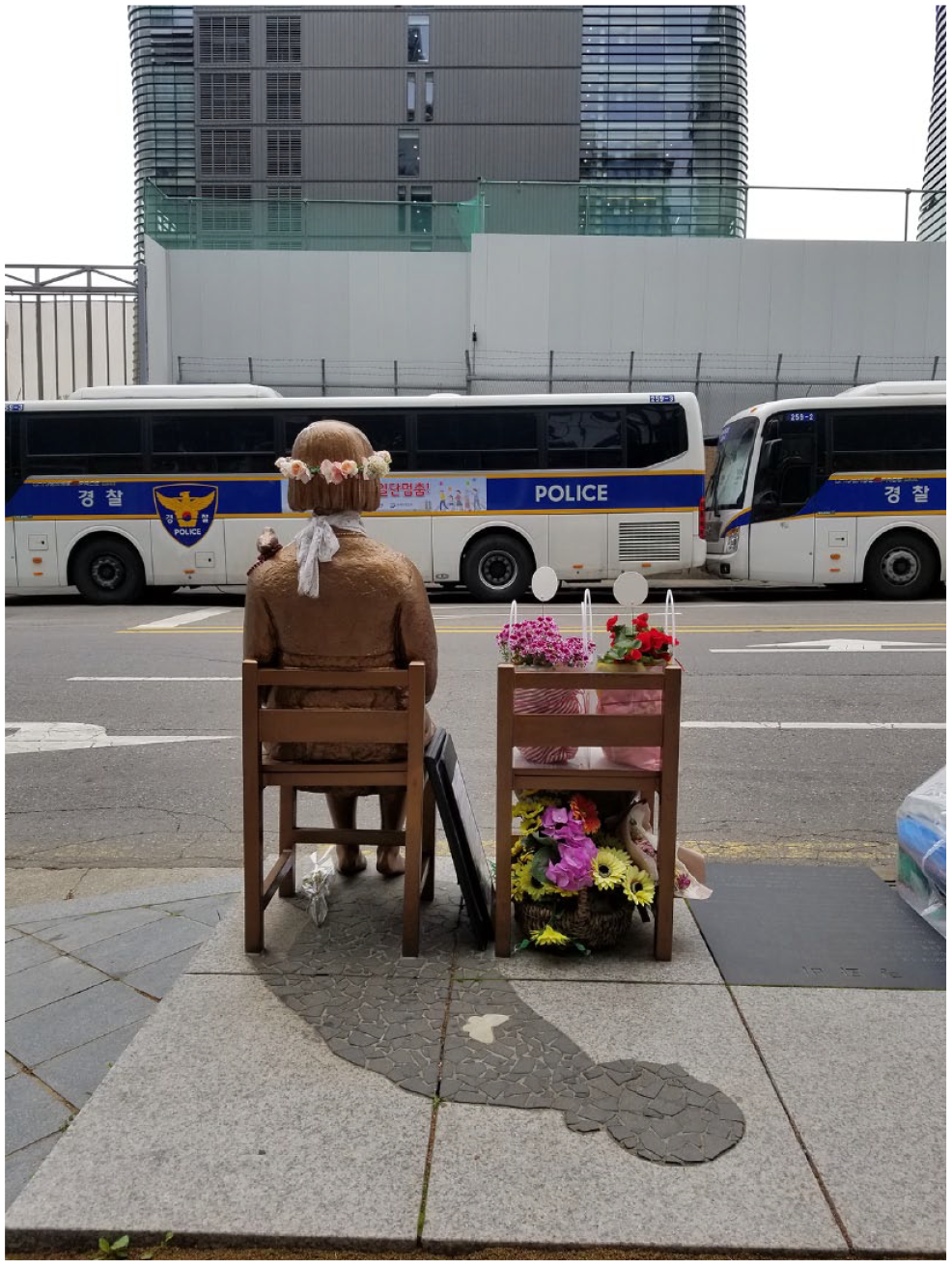
(Blocked) view on the Japanese Embassy building, April 2019.
The life-size statue is located in public space; that is, it is situated on a footpath across from the Japanese Embassy (Image 2 above). The location of the sculpture helps shape the bodily experience of visitors with the memorial. The statue is located in the lively Seoul district of Jongno, which has served as the cultural, economic, and political center of the capital for the last 600 years now. The surrounding area of the memorial is business-like and features bars, cafés, diplomatic missions (e.g. the US Embassy, the South Korean Ministry of Foreign Affairs), hotels, landmark tourist sites (e.g. Gwanghwamun Square, Gyeongbokgung Palace), and office buildings. Pedestrians walk by every day. Given the statue’s easy accessibility, it invites close, bodily encounters from curious pedestrians.
A particular role in these encounters is played by the empty chair placed beside the figure of the girl. The empty chair is a distinct commemorative icon, one well-known from other memorial sites. For instance, the Krakow Ghetto Hero Square in Poland, the Leipzig Holocaust Memorial in Germany, the Oklahoma City National Memorial in the US, and the Sarajevo Red Line in Bosnia and Herzegovina all feature large numbers of empty chairs as part of their respective commemorative installations. Being thus familiar across different cultures of memory, the empty chair enacts the interplay between presence and absence. More precisely, it marks the attempt to make an absence—in the abovementioned cases, those who died as victims of violence—present: that which is absent is thus made present by placing a piece of furniture in a given spatial setting.
The memory politics of the empty chair is also well known from, for instance, (inter)national award ceremonies for prominent academics, activists, or artists unable to or prevented from accepting their prize in person. The awarding of the 2010 Nobel Peace Prize to Chinese writer and dissident Liu Xiabo is a good example. As the awardee was serving a jail sentence in China at the time, the chairman of the Nobel Committee placed the peace prize on an empty blue seat within a small row of chairs. In this way Liu’s absence, even though it would have been apparent without the blue seat, was made present to a global audience. Important to note is that the chairs need to remain vacant, as sitting on them would arguably counter the logic of commemoration of these events and sites. In this way, the chair reflects a form of disembodied remembrance.
The empty chair of the Statue of Peace, however, inheres an opposite material rhetoric: it needs to be filled; something which becomes also striking if, as mentioned above, one thinks of the memorial’s copies, which have been placed inside public transportation buses in Seoul. For putting the statues there has enabled commuters to sit in front of, behind, or beside the girl. Thus the act of taking a seat is crucial and hence reflects a form of embodied commemoration. For with the filling of the empty chair, the “comfort women” memorial can be said to be complete. By inviting the viewer to take a seat, the memorial transforms the passive bystander into an active participant, one who thereby takes part in a range of embodied practices including commemoration, consolation, mourning, reflection, and/or protest. This transformation has been aptly captured by the Japanese artist Yoshiko Shimada (Kwon, 2019: 26). Named by the Japan Times (2002) as “Japan’s premier feminist and antiwar artist,” Shimada has staged sitting in the empty chair as a commemorative performance at the Japanese Embassy in London and at Glendale Central Park, close to Los Angeles—which features an identical copy of the peace statue (Kwon, 2019: 26).
The empty chair also indicates how the memorial engages its viewer’s sense of sight (see also, Lee and Huang, 2019). While the statue was placed in a way that Japanese diplomats could see it as they entered and left the office, visitors, along with the girl, look straight at the embassy too. As the Japanese ambassador to South Korea recalled during a public forum: “Every day I go to work at the embassy and I see that statue. I don’t think it was the right decision to put it there” (cited in Gil, 2013). Ironically, a direct line of sight toward the diplomatic mission has been blocked since 2015 due to construction walls and police buses, which park in front (see Image 2 above). In this way the obstruction of vision corresponds to the Japanese politics of denial. It should be pointed out, however, that the abovementioned engagements are also embedded in other actions shaped by the material aspect of the memorial’s rhetoric.
For instance, when visitors approach the statue they are not only able to recognize all of its elements: the small bird on the shoulder, the old woman’s shadow on the ground, and the commemorative plates in front. Often, they also take pictures of (themselves with) the memorial, bring flowers, or leave personal items such as letters, photographs, or poems (Busan Kyeoryehana, interview, April 24, 2019; Heemang Nabi, interview, April 29, 2019; Peace Butterfly, interview, April 29, 2019). During the cold season, the girl’s statue is wrapped in thick winter clothes including a woolen hat, scarf, and a cape (see Image 3 below). Son (2018: 158) describes additional embodied engagements such as the empathetic touching of the sculpture. While these embodied acts take the form of patting the girl’s head or stroking her shoulder, physical interaction is conditioned by the material rhetoric of the life-size statue.
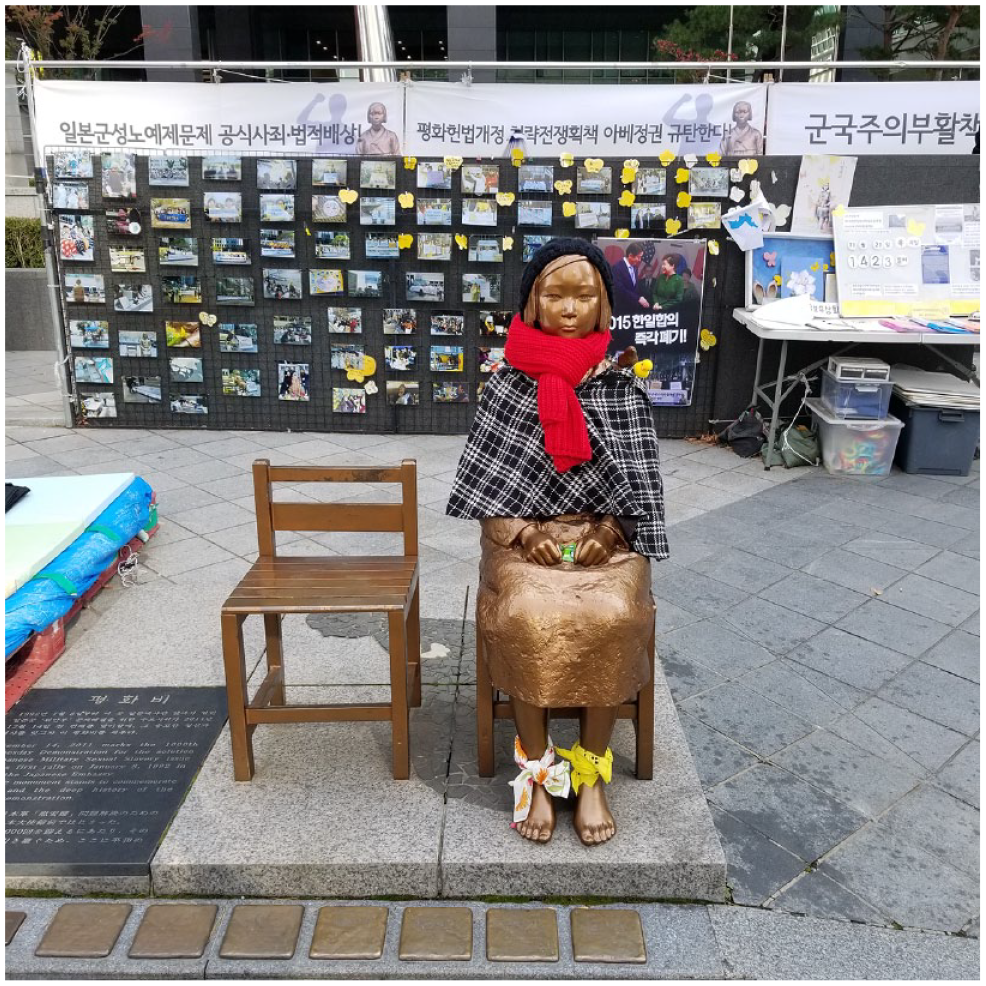
Statue of Peace wrapped in winter clothes, November 2019.
Interviews with activists, observations of visitors, and visual documentation validate the range of embodied practices occurring (Busan Kyeoryehana, interview, April 24, 2019; Heemang Nabi, interview, April 29, 2019; Peace Butterfly, interview, April 29, 2019; Sonyeosang1230, interview, November 24, 2019). However, the statue’s material rhetoric also elicits completely different forms of embodied engagement. As mentioned above, the statue creates a shared space for a variety of social groups by functioning as a physical destination. These include activists, former victims, and tourists, who form a community of protest (activists), recognition (former victims), and/or curiosity (tourists). But for those who oppose the sculpture, the memorial functions as a literal destination for counteraction as well.
The diplomatic efforts by the Japanese government to remove the statue are well known. Others opponents have visited the site and assaulted the sculpture by slapping the girl in the face or by throwing money at her feet in an attempt to allude to “comfort women” being prostitutes—a popular narrative among historical revisionists and Japanese nationalists (Huimang Nabi, interview, April 29, 2019). 2 In June 2012, a Japanese right-wing activist placed a stake beside the statue reading that the Liancourt Rocks—a group of small islands claimed by both Japan and South Korea—is part of Japanese territory (Korea Herald, 2012). In response, a South Korean nationalist drove his truck into the entrance of the Japanese Embassy claiming that the island belongs to South Korea (BBC, 2012).
Ironically, the “paradox of materiality” (Blair, 1999: 37) seems to give rise to these iconoclastic counteractions: as the Statue of Peace is built to last—eventually the “comfort women” will be gone, while their memorial will remain in place—its very durability—the bronze material that it is made of—renders the statue more vulnerable; the very reason why it prompts embodied means of continuous guardianship (see also, Choi, 2014).
Conclusion
I have examined the material rhetoric of the Statue of Peace situated in front of the Japanese Embassy in Seoul, South Korea. I have provided a novel perspective on the memorial by focusing on the work that it does to shape the bodily experience of visitors. Commemorative sites function not only by virtue of their symbolic power, but also have an effect by their mere physical appearance too. The empirical discussion has highlighted how the viewer, in contrast to other memorial sites, becomes part of the mnemonic installation by its inviting of them to take a seat. This form of embodied commemoration also engages the sense of sight of visitors—that is, to follow suit with the gaze of the featured girl herself. Other examples of how the memorial’s material rhetoric elicits embodied engagements include the guardianship and care by activists, protests for recognition by former victims as well counteractions by opponents.
Being the very first “comfort women” memorial to be built, the Seoul statue of an unsmiling teenage girl has served as the example for the construction and spreading of dozens of copies across South Korea and beyond. Together with another copy erected near the Japanese consulate in Busan, the memorial continues to negatively affect the bilateral relations of Japan and South Korea. Important to note is that with the erection of these statues, memories of former sex slaves have been monumentalized for a broader public for the very first time. In other words, “comfort women” memories have been constituted as being worthy of recall in the public memory.
The question of who or what deserves commemoration needs to be raised here, as it is by no means self-evident. Suffice to say that traumatic events have to be mediated to audiences, as they do not by themselves recount how people (should) remember them. Public memory, thus, inevitably entails interpretive decisions over what to recall, what to forget, and how to display it to a broader public—central questions which reveal memory’s close connection to power (see Bell, 2006; Edkins, 2003; Zehfuss, 2006). Due to the social stigmatization of the victims in South Korea, the “comfort women” memories were a private matter for a long time. While testimonies of former sex slaves—including from Kim Hak-sun, who came forward publicly as the first such woman in 1991—broke their long-standing silence, the Statue of Peace helped making “comfort women” memories a more public and even global affair (see also, Gluck, 2019; Kim, 2014; Matsumoto, 2017).
The force of memorials to assert a form of moral and political authority warrants further inquiry into the exact consequences that they have. These comprise, for instance, the foregrounding and the silencing of certain memory narratives by social groups or the appropriation (of certain elements) of a memorial by other monuments, as in the case of the Statue of Peace. This can also include in-depth studies on audience reactions to particular memorials as, it was attempted to show, material rhetoric gains force through reception. Furthermore, as commemorative objects and sites keep attracting people, scholars of Memory Studies could address how visitors themselves affect each other’s bodily experience of a memorial. For bodies as particular agents or subjects of memory have effects on other bodies as well. This includes also regarding the other, temporarily installed items often part of memorial sites, such as banners, stands, or tents.
Footnotes
Acknowledgements
Earlier versions of the article have been presented at conferences of the Memory Studies Association (2019) and European International Studies Association (2018). I would like to thank Maria Mälksoo and Mykola Makhortykh as well as the editors and reviewers for their constructive feedback. I am also grateful to Nataly Han for helping me to contact some of the activists, who were interviewed for this article.
Funding
The author disclosed receipt of the following financial support for the research, authorship, and/or publication of this article: This research was supported by the Korean Studies Grant Program of the Academy of Korean Studies (AKS-2019-R-08).

Interviews:
Busan Kyeoryehana, Interview, 24 April 2019.
Heemang Nabi, Interview, 29 April 2019.
Peace Butterfly, Interview, 29 April 2019.
Sonyeosang1230, Interview, 24 November 2019.