




Abstract
The critical years hypothesis is an influential hypothesis in the social sciences. According to this hypothesis, events occurring during adolescence or young adulthood are most important. This hypothesis is significant because if generations do indeed differ from each other because they were socialized in different contexts, the succession of generations has the potential to change societies. In this study, we test the validity of the critical years hypothesis using data from the Dutch Longitudinal Internet Studies for the Social Sciences Immigrant Panel. We first compare the power of the critical years hypothesis to that of alternative patterns, after which we conduct a structural examination of the conditionality of the critical years hypothesis. We test our hypotheses according to both open-ended and closed-ended questions. The results provide only limited evidence for the critical years hypothesis.
Keywords
Introduction
History has known countless events like wars, crises, political murderers, terrorist attacks, demonstrations, processes of colonization (and de-colonization), immigration, emancipation and supranational collaboration. Each of these happenings has played some role in shaping current society. Some are remembered, while others are collectively forgotten (Zerubavel, 2003). There could be substantial differences within societies regarding the historical events that are considered important. 1 Many studies have focused on how generations, each socialized under unique societal conditions, differ regarding their view on history (e.g. Griffin, 2004; Roberts and Lang, 1985). According to many scholars, events occurring during adolescence or young adulthood (approximately 17–25 years old) are considered the most important (Mannheim, 1952). This hypothesis – known as the critical years hypothesis 2 – has been very influential. This is not surprising, given its major societal implications. If generations do indeed differ significantly from each other because they were socialized in different contexts, the succession of generations has the potential to change societies. In this study, we test the validity of the influential critical years hypothesis according to the Dutch Longitudinal Internet Studies for the Social Sciences Immigrant Panel (LISS-I panel). As many other European countries have similar histories and commemoration cultures, the Netherlands is a representative case upon which to test the validity of the critical years hypothesis (Krimp et al., 2014).
Previous studies on the critical years hypothesis have been exaggerated to the point of ignoring contrary development patterns (Jennings and Niemi, 1968). We therefore start this study by formulating and empirically testing hypotheses for alternative age patterns. More specifically, in addition to the critical years hypothesis, we test the living-in-history hypothesis, 3 which predicts that all age cohorts living during a specific event will be influenced by this event. In contrast to the critical years hypothesis, the living-in-history hypothesis does not regard the formative period as exceptional. We also test the keeping-history-alive hypothesis, which predicts that all age cohorts will consider a specific event important, regardless of whether they had lived through it. This age cohorts pattern can be expected for events that are frequently commemorated in a nation’s media and/or educational system (Koppel, 2013).
In the second part of this study, we examine the importance of age, as compared to other demographic factors, in explaining intra-national variation in the importance attached to historical events. Schwartz (1999) argues that, in addition to its developmental aspects (i.e. related to age), the critical period has social aspects. The consequentiality of historical events differs from social group to social group (Brown and Kulik, 1977). Structural differences are therefore likely to occur between groups with regard to the historical events that are considered important (McKeever et al., 1993). In this study, we examine gender differences and differences between natives and immigrants regarding the importance attached to historical events. Although several studies on collective memory have included such aspects as control variables (e.g. Scott and Zac, 1993), they rarely focus explicitly on the influence of such aspects on which historical events are considered important (for notable exceptions, see, for example, Schuman et al., 2003). In this study, we will test the extent to which these demographic aspects are more strongly related to the importance attached to historical events than is age.
The third part of our study explores whether the validity of the critical years hypothesis is conditional (i.e. whether the critical years are important only for certain groups). For example, suppose that, in general, the process of women’s emancipation is not more important for individuals who were in their critical years during this process than it is for those who were not in their critical years at that time. It could be that women who were in their critical years were strongly influenced by this process, while men were not. In other words, the critical years hypothesis would be valid for women, but not for men. Limiting the analysis to the general effect of the critical years might generate biased conclusions concerning the validity of the critical years. A good overview of the validity of the critical years hypothesis requires studying its validity for different groups. Despite fragmented information suggesting such conditionality for the critical years hypothesis (e.g. Jennings and Zhang, 2005), this issue has tended to be tested only sporadically and, in most cases, yielding only descriptive evidence. For this reason, this study includes a more systematic examination of the extent to which the influence of critical years on the importance attached to historical events depends upon educational level and gender.
Finally, our study draws upon both open-ended and closed-ended questions. The open-ended question requires the respondent to bring to mind a range of alternatives and mention only one or two, while the closed-ended question lists a number of historical events and respondents can indicate that multiple events are (equally) important. Most studies on critical years use open-ended questions (e.g. Corning and Schuman, 2015). Nevertheless, it has been suggested that conclusions concerning the validity of the critical years hypothesis might depend upon the type of questions used: the critical years hypothesis is more often confirmed using open-ended questions than closed-ended questions (Corning and Schuman, 2015; Koppel, 2013). In order to test the validity of the critical years hypothesis thoroughly, it is therefore important to employ open-ended questions as well as closed-ended questions.
In sum, by (1) formulating and testing competing hypotheses on the relationship between age and the importance attached to historical events, (2) examining the importance of age relative to other demographic factors, (3) structurally examining the conditionality of the critical years and (4) employing both open-ended and closed-ended questions, this study provides deeper insight into the relationship between critical years and the importance attached to historical events.
Generational differences and the importance of historical events
Critical years hypothesis
The work of Karl Mannheim (1952) is often taken as a starting point for an enquiry involving generations. He theorized that events occurring during adolescence have more impact, given their major advantage of primacy (the idea that first experiences are generally more important than subsequent experiences) and the relative openness of young adults to new events. Schuman and colleagues have conducted extensive study on generational differences in memories of public events (e.g. Schuman and Corning, 2012; Schuman and Rodgers, 2004; Schuman and Scott, 1989). In many studies, they conclude that different generations recall different events and that such memories do tend to come from adolescence and early adulthood. For example, in their pioneering study, Schuman and Scott (1989) report that individuals who were between 16 and 24 years of age during the Second World War were more likely to identify this war as the most important event in modern history. Similar generational differences have been reported with regard to memories of the Vietnam War, the Iran hostage-taking and subsequent acts of terrorism, and the assassination of John F. Kennedy. Scott and Zac (1993) examine the importance of national and international events during a period of immense historical change: the fall of the Berlin Wall and the more general collapse of communist regimes. These dramatic changes did not have the same impact on older cohorts that they did on younger cohorts. The memories of older people were still dominated by wartime events from their youth (mainly the Second World War). Based on the extensive literature concerning the critical years hypothesis (see Corning and Schuman, 2015, for a more complete overview), events are likely to be considered most important by people who experienced them during their critical years:
Hypothesis 1a. People who experienced an event during their critical years consider this event more important than do people who did not experience it during their critical years.
Living-in-history hypothesis
As outlined above, several studies have provided empirical evidence for the critical years hypothesis. Nevertheless, other studies have reported findings that undermine the validity of this hypothesis (e.g. Corning, 2010; Jennings and Zhang, 2005). One competing hypothesis is that important events are not only those that occur during the formative years but all events that individuals experience, regardless of the age at which they take place (Koppel, 2013). As personally experienced events generally cause more arousal than do those that have not been personally experienced, personally experienced events are likely to be considered more important than other events are (Gold, 1992). The living-in-history hypothesis 4 does not regard the critical period as exceptional. Such age distributions are especially likely for events that exert a particularly strong impact on a country’s day-to-day life at the time they occur (Koppel, 2013). Many previous studies on the living-in-history hypothesis examined the extent to which historical events influence autobiographical memory (e.g. Brown et al., 2009). Although the focus of such studies is slightly different, the main idea – that public events that exerted a particularly strong impact on a country’s day-to-day life at the time they occurred are important to all persons who consciously experienced these events – can also be used to study the general importance attached to historical events. Several studies on the importance attached to historical events have shown that an event is considered important by all citizens living at the time it occurs, and that date of birth has little or no effect (Corning, 2010; Jennings and Zhang, 2005; Schuman et al., 2003). For example, Chinese citizens perceive the general reforms and openings to the outside world (from the late 1970s) as the most important process of modern history, regardless of age (Jennings and Zhang, 2005). The collapse of the Soviet Union in 1991 has also been found to be equally important to all Russian immigrants in the United States. Older generations of immigrants do not differ from Russian immigrants who experienced the end of the Soviet Union in their formative years (Corning, 2010). According to another study, memories of the Six-Day War in Israel were equally distributed across all age cohorts living at the time of this war (Schuman et al., 2003). These findings suggest that all age cohorts that consciously experience an event consider this event important and that the critical years do not constitute an exceptional period in this regard:
Hypothesis 1b. People who consciously experienced an event consider this event more important than people who did not consciously experience the event, and people who experienced the event during their critical years do not consider it more important than people who experienced the event before or after their critical years.
Keeping-history-alive hypothesis
Koppel (2013) argues the possibility of another age pattern in contrast to the critical years and living-in-history hypotheses. More specifically, some events are likely to be considered equally important by all age cohorts, regardless of whether they had lived through it. This age pattern is likely to emerge for events that are actively commemorated in the national media and/or in the educational system. In the Netherlands, for example, this age pattern could be expected for the Second World War. The two national days of commemoration in the Netherlands – 4 May (Remembrance Day) and 5 May (Liberation Day) – were developed in direct response to this war, which continues to play a central role in these two national commemorations (De Regt et al., 2017). Moreover, knowledge about the world wars and the Holocaust has been identified as one of the key goals of primary education in the Netherlands. 5 The Second World War is thus actively commemorated in the Netherlands, both in the educational system and by means of annual national commemorations. As a result, we might expect age cohorts in the Netherlands not to differ significantly from each other with regard to the importance they attach to the Second World War. In other words, we expect that if an event is actively commemorated, age cohorts that did not experience this event do not consider this event less important than cohorts that did experience the event:
Hypothesis 1c. People who consciously experienced an explicitly commemorated event do not consider this event to be more important than do people who did not experience the event.
The relationships between age cohorts and the importance attached to events according to the three hypotheses (critical years, living-in-history and keeping-history-alive) are illustrated in Figure 1.
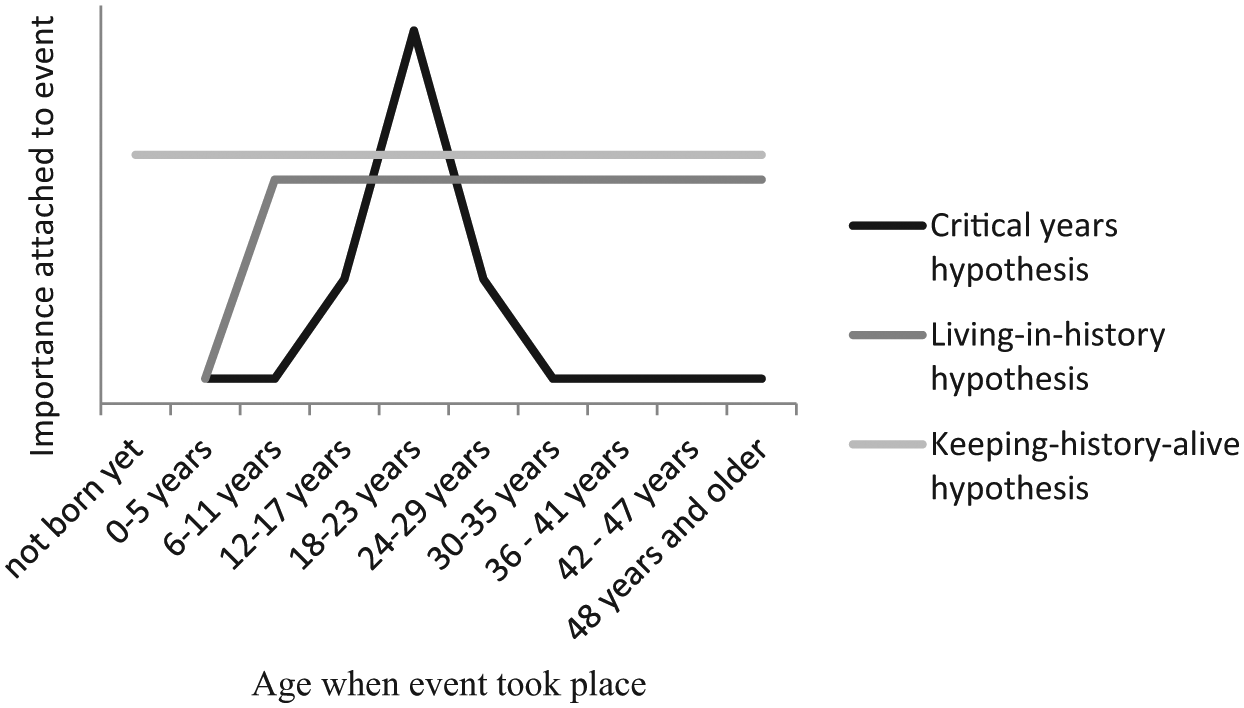
Hypothetical relationship between age cohorts and the importance attached to events.
Influence of other demographic factors on the importance of historical events
Gender and the importance of historical events
It has been argued that the critical period is not only developmental (related to age) but also social (Schwartz, 1999). In general, events that are commemorated and remembered are those that embody our deepest and most fundamental values (Schwartz, 1982). In other words, historical events that are important to the (group) identity of specific groups are particularly likely to be remembered by members of those groups. Furthermore, the impact that historical events have on personal lives can differ between groups (Bohn and Habermas, 2016; Zebian and Brown, 2014). Women’s emancipation arguably changed the identity and societal position of many women. The process of emancipation changed the expectation that women should be the sole caretakers of children and housekeeping, while men were considered more suitable to working outdoors. It became acceptable for women to pursue higher education, and they gained rights regarding their bodies and sexuality (e.g. abortion laws). The historical emancipation of women might thus be more important to the identity of women than it is to the identity of men and therefore considered more important by the former group. Based on an open-ended question, Schuman and Scott (1989) found that women are indeed more likely than men to mention women’s rights as the most important change occurring the past 50 years. We can therefore expect women to judge the process of emancipation as more important than men do:
Hypothesis 2a: The emancipation of women is considered more important by women than it is by men.
Ethnicity and the importance of events
As outlined above, it has been argued that historical events that are important to the identity of groups and/or have a strong impact on the personal lives of group members are particularly likely to be remembered (Bohn and Habermas, 2016; Brown and Kulik, 1977; Zebian and Brown, 2014). We could therefore expect different ethnic groups to consider different historical events important. Several studies have provided evidence of differences in the ways in which Blacks and Whites (or immigrants and natives) view the past. For example, Schuman et al. (1997) report that Black respondents knew more about Rosa Parks (the Black women who protested racial segregation by refusing to move to the back of the bus) than White respondents did, while the situation was reversed for knowledge about other historical events (e.g. the Marshall plan, the Tet offensive and Watergate). Other studies have also shown that race is significantly associated with the likelihood of identifying the civil rights movement and the election of Barack Obama as most important event in modern history, with Blacks attaching more value to these events than Whites do (Corning and Schuman, 2013; Schuman and Rodgers, 2004). In this article, we examine historical events related to specific ethnic groups (e.g. the decolonization of Suriname and the arrival of Turkish and Moroccan guest workers), predicting that immigrants are generally more likely to consider them important than native Dutch people are:
Hypothesis 2b. Events related to specific ethnic groups are considered more important by members of these groups than they are by natives.
Conditionality of the critical years period
Fragmented evidence exists to support the idea that the critical years are especially influential during certain circumstances or for special groups (e.g. Schuman et al., 1997; Schuman and Scott, 1989). For example, studies have shown that the influence of the formative period can differ by gender. In a study on collective memory in Russia, Schuman and Corning (2000) examine knowledge of Katya Lycheva, an 11-year-old Soviet girl who travelled to the United States during the Cold War with the peace mission. The results indicated that girls in their formative years were particularly knowledgeable about this event. Similarly, Schuman et al. (1997) demonstrate that men who were young during the Tet offensive were particularly well informed about this campaign. The fact that they knew more than either women of the same age or older men can be explained by the fact that young men were the most threatened during the Tet offensive, as they were of military age. Less evidence exists on interactions between age and educational level. Schuman and Scott (1989) report no evidence of interactions between age and educational level in yielding memories of events. It is nevertheless plausible that the influence of the critical period depends upon educational level. The critical years hypothesis predicts that events occurring during adolescence and young adulthood are particularly likely to be considered important. This is likely to be especially true for those with higher levels of education. In general, people with more education are more capable of recognizing the uniqueness and impact of events (Schuman and Rodgers, 2004), and young adults with a higher level of education should thus be particularly likely to be influenced by events occurring during their formative years. In short, several studies provide evidence that the critical years hypothesis is conditional. Much of this evidence is descriptive and ad hoc, referring to only limited number of events. In this study, we conduct an explorative, systematic test of the conditionality of the critical years hypothesis on educational level and/or gender.
Method
Participants
To test the validity of the critical years hypothesis, we use data from the Longitudinal Internet Studies for the Social Sciences Immigrant Panel (LISS-I panel) administered by CentERdata (Tilburg University, the Netherlands). In this Dutch panel, immigrants are oversampled in order to allow for the reliable investigation of differences between immigrant groups in the importance attached to historical events. Households that would otherwise have been unable to participate in the panel are provided with a computer and/or Internet connection. Panel members complete an online questionnaire monthly, being paid for each completed questionnaire. Data for this study were collected in April 2014. In all, 1325 individuals participated in the study, for a response rate of 77.7%. The youngest respondent in our sample was 16 years old and the oldest respondent was 89 years old (M = 47.57, standard deviation (SD) = 16.55).
Measures
Importance of events
In this study, we employed an open-ended question as well as a closed-ended question to measure the importance attached to historical events. Both formats have advantages and disadvantages. It is known, for example, that open-ended questions are generally less leading and can produce unanticipated findings, while closed-ended questions are generally easier for respondents to answer and respondents’ answers are easier to compare (Neuman, 2012). As the two methods are related, but different, both methods were used in this study in order to study the importance attached to historical events thoroughly.
Importance of events – open-ended – The respondents first answered the open-ended question about the importance of historical events: Many national and international events and changes have occurred in the last 70 years. Can you list 1 or 2 events or changes which you think were particularly important? Similar questions have been employed successfully in most other studies on the critical years hypothesis (e.g. Corning and Schuman, 2015). Consistent with these studies, we combined first and second mentions. This is a measure not only of recall but also of perceived importance, as it can be assumed that respondents mention the events they consider to be most important. It was technically impossible for the respondents to return to this question after answering it. This method prevented any bias resulting from respondents changing their answers after seeing the historical events presented in the closed-ended question.
Importance of events – closed-ended – The respondents subsequently answered the closed-ended question on the importance of historical events: Below is a list of events and changes that occurred in the last 70 years. Please indicate for each event and change how important you consider this to have been (1 = not at all important and 10 = very important). If you really don’t know, then you can choose ‘?’. (1) The arrival of Turkish and Moroccan guest workers, (2) The assassinations of Pim Fortuyn and Theo van Gogh, (3) The independence of Indonesia, (4) The establishment of social security (e.g. the General Old Age Pensions Act and the Social Welfare Act), (5) The independence of Suriname, (6) The terrorist attacks on the United States on 11 September 2011, (7) The Second World War, (8) The fall of the enclave of Srebrenica in Bosnia, (9) The fall of the Berlin Wall and (10) Women’s emancipation/feminism. The events were presented in random order, thus preventing biases resulting from the sequence in which the events were presented. We also consciously included important events from different historical periods. Figure 2 shows when the events in question took place.

Chronological order of events.
Such a closed-ended question has rarely been employed by studies examining the validity of the critical years hypothesis. Studies that did use closed-ended questions to test the validity of the critical years hypothesis often used knowledge measures (e.g. Janssen et al., 2008; Rubin et al., 1998). In our study, however, we are interested in the importance attached to historical events. It is possible that people have knowledge of historical events (e.g. because of commemorations in the media and/or the educational system), but do not consider this event important. In our study, we therefore chose to employ another closed-ended question to examine the importance attached to historical events. For excellent reviews of previous studies on the importance attached to historical events as well as the distinction between the two question formats, the interested reader is referred to Koppel (2013) and Corning and Schuman (2015).
Age-cohorts – In order to be able to test our hypotheses, we empirically distinguished between four age cohorts: (1) people who did not consciously experience the event, (2) people who experienced the event before their critical years, (3) people who experienced the event during their critical years and (4) people who experienced the event after their critical years. The first category – people who did not consciously experience the event – consisted of people who had not been born when the event occurred and people who were in early childhood. More specifically, we set the boundary at 5 years old, as in general most adults cannot remember events that happened prior to the age of 5 (see Erikson, 1950, on the developmental stages of children and Rubin et al., 1986, on childhood amnesia). Therefore, it can be expected that both people who had not yet been born and people aged under 5 years old did not consciously experience the event. In line with many previous studies (e.g. Corning and Schuman, 2015), we define the critical period as being between the ages of 17 and 25 years. This means that in our study, individuals who experienced an event before their critical years were between 5 and 16 years of age when the event occurred, and people who experienced the event after their critical years were over 25 years old when the event took place. 6
Gender – Gender was assessed by the dummy variable ‘Female’ (1 = female and 0 = male). In our sample, 53.7% were female and 46.3% were male.
Immigrant status – We used five dummy variables to measure ethnicity: Turkish (5.1%), Moroccan (5.8%), Surinamese (4.8%), other non-Western immigrants (24.5%) and Western immigrants (26.2%). Native Dutch respondents (33.2%) were the reference category.
Procedure
In this study, we first compare the validity of the critical years hypothesis to two competing age patterns (i.e. the living-in-history hypothesis and the keeping-history-alive hypothesis). More specifically, we compare (1) the mean importance attached to historical events (derived from the closed-ended question) across age cohorts by means of analysis of variance (ANOVA) and (2) differences across age cohorts in the percentage of mentioning a specific event (derived from the open-ended question) by means of chi-square tests. Second, we compare the explanatory power of age to other demographic aspects (i.e. gender and ethnicity). To examine the effect of age compared to gender and ethnicity using the closed-ended question on the importance of historical events, we use ordinary least squares (OLS) regression. Logistic regression is used to analyse the open-ended questions on the importance of historical events, as mentioning an event has only two categories (mentioned = 1 and not mentioned = 0). We report standardized coefficients, as this allows us to compare the strength of the effect of age on the importance attached to historical events compared to other demographic factors. 7 Third, we use interaction terms to test the conditionality of the critical years hypothesis. More specifically, interaction terms are created between the critical years and educational level and gender. Unfortunately, the data did not contain responses from enough immigrants to test interactions between age cohort and ethnic background.
Results
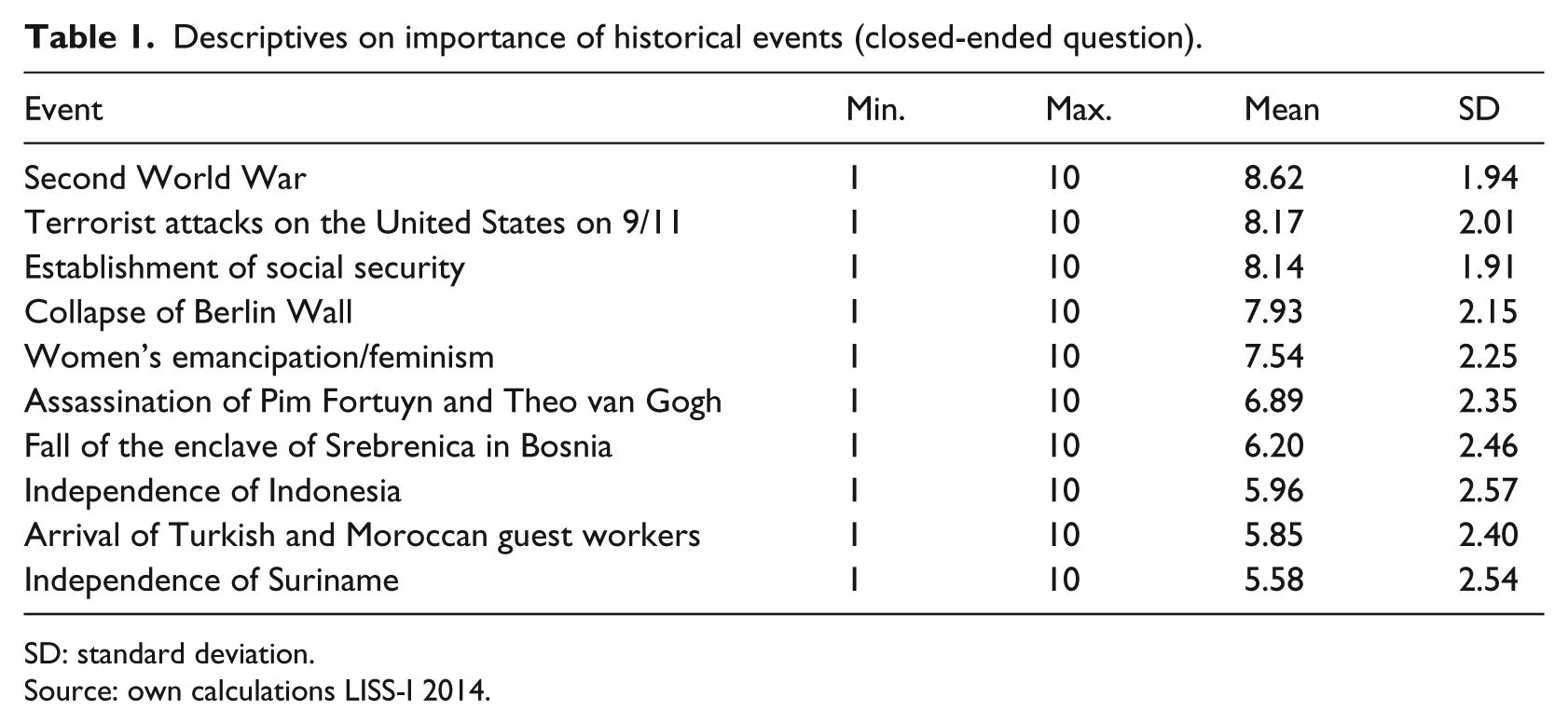
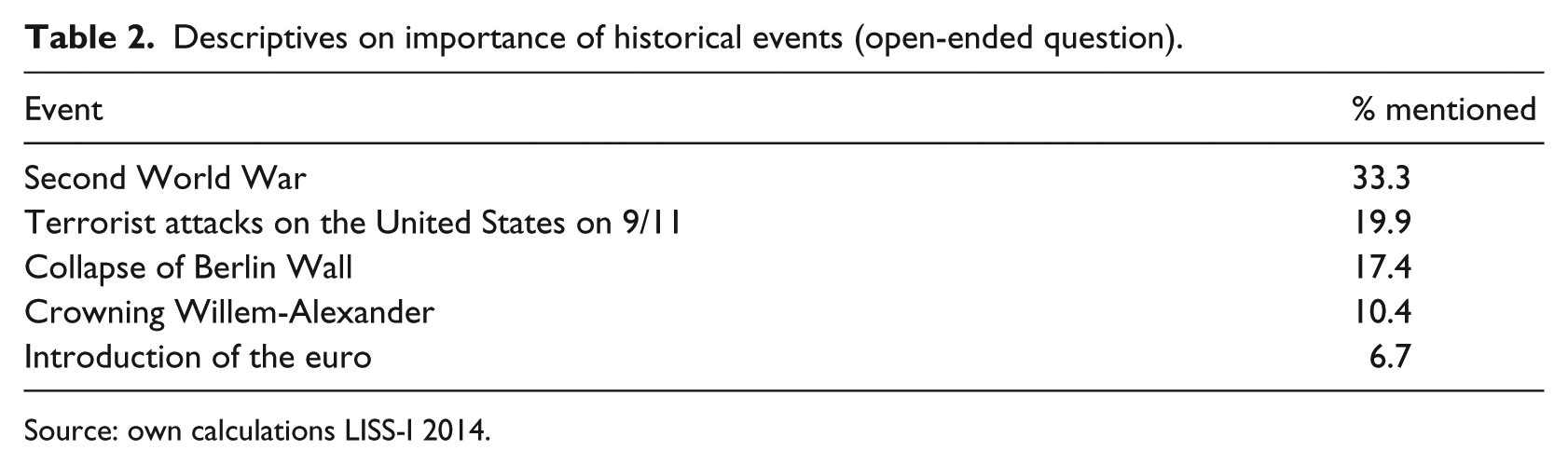
Before examining the extent of variation within Dutch society, we examine which events are generally considered most important according to respondents in the Netherlands. In Table 1, we present descriptive statistics on the items concerning the importance of historical events (the closed-ended question) and in Table 2, we present the events that were mentioned most often as important historical events (the open-ended question). 8
Descriptives on importance of historical events (closed-ended question).
SD: standard deviation.
Source: own calculations LISS-I 2014.
Descriptives on importance of historical events (open-ended question).
Source: own calculations LISS-I 2014.
As indicated in Tables 1 and 2, the Second World War was identified as the most important historical event by respondents in the Netherlands (according to both the open-ended and the closed-ended question). Other events that were identified as important include the 9/11 terror attacks and the fall of the Berlin Wall. Although the respondents also identified the establishment of social security as important based on the closed-ended question (M = 8.14, Min. = 1, Max. = 10), only a few respondents (0.9%) mentioned this in the open-ended question. Another interesting difference is the relatively large number of respondents mentioning the coronation of Willem-Alexander as one of the most important events in history. This result is likely due to the ‘recency effect’ (O’Connor et al., 2000), given that this event occurred 1 year before our data were collected.
Age and importance attached to historical events
Table 3 shows the mean importance attached to historical events (derived from the closed-ended question) for different age cohorts. As we can see, the results are not in line with the critical years hypothesis. Respondents who experienced the arrival of Turkish and Moroccan guest workers, the emancipation of women, the independence of Suriname, the fall of the Berlin Wall, the fall of the enclave of Srebrenica, the terrorist attacks on the United States on 11 September 2011 and the assassinations of Pim Fortuyn and Theo van Gogh during their critical years do not consider these events significantly more important than do people who experienced these events before or after their critical years. We also see that the results regarding the validity of the living-in-history hypothesis and the keeping-history-alive hypothesis are mixed. In line with the living-in-history hypothesis, we see that people who experienced the Second World War, the independence of Indonesia, the establishment of social security, the fall of the Berlin Wall and the fall of Srebrenica consider these events significantly more important than do people who did not consciously experience them. On the other hand, we find that people who experienced the arrival of Turkish and Moroccan guest workers, the emancipation of women and the independence of Suriname do not consider these events more important than do people who did not experience these events. This is in line with the keeping-history-alive hypothesis.
Mean importance attached to historical events by age cohorts (closed-ended question).
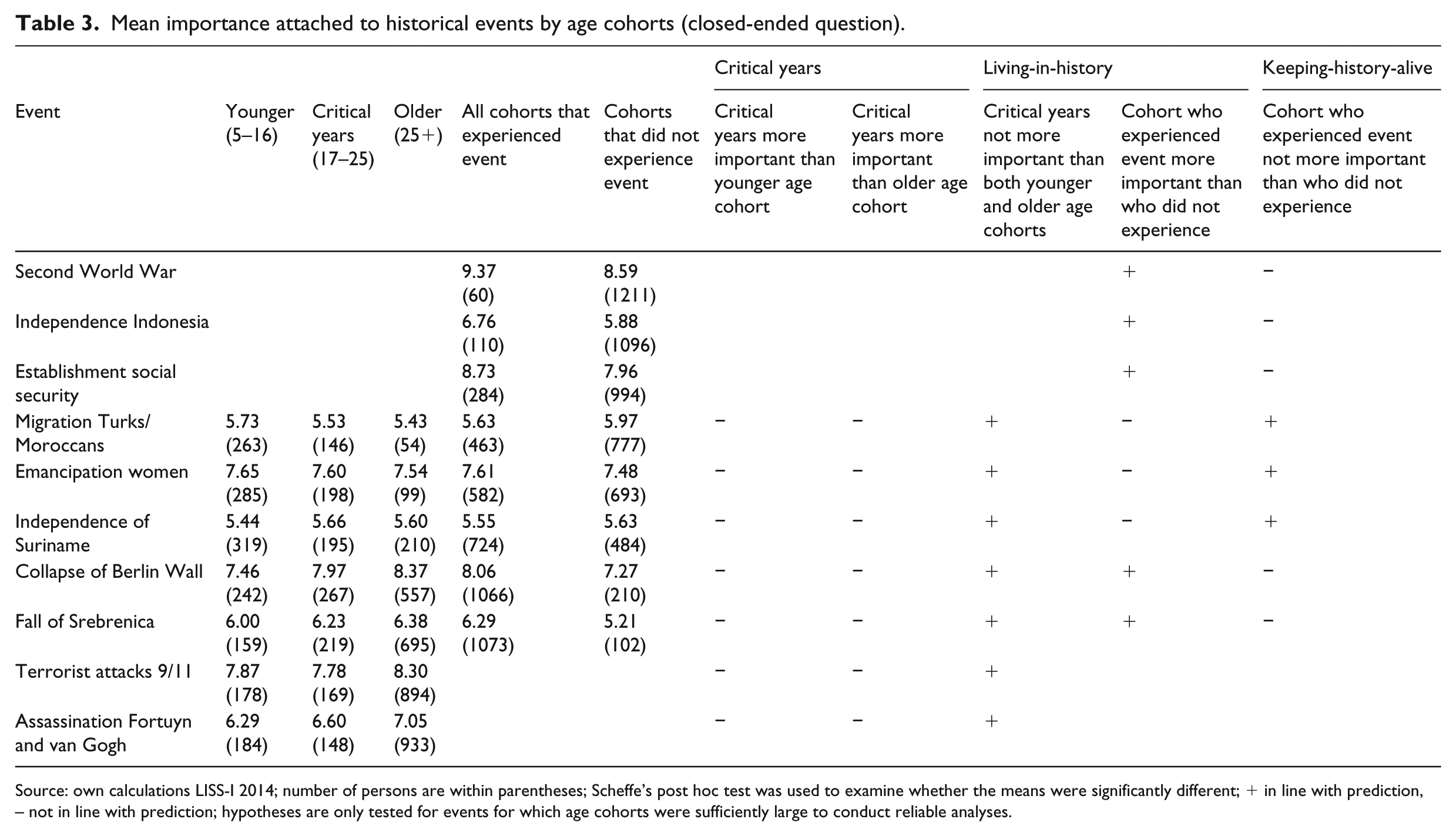
Source: own calculations LISS-I 2014; number of persons are within parentheses; Scheffe’s post hoc test was used to examine whether the means were significantly different; + in line with prediction, – not in line with prediction; hypotheses are only tested for events for which age cohorts were sufficiently large to conduct reliable analyses.
Table 4 displays the results of the open-ended question. Again, no evidence is found for the critical years hypothesis. People who experienced the collapse of the Berlin Wall, the terrorist attacks of 9/11 and the introduction of the euro in their critical years do not consider these events significantly more important than do people who experienced them before or after their critical years. We also see that people who experienced the collapse of the Berlin Wall consider this event more important than do people who did not experience this event. This is in line with the living-in-history hypothesis but contradicts the general idea of the keeping-history-alive hypothesis.
Percentage mentioned as one of the most important events in history by age cohorts (open-ended question).
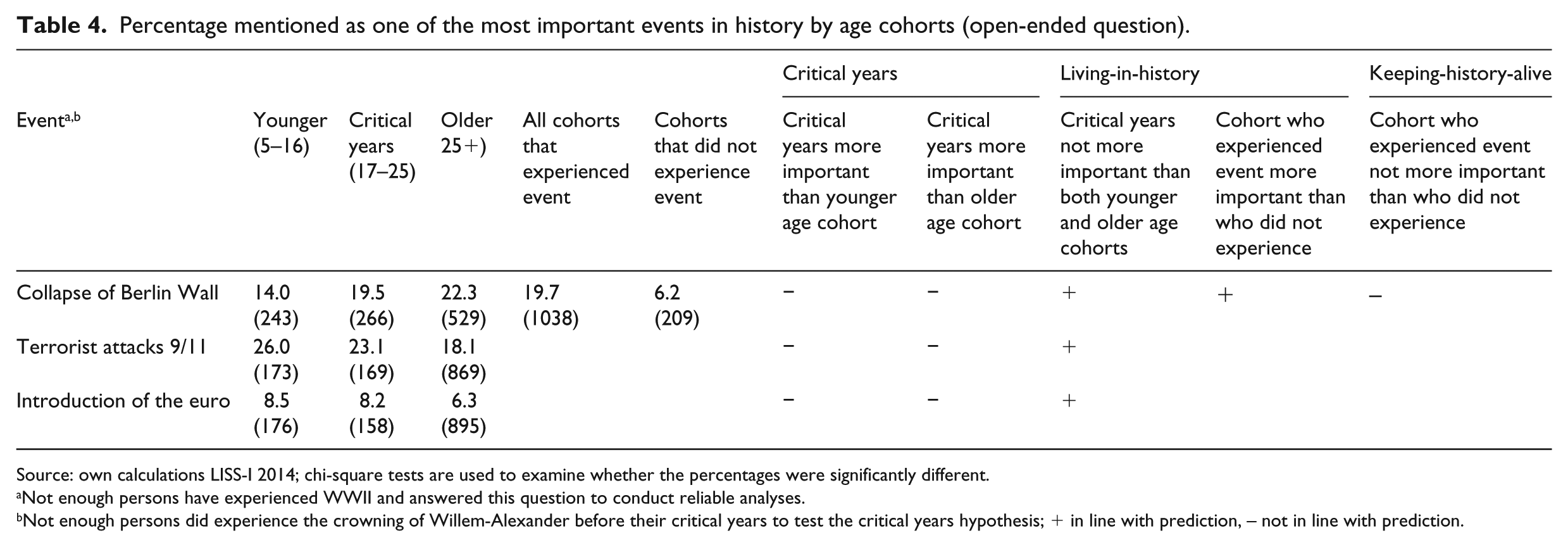
Source: own calculations LISS-I 2014; chi-square tests are used to examine whether the percentages were significantly different.
Not enough persons have experienced WWII and answered this question to conduct reliable analyses.
Not enough persons did experience the crowning of Willem-Alexander before their critical years to test the critical years hypothesis; + in line with prediction, – not in line with prediction.
Other demographic factors and the importance of events
Next, we compare the explanatory power of age compared to gender and ethnicity. In Hypothesis 2a we formulated the expectation that women would consider the emancipation of women more important than men would. This hypothesis is confirmed by the results of the analyses, as reported in Table 5. Women consider the emancipation of women significantly more important than men do. Additional analyses furthermore showed that the effect of gender on the importance attached to the emancipation of women is significantly stronger than the effect of gender on the importance attached to fall of the Berlin Wall, the arrival of guest workers and the fall of Srebrenica. The results in Table 5 also provide support for Hypothesis 2b that events pointing to specific ethnic minority groups are considered more important by members of these groups than they are by those of ethnic majority groups. Respondents of both Turkish and Moroccan background regarded the arrival of Turkish and Moroccan guest workers as more important than those of Dutch background did. Similarly, respondents of Surinamese background regarded the independence of Suriname as more important than was the case for those of native Dutch background. As shown in Table 5, gender and ethnicity are more consistently related to the importance attached to historical events than age is.
Summary of OLS regression analysis (beta’s) and logistic regression analysis (standardized coefficients) for variables predicting importance of historical events a .
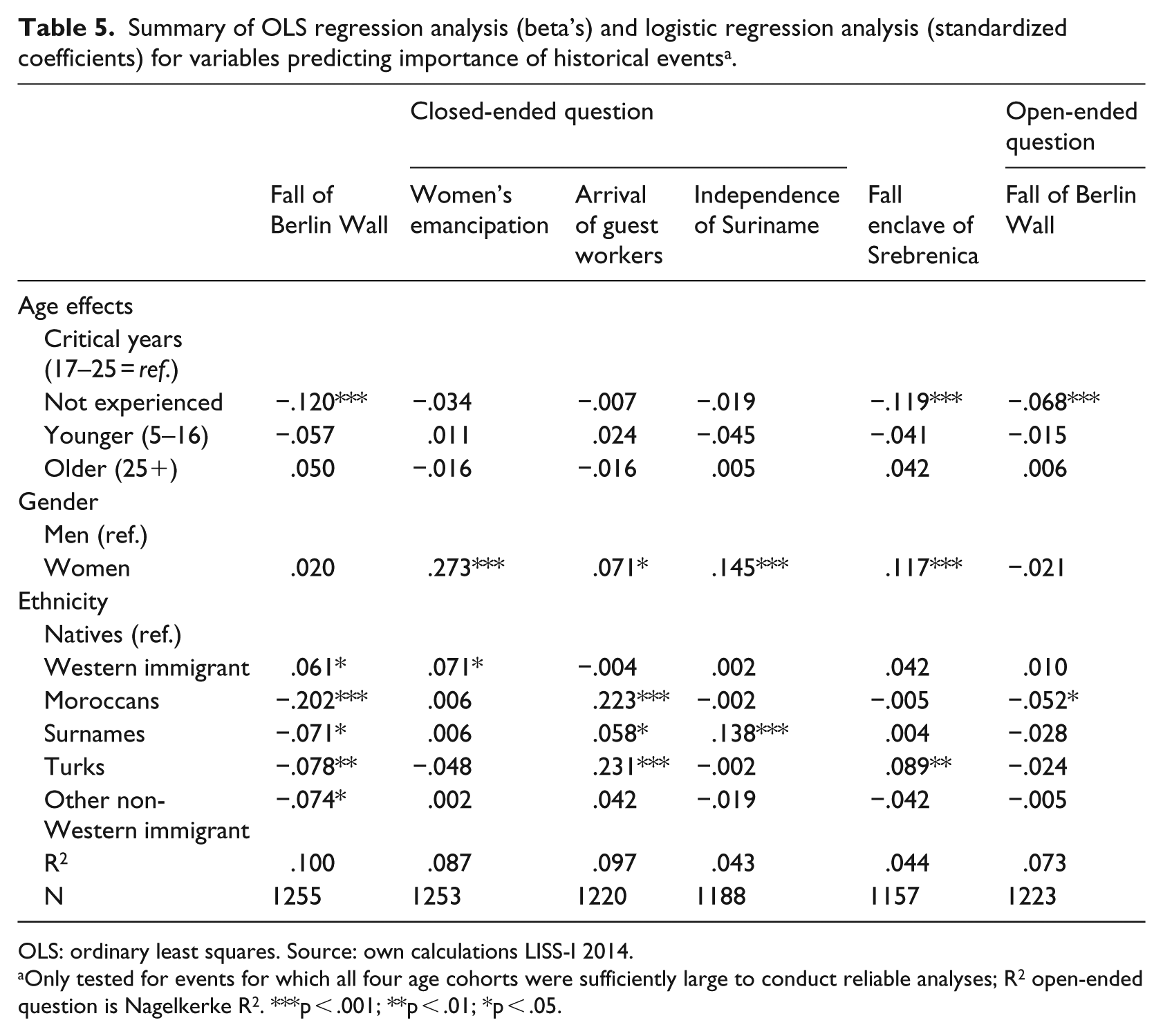
OLS: ordinary least squares. Source: own calculations LISS-I 2014.
Only tested for events for which all four age cohorts were sufficiently large to conduct reliable analyses; R2 open-ended question is Nagelkerke R2. ***p < .001; **p < .01; *p < .05.
The conditionality of the critical years hypothesis
In the theoretical section, we suggested that critical years might be important only for certain groups. Table 6 (closed-ended question) and Table 7 (open-ended question) display results testing the conditionality of the effect of formative years on education and gender.
Summary of OLS regression analysis (beta scores) for variables and interactions predicting the importance of historical events.
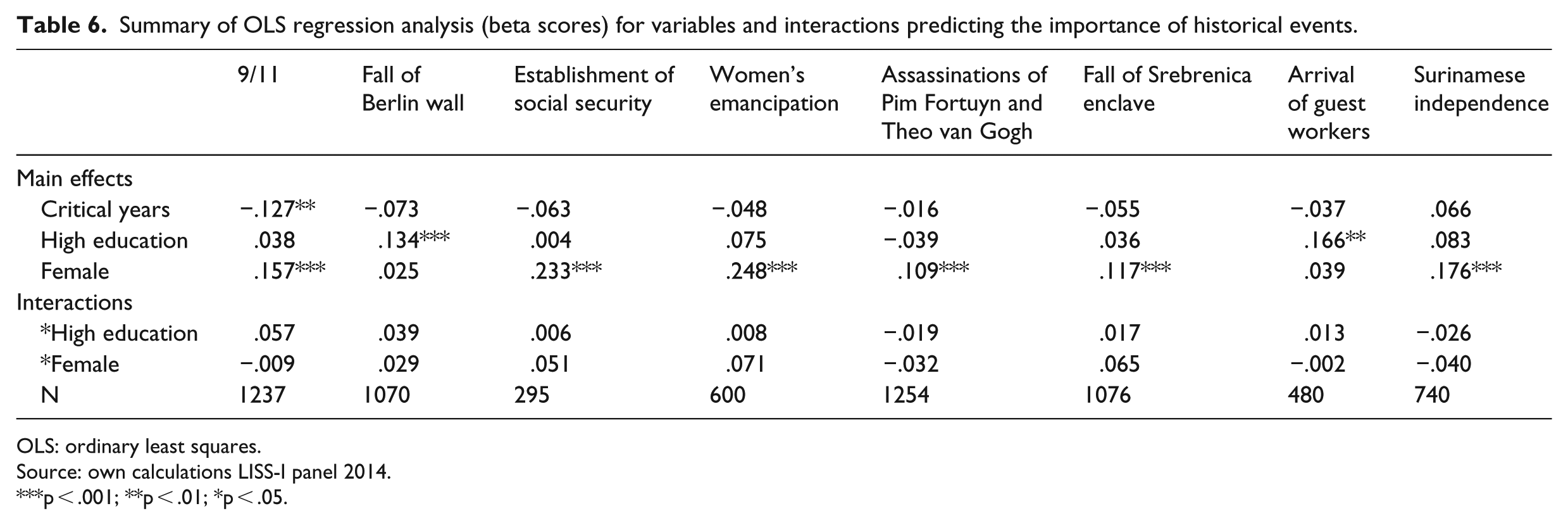
OLS: ordinary least squares.
Source: own calculations LISS-I panel 2014.
p < .001; **p < .01; *p < .05.
Summary of logistic regression analysis (standardized coefficients) for variables and interactions predicting the importance of historical events.
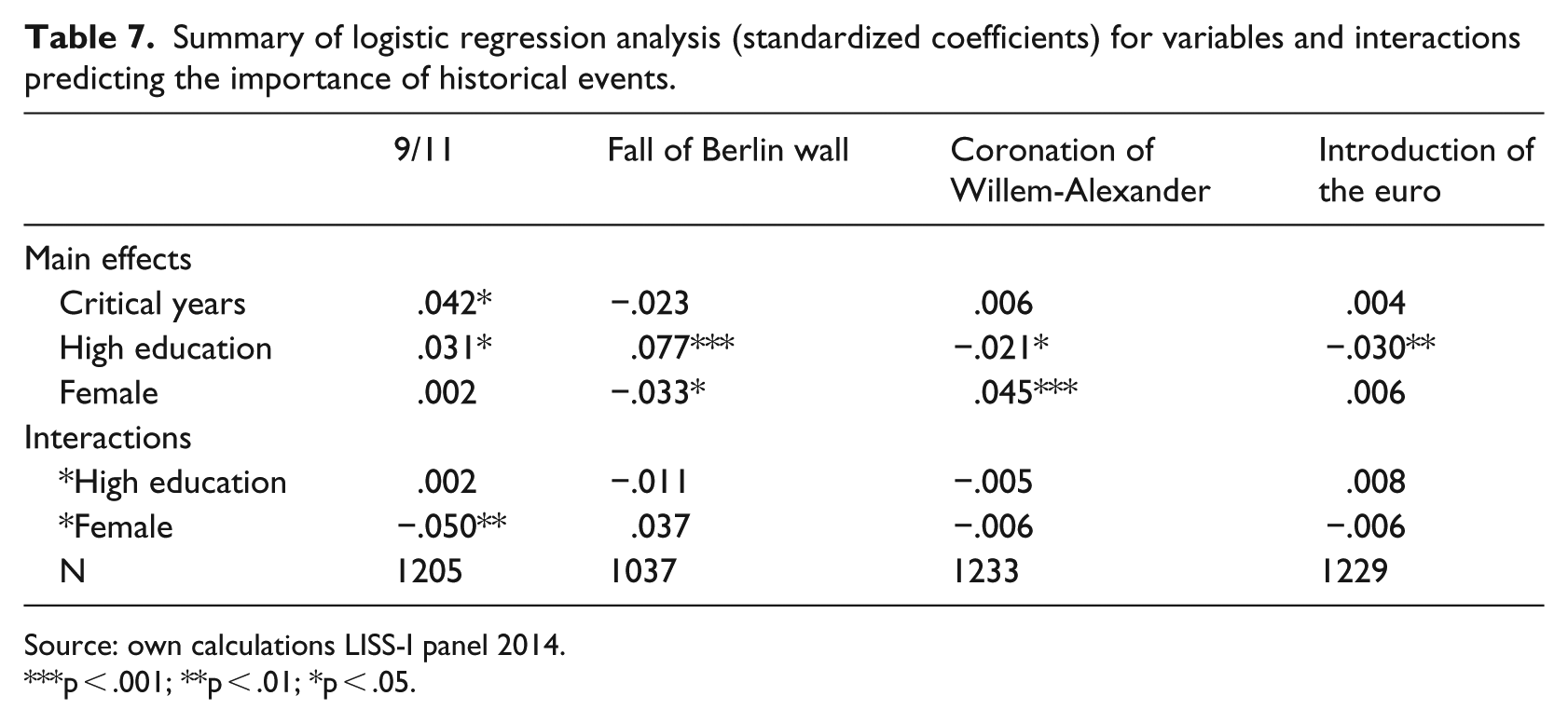
Source: own calculations LISS-I panel 2014.
p < .001; **p < .01; *p < .05.
As indicated in these tables, our main conclusion regarding the validity of the critical years hypothesis hardly changes when examining the interactions with educational level and gender. These results also provide no convincing evidence supporting the validity of the critical years hypothesis.
Robustness checks
Following previous studies on the critical years, we defined the formative years as being between the ages of 17 and 25, although the exact boundaries have been the subject of discussion (see, for example, Holmes and Conway, 1999; Schuman et al., 1998; Schuman and Corning, 2012; Schuman and Rodgers, 2004). Subsequent analyses using different boundaries for the critical years did not alter our main conclusions (results available from the authors upon request).
In this study, we used data from the LISS-I 2014 panel to test our hypotheses, as immigrants are oversampled in the data set. This allowed us to conduct a reliable study of the differences between immigrant groups with regard to the importance attached to historical events. We used data from a different sample (the Longitudinal Internet Studies for the Social Sciences Panel 2014) to conduct the analyses again, except for the ethnicity variable. This did not alter the main conclusions stated this article. None of these analyses provided convincing evidence for the critical years hypothesis. The tables are available from the authors upon request.
Discussion
In this study, we tested the validity of the critical years hypothesis, which predicts that events occurring during the critical years (between 17 and 25 years old) are particularly likely to be considered important. In addition to testing the critical years hypothesis, we tested two alternative age patterns with regard to the importance attached to historical events. More specifically, we tested the validity of the living-in-history hypothesis and the keeping-history-alive hypothesis. The living-in-history hypothesis predicts that everyone who consciously experiences an event may consider that event important and that the critical years are not an exceptional period in this regard. The keeping-history-alive hypothesis predicts that all age cohorts will consider certain events important, regardless of whether they experienced them. Our results provided no substantial supportive evidence for the critical years hypothesis: respondents who experienced an event during their critical years did not consider this event significantly more important than did people who were younger or older when the event occurred. Results regarding the living-in-history hypothesis and keeping-history-alive hypothesis were mixed.
In addition to testing different age patterns regarding the importance attached to historical events, we also examined the explanatory power of age compared to other demographic factors. We predicted that the process of women’s emancipation was considered more important by women than it was by men. This hypothesis was supported by the analyses. We also predicted that several events would be considered more important by immigrants than they would by natives. This hypothesis was also supported by the data. In other words, gender and ethnicity were generally more consistently related to importance attached to historical events than the critical period was.
Finally, we conducted a structural examination of whether the effect of critical period is dependent upon education and gender, in order to gain more insight into the conditionality of the influential critical years hypothesis. These results also provide hardly any support for the critical years hypothesis.
In this study, we used both open-ended and closed-ended questions. Interestingly, the two methods yielded similar conclusions. The Second World War, the collapse of the Berlin Wall and the terrorist attacks of 9/11 were found to be regarded as the most important historical events using both methods. In addition, with regard to the validity of the critical years hypothesis, the two methods resulted in similar conclusions. With regard to gender, our data showed that women considered almost all historical events more important than men did, and this was especially the case with the closed-ended questions. One reason could be that women are generally more likely to answer questions in socially desirable ways (e.g. Chung and Monroe, 2003). Unfortunately, because we had no reliable measure of social desirability, we were unable to take this aspect into account. In future studies, it would be interesting to take the aspect of social desirability into account when studying the importance attached to historical events by means of closed-ended questions.
As outlined in the theoretical section, the Second World War is actively commemorated in the Netherlands, both in the educational system and by means of annual commemoration days. We therefore expected people who did not experience this war to consider it equally important as did those who lived through it (the keeping-history-alive hypothesis). We demonstrated that Dutch people do indeed consider this war to be by far the most important event in history. Both question types revealed the Second World War to be the most important event in history. In this regard, we can conclude that commemoration does indeed matter (see also Corning and Schuman, 2013, on the influence of commemorations). Yet, in line with the living-in-history hypothesis, we also found that people who lived through this war consider it more important than people who did not. In other words, commemorations do seem to have the potential to increase the overall level of importance attached to historical events, but they do not seem to cause the age patterns predicted by the keeping-history-alive hypothesis.
When it comes to other events, we did find evidence for the keeping-history-alive hypothesis. More specifically, we found that people who experienced the arrival of Turkish and Moroccan guest workers, the emancipation of women and the independence of Suriname do not consider these events more important than do people who did not experience these events. At the time our data were collected, these events had regained a certain degree of societal relevance. At a rally held a few weeks before our data were collected, for example, the influential right-wing politician Geert Wilders asked his supporters whether they wanted more or fewer Moroccans in the Netherlands. His followers responded by chanting ‘Fewer, fewer, fewer!’ and Wilders concluded ‘Then we’ll see to that’. His statements were met with outrage and 6400 complaints to the police followed. Wilders has also argued that immigrants rarely integrate well and do not share the same attitudes towards liberty and equality as native Dutch people, for example, on the issue of gender equality. A very heated debate was also taking place about Black Pete, the ‘servant’ of Saint Nicholas, who is portrayed using controversial blackface make-up during Saint Nicholas celebrations on 5 December. People from countries who were exploited for slavery, such as Suriname, are prominent opponents of blackface. In the light of these societal developments, the arrival of Turkish and Moroccan guest workers, the emancipation of women and the independence of Suriname had once again become very relevant and important events for contemporary Dutch society. In other words, it seems that the age pattern predicted by the keeping-history-alive hypothesis can be explained not by commemorations but by the (renewed) relevance of events in current society.
The results for several events were in line with the living-in-history hypothesis: the Second World War, the independence of Indonesia, the establishment of social security, the fall of the Berlin Wall and the fall of Srebrenica. It can be argued that most of these events exerted a particularly strong impact on Dutch society at the time they occurred. With the exception of the fall of the Berlin Wall, all of the events are included in the Dutch canon, which includes the most influential events in Dutch history (see, for example, Van Oostrom, 2007 for more information on Dutch history and this canon). The fall of the Berlin Wall is not mentioned in the canon as it was not a Dutch event. Yet, given the shared economic, social and political histories of Germany and the Netherlands – being neighbouring countries – the fall of the Berlin Wall also influenced Dutch society substantially (Jürgens, 2014).
In sum, our findings suggest that when events exerted a strong influence on society at the time they occurred, an age pattern consistent with the living-in-history hypothesis can be observed, and when events gain renewed societal importance, we see an age pattern consistent with the keeping-history-alive hypothesis. It seems that the societal importance of an event outweighs the influence of an individual’s age when it occurred. More studies that investigate different events in different contexts are needed in order to understand the exact reasons for age differences in the importance attached to historical events. Using additional methods besides survey data might enhance our understanding of the relation between age and the importance attached to historical events. In-depth interviews, for example, could tell us more about why different age cohorts consider different events to be important (see also Corning and Schuman, 2015, who used survey data to investigate why people feel that historical events are important).
Several of the major theories on generations are based on Mannheim’s observations on critical years, including the influential theory on post-materialism developed by Ronald Inglehart (1971). He postulated that many societies were undergoing a transformation of individual values, switching from materialist values (which emphasize economic and physical security) to post-materialist values (which emphasize autonomy and self-expression). Generational replacement was argued to be one of the main drivers of this value change. In this study, we tested the validity of the critical years hypothesis for a wide range of events from different historical periods, using different methods (open-ended and closed-ended questions) and different samples. The results yield very little evidence to support the idea that people consider events occurring during their critical years more important or influential than they do events occurring when they are younger or older. This obviously does not negate the utility of such theories. According to our analyses, however, societal change resulting from the disappearance of older generations and the entrance of new generations might be slower than such general theories on generations might predict. Although differences will remain between age cohorts in terms of attitudes, beliefs and behaviours resulting from the events they have experienced, such differences are less likely to be restricted to experiences stemming from their formative years.
Footnotes
Acknowledgements
The authors would like to thank the reviewers of Memory Studies for their excellent review which helped us to significantly improve our manuscript.