




Abstract
Throughout his filmic production, Argentine director Jonathan Perel has demonstrated strict adherence to a unique aesthetic programme in which human agents appear to have only a minimal role. Each film contains only diegetic sounds and consists of fixed shots of architectural spaces and objects closely associated with the most recent Argentine military dictatorship (1976–1983) and recent attempts to memorialise the atrocities they committed. Through the close analysis of Perel’s first two films – El predio (2010) and Los murales (2011) – this article focusses on Perel’s highly distinctive use of environmental sound and argues that they are, in fact, uniquely musical works. Drawing on the work of John Cage, Michel Chion, Deleuze and Guattari, and Doreen Massey, the article proposes that Perel manipulates sound in order to situate debates over the memorialisation of recent atrocities in a perpetual present and thus critique contemporary abuses of power in Argentina.
Keywords
Introduction
In the seven films he has made to date, Argentine director Jonathan Perel has demonstrated strict adherence to a unique aesthetic programme. Each film consists of fixed shots of protracted duration of architectural spaces and objects closely associated with the most recent Argentine dictatorship (1976–1983) and attempts to memorialise the atrocities they committed. In their composition, all of Perel’s films tend towards an extreme naturalism: each frame is shot in natural daylight and deep focus, and point of view and point of audition appear to be perfectly synchronised. The films are accompanied only by diegetic environmental sounds and feature little discernible speech. Indeed, where much post-dictatorship cinema in Argentina has focussed on familial relations and the human suffering experienced throughout the period, Perel’s films are wilfully depopulated and the few human personages who do appear in his texts are of secondary importance to architectural and spatial elements. As has been well established, the dictatorship deployed ‘a sinister methodology’ which sought the ‘destruction of individuals’, a strategy which found its apotheosis in ‘the “disappearance” of mortal remains’ which denied ‘even the possibility of a posthumous reconstruction of subjectivity through mourning and remembrance’ (Andermann, 2012: 79–80). Moreover, as Pilar Calveiro (1998) – herself a former prisoner in one of the dictatorship’s Clandestine Detention Centres (CDCs) – notes, ‘the testimonies from any camp coincide in [their description of] the darkness, the silence, and the immobility’ (p. 48, original emphasis) experienced in the CDCs. 1 Thus it seems that, throughout his work, Perel appropriates and inverts several of the techniques employed by the dictatorship during its regime of systematic State terrorism in order to commemorate its victims. Perel’s camera remains entirely immobile, the audio track records only silence, and the lack of human subjects provides a visual echo of the fact of disappearance. As Perel has frequently asserted, then, it appears that his filmic oeuvre is constructed from ‘silence and emptiness’ (McNamara, 2012: 31; Perel, 2011; Perel and Feierstein, 2014: 112), a statement which immediately ties Perel’s artistic output to arguments such as those put forward by Horacio González (2005) that ‘emptiness’ creates ‘the possibility of marking the absence of that which was snatched away by horror’ (p. 72). 2 Despite this convergence of thematic content and stylistic qualities, however, I contend that the apparent ‘emptiness’ of Perel’s films is a mere illusion, a method of demonstrating that ‘[t]here is no such thing as silence’ (Cage, 1961: 191). Indeed, what I want to propose is that Perel’s first two films in particular, El predio (The Site, 2010) and Los murales (The Murals, 2011) are, in fact, uniquely musical works.
Framing silence as music
Darkness. A black screen. Nothing. Silent emptiness extends and seems interminable. The faintest of sounds begins; rapid, rhythmical, repetitive. Sustained and unchanging from the moment of its emergence. The screen remains empty. The isolated sound is perceptible yet unidentifiable. Is it a distant idling motor? The faint whir of film running through a projector? An increase in intensity; silence surrounds, envelops and roars. Light bursts from the screen. Momentary disorientation before the image crystallises. The camera advances along a tree-lined street in bright daylight. Shadows on the road form irregular shapes and patterns like the sensuous curves of water refracting bright light. Silence is the rumble of distant traffic transiently punctured by other unseen sounds: the high pitched wail of an angle grinder; the harmonious cacophony of dissimilar birdsongs. A bus is stationed on the right of the screen, a car on the left. A figure emerges from behind a tree and crosses the road. We roll towards them, then cut. Another street, a different silence. (Figure 1)
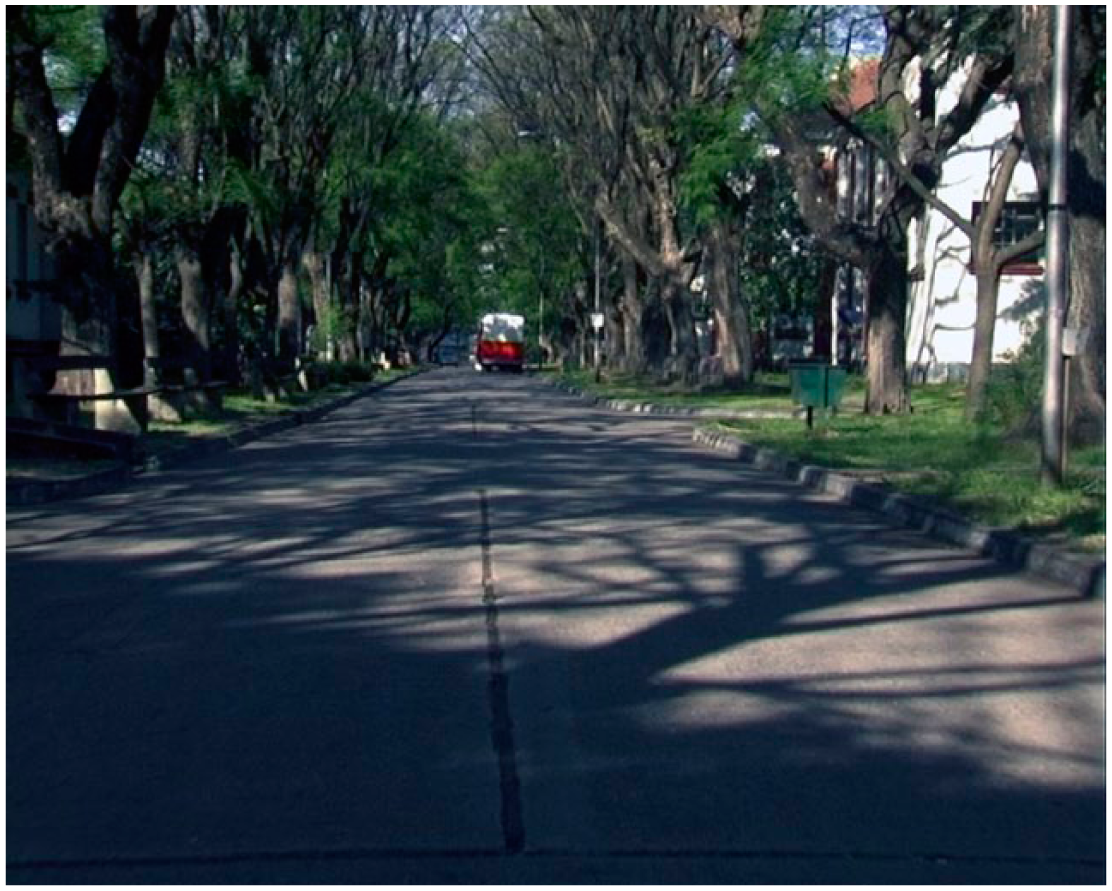
Opening shot from El predio (2010).
El predio opens with sound and an exception. There are 40 seconds of silence proper (i.e. the absence of sound emitted from the film) before the first sonic event, which extends for a further 30 seconds before the visual image emerges. There follows a series of seven tracking shots; the only ones found in any of Perel’s films. At this point, sound and vision synchronise and the soundscape becomes coherent. Yet it is the delicate sonorous opening which ensures that the viewer is acutely attentive and readily perceives every subtle change in the soundtrack. Thereafter, the continual presence of sound ‘that is irregular and thus unpredictable […] puts the ear and the attention on constant alert’ (Chion, 1994: 15) and the ‘vast extension’ (p. 87) of ambient sounds provides ‘unity by establishing atmosphere […] as a framework that seems to contain the image’ (p. 47). 3 Or rather, the erratic fluidity of the sounds accompanying the filmic scene surrounds the viewer and slight alterations in sonic intensity allow each individual sound to be spatially located whether their source is visible on screen or not. Rather than containing the image, then, the atmosphere created by environmental sounds in El predio (and all of Perel’s films) adds depth and draws the audience into the shot. Ambient sounds convert the flat screen into a three dimensional space inhabited by the audience. The effect is further accentuated by Perel’s use of deep focus as the viewer’s gaze can wander and select what to view at any given moment. 4
In the film’s opening sequence, these sonorous and visual effects work together such that the viewer is located within ‘a space apart from the city’ yet nonetheless ‘located very much within it’ (Scorer, 2016: 31–32). The continual rumble of traffic is heard, but never seen; the roads the camera travels along are largely empty and appear to be walled-in; and, despite the continual clamour of environmental sounds, very few of the sources for this sonic material enter the visual field. This is to say that the viewer is immediately situated within the titular ‘site’ of Perel’s first film, arguably the most notorious of the Argentine CDCs operational during the military regime’s self-styled ‘Dirty War’, the ‘Escuela Superior de Mecánica de la Armada’ (Naval Academy of Mechanics, ESMA). Over the period of systematic State terrorism some 5000 prisoners passed through the gates of ESMA (Colombo, 2012: 497) and the opening to Perel’s film immediately recalls the numerous testimonies which converge on their description of ‘the proximity of the desaparecidos to the everyday life of the city’ despite their confinement (Bell, 2010: 77). 5
Following its mobile introduction, El predio returns to Perel’s standard mode of technical composition and moves through a series of 100 shots from fixed camera positions containing only diegetic sounds. As betrayed by this description, the temptation is to privilege the visual in analysing Perel’s work precisely because the shot has become the ‘the specific unit of cinema’ (Chion, 1994: 41) due to the fact that ‘the image’ provides it with a delimiting container (Chion, 1994: 66–67), as film critic and experimental composer Michel Chion explains. While Chion (1994) goes on to argue that there is no equivalent unit in the auditory field because the ‘image is bounded in space, but sound is not’ (p. 144), I want to suggest that in El predio, the order of primacy is inverted and the visual image is but ‘an act of framing, of enclosing environmental and unintended sounds in a moment of attention’, as Kyle Gann (2010) summarises John Cage’s description of his most (in)famous work, 4’ 33” (p. 11).
As is well known, Cage’s ‘silent’ composition, 4’ 33”, is not in fact silent at all. Rather, it is filled by unforeseen and ambient sounds which fill the performance space (Gann, 2010: 191). Subdivided into three discrete movements measuring 30 seconds, 2 minutes 23 seconds, and 1 minute 40 seconds, respectively, Cage’s work forces an attentiveness to the sounds surrounding the audience and renders both silence and time sonorous. So, too, in El predio the lack of a traditional soundtrack paradoxically focusses the viewer’s attention on the sounds that are heard, and the lack of movement in the camera makes them acutely aware of their own experience of time passing. Nonetheless, as a musical happening, Cage’s 4’ 33” necessarily situates the audience in (and is a reflection on) the ‘here’ and ‘now’ of the specific performance space. In contrast, El predio is always situated in the ‘then’ and ‘there’ simply because it exists as a recorded text. Yet I would contend that both Perel and Cage set out ‘to capture and control’ environmental sounds in order ‘to use them, not as sound effects, but as musical instruments’ (Cage, 1997b: 380). Where Cage’s work is centred on a performer on the stage, leading the audience to contemplate the nature and limits of musical expression, the manipulation of sound in Perel is rather different. Chion (1994) notes that modern cinema relies upon a ‘punctuative use of sound’ to ‘modulate the meaning and rhythm of a text’ (pp. 48–49), yet Perel minimises the tools at his disposal to create this effect. By exclusively including environmental sounds in his film, Perel can only sonically punctuate his text through the selection of images. Thus, the montage of visual images becomes a form of experimental musical notation ‘in the sense that John Cage gives to the word: what is produced at the time of the realization is not predetermined by the nature of the signs inscribed in the score’ (Bosseur, 1993: 15). This is to say that, while El predio appears to lack a film score, it is the visual text, in fact, which is the score. And, as I will go on to argue, it is this careful organisation and punctuative use of sound which uncovers the organising principle which underpins Perel’s film: the construction of post-dictatorship memory in Argentina.
The testimonial site
A billboard fills the screen. The rumble of traffic pools, swells, ripples and disorientates. Ascending and descending simultaneously, the sound of traffic approaches and recedes but is never seen. A bird sings. The billboard is shot from the reverse side, the text running backwards, legible but difficult to read. ‘Works Plan for All Argentines, Presidency of Cristina Fernández de Kirchner, Project: National Memory Archive, Former Naval Academy of Mechanics, Cost of the Project: $14,763,721.08, Argentina is All of Us’. Cut to a security fence, slightly off-kilter, leaning to one side. A loose piece of tape moves slightly in the wind, the sound of the creases and crimps can just be heard over the distant roar of traffic. Marginally off-centre, a sign on the fence is clearly visible: ‘Danger Construction Site’. (Figure 2)
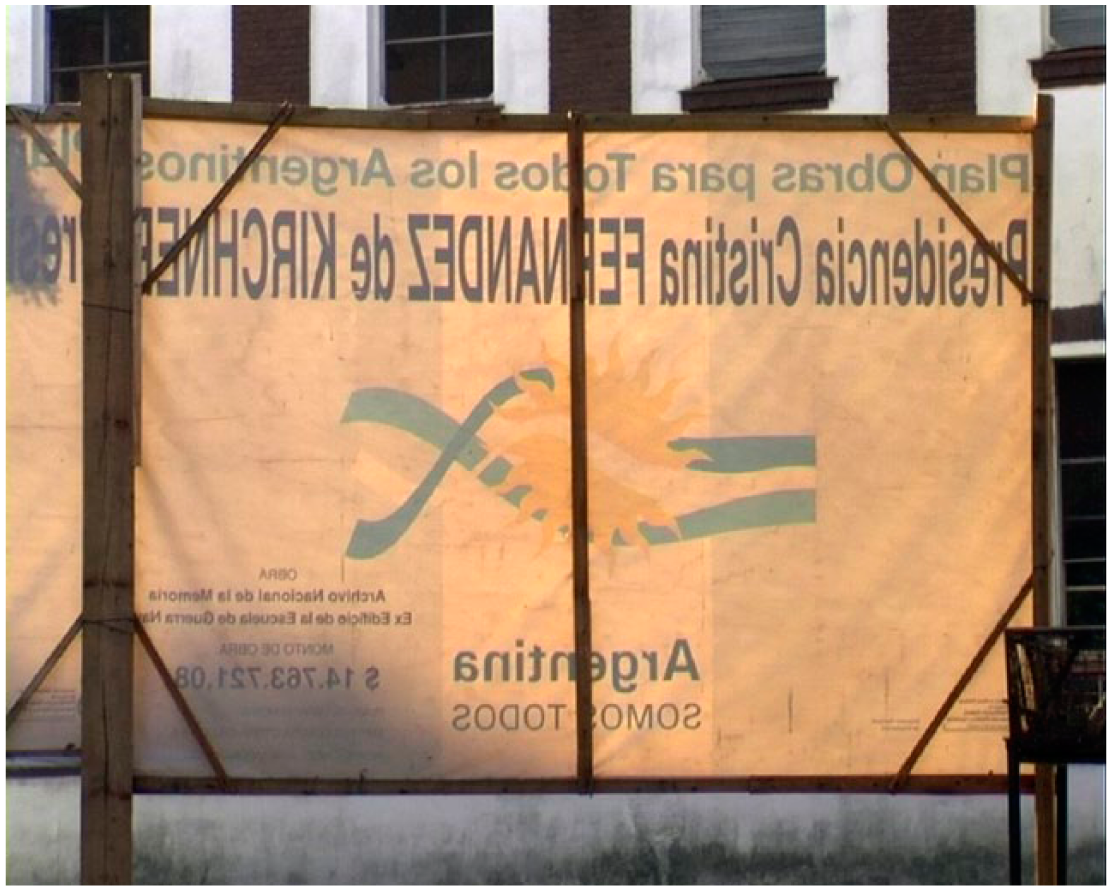
Billboard shot from the reverse side. Still from El predio (2010).
Perel’s first fixed shots set the tone for the rest of the film. El predio foregoes a focus on the most famous and recognisable spaces within ESMA and instead utilises angles that are unusual and disorientating such that it is frequently difficult (if not impossible) to identify specific buildings or locations. For example, the following six shots catalogue materials and equipment required for the construction project: 10 radiators upright on grass outside a building; tiles stacked against a wall; sinks and toilets removed, broken and abandoned in the undergrowth; new bricks neatly arranged beside a pile of rubble; port-a-loos and air conditioning ducts; scaffolding and safety fencing (Figure 3). Alterations in light level make temporal identification challenging: shots cannot be placed in sequential order as the time of day or year appears to vary sporadically. Occasionally, the soundtrack appears to aid the viewer’s understanding by situating them in a specific place. The emergence of muffled echoes and slight reverberations alert the viewer that the camera has moved inside a building. In truth, however, it is only because the sonic disharmony is so bewildering that the viewer becomes hyperattentive to subtle alterations in the acoustic field, and they provide only rudimentary information. Thus, Perel again appears to repurpose the strategies employed by the dictatorship when it occupied the site. His unusual angles echo the fact that ‘prisoners have spoken of being able to watch the legs of pedestrians passing outside’, just as the disconcerting arrangement of both sound and vision reflects the fact that the ‘brutality of torture and rape was accompanied by techniques designed to further defamiliarize the space of incarceration, such as blindfolding prisoners and leading them on different routes around the prison to enhance disorientation’ (Scorer, 2016: 34). Perel, too, defamiliarises ESMA and disorientates his viewer. However, where such techniques were utilised by the dictatorship as part of ‘the pedagogies of disposal, destruction and reconversion of people’ (González, 2005: 71), Perel exploits them to record the same pedagogies being applied to the site itself. For what the film does capture is the conversion of the former CDC into an ‘Espacio para la Memoria y para la Promoción y Defensa de los Derechos Humanos’ (Space for Memory and for the Promotion and Defence of Human Rights), precisely as the first fixed shots suggest.

Construction waste. Still from El predio (2010).
In order to fully appreciate the significance of Perel’s film, it is necessary to understand that the struggle over justice and memory has a complicated history in Argentina. Following President Raúl Alfonsín’s early success in overseeing the creation of the Comisión Nacional sobre la Desaparición de Personas (National Commission on the Disappearance of Persons, CONADEP); the publication of their final report, Nunca más (Never Again, 1984); and the trial of the Argentine Junta in 1985, Alfonsín came under increasing pressure from sections of the military to change tack. Subsequently, Alfonsín passed the Ley de Punto Final (Full Stop Law) in 1986 that set a date beyond which new trials against the military could not be brought to court. This was followed in 1987 by the Ley de Obediencia Debida (Law of Due Obedience) which established that subordinate personnel in the security forces could not be tried if they were following the orders of their superiors. The situation changed drastically once more when Carlos Saúl Menem was elected president in 1989. Not only did Menem pardon those already convicted, but the discourse of historical memory changed significantly during his administration. The initial ‘Teoría de los dos demonios’ (Two Demons Theory), which postulated that Argentine citizens had been caught in a conflict between the Military State and guerrilla groups who were both responsible for the violence of the period, gave way to a history focussed on the brutality of the terrorist State. This was particularly so following the confessions of Adolfo Scilingo and Martín Balza in 1995. Contrary to this development, however, throughout the 1990s the Menem government attempted to reframe discussions of the dictatorship within a discourse of ‘reconciliation’. Nonetheless, the Argentine congress eventually repealed the Ley de Punto Final and the Ley de Obediencia Debida in 1998, and Judge Gabriel Cavallo proclaimed them unconstitutional and void in March of 2001. Following the 2003 election of Néstor Kirchner, trials for crimes against humanity were reopened in 2006, thus overturning the Menem government’s attempt to impose ‘reconciliation’ on the population. This work was continued by Kirchner’s wife, Cristina Fernández de Kirchner, when she assumed the presidency in 2007. 6
Regarding the ESMA site in particular, in January 1998, the Menem government sought to subdue demands to overturn the amnesty laws by decreeing that ESMA should be demolished and replaced with ‘a monument as a symbol of democratic co-existence among Argentines and their will to be reconciled with one another’ (Da Silva Catela, 2015: 9). As Ludmila da Silva Catela (2015) notes, however, with the passing of this presidential decree ‘a battle for memory began’ (p. 9). Beginning in 1998, human rights groups used legal recourse to prevent the demolition and, following the intervention of the City of Buenos Aires, it was first proposed in 2000 that ESMA should become ‘a space for memory’ (Arenillas, 2013: 373). Nonetheless, it was only with the election of Néstor Kirchner – who had made the cause of memory and justice one of the central tenets of his regime (Andermann, 2012: 78; Lorenz and Winn, 2015: 39) – that the site was proclaimed a ‘Space for Memory and for the Promotion and Defence of Human Rights’, and it didn’t open its doors to the public until 2007. Multiple proposals for converting the site were sought from human rights organisations sparking heated debates among artists, activists and intellectuals in newspapers and journals. 7 Several public events were also organised to discuss the various plans (Andermann, 2012: 84–85; Brodsky et al., 2004: 55). Following these debates, various government offices related to historical memory and several human rights organisations moved into the site in 2008 (Andermann, 2012: 83–84; Arenillas, 2013: 373–375; Di Paolantonio, 2008: 30). Despite reclaiming the space, however, there was still ‘no consensus among the human rights organizations, let alone Argentine society at large, on how the former sites of State terrorism’ could ‘be adequately “recovered”, or what the purpose and function of such a recovery might be’, as Jens Andermann (2012: 76) notes. And, it is these very ‘debates about the construction of memory’, which Perel has stated are at the centre of his filmic production (Perel and Feierstein, 2014: 110), that El predio records precisely as they are spatially and architecturally enacted.
Visually, the material effects that Perel records in the film’s opening sequence are trapped in stasis, evidence of human activity that is absent from the screen. In contrast, the sound of traffic drones continually, varying only in intensity. Birdsong emerges frequently yet intermittently, as the distinctive rumble of a diesel engine in a piece of heavy equipment is heard then fades away. The occasional metallic echo of a hollow tube striking a solid surface pricks the attention. A succeeding shot taken from outside a building frames an open window in the centre of the screen. The gentle murmur of what Chion (1994) calls ‘emanation speech’ – speech which is heard but not fully comprehended (p. 177) – can be perceived gently reverberating as it drifts through the window. Point of view and point of audition are reconciled throughout, but there is incongruity between what is seen and what is heard: stasis in the visual field, activity in the soundtrack. This disjunction between visual emptiness and sonic plenitude opens a space for the viewer to reflect on the process which is underway. The focus on the material alteration of ESMA cannot but bring to mind the proposal submitted by the Asociación de Ex Detenidos Desaparecidos (Association of Ex Detained and Disappeared Persons) who, uniquely, advocated the total conservation of ESMA as a ‘site-witness to genocide’. As they stated, ‘the conservation should be based on respect for the historic fabric of the site, and should not distort the evidence that it possesses’ and ‘the conservation should not allow any demolition or alteration that would have an adverse effect on the cultural value of the site’ (Brodsky, 2005: 215). In the first instance, then, disjunction between audio and visual tracks indirectly incorporates the voices of those who did not agree to the chosen plan for the site into the very process of its enactment.
In discussing the diverse proposals submitted for reclaiming ESMA, and while recognising that the majority combined different elements, Andermann broadly categorises the projects into three distinct groups. First, he describes ‘the testimonial option which takes the entire site as unalterable heritage’. This is followed by ‘the museal option’ which sought the contextualisation of ‘the site’s material evidence in ways that allow it to serve certain pedagogical functions, such as the inculcation of democratic values’. Finally, he defines ‘the performative option’ which advocated entrusting the site ‘to future-oriented artistic and political activities’ in order to reclaim the space from ‘death and its executioners’ (Andermann, 2012: 84–85). Thus far, the focus on seemingly insignificant materials (radiators, toilets, walls and windows) assumes a testimonial weight. No detail is considered too inconsequential to be given considerable time for the viewer closely to examine the tactile qualities of each object, and the very act of cataloguing these items forces the audience to question what is relevant within ‘a site-witness to genocide’. Nonetheless, as the film progresses, a select few human personages do emerge into the visual field, and their activities correspond to the ‘performative option’ described by Andermann. Moreover, the suturing of sound and vision ultimately transforms the film into a work of ‘museal’ art, although in a different manner than in Andermann’s initial summation, as we shall later see.
The first performative movement
A hand is seen in close-up on the left side of the screen. Holding a pencil, it sketches rapidly on a rough surface. A soft, gossamer shadow dances across skin stretched taught over veins and tendons. Silence rumbles. The faint traces of the pencil scratching the surface can be heard. Incomplete, the drawing appears to include a row of teeth just below the hand. Cut to two holes and markings on a wall for thirty seconds. A door creaks; an unidentifiable high-pitched sound is heard. Cut to a close up of the drawing: an unusual skull framed in the centre of the screen. The artist’s body is hunched, cross-legged, occupying the left vertical edge. A straight line of light, parallel with this boundary, divides the space. The artist sits in darkness; the drawing is bathed in golden light. He is drawing on a wall. Various pencils lie scattered on a sheet of bubble wrap on the floor. Sound continues as before, rumbling silence and scratching. Cut to a wider shot. The artist occupies the corner of a dimly lit room. A projector throws a square of light onto the facing wall, the bottom edge aligned with the base of the wall. The artist traces the image onto the surface. The wall contains numerous holes which have been filled, but not finished. Birdsong is heard. (Figure 4)
A grey external wall shot from a low angle. Tall grass stands in the foreground, the wall in the background, low cropped grass lays in-between. The wall is split horizontally; the lower part is rough and dark, the upper section smooth and light. Irregular lighter and darker areas reveal where the wall has been patched. A dull rectangular metal box is inset in the wall on the right side of the screen; an old wooden plank stands precariously against it. On the leftward edge a thin dark red tube enters the screen, runs along the wall’s horizontal divide, turns ninety degrees and enters the wall. A thicker vermillion pipe curves out the same entry point and extends straight down into the ground. The left hand side of the middle ground is marked off with sagging red tape. There are traces of brown among the mottled greens and yellows of the grass in this area. The rumble of traffic ascends and descends, the tall grass sways haphazardly in the breeze, insects drift across the screen. Cut to a wider angle of the same scene. The tall grass has been cut back, the tape delineates a rectangular area. The deep browns now reveal that the ground has been disturbed. Sound continues as before. Cut to a close-up of a hoe striking and breaking the ground while a rake turns over the earth in a corner of the designated area. The audible sound has changed; a low-quality transmission of tinny music booms, blends and interferes with the environmental sounds. Cut-away to the full bodies of two people (one female, one male) using the tools and turning the earth. The radio broadcast is louder and clearer, rock guitar can be discerned.
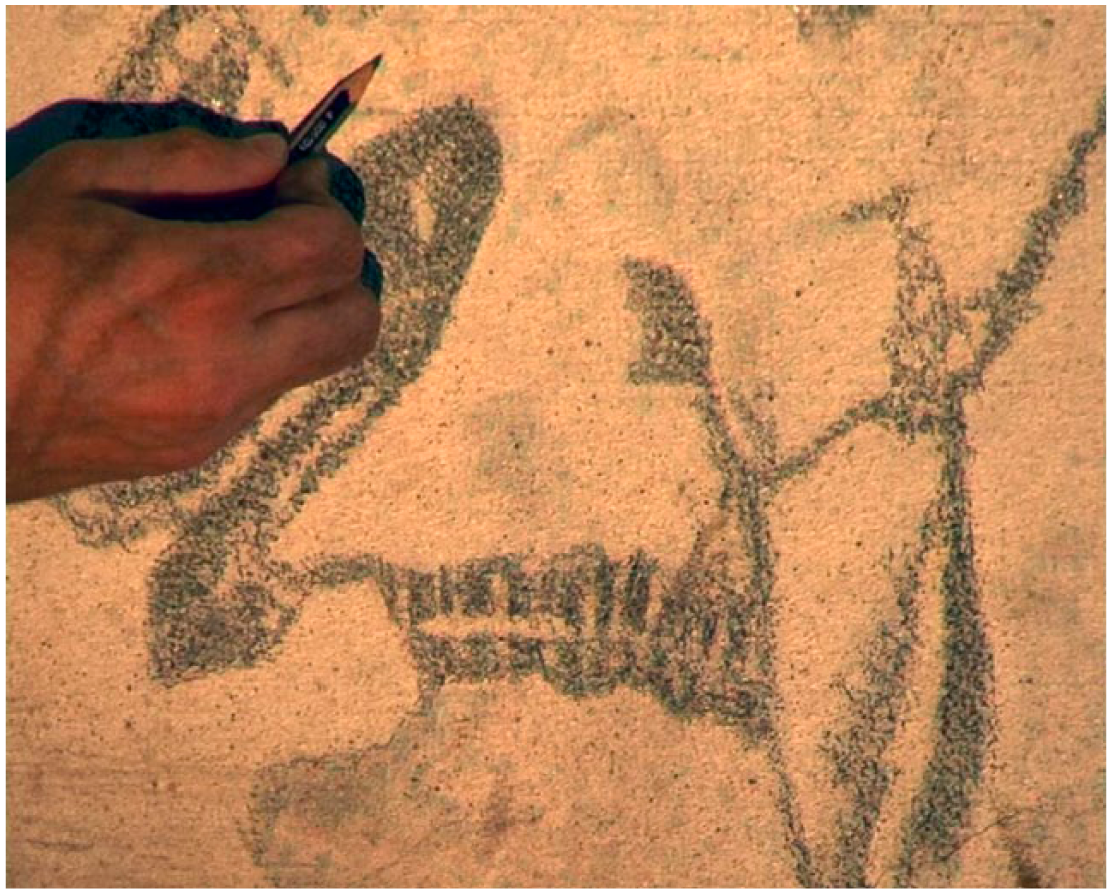
A hand sketches on the wall. Still from El predio (2010).
It is some 12 minutes (almost a quarter of the film) before the first human agent is seen in El predio. With almost perfect symmetry, this artist will be revealed to be Javier Barrio installing his work ‘Museo del Gliptodonte’ (Museum of the Gliptodonte), three quarters of the way through, in the 46th minute. An intermediate sequence is included in the film’s 37th minute. Similarly, the film will eventually divulge that the second shot sequence described introduces Marina Etchegoyen installing her work ‘Cosechar/Multiplicar’ (To Harvest/To Multiply). As a close-up of an informational board included in the film explains, the work is an ‘Artistic action./ To make memory and think of the future. To sow potatoes,/ in the earth of ESMA./ To reproduce and harvest energy’. In both instances, the soundtrack plays a fundamental role in capturing and transmitting debates concerning the performative use of the ESMA compound to the audience. The sound of the radio accompanying Etchegoyen working the ground in ESMA is the first time recognisable music is heard in Perel’s film. In addition, when the Barrio sequence concludes, it is the only shot sequence which does not feature any ambient sounds. Instead, it is accompanied by the artist’s sound installation, ‘Yo soy el gliptodonte’ (I am the Gliptodonte). Thus, the soundscape becomes fully performative and, for a few minutes, is entirely dominated by a work funded by a grant from the Fondo Nacional de las Artes (National Fund for the Arts) under the auspices of the ‘Espacio Cultural Nuestros Hijos’ (Our Children’s Cultural Space, ECUNHI), the cultural centre within ESMA created and organised by the Asociación Madres de Plaza de Mayo (Mothers of Plaza de Mayo Association) (Barrio, 2009a, 2009b; ECUNHI-FNA, 2010). 8 In each case, the emergence of music or a more traditional soundtrack immediately recalls arguments such as that made by artist Magdalena Jitrik who declared herself ‘totally against making a song to life in a concentration camp’ (Brodsky et al., 2004: 61). These punctuative uses of sound thus lead to a profound disagreement among those who submitted proposals for the reclamation of ESMA. On one hand, there were those such as Hebe de Bonafini (leader of the Asociación Madres de Plaza de Mayo) who expressed no interest in ‘the idea of a museum of horror’ arguing that ‘[m]useums are associated with death’ and that ‘[d]eath is for the executioners, not for us’ (Andermann, 2012: 85; Brodsky, 2005: 219). On the other hand, groups such as the Asociación de Ex Detenidos Desaparecidos argued forcibly that ‘where there was death […] one should not pretend that now there is life’ (Vezzetti, 2006: 39). It appears that the testimonial option which opened El predio coexists with the performative option over the length of the film. The shot sequence immediately following the introduction to Etchegoyen (which in turn immediately follows the first Barrio progression) would appear to confirm this hypothesis: Perel’s camera returns inside a building and includes three shots in almost total darkness with only slivers of bright light entering the frame. One of only two arrangements of images shot in darkness in the entirety of Perel’s filmic output (the second is also encountered in El predio) this immediately connotes the stark reality of imprisonment, torture and death after introducing life into ESMA.
The second performative movement
In the darkness, thin strips of golden light break through the narrow spaces between closed shutters and fall on a wall opposite. The light is vectorised. Just enough luminance bleeds from the bottom left corner of the frame, radiating out, upwards and to the right, for a window to be identified. Bathed in crepuscular light an object fixed to the wall is discernible, yet difficult to classify. Ambient sounds are heavily muted and too faint to determine their source. Cut to a space which is darker still. The multiple shafts of light have been replaced by two groups of three bands. The uppermost strips curve, revealing three thin metallic objects, semi-circular in form, reflecting light whose origin cannot be traced to source. Three thicker bands with less definition seep from the leftward endpoint of the arcs, revealing smooth planes extending downwards. The endpoints of the diameter define the limits of these flat surfaces, which are dark and composed of a warmer material. Another cut returns us to the first shot, but time has shifted. The brilliant strips have disappeared, yet a fainter glow still emanates from the same corner of the window frame. A new object occupies the centre of the frame. A solitary surface is illuminated on each of a series of elongated rectangular cuboids. These, in turn, are arranged in a triangular form. There is more sonic activity. A high pitched almost electrical crackle endures for several seconds. Is it the sound of adhesive tape being peeled from its roll? There are rapid dull thuds that could be distant footfall elsewhere in the building, and the faintest trace of muffled speech, so delicate that one cannot be sure. A black shadow moves up the screen. As it ascends, the foremost edge is briefly illuminated forming the silhouette of an arm and a head, leading to the conclusion that the original object is a step-ladder. Longitudinal waves of light appear, undulate momentarily and disappear. Cut to a brightly illuminated room, an auditorium filled with neat rows of foldable chairs. Half are occupied with people facing a white wall flanked by large black speakers. In the rearmost bank, only three chairs enter the frame. The backs are matte black, smooth and enclosed in strips of aluminuium, curved across the top of the chairback and straight-edged from the endpoints of the curve. Their form confirms it is the same room and the same shot as before. There is the murmur of conversation, identifiable but indiscernible. Blocks of light are extinguished with a click until the room is pitch black. White text appears in the upper part of the the screen. Illegible, its form is nontheless recognisable as the opening credits of a film. (Figure 5)
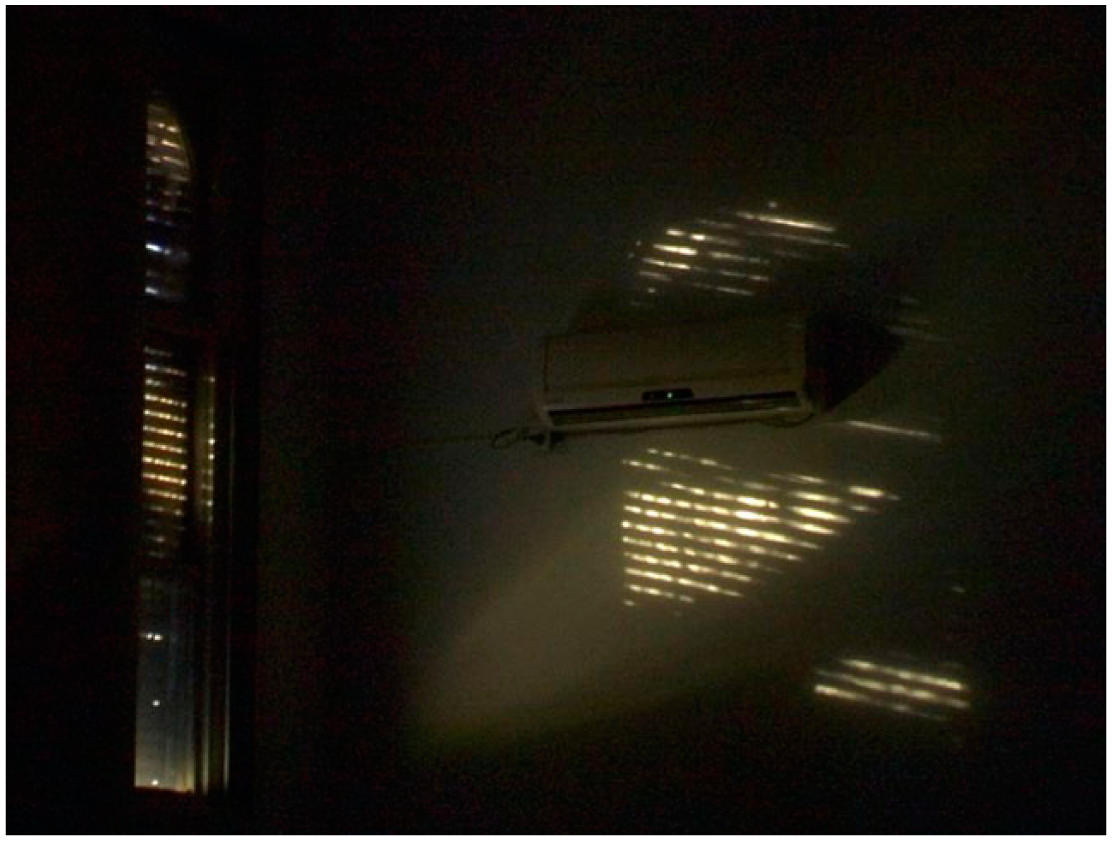
Light breaking through a shuttered window. Still from El predio (2010).
Thus begins the second performative movement that appears intermittently throughout El predio: a series of film screenings and public discussions that take place within ESMA. The first image, in particular, cannot but evoke ‘the darkness, the silence, and the immobility’ experienced by those detained in the camp (Calveiro, 1998: 48, original emphasis). The sequence once again questions the value of establishing a programme of education or entertainment in the former site of torture and extermination. The subtle composition of the individual shots, however, reveals additional formal elements consistently found throughout the film which add further depth to the debates over the future of the site. As before, the muffled soundscape draws the viewer’s attention to subtle changes in the auditory field. In this instance, however, the minimal use of light performs the same function: the viewer peers more keenly in an attempt to perceive the underlying image. In his writings, Cage (1997a) has suggested that attentiveness to incidental sound can be found ‘in the fields of modern sculpture and architecture’ due to the fact that there is ‘no such thing as an empty space or an empty time’ and that there ‘is always something to see, something to hear’ (p. 384). Extending the premise further, he argues that the ability visually to perceive multiple phenomena simultaneously and to allow the eye to wander between them reveals ‘a new sense of polyphony’ (Bosseur, 1993: 132, original emphasis). So, too, Perel discovers this same visual polyphony through the use of deep focus: everything on screen is given at once and the viewer’s eye is free to roam. The stillness of the take ensures that the audience are attentive to the ‘visual microrhythms’, those ‘rapid movements on the image’s surface’ (Chion, 1994: 15–16), such as shifting shadows or ripples of wind passing through leaves or grass, that are present throughout El predio. The dark opening to the film screening sequence simply accentuates these qualities and demonstrates that, in Perel’s work, even visual phenomena are experienced primarily as sound.
As the cinematic sequence continues, Perel records the film screenings themselves. The images projected against the wall are clearly discernible and at certain key points, the text is puncutated by ambient sounds which crystallise into perceptible speech and music. In the second projection, for example, a woman’s head composed of pale blue light occupies the centre of the screen. A series of parallel black creases across the image alert the viewer to the fact that the image is projected onto the shuttered window they have seen previously. The woman’s face is in continual yet minor motion; micro-movements in the muscles of the face betray an affective intensity which cannot, however, be decoded. The drone of the projector is accompanied by the unfocussed, deep timbre of a male voice and the echoing vibrato of interference suggests the sound accompanies the projected image. The listener must strain to decipher the vocal sounds but, gaining slightly in clarity, it becomes apparent that the language spoken is not Spanish, as would be reasonably expected, but is in fact French. When the woman responds, her voice accompanied by the movement of her lips, this is confirmed, but the fragments of discernible speech never provide sufficient information to decipher the scene.
The subsequent clip leads to a possible interpretation of these movements. Grainy colour film stock ages the image and places us in the past. The low rumble of voices in unison engaged in a call and response with the cry of a solitary voice, the wail of a siren, and images of an unruly multitude carrying banners and flags situate the audience in a protest march. A blurry glimpse of riot police in line confirms this proposition. The following image of women in white headscarves marching while carrying portraits of young men appears to fix the viewer in time and space. But the image betrays, and it is the audio track that reveals the deception. 9 As the voices become discernible, the language they are speaking is not Spanish. This time, however, a subtitle track appears on the screen Perel records and reads ‘¡Ocalan estamos contigo!’ (Öcalan we are with you!). The protest is in Turkey, the march in support of the co-founder of the Kurdistan Worker’s Party (PKK), Abdullah Öcalan. The signifiers slip, and the audience take a bewildering leap through time and space. The white headscarves, the protest march and the following subtitles – ‘Viva la lucha guerrillera’ (Long live the armed struggle!), ‘Los derechos del pueblo no pueden suspenderse’ (The rights of the people cannot be suspended!) – would not seem out of place in the recuperated ESMA. 10 Yet, the refrains the audience listen to (with the eye as much as the ear) are uprooted and connect with other ‘block[s] of space-time constituted by the periodic repetition of the component’ (Deleuze and Guattari, 2010: 345). This is to say that these progressions function as Deleuzo-Guattarian refrains, those sonorous or visual patterns which construct a territory consisting of a ‘point of stability, a circle of property and an opening to the outside’ when reproduced (Bogue, 1991: 88). The projection screen provides a point of stability, while the audience seated in the foreground delineate the theatre-territory, and the filmic texts continually open ESMA to events taking place beyond its spatio-temporal confines. As Deleuze and Guattari (2010) assert, the ‘territorial assemblage’ produced by the refrain ‘is inseparable from lines or coefficients of deterritorialization, passages, and relays toward other assemblages’ (p. 367) and the ‘deterritorialization of refrains – their disconnection from their territory – is what they call music’ (Murphie, 1996: 21). The screening sequence is thus a musical projection during which the audience witness the de- and re-territorialization of the refrain and the leaps through space-time this entails.
When El predio returns to a second sequence of film projections, the works shown reterritorialize the refrain and return the audience to the specifically Argentine context. In the first case, Perel records Azucena Maizani singing ‘La canción de Buenos Aires’ (The Song of Buenos Aires) in the opening credit sequence of the film ¡Tango! (1933), the first Argentine film to feature synchronised speech and optical sound (Navitski, 2011: 43). In this way, Perel confirms the importance of both sound and music to his film. Given the politically charged nature of the site, however, it is important to note that the film was released (and hence the audience are temporally situated) in the midst of the ‘Década Infame’ (Infamous Decade), the name given to ‘a 13-year period of military and fraudulently elected governments’ which began with ‘the first military overthrow of an elected government’ in Argentina (Hedges, 2011: 46). 11 The subsequent film screening depicts a couple dancing on a stage while a solitary figure plays guitar and sings. The male dancer is in a wheelchair, yet it is the musical accompaniment that is especially evocative. The song performed is immediately recognisable as León Gieco’s ‘La memoria’ (Memory). The audience clearly hear Gieco’s denunciation of ‘the deception and the complicity/ of those who committed genocide and remain free/ the pardons and the “Punto Final”’, and they are immediately (and sonically) returned to the long struggle for justice following the dictatorship’s brutal and systematic policy of State terrorism. Yet the song is another temporal signifier which slips, having famously appeared during the concluding sequence of Tristán Bauer’s film of the Falklands-Malvinas conflict, Iluminados por el fuego (Enlightened by Fire, 2005). If the inclusion of ¡Tango! situated the audience in the period immediately following the first military coup and dictatorship in Argentine history, then the incorporation of Gieco’s ‘La memoria’ ultimately transports them to the calamitous war which marked the beginning of the end of the military’s most recent reign of terror. The sequence thus leads the audience to contemplate the cyclical emergence of military coups and State repression which continued throughout the twentieth century in Argentina.
The question remains, however, of how these movements of the refrain are to be understood within the wider context of Perel’s film and the transformation of ESMA into an ‘Espacio de la Memoria’. The simple fact that the film screenings contain more human bodies than are found anywhere else in the film cannot but remind the viewer that, while the original debates over the fate of ESMA were directed towards ‘groups specifically interested in the theme’, it was repeatedly stressed that the debate ‘should progressively pass over to be society’s patrimony’ (Pastoriza, 2005: 85). 12 The second related point is that various proposals sought not only to expand the audience for the museum, but its content as well. For example, a proposal submitted by numerous organisations suggested that the museum within ESMA ‘should give voice to minorities, to those forgotten in history and in museums’ (Brodsky, 2005: 215), 13 a sentiment echoed through the inclusion in Perel’s film of those with disabilities dancing to a protest song commemorating the victims of State repression. Yet, as we have seen, the movement of the filmic refrain in El predio expands the content of the museum much further than this. The screening sequences give a sense of global and plural histories, generate multiple viewpoints on the events being commemorated, and fulfil arguments such as that put forward by Montserrat Iniesta that ‘historical museums’, such as that planned for ESMA, ‘cannot limit themselves to transmitting […] univocal historical events’ (Brodsky, 2005: 204). Thus, those debates over the construction of memory within the ESMA site run through these sequences as they do throughout the entire film. As we shall later see, however, the film sequences serve another important function.
The third performative movement
An external wall fills the screen. In the centre of the frame a lower wall extends forwards dividing the space. A man in a black coat and jeans stands on the right of the division, facing in the same direction. He is three-quarters turned and only the back of his head is visible. One leg slightly forward, hunched, he steadies himself as he holds a camera at chest height. He slowly pans the camera from left to right. Noise is minimal, a low level hum, the song of a solitary bird. The man completes the turn and, standing side on, strides out of shot to the right.
This meta-textual moment is sustained over several shots as Perel’s camera records a man wielding a camera and recording unusual angles of the buildings within the ESMA compound. The figure appears almost as a cypher for Perel himself except for one key feature: the panning of the camera. 14 Later, Perel records a metal filing cabinet in a cluttered room, the word ‘grant’ scrawled on the front of a partially opened drawer. The following shot features a projection of the man’s recording but with no audience in attendance. Perel’s camera cuts to a window, shot from the inside looking out. This is the first of only two occasions in which direct speech from the moment of recording is distinctly heard. Only a fragment of the conversation is contained in the film. The man begins to propose a project (unnamed or described) to take place in a former CDC in Tucumán province. Two other voices interviewing the man are clearly distinguishable but never seen. A final shot records the young man alone in a waiting room as muffled inaudible voices talk off-screen. The minimal detail provided about the planned project serves to generalise the proposal to the extent that it could stand for any proposal. Moreover, as the point of decision is absent from the text, the discussion itself is trapped in a perpetual present. Thus, Perel manages ‘to foment and sustain permanent interpellation’ (Naftal, 2005: 192), a key objective articulated in numerous proposals for the ESMA museum.
Chion (1994) has proposed that ambient sound in film ‘renders the perception of time in the image as exact, detailed, immediate, [and] concrete’ (p. 13). From the outset, El predio alludes to debates surrounding the fate of ESMA and the immediacy of the environmental sounds transpose them into a suspended, yet perpetual, present. Indeed, the early establishing shot of a sign declaring ‘Peligro: area en construcción’ (Danger Construction Site), cannot but recall the title of the book edited by Marcelo Brodsky which compiled the various proposals for the ESMA site and key texts debating those same proposals: Memoria en construcción (Memory in Construction, 2005). From the outset, Perel’s film like the book serves as ‘a call for the contribution of ideas, and for permanent debate’ (Indij, 2005: 43), and it is not only the ambient sound which situate this debate in a continuous yet ever-changing present. As Chion (1994) notes, the ‘camera, though excluded from the visual field, is nonetheless an active character in films’ (p. 93). While this is the case in every film, it is especially so in El predio. Within Perel’s film, there is never a subjective point of view within which a ‘character in the story is (apparently) seeing what I [the viewer] see’ (Chion, 1994: 89). Rather, as in Deleuze’s (1986) interpretation of Vertov’s Man with a Movie Camera (1929), ‘movement is perception, the glance, the eye. But the eye is not the too-immobile human eye; it is the eye of the camera’ (p. 40). Unlike Vertov, however, Perel almost entirely excludes ‘the cameraman who follows, runs, enters, [and] exits’, and his film exhibits none of Vertov’s formal experimentation, thus reducing the role of the filmmaker to a minimum. Yet both directors create montage through the ‘choice of material, that is, the portions of matter which are to enter into interaction’ (Deleuze, 1986: 40) and obtain ‘objectivity’ – defined as the ability ‘to carry perception into things, to put perception into matter’ (Deleuze, 1986: 81) – albeit in a different manner. In Perel’s case, the experience of watching El predio is somewhat akin to a description found in Bergson’s Duration and Simultaneity in which Bergson (1965) imagines that When we are seated on the bank of a river, the flowing of the water, the gliding of a boat or the flight of a bird, the ceaseless murmur in our life’s deeps are for us three separate things or only one, as we choose. We can interiorize the whole, dealing with a single perception that carries along the three flows, mingled, in its course; or we can leave the first two outside and then divide our attention between the inner and the outer; or, better yet, we can do both at one and the same time, our attention uniting and yet differentiating the three flows, thanks to its singular privilege of being one and several. (p. 52)
From this point, Bergson (1965) argues that all three flows ultimately ‘occupy the same duration’ and therefore that ‘this duration is ours only when our consciousness is concerned with us alone, but it becomes equally theirs when our attention embraces the three flows in a single indivisible act’ (p. 52). Thus, what appeared initially to refer to the subjective experience of time, duration, is shown to reside in external objects and is endowed ‘with the power to encompass itself’ (Deleuze, 1988: 80). So, too, in El predio: the work incorporates the viewer’s duration into the film’s temporal milieu. As in Vertov, perception passes into the objects themselves precisely because it is the viewer who is held within the long duration of the inanimate objects depicted. At this stage, however, another phenomenon emerges. Unlike Man with a Movie Camera, where Vertov blends two images to show the audience the omniscient ‘camera-eye’, in Perel’s film, the viewer’s eye and the camera are perfectly synchronised in their total immobility. Perception passes into the things captured by the camera-eye but, simultaneously, it is the viewer’s eye which becomes the camera.
Viewed in this way, the film screenings that Perel contains within El predio take on an additional function. Perel’s camera records beams of light projected onto a screen, which reflects the light back to a camera which traps it. When this new film is subsequently projected onto another screen, the synchronisation of camera and viewer’s eye ensures that the movement becomes an infinite regression. The viewer-camera will record the light projected, as it will be projected again and recorded anew, and so on, ad infinituum. The visual and the sonic use different means to obtain the same effect: they both trap the viewer in a perpetual present, somewhat akin to ‘the experience of time felt by those detained/disappeared within the Clandestine Detention Centres: a suspended temporality consisting of a present that left no place for a before or an after, an “absolute now”’, as suggested by Pamela Colombo (2010: 3–4). Yet, the movement of the refrain, its continual de- and re-territorialization, ensures that this continual ‘now’ is dynamic and perpetually revitalised. In this way, the debates that are the subject matter of El predio are renewed at every turn and ceaselessly perpetuated.
The museum as spatio-temporal event
An auditorium. Four rows of chairs are visible, shot from behind. Three seats are occupied. In the background facing the audience is a table with four chairs, set up for a public discussion. Audible but unintelligible speech is heard. An older woman and two men enter from the right, they converse as the woman prepares to take her place on the panel. The conversation is not heard. One man leaves, the woman sits down, the second man moves to take a place on the panel, another man joins the audience. Cut to a medium shot of the woman sitting at the table. Her face is directed downwards, reflective, perhaps dejected. Beside her a man has his hand on her back, comforting her. The murmur of the audience assembling and talking amongst themselves is heard. Cut to a full shot of a man with a sophisticated camera standing beside a woman with a small portable camera. They stand at the side of the stage, recording the audience. The backs of chairs and heads are visible in the foreground. A voice is heard. (Figure 6)
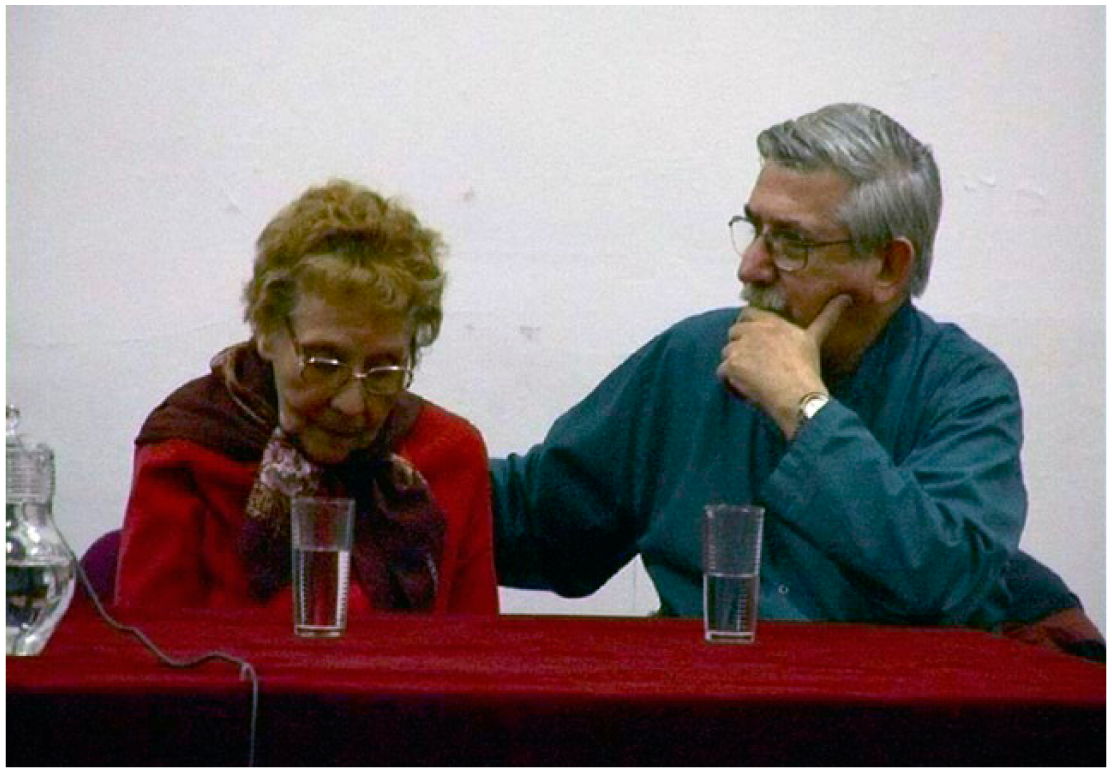
Comforting a speaker at a public discussion. Still from El predio (2010).
Given Perel’s insistence that his films ‘promote debate and produce open questions, negating every type of didacticism’ (Perel and Feierstein, 2014: 114), it is not surprising that El predio has been subject to numerous contradictory interpretations. For example, with regard to Perel’s inclusion of Marina Etchegoyen’s ‘Cosechar/Multiplicar’, Rafael McNamara (2012) argues that it should be understood as an attempt ‘to capture the site that was synonymous with death and torture almost as if it were a living organism, at the moment of its (re)birth’ (p. 33). In contrast, María Guadalupe Arenillas (2013) analyses a later close-up of the harvested potatoes lying on an old newspaper to suggest that ‘the potatoes spoil on the pages of the Wall Street Journal, like a revolutionary project which ended under the power of foreign capital’ and that ‘even though it aims “to harvest energy,” there is also something about these young people digging which reminds us of, or takes us to, the work camps, or the search for bones’ (pp. 384–385). In a far less positive reading, however, cultural critic Quintín first recognises that the work possibly alludes to themes of renewal, before arguing that ‘the film also permits the opposite interpretation: that the occupation of ESMA by political organisations and their activists’ alters the site rather than preserves it. That by engaging in the projects of the present, the site produces ‘a policy of forgetting in place of a policy of memory’. Quintín finds this argument confirmed in two shots near the conclusion of the film: one consists of an image of a military monument that has had its identifying plaque removed. The other is a plaque commemorating Cristina Fernández de Kirchner and Néstor Kirchner’s role inaugurating the space. For Quintín (2010), this demonstrates ‘the transformation’ which ESMA ‘has suffered thanks to the teaching of the new century’ and echoes his belief that it has been co-opted into party politics. Nonetheless, in interview, Perel (Reale and Perel, 2011) has acknowledged that El predio was only made possible due to this substitution and stated that it ‘reveals everything that has changed in ESMA’, an ambiguous statement which need not be interpreted in the critical manner adopted by Quintín.
This ambiguity thus leads to another fundamental question which was subject to considerable debate during the process of reconverting ESMA into an ‘Espacio de la Memoria’: the role of the State. As Da Silva Catela (2015) notes, from the beginning of the twenty-first century, the Kirchner administrations established and implemented a new state-led memory politics by creating important archives, cultural centres and memorial sites, and incorporating cultural memory into public policy through numerous initiatives (pp. 10–11). However, given that the Kirchner administrations were particularly polarising, these projects were not without their serious detractors. Regarding the reconversion of ESMA, the most forceful critique arguably came from Hugo Vezzetti (2006) who, in 2006, claimed that the numerous proposals submitted ‘have not provoked any public discussion’ (p. 37). Indeed, Vezzetti (2006) would argue that ‘that which has not changed is the absence of a state function capable of promoting public deliberation, including other voices and other constellations of ideas’ (p. 38). As Quintín demonstrates, Vezzetti’s critique can easily be read into El predio. For example, the simple fact that the assessment of a potential artwork to be installed at a former CDC takes place off-screen, that we learn nothing about the project itself, and that both the artist and the assessors remain entirely anonymous, arguably reflects Vezzetti’s (2006) critique that ‘the human rights organisations were, in fact, the organisers’ of an ‘act intended for few’ (p. 38). Perel’s establishing shot of the information board announcing the transformation of ESMA shot from the reverse side could easily be interpreted in the same manner. Nonetheless, it is important to note that the role of the State was consistently discussed, debated and critiqued by the human rights organisations and activists who sought to reclaim the site. For example, Guido Indij (2005) argued that the question of how to represent memories of the dictatorship was one which could not be left to the State (p. 43). Similarly, the proposal submitted by the Buena Memoria, Asociación Civil (Good Memory Civil Association), argued against leaving the site empty because it would serve as an ‘an invitation so that, if there were political regressions in the country, the place could be converted into that which the authorities of the time determine’ (Brodsky, 2005: 216). Bruno Groppo, Nicolás Guagnini and Marcelo Brodsky also discussed the role of the State at length as they searched for a method of financing the project that could ‘limit the influence of political difficulties’ (Brodsky et al., 2004: 53–59). The proposal submitted by the activist organisation Hijos por la Identidad y la Justicia Contra el Olvido y el Silencio (Sons and Daughters for Identity and Justice against Forgetting and Silence, HIJOS) also stated categorically that the ESMA site ‘should not be subject to fluctuations in the government’ (Brodsky, 2005: 220). These fears gained magnitude when Mauricio Macri was elected head of the government of Buenos Aires in 2007 as he appeared ‘indifferent’ to the cause of the human rights organisations and it was suspected that he ‘may come to stall or eventually foreclose ongoing memorial projects such as those taking place in and around ESMA’ (Di Paolantonio, 2008: 36). Such fears were at least partially realised when Macri was elected President in 2015 and proceeded to slash the human rights budget by some 15% (Bullentini, 2017; Sued, 2016).
It appears, then, that discussions of the role of the State within the reclaimed ESMA can be broadly divided into two groups. On one hand, there were those that feared that excessive reliance on the State could lead to future problems with subsequent changes in government following the Kirchner administrations. 15 On the other, there were those who feared that the present role assigned to the Kirchner-led State would unnecessarily politicise post-dictatorship memory to the detriment of society. In his critique of Vezzetti’s position, Andermann (2012) notes that he ultimately embraced the proposal submitted by the Centro de Estudios Legales y Sociales (Centre of Legal and Social Studies, CELS) ‘accusing the government and the other human rights groups of thwarting, with their “clientelist” claims to the site, the occasion for constructing a democratic consensus’ (p. 89). 16 Within Perel’s film, however, each of these positions is sustained simultaneously. Moreover, by trapping these debates within a perpetual and inescapable present, there is no hope of ever reaching a consensus precisely because the unusual arrangement of shots and the careful musical manipulation of sound and light never allows the site to coalesce into a cohesive ‘place’, understood as a site held together ‘by personal and common values, and by the maintenance of those values over time, as memory’, as Jeff Kelly defines the term (Till, 2008: 108). Instead, Perel’s film produces a different sense of ‘place’ altogether.
As we have seen, El predio builds upon Bergson’s philosophical proposal that duration is not only a subjective experience, but that it also resides in external objects. In For Space, Doreen Massey (2005) proposes that this same principle ‘pointed to a radical change in the potential conceptualisation of space’ such that it became ‘the dimension of a multiplicity of durations […], a simultaneity of stories-so-far’ (p. 24). Within this conception, Massey (2005) argues that space must be considered ‘the product of interrelations […], from the immensity of the global to the intimately tiny’ and that it should be recognised ‘as always under construction’ (p. 9). The connection with Perel’s film is immediately apparent. In El predio, ESMA is perpetually ‘under construction’ precisely because the film sustains multiple positions simultaneously, and the site is revealed to be the product of both global and intimately local interactions. In this way, Perel ensures that the titular site becomes a place which is both ‘open’ and ‘internally multiple’ (Massey, 2005: 141), perfectly in keeping with Massey’s (2005) description of places ‘as temporary constellations where the repercussions of a multiplicity of histories have been woven together’ (p. 145) such that they become ‘spatio-temporal events’ (p. 130). As in Andermann’s (2012) ‘museal option’, then, El predio promotes continual debate and discussion through its arrangement of ‘the site’s material evidence’. Rather than serving to inculcate ‘democratic values’ (p. 85), however, Perel’s film denies the possibility of reaching a consensus and even explores that which is potentially excluded within the very conception of democratic citizenship itself, as we shall now see.
In his analysis of the function of the reconverted ESMA, Andermann (2012) notes that the same principle which underpins Vezzetti’s argument is also ‘implicit in the more cautious proposals submitted by CELS or Buena Memoria’, namely, that their calls for ‘inclusiveness’ and an openness to multiple visitor responses to the site is ‘warranted by an institutional mandate granted by the State on behalf of a “social consensus” that pre-establishes the limits of this very multiplicity’ (p. 90). This is to say that, for Andermann (2012), in defining values such as democracy and tolerance as the goal towards which visitor performance, however open and multiple, must nonetheless strive, the museum encounter turns here into a pedagogy of de-identification with the victims’ historical struggles (those of the militant left of the 1960s and 1970s). (p. 91)
In adopting this position, Andermann closely aligns himself with observations such as that made by Andreas Huyssen that, in Argentina, the militants of the 1960s and 1970s had to be forgotten in order to construct ‘a national memory consensus that revolves around the figure of the disappeared as an innocent victim’ (Brodsky, 2005: 200). Thus, Andermann (2012) concludes that ‘the principal target of Vezzetti’s attacks is the “partisan” memory of victims and their relatives […] that refuses to acknowledge the pastness of the traumatic events as a precondition for their commemoration’ (p. 91). Examples of this type of ‘partisan’ memory can be found in several of the other proposals submitted for the site. For example, Hebe de Bonafini argued that the art school advanced by the Asociación Madres de Plaza de Mayo should include ‘a site dedicated to learning about the “ideals of the 1970s” and the accomplishments and aspirations for social justice of the disappeared’ (Di Paolantonio, 2008: 26). This idea is even more forcibly expressed in the proposal submitted by HIJOS which sought to include the history of the militants and their ‘struggle for a better world’ included in the site, ‘making it completely clear that it was not a defeat’, and linking this history to present political movements and challenges (Brodsky, 2005: 220).
El predio undoubtedly shares similar concerns to Andermann and numerous shots include references to previous periods of militant activity within the film. For example, Perel’s camera records graffiti sprayed on a wall within ESMA which states ‘solidaridad’ (solidarity) and ‘compromiso’ (commitment). The subsequent shot is of the central character from Héctor Germán Oesterheld’s comic El Eternauta stencilled on a wall in the compound. Oesterheld’s science fiction comic was, of course, overtly political and written to denounce the crimes of the military government. Moreover, Oesterheld and his daughters joined the Peronist militant group the ‘Montoneros’ and all were disappeared by the dictatorship. Finally, Oesterheld adhered to the conception of the ‘intelectual comprometido’ (committed intellectual) and thus these two simple shots allude not only to the actions of the militant groups of the 1970s but also to their intellectual underpinnings. 17 Subsequent shots in Perel’s film include portraits of Che Guevara stacked haphazardly in a storeroom and images of Rodolfo Walsh’s ‘Open Letter from a Writer to the Military Junta’ pasted on a wall within the site. The opening phrases of Walsh’s letter are clearly visible to the audience and one is again reminded that Walsh, too, had been a member of the Montoneros and was tragically disappeared. The very fact that these visual allusions to the militants of earlier periods appear in Perel’s film in the form of graffiti, oppositional and illegal in its very nature, and portraits abandoned in a storeroom reflect that these elements remain beyond the limit of the civilised discussions over the future of the site. All of this seems to confirm Andermann’s hypothesis and demonstrate an attempt on Perel’s part to ensure that the militants of the 1970s and their goals are not excluded from the site. The subsequent intrusion of sound, however, further complicates this picture.
During a short sequence, the viewer witnesses a round-table discussion being set up before cutting to an alternative angle to frame two people recording the event. The cameras are both directed at the audience and, in the second and final instance of direct speech recorded in the film, a woman’s voice is heard off-screen. It is that of Blanca Santucho thanking former president Néstor Kirchner for ordering that a search be conducted for the bodies of Mario Roberto Santucho (her brother) and Benito Urteaga. 18 Both men were leaders in the ‘Partido Revolucionario de los Trabajadores’ (Revolutionary Workers Party, PRT) and its armed guerrilla wing the ‘Ejército Revolucionario del Pueblo’ (People’s Revolutionary Army, ERP). They died together at the hands of the military on 19 July 1976 and their bodies were subsequently ‘disappeared’ (Clarín, 1998; La Voz, 2012). Doubtless, Perel demonstrates at this stage that memories of the militants of previous generations were afforded a place within ESMA, and the use of direct speech (almost entirely absent from the rest of the film) serves to mark their importance. While the sequence could easily be read in line with Vezzetti’s critique of the politicisation of the past, the affective resonance of the establishing shot of Blanca Santucho waiting to speak, looking downwards, dejected and mournful, would contradict this interpretation. It would seem rather to suggest that Andermann’s critique of Vezzetti could also be applied to the Kirchner administrations. As this sequence demonstrates, Néstor Kirchner identified himself as a participant in the revolutionary processes of the 1970s and sought to bring their cause within his government (Lorenz and Winn, 2015: 39). Therefore, the Kirchner administration could never be accused of attacking ‘the “partisan” memory of victims and their relatives’ (Andermann, 2012: 91). Nonetheless, as such actions continue to be ‘warranted by an institutional mandate granted by the State’ (Andermann, 2012: 90), they too risk pre-emptively defeating the very revolutionary cause which they seek to revitalise. This critique is perhaps best conceptualised by Nicolás Guagnini who professed to be conflicted by ‘the idea of making an institutional criticism with the State as a partner’ precisely because ‘there are no freedoms or rebellions organised by or with the State’ (Brodsky et al., 2004: 63). The very fact that the memory of former political militants enters Perel’s film through the search for their bodies also endows the revolutionary struggle of the 1970s with a sense of ‘irretrievable pastness’ such that it seems to belong ‘to an “age of atrocity” that is now safely locked away in the temporality of the object or of the site’ (Andermann, 2012: 92). Nonetheless, in his subsequent film, Los murales (2011), Perel irrevocably situates these struggles in the present to horrifying effect.
Coda: continually renewed struggle in Los murales
The screen is black. The sound of rushing wind increases in intensity and condenses into the roar of a jet engine. Volume and pitch ascend in a steady crescendo. An image appears. A concrete balustrade extends from the left hand side of the frame to the centre of the screen. The right hand edge is broken. Occupying the same position on the inverse side, a concrete block topped with a round steel beam forms a temporary barrier. A thin gap between balustrade and barrier reveals a body of water in the background. The wire mesh of security fencing spreads across the full width of the screen, and three quarters of its height. A narrow stretch of asphalt occupies the lowest quarter of the frame. The roar of the engine, having reached a peak of intensity continues for some 50 seconds. In the final 7 seconds, the roar rapidly fades. Throughout this period, movement is minimal. A plastic bag vibrates in the wind, a few scattered leaves are blown across the screen at ground level, a bird flies past and the security fence undulates almost imperceptibly. (Figure 7)
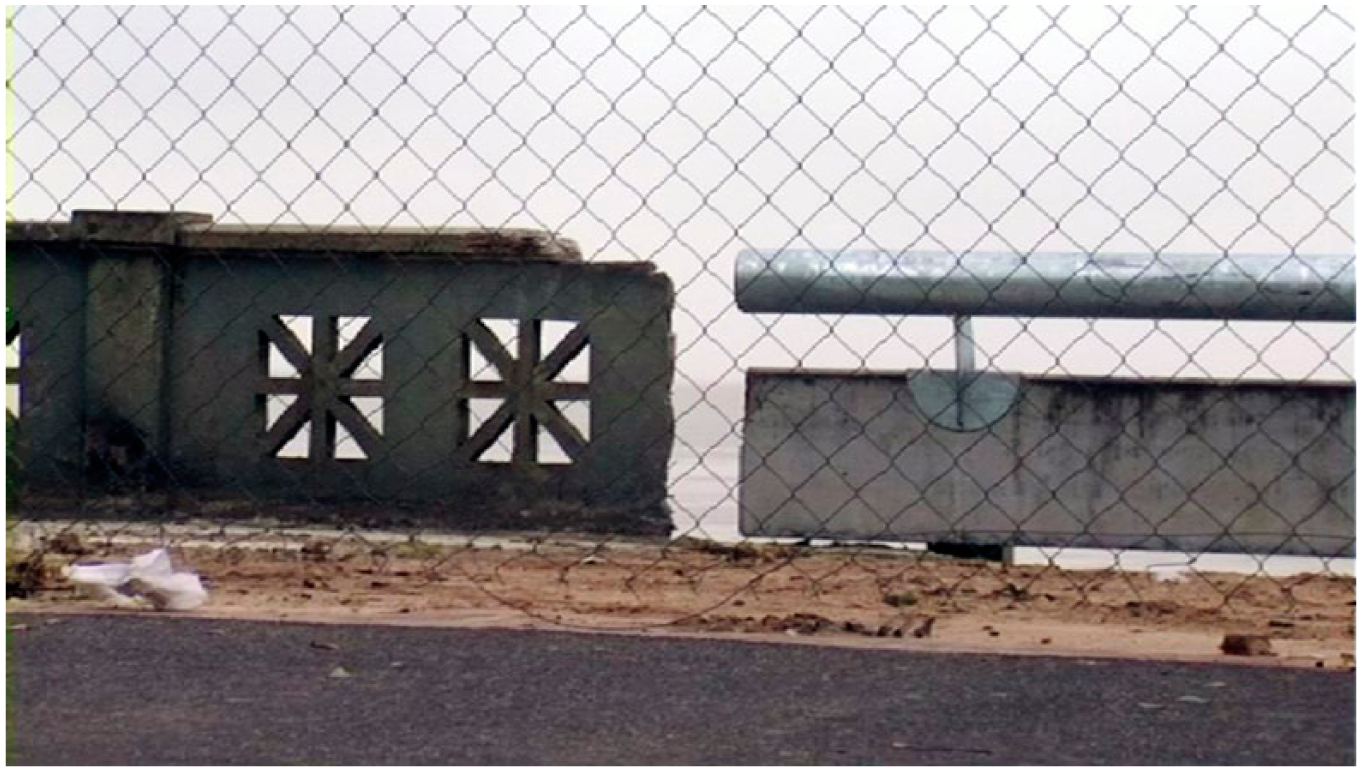
Opening shot from Los murales (2011).
The opening shot of Perel’s second film is incongruous with the rest of the text. As Adrián Gorelik (2014) notes, the location can be situated in the ‘Costanera Norte’ (Northern Promenade) which runs along the northern bank of the Río de la Plata in Buenos Aires. The origin of the sound heard, however, is rather more difficult to trace. The roar of the jet engine could conceivably emerge from the Aeroparque Jorge Newbery (the airport which stands behind the coastal walkway), yet the clarity, volume and intensity of the noise suggest otherwise. Following this establishing shot, the remaining 10 minutes of Perel’s short film can be subdivided into three distinct sections, all of which take place in the former CDCs ‘El Olimpo’ and ‘Automotores Orletti’ situated in the west of the capital city. No human characters appear at any point in the film. As the first sequence of eight shots records close-ups of walls, windows and shuttered doors shot from unusual angles, it is reminiscent of El predio. The penultimate shot in this sequence serves as a transition to the following section and gives the viewer the first indication of the thematic content of the film. The camera is positioned further back and the screen is largely filled by a garage door which has been heavily spray-painted. In the bottom right-hand corner of the screen, partially visible text spells out ‘[op]ressors’ and ‘prison’, the first glimpse of the political graffiti which occupies both of the remaining sequences.
The film’s second movement consists of nine close-ups of the names, ages and professions of some of the victims and survivors of the 1972 Trelew Massacre – where 16 guerrilleros from the Montoneros, the ERP and the Fuerzas Armadas Revolucionarias (Revolutionary Armed Forces) were summarily executed by a previous military dictatorship following an attempted escape from the Rawson maximum security prison – painted on the walls of the former CDCs. 19 The tributes, however, have been painted over with thick white and red paint and obscured to varying degrees (Figure 8). Nonetheless, enough information is visible for the names to be deciphered, 20 and the penultimate shot in the film’s third and final sequence includes a text (heavily obscured but partially visible) that confirms that the graffiti is an homage to the victims of Trelew. The film’s final sequence consists of five shots which record responses to these messages calling the memorialised victims ‘subversive murderers’ and ‘Montoneros murderers’, stating ‘not one innocent’, referencing ‘Sons and Daughters of murderers’, 21 and declaring ‘no to terrorism’. The message ‘terrorist murderers were executed here’ is shown in the penultimate shot painted over the larger text explaining the original memorial (Figure 9).
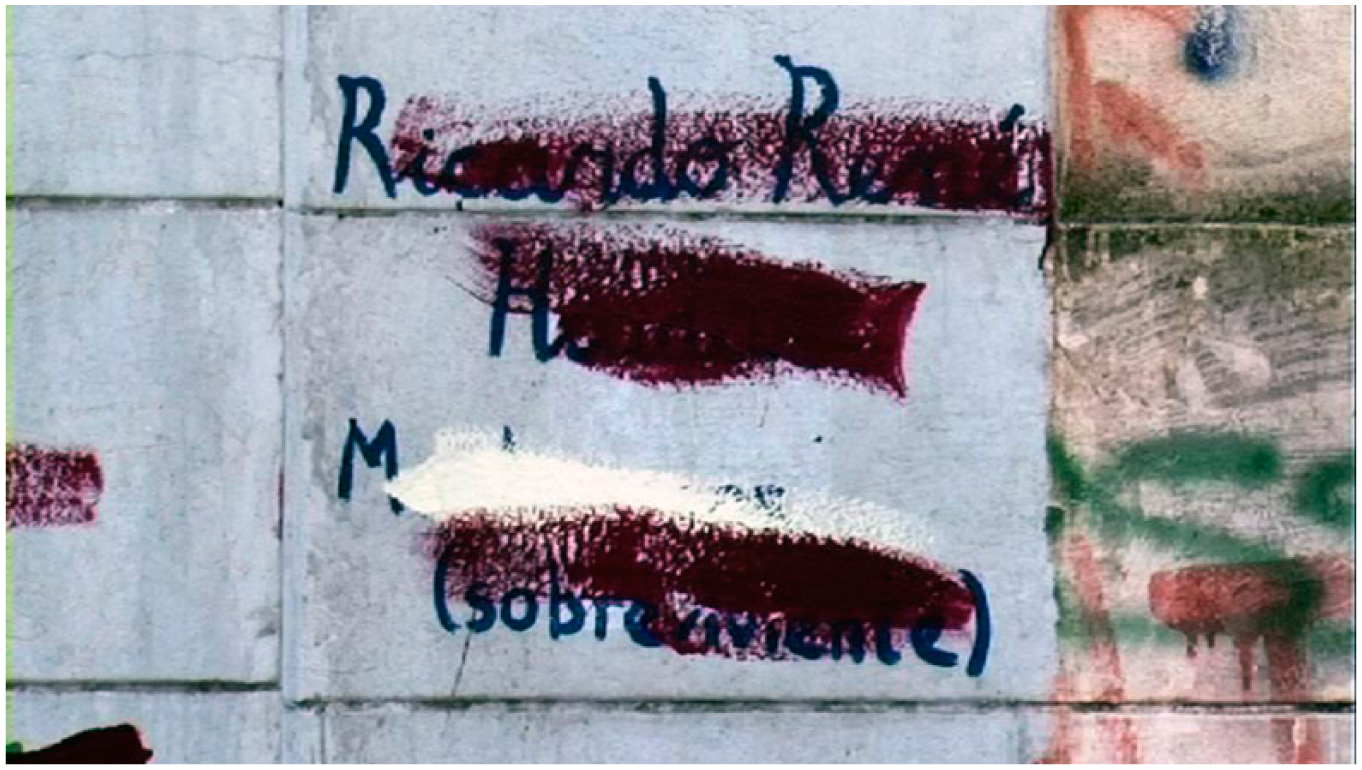
Obscured tribute. Still from Los murales (2011).
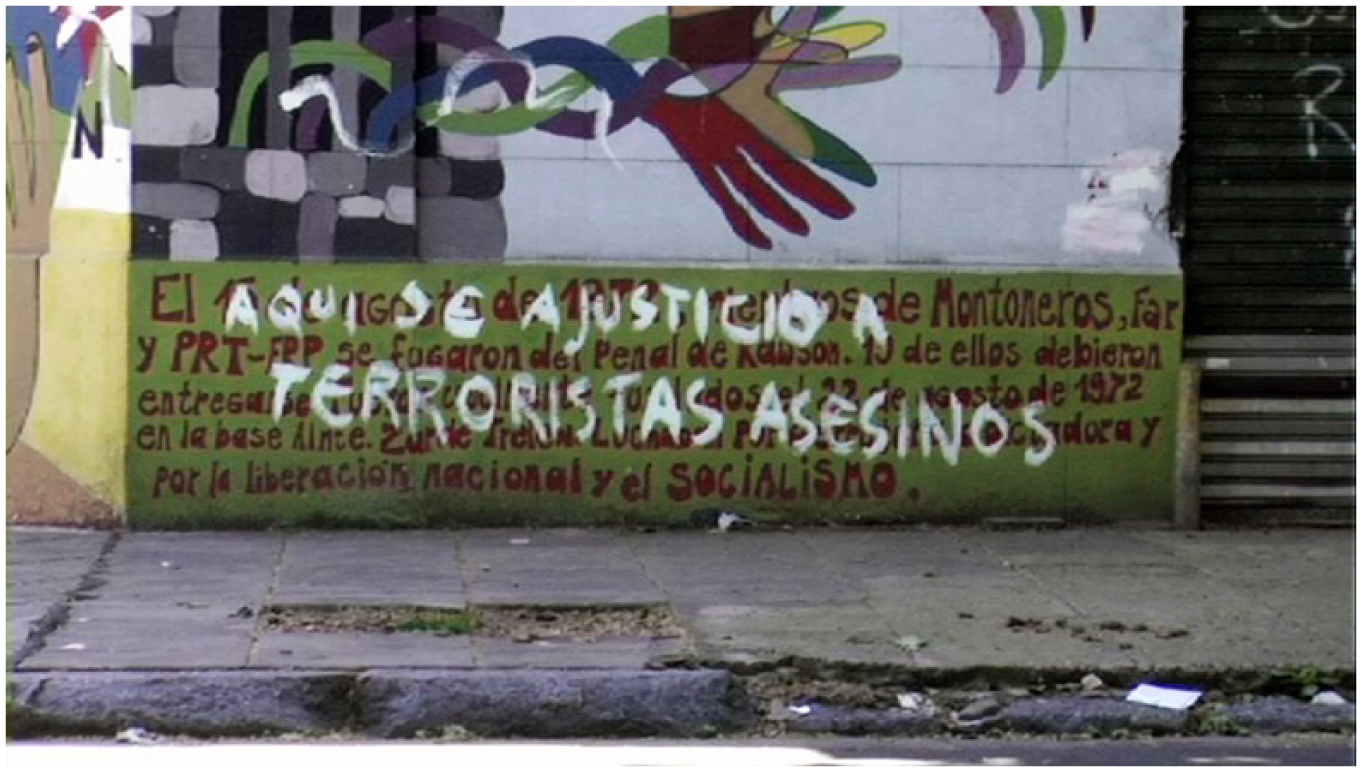
Vandalised memorial. Still from Los murales (2011).
Unlike Perel’s first film, Los murales is located within the main urban fabric of Buenos Aires and thus there is far less plant life included in the film. For this reason, the soundscape takes on an even more fundamental role than in El predio. The majority of the shots included in the film feature almost no perceptible movement at all, but capture only the material fabric of the buildings recorded. Chion (1994) argues that within ‘a sequence of images [that] does not necessarily show temporal succession in the actions it depicts’ the use of ‘diegetic sound imposes on the sequence a sense of real time, like normal everyday experience, and above all, a sense of time that is linear and sequential’ (pp. 17–18). Due to the almost total lack of movement in Los murales, however, it is the use of environmental sounds that alerts the audience to the fact that the images are in motion at all. From this point, the ear leads the eye and the viewer searches for the intermittent visual micro-rhythms that appear on screen: the slight tremble and wave of tree branches moving in the wind; clouds of pollen and dust passing across the screen. The meaning of the broader visual montage, however, proceeds in a halting, retrograde manner. It is almost 5 minutes (and thus over a third of the way through the film) before the penultimate shot of the first sequence provides a glimpse of the material which forms the focus of the larger part of the film. In the second sequence, a viewer unfamiliar with the details of the Trelew massacre will not realise what is being memorialised until the film’s penultimate shot, some 2 minutes before its conclusion. Moreover, the location of the graffiti will not be revealed until the concluding intertitle. Thus, it is not only sound which ‘endows [the] shots with temporal linearization’ (Chion, 1994: 13), it is simply that the visual vector runs in the opposite direction. This antagonistic flow of multiple times ultimately serves to confirm Vikki Bell’s (2010) assertion that the ‘aftermath of the dictatorship has not been able to become about memory and memorials’ at all (p. 72). While the visual images essentially run backwards, as if retreating into the past, the immediacy of the ambient sounds once more situates the struggles depicted in a perpetual present. Memorialisation becomes impossible as these acts cannot be absorbed into the past.
What is particularly shocking and unusual about Perel’s film is that the type of public denunciation and protest normally deployed to denounce the crimes of the last dictatorship have been appropriated by those who wish to defend and celebrate those same crimes. 22 Indeed, the message ‘Aquí se ajustició a terroristas asesinos’ (terrorist murderers were executed here), appears directly to reference a work created by the Grupo de Arte Callejero (Street Art Group) in 2001 which consisted of distributing posters titled ‘Aqui viven genocidas’ (War criminals live here) that featured maps locating the former CDCs and the dwellings of supporters of the dictatorship throughout Buenos Aires (Brodsky, 2005: 174; Scorer, 2016: 58). With this in mind, it is particularly noteworthy that, unlike El predio, Los murales features no interior shots whatsoever. While in Perel’s earlier film windows frequently served as portals through an objective shot-reverse-shot technique that would function as a transition between exterior and interior spaces, in the latter work, windows become barriers. The viewer is literally locked out of the former CDCs. 23 This is despite the fact that ‘El Olimpo’ was converted by the State into a ‘Memory Site’ in 2005 and that ‘Automotores Orletti’ was designated a ‘Historic Site’ in 2009. What Perel’s film demonstrates, then, is that regardless of the State’s attempts to incorporate memories of the past into official public policy, there were those who would take to the streets, beyond the control of the State, in order to defend the crimes of the dictatorship. If El predio highlighted the disagreements and debates among different human rights organisations as to how to memorialise the events of the recent past in cooperation with the State, Los murales depicts the outside and limit of this process. Moreover, Perel’s use of sound in the film delineates further institutional failings and abuses of power.
As previously described, Los murales opens with the intensive roar of a jet engine while the audience catch a glimpse of the Río de la Plata. The agglomeration of this specific sound and this specific place cannot but remind the viewer of the ‘Vuelos de la muerte’ (death flights) and the river’s violent past. Even the fact that the jet is never seen and that the view of the river is almost entirely obscured seems to testify to the secret extermination plan carried out in this place. As the film progresses, the soundtrack frequently features the sounds of motors starting, the heavy thuds of car doors opening and closing, the high pitch whine of electric wheel wrenches, and other sounds that situate the audience in a mechanic’s garage. Yet none of the sources of these sounds are visible. The audience view the present reality of the former detention centres but, as both sites were used as garages while functioning as extermination centres, the soundtrack situates the deception that was used to mask the reality of torture and murder in our present moment. Just as the graffiti covered walls of the former CDCs remind the viewer that, despite the successes and best attempts of the Kirchner administrations, the resumed trials for crimes against humanity committed during the dictatorship have proceeded at a painfully slow pace (Winn, 2015: 334–355), these sounds evoke contemporary abuses of power such as the 2006 disappearance of Julio Jorge López as he waited to appear as a witness against those responsible for his kidnap in 1976 (Lorenz and Winn, 2015: 61); Facundo Rivera Alegre’s disappearance in Córdoba in 2012 (Da Silva Catela, 2015: 14); the arbitrary imprisonment since January 2016 of the social activist Milagro Sala by the governor of Jujuy province (who supports President Macri) despite calls for her release emanating from the Inter-American Commission on Human Rights, the United Nations, Amnesty International, international academics and the current Pope (Agostini, 2017; CELS et al., 2016; Molina, 2017; Página/12, 2017b; The Guardian, 2016a, 2016b); or, even more recently, the tragic case of Santiago Maldonado on 1 August 2017. On this date, police violently raided a protest in defence of the land rights of the indigenous Mapuche community in which Maldonado had participated. When he could not subsequently be located, the commonly held fear was that he, too, had been forcibly disappeared leading to massive protests (Goñi, 2017; Amnesty International, 2017; La Nación, 2017; Página/12, 2017a; Rojas, 2017; BBC Mundo, 2017). While Maldonado’s body was subsequently recovered from a river in the area and his autopsy revealed that he had drowned, significant questions remain as to how he came to this fate, and the degree of police responsibility is yet to be established (Hauser and Kollmann, 2017; Maldonado, 2017; Página/12, 2017c; Soriano, 2017). 24
Conclusion
In discussing the proposals submitted for the reconversion of ESMA into an ‘Espacio de la Memoria’, Di Paolantonio (2008) makes a persuasive case for the inclusion of works of art in the site arguing that ‘[v]isual art, in a particular non-didactic form, has the ability to offer objects and open an interpretative space where evocative interminable questions around representation and relations to the past can emerge’ (p. 36). Nonetheless, Di Paolantonio (2008) also recognises that a primary concern of those opposed to the inclusion of artworks in the site was that ‘placing artistic works or a gallery space within the premises would alter and corrupt the actuality and historical authenticity of this site’ (p. 33), an opinion echoed in Horst Hoheisel’s argument that ‘[t]hese spaces where torture and murder took place are symbolically loaded and sufficiently evocative’ and that ‘there is no need for sculptures or art objects here’ (Di Paolantonio, 2008: 35). What is exceptional about El predio and Los murales is that they demonstrate that the former need not disqualify the latter. As works of art themselves they unarguably provoke ‘evocative interminable questions’ about the relationship between the recent past and present attempts at memorialisation. Yet Perel’s ‘silent’ and ‘empty’ films also continually testify to the ‘symbolically loaded and sufficiently evocative’ environment of ESMA and the former CDCs. At every turn in watching the films (and just as much in my attempts to describe key scenes), the temptation is to project an interpretive framework drawn from the sombre and tragic past of the site onto the images. Just as Arenillas (2013) argues that ‘the young people digging […] reminds us of, or takes us to, the work camps, or the search for bones’ (pp. 384–385), so too I have proposed that Perel’s filmic techniques evoke and appropriate several of the key strategies deployed by the torturers that previously occupied the sites. The fundamental point is that the spaces Perel records are affectively saturated with the traumatic past. As Pamela Colombo (2010) has argued, Perel’s films are constructed from ‘fragments of the past in the present’ (p. 9, original emphasis). Or rather, as Juan Besse (2015) has argued in relation to Perel’s 2012 film 17 monumentos, in Perel’s cinematic oeuvre, there is a disjunction: ‘images from today and sounds of the past. Images of the past and sounds from today’ (p. 664). This is a sentiment echoed by Perel himself when he proposed that his films are constructed from ‘that which Deleuze denominates the time-image’, from ‘fragments of time in a pure state’ (Perel and Feierstein, 2014: 113). Certainly, Perel’s films are constructed from ‘crystal images’ in the Deleuzian sense: they are trapped between two temporal registers where the ‘present is the actual image, and its contemporaneous past is the virtual image’ simultaneously (Deleuze, 1989: 79), and the image becomes ‘the point of indiscernibility of the two distinct images, the actual and the virtual, […] a bit of time in the pure state’ (p. 82). Given that I have argued in favour of a sonic interpretation of Perel’s films and have even proposed that the visual should be understood as sonorous within them, it is particularly important to remember that Deleuze also argued that the ‘crystal-image is as much a matter of sound as it is optical, and Felix Guattari was right to define the crystal of time as being a “ritornello” par excellence’ (p. 92). And this is essentially what I have been arguing throughout: that the use of ambient environmental sounds situates the past in a perpetual present such that it is continually renewed and reinvigorated. It is in this way that Perel successfully transforms the spaces he records into ‘monuments’ in the sense that Deleuze and Guattari (1994) understand the word, that is as sites which ‘confide in the ear of the future the persistent sensations that embody the event: the constantly renewed suffering of men and women, their re-created protestations, their constantly resumed struggle’ (pp. 176–177). Ultimately, El predio and Los murales serve to remind the viewer that the memorialisation of the past cannot be entirely entrusted to the museum or the State precisely because the injustices of the 1970s continue in the present moment. Similarly, by including the voice of those who would seek to defend the dictatorship’s crimes in his films, Perel underscores that this work is as pressing and important as ever, as he also demonstrates why the goal of achieving a democratic consensus is presently impossible.
Footnotes
Declaration of conflicting interests
The author(s) declared no potential conflicts of interest with respect to the research, authorship, and/or publication of this article.
Funding
The author(s) disclosed receipt of the following financial support for the research, authorship, and/or publication of this article: Open Access has been funded by the School of Advanced Study, University of London.
