




Abstract
This article examines how the Myanmar National Democratic Alliance Army (MNDAA) uses media communication to construct legitimacy in shifting conflict contexts. Focusing on official statements, news reports, and commentaries produced during a large-scale armed campaign and the subsequent ceasefire, it analyzes how discursive legitimation strategies are reconfigured across conflict phases. Drawing on Critical Discourse Analysis and Van Leeuwen’s (2005) framework, the study traces how the MNDAA deploys strategies of authorization, moralization, and rationalization in context-sensitive ways. The findings show that, while the main categories of discursive legitimation remained consistent in the MNDAA’s communication, their form and emphasis shifted between wartime mobilization and governance under ceasefire. By foregrounding discourse rather than material service provision, the study contributes to a deeper understanding of rebel legitimacy as a communicative process, highlighting the importance of media strategies in sustaining authority within civil wars.
Introduction
Similar to formal political actors, legitimacy is central to the long-term survival of rebel groups (Schlichte and Schneckener, 2015; Terpstra and Frerks, 2017). Over the past few years, there has been a growing academic interest in how these groups acquire legitimacy, a process commonly referred to as legitimation. Current research highlights that rebels are not merely violent actors but often take on a variety of governance roles, such as providing security, healthcare, education, taxation systems, and legal frameworks (Huang, 2016; Loyle, 2021; Mampilly, 2015). Scholars have also noted that rebels can bolster their legitimacy through the provision of such essential services (Alijla, 2023; Cunningham et al., 2021; Stewart, 2018). For instance, Weigand (2017)’s research on domestic governance in Afghanistan demonstrates how the Taliban gained legitimacy by capitalizing on governmental shortcomings and offering superior local services compared to the incumbent authorities. Loyle (2025) examines how rebels in Nepal and Northern Ireland establish legitimacy specifically through the procedural fairness, deliberation, and effectiveness of their courts. Thus, contemporary understandings of rebel legitimation strategies often revolve around the provision of public goods and services.
While wartime service provision is a well-recognized strategy, it is not the sole pathway to rebel legitimacy. Armed groups are increasingly sophisticated users of media and communication (Arjona et al., 2015; Bos and Melissen, 2019; Tønnesson et al., 2021b). Many rebel organizations operate magazines, television stations, social media accounts, websites, and YouTube channels to report operations, communicate grievances, and frame their objectives. Building on Stuart Hall’s (2024a, 2024b) seminal argument that media does not merely reflect reality but actively constitutes it, media and cultural studies have treated communication as central to the production of meaning and political authority (Kellner, 2003; Louw, 2010; Skeggs and Wood, 2012; Weimann, 2000). In civil war settings, empirical research also suggests that rebel communication can, under certain conditions, influence civilian perceptions and behaviors (Armand et al., 2020; Lucas, 2024). At the same time, extensive works examine the media strategies of armed groups (Al-Rawi, 2018; Ciovacco, 2009; Novenario, 2016), but systematic analysis of how rebels construct legitimacy through discursive strategies has remained comparatively limited. Within peace and conflict research, studies of rebel legitimacy still more often privilege service provision over the structured examination of legitimation discourse, with only a small number of works addressing this issue directly (El-Nashar and Nayef, 2022; Termeer, 2023).
Furthermore, comparative research on rebel legitimation strategies tends to focus on geographically distinct groups, with less attention given to how a single group adapts its strategies across different contexts. For instance, Sanaullah (2024) compares the legitimation strategies of the Afghan and Pakistani Taliban, and Termeer (2023) examines ISIS and the Taliban, both emphasizing cross-case variation. While these studies provide important insights, they prioritize broad comparisons over the internal dynamics of one group’s changing practices, and their temporal scope is largely shaped by the availability of data rather than by a systematic focus on phases.
To address these gaps, this study investigates the discursive legitimation strategies of the MNDAA, an Ethnic Armed Organization (EAO) operating in northern Shan State that has been involved in Myanmar’s prolonged civil war. Following Lewis (2020), rebel groups are defined as non-state actors that use physical violence against government targets with the aim of challenging the ruling government’s authority. As an EAO engaged in sustained military confrontation with the Myanmar military and seeking autonomy, the MNDAA falls within this definition. On 27 October 2023, the MNDAA launched Operation 1027, a large-scale coordinated offensive that rapidly altered the balance of control in northern Shan State and brought the group renewed territorial authority. This study examines the MNDAA’s official public communications during the seven-month period from October 2023 to May 2024, spanning both the intensive fighting phase of Operation 1027 and the subsequent China-brokered ceasefire. The case of the MNDAA is particularly relevant for analyzing how discursive legitimation strategies are recalibrated across conflict phases, given the shifting dynamics of Myanmar’s prolonged civil war, which has been marked by cycles of intense conflict followed by temporary ceasefires. These alternating patterns reflect what Staniland (2021) refers to as “wartime orders”, characterized by phases such as total war and limited cooperation.
Methodologically, the study applies Critical Discourse Analysis (CDA) and adapts Van Leeuwen’s (2007) legitimation framework by focusing on authorization, moralization, and rationalization. The analysis draws on the full set of textual materials published on the MNDAA’s official website during the seven-month period, including statements, announcements, and news reports. All texts were originally published in Chinese and are examined in their original language, with English translations provided for illustrative purposes. The article first reviews key concepts; it then outlines the methodology and data analysis; introduces the MNDAA and the two phases under study, presents findings on discursive strategies, and concludes by discussing their broader implications for understanding rebel legitimacy.
Legitimacy, legitimation, and discursive legitimation
Legitimacy is generally understood as the belief that a governing body has the rightful authority to rule and that its actions align with the expectations of those it governs (Suddaby et al., 2017; Weber, 2012). Habermas (2009) extends this by framing legitimacy as an objective metric for political stability, measurable through the recognition a state receives from its populace. In this context, legitimacy serves as a foundational element that upholds social order and governance.
In recent scholarship, there has been growing interest in the legitimacy of rebel groups as a distinct area of study (Loyle, 2025; MacWeeney et al., 2025; Stallman and Griffiths, 2025; Terpstra and Frerks, 2017). MacWeeney et al. (2025) define rebel legitimacy as the acceptance of a rebel group’s political authority over a population and territory by states, local constituents, and the international community. Drawing on Max Weber’s conceptualization of authority, Schlichte and Schneckener (2015) frame rebel legitimacy as a shared belief in the moral and political validity of a rebel group’s agenda and actions. While, like the concept of legitimacy, the precise definition of rebel legitimacy is still a subject of ongoing debate, there is widespread consensus that legitimacy plays a critical role in the dynamics of conflict. For rebel groups, obtaining and maintaining legitimacy is essential to their survival, as their authority is constantly contested by competing actors in conflict zones. Schneckener (2017) and Terpstra and Frerks (2017) highlight that non-state armed groups, much like established political actors, must actively engage in efforts to secure and sustain legitimacy to remain influential and ensure long-term survival.
For any actors, legitimacy is not automatically conferred, and it must be constructed and sustained through strategic actions. This dynamic process of securing legitimacy is referred to as legitimation, encompassing the strategies actors employ to justify their authority, actions, and right to govern. Legitimation is not a one-time achievement but an ongoing process of public justification, as actors must continually align their actions with established norms, values, or expectations (Von Haldenwang, 2017). Fairclough and Fairclough (2012) describe legitimation as a form of public justification, whereby actions are rationalized through arguments that can be collectively accepted by the audience.
In this study, legitimacy refers to a state or condition—something that a group or actor possesses when their authority is widely accepted. In contrast, legitimation refers to the ongoing process and series of actions that attempt to create, sustain, and reinforce legitimacy (Bexell, 2014). This distinction is particularly critical in conflict settings, where authority is frequently contested, and perceptions of legitimacy can shift over time. For instance, a rebel group may achieve legitimacy through specific strategies or actions, but it must continually engage in legitimation practices to preserve that legitimacy. Public perceptions are fluid and can erode without consistent efforts to reinforce the group’s authority. As such, legitimation in conflict settings demands persistent and adaptive efforts to align actions with evolving norms and expectations.
Discursive legitimation refers to the strategic use of language and rhetorical tools to shape perceptions of what is deemed “legitimate” or “acceptable” within a given context (Vaara, 2014). Political activity, by its nature, is inherently discursive, as much of governance, resistance, and conflict revolves around the narratives that actors construct to justify their actions and claims to authority (Chilton, 2004; Van Dijk, 2015). From this perspective, legitimacy can be established, sustained, and communicated through the production of texts, enabling a shift in focus from static notions of legitimacy to the dynamic, discursive struggles surrounding legitimation, which deepens our understanding of the micro-level political dynamics inherent in these processes (Vaara and Tienar, 2008: 988). However, discourse is not solely about constructing or reinforcing legitimacy; it is also a battleground for contesting it. Political actors frequently engage in delegitimation, where they seek to undermine or discredit their opponents by framing them in negative or illegitimate terms (Hellin Garcia, 2022). Given the intertwined nature of legitimation and delegitimation, when examining legitimization strategies, it is equally important to analyze the delegitimization efforts that accompany them.
Methodology
This study employs CDA as the primary methodological framework to examine discursive legitimation. CDA is characterized as “a problem-oriented interdisciplinary research movement” that synthesizes diverse approaches with a shared focus on examining the semiotic dimensions of power, inequality, abuse, and socio-political or cultural transformations (Van Dijk, 2015). Therefore, this approach provides a valuable lens for analyzing the public communications of armed groups such as the MNDAA, particularly regarding how these communications contribute to legitimation. By employing CDA, the analysis extends beyond the surface-level content of texts to explore what is implied, assumed, or left unsaid (Fairclough, 2003). This focus on implicit meanings enables the uncovering of hidden elements within the MNDAA’s discourse, illuminating how their rhetoric aligns with and supports their broader legitimation strategies.
Framework of investigation
Existing CDA-oriented studies on legitimation have provided a wide array of analytical tools that can be used to identify and categorize legitimation strategies (Bennett, 2022; Martín De La Rosa and Lázaro, 2022; Reyes, 2011; Van Leeuwen, 2007). This study adapts Van Leeuwen’s (2007) framework as a starting point, while focusing on three categories most relevant to the MNDAA’s official discourse: authorization, moralization, and rationalization. These categories are widely regarded as robust and flexible for examining legitimation, and they frequently interact within texts rather than appearing in isolation. Notably, these strategies can be used not only to legitimize but also to delegitimize or critique.
(1) Authorization: legitimation achieved through the use of the use of traditional, customary, and legal authority.
(2) Moralization: legitimation grounded in value systems, often invoked indirectly, to align actions with moral or ethical principles.
(3) Rationalization: legitimation based on the goals and functions of institutionalized social actions.
Although Van Leeuwen (2007) also identifies mythopoesis, legitimation through narrative, this category is less analytically precise and often overlaps with the other three (Bennett, 2022). Moreover, the textual genres under investigation here, official announcements, communiqués, and news reports, are not extended narrative forms. For these reasons, the analysis retains only the first three categories, which provide clearer analytical traction for understanding the MNDAA’s discursive strategies.
Data source and collection
The empirical material for this study is drawn from the MNDAA’s official website, kokang123.blogspot.com, which is operated by the MNDAA’s news agency. It functions as an archival hub that consolidates materials disseminated across the MNDAA’s wider media ecosystem, including Facebook, Twitter, WeChat, and Weibo. Many of these social media channels have experienced post removals, temporary suspensions, or permanent blocking, which makes them unreliable as stable repositories. By contrast, the website systematically preserves the full set of public communications issued by the MNDAA, rendering it the most complete and consistent source for analysis.
Data were collected on 10 July 2024, yielding a full corpus of 598 textual items produced between 1 October 2023 and 31 May 2024. The timeframe was selected to capture both the military offensive known as Operation 1027 and the subsequent ceasefire. Although Operation 1027 formally began on 27 October, signals of heightened military activity were evident earlier in the month, justifying the inclusion of materials from 1 October. The corpus includes statements, speeches, news reports, announcements, opinion pieces, and reprinted materials. Monthly distribution is as follows: October 89, November 155, December 83, January 52, February 42, March 37, April 63, and May 77. No filtering was applied during initial collection to ensure the comprehensiveness of the corpus.
Data processing and analysis
Following collection, the dataset underwent several refinement steps. Duplicate postings and reprints originating from external media outlets were removed so that the final corpus would reflect only the MNDAA’s own communicative output. The corpus was then divided into two analytically meaningful periods, using the China-brokered ceasefire of 11 January 2024 as the temporal boundary to enable a within-case comparison.
The first round of coding applied Van Leeuwen’s (2007) three macro-categories of legitimation in a deductive manner to the full corpus. Each item was examined for explicit and implicit indicators of these strategies. Subsequent rounds of close reading introduced an inductive element, allowing context-specific patterns to be identified and subcategories to emerge. Under authorization, for instance, six recurring subtypes crystallized across the dataset. Their labels reflect the sociopolitical context. The “peer-based authority,” for example, was introduced to capture the MNDAA’s recurrent appeals to recognition from other EAOs.
All data processing and coding were conducted by the researcher. Given that all original texts were written in Chinese, the analysis was conducted in the original language to preserve linguistic and cultural nuances. To illustrate key points and support the analysis, selected extracts were translated into English.
Background
The MNDAA, Operation 1027, and a China-brokered ceasefire
Myanmar has been plagued by protracted ethnic conflicts since its independence in 1948, driven by deep-rooted tensions between the central government and various ethnic minority groups (Kramer, 2021). These conflicts are largely concentrated in border regions, where EAOs have sought autonomy and greater political rights. Peace talks and ceasefires have often faltered, as underlying issues of ethnic identity, resource control, and political representation remain unresolved (Tønnesson et al., 2021a). The situation deteriorated further following the 2021 military coup, which ousted the civilian government and triggered intensified fighting nationwide. The political upheaval has significantly undermined prospects for peace, as many EAOs have aligned with anti-coup resistance movements, broadening the scope of the conflict (Stokke and Kyaw, 2024).
The MNDAA was established in 1989 as one of four factions that emerged following the disintegration of the Burmese Communist Party. Shortly after its formation, the MNDAA signed a ceasefire agreement with Myanmar’s central government, which allowed it to maintain control over the Kokang region in northern Shan State, designated as Shan State Special Region No. 1 (SR1). The Kokang region has historically maintained strong social and economic ties with China, reflecting the Han Chinese ethnic identity of the Kokang people, who speak a Mandarin dialect akin to that of Yunnan Province in China. This ceasefire endured for two decades, during which the MNDAA exercised governance over SR1.
Tensions escalated in 2009 when the Tatmadaw (Myanmar military) demanded that the MNDAA transform into a Border Guard Force under central military control, in line with the stipulations of Myanmar’s 2008 constitution (ISP, 2023). The MNDAA's leader, Peng Jiasheng, refused, reigniting conflict in the region. After several days of fighting in August 2009, the Tatmadaw captured the Kokang region, forcing Peng and his loyal followers to retreat to Shan State Special Region No. 4, an area controlled by another EAO with close ties to Peng. Since then, the MNDAA had been actively seeking to reclaim the Kokang Self-Administered Zone (SAZ), previously known as SR1, by establishing bases in remote mountainous areas (Crisis Group, 2023). Despite launching significant offensives in 2015 and 2017, the MNDAA was unable to regain control of the Kokang SAZ.
On 27 October 2023, the MNDAA, in collaboration with the Arakan Army and the Ta’ang National Liberation Army, launched Operation 1027, a large-scale offensive in northern Shan State. The operation advanced rapidly as government forces abandoned or surrendered several military installations and townships. By 5 January 2024, the MNDAA successfully captured Laukkai, the Kokang SAZ’s capital, after the surrender of over a thousand government troops, civil servants, and their families (The Irrawaddy, 2024). In response to the escalating conflict, China facilitated peace talks in Kunming, Yunnan Province, between representatives of the rebel and the Myanmar military. These negotiations, held on 10–11 January 2024 resulted in a ceasefire agreement for northern Shan State (FMPRC, 2024). Although sporadic clashes continued, the post-ceasefire period was characterized by a stronger governance orientation. This period of relative stability ended in June 2024, when the MNDAA launched another significant offensive targeting Lashio, the largest town in northern Shan State.
The MNDAA’s discursive legitimation strategies
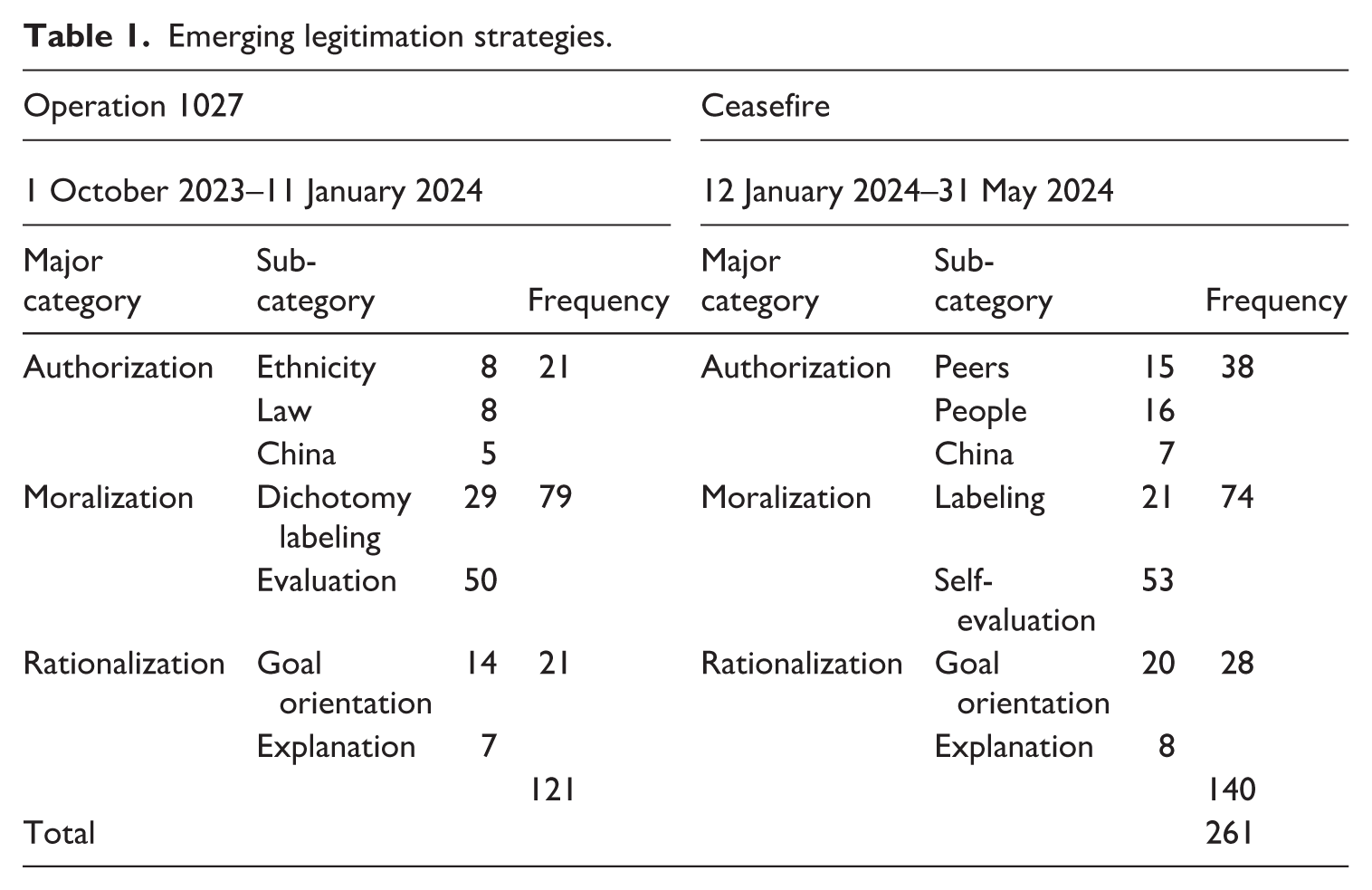
The MNDAA employed all three major legitimation strategies across both Operation 1027 and the post-ceasefire phase, yielding a total of 261 identifiable instances of discursive legitimation. Table 1 summarizes the distribution of these strategies across the corpus, which serves as a contextual complement to the qualitative analysis that follows.
Emerging legitimation strategies.
Authorization
Across the transition from active military conflict to the ceasefire period, there is a distinct shift in the authority figures referenced in MNDAA communications. During Operation 1027, the authority included ethnic minorities, the law, and China. In the post-ceasefire period, this shifted to include peers, the people, martyrs, and China.
Ethnicity, law, and China
Myanmar’s complex ethnic composition provides a potent framework for legitimization, as alliances with ethnic groups enhance the MNDAA’s claims to represent local interests and foster broader legitimacy. During Operation 1027, the MNDAA frequently invoked Ethnicity-based authority by emphasizing solidarity among ethnic groups, such as the Jingpo (Kachin), Ta'ang, and Dai (Shan). In Extract 1, the MNDAA draws on Ethnicity-based authority by highlighting the endorsement by the Jingpo Cultural Association and the Jingpo Women’s Association, two prominent organizations within the Jingpo ethnic community. The MNDAA frames this backing as the “greatest gift” in celebration of its recent military success, particularly the occupation of Monggu County. By portraying ethnic solidarity as a source of its authority, the MNDAA underscores that its military actions are not solely self-directed but are endorsed by influential ethnic actors within Myanmar (see bold type):
Extract 1: He (MNDAA’s official) expressed that “since the time of the Yang chieftain in Kokang, the
The MNDAA also leverages Law-based authority to simultaneously legitimize its own actions. By adhering to international legal norms, such as the Geneva Conventions, the MNDAA portrays itself as a lawful and responsible actor. For example, in Extract 2, the MNDAA emphasizes its compliance with humanitarian law by detailing its provision of medical care to captured enemy soldiers (see bold type). This narrative aims at enhancing the group’s image as a principled actor in line with international norms.
Extract 2: Since the launch of Operation 1027, the MNDAA has strictly followed the
The final form of Authorization employed by the MNDAA during its military offensive draws on its relationship with its only foreign neighbor, China. This framing is strategically significant, as China’s regional influence lends weight to the MNDAA’s actions and positions the group as diplomatically adept (Han, 2017). In Extract 3, the MNDAA emphasizes the formal involvement of Chinese officials in facilitating the return of Chinese criminals. The phrasing (see bold type) underscores the MNDAA’s capability to navigate formal diplomatic procedures and implies implicit support from a powerful neighbor.
Extract 3: Under the
Peers, martyrs, people, and China
The subcategories of Authorization have shifted significantly during the ceasefire period.
First, by aligning itself with other well-established EAOs, the MNDAA invokes Peer-based authority, particularly through its connections with the United Wa State Army (UWSA) and the National Democratic Alliance Army (NDAA). Both organizations function as aspirational models for other EAOs due to their relative autonomy, military strength, and economic success (BNI, 2019). The UWSA’s political wing, the United Wa State Party, further enhances this influence by leading the Federal Political Negotiation and Consultative Committee, a coalition of seven EAOs that amplifies Wa political leverage within Myanmar’s broader armed landscape (Xian, 2023). Through these associations, the MNDAA situates itself within a network of highly institutionalized and influential actors.
In Extract 4, the MNDAA highlights its alignment with the UWSA by invoking notions of “revolutionary friendship” and “battle-forged bonds” (see bold type). This language emphasizes the historical solidarity between the two groups, framing their connection as longstanding and reinforced through years of mutual revolutionary struggle. By stressing that the two stand together and the UWSA’s help during Operation 1027, it also conveys that its current administration over Kokang and previous military operations have the backing of UWSA.
Extract 4: He (Peng Deren) expressed that both sides will
People-based authority reflects the MNDAA’s assertion that its governance and actions are mandated by the local population. In Extract 5, the MNDAA describes the challenging tasks of local governance and post-conflict reconstruction as responsibilities “entrusted to us by the people” (see bold type). This phrasing conveys a deep sense of duty, suggesting that the MNDAA’s authority to make decisions stems from a delegated mandate rather than self-assertion. Martyrs-based authority invokes the legacy of MNDAA members who died before the organization’s reclamation of Kokang in early 2024. In Extract 6, the MNDAA asserts that “the people of SR1 will forever remember and carry on the legacy of the martyrs.” Linking its current governance to the unfinished work of its fallen members suggests that its authority is rooted in a commitment to honoring and completing their cause (see bold type).
Extract 5: At present, the Special Region faces numerous challenges, and the tasks of local governance are daunting. We need to apply our wisdom, actively carry out our duties, and fulfill the important Extract 6: The people of the SR1 will forever remember and carry on
Similar to its strategy during Operation 1027, the MNDAA continued to leverage China. In Extract 7, the MNDAA attributes its campaign’s success in SR1 to “deepening cooperation between the SR1 and the Chinese police” (see bold type). This phrasing underscores China’s role in endorsing and supporting the MNDAA’s activities, positioning the MNDAA as an organization capable of working closely with a powerful external actor.
Extract 7: This is the result of the campaign in the SR1, as well as the outcome of
Moralization
In both periods, the MNDAA employed labeling and evaluation as sub-strategies under Moralization, but with notable differences in application. During Operation 1027, labeling and evaluation strategies exhibited a distinct dichotomous nature, where “us” and “them” were explicitly juxtaposed in polarized terms. This approach simultaneously employed legitimation and delegitimation strategies, making the distinction between the MNDAA and its adversaries overt and direct. In contrast, during the ceasefire period, the MNDAA’s discourse was more restrained, with fewer direct comparisons. Instead, the audience was left to infer these contrasts, shifting the responsibility of making moral distinctions to the observer.
Dichotomy labeling and evaluation
The MNDAA employed Dichotomy labeling to create a clear moral and ideological contrast between itself and its adversaries. Positive labels were assigned to the MNDAA, while negative labels were attributed to its opponents, reinforcing the group’s self-portrayal as morally superior and framing its adversaries as oppressive and illegitimate. The labels are often paired directly, creating a one-to-one comparison that emphasizes this contrast. In Extract 8, for instance, the MNDAA labels itself as a “people’s force,” a term that conveys alignment with the interests and well-being of the local population. In contrast, it characterizes the military regime as “conquerors,” a term that connotes oppression, exploitation, and a lack of moral right to govern.
Extract 8: In SR1 and other occupied ethnic minority areas, they (the military regime and associates) have always regarded themselves as
Dichotomy evaluation intensifies this contrast by differentiating the moral worth, capabilities, and motivations of the MNDAA from those of its adversaries. This evaluative dichotomy frequently appears in discussions of military morale, governance, and public support. In Extract 9, the MNDAA emphasizes the demoralization and disarray within the ranks of Min Aung Hlaing’s forces, framing them as weak, disorganized, and incapable of resistance. By contrast, the MNDAA portrays itself as disciplined, resilient, and militarily superior. Terms like “extraordinary combat strength” and “modern military miracle” frame the MNDAA as exceptional, elevating its status as a revolutionary force.
Extract 9: Most of the Min Aung Hlaing faction members at various strongholds have
Labeling and Positive self-evaluation
In the ceasefire period, the MNDAA shifted from dichotomous comparisons to a focus on Labeling and Positive self-evaluation without directly contrasting itself with adversaries. In this phase, Labeling primarily served to discredit former Kokang rulers and undermine their legitimacy by associating them with immoral and unfit behaviors. In Extract 10, the MNDAA categorizes the previous political elites of Kokang using labels such as “dictators,” “shit-stirrers,” “demons,” “thieves,” “corrupt alliance,” and “traitors,” each aimed at portraying them as unsuited for leadership. Furthermore, the MNDAA incorporates specific biographical details. For instance, highlighting Bai Yingcang’s dropout status and Bai Yinglan’s multiple marriages suggests their incompetence and questionable moral character (see bold type). Such details reinforce the constructed image of these figures as lacking both the qualifications and the ethical standing to govern.
Extract 10: The Wei family has since embarked on the criminal path of becoming a
This Positive Self-evaluation approach mainly involves the MNDAA’s heavy use of affirmative language to project the MNDAA as an effective, stable, and morally upright governing body. In Extract 11, the MNDAA demonstrates this self-evaluation strategy, using terms like “successfully,” “strong,” and “solid” to frame its recent campaign against crime as a significant achievement (see bold type). Additionally, describing the campaign’s outcome as laying a “solid foundation” for future law enforcement highlights the MNDAA’s commitment to long-term governance and stability.
Extract 11: The major inspection and rectification campaign has concluded
Rationalization
The MNDAA employed two minor rationalization strategies, Goal Orientation and Explanation, to legitimize its actions. While both strategies are used consistently, their focus and application differ significantly depending on the context.
Goal Orientation
Goal Orientation during the period of armed conflict emphasized abstract and long-term objectives, which were used to rationalize military operations by aligning them with universal principles of justice and reform. In contrast, during the ceasefire period, the MNDAA’s goals in its public communication became more practical and localized, focusing on addressing the immediate needs and welfare of the Kokang population. In Extract 12, the MNDAA justifies its military operations by framing them as necessary to achieve morally resonant goals like ending the military regime’s atrocities and advancing democratic values (see bold type).
Extract 12:
During the ceasefire period, the MNDAA’s public communication placed greater emphasis on concrete and localized objectives. In Extract 13, the MNDAA rationalizes a significant investment in pollution control by presenting it as a community service, despite acknowledging financial limitations. By emphasizing the creation of an “eco-friendly and pleasant recreational environment” (see bold type) the MNDAA casts this environmental initiative as a direct benefit to the public. It is worth noting that this approach closely aligns with People-based authority, creating a reinforcing cycle where the MNDAA derives its authority from the people and, in turn, legitimizes its actions by framing them as benefiting the public.
Extract 13: Despite financial constraints, we invested over 300,000 yuan to address the pollution of Dongcheng Lake, providing
Explanation
The MNDAA employed Explanation as a rationalization strategy to justify its decisions to show that its choices are logical and pragmatic. This strategy helps portray the group as thoughtful and responsible, particularly in contexts where decisions may be questioned or controversial. During the military operation, explanation was frequently used to address sensitive issues, such as delaying an attack on the Tatmadaw or enforcing conscription policies. In Extract 14, the MNDAA justified its decision to postpone an assault on Laukkai, a move that initially raised doubts about its military strength and commitment to reclaiming Kokang, by emphasizing concern for civilian safety and foreign nationals.
Extract 14: Since our army has surrounded Laukkai, we have delayed launching a full-scale attack
During the ceasefire period, Explanation is used to rationalize decisions related to local governance and public welfare. Extract 15 illustrates this approach, where the MNDAA provides a detailed rationale for the removal of side billboards and restrictions on mobile billboard placements. The announcement highlights safety as the primary concern, explaining how prolonged exposure to the elements can cause billboards to deteriorate, leading to potential hazards. Interestingly, the MNDAA addresses the aesthetic aspect, framing the removal as a measure to improve the visual appeal of the city. By combining references to safety, aesthetics, and the responsible use of public space, the MNDAA signaled that its governance decisions were not arbitrary but carefully reasoned (see bold type), reinforcing its credibility as a provider of orderly administration.
Extract 15:
Discussion
This study shows that the MNDAA consistently relies on discursive legitimation across its official media, yet the content and emphasis of these strategies are not fixed. The group reconfigures how it claims authority, evaluates conduct, and rationalizes decisions as it moves from fighting to a ceasefire period oriented toward governance.
In wartime, authorization drew heavily on recognized sources of authority that could bolster the MNDAA’s legitimacy under conditions of military confrontation. These included references to ethnic solidarity and support from other minority organizations, appeals to legal norms to signal rule-consciousness, and invocations of China-based authority, emphasizing cooperation with Chinese local officials. During the ceasefire, authorization localized: in addition to continued references to China, the MNDAA emphasized peer-based authority by aligning itself with the UWSA and NDAA, invoked people-based authority by framing governance tasks as entrusted by local communities, and activated martyrs-based authority rooted in past sacrifice. Among these subcategories, peer-based authority is especially significant. While earlier research suggests that rebel groups often strengthen legitimacy through association with international actors (Huang, 2016; Krieger, 2018), the MNDAA’s reliance on respected peers reveals that intra-civil war recognition can serve a comparable legitimating role. At the same time, “China” recurs across periods, functioning as a powerful arbiter whose leverage lent diplomatic weight to the MNDAA.
The MNDAA’s moralization strategies reveal how legitimation is often achieved through differentiation (Chovanec, 2010). During Operation 1027, moralization was overtly dichotomous: the Tatmadaw were framed as “conquerors” and “war criminals,” while the MNDAA were depicted as the righteous “people’s force.” Such binary oppositional framing functioned as both a legitimating and delegitimating practice, establishing a stark moral hierarchy between self and enemy. In the ceasefire period, however, moralization became more subtle and layered. Instead of constant us–them polarization, the MNDAA shifted toward positive self-evaluation, portraying itself as disciplined, orderly, and attentive to local concerns. At the same time, it delegitimized the former Kokang rulers not through abstract labeling but by highlighting concrete failures, such as corruption and ineffective governance. Two factors might help explain this shift. First, the MNDAA’s past reliance on the drug trade undermined its ability to sustain sweeping claims of moral superiority (Crisis Group, 2019). Second, the relative stability achieved by its predecessors limited the effectiveness of overt dichotomies. The group thus adopted a more nuanced moralization strategy, leaving audiences to draw contrasts from the juxtaposition of present achievements and past shortcomings. This demonstrates that moralization is not simply a matter of harsh labeling but can also operate through indirect evaluation and selective memory, calibrated to context.
Rationalization further demonstrates the MNDAA’s capacity to adapt discourse to shifting contexts. During Operation 1027, goal-oriented rationalization stressed broad objectives such as democracy, human rights, and the overthrow of dictatorship, aligning military actions with universal principles. In the ceasefire, rationalization was more frequently articulated around localized governance, highlighting initiatives like environmental protection and urban management as practical services for Kokang society. Explanatory strategies appeared in both periods: during wartime, to justify contentious military choices, and during the ceasefire, to rationalize governance measures in terms of safety and public welfare. These explanations portrayed the MNDAA as a responsible and calculated actor across domains.
A further observation is the MNDAA’s ability to merge normative discourse with performative practices of governance. The MNDAA deliberately translated performative acts into normative claims, ensuring that achievements such as pollution control, road management, or law enforcement were framed as evidence of responsible authority. In this way, governance practices were framed as discursive resources, meaning that concrete administrative actions were repeatedly recontextualized as rhetorical evidence in public justifications of rule. This finding complicates the conventional dichotomy between normative and performative legitimacy (Termeer, 2023), suggesting instead that rebel discursive strategies can mediate between doing and saying. In conflict settings where material capacity is fragile, the ability to embed governance acts in legitimation narratives may be as important as the services themselves.
Lastly, previous research emphasizes that the effectiveness of legitimation strategies is inherently dependent on how they are perceived by intended audiences (Bexell et al., 2021; Von Billerbeck and Gippert, 2017). Although this article does not systematically examine audience reception, some tentative observations may be made. In the MNDAA’s case, linguistic variation appears to indicate differentiated targeting. Posts on WeChat and Weibo, largely in Chinese, may have been designed for Kokang residents and Chinese-speaking publics, while Facebook content, often mixing Chinese, Burmese, and English, suggests an effort to reach broader Myanmar audiences and international observers. This broader orientation also reflects changing political circumstances. Since the 2021 coup, the National Unity Government has portrayed the MNDAA as aligned with the wider anti-junta resistance, which may have expanded its visibility and appeal (Xian, 2024). As a result, the MNDAA’s discourse during the seven-month period likely addressed not only its traditional base in Kokang and China but also sought legitimacy among Burmese publics and international communities sympathetic to Myanmar’s democratic struggle. Future research could build on this by systematically analyzing how rebels tailor their communication to different audiences, and how these audiences interpret and respond to competing claims of legitimacy.
Conclusion
This article has analyzed how the MNDAA recalibrated its discursive legitimation strategies across two distinct phases: a large-scale military offensive and a subsequent period of governance under a China-brokered ceasefire. By applying CDA and adapting Van Leeuwen’s framework, the study demonstrates that rebel legitimation is not static but highly phase-sensitive, with emphases differing between mobilization and the governance phases.
The analysis addresses two gaps in the existing literature. First, while Media and Cultural Studies have long examined the entanglement of discourse and practice, peace and conflict research on rebel legitimacy has more often foregrounded service provision, leaving less systematic attention to recurring legitimation discourse. This study illustrates how rebel communication functions as an active component of legitimation. Second, whereas comparative research has often contrasted geographically distinct groups, less attention has been paid to how a single organization adapts over time. By tracing the MNDAA across both war and ceasefire, the article offers a rare within-case perspective on the temporal evolution of rebel discourse.
Methodologically, the article illustrates the value of combining CDA with a streamlined version of Van Leeuwen’s framework for analyzing rebel communications. This approach captures the ways in which armed groups construct legitimacy through public discourse and offers a template that can be applied across cases to assess whether similar phase-sensitive patterns appear in other conflict contexts.
The findings also point to several avenues for future research. In particular, further inquiry should explore how discursive and non-discursive strategies interact over time, and how different audiences, local, national, and international, interpret and respond to rebel claims. Such questions would deepen our understanding of how legitimacy is negotiated, sustained, and contested in civil war settings.
Footnotes

Funding
The author received no financial support for the research, authorship, and publication of this article.
Declaration of conflicting interests
The author declared no potential conflicts of interest with respect to the research, authorship, and publication of this article.