



Abstract
Community media in divided societies can consolidate one-sided suffering narratives or cultivate cross-community recognition. The author traces a mechanism linking participatory governance to editorial routines and, in turn, to textual framings of victimhood. Drawing on six Cypriot community media organisations (36 producer interviews; 111 texts, 2013–2018), the article identifies a “five-plus-one” pattern: five outlets predominantly frame victimhood agonistically, while one heritage outlet sustains antagonistic, hierarchical victimhood. Agonistic framings—out-group recognition plus acknowledgement of own-side harms—are more likely where governance embeds input diversity, reflexive accountability, and boundary-crossing practice, and where routines institutionalise dissent (paired testimonies, symmetry checks, and anti-euphemism rules). The article contributes a portable organisational account of how participatory infrastructures can shape conflict-relevant discourse in divided settings.
Introduction
In divided societies, community media can either entrench one-sided narratives of suffering or open space for cross-community recognition. This article examines who is regarded as a victim in Cyprus’s community media, and how internal participatory governance within these outlets is linked to agonistic framings of victimhood (recognising out-group losses while acknowledging own-side harms). This focus is significant because victimhood narratives can either exacerbate societal divisions or foster mutual recognition, thereby shaping prospects for reconciliation. However, conflict reporting (e.g., war vs. peace journalism) has often emphasised normative distinctions (such as conflict vs. peace frames) instead of examining the organisational conditions under which inclusive narratives can emerge (Galtung, 1998; Lynch and McGoldrick, 2005; Wolfsfeld, 2004). This article addresses this gap by linking the internal participatory governance of community media outlets to their external discursive outputs.
Following Entman (1993), this article treats framing as a process of selecting and emphasising certain aspects of reality to shape causal inference and moral evaluation in texts. This implies that upstream routines and decision rules can systematically shape downstream narratives. Building on the Cyprus community media mapping (MIC; Voniati et al., 2018), this article extends it with an embedded comparative design: 36 producer interviews (2018) and 111 published texts (2013–2018) from six outlets. The analysis identifies a clear “five-plus-one” pattern: five outlets predominantly frame victimhood agonistically, while one heritage outlet sustains antagonistic, hierarchical victimhood. It then goes on to trace three recurrent editorial routines—deliberative input, boundary-crossing participation, and compact rule sets (e.g., symmetry checks and anti-euphemism guidance)—through which participatory governance is translated into textual framings of victimhood.
The contribution is twofold: first, a consolidated field map for Cyprus grounded in the MIC baseline; and, second, a field-anchored model linking participatory governance to editorial routines and, in turn, to discursive outputs in a high-stakes, divided context.
Community media organisations (CMOs) form a smaller, more precarious—but consequential—layer that interacts with social movements, cultural associations, and cross-community initiatives. Crucially, their governance varies from horizontal assemblies to custodial heritage boards, creating meaningful variation in how participation is organised and how editorial accountability is practiced; our claim is that these organisational choices help explain representational outcomes. Recent work on Cyprus’s online journalism shows how production routines can either normalise officials’ exclusionary discourse or enable resistance through diversified sourcing and recontextualisation—underscoring why organisational design matters for discursive outputs (Trimithiotis and Voniati, 2025).
Accordingly, this article contributes to debates on media and conflict by specifying the organisational conditions under which inclusive victimhood narratives become more likely. The argument resonates with peace journalism’s emphasis on multi-perspectival sourcing and a refusal of zero-sum victimhood, but it shifts the emphasis from normative exhortation to organisational explanation: rather than prescribing “better” outputs, it traces a mechanism linking participatory governance to editorial routines and, in turn, to textual framings of victimhood (Galtung, 1998; Lynch and McGoldrick, 2005; Shinar, 2009). In doing so, it complements recent work on “peace-possible” storytelling and computational mappings of conflict discourse by adding a meso-level account of how such discourse is made sustainable in practice (Fairey, 2024; Ptaszek et al., 2024). The Cyprus case thus extends the repertoire beyond the island’s mainstream patterns of one-sided victimhood by showing when and how community media can sustain agonistic framings even under entrenched division (Stelgias, 2025).
Reader guide
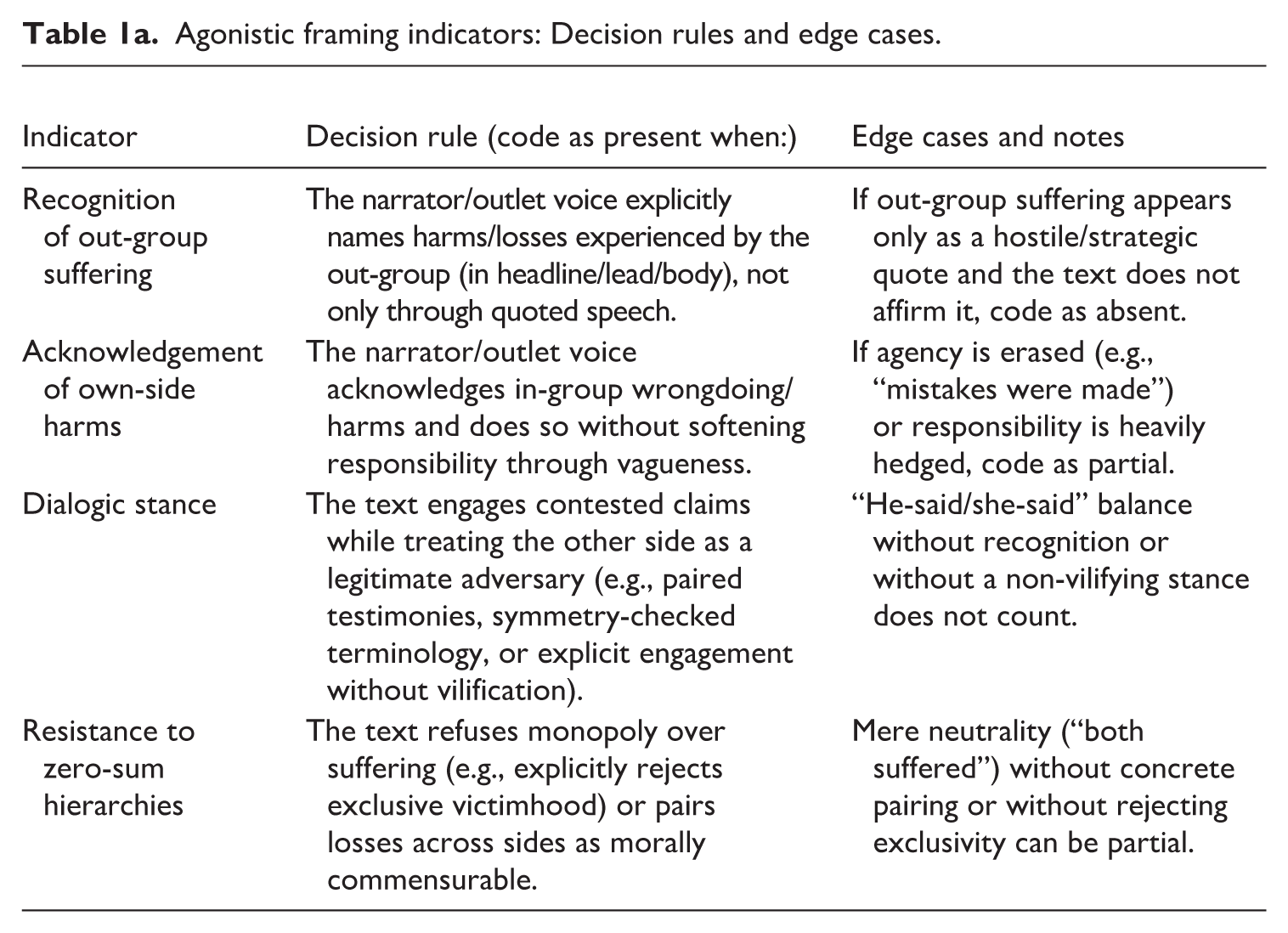
Section 2 defines agonistic and antagonistic victimhood framings and operationalises them as indicators (Tables 1a and b), then introduces the governance→routines→text mechanism (Figure 1). Section 3 sets out the design (36 interviews; 111 texts, 2013–2018). Section 4 reports the “five-plus-one” pattern (Figure 2) and traces how routines help explain it. Sections 5–7 test robustness, specify scope conditions, and draw out implications and a replication checklist.
Agonistic framing indicators: Decision rules and edge cases.
Antagonistic framing indicators: Decision rules and edge cases.
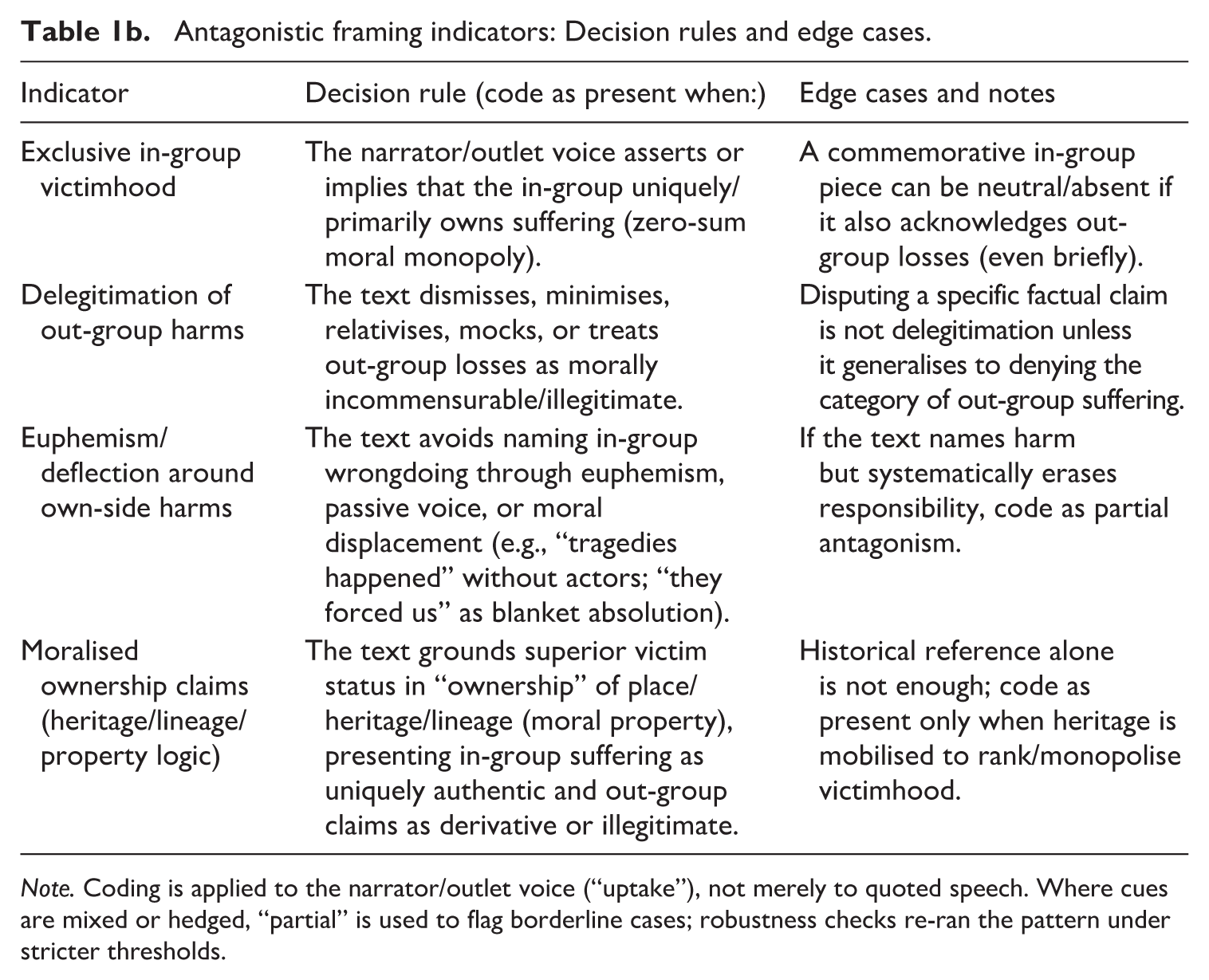
Note. Coding is applied to the narrator/outlet voice (“uptake”), not merely to quoted speech. Where cues are mixed or hedged, “partial” is used to flag borderline cases; robustness checks re-ran the pattern under stricter thresholds.
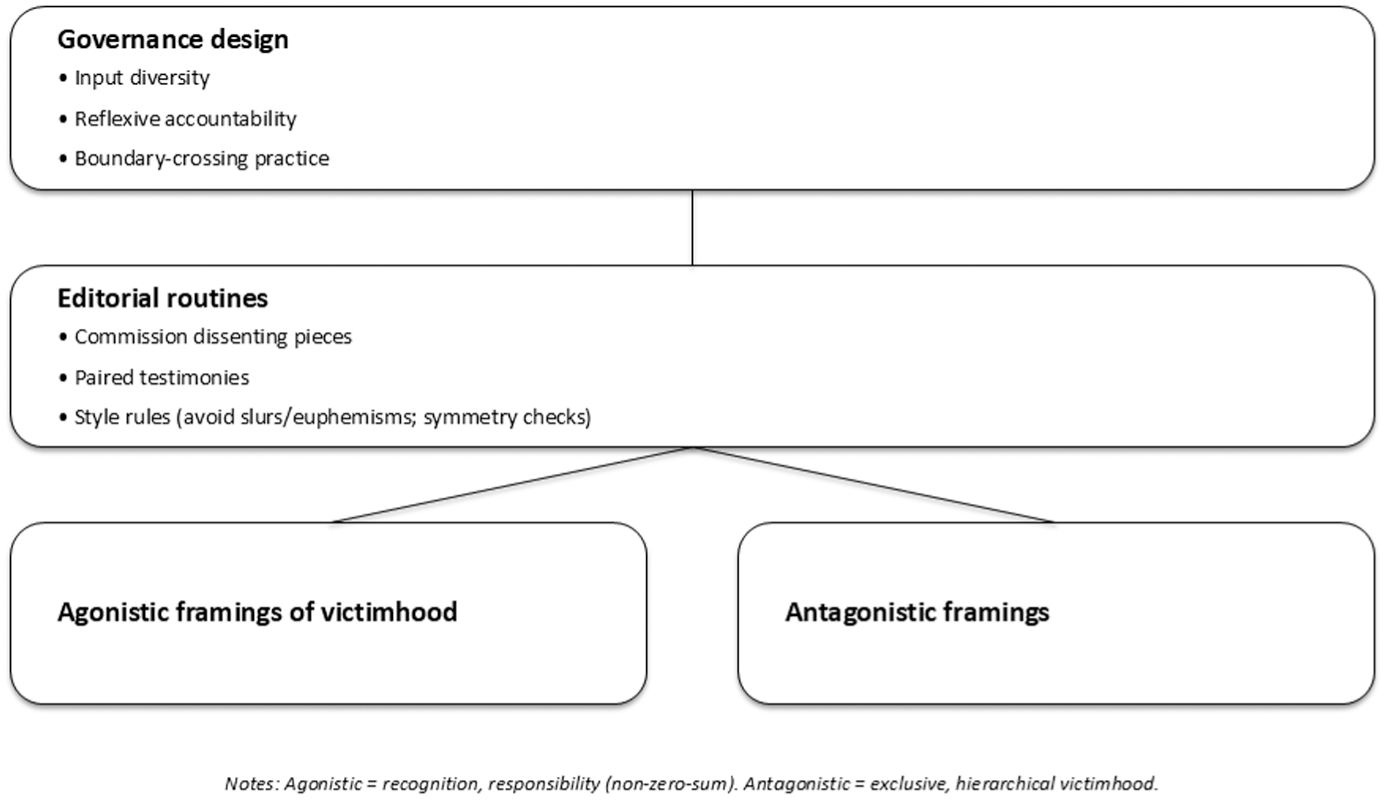
Governance, editorial routines, and text (mechanism). Three pathways: (a) deliberative input—assemblies and rotation—leading to commissions that include dissenting/oppositional voices and resulting in texts that recognize out-group and in-group victims; (b) boundary-crossing participation—bilingual co-production, translation partnerships—leading to routine inclusion of out-group testimonies and resulting in relational attributions of harm; (c) editorial rules—style guidance avoiding euphemisms and symmetry checks—creating permission to name own-side harms.
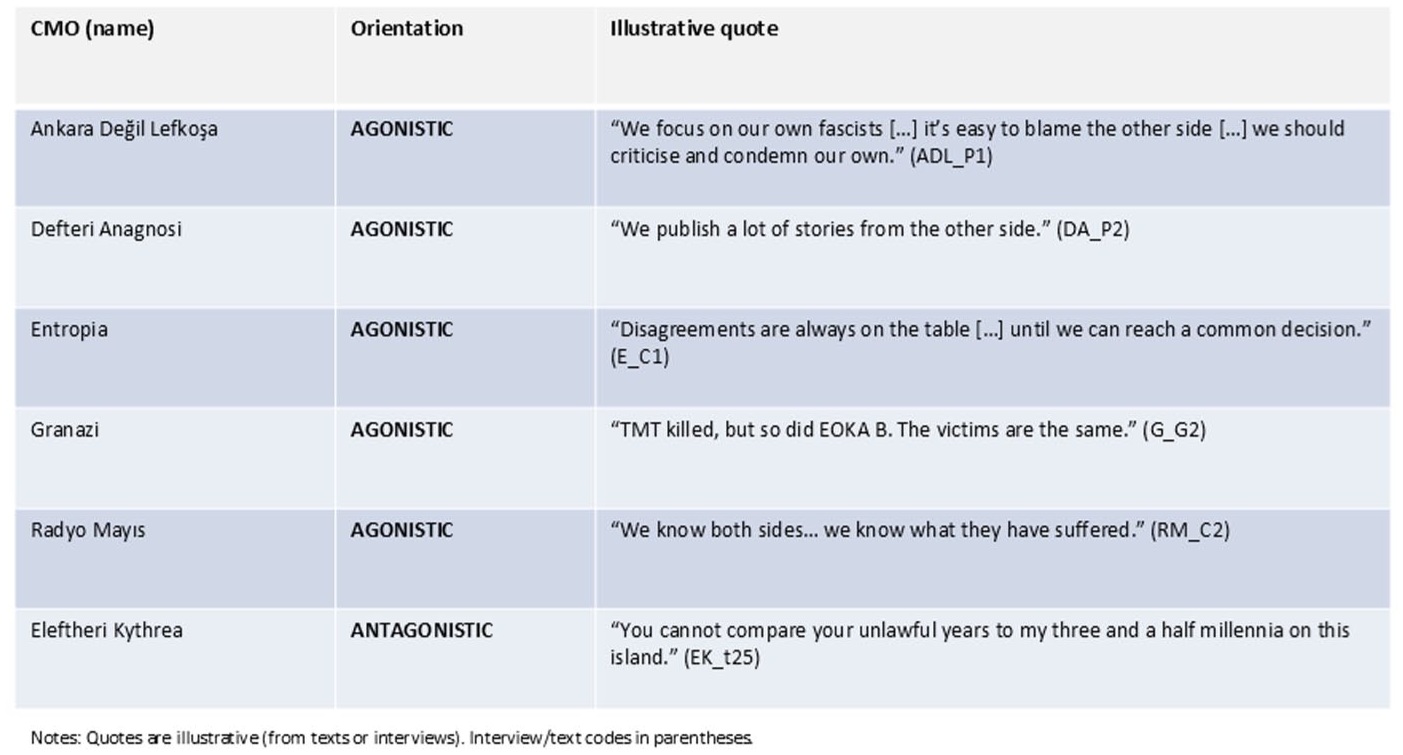
Five-plus-one pattern across six CMOs. A compact visual indicating the dominant orientation (agonistic vs antagonistic) per case, with one micro-quote per case (⩽25 words; source codes in parentheses).
From mapping to meaning: A concise conceptual bridge
This section builds the conceptual bridge from field mapping to textual analysis. This article defines agonistic framings of victimhood, contrasts them with antagonistic, zero-sum logics, and shows why participation as organizational infrastructure matters for what can be said, and by whom. We use “framing” in Entman’s (1993) canonical sense: selecting aspects of reality to make them salient in a communicating text, thereby promoting particular problem definitions, causal attributions, evaluations, and remedies. Table 1a and b operationalise the agonistic/antagonistic contrast as decision rules and indicators for coding texts. Section 2.4 states three propositions (P1–P3) summarised in Figure 1.
Agonistic framings of victimhood
Here, agonistic framings of victimhood are used to denote representations that keep conflict visible while refusing moral monopolies. They recognise out-group suffering, acknowledge own-side harms, and invite contestation without dehumanisation—consistent with agonistic pluralism. Following Mouffe (2005, 2013), agonism presumes enduring disagreement among legitimate adversaries; it rejects consensus as closure while disciplining antagonism so that the Other remains a valid interlocutor. Agonistic framings do not require agreement or reconciliationist closure; they require disagreement without erasing, vilifying, or delegitimising the other side’s losses.
By contrast, antagonistic framings monopolise victimhood for the in-group, minimise or deny out-group harms, and police taboos around naming in-group wrongdoing. Here agonism/antagonism is treated as an analytic lens observable in texts (lexicon, attribution, voice, narrative structure), not as a moral rating of outlets or authors (Fairey, 2024; Mouffe, 2005; Shinar, 2009). The concept overlaps with—but is not reducible to—peace journalism: it is compatible with critical disagreement and does not entail “reconciliationist” narratives, even as it resonates with peace journalism’s opposition to zero-sum victimhood and its preference for multi-perspectival sourcing (Galtung, 1998; Lynch and McGoldrick, 2005; Shinar, 2009).
Competitive vs. inclusive victimhood
Work in political psychology and conflict communication links competitive (exclusive) victimhood to hardened intergroup attitudes, in-group bias, and resistance to compromise, whereas inclusive victimhood and recognition tend to correlate with more conciliatory orientations (Counihan et al., 2024; Noor et al., 2012; Selvanathan et al., 2023). The dynamic is often described as a hierarchy of suffering in which in-group harm is privileged and out-group loss is minimised, denied, or treated as morally incommensurable. By contrast, inclusive victim consciousness expands moral concern to out-groups without negating one’s own losses (Vollhardt, 2015).
Translating these intergroup dynamics into media analysis, agonistic versus antagonistic victimhood framings are operationalised through four textual indicators (Tables 1a and b). Agonistic texts (i) recognise out-group suffering in the narrator’s own voice (not merely through hostile quotation); (ii) acknowledge own-side harms without euphemism; (iii) adopt a dialogic stance toward contested claims without vilification; and (iv) resist zero-sum hierarchies by pairing losses or explicitly refusing monopoly over suffering. Antagonistic texts reverse these cues: they privilege exclusive in-group victimhood, delegitimate out-group losses, soften or deflect in-group wrongdoing, and mobilise ownership claims that naturalise superior victim status.
Participation as organisational infrastructure
Participation is an organisational property: decision rules, role allocation, transparency routines, and boundary practices that shape who can speak, which claims are admissible, and how taboos are managed. Our usage aligns with classic participation theory that distinguishes tokenistic from empowering participation, and with democratic media theory that foregrounds how decision rules redistribute power (Arnstein, 1969; Carpentier, 2011; Pateman, 1970).
Community and alternative media scholarship often treats participation as a normative horizon, but it also documents substantial variation, drift, and internal asymmetries (Carpentier, 2011; Ihlebæk et al., 2022; Levesque and Onguny, 2024; Staender et al., 2024). The expectation is mechanistic: governance enables or constrains representational choices by stabilising the routines through which texts are produced. In Carpentier’s (2017) terms, participatory practices are entangled in a discursive–material knot: ideals of inclusion meet organisational constraints, resources, and informal hierarchies that condition what participation can practically do.
In Cyprus, participatory arrangements have been shown to create contact zones that sustain boundary-crossing practices (Yüksek and Carpentier, 2018). Beyond single outlets, transmedial practices in grassroots and alternative media show how participatory infrastructures can distribute oppositional stories across platforms and formats (Bromley and Voniati, 2026). A complementary analysis of these Cypriot CMOs likewise shows that participatory depth and reflexive accountability are decisive for sustaining agonistic democratic discourse more broadly (Voniati, 2026). Governance, then, is not a “values label” but an enabling condition for counter-hegemonic narration: it can stabilise dissent, normalise recognition across lines, and reduce reliance on ad-hoc, personality-driven editorial bravery in hybrid media environments (Ihlebæk et al., 2022; Wolfsfeld, 2004).
Communicative justice link
Framing victimhood agonistically is not only a matter of “more voices” but of whether voice is heard, taken up, and institutionally sustained. We treat this as a communicative-justice problem: who counts as a legitimate participant in public claims-making, and when recognition becomes routine rather than exceptional (Fraser, 2009). Dreher’s (2010) “politics of listening” sharpens the point: communicative justice cannot rest solely on marginalised speakers “speaking up,” but also on institutions building repeatable listening routines that make uptake more likely. In our mechanism, participatory governance designs (input diversity, accountability, boundary-crossing practice) enable such listening to be operationalised as newsroom routines; Tables 1a and b then specify when that listening becomes visible in discourse (e.g., narrator uptake of out-group losses; non-euphemised acknowledgement of own-side harm; refusal of monopoly over suffering).
Propositions
The analysis expects governance design to influence editorial routines and, in turn, textual outcomes. Analytically, we treat these links as causal process mechanisms that can be evaluated through within-case tracing of decisions, artefacts, and outputs (Beach and Pedersen, 2019). We specify three propositions, corresponding to the three pathways in Figure 1.
P1 (Deliberative input)
Where participatory governance institutionalises deliberative input (e.g., assemblies, role rotation, open pitch cycles), editors are more likely to encounter dissonant perspectives and to commission or accept content that recognises out-group suffering and acknowledges own-side harms.
P2 (Boundary-crossing participation)
Where participatory governance institutionalises boundary-crossing participation (e.g., co-production, translation partnerships, dialogue formats), out-group testimony is more likely to become routine rather than exceptional, increasing the likelihood of dialogic stance and paired losses in published texts.
P3 (Editorial rule sets)
Where outlets adopt compact editorial rule sets (e.g., symmetry checks; explicit guidance against euphemism; short contextual notes explaining sensitive publication choices), writers and editors are more likely to have permission to name taboo harms and to resist zero-sum hierarchies of victimhood.
Figure 1 summarises these pathways as a governance → routines → text mechanism that we examine through contrastive logic across cases, including a planned deviant case.
Why Cyprus matters theoretically
Cyprus’s dual media and memory fields, long horizon of division, and the coexistence of markedly different community media forms (movement-style assemblies, hybrid platforms, community radio, and heritage custodianship) provide built-in contrasts for evaluating the propositions (Voniati et al., 2018; Zembylas and Karahasan, 2017). These contrasts make Cyprus a most-likely case for antagonistic victimhood narratives—such narratives are historically entrenched—yet organisational forms vary sharply within the same conflict ecology. This configuration lets us probe whether participatory design, rather than issue mix or audience alone, helps predict agonistic outputs, with implications for other protracted conflicts where community outlets coexist with heritage custodianship (Bryant and Papadakis, 2012; Wolfsfeld, 2004).
The case is theory-relevant because it varies on participatory governance and boundary orientation while holding constant a high-stakes, divided setting. These built-in contrasts allow us to observe how participatory governance travels into editorial routines and, ultimately, textual outcomes. More broadly, the configuration illuminates a general mechanism—participatory governance → editorial routines → agonistic framings—that extends framing scholarship upstream to organisational design and invites mechanism-based tests beyond Cyprus.
Methods: Field mapping and data
The study combines a population-based field mapping of community media organisations (CMOs) in Cyprus with an embedded qualitative design (texts + interviews). The mapping establishes the field baseline (what kinds of outlets exist and how they are organised); the embedded design then examines how governance arrangements and editorial routines are reflected in published discourse.
The design is mechanism-oriented: it traces how organisational choices travel into routines and texts, rather than maximising breadth (Beach and Pedersen, 2019; George and Bennett, 2005). Triangulation across mapping data, archival texts, and interviews enables convergent validation of the proposed governance → routines → outputs mechanism, while also allowing us to probe plausible rivals (funding dependence, audience composition, and issue/genre mix).
Population mapping and MIC instrument
Identification and screening
To mitigate visibility bias in a fragmented field, we combined directory canvassing and desk/archival checks with snowballing through civil-society networks, cultural associations, municipal bulletins, activist and campus groups, and tri-lingual searches (Greek/Turkish/English). Stage 1 generated approximately 110 key-informant contacts and candidate outlets. Stage 2 conducted 62 verification interviews against an operational definition of community media: (i) civil-society embedded, non-profit logic; (ii) regular, public-facing content; (iii) substantial editorial autonomy from state/party/market actors; and (iv) meaningful participation opportunities beyond routine commenting. The final population comprised 26 CMOs across both communities.
Case selection
From the mapped population, we purposively selected six cases to maximise variation on governance form and boundary orientation, and to include a planned deviant heritage outlet for contrast. This selection strategy improves analytic leverage on the proposed mechanism while guarding against cherry-picking by making variation and contrast explicit (Seawright and Gerring, 2008).
Instrument (MIC)
For each CMO, we completed a Mapping Index Card (MIC) structured into eight blocks: (1) history; (2) remit/audiences; (3) formats/outputs; (4) governance structure and decision rules; (5) participation routines; (6) financing and autonomy claims; (7) boundary orientation; and (8) cross-community practice. Narrative fields were used to capture organisational nuances (e.g., taboo management; language policies; informal hierarchies; exceptional incidents). A purposive subset was double-coded; Krippendorff’s α (see Krippendorff, 2013) ranged from 0.777 to 1.000 on the main blocks. A fuller methodological account of the Cyprus mapping and contextual field description is reported elsewhere (Voniati, 2021; Voniati et al., 2018).
Text corpus and coding
Corpus
We compiled a corpus of 111 published items from the six selected CMOs spanning news/analysis, op-eds, features, poetry, and radio transcripts. Items were archived from outlet websites, print scans, and programme logs. Inclusion required explicit reference to conflict, memory, loss, displacement, suffering, or reconciliation themes. The unit of analysis is the published item (article, feature, poem, transcript segment). Where outlets produced high volumes, we used temporal balancing across months to reduce event clustering.
Coding logic
Coding was interpretive but rule-based. We operationalised agonistic/antagonistic victimhood framing through four indicators (see Tables 1a and 1b): (i) recognition of out-group suffering (with narrator uptake, not merely adversarial quotation); (ii) acknowledgement of own-side harms without euphemism; (iii) dialogic stance toward contested claims without vilification; and (iv) resistance to zero-sum hierarchies (e.g., explicit refusal of monopoly over suffering; pairing losses). Each coding decision was anchored to these indicators; edge cases were resolved through memoed adjudication rather than post-hoc redefinition (Saldaña, 2016).
Reliability and adjudication
Two trained coders jointly piloted the codebook to stability through calibration sessions. A stratified subset of texts was then double-read. Discrepancies were resolved through memo-based adjudication, with reasons logged in an audit trail (e.g., whether out-group recognition was narrator uptake or confined to hostile quotation; whether “mistakes were made” constituted euphemism). The full set was coded under these decision rules with periodic spot-checks against the audit trail to maintain consistency across time and genre.
Reflexivity
Because interpretations of victimhood, harm, and responsibility are inevitably shaped by researchers’ positioning in a divided field, we treated reflexivity as a quality-control procedure rather than a personal disclosure. Throughout calibration and adjudication, we used reflexive memos to surface assumptions, identify “common-sense” ethnonational categories, and record alternative readings before final coding decisions were logged in the audit trail (Berger, 2015).
Translation, fidelity, and coder roles
Source materials appeared in Greek, Turkish, and English; bilingual coders worked in the original language where available, with double-checks for semantic equivalence of key terms (e.g., “martyrs,” “occupation,” “peace operation”). Any uncertainty triggered a memo and, where quoted, back-translation. Two trained coders independently piloted the codebook; the lead coder then coded the full set with periodic spot-checks, resolving disagreements by consensus (a third-coder option was available but not used).
Producer interviews
We conducted 36 in-depth, semi-structured interviews with editors, producers, and coordinators across the six selected CMOs. The protocol focused on governance and decision-making (who decides, how accountability is enacted, and how disagreement is handled), participation routines (assemblies, rotation, openness of pitches/submissions), editorial rule sets (style guidance; symmetry checks; taboo management), and cross-boundary engagement (co-production, translation, dialogue formats). Interviews also elicited “critical incidents” (content controversies, veto moments, or difficult publication decisions) to generate traceable links between governance moments and textual choices (Kvale and Brinkmann, 2009).
Given the sensitivity of conflict-related speech and intra-community dissent, we avoided routine member-checking that could expose participants to reputational or political costs. However, participants were offered the option to review any excerpt attributed to their interview code on request. Throughout, we prioritised thick description of organisational practice and treated interview claims as evidence about decision rules and routines to be triangulated against mapping fields, documents, and texts.
Integration and inference
For each case, we assembled trace bundles linking: (i) a governance moment (decision, dispute, or routine); (ii) an editorial artefact (e.g., minutes, style notes, commission messages, contextual editor notes); and (iii) the resulting textual choice in the published item. These traces allow mechanism-focused inference: we assess whether governance arrangements plausibly generated editorial routines that, in turn, shaped textual framings of victimhood. We evaluate traces using process-tracing logic (including hoop tests and, where available, stronger “smoking-gun” indications), while keeping causal claims bounded to the evidence (Beach and Pedersen, 2019; Bennett and Checkel, 2015).
Inference proceeds through within-case process tracing and contrastive logic across cases, including a planned deviant heritage outlet. We also probe three rival explanations—funding dependence, audience composition, and issue/genre mix—using MIC fields, documents, and interview evidence. This “most-plausible alternative” logic clarifies what governance explains over and above resources, audiences, and topic selection (George and Bennett, 2005).
Field typology (baseline)
As a descriptive baseline, the mapped field clusters into five organisational families. First, activist and social-movement media: horizontal decision-making, porous civil-society ties, rotating roles, and outputs such as op-eds and campaign explainers. Second, cultural and heritage CMOs: custodial boards, lineage/authority claims, and commemorations or heritage essays. Third, alternative news and public affairs: hybrid activist–journalistic cores with advisory circles, producing investigations and analysis. Fourth, community radio: mixed governance with coordinators and volunteer producers, typically call-in magazines and interviews. Fifth, hybrid/bi-communal platforms: project-based co-production with translation capacity, often featuring paired testimonies and joint podcasts/events. The typology organises field structure and informed case selection; it does not pre-judge findings. It is consistent with classic work emphasising participation, autonomy, and counter-hegemonic orientation in alternative/community media (Atton, 2002; Downing, 2001).
With the baseline in place, we now turn to the texts to assess whether the expected pattern emerges and to trace how governance and routines bend representational outcomes.
Findings
Textual pattern: five agonistic, one antagonistic
Across the 111 texts, five outlets predominantly display agonistic framings of victimhood—they recognise out-group suffering, acknowledge own-side harms, and resist zero-sum hierarchies—while one heritage outlet consistently reproduces antagonistic, exclusive victimhood. The six outlets analysed are Ankara Değil Lefkoşa, Defteri Anagnosi, Entropia, Granazi, and Radyo Mayıs, with Eleftheri Kythrea included as a contrastive deviant case. Figure 2 summarises this “five-plus-one” pattern.
How agonism looks in practice
Agonistic items frequently: (i) pair testimonies across communities; (ii) use bilingual or symmetry-checked terminology; and (iii) adopt an explicit, self-implicating stance when naming own-side harms. Editors sometimes add brief contextual notes and apply headline/lead symmetry checks for sensitive items. Illustratively, one Radyo Mayıs producer notes, “We know both sides . . . we know what they have suffered” (RM_C2); an editor from Defteri Anagnosi stresses, “We publish a lot of stories from the other side” (DA_P2); and a producer from Ankara Değil Lefkoşa adds, “It’s easy to blame the other side . . . we should criticise our own” (ADL_P1). Together, these routines realise the agonistic indicators in Tables 1a and b: narrator uptake of out-group losses, non-euphemised acknowledgement of own-side harms, dialogic stance without vilification, and refusal of monopoly over suffering.
How antagonism appears
The heritage outlet frames lineage and place as moral property, leans on asymmetric temporality (deep historical continuity versus recent illegality), and polices taboos around naming own-side wrongdoing. Cross-community sources are absent, marginalised, or pre-emptively discredited; out-group losses are minimised, relativised, or treated as morally incommensurable.
Edge cases
Some commemorative pieces within otherwise agonistic outlets contain muted recognition and were coded as partial agonism under the decision rules (Tables 1a and b). Conversely, sporadic conciliatory phrases in the heritage outlet do not alter its dominant antagonistic orientation because the core cues—exclusive ownership, delegitimation, and euphemised own-side harm—remain intact.
Taken together, Section 4.1 establishes the pattern to be explained; Sections 4.2–4.3 then trace how governance arrangements travel into editorial routines and, in turn, into these textual outcomes.
Figure 2 visualises the five-plus-one pattern across the six CMOs.o
How governance bends content
Across the five agonistic outlets, a recurrent chain is observable: governance design → editorial routines → text. Three routine families recur, corresponding to P1–P3. First, deliberative input (assemblies, rotation, open submissions) exposes editors to dissonant perspectives and lowers the social cost of publishing internal critique. Second, boundary-crossing participation (co-production, translation partnerships, dialogue formats) makes out-group testimony routine rather than exceptional. Third, compact editorial rule sets (symmetry checks, anti-euphemism guidance, short “why we published this” notes) institutionalise permission to name taboo harms and to refuse zero-sum hierarchies. In combination, these routines travel into texts as paired testimonies, balanced attribution, and explicit acknowledgement of own-side wrongdoing when relevant—consistent with newsroom sociology findings that organisational routines mediate message formation (Ryfe, 2012; Shoemaker and Reese, 2014).
Two brief traces illustrate the mechanism in practice. In Defteri Anagnosi, a contested item naming own-side wrongdoing was published only after editors paired it with an out-group testimony and added a short contextual note; the published package makes the pairing visible in structure and lead emphasis (DA_t11 + DA_t2). In Radyo Mayıs, an on-air disagreement prompted an internal discussion and a symmetry-check rule for sensitive segments; a later transcript shows balanced terminology and a brief preface explaining the editorial choice (RM_C2). In both traces, governance does not directly “cause” agonistic language; it stabilises routines that help agonistic indicators survive editing and publication.
Boundary-crossing infrastructures matter where language divides publics. Translation partnerships and bilingual packaging reduce frictions that keep testimony siloed and allow out-group recognition to appear as narrator uptake rather than distant quotation. Agonistic outputs, then, are made repeatable by routinised decision rules anchored in participatory governance.
Deviant case: Exclusive victimhood (heritage outlet)
The heritage outlet sustains antagonistic victimhood through a closure regime: it frames lineage and place as moral property, treats suffering as a hierarchical entitlement, and polices taboos around naming own-side wrongdoing. Three cues recur across texts. First, exclusive ownership narratives present memory and land as in-group property that grounds superior victim status. Second, asymmetric temporality juxtaposes deep historical continuity against recent illegality, naturalising incommensurability. Third, delegitimation of out-group losses occurs through minimisation, suspicion, or pre-emptive discrediting of out-group testimony. One item captures the logic succinctly: “You cannot compare your forty-one unlawful years to my three and a half millennia on this island” (EK_t25). Such formulations exemplify heritage exceptionalism—the mobilisation of antiquity and lineage to stabilise exclusive claims over memory and space (Lowenthal, 1998).
Analytic value
Treating this outlet as a planned deviant case strengthens inference by contrast. It shows that antagonistic framing can remain stable even without obvious funding shocks, and that occasional gestures toward “balance” do not alter output when participation is not institutionalised and when editorial rules do not license recognition across lines. In mechanism terms, custodial governance (low rotation; protective boundaries; heritage authority) coheres with routines that discourage narrator uptake of out-group suffering and keep own-side wrongdoing euphemised or off-limits.
Scope implications
The deviant case also clarifies boundary conditions: where heritage custodianship imposes purity logics and ownership claims, agonistic framings are unlikely unless countervailing routines (deliberative input, boundary-crossing participation, explicit anti-euphemism/symmetry rules) are deliberately institutionalised. This does not imply that heritage work is inherently antagonistic; it shows that, in this conflict ecology, custodial governance without participatory correctives tends to stabilise exclusive victimhood and communicative closure.
Robustness and replication
Rival explanations
We assessed three plausible rival explanations using MIC fields, organisational documents, and interview evidence alongside the texts: funding dependence, audience orientation, and issue/genre mix. The aim is not statistical control but mechanism-focused plausibility: do rivals account for the observed pattern without invoking governance design, or do they mainly condition how governance works in practice?
Funding dependence
Resource volatility shapes production capacity and risk tolerance, but it does not map cleanly onto the outlet-level orientation. In the cases analysed, outlets with explicit participation routines and compact editorial rules maintained agonistic indicators despite financial fragility, whereas the heritage outlet sustained antagonistic cues under comparatively stable support. Funding thus appears to act as an amplifier or constraint on routines (e.g., translation capacity), rather than a substitute explanation for the direction of victimhood framing.
Audience orientation
Audience composition and target community matter for what is legible and politically feasible, yet they do not mechanically predict antagonism. Several agonistic outlets address primarily in-group publics but institutionalise boundary-crossing routines (e.g., bilingual packaging; paired testimony formats) that bring out-group recognition into the outlet’s own narrative voice. Audience orientation therefore conditions the cost of recognition, but does not by itself explain why recognition becomes routine in some outlets and not others.
Issue/genre mix
Genre matters at the margins. Commemorative and heritage genres raise the likelihood of exclusive ownership claims and euphemised own-side harm. However, where commemorations are paired with dialogic formats, contextual editor notes, or symmetry checks, agonistic indicators remain visible. Conversely, the heritage outlet’s antagonistic cues persist across genres, suggesting a more stable organisational logic than topic selection alone.
Interim conclusion
Taken together, the rivals help specify constraints (resources, audience risk, genre effects), but they do not account for the five-plus-one pattern as parsimoniously as the governance → routines → text mechanism traced in Sections 4.2–4.3. The claim is bounded: governance has higher leverage for routinised recognition and accountability, while rivals shape how easily routines can be sustained.
Sensitivity checks
We conducted three sensitivity checks aimed at the most likely sources of classification instability: edge cases, threshold strictness, and genre clustering.
Edge cases (partial agonism)
Items with muted recognition or hedged acknowledgement (e.g., vague agency in naming harm) were coded as partial under Tables 1a and b decision rules. We re-read these cases to ensure that partial coding reflected genuinely mixed cues rather than coder drift.
Stricter threshold
As a robustness check, we re-applied a stricter rule that counted only clear, unambiguous instances of each agonistic indicator (excluding partial cases). This did not change the outlet-level pattern: the same five outlets remain predominantly agonistic, and the heritage outlet remains predominantly antagonistic.
Genre clustering
We reviewed whether the five-plus-one pattern could be an artefact of genre concentration (e.g., commemorations). While genre shifts the probability of particular cues, it does not overturn the pattern: agonistic outlets display recognition and accountability indicators across multiple genres, and antagonistic cues in the heritage outlet remain stable rather than genre-specific.
Finally, we reiterate a scope statement: 2013–2018 is treated as a historical baseline for identifying organisational mechanisms, not as a claim about current conditions. The replication protocol (§5.4) specifies how to re-test the mechanism with contemporary corpora.
Scope conditions
The mechanism proposed here is expected to operate under identifiable scope conditions. Agonistic framings of victimhood become more likely when participatory governance stabilises disagreement as routine rather than exceptional. In practice, this is most likely where governance stabilises (i) input diversity (rotation, open pitches, assemblies); (ii) reflexive accountability (documented decisions, correction practices, tolerance for internal dissent); (iii) boundary-crossing routines (co-production, translation partnerships, dialogic formats); and (iv) compact editorial rule sets that institutionalise permission to name taboo harms (symmetry checks; explicit anti-euphemism guidance; short contextual editor notes for sensitive items).
Conversely, the mechanism is constrained when three conditions coincide: symbolic participation without influence, dependency regimes that punish dissent (funding, party ties, donor strings), and platform incentives that reward outrage or selective victimhood. Under these conditions, participatory governance becomes procedural rather than substantive, and routine symmetry checks are harder to sustain.
A final boundary concerns causality: governance and outputs can co-evolve. While we trace governance-to-routine-to-text pathways as the dominant direction for the baseline period, we do not assume strict unidirectionality; successful agonistic outputs can also reinforce participatory routines over time, and backlash can harden closure regimes.
Replication checklist
To re-test the mechanism beyond the baseline (and to evaluate change after 2018), the following replication-oriented protocol can be applied:
Discussion
What the mechanism adds
This article moves beyond the intuition that community media “humanise” conflict and specifies when and how they can do so. The core contribution is upstream: it connects victimhood framings to an organisational pathway in which participatory governance—treated as infrastructure rather than ethos—stabilises editorial routines that make agonistic framings of victimhood more likely to survive commissioning, editing, and publication. In the Cyprus baseline, three governance-enabled routine families recur across the five agonistic outlets: deliberative input (assemblies, rotation, open pitch cycles); boundary-crossing participation (co-production, translation partnerships, dialogue formats); and compact editorial rule sets (symmetry checks, anti-euphemism guidance, contextual editor notes for sensitive items). These routines, in turn, travel into texts as out-group recognition with narrator uptake, acknowledgement of own-side harms without euphemism, a dialogic stance without vilification, and resistance to zero-sum hierarchies of suffering (Tables 1a and b).
The mechanism refines three literatures at once. First, it extends framing research “upstream” to organisational design, consistent with media sociology accounts in which routines mediate message formation and stabilise what counts as publishable knowledge (Shoemaker and Reese, 2014). Second, it gives agonistic pluralism an empirically traceable production pathway: the permission to name taboo harms is not only an individual disposition or episodic courage; it is a governance property that can be routinised and defended collectively (Mouffe, 2005, 2013). Third, it clarifies how community media can resist competitive victimhood dynamics: where routines normalise recognition and accountability, texts are more likely to avoid moral monopolies and to resist hierarchical victimhood claims (Counihan et al., 2024; Vollhardt, 2015).
The article also disciplines optimistic accounts of participation. Participation does not mechanically produce agonistic outcomes; it can contain internal asymmetries and exclusions. What matters is whether governance design translates inclusion, accountability, and boundary-crossing into repeatable routines that shape textual outputs—capturing the discursive–material knot through which participatory ideals meet organisational constraints and informal hierarchies (Carpentier, 2017; Ihlebæk et al., 2022; Staender et al., 2024). In this sense, this article reframes peace journalism debates: instead of prescribing “better” outputs, it specifies the organisational conditions under which multi-perspectival, non-zero-sum victimhood representations become sustainable practice (Lynch and McGoldrick, 2005; Shinar, 2009). The broader implication is simple but consequential: who counts as a victim is partly a governance effect, not only a narrative choice.
Implications for practice and policy
The practical implication is design-oriented: in conflict-sensitive media, the key lever is institutionalising routines that make recognition and accountability repeatable. Four implementable levers stand out.
For funders and policy actors, the implication is to fund capacity for participation, not only content: time for deliberation, modest stipends enabling role rotation, translation, and verification resources, and infrastructure for co-production. This sustains agonistic outputs beyond one-off “good” stories that cannot be repeated. Finally, because participatory infrastructures can operate transmedially, supporting governance routines can have spill-over effects across platforms and formats, strengthening counter-hegemonic narration beyond any single outlet (Bromley and Voniati, 2026).
Limits, scope, and what travels
Three limits are central. First, temporal scope: 2013–2018 is treated as an historical baseline for identifying organisational mechanisms, not as a claim about current conditions. The replication protocol (§5.4) specifies how to re-test the mechanism with contemporary corpora and updated field maps. Since 2018, platformization and metrics-driven distribution may have reweighted editorial incentives and participation frictions; a replication using post-2018 texts would test whether the mechanism holds under intensified datafication and algorithmic visibility pressures.
Second, method and inference: coding is interpretive, rule-based (Tables 1a and b), and supported by memoed adjudication. This is appropriate to the construct—victimhood framings are context-sensitive and often signalled through implication, attribution, and taboo-management rather than through overt keywords—but it also means claims should remain mechanism-bounded rather than frequency-maximising.
Third, power and asymmetry: agonistic framings do not require consensus, remorse, or reconciliationist closure, but they do require that the Other remain a legitimate interlocutor. Where structural inequality, legal/extra-legal risk, or strong boundary policing makes reciprocity of recognition practically dangerous or institutionally blocked, the mechanism is constrained. The deviant heritage case illustrates a particularly hard boundary: custodial governance anchored in ownership and purity logics stabilises communicative closure unless countervailing routines are deliberately institutionalised. We also do not assume strict unidirectionality: outputs can feed back into governance—successful agonistic items can strengthen participatory routines, while backlash can harden closure regimes—so the mechanism should be treated as a dominant pathway under specified conditions, not a one-way law.
We did not systematically analyse audience reception; however, producers reported that comment streams, emails, and social-media reactions could both reward cross-community recognition and punish it through backlash—pressures that fed back into moderation practices and rule enforcement. Future work should pair organisational mechanisms with reception/engagement analysis to examine how publics appropriate, contest, or refuse agonistic framings.
What travels is not “Cyprus” but a portable organisational logic: where outlets institutionalise input diversity, reflexive accountability, boundary-crossing routines, and compact rule sets that license taboo-naming, agonistic indicators should remain visible in published discourse. Where these conditions are absent—or where platform incentives and resource scarcity erode deliberation, translation capacity, and rule enforcement—antagonistic framings are more likely to persist. The appropriate generalisation is mechanism-based: portable where participatory infrastructures can be built, and falsifiable where they cannot.
Conclusion
This study asked who counts as a victim in Cyprus’s community media and how participatory governance conditions agonistic framings. Using a validated field baseline and an embedded design (36 interviews; 111 texts, 2013–2018), we found a “five-plus-one” pattern: five outlets predominantly frame victimhood agonistically, while a heritage outlet remains antagonistic. We traced how governance travels into text via deliberative input, boundary-crossing participation, and compact editorial rule sets. The contribution is: (i) conceptual—linking agonistic pluralism to organisational design; (ii) methodological—offering transparent indicators (Tables 1a and b) and a replication protocol (§5.4); and (iii) practical—identifying modifiable levers for editors and funders.
Treating 2013–2018 as a baseline, the model is falsifiable: where governance reforms take root, agonistic framings should remain visible; where they do not, antagonism is likely to persist. More broadly, broadening who “counts” as a victim is not only persuasion but organisation—how participation is structured in media institutions. Efforts to broaden victim representation should therefore focus on participation structures, not only content strategies.
Footnotes
Acknowledgements
I thank Hazal Yolga (Cyprus Community Media Centre) for research and translation assistance during the mapping stage, and Nico Carpentier and Vaia Doudaki for supervisory guidance. Nikolas Defteras contributed to the field mapping and left the team thereafter. Any errors are my own.

Ethical considerations
All interview participants provided informed consent. Interviews were audio-recorded with permission and transcribed/translated as needed. Outlets are publicly named; interviewees remain anonymised via internal codes. Procedures followed the university’s research ethics guidance.
Funding
This article is based on research conducted during my doctoral studies at the Vrije Universiteit Brussel, supported by the Research Foundation Flanders (FWO); grant number G016114N.
Declaration of conflicting interests
The author declared no potential conflicts of interest with respect to the research, authorship, and publication of this article.
Data availability statement
Instruments, codebook excerpts, and anonymised trace pointers can be provided upon request.