



Abstract
This study analyzes peace representations in the Colombian press during transitional justice (2016–2021) of an intractable conflict. A sample of 1,800 news articles and 1,609 photographs from two national newspapers was analyzed through automated lexical analysis and manual image coding. The authors’ findings revealed two dominant representations: a victim-centric approach (negative emotions and confrontation) and an institutional one (state-led, political cooperation). Results indicate the press reinforced a hegemonic, institutional perspective, portraying government elites as drivers of peace –related to structural peace initiatives, while depicting victims and communities as passive beneficiaries – aligned with negative peace, underlining conflict ending over societal transformation. Peace narratives shifted from heterogeneous perspectives to singular focuses on victims or institutions. Emotionally impactful images, often depicting victims, children, and death references, were used to evoke reactions, yet gender disparities overlooked women’s agency. The press prioritized bureaucratic, top-down peacebuilding, sidelining grassroots initiatives and alternative solutions from conflict-affected communities, reinforcing a state-centric approach to peace.
Keywords
This study explores how the Colombian press communicated peace textually and visually during the 2016 peace agreement referendum and the first five years (2017–2021) of transitional justice (TJ). We analyzed the text of 1800 news articles and their leading photographs through automated lexical analysis and quantitative categorization to examine what peace representations the press disseminated. Colombia has experienced one of the region’s most protracted conflicts, culminating in the 2016 peace agreement with the largest guerrilla ‘FARC-EP’. In the last decade, public debates on peace have revealed a polarized sociopolitical arena, multiple disagreements on achieving peaceful resolutions, and challenges in implementing TJ effectively.
The Colombian case illustrates an intractable conflict with multiple illegal armed groups, intense political polarization, and devastating high victimization. Root causes include economic and sociopolitical exclusion, and land disputes for economic development. After six decades of war and four years of negotiations, the 2016 peace agreement with the guerrilla FARC-EP was signed despite being rejected by 51% at the referendum 1 and the right-wing party’s opposition (Democratic Center Party). The agreement addressed the conflict’s underlying factors through a TJ model emphasizing socioeconomic reparations and equality.
Political elites were divided, casting doubt on the agreement’s effectiveness and costs. Societal disagreements over peace coincided with political polarization, low institutional trust, a negative emotional climate (Ruiz et al., 2022) and the persistence of other armed groups. This fostered a unique media environment and public opinion with heightened political expression online and in digital media (Arroyave and Romero, 2023).
During 2016, top-down peacebuilding efforts challenged the psychosocial foundation of the conflict. However, by 2018, the right-wing president Iván Duque questioned these measures’ efficacy. Despite institutional support and media coverage of peacebuilding, counter-narratives of peace and a tense sociopolitical climate reinforced hindering beliefs acting as barriers to peace (Rico and Barreto, 2022). Lastly, the media, which once normalized violence during the conflict, now plays a role in TJ strategies to promote peaceful resolution (Truth Commission, 2022).
Media in transitional justice
Media plays a significant role in intractable conflicts by disseminating narratives that legitimize conflict-supporting perspectives while marginalizing alternative information, hindering peaceful resolution. In societies transitioning from violence, media and cultural products are crucial for shifting dominant narratives toward peace that must be shared by the public and elites (Bar-Tal et al., 2014).
Societies collectively build the meaning of social objects (i.e., values, ideas, and practices) through communication and interaction, creating a code for social exchange that individuals reproduce and modify (Höijer, 2011; Moscovici and Duveen, 2000). During conflicts, rigid beliefs reinforcing violence contribute to distorted and biased information processing, perpetuating conflict (Bar-Tal and Halperin, 2014).
News outlets must actively participate in transitional efforts to transform societal paradigms, serving as communicators and accountable actors in post-conflict settings (Laplante, 2015). Media in TJ is the primary channel for information about its institutions and mechanisms, shaping public perceptions of historical conflicts, representing victims, uncovering hidden truths, or monitoring accountability (Laplante and Phenicie, 2010).
This intermediary role influences how society perceives TJ initiatives. For instance, mass media can raise awareness of past violence, fostering a shift in collective memory that respects human rights and supports peaceful democracy (Laplante, 2015). Journalists often adopt broader roles as activists, public interest protectors, or educators, reflecting a heightened responsibility in transitional settings (Andresen et al., 2017).
News outlets have undergone legal reforms to increase TJ acceptance and decrease hate speech (Price and Stremlau, 2012), focusing on how violent past is portrayed (e.g., who did what, who was guilty). Media regulation aims to improve content transparency, reduce uncertainty, and promote democratic values (Buyse, 2015). However, the interaction of media and TJ is complex with positive effects in cases like South Africa and negative impacts in others like Peru, where coverage fueled political polarization and divisive misperceptions (Hodzic and Tolbert, 2017).
In Colombia, TJ institutions used mainstream media to set the agenda around the conflict (Truth Commission, 2022). Studies on Colombian media present mixed findings: Rincón-Unigarro et al. (2020) noted conflict-oriented beliefs and emotional appeals pre-agreement, shifting to peace-related beliefs during the referendum. Conversely, García-Perdomo et al. (2022) identified war frames in referendum coverage, favoring elite sources and dual-party reporting.
We argue that analyzing textual and visual media portrayals of peace in TJ is crucial, as news outlets contribute to collective beliefs and narratives that foster lasting peace (Bar-Tal and Halperin, 2013).
Political elite and media
Analyzing traditional media content reveals the information flow between elite and other social groups in the public sphere, especially when political and economic entities participate and own national media (Happer and Philo, 2013), as is the Colombian case. Press content, even online, reflects power structures and often shares hegemonic interpretations of social objects held by dominant groups.
Media and political elites share a bidirectional, symbiotic relationship, fulfilling distinct roles based on their interests and context (Bahador et al., 2019). Media inform politicians about public opinion and other political actors, enabling them to capitalize on issue salience. Simultaneously, media serve as a public arena and a tool for political communication, advancing elite perspectives to cultivate favorable images and agendas (Van Aelst and Walgrave, 2016). Moreover, shifts in politicians’ policy positions can lead to changes in media coverage (Habel, 2012).
As intermediaries between political elites and the public (Aday, 2010), policymakers use media to disseminate information, push their interpretation of social issues, and frame negotiations (Van Aelst and Walgrave, 2016). Consequently, elites can shape media coverage (Carmichael and Brulle, 2017), which in turn influences political attitudes and social processes like public expression and agenda salience (Amsalem and Zoizner, 2022; Luo et al., 2019). For example, Mun et al. (2021) found that tolerance toward Colombia’s largest guerrilla group was positively related to news consumption about the peace process.
Regarding political elite and media coverage in TJ, studies in Colombia show how media representations of the peace agreement changed between Santos pro-agreement administration (2014–2018) and Duque’s right-wing administration (2018–2022). During the first period, Grajales Sánchez and Martínez Arévalo (2020) found that a national newspaper legitimized dialogue strategies and supported the negotiation team. In contrast, in the second period, media portrayed the agreement as problematic, with a pessimist bias toward key peace issues (Charry et al., 2019). The media portrayals of peace have changed since the 2016 agreement, shifting from optimism to polarization.
We argue that media content reflects top-down peacebuilding structures, echoing official narratives from political elites, governments, and transitional institutions as primary sources. Top-down approaches prioritize security and peace from a traditional perspective, emphasizing bureaucratic processes and international support. Meanwhile, bottom-up perspectives favor the voices of other social groups and everyday narratives from conflict-affected areas (Mac Ginty and Firchow, 2016).
Media coverage of peace-related issues could reveal tensions between these peacebuilding perspectives. For instance, after Colombia’s first TJ law in 2011, Montoya and Vallejo (2018) found newspapers covered transitional issues differently. Law implementation and international cooperation had an elite-driven coverage focusing on procedural politics, meanwhile, when discussing the peace process and armed conflict, the media acted as advocates of victims with symbolic alternative narratives and popular appeals.
Peace representations
The representation of peace is a dynamic and debated concept, less stable than war, and relates to abstract notions and values such as positive emotions, interpersonal relationships, metaphors, and symbols like doves. Moreover, it is often viewed as an unattainable goal or utopia, linked to structural changes like equality, justice, and tolerance (Sarrica, 2007; Sarrica and Wachelke, 2012).
Societal and cultural contexts influence diverse representations of peace (Sarrica and Wachelke, 2012). Previous studies show that, even when peace is a shared goal for a population in armed conflict, its citizens may hold different meanings, expectations, and preferred methods to achieve peace (Akalın and Göregenli, 2022; Leshem and Halperin, 2020).
In protracted conflicts, people’s associations with peace stemmed from three definitions. First, negative peace, meaning absence of direct violence in all forms, such as war, death, and bloodshed; second, positive peace understood as positive social and commercial relationships based on cooperation and harmony; and lastly, structural peace tied to independence, equality, and overturning entrenched systems (e.g., ending discrimination and racism) to achieve justice (Biton and Salomon, 2006; Leshem and Halperin, 2020).
Given Colombia’s controversial peace agreement referendum, multiple peace representations likely coexist with varying objectives. This study addresses the need to analyze how society publicly handles peace while overcoming hostile dynamics. While prior research examines war vs. peace frames in media evaluating the reporting practices and strategies (García-Perdomo et al., 2022), we explore what newspapers discuss when addressing peace. Analyzing peace representations in media reveals the collective meanings – symbols, associations, images, etc. – used and shared in the public sphere to make sense of peace, how they change through communication and interaction, and whether they reflect differing preferences for conflict resolution.
Why do images matter to peace representation?
While most research has focused on beliefs and attitudes about peace and conflict in Colombia (Rico and Barreto, 2022), few studies have examined media representations, particularly images. This study examines how Colombian press discussed peace visually during 2016 and the first five years of TJ.
Photographs are pivotal in representing social issues; they can make abstract peace concepts tangible, and newspapers use them to illustrate key ideas and amplify their messages (Höijer, 2011). Though conflict imagery’s role is well-documented across contexts (Fahmy and Neumann, 2012; Schwalbe and Dougherty, 2015), peace imagery remains underexplored (Möller, 2019).
News photographs in protracted conflicts evoke emotional responses, affect messages’ interest and credibility, and influence perceptions of represented actors (Brantner et al., 2011). By employing emotionally charged images, visuals transform abstract issues into concrete concepts; this emotional objectification aids issue interpretation and judgement (Höijer, 2011).
For instance, images of certain social groups have behavioral and emotional effects concerning conflict resolution. Victims and belligerent photos influence opinion, activate emotional pathways, and drive victim protection or military intervention. Victim images elicited sympathy, increasing support for policy intervention, while paired with text triggered anger (Powell et al., 2015). Instead, negotiation photos between elites and demonstrations emphasize reconciliation and reconstruction (Fahmy and Neumann, 2012).
Other groups include children, whose vulnerability elicits urgency (Fahmy and Neumann, 2012), and women, often reduced to mourning figures that reinforce passive victimhood (Zarzycka, 2016). In Colombia, violent imagery (e.g., massacres, funerals) triggered intense emotions (Hurtado-Parrado et al., 2020) with death-related images generating higher emotional activation. Likewise, Powell et al. (2015) found loss-related visuals reduce war support. Given Colombia’s polarization, newspapers likely leverage such imagery to shape emotional responses to peace.
Method
This study’s novelty lies in examining peace representations through text and images during TJ in an intractable conflict, revealing how peace and its symbols are socially shared. The six-year sample (2016–2021) tracks changes in peace narratives after a controversial agreement, addressing two questions: what peace representations were disseminated textually and visually, and to what extent the topics’ salience has changed over time. To our knowledge, no prior studies have examined Colombian media’s peace imagery and text, underscoring the role of peace representations in discussing peace as a viable solution.
We gathered 1,800 online news articles from El Espectador and El Tiempo, Colombia’s most widely circulated and trusted newspapers (García-Perdomo et al., 2022) for lexical and visual analysis of peace representations. These outlets have distinct political ties 2 and stances on the conflict and peace agreement (Grajales Sánchez and Martínez Arévalo, 2020; López-López et al., 2014). The sample covers January 2016 to December 2021, covering the peace process final year (the referendum) and TJ’s first five years.
Data collection
We performed a manual, systematic online news collection. First, free accounts were created on the newspapers’ websites. Second, the search keywords were peace, truth, and victims, identified by Caicedo-Moreno et al. (2021) as salient issues regarding 2016 coverage of the agreement. These words relate to the agreement’s main objectives: building a stable peace, searching for the truth, and repairing the victims as a key component (Truth Commission, 2022). Content was filtered by year on each website (e.g., 01/01/2016 – 12/31/2016).
The initial keyword truth yielded unrelated results, so it was refined to Truth Commission to focus on peace-related content. This returned 103,939 articles from El Tiempo and 12,289 from El Espectador between 2016 and 2021.
Third, researchers manually screened news for peace, victims, and truth commission to identify those related to peace, armed conflict, or TJ, using predefined topics (see Appendix 1 for criteria). Articles were randomly organized by the websites and manually reviewed until reaching 300 items per year, a predetermined limit to balance relevance, breadth for lexical analysis, and resource constraints. 3 Duplicates were removed. The final dataset, collected between 2021 and 2022, included 1800 news (900 per newspaper, 600 per keyword, and 300 per year; see Appendix 2) and 1609 photographs.
Data analysis
Three methods were employed using Iramuteq software (Ratinaud, 2009): the Reinert method, lexical similarity analysis, and multiple correspondence factor analysis. Iramuteq processes text, generates matrices, and writes R scripts, enabling statistical analysis and visualization.
First, the Reinert Method (1983, 1993) served as our primary lexical analysis tool, extracting words and sentences and categorizing them by frequency and proximity, allowing statistical analysis through vocabulary quantification. It identifies co-occurrence patterns, reflecting trends or emerging terms, i.e., shared representations in collective thinking. It treats language as a system of interdependent words, making it suitable for studying media and social issues (Idoiaga Mondragon et al., 2018; Klein and Licata, 2003).
This method employs descending hierarchical clustering to group text segments that appear together into lexical classes in collective discourse, identifying words and segments that best represent each class or repeated idea. It handles text as a collection of words forming units of meaning reflecting diverse perspectives on a topic, regardless of syntax (Reinert, 1993).
The process is automated and partially supervised. The algorithm classifies nouns, verbs, adjectives, and adverbs, identifying 30-word segments to create a contingency table, generate a distance matrix (where segments are close if they share parsed words), and perform hierarchical clustering, producing classes that best differentiate vocabulary (Kronberger and Wagner, 2000). Iramuteq calculates association strength using Chi-square (x2) value 4 that describes how often segments would appear together if distributed randomly; a high value indicates stronger associations between segments or other variables (i.e., year and photograph variables).
Second, a similarity analysis was performed in each lexical class to confirm the content structure and interpretation. It visualizes the corpus as a tree-like figure, with nodes representing significant terms and connections showing lexical communities, highlighting co-occurrences, and summarizing the internal structure of the representation (Marchand and Ratinaud, 2012).
Third, a correspondence factor analysis graphed oppositions and tendencies among text classes, mapping them in a two-factor space (Kronberger and Wagner, 2000).
Before analyzing the full corpus, we tested keyword sensitivity by applying the Reinert method to each keyword (peace, Truth Commission, victims), verifying consistent clustering patterns across keywords and confirming all content revolved around peace representations (see Appendix 3). Similarity graphs validated the connectivity, correlations, and closeness of lexical spaces (Marchand and Ratinaud, 2012) (see Appendix 4).
This automated approach provides transparent and reproducible statistical analysis with minimal supervision and reduces researcher bias, while balancing reliability and validity in large-text analysis (Reinert, 1983). Researchers interpret and name the lexical classes identified by the algorithm. The original Spanish data were translated by trained researchers for publication.
Besides text, we analyzed photographs to explore the social groups associated with peace representations. First, we categorized 5 them based on the group membership or social role adapted from Fahmy and Neumann (2012): role (victims, civilians, politicians, experts, armed actors, ex-combatants, demonstrations, and negotiating team). Second, we classified by gender (women, men, or women and men together), children’s presence, and references to the deceased 6 grounded in results from (Hurtado-Parrado et al., 2020; Powell et al., 2015; Zarzycka, 2016).
These variables highlight emotional and behavioral activation related to conflict resolution preferences and attitudes towards victimhood or war, issues that materialize and provide context to abstract representations of positive, negative, or structural peace. Lastly, these variables and publication years were associated with the lexical classes.
Results
The textual corpus contained 1,759,982 words, of which 14,557 were unique. The descending hierarchical cluster analysis divided the corpus into 63,496 segments, found two clusters, and assigned 91.11% into five classes. Figure 1 illustrates the dendrogram with the most frequent and associated words.
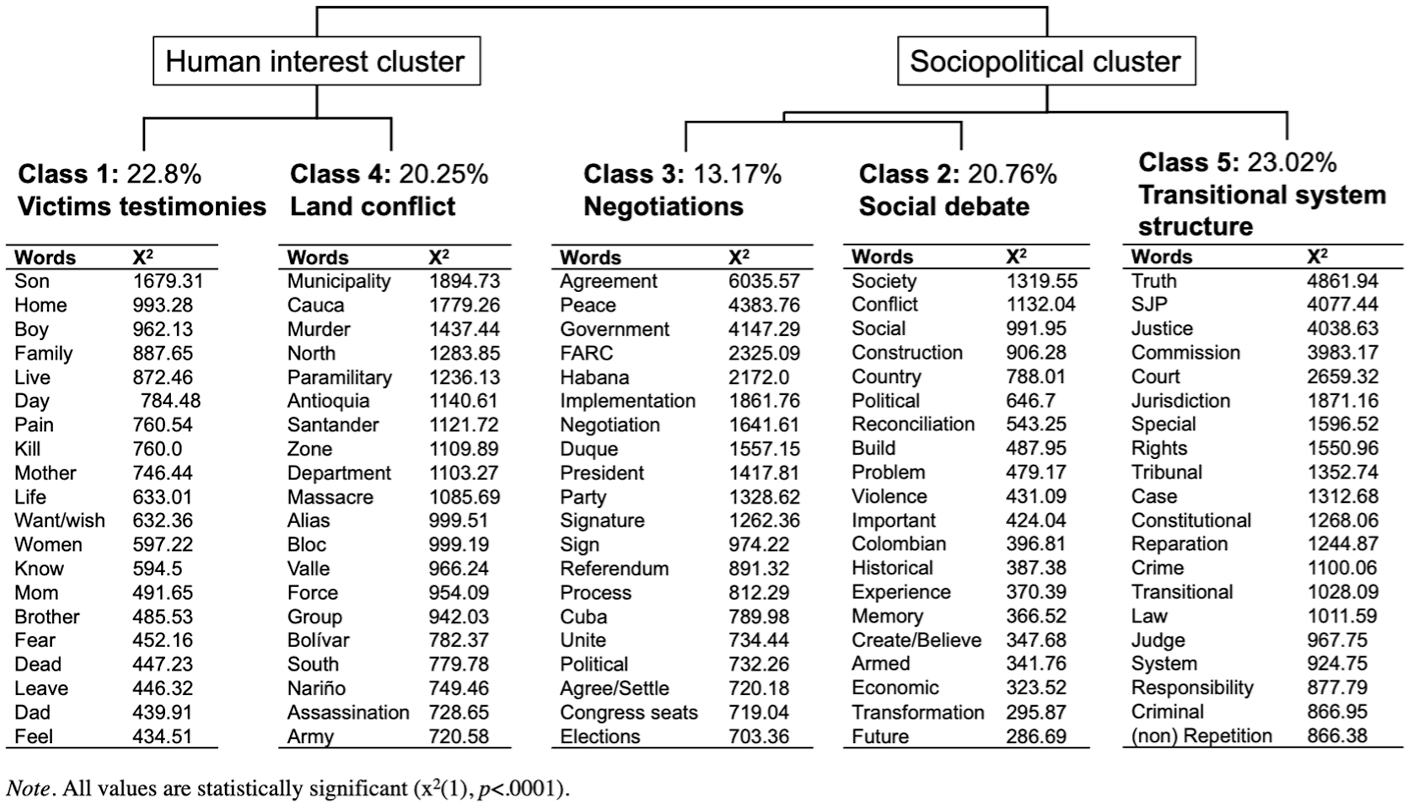
Hierarchical cluster dendrogram of peace representations in Colombian news from 2016 to 2021.
Clusters’ content
The results showed two main clusters in Colombian national newspapers’ coverage of peace (2016–2021), each comprising distinct classes with characteristic words revealing the most salient topics (see Figure 1). Addressing the first research question, what peace representations were textually disseminated, there are two overarching lexical universes of peace. The first cluster named ‘Human interest’ focused on victims’ accounts and violent events (Classes 1 and 4: Victims’ testimonies and Land conflict), while the second cluster named ‘Sociopolitical’ centered on political and legal procedures of the peace agreement, TJ institutions, and social debates on peace (Classes 3: Negotiations, 2: Social debate, and 5: Transitional system structure).
The first cluster portrays the human drama of conflict victims and the dynamics of land-related violence. Class 1 was called ‘Victims’ testimonies’ (22.8%) and featured stories from surviving family members about the loss of their loved ones and homes, particularly mothers seeking disappeared or murdered children. Key lexical features of the similarity analysis included verbs like “saying” and “doing,” past-tense storytelling, and expressions of anti-war sentiment, e.g., “no more war” (see Appendix 7 for similarity analysis per class).
A representative segment illustrates this: “when they killed my son, the pain was too big, people told me to get revenge, I told them that I didn’t want to see a mother suffering for a son as it happened to me” (x2 = 6,499.59, role: victims, gender: women and men, 2017) (see Appendix 6 for significant quotes per class). Likewise, this class emphasized women as survivors and victims of aggression towards their families, alongside children, with a strong emotional component (e.g., pain, suffering, and fear, see Figure 1).
Following is Class 4 ‘Land conflict’ (20.25%), which documents violent events by territory, e.g., “1,000 human rights defenders were killed, about 760 during the Duque administration, where the departments of Antioquia, Cauca (. . .) Chocó topped the list” (x2 = 10,953.45, role: civilians, gender: men, 2021). The dendrogram shows it highlights regions with high conflict-related violence, affected groups, and armed groups’ confrontations for land control. The similarity analysis emphasizes violent events’ timelines, locations, affected communities, and armed actors involved.
Regarding the second cluster, findings reveal the peace negotiation’s political outcome, social debates on overcoming conflict, reconciliation scenarios during 2016, and the transitional system’s structure (see Figure 1).
The third and smallest class, ‘Negotiations’ (13.17%), covers government-FARC negotiations in Cuba and political debates on implementing the agreement. This lexical class highlights the political figures behind intergroup cooperation, meaning the role of ex-presidents (e.g., Santos, Duque, and Uribe) and their parties throughout the process (referendum, signature, and implementation). Structurally, the similarity analysis reveals peace as a process and agreement between the presidents, Congress, political parties, and the FARC. The main protagonists are high-ranking political leaders and their actions, indicating an institutional perspective centered on elite figures that understates other groups involved during the negotiations (i.e., indigenous, women, farmers, or victims) – e.g., “Álvaro Uribe urged the United States special envoy for the FARC, to analyze . . . the referendum the government advances to endorse the peace agreements in Havana” (x2 = 23,940.31, role: politicians, gender: men, 2016).
The next class within the cluster ‘Social Debate’ (20.76%) examines societal dialogue on the conflict, recognizing causes, reconciliation, historical memory scenarios, and necessary transformations for peace solutions. Peaceful transition is discussed as a sociopolitical process impacting society, illustrated in the segment: “We cannot understand what is happening without considering the conflict and the need for peacebuilding enabling sustainable socioeconomic development” (x2 = 4,784.06, role: experts, gender: men, 2021). The similarity analysis confirms peace centrality related to overcoming conflict through collective processes like recognition, memory-building, and reconciliation in sociopolitical arenas.
Finally, the last class (Class 5: 23.02%) ‘Transitional System Structure’ provides an instrumental overview of the system of truth, justice, reparation and non-repetition that includes SJP and TC. 7 While the primary forms in the similarity analysis are victims’ rights and truth-seeking objectives, they are described in technical language, avoiding their implications for the target communities or society in general. Characteristic segments illustrate the TJ legal outcomes or due process: “in the chambers there will be 18 magistrates in the tribunal 20. SJP is part of the integral system of truth . . .” x2 = 19,402.66, role: politicians, gender: women and men, 2018) and “provided information on protection routes and mechanisms to participate in TJ instances, such as the report submission on victimizing events to SJP and TC” (x2 = 20,467.24, role: civilians, gender: women and men, 2020). This lexical universe exclusively portrays institutions and their due process; hence, words like ‘truth’ and ‘justice’ remain attached to the institutions’ names rather than being discussed as a psychosocial process or sociopolitical issue.
Representation salience over time and image analysis
After identifying lexical classes, Iramuteq tested their association with publication year and photograph variables. Figure 2 shows a timeline of significant associations between lexical classes and year.
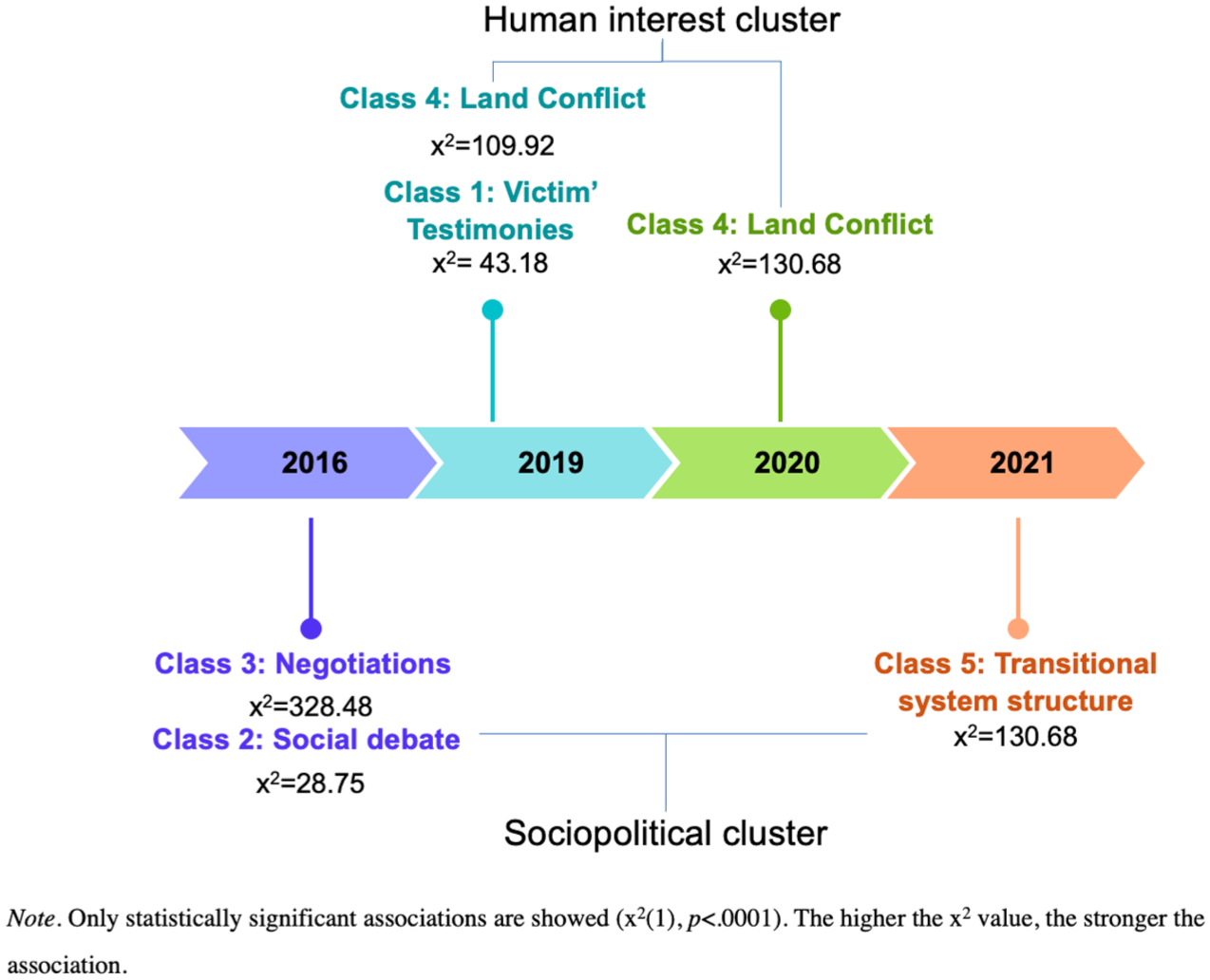
Timeline of lexical classes.
Addressing the second research question, to what extent the topics’ salience has changed over time, the lexical classes reflect shifting political and social dynamics regarding peace. In 2016, during the referendum, the ‘Sociopolitical’ cluster emphasized peace negotiations and social debates of peacebuilding, linked to dialogue and social transformation. The ‘Human-interest’ cluster related to victims and violence associates with 2019 amid heightened violence, illegal economies disputes, and political tensions during the agreement’s implementation. By 2021, Class 5 ‘Transitional system structure’ gained salience, highlighting truth, justice, and reparation as public issues when transitional institutions reached their five-year mark.
Regarding images of peace representations, only 10.6 % of the sample lacked photographs. Concerning the role, 21.6% were victims, 18.6% civilians, 13.2% politicians, 12.3% experts, 7.9% armed actors, 7.8% ex-combatants, 5.6% demonstrations, and 2.4% depicted the negotiation team. Most photographs were of men (36.8%), followed by men and women (25.4%), women alone (15.3%), and 11.7% with no distinctive gender. Only 2.1% portrayed children, and 7.7% references to the deceased.
The visual analysis reveals differences in peace representations across clusters by gender and role. Table 1 presents the significant association between photograph analysis with the lexical classes. In the first cluster, Classes 1 (Victims’ Testimonies) and 4 (Land Conflict) featured images of victims, children, and references to the deceased (see Table 1). Women were salient in Class 1, reinforcing lexical findings of women and children as survivors. Meanwhile, Class 4 prioritizes armed groups and avoids individual portraits and gender distinctions, confirming the text results of general and impersonal narratives.
Associations of photograph variables and lexical classes.
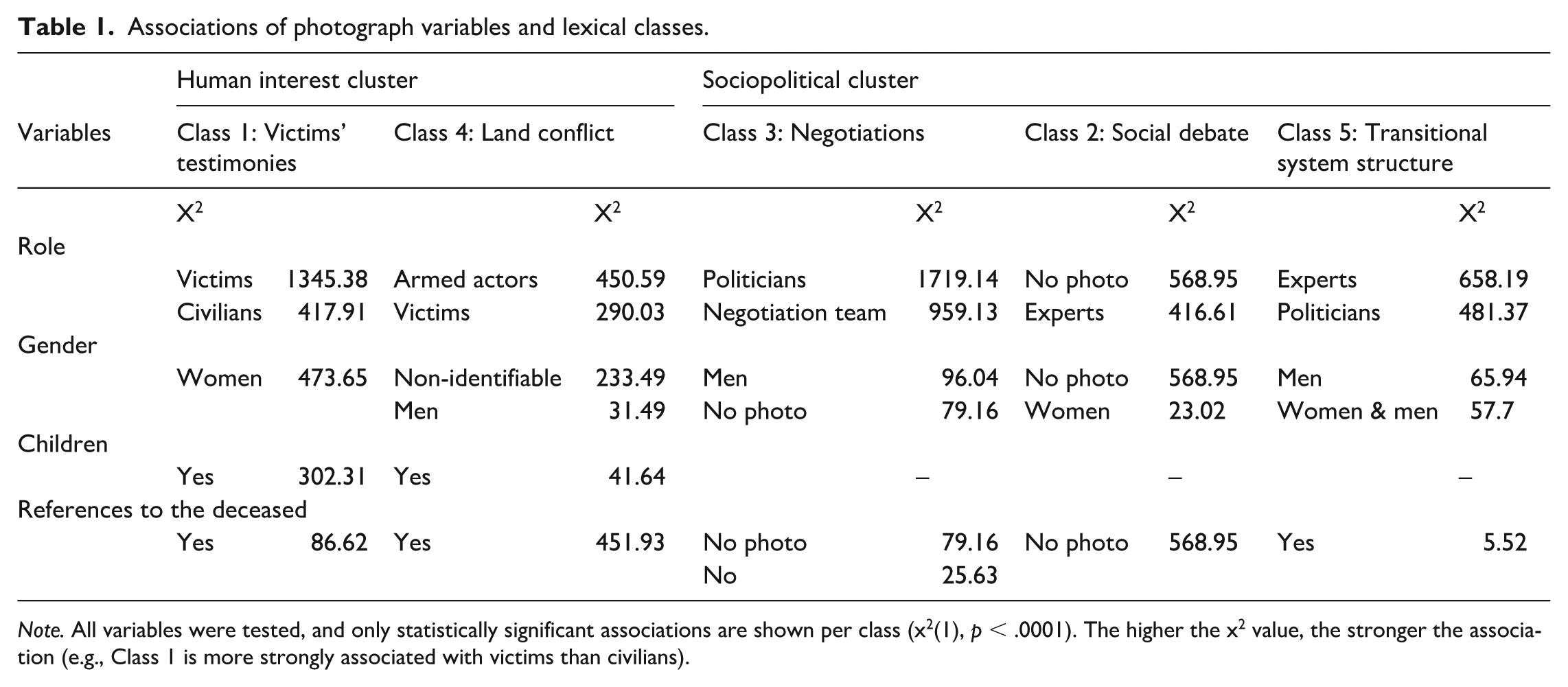
Note. All variables were tested, and only statistically significant associations are shown per class (x2(1), p < .0001). The higher the x2 value, the stronger the association (e.g., Class 1 is more strongly associated with victims than civilians).
In the ‘Sociopolitical’ cluster, images predominantly depict men, politicians, and experts to different extent per class (see Table 1). Class 3 (Negotiations) includes negotiation team photos (i.e., politicians, FARC representatives, victims, and other relevant members), while women appear in Class 2 (Social debate) and alongside men in Class 5 (Transitional system structure). The prevalence of men in these roles reflect the disparity in women’s participation in Colombia’s political and legal sphere. Children are not significantly associated, aligning with cluster content, and references to the deceased is minimally associated with Class 5, likely due to a commissioner’s death during the pandemic.
Multiple correspondence factor analysis
Finally, the factor analysis supports the two lexical clusters of peace representations found in previous results. Figure 3 shows the opposing narratives with data grouped on two factorial axes, conserving 62.66% of the variance. The factorial plane shows the most contributing words to each axis.
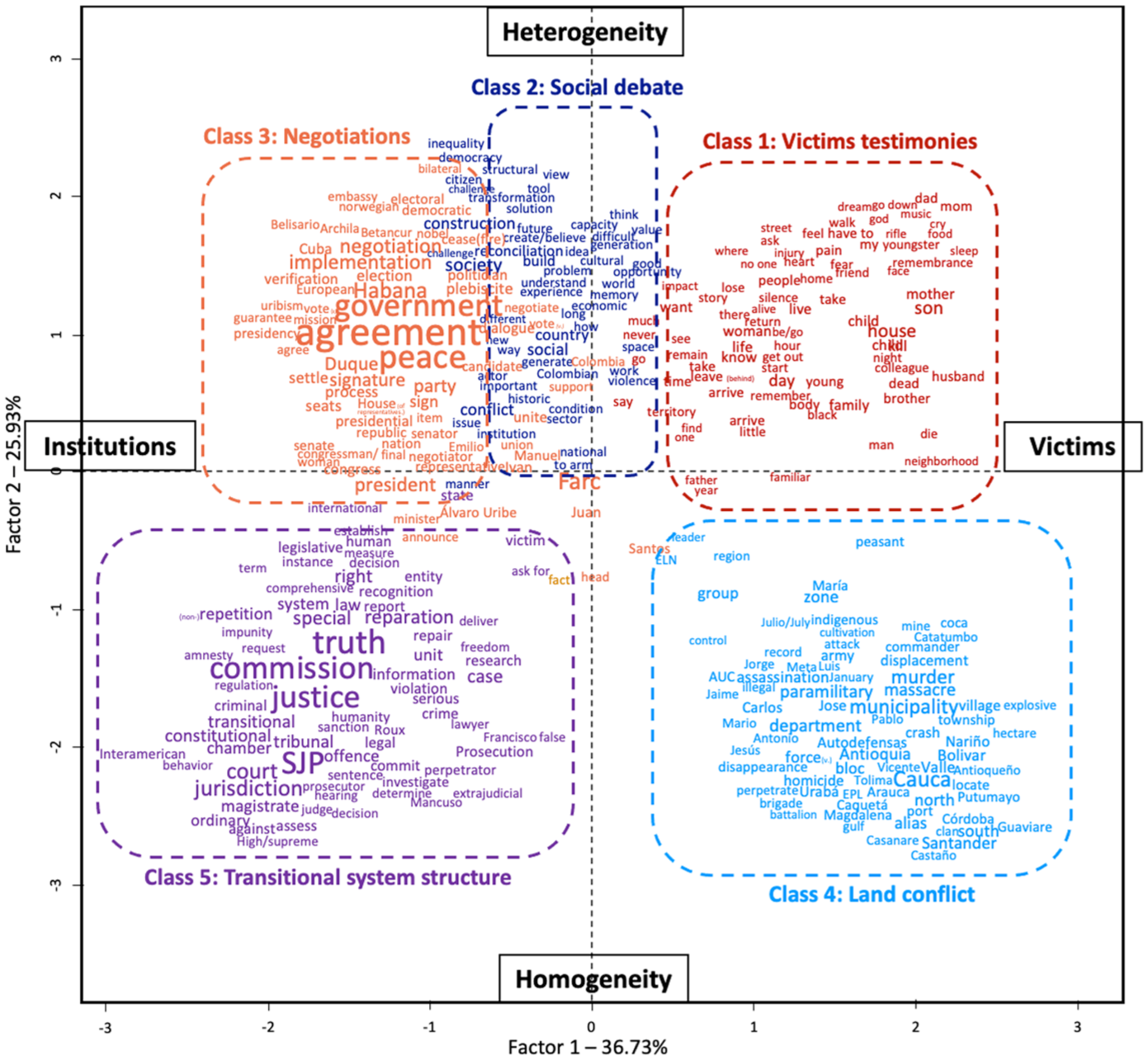
Multiple correspondence factor analysis.
The first factor (y-axis) contrasts the diversity of representations and social subjects, with two opposing poles: heterogeneity of voices and homogenous conflict visions. The top pole reflects heterogeneity, characterized by dialogue and everyday life, encompassing Class 1 ‘Victim Testimonies’, Class 2 ‘Social debate’, and Class 3 ‘Negotiations’. It is characterized by multiple subjects and actions including: (a) the impact of violence on victims and families (son, mother, child, kill, pain, family); (b) the need for sociocultural change (think, believe, build, reconciliation, memory, future); and (c) political mobilization around negotiations (embassy, European, Uribism, presidency, Duque, senate, congressman/woman).
The bottom pole represents homogeneity, with one-sided texts focused on primary groups creating exclusive universes of peace. One of the representations has a facts-based approach of social groups and land issues centered on violent events (Class 4 ‘Land conflict’: municipality, massacre, department, paramilitary), while the other portrays peace focused on institutions and prescribing legal actions of TJ (Class 5 ‘Transitional system structure’: TC, SJP, court, amnesty, sanction, crime). Despite differing content, both classes’ vocabulary derives from official records reflecting asymmetrical power in communication.
Regarding the second research question, the heterogeneity pole aligns with lexical classes 3 ‘Negotiations’, 2 ‘Social debate, and 1 ‘Victim Testimonies’ prominent in 2016 and 2019 (see Figure 2), featuring diverse subjects and actions (e.g., conflict consequences and sociopolitical mobilization). In contrast, the homogeneity pole corresponds to classes 5 ‘Transitional system structure’ and 4 ‘Land conflict’ salient in 2020 and 2021 (see Figure 2), dominated by two peace narratives, factual accounts of social groups and land conflict versus TJ’s political, institutional, and legal actions.
The second factor (x-axis) indicates the most notorious lexical difference in peace representations, the polarization between victims and institutions. On the right pole, collective violence, that is, victims’ testimonies and violent accounts, build peace descriptions (classes 1 and 4), emphasizing emotional language, interpersonal relationships (pain, fear, injury, family, friend, colleague), and violent intergroup dynamics (displacement, self-defense groups, paramilitary, peasants, indigenous). Conversely, the left pole converges peace representations upon political leaders and institutions (government, candidate, party, senator), prioritizing their actions over the agreement (classes 3 and 5) with political and legal language (tribunal, court, jurisdiction, constitutional, crime) with minimal emotional content or violence-related text. This indicates an institutional viewpoint where social groups have different salience and associations, with elite members being central to sociopolitical issues, while victims only appear through their testimonies.
In conclusion, two overarching peace representations emerged in Colombian newspapers. The first cluster discussed peace through negative emotions, the absence of death, and confrontation. It emphasized local events and personal victim stories showcasing violence’s emotional impacts. This representation shows what happened, what reparations are needed, and their desire for peace, portraying victims as passive subjects enduring suffering and reliant on external assistance, with limited agency in restoring their rights (see Figure 4).
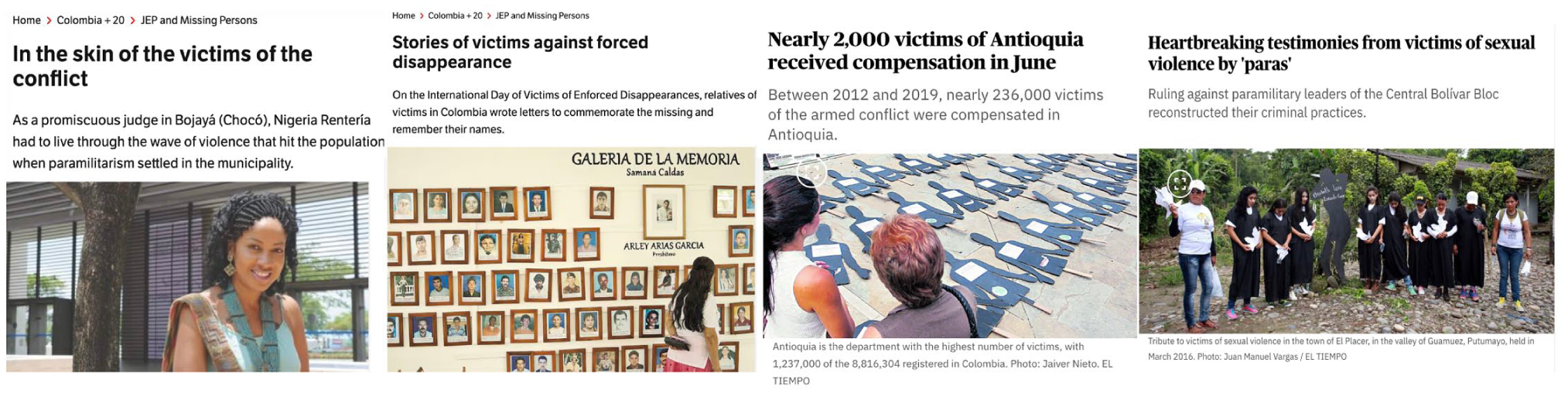
Examples of headlines and images from the first cluster.
The second cluster focuses on mutual goals, cooperation, and human rights’ political concessions. It presented peace as a future project requiring institutional reorganization towards the common goal: peaceful resolution. This representation underlines abstract peace-related concepts, assigns agency to government and institutions in the decision-making process, and avoids emotional narratives (see Figure 5).
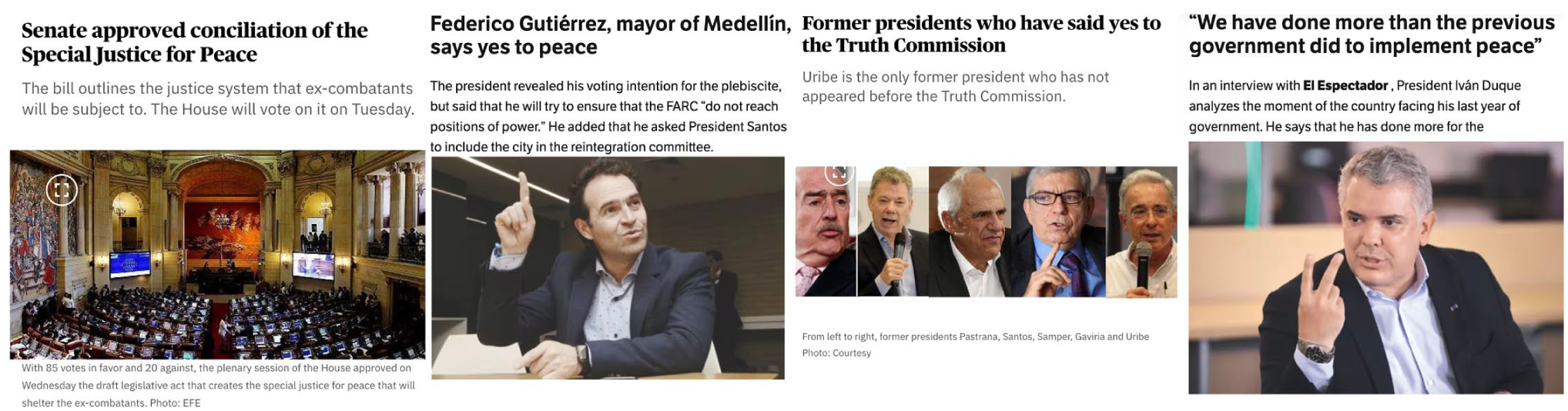
Examples of headlines and images from the second cluster.
Moreover, the media reflected shifts in peace representations over 2016 and the five years post-agreement. Initially, the agreement was discussed positively within a sociopolitical context (Class 2 and 3, associated with 2016). Over time, the implementation faced new violent dynamics in marginalized territories (Class 1 and 4, associated with 2019 and 2020), and by 2021, legal issues regarding truth, justice, and reparation dominated public narratives (Class 5 associated with 2021), aligning with Weintraub et al. (2024) who found eroding perceptions of these issues between 2019 and 2021. Figure 6 illustrates the dynamics through headlines and images from each significant year.
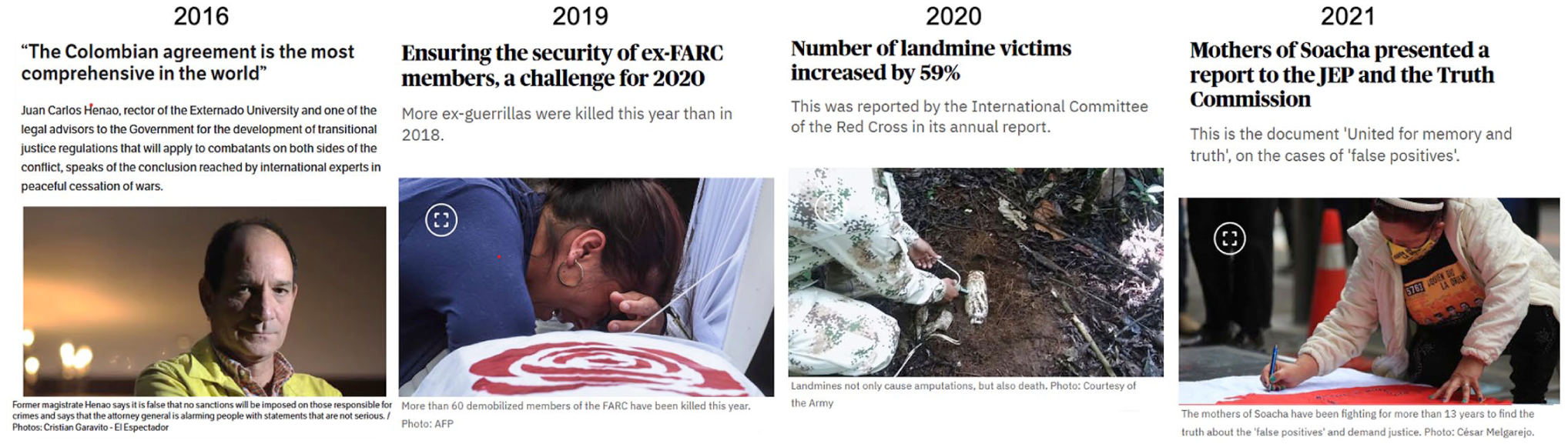
Examples of headlines and images from 2016, 2019, 2020, and 2021.
Discussion
This study highlights the relevance of analyzing peace representations through text and images in media during TJ, as changes in collective beliefs and narratives contribute to a long-lasting peace (Bar-Tal and Halperin, 2013). We aimed to identify what the Colombian press communicated as peace, to what extent the salience of these representations changed over 2016 and the five years post-agreement, and what images accompanied these representations.
Media representations of peace are shaped through social interactions and communication, where meanings are created via metaphors, images, and values, perpetuating and reflecting collective structures (e.g., historical, cultural, or economic) (Höijer, 2011; Sammut, 2015). Firstly, in our results, press peace representations reinforce an institutional perspective, where the government elite controls the peace-driven political project, as seen in classes 3 and 5 of the Sociopolitical cluster, located in the institutional pole of the factor analysis. Meanwhile, the Human Interest cluster, grouped in the victim pole, sustains the notion of passive and emotionally dependent victims and communities requiring government assistance to cope (García, 2021). This aligns with the concept of negative peace, leaving communities tied to the desire to end war rather than active societal transformation. In contrast, the press related governmental elites to structural peace initiatives through collaboration and policymaking (Class 3 and 5).
Nevertheless, victims and communities played an active role in Colombia’s peace process through self-governance, collective action, and advocacy, exerting social pressure on institutions (Brett, 2022; Restrepo, 2016). Despite the press including victims in public discourse, it overlooks their agency and capacity for political participation and social transformation. A more balanced representation is needed to show their active contributions to peacebuilding.
Second, our findings agree with prior studies showing shifting peace beliefs during the referendum, more rigid views later (Rico and Barreto, 2022), and a supportive media stance toward the agreement between 2012–2016 turning pessimistic by 2018 (Charry et al., 2019; Grajales Sánchez and Martínez Arévalo, 2020). Our analysis reveals the 2016 referendum opened public debate to diverse voices (Class 3). But, over time, representations narrowed to two dominant narratives: victim/factual (Class 1 and 4) and institution/legal (Class 5), which reflect the polarization solidified by 2021 and could have implications in the conflict-supporting narrative. Colombia’s press content illustrates a pathway to institutionalizing a perspective supporting the peace agreement (Bar-Tal et al., 2014). Unlike pre-agreement studies, our results found no dehumanizing language or opposition to peaceful resolution, avoiding spoiling the process and fostering debate of its concessions (López-López et al., 2014).
However, institutionalizing a peace narrative should not overshadow participatory, collective discourse amidst ongoing conflict. While top-down, government-led implementation is vital for structural change, small-scale, everyday peacebuilding efforts are equally crucial (Mac Ginty, 2021). The media, while promoting institutional narratives, should also represent non-state communities, acknowledging their self-determination and role in shaping social reality to foster sustainable, bottom-up peace processes.
Third, news articles varied in their visual representations of peace. The Colombian press used impactful photographs when discussing testimonies and armed groups’ violence. Such images, more attention-grabbing than text (Bucher and Schumacher, 2006) may evoke emotional reactions and influence behavior (Powell et al., 2015) by depicting victims, children, and references to the deceased. Further research should explore whether these victims’ images provoke anger and fear, prompting action among Colombians. Moreover, individual portraits of victims in Class 1 (Victims’ Testimonies) may counter compassion fatigue, as journalists select humanized images to avoid public indifference to suffering (Dhanesh and Rahman, 2021).
Contrary to the peace journalism model, which associates elite actors with war frames (Galtung, 2003; Lee and Maslog, 2005), our findings show that Colombian media linked politicians, experts, and members of TJ institutions to peace-oriented representations. This supports Tenenboim-Weinblatt et al. (2016), who found establishment actors were predominant in news items supporting dialogue and peace negotiations.
Images support the two peace representations in Colombian newspapers. One cluster focused on emotional, victim-centered narratives, and the other on political and legal aspects tied to institutions. The latter evokes top-down peacebuilding centered on policymakers (Mac Ginty and Firchow, 2016) and concerns regarding truth, justice, and reparation to victims (Weintraub et al., 2024), conversely, hyperlocal victim stories of the first cluster may not effectively contribute to bottom-up initiatives and everyday peacebuilding (Mac Ginty, 2021).
Furthermore, findings indicate gender discrepancies. Women are linked to emotionality, victimization, and dialogue present in Class 1 and 2, whereas men dominate politics and law in Classes 3 and 5, reinforcing biased stereotypes of women as passive and inherently peaceful victims (Adjei, 2019). The Colombian press sample reinforces the mourning woman trope discussing trauma and loss (Zarzycka, 2016), underplaying their active roles as leaders and advocates for their rights (Bouvier, 2016). Despite the agreement’s gender-focused measures, women’s mobilization remains vulnerable to violence and constraint political representation (Zulver, 2021). The media must shift from portraying women as ‘helpless’ victims to agents of change, capable of challenging power structures and combating gendered violence (Brett, 2022; Restrepo, 2016).
Lastly, the implications of our findings concern who becomes relevant to peace and in what ways. Colombian media privilege bureaucratic processes, meaning the formalization and standardization of rationales and mechanisms for conflict resolution (depicted in Class 5 and 3). This logic follows top-down peacebuilding reinforcing a state-centric approach to peace (i.e., government-led through politics) and risking excluding grassroots initiatives and alternative solutions proposed by conflict-affected communities (Mac Ginty, 2021; Mac Ginty and Firchow, 2016).
Victims sharing their experiences fosters empathy and social support. However, recounting negative experiences without cognitive framing risks revictimization and emotional harm (Rimé et al., 2020). This “ideal victim” trope in our sample (Class 1) defined by suffering and emphasizing innocence and vulnerability, can foster compassion (Lewis et al., 2021), empathy, or awareness of violence but instrumentalizes victims, undermining their role in shaping peace processes (Brett, 2022) reducing them to beneficiaries rather than active participants in peacebuilding, as seen in similar studies in Colombia (García, 2021). Thus, peace narratives in the Colombian press often portray governments as change-makers while sidelining victims.
At a sociocultural level, media should highlight victim narratives that emphasize self-determination, agency, and transformative potential, fostering everyday peace. This approach reflects the strategies individuals use to navigate life in conflict-affected societies (Mac Ginty, 2021: 18). While top-down peacebuilding is crucial for state-level change, grassroots initiatives must also shape public discourse, offering contextualized solutions with symbolic, formal, and informal impacts (Mac Ginty and Firchow, 2016).
Our findings emphasize a dialogical perspective, where peace is a socially constructed concept shaped by public discourse and found in antonymic tension that is interdependent to sociocultural contexts and maintained through dialogue (Liu, 2004; Sarrica and Wachelke, 2012). Lexical repertoires reflect deep-seated ideas (Liu, 2004) sparked by the peace agreement, e.g., victims vs. institutions / women vs. men, which are antonyms socially debated. This process highlights the struggle between continuity and change and captures the collective memory of social thought (Marková, 2003).
An example of interdependency of social context is how victim narratives (Class 1) gained prominence in 2019 due to the National Roundtable of Victims, the TC’s testimonial gatherings, and the SPJ’s reports on conflict violence. News outlets gave space to the victims’ moving stories who wished their truth to be known and clarified, aligning with these events (see Figure 7).
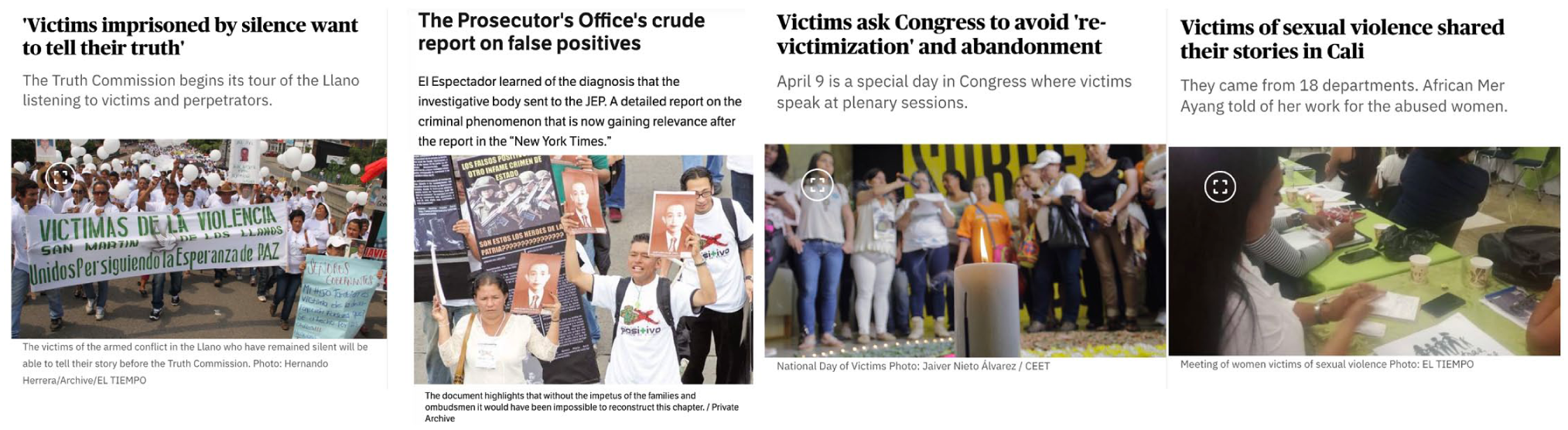
Examples of Class 1 headlines and images from 2019.
Despite Colombian press highlighting the invisible effects of violence and featuring diverse voices without moral judgments, it is crucial to maintain multivocality for political and legal initiatives and include underrepresented groups.
As for limitations, future research should expand to include more Colombian media outlets to capture local peace dynamics and consider periods before the peace agreement or under left-wing governments. While Iramuteq software enables efficient, large-scale data analysis with minimal bias, it lacks semantic understanding, i.e., understanding word meaning or order prediction, requiring contextual interpretation by researchers. Although 300 news items per year provided a robust and stable corpus, this sample may not fully represent the over 100,000 articles, potentially excluding less frequent topics, alternative discourses, or over-representing other narratives. Future studies could leverage from fee-based tools to mine internet data for a more inclusive sample. Community samples or interviews can address these limitations and provide comparisons between media representations and shared knowledge.
Finally, this study analyzed six years of press coverage of peace during TJ in an intractable conflict, providing evidence of the social nature of peace representations and its visual cues. The findings of our study raise the need to analyze how peace is understood in a challenging yet hopeful environment aiming for a peaceful conflict resolution.
Footnotes

Ethical considerations
This article does not contain any studies with human or animal participants. There are no human participants in this article and informed consent is not required.
Funding
The research was funded by the University of the Basque Country (UPV/EHU) PIF 21/78 awarded to Caicedo-Moreno, A., POSTUPV24/26 awarded to Castro-Abril, P., and the Vice-Rectorate for Scientific and Social Development and Transfer, the Basque Government (‘Culture, Cognition, and Emotion’ Consolidated Group IT1598-22), the Spanish Ministry of Science and Innovation (PID2020-115738GB-I00, MCIN/AEI/10.13039/501100011033/).
Declaration of conflicting interests
The authors declared no potential conflicts of interest with respect to the research, authorship, and publication of this article.
Data availability statement
Supplemental material
Supplemental material for this article is available online.
Notes
Author biographies
Address: as Angélica Caicedo-Moreno. [email:
Address: Pontificia Universidad Javeriana, Bogotá, Colombia. [email:
Address: as Angélica Caicedo-Moreno. [email:
Address: as Angélica Caicedo-Moreno [email:
References
Supplementary Material
Please find the following supplemental material available below.
For Open Access articles published under a Creative Commons License, all supplemental material carries the same license as the article it is associated with.
For non-Open Access articles published, all supplemental material carries a non-exclusive license, and permission requests for re-use of supplemental material or any part of supplemental material shall be sent directly to the copyright owner as specified in the copyright notice associated with the article.
