



Abstract
Framing is a central concept during times of dispute because it can escalate the dispute or push it toward cooperation. Contributing to the automatic identification of frames in conflict studies, this article aims at examining the dynamics of the main media frames emphasized by Egypt, Sudan and Ethiopia over the Grand Ethiopian Renaissance Dam. These frames represent the factors of power and hydro-hegemony between the three countries, including the geographic location, military intervention, mediation, agreements and economic dimensions. Keyword-Assisted Topic Models (KeyATM) are implemented to analyse the English governmental and non-governmental newspapers that covered this dispute the most (N = 12) over 11 years (2011–2022). While the results show the Egyptian and Sudanese media are dominated by the mediation and agreements frames, the Ethiopian media emphasizes the economic frame. They also confirm the existence of hegemony and counter-hegemony between the downstream and upstream which can be attributed to the dynamics in the adopted frames.
Keywords
Introduction
News media framing is a process by which particular information can be disseminated to a target audience and influenced by certain beliefs, goals and agendas (Walter and Ophir, 2020). Framing conflicts and wars allows for various portrayals affecting people’s understanding and their perception of these conflicts depending on the nature of the reporting news outlets. For example, both the Arabic and western media covered the Iraqi war, but from different lenses. The Arabic media was dominated by ‘wounded and screaming Iraqi women and children, captured or terrified Iraqi and U.S. and British soldiers’ while the US and British media were highlighted by ‘a gripping made-for-TV show starring brave U.S. and British troops putting their lives on the line to bring freedom to oppressed Iraqis’ (Dimitrova and Connolly-Ahern, 2007: 2). So, the origin of the media outlets affects the news framing concerning what is the most dominant frame and its dynamics over time. This highlights the necessity of media framing in conflict and security studies.
In this vein, this article considers the Nile dispute with regard to the construction of the Grand Ethiopian Renaissance Dam (GERD) as a case study to contribute to the literature of media framing and hydro-politics. On one hand, this article introduces a computational approach using the Keyword-Assisted Topic Model (KeyATM), developed by Eshima et al. (2023), to explore the dynamic shifts in the main media frames adopted by the three involved countries in this dispute (Egypt, Sudan and Ethiopia). Despite the wide variation of media sources between global and national outlets, and social media platforms, the national governmental and non-governmental newspapers are still viewed as the key media providers reporting on such water disputes. As such, this article focuses on examining the dynamic shifts in the 12 English governmental and non-governmental newspapers over the 11 years (2011–2022) that covered the dispute the most.
On the other hand, this article assumes that the main media frames in these national newspapers are represented by the common factors explaining water disputes over transboundary basins in conflict literature. These factors include the geographical location of each riparian country, military hostility, mediation efforts, historical agreements, and the economic motives and consequences of the dispute (Endaylalu, 2019; Zeitoun and Warner, 2006). These factors are also mirroring the role of power relations and hydro-hegemony between the downstream (Egypt and Sudan) and the upstream (Ethiopia).
The focus is on the automatic identification of these common factors in this kind of dispute, and they are displayed as the seeded topics while implementing the KeyATM by seeding this model with a set of representative keywords for each factor of interest. To do so, I formulate the theoretical expectations of how the three countries frame this Nile dispute over GERD and the shifts in their framing since the onset of such a dispute was in 2011.
As a sequence, these two sides of contribution are untouched and absent in the case of the GERD. In this way, this article aims to fill this knowledge gap by answering the following questions:
How are the main factors of hydro-hegemony framed in the English governmental and non-governmental newspapers in Egypt, Sudan and Ethiopia?
Are there shifts in framing these factors over time? If so, why do we notice such dynamic shifts in framing the dispute between the three countries?
In answering these two questions, this article unpacks the main national media discourses on the GERD dispute using KeyATM to automatically identify the key causes of such a dispute. This automatic unpacking also reveals the interests of the three involved countries in the dispute (Egypt, Sudan and Ethiopia) and why each of them emphasizes certain media discourse. Hence, this article is different from what Fairclough (1993) proposed about critical discourse analysis because the latter is a theoretical analytical framework of discourses and has its own approach for analysing the media text. However, the contributions of this article share some aspects of Fairclough’s work because his framework’s dimensions also exist: (The text of the collected newspapers, the description is done by the KeyATM, the interpretation and explanation of the KeyATM results).
Frame detection and identification
Entman (1993) argued that the process of frame detection and identification is specified by promoting a particular interpretation, evaluation and solution to an issue that impacts how people view and interpret the disseminated information. Technically, quantitative content analysis has been used to locate relevant frames in media texts (Kwak and An, 2014; Matthes and Kohring, 2008) and the manual identification of these frames becomes infeasible, especially with the huge volume of content generation. To overcome the challenge of massive text data volumes, computational methods help detect frames automatically (Guo et al., 2022).
Lexicon-based techniques suggested by Lyu and Takikawa (2022) as well as machine learning (ML) techniques were used to discover frames of interest from the media outlets. When the frames of interest were pre-defined, both lexicon-based and supervised ML methods were useful for frame detection. However, when frames were not known, they were identified using topic modelling which is the most popular unsupervised ML (Caliskan and Kilicaslan, 2023).
Framing literature has advanced depending on the choice of these computational methods and data sources. The (2018) scandal surrounding Chinese gene-edited human newborns (Chen and Zhang, 2021), US immigration and nuclear power issues are analysed using sentiment analysis, AdaBoost and Gradient Boosting (Madrigal, 2023). Both word2vec and BERT are used to investigate how people perceive various political ideologies, gender discourses, legitimacy, and racial and religious minorities (Müller et al., 2023). The propagation of false information is studied by k-means clustering and network similarity algorithms (Caliskan and Kilicaslan, 2023). Latent semantic scaling as well as Structural Topic Modeling (STM) are applied on the shifts in media coverage of German Renewable Energy Act (Dehler-Holland et al., 2021). Latent Dirichlet Allocation (LDA) is applied to analyse 12 climate change frames used by NGOs, governments and experts in Indian and US media (Ylä-Anttila et al., 2021).
In contrast, most of the existing works on framing are founded on Twitter-centric social media analytics. Socioeconomic issues of the COVID19 pandemic, racism, inequality, minority groups and Syrian immigration to Turkey are studied by sentiment analysis (Koytak and Celik, 2023). Ensemble classifiers and network analysis are utilized in liberal politics and neural networks are used for violence studies (Chang and Ferrara, 2022). The analysis of elite messages and network amplification is done using LDA (Zhang et al., 2022). These examples of studies focused on social media and news media outlets are less studied. Also, they focused on either supervised or unsupervised tasks. Accordingly, semi-supervised topic models bridge the gap between the supervised and the unsupervised by considering the coexistence of pre-defined and undefined frames in framing analysis and decrease the need for manual frame identification.
The recent semi-supervised topic model is KeyATM which is applied on mobile app reviews (Tushev et al., 2022) and quantifying the signals of monetary policy (Diaf, 2022). Tushev et al. (2022) extracted meaningful information from mobile app reviews to solve data sparsity by seeding keywords from the review corpus. These seed words create relevant domain-specific themes. Diaf (2022) was able to deduce the central banking’s most held policy preferences depending on the speeches of Federal Reserve governors from 1996 to 2020.
Hence, KeyATM is very limited in its applications in social sciences and in transboundary water conflicts. By taking the ongoing Nile dispute as its case study, this article contributes to the water conflict and framing literature by empirically investigating the dynamic shifts in the main media frames in the national governmental and non-governmental outlets in Egypt, Sudan and Ethiopia English-language outlets over 11 years (2011–2022). These frames are assumed to represent the main factors of water dispute over transboundary basins. These frames, in turn, are considered as the seeded topics while implementing the KeyATM. An overview of the GERD dispute is introduced as follows.
Nile dispute
Existing literature on water conflicts is frequently devoted to examining water scarcity and how the growing water demand in riparian countries is correlated with the escalation of tensions between these countries (Wolf, 2007). The Copenhagen School, the leading school in security studies, formulated the concept of securitization to examine the causes of conflicts and divergent interests to justify the motivations of the involved countries. The securitization aspect here refers to using violence and terrorist attacks to seize more control of shared water (Wei et al., 2022) and, in the post-cold war era, violent conflict 1 was attributed to an abundance of natural resources. It became widely known that this abundance increases the likelihood that violent conflict will harm the national economy and regional security (Collier and Hoeffler, 2005). However, it is worth noting that not all water disputes escalate into violent conflicts; in fact, some lead to negotiating tables and round table talks (Bréthaut et al., 2021) like the Jordan, Indus and Mekong rivers for instance (Zeitoun and Mirumachi, 2008). This happens to activate water treaties to minimize potential losses that could result from such an escalation (Koubi et al., 2013).
The case study, in this article, of the Nile River and the ongoing dispute between Egypt, Sudan and Ethiopia over the Grand Ethiopian Renaissance Dam (GERD) is worth studying because it serves as a case of non-violent conflict over a shared basin despite the presence of escalation factors to violence and military hostility. This goes back to the power dynamics between the Nile riparian countries and their control over the shared basin out of their hydro-hegemonic positions. Zeitoun and Warner (2006) proposed the framework of hydro-hegemony which includes these main pillars (geographical, material involving economic power, military power, and international financial support, and bargaining with negotiations and agreements).
The dispute begins with competing views on the GERD, and each country insists on its stance to defend its interests (Yang and Block, 2021). In 2011, the GERD began in the northwest near the borders of Sudan–Ethiopia and this location was initially selected by the US Department of Interior Bureau of Reclamation (1964). Ethiopia announced the dam can store 74 billion cubic meters of water and generate 5150 megawatts of electricity (Matthews and Vivoda, 2023: 8), making it Africa’s largest hydroelectric power plant. Egypt and Sudan, the two downstream countries on the Nile, strongly opposed Ethiopia’s unilateral dam construction plans and absence of collaboration (State Information Service, 2019). Ethiopia argues that building this dam will elevate its people out of poverty and put the country on the path to economic progress, although Egypt and Sudan argue that this violates the signed agreements in 1929 and 1959 (Pemunta et al., 2021).
A detailed paradox of the divergent views of the three countries is shown in Table 1, reflecting how the main factors of water disputes are interpreted by these countries to justify their point of view. By revisiting the hydro-hegemony approach, these factors involve the geographic location, military intervention to control these shared waters, signed agreements, regional and international mediation, and economic dimensions to utilize these shared waters (Endaylalu, 2019; Zeitoun and Warner, 2006). These factors are considered the key media frames in this article. Although Boydstun et al. (2014) identified the general 15 framing dimensions 2 to perform framing research in social sciences, these framing dimensions are too generic, and we need specific dimensions, shown in the following Table, to be able to understand the framing of the ongoing Nile dispute.
The divergent views and interests of Egypt, Sudan and Ethiopia over the GERD.
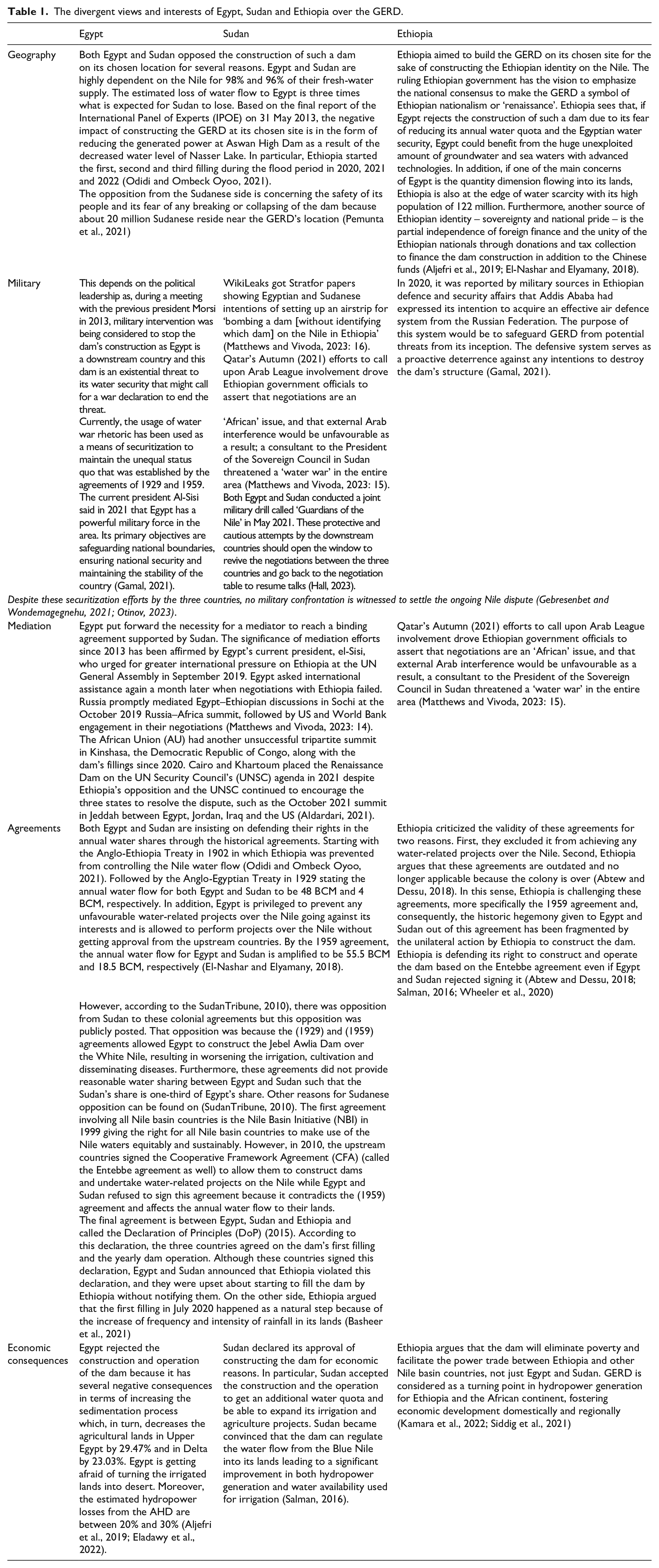
As per the contradiction illustrated in Table 1, the author derived the following theoretical hypotheses to be tested by topic modelling.
H1: Egypt will emphasize the frames of historical agreements and mediation more than other frames on the GERD dispute.
H2: Sudan will emphasize frames of historical agreements, mediation and economic consequences more than other frames on the GERD dispute.
H3: Ethiopia will emphasize frames of its geographical rights and economic consequences more than other frames on the GERD dispute.
Materials and methods
Data
It is worth noting that the selection of media outlets to be the data source to analyse the shifts in media frames of the Nile dispute requires the distinction between the elite model and pluralist model. In the elite model, the media is controlled by the state and serves as a propaganda mouthpiece, reflecting leaders’ preferences. In contrast, the pluralist model allows media to scrutinize government power and influence decision-makers, allowing it to participate in policymaking and bring public attention to specific issues (Robinson, 2016).
Egypt, Sudan and Ethiopia are ranked 168, 151 and 114 out of 180 according to the index of the press freedom of Reporters Without Borders (RSF) in 20223 supporting the less liberalized media landscape in these three countries. Although the three countries are authoritarian and the media landscape is polarized, there are state-owned and privately-owned newspapers. However, both types of newspapers are subject to official censorship and adhere to the country’s moral code. Despite these facts, both types are taken into consideration in the analysis as a different framing of the dispute might be detected. So, it can be argued that the elite model of media framing is more relevant to the Nile dispute than the pluralist model which seems to be a suitable main data source for topic modeling.
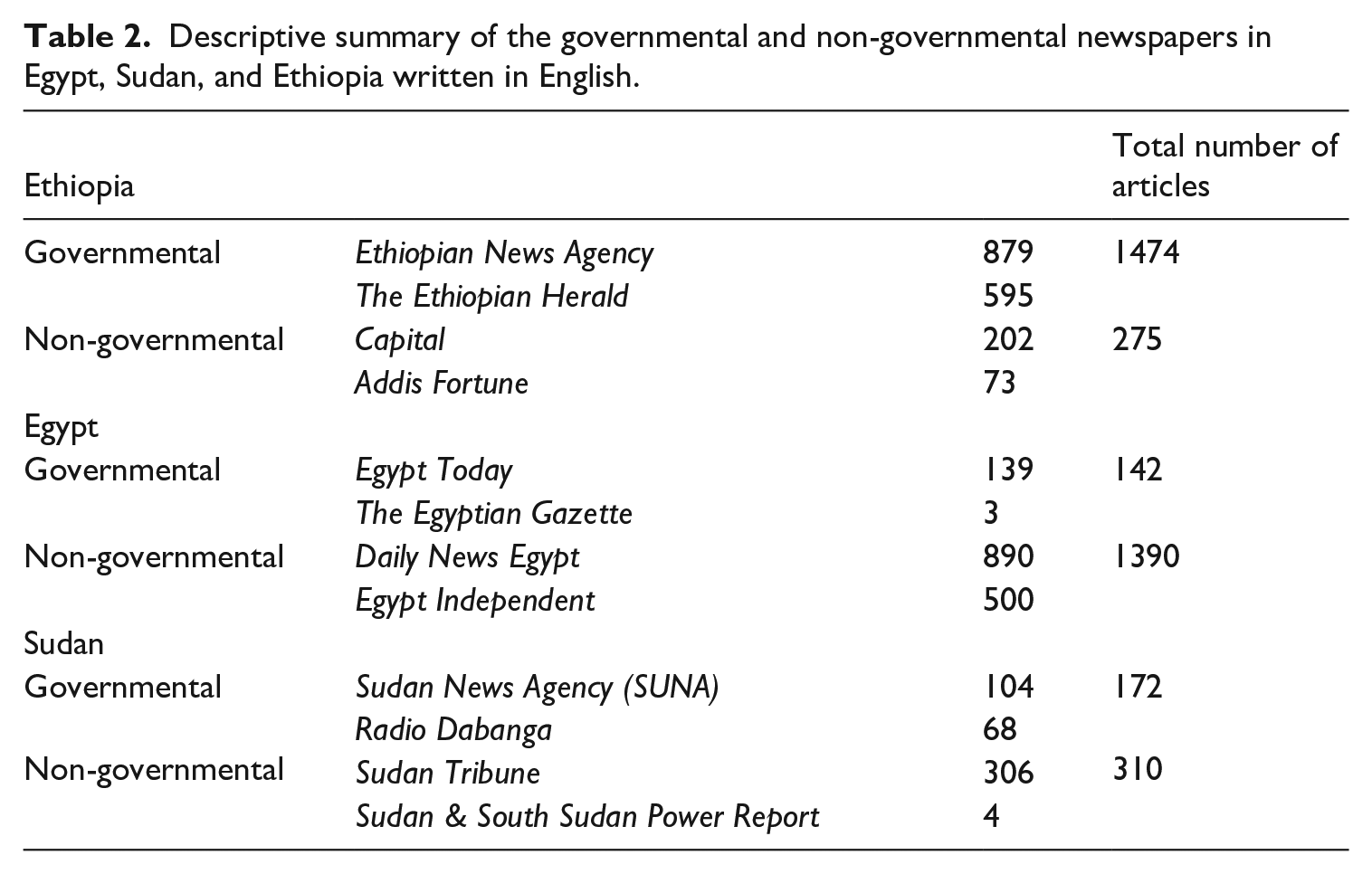
For these reasons, the Lexis Nexis database 4 is the main source of collecting the relevant news articles using keywords ‘GERD’ and ‘Grand Ethiopian Renaissance Dam’ for English articles. The collected English corpus consists of the English governmental and non-governmental newspapers that have given high coverage to the Nile dispute since 2011. As a result, the size of the collected English corpus is 12 newspapers from both the state-owned and independent ones with a total number of 3,763 news articles over the time period (2011–2022). A description of the selected sample is shown in Table 2.
Descriptive summary of the governmental and non-governmental newspapers in Egypt, Sudan, and Ethiopia written in English.
Topic modelling algorithms are shared to uncover and identify hidden/latent patterns within large unlabelled text-based documents (i.e. corpus) and the LDA method introduced by Blei et al. (2003) is widely used in text-as-data applications in social sciences. LDA is an unsupervised, mixed membership Bayesian model that learns latent characteristics made up of words, called topics, and assumes that documents are mixtures of topics, which are in turn mixtures of words taken from a Dirichlet distribution (Gentzkow et al., 2019). Despite its popularity in the applications in social sciences, it suffers from a set of limitations, including the difficulty of interpreting results and relating model results to relevant social science theories.
KeyATM, introduced by Eshima et al. (2023), extends LDA as a semi-supervised approach to define topics of interest. Insofar as our focus is on detecting specific media frames (e.g. the five frames discussed earlier) and other topics that complement the analysis of the Nile dispute, dynamic KeyATM is an appropriate topic model considering changes of these frames over time. KeyATM’s central concept is the incorporation of user-defined seed words for topic-word distributions. Each seeded topic, representing a frame of interest, can be fed with particular keywords believed to define that topic. Once you have given keyATM your initial seeds, it can figure out more closely related keywords from the corpus. So, we assume that every seeded topic in the KeyATM is a media frame from the five frames which, in turn, represent an explanatory factor of water conflicts over transboundary basins derived from the conflict literature. The technical details of KeyATM can be found in the Appendix
Seed words generation
Because of the necessity of selecting the relevant seed words in the context of water dispute in the Nile, I created a dictionary for the five media frames of interest mentioned earlier. The creation of such a dictionary is primarily based on the method of Keyword-In-Context (KWIC) recommended by Watanabe and Zhou (2020).
Two steps are implemented using KWIC to generate the seed words for the use case in the Nile. First, a keyword was identified that would represent the seeded topic of interest. So, we have five seeded topics in the case of the Nile dispute that correspond to the main five factors explaining the dispute. A keyword for every seeded topic is chosen as follows. For the geography frame, the word ‘geograph*’ 5 is used, ‘military*’ is used for the military frame, ‘mediat*’ and ‘sign*’ are used for mediation and signing agreements frames, and ‘generat*’ is used for the economy frame. Second, this was read carefully, depending on the knowledge domain and the context in which these keywords are mentioned. Third, all relevant seed words for every seeded topic were picked from this context and the desired dictionary was constructed to implement the KeyATM dynamic model as shown in the Appendix.
Results and analysis
The main media frames (seeded topics) in the governmental English newspapers
Initially, the geographic frame was significant with a peak in Egypt’s media attention in 2013. There has been a relatively stable situation in the last years of the ongoing dispute. This media frame for Ethiopia has mostly remained consistent since the start of the dispute with a notable surge since 2019. In Sudan, it showed clear oscillations with an initial rise followed by subsequent decrease. In 2018, there was a significant decrease in its media coverage compared to 2015 and 2020 as depicted in Figure 1.
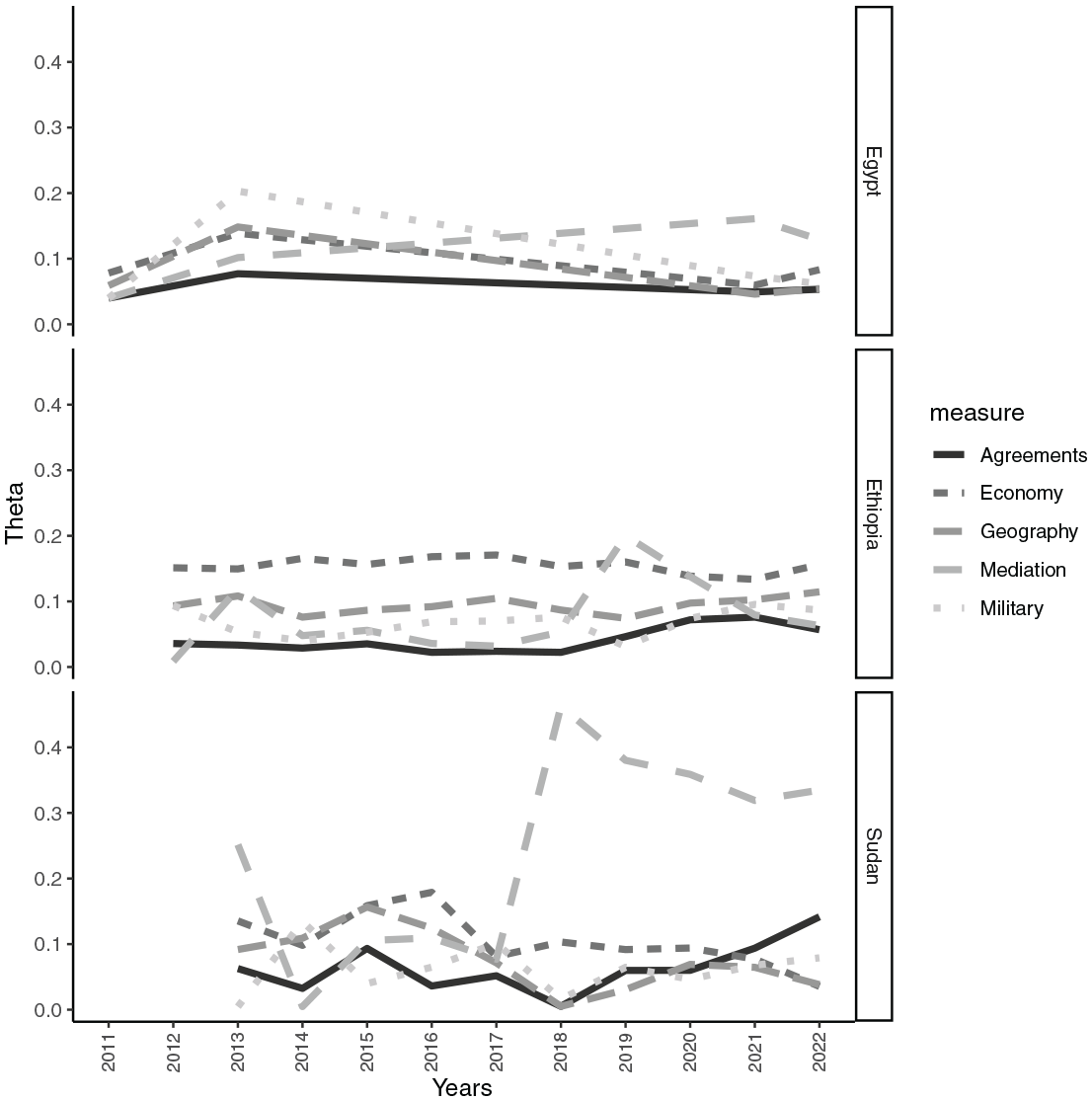
Dynamic KeyATM over the governmental newspapers in English (only seeded topics).
In Egypt, a rise in the share of media attention centred around the military was first seen in 2013. Except for the years 2021 and 2022, the Ethiopian media paid little attention to this frame. However, the Sudanese media showed variations in portraying this frame with a prominent increase in 2014 and 2017. The Egyptian media has demonstrated little interest in the agreement frame since the dispute began. The Ethiopian media started to prioritize this frame since 2018 and the Sudanese media in 2015 and 2019 to 2022.
Since 2013, the Egyptian media has shown growing interest in the use of mediation as a means to resolve the dispute. The mediation frame in Ethiopia was not extensively covered, but its presence was evident in both 2013 and 2019, and Sudan covered this frame more extensively in 2018. Except for 2013, the Egyptian media has barely covered the economic frame. Since the dispute’s commencement, the Ethiopian media has emphasized the economic frame, but it was highly debated in the Sudanese media in 2016.
To sum up, in 2013, the Egyptian government’s media mostly focused on geographical, military and economic aspects. However, following 2013, there was a shift towards emphasizing mediation and negotiations, with less attention given to the agreement frame throughout the years. The dominance of both geography and military in 2013 can be explained because, during a meeting with the former president Morsi in 2013, military intervention was being considered to stop the dam’s construction as Egypt is a downstream country and this dam is an existential threat to its water security (Matthews and Vivoda, 2023: 16).
One year earlier, WikiLeaks obtained Stratfor papers showing Egyptian and Sudanese intentions of setting up an airstrip for ‘bombing a dam [without identifying which dam] on the Nile in Ethiopia’ (Matthews and Vivoda, 2023: 16). The current Egyptian president, el-Sisi, advocated stronger international pressure on Ethiopia at the UN General Assembly in September 2019, highlighting mediation attempts since 2013. After pointless discussions with Ethiopia, Egypt requested international assistance a month later. Russia promptly agreed to be involved in such negotiations, then Egypt urged the US and World Bank (WB) to facilitate Egypt–Ethiopian talks, but Ethiopia rejected this since GERD is an African concern. As a result, the African Union (AU) was invited to their discussions (Tekuya, 2021).
In February 2020, a settlement was reached but Ethiopia declined to sign at the last minute, prolonging the dispute. The previous president, Trump, was disappointed, taking the Egyptian side and stopping US$260 million of Ethiopian funding, claiming ‘Egypt may blow up the dam’ (Matthews and Vivoda, 2023: 14).
The AU had another unsuccessful tripartite summit in Kinshasa, the Democratic Republic of Congo, discussing the fillings of the dam since 2020. Cairo and Khartoum placed the Renaissance Dam on the UN Security Council’s (UNSC) agenda in 2021 despite Ethiopia’s opposition and the UNSC continued to encourage the three states to resolve the dispute (Aldardari, 2021).
In the Ethiopian media, the frames of geography and agreements were dominant from 2018 to 2022 as Abiy Ahmed took on the political leadership from 2018 (Meseret, 2021). The economic frame has dominated since the dispute began as Chinese companies were engaged on 308 hydropower projects by 2012, with 28 percent in Africa. Ethiopia’s leverage was boosted in May 2013 when Sudan declared that the dam is not a threat to its lands. China’s dam participation is part of Beijing’s geoeconomic ambition through the Belt and Road Initiative (BRI) with the (2013) US$1.2 billion loan to develop turbine electrical equipment and transmit power between the dam and neighbouring cities. Chinese dam-building in Africa declined to 26 percent in 2016; in addition, China offered Ethiopia US$1.8 billion to boost renewable energy industry in 2019 and Ethiopia hired two Chinese businesses to construct the generating station and spillways in February 2019. The third dam filling was finished in August 2022, allowing turbine activation (Matthews and Vivoda, 2023: 9–10).
The geography and agreements frames were dominant in the Sudanese media in 2015 due to the signing of the Declaration of Principles (DoP) affirming the right of Sudan as a downstream country to protect its water share (Aman, 2015). The military frame dominated in 2014 due to national violent clashes, in 2017 hundreds of protestors marched against the government’s gasoline subsidy cut as requested by the International Monetary Fund (IMF), and from 2020 to 2023 due to Al-Bashir’s state of emergency, which prevented gatherings and protests (AP News, 2023).
The rise of the agreement frame was from 2019 to 2022 since Egypt and Sudan opposed Ethiopia’s February (2021) filling and partial operation seeking for a binding agreement (Endeshaw, 2021). The two countries condemned Ethiopia’s unilateral dam filling and electricity generating. Due to heavy Chinese investment, Ethiopia exported US$47.5 million of electricity to Sudan in 2016, emphasizing the economic frame in Sudan (Matthews and Vivoda, 2023: 11).
The main media frames (seeded topics) in the non-governmental English newspapers
The non-state media in Egypt and Sudan has provided moderate coverage of the geography frame, as seen in Figure 2. Nevertheless, the Ethiopian media has seen two significant jumps in covering this dispute in 2018 and 2021. Egypt placed significant emphasis on a military frame in 2013 and 2021, while Ethiopia did so in 2018 and 2021. Sudan, on the other hand, adopted it in 2013, 2017 and in recent years.
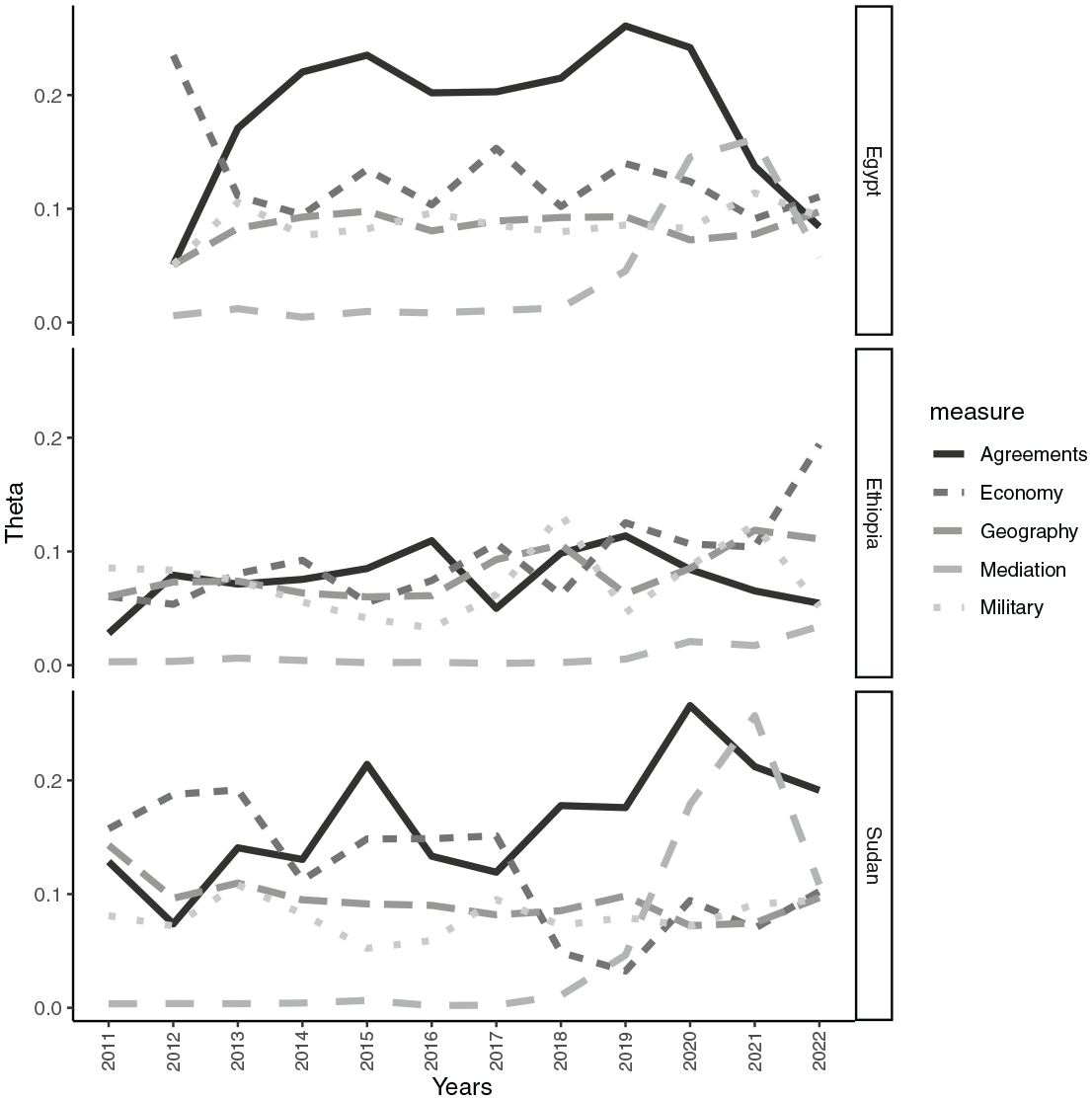
Dynamic KeyATM over the non-governmental newspapers in English (only seeded topics).
The agreement frame was extensively disseminated in Egypt and Sudan, with a special emphasis in Egypt in 2015 and 2019, and in Sudan in 2015 and 2020 while the Ethiopian media’s coverage peaked in 2016 and 2019. Except for the years 2020 and 2021 in Egypt, and 2021 in Sudan, media outlets in all three countries showed little interest in the mediation frame. The economic frame garnered more attention in the Egyptian media over the years 2015, 2017 and 2019. Ethiopia showed a strong interest in this frame over 2014, 2017, 2019 and the recent two years. Conversely, in 2013, an observed increase was witnessed in the coverage of this frame in Sudan.
To sum up, the non-governmental media in Ethiopia focused mostly on geographical and military frames in both 2018 and 2021. This emphasis may be attributed to Ethiopia’s ranking of 133rd out of 163 countries on the 2020 Global Peace Index, 6 indicating a decrease in peace compared to 2019. In addition to the Tigray war which was from 2020 to 2022 (Asgele Siyum, 2021).
The dominance of the military frame in Sudan was in 2013, 2017, 2021 and 2022 as, in addition to the reasons mentioned in the previous sub-section, Qatar’s Autumn (2021) efforts to call upon Arab League involvement drove the Ethiopian government to oppose these non-African mediations. As a result, a consultant to the President of the Sovereign Council in Sudan threatened a ‘water war’ in the entire area (Matthews and Vivoda, 2023: 15).
The agreement frame was dominant in Egypt and Sudan since the onset of the dispute, specially in 2015 as a result of the DoP in Egypt and 2020 in Sudan since Addis Ababa began the first of the dam’s three fills without an agreement (Meseret, 2021). However, this frame’s greatest share in Ethiopia was in 2016, a year after the 2015 DOP, also in 2019 as it was after Abiy Ahmed’s led the government with an ambition to reach a binding agreement.
The mediation frame received considerable attention in the non-governmental Egyptian and Sudanese media throughout the years 2020 and 2021, similar to the level of coverage by the governmental outlets. The economic frame dominated in 2015 as Egypt prohibited water-intensive rice farming in Delta due to water shortages (Nieuwsbericht, 2017). Its prominence in 2017 and 2019 in Egypt was due to the expansion of Chinese investment in energy generation in Ethiopia to convince those countries downstream of the advantages of the dam on others, not just Ethiopia. (Matthews and Vivoda, 2023).
Other topics covered in both the governmental and non-governmental newspapers
By using LDAvis to visually represent the unseeded topics from the governmental media outlets, a set of interesting topics were detected that enhance the understanding of the Nile controversy from Figure 3a. These topics are manually labelled by the author based on the top words detected by the KeyATM. These include manufacturing projects, equitable water use, role of Egyptian foreign minister, Ethiopian bonds, Ethiopian solidarity symbol, dam hydro-power generation, Sudan’s civil war, negative externalities of GERD on Egypt, role of Ethiopian delegates, Tigray civil war, Ethiopian–Sudanese trade exchange, Ethiopia’s economic growth, COP 27, Agricultural productivity, Abiy Ahmed, ecosystem and climate change, Korean delegation, IPOEs, Sudan–Uganda relations, Constitution of the Federal Democratic Republic of Ethiopia, Ethiopia’s independence 1896, rebels in west Darfur, electromechanical project, dam second filling 2021, information sharing, tourism, health and fishery investment, EU summit, ethnic groups, Meles Zenaway, Brazilian corporation, stock exchange, Ethiopian democratic party, role of Egyptian Coptic church, Britain treaty 1902, media reporting and accuracy, role of Al-Azhar, Saudi investment, US Department of Treasury, Ethiopian telecom donors and China’s investment.
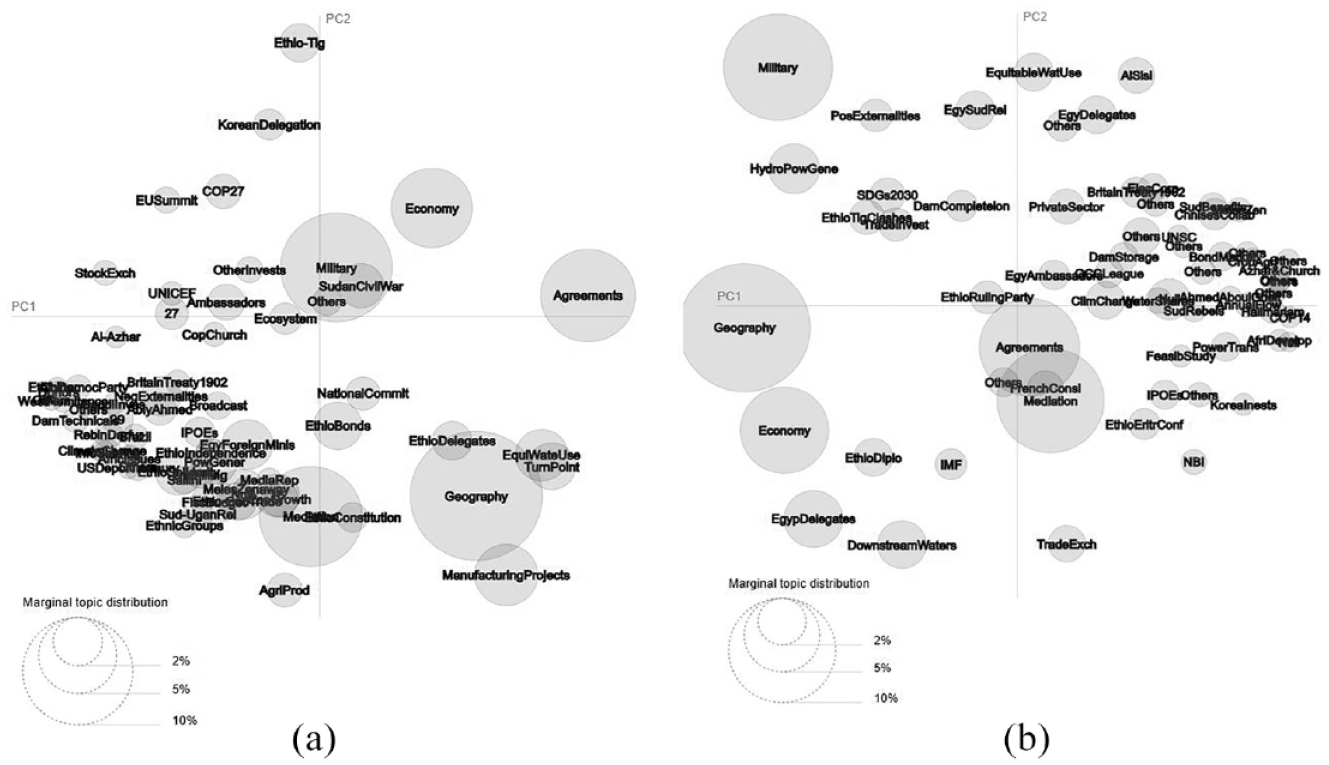
Visualizing the semantic correlation between seeded and unseeded topics in the governmental (a) and non-governmental (b) English media outlets.
In addition, a list from the non-governmental media outlets is shown in Figure 3b. This involves the role of Egyptian delegates, hydro-power generation, downstream water share, Egypt–Sudan relations, equitable water use, Ethiopia’s diplomacy, climate change, trade exchange, presidential speech, private sector investment, French consultancy, SDGs 2030, Ethiopia–Eritrea clashes, Ethiopian ruling party, positive externalities of GERD, Ethiopian–Chinese manufacturing corporation, dam completion, IMF funding, Britain treaty 1902, IPOEs, electricity power transmission, GCC league, the bond market, dam storage, Sudan’s benefits, agricultural crops in Egypt, historic water shares, annual water flow, NBI 1999, UNSC, Sudan’s rebels, feasibility study, COP 14, and Al-Azhar and Egyptian Coptic church.
Furthermore, LDAvis also provides a facility to link between the seeded and unseeded topics semantically. So, we can notice that seeded topics (i.e. geography, military intervention, mediation, agreements, and economic motives and consequences) are more frequent compared to the unseeded topics. This frequency is represented by the size of the bubble, the larger the bubble, the more frequent the topic. This indicates the relatively large proportion of media coverage dedicated to these five predetermined topics in the governmental and non-governmental English newspapers in the three countries. Furthermore, it confirms the theoretical arguments mentioned previously about the significance of these specific seeded topics as the primary media frames in this study.
Nevertheless, the governmental outlets reflect that the geography seeded topic is semantically close to the unseeded topics: equal water use, Ethiopian bonds and manufacturing projects, hydro-power generation, the military intervention is semantically close to Sudan’s civil war and Ethio-Tigray clashes, mediation and the French consultation, IPOEs and the role of Ethiopian delegates. The empirical identification of the unseeded topics and their association with the seeded topics of interest confirms the explanation in the previous sub-sections.
Discussion
This analysis revealed the dynamic framing of the Nile dispute based on how Egypt, Sudan and Ethiopia each portrayed the primary causes of the dispute: the English media outlets owned by the government and the non-governemntal outlets have their own emphasis and framing over the years 2011–2022. This dynamic framing leads into different perceptions of the same Nile dispute, adopting the main explanatory factors of the onset of water conflicts over transboundary basins (geographic location, military intervention to control these shared waters, signed agreements, regional and international mediation and economic dimensions).
These factors also explain the role of hydro-hegemony approach. Despite the observed dynamics of framings in the selected newspapers in the three countries, the dominant frames from these newspapers can be recognized. On the one hand, mediation, geography and agreements, and economic dimensions are more apparent in the governmental outlets in Egypt, Sudan and Ethiopia, respectively. On the other hand, the non-governmental outlets preserve the agreements, military and agreements, and economic dimensions as the most noticeable frames in Egypt, Sudan and Ethiopia, respectively.
These findings make sense with what has been discussed about hydro-hegemony and counter-hegemony as noted (for example, Cascão, 2008; Zeitoun and Warner, 2006) to analyse the dynamic power relations between the riparian counties in a shared basin. So, these findings can be assigned to two approaches as follows. On one side, the dominance of both frames of the agreements and mediation in both Egypt and Sudan implies the hegemonic behaviour of the two countries. Historically, Egypt and Sudan have a monopolistic power over utilizing the Nile waters due to the two agreements in 1929 and 1959 (Endaylalu, 2021). In addition, being a downstream country makes them at risk of the limited water flow from the Nile accompanied by the high population growth 7 (1.6% and 2.6% in 2022, respectively).
This results in investigating water security concern strengthened by geographical location and historical agreements to highlight the securitization aspect during their requests for both regional and international mediation to resolve this dispute. In other words, water securitization, as proposed by the Copenhagen school, which is driven by high water dependency and lack of alternative water resources apart from the Nile leads to a threat to their national security (El Nour et al., 2021; Fischhendler, 2015). Egypt uses phrases such as ‘Egypt cannot exist without the flowing water from the river’ due to its high dependency ration on the Nile by 98 percent and Sudan by 96 percent. 8 As a consequence, these agreements securitize their water shares from the Nile and the two countries use such agreements as veto power to defend their shares during calls for mediation. This agrees with the narrative of water insufficiency proposed by Hussein (2018) in which high population growth and inequitable water distribution between the countries in a shared basin increases concerns around water security.
On the other hand, the dominance of the economic frame in Ethiopia implies that Ethiopia is a counter-hegemonic country that seeks utilization and management of the Nile waters through constructing the GERD. This matches Ethiopia’s justification for building such a dam on its land. This justified counter-hegemonic behaviour from Ethiopia can be seen as counter-securitization (Stetter et al., 2011) to secure the right of the Ethiopian people to achieve sustainable development and eliminate poverty along with their high population growth 2.5 percent in 2022 9 in addition to their sovereign right of being upstream as the Nile originates from their lands. This goes aligned with what Fantini et al. (2018) argued about exercising the country’s power to enhance its territory’s control by investing in large-scale projects like the construction of huge dams which is the GERD in our case. This also relates to the role of cultural hegemony and water nationalism as Menga (2016) and Wheeler and Hussein (2021) illustrated so that the GERD represents the Ethiopian identity and heritage in the form of utilizing the Nile waters originating from their lands to achieve economic development, especially as the GERD was initially funded by governmental taxes and bonds. This implies the GERD is a national symbol and legitimate right of the Ethiopians, and shapes their collective identity.
Accordingly, hegemony and counter-hegemony and their relevance to securitization and counter-securitization co-exist in the case of the Nile dispute represented by the above-mentioned opposing news media frames between the downstream and the upstream countries. This is despite the exerted efforts from these counties to de-securitize the ongoing dispute by launching the NBI in 1998, CFA in 2010 and DoP in 2015. This paradox in framing and the resulting hegemony and securitization aspects might lead into either escalating the dispute into a violent conflict or fostering the role of hydro-solidarity and benefit sharing between the riparian countries to minimize the likelihood of such an escalation (Tawfik, 2016).
Hydro-solidarity arose in the late 1990s as a reaction to resource security politics, namely concerning water. It addressed the concern that scarcity of resources may hinder a nation’s economic progress. The hydro-solidarity idea highlights the positive effects of cooperation rather than the adverse outcomes of rivalry, and it may foster a conducive setting for the equitable management of water resources (Kasrils, 2003). This is actually verified by signing the NBI and DoP but the downstream countries are upset by the Ethiopian violation of these initiatives to settle the dispute and share benefits between all Nile basin countries. This violation increases the likelihood of the onset of violence to securitize the water shares of the downstream countries, especially if the negotiations hit a deadlock. Both Egypt and Sudan conducted a joint military drill called ‘Guardians of the Nile’ in May 2021. These protective and cautious attempts by the downstream countries should open the window to revive the negotiations between the three countries and encourage them to go back to the negotiation table to resume talks (Hall, 2023).
The three countries should recognize that the concept of a zero-sum game is not the optimal solution in the meantime and should look at preserving their cooperation beyond the Nile dispute and avoid making the GERD destroy their cooperative relations. The role of international mediation should not stop at finding a common ground between the three countries but should be extended to impose punishments on the violated country if any of them deviates from the agreed talks, such as imposing economic sanctions (Tekuya, 2021: 101–103).
Although this article is confined to English national newspapers, an additional analysis is discussed in the Appendix on the Arabic newspapers in Egypt and Sudan. However, obtaining Amharic newspapers for the study period (2011–2022) was challenging, whether through web scraping or using Lexis Nexis. Future research should recognize this limitation and conduct a comparative analysis of the national languages spoken in Egypt, Sudan and Ethiopia, as well as examining global media coverage of this dispute. In addition, topic-sentiment analysis is one of the potential types of research for taking into consideration the semantics of the detected topics and how every country frames the dispute with its own semantics to gain national and international support.
Supplemental Material
sj-docx-1-mwc-10.1177_17506352241241159 – Supplemental material for Keyword-assisted topic models reveal the dynamics in the main media frames of the Grand Ethiopian Renaissance Dam (2011–2022)
Supplemental material, sj-docx-1-mwc-10.1177_17506352241241159 for Keyword-assisted topic models reveal the dynamics in the main media frames of the Grand Ethiopian Renaissance Dam (2011–2022) by Salsabil M Abdalbaki in Media, War & Conflict
Footnotes
Funding
The author received no financial support for the research, authorship and publication of this article.

Notes
Author biography
References
Supplementary Material
Please find the following supplemental material available below.
For Open Access articles published under a Creative Commons License, all supplemental material carries the same license as the article it is associated with.
For non-Open Access articles published, all supplemental material carries a non-exclusive license, and permission requests for re-use of supplemental material or any part of supplemental material shall be sent directly to the copyright owner as specified in the copyright notice associated with the article.
