



Abstract
Memes are iconic digital artefacts that acquire meaning through their production and circulation among the digitally mediated publics. This visual essay presents an iconographic exploration of the North Atlantic Fella Organization (NAFO) – a vernacular online collective engaged in ridiculing Russian disinformation and rallying support for Ukraine’s defence and recovery efforts. We approach memes as a visual interface between the user and various subgroups within and outside the community. Drawing on a combination of autoethnographic, visual semiotic and computational methods, we demonstrate how memes perform three key functions within the online community: representing the self, maintaining social relations within the group and articulating the group’s values and commitment to its members and the broader public. In doing so, they can be understood as an extension of social and cultural practices surrounding religious iconography. Going beyond short-lived or self-centred engagement, memes constitute a rich yet flexible medium to mobilize social media users in significant international crises such as wars.
Introduction
On 15 May 2022, the Ukrainian Armed Forces posted an image of a destroyed Russian T-80 main battle tank (MBT), sparking a cascade of celebratory tweets from the digitally mediated publics. In one such tweet, user @Kama_Kamilia posted a Reddit meme of two Shiba Inu dogs Cheems wearing Adidas tracksuits (Sommer, 2020), standing against the said tank (see Figure 1).
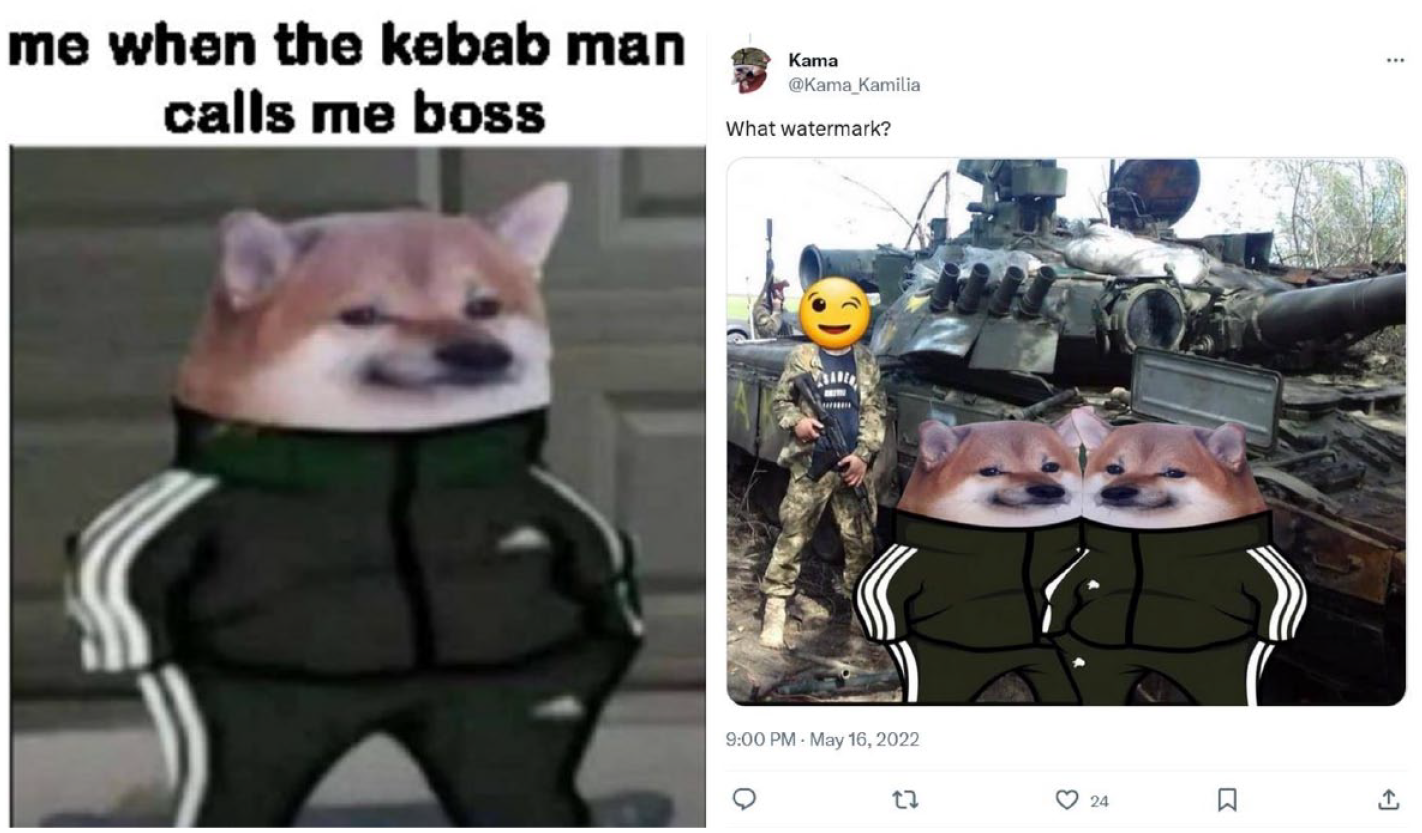
(Left) The original Cheems in a tracksuit meme (r/dankmemes, 2020). (Right) @Kama_Kamilia’s tweet celebrating the destruction of Russia’s T-80 tank (Reproduced with the permission of the user).
The rest is history: this post had started what is now considered to be the largest transnational online movement opposing the Russian invasion of Ukraine. In a matter of days, dozens of Twitter users donned similar-looking avatars to ridicule Russian military objectives in this illegal and unprovoked military campaign (Boichak and Hoskins, 2022) (see Figure 2).
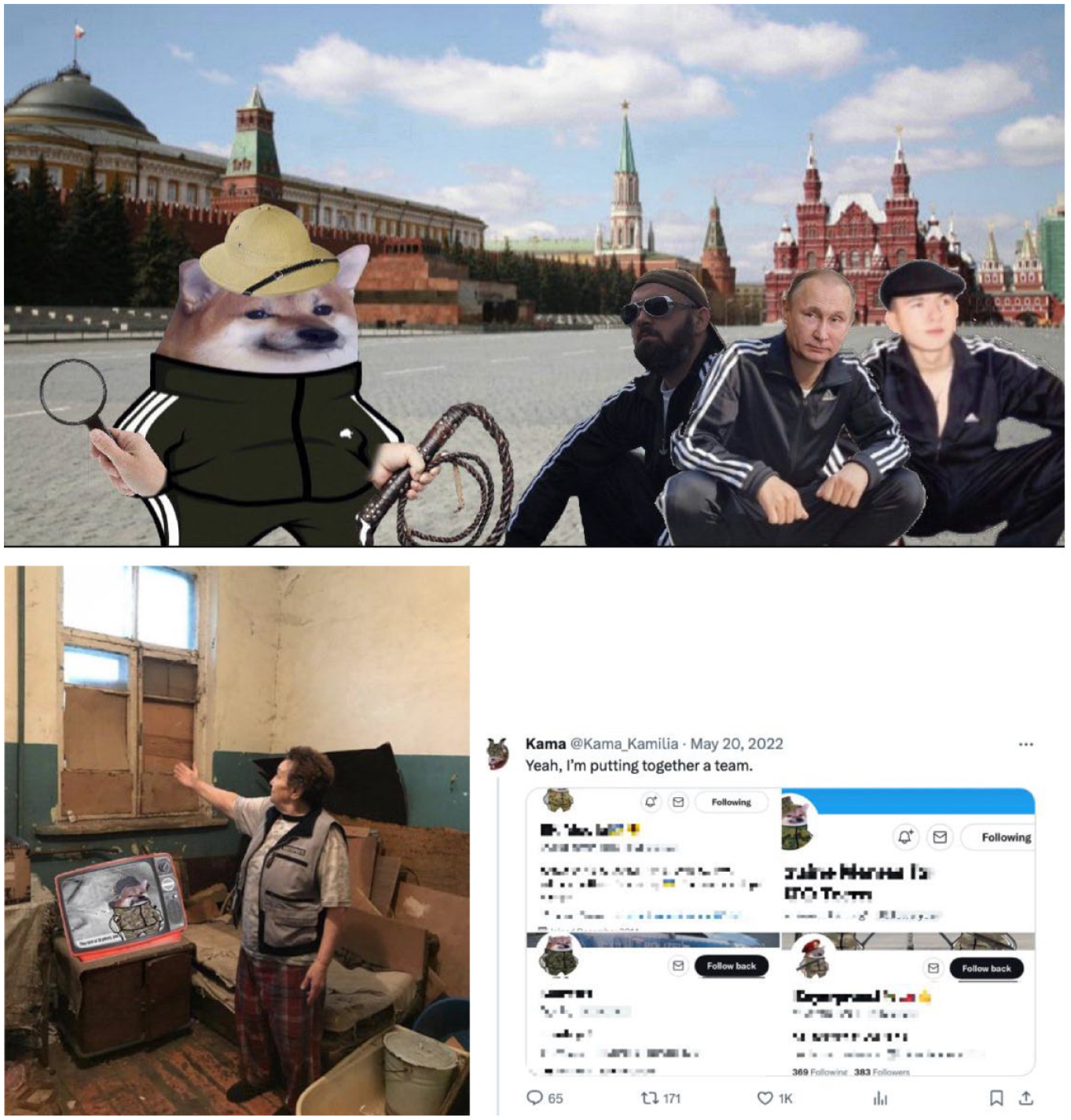
(Top) The figure of Cheems used in @ Kama_Kamilia’s meme mocking the Russian regime (Reproduced with the permission of the user). (Left) Cheems used in @Kama_Kamilia’s meme ridiculing Russian propaganda and low quality of life (Reproduced with the permission of the user). (Right) @Kama_Kamilia’s tweet highlighting other users donning NAFO avatars (Reproduced with the permission of the user).
This visual essay shows the diverse functions of memetic iconography of the North Atlantic Fella Organization (aka NAFO, see Figure 3). Analysing the rich repertoire of NAFO’s memetic practices, we argue that memes serve as icons that anchor online communities through organizing the rituals and articulating the values of participant involvement. Our findings contribute to scholarly understanding of the role memes play in mobilizing and maintaining online communities during significant international crises such as wars.
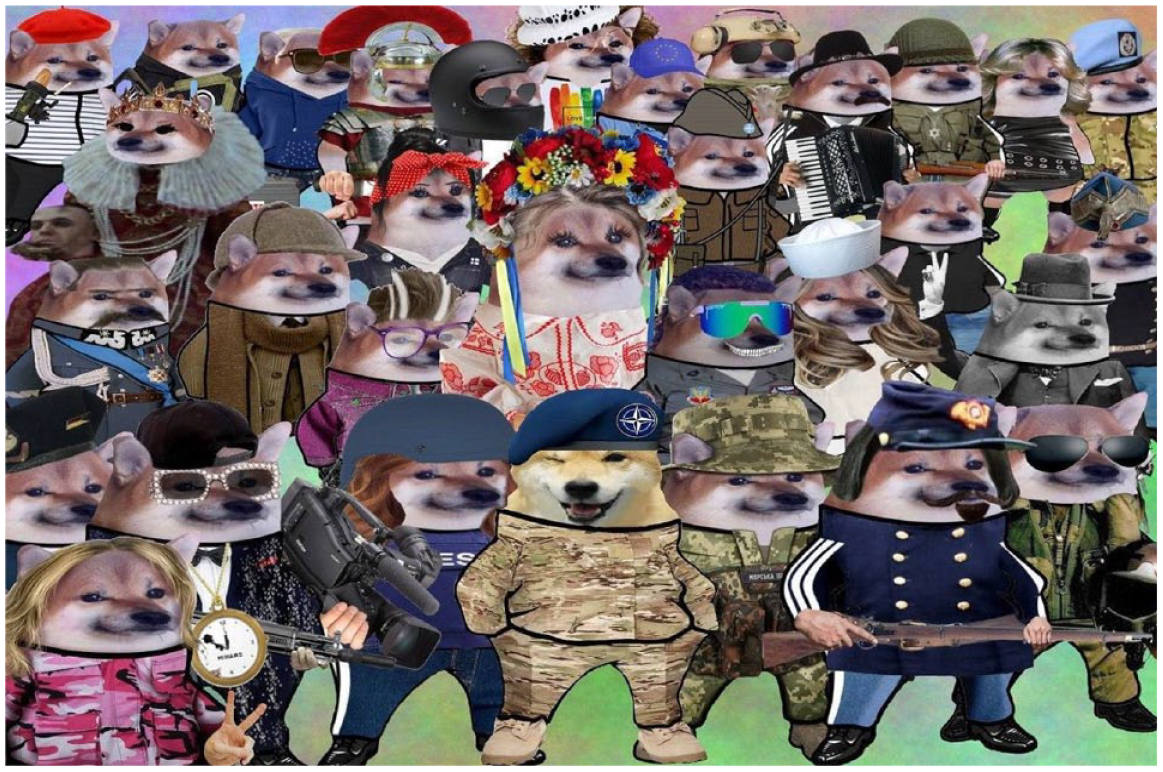
A collage of NAFO members’ avatars (Pearson, 2022).
‘Research fellas’ join NAFO
NAFO is a self-mobilized transnational community that took the internet by storm by ridiculing Russian disinformation and rallying support for Ukraine’s defence and recovery efforts. These users adhere to a unique aesthetic and are immediately recognizable for avatars featuring the same Shiba dog dressed up in human clothing and bearing various identity attributes.
NAFO members, who call themselves ‘fellas’, come from many countries and represent various backgrounds and demographics. At the time of writing of this visual essay, NAFO is 100,000–120,000 fellas strong, although membership in this community continues to fluctuate and move across platforms. Due to their decentralized nature, there is no single registry of fellas, although various record-keeping practices exist in smaller groups. While NAFO has a presence on platforms like Reddit, Discord and Bluesky, Twitter (now X) has been their primary site of operation.
The authors of this essay became aware of NAFO in June 2022. As careful observers of the developments surrounding Ukraine, we witnessed Twitter accounts with dog avatars adding memes in replies of accounts spreading Russian propaganda or defending vocal Ukrainian users from numerous pro-Russian trolls. Several months later, one of the authors made a small donation to a military unit of the Ukrainian Armed Forces and requested an avatar representing the other author in recognition of their common experiences in fighting Russian disinformation. Following previous accounts doing so, the author included a hashtag #fellarequest and a brief description of the desired avatar – a type of haircut, accessories appropriate for an academic and a few other distinctive features. Four days later, another NAFO account (belonging to a sub-group of meme creators who refer to themselves as ‘forgers’) responded with the requested avatar. Donning the NAFO avatar concluded the process of joining NAFO and soon the other author had joined the ranks in a similar fashion (see Figure 4).
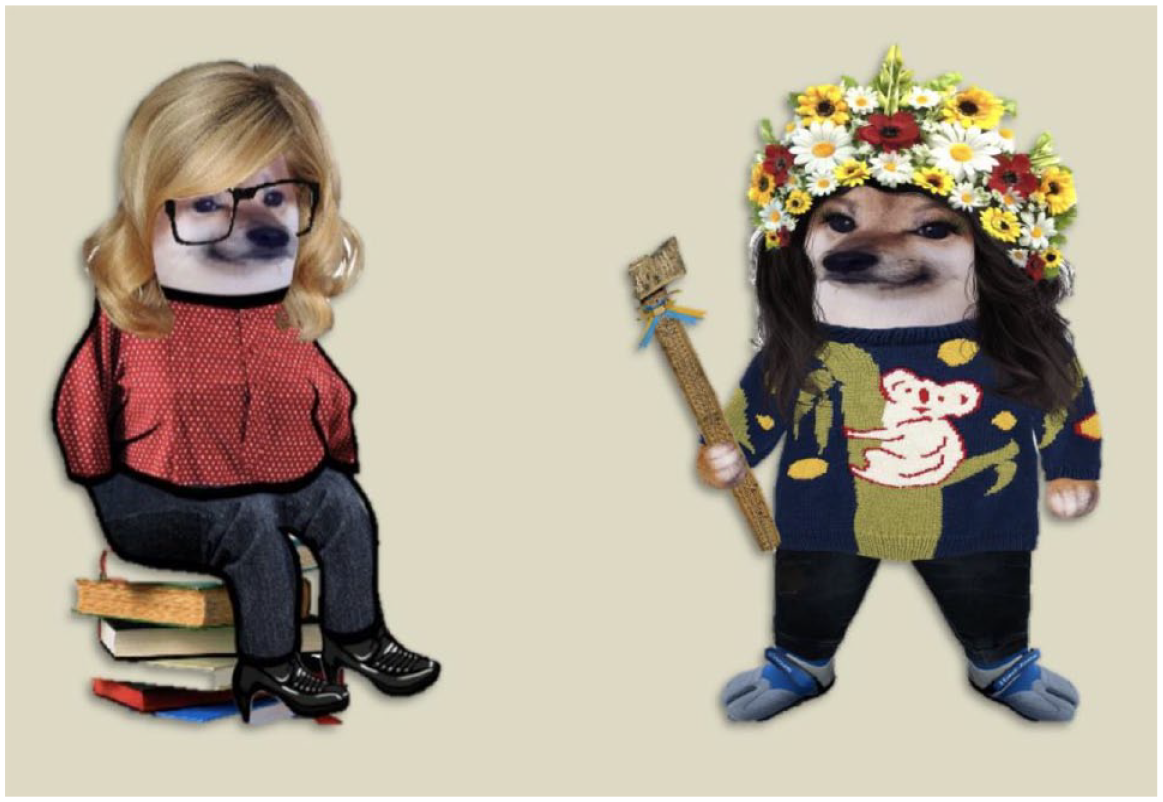
NAFO ‘research fellas’ (Collage by authors).
In this visual essay, we draw on a series of 25 semi-structured interviews with NAFO fellas, 5,737 #fellarequest tweets, a year of participant observation, our individual and collective experiences as ‘research fellas’, as well as multiple collectively maintained meme repositories shared with us by our participants.
While becoming a fella is open to all those who do so in good faith, the authors underwent additional vetting to interview other fellas. It was a two-way process, whereby fellas would both suggest other NAFO members they knew or provide background information about each other, and ask each other about whether interview requests from us were not attempts to undermine or subvert the movement.
During the initial nine interviews in February–March 2023, we asked about fellas’ motivations to join the collective and their role and experiences in it. As we spoke to fellas, we observed that they would often try and find a past post to illustrate their points. In the following 16 interviews conducted in August–October 2023, we formally introduced a scroll-back element (Robards and Lincoln, 2017), where we would ask the interviewee to scroll through their Twitter timeline in reverse chronological order and reflect on memorable posts. Such posts would often feature memes – ‘forged’, curated, or ‘stolen’ by our interviewees (e.g., Figure 5). Many fellas spoke about their memetic practices and some shared with us their collections of memes – repositories hosted on Google Drive or other websites (see Figure 6).
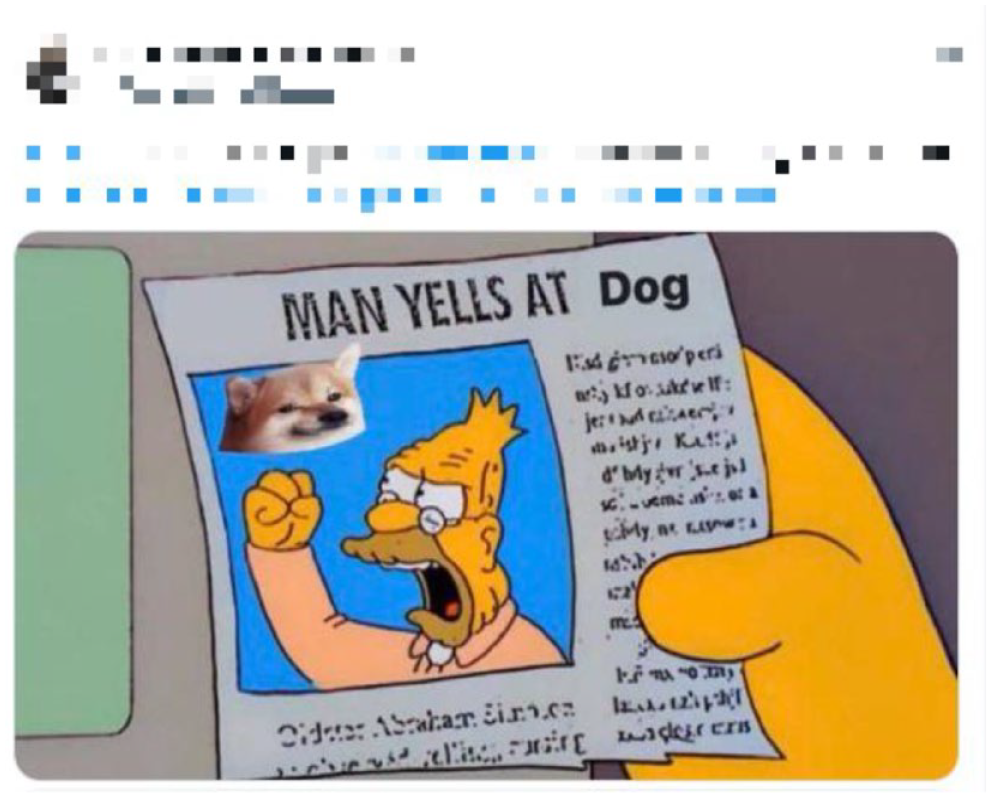
A meme used in a post by Canary* to ridicule a high-profile pro-Russian account’s anger at NAFO (Reproduced with the permission of the collective and the author of the post).
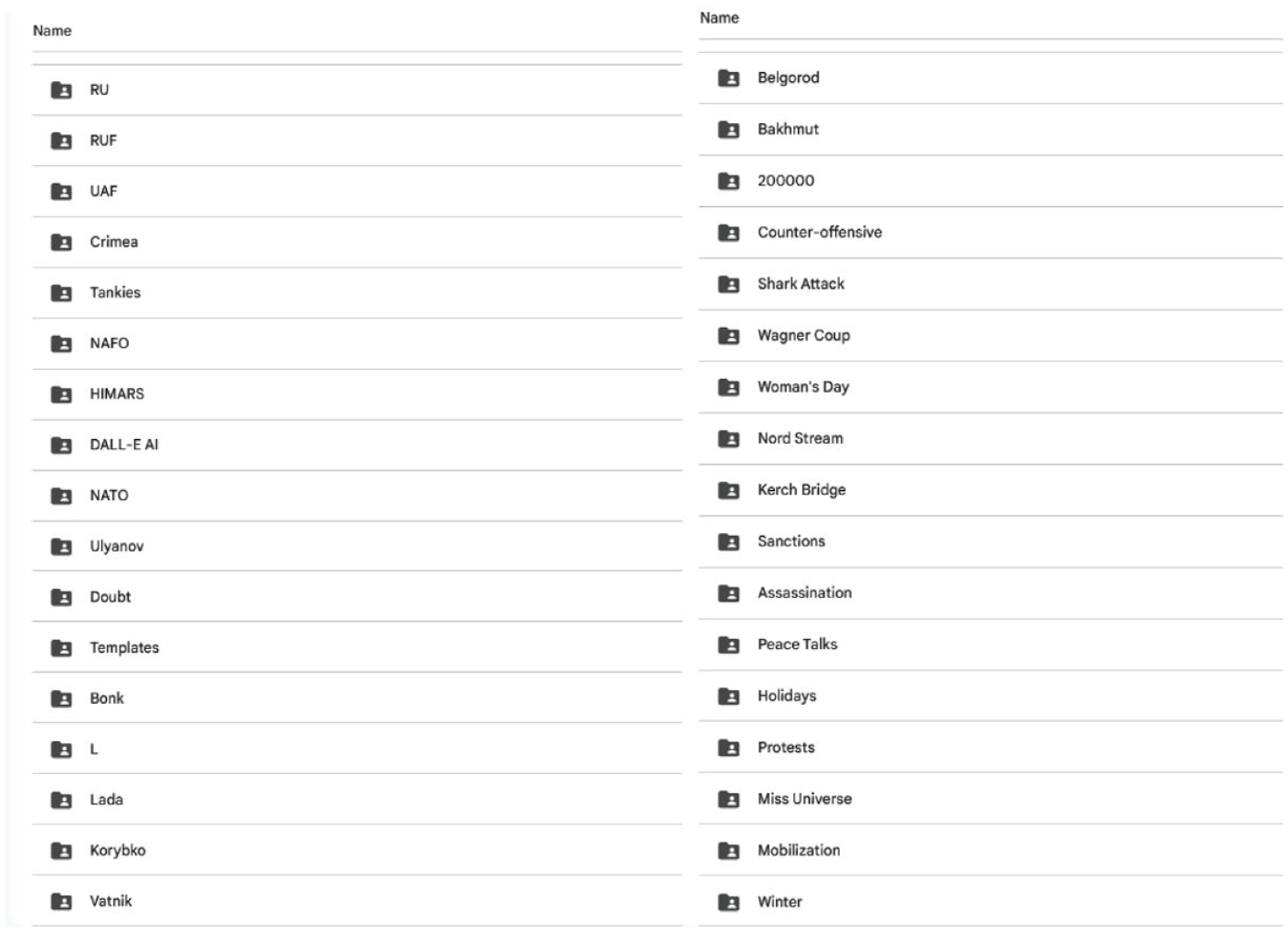
Shared repositories of NAFO memes (Screenshot by authors).
Memetic iconography
Understanding memes as icons foregrounds their centrality to organizing and maintaining the NAFO community. Icons are images that inspire a powerful response beyond interpretation or aesthetic enjoyment (Bartmański and Alexander, 2012; Brink, 2000). Like the sacred images in early Christianity and subsequently the Eastern Orthodoxy, symbolic properties of memes are not lost, but amplified as these images get reproduced (Brink, 2000; Dawkins, 1976; Parry, 2019).
Memes and other visual icons communicate values to ‘believers’ and ‘nonbelievers’ (see Figure 7). They bond communities together through a process of iconization (Wignell et al., 2017) which condenses and amplifies meaning through images, texts and other objects to facilitate collective sensemaking, mobilization and various forms of action ranging from violent extremism to political or social protest (Kirby and Özkula, 2023; Parry, 2019; Wignell et al., 2017). When deployed on social media platforms, memes, in their iconic understanding, have a potential to both establish and renegotiate sociopolitical divides (Eroukhmanoff, 2019; Gerbaudo, 2015; Mortensen and Trenz, 2016). For example, the image of Malala Yousafzai (Figure 8) emerged as a global icon, at the same time symbolizing universalist moral values and prompting some to resist Western appropriation of the figure and essentialization of the political situation in Pakistan that it entails (Olesen, 2016).
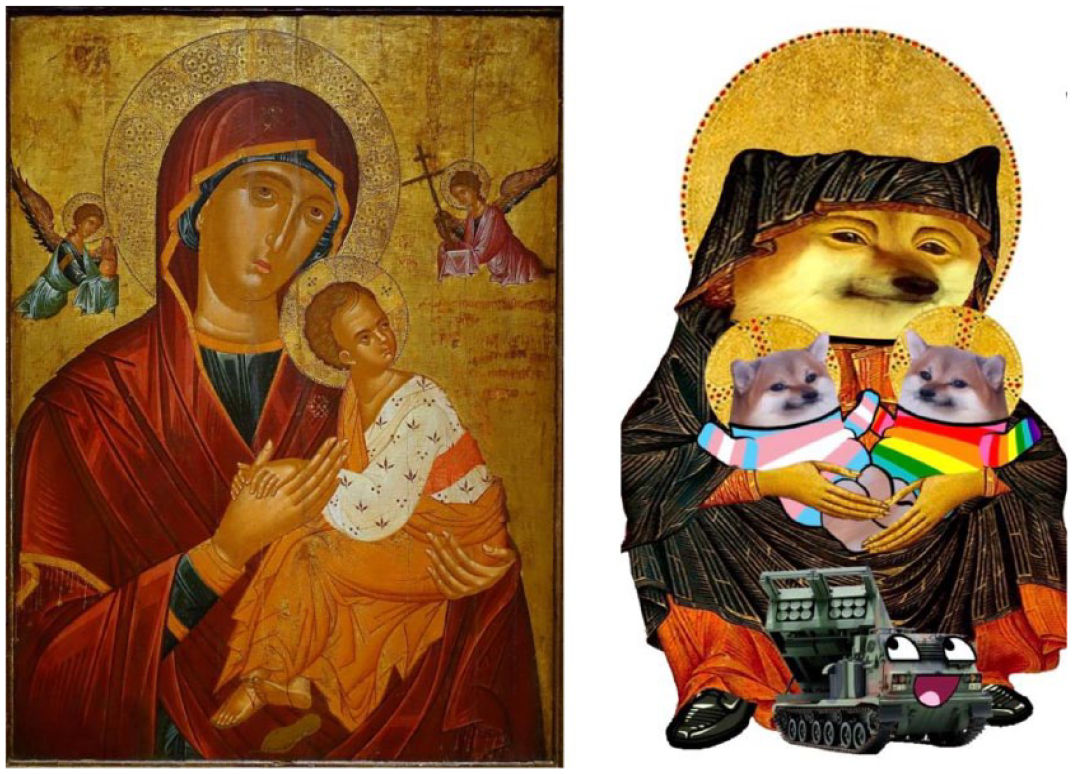
(Left) Virgin of the Passion icon (Ritzos, 1451–1492). (Right) A NAFO reinterpretation of Our Lady of Perpetual Help to signify the collective’s diversity.
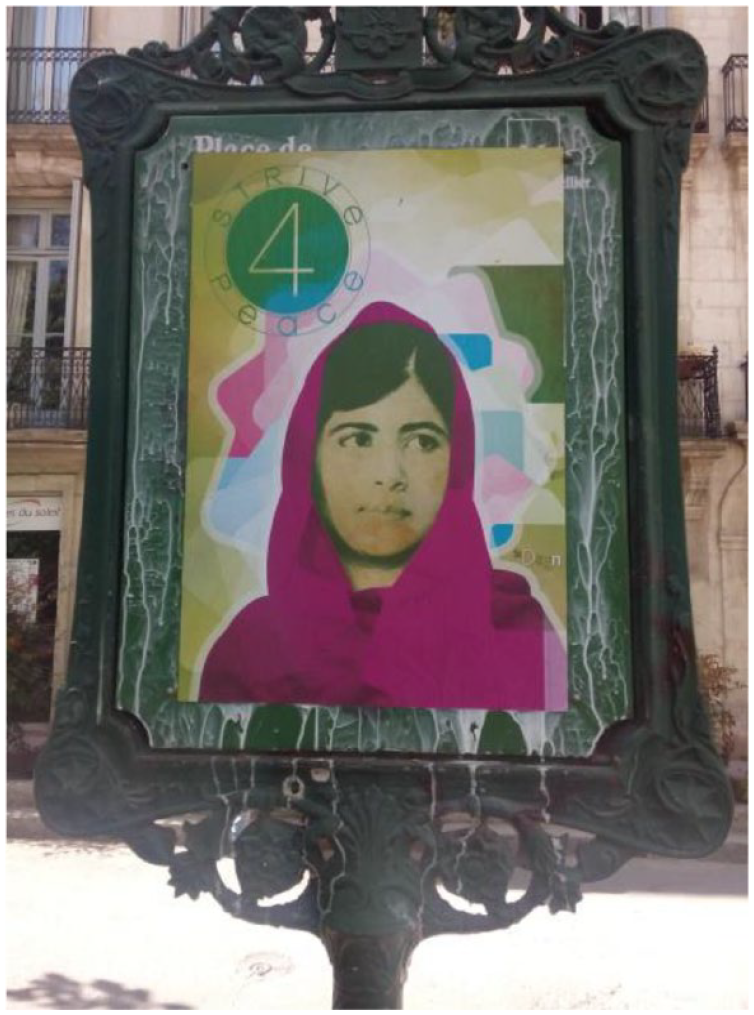
Street art of Malala Yousafzai in Montpelier, France (Hutchins, 2015).
Yet, these emergent social relations are often characterized as volatile, with digital publics formed around memetic icons dispersing as quickly as they form, without achieving meaningful political action. In contrast, in this essay we consider memes in their capacity to perpetuate NAFO’s activist practices in the highly volatile digitally mediated environment of Twitter.
NAFO’s memes both connote (see Figure 9) and explicitly feature religious themes and elements. This is particularly prominent in memes used by fellas as avatars and memes incorporated in NAFO’s rituals. To explore the iconic power (Bartmański and Alexander, 2012) of memes for the collective, we perform a comparative visual social semiotic analysis (O’Hagan, 2023) and identify analogies between NAFO’s memes and religious images. Similar to Brink (2000), our aim is not to elevate memes to the level of the sacred, but to highlight the power of memes as ‘acts of meaning’ (Bruner 2000: 108, in Bartmański, 2012: 43) within the context of one self-mobilized community. Below, we analyse the memetic iconography of NAFO in its capacity to represent users (avatars) and serve as ‘glue’ bonding an online community together (rituals).
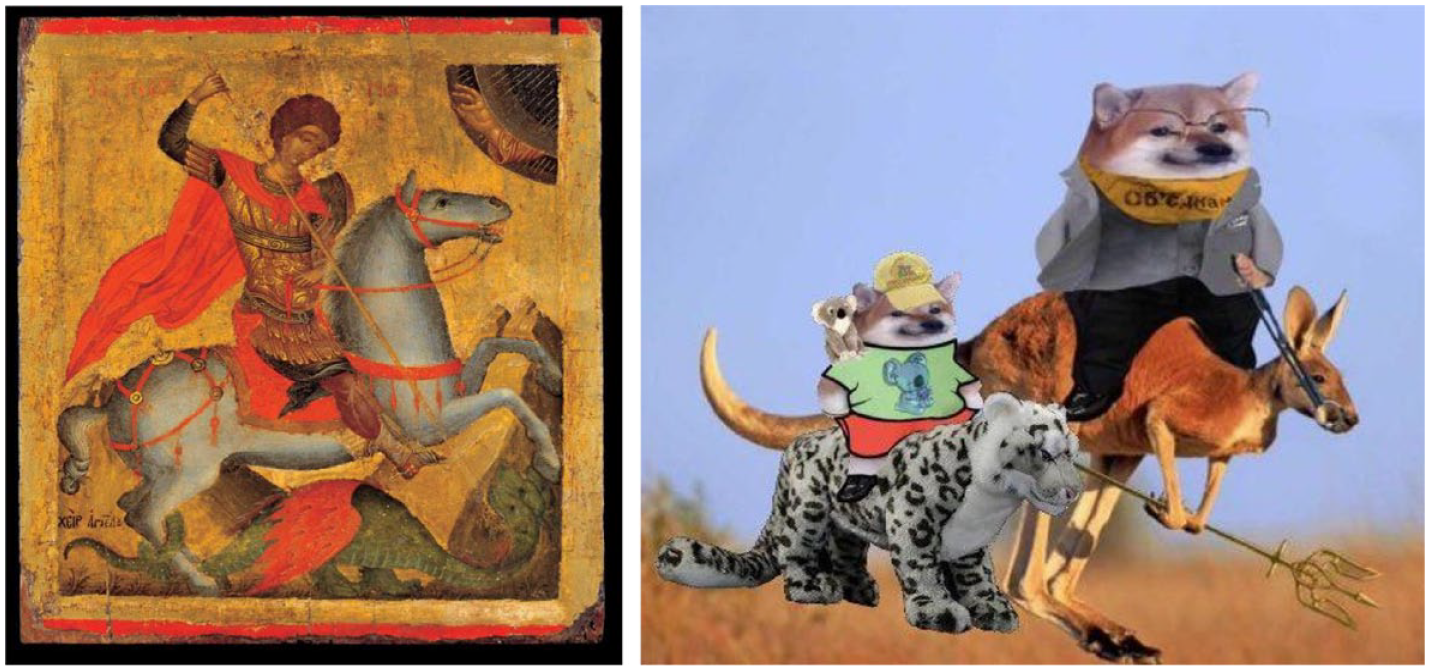
(Left) An icon of St George slaying the dragon, featuring a series of canonical attributes (Akotandos, 1425–1450). (Right) The NAFO avatar of the Australian Ambassador to Ukraine Bruce Edwards, featuring attributes of emerging significance.
Avatars
Avatars featuring a Shiba Inu are the most distinctive feature of NAFO and, as elaborated above, obtaining an avatar is a precondition of joining the collective. NAFO avatars are inherently memetic – not simply because they incorporate the Reddit meme of Cheems/Doge, but as they share properties of other memes – relative visual simplicity, virality and imitation (Gerbaudo, 2015). The first NAFO avatars were a creation by the movement’s founder, @Kama_Kamilia – a sarcastic dab at the Russian military might despite the obvious disparities between Ukraine and Russia’s armies. This tongue-in-cheek representation resonated with the online public and was immediately appropriated by other users to represent their stance. As the number of people tweeting at Kama and requesting profile pictures increased, he invited others to help. Often equipped with no more than a smartphone, an eraser tool and Pixar or similar apps, creators of memes, or ‘forgers’, added custom attributes to templates of a dog wearing a tracksuit in response to tweets with a hashtag #FellaRequests. For NAFO fellas, such attributes are used to signify gender, family heritage or national belonging, relationship to military, religious, or other institutions, fashion choices, pop culture fandom, as well as hobbies and interests. To understand the relationship between avatar attributes and user identities they were meant to represent, we mapped the co-occurrence of these attributes in avatar requests. We did so using a semantic network approach (see Boichak, 2023, for details on the method) and visualized the results as a heatmap (Figure 10, see also Van Eck and Waltman, 2011).
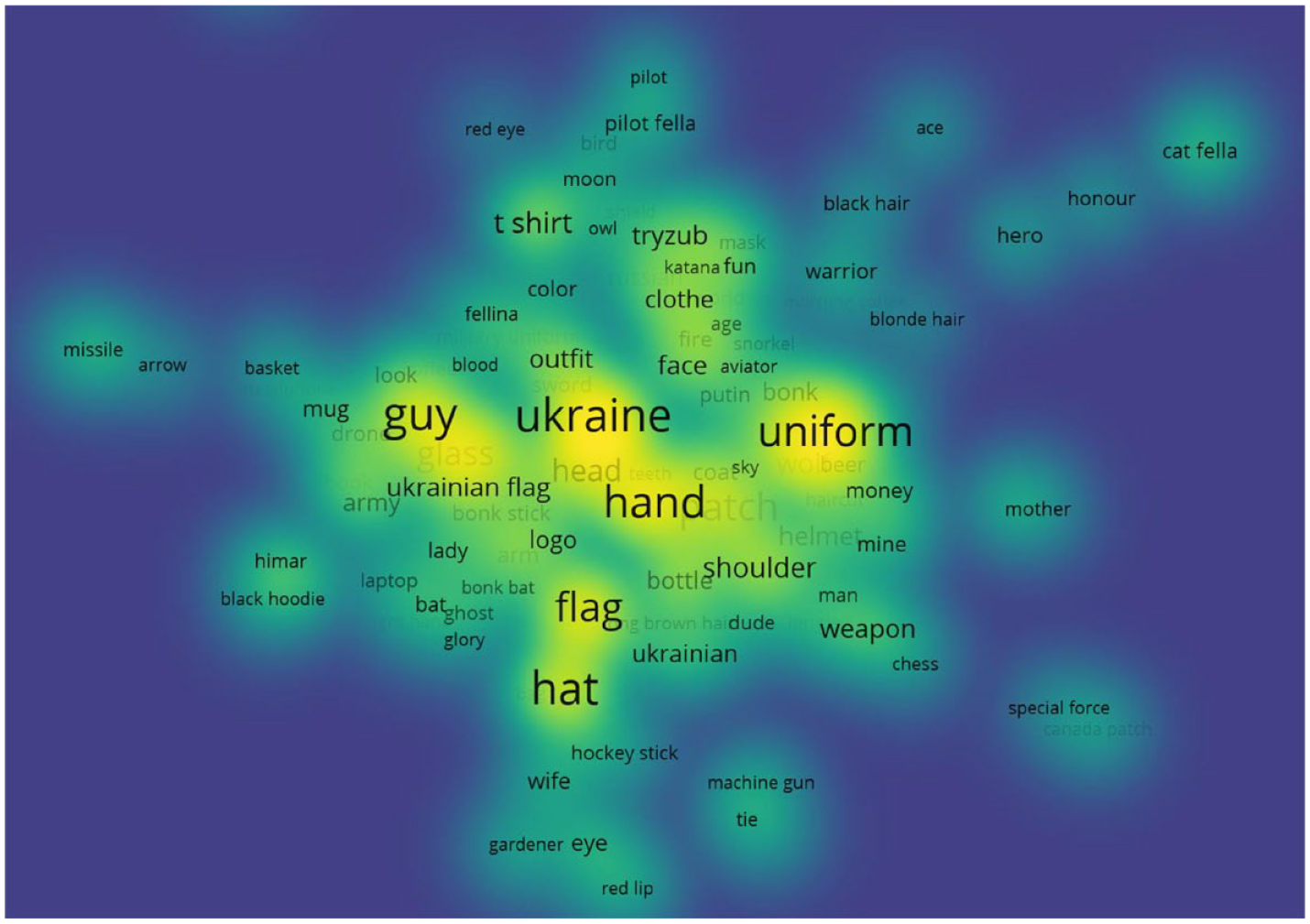
Heatmap image showing co-occurrence of terms used in 5,737 tweets posted between October 2022 and January 2023 with #fellarequests describing the desired avatars to forgers.
Despite the seemingly self-centred nature of avatars, Figure 10 demonstrates the centrality of support for Ukraine, expressed through the country’s national symbols such as flag and coat of arms, or tryzub (the Trident); and the users’ duty as a member of NAFO, expressed through various weapons and other military symbols. This renders them similar to attributes of Christian saints, who in Byzantine and pre-Reformation Europe would often be portrayed carrying particular tokens – a book, a wheel, a seashell. These tokens served as symbols of power both of saints as individual actors and the belief system they represented (Stanbury, 2008). As Stanbury suggests, ‘as tokens, attributes should be read the same way we read saints themselves – that is, as signs to make us think of the idea behind the image and not the image itself’ (p. 74).
Consider Vanessa, a fella with Ukrainian heritage, whose avatar through the use of background colour, fire and a crown, paid homage to Saint Olga of Kyiv (Figure 11). Here is how she interpreted the connection between her avatar and the canonized princess of the Kyivan Rus, infamous for violent revenge on a tribe that killed her husband (Dyba, 2013): Olga . . . really stood up for her values . . . And, you know, when she realized what was happening, and she had people that she loved taken away from her, she rose up on her own, and this fire just came up in her and she planned and executed it to perfection. Particularly for a woman to be able to do those things at that time, I just find her fascinating. And I think that that type of fire is something that we all have, and we should harness it at the times that we need to, and harness it in a way that’s able to be used for common good.
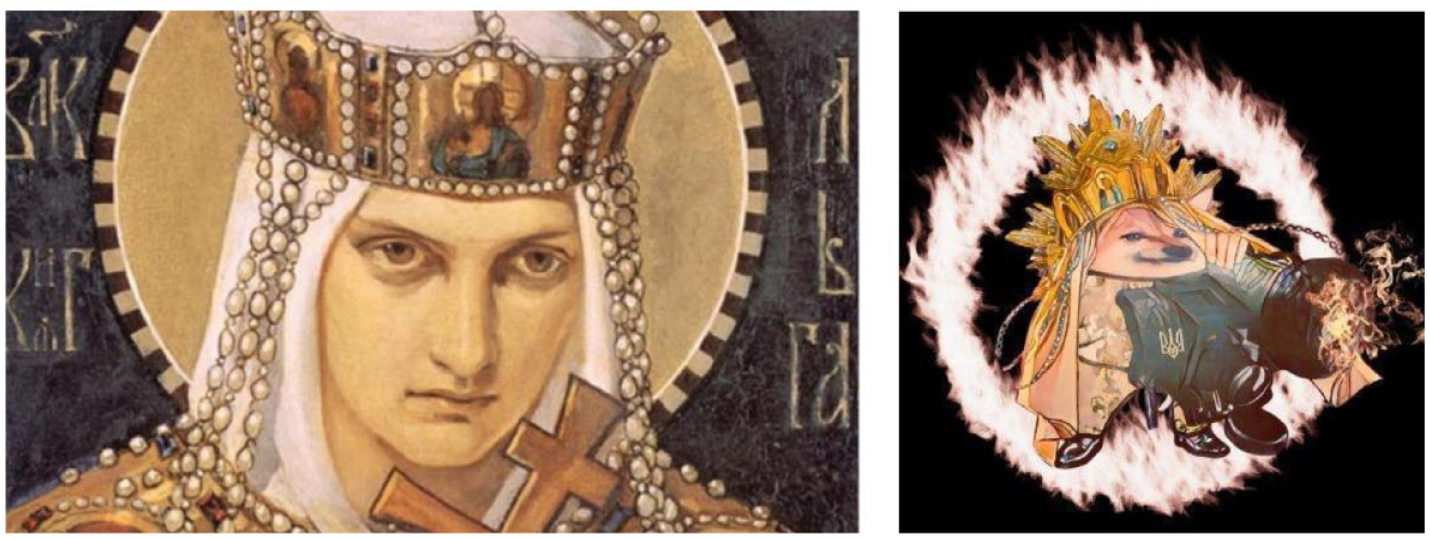
(Left) Saint Olga of Kyiv featuring canonical attributes such as the crown and the cross (Bruni, 1901). (Right) Vanessa’s NAFO avatar featuring an interpretation of St Olga’s canonical attributes (Reproduced with the permission of the user).
Vanessa’s NAFO avatar appropriated elements from the Ukrainian saint’s iconography to embrace her identity as a person with Ukrainian heritage standing up for her values. This can be seen as an instance of the interrelated processes of adaptation and self-celebration, ‘where icons are adapted to dominant value sets and, as a result, become sites and occasions for celebrating these values’ (Olesen, 2018: 313). In Eastern Orthodoxy, in particular, icons are often gifted to ensure their owner’s protection by their name saint or patron saint. Similarly, featuring St Olga’s canonical attributes, Vanessa’s avatar paid homage to the saint in fulfilling her mission of supporting Ukraine.
In contrast to protest avatars described by Gerbaudo (2015) that are easily adopted to represent one’s allegiance to a cause and often just as easily discarded, the process through which users don NAFO avatars involves some ‘lingering’ (Han, 2017). Making new members select avatar attributes and an organization or cause to donate, as well as waiting for ‘forgers’ to work through a backlog of ‘fella requests’ slows down the growth of NAFO, but ensures contemplation on one’s dedication to the cause. In this capacity, NAFO avatars serve as a visual interface among various groups within the NAFO community, documenting a transaction between the user and avatar creators (forgers), benefactors (charities) and the other users from the public observing this induction process. In medieval times, the practice of making a donation in exchange for having an image of a saint signed with one’s name was common (Stanbury, 2008: 37), and procuring a ‘personalized’ avatar through a donation can be considered an extension of this tradition. The creative control fellas have over one’s self-representation also varies, either due to fellas not having a preference, or forgers adding unrequested attributes to avatars. Ingrid’s* explanation of her avatar (Figure 12) is telling: I don’t remember saying anything. Because I didn’t really have an idea what I wanted to be like, I might have said that I’m a blonde. But I was pleasantly surprised when I saw this because I didn’t have any . . . I didn’t say anything. Because it was really in the beginning. And what do I say? I am just an ordinary person.
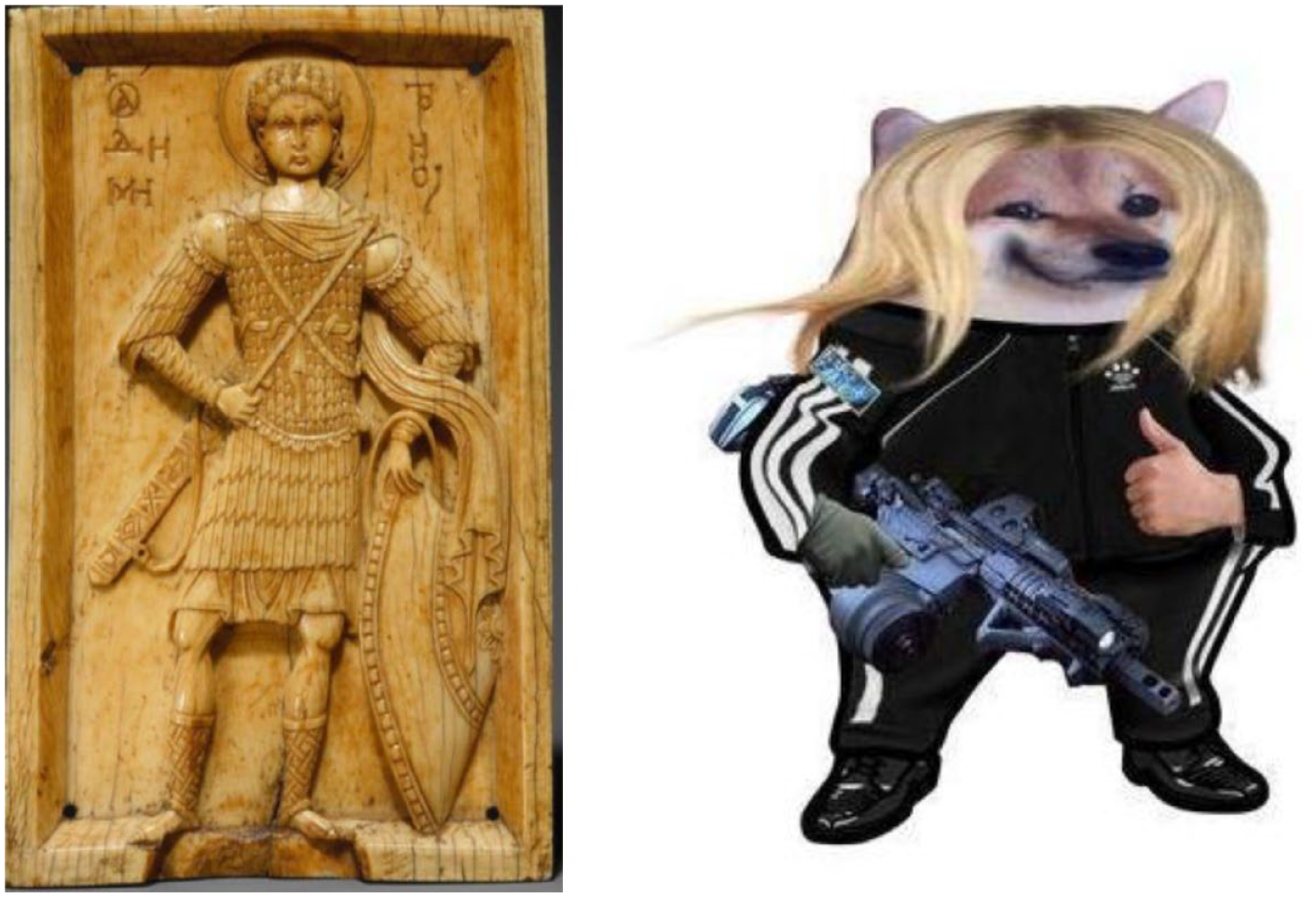
(Left) Icon of Saint Demetrios (Anonymous, 950–1000). (Right) Ingrid’s NAFO avatar (Reproduced with the permission of the user).
Ingrid was not deterred by the fact that the avatar did not look like her, that she would ‘never wear this outfit’, or hold an assault rifle, in real life, as long as it allowed her to be a part of NAFO and act to support Ukraine. In this way, as images of Byzantine saints (Figure 12), NAFO avatars draw their iconic power not from likeness to the subject they depict, but from often schematic attributes that indicate a saint’s ‘position in the scheme of intercession and salvation’ (Maguire, 2000: 16).
Rituals
The process of joining the collective through requesting an avatar also highlights the centrality of memes, as a form of iconic imagery, to NAFO’s rituals. As a rite of passage, online rituals are structured, formalized action sequences that serve as vehicles for sensemaking (Burgess et al., 2019) and expression of values (Trillò et al., 2022). In this section, we demonstrate that, similarly to religious icons (Alexander, 2012; Binder, 2012), NAFO’s memes anchor the collective’s ritualistic practices.
In Christianity, religious icons enable various types of rituals with multiple degrees of ‘publicness’, ranging from highly private, like an individual prayer or kissing of an icon, to deliberately public such as mass processions (Binder, 2012; Ševčenko, 1991). For NAFO, we identified three types of rituals to which memes were central. First, memes are wielded as weapons in the practice of shitposting, or humorous, aggressive, or nonsensical attempts to derail the discussion and provoke opponents (McEwan, 2017). The most famous example of NAFO’s shitposting is the collective’s exchanges with the Russian Ambassador to Austria, Mikhail Ulyanov, in June 2022.
Like other Russian government-affiliated actors (Shultz, 2023), Ulyanov actively utilized his Twitter account to influence discussions around the war for the benefit of the aggressor state. When NAFO fellas started bombarding replies to Ulyanov’s posts with both counter-arguments highlighting ridiculousness of his claims, as well as jokes and memes, the ambassador aggressively responded to a user with a phrase ‘You pronounced this nonsense. Not me.’ NAFO quickly appropriated this phrase, incorporated it in their memes and used it against Ulyanov and other pro-Russian accounts on the platform. It has also become one of the main symbols of NAFO’s effectiveness. Echoing military parades displaying captured Byzantine icons (Ševčenko, 1991) to celebrate one’s victory and assert righteousness of one’s authority, NAFO utilize the ‘nonsense pronounced’ meme to remind themselves and others of their victory over a highly visible and powerful adversary (Figure 13).
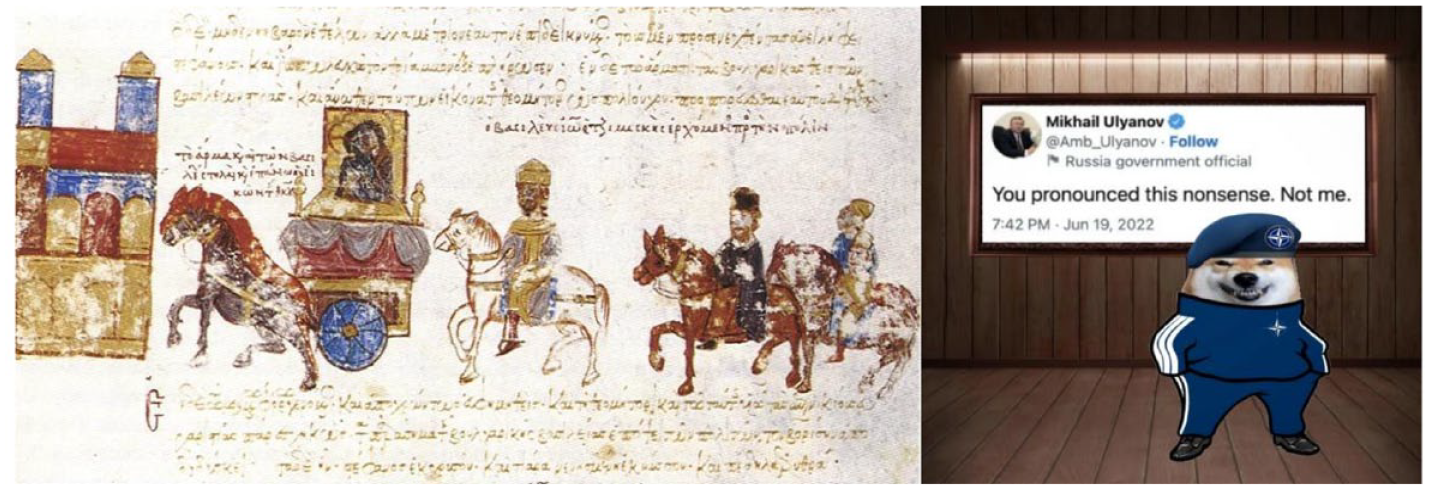
(Left) An icon used in a ceremony celebrating Emperor John I Tzimiskes’ military victory (Skylitzes, 1100, c.12th century in Ševčenko, 1991: 47). (Right) A meme celebrating NAFO’s trolling of Ambassador Ulyanov.
Some of NAFO’s memetic rituals unfold in settings that are less public. In addition to the initiation ritual involving having one’s avatar ‘forged’, NAFO users often change their header photos to display symbols of their support for Ukraine. For example, one of the interviewees, Sam*, displayed as his account header the picture of Oleksandr Matsievskiy (see Figure 14), a Ukrainian prisoner of war shot by Russian captors – a symbol of Russia’s war crimes and Ukrainian defiance. The audience for such iconic images would not extend beyond users who would take an extra step of clicking on someone’s profile and examining the attributes beyond the avatar but, for Sam and others, displaying memetic icons on their profiles was a necessary step in self-presentation as a supporter of Ukraine and a person with an appropriate moral standing. This semi-private practice is akin to placement of icons in domestic spaces that are still accessible to house guests (Voulgaropoulou, 2019) or decorations common in Ukrainian public buses (Figure 14), where drivers customize their workplace through artifacts often including icons (Kasianova, 2021).
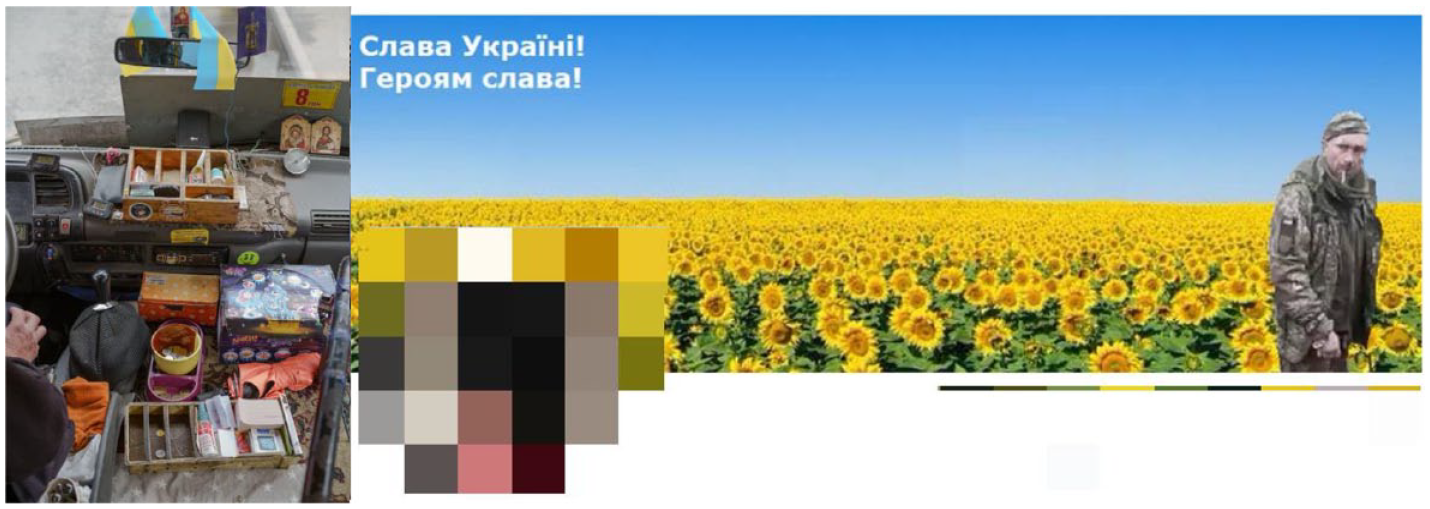
(Left) Icons displayed on the dashboard of a public bus in Kyiv, Ukraine (Prutkin, 2021, in Kasianova, 2021). (Right) Sam’s account header image.
While the above example of memes serving as icons in semi-private rituals of self-presentation reinforces the idea of the role that memes play in propagating NAFO’s values, the third type of NAFO’s memetic rituals is most explicitly aimed at maintaining the community’s cohesion and upholding its values. Despite some of our interviewees claiming that ‘one of the characteristics about NAFO is that there are no rules’ (Mariko*), one of the important roles memes play in the collective is to communicate what NAFO fellas should and should not do.
One of the most distinct examples of this is a ritual of repetition of the phrase ‘This is the way’ (see Figure 15). Originating in Disney’s TV show The Mandalorian (Know Your Meme, 2019), the phrase was appropriated by NAFO and used in memes that could be added in replies or posts approving a fellow member. We observed the phrase also being used without the image in reply threads where it would be repeated by multiple users to highlight instances and properties of desirable action (according to one such tweet, these properties included ‘bonking as hard as possible’, ‘donating if possible’, ‘giving credit and taking no credit’, ‘boosting good content and following new fellas’, ‘protecting Ukrainian users and supporting each other’ and ‘giving grace’). Ben, a fella from the US who spoke about being responsible for starting this ritual, explained it in the following way: When I became a fella, I wanted a good solid, quick thing that I can tweet. So I usually say either, you know, ‘Ukraine will prevail’, or I’ll say ‘This is the way’. And so that’s a thing, just to say, and, and so actually earlier . . . I guess it would have been maybe about six months ago now or so. I started doing that, we started like a little chain. ‘This is the way’ and then it grew to these huge, huge chains of different fellas that were saying it and then replying to each other and quote tweeting each other.

A NAFO meme featuring the phrase ‘This is the way’.
This ritual of collective repetition, supported by a meme, echoes a prayer ritual, which in early and Eastern Orthodox Christianity has often been supported by icons (Ševčenko, 1991). Similarly, brief incantations such as ‘Amen’, ‘The Lord be with you’ (or in Islam, ‘Inshallah’ and ‘Alhamdulillah’) are a feature of many religions and folk belief systems surrounding them. Saying them out loud in the presence of others serves as proclamation of one’s identity (Gay, 2004).
Icons and rituals give a flexible structure to a fully online community of NAFO. They allow the collective to uphold its values (and thus perpetuate itself) without imposing strict rules that would prevent its growth and expansion of support for Ukraine.
Conclusions
Previous scholarship conceiving memes as visual icons has recognized their potential for mobilizing diverse groups of people towards a cause, while suggesting that the participation they afford is transient. Through a comparative visual social semiotic analysis of memes and religious images in early and Eastern Orthodox Christianity, we demonstrate that memes’ potential as a participatory genre of digital cultures goes beyond short-lived or self-centric engagement.
For NAFO, an online collective that arose to counter the Russian invasion of Ukraine, memetic avatars enable a form of involvement that deprioritizes an authentically performed self in favour of the cause they support, in addition to being a transactional mechanism to streamline donations and rally support for Ukraine’s defence and recovery efforts. NAFO wields memes as both weapons in their fight against disinformation and propaganda, and as spoils of war through which they celebrate the collective’s effectiveness. Through enabling initiation and communal rituals, memes provide NAFO’s members a space for contemplation and a repetition that, according to Han (2020: 11), are necessary for creation of a ‘communal body’.
As a diffused and non-hierarchical collective, NAFO is not devoid of conflict and controversy as its size continues to grow. Yet, the very existence of NAFO and the diversity of its practices and avenues for participant involvement warrants scholarly attention, especially as the arsenal of tactics to combat computational propaganda has been traditionally limited to information-based practices, often at the detriment of paying attention to the communities involved in this process. It is our hope that memes will be prominently represented, and studied, as a lasting (although fluid and flexible) visual record documenting the history of collective online mobilization in significant international crises such as Russia’s war against Ukraine.
Footnotes
Declaration of conflicting interests
The authors declared no potential conflicts of interest with respect to the research, authorship and publication of this article.
Funding
The authors disclosed receipt of the following financial support for the research, authorship, and/or publication of this article: This work was funded through the University of Sydney SOAR Prize.


