



Abstract
This article discusses the results of verbal framing analysis of the conflict in news published on Telegram channels by the Russian news agency RIA Novosti (RIAN) and the Ukrainian news agency (UNIAN) during the Russian invasion of Ukraine in 2022. The analysis, using the text mining method, shows differences between how a more authoritarian and more competitive regime uses social media to construct strategic narratives. RIAN benefits from a technical frame that has not changed throughout the war although the reality on the ground has been evolving dramatically. It focuses on military issues and international rivalry (e.g. sanctions) because the Kremlin focuses on it. UNIAN, on the other hand, uses the moralizing frame of conflict which is more flexible and has been developed in response to changes on the ground – from discussions about the possibility of the invasion to humanitarian tragedy to war crimes, and to creating a more essentialized image of the enemy (‘rashists’).
The mass media imposed the rhetoric of wars and conflicts for a long time. Their role began to diminish with the development of social media which started to play a crucial role in the mediatization of war (Hoskins and O’Loughlin, 2015; Merrin, 2019). On the one hand, social networks have made it possible for anyone in or out of a conflict zone to participate in the information war by presenting events from their perspective or engaging in activities that expose propaganda (Merrin, 2019). On the other hand, professional media and military institutions, thanks to their presence on social platforms, can control their dynamics and use them for their own ends, including capturing public attention. This kind of mediatization of war is called ‘arrested war’ by Hoskins and O’Loughlin (2015) and the conflict between Russia and Ukraine in 2022 is a good example.
Many studies of media coverage of wars and conflicts have focused on analysing news framing. Researchers have pointed out that the way in which wars and conflicts are reported in the media depends on such factors as a media organization’s ties to the party in the conflict (Dimitrova and Strömbäck, 2005; Dimitrova et al., 2005; Seib, 2004), the media and political system in which the organization operates (Deibert et al., 2010; Kostopoulos, 2020), as well as related self-censorship and the degree of activism among journalists (Nygren et al., 2018).
In this study, we argue that differences in strategic narratives relating to Russia’s invasion of Ukraine in 2022, constructed in the news published by Russian and Ukrainian news agencies on social media, reflect differences between the two countries’ media and political systems. We assume that, in a more totalitarian regime like Russia, government-controlled social media will replicate official state messages regardless of actual events on invasion. In contrast, in a state with a more competitive political system like Ukraine, where there is freedom of speech, social media will react quickly to real events and create strategic narratives in news reports based on them.
This article covers the results of the research on verbal framing analysis of the news published on Telegram channels by the Russian news agency RIA Novosti (RIAN) and the Ukrainian news agency (UNIAN) during the Russian invasion of Ukraine in 2022 (from 24 February to 3 June 2022). The choice of channels was dictated primarily by the number of their subscribers and quotability on Telegram, as well as by the fact that each of them in a different way implements the state’s information policy. RIAN is controlled by the Russian government and UNIAN is the first and largest independent news agency in Ukraine, founded in 1993, a leader among the country’s news media outlets and the most quoted source of information about events in the country. We used computerized text mining to identify frames to show how the war between Russia and Ukraine was presented in the news published by the two news agencies. The application of text mining in the analysis of frames made it possible to detect rules and regularities regarding the occurrence of specific words and their combinations (Dan, 2017; Matthes and Kohring, 2008). It also allowed identification of news frames aligned with the two countries’ strategic narratives disseminated by news agencies, as well as capturing the dynamics of these changes in the various stages of the war over its 100-day duration. In order to categorize identified news frames, we use Entman’s (1991) concept of technical and moralizing frames.
The article briefly discusses the framing theory, the role of the media in reporting on the war (particularly the Russian–Ukrainian conflict, which began in 2014) as well as the character of Telegram as a source of news, especially during the Russian–Ukrainian war in 2022.
Framing theory of the news
We refer to framing theory to show how media information, consisting of words, phrases and the specific meanings given to them through context, creates an interpretive framework that influences the audience’s understanding of the messages (Lecheler and De Vreese, 2019). Framing is a process that often involves journalists and media organizations that present a particular vision of the world, including political or social events (Brüggemann, 2014; Lecheler and De Vreese, 2019; Tewksbury and Scheufele, 2009). As Entman (2004) points out, by selecting and highlighting certain aspects of events or issues and making connections between them, a certain interpretation or evaluation of them is promoted. The selection of these aspects depends on what the broadcaster wants to highlight or hide. Analysing news frames and grasping what aspects of reality have been highlighted by the sender of the message enable us to see what alternative versions of reality have been rejected by the sender or are hidden from the viewer (Butler, 2016).
Frame constitutes ‘a central organizing idea or storyline that provides meaning to an unfolding strip of events’ (Gamson and Modigliani, 1994: 376). However, if the frame is already familiar to the audience, its presence in the message can have the effect of evoking specific associations (Tewksbury and Scheufele, 2009). Frames can also serve to create specific narratives, especially strategic ones, that are used by political actors to construct a shared meaning of the past, present and future (Livingston and Nassetta, 2018; Miskimmon et al., 2013).
Currently, some researchers note that, due to technological and social changes in the media ecosystem, including the fragmentation of communication channels in digital media and new ways of consuming news, the strength of the framing effect may be less than in the case of legacy media (Casemajor and Rocheleau, 2021; Knüpfer and Entman, 2018; Lecheler and Vreese, 2019). On the contrary, a few scholars argue that in SNs, the distribution of news frames can be enhanced by platform mechanisms, including algorithms and networking of relationships (Trilling et al., 2017). In this context, Knüpfer and Entman (2018) talk about the competition for frames that takes place on SNs. Recipients of media messages shared on SNs may compare content on the same issues or events, which also involves the transfer of different frames from one media system to another. They distinguish between international and transnational frame competition. The first type represents a conflict between different states and media systems, and rivalry over frames may emerge among representatives of both the elite and the masses, but it does not extend beyond the borders of their states. The situation is different in the case of rivalries of a transnational nature. Messages appealing to foreign public opinion or initiated as a result of another country’s disinformation efforts containing competing frames may appear in the media space of one country.
However, the strength of the framing effect depends on a country’s media system and the level of media freedom; it should not be forgotten that, in authoritarian countries, framing is an effective propaganda technique (Alyukov, 2021; Hutchings and Szostek, 2016; Lankina and Watanabe, 2017).
War in media coverage
The media have always played an important role in reporting on armed conflicts, warfare and crises which makes them meaningful (Seib, 2004). In the 20th century, such a function was mainly performed by broadcast media (Hoskins and O’Loughlin, 2015), allowing the public to witness events and update their knowledge of them in real time, especially about wars taking place in countries not normally in the media’s field of interest (Seib, 2004).
Previous research on the framing effect in media coverage during armed conflicts presents significant differences in the portrayal of the same events by different media. For example, during the Second Gulf War in 2003, non-US online media focused on responsibility frames, while US media focused on military conflict, human interest and media self-coverage frames (Dimitrova and Strömbäck, 2005; Dimitrova et al., 2005). On the other hand, Hayes and Guardino (2010), when analysing editions of all ABC, CBS and NBC stations’ evening newscasts on Iraq eight months before the 2003 US invasion, indicated that the media assisted the Bush administration in its march to war without a wide-ranging debate that included diverse analysis and commentary on the issue. In contrast, a study conducted by Alitavoli (2020) revealed how the ideological bias of news producers affected news frames on the Syrian war in 2013.
Since the national media system, as well as the market and ownership structures, there are factors that influence not only the production of news but also the framing of such messages (Kostopoulos, 2020). Coverage of conflicts or wars is different in authoritarian countries such as Russia, China or Iran, where the state controls the entire information ecosystem, including digital media (Deibert et al., 2010). Studies analysing media messages related to the first conflict between Russia and Ukraine from 2013 to 2014 showed that both Russian digital and traditional media disseminated the same strategic narratives about the conflict subservient to the regime’s narratives (Alyukov, 2021; Livingston and Nassetta, 2018; Roman et al., 2017). For example, Hutchings and Szostek (2016) observed that, after the Euromaidan revolution and the overthrow of the Yanukovych government, the Russian media created a narrative that the new Kyiv regime was saturated with, tolerated or manipulated by Nazi extremists, which was intended to discredit and de-legitimize the government from power, elected after the removal of Yanukovych. In turn, with Russia’s annexation of Crimea in 2014, anti-Western narratives intensified in the Russian media. Both of these narratives were very much in line with the mainstream strategic narrative of Russia’s timeless string of perceived casualties and wrongs at the hands of the West, which had been going on for more than a decade (Snyder, 2018).
Telegram in the context of Russian and Ukrainian media systems
Russia, as an authoritarian regime, controls not only the mass media, but also the internet. This began on a large scale in 2000 with the rise to power of Vladimir Putin, who issued the Information Security Doctrine. It regulates traditional media and also indirectly places the internet at the centre of national security policy (Wijermars and Lehtisaari, 2020). Since Russia’s annexation of Crimea in 2014, the Russian state ‘has increased its efforts to shape Runet into an instrument of propaganda and counter-propaganda, aimed at users both in Russia and abroad’ (Zvereva, 2020: 258). Russian authorities also made repeated attempts to block Telegram, which finally happened in 2018. This massaging app was founded by the Russian tech entrepreneur Pavel Durov and his brother Nikolai in 2013. It emerged in the context of the Kremlin’s increasing restrictions on civil society and political expression in Russia, and is widely believed to have been created as a tool to protect against political persecution (Ermoshina and Musiani, 2021). However, the platform managed to get around the technical restrictions and operate within Russia until negotiations between Telegram and the Russian authorities resulted in the ban being reversed on 18 June 2020 (Wijermars, 2022). With the blocking of Western social media in Russia, Telegram became the only non-Russian social media outlet that worked in Runet.
Ukraine, on the other hand, has a more diverse media space, partially controlled by a few oligarchs, who thus influence public opinion and shape political preferences (Grabova, 2021). This influence is most evident in the promotion of certain political figures or agendas on a continuous basis (e.g. promoting Russian narratives or specific business interests) or periodically, increasing before elections (Korbut, 2021). On the one hand, since the 2019 presidential election, there has been a clear shift toward demonopolization of the media by the oligarchs and a change in media consumption in favour of social media. Representative surveys show that, in 2020, 62 percent of Ukrainians also get the news from social media, with the highest use of Facebook (47 percent), YouTube (30 percent), and Telegram (21 percent)1. On the other hand, a certain monopolization of freedom of speech in the media space and an attempt to control the media by the president and his entourage is also becoming apparent, as evidenced by the closure of several pro-Russian TV channels in 2021 or changes in the editorial board of The Kyiv Post newspaper, among others (Kossov, 2022).
Since Russia’s invasion of Ukraine in 2022, the social media platform Telegram played the most important role in providing the latest information about the war, the hostilities, bombing, casualties, aid or losses, and the successes of both armies. In Russia, the number of people using Telegram increased from 42 percent in 2021 to 55 percent in 2022 after Western social media platforms were banned,2 but in Ukraine increased from 31.6 percent to 39 percent. At the same time, however, it should be mentioned that 59 percent of Ukrainians consider social networks (including Telegram) to be one of the two best sources of information during the Russian invasion.3 Using Telegram during this war perfectly represents Merrin’s (2019) idea of ‘participatory war’, ‘where networked technologies and online public platforms allow anyone within or outside of a conflict zone to participate in informational war, to tell their story, expose events, offer support and contribute toward or expose propaganda’ (pp. 195–196). Telegram began to be used intensively not only by the Ukrainians but also by the Russians (including independent journalists but also media controlled by the government), who, as a result of the state’s action, were cut off from Western social media platforms such as Facebook, Twitter and Instagram that were considered extremist organizations (Safronova et al., 2022). Although Telegram is not controlled by the Russian government, the presence of government or pro-government media on Telegram already indicates the control of the information space by Russian propaganda and has become the digital battlefront between Russia and Ukraine (Loucaides, 2022).
Given vastly different media systems and media freedom in both countries and thus diverse functioning of social media as well as the strategic narratives and news frames used in previous conflict between Russia and Ukraine, we expect to find differences in the framing of news coverage of the war published on the Telegram channels of both news agencies. Our study fills the gap related to the analysis of one of the most significant international events of recent decades, which has not yet been systematically studied. Moreover, previous studies of strategic narratives and news frames relating to the 2013–2014 conflict between Russia and Ukraine, have focused mainly on traditional media (television, press), while marginalizing social media. Since the Telegram channel is a stream of news data that can be categorized as Big Data and for which Text Mining techniques are applied to analyse it, there are fundamentally new opportunities to identify news frames based on word frequency analysis, collocation and automated thematic analysis. It is interesting to note that traditionally defined frames tend to be static in nature while Big Data and Text Mining allow the tracking of changes in the framework according to changing conditions (period, stages of war, situation, parties to the conflict, etc.).
Our analysis answers the following research questions:
RQ1: What frames of the Russian–Ukrainian conflict are created by the most frequently used words, keywords and word associations in RIAN and UNIAN coverage on Telegram?
RQ2: What aspects of the conflict, including internal and external actors, do the frames highlight or hide?
RQ3: How do the frames change as the war unfolded?
Methodology
Data
To find answers to the research questions, news published on the Russian-language versions of two popular and publicly available news agency channels on Telegram – the Russian state news agency RIA Novosti (RIAN) and the Ukrainian Independent News Agency (UNIAN) – were selected for the study. RIAN was created in 1991 from the transformation of the Novosti Press Agency (APN), heir to the Soviet Information Bureau – the main propaganda news agency in the Soviet Union, founded in 1941. Since 2013, RIAN has been part of the Rossiya Segodnya media group.4 UNIAN, on the other hand, is the Ukrainian Independent Information Agency founded in Kyiv in 1993. It now belongs to the 1+1 private Media Group, which is owned by the oligarch Ihor Kolomoisky, who played a vital role in stemming the spread of separatism in Ukraine.
The RIAN channel5 in July 2022 ranked 4th in terms of users among all Russian channels on Telegram with 2,030,718 subscribers. The channel was also ranked first place in terms of citation in Russia among all channels, and news and media channels. On the day of Russia’s attack on Ukraine, the number of subscribers almost doubled (20 February: 362,280/24 February: 634,555). RIAN is most often quoted in the country – 75 percent, followed by Belarus – 16.6 percent. On the other hand, UNIAN’s channel6 in terms of the number of users in July 2022 was in 9th place with 763,380 subscribers among all Ukrainian channels. The channel was ranked in 9th place in terms of citation in Ukraine among all news and media channels. In January 2022, the number of subscribers was 25,144, but already on 28 February, it increased to 542,565. The UNIAN’s channel is the most cited in Ukraine – 44.8 percent, as well as in Russia – 36.1 percent, and Belarus – 11.6 percent.
The analysed news was published during the 100 days of the Russian–Ukrainian war covering the period from 24 February to 3 June 2022. News published immediately before the beginning of the Russian invasion of Ukraine (from 1 to 23 February), was used as comparative. To study the dynamics of changes in the construction of news frames, the research material was divided into the following periods:
All messages were exported from Telegram using jsonlite – a JSON parser and generator for R enabling text mining. After excluding from the sample messages containing only video or pictures without text, and in the case of the UNIAN channel also messages containing text fragments in Ukrainian (less than 2% of UNIAN messages), the total number of news (documents) analysed for RIAN was 21,560 and for UNIAN 21,960.
Methods
To identify the news frames of RIAN and UNIAN, a text mining method was applied to detect rules and regularities regarding the occurrence of specific character strings (words and their combinations) for natural language. Text mining allows the extraction of previously unknown information from a text by analysing unstructured data (Feldman and Sanger, 2007) and detecting such relationships between words within an entire corpus of texts that would be blurred, thereby identifying the dominant ones (Reese, 2001). This approach is called a computer-assisted or computational approach to verbal framing analysis (Dan, 2017; Matthes and Kohring, 2008), and is becoming an increasingly popular method for analysing frames in media messages with the development of computational social sciences (Nicholls and Culpepper, 2021; Walter and Ophir, 2019).
The process of analysis is divided into three stages: (1) text preprocessing, (2) construction of a word frequency matrix, and (3) analysis of the word matrix. Text preprocessing is the transformation of text news into a list of words referred to as a bag-of-words. At first, separate data collections for UNIAN and RIAN were created. At the same time, a corpus including both UNIAN and RIAN messages (as a separate collection) was created for the comparative analysis. In the next phase, a cleaning document took place. Numbers and punctuation marks were removed as well as stopwords for Russian,7 i.e. words that do not contribute additional information and others that are not useful in the analysis, such as those occurring very rarely (least frequent) or very frequently (most frequent) (Hvitfeldt and Sigle, 2022). To remove stopwords we used Multilingual Stopword Lists for R created by David Muhr and extended in cooperation with Kenneth Benoit and Kohei Watanabe.8 Stemming and lemmatization were applied to transform different forms of the same word into the version considered basic. After the data was cleaned, the corpus was tokenized and each document was represented like a collection of words to create a frequency matrix. The construction of the word frequency matrix uses the Vector Space Model, in which documents and the words occurring in them are represented as a matrix (Gudivada et al., 2018).
In order to group the most frequent words, we used a ‘reflexive thematic analysis’ approach (Yuskiv et al., 2022). The coding procedure was mostly automatic with manual verification by two coders in the case of ambiguous words. The coding process took into account such word parameters as the frequency of occurrence, semantics of the word and context of use. It should be noted that the meaning of some words, mostly proper names (and/or possible contexts of use), is unambiguously specified (e.g. ‘Putin’, ‘Zelensky’, ‘LPR’, ‘DPR’, ‘USA’, ‘Armed Forces of Ukraine’). To code other words we used the kwic() function from the quanteda package of the Text Mining procedure to locate keywords-in-context. After applying the kwic() function to each problematic keyword, all instances (list of context sentences included five words before the keyword and five words after the keyword) were displayed in separate Excel sheets. The content of the resulting sentences for each word was further analysed by reading.
Text mining techniques for identifying news frames
To identify news frames on conflict, we used three statistical text analysis techniques: (1) word frequency, (2) keyness analysis, and (3) word association. Word frequency identifies priorities in document collections and thus determines the appropriate structural basis of the data frame, but does not allow for determining the degree of importance of words for the text and the whole collection. Therefore, the frequency analysis was supplemented with keyness analysis (Gabrielatos, 2018). The keyness index is calculated in a statistical test by comparing the frequency of words in the target text with the expected frequency of words in the comparison corpus. In our case, we used the χ(chi)² relative index: the more positive its value, the more important the target text is to the evaluated word and vice versa. We included words with large values of the χ(chi)² statistic with a significance level of p-value < .01 in the list of a target section keywords. For determining the general subject matter present in news agencies’ coverages, we applied the detection of word associations, that is, the evaluation of their common presence in documents. We used word correlation (Robinson and Silge, 2017), which characterizes not only the relationship between pairs of words but also the strength of the connection between them. The correlation indicator is the coefficient (phi), where 0–0.3 means insignificant correlation or no correlation, 0.3–0.7 a weak correlation and 0.7–1.0 a strong correlation.
All calculations were performed in the R programming language using the packages dplyr, ggplot, ggraph, ggthemes, igraph, quanteda, tidyr, tidytext and topicmodels.
In our analysis, we distinguish two structural elements of a frame of conflict: the fixed and the variable. The fixed part is general, expresses objectives and is a scheme independent of changes in the current situation. However, for use in a particular case, it requires a specific completion, and then we are dealing with the variable part of the frame. The fixed elements of the frame were reconstructed using the word frequency analysis and variable part using keyness and association analyses. Within the structural elements, distinctive meaningful elements are also distinguished. Thus, this is a multi-faceted analysis enabled to compare different elements of the frames with each other and qualify them into a specific type (Entman, 1991).
Results
The most frequently used words
The structural elements of the frame were identified based on the 25 most frequently used words in the RIAN and UNIAN news (Table 1). Next, in the coding process, using the ‘reflexive thematic analysis’ approach, we grouped these words into five semantic clusters: (a) strategy and policy – supporting the country’s strategy and policy in the war; (b) directly related – directly related to the war and its implementation; (c) indirectly related – indirectly related to the war or expressing certain intentions regarding it; (d) cohesive/bonding – social cohesion around the idea (support) of war; and (e) a smokescreen – acting as a smokescreen.
Word frequency of the RIAN and UNIAN news in pre-war and war periods (top 25).
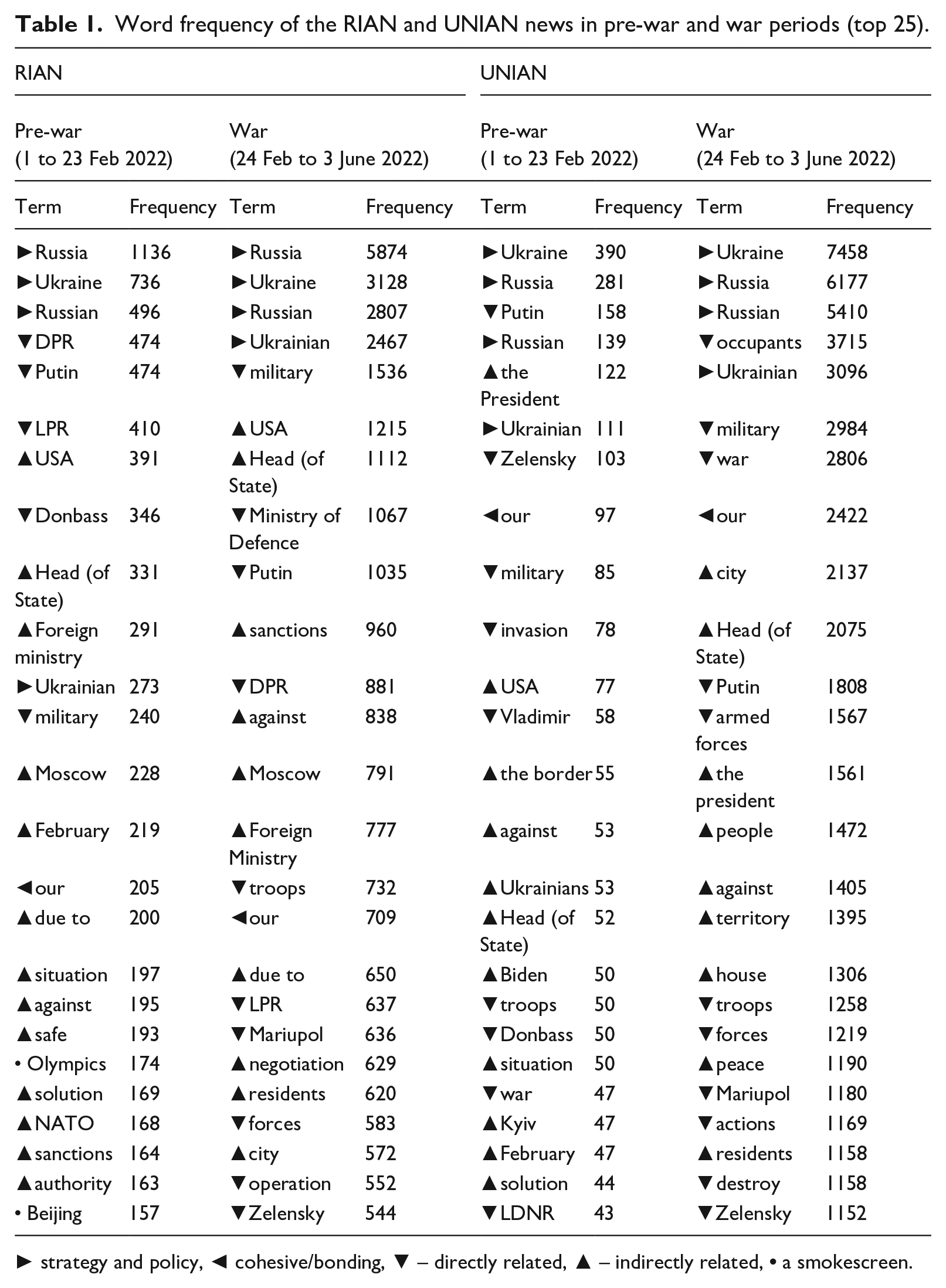
► strategy and policy, ◄ cohesive/bonding, ▼ – directly related, ▲ – indirectly related,
A comparison of the words in RIAN news showed that the structure of the conflict frame is quite predetermined and remains unchanged throughout the stages of the studied war. The most commonly used words practically do not differ much from each other in the subsequent stages of the war. The highest frequency is observed in words from semantic group [a] (‘Russia’, ‘Russian’, ‘Ukraine’, ‘Ukrainian’), words describing Russian policy in terms of goals and instruments – group [b] (‘military’, ‘ministry of defence’, ‘Putin’, ‘DPR’), and words from group [c] (‘USA’, ‘head’, ‘sanctions’, ‘Moscow’, ‘foreign ministry’). The word ‘our’ (group [d]) appears on the lists of both periods, but its frequency is not high. Nevertheless, its use serves to emphasize togetherness. In the list, 16 words remain the same or similar position in all stages. New words appear in the war period, which can be included in group [b] (‘troops’, ‘forces’, ‘Mariupol’, ‘operation’, ‘Zelensky’) and group [c] (‘negotiations’, ‘residents’, ‘city’). Also, only in the pre-war period words from the group [e] (‘Olympic’, ‘Beijing’) appear.
On the contrary, the UNIAN with the onset of the war began to actively and, most importantly, deliberately create the news frame, as evidenced by the much greater variation in the most frequently used 25 words in the UNIAN collection. For UNIAN from period to period, the first place is consistently held by the [a] group of words (e.g. ‘Ukraine’, ‘Ukrainian’, ‘Russia’, ‘Russian’, ‘occupants’), followed by words that always express the essence of the conflict, such as ‘war’, ‘army’, ‘armed forces’, ‘Putin’, belonging to the [b] group, and the word ‘our’ ([d] group). This is the first half of the 25 most frequently used words. The second half, however, is more varied. And the variations have a clearly expressed target character during the war period: from confusion at the beginning (e.g. ‘invasion’, ‘situation’, ‘solution’, ‘the border’) to a sense of the need to forcefully repel the enemy (e.g. ‘armed forces’, ‘military’, ‘action’, ‘forces’, ‘destroy’). The words in group [e] are not present at all. In the list of the 25 most frequent words of all periods, nine words remain the same and occupy a similar position. The exceptions are the word ‘war’, which saw an increase in the frequency ranking during the war period, and the word ‘Zelensky’, which in turn saw a decline (the last of 25 words).
The conflict frame arising from the analysis of word frequency in the RIAN news focuses on words related to Russia’s internal politics and presents information about the conflict with Ukraine from this point of view. RIAN’s frame is oriented more towards an internal (domestic) audience and focuses on the presentation of the Russian Federation’s propaganda goals, in which specific vocabulary is used (military vocabulary, proper names, etc.). At the same time, it should be noted that, among the most frequently used 25 words, there are no negative terms for the enemy. There is, however, an official term for Russians living in the occupied territories in Ukraine, who are called ‘residents’. In contrast, even though the frame for UNIAN news focuses on words related to the military invasion and its consequences, it shows primarily how ‘they’ (the aggressors) act (words: ‘war’, ‘invasion’) and the consequences of ‘their’ actions (words: ‘occupants’, ‘city’, ‘territory’). UNIAN’s discourse is intended for both internal and external audiences. When comparing the most frequently used words in RIAN and UNIAN news, it is clear that the structural element of the frame in the case of RIAN is more technical, while the UNIAN frame is more moralizing. However, what distinguishes the UNIAN frame from RIAN is its highlighting of the human dimension of the tragedy (‘occupants’, ‘people’, ‘house’, ‘peace’).
Keyness analysis
The analysis of the 20 keywords enables identification of the variable part of the news frame and extraction of chains of word meaning for each stage of the war showing the dynamics of change and revealing additional differences in the frames.
In the case of UNIAN news, the transition from the pre-war period to the successive stages of the war allowed us to distinguish at least three related word chains:
(1) pre-war: [‘invasion (pending)’] → wide-offensive: [‘humanitarian (tragedy)’, ‘enemy’] → positional war: [‘atrocities’, ‘crime’, ‘genocide’, ‘murder’] → battle for Donbas: [‘rashists’], 1)
(2) pre-war: [‘LDNR’, ‘DNR’, ‘LNR’] → wide-offensive: [‘Chernigov’, ‘Kharkiv’, ‘Kyiv’, ‘Gostomel’, ‘Akhtyrka’] → positional war: [‘Bucha’, ‘Kramatorsk’, ‘Borodyanka’, ‘Kremenchuk’] → battle for Donbas: [‘Azovstal’, ‘Severodonetsk’],
(3) pre-war: [‘Minsk’] → wide-offensive: [‘suspend’, ‘negotiation’] → positional war: [‘liberation’] → battle for Donbas: [‘howitzer’, ‘Lend-Lease’].
The first chain is the most important because it expresses the dynamics of the perception of the enemy from invaders (pre-war) through murderers (positional war) and rashists (battle for Donbas). In this chain, there are words negatively and emotionally charged, containing a moral judgment of the actions of the Russians such as ‘crime’, ‘genocide’, ‘murder’ or ‘rashists’, which also highlight Putin’s goal of war – the extermination of the Ukrainian people. This chain is also crucial for distinguishing the moralizing frame of UNIAN news.
It is also noted that the word ‘invasion’ appears in the pre-war period in UNIAN news as its foreshadowing. From the perspective of Ukrainian politics, there is nothing surprising about this, because Ukraine had already been officially at war with Russia since 2014. Besides, the possible invasion of Ukraine had been speculated about by the US media since autumn 2021 (Sonne et al., 2021). The role of the next two chains is explanatory and complementary. The second chain contains only proper names (names of cities and places) and depicts the circumstances (series of dramatic events) under which transformation of enemy perception takes place. In turn, the third chain includes words related to the efforts to find ways to resolve the conflict in the form of peace (‘Minsk’, ‘suspend’, ‘negotiation’) or force (‘liberation’, ‘Howitzer’, ‘Lend-Lease’).
In contrast, a keyness analysis of the RIAN news shows that only two chains that include partially the same words (e.g. ‘humanitarian [tragedy]’), but in different contexts, can be distinguished. The first chain starts as early as the pre-war period and concerns the special operation and related events in the following periods:
(1) pre-war: [‘invasion’, ‘Donbas’, ‘DNR’, ‘LNR’] → wide-offensive: [‘negotiation’, ‘suspend’, ‘operation’, ‘Medinsky’, ‘humanitarian (tragedy)’] → positional war: [‘Bucha’, ‘Kramatorsk’, ‘provocation’, ‘Irpin’] → battle for Donbas: [‘Azovstal’, ‘Kherson’, ‘Kharkiv’, ‘action’, ‘victory’, ‘defeat’].
The second chain is about sanctions and their consequences:
(2) wide-offensive: [‘sanctions’, ‘Instagram’] → positional war: [‘non grata’, ‘send’] → battle for Donbas: [‘Yerevan’, ‘Finland’, ‘stock’].
During the period of the wide offensive war (24 February 2022–2 April 2022), the behaviour of the Russian Federation changes: a frame of negotiation emerges, with the official aim of ‘avoiding a humanitarian tragedy’, although de facto it is a matter of keeping the occupied territories. At the same time, there is a concern about the impact of Western sanctions. In the positional war stage (3 to 18 April 2022), the Russian Federation, after revealing the massacres in Bucha, Kramatorsk, Irpin, and other localities, completes the conflict frame with the term ‘provocation’. This notion, used by Russian propaganda as a distraction, puts Russia in the role of victim, which was also used during the 2014 conflict (Pynnöniemi, 2016). In contrast, in the third stage of the war, when the Russian Federation launches an attack on the Donbas, the conflict frame is completed by elements emphasizing victory.
It should be noted that in the RIAN news in each period there are many keywords that are not related to the events of the Russian–Ukrainian war, such as ‘Zhirinovsky’, ‘smallpox’, ‘Mélenchon’. On the one hand, they serve to shift attention away from certain events (news). On the other hand, they also serve to show that some events exist and are no less important than war events (diminished importance). In the pre-war period, the Russian Federation’s invasion of Ukraine takes place in the shadow of the achievements and victories of the Russian athletes (performing under the flag of the Russian Olympic Committee) at the Winter Beijing Olympics.
The comparison of keywords leads us to the same conclusions as the frequency analysis: the RIAN frame is more technical, while the UNIAN frame is more moral.
Associations and correlations among words
Another aspect of the variable part of the news frames was revealed through the association analysis, which extracted the most important hidden themes from the collections of texts of both agencies (Figures 1 and 2).
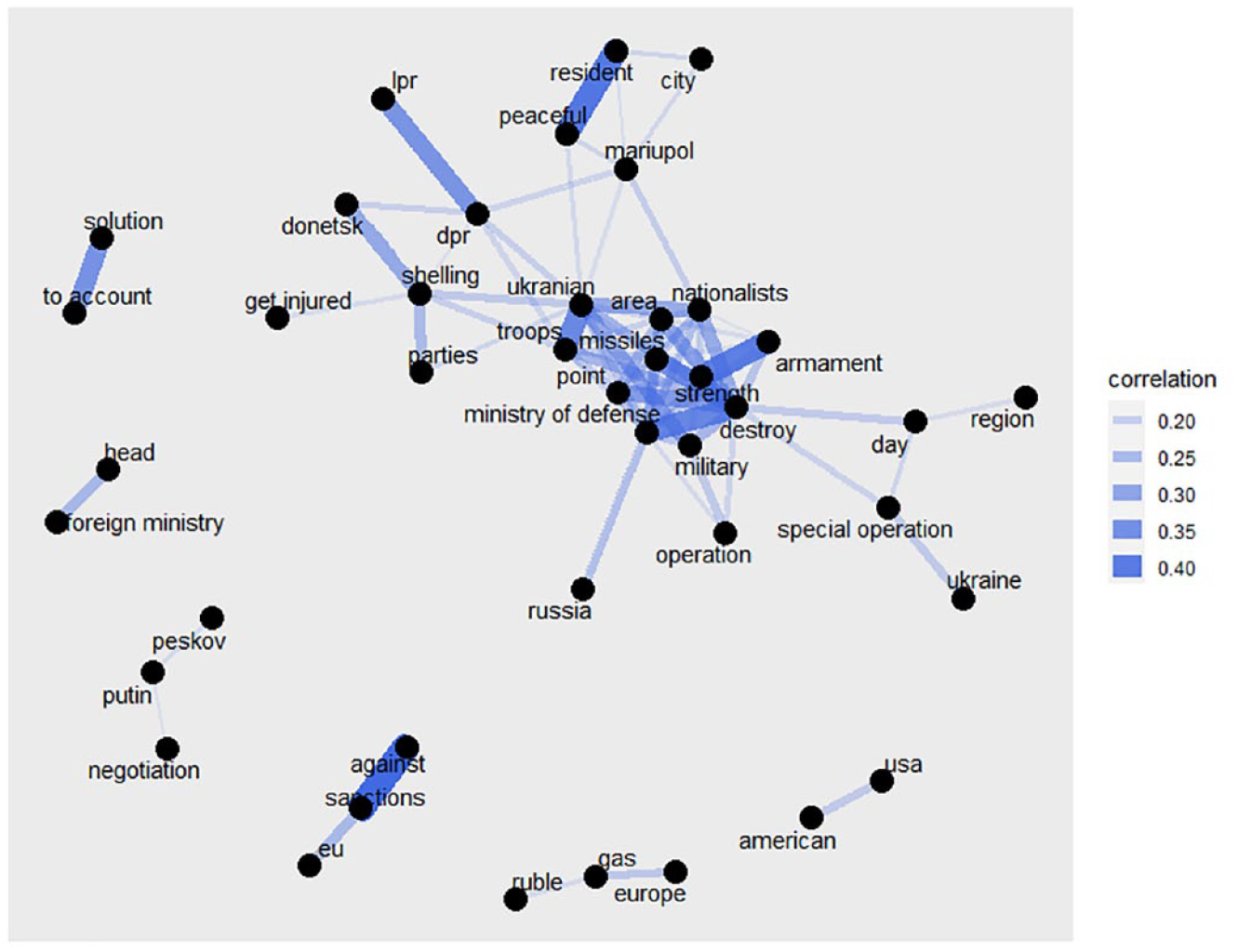
Network RIAN news based on the correlation between words from 1 February 2022 to 3 June 2022 (n > 400, correlation > 0.15, without the word ‘Russia’).
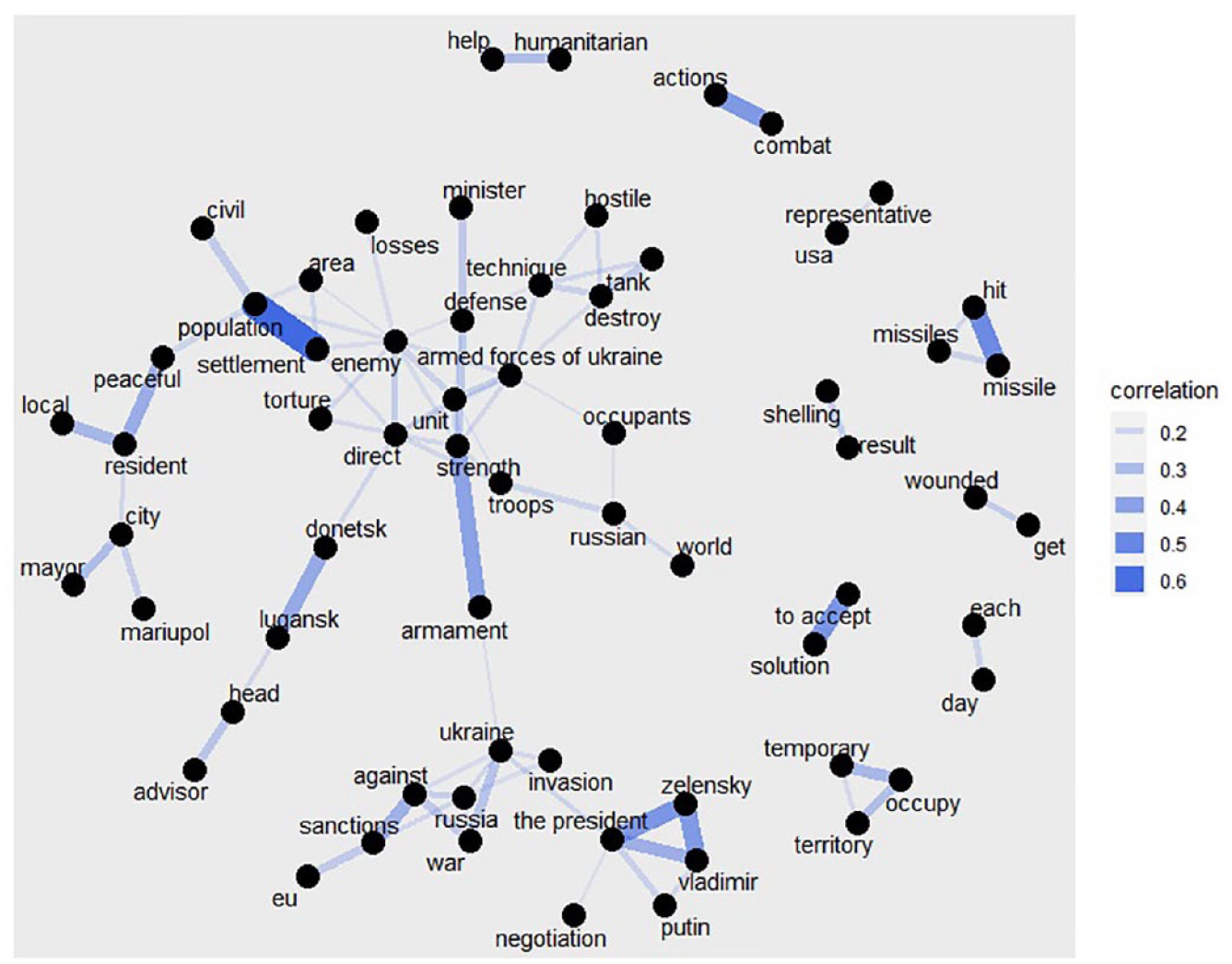
Network UNIAN news based on the correlation between words from 1 February 2022 to 3 June 2022 (n > 500, correlation > 0.15, without the word ‘Ukraine’).
The visualization of the correlations among words in the RIAN news shows two latent topic groups that create a specific frame in the minds of the audience about the event. The first group is homogeneous and exposes correlation dependencies that relate to the goal of the Russian Federation’s special operation in Ukraine and its consequences. In the centre of the network of the group appear words with relatively large relationships among them. Some of these relations are typical components of propaganda clichés such as ‘nationalists’ – ‘Ukrainian’, ‘nationalists’ – ‘destroy’, justifying the invasion. Other associations express military realities of invasion: ‘destroy’ – ‘locality’, ‘destroy’ – ‘missiles’, ‘destroy’ – ‘ministry of defense’, ‘armament’ – ‘strength’, ‘military’ – ‘Ukrainian’ and ‘Ukrainian’ – ‘troops’. This central network is linked to peripheral sub-networks, such as ‘residents’ – ‘peaceful’, ‘DNR’ – ‘LNR’, ‘Donetsk’ – ‘shelling’ showing a link to the military activities of both sides. The second thematic group refers to the impact and consequences of the invasion (called special operation) on the international relations of the Russian Federation. It is a set of extracted correlative relations between pairs and triads of words. Among them, the strongest connections are: ‘against’ – ‘sanction’ – ‘UE’ and ‘solution’ – ‘to accept’.
The correlation relationship network among words in the UNIAN news (Figure 2) visually resembles a RIAN network. There is one large overall (homogeneous) sub-network and a group of individual dependencies between pairs or triads of words. However, significantly, the UNIAN network differs from the RIAN network in a semantic way. The large network dispersed into several smaller thematic networks related to: people (‘population’ – ‘settlement’, ‘population’ – ‘civil’, ‘peaceful’ – ‘residents’, ‘resident’ – ‘local’), destruction (‘destroy’ – ‘technique’, ‘destroy’ – ‘tank’), occupied territory (‘Lugansk’ – ‘Donetsk’), occupiers (‘Russian’ – ‘troops’), occupation and sanctions (‘sanctions’ – ‘against’, ‘against’ – ‘war’, ‘war’ – ‘Ukraine’, ‘sanctions’ – ‘EU’). The second separate thematic group is very heterogeneous and expresses different aspects of war, and the most important in terms of correlation can be considered the word combinations: ‘actions’ – ‘combat’, ‘missile’ – ‘hit’, ‘help’ – ‘humanitarian’, ‘accept’ – ‘solution’, ‘USA’ – ‘representative’, ‘occupy’ – ‘temporary’ – ‘territory’.
Also, the analysis of associations and correlations between words reveals significant differences in highlighting specific aspects of the conflict and its actors. RIAN’s news is dominated by connotations emphasizing Russia’s pursuit of military objectives in Ukraine, including the destruction of Ukrainian nationalists. This element of the frame is new but, according to Putin’s doctrine, it should be treated rather as a technical term associated with the concept of denazification of Ukraine. It also highlights the external actors involved in the conflict: the US and the European Union. In the case of the UNIAN frame, on the other hand, an important element, in addition to associations referring to destructive military actions against the enemy, are associations directing the viewer’s attention to the anti-human dimension of war: enemy actions against peaceful civilians or torture. Thus, the UNIAN frame assumes the form of a moralizing frame.
Discussion
Overall, the multi-element analysis based on text mining showed that the frame of news published by the two agencies differs in the most frequently used words, keywords as well as associations among words. These differences make it possible to distinguish, similar to Entman (1991), two types of frames that direct the audience’s attention to the various elements of the conflict, the actors involved and their judgment.
In the case of RIAN, we are dealing with a technical frame. The conflict is presented in a substantive manner, the vocabulary refers to issues related to Russia’s internal politics and the undertaken military actions. The central element of the conflict frame is the Russia–Ukraine confrontation, which takes the form of a Russian Federation military special operation on Ukrainian territory, and the consequences of it. In addition, the term is the only expression used to name the situation and, like the term ‘punitive operation’ appearing in propaganda media messages during the 2013 conflict (Roman et al., 2017), it should be considered as a technical word emphasizing Russia’s responsiveness. RIAN’s frame also emphasizes togetherness and national self-interest. This shows that the special operation is in the interests of the Russian people, but not only the political elite. Moreover, RIAN news includes vocabulary and associations of words with a specific propaganda field due to the strategic goals for the invasion of Ukraine and supporting the military conquest such as ‘nationalists’ – ‘Ukrainian’, ‘nationalists’ – ‘destroy’. Thus, the frame reinforces in the audience the values and beliefs specific to the regime’s narratives (Alyukov, 2021; Livingston and Nassetta, 2018; Roman et al., 2017).
The UNIAN frame, on the other hand, can be categorized as a moralizing frame. The conflict is presented in an emotional and dehumanizing way. At the base of the UNIAN conflict frame there is also the confrontation of ‘the Russian Federation vs Ukraine’, whereby the UNIAN frame indicates that Russia is the occupying power, and the form of this confrontation is the war initiated by Vladimir Putin. For Ukraine, it is the war of the whole nation (our ‘war’) and the enemy is being fought by the Armed Forces of Ukraine. In addition, it is emphasized that this is a war against an occupying power and Ukraine is counting on help from the West, especially the US and President Biden personally. The presence of emotional elements in the frame was also an important factor in differentiating Ukrainian and Russian media coverage during the 2014–2015 conflict (Roman et al., 2017).
Identifying significant differences in conflict framing, the findings also show how the authoritarian regime and the competitive regime use Telegram, an unmoderated social media platform, to construct strategic narratives and how these narratives are related with real events of the conflict. From this point of view, the RIAN frame of the conflict has not changed much throughout the war, although the reality on the ground changed dramatically. It focuses on international confrontation and is mainly aimed at internal (within Russia) and pro-Russian (outside Russia) audiences. Moreover, RIAN, as a state-controlled news agency, duplicates an official view of the ongoing military conflict between Russia and Ukraine. For this reason, strategic narratives contain some propaganda elements (e.g. calling Ukrainians nationalists, drawing attention to Western sanctions or Donbas) also present in different media coverages during the previous conflict with Ukraine in 2013–2014 (Lankina and Watanabe, 2017). As Cottiero et al. (2015) noticed, these frames have a powerful impact on Russian internet users. It should be noted, however, that the anti-Ukrainian element of the current frame is less aggressive and does not include (among frequently used words or keywords) certain topics previously frequently used by Russian propaganda, such as denazification and demilitarization of Ukraine, protection of the Donbass population or prevention of NATO expansion. The word ‘NATO’ appears among the 25 most frequently used, but only in the pre-war period. It also does not occur in either key-ness analysis or word association analysis. Similarly, the words ‘denazification’ or ‘demilitarization’ do not appear among the 20 most frequent keywords. The reduction of these elements in pro-state mass media, but not from social media, is also noted by Alyukov et al. (2022), who indicate that these words did not resonate with public opinion and were gradually abandoned from the official discourse. This just demonstrates that, on the one hand, public discourse in social media has its own rules and, on the other hand, social media channels of pro-government media operate under the same rules as the mass media (Alyukov, 2021).
The UNIAN frame, on the other hand, can be identified more as transnational, targeting Russian-speaking audiences (inside and outside Ukraine). It is also, contrary to the RIAN frame, much more flexible and built in response to a change of events and due to the interest of international opinion – from discussion of the possibility of invasion, to humanitarian tragedy and war crimes, as well as the creation of a more essentialized image of the enemy (‘rashists’). This frame addresses two key dimensions of conflict: military and human. The former clearly identifies the agents responsible for the situation (Russia, Russians, defence ministry, Putin) and explicitly calls the conflict an invasion (at the beginning) and later a war. In human aspect, the frame appeals to the humanitarian values of modern Western civilization, condemning unjustified military aggression and aiming at civilians. In this sense, the UNIAN frame exposes the real intentions of Russia’s invasion – the annihilation and destruction of Ukraine – concealed in the conflict by Russian propaganda, which is served by such terms as ‘rashism’ and ‘genocide’, among others (Snyder, 2018). Both expressions only appeared in media discourse in April 2022 after the discovery of mass graves of civilians in Bucha, indicating that Ukrainians did not view their enemies in this way from the beginning of the invasion.
In conclusion, our study explicitly demonstrates how media and political systems determine in what manner RIAN and UNIAN used social media during Russia’s invasion of Ukraine, thereby shaping the way their audiences interpreted events and responded to them. Because, in ‘arrested war’, ‘news media prevents war from escaping intelligibility and remaining “out there” and mysterious’ (Hoskins and O’Loughlin, 2015: 1330), they present the reality of war according to specific propaganda goals. While in the case of RIAN, Telegram is used to disseminate strategic narratives consistent with Kremlin information policy regardless of events in Ukraine, UNIAN works in a more pluralistic media system (Korbut, 2021) and therefore the news frame is more diverse, changeable over time and relates to actual events, highlighting the barbarism of the Russians and exposing their real intentions.
Limitations and future research
In this study, however, we point out several limitations arising from the research material and the methodology adopted. First, the first 100 days of the war were analysed, and with subsequent stages of the war, there may occur some modifications of news frames concerning the conflict. Second, in the study, we do not analyse full-text news, but rather news of various lengths, the form of which is adapted to the specifics of Telegram. In addition, we focus on only two news agencies – RIAN and UNIAN. Future research should also take into account a greater variety of news, including analysis of visual materials, as well as other social media platforms. Third, we analyse most frequent words and keywords together with an association between them, so we could have missed words or phrases that do not appear frequently but may be crucial for the analysis. Fourth, and finally, the approach we used to identify the news frame based on natural language processing is the only possible approach that has a substantial impact on frame quality and interpretation (Nicholls and Culpepper, 2021).
Footnotes
Acknowledgements
We would like to thank the anonymous reviewers for all comments and remarks which helped us to improve our article.
Funding
The authors received no financial support for the research, authorship and publication of this article.

Notes
Author biographies
Address: as Grzegorz Ptaszek. [email:
Address: Rivne State University of Humanities, Ukraine. [email: