




Abstract
This article analyzes some implications of new drone aesthetics involved in affective politics against state impunity in social conflicts. Whereas the literature on media, war and conflict has been centered around the war aesthetics of military drones, the author argues that civilian drones can mobilize affective politics – expressed, for example, in the aestheticization of shame, rage and the subversion of fear – as a means of political communication with and against the state. Further, she proposes that the present focus on drone aesthetics should be expanded to also account for the political affects that aesthetic sensory perceptions mobilize. Drawing on actor-network theory and new materialism, the article takes the disappearance of 43 students in Ayotzinapa (Mexico) as an exemplary case of state impunity in the context of the war against drugs and social conflict. By means of a digital ethnography of the social collective project Rexiste, the author analyzes its public interventions deploying a civil drone named ‘Droncita’, which sought to generate an aesthetics of affect against state impunity. The article contributes toward expanding investigation of (civilian) drone aesthetics and the mobilization of affective politics in the literature on war and social conflicts and collective action.
Introduction
The drone aesthetics of necropolitics has been a prominent focus in the literature on media, war and conflict (Gregory, 2012; Maurer, 2017). Government-controlled drones have been analyzed as killing machines involved in global struggles. However, civilian drones are also gaining attention as culturally subversive objects that can put alternative aesthetics into motion (Feigenbaum, 2015; Viernes, 2020; Zuev and Bratchford, 2020). Here, aesthetics is understood as the doing and undoing of sensorial perceptions shaping affective orders (Voß et al., forthcoming). Although there is increasing interest in civilian drones in the literature on collective action (Viernes, 2020; Zuev and Bratchford, 2020), the focus has been centered around drone aesthetics and sensorial perceptions, leaving aside the political affects that are also mobilized through drones. Thus, to fill this gap, I focus here on both drone aesthetics and the mobilization of affect to fight state impunity in a context of war and social conflict, guided by the following question: How is the aestheticization of affects in drone media activism implicated in the politics of state impunity?
Drawing on actor-network theory and new materialism, I challenge the classic understanding of technologies as passive and manipulable objects to, instead, analyze the ways that drones are active in collective action, facilitating assemblages among activists, providing media materials for counter-culture but also evoking affects in social media (Bennett, 2010). I argue that civilian drone media can prompt the aestheticization of affects such as shame, rage and subversion of fear as new forms of political communication against the state. Such drone-based repertoires can trigger political affects as a means toward subverting the dire situation of state impunity in the war on drugs and other social conflicts. This article seeks to make two theoretical contributions: (1) extending the focus of previous research on drone aesthetics in collective action to include affective politics, and (2) adding a new dimension to the literature on war and conflict by discussing the role of civilian drones in affective politics.
To accomplish this objective, I focus empirically on a case of state violence in the disappearance of 43 students in Mexico that remains officially unexplained and unpunished until today. The case considered below is situated within the so-called war on drugs in Mexico (Lacasse and Forster, 2012; Luna-Monsivais et al., 2020) but also has international relevance, as it shows the implications of changes in drug trafficking routes that made the Mexico–USA border the key entry point of narcotic substances to the USA (Morton, 2012). This resulted in a reconfiguration of power and violent disputes between state actors and drug cartels in Mexico. Although confrontations between the state and the criminal gangs devoted to narcotraffic have a long history of tension, the entry of Felipe Calderon into the presidency in 2006 marked a turning point in the increasing violence in Mexico. As Calderon assumed power, he essentially declared the war on drugs by commanding militarization of the country against drug-trafficking cartels (Benitez, 2014; Magaloni and Razu, 2018). Authors point out that the increase in violence can be explained by the failure of his militarization strategy against drug trafficking, primarily based on hunting for the heads of the cartels (Rosen and Zepeda Martínez, 2016). This strategy backfired, however, resulting in fragmentation of the number of cartels and re-formation of new criminal groups with more radically violent practices. Furthermore, the war against drug trafficking resulted in two other wars, one between the cartels themselves, fighting over markets and transit routes to the US, and another between the cartels and members of civil society, as the cartels increased kidnappings and extortion as well as ramping up their participation in municipal political structures (Benitez, 2014: 49). The social implications of the drug war continue until today with uncontrollable violence, assassinations and, above all, impunity from punishment of the actors involved.
One typical example of the victims and public reactions to Mexico’s failed war on drugs, and the state impunity to the violence it has entailed, is the case of the disappearance of 43 students in Guerrero (Mexico) on 26 September 2014. On that night, students from the Rural Normal School of Ayotzinapa commandeered several buses to travel to Mexico City to participate in an annual protest. Although there had been a history of the police being tolerant toward the students ‘borrowing’ vehicles for such purposes in the past, during this journey the buses were attacked by various police and military forces. Due to this attack, 6 people were killed and many others were injured; afterwards, 43 students were missing. An official account of what had happened in Ayotzinapa that night was put out by the government, which framed it as the ‘historical truth’ (hereafter referred to as the official account) (Valencia et al., 2015). Political intervention by different offices of the state regarding the disappearance of the 43 students neglected various pieces of media evidence (including videos, photos, and mobile communications) or at least failed to demonstrate whether they corroborated the official account or not, pointing to an untestable assemblage created by the state’s discursive and material practices.
In contrast to the official account, independent research conducted by a group of experts of the Organization of American States (OAS) proposed the hypothesis that the 43 students may have been attacked because the buses they were traveling in were carrying drugs that would be transported to the US (Valencia et al., 2015). This was not seen as surprising by those skeptical of the state, as the neglected media traces reveal the great extent of state responsibility for the events in Ayotzinapa, resulting in struggles over the truth mobilized by collective actors who employed new affective political repertoires to call for state accountability. One particular actor I focus on here is Rexiste, a social collective of activists that stages public interventions with the help of a drone that acts not only as a media machine but also as a figurative character with a name – Droncita – exhibiting abuses of power by the Mexican state by triggering political affect on social networks such as Facebook and Twitter.
The remainder of the article is organized as follows. The following section discusses the theoretical approaches that underpin the article, namely actor-network theory and new materialism. The third section presents methodological notes on digital ethnography conducted with the social collective Rexiste. The fourth section centers on the Ayotzinapa case. The fifth section develops my argument regarding enactment of drone aesthetics as an affective politics of state shaming, aestheticization of rage, and subversion of fear through anti-state interventions in public spaces waged by Rexiste along with its ‘little machine sister’, Droncita. Section six discusses the results of the case with regard to the relevant literature. In the final section, I draw conclusions for future research.
Drones as affective actor-networks
Actor-network theory is an interdisciplinary research field that shifts attention away from triumphalist perspectives on technology toward understandings of its role in shaping socio-political orders. Although actor-network theory is well known in science and technology studies, in the few last decades its contributions have been extended to different accounts of collective action that are not only human-centered (Sánchez and Rodríguez-Giralt, 2020), where the focus on networks is not to enunciate a preexisting social organization (Latour, 2005) but, rather, to trace associations of heterogeneous entities: humans and machines (Callon and Latour, 1981). Actor-network theory opposes homogeneous actors/concepts, calling them black boxes.
The network metaphor is enacted as a way to question the traditional division between social and technical entities (Latour, 1993). Technologies are consequently understood as mediators among human and non-human entities, which means problematizing their interactions and assemblage practices (Latour, 1994). Through this lens, various authors have analyzed the ways in which objects shape collective action as the locus of political struggles but also in the specific ways in which these are enacted through public participation and acquire the political capacities to organize publics (Marres and Lezaun, 2011; Rodríguez-Giralt, 2011).
Through the lens of actor-network theory, in this article I analyze drones as playing an active role in both the production of aesthetics and political affect in collective action. While actor-network theory has contributed toward conceptualizing non-human agency in collective action by focusing on non-human actors, it has not addressed discussions about affective politics in depth, with some critics having argued that this strand of the literature does not pay enough attention to affect due to an impoverished sense of the human (McCormack, 2019: 182). Consequently, I also draw on new materialism as a research perspective that shares with actor-network theory an interest in vital assemblages of human and non-human entities (Coole and Frost, 2010; DeLanda, 2015) but has a more refined theoretical approach to affect (Fox and Alldred, 2015), understood as the ways to affect and be affected (Deleuze and Guattari, 1987). The broader scope of affective categories provided by new materialism for analyzing matter in a fresh way – including vitality, insensitivity, energy, and force (Barad, 2003; Bennett, 2010; Coole and Frost, 2010) – enable us to explore distributed affective practices among drones, media, objects, and humans.
In the literature on media, war and conflict, there has been increasing attention on the drone aesthetics of necropolitics (Fairhead, 2019; Gregory, 2012; Maurer, 2017), with emphasis being put on the asymmetric power of the state and the role that drones, as military machines, have in the production of the aesthetics of killing. This focus has led to a research gap, however, regarding civilian drone aesthetics and their role in counter-culture tactics in war and social conflicts. Further, while the existing research on collective action and drones does tackle drone aesthetics and the production of and disputes over visual regimes (Viernes, 2020; Zuev and Bratchford, 2020), the sensual perceptions shaping affective orders have been underexplored. Given this gap regarding how civilian drone aesthetics can enact affective politics, by applying the insights of actor-network theory and new materialism to the case of the disappeared students of Ayotzinapa and the protests surrounding it, I first analyze the political affects that drone aesthetics can spark in social conflicts and the role they may have in political communication against the state. Second, I analyze the potential affective politics of drones creating assemblages with civilians, in terms of the imaginaries they inspire, their distributed agency with activists, and the new material practices of political engagement they enable, in order to contest power in contexts of state impunity.
Method: Digital ethnography of the collective project Rexiste
As a means for analyzing assemblages of human and non-human actors in collective action, I selected a digital ethnographic approach which relies on the sensory and bodily experiences of researchers as the primary means of discovery (Hine, 2015; Pink, 2009). Hine (2015) proposes that the internet is embodied and embedded in everyday practices; therefore, digital ethnography does not look to reinforce the division between digital and nondigital spaces but, rather, seeks to embrace ethnographic holism regarding topics of study as they cross that boundary (Hine, 2015; Murthy, 2011). A digital ethnography was performed on and with the Mexican social collective Rexiste, a project for political experimentation through interventions in public spaces.
Rexiste has been developing different public interventions together with its so-called little sister Droncita (‘small female drone’ in Spanish). Through works of art (murals, posters, graffiti, etchings, and serigraphs) and multimedia material (photos and videos taken by drone), the aim of the collective is to exhibit the state in cases of impunity, surveillance, corruption, disappearances, human rights violations, criminalizing civilian protests, and crimes. By digitally following Droncita’s off/online actions and situating them in their specific socio-political space, I was able to document several actions to support the cause of the disappearance of 43 students in Ayotzinapa. This case, according to Rexiste, represents a breakthrough not only in the way that resistance was mobilized but also in terms of political communication between state actors and collective action. The case also illustrates how material artifacts sparked affect as a way to dispute the official account of what really happened that night, giving rise to the enactment of affective politics of shame, the aestheticization of rage and the subversion of fear.
Different sources of information came together. First, for the contextualization of the Ayotzinapa case, I conducted a content analysis of the official documents and media news. Second, I analyzed 172 posts about Ayotzinapa on Facebook from the Rexiste collective and 67 on Twitter from Droncita’s account. Other sources include field notes, virtual participant observation, and visual and audio materials tracked from Rexiste’s YouTube web page (rexiste.org), and social networks. I also applied affective techniques and analytical strategies to delineate networks and assemblages among actors, affects, actions, discourses, artifacts, and agencies (Burrell, 2009). In order to analyze social media posts, images, and my notes, I rely on mapping affects, including the ones that I myself experienced in reading my materials, such as rage, powerlessness, and sadness.
Ayotzinapa: State impunity and neglected media
On the night of 26 September and the morning of 27 September 2014, students from the Rural Normal School of Ayotzinapa in Guerrero, Mexico, commandeered several buses to travel to Mexico City to commemorate the anniversary of the 1968 Tlatelolco Massacre. 1 During the journey, the students were chased and attacked by different police and military forces. As a result, 43 students went missing, 6 people were killed, and many others were injured. According to the conclusions reached by the investigators from the Mexican government in their official account, the 43 missing students had been handed over by the municipal police of Iguala to the drug gang Guerreros Unidos, who then incinerated them in a dump in the neighboring town of Cocula. This narrative is known as the historical truth (hereinafter referred to as the official account) after the former Attorney General from the Procuraduría General de la Republica (PGR), Jesús Murillo Karam, used this term in a press conference. These claims were supposedly based on reports by scientific experts and confessions from the drug dealers.
The official account of the Ayotzinapa incident was vigorously contested by the families of the victims, social collectives, researchers, journalists, non-governmental organizations, and civilians, who demanded justice, clarification about the extent of involvement at different levels of the police and the army, and the imprisonment of those responsible. These actors have their own account of the incidents, which have since provoked heated controversies over the truth. For that reason, an Interdisciplinary Group of Independent Experts (IGIE, in Spanish the Grupo Interdisciplinario de Expertos Independientes, GIEI) was convened by the Inter-American Commission on Human Rights of the OAS, the Mexican government, and families of the victims, with the objective of investigating the crimes, searching for the missing students, and attending to victims and relatives. After one year of investigations, the group published two reports (Valencia et al., 2015, 2016) in which they uncovered and documented the use of disproportionate force by different levels of the police and the extent of coordination behind the attack. The reports also give accounts of the extent and complexity of the operations of various police forces involved in the ambush, arrest, shooting, and disappearance of the students which meant there must have been centralized coordination (Al Hussein, 2015; Valencia et al., 2015). In Iguala, according to compelling evidence from the IGIE investigation, municipal, state, and federal police – along with other state officials and the army – were involved, either in the crimes themselves, in failing to protect the victims, or in taking part in the ensuing cover-up.
Further, the IGIE reports also challenged the evidence presented by the PGR officials about the 43 students allegedly handed over by Iguala municipal police to the drug gang Guerreros Unidos, who then supposedly killed them and incinerated their bodies in Cocula, by showing the weaknesses and inconsistences of different testimonies and pieces of evidence. The document also shows that the operation was carried out with a disproportionate use of force, which led IGIE to examine police motivations for such an operation.
The report highlights the fact that Iguala is a site of commerce and transport of narcotic substances to the USA. In fact, according to information from the judicial courts of Chicago gathered from the IGIE (where an investigation has already been carried out into members of Guerreros Unidos cartels), Mexican commercial buses are used to transport heroin, cocaine, and money obtained from trafficking between Iguala and Chicago (USA) (Valencia et al., 2015). This led the IGIE to formulate the hypothesis that the municipal police and Guerreros Unidos might be working together in drug trafficking in some way, and that this could have been the main reason behind the attacks on the students who commandeered the buses.
The IGIE point out that one of the main problems in the investigation of the Ayotzinapa case as conducted by the Mexican government was the priority given to testimonials and confessions as evidence used to solve the case. These oral testimonials played an important role in the Ayotzinapa case in two ways. First, the government’s account became the dominant account about what happened. Second, the government strategically justified its claims that there was no need to conduct further investigations, since the case had clearly been solved by the confessions. Taking seriously Barad’s (2003) idea about the imbalance between discursive and material practices as a way to perform order means that focusing on discourse in the official account of Ayotzinapa was a political strategy to hide the state’s participation in the events. However, this official account did not correspond sufficiently to material and media records to be credible.
In a certain sense, material objects spoke back to contest the official account. They played the role of what Bennett (2010: 9) calls object-witness in political trails. For instance, traces of bone that were planted in Colula by the government fueled heated scientific disputes between government (independent) forensic experts, scientists, families of the victims, and social collectives, who had also been organizing, networking, and producing knowledge about the search for the incinerated bodies. Other objects such as mobile telephones, signals and antennas rendered visible other temporal and spatial information than that constructed by the government. The official account states that the mobile phones were burned before midnight along with the students’ bodies, which is clearly contradicted by some of the signals detected after that time in multiple antennas. Another example is the record of the signals, which showed that some of the students’ mobile telephones had activity hours or even days after (Valencia et al., 2016). A representative case is a message from one student’s mobile, sent on 27 September 2014 at 1:16 am to his mother, one hour after the students were supposed to have been killed (according to the official account) (Valencia et al., 2016). Another important trace was a mobile chip of one of the students that was used even months later; the PGR (the agency in charge of conducting the investigation) did not carry out the necessary investigations to explain this, nor was a statement made explaining how these traces were possible in the framework of the official account.
There were many irregularities in the investigation conducted by the PGR, relating to the suggestion that the records of cameras, videos, and photos were manipulated or were not incorporated into the official investigation. One example is a photo taken by a military officer but not included in the file because it was allegedly taken with his private phone. This is evidence that the army was fully aware of both the action and the cover-up of its role in the case. The PGR was protecting the army at all costs. Finally, the crime scenes were not properly secured; for instance, the site where the students’ bodies were supposedly incinerated.
All these matters and media objects thus became evidence used to pick apart the official account. They can be read as vibrant records that continue to push against the human agencies that wanted them to remain hidden (Bennett, 2010; Coole and Frost, 2010). In a country where witness testimonials are widely used as evidence in punitive processes (Magaloni and Razu, 2018), and at the same time where government judicial statements are not trusted and are constantly questioned, following the traces, records, and allocations of media objects was a vital political strategy for eventually uncovering the fabrication of the official account. These material objects gave evidence of the networked character of the state with criminal drug cartels (Passoth and Rowland, 2010) and the high degree of coordination within different domains of the government to cover up state participation in Ayotzinapa.
For all these reasons, media objects in the Ayotzinapa case play a role as affect catalyzers (Bennett, 2010) of indignation and unrest, as well as distrust in the discourses and evidence presented by the federal government through the PGR. The families of the victims, organizations, social collectives, and independent journalists, along with transnational protests in different countries, have helped increase awareness of the serious obstacles to achieving justice and holding government officials to account. However, there was also increasing criminalization of protests and manipulation of information, often on the part of television and newspaper media. The IGIE concluded its mandate in Mexico in 2016 with the allegation that obstacles to their research prevented them from fulfilling their central task: locating the 43 students from Ayotzinapa and conducting further investigations.
Yet, in 2018, the political scene in Mexico changed. With the arrival of a new party, a Commission for Truth and Access to Justice in the Case of Ayotzinapa was created. Further investigations were conducted on key objects, such as forensic examination of bone samples from a student, clearly revealing that the students were not burned, as the official account stated (Camhaji, 2020), which has been key to burying the historical truth. Criminal proceedings were initiated against some of the main authors of the official account, except for former president Peña Nieto. However, none of this action has yet materialized in concretely honoring the families’ right to know the truth of what really happened that night.
Collective action for Ayotzinapa
In Rexiste’s first post on Facebook related to the disappearance of the 43 students, reference was made to the collective pain and indignation caused by Ayotzinapa. This was done through the sharing of photos of the 43 missing students, using the phrase #Ayotzinapa #CompartimosElDolor (‘We share the pain’) (Rexiste, 6 de octubre, 2014). Further posts called for a day of protest and indignation through placards portraying tears falling down, symbolizing rain, and captioned ‘out of this pain rains rage’ (Rexiste 7 de octubre, 2014). These posts heralded the enactment of Rexiste’s affective politics, which would be further materialized in its drone activism. In the following paragraphs, I analyze three moments of the collective actions undertaken by Rexiste that embody the aestheticization of shame, rage, and subverted fear.
Rexiste: ‘It was the state’ and the aestheticization of shame
Just a few weeks after the disappearance of the students in September 2014, the first interventions of Rexiste had the objective of shaming the state, achieved through a ‘Monumental Tag’ created by using 30 liters of paint in Mexico City’s main square, the Zocalo, with the inscription ‘It was the state’ (Fue el Estado, see Figure 1). This intervention set the tone for the enactment of Rexiste’s affective atmosphere of blame and rage. Furthermore, the collective called for an action day to shame the state, inviting different collectives and civilians to write ‘IT WAS THE STATE’ in public spaces, the photos of which were then circulated via global media to contest the state’s official assertions regarding the disappearance of the students and accuse it of being complicit in the events (see Figure 2).
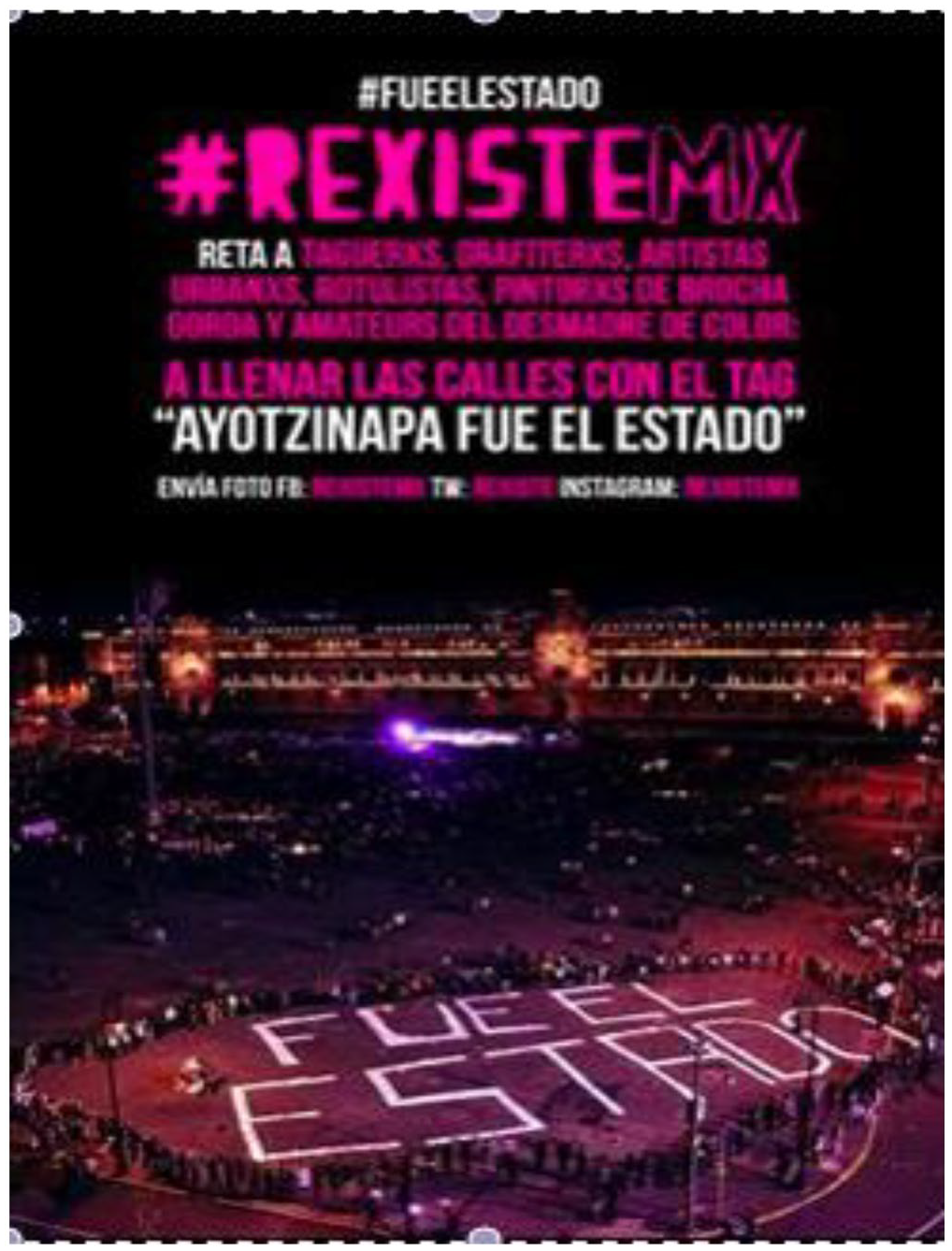
Placard: ‘IT WAS THE STATE’.
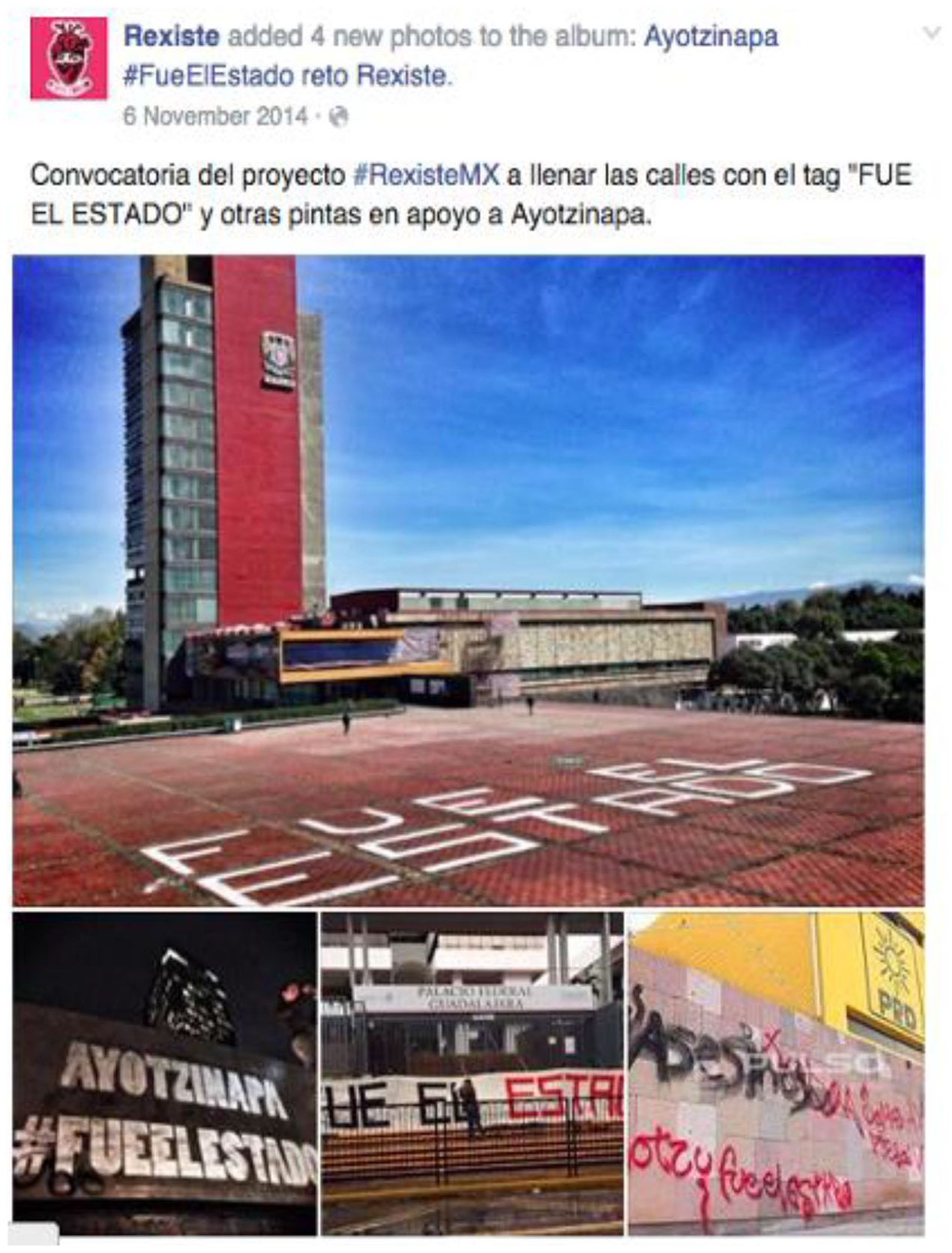
Action: ‘IT WAS THE STATE’, 6 October 2014.
This type of intervention made the collective well known. In addition, the motto ‘It was the state’ became the symbolic phrase for Ayotzinapa social mobilizations, and was rapidly taken up by other collectives globally. The affective impact of the phrase gave civilians ways to share the official account, with feelings such as indignation, betrayal, and fury.
The mobilized political affects of blame and shame were extended to social media through the hashtag ‘It was the state’ along with an image of the intervention and comments of civilians expressing their rage against the state. Through this intervention, Rexiste performed an aesthetic narrative of the state as a unified actor to make it a target but, at the same time, also as an actor-network, in order to render visible its networks with gangs, police, and military forces capable of conducting such attacks. Following the lens of actor-network theory (Latour, 2011), this tension between the state as an actor and the state as a network (Passoth and Rowland, 2010) in itself reflects a strategy of the affective politics of shame of the collective while simultaneously disrupting the aesthetics of the main square in Mexico City.
Droncita: ‘You tried to barrack the truth’ and the aestheticization of rage
In 2015, on the first anniversary of the disappearance of the students from Ayotzinapa, Rexiste’s next project went public with Droncita: a civilian drone that would not only provide media material for the political actions of the collective but was also created as a figurative character to be embedded in social networks. Droncita has its own Twitter account that is full of affective posts challenging the official account. Droncita’s debut as a member of Rexiste came in the form of a 40-second video in which what is essentially a human-machine (drone) demands the resignation of then president Enrique Peña Nieto while shaming his image by turning it into graffiti (see Figure 3). The first scene of the video shows the viewer what Droncita sees. Panning up from the ground, the camera movement stops when a black and white silhouette of the president appears in the background, with open arms and dressed in a suit. The figure of the president evokes solemnity, as if he were receiving an ovation for giving the official account speech. The numbers 1 to 43 appear in consecutive order just above images of the turtles to remind the viewer of the students who disappeared in Ayotzinapa, which means ‘the place of turtles’ in Nahuatl. Then Droncita paints his face red, with the paint spilling onto his body as she says: This is not the country that you dream about But you already knew that [image: the President of Mexico] Ayotzinapa was only the beginning of our story of his end You tried to barrack the truth You tried to fool us It is time to change it all
‘Barracking the truth’ refers to the possibility that the 43 students may have gone missing in the military barracks of Iguala (in Guerrero). When approaching Nieto’s image to paint his face, Droncita appears as a fearless machine. By covering his face in red, symbolizing the spilled blood that runs down the presidential figure, the video immerses the spectator in a scene of public blaming of the then-president. The final scene shows the presidential image covered with blood, symbolizing that Ayotzinapa will be remembered as a historical site of the state’s shame and involvement.
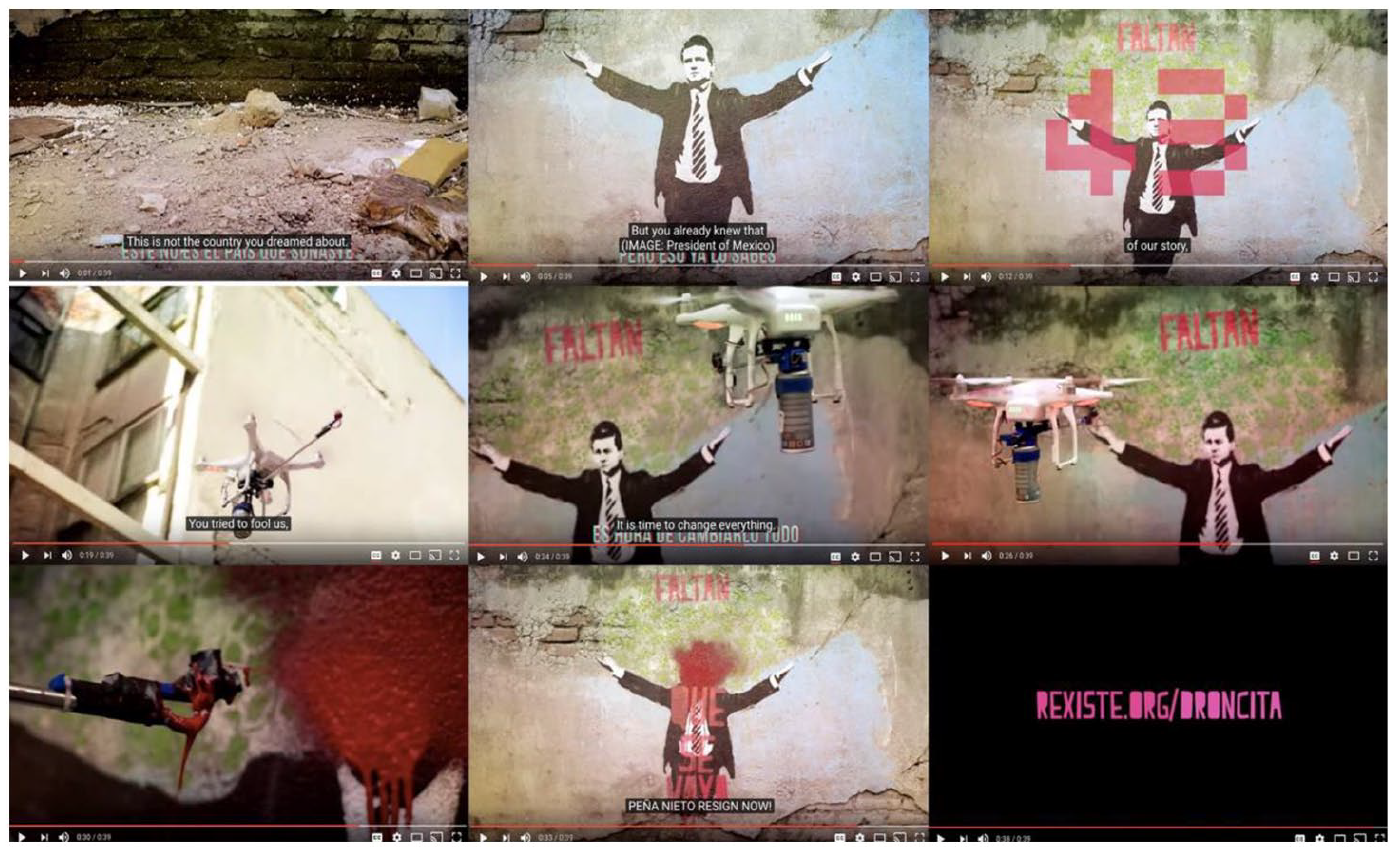
‘Es hora de cambiarlo todo’ (It is time to change it all).
The video provides evidence of the aestheticization of rage against the presidential figure, with Rexiste combining subversion of the necropolitical aesthetics of a military technology (Feigenbaum, 2015) that usually intervenes in public spaces (drone) with the creation of a digital character that blames the presidential figure for the students’ disappearance. The video and related photos circulated on global media and on social networks accompanied by Droncita’s phrase, ‘I took a selfie with Peña Nieto during the Ayotzinapa crisis.’ With this phrase, the collective subverted the very aesthetics of the drone, which is conventionally portrayed as a military killing machine (Sharkey and Suchman, 2013). In spite of her genealogy – trained to kill (Franz, 2017) – Droncita exhibits a diversification of her political repertoire by performing shame and rage. These are her affective weapons. However, these affects are indeed directed toward evoking death, but here it is the death of the official account.
While the video constitutes one way in which the collective mobilizes what I call the aestheticization of rage toward state impunity, at the same time, it also evokes other political affects, such as solidarity, outrage, and hope for finally getting closer to the truth as well as disgust at the presidential figure covered in blood. As the video circulated through social networks, Droncita enacted networked affects with audiences (Hiilis et al., 2019), inviting them as accomplices to occupy the gaze of a female machine performing the normally illegal act of graffiti to shame the state, represented in the figure of the former president, as an affective political act against its impunity in the face of such crimes.
The view from above and the subverting of fear
Here, Rexiste combines the appropriation of drone technology to intervene in public spaces via the creation of a digital character (Droncita) that reshapes the aesthetics from above during protests. Through Droncita, Rexiste proposes a visual aesthetics that seeks to challenge the hierarchical metaphor of the state, which like the sovereign of Hobbes’ Leviathan usually appears to be above society, though it too is part of the body politic. Droncita’s civilian drone view from above, however, constitutes a visual narrative to turn this vertical metaphor on its head by enacting counter-cultural surveillance practices (Zuev and Bratchford, 2020). In the following protests against the Ayotzinapa cover-up, for example, Rexiste deployed material objects, such as a Mexican flag with the letters RIP, to evoke fear of the dead (see Figure 4), while Droncita offered a view from above.
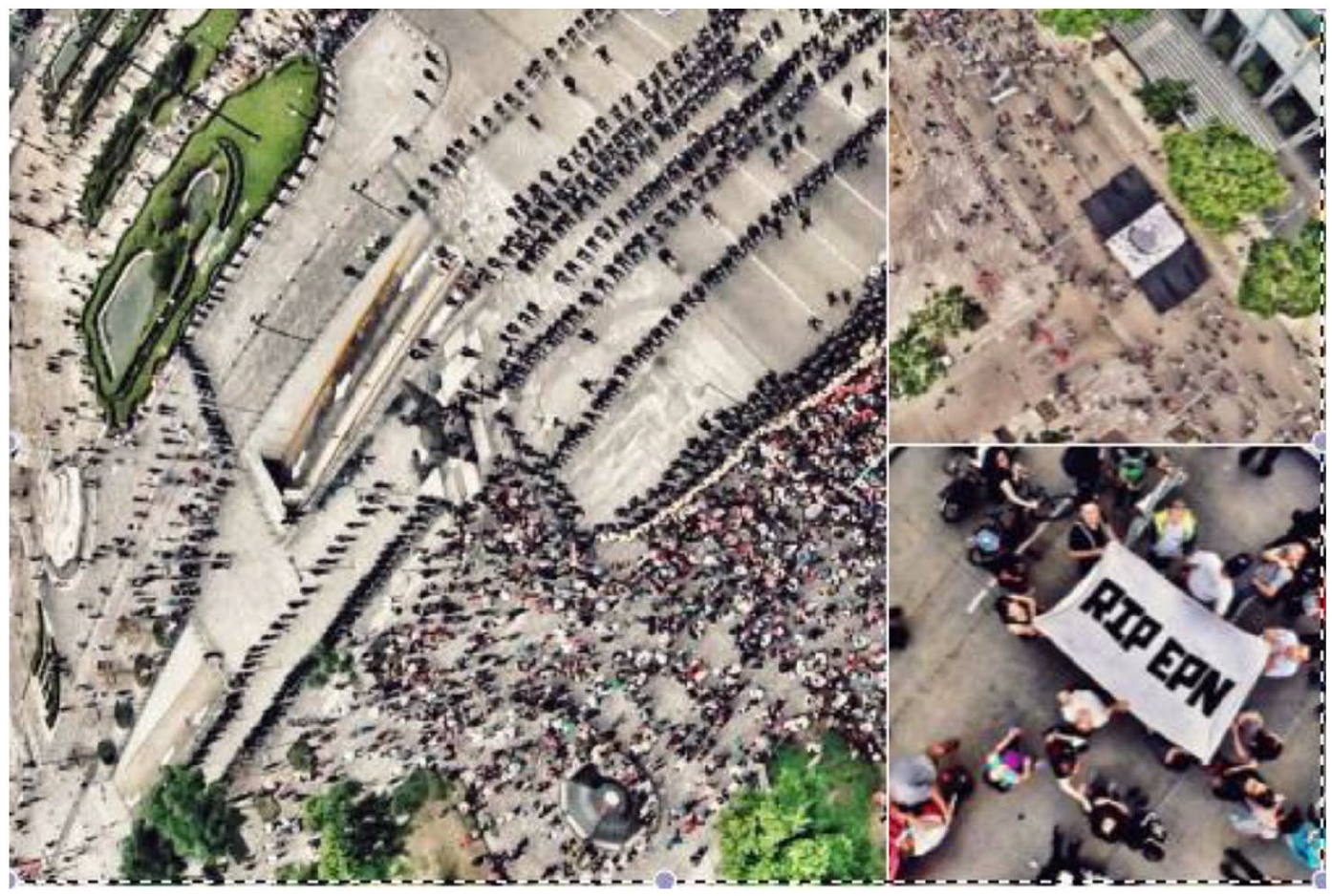
Droncita’s aesthetics from above of a protest, demanding the resignation of the President Enrique Peña Nieto. Photo 1 (left): Protests from above, showing police and citizens face to face; Photo 2 (upper right): a black Mexican flag employed as politicized material object in the protest; Photo 3 (lower right): RIP Enrique Peña Nieto.
In the collage of photos, we can see a drone aesthetic depicting death, represented by two objects. One photo shows a Mexican flag with the letters ‘RIP’ as a way of saying that the official account of the former president is dead, as is justice in Mexico. In addition to that, the photo alludes to the fear felt by the government, which brought out the police to contain the protest. In claiming the right to the view from above, with Droncita, the Rexiste collective also challenges the normally asymmetrical drone aesthetic of unilateral state power (Gregory, 2012).
Droncita then calls on others to join her and document the Ayotzinapa protests with affective messages, via photos on social networks. Asserting that ‘although the heart still has pain, this kind of justice does not stop’ (Droncita, 2016), she films the Ayotzinapa protest, creating spaces for affective memory. In the photos, the families of the 43 students can be seen in the first row, holding images of their disappeared sons. These perspectives also contribute toward contesting the official account of the state gaze regarding Ayotzinapa by proposing alternative views, including the affective expressions of the protesting families.
Discussion: From aesthetics to affective politics in collective action
The Ayotzinapa case provides evidence of a counter-military drone aesthetic that seeks to mobilize affects such as shame, rage and the subversion of fear as a means of political communication from civil society against the state. Rexiste mobilized a civilian drone aesthetic to, on the one hand, unmask the state’s impunity, through questioning its presumed status as a separate and autonomous entity, while at the same time acknowledging the importance of the state as an analytical and even performative category of reference in the politics of impunity (Passoth and Rowland, 2010). Here, Latour’s (2011: 800) idea of actor-network reversibility – an actor is nothing but a network, while a network is nothing but actors – is visible in the way Rexiste performed its aestheticized narrative of the state (with the phrase ‘It was the state’), which is not only the key actor to blame for Ayotzinapa but also, at the same time, a network of actors (i.e. the gangs, police and military forces). This also shows that the meaning of the ‘state’ should not be considered an impenetrable black box (Callon and Latour, 1981), as this phrase has also the objective of rendering visible the complex distribution of agency of state actor-networks and, thus, how it achieves impunity. In this case, this tension between the monolithic public image of the state and the actual plurality of the actor-network state is in itself a political affective strategy of the collective action.
If the state cannot be analyzed as an autonomous and unified entity, the same holds true for civil society. Social collectives can also be understood as actor-networks (Rodríguez-Giralt, 2011), enabling us to move beyond seeing collective action as homogeneous and only human-centered in ways that tend to portray objects as passive. Through actor-network theory, we can see the agency of Rexiste as being performed and distributed between assemblages of the collective’s human and non-human actors (Barad, 2003), such as Droncita and, with that, the aestheticization of affect through social networks.
In one sense, Rexiste’s actor-network reaffirms the militarized drone aesthetic prevalent in the literature on war, in that Droncita articulates a visual authority that is distributed through the network and becomes a material force (Stubblefield, 2017). This distribution of authority resembles the distribution of action in a network proposed by Latour (2011). As a civilian drone, however, Droncita offers a different aesthetic, questioning the authority represented by the Mexican state, making it a target of blame, and subverting its image of impunity. In the network of collective action, Droncita plays the role of the authorized machine that publicly blames the presidential figure in the context of social conflict. In doing so, she brings visibility to those who have no part in the official accounts (Viernes, 2020). These practices capture multi-scalar perspectives, disrupting the vertical, top-down power of the state. In the end, the perspectives opened up by Rexiste’s interventions contest the asymmetrical state gaze from above by not only proposing alternative views but also publicly challenging the ‘historical truth’ of the official account.
In the literature on the drone aesthetics of war, the asymmetrical ways of remote sensing implemented by military drones – seeing without being seen – has been extensively discussed (Gregory, 2012). Meanwhile, the interventions of the Rexiste collective reveal how a civilian drone – the all-seeing witness/activist – can promote other ways of seeing the (flaws and contradictions of the) state and taking an active role in violence against civilians. This confirms, on the one hand, the idea of actor-network theory of objects offering new possibilities of seeing (Latour, 1999) and, on the other hand, reaffirms previous research about civilian drones subverting the military aesthetic to frame the state from new vantage points (Viernes, 2020). However, Rexiste goes one step beyond aesthetics as production of visual regimes (Zuev and Bratchford, 2020), as it does not stop at sensory perceptions but also thematizes the affects that this new aesthetic generates. Civilian drones should, then, be understood as affect catalyzers (Bennett, 2010), which could widen the scope of the literature on drone aesthetics towards examining the affective politics they also mobilize.
During protests, the role of the civilian drone is not only to be an objective witness of the abuses of the police (Bennett, 2010) but also, in the Rexiste case considered here, as an actor-network performing (Barad, 2003) the fictional character of Droncita, which puts blame on the state through its videos and posts. This a way to contest the power of the state by reclaiming visibility as a means of resistance (Mann et al., 2003). Moreover, the aesthetics of the civilian drone along with the counter-narratives it transmits via social networks are also tools for dismantling the state’s optical regimes, which seek to shape and control public perception of politics and policing (Zuev and Bratchford, 2020).
Furthermore, the interventions of Rexiste also show that perceptions are not limited to the production of visual regimes but also political affect. In the case of the Ayotzinapa protests, the civilian drone prompted an aestheticization of such affects and subverted fear of the police by exhibiting its abuses. The Rexiste collective’s political repertoires were also mobilized to evoke a collective subjectivity of pain that was then converted into rage by, for example, calling for global actions of outrage and, subsequently, shaming the state with mega tags. Furthermore, Droncita takes a view from above the state, via the gaze of a female figure, asserting that post-human nature does not fear the president and will destroy the official account proffered by the state. I have called these repertoires shaming the state and the aestheticization of rage and shame vis-à-vis extreme state impunity. One implication of these new affective repertoires is the establishment of new ways of contesting state power. Another implication is the further spreading of affective politics, supported and enriched by other collectives; after the Ayotzinapa protest, for example, some collectives took to shaming the state for its role in gender violence with the phrase ‘femicide state’.
Conclusions
In the present article, I have argued that a new kind of drone aesthetic has been deployed for promoting affective politics against state impunity, which in the case of Mexico has resulted in diverse actions of aestheticization of rage against and shaming of state actors and the subversion of fear of the state. In this article, I have drawn on contributions from actor-network theory and new materialism to expand the existing focus in the literature from drone aesthetics to the affective perceptions that these aesthetics evoke, seeking to make a double contribution to both the literature on the drone aesthetics of war and social conflict, and the literature on civilian drones in collective action. First, the study fills a gap in the literature by empirically documenting and theoretically explaining the use of civilian drones and affective politics to expose and fight state impunity. Second, it expands the hitherto limited understanding of drone aesthetics as visual regimes by incorporating analysis of the affective perceptions that such visual regimes evoke.
Based on the case of the 43 disappeared students of Ayotzinapa, I have also introduced new perspectives on collective action to fight state impunity. First, through the lenses of actor-network theory and new materialism, this case provides evidence of the important role played by social media, revealing its character as a vibrant and political witness both in terms of exposing the illegitimacy of state impunity itself and in motivating and circulating protests against it. In Mexico, the media and material objects, including Droncita, took on the role of uncovering the fabrication of the state’s official account about what happened to the students and, thus, evoked an affective politics through feelings of indignation, rage, and injustice. Second, through Rexiste’s deployment of Droncita, this case can enhance our perspective on how to see collective action beyond human actors in the emerging era of drone media. Through discussing the aestheticization of affect and new roles for media technologies, this study may also contribute toward opening new lines in drone research to broaden our understanding of the relationships between politics and affect in war and other social conflicts.
Footnotes
Acknowledgements
I would like to thank Christopher Hank and the anonymous reviewers for their valuable comments.
Funding
The author received no financial support for the research, authorship, and publication of this article, and there is no conflict of interest.
