




Abstract
In this article, the authors apply a narrative model to examine how narratives about the current crisis in Yemen are constructed on English Wikipedia. Using concepts from various narrative theories, as introduced to the field of translation studies by Baker’s Translation and Conflict: A Narrative Account (2006), they analyse an article published on English Wikipedia. The analysis, based on a narrative model designed for this study, focuses on the alleged supporters of the Houthis in the current Yemeni crisis and is applied to the talk pages and history pages associated with the article. The article concludes that, although Wikipedia writers appear free to write and edit without restrictions, they are in fact subject to strict policies and regulations. The transparency of their discussions is a striking feature that controls the quality of the narratives they negotiate on Wikipedia.
Introduction
In this article, we examine the English Wikipedia (nd) article ‘Yemeni Civil War (2015–present)’ to discover the narratives its contributors have created about the current crisis in Yemen.
Social media and mainstream media present conflicting narratives about the crisis in Yemen, each seeking to create legitimacy for a certain political party. However, as a result of the collaborative nature of its construction, the narrative on Wikipedia differs from other online narratives. This study illustrates how the aforementioned Wikipedia article’s main narrative comprises fragmented narratives created by anonymous amateur narrators who engage in extended public debates about their narrative choices. We explore varying invisible narratives about who can and cannot contribute to a Wikipedia page and how they should do so. While the majority of researchers have investigated published media narratives (see Baker, 2010; Harding, 2011, 2012b; Jones, 2018; Sadler, 2018), we investigate behind-the-scenes negotiations occurring between contributors to the Wikipedia article on the Yemeni crisis as a case study, highlighting the effects of such negotiations on the ongoing narrative of the article.
We examine narratives that readers and researchers can access through Wikipedia articles’ revision histories, links to other pages and references to external sources. A Wikipedia article’s revision history shows the times at which some certain narratives are added and whether those narratives have been accepted or removed by other contributors. Discussions on talk pages demonstrate which issues in a narrative cause disagreement and how contributors negotiate to reach solutions that comply with Wikipedia’s policies while serving the overall aim of producing a coherent and meaningful narrative. We also discuss Wikipedia’s policies on writing articles, citing sources and solving controversial issues concerning article editing.
We employ a conceptual model based on narrative theory, as proposed by Somers (1992, 1997) and Somers and Gibson (1994), which was further developed for application in translation studies first by Baker (2006) and then by Harding (2012a). This conceptual model is applied to the narratives in the Wikipedia article in question to examine how such narratives are influenced by the political positions of individual contributors. With emphasis on personal narrative and public narrative (Baker, 2006), we aim to answer the following questions:
What changes/edits do Wikipedia contributors introduce behind the scenes while reaching their narrative choices about the alleged supporters of the Houthis in the current crisis in Yemen?
How can Wikipedia help contributors construct and develop their narratives with reference to the alleged supporters of the Houthis in the current crisis in Yemen?
The narrative: A model for analysis
In Translation and Conflict: A Narrative Account, Baker (2006: 1) introduces narrative theory to translation studies, arguing that in a world where we are surrounded by conflicting narratives, ‘translation is central to the ability of all parties to legitimize their version of events.’ Although this article does not discuss translated texts, we find Baker’s views useful for our purposes as they draw on social and communication theory in applying narrative in translation studies, often using narrative to mean the stories we live by. In addition, Wikipedia articles, by nature, rely on information from sources written in other languages and, as such, translation, rewriting, and other forms of multilingual transfer significantly contribute to the constitution of narratives on Wikipedia.
Baker (2006: 4) defines public narratives as ‘stories elaborated by and circulating among social and institutional formations larger than the individual, such as the family, religious or educational institutions, the media, and the nation’. Public narratives are not static but can change (sometimes dramatically) over time. News broadcaster Al Jazeera, for example, serves as an example of how a public narrative can change within months. Based in Qatar, Al Jazeera is known to be influenced by the Qatari government, and its public narrative about the crisis in Yemen has changed since Qatar left the Saudi-led coalition, which was allegedly formed to help restore the legitimate government in Yemen after Houthi fighters took control in September 2014. Al Jazeera initially supported the intervention and seldom reported on the victims of airstrikes launched by the coalition, but this narrative suddenly changed when the Qatari–Saudi crisis started in June 2017. In a comprehensive study, Gasim (2018) argues that Al Jazeera’s coverage on English news websites of both the humanitarian crisis and civilian casualties in Yemen has increased since the outbreak of the Gulf crisis. With this new narrative, Al Jazeera has attempted to delegitimize the Saudi-led intervention in Yemen by focusing on its impact on civilians and their rights.
Personal narratives are apt to be influenced by public narratives, particularly narratives created by state authorities. Individuals tend to accommodate new changes in narratives constructed by institutions, and it is a matter of survival for some to change their personal narratives. This kind of change in narrative is more likely to be seen in non-democratic regimes with poor human rights records, where an individual can be denied rights merely for adopting a narrative (opinion) that contradicts the one adopted by the ruler. This would explain the motive behind the shift in personal narratives among many Yemeni activists residing in or enjoying the support of Qatar or its close ally Turkey following the Gulf crisis. For example, Tawakkol Karman, a Yemeni Nobel Peace Prize laureate, complimented the Saudi-led intervention in Yemen at its inception. On 10 March 2015, she tweeted, ‘I’m very proud of the role [that] Saudi Arabia is playing in keeping Yemen[’s] stability and independence’ (Karman 2015). However, in a later interview with Vogue magazine (Codinha, 2018), Karman reported, ‘Parts of the country are under occupation, siege, and war by Saudi Arabia and the UAE.’ This narrative about the intervention of Saudi Arabia and the UAE in Yemen emerged following the Gulf crisis, with Qatar on one side and Saudi Arabia, the UAE and Bahrain on the other. Before the crisis, Karman had given full support to the Saudi-led coalition and its intervention in Yemen. It may be argued that Karman noticed a change in the nature of acts committed by the Saudi-led coalition in Yemen and therefore changed her narrative. However, Karman’s narratives of similar events before and after the Gulf crisis differ substantially. On 8 October 2016, the day on which 155 people were killed and at least 525 more were wounded when two airstrikes allegedly launched by Saudi-led coalition forces hit a packed funeral hall in Sana’a, Yemen, Karman did not tweet to condemn the attack. However, on 11 October, she tweeted to condemn an attack by Houthi forces on civilians in another Yemeni city (Karman 2016). On 26 December 2017, after the Gulf crisis, Karman (2017) tweeted in Arabic, translated literally as follows:
The Saudi–UAE coalition air forces have committed a new massacre today against civilians that has left scores of martyrs and injuries in the Alhayma area of Taiz. Yesterday, they committed a similar massacre in Dhamar. Justice will remain absent until the leaders of this coalition and all those involved in the massacres in Yemen are brought to the ICC.
That Karman has received citizenship from Turkey (Hürriyet, 2012), which is a strong ally of Qatar, suggests a motive behind the change in her narratives about the Saudi-led intervention in Yemen. In more accurate terms, a state-backed narrative can make individuals change their personal narratives in an effort to continue enjoying rights under a particular political regime, hence our use of the term ‘authority narrative’.
Narratives, the stories we tell about ourselves and about other narratives, are not made in a vacuum. Personal narratives, in particular, as demonstrated above, can be affected by other narratives (i.e. authority narratives). In becoming larger and more coherent narratives, personal and public narratives go through a process of negotiation, which is restricted by factors such as personal beliefs, societal traditions and institutional policies. In this study, we draw on the narrative framework to examine the internal process of negotiation underlying the narratives of the article in question, ‘Yemeni Civil War (2015–present)’.
Our analysis employs relevant features selected from Baker’s (2006) model and developed for translation and interpreting studies, and it draws on the features of narrative introduced by Somers and Gibson (1994), Somers (1992, 1997) and Bruner (1991). In particular, our model comprises three dimensions: temporality, relationality and selective appropriation. Temporality is ‘the embeddedness of narratives in time and space’, and it ‘highlights the fact that all narratives are temporally and spatially constituted’ (Baker, 2014: 167). However, it does not refer to the precise sequencing of narrated events since narratives are often constructed without consideration for the precise order of their constituent events. Rather, temporality can function as an organizational tool that helps narrative-makers form a coherent order of events. In the context of Wikipedia, we investigate temporality through the article’s history page, which logs every change to the text and, by implication, the narrative: it shows additions, removals and amendments, and it documents the username of the editor (or, failing that, the IP address) and the time of the change. Furthermore, temporality refers to the spatial sequencing of events constituting a narrative. For example, in the English Wikipedia article titled ‘2016 Sana’a funeral airstrike’, about a widely reported airstrike on a funeral hall in the Yemeni capital, the contents are ordered as follows:
War crime allegations
Reactions 2.1 Domestic 2.2 International 2.3 Non-governmental organizations
References
In the ‘Reactions’ section, Saudi Arabia, the leader of the Arab coalition accused of launching the air raid, is listed prominently among other countries and their reactions. However, in the Arabic Wikipedia article, ‘ ’ (Wikipedia), the contents are ordered as follows, translated literally:
Deaths and injuries
Accusations of Saudi Arabia and the coalition 2.1 Inquiry
Reactions 3.1 States and organizations
External links
References
Placing ‘Accusations of Saudi Arabia and the coalition’ immediately after ‘Deaths and injuries’ and not including Saudi Arabia in the ‘Reactions’ section creates a different narrative from when it is generated by the order used in the English-language article. In other words, as Baker (2006: 52) argues, ‘the way we order elements in a narrative, whether temporally or spatially, creates the connections and relations that transform a set of isolated episodes into a coherent account.’ In Wikipedia articles, one can trace the history of every narrative, and in the accompanying talk page, contributors discuss their choices. This takes us to the third dimension of our model: selective appropriation.
Selective appropriation informs which details are included in a narrative and which ones are ignored. Baker (2014: 167) argues that selective appropriation ‘is inherent in all storytelling and is guided by evaluative criteria that reflect the narrative location’ of the narrator; it is politically determined and has political consequences (Somers and Gibson, 1994: 59). Hence, narrators, by selectively appropriating their own narratives, position themselves in a politically charged domain that can direct the narrative towards a particular angle. In the context of Wikipedia, selective appropriation applies to various elements of the article, such as selecting certain details and excluding others, choosing external links and citing references, and naming the sections, headings and title. In the aforementioned Arabic-language article, ‘Qasf alsaalah alkubraa (Sana’a)’, the title literally means ‘Bombing of the grand hall (Sana’a)’; the word qasf (‘bombing’) was selected over lighter, more neutral word choices such as infijar (‘explosion’). The former suggests the use of airstrikes, which are known to be used solely by the Saudi-led coalition. Interestingly, in the talk page, contributors (or narrators) have engaged in a tense discussion about the selection of this word and some have suggested using more neutral words. It is worth noting that the English-language article uses ‘airstrike’, which explicitly refers to the main suspect of the attack.
The third dimension of our model is relationality, which serves to produce coherent and meaningful narratives. According to Baker (2018: 187), ‘Individual elements acquire meaning and value from the way they are configured within a narrative and cannot mean in the same way once transformed into a different narrative environment.’ Hence, individual elements are intentionally configured to fit the narrative in which they are used. For example, in a political context, describing the Saudi-led intervention in Yemen as an aggressive act will probably bear value in a narrative written by a pro-Houthi writer; however, it will probably lose value when used in a narrative that praises the intervention in Yemen and considers it necessary to save Yemenis from Houthis. As previously mentioned, the talk page for the Arabic Wikipedia article about the strike on the Sana’a funeral hall, ‘
I explicitly intended to write the article under the title ‘Bombing the grand hall’ as I did in the bombing of Al-Mirezak camp and the bombing of Al-Dahra in Taiz, but since each side has begun to blame the other, I see it as appropriate to choose infijar because infijar can mean an airstrike, a ground bombing, or other forms of bombing.
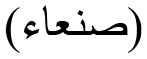 ’, contains a discussion about whether to use qasf (‘bombing’), infijar (‘explosion’), or hadithah (‘accident’). Aside from the fact that the word qasf has various meanings in Arabic,
1
the contributors in this discussion attempted to defend their choices by relating them to a bigger narrative. A Wikipedia editor with the username Mr Ibrahem, for example, said the following on the talk page (Wikipedia):
’, contains a discussion about whether to use qasf (‘bombing’), infijar (‘explosion’), or hadithah (‘accident’). Aside from the fact that the word qasf has various meanings in Arabic,
1
the contributors in this discussion attempted to defend their choices by relating them to a bigger narrative. A Wikipedia editor with the username Mr Ibrahem, for example, said the following on the talk page (Wikipedia):
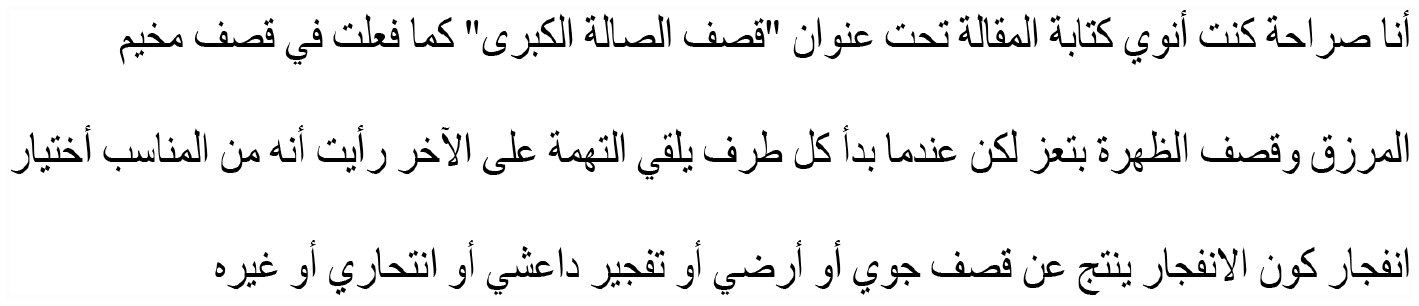
The user thus suggests an alternative wording for the title and refers to a larger narrative framework to justify his choices. He alludes to the narrative that Saudi-led forces have also carried out similar airstrikes on civilian targets, killing and injuring civilians, and he suggested that this narrative is supported by other Wikipedia articles that use the word qasf in their titles. He then suggests using infijar (‘explosion’) on the basis of another narrative: that of Wikipedia’s policy of neutrality. These alternative narratives on Wikipedia talk pages show how discussions between narrators (i.e. Wikipedia contributors) relate individual elements of a narrative to other narratives and pave the path for the creation of new narratives. The choice of one alternative in the title while excluding others shows how relationality can further function as a constraint (Baker, 2006: 66).
In sum, relationality means that for any narrative to be read and understood as such, ‘it has to be conceived as an episode, one part of a larger configuration of events’ (Baker, 2005: 8). But readers must be aware that what they read is only one side of many possible sides of the narrative. This combination of the three dimensions of narrativity – temporality, selective appropriation and relationality – constitutes the model we apply to our data below.
Wikipedia: Governance, editing conflict and policies
Konieczny (2010) discusses the forms and elements of governance that Wikipedia has, and how such governance affects Wiki editing and helps resolve issues that arise among editors. Interestingly, the policies and guidelines that regulate the editing of Wikipedia articles are themselves written and edited like Wikipedia’s articles. Any Wikipedia editor can edit them. Nevertheless, according to Konieczny, changes to Wikipedia’s policies, as noted in relevant Wikipedia policy pages, reflect either the consensus among editors, ‘a slow evolution of convention and common practice eventually codified as a policy’ (p. 258), or a decision by Jimmy Wales, co-founder of Wikipedia; the Wikimedia Foundation Board of Trustees; or the developers. Konieczny argues that Jimmy Wales and the Board are the highest authorities with a say in how Wikipedia functions. However, significant changes have been introduced to Wikipedia’s bylaws, including the distribution of the power to ban editors, which had previously been solely in the hands of Wales, to thousands of editors with administrator status (p. 269).
In 2003, Wales established Wikipedia’s Arbitration Committee, which has the power to review editors’ complaints against one another, ban editors from the site and impose other restrictions. The Arbitration Committee also has ‘the authority to impose binding sanctions and also to determine which users have access to special permissions’ (Wikipedia: Arbitration Committee, nd). The appointment and election of this committee have gone through various changes since its original establishment. As of 30 April 2020, there are 11 active versions of the Arbitration Committee, each one specializing in a particular language version of Wikipedia. Members are elected by Wikipedia’s community via standard elections. However, on the English Wikipedia, Jimmy Wales ‘has reserve authority to appoint and dismiss committee members, or to disband the committee and force new elections’ (Wikimedia Meta-Wiki, nd). Regardless of how much power they have in Wikipedia’s editing policies, Jimmy Wales and the Board apparently rarely intervene, ‘leaving most details in the hands of the community and trying to consult the community on important decisions’ (Morell, 2009, in Konieczny, 2010: 270). Konieczny (2010) concludes that, while in theory they rule over the Wikipedia community, Jimmy Wales, the Board and the Developers ‘in practice . . . rarely voice their opinions and reserve their veto powers for legal and technical matters’ (pp. 270–271).
The writing and editing of Wikipedia articles are based on coordination among Wikipedia’s community, which is proven by the ‘talk before you type’ policy (Viegas et al., 2007). On Talk pages, editors discuss their edits and supply arguments to support their choices, and in extremely controversial cases, their discussions can extend to many pages, constituting what is called ‘an edit war’ (Schneider, 2010). According to Jemielniak (2016: 368), ‘lengthy debates are the heart and soul of the Wikipedia experience’, and discussions often extend beyond articles’ content to include Wikipedia’s policies, rules and regulations. The length of a discussion page is a strong indicator of the level of controversiality in an article: in a statistical analysis of a January 2010 dump of the English Wikipedia, Yasseri et al. (2012) found a strong correlation between the length of a discussion page and the level of controversy in an article. However, this ‘talk before you type’ policy depends highly on language and culture, according to Yasseri et al., who argue that, unlike English Wikipedia, Hungarian Wikipedia Talk pages, for example, rarely mention the actual arguments.
In our case, the Arabic version of our article is very short, with only a few entries that cause little controversy. Considering the article is about a controversial case in the Arab world, it was highly expected the Arabic version would contain a lot of controversial issues regarding who supports the Houthis. Interestingly, the English version has many more controversial issues, although many of the editors, judging by their names, are from the Arab world. They did not leave as many comments in the Arabic version as they did in the English version. The cultural differences among Wikipedias rather than editors are what cause different judgments on the quality of articles and their content. Jemielniak and Wilamowski (2017: 2468) confirm that ‘there are clearly different cultural norms between Wikipedias . . . the saturation in images, references, and links, as well as average word count, relies, to large extent, on local community perceptions of what is proper and right in this respect.’
Despite the evident existence of authorities, at least in theory, Wikipedia is de facto run and managed by a large community of editors. Wikipedia has policies that regulate the writing and editing of its articles, which are written and edited by Wikipedia’s editors like any of its articles. A policy ‘documents a rule or standard with wide acceptance among Wikipedia editors that all users should normally follow’ (Wikipedia: List of policies and guidelines, nd). It is worth noting that Wikipedia documents distinguish policies from guidelines, where the latter show the best practices supported by the majority of Wikipedia editors. The current policies followed by Wikipedia’s community are divided into various categories: content policies, conduct policies, deletion policies, procedural policies, enforcement policies and legal policies.
For the purposes of this current study, we will briefly discuss two policies: ‘neutral point of view’ (NPOV) from content policies, and ‘edit warring’ from conduct policies. The former, in conjunction with the other two core content policies of ‘verifiability’ and ‘no original research’, aims to determine the quality and type of content acceptable for Wikipedia. This policy is non-negotiable, according to Wikipedia (Wikipedia: Neutral point of view, nd), and every editor should follow it. Editors are supposed to present complete information and not prefer one point of view to another. They should include ‘all verifiable points of view which have sufficient due weight’. The latter policy, on ‘edit warring’, aims to prevent editors from repeatedly overriding each other’s contributions. Schneider et al. (2010, in Yasseri et al., 2012) estimated that in the English Wikipedia, among highly edited or highly viewed articles, about 12 percent of the discussions are devoted to reverts and vandalism. Further discussion on NPOV and edit warring are given below (see Wikipedia’s control of the narrative).
In addition to policies, the Wikipedia community has also created a full set of rules to resolve conflict situations, including the so-called ‘three-revert rule’, locking articles for non-registered editors, tagging controversial articles, and temporarily or permanently banning malevolent editors (Wikipedia: Edit warring, nd). The three-revert rule says an editor cannot perform more than three reverts on a single page within a 24-hour period, whether those reverts involve similar or different materials. Violating this rule may result in the editor losing the ability to edit for 24 hours.
Material
In this article, we analyse one article on the Yemeni civil war, published on English Wikipedia, titled ‘Yemeni Civil War (2015–present)’ as of 30 April 2020. We selected this article, which discusses a subject critical to the Yemeni crisis because it exemplifies the knowledge production process and is published on a continually updated medium. As of 30 April 2020, the article had been published in 39 languages on Wikipedia and had received a total of 5,498,603 views in all language versions, with a daily average of 3,115 views. 2 The article on English Wikipedia had received 3,819,188 views, with a daily average of 2,164 views (see Table 1).3,4 It was created at 17:43 on 24 March 2015 by editor Rogal Dorm under the title ‘Southern Yemen offensive (2015)’, which was changed to ‘Yemeni Civil War (2015)’ at 01:27 on 9 April 2015 by editor Kudzu1, who noted on the talk page, ‘Sources are increasingly calling this a civil war, and spinoffs keep piling up.’
General information on the article ‘Yemeni Civil War (2015–present)’.
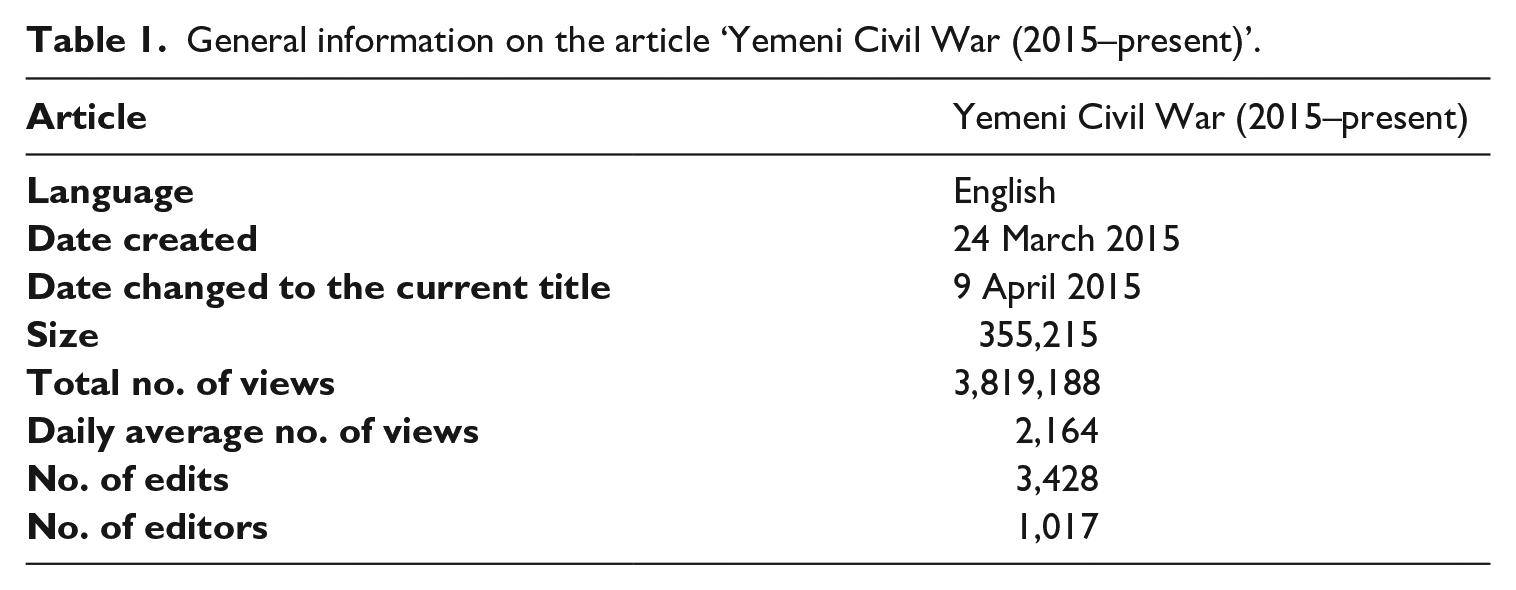
Although some other language versions of the article (e.g. Arabic and Persian) were created around the same time, the English article has received approximately 10 times more views than the Arabic article, which suggests people all over the world are interested in learning about the current crisis in Yemen. This is also expected given the fact that Arabic Wikipedia ranks 15th in terms of number of articles published, with 1,040,809 articles published as of 30 April 2020, according to Wikipedia’s (nd) list of Wikipedias. This falls far after English Wikipedia, with 6,068,435 articles. In addition, Shuttleworth (2018: 233) found, ‘The global profile and reach of the English edition is evident in its daily average page views’, which reached 253,455,338 as of 30 April 2020. 5
In addition to the English version of the article, we analyse the article’s associated talk pages and history pages. The article is thus treated as one main narrative composed of fragmented narratives added by contributors at different times.
The talk page associated with the ‘Yemeni Civil War (2015–present)’ article on English Wikipedia is accessible via the ‘Talk’ tab, located in the top left-hand corner of the article. This space offers a platform where Wikipedia contributors can discuss their choices for the article, plan changes, explore different points of view, suggest additions and/or deletions, and conduct other related tasks (e.g. voting). The article’s talk page contained 588 comments by 146 different individuals. 6 Comments on the talk pages significantly contribute to the main narrative. At publications such as The New York Times and Encyclopaedia Britannica, discussions among writers happen ‘behind the scenes’; on Wikipedia, the discussions and debate found on talk pages are ‘rich context’ (Viegas and Wattenberg, 2006) that is available to the public, who can access the well-informed, thorough discussion of the choices contributors make in writing and editing an article. According to Tkacz (2007: 5), as cited in Jones (2018: 279), conversations on Wikipedia talk pages ‘clearly reveal the “cacophony of individual voices” involved in the construction of each text and allow scrutiny of the behind-the-scenes discussions that take place between them, opening up the “black box” of the knowledge production process’.
The article’s associated history page is accessible via the ‘View history’ tab, located in the top right-hand corner of the article. This page shows the history of edits made to the article in reverse chronological order and documents who made each edit and when. It also shows the usernames of these editors and provides links to their user pages, which often give more information about the editors. This is particularly helpful for researchers investigating the political and cultural motives behind narratives added by a given user. It is worth noting that articles on Wikipedia are subject to continual changes by contributors and editors, meaning these articles cannot be treated as complete. They are, in fact, ‘dynamic in nature’ (Shuttleworth, 2018: 233), ‘living documents’ (Callahan, 2014: 69) and ‘moving objects’ (Shuttleworth, 2017: 315), which necessitate the use of an effective tool such as the history page to trace the development of their narratives and information content. In our study, the article’s history page listed 3,428 edits made by 1,017 editors, with the first edit, the creation of the article, made on 24 March 2015 at 17:43 by editor Rogal Dorm. 7
Wikipedia is known for the wealth of interactive tools and features it provides to its contributors and readers. The revision history gives a detailed record of every edit made to the article, showing the content of the edit, the time and date it was performed, and the username of the editor. This tool allows us to examine the order of the edits, relate them to other edits made in the article, and put all edits in context. Tracing edits made to the list of supporters enables us to contextualize additions and omissions of alleged supporters (e.g. Qatar) and relate them to the political situation in the external world.
We begin with the talk pages, where all discussion topics are listed and grouped under themes subject to further critical investigation. An examination of these talk page discussions and relevant revision history allows us to determine how these relate to the development of events and information in the article.
Negotiating narratives
In this study, we examine narratives in the article published on Wikipedia about the crisis in Yemen, ‘Yemeni Civil War (2015–present)’. We treat the article as a narrative made up of many minor narratives, but, for the purposes of our study, we limit our analysis to the narrative concerning the alleged supporters of the Houthis, which is categorized under a separate section in the article titled ‘Allegations of outside support’. We analyse the discussions behind the scenes of constructing a drop-down list of alleged supporters, which is continually updated by the article’s editors and contributors. The list of alleged supporters of the Houthis, with the title ‘Alleged support,’ is in the third column to the left of the infobox titled ‘Main belligerents’ (see Figure 1) as of the time of this study. We chose this narrative because, after our initial examination of the data, we found it to be the focus of several edits (additions and removals) and talk page discussions by editors and writers. First, we examine the article’s history page to learn the context and timeline of how the narrative unfolds, and we study editors’ justifications for their changes to the narrative. Next, we search for relevant discussions in the accompanying talk pages in an attempt to understand how the narrative has reached its present version.
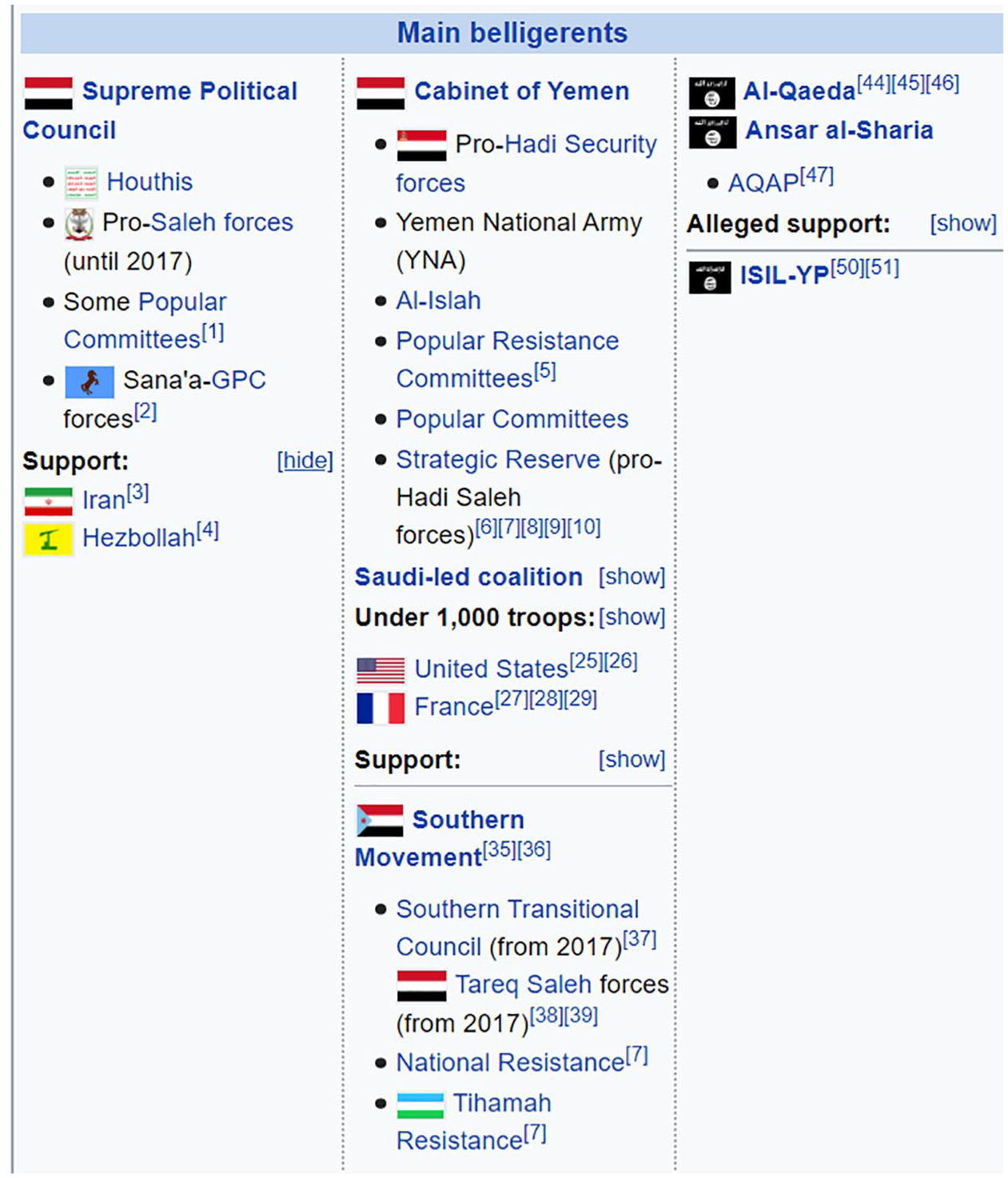
Screenshot of Wikipedia on 30 April 2020.
The alleged supporters of the Houthis
Wikipedia contributors have the option to use infobox templates, which, according to Wikipedia’s (nd) article ‘Help:Infobox’, ‘contain important facts and statistics of a type which are [sic] common to related articles’. Infoboxes are usually added to the top right-hand corner of English-language articles. The main infobox in our article contains, among other sections, the ‘Main belligerents’ section, listing all parties and supporters involved in the current war. We focus our analysis on the alleged supporters of the Houthis for two reasons: (a) Houthi supporters are not consistently identified in the media, unlike the unambiguously identified supporters of the coalition; (b) looking through the history pages and talk pages accompanying the articles, we noticed a long record of edits made to the list of the Houthis’ supporters, accompanied by heated talk page discussion, whereas the coalition’s supporters were agreed on without discussion.
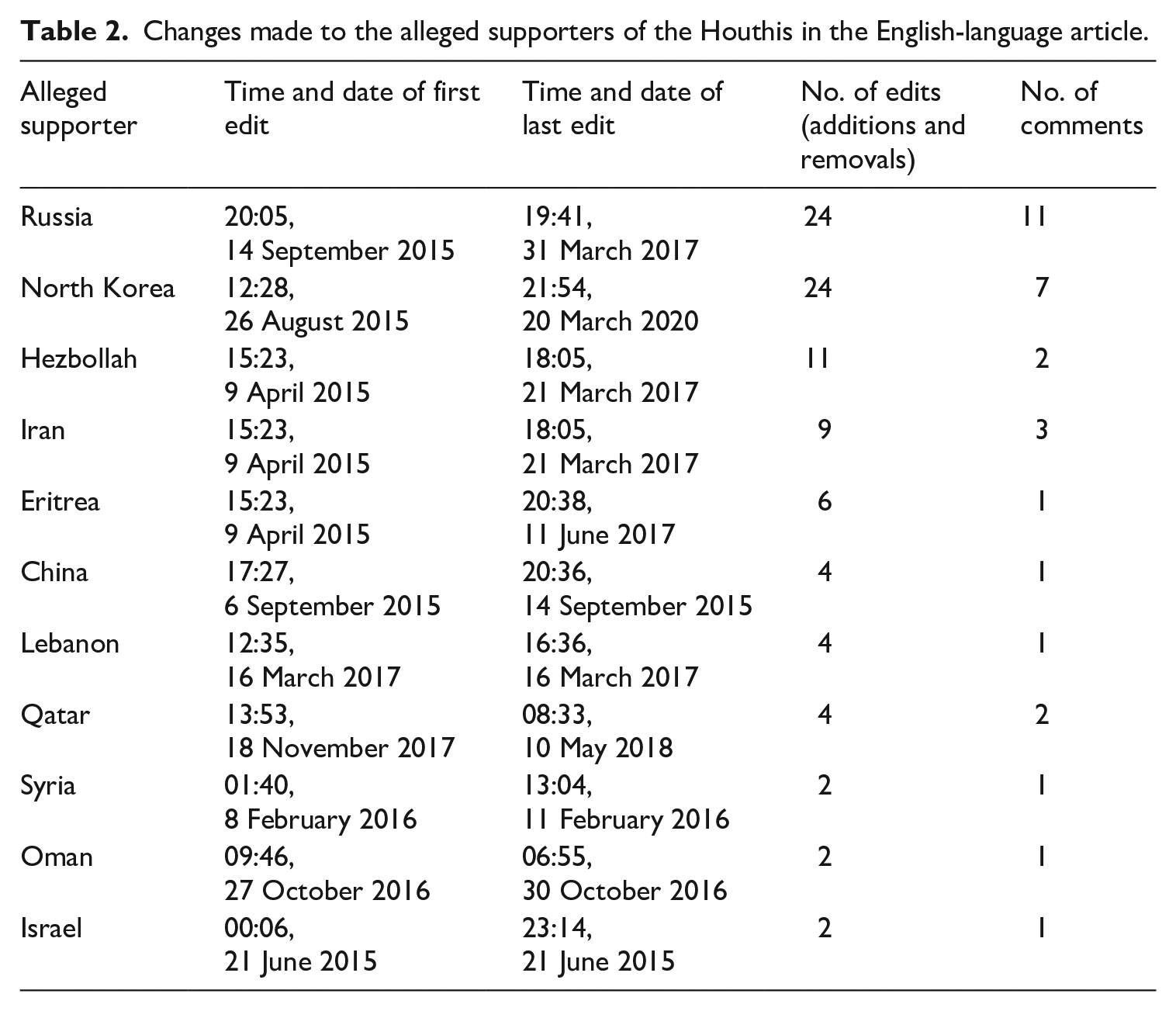
As of the date this study was completed, 30 April 2020, the article listed two states/organizations as alleged supporters of the Houthis: Iran and Hezbollah. Selecting one particular state or organization and naming it as a supporter of either party directs the reader towards a certain reading of the text. Selective appropriation, according to Baker (2014: 167), is ‘inherent in all storytelling’, but the timing of the addition of a particular entity as a supporter is likely motivated by external factors. Somers and Gibson (1994: 59) have discussed how political factors can determine the selection of any particular narrative at any particular time. For example, Qatar was added to the list of the Houthis’ alleged supporters on 18 November 2017, shortly after Saudi Arabia and other Arab countries cut diplomatic relations with Qatar (BBC, 2017). According to Baker’s (2018: 187) definition of relationality, adding Qatar to the list of alleged supporters at this particular time has more value and added meaning only when motivated by the political narrative about broken relations between Qatar and other countries. A change in a particular detail of the narrative does not occur in isolation from the overall narrative outside the text: Adding or removing an alleged supporter is affected by what is happening in the world. Russia, for example, has been added and removed from the list of the Houthis’ supporters, changes likely motivated by Russia’s role in the Syria crisis.
The data show that supporters have been added in different patterns of frequency. Some supporters have been added to the list and removed once (i.e. Israel and Oman). Oman was added on 27 October 2016 by editor Qrmoo3 and removed by editor Greyshark09 on 30 October 2016, with no justification given for the addition or the removal. The addition of Israel by an unknown editor on 21 June 2015 was explained by editor Mikrobølgeovn on the talk page as being because ‘some users seem to have an obsession with adding Israel in every military infobox on Wikipedia’. Mikrobølgeovn removed Israel a few hours later, leaving the following note on the history page next to the decision: ‘veteranstoday [the unknown editor’s source] is not a reliable source’. In justifying an addition or removal, discussions and notes left by editors on the history page and talk page consistently raise questions about which sources and media to use as evidence. This kind of narrative is discussed further below.
The primary talk and history page narrative about the alleged supporters of the Houthis concerns the involvement of Russia and North Korea (see Table 2). Russia and North Korea have been added to and removed from the list of alleged supporters 24 times. Changes to the supporter status of Russia were accompanied by 11 comments on the history page to justify those changes, and changes to North Korea received seven comments. Most justifications were based on the types of sources cited as evidence by the editors. On the history page, for example, editor Lycoperdon, justifying the removal of Russia from the list on 18 September 2015, stated the following:
because uatoday [Ukraine Today] is notorious for anti-Russian sentiment and Russophobic propaganda, so it cannot be considered a reliable source; besides, the link is dating back to early April so the information is out of date.
Changes made to the alleged supporters of the Houthis in the English-language article.
Wikipedia editors were heavily involved in discussions about the relevance, appropriateness, reliability, and trustworthiness of the sources quoted as evidence for their edits. In fact, as per its article ‘Identifying reliable sources’, Wikipedia (nd) has a clear policy on the use of sources:
The policy on sourcing is Wikipedia:Verifiability, which requires inline citations for any material challenged or likely to be challenged, and for all quotations. The policy is strictly applied to all material in the mainspace – articles, lists, and sections of articles – without exception.
Wikipedia’s policy maintains that all controversial narratives in its articles should be accompanied by inline citations from reliable sources. As per the same article, it also emphasizes, ‘Wikipedia articles should be based on reliable, published sources, making sure that all majority and significant minority views that have appeared in those sources are covered.’
However, we have observed that many editors rely on a broad and seemingly flexible definition of acceptable sources and add any sources that ‘prove’ their controversial edits without assessing the reliability of those sources. For example, editor GoldenRainbow added North Korea on 14 September 2015, using as evidence an article by Samuel Ramani, an international relations PhD student at Oxford University, which was published on HuffPost UK on 17 August 2015 (see Ramani, 2015). On 1 November 2015, user Lycoperdon removed North Korea, noting the following on the history page:
The article which blames North Korea is written by some student and not an actual journalist, it refers to mysterious unnamed ‘former security official’ talking to South Korean intelligence, clearly shows that he does not represent DPRK in any way.
The narrative grew tense when the original editor, GoldenRainbow, returned North Korea to the list later the same day, stating the following on the history page:
These articles are not written by a student nor an ‘appeal to anonymous authority’. The Huffington Post and International Business Times are better and great sources. Please don’t start an edit war.
The editor Lycoperdon removed North Korea the next day, providing screenshots underlining the mention that the article had been written by a student and appealed to anonymous authority. On the history page, the user reminded the first editor that Wikipedia ‘states we can remove libellous, biased and poor sources’. Following this, the editor GoldenRainbow returned North Korea to the list, beginning a seemingly endless dispute. Then, in less than two hours, the second editor removed North Korea again, noting on the history page, ‘Dispute underway’.
This long behind-the-scenes discussion between writers shows how a narrative is constructed and how narrators go through a lengthy, complicated process of negotiating their narratives before reaching a final version of the narrative. However, Wikipedia articles are never final, as they can be edited and updated at any time by almost anybody. This discussion shows that narrators working on collaborative platforms such as Wikipedia struggle to add their own narratives freely. External sources and internal policies, among other factors, affect how they construct their narratives. Unfortunately, due to the limited information on some editors’ user pages and the lack of identification of others, it is beyond the scope of the current study to examine how editors’ political backgrounds affect their written narratives.
Wikipedia’s control of the narrative
The use of external sources was a key issue that editors and writers raised in the context of justifying their edits. As discussed above, some editors, while apparently attempting to comply with Wikipedia’s aforementioned policy of identifying reliable sources, cited weak or poor sources without examining their reliability and credibility. As seen above, in the context of North Korea, one editor referred to an article written by a student who relied on a reference to an anonymous source. We believe Wikipedia’s policy of making their articles and all related discussions open to the public is a strength that helps maintain the reliability and credibility of their content. Indeed, contributors and editors voluntarily monitor the application of Wikipedia’s policies and intervene as necessary to correct violations thereof.
Although Wikipedia applies strict policies regarding controversial content, some ‘troublemaker’ editors tend to manipulate content in an unprofessional manner. In the context of the alleged supporters discussed above, Russia and North Korea received 24 edits each. Some editors insisted on reverting any corrections made by others. Wikipedia imposes the ‘three-revert rule’ in order to prevent editors from entering an ‘edit war’, as discussed in the article ‘Edit Warring’:
An editor must not perform more than three reverts on a single page – whether involving the same or different material – within a 24-hour period. An edit or a series of consecutive edits that undoes other editors’ actions – whether in whole or in part – counts as a revert. Violations of the rule often attract blocks of at least 24 hours. Fourth reverts just outside the 24-hour period may also be taken as evidence of edit-warring, especially if repeated or combined with other edit-warring behavior.
Another policy Wikipedia has adopted to maintain neutrality of the narrative of their articles is the neutral point of view. Wikipedia states the following:
All encyclopedic content on Wikipedia must be written from a neutral point of view (NPOV), which means representing fairly, proportionately, and, as far as possible, without editorial bias, all of the significant views that have been published by reliable sources on a topic.
The NPOV is particularly relevant to the question of which media and sources editors should select to prove the accuracy of their edits (the narratives, in our context). Editors are encouraged to present all different points of view if evidence is cited. However, editors can sometimes enter what seems like a war, accusing each other of bias. Reports on the number of casualties spurred a good example of this kind of war in the article ‘Yemeni Civil War (2015–present)’, where editors accused each other on the talk page of citing biased media as evidence of the number of casualties. Editor Chilicheese22 proposed that editors Mr.User200, Wikaviani and OxfordLaw state their positions on the issue and why they were in favour of or against such positions. Chilicheese22 also invited editors who frequently contributed to the article to vote on whether they should use state-controlled media to cite casualties. Voting eventually solved the issue of dispute.
Conclusion
At the time of this study, the list of alleged supporters of the Houthis consisted of Iran and Hezbollah in the English-language article in question. This analysis, in view of the three dimensions of narrative (temporality, selective appropriation and relationality), shows that the list of alleged supporters of the Houthis, as an essential component of the narrative on the Yemeni crisis, had gone through a significant but uncertain process of manipulation since the creation of the article. The article started with Iran, Hezbollah and Eritrea, added at 15:23 on 9 April 2015, then kept changing until the last time we checked it.
We found that selective appropriation was the main strategy contributors adopted when amending the list of supporters. They added some supporters and deleted others without explanation. For example, Israel was added to the list of supporters even though there are few links in the media between the Houthis and Israel. However, some additions were justifiable through relationality. Qatar, for example, was added to the list of the Houthis’ supporters only when the crisis occurred between Saudi Arabia and the United Arab Emirates on one side and Qatar on the other. This narrative was configured and given value only in a wider global context, which crosses the borders of the Wikipedia article to the Gulf crisis narrative outside the text. Temporality, the third strategy, was represented via the timing of the selection of certain supporters and the order in which they have been added to the list. However, although there appears to be no obvious justification for the order in which supporters have been added, the history and talk pages of the articles show that some additions and removals have occurred in response to the acts of other contributors and/or because of potential ideological factors. We recommend that future research investigate the role of ideology in writing politically and ideologically oriented articles like the ones discussed in this study.
For the sake of ensuring neutrality, Wikipedia sets out policies and guidelines that it encourages contributors to abide by in their writing. The NPOV, for example, ensures that contributors are free to write anything provided they include all possible views and cite reliable sources to prove them. Some contributors nevertheless use any sources that support their arguments without checking their reliability, and Wikipedia does not provide an effective tool to prove the reliability of sources. The ‘three-revert rule’ is another policy Wikipedia has introduced to minimize disputes between contributors. According to this rule, any contributor who performs three reverts on one page in less than 24 hours is blocked from further editing for 24 hours. The analysis above shows how effective this rule was when discussion related to the supporters became tense and contributors began to react quickly by reverting edits made by others.
Footnotes
Acknowledgements
The publication of this article was funded by the Qatar National Library.
Funding
The author(s) received no financial support for the research, authorship, and/or publication of this article.

Notes
Author biographies
Address: Sultan Qaboos University 42, College of Arts and Social Sciences, Muscat 123, Oman.
Email:
References


 (Twitter),
 (
(
 _1 (
_1 (