




Abstract
Eight years after the ‘Arab Spring’, literature is still marked by techno-deterministic interpretations. This article contributes to examining the role of agenda-building processes just before the outbreak of the Egyptian uprising in 2011 within authoritarian systems. Using the ‘hybrid media system’ concept, the article not only focuses on new media effects but, by including print media, it takes into consideration the media system in its entirety. Focusing on Khaled Said’s case as a counter-issue, the qualitative content analysis investigates how challengers in Egypt successfully pushed the media salience of police torture onto the mainstream media agenda. By reconstructing the issue cycle and intermedia spill-over effects, the author investigates the agenda-building processes within hybrid media systems in Arab authoritarian contexts.
The qualitative content analysis includes 415 articles and posts from 12 diverse print, online and social media outlets between June 2010 and January 2011. The central finding is that successful spill-over effects occurred from online media to private print media, even though state media tried to ignore the issue. The coverage transferred the issue’s salience from new media into mainstream media, thus reaching wider non-politicized audiences. These proven interlinkages between old and new media are often an overlooked aspect in the literature on media and the ‘Arab Spring’.
Introduction
Triggered by the ‘Arab Spring’ protests, studies have employed mobilization or democratization theories to analyse new media effects in the Arab public sphere. Related research has focused on the technological novelty, capacity and effects of social media in political contention, conceptualizing it as a mobilization tool, an accelerator or a catalyst (Abdulla, 2011; Alaimo, 2015; Khamis and Vaughn, 2011; Wolfsfeld et al., 2013). Even before the ‘Arab Spring’, the liberation technology hypothesis (Diamond, 2010) had already captured the eminent transition in semi-liberalized media systems, whereby the commercialization of traditional media and the introduction of the internet generated a new logic in media coverage dynamics. Newly established private media drew on blogs and social media platforms to publish on marginalized issues, which helped diverse dissidents and identities to raise concerns that otherwise would not have appeared on the media (Etling et al., 2010; Hamdy, 2009; Hussain and Howard, 2013; Radsch, 2014; Richter, 2011). Early research euphorically emphasized the liberating new media effects and suggested uni-lateral linearity, isolating the digital media from the entire media system. Later research has highlighted how authoritarian regimes learned to use social media for surveillance and public relations spin and argued that politics, not media, come first (Badr, 2013, 2015; Wolfsfeld et al., 2013).
Because the literature is still not conclusive and over-emphasized the role of digital media, eight years after the ‘Arab Spring’, understanding the context-specific constellations that shaped media agendas in the run-up to the uprisings remains important. Instead of arguing that new media expanded the public sphere and focusing on new media alone, this article positions itself within the literature of agenda building and hybrid media systems in relation to the Arab uprisings. It explores how actors in a given society shape media agendas. The study expands the agenda building literature to the Arab constrained contexts. By including diverse media formats, print and online, it studies an under-researched aspect of media and the ‘Arab Spring’.
Agenda-building theory explores influences on the media agenda as a dependent variable to understand who or what builds the agenda of the media and shapes the issue cycles. This approach is different from agenda-setting theory, which assumes that media sets other agendas and examines the influence of media on public and policy agendas. Research on the links between civil society campaigns and traditional mass media remains sparse as literature rarely addresses the surrounding conditions of agenda-building processes (Pfetsch et al., 2013: 13).
Agenda transfer of issue salience has been extensively studied in democratic contexts, with a focus on US elections. This article theoretically contributes to agenda-building research in non-Western authoritarian contexts, which are still under-researched. Agenda-building approaches remain rare in Arab media studies. While one study (Richter, 2011) explored the intermedia agenda-setting effects of Islamist media under Mubarak, no study has yet scrutinized agenda-building processes in the context of the Arab uprisings. Instead, literature diffusely states that interplay between new and established media took place, calling for further research (Spier, 2017: 122).
This article’s central argument is that the 2011 uprisings in Egypt erupted due to a public awareness of counter-issues within hybrid media systems. The awareness would not have been possible without the challengers’ agenda-building efforts. They pushed counter-issues and caused the spill-over processes into the public sphere through an overlooked step: the mainstream print media. Acknowledging the interplay between new and traditional media, the article draws on the concept of the ‘hybrid media system’, coined by Andrew Chadwick (2017: 285). It refers to the interlinkages within media systems without dividing them into either old or new media, but in order to analyse them and their interactions together.
This article contextualizes social media within the broader hybrid media context and the power struggles within Egypt before 2011. Focusing on the case of a victim of police brutality (Khaled Said) as a counter-issue, this study argues that that successful spill-over effects occurred from online media to private print media, even though state media tried to ignore the issue. The coverage transferred the issue’s salience from new media into mainstream media, thus reaching wider non-politicized audiences. Those interlinkages between old and new media are often an overlooked aspect in the literature on media and the ‘Arab Spring’.
Therefore, this study neither subscribes to the linear euphoric liberation effects of technology nor underestimates authoritarian regimes’ learning capabilities: it does not see the digital media as the sole cause of protests and, at the same time, acknowledges that regimes learned to respond to (new) media challenges. By analysing the Khaled Said case as a counter-issue, it reconstructs a struggle over attention and interpretation within Egyptian media. Notably, debates about the role of transnational Arab TV or the transformation outcomes in Arab countries are beyond the scope of this study.
Operational definitions
Three key terms are central for this article:
Challengers are a diverse group of oppositional actors who raise counter-issues for more visibility in media and public discourses. They include non-co-opted civil society, counter-elites, advocacy groups, bloggers and social movements. The diverse challengers seek to build the media agendas. In the Egyptian context, they advanced their claims through communication strategies to challenge autocratic rule and highlight socio-political injustices. Challengers exposed human rights violations and demanded political change through mediated political campaigns within a semi-liberal, yet restricted political framework (Bayat, 2012).
Counter-issues are socio-economic and political grievances that regimes want to prevent from further stirring the public. They delegitimize the regimes and are understandably ‘not placed on the (media) agenda by the established elites, but by counter-elites’ (Badr, 2019; Mathes and Pfetsch, 1991: 37). Counter-issues spur contradicting interests and harbour a struggle between challengers and governments over their salience and interpretation.
Spill-over processes refer to transfer of an issue from one agenda to another. For example, when marginalized challengers visibly and favourably place their counter-issue on the media agenda, a spill-over process from the challengers’ agenda to the media agenda occurs.
Against this background, this article empirically examines the transfer of counter-issue police brutality in Egypt before 2011 from the challengers’ agenda into the mainstream media agenda. The analysis focuses on the case of Khaled Said, the young Alexandrian man beaten to death by the police in 2010. Khaled Said was selected for several reasons: in Egypt, the issue of police brutality destabilized the moral foundations of Mubarak’s rule in its last few months. The awareness of police torture publicly delegitimized the regime, caused rage and mobilized the masses. The choice of the protests to mark 25 January purposefully challenges the Annual Police Day celebrating the patriotic achievements of the police. Khaled Said became a posthumous icon for the revolution, although he never witnessed it.
By comparing the issue cycle in different media over time, the analysis locates spill-over effects to see how challengers pushed the counter-issue of police abuse in the last seven months of Mubarak’s rule in Egypt. This article poses three research questions:
RQ1: How can we interpret and contextualize the evolution of agenda-building process (including the issue cycles and spill-over processes) in the Egyptian hybrid media system?
RQ2: What are the similarities and differences in the selected media within Egypt’s hybrid media system before 2011?
RQ3: How did the constellations (issue characteristics, political context, networked actors, and media system) shape the agenda building processes?
The article begins with a theoretical section explaining the agenda building theory as a politics of attention, highlighting the specifics of agenda building in authoritarian settings. Examining Egypt before 2011, the article explains the constellations for spill-over effects, including the media landscape, the counter-issue and actors’ networks. After briefly summarizing Khaled Said’s case, the methodology section introduces the research design, media sample and qualitative analysis. The results present the findings in three subchapters. Finally, a discussion and conclusion contextualize the findings within the literature.
Politics of attention: Agenda building and spill-over processes
Agenda-setting research is the study of the ‘transfer of salience between a pair of agendas’ (Funk and McCombs, 2015: 2). Media attention is a scarce resource as it can only focus on a limited number of issues at any given moment. In a time of saturated and fragmented media environments, regardless of the political context, various actors compete to gain attention for a certain issue, meaning ‘attention is a key resource’ (Tufekci, 2013).
Cobb and Elder (1971), who coined the term ‘agenda building’, conclude that the mainstream media agenda reproduces the status quo. It favours political elites and its discourse promotes political stability. Marginalized actors find it more difficult to influence the range and type of issues raised in the media, as media excludes them from the official beat system (p. 897). Thus, oppositional actors frequently seek media attention for their counter-issue through alternative means. They often use spectacular events or protests as an entry point onto the media agenda, forcing themselves into the agenda-building process (Cobb and Elder, 1971; Mathes and Pfetsch, 1991: 34; Walgrave and Vliegenhart, 2012: 137). When challengers of the status quo severely disrupt prevailing norms, they foment ‘legitimate political controversy’ and create pressure on the government through the added visibility of their concerns (Cobb and Elder, 1971: 900–903). Challengers thus function as issue sponsors and ‘suppliers of new issues and points of view’ (Mathes and Pfetsch, 1991: 36).
Challengers’ agenda-building function refers to its ability to push their counter-issue into the mainstream media agenda. Building the agenda refers to both breaking the silence to push an issue onto the agenda and advancing a desired interpretation of the issue. As opposing agendas compete, actors actively seek to shape the media agenda to serve their interests. As challengers are dependent on media attention, they adapt to the media’s logic by staging events designed to attract attention and create newsworthiness through big numbers or disruptive behaviour (Rucht, 2016: 21). Protest movements are creative in using performative acts of dissent, political slogans or orchestrated blog swarms so that media can no longer ignore their issue. Evidence shows that not only media but also governments increase their attention to issues that cause protests (Walgrave and Vliegenhart, 2012: 151–152). Another strategy for agenda building is through alternative media, where challengers resort to their own media outlets to carve out independent spaces in the media landscape (Rucht, 2016: 22).
Spill-over processes from the challengers’ agenda to the media agenda do not negate the existence of journalistic autonomy. Media organizations and journalists actively choose their sources and issues according to newsworthiness and professional logic. In addition, context conditions from the media system such as ownership, partisan leaning and economic constraints shape the agenda. Because agenda-building processes are ‘context-sensitive’ (Pfetsch et al., 2013: 10–13), understanding the surrounding constellations is crucial for grasping spill-over effects and the evolution of an issue cycle within a certain political and media context (Mathes and Pfetsch, 1991: 34).
Agenda-building research on counter-issues in Western democracies shows that both state and challengers influence the media agenda on different types of issues. For example, advocacy groups have been shown to successfully influence the media agenda on issues like food safety (Pfetsch et al., 2013, 2016) and environmental concerns (Neil et al., 2016). Meanwhile, studies on critical counter-issues that threaten the moral legitimacy of the democratic political system show that security institutions have more influence over the media agenda. For example, Bakir’s (2015) study on the issue of torture in the US context reveals that intelligence agencies manipulated different agenda-building nodes, including the press, to serve their interests (p. 141). Similarly, Marchionni’s (2012) study on international human trafficking concludes that the press embraced the government’s agenda instead of serving as a watchdog (p. 155). These studies prove that the nature of the counter-issue has an effect on challengers’ and states’ influences on the media agenda.
As online technologies increasingly became part of the ‘hybrid media system’ (Chadwick, 2017), the nature of spill-over processes changed. As the internet and user-generated content have diversified agenda-building processes, we see today a stronger diffusion of social media agendas into the traditional media agenda. The classic legacy media influence gets weaker as traditional media no longer possess the singular power to set the salience of an issue (McCombs et al., 2014: 788; Meraz, 2011: 111; Vonbun et al., 2016: 1). However, social media accelerates rather than causes information diffusion and salience transfer. Results show that, in countries with restricted media freedom and low civil liberties yet relatively high internet penetration, new media remarkably contributes to the agenda-setting process (Rauchfleisch and Kovic, 2016: 11–12). As social media dramatically compresses time and space, it adds pressure on autocratic political systems to react quickly, which can spur bottom-up liberalization (Voltmer, 2013: 84). In the context of the ‘Arab Spring’, new media created strong enough attention and helped social movements to diffuse their preferred framing to large audiences (Tufekci, 2013: 853). Counter-issues became hard to ignore.
Specifics of agenda-building processes in authoritarian regimes: The case of Egypt
The core mechanism of agenda-building processes – transfer of issue salience between agendas – is not fundamentally different in autocratic systems; ‘context-sensitive’ constellations still affect agenda building. However, unlike in democracies, challengers in authoritarian systems face additional constraints to make their counter-issues visible. While actors can counter official regime narratives of success and prosperity by uncovering counter-issues of failure and injustice (Voltmer, 2013: 80), they face harsh consequences from restrictive laws or repressive measures that threaten their safety. If challengers perceive the political cost and level of threat to be too high, it potentially suppresses independent agenda-building processes and pushes them underground. Under Mubarak, challengers in Egypt often worked under conditions of anonymity and secret collaboration to avoid jail and torture (Ghonim, 2012: 61). At the same time, challengers’ agenda-building efforts in authoritarian systems also reflect the regime’s margin of toleration and the openness of the media environment. In Egypt after 2000, when Mubarak’s political and media system in Egypt began to open up from a closed system to a commercialized system due to economic liberalization and technological developments, it became more responsive to counter-issues, though still less responsive than liberal media systems.
Context-specific constellations for agenda-building processes: The counter-issue and its context
To contextualize the agenda-building processes of the counter-issue police torture before the Egyptian revolution in 2011, the following section elaborates on three context variables: (a) the nature of the counter-issue; (b) the political context, including relevant actors and their networks; and (c) the media landscape. Together they provided the conditions for the counter-issue police torture to spill over onto Egypt’s mainstream media agenda.
The nature of the counter-issue: Police torture and emergency law
When people demanded dignity in Tahrir Square in 2011, they rose against the regime’s police, whom they perceived to be a ‘symbol of injustice and humiliation’ (Ismail, 2012: 450). It was not surprising that Khaled Said, a victim of police torture, became a posthumous icon of the Egyptian uprising, as shown in many Facebook avatars (Ali and El-Sharnouby, 2014; Gerbaudo, 2015). In modern states, police usually monopolize the legitimate use of violence to maintain state power and reinforce the social order (Trottier and Fuchs, 2014: 31). In Mubarak’s Egypt, however, police brutality had become a systematic routine exercised in the name of security (Abdel Aziz, 2007; Moorehead, 2005; Morayef, 2015: 10). Through a ‘politics of humiliation’, the police frequently used physical punishment and verbal violence to uphold the authoritarian regime (Ismail, 2012: 437–438). The arbitrariness of abusive practices and the ubiquity of police presence in the daily lives of citizens symbolized the regime’s injustice (Ismail, 2012: 450). At the same time, access to accountability through justice institutions was non-existent (Khalil, 2013: 28), as a decades-long state of emergency suspended the rule of law and gave the police exceptional powers.
Even before the killing of Khaled Said, challengers worked to increase the visibility of police torture. Relevant challengers who caused pressure included the Egyptian Organization for Human Rights, which monitored and documented regime violations; the Nadeem Center, which provided post-traumatic rehabilitation for survivors of violence; and the Hisham Mubarak Law Centre, which offered legal aid for victims, to name just a few. In addition, bloggers not only broke the silence on police torture, but also provided audio-visual proof. In 2007, Wael Abbas’ blog Misr Digital leaked a video of police torturing 21-year-old minibus driver Emad El Kabir, which stirred up debate and pushed the Egyptian authorities to put the police officers on trial, a rare occurrence at the time (Azimi, 2007: 11). Filmmakers raised the issue of police torture to wider audiences; Khaled Youssef’s film Chaos (2007) featured a corrupt and violent police officer as the main character, while the former Al-Jazeera producer Howaida Taha was put on trial for making the documentary Behind the Sun (2008), which accused Egyptian police officers of torturing poorer citizens. Professional journalists in newspapers and talk shows picked up the stories and added salience to the issue (Hamdy, 2009).
In coverage on the issue of police torture from the time of Khaled Said’s killing to the 2011 uprising, the human aspect was prevalent. Challengers used the cultural access point that recognizes victims as ‘martyrs’ (Buckner and Khatib, 2014; Mittermaier, 2014) to fuel demands for dignity against brutal injustice. Wael Ghonim, founder of the Facebook page ‘We are all Khaled Said’, wrote he sought to ‘market the public sympathy for the victim, using the positive affect for the martyr and his grieving mother’ (Ghonim, 2012: 84).
The political context and challenger networks in Egypt in 2010
Khaled Said’s killing occurred during a period marked by general public dissatisfaction and the desire for political change. The controversial 2010 parliamentary elections and upcoming presidential elections in 2011 led to intensive debates on Egypt’s future among elites and counter-elites. Lack of clarity on Mubarak’s successor and his son’s quick rise in the ruling party fuelled outrage at the idea that he might be groomed to take over (Schäfer, 2009). At the same time, the ‘authoritarian bargain’ whereby Egyptians traditionally exchanged their political quiescence for social goods and services from the state was being slowly eroded by the state’s expanding neoliberal policies (Ismail, 2012: 437).
After large-scale pro-Palestine and pro-Iraq protests in Egypt in 2000–2003, challenger networks evolved over the course of Mubarak’s last decade (Schemm, 2012). Back then, the regime tolerated youth activism, both as a means of legitimating itself and diverting frustration towards foreign policy issues, but these same oppositional networks increasingly diverted the focus of their agenda-building efforts on domestic issues. After 2005, the oppositional Muslim Brotherhood bloc in parliament also held a margin of legitimate political action. In 2010, the return of Mohamed Baradei, Egyptian Nobel Laureate and former Director General of the International Atomic Energy Agency, strengthened the alliance of diverse political actors under the umbrella of the National Association for Change, which demanded an end to Mubarak’s rule and refused his son’s candidacy (Schäfer, 2009). A man of Baradei’s stature was a credible presidential challenger to Mubarak. The alliance called for political reforms labelled as ‘the seven demands’. These included the end of the state of emergency, full judiciary supervision over elections, electoral monitoring by local and international civil society, giving Egyptians abroad the right to vote, limiting restrictions on candidates for presidential elections and allowing citizens to vote with their national IDs to widen the electoral base. Amid this tense political climate, the Khaled Said incident sparked protests to demand justice, democratic rule and an end to emergency law.
The media landscape: The controlled semi-liberalized scene in pre-revolutionary Egypt
Before 2011, controlled pluralism and semi-liberalized commercialization characterized the Egyptian media system. The law allowed the economic liberalization of print media in 1996 and audio-visual media in 2001, which produced a semi-independent private media sector that pursued a professional logic. Private media used Western-oriented journalism practices and diverse sources to bolster its credibility (Sakr, 2013) and secure followers. While the regime originally gave media licences to a select handful of loyalist business tycoons (Roll, 2013), the inherent media logic used this margin of freedom to keep a minimum of integrity in a tight market in the face of competition from other Arab satellite channels. Beyond the national media landscape, transnational Arab-speaking TV stations, such as Al-Jazeera, posed serious legitimacy threats by airing critical news and shows on Egyptian politics. It gave challengers a voice to reach wider publics (Schäfer, 2009).
The liberalization policies from above generated an ‘unintended by-product’ in the form of a diversification of editorial choices and the training of a new generation of professional journalists (Voltmer, 2013: 81). A ‘talk show effect’ led to a gradual process of opening the public sphere (Sakr, 2013). The regime tolerated limited pockets of free expression as a survival tactic to appease its Western allies and attract foreign investments. As Egypt’s political parties remained weak, co-opted and conflicted, the private media took on the role of vocalizing grievances, airing controversies and making political demands (Hafez, 2004). Despite this, in 2010, Egypt was still ranked ‘not free’ according to Freedom House’s (2010) annual study of civil and political rights, even if journalists could challenge the regime.
The case study of Khaled Said: Course of events
On 6 June 2010, two plain-clothes police officers were checking IDs of users in an Alexandrian internet café, empowered to do so by the emergency law. When Khaled Said questioned the practice, the police officers dragged him out of the café into a neighbouring house and beat him to death in front of countless witnesses (Al-Nadeem Center, 2010). Authorities framed the incident as the death of a drug addict. Without mentioning signs of torture, the first coroner’s report cited the cause of death as asphyxiation due to swallowing a marijuana packet. Khaled Said’s family and human rights activists publicly countered that. They pushed for a re-examination of the body to prove that he had been tortured and to exonerate him from the substance abuse charge. Using the internet, they circulated pictures of Khaled Said’s disfigured face on social media juxtaposed with his neat-looking passport photo. For many, Khaled Said’s killing was further proof of the regime’s brutality (Human Rights Watch, 2010). Unlike other victims from lower classes, the regime was unable to use intimidation or financial compensation to silence Khaled Said’s middle-class family. After five days they decided to speak to the media openly, a decision that was not easy and added public pressure (personal communication with Mohammed Fouad). His torture led to widespread sympathy and rage, especially among youth. Challengers organized massive protest waves in June and July 2010. At the same time, Muslim Brotherhood parliament members proposed a motion to investigate the incident. The official state response was initially ignoring the issue as the Minister for Legal and Parliamentary Affairs refused to respond. Yet this triggered further additional media attention from within the regular parliamentary beat system. Eventually, the Prosecutor General ordered the re-examination of Khaled Said’s body, as well as the arrest and trial of the two officers in late July 2010. Since then, the trial sessions were rescheduled on a monthly basis, until the events of January 2011 erupted.
Method, media sample and analysis
This article investigates the agenda-building processes and spill-over effects for pushing the counter-issue police abuse into the mainstream media within an authoritarian media system. A qualitative content analysis of 415 articles and social media posts from 12 online and print media reconstructs the issue cycle of police torture between 7 June 2010 and 11 February 2011. The analysis uses the quantitative approach to retrace and contextualize the issue cycles across the media through visualized graphs. The article relates the issue cycle to relevant challengers’ and state actions to locate the spill-over process in media agenda-building processes. The research questions stated above guide the qualitative content analysis and the formulation of the codebook (as detailed below).
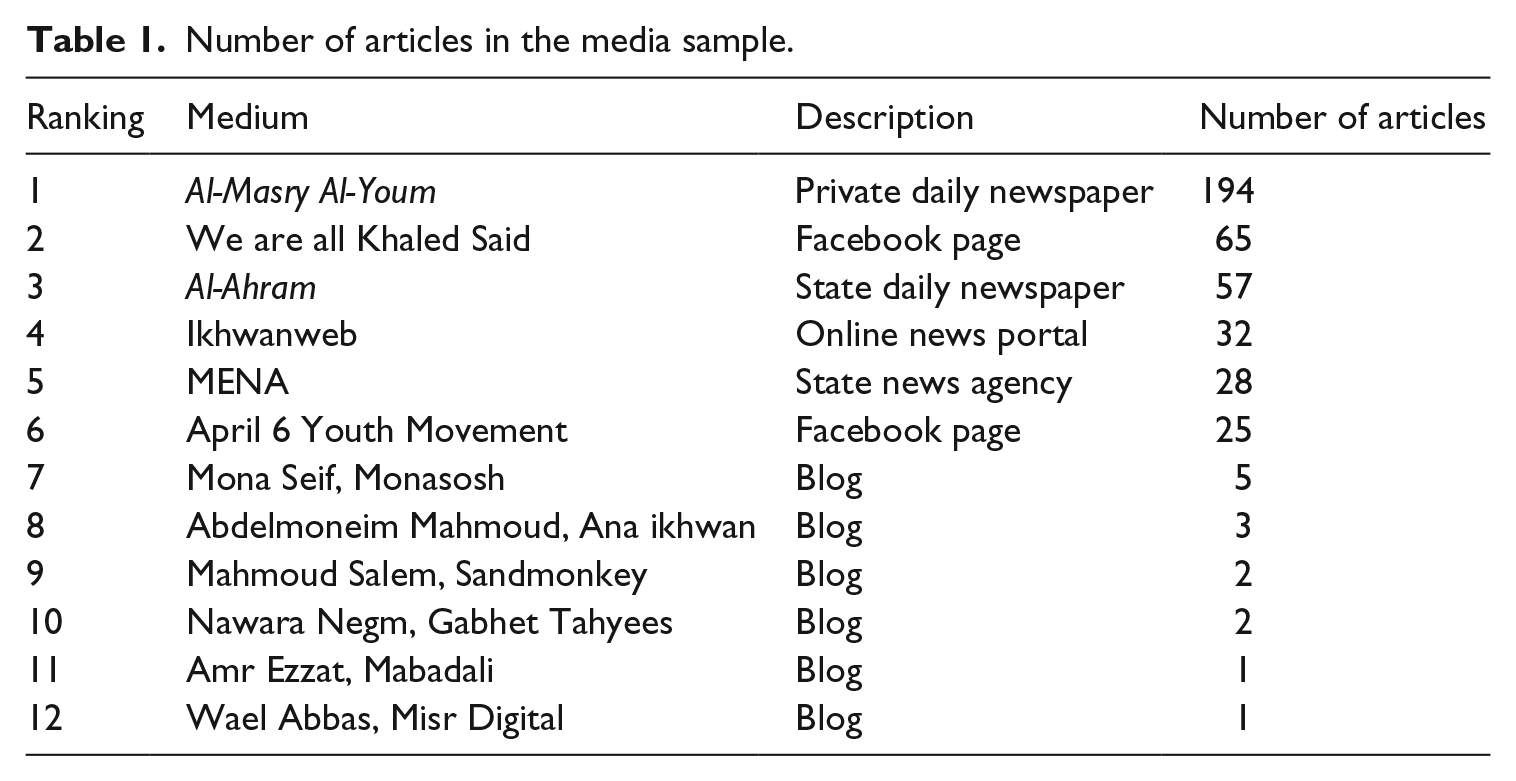
Sampling criteria for selecting the media included the ownership and political position of the medium, the representation of different stakeholders, the medium’s relevance to Khaled Said’s case, and inclusion of professional and new media (to acknowledge the hybrid media system). The sample consisted of a total of 12 media: two daily newspapers (Al-Ahram, Al-Masry Al-Youm), one online news portal (Ikhwanweb), two Facebook pages (April 6 Youth Movement, We are all Khaled Said), six influential blogs, and the state news agency MENA (see Table 1). Media archives of Al-Ahram were collected from the paid service by the Al-Ahram Center for Archiving and Documentation. The MENA articles were collected through a service available in the archives of the news agency. Online materials from blogs and Facebook pages were secured in July–August 2016. For the qualitative analysis, the study utilized the computerized data analysis software MaxQDA 12 (Kuckartz, 2014). While spill-over effects from transnational Arabic-speaking media cannot be dismissed, the empirical analysis is confined to Egyptian media, which is a limitation of access and archiving of audio-visual materials.
Number of articles in the media sample.
A preliminary study of 10 percent of the material (40 articles) inductively generated the main arguments from the whole media spectrum (Mayring, 2015). The unit of analysis was the statement. Categories were fine-tuned as the analysis progressed. The analysis identified four main contested aspects that reflect polarized positions between the regime and challengers: (a) the cause of death (asphyxiation versus brutal murder); (b) Khaled Said’s reputation (criminal drug addict versus good citizen); (c) the police officers’ actions (innocent versus guilty); and (d) the contextualization of the incident and consequences called for (an individual mistake requiring investigation vs systematic police torture requiring political change). Interviews with key journalists and activists complement the media analysis.
Results: Competing for attention and interpretation of Khaled Said’s death
Massive breakthrough of the counter-issue in agenda-building processes
The reconstruction of issue cycles of Khaled Said’s killing shows a sharp rise of on police torture rose sharply in media attention. After a massive breakthrough, the issue cycle showed two peaks and two declines (Figure 1). The first peak occurred in June–July 2010 and clearly reflected the challengers’ agenda-building efforts through protests. The start of the trial of the police officers on 31 July 2010 marks a sharp decline of the counter-issue. Followed by a prolonged phase of limited attention, the media routinely covered the monthly court proceedings of the police officers’ trial. The issue cycle showed a temporary upswing in November 2010 as new police torture victims became known. New issues like the parliamentary elections dominated the media until December 2010, when challengers called for January 2011 protests. The second peak reflected the challengers’ mobilization against police brutality on 25 January 2011, Egypt’s annual Police Day. These protests evolved later into the Egyptian revolution. Again, in the second decline phase, the counter-issue salience dropped sharply after Mubarak’s resignation, as media shifted to other issues relevant to the transition.
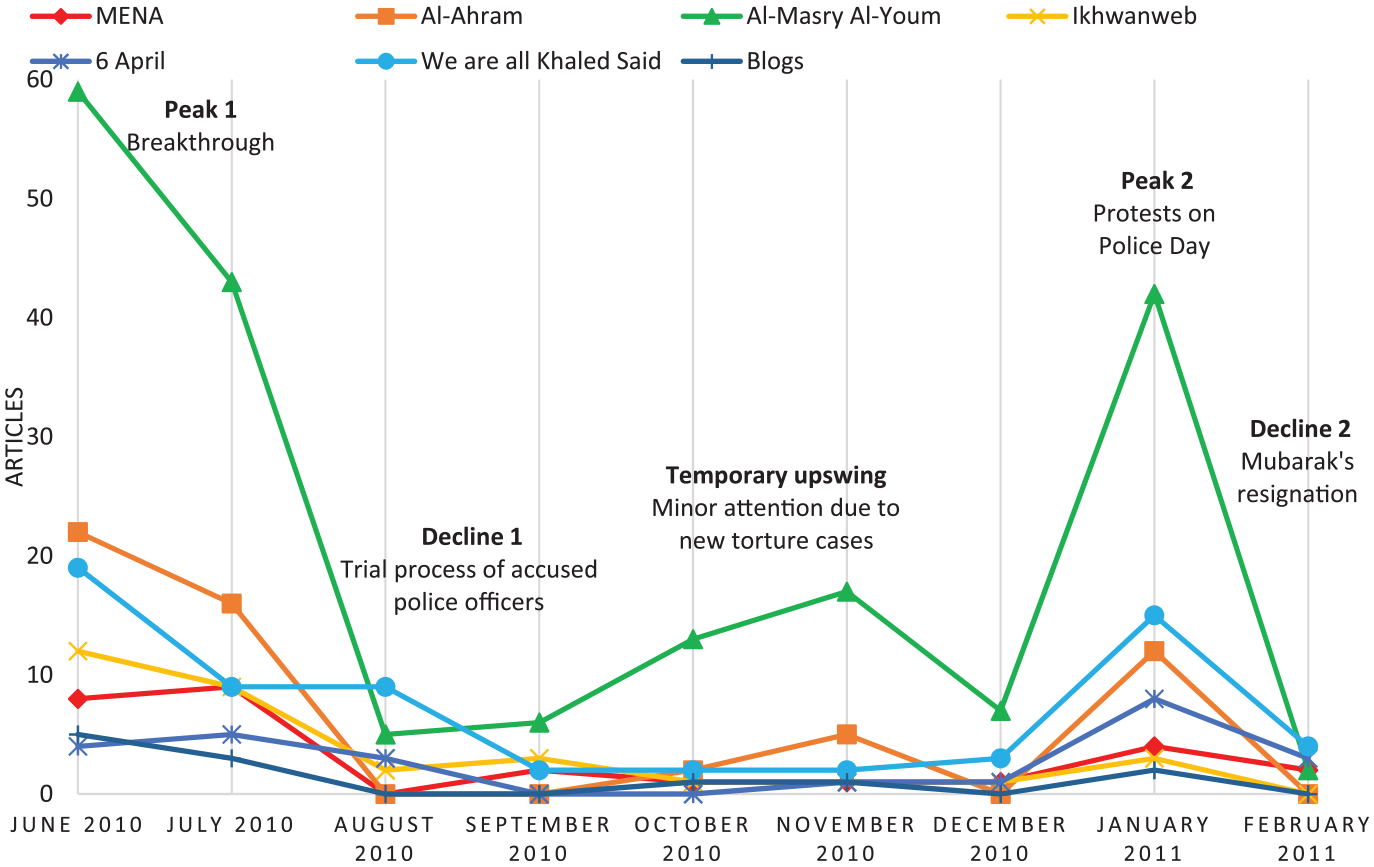
Trends in the issue cycle of Khaled Said’s killing and police torture, June 2010 – January 2011.
A closer look at Figure 1 reveals three observations: first, the issue cycle across the media follows the same pattern of attention as peaks and decline phases occur in the same time. They reflect the real-life acts: challengers’ agenda building efforts and the regime actions or responses. Second, media ownership and political position shaped the level of media attention to the counter-issue. The attention varied in each medium according to its ownership and political affiliation. Comparing the two daily newspapers alone is telling: the private daily newspaper Al-Masry Al-Youm peaked the attention cycle in most months (after picking up the issue from the challengers’ agenda); the state-owned newspaper Al-Ahram showed less interest to cover the counter-issue. Most strikingly, the state news agency MENA rarely raised the incident despite its institutional capacity. While new media (blogs, online news portals and Facebook pages) covered Khaled Said’s case less when compared to the daily Al-Masry Al-Youm, yet, in their few articles, they strongly called for protests, justice and political change. In particular, the Facebook page ‘We are all Khaled Said’ played a key role in pushing the issue salience: although it operated as a one-man show most of the time, it devoted visible attention each month only to this single issue (Figure 1). Its dedication to Khaled Said’s cause explains why it comes third in levels of media attention despite its structural limitations. Third, results show a pattern predicting the issue salience in the media: when favourable response from the regime makes challengers’ agenda-building efforts immediately stop or they become ineffective for penetrating the media agenda. In both decline phases, August 2010 and January 2011, once challengers elicited a desirable reaction from the regime (either putting the police officers on trial or Mubarak stepping down), the advocacy for the issue as well as the media moved on to other issues.
Diffusion delay of the counter-issue
In order to locate the spill-over effects, Figure 2 visualizes the media attention to Khaled Said’s case in weeks. Comparing the attention levels in the early phase (week 24 and 25) clearly shows a spill-over effect from the newly established Facebook page ‘We are all Khaled Said’ into the other media. Although it was only operated by one person, at that time, it had the highest number of articles in week 24. In this week, ‘We are all Khaled Said’ had the single-issue advocacy and published four articles. Initially, Al-Masry Al-Youm and Al-Ahram briefly covered the story in their criminal sections before its political dimensions unfolded. Therefore, both newspapers gave Khaled Said’s story rather low priority in week 24 (1 article in Al-Ahram, 2 articles in Al-Masry Al-Youm). In week 25, the counter-issue salience evolved dramatically: Al-Masry Al-Youm (24 articles), followed by Al-Ahram (10 articles). Al-Masry Al-Youm clearly adapted its agenda to the challengers’ agenda and responded to social media and blogs.
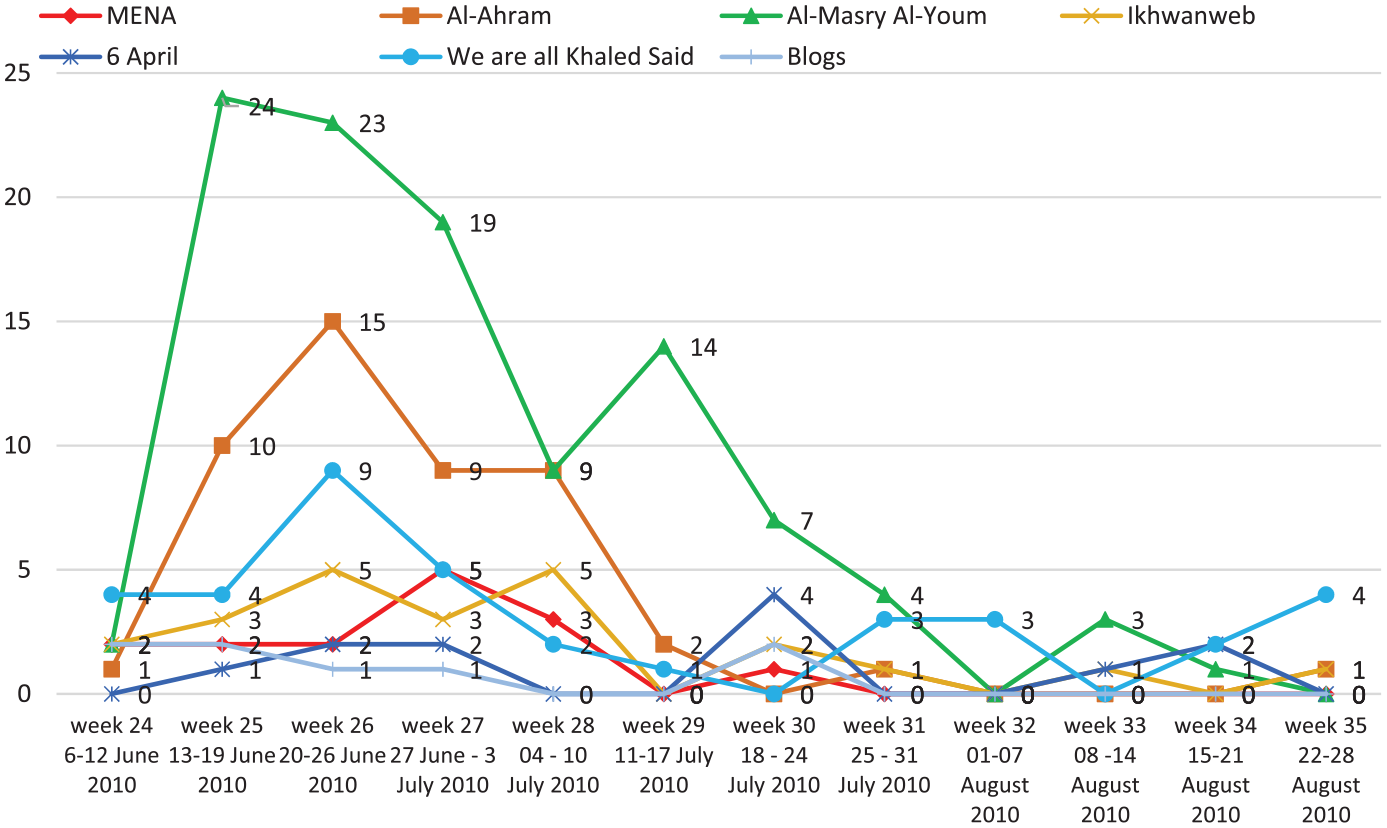
Spill-over effects in Khaled Said’s issue cycle June–August 2010.
The issue cycle shows a diffusion delay of issue coverage in the mainstream media. From the day of Khaled Said’s death on 6 June 2010, it took the MENA news agency 5 days to mention the incident at all on 11 June 2010. One of the reasons was the reluctance of Khaled Said’s family to share their story with the media according to an Alexandrian reporter (Mohamed Fouad, 2017, personal communication). During those five days, as Khaled Said’s family was undecided whether to include the media or not, the public stir and rage in Alexandria strengthened them. Challengers disrupted the norms of stability to push the issue and gain coverage. They advanced their preferred framing of the incident on social media. For example, the founder of the ‘We are all Khaled Said’ Facebook page, Wael Ghonim, stated that he founded the Facebook page instantly after reading about Khaled Said in a Facebook post of the opposition politician Ayman Nour for the first time on 10 June 2010 (Ghonim, 2012: 51).
During those early days, Al-Ahram and Al-Masry Al-Youm initially reported on the incident in their crime sections in week 24, but they increased their coverage in response to the challengers’ agenda. The story moved into the political section and even numerous times made it onto the front page of Al-Masry Al-Youm. Challengers’ interpretations of the counter-issue as police torture and proof of broader regime brutality and repression led to increased politicization. The sympathy with torture victims surpassed partisan and ideological divisions, which encouraged non-politicized youth to join protests for the first time (Mahinour El-Masry, 2017, personal communication).
State institutions, MENA and Al-Ahram, reported only on the government’s actions and ignored the protests altogether. They focused on the officials’ statements. Only Al-Masry Al-Youm covered both the protests and state responses. This was part of its professional self-conception and attracted attacks from both sides (Ahmed Ragab, 2017, personal communication). Blogs and new media, with their limited capacities, could not follow the events on a daily basis, but fed the mainstream media with offline strong positions and mobilizing posts. Online media reflected their respective movement’s particular claims, as evidenced in the posts on Ikhwanweb and 6 April, which both connected Khaled Said to their own victims of police torture. The Muslim Brotherhood, in particular, lamented their overlooked martyrs of torture.
Over the following weeks 25 until week 30, issue attention in the media increased, as it covered the challengers’ disruptions of normal life. They utilized two strategies to push Khaled Said’s case into the mainstream media: (a) adaptation to the media logics, and (b) using alternative media (Rucht, 2016). First, they adapted to the media logic through various tactics: they staged routine protests in key places in Alexandria and Cairo. Staging events such as calling for ‘Silent Stands’ or organizing solidarity fast-breaking with Khaled Said’s family added newsworthiness. In addition, visits by key oppositional figures, such as Ayman Nour and Mohamed El-Baradei, and the use of press releases and conferences generated media coverage. Even state responses stirred up further media attention, such as the Prosecutor General’s order to re-examine Khaled Said’s body. Mainstream media operated through the classic beat system and picked up this reaction through the designated reporter. The challengers’ second tactic was to use their own alternative media, such as blogs and Facebook. During a time of unregulated internet, they shared Khaled Said’s picture, but later also pictures of the protests to prove regime repression and mobilize for further protests. In weeks 25–30, the issue cycle gradually declined. The sharp downswing phase coincided with the first court session in week 31.
One event, two stories: A ‘drug addict’ or ‘martyr of emergency law’?
As the issue salience in the media was uneven according to media ownership and political affiliation discrepancies, so was the interpretation of Khaled Said’s story. Khaled Said’s death became a disputed issue, as the Ministry of Interior and state institutions, on the one hand, and Khaled Said’s family and advocacy groups, on the other, attempted to shape media coverage. Media analysis shows two clashing constructions of the event that either legitimized or de-legitimized the victim and regime. The qualitative analysis identifies four contested aspects of Khaled Said’s story.
Egyptian media showed divisions over the description of the event and the cause of Khaled Said’s death. After the first coroner’s report that accused Khaled Said of substance abuse, his family insisted on re-examining his body to prove that he had been tortured and clear his name from drug abuse. In a detailed press release, the Nadeem Center challenged the integrity of the coroner’s report by publishing its own independent investigation report. For online media and Al-Masry Al-Youm, Khaled Said was a ‘martyr of the emergency law’ (Al-Masry Al-Youm, MY.10.06.28.06; April 6, APR.10.06.25; Gabhet Tahyees, 10.07.16; Ikhwanweb.10.06.20.1; We are all Khaled Said, KS.14.06.10.N1). The coverage criticized that the law empowered the police to violate citizens’ rights upon suspicion and granted them impunity. In the Facebook pages and blogs, challengers refused to perceive Khaled Said’s beating to death as an individual mistake. Challengers saw it rather as evidence of ‘systematic torture and common police practice’. State media Al-Ahram and MENA initially tried to ignore the incident but, as pressure evolved, they had to construct a counter-story. Both state media dismissed Khaled Said as a criminal drug addict who died due to asphyxiation from drugs. The state media denied any torture and claimed that Khaled Said’s gruesome picture had been taken after the autopsy.
The media description of the victim and his reputation diverged dramatically. For Al-Masry Al-Youm and the two Facebook pages, and all six blogs examined, Khaled Said was an innocent law-abiding citizen, a ‘martyr’ and symbol of Egypt’s marginalized youth, and a victim of people’s silence. Challengers maintained that the regime faked the cause of Khaled Said’s death to defame him. On the other hand, state media outlets MENA and Al-Ahram discredited Khaled Said as an unemployed criminal and drug addict. Al-Ahram even called him cynically ‘the martyr of marijuana’ (Al-Ahram, AH.10.06.12.18). State media and, to a lesser extent, Al-Masry Al-Youm, cited official sources who either questioned Khaled Said’s military service or reported his misconduct (Al-Ahram, AH.10.06.15.24.1). His mother’s initial testimony stating that he occasionally consumed hashish ‘like all other young men’ served as proof for the state’s version of events (Al-Ahram, AH.10.06.15.24.1; Al-Masry Al-Youm, MY.10.06.13.08.3).
The media construction of the police officers ranged from their presumed innocence to their definite guilt. ‘We are all Khaled Said’ and Mona Seif’s blog, Monasosh, labelled them as ‘liars’ and called the police pawns in the ‘systematic violence committed by a repressive inhumane regime’ (Monasosh, 27 September 2010). The April 6 Facebook page and Mona Seif’s blog even spoke of a ‘terrorist regime’ and ‘blood on the hands of the Minister of Interior and his torture devils’ (Monasosh, 27 September 2010). Meanwhile, Ikhwanweb asserted that ‘the policy of torture is the state’s policy, which operates according to the minister’s whims and political decisions’ (Ikhwanweb.10.06.20.1).
On the other side, Al-Ahram, MENA and Al-Masry Al-Youm emphasized that the police officers only wanted to keep law and order. Al-Masry Al-Youm and MENA cited lengthy police interrogation reports indicating the defendants’ innocence and their attempts to help the victim. They suggested, for instance, that the officers hit him to save his life while he was choking, but he died in the process (MENA.10.06.12.2). A major shift in the official discourse took place after the Prosecutor General opened an investigation that uncovered additional facts: Al-Ahram and MENA began to accept the possibility of the police officers’ guilt. However, both state media only acknowledged that police officers might have ‘violently manhandled Khaled Said’ not that they tortured him (Al-Ahram, AH.10.07.05.04; MENA.10.07.06). At some point, Al-Ahram criticized the Ministry of Interior’s mismanagement of the incident: ‘if some low-ranked officers committed a mistake, why would the state institutions jeopardize their credibility to cover up for them? Let them go on trial!’ (AH.10.07.05.04).
Finally, the contextualization of the incident and the actions called for varied dramatically according to the political affiliation of each medium. As Khaled Said’s killing happened in a fertile political moment, as explained in the theoretical part, it was increasingly politicized on social media and blogs. Khaled Said’s case was a symptom of broader regime repression. The ‘We are all Khaled Said’ Facebook page and a number of blogs called for protests to show rage and solidarity: ‘Only protests can defy the regime and show that we are many.’ At the same time, social media coverage of the issue also sought to assure people that calls for protest derived from a sense of patriotism and demand for dignity. Challengers demanded justice and speedy punishment of Khaled Said’s killers to establish accountability. They used strong emotions to mobilize protests, calling on youth to defy the regime and unite on shared humanity despite political differences. When protests scheduled for the annual Police Day approached in January 2011, Mona Seif called for a ‘full revolution’ on her blog (24 January 2011). A bit more nuanced, ‘We are All Khaled Said’ called for regulated protests and safety measures to avoid provoking the police. While demanding justice, the page constructed a differentiated image of police, beyond the binary discourse advanced by many other blogs. Al-Masry Al-Youm offered legal and regulative solutions, such as the ‘immediate end of emergency law’, as well as the reform and rehabilitation of police personnel (MY.10.06.15.04.1). Al-Masry Al-Youm and alternative media maintained the necessity of an immediate change of the political system. Al-Masry al-Youm thus echoed the organized youth and oppositional movements, who demanded a democratic transformation and endorsed Baradei as a presidential candidate.
On the other hand, state-legitimizing discourse in Al-Ahram and MENA responded to challengers’ mobilization. It insisted on contextualizing Khaled Said’s death as an ‘individual mistake’ and called for narrow and direct consequences targeting only the two police officers. Both media praised the professional and well-functioning security system, and lauded the sacrifices made by police to protect the country. MENA and Al-Ahram insisted on giving the defendants the benefit of the doubt and urged public trust in the integrity of the judiciary (Al-Ahram, AH.10.06.04.08.1). As the event gained greater attention and public pressure escalated, state media insisted that citizens should respect the state institutions. State deference and stability were important cornerstones of argumentation. They referred to the judiciary’s rule of law and the expertise of the tripartite coroner’s committee, which confirmed the cause of Khaled Said’s death as substance abuse. Even when the Prosecutor General had decided to re-examine Khaled Said’s body, Al-Ahram welcomed this step as proof of the state’s credibility. Al-Ahram also framed the officers’ trial as a triumph for justice, and not just a concession to Khaled Said’s family (Al-Ahram, AH.10.07.02.01). State media generally ignored the protests, apart from a few Al-Ahram columnists who discredited the protesters, claiming they ‘abused the dead for political gain’. The editor in chief of Al-Ahram wrote, ‘For Khaled’s sake, people and media should not dramatize the incident and should trust the law’ (AH.10.06.25.05). Once the court proceedings started, Al-Ahram and MENA rarely mentioned the issue, arguing that the media should not interfere with justice.
Discussion and conclusion
What does applying the ‘politics of attention’ theoretical framework on Egypt before 2011 tell us? This article avoided the techno-deterministic interpretation of the rise of counter-issues before the Arab uprisings that isolate digital media. Through a qualitative content analysis it contextualized the agenda-building approach within hybrid media systems to explain the rise of counter-issue salience of police torture under authoritarian frameworks.
Previous research in democracies showed that challengers influenced the media agenda when counter-issues did not threaten the legitimacy of the political system (Pfetsch et al., 2016). Otherwise, governments influenced agenda building in morally delegitimizing counter-issues (Bakir, 2015; Marchionni, 2012). Surprisingly, the findings here show that challengers in pre-revolutionary Egypt successfully transferred a counter-issue that threatened regime legitimacy into mainstream print media under authoritarian settings.
Regardless of the constrained contexts, challengers achieved a successful breakthrough into the mainstream print media, despite the diffusion delay of five days. Bolstered by the class aspect, Khaled Said’s middle-class family was not intimidated as other numerous victim families from underprivileged backgrounds had been. The non-ideological, humanized counter-issue successfully connected to existing collective grievances by tapping into the public’s own experiences of humiliation by the police.
Acknowledging the high regime-delegitimizing nature of the counter-issue explains why the regime initially tried – and failed – to ignore the issue altogether. Yet massive contestations and challengers’ strategies forced the state media to respond. Similar to processes outside Arab countries, challengers achieved the breakthrough of the counter-issue through disrupting norms, as they successfully transferred the issue salience of police torture to mainstream media. Challengers adapted to media strategies and staged spectacular events to gain entry into the media agenda. They pushed the counter-issue of police torture into the legitimate political controversy (Cobb and Elder, 1971; Mathes and Pfetsch, 1991; Rucht, 2016). Challengers utilized new and classic strategic communication methods by using PR releases and press conferences but also Facebook pages and blogs.
Challengers increasingly politicized Khaled Said’s coverage in print media as they contested the interpretation of Khaled Said’s killing in respect to four aspects: the cause of death, the reputation of Khaled Said, the characterization of the police officers, and, finally, the contextualization of the incident and called-for consequences. On each aspect of Khaled Said’s story, the state media tried to counter the challengers’ interpretation. While it defended the security system and regime as a whole, at some point it accepted the possibility that the police officers committed an individual mistake and that the honourable judiciary would achieve justice.
Contextualizing the counter-issue within the intensely contested political context just before the Egyptian Revolution in 2011 with strong actors’ networks shows how favourable context-sensitive conditions in pre-revolutionary authoritarian Egypt contributed to the successful agenda-building process of police torture. The relatively open political context encouraged non-politicized youth to demand justice and challenge the regime through media and protests. Vibrant activist networks developed the trust and companionship needed to mobilize protests and campaigns. Anti-torture activists, Baradei’s campaign for president, and the National Association for Change cooperated to promote the issue. Challengers also found allies inside formal political institutions, for example the Muslim Brotherhood parliamentary opposition, which used the moment to pose a parliamentary investigation further pushing for visibility in media.
In the semi-liberalized media landscape, challengers adapted to the media’s professional logic to appeal to the market-driven private media. The high levels of contestation and media attention forced the regime to react after the loyalist media initially ignored the issue. The delayed diffusion of issue salience into mainstream media highlights different practices of journalistic autonomy and editorial choices, which reflect the political position of each medium, its ownership, loyalty and level of professionalism. While the state-owned media was reluctant to mention police torture, the privately owned Al-Masry Al-Youm strongly campaigned for the counter-issue. Its sustainable coverage transferred the salience of police torture from the internet to mainstream media, where its visibility significantly increased, reaching wider audiences and escalating pressure on the regime to respond. This interpretation confirms the agenda-building function of social media (Vonbun et al., 2016), but it does not contradict the role of legacy media in pushing issue salience. This specific interplay of issue salience in hybrid media systems highlights the need for further research into the role of private media in salience transfer in authoritarian systems.
This study raises the importance of conducting comparative research on agenda-building processes of counter-issues across autocratic and democratic contexts. Considering the degree of challenge within the nature of a counter-issue can be helpful to reconstruct the issue cycles and their contextual constellations in diverse media and political systems. Finally, more research needs to be done on why challengers’ disruptive practices do not always successfully push the counter-issue in the media in hybrid media systems in authoritarian settings.
Footnotes
Funding
The author(s) disclosed receipt of the following financial support for the research, authorship, and/or publication of this article: The author received financial support from the DFG (German Research Foundation) for the research, authorship and publication of this article.
