




Abstract
This article examines how war memory circulates, connects and collides on digital media platforms driven by digital publics that form around popular culture. Through a case study of vernacular memory discourses emerging around a game inspired by the Yugoslav war, the article investigates how the commenting practices of YouTube users provide insights into the feelings of belonging of conflict-affected subjects that go beyond ethnicity and exceed geographical boundaries. The comments of 331 videos were analysed, using an open source tool and sequential mixed-method content analysis. Media-based collectivities emerging on YouTube are influenced by the reactive and asynchronous dynamics of comments that stimulate the emergence of micro-narratives. Within this plurality of voices, connective moments focus on shared memories of trauma and displacement beyond ethnicity. However, clashing collective memories cause disputes that reify identification along ethnic lines. The article concludes that memory discourses emerging in the margins of YouTube represent the affective reactions of serendipitous encounters between users of audio-visual content.
Introduction
The politics of war memory is nowhere more apparent than in the Balkan region, where the strategic targeting of civilians via ethnic cleansing during the Yugoslav war created collective traumas that are now used by successor states as ethno-national narratives of collective memory (Beronja and Vervaet, 2016: 5). 1 These ethnically marked traumas resonate in the post-Yugoslav present. In Bosnia-Herzegovina (BiH) alone, the Organization for Security and Co-operation in Europe (OSCE) recorded 21 hate crimes based on ethno-religious identity in 2016 (OSCE, 2016). The politics of the everyday focus on mundane practices and their entanglement with power relations (Scott, 1989). Mundane practices can reify ethnic ‘groupness’ (Brubaker, 2004), but also offer potential sites of resistance. Everyday politics differ from openly declared contestations by virtue of their focus on mundane acts and communications. Today more than ever, these mundane acts of communication emerge on digital platforms via the content that post-war individuals watch, share and like. Of all digital platforms available, YouTube has acquired the status of a medium that curates transnational videos from across the globe, offering a space for different, sometimes polarized voices on disputed issues to emerge simultaneously. For example, on YouTube, Yugoslav memory discourses emerge via the comments made regarding Yugoslav music (Pogačar, 2015). In this respect, YouTube is a popular platform for circulating Yugoslav memory.
YouTube is a platform where formal and user-generated content meet (Burgess and Green, 2013[2007]), making it an important medium for commemoration and remembrance. Although commemoration on YouTube has garnered nationalistic interpretations of the past, YouTube also possesses a democratizing potential for collective remembrance because it allows users to experience the past outside official frames of reference (De Smale, 2019a, forthcoming; Knudsen and Stage, 2013; Makhortykh, 2017, 2018). YouTube allows for creative forms of remembrance through self-expression, participation and collaboration, such as the remixing of news representations of migrant suffering as a strategy to counter hegemonic Eurocentric imagery (Horsti, 2017), or Holocaust remembrance through YouTube videos such as ‘Dancing Auschwitz’, featuring a Jewish family dancing at various memorial sites (Gibson and Jones, 2012). Although considered controversial on occasion, user-generated videos are expressions of vernacular memories. The global reach of YouTube makes memory work as both transnational in character, and a multidirectional enterprise (Kaprāns, 2016). Furthermore, its comment sections are the home of vernacular discourses. There are those who argue that YouTube’s features make it ‘a location for fun, not for political dialogue’ (Hess, 2009: 427). However, this article departs from the view that vernacular discourses on YouTube are simply enactments of memory ‘from below’ – also known as bottom-up, personal narratives of everyday individuals. Accordingly, I suggest that studying everyday digital communication offers unique insights into vernacular memory discourses of post-war individuals that connect on shared interests.
Coinciding with the idea of the democratization of cultural memory are the complex connections between YouTube users, the technology that structures them, the economic model in which they are enveloped, and the institutional body that governs them (Van Dijck and Poell, 2013). These dynamics play out via different entanglements, such as YouTube’s governance of copyright protection (Hilderbrand, 2007), or features that allow for different levels of participation and engagement (Benson, 2016). These features, or affordances, invite specific usages. Affordances such as the ability to embed videos reconceptualize how post-war individuals remember, by enabling videos to be spread on dedicated websites to commemorate the local identities and memories of displaced persons, even if the physical village is no longer there (Halilovich, 2014).
Digital games can function as carriers of cultural memory (Kingsepp, 2007; Losh, 2006; Pötzsch and Šisler, 2016), for instance by re-enacting violent pasts (Chapman, 2016; Kempshall, 2015). Games have the potential to be powerful representations of cultural memory because they are engaging, accessible and experienced by a wide audience (Chapman, 2016: 7). As historical war games such as This War of Mine (11 bit studios) continue to incorporate elements of what others have called ‘critical game design’ (Flanagan, 2009), they potentially facilitate critical inquiries of the past within the boundaries of the framed in-game experience (Pötszch, 2017). Games offer potential counternarratives that commemorate marginalized identities and pasts (Hammar, 2016) or ethically and emotionally contested memories of violent pasts (Šisler, 2016). This form of historical war game is therefore particularly important in wars such as the Yugoslav war, where collective memory is contested between post-Yugoslav states. This article adds to this growing body of work by focusing on moments of connective memory generated through encounters with game content that circulates on YouTube. Furthermore, it seeks to answer the question of what Yugoslav war memory discourses emerge from game publics on YouTube and what form they take.
The methodological reflections and empirical findings of this article are based on a case study of game publics mediating and discussing war memories in collectivities formed around YouTube videos of This War of Mine (11 bit studios, 2014). This war game is an atypical single-player survival game inspired by the siege of Sarajevo. This article elaborates how media-based collectivities facilitate modes of belonging beyond ethnic categorization. Collectivities emerging around game-related content publishers are called Let’s Players; platform-specific micro-celebrities. The discourses of these game publics centre around familial and childhood memories of trauma and displacement. On the one hand, the interplay between YouTube’s commenting and monetizing structures facilitates informal commemoration in the promotion of textual and audio-visual content, whilst on the other, connective memory can collide and reaffirm a sense of belonging to ethnic groups. In short, post-war remembrance in popular culture illustrates the ongoing tension between everyday reification of, and resistance to, ethno-nationalist belonging.
Post-Yugoslav belonging and connective memory practices
Contrary to conventional belief, the sense of ethnic belonging of post-Yugoslav publics was not the cause, but rather a consequence of the Yugoslav war that followed the dissolution of the Socialist Republic of Yugoslavia. Under the threat of violence, neighbours often found themselves within the boundaries of a group with which they did not identify (Drakulic, 1993). The generative force of violence triggered the ethnicization of social identities and relations (Bergholz, 2016). Although repressed under former President Tito, the ethnic violence of the Second World War was not forgotten, and was strategically used by political elites to frame ethnic relations (Oberschall, 2000). Following the mass atrocities of the Yugoslav war, colliding collective memories of the events are told between post-Yugoslav states and between ethnic groups within those nations.
Dramatic events – such as losing loved ones, rape, starvation, mass-killings, or other forms of trauma – can harden ethnic ‘groupness’ (Brubaker, 2004: 41). Group-making is a social, cultural, and – more importantly – political project, as illustrated by Benedict Anderson’s (2016[1983]) seminal work on nationalism. For Anderson, the nation is an imagined political community. The political function of the nation is the idea that individuals are divided into nations and that those nations have the right to self-determination. Socially, national belonging is part of a shared identity that exists between individuals. Groupness as a form of belonging is a contextually fluctuating conceptual variable (Brubaker, 2004: 38). However, in a post-Yugoslav context, it might be more fitting to speak of ethno-religious nationalist labels, tied to language and religion (Mojzes, 2016). For example, Bosniaks are categorized as Muslim; Bosnian Serbs and Serbians as Orthodox; and Bosnian Croats and Croatians are labelled as Catholic. The crystallization of group belonging is what Rogers Brubaker (2004: 10) terms the reification of groupness. These processes of reification are found in everyday expressions. Ideas regarding identification along ethnic lines are also known as everyday primordialism – a concept used to describe how people understand themselves in immutable and fixed categories of ethnicity or nationality (Fearon and Laitin, 2000: 848). At the opposite end of the spectrum, however, everyday practices also have the potential to renegotiate belonging along ethnic lines. The politics of the everyday focus on the mundane practices and their entanglement with power relations (Scott, 1989). Everyday practices can reify, but also resist, existing ethno-politics. As Anna Johansson and Stellan Vinthagen (2016) illustrate, these practices are always situated and contextual. Everyday primordialism sensitizes the study of belonging by focusing on the use of the ethnic scripts employed by individuals in everyday communication.
Language is an identity marker that is used both politically and in everyday life to distinguish between ethnicities and nationalities. Important in the context of Yugoslav war discourse is the complex role of language in the Balkans and the effects of subsequent post-war state-building in the years thereafter. As Catherine Baker (2015: 239–240) summarizes, the dissolution of Yugoslavia had profound effects on language, namely: (1) the collapse of Serbo-Croatian as a shared language; as well as (2) the establishment of new official languages. One example is Kosovo recognizing Albanian as an official language; furthermore, Baker (2015) addresses (3) the use of ethno-political language reform in states such as Croatia as a tactic to recognize Croatian as a distinct language from Serbo-Croatian; and lastly, (4) changing perceptions of existing linguistic elements – for example, in the identification of Cyrillic scripts with Serbian language and culture. As a consequence, ethnicity is imbued with nationalism, which is palpable on both state and individual levels. These language politics find their way into national media discourse that delegitimizes the war memories of individuals from other ethnicities or Balkan states (Felberg and Šarić, 2013). More importantly, in everyday local interactions, language is used to identify words that are ‘typically’ Croat or Bosniak (Palmberger, 2016: 29). These language politics stray into the realm of popular culture as well, for instance when producers of Croatian dance music identify their music as something uniquely Croatian that could not have originated in socialist Yugoslavia (Baker, 2013: 318). Thus, language politics, ethno-national identification and global cultural flows are intimately connected.
Processes of reification or the resistance of everyday primordialism materialize on digital platforms through connective memory practices. Connective memory is the enactment of expressions between people across different platforms through different media forms. For Andrew Hoskins (2011), the concept of connective memory highlights the moment of connection as the moment of memory … Memory is not in this way a product of individual or collective remembrances, but is instead generated through the flux of contacts between people and digital technologies and media. (p. 272)
Connective memories are: (1) moments of connection, (2) in ever-changing networks, and (3) they are situated locally in everyday life. This moment of connection can take myriad forms, be it joining a Facebook group, liking a post, or commenting on a video. Such moments of connection are communicative acts and, whilst some traces such as commenting leave explicit marks, other traces are nothing more than a sign left in the view count of a video. In this context, remembering the Yugoslav war by leaving a comment signifies a connective memory moment.
Moments of connective memory also visualize conflicting collective memories. In these moments, individuals encounter conflicting frames of knowledge regarding their shared past. One example of conflicting collective memories is the framing of the Srebrenica genocide on Wikipedia. In a comparative analysis between English, Dutch, Serbian, Bosnian and Serbo-Croatian Wikipedia pages on the massacre of over 8000 Bosniaks in July 1995, Richard Rogers and Emina Sendijarevic (2012) found that the Bosnian, Dutch and Serbian pages were framed by specific sets of editors contributing in their own language and using national references. On the English page, these different views came together and collided, and the remnants of this battle can be found in its intense editing history (Rogers and Sendijarevic, 2012). The ways in which events are remembered on Wikipedia’s different language pages enact different modes of (conflicting) categorization. The consequence of the connective memory of highly disputed events is that conflicting perspectives collide. Connectivity as a central concept proposes ‘that everything from oppression to resistance, creation to destruction takes place within the system and never outside it’ (Karppi, cited in Lagerkvist, 2017: 49). Connectivity offers the coming together of individuals whose frames of remembrance differ. Around highly disputed political events, discourses tend to be polarized and extreme, which is why scholars question YouTube’s potential for meaningful discourse in relation to the commemoration of controversial events such as genocide (Benzaquen, 2014). However, popular culture is quite different in this respect because these discourses revolve around media-related events, rather than polarized political events. The digital publics forming around these media events are accidental encounters and, as a consequence, the forms of commemoration that emerge are accidental in nature as well. By studying micro-politics in everyday life, we are able to analyse if a media-based collectivity allows for the appropriation, subversion, or transformation of the ethnic categories imposed.
Imagined communities in media-based collectivities
To understand post-Yugoslav belongings in game publics on YouTube, it is necessary to discuss how Anderson’s (2016[1983]) intellectual work in digital research reconceptualizes the notion of communities, and the role of media as a facilitator of belonging. In scholarship that builds on Anderson’s imagined community, the idea of the community or public has different meanings. As briefly discussed above, Anderson’s original conceptualization revolved around a nation’s publics, or the imagined political community. It encouraged a generation of historians to study the local expressions and assumptions of ordinary people in constructing their national identity (Colley, 2012[1997]; Hobsbawm, 2012[1990]), as found in everyday expressions and symbols (Billig, 2010[1995]). Similar to everyday primordialism, what these authors emphasize is the study of national belonging found in the vernacular. In research on mediatized societies, Anderson’s theory of the imagined community focuses on a looser definition of the public.
Here, a public is not territorially bound, but networked, enabling people to connect globally (Appadurai, 1996; Castells, 2011). Digital publics are publics restructured by the internet and imagined communities emerge ‘as a result of the intersection between people, technologies and practice’ (boyd, 2014: 8). In this (re)conceptualization of publics, imagined communities are more passion-based than nation-based. Moreover, these publics form their groupness around a collective media interest (Livingstone, 2005: 9). Where research on feelings of belonging as expressed through digital media intersects with ethnicity is in its relation to that sense of belonging, as seen in the digital media use of diasporic networks (Wise and Velayutham, 2009). On social media platforms, ethnic minorities express groupness and contest hegemonies (Byrne, 2008), for example by watching YouTube videos reminiscent of their homeland (Leurs et al., 2016). Thus, media form publics with collective belongings around shared interests and, whilst digital platforms may enforce collective imaginings of the nation, they also offer opportunities for individuals to communicate beyond territorial boundaries in transnational networks.
Platforms such as YouTube not only help shape belonging because of their content – as, according to Anderson (2016[1983]), was originally facilitated by print media – but also provide the space for individuals to communicate. Media scholars Nick Couldry and Andreas Hepp (2016: 168–170) define media-based collectivities as ‘any figuration of individuals that share a certain meaningful belonging that provides a basis for action and orientation-in-common’. For Couldry and Hepp, media content becomes the frame of reference around which publics gather. In other words, a game such as This War of Mine (TWoM) becomes the frame of reference around which individuals gather; just as audiences gather for football matches, individuals gather around particular games. Whilst a more stable form is also defined as a ‘fan culture’ (Jenkins, 2006), collectivities can also be momentary – for instance, watching gameplay content of a particular game when it is released, or when a friend posts a video of his gameplay content on YouTube. In short, media-based collectivities can be more established fan cultures, but also loosely connected around specific (media) events in a particular time and context, in which the level of involvement depends on the individual case and community.
Platform affordances structuring media-based collectivities
The dynamics of media-based collectivities are dependent on a given platform’s interface, which affords a specific technical infrastructure and social usage, and in turn shapes the platform’s environment (Gibson, 2011[1979]). The emphasis on YouTube as a platform helps to reveal the complexities of these affordances as an interplay between commercial and user-generated content, between community management and advertisement, and between intervention and neutrality regarding content (Gillespie, 2010: 349). YouTube does not have scheduled output as seen in traditional broadcasting, but content is mediated by search engines and ranking algorithms (Van Dijck, 2013: 111). What a user sees is a product of all these platform complexities. Video posters, particularly those that post content for commercial purposes, navigate between community management and advertisement interests in managing and curating their own content (De Smale, 2019a, forthcoming).
Video producers grow their audience through optimizing practices such as tagging, adding hashtags, choosing a description and a personalized thumbnail. As game scholars are increasingly noting, watching game content on YouTube is a practice central to digital game culture (Glas, 2015; Nguyen, 2016). These forms of consumption are interactive, with YouTube offering dedicated spaces where players and viewers can interact with one another. Within this sphere, media-based collectivities emerge around specific games, such as TWoM. Other points of entry are specific users who follow the work of specific Let’s Players such as PewDiePie, who are micro-celebrities within the game genre (De Smale, 2019a, forthcoming). On YouTube, the comment section offers a communicative space for collectivities to interact. YouTube comments are a form of communication in the margins – easy to glance over, quick to reject and easy to be appalled by, given their (often negative) nature.
Commenting is an active engagement with a video, but requires a higher level of participation from the user then merely watching a video. Whilst no account is needed to watch videos, a user needs a YouTube or Gmail account to rate videos and comments (although not comment themselves). An additional level of participation is needed to post comments, which requires users with an account to create a YouTube channel. To produce these texts, YouTube requires a certain commitment as an ‘active publisher’, suggesting that commenting and video posting are two sides of an interactional process (Benson, 2016: 41). In other words, audio-visual content on YouTube cannot be seen as separate from the texts that accompany it. YouTube comments are public, short, reactive and asynchronous (Reagle, 2015: 2). They can be short, filled with emoticons, abbreviations, different languages, or several paragraphs in length. Comments are always in response to something, but do not have to be engaging. In the case of YouTube, the comments may be directed towards something observed in the video, be it its description, title, or the content itself. It may be directed towards the user producing and narrating the video, as is often the case in gameplay videos, where Let’s Players narrate their own gameplay experience. A comment can also be a reaction to another commenter. Lastly, comments are asynchronous, meaning that reactions to comments may be instant, but can also be days, weeks, or months apart. Inactive discussions may flare up again because of new comments posted months later. As a consequence, the comments turn into threads of communication, in which different topics collide, converge, disappear and re-emerge.
Examining the nexus between ethnic belonging, memory and media-based collectivities illustrates how belonging can be hardened by traumatic memories and reified through everyday expressions and language that reproduce groupness along the lines of ethnicity. Collectivities active on digital media platforms construct networks of belonging based on shared interests in popular culture. Connective memory practices emerge on YouTube, but are always informed by the dynamic of commenting and YouTube’s interface. Moments of connective memory are therefore informed by the ever-changing network of loosely connected users that comment on content or persons, bringing together memories that converge and collide. The ephemeral and diffuse nature of these collectivities, however, makes it difficult to collect and analyse them. How best to study such an emergent and diverse public?
Sequential mixed-method data analysis
For a systemic filtering of a large set of comment data, the method chosen in this article is a sequential mixed-method content analysis. The sequence begins with quantitative research, performed via the scraping, filtering and evaluation of data and ends in a qualitative content analysis (Creswell, 2014). This article breaks down the approach taken into five steps: scraping data; filtering data through keyword search; evaluating data through variables; grouping data through coding; and finally, analysing clusters of data through qualitative content analysis.
In order to obtain a sample of YouTube comments in the sphere of TWoM, an open source data scraping tool called DMI YouTube Scraper was used (Rieder, 2015). To obtain a dataset of videos specifically on TWoM, a general query of the game was used, both with and without quote marks: This War of Mine OR ‘This War of Mine.’ Being aware of the personalization effects of YouTube’s search engine (Rogers, 2017: 80), this query was run with different search parameters available in the tool (relevance, rating, view count and title). Combined, these searches resulted in a consolidated sample dataset of 537 videos scraped up until December 2017. The study focuses on English comments for two reasons: first, since English is the lingua franca of the global gaming community, the search was limited to Anglophone comments; second, Anglophone comments connect local experiences to global audiences, providing insights into Yugoslav war memory discourses across multiple geographical locations and languages. Therefore, videos that were not described or narrated in English were excluded from the sample set. Videos with less than 10 comments were also excluded because of time constraints and lack of discussion. This first phase of scraping and filtering resulted in a final sample set of 61,542 comments derived from 331 videos. The second step was to filter out comments related to the Yugoslav war. A keyword dictionary was created to filter relevant comments, resulting in a dataset of 721 comments. This keyword dictionary consisted of 127 variations of words generated from general terms related to war and family, as well as words specific to Yugoslav war memory.
The third step was to evaluate 721 comments on their specificity in relation to war, and the personal tone of the comment. This step was actioned by a researcher and a research assistant. The “personal tone” variable concerned the extent to which the comment was impersonal or personal, and the “war specificity” variable concerned how specific the comment concerned war-related content. The variables were scored on a 4-point scale (impersonal tone, slightly personal, personal, very personal; and unspecific, slightly specific, specific, very specific in relation to war). The result was a final dataset that consisted of 183 comments that scored high on personal tone and/or war specificity.
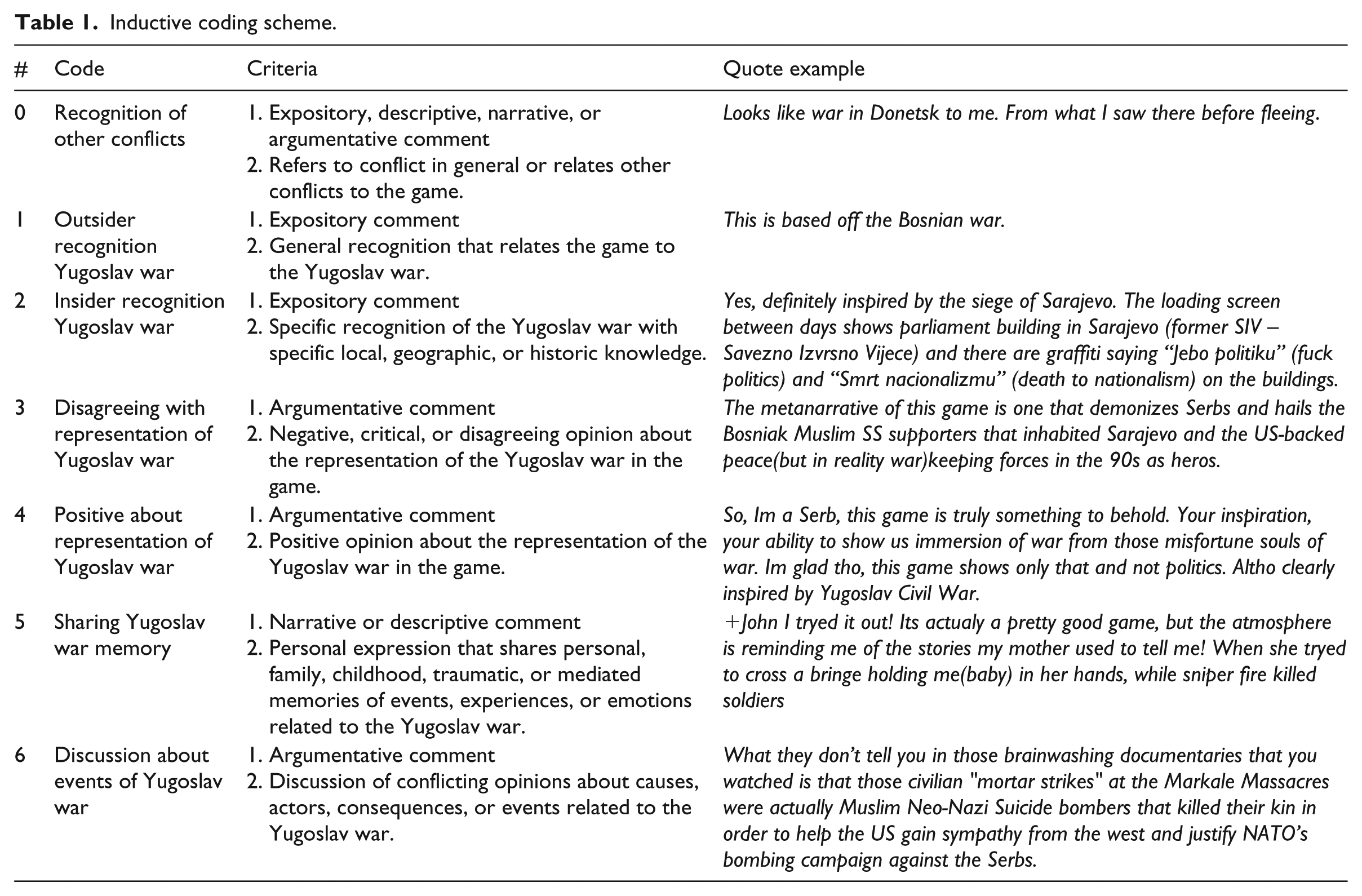
The fourth step was to group comments in thematic clusters. These groups were clustered using emergent coding (Stemler, 2001). Two researchers independently developed a list of inductive categories by reviewing all comments. These categories were compared and consolidated to create one coding scheme with key criteria, as seen in Table 1. Criteria were differentiated according to (1) text type as well as (2) main subject. Researchers coded comments independently with a substantial agreement of 0.61 according to the intercoder reliability of Cohen’s (1968) Kappa, using the rating by Landis and Koch (1977). Disagreements about interpretation were discussed between the researchers and comments were assigned the most appropriate code. Figure 1 shows the distribution of code clusters in percentages and Table 1 describes them in more detail. Cluster 0 was excluded, because it focused on conflicts other than the Yugoslav war, such as the Syrian war or events happening in Eastern Ukraine. Cluster 5 and 6, the largest clusters, were comments of individuals sharing their personal experiences of the Yugoslav war. Cluster 5 concerned individual experiences, whereas cluster 6 comprised discussions emerging around individual or collective memories of events. The last step was a qualitative analysis of the comments of the two largest clusters, focused on a close reading of the content, describing the content, the individuals mentioned, the perspective of the commenter, as well as the sentiment of the comment. This qualitative step allowed the researchers to analyse war memory discourses on YouTube connected with TWoM. Some comments were isolated, but more often a comment was a reaction to a discussion, or even the cause of a discussion. A final qualitative analysis of the two largest clusters is discussed in the proceeding section.
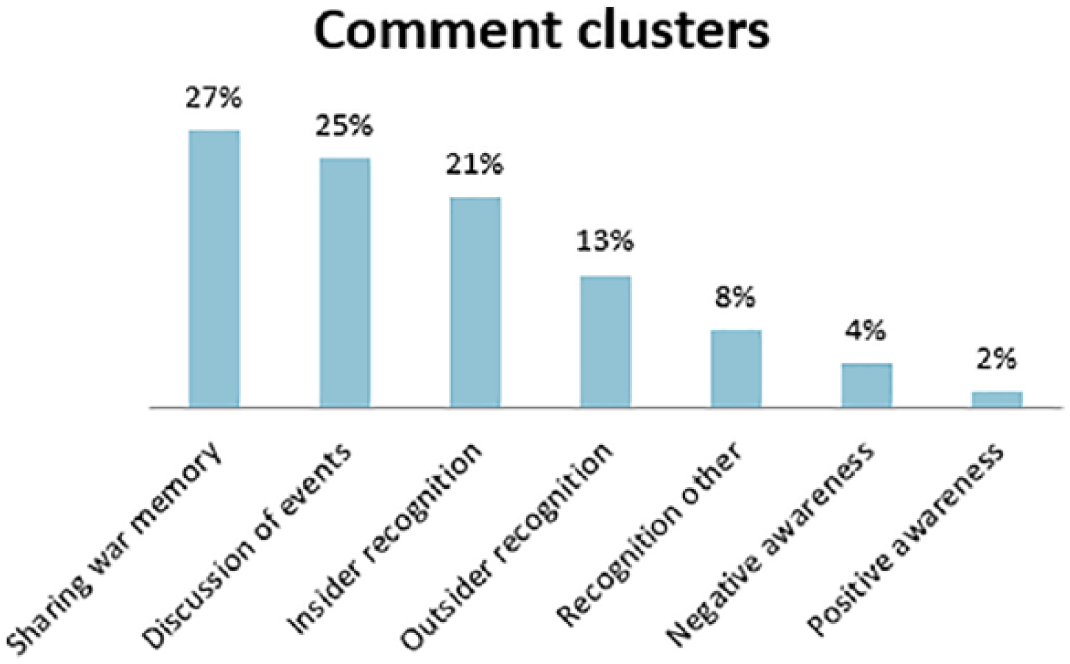
Size of clusters in percentage.
Inductive coding scheme.
Connecting and colliding memories
Game publics connect through shared experiences of traumatic pasts. Whilst these moments of connection evoke informal, even accidental commemoration, other emergent discourses are a clear case of post-Yugoslav memory politics inviting discussion and argument between commenters. However, here one must also recognize the other, more marginal discussions that emerge. Although comments were clustered, the majority of voices in the game publics analysed are plural and diffuse, ranging from discussions on specific ways to survive in the game, debates on current events, to intense arguments on the political power of the West in the Balkans. Also, the voices that came together in this communicative space were not only from the Balkan region. The study found references to other wars, as well as the voices of peacekeeping veterans stationed in the Balkans. What this illustrates is the ephemeral and ever-changing nature of digital publics. Similar to a kaleidoscope, these collectivities are ever-changing and diverse. The following analysis provides a glimpse of their various meanings.
Connecting memories of trauma and displacement
Childhood and family memories are the two major themes within the cluster of commenters sharing Yugoslav war memories. The majority of commenters in these themes relied on their experiences as young children or those of their direct kin. Commenters sharing personal memories drew on their own experiences, describing how it felt to lose a relative or be subjected to daily air raids (see Figure 2). Family memories tended to focus on the experiences of parents or grandparents. Other voices concerned the memories of militants stationed in the war, encounters with Yugoslav refugees and remembering the images and news of that time. Delineating childhood and family memories, commenters share a common hesitance towards playing the game, albeit enjoying the YouTube content nonetheless. The overarching content across these themes are feelings of loss, displacement, and insecurity.
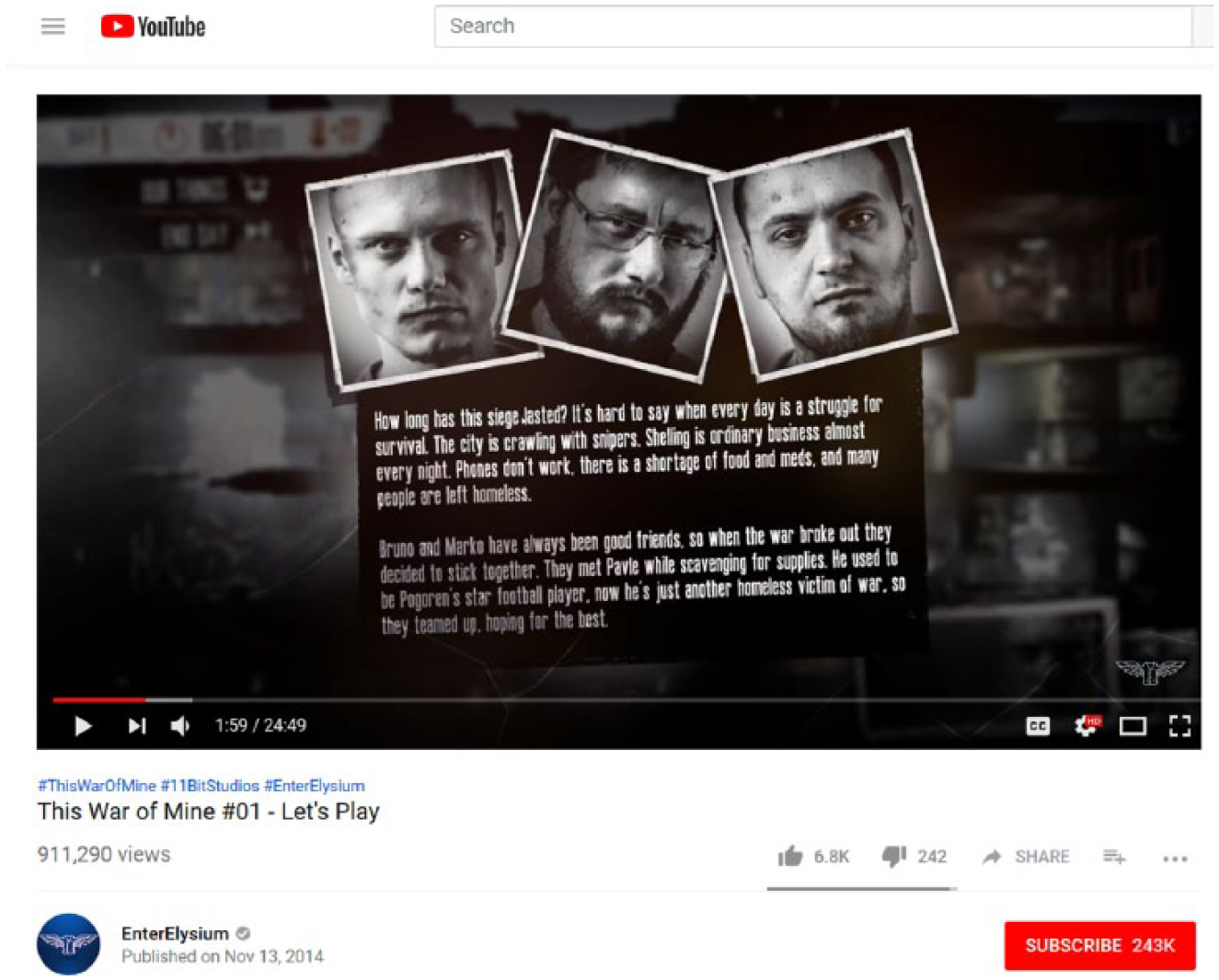
Narrative setting of opening scene in This War of Mine (EnterElysium, 2014).
Childhood memories of trauma and displacement
Focusing on the theme of childhood memories, the commenters are not negative about the game, although some have hesitations because of the memories it triggers. Because playing games can potentially offer embodied experiences of the past – as seen in historical re-enactments – it is not difficult to imagine why some players are hesitant. In another study, this time on Bosnian youth remembering traumatic pasts through playing This War of Mine, empathy acted as a trigger for postmemory (De Smale, 2019b, forthcoming). 2 Yet, as illustrated in the comments below, watching game-related content affects these users deeply. Commenting on a YouTube video or responding to another commenter evokes affective reactions. On the one hand, commenters react to the producer of the video, the Let’s Player, whilst on the other hand, comments can be a more general reaction to the video watched.
I’m from Bosnia and I had [was] 5 [years of age] when the war started. I didn’t live in Sarajevo, but in another town which was razed to ground level by the Serb forces. My family had to flee and leave everything behind … Some of our neighbours who decided to stay before the shelling started didn’t survive even for a month. Some of them were slaughtered in their houses because they believed the soldiers would spare the civilians … I just wish that this never happens to anyone, and this trailer almost made me cry, even if [now] I’m a full grown [adult]. There should be more games like this, that don’t glorify war, but actually present the evil essence of it: Murder, rape, destruction and suffering of all living things (even animals were slaughtered en masse for food, plants and trees were chopped and burned for cold winter nights …). I will definitely try to play this game, but I am really afraid of what memories it may return.
Exemplified in this quote by commenter 1, some feel averse to watching any more of the game, or even playing the game because of their personal experiences in the Yugoslav war because watching recalls painful memories and emotions described in great detail. However, their passion for gaming makes players curious to experience how the game will make them feel. Feelings of loss illustrate that the trauma of war is still part of the everyday lived reality and in the minds of these viewers. Seen in the quote by commenter 2, traumatic experiences and feelings of insecurity are most visible in those childhood memories that focused on the actual experience of being in war:
I have spent my childhood in Bosnia during that war (age 12). This is so emotional for me. Kind of scared to start playing ad [and] evoke some memories that I’d like to forget :) 3
I really love this game. Reminds me a lot of the hard times that me and [my] 2 brothers went through. I was 5 years old when the war come and I am the youngest child in the family. My dad went to the hills and left us with my mom because the military were looking for men during the oppression. My mom didn’t know where to go so we take refuge in a church near to our house, but then the militia took over the church and it wasn’t safe anymore. Then my aunt found us and took us to an abandoned prison which was her workplace, we stayed there for shelter. Two brave women fed us under pain and suffering. I would like to thank my mom for raising us with so much love and grace, even when we were surrounded by violence, gunshots and military oppression. I love you, mom! Thanks for teaching us to always be positive in life and to always carry a smile on our face even when things are difficult.
A recurring theme is displacement – something also seen in the family memories. Commenter 3 describes the actual experience of having to leave everything behind under the immediate threat of violence or even death is a memory that leaves a profound impact on commenters. The commenters sharing their childhood memories mention their age or that they were children during the war. Feelings of loss and boredom of waiting all day when you cannot go outside to play are some of the affective experiences the game tries to represent. What these childhood memories have in common is that these individuals were children or young teenagers during the Yugoslav war. Whilst these individuals were not actively fighting in the war, they faced the consequences. The comments tell us that this generation remembers through the stories and images with which they grew up, and that watching game content or a Let’s Player triggers those memories.
Familial memories and sarcasm
The second and largest theme of the cluster is family memories. The main individuals mentioned in these narratives are direct kin – siblings, mothers and fathers – and to a lesser extent more distant relatives, such as uncles, aunts and grandparents. For this cluster, an intergenerational perspective is relevant, as these are the memories of the post-war generation (Hirsch, 2008). These individuals came of age in the ruins left by the war. For some commenters, this means growing up in a country torn apart by war, whilst for others, this means growing up in a foreign country far away from their homeland. Across these comments are also narratives of displaced families, as seen in the quote by commenter 4:
… I live 22 km from Sarajevo. And my father was in the war. If they lost the line of defence, Sarajevo would fallen in the hands of the Serbs. And my father was always telling me how it was hard during the war especially when you have to feed a child. I remember I wouldn’t have seen him for months. It’s something that shouldn’t be forgotten and thanks to the developers of this game [it will not be forgotten]. It’s an amazing game :)
In the comments, war memories describing the role of the father tend to focus on the paternal role of provider and of combatant. Users sharing memories of their mothers focus on their role as caregivers and guardians. Whereas the paternal role is described as active, either through engagement in combat or finding necessities to survive, the maternal role is described as more reactive and focused on securing safety for the family. The maternal role focuses on keeping children out of harm’s way, either by staying in one place, or by seeking refuge when faced with immediate threats. Commenters describe the emotional state of longing – such as an absent father or a deceased family member. In addition to memories of direct kin, experiences of more distant family members are shared:
reminds me of my grandparents, who fled from istria when yugoslavia came in. Venetians in their homeland, they abandoned everything and when they stepped in italy they were welcomed by spits and insults. Love this country.
Yeah, bitches … another game with something that is related to the Bosnian War … But that fucking war cost my grandmas life …
As illustrated in the quotes by commenter 5 and 6, another relevant aspect is the use of sarcasm when sharing war memories. Sarcasm materializes in text, but also through the use of emoticons, exemplifying another intergenerational aspect of war memory. Sarcasm or irony as forms of black humour are illustrative of everyday resistance (Scott, 1989). Such expressions found their way into descriptions of the current state of affairs in post-Yugoslav states – both politically and economically. This resonates with how Bosnian youth use irony and black humour to describe their current state of affairs (Majstorović and Turjačanin, 2013: 90). In other words, the use of irony is a coping mechanism that is used to deal with the atrocities that are so embedded in the everyday lives of these individuals growing up after the war. It materializes, for instance when commenters share their family memories of feeling like an outcast, unwelcome and unsafe in the land of refuge with the threat of losing loved ones.
YouTube’s accidental communities of commemoration
Exemplified in the discourses emerging around childhood and family memories is how videos of this game are used as a memory object – as a way in which to remember traumatic pasts. In post-Yugoslav states such as BiH or Croatia, national news media are strictly regulated (Baker, 2018). On YouTube, however, individuals across the globe, regardless of their ethnicity or nationality, can watch commemorative videos of politically charged events such as the Srebrenica memorial day. For mourners of the Yugoslav war, YouTube serves as a global ‘accidental community of memory’ (Huttunen, 2016: 257). In this respect, YouTube offers a different form of media freedom for post-war societies in which national media such as radio, television programmes and news have limited freedom. Affective memories and experiences of missing family are shared, and make visible a plurality of victims, illustrating the role of digital popular culture in mourning and the sharing of grief.
The ability of YouTube users to comment on a posted video provides a space for viewers to communicate traumatic experiences of the Yugoslav war. Whilst Yugoslav celebrities and cultural icons are understood as galvanizers of cultural memory, YouTube celebrities also play a key role in the circulation of memory. An important addition is that the governance of copyright is different in the game industry. Stricter governance of music copyrights leads to the removal of YouTube videos, which in turn removes traces of the collectivities and discourses emerging in the digital publics that surround Yugoslav music (Pogačar, 2015). Conversely, self-made Let’s Players and game companies whose games are featured thrive on spreading game content regardless of copyright issues (De Smale, 2019a, forthcoming). The tactics used to invite viewers to comment is vital in this respect. In video descriptions as well as in their videos, Let’s Players invite viewers to interact with them. Commenting is one of the forms that this interaction takes. As ‘loose collections of informal cultural memory’ (De Smale, 2019a. forthcoming) these celebrities engage millions of fans of all ages, although, as a relatively young phenomenon, watching these videos is particularly popular with a younger audience. In a post-Yugoslav context, this is interesting because its emergence coincides with the coming of age of the post-war generation. Each video acts as a digital place in which to commemorate and grieve, with the possibility of meeting others who share similar losses that go beyond ethnicity. This space becomes a place able to communicate war memories beyond the discursive frames of ethno-politics. The loose character of collectivities enables informal commemoration. Instead of having one collective narrative, these forms of remembrance are a constellation of micro-narratives, voices and micro-support networks on trauma and displacement. Yet, whilst these micro-narratives have coherence in that they focus on childhood and family memories, the post-war controversies are much more diverse in nature.
Colliding memories of post-war controversies
Whereas the previous empirical section focused on connecting narratives of war memories, this section focuses on the discussions emerging as a consequence of colliding perspectives. The connecting memories discussed earlier were more coherent in that they focused on childhood and family trauma, such as the loss of loved ones and displacement. Conversely, the colliding memories discussed more in-depth below tend to focus on war events that are perceived differently by individuals across post-Yugoslav states. More importantly, the discussion had a broader range, which made it difficult to distil core themes. Instead, it is much more productive to talk about the micro-narratives that emerged. In these micro-narratives, commenters expressed conflicting opinions on the causes, consequences, or actors involved in, and affected by, the Yugoslav war. Alternative facts, which differ across post-Yugoslav nations and ethnicities, materialize in the discussion of war crimes – for instance, in the recognition of Serbian victims in the Belgrade bombing vis-à-vis the perspective of Serb and Serbian individuals as perpetrators. As another example, when discussing responsibility for the Markale massacres in Sarajevo, blaming the army of Republika Srpska is considered a valid opinion for one commenter, but is considered as propaganda by other Serb commenters. The types of conversations ranged from a single reply, to an incoherent discussion with multiple conversations simultaneously, or a heated argument that suddenly reignited six months later. Below I will address how the way in which YouTube structures comments is key to understanding how micro-narratives emerge instead of several large discussions. By closely analysing one discussion and the dynamics emerging, I argue that these micro-narratives, although seemingly random at first, are productive discourses in the study of Yugoslav war memory as reflections of current ethno-nationalist politics and tensions felt by individuals in post-Yugoslav states.
Below I present an in-depth analysis of the most debated comment of this dataset, called ‘Yugoslavia feels :-(’. This particular comment thread received 82 replies from 16 discussants. The comment is a play on the video title, as seen in Figure 3. This channel is branded as ‘Slavic’, with Slavic related Anglophone commentary on games. The channel attracts a large audience with over 1.7 million subscribers, attracting a global as well as regional audience.
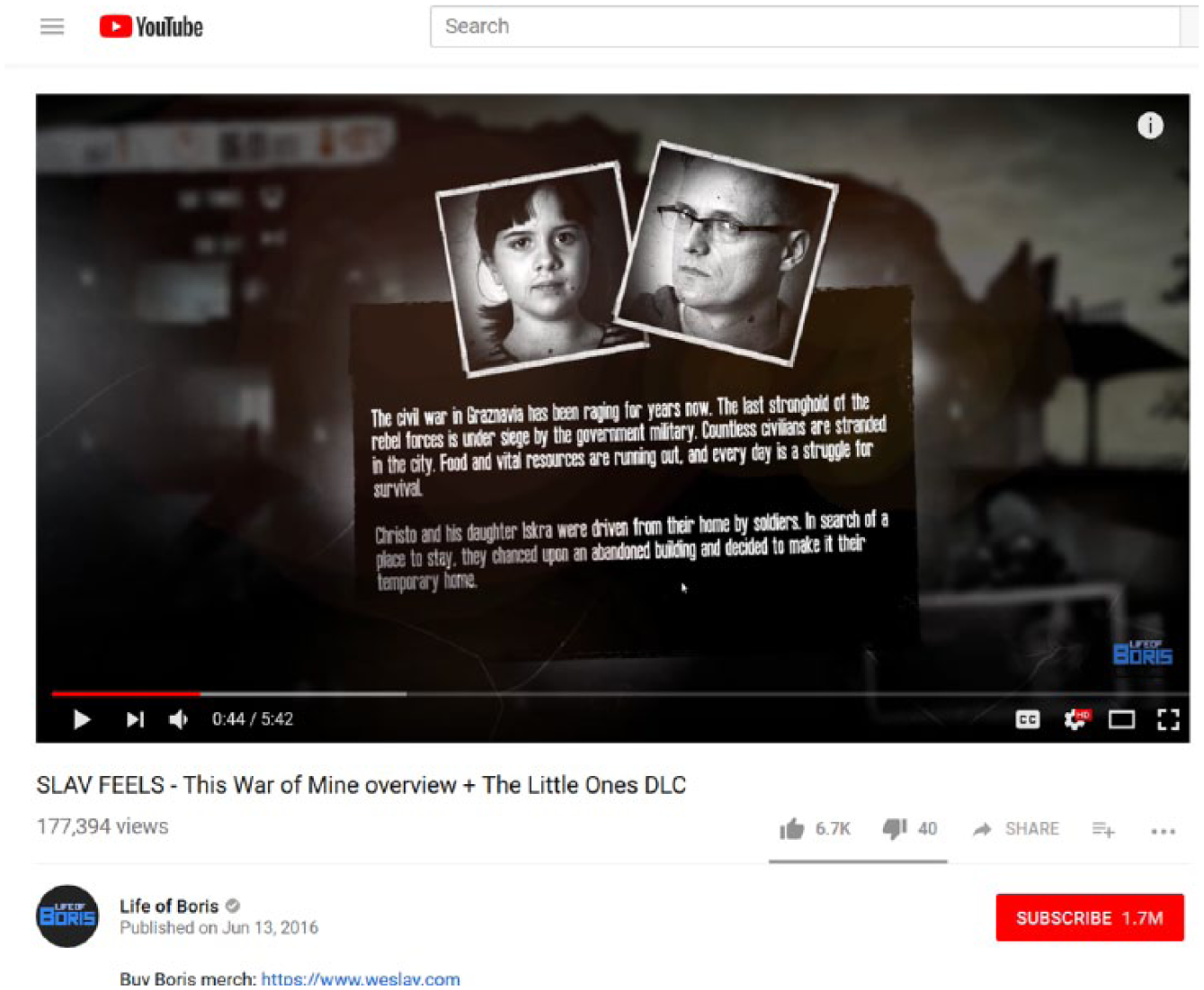
Personalised LP introduction before discussing gameplay (Life of Boris, 2016).
Language as ethnic identifier
As seen in Figure 4, the first reaction on the original comment is an expression of sympathy and solidarity. Deconstructing how ‘Sarajevo’ is written in different Balkan states, commenters try to ethnically categorize each other. For the Balkan region, language is a complex political matter. The official language of Yugoslavia was Serbo-Croatian. After the dissolution of Yugoslavia, different states adopted different versions of the language. For example, Bosnian, Serbian and Croatian are the official languages spoken in the respective states, which are written variations of Serbo-Croatian but have variations in dialect as well as Cyrillic, Latin and Arabic variations in writing (Bugarski, 2001). Reactions by commenters 7, 8, 9 and 10 on the various spellings of the word ‘Sarajevo’ illustrate the importance of language as a marker of identity:
@Jan Ahhh but you are tricked, true south Slavs like myself never say Сарајево, we say Сараево 4
+Bob Bulgaria*
Might be, Macedonia uses Saraevo too :)
bosnian ‘ere, I say Sarajevo with a short e, but people usually say Sarajevo with a long e wherever you are in Bosnia.
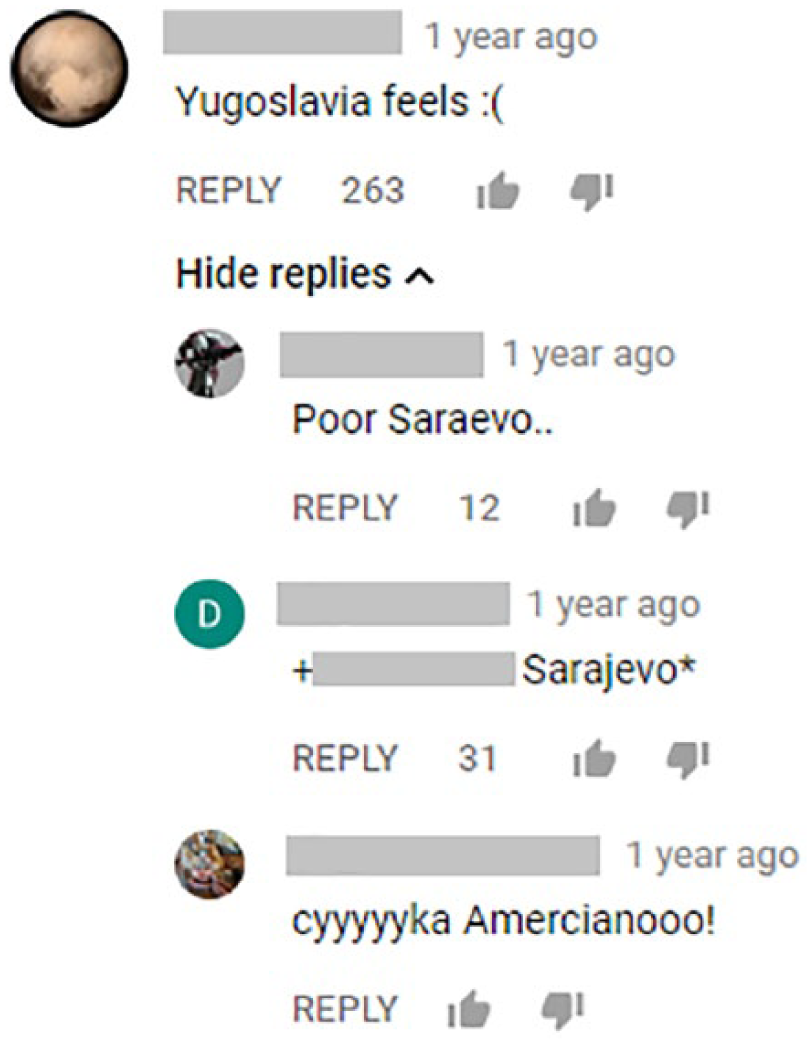
Screenshot of discussion threads within comments.
The discussion above is illustrative of the everyday practices of ethnic identification after violent conflict, so familiar to the Balkan states. In ethnically diverse urban areas such as the Bosnian city of Mostar, Monica Palmberger (2016: 30) describes how identification through language is used in everyday life to discern ethnicity. Subtle variations in language mark differences between ethnic groups (Jenkins, 2008[1997]). In the discussion above, linguistic differences in type and spelling evoke a debate about the commenter’s ethno-national origins. Whilst the commenters do not reach a conclusion on the commenter’s origins in relation to the word, this is not the issue at hand. What is important here, is how this discussion reifies ethnic belonging by determining the Other in relation to the Self. Once ethnicities are established, the discussion takes a more ethno-nationalist turn:
+Dirk yes u are right im from kosovo
+Commenter11 You mean Serbia
+Commenter11 Kosovo IS Serbian, say what YOU want but YOU are living on Serbian ground. Albania IS an artificial country, the land that shiptars occupied and call Albania belongs to Serbia and Greece. [emphasis added]
+Commenter12 You guys starting another war? Balkans will never have real peace :(
+Commenter13 We can’t have peace with Turkish leftovers here. Every place has their own dumpster, sadly we got albania…
Calling out commenters for their ethnicity leads to the use of dehumanizing rhetoric such as shiptar – a pejorative name for Albanians – by commenter 12. The discussions are not only polarized along ethnic lines, but in fact oscillate back-and-forth between reification of, and resistance to, ethno-nationalism. When commenter 11 identifies as Albanian Kosovar, the discussion evolves into a dispute on the territorial status of Kosovo. Specific events are deeply embedded within the collective memories of each nation. As Paul Mojzes (2016: 197) argues, ‘almost anything the Serbs say about the history of Kosovo is contested by Albanians and vice versa.’ Whilst political leaders are considered national heroes in some states, they are the symbol of death and destruction in others. For example, Kosovo played a key role in the rise of Slobodan Milošević as the undisputed leader of the Serbian people, giving rise to the mass movement of Serbian nationalism (maspok) throughout Yugoslavia in the late 1980s (pp. 203–204).
Natural moderation of hate speech
Both examples described above illustrate how these narratives continue to cause disputes in everyday life. Whilst one is concerned with language, the other is a collision of collective memory. Both, however, are expressions of everyday primordialism, connected through a shared interest in popular culture. However, within these controversies, a natural mediation occurs in the form of other commenters:
+Commenter12 Hmmm … But we can’t really change things like these [the current status of Kosovo]. This is how these types of ethnic wars start. With ignorance and hate and it only weakens the region
+Commenter12 See? You are again starting the same argument. Don’t generalize like that, not every Albanian is a terrorists and not every Albanian lives in Kosovo. Arguing like this makes you looks like some aggressive nationalist which isn’t good either. If you want to argue, argue in a way that actually arrives to a conclusion and doesn’t just attack the person you are arguing with. Fine I get that you are angry … but what else are we supposed to get out of this? I give up hope for peace. You have perfectly demonstrated what I meant when I said that there is enough of this useless fighting. The modern generation should fix what the older generation messed up – this goes for both the Albanians and the Serbians (and every other ethnic group in the Balkans) and we all should change if anything should ever change.
The quotes of commenter 13 – the original comment poster – are illustrative of the moderating role that commenters assume. Commenter 13 moderates the heated dispute between the Albanian and the Serbian commenter. In a refusal to agree with ethnic differentiation, commenter 13 emphasizes shared history and groupness beyond ethnicity. Referencing this shared identity is one way to dissipate groupness along lines of ethnic categorization. Although Yugo-nostalgia – conceptualized as a nostalgic yearning for the past through an imaginary of unity beyond ethnicity (Volčič, 2007: 34) – is ambivalent, in discussions it served as a script of a shared past that goes beyond blood ties. Although the discussion above is illustrative of the heated discussions that arise in the margins of a war game, these discussions should not be universally dismissed as inappropriate hate speech or rants (Lange, 2014). In the margins of each video is a plethora of micro-narratives that go beyond trolling and hate speech. It illustrates the desire of these individuals, who have spent the last decades in the wreckage of war, to move on and to start living together again.
Micro-narratives through YouTube logic
The diversity of commenters and the diverse mix of discussions in YouTube comments make it hard to find a coherent narrative of collective memory. One of the reasons for this kaleidoscope of different discussions emerging in one thread is the YouTube interface, which forces users to comment within a comment, making it possible to reply within a reply, and reply within that reply (see Figure 5). YouTube has attempted to fortify their commenting system in order to make it more resistant to abuse (Reagle, 2015: 7–9). That only channel owners can comment provides safeguards against abusive discussions – flagging comments is another. The structuring principle to visualize the comment with the highest number of reactions at the top of the list is an incentive that places highly controversial and disputed topics higher than other, more moderate comments (Figure 5). What is shown in YouTube’s default setting is only the first layer of comments. Replies are only visible numerically and need to be unfolded in order to be read. Furthermore, a viewer cannot search within the comment section, making YouTube – as a communicative space – different to, for example, a forum. As a consequence, instead of one collective discourse, different micro-narratives emerge, in which individuals react to textual or audio-visual content.
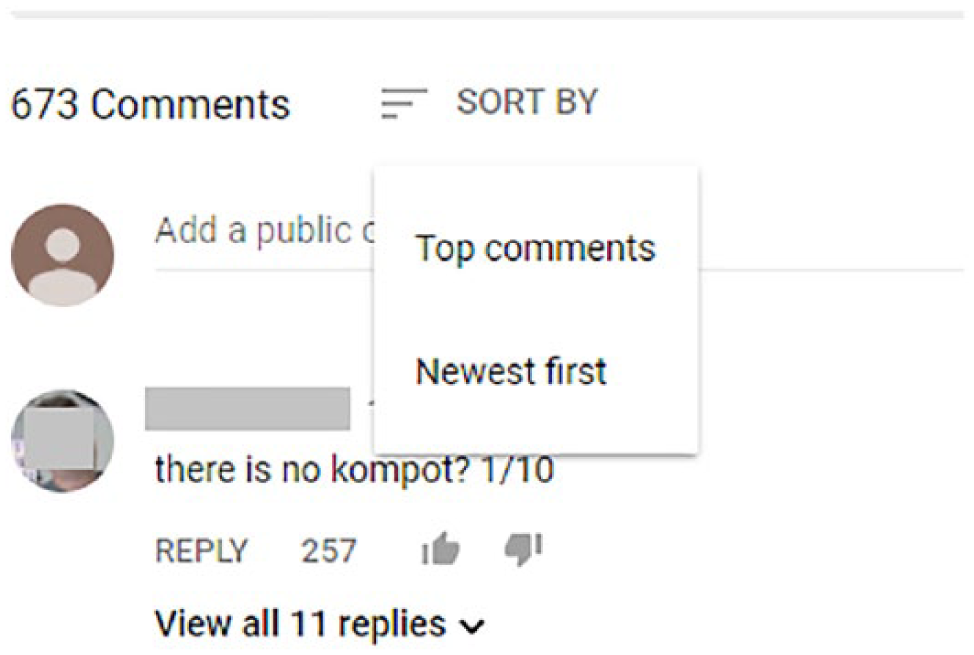
Screenshot of discussion comment sorting.
The public nature of comments makes them open to contributions by everyone. However, the visibility of the comment is subject to YouTube’s algorithmic logic as a connective force. Comment date, number of likes/dislikes and number of comments are all factored into the potential visibility of the discussion. Video owners also benefit from extensive discussions as they have a stake in engaging viewers and growing their fanbase. For a video poster, the number of comments, likes and dislikes are engagement metrics that give insights into what viewers like and dislike, and can thus be used to grow their audiences (YouTube Creators Academy, 2018). In short, both criteria – how comments are structured and how they are visualized – inform the dynamics of the discussions emerging on the lower half of every YouTube page.
Serendipity in connecting and colliding war memories
When we combine the empirical findings of both clusters – sharing Yugoslav war memory and discussion of war events – the idea of accidental communities and the discussions that emerge can be interrogated further through the concept of serendipity. Serendipity, not to be confused with coincidence, requires one to go with the flow of what is encountered. It ‘is the wisdom of recognizing and then moving with the energetic flow of the unexpected’ (Lederach, 2005: 115). For peace researcher John Paul Lederach (2005), serendipity is an important aspect of peace building which requires a creative mind and is inherently tied to aesthetics and artistic practice. It is within collective serendipitous encounters that creative minds are triggered. Emerging in these game publics are serendipitous encounters facilitated by YouTube and the video producer.
Since the commenters in this analysis come together because of a creative and informal practice, it provides them with the opportunity to interact outside of the ethno-political framework that exists in the memory of the Yugoslav war. The reason behind their gathering is primarily because of a shared interest in games and not because of their differences. Although social categorization and the labelling of others as ethnically different emerges in the collision of conflicting collective memories of events, the moderation by commenters makes it a space for meaningful interaction that exceeds the frames of ethno-religious groupness.
In sum, Yugoslav memory discourses found in the colliding narratives of game publics visualize a tension between the reification of, and resistance to, ethno-nationalist identification. Everyday reification processes crystallize groupness along lines of ethnicity and follow ethno-political scripts that use collective memory to harden those boundaries. Conversely, by connecting war memories post-Yugoslav individuals find shared experiences in their childhoods and familial memories. These are the memories of being in a war, of hiding in cellars, and the pain of missing a family member. Stories of displacement and survival resonate with the content of the game videos. In the age of deep mediatization, media-based collectivities aid in creating imagined communities and feelings of belonging between subjects across territorial and ethnic boundaries. In this case study, videos of a war game offer a communicative space for connective war memories. How those spaces materialize, however, is dependent on serendipitous encounters between individuals.
Conclusion: A culture of post-war connectivity
The findings of this study suggest that meaningful memory discourses emerge around war-themed popular culture. This view complies with other researchers who argue that YouTube potentially enriches remembrance by offering an experience unavailable via traditional forms of commemoration (Gibson and Jones, 2012; Makhortykh, 2017). In addition, acts of remembrance in a media-based collectivity differ in their accidental and informal nature, supporting commemoration from a multitude of viewpoints. In the case of this Yugoslav-war inspired game, a public collective forms first and foremost because of a shared interest in games. On the one hand, Yugoslav war memory discourses emerging in game publics illustrate how ethnic belonging is reified through subtle language variations that trigger ethnic labelling by post-Yugoslav individuals. On the other hand, small acts of resisting ethno-nationalist identification are noticeable in the involvement of, and moderation by, other commenters in heated discussions on the Yugoslav war. Although a YouTube video offers a starting point for conversation and expression, comments have their own social dynamic. The reactive and asynchronous character of comments creates micro-narratives that emerge as reactions to other comments. The publicness of YouTube comments allows other users, who might be ‘just passing by’, to get involved in the discussions, thus creating serendipitous encounters and dialogues.
Since YouTube comments are not indexed and searchable for users, scraping its content is an act of preserving vernacular connective memory discourses in a particular time and place. For practitioners and researchers studying the potential of social media and post-war reconciliation, popular culture is one entry into studying potential spaces for positive interaction. It requires an effort to move away from the top-down approach of studying social movements, or local communities. This case study illustrates that a passion-based approach to studying groupness does not necessarily start with an ethno-political framework. Rather, studying memory practices bottom-up allows us to see how (post)memories of war and conflict are lived in the everyday. Further research could study the roles played by entertainment, popular culture and digital communication in the lived experiences of post-war individuals – particularly youth. In the platform society (Van Dijck et al., 2018), monitoring the political discussions and opinions of citizens online is acknowledged to be an important tool in the governance of nation states. However, discussions emerging around popular culture are different enactments of these same publics, not simply organized around politics or ideology. Monitoring discussions in media-based collectivities provides insights into the vernacular discourses of citizens and their meanings in post-war regions.
Footnotes
Acknowledgements
The author would like to thank Callum Lewis for his work as a research assistant in helping collect and filter the data.
Funding
The author(s) disclosed receipt of the following financial support for the research, authorship, and/or publication of this article: The author received financial support from the Netherlands Organisation for Scientific Research (NWO) for the research conducted in this article (project number 022.005.017).