



Abstract
This interactional-analytic study investigates the evolving use of self-disclosures by pre-service teachers, acting in their role as novice foreign language learning (FLL) counsellors across a seven-session cycle. Building on previous research on their interactive potential, the analysis of three case studies reveals that novices initially employ self-disclosures to bridge interactional gaps. Over time, their use becomes functionally diversified and increasingly aligned with specific FLL counselling goals, including preparing and legitimizing advisory actions, fostering reflection and transformative learning, and supporting solution-oriented strategies. Finally, self-disclosures assume an argumentative function, addressing internal resistance, harmonising conflicting perspectives and bridging between divergent positions. These developments illustrate the co-adaptive interplay between the novices’ growing professional interactional competence, accumulated interactional history, and adaptations that follow the transformative learning dynamics. The findings underscore that self-disclosures function not only as multifunctional resources but also as instruments of professional development, enabling novices to engage in reflective, goal-oriented, and transformative counselling practices.
Keywords
Introduction
In professional interaction, self-disclosures (SDs) function as communicative resources that foster interactional alignment and interpersonal bonding, while signalling deeper understanding, displaying empathy, and facilitating emotional regulation (Antaki et al., 2005). Within counselling, SDs serve multiple, specialized functions, such as introducing alternative perspectives, fostering second-order reflexivity (Yasui, 2023), challenging dysfunctional patterns (Svinhufvud et al., 2017), and scaffolding the advisory process by supporting central counselling activities. Beyond these functions, SDs contribute to advisory processes through referent upgrading, focus shifts (Leudar et al., 2006), and the embedding of subtle corrections (Antaki et al., 2005). While SDs have been widely recognized as a flexible communicative resources, far less is known about how their use dynamically adapts and evolves across interactional contexts and over time, and how professionals tailor it adaptively to serve specific counselling purposes. Existing research rarely addresses how their functions and design change, and adapt to meet the co-constructive dynamics, both within unfolding interactions and across longitudinal sequences of multiple encounters.
In foreign language learning (FLL) counselling, SDs create a multidimensional interface that allows the counsellor to adopt the learner’s perspective, demonstrate empathy (Lazovic, 2025a), and promote self-regulation, while facilitating (self-)transformative learning and fostering joint reasoning to develop learner-centred solutions and innovative learning approaches (Kato and Mynard, 2016; Mynard and Carson, 2012). SDs serve as multifunctional resources to harmonize various cognitive, affective, meta-reflexive dimensions and conflicting elements within the learner’s learning ecosystem, while activating self-regulatory processes and anchoring supportive practices. As learners progress and the interactional dynamics evolve, the functions of SDs transform to support ongoing learning processes and enable co-constructive, learner-centred engagement. The variation and functional transformation of SDs is crucial for guiding learning processes adaptively and responding to learning dynamics. Although conversation-analytic studies have examined professional interactional competence from a longitudinal perspective across various advisory practices (Nguyen, 2012; Nguyen and Malabarba, 2025), there remains a significant gap in understanding how SDs are cultivated as interactional resources in FLL contexts and adapted in response to changing counselling needs over time.
A further research gap remains regarding how novices develop professional interactional competences needed to mobilize and functionally adapt diverse practices – such as SDs – which may initially appear unexpected in institutional contexts yet are tacitly functionalized, and require functional adjustment to meet specific counselling objectives. This includes the examination of how novices’ use of SDs evolves as they navigate role transitions and develop adaptive competences to functionally align narrative forms with different counselling goals, thereby balancing interactive closeness and professional distance as well as their epistemic and deontic positioning. The initial practical phases appear particularly important formative experience, as they reveal hidden aspects of interactional skills that are essential to the development of adaptive professional competences (Pekarek Doehler and Petitjean, 2017). Despite some existing studies (Lazovic, 2025a, 2025b, 2025c, 2025d, 2025e, 2025f), longitudinal perspectives on novices’ counselling practices remain scarce, particularly regarding how the use and design of SDs evolve over time and across counselling interactions.
To address some of these research gaps, the study examines SDs as multifunctional interface and their specific interactional dynamics in FLL counselling, based on three case-studies. The study examines how novices use SDs and expand their functional potential, including how they initiate, design, and align SDs with counselling goals. It offers interactional-analytic insights into their discursive history and functional adaptation over time (Lazovic, 2025c). It thereby sheds light on processes of professionalization through service learning context over one semester. The study focuses on the self-disclosing activities of pre-service teachers of German as a Foreign Language (GFL), who act for the first time as FLL counsellors for international students in a service-learning context. Although not formally professional counsellors, they position and act as professionals, and are perceived as such by learners. In doing so, they develop their counselling role – building on prior brief training units, through co-constructing their counselling position and expanding their professional role understanding in action-reflection-cycles, and different learning facilitation processes. This engagement fosters a more nuanced role perception as process facilitator, thereby enhancing adaptability and promoting a learner-centred approaches. The analysis of the use of SDs reveals quantitative changes and functional transformations in their use over the course of six counselling sessions, demonstrating the development of professional interactional competence through their functional diversification and fine-tuning for specific purposes. The following sections first provide general theoretical insights into research on the use of SDs, with focus on their relevance for FLL counselling (Section “Self-disclosures as interactional resources in counselling”) and then examine dimensions of adaptive changes in interactive practices over time (Section “Exploring the interplay of co-adaptation and developmental changes”). The study design and methodology are presented in Section “The present study: Data and procedure”, followed by an analysis of SDs across three time frames: the initial sessions (Section “Self-disclosure in initial sessions: Bridging interactional gaps”), the mid-phase (Section “Self-disclosures at the midway: Facilitating transformation and offering advice”), and the final sessions (Section “Final functional profile: Addressing and resolving internal resistance”), with an overall discussion in Section “Discussion and conclusion”.
Self-disclosures as interactional resources in counselling
Self-disclosures (SDs), understood as the voluntary sharing of personal information, feelings, thoughts, and experiences, that extend beyond situational expectations, are recognized as functional to achieving institutional goals (Antaki et al., 2005; Logren et al., 2019). By mirroring and aligning experiences, SDs demonstrate deeper understanding and emotional alignment, functioning as a bonding strategy that fosters productive alliances, supports reciprocity and generates social dynamics. Their functional potential, as documented so far (Antaki et al., 2005; Audet and Everall, 2010; Gibson, 2012; Knight, 2012; Krieger Cohen and Johnson, 2022; Logren et al., 2019), is to illustrate, transmit complex meanings, facilitate collaborative processes, reinforce new perspectives and behaviours, promoting problem-solving activities. Serving as a facilitator of transformative processes and a catalyst for change, SDs allow the counsellor to engage in stance-taking, model reasoning processes, and propose candidate solutions (Leudar et al., 2006), without disrupting the epistemic balance. SDs demonstrate epistemic access to experience and substantiate claims (Logren et al., 2019), thereby reinforcing the counsellor’s epistemic and deontic positioning. This is particularly important when challenging the client’s reasoning to resolve ruptures, developing an analytical stance or “encouraging second-order reflexivity to deepen reflection” (Yasui, 2023), while mitigating the intervention, shifting toward a collaborative orientation and engaging in co-constructed practices. By opening cooperative transformation zones (Goodwin, 2015: 216), SDs provide a subtle means of delivering correction (Antaki et al., 2005), serving as a sophisticated form of (re)alignment. SDs challenge clients’ dysfunctional patterns to resolve internal conflicts (Svinhufvud et al., 2017: 211), while simultaneously normalizing negative experiences and enhancing their awareness of distorted perceptions, thereby shifting perspectives, supporting self-distancing and reappraisal. SDs’ transformative power (Kokkos, 2020) lies in creating a space for building bridges between different experiences, enabling the co-construction of new knowledge and solutions to support future actions, self-efficacy and self-positioning (de Weck et al., 2017). SDs constitute thus multifunctional hybrid practices – integrating diverse actions with different functions, systematically organized within a coherent narrative script – serving as an anchor for other constitutive counselling actions and creating an operational interface for advisory interventions.
Leudar et al. (2006) document several linguistic resources of SDs, including: the use of extreme case formulations to emphasize the significance and newsworthiness of the issue; recipient-oriented design that focuses on the similarity of the disclosed experience; habitual present tense to maintain the temporality of the client’s current problem or difficulty; explicit matching with the previous turn while simultaneously upgrading referents, substituting words, or shifting the point or focus; polyphonic practices combining multiple voices through direct or reported speech, enabling co-argumentation. The reuse of previous resources and re-enactments serve as a tying device, to display divergent stances and by reshaping these structures into new, different forms they create a bridge and anchor transformative advisory interventions (Yasui, 2023). Addressee specifically oriented design (Johnsen and Ding, 2021) is needed to ensure its optimal functionality, so SD doesn’t shift the focus, influence the perception of the counsellor’s credibility (Erickson et al., 2024), or challenge the interactive framework. SDs vary according to the subject of disclosure, the focus on interpersonal or intrapersonal aspects, the specific relatedness to the self of the addressee, and the potential to shift the focus (Audet, 2011).
Understanding the specific functions of SDs in FLL counselling requires consideration of the broad spectrum of diverse tasks involved, aimed at providing individualized support to enhance learners’ language skills, learning strategies and self-regulation. This is an empowering context in which the learning process is not directly guided, externally controlled, formally evaluated or dominated by teacher input and explanations or collaborative tasks with peers, as in classroom teaching context, but offers process-oriented, resource- and solution-focused support that fosters learners’ own capacity to help themselves while promoting actional, reflective, self-regulative learning competencies. This includes cultivating believes and attitudes toward learning process and the self, enabling supportive environment through learner-cantered approaches, flexible process design, and bridging strategies within this transitional process to connect different learning contexts. Instead of engaging in this practice in a therapeutic sense, the focus is on the learning process facilitation, its multidimensional regulation and fostering self-monitoring. This involves a variety of adaptive counselling activities, including providing constructive feedback and encouragement, regulating emotions and attitudes, supporting learning identity and self(-efficacy), developing domain-specific learning strategies, recommending resources, and supporting learners in overcoming internal resistance to learning. Most importantly, it entails engaging learners in self-reflection and internal dialogue to build self-regulatory and problem-solving abilities (Kato and Mynard, 2016), as well as offering joint reasoning contexts to collaboratively develop new approaches, implementing new strategies and adapt them in action-reflection cycles. These actions rarely follow a linear progression, instead unfolding dynamically to produce emergent, adaptive responses shaped through the co-construction of interactional trajectories and specific learning dynamics. Although the counselling process generally follows a structured progression (Pick, 2017) – from problem identification and assessment of learning needs, the co-constructive redefinition of problem, establishment of counselling focus, over mental restructuring and the development of new approaches and solutions, to the formulation, implementation, and evaluation of concrete steps – this interactional trajectory unfolds dynamically and inconsistently, often due to latent issues or internal conflicts that must be adaptively addressed during the process.
Within this process, SDs reveal important multifunctional potentials, functioning as an operational interface, connecting multiple levels of counselling and enabling flexible process transformation, as demonstrated in the following study: integrating distinct counselling objectives, transforming the advisory level and re-directing the focus toward counselling-specific priorities, while stabilizing interaction, supporting secondary goals, and paving the way for joint reasoning and problem-solving activities, thereby fostering deeper transformations within the learning system. SDs reduce learning anxiety and foster positive interactions (Tutton and Cohen, 2024), thereby promoting self-distancing and self-regulative stance. An additional significance of SDs lies in their harmonizing symmetrical epistemic positions, enabling counsellors to act in a peer-role manner, organize complex counselling steps in a recipient-oriented and simplified way, and facilitate and accelerate the transition from problem identification and transformative work to solution development. SDs further serve as bridging structures that help transform the interactional framework into a co-constructive space, reposition the learner interactionally and regulate the process orientation, thereby transforming the level for intervention. This is particularly important because counselling interactions often involve conflicting role expectations, differing understandings of the process, and inherent complexity as well as additional steps of mental and transformative preparation that must precede engagement with solution-oriented work. For FLL teachers who extend a narrow professional understanding and enact counselling roles, as in the present study, this means regulating learners’ and own expectations (Lazovic, 2025f) while adapting their level of directiveness, explicitness, evaluative stance, input and explicative orientation, and high epistemic positioning. Such adaptations include techniques that transform the interaction toward more co-constructive, solution-oriented interactions, promote epistemic balance, and create flexible spaces for learner development, thereby connecting different learning dimensions in alignment with learners’ resources and responsiveness. The competence of “navigating between different activities and frames, and managing the transitions in crossing interactional boundaries” (Marra et al., 2017: 245), interactional roles and functional orientations proves to be essential, underscoring the importance of analysing SDs as multifunctional bridging practices, that serve as a connecting, transformative and operational interface, linking other supportive activities with counselling-specific interventions and goals, transforming the interactional modality and providing a productive working space for joint reasoning. The adaptive use of self-disclosures – their alignment with advisory goals, functional transformation to support learning dynamics, and design modifications over time – constitutes the central focus of this study.
Exploring the interplay of co-adaptation and developmental changes
To support FL learners’ ongoing development and transform their interactive behaviours and learning processes toward more self-regulation, successful FLL counselling interactions require context-sensitive adaptation and variation of multimodal interactive practices to meet recurring or locally emergent interactional needs, thereby taking into account learners’ co-adaptive behaviours. While the adaptive dynamics of experienced counsellors consolidate into relatively stable adaptive patterns, novices are still learning to balance the maintenance of stable, consistent, and supportive interactional ground, routinizing reliably effective practices, with the functional variation and adaptive transformation of their practices to foster learners’ developmental processes. In situ interactional forces, such as interactional troubles, emergent aspects of interactional infrastructure and reflection-in-action influence these dynamics of change and stimulate the search for more effective solutions (Nguyen and Malabarba, 2025). This professional socialization process is closely related to the development of flexible epistemic positioning, multifunctional and jointly constructed practices, as well as transitive and in-action reflexivity (Pekarek Doehler and Pochon-Berger, 2019). The ability to adapt to situational contingencies (Pekarek Doehler and Petitjean, 2017: 13) is gradually acquired by novices, as professional identity itself constitutes a dynamically co-constructed interactional process (Rine and Hall, 2011). Adaptive processes are therefore situated interactive learning processes (Pekarek Doehler, 2018), that involve the continuous, context-sensitive recalibration of practices and multimodal resources, and the development of mutually comprehensible solutions (Pekarek Doehler, 2021), thereby adapting to the dynamics of co-construction and co-adaptation. In this process, novices explore and expand the multifunctional potential of specific actions, supporting alignment, working alliance and epistemic harmony, while attending to co-constructed practices, shared meanings, and the dynamics of co-adaptivity. To capture the dynamics of change in novices’ use of SDs – ranging from (individual, contextual, explorative) variation and functional adaptation, through the coexistence of different practices and their functional expansion, to the emergence of new co-constructed forms within the interplay of moments of sedimentation and reconfiguration (Wagner et al., 2018) – both adaption to interactional histories and developmental dimensions must be considered, including the dimension of co-adaptivity, which follows the learner’s evolving learning dynamics and changes in interactive behaviour. The interplay among these dimensions embodies higher-order mechanisms supporting complex, multidimensional adaptive and variational processes in situ.
Adaptive changes emerging from interactional histories (Deppermann, 2018; Voutilainen et al., 2018) constitute a first relevant dimension in analysing the changes in use of SDs within the multi-session counselling cycles examined in this study. Studies on interactional histories provide broad empirical evidence that shared interactive experiences, negotiations, co-constructions, and mutual accommodation lead to the routinisation of certain practices and the habitualization of multimodal gestalts. The resulting repertoire of shared (sense-making) practices and meanings (Deppermann and Schmidt, 2021) enables simplifications, reductions and increasing implicitness. Similarly, normative expectations and preferences emerge, shaping the interpretative consequences of subsequent variations. With increased sensitivity to the interactive history, co-participants exhibit adjustments depending on whether these concern the interactive common ground in general or specific learning processes (Deppermann, 2018). Accordingly, educators adjust their co-adaptive behaviour over time in different ways depending on the underlying purpose (Konzett-Firth, 2020), thereby stimulating learning-functional transitions. Such adaptations are continually informed by comparisons with previous interactions and by assessments of learners’ progress, needs and co-adaptive behaviours, for example through the promotion of more self-initiated and self-corrective actions (Martin and Sahlström, 2010). This dynamic is particularly relevant in advisory interactions aimed at fostering self-regulative reasoning in learning and scaffolding toward more learning autonomy.
Given that the FLL counselling context examined here requires that adaptation processes take into account L2 learners’ developmental trajectories and co-adaptive behaviour, the second relevant dimension draws on insights from the extensive research field on the development of interactional competence in L1 and L2 (Berger and Pekarek Doehler, 2015, 2018; Pekarek Doehler and Balaman, 2021; Pekarek Doehler and Pochon-Berger, 2011, 2019; Skogmyr Marian, 2021, 2023; Wala et al., 2024). This developmental perspective reveals general tendencies in change over time, reflecting overarching adaptive mechanisms at meta-level in novel situations, as adaptive-developmental patterns observed in FLL contexts – where learners “adaptively re-develop” established L1 interactional practices and competences in L2 – are expected to manifest similarly in professional domain, where familiar practices must be readapted and newly developed to fit situational demands, with direct implications for understanding the evolving dynamics of SDs in novices’ use. These studies document the tendency toward specialization of certain resources and practices for specific purposes, alongside a growing repertoire and diversification of resources aimed at performing actions in a more context- and addressee-appropriate manner, reflecting the dual dynamics of stabilization, specialization and functional differentiation over time. These studies show how practices become increasingly designed as joint actions (Pekarek Doehler, 2018), featuring greater recipient orientation, adaptability to local contingencies, diversified procedures for establishing intersubjectivity, including coherent linking to previous turns, and practices for securing acceptance and mutual understanding while organizing contributions and elaborating in recipient-oriented ways. In line with increased orientation toward co-construction, leading to changes in sequential organisation, there is a reduction of actions with negative valence in favour of those that strengthen solidarity and acceptance (Skogmyr Marian, 2021), thereby enabling the cooperative negotiation and alignment of (evaluative) stances (Pekarek Doehler and Pochon-Berger, 2011). Studies on L2 storytelling contexts (Berger and Pekarek Doehler, 2015, 2018), point to a diversification of interactional functions of stories – from informational to argumentative – as well as to heightened displays of speakers’ stances toward reported events, alongside efforts to secure recipients’ affiliative responses. Similarly, in L1 children’s argumentative use of stories (Wala et al., 2024), diverse argumentative functions emerge, including the shifts from their use as supporting evidence and others’ positions toward joint problem-solving. Initial difficulties in drawing explicit conclusions and linking narratives to ongoing interaction gradually give way to highlighting key points, integrating them into discourse, and aligning them with broader conversational and problem-solving goals. Our study demonstrates that some of these tendencies manifest in professional practice, suggesting that they reflect general adaptive-developmental trends.
For the present analysis, the central dimension relates to the professional development of advisory competences. Studies in this area (Lazovic, 2025a, 2025b, 2025c, 2025d, 2025e, 2025f; Nguyen, 2008, 2012; Winefield et al., 1989) provide interactional evidence on developmental trends observed in other contexts, supporting the idea of overarching mechanisms and adaptive strategies that appear to be generalizable across diverse contexts and processes. These studies document adaptive changes in sequential organization, including the connecting, structuring, and designing of coherent transitions. They show, how novices learn over time to coordinate multiple tasks simultaneously and coherently reorganise courses of action, and most importantly to link these more effectively to professional goals while appropriately incorporating co-participants’ turn content (Nguyen and Malabarba, 2025). This manifests particularly in increased alignment and orientation toward the other’s perspective, for example through simulated inner speech from the learner’s perspective (Lazovic, 2025c), complemented by positive relationship-building and bridging structures that support and organize receptive activities (Nguyen, 2011, 2017). It also includes practices for balancing multiple roles and goals, especially when addressing sensitive issues or engaging in joint reasoning (Degoumois et al., 2017).
As changes in the use of SDs over time remain underexplored, the present study addresses this gap by examining the adaptive processes involved in their design, integration, and transformation across interactions and multiple encounters. Focusing on GFL pre-service teachers acting as FLL counsellors for the first time, the study documents how shifts in their use of SDs reflect their professional development through interactive (co)adaptation. In examining these processes, the interplay of interactional history, the development of professional interactional competence, and co-adaptation is assumed to reveal higher-order adaptive mechanisms guiding adaptive professional practice.
The present study: Data and procedure
The study focuses on the practices of GFL pre-service teachers in their third semester of a master program, acting as student counsellor (CNs) within a service-learning context. 14 CNs voluntarily advise 14 learners (LNs) of German as a third/additional language at proficiency level B2, who were exchange students visiting one German university and were enrolled in a language course offered by the university’s International Office. LNs responded to an open call to participate in the language learning counselling program and were thus voluntarily recruited, resulting in a self-selected sample. Important learning-related biographical information was collected in written form prior to the start of the counselling – including learning autonomy, styles, goals, preferred learning strategies, learning difficulties, and expectations – which served as the basis for designing the counselling interventions. Additional information on learning progress, interactional activity – particularly initiative and responsiveness – and potential resistance to counselling was gathered through in-the-process-observation of participants’ engagement and reflection of CNs, significantly shaping the adaptability of the counselling approach. These observations were further corroborated through recordings and analysis of participants’ reactivity, initiative, and acceptance or rejection of recommendations or other counselling interventions. Neither CNs nor LNs have prior or parallel counselling experience, making this a unique interactive context.
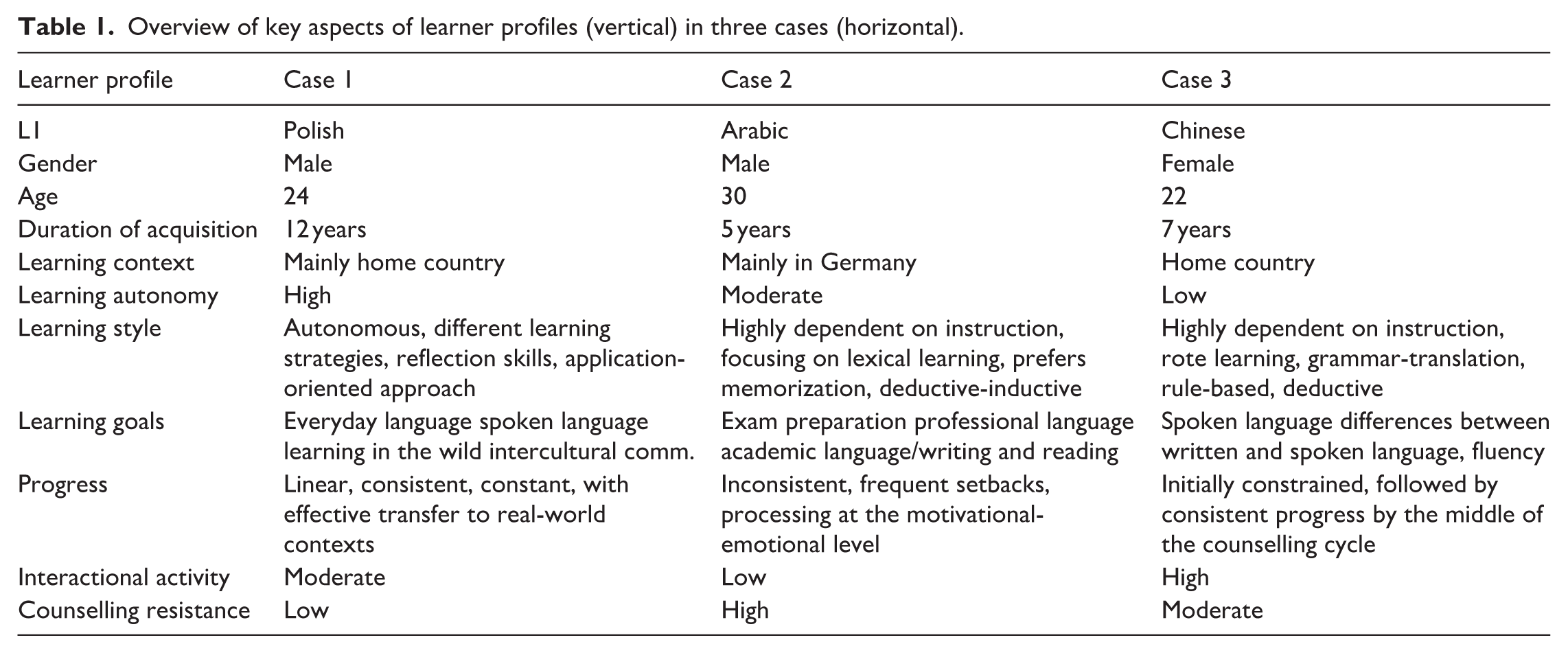
Over the course of one semester, their counselling cycle consists of seven sessions in which the CNs provide personalized guidance to help the learner improve their FLL skills. This includes assessing their needs and resources, developing learning strategies, recommending resources, providing ongoing feedback and engaging students in self-reflection to build problem-solving skills. The goal was not to implement a particular counselling approach, but to design and adapt it to the learners’ specific developmental dynamics, reflecting on their progress, challenges and adaptations during team meetings. Written informed consent to record interactions was obtained from all participants. Confidentiality was ensured through anonymization of all data, and ethical approval was granted by the host institution. The corpus of audio recordings consists of 14 cases, with seven sessions each, resulting in 130 audio-recorded and GAT2-transcribed (Selting et al., 2009) consultation sessions (135 hours), which are expanded with 7 hours of recordings of team meetings. For the purposes of the following analysis, three cases were selected, each involving LNs with different L1, acquisition backgrounds, learning goals, and styles (see Table 1), but most importantly differing in their interactional activity, as reflected in their initiative and responsiveness, as well as in their resistance to counselling practices.
Overview of key aspects of learner profiles (vertical) in three cases (horizontal).
To examine novices’ use of SDs – focusing on their specific functions in FLL counselling and changes across interactions – the analysis employs an interactional linguistic approach (Auer et al., 2020; Couper-Kuhlen and Selting, 2018; Imo and Lanwer, 2019). SDs are identified through a sequential, bottom-up exploratory approach, analysed from an interactional linguistic perspective, and then quantified based on their functional potential in specific contexts. Equivalent interactive episodes and practices were collected, comparable in terms of the character of counselling interaction characteristics. Their chronological organization enabled both within-session cross-case comparisons and longitudinal analyses to reveal consistent patterns as well as changes and differences over time. Changes and adaptations over time are reconstructed using longitudinal interactional techniques informed by multiple studies (Berger and Pekarek Doehler, 2018; Deppermann, 2018; Nguyen, 2012; Nguyen and Malabarba, 2025; Pekarek Doehler, 2021; Skogmyr Marian, 2023).
Since the focus is on counselling activities aimed at facilitating problem-solving and self-regulation, only SDs occurring within the advisory context are included. Those during opening and closing phases, small talk, or self-referential comments and unrelatable comparisons without advisory relevance are excluded. The final session is also excluded due to its differing nature, as it primarily involves providing final mutual feedback and contains minimal or no counselling activities. The data are organized into three time frames: the initial phase (first two sessions), the middle phase (sessions 3–4), and the final phase (sessions 5–6). The division of the 6-month counselling period into three phases serves multiple purposes: This temporal structuring aligns with the participants’ self-organizing framework, supporting joint planning and progress monitoring. It provides a solid foundation for comparing data across sessions, with each time frame spanning approximately 2 months and enabling systematic, consistent comparisons. This is also shaped by the dynamics of the interactional history. While specific topics may change, interactions during the first two sessions primarily focus on stabilizing shared actions and co-constructive processes. In the second time frame, these contexts are further consolidated, extended, and diversified within new thematic areas, as the interactional history develops and learners’ agency increases. The final time frame yields qualitatively distinct forms through the combination of accumulated experiences, well-established common ground, and the awareness that the process is concluding.
Tracing changes in novices’ counselling self-disclosures across sessions
Before delving into the interactional linguistic analysis, a brief quantitative overview of the frequency and distribution of SDs across three cases is provided, both in total and related to three time frames (see Figure 1). The quantitative analysis identified 55 SDs in total, with approximately half occurring during sessions three and four. Considerable individual variability appears across cases, related potentially to differing understandings of professional role, variations in learners’ interactivity and resistant behaviour and the deployment of other interactional practices for achieving alignment, intersubjectivity, and due to different co-adaptive dynamics – processes that warrant further multidimensional longitudinal investigation. However, all cases demonstrate a general trend: initially low use of SDs that increases over time before gradually decreasing. This may reflect adaptive-developmental dynamics in which SDs are first cultivated and expanded, then moderated as counselling relationships and interactional framework stabilize; it may also indicate a tendency to explore and expand their functional potential, adapting them as co-constructed practices to align with counselling goals, before settling into more specific functions, as the qualitative analysis will demonstrate. The following sections provide a detailed interactional linguistic perspective.
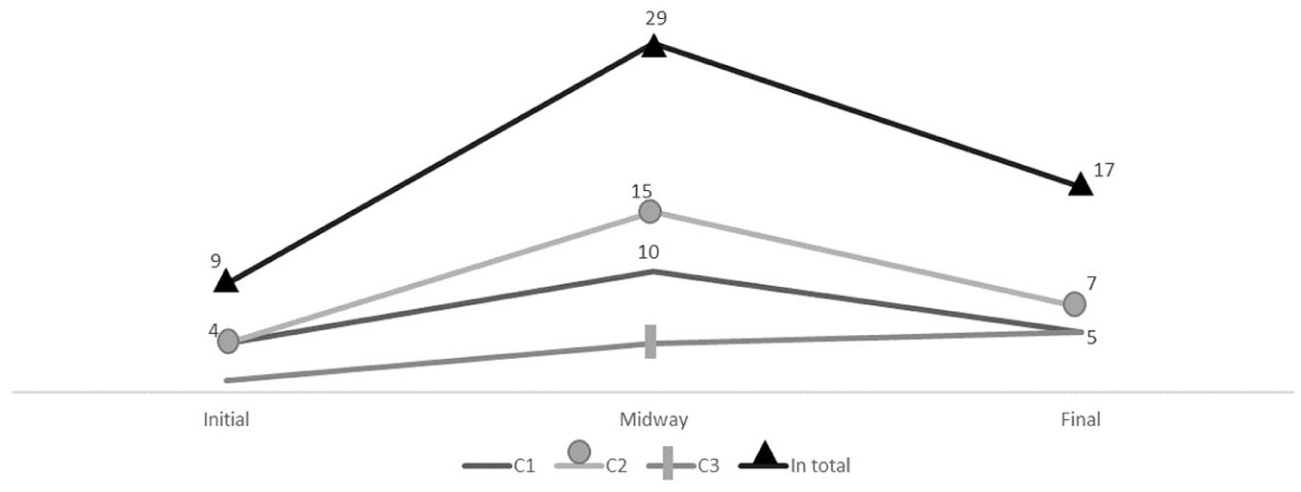
Distribution of SDs across three cases (C1-3), overall and in three time frames.
Self-disclosure in initial sessions: Bridging interactional gaps
The following examples demonstrate typical realizations of SDs in the first two counselling sessions: bridging interactional gaps and supporting the reorganization of the advisory action. In the first example (Example 1), the LN reports on the use of the new strategy for learning football vocabulary, highlighting newly acquired words and emphasizing the word goalkeeper (lines 1–3). The CN provides positive, supportive confirmation (line 4). However, as the LN hesitates and refrains from further elaboration (line 5), the CN shares an anecdote about a boy who creatively invented an alternative word, which the CN positively describes as cute (lines 6–12). This SD is associative and loosely connected to the preceding turn, functioning as a side sequence in a phatic function and in a peer-like manner. It begins with an introductory phase (line 6) that reveals its mental status as an associative, reflective flow (grad nachdenken), accompanied by an ambiguous reference (darüber) and opening a parallel discourse (Turntruppe) (line 7). The sequence is simply structured, referring to the context and a figure (Junge), while emphasizing a positive evaluative, emotional stance and attitude, displaying appreciation for creative language use. However, repeated references to the same word and the boy, who is learning new vocabulary, may lead to learner self-identification with potential negative effects on self-image and interactional self-perception. Another potentially problematic effect arises from the evaluative narrative core, reflecting the CN’s evaluative stance within situational reasoning. The novice CN fails to establish a concrete connection for the learner, as evidenced in line 13, where the LN speculates about the anecdote’s meaning and seeks further clarification. Rather than perceiving the anecdote as humorous, the LN focuses on its functional aspect in advisory sense (the usage of the word), co-regulating the functional value of SD in a professional sense, relating it to recommending and supporting learning.
The CN (lines 15–16) elaborates by framing it as a child’s invention, positively evaluating and re-enacting it (line 16), by modulating the voice, accompanied by laughter and inviting alignment. The LN responds accordingly but takes the initiative to change the topic, leading in a direction that is more functional for his learning goals (line 17). This re-orientation demonstrates a potential negative effect of SDs in shifting the discourse progression when introducing new or ambiguous focus, highlighting the importance of recipient design and clear connection to the learner’s objectives and previous turn. SD functions as a conversational “joker”, bridging moments of hesitation and interactional retardation, fostering interactive symmetry and serving an emotionally relaxing function. It also has the potential to redirect the main course of action, as the LN demonstrates increased self-initiative and shifts the topic in response to the focus introduced by the SD. In subsequent turns, the SD triggers the LN’s narrative reflexes, leading to repeated revisiting of similar episodes over the next 10 minutes without deepening reflection. This creates new challenges for CNs in shaping and guiding the learners’ narratives toward advisory goals and managing focus shifts arising from associatively aligned self-disclosures, that lack a clear key point connected to the counselling goals. The LN co-constructs the SD’s local function, supporting subsequent adjustment in SDs toward more explicit and advisory functional alignment within the interactional context.
Another typical realization of SDs occurs following more complex elaborations by the CN, where an interactive gap appears due to the explanation’s design that does not seem to fit the addressee, leading to interactive and epistemic imbalance. In the following example (Example 2), a new learning strategy is recommended: The CN explains how learning words by connecting them in networks is a more effective approach (lines 1–2) then memorizing translated lists. Potential difficulties with unfamiliar words are thereby presented as normal and expected (lines 3–5). The learner remains passive, likely influenced by the complexity of the subject matter, its abstract nature, and the low recipient design (despite directly addressing the LN with the informal pronoun du) as well as a lack of attachment to his own learning experience and preferred strategy. At the point where the discursive flow seems to be disrupted due to low responsiveness or potential intersubjectivity problems, the CN indicates a possible shift through the conjuction but, hesitation and discourse marker (line 6), resolving the issue with calibration of recommendation and recipient design through narrative self-reference, serving as interactive repair “joker”. Through the SD, the CN adopts the role and perspective of a foreign language learner and evokes shared experience by illustrating the search for an unfamiliar word (line 6–7). CN then presents her own strategy as a starting point, not only to legitimize the previous elaboration, but to shift from problem focus to solution-finding and to repair the sensitive moment of misalignment, thereby shifting from initial simple evaluative and directive recommendation toward a process- and action-oriented, co-constructive approach. This transition opens a topic with greater potential for learner engagement, bridging the interactive gap. The SD serves as an interactive, empathic bridge, that reorganizes discourse in a more addressee-oriented direction, introducing a new topic and solution-focused perspective and reconnecting advisory actions with the LN, building a stable intersubjective foundation. Epistemic and deontic positions are re-established through shared experience, perspective and role alignment, supported by references to repeated action and a causal logic that presupposes an organized solution, thereby enhancing acceptance of the advisory action. The SD creates an experiential bridge, providing an operational interface for the learner to step in and actively engage in joint problem-solving.
In summary, SDs in initial counselling sessions primarily function as associative narrative reflexes and bridging acts, spanning interactive and discursive gaps. Within this intersubjective repair functionality, SDs evolve from merely bridging discourse disruptions toward self-organized processes that calibrate advisory actions and render them more appropriately tailored to the addressee. Initially appearing as follow-ups amid difficulties with adaptive continuation, SDs associatively open parallel symmetrical everyday/peer discourses rather than goal-oriented, functional advisory ones. SDs then occur in turn-internal yet potentially transitional positions, following complex elaborations with missing links for LNs, low addressee involvement or anticipated interactive gaps. Here, SDs serve to bridge and reorganize discourse toward greater addressee-orientation, introducing new topics or solution-focused perspective, thereby transforming trajectories toward more functional and aligned advisory actions, while encouraging greater learner initiative. This reflects adaptivity resulting from the LN’s co-constructive activities, aimed at the functional integration of SDs in previous realizations. However, challenges arise in aligning SDs with participants’ experiential worlds and advisory goals due to the SDs’ loose-tight design, ambiguous references, unclear links to prior turns, uncertain projective potential. Further challenges arise from limited co-constructive opportunities, and vague central messages, which are often evaluative or emotionally framed, reflecting the CN’s evaluative stance. Low recipient design, failing to sufficiently align learners’ experiences with a new event and the narrative reasoning, carries risks for learner’s self-identification and may negatively affect self-image, self-efficacy and epistemic authority of the LN.
Self-disclosures at the midway: Facilitating transformation and offering advice
In the middle phase, SDs increasingly serve for delivering advice and as a preparatory step legitimizing the advisory actions, becoming functionally integrated with core advisory tasks. The following example (3) demonstrates SD’s use in a context where the LN expresses his concern in a resigned manner due to high self-expectations, learning difficulties and limitations of current strategies. The CN responds with an expression of understanding (line 3–4) and follows with a self-disclosure (line 5–11) aimed at demonstrating empathic understanding, perspective synchronization and shared epistemic stance before offering advice as a co-constructed solution (line 13–16). This experience-based alignment embodies a similar problem, thereby simulating the learner’s cognitive perspective and emotional state. The SD not only depicts, but enacts shared experience, creating an empathic interface (Lazovic, 2025a) that resonates with the LN’s negative self-expectations (ich muss), echoes his attitudes toward the learning process, and reflects his emotional state of concern and resignation (Oh, das wird nichts). Designed to align with the LN’s inner state, the SD incorporates relevant statements from previous turns, including statements that reflect inner speech, reflection-in-action, expressions of emotional load, and the voice of concern and self-awareness. It creates space for emotional self-regulation (lines 7, 9) by facilitating self-distancing, enhancing self-awareness, and normalizing the problem by framing negative consequences as common, thereby supporting reappraisal and adjustment of self-expectations.
SD is designed as a co-constructive, co-reasoning sequence, supporting self-distancing from distorted perceptions, states, and expectations, and challenging LNs’ dysfunctional patterns. SD demonstrates a multifunctional valence: normalizing experiences, regulating emotions, generating an empathic interface, promoting deeper change as well as supporting and argumentatively legitimizing subsequent recommendations, thereby securing the CN’s epistemic and deontic position. SD addresses self-expectations and deeper mental structures, thereby regulating the foundation for action rather than merely its consequence. It triggers an action- and processual operational modality that allows activities to be enacted agentively and self-regulatively. It prepares the learner for transformative interventions and advice, which may conflict with existing learning and advisory expectations, by recommending reduction and simplification of the problem, fostering self-transformation, and harmonizing cognitive and emotional dimensions, rather than focusing solely on strategies or generally changing the approach. The learner responds to the vivid SD with positive affirmation and displays emotional relaxation (line 12). Subsequently, the CN offers a recommendation (lines 13–16), including a transformative intervention targeting the learner’s high self-expectations. This is justified by a better sense of self (line 16) and emotional relaxation (line 18), mitigated by expressions of epistemic uncertainty (maybe, somehow, a bit). SD enables an empathic operational interface that directly addresses and regulates some self-related issues. In contrast to earlier transformative suggestions, the learner responds here affirmatively, highlighting SD’s functional role in reducing counselling resistance and preparing for advisory interventions. This gradually contributes to its functional specialisation in addressing resistance within the counselling process.
The following example (Example 4) from the third session in a different case demonstrates the second observable trend in the increasing use of SDs to make recommendations, offer advice, and proactively model reflective thinking. The sequence begins after the LN admits to using a negatively framed strategy (learning by heart), upon which the CN invites further elaboration (lines 1–2). The LN explains her strategy (lines 3–6) with evident discomfort, relaxed by laugher indicating embarrassment. The self-disclosure occurs at the point after affirming and highlighting the equivalence of experience (line 7, so mache ich das auch), demonstrating empathic understanding and regulating emotionally. The CN then (line 8–9) selectively integrates the parts of the LN’s previous statement (line 4) to establish cognitive equivalence, align perspectives, and normalize the experience without taking an evaluative stance. At the same time, the CN acknowledges the effort involved in the shared action, building an empathic interface. This selective experiental matching with subtle reformulation functions as a connecting anchor, opening a transformative space. This is further expanded and subtly reframed to emphasize goal orientation (line 11, damit ich mir das merken kann), bridging toward a new learning approach. This is followed by an experience-based recommendation, introduced as a potentially helpful course of action (line 11), making it interactively open for co-construction. The SD builds on this bridging act, emphasizing goal orientation (lines 13, 17), presenting a new action (lines 14–16), and structuring it within a reasoning-action-consequence chain. Key linguistic strategies supporting this process include: supporting interactive engagement (pauses, focusing, emphasis); simulation of inner speech to suggest a shared in-situ perspective (echoing self-monitoring) and involve in reflection-in-action (line 17); listener-oriented or dual-mind syntax phenomena (Haselow, 2024: 528); structures highlighting consequence (so that, that I), implying beneficiary relation, epistemic validation (really, always, then always) and causal linking (if-then, that, because, but). The SD is closely connected to the LN’s elaboration while incorporating key transformational elements and modelling reflection through goal-oriented reasoning, regulative process-orientation and enhancing action-goal alignment.
The SD further develops an argumentative function, as it not only emphasizes the new strategy as an argumentative point in concluding the storyline (lines 22–23), but also reinforces this with additional supporting arguments (lines 19–20), elaborating in a problem-solving manner and aligning it argumentatively with learners’ experiences and reasoning. SD increasingly develops into an argumentative sequence, in which multiple argumentative aspects are co-constructively addressed within a joint-reasoning mode and simulating co-reasoning. This includes particularly arguments that challenge the unproductive mind-set expressed in the LN’s previous turn, while maintaining a face-saving and non-confrontational stance. Instead of directly refuting the LN’s strategy by focusing on its negative aspects, the SD enables collaborative development of a new strategy as joint reasoning in a problem-solving way. This approach allows transformative points to be introduced without direct opposition or confrontation, while facilitating the cooperative alignment of evaluative stances and supporting the co-argumentative connection and orchestration of different perspectives.
The SD enables a co-argumentative interface, fostering greater LN engagement: the LN not only provides confirmations (lines 18, 21), but also actively engages in a co-constructive process through self-initiated expansions with aligned argumentation (lines 24–27), thereby introducing new aspects that support the new strategy and highlight its relevance and arguments in favour of it. In this multifunctional interface role, the SD enables joint reasoning during problem-solving, thereby argumentatively transforming internal structures (attitudes, action patterns), while addressing other secondary advisory goals and integrating them into a focused direction.
In summary, mid-way SDs are employed to prepare, legitimize, and provide recommendations after LNs have expressed challenges, learning difficulties and emotional burdens. They firstly demonstrate empathy, normalize negative experiences, distance LNs from unproductive actions, and regulate emotions, while preparing mental bridges for (self-)transformative processes and joint reasoning. SDs legitimize (self-related) transformative recommendations and present them in an aligned, empathic and face-saving way, framing them to be seamlessly integrated or attached within the learning system. SDs are designed to represent complex inner states, reflecting attitudes, emotions, and situated reasoning, through simulated inner speech and reflection-in-action. They display emphatic inferences, high alignment with LNs’ situational perspective, thereby enabling an operational interface for intervention. SDs establish the epistemic and deontic position for CNs prior to transformative interventions, since SDs are, compared to previous cycles, embedded in more complex and argumentative contexts, more closely connected to LNs’ previous statements. LN’ statements are used as anchors – sometimes selectively focused, paraphrased and functionally adjusted – and extended through bridging structures that connect learners’ elaborations with new knowledge. An argumentative modelling of SDs also becomes more apparent, as their complexity and connection with LN’s experiences increases. SDs also address not only local issues but attitudes and aspects recognized throughout the interactional history. The narrative structure provides a framework for organizing multilayered argumentation, in which the “I” of self-disclosure is positioned as an interface mediating between LNs’ personal experience, different believes and advisory action and supporting their coherent integration into a new solution-oriented reasoning. This narrative argumentation begins with establishing common ground and empathic display, presenting an issue and creating a bridge toward a new solution. It is then elaborated argumentatively, leading to a key message that concludes the storyline. Internal resistances and constraining aspects identified in prior talk are argumentatively addressed and processed in a face-saving and a joint reasoning manner, also through simulating inner (self-)talk. Overall, the argumentative design and multilayered nature of SDs demonstrate their function as a multifunctional operational interface that mitigates resistance and fosters enhanced learner engagement in co-constructive processes.
Final functional profile: Addressing and resolving internal resistance
In the final sessions, SDs primarily address and process LNs’ resistance to advice or in relation to internal obstacles arising from collisions between goals, self-expectations or entrenched action patterns. SDs establish shared ground, highlight dysfunctional aspects and support overcoming inner resistances in a problem-solving-oriented manner, thereby enabling face-saving disagreements, challenging and transformative initiatives. The following example (Example 5) demonstrates this: This sequence follows the LN’s report on his intensive test-preparatory learning based on a course book and test-preparatory materials, although the CN repeatedly suggests alternative learning contexts and resources, encouraging the LN to align his actions more with different goals and learning styles. The LN persistently rejects these suggestions, asserting that “learning for the test is something different” and emphasizing “efficiency as the priority, which is guaranteed only through the course-book”. LN references past negative experiences that were time-consuming and unproductive. Despite multiple efforts over a 5-minute-span, this resistance remains and the interaction fails to progress in a productive direction. The sequence begins at the point where the LN expresses his contradictory opinion against test-preparatory learning while simultaneously acknowledging the pressure to learn as quickly as possible (lines 1–4). This duality reveals emotional stress, argumentative contradiction and internal conflict, blocking the action (ich mag so nicht, aber ich muss): a desire and pressure to achieve the goal as efficiently as possible, juxtaposed with a reluctance to engage in traditional methods, accompanied by high negative emotional load. The CN initially confirms (line 5), demonstrating understanding of the LN’s perspective (lines 6, 11), and provides supportive arguments (lines 7–10), thereby aligning with the LN’s previous statements, demonstrating shared reasoning, and normalizing this experience it by using a generic pronoun (man). The CN then issues a disclaimer, acknowledging the LN’s approach and reluctance to challenge it if the LN believes it to be effective (lines 12–13), thereby strengthening LN’s agency and self-regulation. Subsequently, a counter-argumentative sequence is introduced (line 14, aber/trotzdem) with a self-referenced epistemic marker (ich denke), thereby addressing the learner directly (wenn du) before transitioning into a self-disclosing sequence.
Rather than directly contradicting, the CN shifts to a self-disclosing modality, thereby sharing equivalent experience as a FL learner (line 15) and recounting her efforts to engage comprehensively with all the tasks and materials (lines 16–18). She emphasizes an iterative, engaged, and intensive process, aligning it to the LN’s experience and facilitating interactional bonding. This acknowledges the LN’s previous efforts while reframing them in a new format. The three-part participial verb chain (line 18) indexes persistent engagement and situated involvement, functioning as a resource for displaying affiliative stance and achieving emotional alignment, thereby normalizing the negative experience. SD establishes a shared epistemic and emotional foundation, upon which a narrative tension is built by presenting conflicting perspectives and facts (lines 19–20). The LN’s previously expressed discomfort (manifested as lack of enthusiasm and high emotional load) is enacted in the form of situated self-talk as reflection-in-action (line 20), relaxing the emo-cognitive tension. By shifting between the advisor’s “I”-perspective, a generic “one”-formulation, and the dramatized simulation of inner speech, the discourse becomes dynamically layered, enabling a functional distancing and reframing of the negative experience. The CN connects here the two conflicting aspects (acts/goals, desired outcomes versus process loss) as normal steps in a process, thereby supporting self-distancing and strengthening awareness of internal resistance and blockage.
The internal conflict, instantiated as narrative tension, is subsequently resolved by presenting an alternative action (line 22) that offers a new, experience-based solution. A strategy previously rejected by the learner (reading books) is presented neutrally as personally experienced and deliberately chosen. This is further extended with inner reflection on its use, which integrates additional contradictory arguments from the learner’s previous turns (lines 23–24, regarding its restricted effectiveness). These arguments are integrated and normalized in the reflective flow of the SD, but then countered with a new argument (line 25, learning evidence), thereby transforming the internal resistance through high-evidence-based joint reasoning. The SD achieves argumentative consolidation and coherent integration of different conflicting statements from the LN, resolving internal contradictions through narrative restructuring, reframing, and integration into the reasoning flow. Simultaneously, an implicit, face-saving contradiction reframes the previously rejected idea as productive and cohesively incorporated. Beyond the use of simulated inner speech (line 20) and the first-person perspective as empathic interface, shifts to the generic man (line 19) provide the actions a generalizable, normalizing, and self-distancing character. The use of du in simulated self-talk (lines 23–25) suggests another argumentative and directly relatable processing, enabling new arguments to connect directly with the learner’s prior elaborations.
In a subsequent argumentative wrap-up-sequence, the CN reconnects (line 26) to LN’s previous statements, drawing on the transactive interactional memory, highlighting specific goals, needs, relevance and challenges (lines 27–29). These are presented as complementary, creating a coherent argumentative connection within the LN’s mental landscape. The previously rejected strategy (reading a book) is reintroduced (line 30) as a valid option with strong argumentative validity. By framing it with exploratory, action-oriented language (‘and why not then. . .’), the CN grounds the suggestion in the learner’s previously established orientations within, promoting engagement with the learning process. Following the LN’s confirmation, the CN builds on this to achieve further argumentative consolidation (line 32), emphasizing its connectedness and relevance to the LN’s specific goal (more time). Rather than introducing external arguments, the argumentative process is regulated internally, with the shared narrative basis serving to integrate new transformed reasoning. The LN responds positively, adopts the previously rejected recommendation (line 33) and subsequently reflects on concrete next steps, acting in a co-constructive way. This sequence demonstrates the functionality of SDs in reducing resistance, promoting a problem-solving orientation through argumentative consolidation, and fostering co-constructive engagement.
In summary, SD has functionally stabilized as a practice for empathically working through inner resistances, conflicting perspectives, and internal tensions. Colliding structures are empathically evoked, and experientally matched to secure the common ground and establish an operational interface, before the colliding aspects (arguments, attitudes) are transformed, coherently related and narratively restructured, thereby facilitating emotional and cognitive regulation of the LN’s mental landscape. SD generates an empathic interface, particularly through simulation of inner self-talk, the enactment of reflection-in-action, and the dynamic shifting between I, you and generic perspectives, which enables the CN to challenge and contradict the LN, question false assumptions and suggest (self-related) transformations. SDs have an inherent argumentative structure, using narrative flow to relate and harmonize arguments and resolve internal contradictions in a solution-oriented way. These are restructured into transformed chains of narrative (self-)reasoning and action. The narrative plot organizes sequences of action, allowing internal contradictions to be expressed as narrative tension, that is subsequently resolved through new courses of actions, and supported through argumentative integration and adaptation of contradictory arguments. The final move is argumentatively consolidated by connecting it with further aspects and statements from the interactive history. In this way, SDs operate on reasoning within a pattern of narratively structured action sequences, integrating new strategies coherently in relation to other attitudes, goals, and learning preferences, thereby harmonizing the learning system and re-modelling reflection-in-action. In contrast to previous sessions, current SDs recycle multiple complex statements, drawn from different phases of the interactional history. These are also fully tailored to the LN while being transformed and re-used in a context-sensitive way. Beyond their increased sequential complexity, SDs are embedded within broader, complex argumentative contexts, and are seamlessly connected, cohesively framed and concluded to foreground the key message, reflecting advanced changes in its discursive integration and sequential organization.
Discussion and conclusion
The present analysis of pre-service teachers’ SDs, acting in their role as novice FLL counsellors, reveals adaptive-developmental trends, demonstrating how their use evolves in relation to advisory interventions and contributes to the growth of professional interactional competence. This setting enables examination of SDs not only within developing interactional histories and novices’ professional interactional competence, but also as co-adaptive practices responsive to learners’ developmental needs and following their progression. The analysis shows that, while initially sporadic, the use of SDs increases significantly in the middle phase before declining in final sessions, a tendency consistently observed across all three cases. Case comparisons suggest that differences in the frequency of SDs may be related to learners’ interactivity (initiative, responsiveness), resistance to counselling interventions, and counsellors’ understanding of interactional alignment, although qualitatively similar tendencies appear in all three cases, illustrating how novices gradually integrate SDs into core advisory practices. The analysis demonstrates that SDs undergo a functional transformation over time, shifting from loosely connected, associative contributions – initially serving as interactional enhancers and bridging devices – toward specialized, multifunctional uses that reinforce novices’ epistemic and deontological position required for multidimensional advisory interventions. Finally, they become argumentatively embedded, complex, and argumentatively designed resources, supporting joint reasoning. This confirms empirical insights from other developmental contexts regarding narratives’ increasing argumentative function (Berger and Pekarek Doehler, 2015, 2018), highlighting key points, integrating them argumentatively, and connecting them to problem-solving goals (Wala et al., 2024). SDs evolve from narrow, supportive functionality through a phase of multi-functional expansion across diverse advisory contexts, settling into a typical, stable argumentative function, that both reflects adaptivity to learners’ developmental changes and the dynamic of interactional history, while embodying the development of professional competence. The co-adaptive nature of SDs is also evident, as their functionality emerges in response to learners’ reactions and co-constructive moves, fine-tuning their advisory value while reinforcing their connection to central advisory practices and enhancing their argumentative significance.
Initially, SDs serve as resources to bridge interactional gaps, as interactive “jokers” that enhance engagement, repair consequences of advisory actions amid limited learner involvement, weak alignment, and epistemic imbalance, or just serve as “interactional loci of remembrance” that enhance local learning experiences. Thus, they help novices navigate some of the challenges in enacting their professional role, balancing epistemic positions and interactive roles, and controlling the advisory focus by reorganizing and restarting advisory interventions. However, some problems triggered by focus shifts and the introduction of new referents and topics (Leudar et al., 2006) are evident, posing challenges to discourse progression. Within their repair functionality, SDs evolve from merely bridging discourse disruptions in follow-ups toward self-organized processes that actively calibrate advisory actions. SDs reorient interaction toward a more addressee-centred approach, introduce new topics, and create opportunities for learners to become more active, involved, and self-initiating.
In the middle of the counselling cycle, SDs become highly frequent and develop more functional designs, serving as a multifunctional operational interface for diverse advisory-specific purposes. They illustrate, support, prepare and legitimize advisory actions, offer recommendations, proactively model reflection, regulate emotions, thereby normalizing negative experiences and creating distance from unproductive actions. Most importantly, they facilitate movement toward solutions, by building mental bridges for self-transformative processes and anchoring corrective recommendations. By harmonizing epistemic positions and achieving emotional alignment, SDs pave the way for transformative interventions that foster situated, action-oriented reasoning, analytical stances, and co-constructive work toward new solutions. Alongside this functionally diversified use, particularly when preparing, enacting, supporting and adjusting recommendations, SDs develop argumentative qualities, following a consistent pattern: after establishing common ground, demonstrating empathy and regulating emotions, they frame issues as narrative tension, and prepare mental bridges to support the following recommendations, which is then supported argumentatively through narrative elaboration and culminate in a key message that concludes the storyline, thereby developing gradually an argumentative structure.
Finally, SDs are employed only argumentatively in contexts where learners show inner resistance, divergence and collisions in their mental landscape. SDs function here as multifunctional argumentative acts that transform internal resistance, harmonize colliding aspects, restructure emotional and mental landscapes, reshape experiential ground, and manage disagreement in a face-saving manner. This argumentative modelling of SDs becomes evident not only in reusing, restructuring, and relating learner’s previous statements, but also in the way they are argumentatively expanded with further elaboration in a face-saving manner. Internal collisions or difficulties experienced by the learner are expressed as narrative tension, which is subsequently resolved through simulating joint reasoning, thereby harmonizing different argumentative dimensions within the learner’s mental landscape and integrating multiple argumentative dimensions. This culminates in a conclusive key message, introducing new solutions and supporting this with joint reasoning and expanded elaboration from learner’s perspective. Inserted into complex argumentative contexts, SDs enable corrective, multidimensional interventions through simulated joint reasoning and reflexion-in-action, supporting reappraisal and self-transformative actions, using polyphonic argumentative structures, as multi-voiced, layered arguments where different perspectives interact in a single discourse unit, enhancing co-construction, and reflective reasoning.
This functional expansion in relation to advisory-specific goals encompasses several additional changes, including shifts in the positioning of SDs, their increasing sequential complexity, including changes in transitions, attachments and bridging structures to involve the learner, as well as potential trigger from previous turns. SDs move from unsystematic narrative reflexes being triggered by interactional challenges to practices that address and regulate negatively valued experiences and learning difficulties, finally operating only in response to recognized internal or counselling resistance. Their positioning reflects a progression from functioning as narrative reflexes within side-sequences or as re-organizing practices in bridging-the-gap positions, progressing to third-turn positions extended with advisory action and increasing turn-internal integration, and finally stabilizing as argumentative insertions within turns in complex argumentative contexts. Similarly, the transition to SDs extends beyond stating equivalent experiences, role identifications or claims of understanding. In addition to demonstrations of understanding through reenactments and expressions of empathic inferences, it involves more complex, interwoven polyphonic structures that are organized argumentatively within the narrative flow, and draw on both the immediate context and previous interactions. These structures evoke emotional states and complex chains of reflection-in-action, serving as transformative interfaces, and anchoring points for interventions. The simulation of inner self-talk and reflection-in-action (Lazovic, 2025c) functions as a crucial practice for alignment and argumentative bridging prior to advisory action, creating an operational interface for intervention, supporting joint reasoning. The evaluative stance is reduced and transformed to signal evaluative alignment, thereby securing affiliative responses, acceptance, and convergence, an adaptive-developmental tendency that has also been observed in other contexts (Pekarek Doehler and Pochon-Berger, 2011; Skogmyr Marian, 2021).
The analysis further reveals a progression toward recipient-matched structures in which novices reuse and adapt material from previous turns, restructuring and condensing it while employing bridging practices. This corroborates findings from previous empirical studies on the development of professional advisory competence (Nguyen, 2012; Nguyen and Malabarba, 2025). While initially associative, and loosely connected, early SDs often exhibit low recipient design, insufficient alignment with the learner’s experience, ambiguous projective potential, and limited space for co-construction. Additionally, they reflect a predominantly evaluative stance and entail potential risks for the learner’s self-image and epistemic authority. Over time, SDs evolve into tightly connected, inferentially complementary structures in which novices both reinforce the learner’s epistemic position and adapt material from previous turns, thereby restructuring and condensing it while employing bridging structures to connect, transform, and expand it with new aspects, inviting co-construction and actively engaging the learner. Additionally, the argumentative reuse of learners’ earlier statements demonstrates an increasing orientation toward the transactive memory system, reflecting the functionalization of prior interactional achievements. This allows novices to align advisory interventions across sessions, foster a coherent learning system, and reduce potential misalignments in the learner’s developmental trajectory. Consequently, as SDs become better integrated into the interactional flow, the risk for modifying or disrupting the ongoing course of action or triggering narrative reflexes in learners is significantly reduced. Correspondingly, learner’s responses to SDs also change, demonstrating an improved understanding of the specific function of SDs, reduced resistance to interventions, and greater initiative and active, co-constructive argumentative participation in follow up sequences. This, in turn, enables counsellors to subsequently calibrate more precisely their specific argumentative function in their later use.
The dynamics in the use of SDs reveal a specific interplay between novices’ developing professional interactional competence and the adaptations that follow learners’ transformative learning dynamics, co-adaptive trajectories, and the accumulation of interactional history. However, to fully understand the multidimensional dynamics of adaptive processes and their interrelations, it is necessary to study a more diverse set of cases, including counsellors with varying levels of experience and interactional styles, across different interactional settings, in order to identify generalizable tendencies and trace trajectories from initial counselling cycles to subsequent professional phases, as well as to examine co-adaptive dynamics with different learners. The analysis should also include multimodal aspects, which could not be addressed in the present study. Further desiderata concern the relationship between various adaptive processes and mechanisms related to different resources and practices, in the sense of multidimensional interrelations and their development (Nguyen and Malabarba, 2025). This includes, for example, the relation between SDs and other functionally related structures; follow-up practices targeting learners’ narrative reflexes, in order to transform them into deeper reflection; and, approaches to managing resistance or engaging in other actions within the similar functional radius, as well as other resources related to interactional alignment. Further investigation is needed to understand why SDs become reduced and increasingly specialized for one advisory task, particularly regarding how this specialization relates to other argumentative dynamics, practices and processes of joint reasoning. Similarly, the development of argumentative dynamics, and patterns should be analyzed in parallel, in order to examine their relationship with self-disclosures. Additional research directions arise from triangulative approaches that link interactants’ beliefs with reflection-in- and on-action dynamics with multimodal interactional behaviours, as well as in intervention settings involving trainings designed to foster professional self-disclosing competence. Practically, it would be very important to coach novices in developing competences to monitor and reflect on changes and adaptations in the design and function of different practices over time, in the sense of transitive, self-transformative reflexivity (Lazovic, 2025f). This includes cultivating awareness of expanding functional potentials, systematically tailoring modifications to addressees, interactional dynamics and developmental trajectories, and responding effectively to co-adaptation, while simultaneously and intentionally shaping their own professional development with increased awareness.
Footnotes
Acknowledgements
I would like to thank the student participants and reviewers for their valuable feedback.

Consent to participate
Participants were fully informed about the purpose, procedures, and potential risks associated with the study. Written consent was obtained from all participants prior to their involvement, ensuring their willingness to participate voluntarily. Participants were assured of their right to withdraw from the study at any point without any consequences.
Funding
The author disclosed receipt of the following financial support for the research, authorship, and/or publication of this article: Open Access funding provided by the Open Access Publishing Fund of Philipps-Universität Marburg.
Declaration of conflicting interests
The author declared no potential conflicts of interest with respect to the research, authorship, and/or publication of this article.
Data availability statement
The recordings for this study are not publicly available because of restricted informed consent of the participants.