




Abstract
Previous conversation analytic studies of institutional interaction included analyses of empathy in interaction. These studies revealed that professionals may use empathy displays not only to validate the client’s worry, but also to perform actions oriented to other institutional goals and tasks such as closing off a troubles-telling sequence. In this article, we present an analysis of empathically designed responses in Dutch telephone counseling. The data consist of 36 calls from the Alcohol and Drugs Info Line. In some of the calls, clients’ troubles-telling includes ‘emotion discourse’, that is, descriptions of their feelings/emotions. Counselors may respond to these descriptions using conventional empathy displays like ‘I can imagine that’ and ‘I understand that’ in a range of verbal and prosodic variations. The analysis reveals that these responses open up advice sequences that vary in the extent to which they treat the client’s articulated feelings as valid. Most are affiliating, treating the client’s feelings as the basis for advice, while some are less affiliative, putting the client’s feelings into perspective or implicitly questioning their legitimacy. Hence, empathically designed responses are pivots to advice-giving.
Introduction
Empathy is widely recognized as an essential aspect in professional–client communication in a range of institutional settings (counseling, psychotherapeutic and clinical). It may be defined as the professional’s ability to understand the patient’s or client’s situation, perspective and feelings and to communicate that understanding. It is thought that certain words may work specifically well to convey empathy (Coulehan, 2001). This article zooms in on a particular set of empathic phrases and their interactional context. Empathy may be displayed not randomly during an encounter but at specific moments. We focus on empathically designed responses to clients’ statements about their feelings and examine what these responses achieve interactionally, that is, what they afford more than communicating an understanding of the client’s feelings. The analysis reveals three different directions in which the responses may work. Some endorse the client’s feelings and as such support the client to alter their behavior (variant 1). Alternatively, the empathic responses are somewhat disaffiliative and relativize the client’s feelings (variant 2) or imply these feelings are counterproductive, that is, understandable but not beneficial given the situation (variant 3).
Empathy is one of the phenomena conversation analysts have been interested in while studying emotion and affiliation in social interaction. Some of these studies have examined empathy in the context of experience, that is, the extent to which respondents display or claim knowledge of the described experience in their response (Heritage, 2011; Kuroshima and Iwata, 2016). Others have focused on empathy displays in institutional settings (Hepburn and Potter, 2007; Ruusuvuori, 2005, 2007; Voutilainen et al., 2011). These studies analyzed how empathy may be employed for specific institutional tasks and goals. This article extends this line of research by providing another angle to how empathy displays may serve crucial institutional goals in advice-giving interaction.
Empathy in interaction
Generally, displaying empathy is seen as an affiliative action, that is, as a way to match the evaluative stance of the prior speaker (Kuroshima and Iwata, 2016; Lindström and Sorjonen, 2013). Various kinds of resources are used to display empathy, varying from facial expressions (frowns) and prosody (response cries) to explicit verbal expressions (using mental verbs) and formulations (Kupetz, 2014). Definitions can also be stretched to include both minimal and extended displays of understanding, compassion or agreement with the interlocutor’s preceding turn of talk (Ruusuvuori, 2007). Extended responses may consist of assessments such as ‘well that’s a bit hard then’ (2007: 605).
Heritage (2011) argues that recipients may encounter the dilemma of having to affiliate with a reported experience, while lacking ‘the experiences, epistemic rights, and sometimes even the subjective resources from which emotionally congruent stances can be constructed’ (p. 161). Under these circumstances the communication of empathy is a challenge, requiring specific interactional strategies, such as assessing how something ‘sounded’ (rather than ‘was’). Kuroshima and Iwata (2016) show how volunteers talking to Japanese earthquake victims employed various practices to respond to the victims’ troubles-telling. In their empathic responses they displayed an orientation to the reported experience as either unique to the victim or similar to that of others, thereby conveying their understanding of the nature of the experience. Hence, displaying empathy inherently involves negotiating the ownership of an experience.
According to Weatherall and Keevallik (2016), certain explicit claims to understanding (I + understand + YOU + PSYCHOLOGICAL STATE) only make a show of affiliation: they give the impression of other consideration while in fact advancing the speaker’s own agenda. Furthermore, these claims simply reference the teller’s affective stance instead of ratifying it. Our analysis further explores the notion that speakers – in our case professionals – may use empathically designed responses for purposes other than just matching the evaluative stance of the caller. In line with Weatherall and Keevallik (2016), we argue that empathy displays do not always support the teller’s stance. We will expand their insights by showing that the extent to which these displays support the teller’s stance may not be an either/or matter, but a gradual phenomenon, with corresponding, differential effects for the caller’s entitlement to (receiving) advice. Rather than distinguishing between ‘pro forma’ and actual affiliation, as Weatherall and Keevallik (2016) do, we propose to focus on what empathically designed responses in counseling calls are designed to achieve, irrespective of their truth value (Te Molder and Potter, 2005). While empathy displays in a particular context may not (solely) advance the teller’s interactional agenda or ratify his or her affective stance at that very moment, it is hard, if not impossible, to establish whether they are authentically affiliative or not. Moreover, assessing its ‘realness’ is not a precondition for understanding the course of the interaction, which is the prime aim of this study (cf. Te Molder, 2016).
Empathy in institutional interaction
In institutional interaction, empathy has been found to be used in the context of and as a vehicle for performing institutional tasks (Ruusuvuori, 2007). This is not to suggest that empathy displays by professionals are abundant; in fact, they seem to be relatively rare (Jefferson and Lee, 1981; Lindström and Sorjonen, 2013; Ruusuvuori, 2005). The general function of empathic responses is showing that clients’ or patients’ feelings are ‘valid and justified’ (Voutilainen et al., 2011: 20). Ruusuvuori (2005) conceptualized empathy as ‘a matter of understanding, of knowing the other person’s experience’ (p. 205) and ‘maintaining a dual perspective, imagining oneself in the same situation as the other without forgetting that this experience is not one’s own but the other’s’ (p. 205). In response to patients’ troubles-telling, professionals in general practice and homeopathic interaction acknowledged and displayed understanding of the troubles without elaborating on their own, equivalent experiences (Ruusuvuori, 2005). In fact, doing empathy rather than sympathy, the participants maintained the division of tasks between the professional and the client. Hence, the issue of experience is relevant to empathy in institutional interaction, because if a display of empathy implies that the professional shares the lay’s experience, the professional disembarks from his or her institutional line.
Previous research also indicates that empathy displays play a part on the topical and sequential level of interaction. One of the first studies using a participant perspective on empathy was an analysis of formulations in health appraisal interviews by Beach and Dixson (2001). They showed how formulations accomplish multiple social actions, arguably empathic in formulation and disattending the patient’s concerns in both function and consequence. One of the utterances they considered empathic was ‘I’m sorry this looks like it must be hard for you’. It appeared that utterances such as these frequently contribute to ‘halting’ further topic elaboration and soliciting uptake from the other speaker (Drew and Holt, 1989). Ruusuvuori (2007) similarly found that affiliative turns in homeopathic and general practice consultations work toward the closure of the sequence of troubles-telling and shift back to the problem-solving activity. However, in homeopathy, such empathic turns may also serve as a means of problem-solving and thus help to complete the institutional task at hand. This supports the idea that there are differences in the standard ways of managing affiliation that can be traced back to the particular constraints and goal orientations of specific institutional settings (Drew and Heritage, 1992). In these two settings – homeopathy and medical – the affiliation displays seemed to help to structure the consultation.
Hepburn and Potter (2007) viewed empathy as a participants’ issue ‘to be practically managed within specific sequences of interaction’ (p. 99, italics in original). In a corpus of calls from a child protection helpline, they examined the call-takers’ responses to crying. They restricted the label empathic to utterances that formulate the mental state (Edwards, 1997) of the co-participant and contain a marker of epistemic contingency. In the corpus as a whole, the production of empathy by call-takers was rare, except in environments that involved the caller crying. An example of an empathic utterance is ‘you sound as though you’re very upset about it’ (p. 103), with ‘very upset’ being the mental state of the caller. Hepburn and Potter (2007) view formulating the mental state of another person as a delicate thing to do for reasons of ‘ownership’ of feelings and epistemology (the speaker not having direct knowledge to make such a claim), which is marked with ‘you sound as though’ as an epistemic basis. It appears that empathic responses are most common when the caller is unresponsive to advice-giving or when they are offering negative or desperate self-judgments.
To summarize, previous studies of empathy in institutional interaction reveal that displaying empathy goes beyond simply responding to the client’s/patient’s articulation of a mental state. It can be employed in the service of achieving institutional goals, such as closing off a troubles-telling sequence (Ruusuvuori, 2007). In this article, we add another dimension by showing how empathic responses may function as a bridging move between the client’s problem presentation and the advice-giving by the counselor. Our analysis demonstrates that these responses negotiate the legitimacy of the expressed feelings relevant to the client’s problem and thereby project (or reject) the entitlement to advice.
Data
The data consist of 36 calls to the Alcohol and Drugs Info Line of the Trimbos Institute, which is a Dutch knowledge institute for mental health and addiction. The helpline’s aim is to provide the general public with information about alcohol and drugs as a health promotion tool. All conversations took place in 2011. The calls had an average duration of 13 minutes (between 1 and 39 minutes). They were transcribed using conversation analysis (CA) conventions (Jefferson, 2004). All names in transcripts were replaced by pseudonyms, and other information that could lead to the caller was deleted. Because the data were collected in the context of a research project that provided input for counseling training, the Trimbos Institute gave permission to analyze the conversations as long as all clients’ information was rendered anonymous (for information on the project, see Stommel and Te Molder, 2015, 2016). The research was explained to the counselors and they were given the opportunity to object to or withdraw from the study – none of them did. The call-takers were paid and had a background in psychology or social work. They received special training for working at the Alcohol and Drugs Information Line and were engaged in supervision sessions and professional trainings. The reasons for the conversations of the Alcohol and Drugs Information Line vary from information on the effects of drugs to advice on how to deal with alcoholic partners or family members.
Method
In this article, we analyze explicit verbal empathically designed utterances in response to clients’ descriptions of or statements about their problems and related feelings (Edwards, 1999). Hence, we refrain from studying minimal displays of affiliation (such as ‘yeah’) and responses to other modalities of displaying emotion in interaction (cf. Kupetz, 2014; Hepburn and Potter, 2007; Ruusuvuori, 2007). Empathically designed responses occurred both in the initial phase (problem account/troubles-telling) and in the advice-giving stage and even in the closing sequences of the calls. The question of when and where the counselors do not use empathic responses will not be further explored in this article.
We identified instances by going through the data handling a rather inclusive definition: a conventional, verbal display of understanding in response to the client’s prior turn(s). The responses included phrases like ‘I can imagine that’ (‘dat kan ik me voorstellen’), ‘I understand that’ (‘dat snap ik’, ‘dat begrijp ik’) and ‘that seems X to me’ (‘dat lijkt me X’), which are conventional, formulaic formats for affiliative turns in Dutch. The responses are in most cases designed with alignment tokens, hedges and/or adverbs, quickly or slowly produced and with varied prosodic packaging (cf. Kupetz, 2014). 1 We found 71 sequences of client statements of their feelings or mental states with empathic responses in 22 calls. The design of these mental state descriptions is rather diverse but usually includes a first-person singular ‘ik’ (‘I’) and a mental verb or verbal expression (e.g. being bothered, being sick of, despising). Our cases occurred in calls with a focus on troubles-telling rather than information, mainly about alcohol or drug use by partners or children and not by alcohol or drug users themselves (with one exception of someone who smoked weed once; see Excerpt 5). The sequences were analyzed line by line, examining how the client described his or her feelings as part of or following from the reason for the call, how the counselor’s response was designed to respond in a particular way (ratifying the client’s statement or not) and how the interaction continued (uptake by client or, in most cases, continuation by counselor). The practices of advice-giving are incidentally touched upon in the analysis. Note that we sometimes use ‘empathic responses’ or ‘empathy displays’ to refer to ‘empathically designed responses’ for the sake of brevity.
Analysis
Before we illustrate the various directions in which empathically designed responses represent a pivotal move in the counseling interaction, we show more generally that empathy in counseling interaction makes relevant advice. The counselor in Excerpt 1 displays empathy and holds the floor, while observably looking for an advice (‘let’s see’). In line 1, the counselor indirectly asks if the client’s partner sometimes ‘gets physical’. Co stands for counselor and Cli for client. The English translations are made by the authors and are as literal as possible, occasionally giving them a non-native flavour:
Excerpt 1 (tel partner alcohol 2 + 3)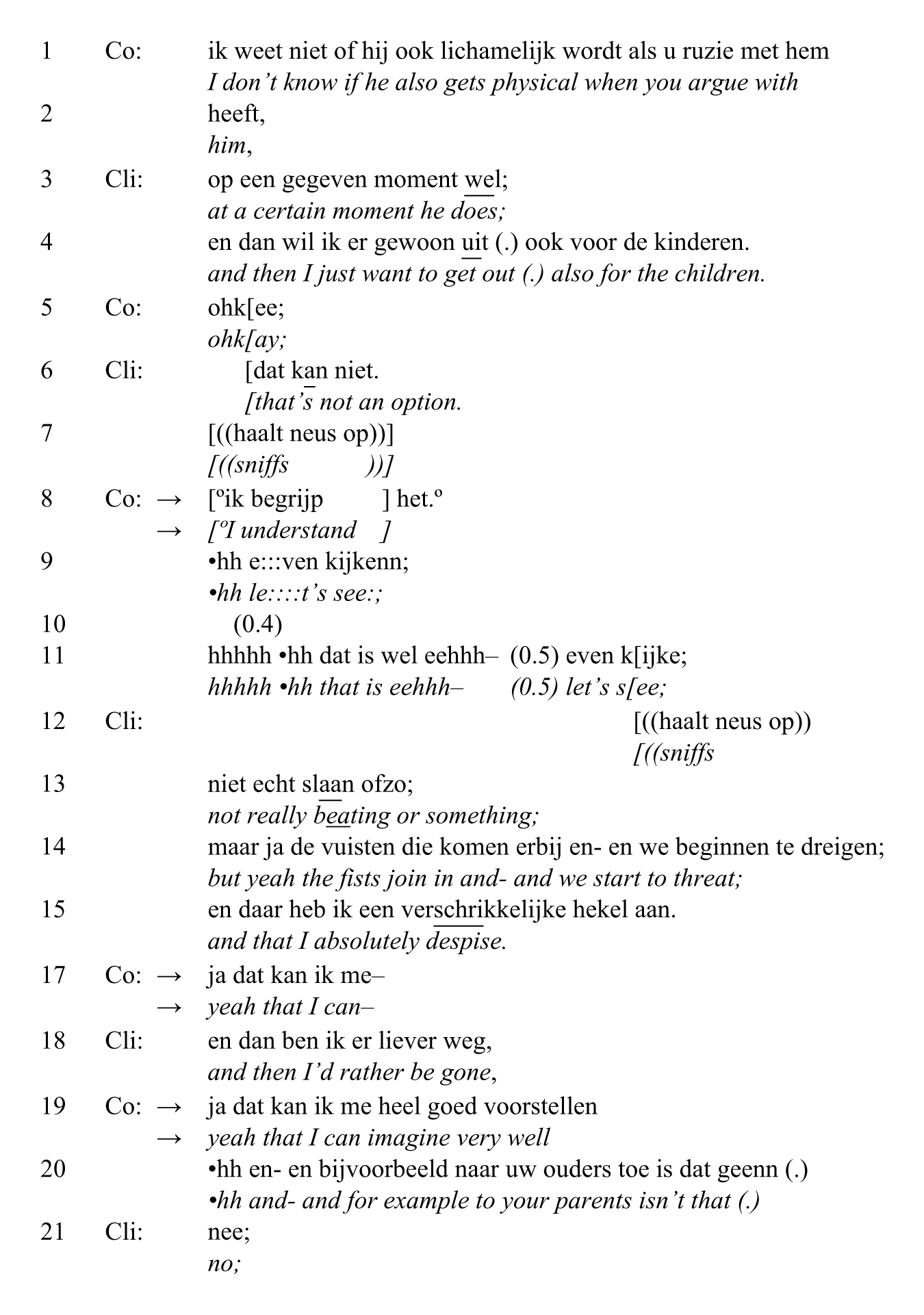
This fragment shows that a conventional empathy display is followed by a projection of advice. The first response from the counselor (line 8) displays understanding of the situation and supports the client’s claim that she doesn’t want to stay in the house when her husband gets aggressive. The counselor does not wait for a response, but is keeping the floor with stretched syllables and ‘let’s see’ announcements, thus projecting advice (lines 9–11). The client then provides more detail to the problem description, culminating in a mental state description (‘absolutely despise’, line 15). This elicits another empathy display (‘yeah that I can imagine very well’), which is followed by an advice in the same turn (the suggestion to go to her parents). This shows that empathic responses make relevant advice and function as a bridge between client’s troubles-telling and advice-giving.
Different types of empathic responses
Overall, the empathic responses overtly treat the client’s feelings as valid and justified, but in the particularities of their design they do more than that. In the majority of cases (43/71), the claimed understanding supports the progression of the interaction to the action of advice (cf. Weatherall and Keevallik, 2016). 2 In the analysis, we focus on empathic responses followed by the counselor’s advice, demonstrating that empathy works as a crucial stepping stone to advice-giving, by negotiating the validity of the client’s emotional state regarding their problem. Overwhelmingly (variant 1), empathic responses work to endorse the client’s feelings, advising and encouraging the client to change something (26/71). Alternatively, the empathic responses are somewhat disaffiliative. In variant 2, the empathic responses put the client’s feelings into perspective, implying that there is not really a problem that needs advice (9/71). In the third variant, the empathy displays treat the client’s feelings as standing in the way of a solution: that is, the feelings are understandable, but not recommendable given the situation (8/71).
(Fully) endorsing the client’s feelings
Excerpt 2 presents a caller (female, married 41 years) who reports that she recently found out that her husband, having a history of alcohol abuse, is still (or again) an alcoholic. The empathic response she receives underscores the articulated feelings, which supports the subsequent implicit advice that the husband’s alcoholism should stop. The Excerpt is taken from a long advice-giving sequence in which the client also recurrently expands her troubles-telling with details of the problematic situation. It begins where the caller explains how she checked on her husband’s alcohol consumption:
Excerpt 2 (tel 61, 21:44)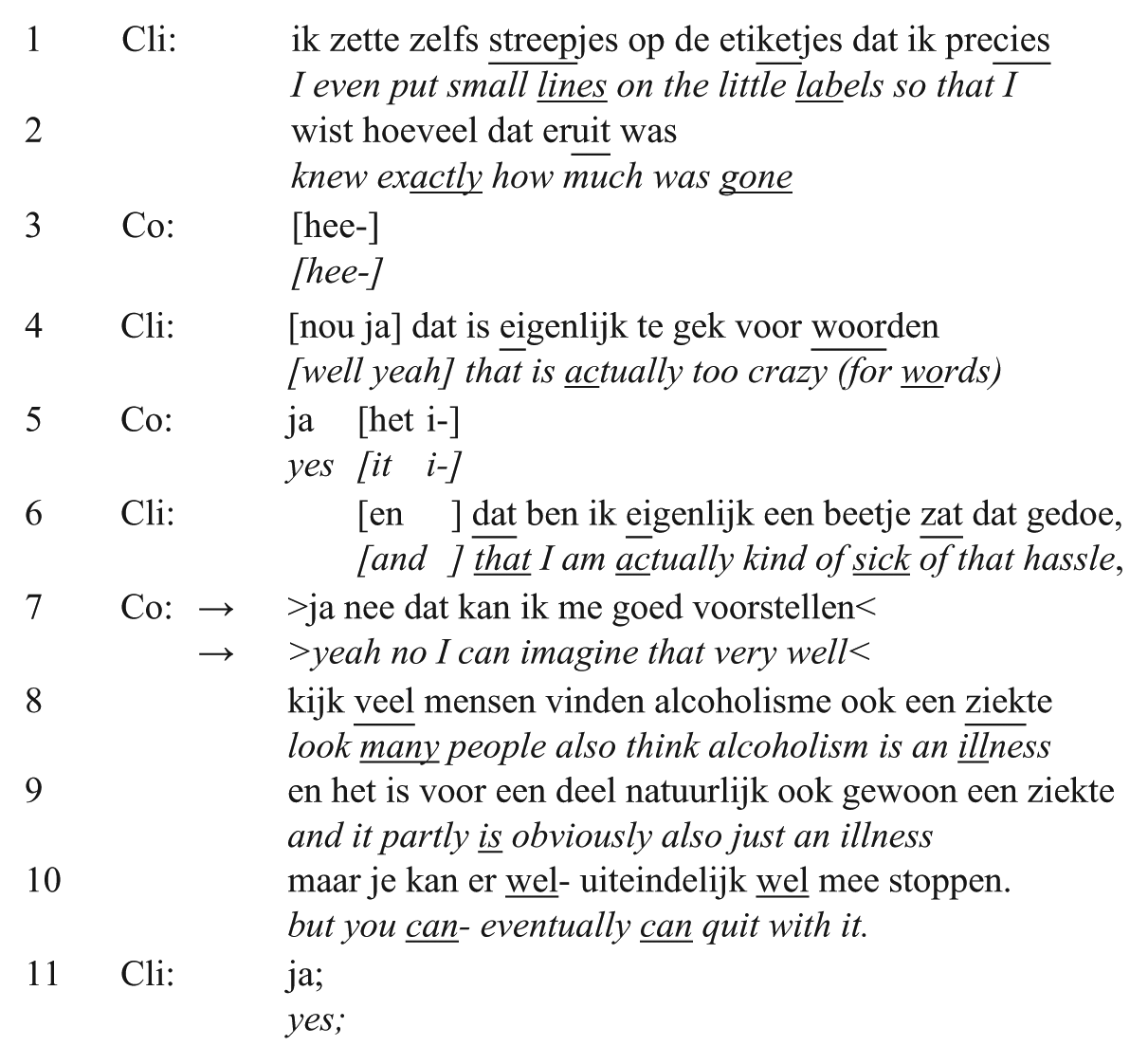
The client’s turn is built toward a mental state description of being ‘kind of sick of that hassle’ (line 6). It is this statement which elicits an empathic response from the counselor (line 7). This response fully legitimates these feelings (‘very well’). The ‘yeah no’ preface of the empathic turn aligns with the negative mental state description and works as an empathic agreement (Burridge and Florey, 2002). The fast delivery of the response puts emphasis on the counselor’s continuation rather than the empathy display itself, which contributes to its formulaic design. What follows in the same turn is an explanation of alcoholism announced with ‘look’ (line 8), thereby marking the transition to a different action trajectory (Sidnell, 2007). Although the explanation is somewhat paradoxical as alcoholism is both an illness (line 9) and a problem one can quit (line 10), the counselor foregrounds the second take on alcoholism: ‘but you
The next example shows even more explicitly how an empathy display may corroborate the client’s feelings as a bridge toward advice-giving. The client is a mother whose son uses hard drugs (speed, cocaine). During the call, the counselor has repeatedly given advice (to stop cleaning up the son’s house, to join a group for relatives of addicts), but the client has not overtly accepted any of them. Excerpt 3 shows the end of the call (except the closing greetings); the client has just declined more information about help groups and said she would call back for that tomorrow:
Excerpt 3 (tel verslaafde zoon, 37:20)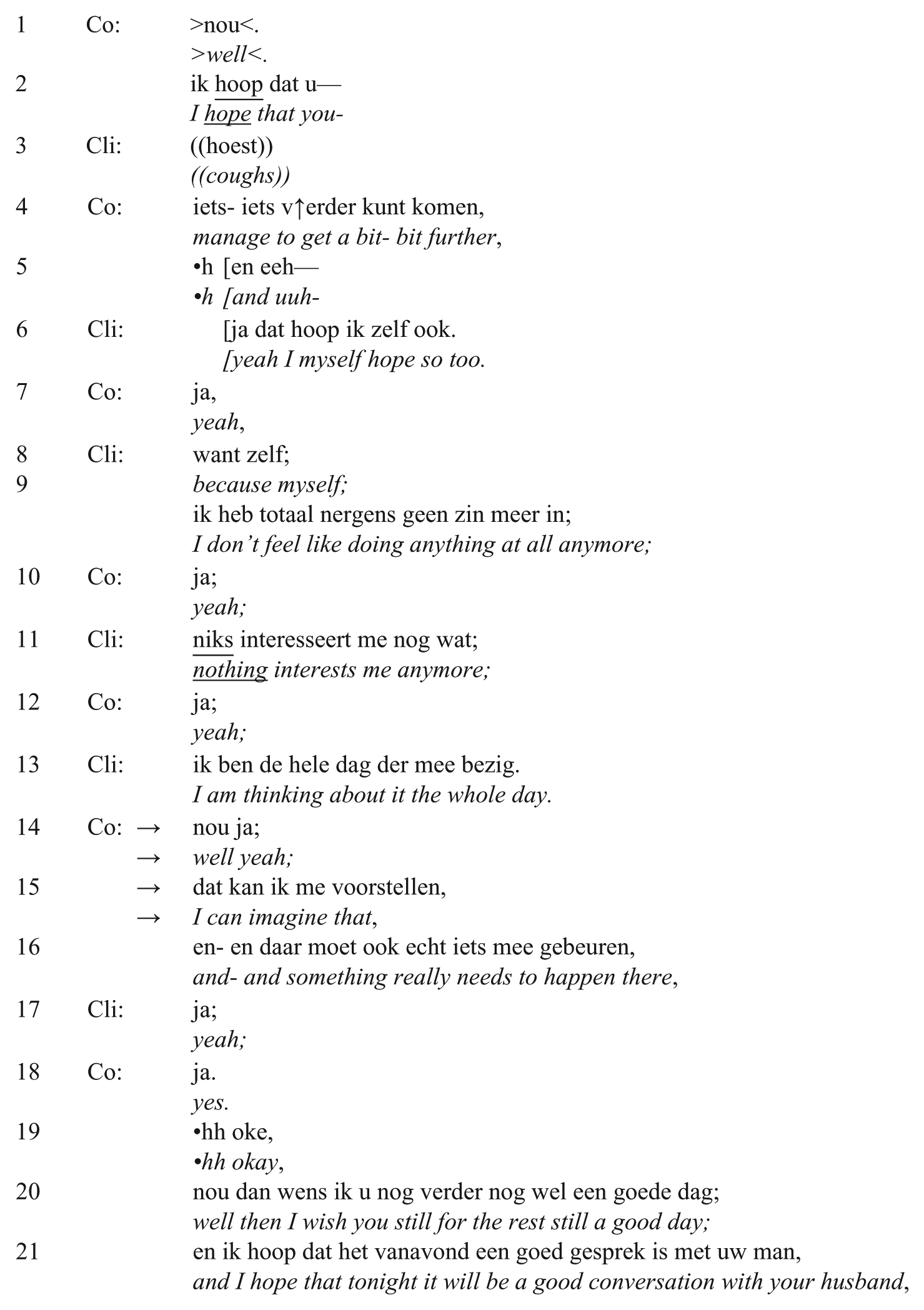
The counselor initiates the closing (‘well’) and expresses a rather vague, conventionally phrased hope for improvement (‘manage to get a bit further’, line 4), which leaves unsaid what the client should ‘get further’ with. At this position, and referring to the time after the call, this is a pre-closing move (cf. Stommel and Te Molder, 2015). The client, in overlap, takes the floor to overtly align with the hope for improvement (line 6), not explicating if she is planning to act upon the advice she received. She goes on to account for her hope with escalating mental state descriptions. The first (‘I don’t feel like doing anything at all anymore’, lines 8 and 9) articulates her general lack of energy or passiveness. The counselor only produces a brief acknowledgment, upon which the client continues with a second (‘nothing interests me anymore’, line 11) and a third mental state description (‘I am thinking about it the whole day’, line 13). Only then does the counselor affiliate with empathy (lines 14 and 15), although the turn beginning signals reluctance (‘well yeah’). The empathic response is followed by advice in a stepwise fashion. It starts with an advice-implicative claim (‘something really needs to happen there’, line 16), directly linking advice to the empathy display (‘and- and’). This advice is unspecified (‘something has to happen there’ rather than ‘you should x’), orienting to the client’s earlier advice resistance. Although the object of talk is unclear, the client claims acceptance of the advice (‘yeah’, line 17) and the counselor continues the closing with further ‘hopes’ (lines 18–21). The second of these hopes restages the client’s earlier presented wish/plan to discuss the issue with her husband and is thus more specifically advice implicative. Hence, in this Excerpt a display of empathy is used to shift the interaction step by step from lamenting to advice-giving, despite the client’s advice resistance. The stated feelings are endorsed as being a (legitimate) ground for advice.
Putting the problem into perspective
Empathic responses may also work in the opposite direction to relativize rather than to ratify the client’s feelings. Excerpt 4 is taken from a call in which a mother reports having found cigarette paper in her son’s bag, upon which he admitted having smoked weed once. The Excerpt occurs toward the end of a long advice-giving sequence which includes expansion of the troubles-telling and evaluations. In line 1, the counselor explains that the cardboard the son carried with him may be used as a filter for the joint:
Excerpt 4 (tel 80, 21:26)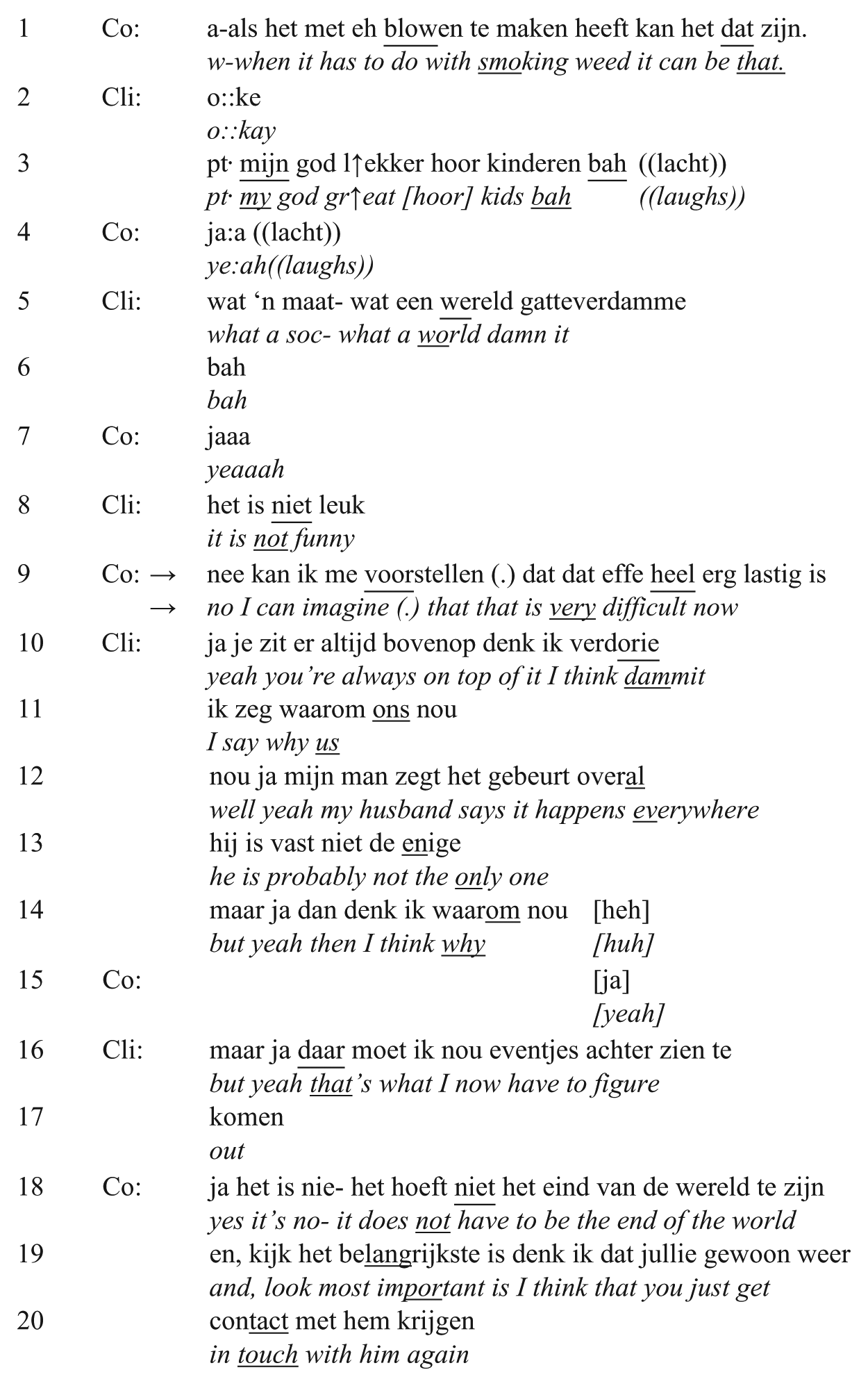
In this Excerpt, it is again an escalating complaint which finally receives an empathically designed response (line 9). After the client acknowledges the explanation for the cardboard (line 2), she initiates lamenting the situation she is in complaining ironically about kids in general (line 3) and then escalating the complaint to society, repaired as the world (line 5), in a serious tone of voice. The evaluative word ‘bah’ (line 6) constructs this complaint as a heavy affect and a physical sensation. The counselor’s agreement (line 7) weakly affiliates with the client’s stance, but it does not overtly empathize. This implies that the counselor is resistant to the client treating this as a major societal problem. The client continues her complaint about the situation but reduces its heaviness (‘it’s
Saliently, the counselor initially refrains from providing advice after the empathic response, despite the client’s orientation to advice relevance. After the empathy display, the client continues lamenting in a less dramatic way than before (from messed up world in line 5 to the question ‘why us?’ in line 11) and suggests the problem has a cause (‘why’). Next, she self-suggests what she should do (to figure out the cause); marking advice is relevant here. However, the counselor does not confirm this (self-)advice proposal. Instead, she challenges the client’s account of the son’s weed use as a big problem: ‘it does not have to be the end of the world’ (line 18). Hence, she again does not treat the client’s complaints as fully legitimate and refrains from building an advice on the basis of the articulated feelings. Note, however, that the counselor’s self-repair (line 18) shows an orientation to not opposing the client’s preceding account too firmly (from ‘yes it’s no-’ to ‘it does not have to be’).
When the counselor finally launches an advice (lines 19 and 20), it is ‘and’-prefaced and thus related to the previous relativizing evaluation of the problem (‘not the end of the world’). Furthermore, the advice is formatted as explanatory (‘look’, line 19) and as relatively simple (‘just’, line 19) in accordance with a minor problem. To conclude, this example shows how an empathy display can challenge the legitimacy of a client’s feelings and paves the way for an advice that puts the problem into perspective.
The next example shows another case of how an empathy display acknowledges the client’s feelings but simultaneously paves the way to relativizing advice. In this case, the empathy display is followed by an account in which the counselor reassures the client that what has happened is not her fault. The client smoked weed a couple of times during the first weeks of her pregnancy (before she knew she was pregnant) and is anxious to know whether this could have an effect on the ‘baby’. The interaction in Excerpt 5 occurred in the advice-giving sequence, which is interwoven with expansions of the reason for the call. Prior to the Excerpt the counselor told the client not to worry too much, but then the client explained that her first child had an extremely low birth weight and developed behavioral problems (‘hyper’). She is now worried her second child could develop similar deficiencies:
Excerpt 5 (tel 22, 8:25)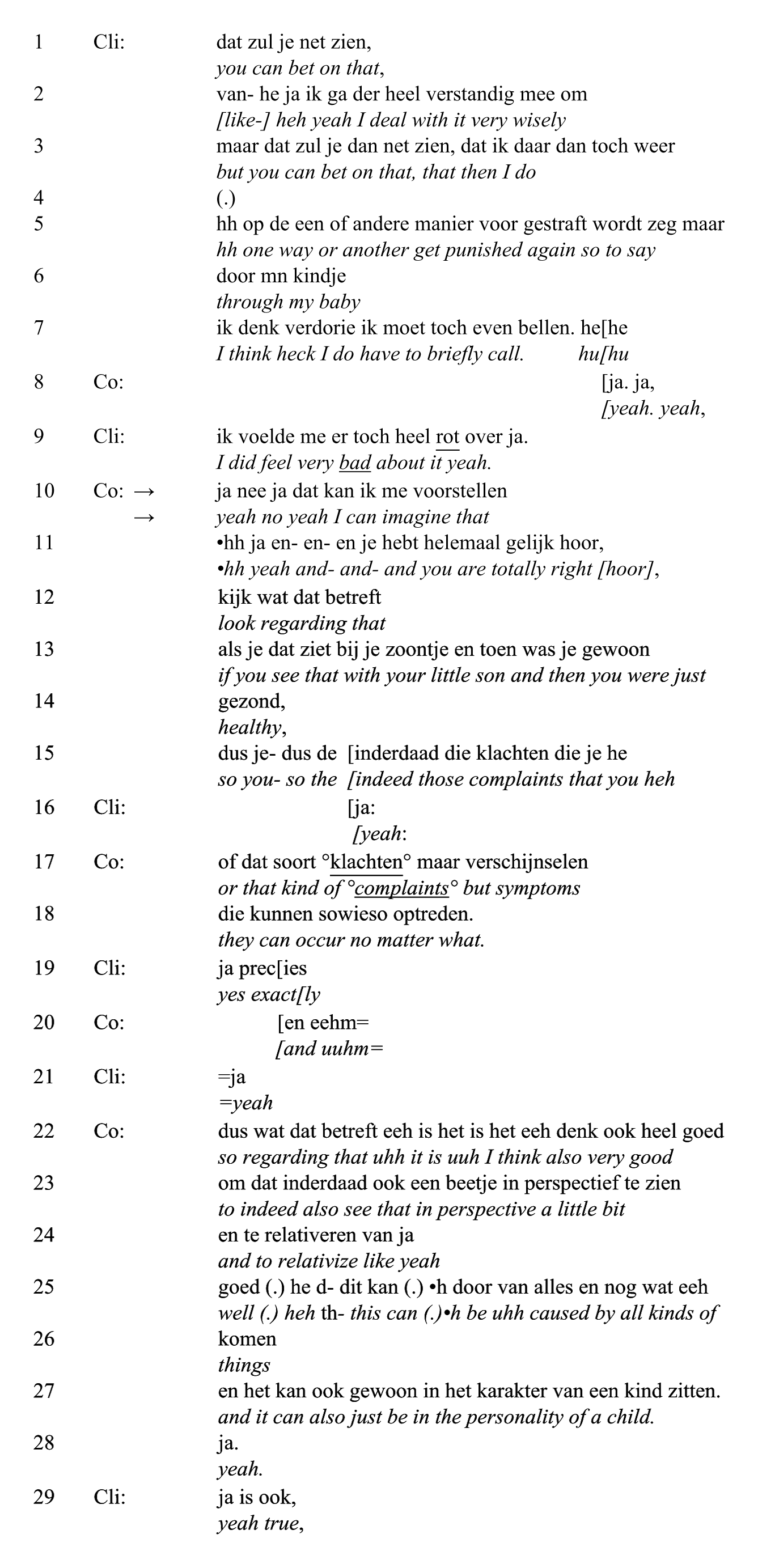
In the first turn, the client re-presents her reason for the call (her fear of getting ‘punished’, line 5), which culminates in a description of her feelings (‘very bad’, line 9). This mental state description elicits an empathic response from the counselor (line 10), prefaced by a series of alignment tokens ‘yeah no yeah’. It seems that ‘yeah no yeah’ is an upgraded version of the ‘yeah no’-preface, which works as an empathic agreement (Burridge and Florey, 2002). The counselor continues with explicit affiliation on a cognitive rather than an emotional level (‘you are totally right [hoor]’, line 11), which is presented as additional (‘and’) and congruent with the client’s stance more generally, since ‘hoor’ (untranslatable tag) links the current action to the global course of action (Mazeland, 2009). This turn develops into an advice (again designed with the contextualization cue ‘look’, line 12), which is to put these feelings of guilt into perspective (lines 22–27). The counselor gradually builds up the advice by first denying the direct link between smoking weed and symptoms in a baby, referring to the client’s first son (lines 13 and 14). She goes on to conclude that these effects can occur no matter what (lines 15–18), and that the client already recognized this (‘indeed’ in lines 15 and 23). Notably, the counselor self-repairs ‘complaints’ to ‘symptoms’ (line 17), slightly reducing the problem status of the client’s account. The client agrees explicitly (line 19), which serves as a basis for the counselor’s more direct advice to put ‘it’ into perspective a bit. The counselor goes even further by presenting a colloquial take on the ‘symptoms’ as ‘just’ the child’s personality (line 27). By agreeing to this assertion (‘yeah true’, line 29), the client accepts and goes along with (the relativizing tone of) the advice. In this way, the counselor’s empathy displays work as a bridging move to put the problem into perspective.
Feelings standing in the way of advice
A third type of empathy displays conveys that the clients’ feelings block a solution to the problem. In the next Excerpt, the client is a woman who calls about her alcoholic husband. He does not want to quit drinking, but she suggests that she possibly maintained the problem herself by always cleaning up his ‘shit’. The Excerpt occurred relatively early in the advice-giving sequence:
Excerpt 6 (tel 45, 6:48)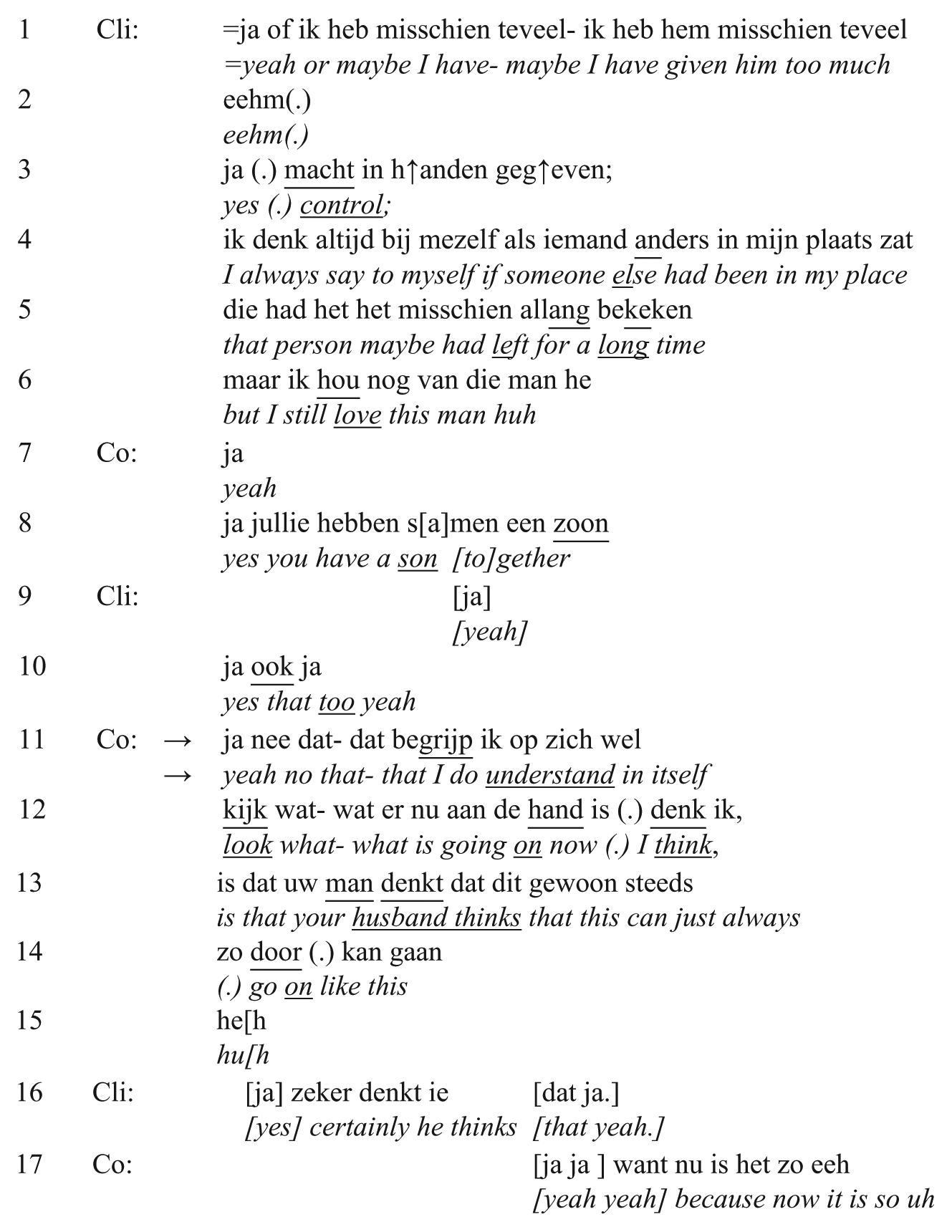
In this Excerpt, it is not a straightforward mental state description which elicits an empathically designed response. The participants negotiate legitimate reasons to not leave the alcoholic husband, including loving him (line 6, proposed by the caller) and ‘hav[ing] a son together’ (line 8, proposed by the counselor). The client treats the counselor’s proposed reason (the son) as no more than an additional reason: ‘yes that too’(line 10). Then, the counselor produces an empathy display: ‘yeah no that- that I do
The last example is taken from a call with another female client with an alcoholic husband (same call as Excerpt 2, earlier in the call). The Excerpt occurs relatively early in the advice-giving sequence, when the details of the husband’s drinking behavior have not been discussed yet. Prior to this Excerpt, she claimed that she would leave her husband if he refused to quit. A mental state description is produced in line 11: ‘it it it Excerpt 7 (tel 61, 5:25)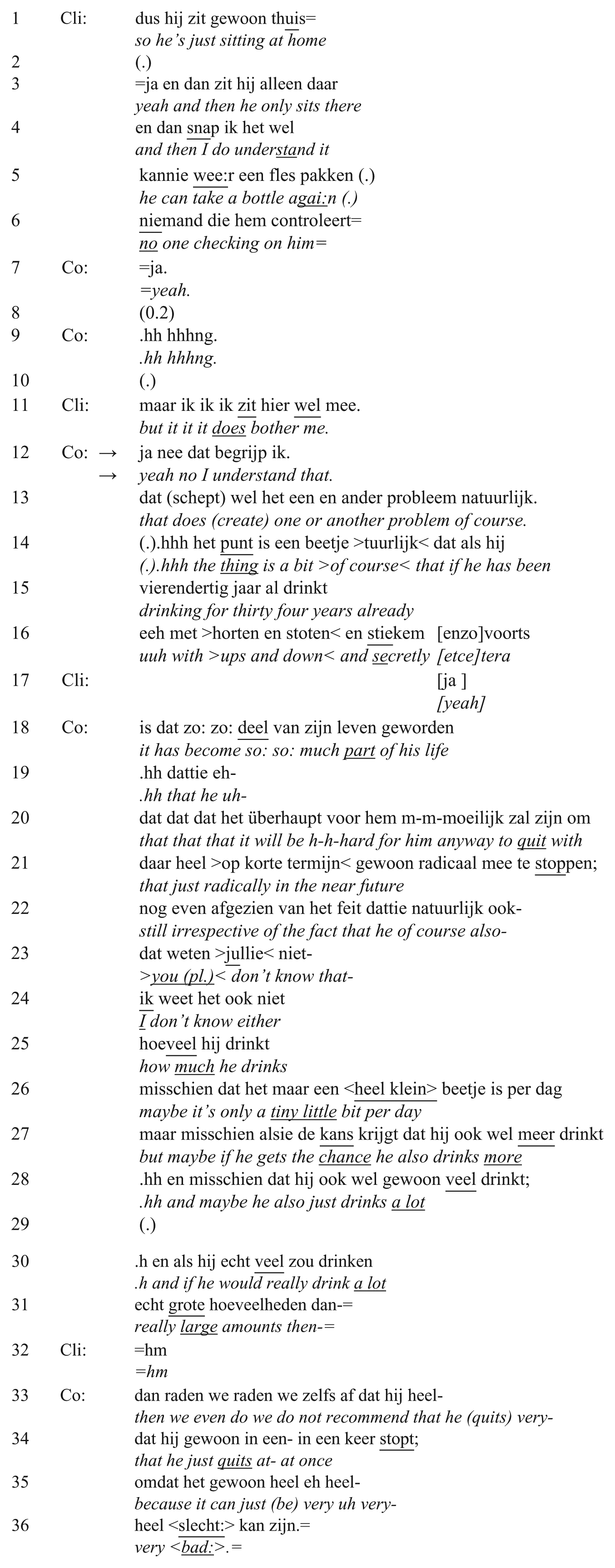
The Excerpt begins with the end of a narrative of how the client’s husband started drinking (heavily) again, being alone in the daughter’s house (lines 1–6). After an ambiguous continuer/agreement (line 7), the client does not continue (pause in line 8), signaling the relevance of a response. The counselor then produces a non-verbal throat sound with falling intonation (‘.hh hhhng.’ line 9), which conveys acknowledgment of the problem but nothing more than that. He could have chosen a third position evaluation here, a follow-up question or an advice on how to deal with the situation. Only when the client then verbalizes how this situation makes her feel (‘but it it it
We have seen that counselors usually produce empathically formatted responses and subsequent initiations of advice in one turn, albeit that the advice is formatted as explanatory (prefaced with ‘look’) and that the ultimate advice is delivered in a stepwise manner, by which its potentially inapposite force is reduced. The package of empathy and advice can work in a variety of directions relevant to the problem, endorsing the client to feel and do something, relativizing the problem or dejecting a course of action based on the articulated feelings. The observed relation between empathic responses and advice does not seem to be related to a particular phase of the call.
Discussion
The analysis has shown that empathically designed responses are pivotal moments in advice-giving; hence, actions in the progression of the interaction are related to the specific institutional tasks (Hepburn and Potter, 2007; Ruusuvuori, 2007). More specifically, these responses pave the way for advice-giving, in the sense that they negotiate the validity of the client’s (emotional) response to the problem. In institutional interaction, empathizing with the client implies imagining oneself in the client’s situation and imagining having the client’s experiences. Overwhelmingly, conventional empathy displays are directly responsive to the client’s articulated feelings. Frequently, these responses affiliate with and thus justify these feelings (cf. Voutilainen et al., 2011). However, some empathy displays treat feelings as ‘more than’ valid, that is, as an understandable and justified response to a (therefore) real problem that deserves a solution. Other empathically designed responses, while conveying understanding, at the same time avoid treating the feelings as legitimate or valid. For instance, clients who complain about their situation while their problem is only minor from an institutional perspective do not get responses that endorse their feelings. Clients who articulate feelings that seemingly block a solution to the problem similarly do not receive fully affiliative responses. The subsequent advice in those cases retrospectively explains the lack of affiliation.
The design of empathic responses deserves some reflection. The responses were frequently prefaced with aligning ‘yeah’, ‘no’ or ‘yeah no’, some included adverbs (‘very well’), and showed notable speed of production, self-repair and so on. It has been argued that some of these empathically designed responses, especially those formatted as I + understand + YOU + PSYCHOLOGICAL STATE, are cases of pro forma affiliation (Weatherall and Keevallik, 2016), that is, affiliating on the surface while in fact disaffiliative with the client’s stance. Our analysis, based on a collection of institutional responses in a variety of formats, suggests the relation between conventionally empathic responses and subsequent advice is more differentiated. The responses in our corpus negotiate a degree of affiliation related to the task of advice-giving. Hence, pro forma or not, real or unreal, empathically designed responses capitalize the richness of language and interaction more generally to negotiate the relation between the client’s feelings, the problem as counselling-relevant and a particular advice. This is interesting, as the client’s feelings – as any feelings of someone else – are in principle not accessible, and assessable, from the outside, by an outsider. Empathically designed responses in the fine details of their design are a practical solution to the lack of epistemic access to clients’ experiences and feelings, allowing a counselor to evaluate the ‘rightness’ of the client’s feelings. The subtleties of empathy displays in counseling interaction thus manage the ownership of experience and feelings (Hepburn and Potter, 2007; Heritage, 2011; Kuroshima and Iwata, 2016) and simultaneously pave the way to advice. Empathy arguably has ‘double-barreled’ (Schegloff, 2007) action force, both enacting different degrees of recognition, and pivoting a particular advice, by progressing those feelings as the basis for advice, or avoiding to do so.
Conclusion
The conventional empathy displays in Dutch telephone counseling frequently respond to a turn in which clients articulate their feelings. The responses are either affiliative, treating the client’s feelings as the basis for the advice, or less affiliative, putting the client’s feelings into perspective or implicitly questioning their legitimacy. They rarely receive uptake from the client. The analysis focused on those cases in which the counselors continued with an explanatory sequence, conveying an advice relative to the established validity of the feelings about a problem and therefore the legitimacy of the problem itself.
The analysis revealed that empathically designed responses are pivots to advice-giving. They are construed to navigate between full corroboration and conditional understanding of the articulated feelings. Alignment tokens (‘yeah’, ‘no’, ‘yeah no’), adverbs and prosody signal what feelings exactly are corroborated and to what extent, and relatedly project a particular advice. This unveils a dilemma inherent to counseling: How to empathize with the client without fully legitimizing feelings and/or the (implicitly) proposed courses of action that run counter to the counselor’s advice? Hence, there seems to be a friction between empathy and advice-giving. Completely affiliating with (negative) feelings implies claiming that ‘you are entitled to have these feelings’, which may block a solution or change or aggravates worries. Overall, it seems that displaying empathy in counseling interaction is an extremely powerful tool that counselors know how to use for their goals and clients know how to elicit and interpret. More research is needed to examine whether conventional empathy displays work similarly in advice-giving in ordinary interaction, in other advice settings (e.g. sales settings) and in other languages.
Footnotes
Acknowledgements
The authors are sincerely grateful to Nathalie Dekker from Trimbos Institute for collaborating with us. Furthermore, they would like to thank the participants of the December 2015 data session at Radboud University (special thanks to Geoff Raymond) for their valuable observations and comments, and Charles Antaki for his feedback on an earlier draft of the article.
Declaration of conflicting interests
The author(s) declared no potential conflicts of interest with respect to the research, authorship, and/or publication of this article.
Funding
The author(s) disclosed receipt of the following financial support for the research, authorship, and/or publication of this article: This work was supported by the Dutch Organization for Academic Research (Nederlandse Organisatie voor Wetenschappelijk Onderzoek) (NWO) program Comprehensive Language Use (project BGRK-11-06).