



Abstract
In this article, we explore the intersection between collective and hierarchical leadership in a software engineering company in Turkey. Drawing on 5 hours of video-recorded virtual team meeting interactions, we focus on decision-making processes as the team reports their progress. By employing Multimodal Conversation Analysis, we reveal the interactional dynamics among the project director, the official team leader and other participants in a software analysis team analyzed through deontic and epistemic lenses. We tease out the intricacies of leadership in the context of a professional hierarchy and by analyzing real time interactions, we demonstrate how leadership is collectively enacted in the sequential organization of talk. Our study provides further empirical evidence that fills the lacuna in understanding how collective and hierarchical leadership are intertwined in complex ways and thus responding to several calls in the leadership literature by analyzing these real-time interactions.
Keywords
Introduction
This paper explores the intersection between collective and hierarchical leadership in virtual team meetings recorded in a software engineering company in Turkey. In line with globalization, modern workplaces are increasingly reliant on video mediated interaction with teams collaborating across various boundaries necessitating the generation of different norms, skills, and experiences. While these developments were long on-going, they have been accelerated in the post-Covid era, and virtual team meetings are now widely perceived as the ‘new normal’ (Due and Licoppe, 2021), changing the modalities of professional communication (Schnurr, 2024). Among the workplaces which are most significantly affected by these developments are software engineering companies in which teamwork and communication are of crucial importance to coordinate software development projects (Buyukguzel and Mitchell, 2023). For example, members of software engineering companies dedicate a significant amount of their time to meetings where they are provided with updates on each other’s work, and as teams, they are engaged in various tasks such as decision-making, problem solving or task assignment. These developments are likely to have significant ramifications for leadership (Larson and DeChurch, 2020), in particular with regards to how leadership is accomplished in the context of virtual team meetings.
Moreover, in this professional context, where teams face conflicts, uncertainties, tight deadlines and have to constantly adapt to client requirements, leadership is particularly significant as attested by previous research (e.g., Gren and Ralph, 2022; Hofman et al., 2023; Quill et al., 2024). However, in spite of this interest in leadership in virtual environments in software engineering companies, there is to date, to the best of our knowledge, no conversation analytic study that explores this context in more detail. We find this surprising, given the widely acknowledged crucial role that language plays in the leadership process (e.g., Larsson et al., 2021; Schnurr, 2009). More specifically, while most previous research on this topic relies on interviews and quantitative surveys focusing on participants’ perceptions (e.g., Imam and Zaheer, 2021), in this paper, we take a conversation analytical approach and analyze naturally occurring audio- and video-recordings of virtual team meetings to capture the detailed discursive processes through which leadership takes place in flight. The particular focus of our investigations is the hitherto relatively under-researched intersection between collective and hierarchical leadership constellations within a professional hierarchy.
With this focus, we address recent calls for exploring various leadership constellations and the interplay between them by analyzing the discursive processes within a hierarchical structure (Fairhurst et al., 2020) to show how leadership is collaboratively achieved even in hierarchical constellations (Schnurr, 2024). At the same time, we also respond to the call for further studies on multimodal analysis of leadership in interaction (Van de Mieroop et al., 2020) in non-English speaking countries (Clifton et al., 2020; Schnurr, 2018) and in virtual context (Eisenberg et al., 2016; Hoch and Dulebohn, 2017). We thereby contribute to discursive leadership research and critical leadership studies to better understand and empirically capture the specific processes through which leadership is conjointly constructed and negotiated in the sequential unfolding of an interaction (Larsson et al., 2021; Schnurr and Schroeder, 2019).
Background
Conceptualizing leadership
Scholars, especially sociolinguists, and practitioners alike often use the term leadership as a concept in a relatively vague and uncritical way to refer to ‘all sorts of phenomena and constellations’ with no clear consensus (Schnurr, 2024: 154, see also Schnurr et al., forthcoming), and researchers are still working to clarify its definition (e.g., Larsson and Alvehus, 2023; Schnurr and Schroeder, 2019). However, in much recent research, traditional heroic notions of leadership which view leadership as located within an individual have been replaced by a more dynamic conceptualization of leadership which understands leadership as a collaborative process in which various participants are involved (Alvesson and Spicer, 2014; Schnurr, 2022). According to the later view, leadership is understood as a process of interpersonal influence to achieve organizational goals (Grint, 2010; Northouse, 2016; Yukl, 2013). This conceptualization of leadership is grounded in discursive leadership (Fairhurst, 2007), a tradition that explores the discursive processes through which leadership is enacted utterance-by-utterance throughout an interaction.
This post-heroic understanding of leadership highlights that rather than being a fixed, stable phenomenon ascribed to the characteristics of an individual leader (i.e., typically someone in a hierarchically senior position in a team or an organization), leadership is an ongoing process which is actively and dynamically constructed through an interaction. One of the benefits of this understanding of leadership is that it enables researchers to challenge the assumption that it is always necessarily the leader ‘calling the shots’ (Clifton, 2017: 45). Rather, it allows us to challenge the traditional dichotomy between leaders and followers (Collinson, 2017, 2020), and to acknowledge that leadership is a continuous process of action (Van De Mieroop, 2020) in which interlocutors engage in a dynamic interaction with each other, blurring the traditional boundaries between leader and follower.
Within this framework, leader identities are co-constructed discursively. In other words, they ‘are considered something that people do, rather than something that people have’ (Clifton et al., 2019: 7). Such identities are not ‘necessarily homogenous and consistent’, and they may change from one turn to another (Schnurr and Chan, 2011: 190). Adopting social-constructivist approaches to identity work (Benwell and Stokoe, 2006; Bucholtz and Hall, 2005) in different forms of leadership constellations, researchers have teased out how leadership is a collective process in which leader identities are collaboratively enacted, constructed, resisted and negotiated as an interaction unfolds (e.g., Salomaa et al., 2024; Schnurr and Zayts, 2011; Van de Mieroop, 2020). Thus, they analyze how participants ‘talk themselves into being as the leader’ (Clifton, 2006: 209) rather than a priori assigning the identity of leader to the person in the most hierarchical role or position.
Research studies taking this discursive approach typically use empirical data in the form of audio- and/or video-recordings of naturally occurring interactions to identify, describe and analyze the discursive practices through which leadership is asserted, granted and negotiated at the micro level of an interaction (Schnurr and Schroeder, 2019). Although previous sociolinguistics research has focused on the language use by individuals in hierarchical positions (e.g., Holmes and Marra, 2004; Schnurr, 2009), more recent studies show ‘how leadership as a shared phenomenon is enacted as part of everyday workplace routines’ (Clifton et al., 2020: 513). These studies have, for example, provided important insights into the ways in which leadership is performed collaboratively, by exploring different forms of collective leadership (Denis et al., 2012; Fairhurst et al., 2020; Schnurr et al., forthcoming) including co-leadership (Schnurr and Chan, 2011; Vine et al., 2008), distributed leadership (Choi and Schnurr, 2014; Clifton, 2017), informal leadership (Van De Mieroop et al., 2020), emergent leadership (Janssens and Van De Mieroop, 2024; Schnurr et al., 2021), or distributed leadership constrained by the seniority principle (Van De Mieroop, et al., 2023). These studies demonstrate that leadership is a process of reciprocal influence (Larsson and Lundholm, 2010) accomplished in collaboration with others rather than an individualistic act and a top-down exercise of power to fulfill organizational goals. However, this does not necessarily mean dismissing the hierarchical dynamics of a team or an organization as irrelevant (Collinson, 2018). Rather, as previous studies have shown, professional hierarchy is still important and often interacts with collective leadership in complex ways (e.g., Fox and Comeau-Vallée, 2020; Lortie et al., 2023).
In spite of these recent developments, we still know relatively little about the ways in which collective and hierarchical leadership intersect with each other. Holm and Fairhurst (2018: 694) recently described this gap in current scholarship, noting that it is ‘one of the current fault lines in the quest to illuminate the nature of leadership [that] lies in the relationship between hierarchical leadership and more plural forms’. This paper addresses this gap by providing an empirical study to explore precisely this relationship between collective and hierarchical leadership in virtual team meetings recorded in a software engineering company in Turkey.
Previous work on collective leadership
A growing body of research has examined collective leadership (Bolden, 2011; Denis et al., 2012) emphasizing its shared, fluid and dynamic nature. These studies highlight how leadership unfolds in collaborative interactions across various contexts rather than being restricted to one individual and thus moving beyond the traditional definitions of leadership (Edwards and Bolden, 2023; Ospina et al., 2020). In addition, by challenging the clear-cut distinction between leadership and followership (Empson and Alvehus, 2020), critical leadership suggests followers are ‘proactive, self-aware and knowing subjects’ with a ‘repertoire of possible agencies within the workplace’ (Collinson, 2005: 1422).
Previous research has recognized collective leadership as an umbrella term for plural leadership forms such as co-leadership, shared and distributed leadership (Contractor et al., 2012; Fairhurst et al., 2020; Ospina et al., 2020, Schnurr et al., forthcoming). We also use this collective understanding of leadership without distinguishing between these specific forms. We further argue that an interactional approach to leadership is particularly beneficial in this context as it allows us for an in-depth exploration of leadership as a collective social process in situ (Larsson and Alvehus, 2023; Schnurr and Schroeder, 2019).
The collective nature of leadership has been investigated in previous studies such as by analyzing the processes and conditions under which collective leadership behaviors are used (Friedrich et al., 2016) or the complexities of collective leadership (Empson and Alvehus, 2020) in professional service firms. Others have also examined the paradox of co-leadership in dyads in healthcare settings (Gibeau et al., 2020), the transition from hierarchical to collective leadership in mining disasters (Sanfuentess et al., 2021), Māori ecosystems (Spiller et al., 2020) and leadership dynamics during periods of uncertainty in haute cuisine kitchens (Lortie et al., 2023).
Collective leadership is also increasingly being observed in recent sociolinguistic research to analyze the collective accomplishment of leadership in sports (Schnurr et al., 2021) or in teams without a designated leader (Choi and Schnurr, 2014). However, considering the crucial role of context in leadership (Maupin et al., 2020; Schnurr, 2024), it has been suggested that other settings should also be examined (Fox and Comeau-Vallée, 2020).
Although the above research provides considerable insight into various contexts, given that collective and hierarchical leadership ‘are not necessarily exclusive’ (Yammarino et al., 2012: 391) and can coexist (Cullen-Lester and Yammarino, 2016), further research on the interplay between collective and hierarchical leadership is needed. However, empirical studies often approach them as opposites due to being context-dependent or positioning collective leadership as superior (Empson et al., 2023). Consequently, as Collinson (2014) argues, this either/or binary view may not adequately capture the intersection between hierarchical and collective leadership.
Studies have also noted the importance of addressing power dynamics in collective leadership studies (e.g., Denis et al., 2012; Holm and Fairhurst, 2018). In this regard, drawing on Gronn’s (2011) work, Fairhurst et al. (2020: 604) suggest that scholars first ‘decipher the configurations of CL [collective leadership] and its power-laced foundations’. Thus, they point out the significance of analyzing leadership configurations (Gronn, 2015) rather than focusing on the individual leader with hierarchical authority.
Moreover, some studies have moved beyond this dichotomy to gain a deeper understanding of how hierarchical and collective leadership interact with each other, such as presenting the idea of ‘hybrid leadership configurations’ (Gronn, 2009), indicating how shared leadership plays an important role in performance when it is combined with vertical leadership (Pearce and Sims, 2002) or exploring the coexistence of individual and collective leadership narratives in professional service firms by emphasizing the ‘mutually constitutive’ (Empson et al., 2023: 221) dimensions. Friedrich et al. (2024) studied how gender shapes the reciprocal relationship between a team’s shared leadership style, and the formal leader’s collective leadership style, and how these jointly affect team performance. However, we still do not have a complete understanding of this interplay between the two (but see e.g., Holm and Fairhurst, 2018; Van de Mieroop et al., 2020), and we believe that a multimodal conversation analytical approach could make important contributions here.
A study that is relevant in this context is Van De Mieroop et al. (2020), who demonstrated the collective nature of leadership and showed how formal and informal leadership configurations are multimodally accomplished in a hierarchical context, albeit sometimes resulting in conflict. While this study makes important observations, it also calls for further empirical investigations into how shared and hierarchical leadership are interrelated in different communities of practice. The authors call for a ‘fine-grained analyses of participants’ in situ achievement of leadership’ (Van de Mieroop et al., 2020: 511). Furthermore, while there is a growing body of research on leadership in virtual contexts (e.g., Liao, 2017; Morrison-Smith and Ruiz, 2020), few studies focus on the interactional in situ practice of leadership in virtual meeting contexts (e.g., Arvedsen and Hassert, 2020; Janssens and Van De Mieroop, 2024).
We contribute to this burgeoning literature by further exploring the complex intersection between collective and hierarchal leadership in the sequential unfolding of online daily team meetings among the members of a software engineering company in Turkey. In our analyses, we pay particular attention to the relationship between participants’ (interactional and notional) roles and the discursive practices they display when dynamically navigating between collective and hierarchical leadership. In line with this focus, we ask: How are collective and hierarchical leadership intertwined during decision-making episodes in the online team meetings of a software engineering company?
Methodology
Data and method
In this paper, we employ Multimodal Conversation Analysis (MCA) (Mondada, 2018; Sidnell and Stivers, 2012) for an in-depth analysis of leadership in daily online meetings. As an inductive research methodology, CA (Sacks et al., 1974) allows the detailed examination of naturally occurring interaction from an emic perspective through the next turn proof procedure (Hutchby and Wooffitt, 2008; Sidnell and Stivers, 2012), which examines how the subsequent turn in a conversation reveals the participants’ own understanding of prior turns. Thus, it documents the interactional resources participants use to produce social actions by drawing on evidence emerging from participants’ own orientations rather than the analyst’s interpretations.
CA has previously been adopted to investigate the details of institutional talk (Drew and Heritage, 1992), and particularly, meetings as joint accomplishments of participants (Asmuß and Svennevig, 2009). Building on this methodological tradition, as workplace communication increasingly takes place online, recent research has extended CA to video-mediated environments. In particular, Conversation Analytic studies have explored how participants accomplish and negotiate everyday tasks in these settings (Arminen et al., 2016; Due and Licoppe, 2021; Heath and Luff, 1993; Mlynař et al., 2018). As Luff et al. (2003) explain, video-mediated environments constitute ‘fractured ecologies’, in which participants do not share the same physical space or have access to each other’s local materials, which make coordination and mutual understanding more challenging (Heath and Luff, 2000; Hutchby, 2001; Rintel, 2015). In this respect, these studies demonstrate how participants organize joint action and maintain intersubjectivity through embodied, material, and digital resources across various institutional contexts, such as business meetings (Nielsen, 2019; Oittinen and Piirainen-Marsh, 2015), daily scrum meetings (Büyükgüzel and Balaman, 2023), courtrooms (Licoppe, 2015), or public service encounters (Due et al., 2019).
CA has also been utilized in leadership studies such as Clifton (2019), Larsson and Lundholm (2013), or Nielsen (2009) to make visible ‘the normally seen but unnoticed machinery of talk with which leadership is enacted’ (Clifton, 2006: 202). With the multimodal turn in social interaction (Deppermann, 2013; Mondada, 2011, 2016), CA studies employing a multimodal approach in corporate meetings have started to focus on how participants make use of various resources such as bodily movements or materials in interaction (e.g., Asmuß and Svennevig, 2009; Büyükgüzel and Balaman, 2023; Oittinen, 2018). As Mondada (2011: 542) emphasizes, this approach enables researchers to understand how sensemaking is achieved in interaction through ‘situated, contingent, embodied, and intersubjective dimensions’, which is crucial for an understanding of leadership (e.g., Arvedsen and Hassert, 2020; Larsson et al., 2025; Van De Mieroop et al., 2020).
The data for this study come from a corpus of daily meeting interactions from different teams collected by the first author during 10 months of fieldwork in a software engineering company in Turkey in 2021. As soon as the Covid-19 pandemic started, the company started to work online; it has since then continued with these online and hybrid working arrangements established during the pandemic. The team analyzed for this study was the analysis team of the company who worked both online and offline depending on the needs and regulations required during the pandemic. The team is responsible for gathering and analyzing client requirements, designing system architecture, creating detailed designs, prototyping, documenting decisions, and collaborating with other teams in the company to ensure that software solutions meet business needs and objectives.
Overall, the data consist of 302 minutes of video-recordings from 21 daily online meetings conducted and recorded in Microsoft Teams. The members of the team are the official team leader (TEN) and three team members (BUR, UMA, SUN). The meetings, which took place every morning, lasted between 5 and 37.5 minutes. The project director (ALP) also attended these meetings when possible to make sure everything ran smoothly. In this paper, we focus on those meetings where the project director is also involved to deepen our understanding of how leadership is negotiated within a professional hierarchy and to analyze how hierarchical and collective leadership interact with each other.
The aims of these daily meetings are for the team members to stay informed about each other’s work, report on their own progress, and address three main questions which are: (1) What has been completed/achieved since the previous meeting? (2) What will be completed today and before the next meeting? (3) Are there any challenges being faced? These meetings also enable team collaboration and coordination, and timely problem resolution on project timelines.
At this point, it is important to provide some more information about the duties of the team members. As the project director, ALP, a software engineer with 25 years of experience, oversees all the projects in the company both from the technical side as well as dealing with customer matters; he also oversees personnel, processes, and tasks from an administrative standpoint. TEN, a software engineer with 12 years of experience, is the official team leader; she provides direction to the team, coordinates the team, and handles project planning and management with the project director, and communicates with the stakeholders and other teams when needed. As for the other three team members, they are software engineers, one with 3.5 years of experience (BUR), while the two others (SUN and UMA) are in their first year of work as junior business analysts in the team.
The company’s and participants’ approval were obtained through informed consent forms to ensure confidentiality and privacy and the procedure outlined by the Human Subjects Ethics Committee of the affiliated university was followed. All the participants were protected by pseudonyms.
Analytical processes
In pursuing a leadership-in-interaction approach, and in accordance with the basic principles of Multimodal Conversation Analysis, we watched the video-recordings of the meetings repeatedly through ‘unmotivated looking’ (Ten Have, 2007). We then identified instances of decision-making episodes, which we transcribed using Jefferson’s (2004) and Mondada’s (2018) transcription conventions (see for Appendix) by means of the Transana software with the aim of capturing and making analyzable interactional details, such as turn-taking, repair and sequence, preference organization and embodiment/multimodality. In what follows, we analyze and discuss our observations line-by-line to illustrate the complex intersection between collective and hierarchical leadership. While all sequences involve decision-making processes, we focus in particular on the decision-making phase in which the team reports their progress. As discussed in previous discursive leadership literature, decision-making episodes can be regarded as ‘the prime sites for the doing of leadership’ (Clifton, 2017: 49), and as important events where future organizational goals are achieved (Clifton, 2009, 2012; Van De Mieroop, 2020). All data was translated (by the first author, a native speaker of Turkish) from Turkish to English semantically by focusing on meaning and context to ensure readability and clarity rather than word-by-word translation.
In order to analyze the discursive processes involved in leadership in the sequential unfolding of interaction, we used the concepts of deontic and epistemic status and stance. The concept of deontic rights (Stevanovic, 2018) or deontic authority (Stevanovic and Peräkylä, 2012) refers to ‘the right to determine others’ future actions’ (Stevanovic and Peräkylä, 2012: 297). Svennevig and Stevanovic (2015) state that deontic authority may manifest itself in two distinct forms, namely proximal, related to local interactional agenda or distal, related to others’ future actions, which are often interwoven in complex ways (Ekström and Stevanovic, 2023). At this point, it is important to note the difference between deontic status and stance. Whereas deontic status refers to the level of authority and power participants hold regardless of their public claims, deontic stance means how participants publicly exhibit their authority and power in their actions compared to others (Svennevig and Stevanovic, 2015). This distinction is crucial since deontic stance and status may not always align with each other, that is, the deontic stance a speaker adopts may be congruent or incongruent with their deontic status (Stevanovic, 2018). For example, a junior team member may assert a powerful deontic stance (such as proposing new project approaches) despite their low hierarchical position; and therefore, incongruent with their deontic status as the junior team member. As Van De Mieroop (2020) states, this distinction is closely connected to the tensions between the pre-discursive roles and positions held by individuals and their actual behavior displayed in the sequential unfolding of an interaction.
Having explored deontics, it is also crucial to acknowledge the role of epistemics in interactional leadership work. Epistemics focus on ‘the knowledge claims that interactants assert, contest, and defend in and through turns at talk and sequences of interaction’ (Heritage, 2013: 370). Epistemic authority refers to participants’ right to know in relation to co-participants and display knowledge (Heritage and Raymond, 2005; Raymond and Heritage, 2006; Stevanovic and Peräkylä, 2014; Svennevig and Stevanovic, 2015). Epistemic claims are enacted and negotiated in interaction ‘central to the maintenance of identity itself’ (Heritage, 2013: 371). As for the status-stance distinction, while epistemic status can be defined as ‘the position that a participant has in a certain domain of knowledge’ (Stevanovic and Peräkylä, 2014: 187), epistemic stance refers to public ways of demonstrating how knowledgeable someone is (Svennevig and Stevanovic, 2015). Thus, whereas the epistemic order deals with knowledge claims and participants’ access to knowledge domains, the deontic order is concerned with authority. As we show and explore in more detail in our analyses in the following section, the notions of deontic and epistemic stance and status prove to be particularly useful for the operationalization of leadership as an in situ social phenomenon (e.g., Clifton, 2019; Murphy, 2025; Schnurr et al., 2021; Tranekjær et al., 2022; Van De Mieroop, 2020).
In the next section, we analyze three interactional sequences (which we have broken down into shorter extracts for ease of reading) to explore the intersection between collective and hierarchical leadership in the sequential organization of interaction.
Analyses
The decision-making sequences analyzed below were selected from the wider data set because they are representative of our overall observations with regards to how the team make decisions, and also because of their relatively short nature. In our analyses, we consider both participants’ verbal utterances and their embodied actions during the virtual meeting, and we thereby illustrate how leadership is collaboratively accomplished in this otherwise hierarchical context.
In the first example, we show an interactional fragment in which one of the team members displays an incongruent deontic stance when questioning the announced decisions previously made by two formal leaders and the complex intersection between collective and hierarchical leadership is evident. In our analysis of the second example, we zoom in on the interactional moves between two formal leaders (i.e., the team leader and the project director) with whom they negotiate hierarchical and collective leadership.
Extract 1
In this extract (1a, 1b, 1c), one of the team members (BUR) displays a stance incongruent with her low deontic status, which leads to an episode of collective leadership as we illustrate below. The navigation between collective and hierarchical leadership is clear.
At the beginning of this meeting, ALP mentioned they made plans for the projects together with TEN, and TEN would present these plans regarding the current and future projects in today’s meeting. At this point in the meeting, the main topic of the discussion revolves around project management and decision-making for two specific projects. The team are discussing the project’s timeline, risks, information sharing, and the need for support. Tase and embank are the pseudonyms for the projects they are involved in. Prior to this extract, TEN has engaged in a typical team leadership activity, namely, outlining the future actions other team members need to undertake, and delegating tasks (Choi and Schnurr, 2014) while ALP is engrossed in his screen.
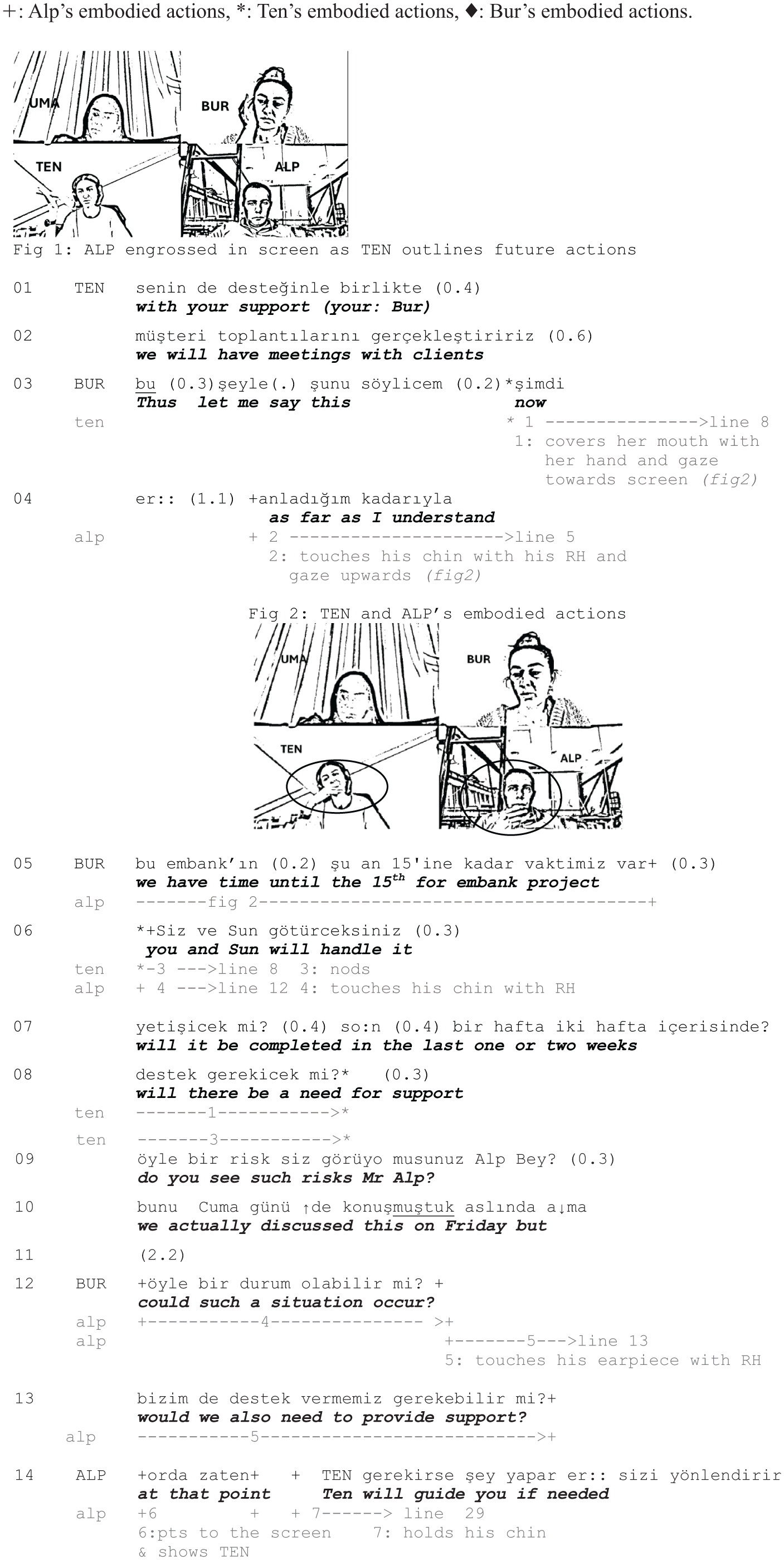
The extract starts with TEN acknowledging the contributions of BUR to hold the meetings for the ‘Tase’ project by using the informal possessive pronoun ‘senin’ (your). This is then followed up by emphasizing the collective responsibility of the entire team using the first-person plural suffix ‘-iriz’ (we will have meetings). Her use of this (Line 2) ‘assumes commitment and agreement’ from other team members (Clifton, 2017: 60), and thus reflects her deontic status and stance which allow her to speak for the team. In what follows, BUR self-selects as the next speaker, changes the ongoing topic and initiates a new topic about the timeline of another project ‘embank’. BUR’s use of the demonstrative pronoun ‘bu’ (this) and the interactional discourse marker ‘şeyle’ (regarding this thing), as well as the phrase ‘şunu söylicem’ (I will say) together with the demonstrative pronoun ‘şu’ (this/that) accompanied by intra-turn pauses shows the transition to a new topic in a stepwise fashion. Through embodied actions (Figure 2), TEN and ALP show their engagement and processing of BUR’s utterances as they orient towards the screen.
It is worth noting that while he is initially engrossed in the screen, ALP’s abrupt change in listenership becomes evident when he directs his gaze upwards and puts his right hand on his chin (Figure 2). From line 5 on, BUR delivers an extended turn about the completion of the project and how it will be handled by TEN and SUN. While BUR addresses TEN using the formal pronominal form ‘you’ (Line 6), TEN, in turn, employs the informal possessive pronoun ‘senin’ (your) (Line 1) to address BUR, which demonstrates an orientation to the hierarchical difference between them. Followed by 0.3 seconds of silence, BUR’s statement is ratified by TEN’s nodding (Stivers, 2008) and ALP’s processing with his embodied action (4: Line 6). Thus, we observe that BUR’s explicit moves for the topic transition can be seen as potential claims for deontic rights on the conversational floor, and enactment of leadership (Van de Mieroop, 2020), shaping the course of the meeting before she further develops the topic. Importantly, TEN and ALP attend to and reinforce these leadership claims by BUR through their embodied actions. In doing so, they align with the new direction on their agenda and follow BUR’s lead.
In lines 7–10, BUR asks several clarification questions, for example about the task’s completion timeline and the need for support and potential risks, which are accompanied by TEN’s listenership (Knight et al., 2024) and her embodied actions (e.g., nodding: line 8). By seeking clarification and raising concerns, BUR potentially questions the project planning and one of the previously announced decisions made by ALP and TEN. She thereby displays her epistemic stance and initiates a new decision-making process, thus making leadership moves. She achieves this by orienting to intra-turn silences to draw attention to specific points highlighted while formulating her stance.
BUR’s last question (line 9) seeks validation from the project director ALP about the potential risks and explicitly nominates him as the next speaker by directly addressing with the honorific title ‘bey’ (Mr) and the formal pronominal form ‘siz’ (you). Similar to how she previously addressed the team leader, she thereby orients to the hierarchical difference between herself and ALP and acknowledges and reinforces their respective deontic status. Importantly, however, BUR thereby bypasses and usurps TEN (the team leader’s) deontic status. Moreover, by explicitly orienting to ALP she at the same time acknowledges his higher epistemic status and places him in a leadership position and with the deontic authority and status to make or ratify any decision for the project planning and timelines. Note that BUR directs her questions to ALP and invites him to the conversational floor despite his initial embodied disengagement at the beginning of the extract (see Figure 1). This demonstrates an orientation to hierarchical leadership positioning ALP as the eligible authority to decide.
In line 10, BUR then refers back to the previous discussion, and by addressing the previous agenda and in particular by uttering the disagreement marker ‘ama’ (but), she brings up a new topic (which might have been overlooked in previous discussions), namely whether there will be a need to support from BUR and UMA in the embank project. The 2.2 second silence as a transition relevance place in line 11 could be interpreted as inviting ALP to respond, but following the noticeable absence of any response in the virtual space, BUR goes on posing further questions (lines 11–12) thereby actively shaping the sequential organization of the talk (Choi and Schnurr, 2014; Schnurr and Chan, 2011).
With her questions about the other meeting, BUR also noticeably changes the trajectory of the meeting, and challenges the goals set by ALP and TEN, which could be interpreted as displaying heightened deontic and epistemic stance. Thus, BUR claims leadership for herself while at the same time acknowledging ALP’s authority, demonstrating how hierarchical and collective leadership coexist. These claims are responded to by ALP who changes his embodied action (4: line 12) and touches his earpiece with his right hand (5: Line 12), signaling his readiness to respond to the ongoing conversation. Upon taking the turn (line 14), he produces the second-pair part of the question-answer adjacency pair and his embodied response is to point to the screen and TEN. Thus, rather than accepting the assigned leadership identity BUR projects onto him, he emphasizes TEN’s epistemic and deontic status as the team leader and passes on the decision-making responsibilities to her. Therefore, ALP rejects taking the lead and rather than making a unilateral decision, he distributes deontic rights and shifts from hierarchical leadership expectations to collective leadership. By relinquishing his own deontic rights to author this organizational goal, ALP cedes his deontic authority (Clifton, 2019) to TEN, thus securing and reinstating TEN’s epistemic and deontic authority. Thus, he still asserts hierarchical leadership by delegating who will take the lead, which reflects the continuous intersection between hierarchical and collective leadership.
Extract 1b
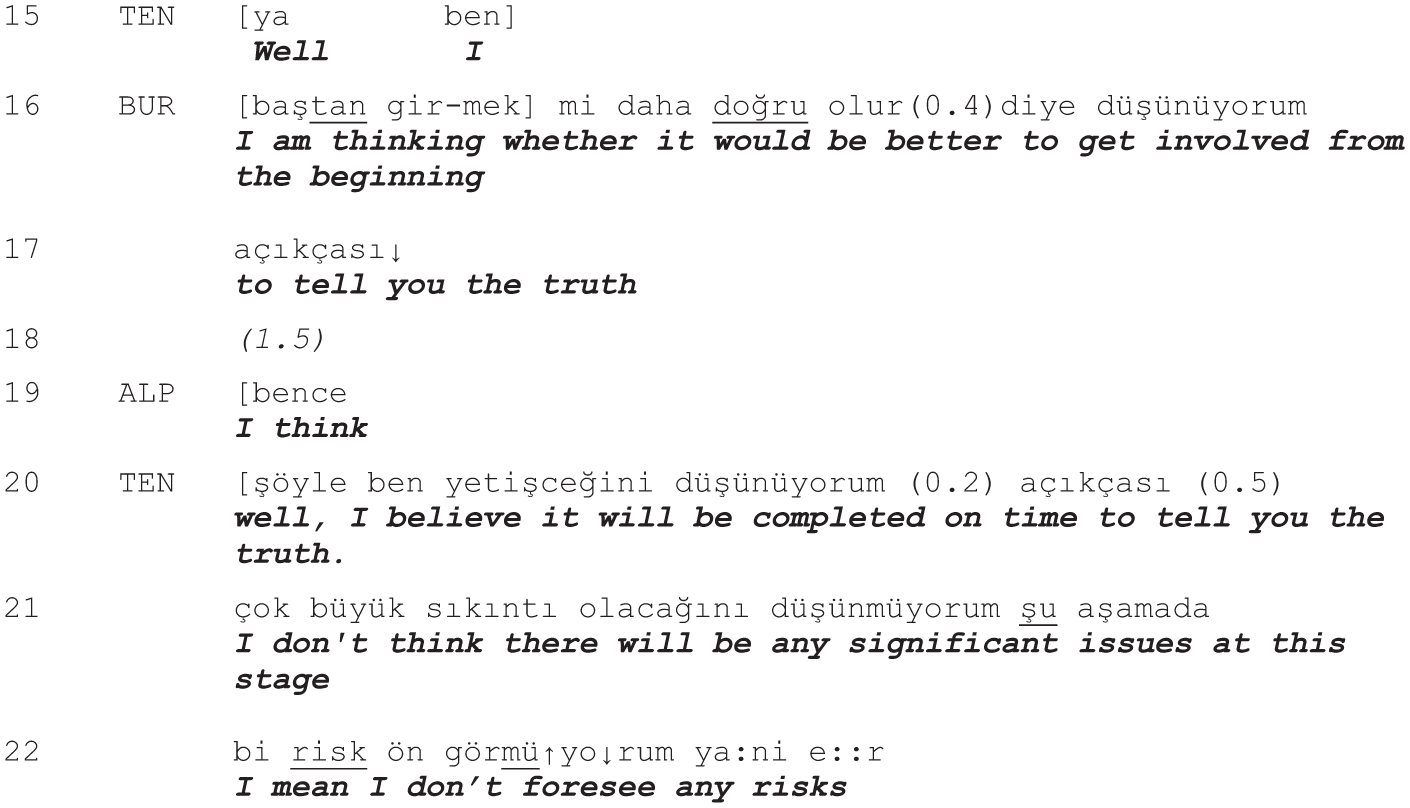
In line 15, TEN, acknowledging this assigned role, starts her response by offering her perspective on the matter. However, her turn-taking overlaps with BUR’s further proposal to be involved in the project’s initial stages. In this way, BUR makes a proposal for the issue identified by herself to move the emerging decision forward, and despite ALP’s suggestion to decide together with TEN, BUR does not yield the floor. Rather, she creates an interactional space for herself to provide her own account, accompanied by another intra-turn silence (0.4) and with a particular emphasis on ‘daha doğru’ (better), thus claiming equal say with the team leader in future actions. Also, her use of ‘açıkçası’ (to tell you the truth) reinforces the strength of her stance. These interactional moves can be read as attempts to assume a key role in the team’s agenda, and they reflect her heightened epistemic and deontic stance incongruent with her deontic status (Choi and Schnurr, 2014; Schnurr and Chan, 2011).
By assessing how they should be involved in the project from the start on behalf of the team, BUR makes a claim to manage the meaning, which has been described as a leadership action (e.g., Clifton, 2012). Despite ALP’s distributing deontic rights to TEN, BUR challenges this unilateral flow of authority claiming a more collective form of leadership. Following 1.5 seconds of silence and overlapping with ALP’s initiation to express his opinion (Line 19), TEN initiates an evaluation of the project’s progress and responds to BUR’s questions initially addressed to ALP but re-directed to herself. In asserting her stance that the project will be completed on time, TEN projects a sense of assurance, judges BUR’s proposal (Asmuß and Oshima, 2012), and thus disaffiliating from it, while also signaling her own epistemic and deontic stance and status. This is further achieved by her use of the first-person pronouns ‘ben’ (I) rather than the inclusive ‘we’, indicating a shift towards asserting her own assessment. Thus, the team moves between different assessments of the situation, and BUR’s displayed leader identity claims have been challenged by TEN, who asserts her deontic status as the team leader. In this way, the team navigates between collective and hierarchical leadership dynamics, and the ongoing intertwining of these two forms continues to unfold in the next part as well.
Extract 1c
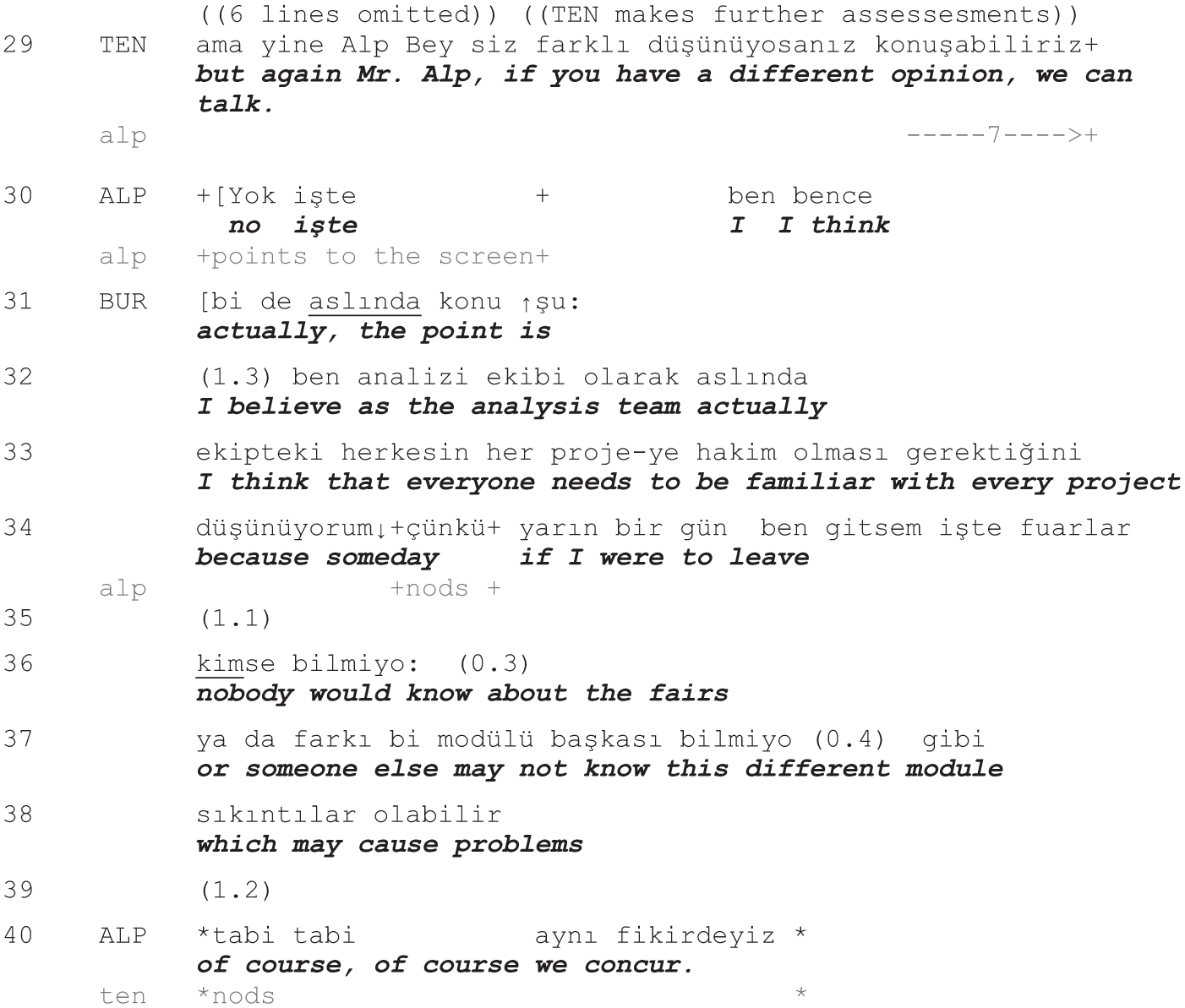
In line 29, by addressing the project manager with the honorific title ‘bey’ (Mr.), and using the formal pronominal ‘siz’ (you), TEN directly addresses ALP to see his opinion instead of closing the topic. Her explicit invitation to ALP to take the conversational floor shows her acknowledgement of his epistemic and deontic status in this matter. While TEN demonstrates an orientation towards hierarchical leadership constellations during the interactional negotiation of an emerging decision, she also initiates a process of shared decision-makig, and thus blurring the lines between these two forms of leadership.
Responding to TEN (line 31), BUR self-selects, overlapping with ALP’s initiation to answer TEN (line 30), and elaborates on the need for knowledge sharing within the team for team functioning and project management. Taking the initiative to speak and nominating herself as the next speaker, BUR enacts her heightened epistemic and deontic stance and status in an attempt to influence the direction of this decision-making episode. She thus initiates another topic shift by employing the discourse marker ‘bi de aslında’ (actually the point is) with a special emphasis on ‘aslında’ (actually), and by uttering the adverbial pronoun ‘şu’ (this) with a rising intonation. This is followed by a relatively long intra-silence of 1.3 seconds.
By stating ‘ben analizi ekibi olarak’ (I, as the analysis team) and by using the first-person singular form ‘düşünüyorum’ (I think) in line 34, BUR makes claims to epistemic primacy and deontic authority. She uses a direct and assertive statement and provides justification for her own position (Lines 32–34). She thereby disaffiliates from TEN by asserting the rights to judge her proposal (Asmuß and Oshima, 2012) and challenging her stance towards being involved in each project, thereby rejecting TEN’s previous leadership claims. These actions are responded to by ALP with an affiliating nod.
After a 1.1 second silence (Line 36), BUR reclaims the floor and provides the reason why she highlights the need for shared knowledge with hypothetical scenarios by elaborating on the potential challenges and consequences that may arise if team members are not familiar with all the projects in the company. She thus displays a heightened epistemtic and deontic stance in the team. This display is repsonded by with alignment by ALP and TEN’s nodding. Thus, in the second and the third part of the extract (1b/1c), BUR more directly claims a leadership identity for herself and initiates a new decision-making process by assessing the previously announced decisions and persistently reiterating her proposal with further accounts regarding being involved in the embank project. While the first part of BUR’s proposal is resisted and a more hierarchical leadership form is observed, her proposals regarding the broader team engagement in every project achieves the preferred response. ALP’s and TEN’s alignment reflects a shared leadership style in the team’s overall approach.
In sum, in this extract, we could observe a decision-making process in which, as interlocutors display and negotiate their own and other’s deontic and epistemic status and stance, hierarchical and collective leadership co-occur and intersect in complex ways. Having explored how the interplay between collective and hierarchical leadership pans out in the sequential organization of talk within team interactions, we now turn our attention to an interaction between the team’s two formal leaders, ALP and TEN.
Extract 2
In this extract, we see the interplay between hierarchical and collective leadership by analyzing the discursive processes through which the decision making is initially concluded through hierarchical leadership displayed by ALP, only then to be revisited through collective leadership efforts collaboratively enacted by TEN and ALP.
Prior to this extract, members have discussed the issue of writing the requirements for the chatbot component of a project on which they collaborate with another team. The extract starts with ALP’s proposal about how to handle the essential chatbot requirements. Using a directive suggestion (şey yapalım/let’s write) with the hortative ‘let’s’, he emphasizes the collaborative effort in these future actions, thereby displaying his heightened epistemic but lowered deontic stance.
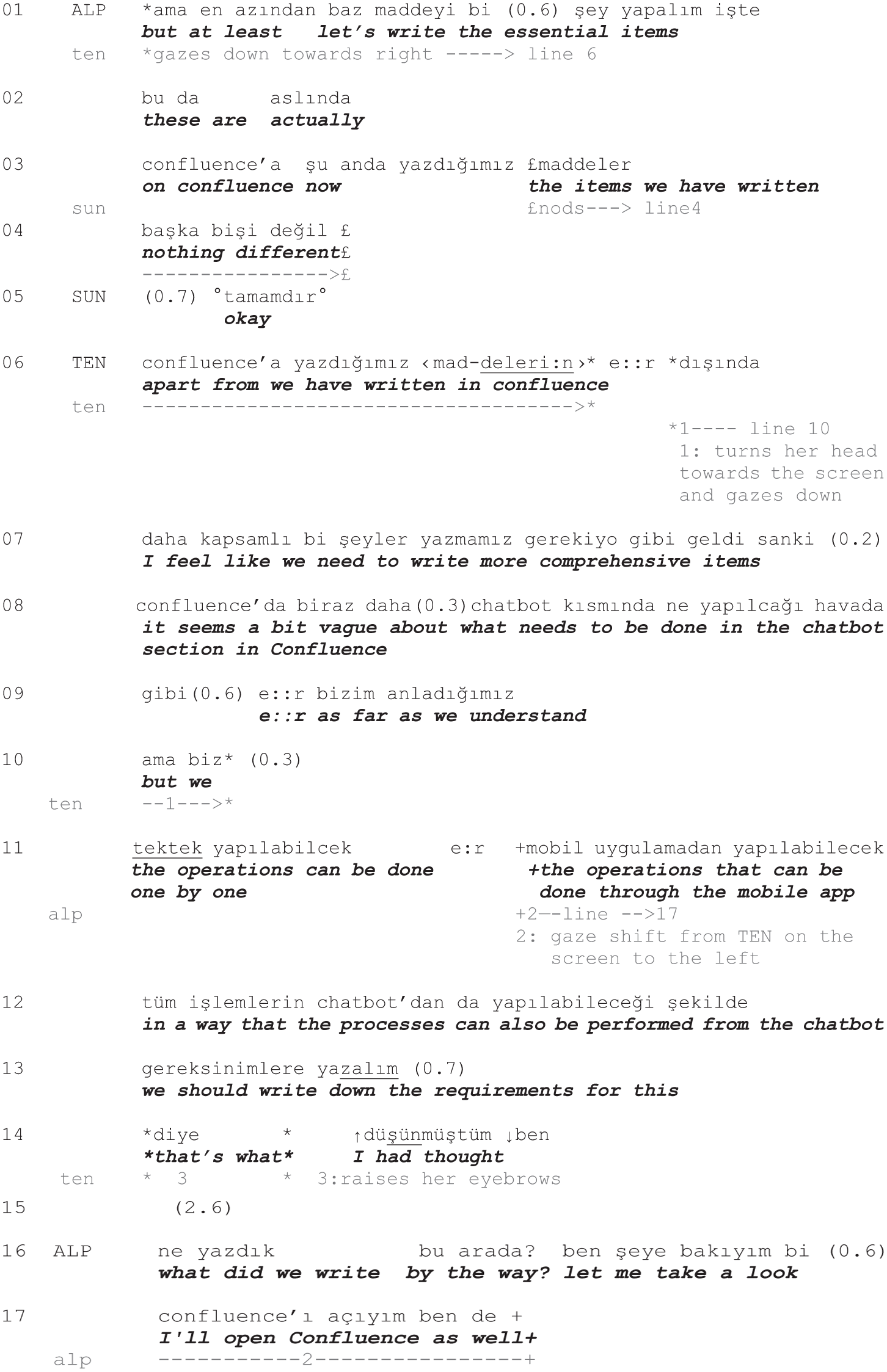
At the beginning of this excerpt, ALP clarifies the scope of the task by stating that the aforementioned requirements are already written on confluence with no additional details to be added (başka bişi değil/nothing different). He thus could be seen as bringing the issue to an end and asserting himself as the one in charge by displaying his heightened deontic and epistemic stance and status. In line 5, SUN shows alignment by uttering the acknowledgement token ‘tamamdır’ (okay) (Ruhi, 2013) and by nodding and following ALP’s lead. Based on these observations, we would argue that at this point in the meeting, ALP enacts hierarchical leadership. However, in line 6, TEN delivers an extended turn in which she suggests producing a more comprehensive documentation, thereby making an alternative suggestion and disaffiliating from ALP. In evaluating ALP’s directive suggestion (Clifton, 2017), she does not accept his proposal, but rather continues with the decision-making process, thereby displaying her heightened epistemic and deontic stance and making leadership claims for herself. Although TEN starts her utterance by formulating an obligation of the team (gerekiyo/we need to), she employs hedging markers (gibi geldi sanki/it seems like) to soften her assertion. She also does not direct her gaze towards the screen but looks downward, which further mitigates her divergence from ALP’s original proposition. Therefore, TEN creates an interactional space for revisiting the decision by ALP, and thus inviting further negotiation, which enables collective leadership to emerge.
In lines 7–10, TEN provides more explanations for her alternative proposal. She acknowledges the team’s understanding of the task by using hedging devices, such as havada gibi (it seems vague) and anladığımız kadarıyla (as far as we understand) accompanied by in-turn pauses (e.g., 0.6) and ‘e:r’. It could be argued that through these discursive strategies she also mitigates the potentially negative effect of disagreeing with the most senior person on the team, ALP. In doing so, she both acknowledges hierarchical leadership, but at the same time actively contributes to the sequential organization of talk, which shows a shift towards collective leadership for the team.
This is followed (lines 10–14) by TEN developing her alternative proposal, starting with the contrastive marker ‘ama’ (but), and highlighting what should be done as a team. She puts an emphasis on ‘yazalım’ (we should write) and ‘düşünmüştüm’ (I thought) with a rising intonation on the first syllable. She also uses the first-person pronoun ‘ben’ (I) with a falling intonation, and while uttering ‘diye ↑düşünmüştüm ↓ben’ (I thought so), she raises her eyebrows. Through these verbal and non-verbal means she asserts ownership of the new proposal and signals her deontic and epistemic stance as the team leader who has the technical expertise to resolve the issue of writing the chatbot requirements so that the other team can start to work on the project. Hence, TEN’s counter proposal suggests a more comprehensive approach, albeit in a downgraded way. This shows her alignment with hierarchical leadership while inclining more towards collective leadership.
Upon TEN’s attempt at advocating for a more comprehensive approach, ALP slightly turns his head and shifts his gaze away from TEN to the left side and appears to be checking something on the screen. Along with this interactional move, the noticeable absence of a response for 2.6 seconds may suggest that ALP considers and checks TEN’s suggestion. In line 16, he does not fully accept what has been put forward by TEN, and instead of continuing with her proposal, he seeks additional information with a question. Through these discursive moves ALP asserts his deontic rights to decide upon the meeting’s flow and the course of action. In response to ALP’s request for clarification, TEN complies and initiates accessing the project documentation platform Confluence to check what has been written about the requirements. Thus, ALP takes the lead by initiating the work and TEN shows involvement in the task, and both start to be engaged in the collective decision-making process, which shows how hierarchical and collective leadership are intertwined in complex ways.
Conclusions
This paper makes two contributions to current scholarship on collective leadership research. First, considering the limited empirical investigation into how leadership is actually done, we have demonstrated how taking a multimodal interactional approach to leadership reveals the intricate nuances involved in how leadership is enacted. Second, more specifically, we have engaged with the call of previous researchers to further explore the interplay between collective and hierarchical leadership (Holm and Fairhurst, 2018; Van de Mieroop et al., 2020). In our analyses above, we demonstrated how hierarchical and collective leadership are intertwined dynamically in the sequential unfolding of interaction in decision-making processes in a virtual team context.
Our study thus responds to Fairhurst et al.’s (2020) call to consider the hierarchies and the intermingling of different forms of leadership constellations by analyzing the processes and contexts in which they occur. In our analyses, we zoomed in on the ongoing negotiation of authority, and leadership in the sequential organization of talk within a professional hierarchy. We also demonstrated the tensions between shared and hierarchical leadership constellations and showed how deontic and epistemic rights highlight these tensions regarding participants’ interactional moves in relation to their positions in the conversation. In this regard, building on Van de Mieroop et al.’s (2020) study, we made visible the discursive processes through which the ongoing negotiation between collective and hierarchical leadership takes place; and we showed how they shift moment by moment throughout an interaction. More specifically, we have illustrated that collective and hierarchical leadership coexist rather than replace each other. This co-existence was particularly obvious at those points where the implementation of decisions are questioned, and the mobilization of knowledge authority is seen in line with team members’ roles. We observed how authority can be reinforced when faced with resistance (Clifton et al., 2018), and how it is sometimes negotiated in situ as a key component of leadership (Holm and Fairhurst, 2018; Larsson and Lundholm, 2010; Van De Mieroop, 2020).
More significantly, we have demonstrated how collective and hierarchical leadership intersect in the high-pressure environment in software development, which involves approaching uncertainties and making continuous on-the-spot decisions every day (Dönmez and Grote, 2018). Moreover, as Lenberg et al. (2024) address the need for different methodological approaches to gain a deeper understanding of the software engineering community, our study offers richer and more comprehensive insights into how leadership is enacted in practice in this context. As our analyses have demonstrated, the methodological approach we have adopted allowed us to examine real time interactions to uncover how leadership is negotiated in situ–insights that other methods such as relying on interviews or questionnaires may overlook in leadership research in software development teams (e.g., Gren and Ralph, 2022; Hofman et al., 2023; Imam and Zaheer, 2021).
We also bring interactional evidence to Empson et al.’s (2023) observation that collective and hierarchical leadership are not binary opposites but interact with each other by adding further to Collinson’s (2014) critical comments about ‘oversimplify[ing] complex relationships and reduc[ing] them to either/or polarities that downplay or neglect interrelations’ (p. 47). Thus, we challenge the traditional dichotomous understanding of leadership and demonstrate its fluid fluidity: leadership continously evolves through the negotiation of authority in ongoing moment by moment interactions in which collective and hierarchical leadership are interwoven. We specifically analyzed how these interactional moves of negotiation reinforce and challenge existing authority relations and how the meeting participants exert influence while navigating the intricacies of hierarchy in decision-making processes. These insights contribute to critical leadership studies (Collinson, 2017, 2020) by indicating how leadership is more than only exercising power based on the formal authority associated with a particular role or position. We thus provide further empirical evidence to show that leadership is indeed a continuous process of negotiation in which authority unfolds sequentially, which can be questioned, resisted and shared. As evidenced in previous leadership research (e.g., Clifton, 2017; Schnurr, 2018; Schnurr and Schroeder, 2019), we also show how leadership is a dynamic process of mutual influence in which participants interact and influence each other as they collaborate towards achieving a shared organizational goal (Clifton, 2006).
Furthermore, through adopting a multimodal approach in a virtual context, we also show that individuals’ corporeal engagement plays a pivotal role, and that the meeting participants make use of a variety of non-verbal resources such as nodding, different gaze orientations, raising eyebrows, orienting to the screen while claiming, assigning, granting, resisting and negotiating their leader identities. To illustrate, participants’ nodding or gaze orientations (Extract 1) or how the screen serves as a focal point in interaction with the participants’ orientations at different points (Extracts 1 and 2) contributed to the negotiation of deontic and epistemic claims. Thus, we align with other studies stating that leadership does not occur without involving the individuals’ bodily orientations (DeRue and Ashford, 2010; Janssens and Van de Mieroop, 2024; Pullen and Vachhani, 2013; Van De Mieroop, 2020).
We hope that future research will continue to explore the complex and intricate ways in which collective and hierarchical leadership intersect with each other–ideally in to date largely under-researched communicative environments, such as virtual teams, and in to-date overlooked socio-cultural contexts outside of Western geographies, such as Turkey or countries in the Middle East.
Footnotes
Appendix
Transcription symbols based on Jefferson (2004) and Mondada (2018).
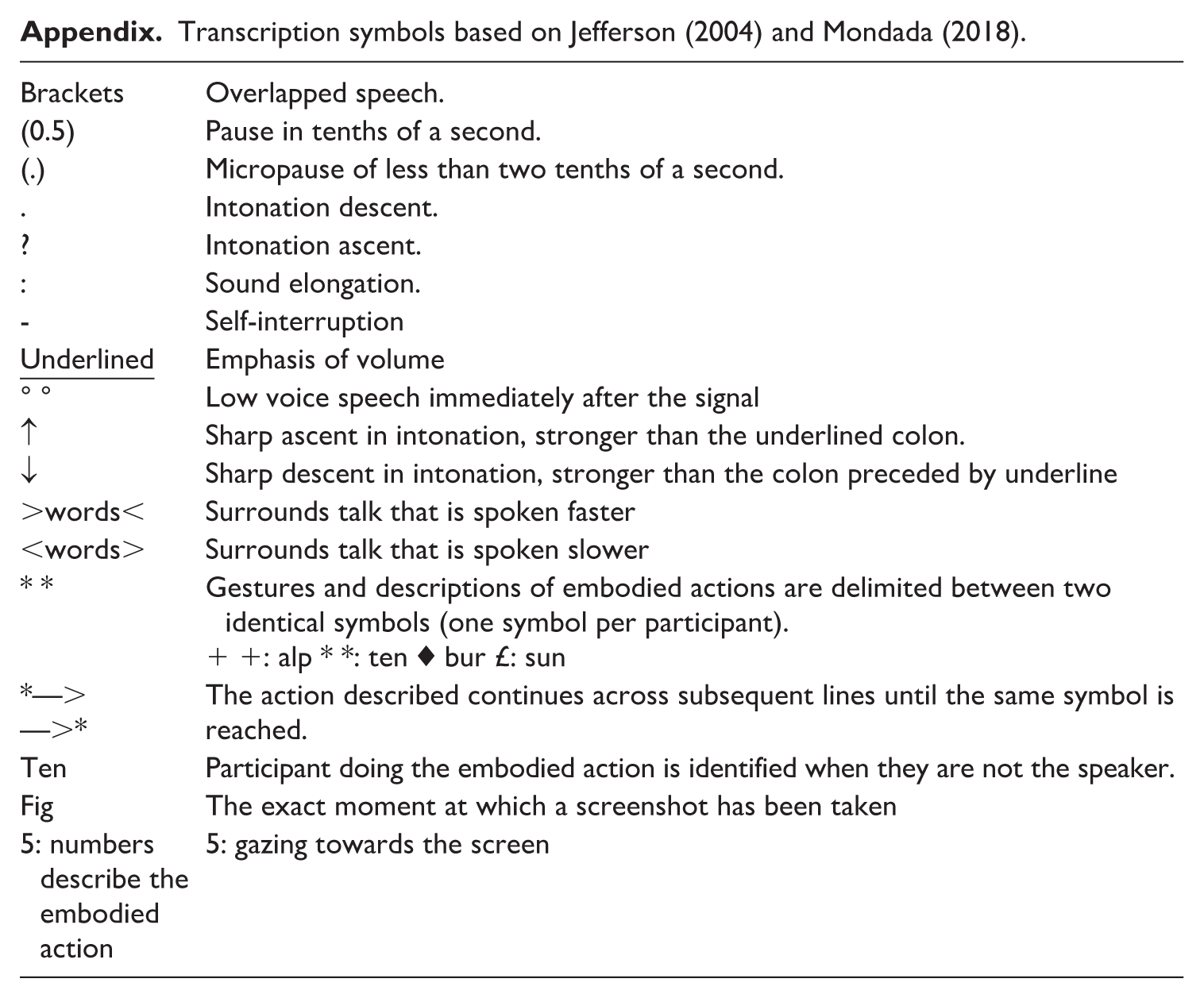
| Brackets | Overlapped speech. |
| (0.5) | Pause in tenths of a second. |
| (.) | Micropause of less than two tenths of a second. |
| . | Intonation descent. |
| ? | Intonation ascent. |
| : | Sound elongation. |
| - | Self-interruption |
|
|
Emphasis of volume |
| ° ° | Low voice speech immediately after the signal |
| ↑ | Sharp ascent in intonation, stronger than the underlined colon. |
| ↓ | Sharp descent in intonation, stronger than the colon preceded by underline |
| >words< | Surrounds talk that is spoken faster |
| <words> | Surrounds talk that is spoken slower |
| * * | Gestures and descriptions of embodied actions are delimited between two identical symbols (one symbol per participant). + +: alp * *: ten ♦ bur £: sun |
| *—> —>* |
The action described continues across subsequent lines until the same symbol is reached. |
| Ten | Participant doing the embodied action is identified when they are not the speaker. |
| Fig | The exact moment at which a screenshot has been taken |
| 5: numbers describe the embodied action | 5: gazing towards the screen |

Ethical considerations
Ethics approval for the larger doctoral research project on which this study is based was obtained from the Human Research Ethics Committee of Middle East Technical University with the protocol number 087-ODTU-2021. The company’s and participants’ approval were obtained through informed consent forms by ensuring confidentiality and privacy, and the procedure outlined by the Human Subjects Ethics Committee of Middle East Technical University was followed. All the participants were anonymized and protected by pseudonyms.
Funding
The authors received no financial support for the research, authorship, and/or publication of this article.
Declaration of conflicting interests
The authors declared no potential conflicts of interest with respect to the research, authorship, and/or publication of this article.
Data availability statement
The data supporting the findings of this study are not publicly available due to ethical reasons and the confidentiality agreement signed with the company.