



Abstract
This study advances counter-extremism efforts by examining the mechanisms whereby incitement texts function as networks of bonds and obligations, shaping bonding dynamics within terrorism and polarisation contexts. It conceptualises incitement texts, in the Hallidayan sense, as functional semantic units, and incitement itself as a relational, intersubjective activity embedded in convergent and divergent bonds and pro-ingroup obligations shaped by contested ideologies, identities, and actions. Inciters strategically select discourse semantic structures to establish these bonds and obligations. Using systemic functional linguistics (SFL), and insights from communication accommodation theory (CAT), the study employs a relational-semiotic approach to analyse eight incitement texts by Osama bin Laden and Abu Bakr al-Baghdadi, identifying three key processes: communion, alienation, and coercion. Convergent bonds sustain communion and shared identities, while divergent bonds promote alienation and conflictual relationships and challenge intergroup rapport. Coercion extends these bonds, positioning violence as a moral obligation and act of care, vigilance and authentication of identity and belonging (i.e. deontic bonds) around which members of a group are invited to converge. The findings reveal how inciters manipulate attitudinal meanings—explicit, invoked, or provoked—to reinforce cohesion, intensify polarisation and urge violence. This process involves bond construction mechanisms (e.g. lexical metaphor, attribution to symbolic authority, intertextual allusions, iconisation, kinship terms, register-specific terms, and inclusive pronouns) and obligation-building tactics (e.g. recommendation, doctrinal authorisation, warnings, and commands). By embedding incitement within dynamic networks of bonds and moral justifications, the study illustrates how linguistic strategies prime attitudinal meanings to forge bonds, deepen polarisation, and coerce into violence. It also showcases how dangerous speech legitimises violence and strengthens identity fusion, offering critical insights for a communicative approach to counterterrorism that develops counter-narratives to reduce extremists’ persuasive appeal. This article also extends SFL work on bonding and CAT work on pre-emptive accommodation in asymmetrical, ideological communication.
Keywords
Introduction
Given terrorism’s global impact and the billions in economic costs annually (Global Peace Index, 2019), countering violent extremism remains a major challenge. This article examines extremist incitement texts as relational semiotic processes that shape intergroup attitudes and behaviours through evaluative language. Incitement is understood here as an intersubjective activity situated in contested ideological and identity-based contexts which are themselves “(inter)subjective constructs” (Van Dijk, 2008: x). Emphasis is placed on the relational nature of linguistic choices in such contexts: language is not created in isolation but emerges relationally (Coupland and Giles, 1988: 175). Analysing eight texts by two central figures in transnational jihadist movements—Osama bin Laden (al-Qaeda) and Abu Bakr al-Baghdadi (ISIS) who played pivotal roles in shaping contemporary extremist discourse, especially in the post-9/11 era—the article demonstrates, firstly, how coercive actions are encouraged through strategic use of attitudinal meanings and values which are understood here as bonds in terms of the social relationships they enact. It, secondly, shows how language in incitement texts functions as a network of bonds and obligations (Firth, 1964: 113) that strategically shape extreme intergroup attitudes and behaviours (e.g. Belavadi, 2018).
The network concept is crucial for understanding how “social networks” (Wardhaugh and Fuller, 2015: 70) in violent extremism context emerge and shape identity and belonging as an active, authenticated practice (Bucholtz, 2003). Incitement texts are also considered functional semantic units (Halliday and Hasan, 1985) that construct, reinforce, and challenge social bonds, positioning (of self and others) and stance-taking through attitudinal language (e.g. Davies and Harré, 1990; Jaffe, 2009). These ideology-shaped stances and informed evaluative strategies (Hart, 2014) position the inciter, the audience, and outgroups as “social beings” (Wardhaugh and Fuller, 2015: 189), aligning stances with ideology-infused discourse structures operating at both cognitive and social levels (Van Dijk, 2009).
Thus, the moral and ideological frameworks within incitement discourse are shaped through audience-designed language (Bell, 1984), forming cognitive bridges between individual action and broader societal structures (Van Dijk, 2008: 17). The central thesis is that incitement texts do not merely issue commands or transmit ideology but embed relational dynamics that mobilise violent action. Aligned with Firth’s (1957) view of language users, inciters are treated as meaning-makers who enact, negotiate, and amplify cultural values and attitudinal positions through discourse. This study, therefore, integrates relational and linguistic approaches in a dual-layered framework, revealing how language encourages extreme actions and simultaneously mobilises affiliation, legitimises violence, and polarises society.
The concept of polarisation is central to this account, not only as ideological division but also as a discourse-semantic process that fosters group convergence around violent goals against an outgroup. Polarisation is foundational to group engagement and political alignment (Smith et al., 2024), shaping shared goals while constructing binary oppositions between in- and outgroups in a black-versus-white dichotomy (McNeil-Willson et al., 2020). This article introduces the notion of “ambient polarisation” to describe how terrorist texts, despite lacking interactional reciprocity, discursively construct stark oppositions that reinforce group identity and moral justification for violence. This dynamic is not only behavioural (Bjornsgaard and Dukić, 2023: 5) but ideational and interpersonal, as language constructs the conditions for action-based convergence.
By examining the intersection of language, ideology, and social alignment, this article offers a novel communication-based perspective on incitement. It holds practical relevance for law enforcement and counter-extremism efforts to address incitement as a form of online/offline deviance (Etaywe, 2025), while also advancing forensic functional linguistics by exploring how discourse structures encode legitimacy, solidarity, and violence-as-moral obligation (Coulthard et al., 2017; May et al., 2021). It also contributes to research on intergroup communication (e.g. Blitvich, 2024; Gaffney et al., 2024), intercultural rapport management (e.g. Spencer-Oatey and Kádár, 2021), and relational work (Locher and Watts, 2008) from a discursive semantic/pragmatic perspective grounded in systemic functional linguistics (e.g. White, 2011).
The article is structured as follows: First, we contextualise the study within existing research on incitement and terrorism. We then introduce the multidimensional framework integrating Systemic Functional Linguistics (SFL), Communication Accommodation Theory (CAT), audience design (Bell, 1984), and identity fusion (Ebner et al., 2022). Following that, we outline the appraisal and bonding framework, describe the data and method, and then present the analysis and discussion.
Literature review
Incitement and communication accommodation in violent extremism
Incitement language, designed to persuade audiences to commit violence, is central to terrorism research (e.g. Etaywe and Zappavigna, 2024). Relational semiotic research, particularly within SFL, provides a framework for analysing how language positions speakers, writers, listeners, and readers in discourses of power, violence, and identity (e.g. Hart, 2014; Martin and White, 2005). Terrorist organisations and leaders, such as ISIS and al-Qaeda’s bin Laden, use language strategically to accommodate their audience to recruit, radicalise, and sustain their networks (e.g. Miller, 2015; Wignell et al., 2017). This study examines the incitement texts of al-Baghdadi and bin Laden, whose jihadist ideologies rank among the most lethal forms of extremism (Global Peace Index, 2019).
Bin Laden (10 March 1957–2 May 2011), founder and first leader of al-Qaeda, was central in shaping its ideology and strategically using media to frame violent actions—particularly martyrdom operations—as moral and religious obligations. His rhetoric targeted both the “far enemy” (the United States) and the “near enemy” (rulers in Muslim-majority nations; Miller, 2015). Al-Qaeda emerged from the context of the Soviet–Afghan war (1979–1989), where OBL fought alongside Afghan Mujahidin, the Taliban, and Pakistani fighters against the Soviet invasion. This jihad, supported by the US CIA during the Cold War (Zghayyir, 2016), drew fighters from across the Arab world, many of whom OBL recruited and financed. Following the Soviet defeat, OBL turned against the US, condemning its military presence in Muslim countries—particularly after the US-led war on Iraq in 1991. This shift marked the beginning of al-Qaeda’s campaign against US interests, targeting embassies, naval vessels, military personnel, and civilians, culminating in the 9/11 attacks on Washington and New York (Dalacoura, 2012). Born in Saudi Arabia, OBL remained a Saudi citizen until 1994, when his nationality was revoked due to his open hostility toward the US and criticism of the Saudi monarchy’s alliance with Washington. In his rhetoric, OBL employed communication accommodation strategies to align violent jihad with moral values and collective identity, while intensifying ideological polarisation by disaligning “enemy” groups—particularly in response to post-9/11 “war on terror” discourse (Ray, 2017).
Al-Baghdadi (28 July 1971–27 October 2019), leader of the self-proclaimed Islamic State (ISIS), spearheaded an evolution in jihadist violent extremism by promoting rhetoric that sharply divided “true believers” from “non-believers,” erasing any “grey zone” in between (Atran, 2015). This discourse justified violence against perceived adversaries and attracted recruits globally (Atran, 2015). ISIS—also known as Daesh—was formally established in 2010 as the Islamic State in Iraq (ISI) by surviving members of al-Qaeda in Iraq and disaffected former officers of Saddam Hussein’s military, alongside tribal leaders from the US-trained “Sons of Iraq” militias in al-Anbar province. Initially formed to stabilise communities against terrorist groups and pro-Iran militias (as per the Global Terrorism Index; Institute for Economics and Peace, 2020), ISI transformed following territorial gains in Iraq and Syria during the aftermath of the 2011 Syrian revolution. In 2014, al-Baghdadi—who had joined jihadist networks after the US invasion of Iraq and later broke from al-Qaeda—declared the establishment of the Islamic State in Iraq and Syria (ISIS) as a revived Caliphate. Under his leadership, ISIS advanced a totalitarian theocracy grounded in a self-proclaimed jihadist-Salafist ideology, enforcing a rigid moral order and a stark “us versus them” worldview towards ideologically or religiously different “Others” (Wignell et al., 2017). The movement’s appeal illustrates the centrality of social categorisation and identity processes in radicalisation, as individuals facing societal upheaval or identity threats gravitate towards groups that offer clear master identities, normative beliefs, and prescribed behaviours (Hogg, 2014). Extremist organisations exploit these rigid identities: “The harder the boundary between groups—the more exclusive the membership rules—the more extreme the ‘us’ versus ‘them’ dichotomy” (Pape, 2005: 87).
By using rhetorical tools for identity construction and forging social (dis)alignments in their discourse, extremists seek to construct and promote not only a moral system but also shared goals and beliefs. That is, beliefs around “preserv[ing] the ingroup’s identity, welfare, and ideological and physical territories,” raising “the value of the violent actions proposed,” the likelihood of intergroup violence, and “strengthen[ing] the believability of the link between violence and the ingroup’s interests” (Etaywe, 2023: 16–17). Of interest to this article are the evaluative language (namely, attitudinal meanings), and use of a “symbolic power” system (e.g. religious) register terms (Bourdieu, 1991) and master identity-based kin ties, which can further illuminate how inciteful language not only reflects but also reinforces social and moral hierarchies and ideological commitments.
Current focus on incitement research and extending it
Research into incitement often intersects with studies on hate speech, propaganda, and the mobilisation of violence. Incitement is recognised as a powerful vehicle for dangerous language that promotes, justifies, or encourages harmful actions, particularly in contexts like terrorism, hate speech, political violence, and genocide (Benesch, 2023; Tsesis, 2017; UNESCO, 2023). Much existing research into incitement focuses on pragmatic analyses of speech acts, identifying direct and indirect forms of incitement (Jaconelli, 2018) or coercive “impoliteness” (Culpeper et al., 2017). While important, these approaches overlook the broader relational dynamics and goal-building throughout incitement texts, to which this study contributes.
Recent incitement research has shifted towards text-level analyses, often using SFL frameworks to understand the patterns of evaluative language in a text (e.g. a far-right extremist’s manifesto, Etaywe and Zappavigna, 2024) and across a set of texts, examining the ethical motivations of incited violence (Etaywe, 2022a, 2025). The present article builds on this SFL approach, taking coercion and demands for violent actions as part of a broader strategy to reinforce bonds within the ingroup and polarise against the outgroup. The present research contributes to a better understanding of the “dangerousness” of incitement texts consistent in “inspiring intergroup violence” (Benesch, 2023: 164). Unlike previous SFL-based studies on incitement, the article integrates SFL, the “identity fusion” concept (Buhrmester et al., 2018) and the audience design concept with CAT principles—described in the next section—offering a multidimensional framework for a fuller understanding of the relational dynamics in incitement discourse. For a linguistic framework of understanding identity fusion as a (psycho)linguistic phenomenon, this study endorses Tracy and Robles’s (2002: 22–23) assertion that personal and relational identities (e.g. aggressive or caring, and distant or close) are inseparable from master (e.g. religious) and interactional (i.e. role, e.g. leader, follower, mujahid) identities (an argument akin to Etaywe, 2024a: 362). In sum, integrating these frameworks enables a nuanced understanding of incitement as a dynamic interplay of relational strategies, psychological constructs, and linguistic systems, offering a robust model for studying incitement discourse.
Communication accommodation theory (CAT) and complementary constructs
CAT, with its 50-year-old interdisciplinary history, has been studied across a plethora of languages, cultures, social groups, and applied and institutional settings (see, for example, Giles 2016; Giles et al., 2025). For us, it provides insights into how individuals adjust their language and communicative practices in discourse to manage their image, gain ingroup approval, or distance from outgroups. Accordingly, it can reveal the relational dynamics of incitement by recourse to at least three key accommodative strategies and processes: “convergence” (reducing social differences), “divergence” (accentuating social differences), and “maintenance” (remaining consistent, in large part, regardless of audiences’ characteristics). These phenomena help explain how incitement rhetoric uses convergence and divergence bonds to mobilise or alienate audiences. Through convergence, speakers align their language with the audience’s expectations or shared identity markers, reducing social distance and encouraging collective action. Divergence, conversely, accentuates social differences and is used to frame opponents as ideologically or morally inferior, fostering animosity and justifying violence.
CAT has been widely applied in studies on perception and belief systems in religious and political contexts (e.g. Bernhold and Giles, 2020; Meyerhoff, 2023). Central to CAT is the “identity accommodation” principle, which enables examining how invoking particular identities influences evaluative attitudes toward social groups, including stereotypes (Giles et al., 2023). These processes have both direct effects on cognition and behaviour and indirect effects through mediating mechanisms that shape broader social consequences (the “indirect effect” principle; Giles et al., 2023: 11). However, CAT alone does not fully account for the linguistic resources and discursive strategies in terrorist discourse. To provide a more comprehensive framework, this study integrates SFL-based appraisal and bonding theory (explained in the next section) alongside identity fusion theory.
Bonding mechanisms contribute to “optimal calibration” (Giles et al., 2023: 11), fostering relational rapport, reducing social distance, and strengthening alignment between inciters and their audiences. Identity fusion theory, originally developed to explain individual-to-group fusion in the context of terrorism, sheds light on the linguistic mechanisms that reinforce group loyalty and motivate action. These include existential threat narratives, violence-condoning group norms, and dehumanising vocabulary (Ebner et al., 2022), as well as the construction of shared experiences, perceptions of collective threat, and kinship connections. As a psychological construct, identity fusion captures the deep sense of oneness individuals feel with their group, fostering unwavering commitment and even self-sacrifice in its defence (Buhrmester et al., 2018).
In incitement discourse, we argue that accommodation strategies are also closely tied to power and identity negotiation. Power, defined by Myers-Scotton (2006), as the ability to influence others’ outcomes, is often enacted through coercive language that fosters hostility and encourages violent actions. By accommodating the ingroup, inciters amplify shared bonds and values, reducing cognitive distance and strengthening loyalty. Divergence, on the other hand (see Gasiorek, 2016), frames outgroups as existential threats, legitimising hostility, and violent action. This dual process aligns with identity fusion, as inciters attempt to merge personal and collective ingroup identities to reinforce commitment to violent action. Given that extremists often use “emotion-based narratives” (Kriner, 2018; Wright-Neville and Smith, 2009: 85) to radicalise audiences, accommodation strategies serve not only to solidify ingroup bonds but also to manipulate emotional and evaluative perceptions of outgroups, reinforcing negative stereotypes and justifying violence. Identity fusion thus provides an essential link between the emotional power of incitement language and the psychological mechanisms underpinning group loyalty and commitment to violent action.
Regarding bonding mechanisms in stylistic adjustment, they are crucial for understanding social alignment and polarised affiliation in incitement texts. They align with Giles et al.’s (2023: 11) “optimal calibration” principle which suggests that calibrated accommodation fosters relational rapport, reduces social distance, and enhances mutual understanding. Initiative stylistic design (Bell, 1984, 2001) can provide a lens on the role of inciters’ stylistic strategies and calibrated accommodation, involving deliberate activation of shared symbols, cultural narratives, emotional triggers and more to engage audiences. Such activation has the potential to give rise to style characteristics targeted at specific communities and their discourse (e.g. Tagg and Seargeant, 2014). However, while Bell’s paradigm highlights the importance of stylistic choices, it lacks a systematic approach to the linguistic mechanisms that facilitate bonding within ingroups (detailed in the next section). This gap can be addressed by integrating the Systemic Functional Linguistic (SFL) meta-functional perspective, particularly Halliday’s (1978) concurrent meta-functions of ideational, interpersonal, and textual meaning. Looking at the meta-functional pattern from the lens of style as “audience design” (Bell, 1984) enriches our discussion of how attitudinal meaning stylistic markers operate at the intersection of interpersonal and intergroup dynamics.
Within this SFL-based framework, bonding and accommodation are strategically embedded in discourse, shaping both content (what is said) and style (how it is conveyed). Halliday’s concept of interpersonal meaning, which deals with social relations, power, solidarity, and attitudes, helps explain how style functions as a tool for bonding. The alignment of attitudes through evaluative language—including judgments, appreciations, and affective expressions (Martin and White, 2005)—is critical in enacting (de)bonding and forming social affiliations. The interplay between attitudinal meaning (which expresses stances towards people, actions, or phenomena) and ideational meaning (which pertains to ingroup, outgroup, or associated social processes) forms the foundation of bonding and social relationship negotiation (Martin, 2010).
This article focuses on association or “coupling” (Martin, 2008) between interpersonal and ideational meaning in incitement discourse, demonstrating how language constructs shared meanings and mobilises collective action. Rejecting the separation of “what” and “how,” Halliday (1996 [originally 1965]: 63, cited in Coupland, 2007: 13) asserts that “there are no regions of language in which style does not reside,” reinforcing the inseparability of interpersonal and ideational meanings (Halliday and Matthiessen, 2014) and how they pattern and function in discourse. SFL thus provides a powerful lens for incitement style analysis, particularly due to its emphasis on semantics and paradigmatic relations (e.g. Butler, 1988: 97–98; Canning, 2014).
This meta-functional approach reveals that terrorist-incitement stylistic choices are not mere adjuncts to the message but defining elements of the register itself. Style in (de)bonding and inciting is understood as “a way of doing something,” continuously indexing social differences and enacting divisions (Coupland, 2007: 1). Incitement discourse is thus taken as both a product of extremists and a process of styling, where language serves to create meaning and negotiate intergroup relationships. From this process-oriented perspective, inciters strategically “style” attitudinal meaning into the social world, with “styling” activating attitudinal meanings and social bonds. The next section details how these bonds are realised in discourse from an SFL perspective.
Appraisal, bonding, and manipulation of perception and attitudinal rapport
In the SFL tradition, Knight (2010) emphasises that when interlocutors share attitudinal meanings—such as judgement, appreciation, or affect—towards a target or trigger (also known as “the appraised” or “attitudinal target”), they enact a bond. This concept highlights how values are negotiated through the coupling of ideational and attitudinal meaning, commonly known as “evaluative couplings” (Knight, 2010). This process forms the basis for an analysis of the act of bonding, wherein individuals or audiences discursively co-identify through these evaluative couplings. As demonstrated in Martin’s (2008: 57–58) work, affiliations are not formed by isolated feelings but by feelings directed towards specific people, phenomena and actions (giving rise to these couplings).
This distinction underscores the critical role that such bonds play in constructing group cohesion or opposition. For instance, in a text by Osama bin Laden (OBL) (“By
Given the discursive semantic/pragmatics focus in this framework (Zienkowski et al., 2011), the Appraisal framework offers a systematic lens for analysing attitudinal evaluation and stance across texts. This approach accounts for how attitudinal meanings—such as evaluations of positive or negative stances—manifest throughout entire texts and groups of texts. Furthermore, it helps to articulate how context and form influence the realisation of these functions (White, 2011: 14). In this way, the framework assists in understanding the linguistic phenomena used to position writers in relation to their audience, particularly in the case of inciters seeking to forge strong bonds with their target group.
To systematically describe the attitudinal meanings within these bonds, a bonding analysis utilises the Appraisal framework, as developed by Martin and White (2005) and rooted in the social semiotic paradigm of SFL. This framework provides a discourse-semantic approach to evaluative language, structured around three interacting systems: the attitude system (expressing positive or negative stances), the graduation system (which modifies the intensity of evaluations), and the engagement system (which describes how speakers engage with other voices). This research article primarily focuses on the attitude system, which maps stances towards phenomena, such as entities, actions, or states of affairs, within the text.
The attitude system is particularly significant in a bonding analysis, as it allows for a deeper understanding of the ways in which stances are constructed and conveyed in discourse (e.g. Knight, 2010). This system is organised into three sub-systems: type, explicitness, and polarity. Attitudinal choices involve selecting from the attitude type sub-system (e.g. affect, judgement, or appreciation), determining whether the attitude is explicit or implicit, and specifying polarity (positive or negative). For example, in the OBL text, the term “traitor” is an explicit negative judgement that creates a bond by positioning U.S.-backed governments as morally reprehensible.
The polarity subsystem of the attitude system further enables the binary structuring of bonds, categorising them as either convergent (aligning with the group’s values) or divergent (opposing outgroup values). This polarity helps to define social groups in terms of their opposing moral value systems. Specifically, judgement-based divergent or convergent bonds provide semantic evidence of value alignment or disalignment, mapping the inciter’s beliefs to a system of social norms and moral judgments about behaviour (Etaywe, 2022a: 293). Appreciation-based bonds, particularly those that devalue the incited-against, also offer insight into acts of value alignment and disalignment by evaluating people, entities, or phenomena and determining whether they are deemed worthy of violence (Etaywe, 2022a: 293; 2024a, 2024b). In the context of inciteful texts, these bonds reveal the ideological positioning that governs the relationship between the ingroup and outgroup, reinforcing either group cohesion or radical opposition.
Through the systematic application of the Appraisal framework-attitude system, we can identify how bonds in inciteful texts create community alignment or opposition. These bonds—whether convergent or divergent—serve as mechanisms for identity fusion, where the outgroup and its associated actions are categorised negatively, while the ingroup is invited to align with the inciter’s values and take action in support of the ingroup’s goals. In this way, the constant negotiation of bonds through evaluative couplings shapes the way ideologies are communicated and reinforced in discourse, providing a clear understanding of the process by which social categories are polarised in the context of conflict and ideological warfare.
In addition to evaluative couplings, bonds may also be realised through instances of ideational meaning that evoke attitude, such as attitudinally fused terms (e.g. “multiculturalism”), ideas or ideals (e.g. “freedom,” “brotherhood”), and social processes (e.g. “killing,” “rape”; Etaywe, 2025; Etaywe and Zappavigna, 2024). Relevant to this study are also various mechanisms that afford and provoke attitude, facilitating bonding, such as:
Affording mechanisms: These include “naming” strategies that invoke collective identities (e.g. “Christianity,” “Muslims”; Omoniyi, 2006), references to performances associated with identity groups (e.g. “church prayer,” “Palestinian folklore dance”; Omoniyi, 2006), and the use of inclusive and exclusive pronouns (e.g. “we” vs “they”; Knight, 2010).
Provoking mechanisms: These mechanisms, including quotations, metaphors, proverbs, and intertextual references, evoke shared attitudes or cultural interests that forge a bond (e.g. Caple, 2010; Knight, 2010). Such mechanisms carry an interpersonal charge, described as “icons,” whose emotional or communal significance is intensified through a process known as “iconisation” (Martin, 2010). Icons may range from figures of heroism (e.g. Mandela) to symbolic structures (e.g. Hagia Sophia, al-Aqsa Mosque; Etaywe and Zappavigna, 2024) that provide a communal grounding for values, creating what Martin and Zappavigna (2013) term “bonding icons.”
In the present analysis, we argue that bonds realised through any of the mechanisms mentioned above facilitate group alignment, either in support of an ingroup or against an opposing group. This dynamic is central to how ideational meaning guides audience interpretation through the lens of group ideology.
Methodology
Data and text selection
This study analyses eight incitement texts from two transnational jihadist leaders: Osama bin Laden (al-Qaeda) and Abu Bakr al-Baghdadi (ISIS). These texts were purposively selected from open-access public statements and transcripts to represent key moments in radicalisation and features of incitement. They are publicly accessible through jihadist archives, media networks (e.g. Al Jazeera), and counterterrorism reports (e.g. CIA FBIS).
The dataset includes
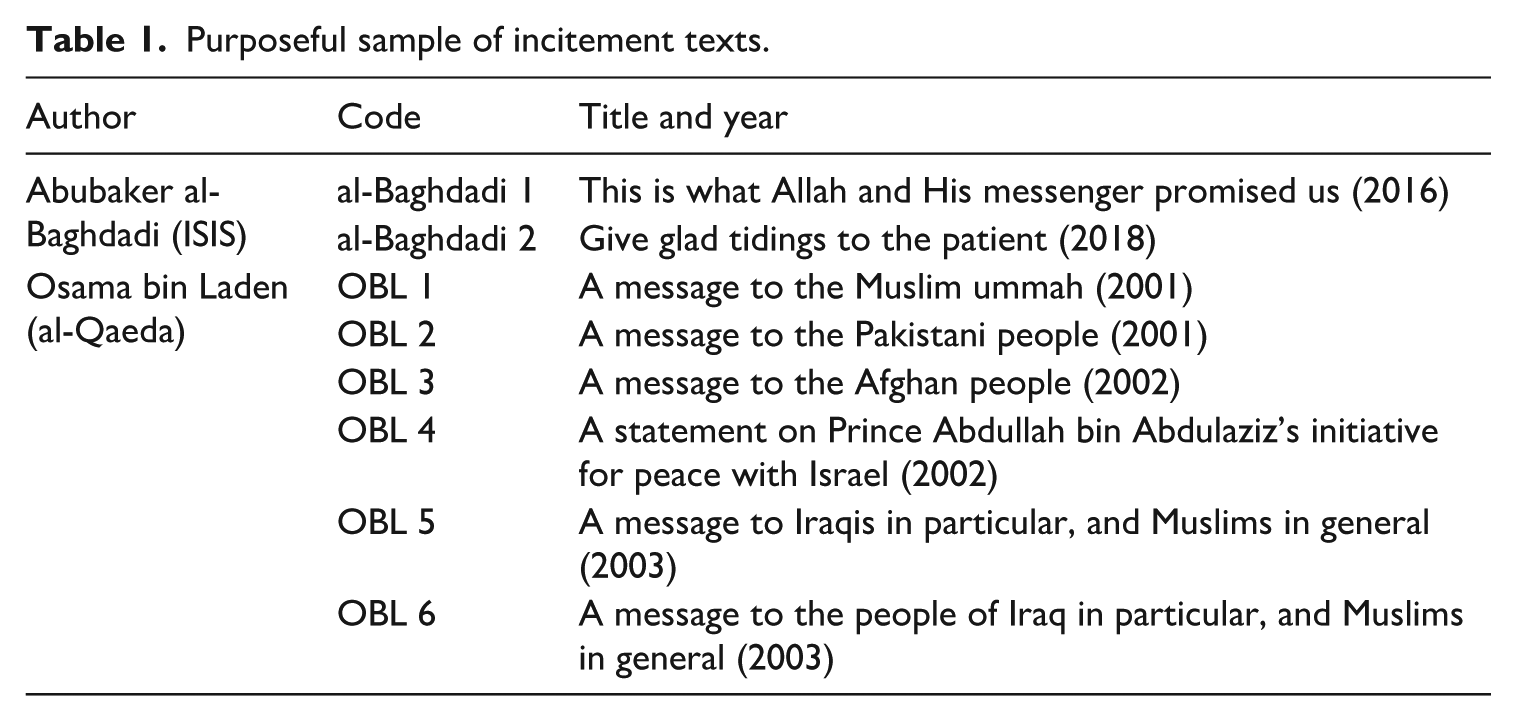
Osama bin Laden (2001–2006, post-9/11 era)—Six statements inciting action against U.S. forces in Afghanistan and Iraq and against Arab rulers were selected, sourced from Al-Bayanat (a jihadist internet website), Al Jazeera, and CIA FBIS archives. English translations were cross-checked against the original Arabic by Author 1, a professional translator, to ensure cultural and lexical accuracy, especially for ideologically charged terms (e.g. murtad “apostate”). For brevity, the original Arabic texts are not reproduced here; instead, each example in the “Results and Discussion” section is followed in brackets by its source and year, allowing quick reference to its context as summarised in Table 1.
Abu Bakr al-Baghdadi (2016–2018, ISIS resistance to U.S. operations in Syria and Iraq)—Two statements, originally disseminated in English by ISIS’s Al-Hayat Media Centre through “Rumiya” magazine, targeting disenfranchised English-speaking youth presumed to share ideological bonds, and promoting rebellion against the U.S.-led coalition and allied Arab governments.
The texts, briefly outlined in Table 1, were selected through purposive sampling to examine rhetorical strategies of incitement and their role in constructing extremist ideology. English translations from credible sources are used, following the approach in Etaywe (2022a, 2024a). Their classification as “terrorist” texts is supported by their provenance, content, and formal designation by counterterrorism agencies and research-based reports and indexes (e.g. Global Peace Index, 2019).
Purposeful sample of incitement texts.
Theoretical framework and analytical procedure
This qualitative study employs an eclectic framework integrating:
Communication accommodation theory (CAT)—To examine convergence and divergence strategies in extremist incitement discourse.
Appraisal framework and bonding (SFL)—To identify key bonds and the mechanisms used in bonding, evaluative framing, and ideological positioning.
Audience design and identity fusion—To further unpack and discuss how language fosters solidarity and extreme loyalty and mobilises action.
The analysis is carried out in three main stages:
(1) Identifying evaluative couplings and linguistic structures used in construing bonds—Using the Appraisal framework, the study categorises attitudinal meanings (Affect, Judgement, Appreciation) that are coupled with ideational meanings to examine the construed bonds and how incitement constructs ingroup unity and demonises outgroups. Construed bonds are taken as entry points to, and evidence of, the rhetorical tactics of (dis)affiliation in terrorist incitement texts. A pattern of use of evaluative couplings that construe bonds and enact bonding gives us a lens on the ways that language “negotiate[s] the potential that feelings have for aligning readers into ‘overlapping communities of attitudinal rapport’” (e.g. Caple, 2010: 116). Such negotiation may take the form of communing the bond that a community’s members share, or otherwise condemning a bond by rejecting it as an unshareable bond (e.g. Knight, 2010), which is acceptable to the tenor of ingroup ambient interaction.
This stage also identifies the following linguistic strategies used in establishing bonds and explains their role in convergence and divergence (illustrative examples are provided in the “Results and Discussion” Section):
– Evaluative couplings.
– Ideational meaning that invokes attitude as in attitudinally fused terms (e.g. multiculturalism), ideas/ideals (e.g. freedom, brotherhood), and social processes (e.g. killing, rape).
– Inclusive and exclusive naming of master identities and pronouns (e.g. “we” and “they”) or identity indexing performance (e.g. prayer, jihad).
– Quotations (e.g. from a religious or symbolic text), proverbs and intertextual references that provide evidence of shared group knowledge or evoke shared social memberships or cultural interests.
– Icons of “hero,” “relic” or a symbolic structure type (e.g. Hagia Sophia, al-Aqsa Mosque).
(2) Categorising bonds as per their function of convergence or divergence
Bonds are classified as:
Convergent bonds: Reinforcing group solidarity through shared values (e.g. “Our fight is sacred”).
Divergent bonds: Demonising the outgroup (e.g. “They seek to destroy us”).
From the audience design discussion lens, the analysis will evaluate how texts’ evaluative style shifts as per attitudinally targeted audiences, with ingroup appeals designed to foster communion (solidarity), and exclusionary rhetoric targeting outgroups alienation. Specific attention is paid to variability in linguistic strategies based on audience composition; relevant to this stage is, thus, the macro description of the three discursive processes of communion, alienation, and finally coercion, based on the targeted audience (as elaborated next).
(3) Communion, alienation, and coercion
This stage examines how the bonds identified in the previous stages operate in texts as propositions that construct “communion” and/or “alienation,” and as proposals that construct “coercion.” These processes function to construct opposing social groups (“They” vs “Us”), mobilise followers, suggest violence as collective actions and goals to pursue, and justify violence:
Communion (Etaywe and Zappavigna, 2024): The use of evaluative language and convergent bonds that emphasise solidarity and shared purpose (e.g. “We must fight as one”).
Alienation (Etaywe and Zappavigna, 2024): The use of evaluative language and divergent bonds that distance and exclude the outgroup as morally and existentially threatening (e.g. “They are enemies of our faith”).
Coercion (Cap, 2017): The employment of linguistic structures that operate as proposals that suggest, recommend or demand action (e.g. commands like “Join the cause”). This is aligned with Cap’s (2017) argument that coercion into action against constructed threats can be achieved by suggesting actions via, for example, commanding (i.e. issuing “directive” speech acts), and recommending certain actions to prevent or neutralise a constructed threat.
These processes establish the emotional and moral justification for violence, portraying ingroup members as righteous defenders, the outgroup as a threat deserving destruction, and incited actions as necessary collective responsibility (we term, deontic bonds—based on the discursively constructed version of deontology, positioning violent action that is proposed to converge around as “deontic” right (Searle, 2010: 9)—morally permitted, required, necessary, accepted, authorised, etc.). Rather than discrete steps, communion, alienation, and coercion are interwoven discursive elements—simultaneously fostering ingroup identity while dehumanising or demonising the outgroup. This interplay is why communion and alienation are examined together next. Coercion is analysed both linguistically and as part of a power-laden discourse involving the threat of violence, exclusion, and moral condemnation, revealing its ties to real-world structures and collective violence.
The study maps how these discursive mechanisms and associated bonds shape identity fusion, fostering unwavering loyalty and legitimising violence. The identity fusion discussion lens is incorporated to highlight how language intensifies ingroup solidarity while heightening outgroup antagonism. Rather than separate stages, these bonds are examined as evolving within texts. The study maps transitions between solidarity rhetoric and calls for violence, showing how the same linguistic resources facilitate both. Discussion highlights “linguistic proxies for identity fusion” and key mediating factors, including existential threat construction, legitimised violence-condoning norms (Ebner et al., 2022), and (de)bonding linguistic choices.
To deepen the analysis of “norms accommodation” and violence-condoning norms—specifically, the moral framing and justification of violence—we examine how core moral foundations (Haidt and Kesebir, 2010; Ståhl et al., 2016), specifically ingroup/loyalty, respect/authority, liberty/oppression, fairness/reciprocity, purity/degradation, and care/harm are strategically invoked, given their relevance to terrorist incitements (e.g. Etaywe, 2025). For instance, “betrayal” by rulers may be framed as “treason,” and religious or ideological figures depicted as infallible authority, legitimising violence. This lens also reveals “accommodative norms” (Giles et al., 2023: 11) that allow inciters to navigate goals, identities, and power relations. The next section synthesises and discusses the results.
Noteworthy, some analytical overlap across the three stages is theoretically driven. Since the same linguistic features (e.g. evaluative couplings, bonding strategies, attitudinal values) contribute to multiple relational functions—such as communion, alienation, and coercion—they are revisited from different analytical angles. This recursive approach aligns with the relational semiotic framework adopted, which recognises that meaning-making is layered, and dynamic. Signposting is provided in the analysis to clarify how these overlapping patterns serve distinct but interconnected interpretive purposes.
Results and discussion
Aligned with Firth’s (1964) view of language as a network of bonds and obligations, the findings highlight incitement as a relational activity embedded in convergent and divergent bonds and pro-ingroup obligations. The three interrelated processes—communion (building convergent bonds among ingroup members), alienation (creating divergent bonds with outgroup members), and coercion (detailed in “The ‘coercing’ function: Deontic bonds and actions to converge around” Section)—fluidly intersect, allowing inciters to adapt their rhetoric to evolving social, cultural, and ideological contexts. Convergent bonds foster shared attitudes towards the ingroup, while divergent bonds sustain alienation towards outgroups, encouraging hostility and violence. Through evaluative couplings and lexico-grammatical structures, incitement texts mobilise these bonds, enacting the moral and ideological foundations of inter-group dynamics.
The findings identify key linguistic mechanisms in incitement texts that shape bonding dynamics and obligations, forging both convergent and divergent bonds (see Table 2).
Linguistic mechanisms and resources in bonding.
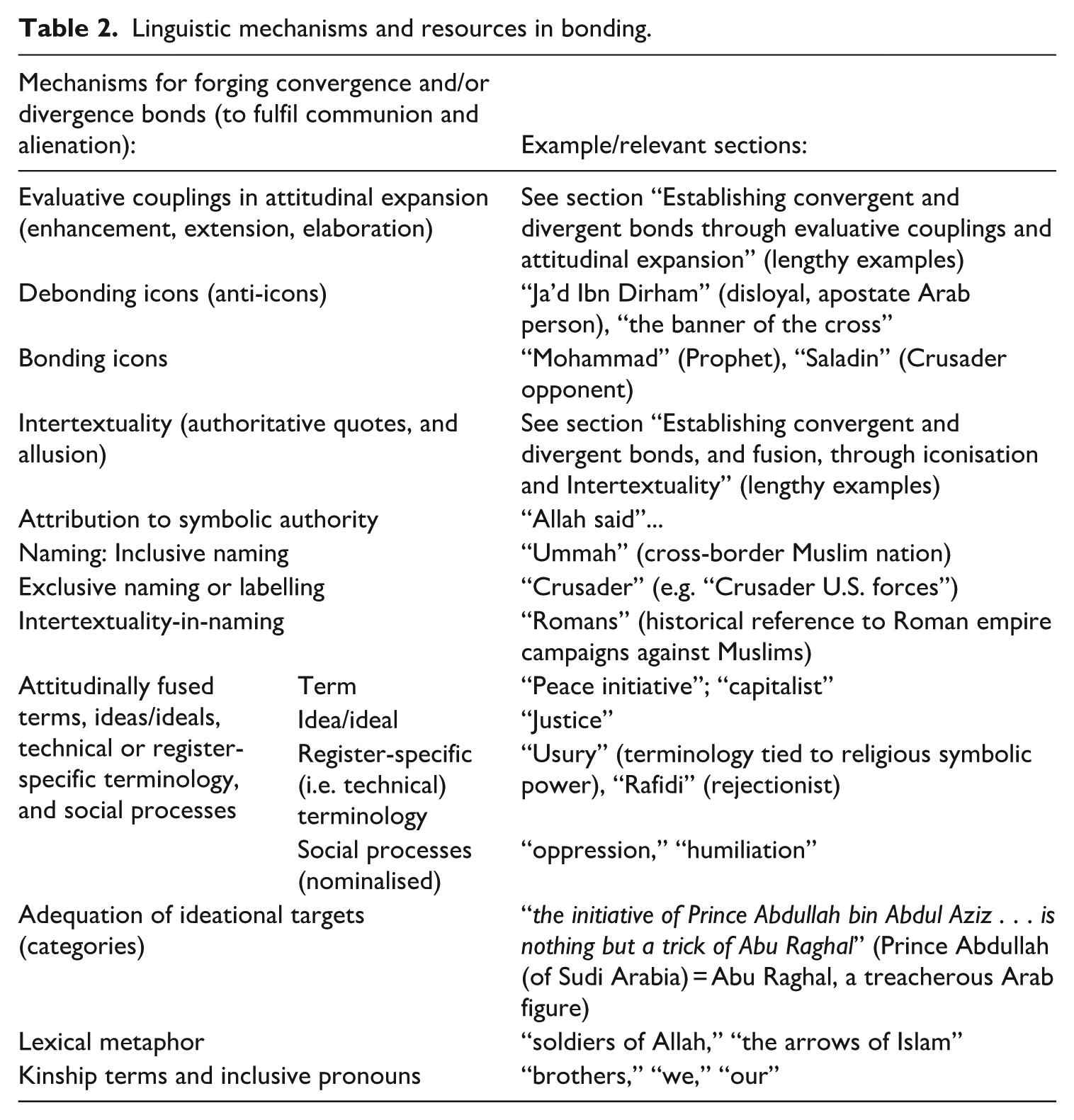
Both OBL and al-Baghdadi extensively use these tactics of bonds and obligations construction (Table 2) to align with incitees’ values, fostering hostility towards perceived enemies and reinforcing binary ideological divides. Both inciters draw extensively on these mechanisms to operate along a continuum of value engagement:
At one end, that is, the value alignment end, the inciters tap into pre-existing values already salient for the audience, such as loyalty to the ingroup, defence of the faith, and care for fellow members. These are framed as morally binding obligations rooted in religious and cultural values, positioning the inciter as a trusted insider who embodies shared ideals.
At the other end, that is, value shaping, inciters actively reconstruct and amplify these values, reframing them within a polarised moral universe that legitimises “othering” and violence against others (e.g. Etaywe, 2022b).
Through selective historical analogies, religious authority claims, and evaluative couplings, they redefine virtues such as loyalty, justice, and honour so that fulfilling them entails hostility towards designated enemies and support for violent action.
In doing so, both leaders present themselves as loyal defenders of the ingroup’s welfare and heritage, strengthening their authority-based appeal (ethos) and enhancing credibility. The repeated construal of convergent bonds (solidarity with the ingroup) alongside divergent bonds (alienation from the outgroup) intensifies the perception that violent action is integral to protecting “our” values. Following Halliday and Hasan’s (1985: 10) view of text as both “product” and “process,” extremist discourse thus becomes a dynamic arena for negotiating intergroup relationships. It is here that evaluative language continuously works to solidify ingroup cohesion, deepen emotional investment, and escalate antagonism toward the outgroup—turning ideological alignment into moral commitment and moral commitment into perceived obligation for violent action.
A key outcome of this process is the fusion of individual identity with group loyalty, which drives followers towards extreme actions. Communion and alienation tactics construct incitement as a process where evaluative couplings, attitudinally fused meanings, and other resources summarised in Table 2 above are relationally selected by inciters to establish bonds and obligations. These bonds, in turn, legitimate violence and coerce incitees into action. By analysing the linguistic choices summarised in Table 2, we can observe the relationship between cultural meaning reservoirs and the repertoire inciters mobilise (Martin, 2010). Inciters enter from the bond entry point (the minimal social unit—Knight, 2010) and progressively integrate into expanding networks of values (e.g. mujahidin networks), ultimately aligning with broader ideological/religious master narratives.
The sections below explore communion and alienation tactics, illustrating how shared identities and values blur individual-group boundaries, fostering fused identities that justify collective action (communion) while constructing outgroups as existential threats to legitimise hostility and exclusion (alienation). This dual framework highlights how incitement operates: convergent bonds reinforce ingroup unity, while divergent bonds generate urgency for action against constructed enemies. That is, the inciters use, what we term here, anticipatory convergence to align with an imagined audience’s values while simultaneously using extreme divergence that allows for framing outgroups as existential threats, weaponising both strategies to incite violence.
Section “The ‘coercing’ function: Deontic bonds and actions to converge around” examines coercion as a process that frames incited action as a collective obligation and moral imperative. By employing coercive rhetorical tactics (e.g. commands, recommendations), appeals to duty, and framing violence as self-defence, extremists cultivate a polarised discourse that simultaneously unites and divides. Coercion extends bonds by presenting violence as necessary for protecting ingroup values, reinforcing both ingroup solidarity and outgroup hostility. The findings reveal that the moral foundations of relationship and treatment negotiation are fluid and strategically redefined within social, cultural, and terrorism contexts. Extremists exploit these moral foundations, invoking values such as “loyalty,” religious “authority,” and “care” to legitimise violence as a moral duty. By embedding incitement within these dynamic networks of bonds and moral justifications, this study underscores how language functions as a powerful tool for legitimising violence, fostering cohesion, and orchestrating collective action.
The “coercing” function: Deontic bonds and actions to converge around
Coercion operates by strengthening ingroup bonds, framing violence against the outgroup as an act of care and loyalty necessary to protect shared values, symbolic power, or survival—creating a deontic bond around which the incited audience is invited to converge. However, the performance of the incited action itself by the incited audience is not part of the incitement message, as incitement is an “inchoate crime” (Wilson, 2017)—that is criminal liability arises even if the incited action is not committed. Encouraged violent actions serve as deontic bonds that reinforce ingroup cohesion while intensifying divisions against the outgroup. The findings show that both OBL and al-Baghdadi use coercion to suggest collective violence, aligning their messages with moral imperatives while extending the incitees’ identity—in Wardhaugh and Fuller’s (2015: 72) terms—from something “they have” to something “they ought to do” as a form of authentication of their identity.
Aligned with Cap (2017), coercion in the dataset is achieved through various techniques. Both inciters tend to employ key strategies, with speech functions established as moralised proposals and demands for action (e.g. Halliday and Matthiessen, 2014). Table 3 summarises these mechanisms.
Linguistic mechanisms used in coercion.
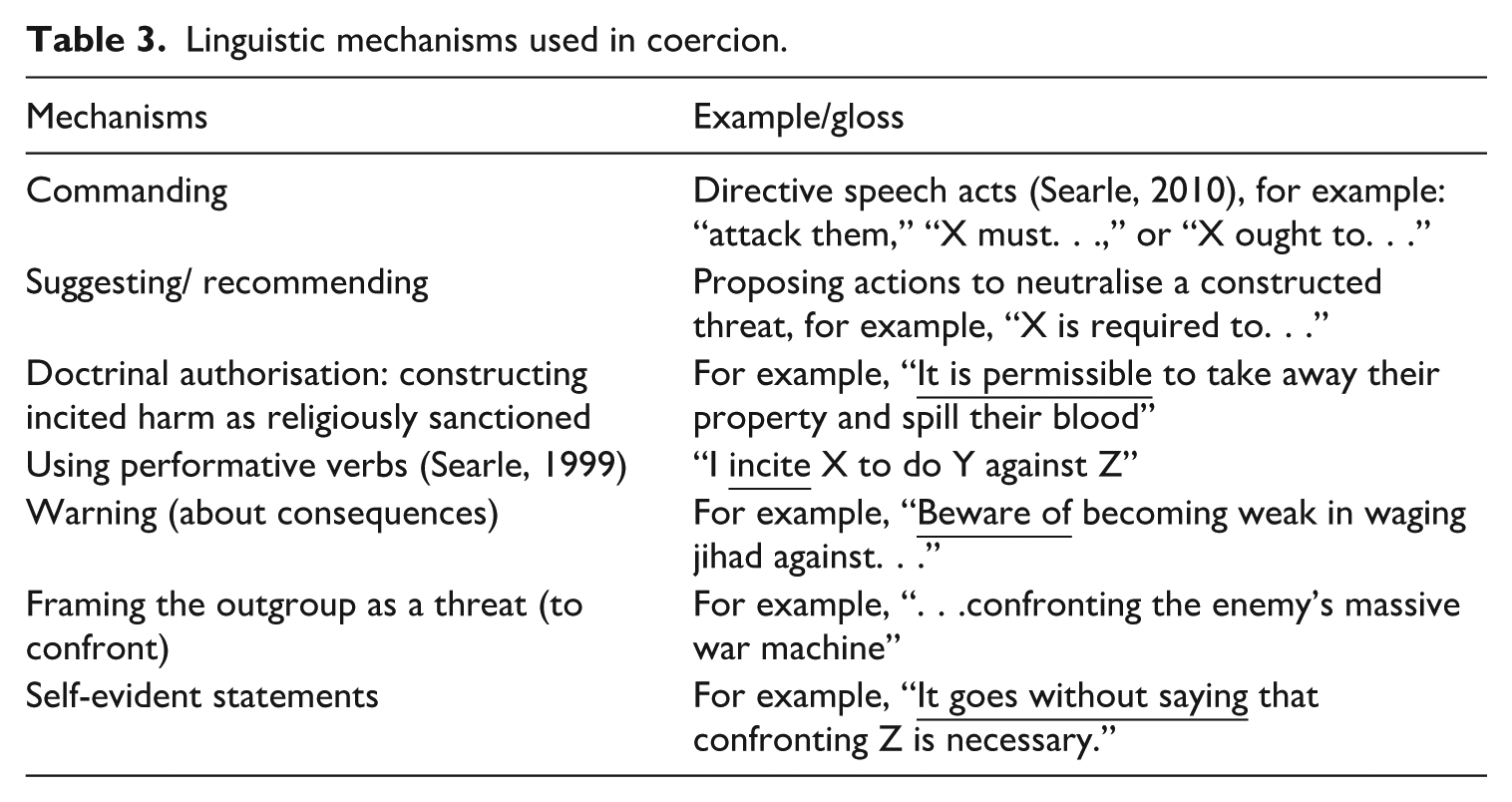
Both OBL and al-Baghdadi’s language creates a sense of duty and solidarity. For instance, OBL’s command, “Muslims in general, and in Iraq in particular, must roll up their sleeves of jihad. . .” (Example 1), uses the imperative “must” to position jihad as a collective responsibility, uniting the ingroup around a common cause. Similarly, OBL’s reference to jihad as “required” and “ought to chip in” and listing recommended actions as “accessible” means of jihad (Examples 2 and 3) urges collective action, while his use of the performative verb “incite” (Example 4) calls Muslims to defend against U.S. forces.
(1) “Muslims in general, and in Iraq in particular, (2) “Today, everyone is (3) “Therefore, – – – – – (4) “We
This coercion mechanism in OBL’s texts also operates by constructing harm as religiously sanctioned and morally obligatory rather than merely suggested, commanded, or framed as a necessity (Example 5). It functions through doctrinal authorisation, where an act (e.g. violence, dispossession) is not just permitted but presented as inherently justified within an intersubjectively established moral or ideological/religious order. In Example (5), the phrase “it is permissible” does not directly command action but authorises harm as an unquestionable religious principle. This differs from directives, recommendations, or warnings, as it does not instruct an action explicitly. Instead, it removes moral and social constraints against violence by embedding it within a legitimised framework of doctrinal endorsement—as long as the targeted victims are US allies in Iraq, hence “apostates” and “outside of the Islam” circle, establishing an irrevocable status of the victims which makes harm against them appear not as aggression but as a rightful consequence of their exclusion. This mechanism thus creates an ideological framework where violence is normalised, justified, and implicitly expected. From a CAT perspective, coercion operates through both convergence and divergence—while inciters linguistically accommodate the ingroup’s perceived values and identity to strengthen solidarity, they simultaneously intensify divergence from the outgroup, ensuring that violence is framed not as an individual choice but as a necessary, morally sanctioned act embedded within the group’s ideological framework.
(5) “We also make it clear that
Al-Baghdadi uses similar tactics, including “warning” against weakness in jihad (Example 6). This warning links group failure to personal betrayal, fostering identity fusion while coercing participation through a sense of moral duty and self-preservation. In this example and mechanism, coercion is constructed through warnings embedded in the process of forging convergent and divergent bonds.
(6) “. . . O people of Ninawa . . .
OBL further intensifies coercion by framing the outgroup as a threat and issuing directives/commands. His directive to enact “Killing the Americans with bullets, knives, stones. . .” (Example 3 above) portrays the outgroup as an existential threat to be eliminated in any available means for the ingroup’s survival. Al-Baghdadi’s rhetoric similarly uses commands as in “attack them” (Example 7) and frames the outgroup as a massive threat to confront (Example 8), urging violent action to ensure the ingroup’s survival. The use of commands and emotionally charged framing language ensures individuals’ actions are perceived as extensions of their identity, aligning personal and group goals. Non-participation is framed as a direct threat to the individual’s moral integrity.
(7) “. . . O men of the Arabian Peninsula, O grandsons of the Sahabah, (8) “And it goes without saying that [. . .]
The analysis shows that both OBL and al-Baghdadi tailor their language to manipulate their audience’s perception of urged violence. This “referee design” (Bell, 2001) strategically shapes the audience’s identity by connecting personal actions to the group’s survival. Through various mechanisms of coercion and emotionally charged language, the inciters position the group’s success and the violent actions taken as extensions of the individual’s identity and role. While the use of commands like “must” creates an authoritative tone, reinforcing jihad as a collective, necessary act, by invoking terms like “unjust campaign” (Example 1), OBL deepens the emotional and ideological resonance, rallying followers to the cause via violent means. Framing of the outgroup’s threat strengthens the moral justification for violence, reinforcing both ideological and personal stakes in the conflict.
The remaining sections report on and discuss the nuances of constant negotiation of intergroup bonds of divergence and ingroup convergence (in terms of “who they are” and/or “what they have” in common). The tactics of establishing convergent and divergent bonds can be understood in light of the more extreme calls for violent actions discussed in the present section. While the “coercing” tactics repeated negotiation, contestation, or affirmation of ways to change the world through a common cause (albeit violent), the tactics reported below operate to actively drive polarisation through differentiating the incited audience from other groups while converging the incitees around the encouraged violent cause as a tool to protect the essence of the group (Islam and/or being Muslims) and their land (Example 9): (9) They [Bush and his supporters] came out to fight Islam under the falsifying name of ‘fighting terrorism’. (OBL 1, 2001)
Establishing convergent and divergent bonds through evaluative couplings and attitudinal expansion
Attitudinal expansion (Etaywe and Zappavigna, 2024) operates in both OBL and al-Baghdadi texts via ideation-attitude couplings to reinforce key bonds soon after they are established in a text. This process employs attitudinal enhancement, extension (Zhao, 2020), and elaboration (Etaywe and Zappavigna, 2024). Enhancement amplifies attitudes by adding similar attitudinal meaning (e.g. judgement), elaboration clarifies an attitudinal meaning (e.g. judgement: propriety) or its target, and extension introduces a new attitudinal meaning with consistent polarity. Both figures utilise these strategies to foster convergent bonds (ingroup alignment) and divergent bonds (outgroup alienation), shaping ideological proximity and distance while strengthening identity fusion. Through audience design, they cultivate a deeply resonant, emotionally charged sense of shared identity, converting personal loyalty into collective allegiance, as shown in the next subsections. This process reflects how inciters exploit one-way convergence to align with followers’ emotions and values while maintaining extreme divergence to construct and reinforce outgroup hostility, strategically shaping ideological proximity and distance.
Convergent bonds for communion and identity fusion
OBL employs attitudinal expansion to affirm jihad’s moral and protective value, reinforcing it as an honourable duty. In Example 10, he invokes seven positive judgement-based couplings (e.g. protection, justice, and dignity) to construct a “good jihad” bond that strengthens communal solidarity and “interactional-master” identity fusion. The emotional intensity of these couplings blurs individual and group identity, aligning followers with jihad as a sacred, collective obligation. The repetitive positive judgements (underlined) create a radiating cumulative value effect, reinforcing shared values and aspirations.
(10) “Verily, it is not unknown to you the position of jihad in the religion. [. . .] By
Al-Baghdadi employs a similar strategy, coupling ISIS with protection, glory, and strength to forge a “good ISIS” bond. Example 11 positions ISIS as the sole protector of Sunni Muslims, fostering identity fusion where loyalty to ISIS becomes an extension of self. His rhetoric presents ISIS as a provider of security and empowerment, reinforcing communal aspirations and consolidating group loyalty. Yet, this strategy plays a role in divergence as shown next.
(11) “O Ahl as-Sunna! After Allah, you
Divergent bonds for alienation and boundary drawing
OBL also constructs divergent bonds to alienate outgroups, particularly the U.S. and its allies. In Example 12, he couples American-aligned governments with negative judgements (e.g. traitors, collaborators) to sustain an “America is bad” bond or “any U.S.-backed government is bad” bond that justifies resistance and jihad which is against the Israeli Palestinian peace initiative presented by Prince Abdullah of Saudi Arabia. Attitudinal expansion amplifies antagonism, deepening ideological divides and reinforcing the need for separation and resistance (“intifadah,” literally “uprising”).
(12) It is no secret that
Similarly, al-Baghdadi intensifies outgroup alienation by framing the U.S.-led coalition forces (targeting ISIS in Syria) as existential threats. In Example 13, negative judgments depict them as enemies waging war against Islam and Muslims (i.e. Allah’s “slaves” or servants who reject being enslaved by humans like the U.S. and find pride in only following Allah’s commands), expanding the perception of threat and justifying violent resistance. His discourse aligns followers through shared fear and antagonism, solidifying communal identity and validating opposition.
(13) “. . .
OBL also employs boundary-drawing tactics. In Example 14, labelling U.S. allies in Iraq as “apostates” marks them (with symbolic religious power-register terms) as outsiders and traitors, reinforcing an ingroup-outgroup divide that legitimises violence against them.
(14) “. . .
In brief, OBL and al-Baghdadi leverage attitudinal expansion to create communion and alienation (outgroup rejection). Through evaluative couplings, they reinforce shared values, intensify ideological divides, and foster identity fusion. The construed bonds operate to align followers by framing ingroup loyalty as a moral duty and outgroup hostility as a justified response, ultimately amplifying the ideological polarisation central to their discourse. The construction of this moral duty is clearest where couplings link ingroup virtues (loyalty, protection, honour) with outgroup threat scenarios. For instance, in Example 13, loyalty becomes a moral obligation against being passivated in a war against Muslims who face expulsion from their own lands. In this framing, anyone who sides with the U.S. in killing Muslims is cast as an “apostate” (Example 14) whose killing is framed as “permissible.” Similarly, in Example 11, joining ISIS is constructed as a moral means to protect land and religion. This moral duty construction is evident in both OBL and al-Baghdadi’s discourse. Not all couplings directly invoke moral duty, but they work cumulatively to create the evaluative landscape in which such duty emerges. Some couplings intensify emotional and moral salience by framing the ingroup as morally virtuous victims and the outgroup as morally corrupt aggressors. Others consolidate binary ideological categories—good versus bad, permissible versus forbidden—through repeated association of moral virtues with ingroup actions and moral vices with outgroup behaviour. Within this good/bad dichotomisation of moral bonds, hostile acts can be presented as “permissible” or “reasonable” (i.e. deontic) through the tactics summarised in Table 2 above. Here, inciter and incitees are co-constructed as cultural members who “share beliefs about what are good and bad” categories, as well as “who is responsible for scenes”; thus they can “indict Others through description of situations” (cf. Tracy, 2008: 176). In this way, instantiated bonds and evaluative couplings operate as activators of cultural and ideological moral orders, drawing on the ingroup’s “basic moral perspective” (assumptions and predispositions; Parvaresh, 2019: 79). These moral orders often invoke meta-values—notably loyalty and care (van Langenhove, 2017)—that function as coding frames for interpreting the moral reasoning behind aggression and for identifying the values used to regulate or legitimise violence.
Establishing convergent and divergent bonds, and fusion, through iconisation and Intertextuality
Iconisation (Martin, 2010) in incitement texts constructs ingroup value-alignment using “bonding icons” (Stenglin, 2004: 402) and outgroup disalignment through debonding icons (anti-icons). These crystallise values, provoke emotional responses, and serve as rallying or divisive devices. Strategic “intertextuality” (Bazerman, 2003; Kristeva, 1980) reinforces these bonds by invoking historical and religious references to deepen shared identities and sustain ideological connections as illustrated next. The inciters strategically converge towards their audience’s ideological and cultural frameworks, using bonding icons to reinforce shared identity and debonding icons to heighten outgroup differentiation.
Bonding icons: Establishing convergent bonds for communion and identity fusion
OBL and al-Baghdadi use religious figures to establish communion and foster identity fusion, merging individual and group identities. Invoking figures such as Prophet Mohammad and Saladin, they position followers to see their fates as intertwined with the collective struggle. For instance, OBL frames jihad as “the path of our Prophet Mohammad” (Example 15) and addresses followers as “grandchildren” (thus extensions) of revered warriors (Example 16), reinforcing a sense of continuity with historical Islamic figures. These intertextual references deepen emotional and ideological ties, solidifying a shared identity rooted in jihad and sacrifice.
(15) “ (16) “O grandchildren of
Similarly, creed icons, such as al-Baghdadi’s reference to the Sunni community as “ahl al-Sunna” in “the peninsula of Muhammad” (referring to the Arabian Peninsula; Example 17), create a transnational collective identity. These references serve to unify followers across geographic boundaries, reinforcing a shared religious identity and positioning their actions—wherever they are—as expressions of this bond.
(17) “
Symbolic object-icons like “Baghdad” and “al-Aqsa mosque” further evoke shared cultural significance. OBL’s reference to Baghdad as “the home of the caliphate” during the Islamic empire time (Example 18) constructs a statehood bond, while invoking al-Aqsa mosque (Example 19) ties jihad to defending sacred spaces against perceived betrayal. These icons serve to link current struggles to past glories, reinforcing ideological and religious unity.
(18) “To the heroes in (19) “And the initiative of Prince Abdullah bin Abdul Aziz. . .is nothing but. . .a form of repeated betrayal in the history of the region’s rulers regarding our issues in general and that of
Debonding icons: Establishing divergent bonds for alienation and identity fusion through opposition. Debonding icons tend to foster divergent bonds by merging group identity with antagonism towards outgroups. OBL and al-Baghdadi label Western forces as “apostates” and “enemies of Islam,” shaping followers’ self-perception as defenders of faith against those fighting under the “banner of the cross” icon (Example 20) which serves to unite perceived enemies under a historical Christian symbol, amplifying the us-vs-them dichotomy.
(20) “Today, you are the soldiers of Allah, the arrows of Islam, and the first line of defence of this Ummah. And the
Al-Baghdadi’s invocation of “Ja’d Ibn Dirham” (Example 21), executed for apostasy, constructs traitors as ideological anti-icons. This reinforces moral purity, urging followers to eradicate perceived threats to “the Ummah” (i.e. an imagined cross border Muslim nation).
(21) “I remind you, O soldiers of the Khilafa and its supporters, to revive the example set forth with the killing of
Intertextuality enhances this alienation by embedding discourse in historical and religious narratives. The “banner of the cross” (Example 20) recalls the Crusades, framing the contemporary conflict as a continuation of past struggles. Likewise, “Ja’d Ibn Dirham’s” execution (Example 21) legitimises violent action as a historical mandate. These references construct outgroups as perpetual enemies, strengthening the ingroup’s ideological cohesion and moral justification.
In a nutshell, through strategic iconisation and intertextuality, inciters embed their discourse within cultural and historical frameworks that reinforce identity fusion. Bonding icons create solidarity, while debonding icons intensify hostility, shaping followers’ self-concept as both defenders and avengers of faith.
Establishing convergent and divergent bonds through attribution and intertextuality: The symbolic power of the sayer
Authoritative quotations play a pivotal role in terrorist incitement discourse, either framing divisive bonds at the outset of an inciting text (Examples 22–23) or reinforcing the message within the main body (Examples 24–25). These references function as explicit intertextual links, shaping audience interpretation through religious and cultural norms. However, it is not religion itself that incites violence but the ideological repurposing of religious texts, aligning with Bourdieu’s (1991) view that ideologies are “doubly determined” by sociopolitical interests. For instance, al-Baghdadi, in Example 22, cites the Quran (where the verse itself presents a “good believer” bond versus a “bad disbeliever” bond) to frame his incited violence as a divine command (deontic bond) against disbelievers. OBL, in Example 23, exploits a prophetic saying in martyrdom rhetoric, construing a “good martyrdom” bond and fusing identity with religious duty. Both OBL and al-Baghdadi further use religious texts to delegitimise and alienate ideological opponents where the referenced religious texts operate “in favor of (or against) the existing (im)moral order” (Al Zidjaly, 2019: 1039). For example, OBL (Example 24) justifies the execution of those aiding the US by citing the Quranic condemnation of alliances with non-believers and the construction of a “bad alliance/ wrongdoing” bond. Similarly, al-Baghdadi (Example 25) demonises the pro-Iran Sahwa (awakening) faction members as spiritually corrupt, invoking a narrated Prophet’s condemnation of factionalism (i.e. a “bad factionalism” bond. This rhetoric positions adversaries as existential threats to Islam, transforming political opposition into a moral and religious conflict.
(22) “Allah also says, “
(23) “Blessing and peace be upon our prophet Mohammad, who says: “
(24) “Allah said: “O you who have believed, (25) “Muslim reported in his Sahih that the Prophet said, “Whoever fights under a banner of blindness, becoming angry for the sake of a faction or calling to a faction or supporting a faction, and is then killed, then it is
From an audience design perspective, quoting authoritative figures establishes legitimacy and moral obligation. Additionally, from the CAT perspective, this strategic use of authoritative quotations exemplifies discursive convergence, aligning inciters’ rhetoric with the religious and ideological expectations of their audience to maximise legitimacy and influence. This tactic constructs a collective identity where ingroup members perceive themselves as aligned with divine authority. Through identity fusion, individuals internalise the ideology, seeing their actions as extensions of religious duty. Terrorist leaders, such as al-Baghdadi, exploit this by embedding revered quotes from the Prophet Mohammad or Allah, reinforcing bonds of communion. Phrases like “Allah says” (Example 22) legitimise violent stances and bonds by invoking divine authority, transforming individual self-concept into a commitment to the group’s moral framework where the power of the sayer is “a power capable of maintaining or subverting the social order” (Bourdieu, 1991: 170). Additionally, this use of religious attribution fosters both ingroup communion and outgroup alienation. Communion transcends ideological alignment, forging an identity deeply intertwined with religious duty, making violent acts a moral imperative. Alienation, meanwhile, is reinforced through the de-/re-contextualised use of religious texts, portraying outgroups as faithless enemies. For example, al-Baghdadi’s invocation of Quranic verses (Example 22) frames “disbelievers” as adversaries of faith, justifying violence as a religious obligation. By embedding these authoritative quotes, terrorist leaders construct a moral framework in which the individual’s identity is inseparable from the ingroup’s cause. Martyrdom (the extreme case of fighting for Islam as flagged by “fight in the cause of Allah” in Example 22 and in the four forms of defence-martyrdom in Example 23) is not just an act but an identity marker, reinforcing an “Us versus Them” divide.
To sum up, OBL and al-Baghdadi’s incitement discourse reflects deliberate audience design, positioning themselves as moral authorities while aligning their followers’ identities with sacred texts. By embedding religious symbols into their rhetoric, they foster a fused identity where violence is framed as a spiritual duty. While not all of the examples discussed above constitute direct incitement to violence (e.g. in the form of explicit commands or exhortations—an issue addressed in Section “The ‘coercing’ function: Deontic bonds and actions to converge around”), they nonetheless reveal a persistent We–They dichotomisation. This binary framing functions as the ideological backdrop against which later calls to action gain moral and emotional traction. In violent extremism, commands alone—whether imperative or hortative—are often insufficient to mobilise support, especially given the general disdain society may hold for extremist figures. Such commands must be anchored in shared moral orders to resonate. The sustained construction of a dichotomous divide frames ingroup inaction as morally dangerous, fostering a fear of the consequences of failing to act. This fear, in turn, is used to lay what Cap (2017: 1) terms a “socio-psychological premise”—a readiness to mobilise in response to what is portrayed as an existing or imminent ideological and physical threat to one’s personal or collective way of life. This strategy deepens ingroup solidarity, vilifies outgroups, and amplifies the moral justification for violence, reinforcing the ingroup’s symbolic power (Bourdieu, 1989, 1991). Through this framing, both leaders work not only to align with incitees’ pre-existing values but also to reshape and reframe those values to conform to their own ideological and moral framework—including values that legitimise violence. Negotiating shared bonds in this way strengthens their perceived credibility and reliability, reinforcing the belief that violent action serves “our” collective values. In their inciting rhetoric, both leaders deploy the tactics summarised in Table 2 to demonstrate coherence between their professed beliefs and those they attribute to their followers. This negotiated convergence not only raises the perceived value coefficient of proposed violent actions but also deepens the cognitive and affective link between violence and ingroup interests.
Establishing convergent and divergent bonds for communion and alienation through naming: Labelling and adequation
Naming and labelling play a crucial role in identity construction, fostering both communion (solidarity) and alienation (division). Drawing on the adequation and indexicality principles (e.g. Bucholtz and Hall, 2005; Hodges, 2007), this section exemplifies how OBL and al-Baghdadi use inclusive and exclusive labels as well as ideational adequation to reinforce ideological bonds and mobilise followers.
Establishing bonds through labelling
OBL and al-Baghdadi employ indexical labels and structures to construct convergent (inclusive) and divergent (exclusive) bonds. From a CAT perspective, the strategic use of inclusive and exclusive labels exemplifies both convergence—aligning ingroup identity through shared ideological markers—and divergence—emphasising linguistic and ideological distance to alienate outgroups, thus reinforcing social stratification. Convergent bonds, essential for identity fusion, are created through inclusive names like “Ummah” (i.e. cross-border one Muslim nation). In Example 26, OBL’s reference to the “Ummah of the beloved Mohammad” merges individual identities with a sacred collective, evoking emotional responsibility and reinforcing solidarity.
(26) “And the
Conversely, exclusive labels define adversarial identities. OBL’s use of “Romans” invokes historical Crusader imagery, framing perceived enemies as ideological outsiders. The phrase “gathered under the banner of the cross” constructs an oppositional identity, reinforcing alienation and moral superiority over outgroups. Additionally, al-Baghdadi’s invocation of “shahada” (martyrdom) in Example 27 integrates personal identity with the group’s mission. By framing martyrdom as an honorific goal, he encourages followers to see their personal destiny as inseparable from the movement’s ideological cause.
(27) “O seekers of
In countering outgroups, divergent bonds are construed to isolate outgroups by labelling them as morally and ideologically inferior. OBL’s reference to the U.S.-led coalition in Iraq as “Crusaders” in Example 28 rekindles historical hostilities, casting the West as an existential threat to Islam and justifying resistance.
(28) “Beware of supporting the
Al-Baghdadi extends this strategy by labelling Kurds as “atheists” and Iranian militias as “Rafida” (a derogatory term for Shiites) in Example 29 (condemning them as fighting Sunnis in Iraq). These labels delegitimise opponents by framing them as religiously impure, reinforcing the pro-ISIS ingroup’s sense of ideological “purity” and justifying hostility.
(29) “Who among us has not heard of the 100 million dollars of support for the
These labels are performative—designed to provoke ideological responses and mobilise followers. Through audience design, OBL and al-Baghdadi craft discourse that aligns with their audience’s pre-existing beliefs, intensifying identity fusion and framing opposition as morally imperative. Ultimately, naming strategies serve as mechanisms for ideological consolidation, transforming abstract beliefs into actionable, radicalised commitments.
Establishing bonds through adequation of attitudinally fused names: Identity construction through ideational meanings
Ideational adequation constructs identity bonds by aligning or differentiating groups (or members thereof) based on similarity or difference between two ideational meanings, that is, the principles of similarity/difference relations (e.g. Bucholtz and Hall, 2005; Hodges, 2007), and through shared or contested ideologies. This tactic enhances identity fusion by presenting collective struggles as inseparable from individual duty, as seen in Example (30). In this example, OBL equates Pakistan with Afghanistan as a “front line of defence” for Islam, fostering unity and identity fusion through a shared jihadist duty where the latter had defended the former and thus, the former was expected to do the same towards Afghani people. The phrase “just as” reinforces historical continuity, framing resistance as a collective moral obligation. This strategy ensures audience alignment by appealing to the Pakistani audience’s sense of belonging and duty within the broader Ummah (to join or defend jihad in Afghanistan).
(30) “It is no wonder that the Muslim Ummah in Pakistan has rushed to defend Islam, as it is considered the front line of defence for Islam in this region –
Adequation also alienates outgroups by likening figures to traitors. In (31), OBL likens Prince Abdullah bin Abdul Aziz of Saudi Arabia to “Abu Raghal,” an Islamic symbol of treachery, deepening moral divides and solidifying ingroup unity. This comparison alienates Abdullah (a traitor Abdullah’ bond) while reinforcing ingroup loyalty by invoking historical betrayal. The audience is encouraged to view themselves as defenders of religious integrity, while outgroup figures are cast as enemies of the Ummah. In (32), OBL extends this rhetoric by associating Abdullah with past “traitors” who met violent ends, reinforcing a narrative where betrayal is punishable by death that is “well deserved” and by “heroes.” This identity fusion solidifies ingroup bonds by equating justice with retribution.
(31) “The treacherous character of ‘Abu Raghal’ has been repeatedly introduced to the Ummah since a century ago, to weaken our front, disgrace our banner, to end jihad, to bring about infidelity and to cement its pillars. And (32) “Our Muslim Ummah:
These ideational adequation strategies deepen audience alignment, shaping a fused collective identity by constructing shared values and common enemies. Through adequation, the incitement discourse manipulates historical and religious narratives to reinforce identity fusion, ensuring emotional and ideological resonance across audiences.
Establishing convergent and divergent bonds through attitudinally fused terms, ideas, and technical/register-specific terminology
Attitudinally fused terms, technical terms, and social processes serve to construct identity-driven discourse by fostering convergent and divergent bonds. These linguistic strategies reinforce identity fusion and audience design, aligning individual attitudes with collective ideals. Terms like “justice” and “injustice” carry emotional and moral weight, binding audiences to shared grievances and obligations. Example (33) shows OBL using words such as “tyranny,” “contempt,” and nominalised processes such as “oppression” and “humiliation” to evoke moral violation and collective suffering, linking personal dignity to group identity. The phrase “death is not more difficult for us than to live in humiliation and contempt” elevates collective ideals above personal survival, fostering commitment to action. Similarly, in (example 34), al-Baghdadi positions resistance as a moral imperative, portraying injustice as an existential threat to the “sons of the Sunnah.” The phrase “warriors who do not sleep in the face of injustice” aligns individual and collective missions, reinforcing unwavering solidarity.
(33) “O Ummah, Rise up and stand against . . . (34) “The Islamic State is not confined to Hajin [a small city in Syria], for the sons of the Sunnah are warriors who do not sleep in the face of
Technical or register-specific terms also add legitimacy and authority. In (35), OBL condemns “capitalists, usury takers, and merchants of arms and oil,” portraying them as agents of moral corruption. The term “usury,” with its legal and religious register significance, resonates with an Islamic audience, reinforcing ingroup moral superiority over exploiters.
(35) “Those [US] soldiers are completely convinced of the injustice and lying of their government. They also lack a fair cause to defend. They only fight for
The process of “humiliation,” seen in (Example 33 above), elicits emotional responses by framing the ingroup as victims of systemic degradation (see Belavadi and Hogg, 2023). This strategy ensures resonance across diverse audiences by balancing broad ideals like “justice” with specific grievances such as “oppression.” While convergent bonds unify individuals around shared ideals of justice and “our dignity” (Example 33), divergent bonds reinforce hostility by juxtaposing moral integrity against outgroup corruption and responsibility for oppression, injustice, etc.
Establishing convergent and divergent bonds for communion and alienation through metaphors
Metaphors serve as powerful rhetorical tools for establishing bonds, aligning identities, and fostering ideological unity (Hart, 2014). They are especially effective in contexts that involve construing social affiliations and enacting ideological alignments (Liu, 2018) through forging convergent and divergent bonds.
Regarding metaphor in convergent bonds, both inciters in this study use metaphors strategically to forge convergent bonds. For example, OBL’s metaphors such as “soldiers of Allah,” “arrows of Islam,” and “first line of defence” position the audience as part of a unified ingroup with a divine mission. These metaphors frame the audience as defenders of Islam, invoking shared Islamic traditions and a sense of moral responsibility (Example 36). Similarly, al-Baghdadi’s metaphor “The ummah’s division will be healed” (Example 37) frames unity as a moral and communal restoration through struggle. These metaphors not only depict the audience as part of a moral and religious struggle but also create a sense of identity fusion, where individual identities merge with the collective cause.
(36) “Today, you are (37) “
Concerning metaphors in divergent bonds, metaphors also operate to delineate ingroups from outgroups. For instance, OBL’s metaphor, “the Romans have gathered, under the banner of the cross, to fight the Ummah,” frames the opposition as a unified, historical adversary (Example 36 above). Similarly, al-Baghdadi’s metaphors like “Turn the disbelievers’ night into day” (Example 38) and “tasted humiliation and disgrace” (Example 39, inciting the Sunni Iraqis against pro-Iran factions) reinforce the moral and ideological divide by framing the opposition as a corrupt, existential threat and the cause of “our” humiliation—justifying relentless confrontation.
(38) (39) “O Ahl as-Sunna in Iraq, is it that every single time you show no sense? You
The metaphor “The hammers of tribulation” (Example 40) fosters resilience within the ingroup, symbolising strength through hardship. Furthermore, metaphors like “extinguish the light of Allah” (Example 41) present the conflict as a moral and spiritual battle: (40) “ (41) “ . . . they will strive to
In summary, metaphors play a dual role. They foster convergent bonds by uniting the audience around shared values and divergent bonds by heightening the moral and ideological distance from the outgroup. Through strategic use, these metaphors serve to reinforce identity fusion, mobilise collective action, and further the inciters’ ideological goals. From a CAT perspective, metaphors act as accommodative devices that facilitate convergence by reinforcing shared group identity and ideological alignment, while simultaneously enacting divergence by framing the outgroup as an existential or moral antagonist, thereby justifying exclusionary and confrontational stances.
Establishing convergent and divergent bonds through kinship terms and inclusive pronouns
Kinship terms and inclusive pronouns foster convergent bonds by invoking familial or communal associations, such as “brothers,” “sisters,” “we,” and “our,” to create emotional and social connections based on shared identity and collective purpose. These linguistic resources facilitate identity fusion, where individual identity merges with the “we” group, creating a deeply felt sense of “we-ness” and collective responsibility. This sense of fusion is central to how inciters mobilise audiences and promote loyalty. For example, OBL’s use of “
(42) “O (43) “I have been informed of the news of the killing of some of
In contrast, exclusive pronouns (e.g. they, them) help forge divergent bonds by framing the “other” as non-kin and an existential threat to the fused ingroup identity. Al-Baghdadi, in Example (44), incites Iraqis in the city of Ninawa against the pr-Iran Rafidi factions and uses the exclusive pronouns “them” to construct a stark moral and ideological boundary between the ingroup (the speaker’s audience) and the outgroup (the Rafidi). Unlike inclusive pronouns and kinship terms that foster convergence, shared identity, and collective responsibility, exclusive pronouns reinforce alienation by positioning the outgroup against whom the people of Ninawa are encouraged to remain steadfast in jihad. This linguistic choice establishes a clear dichotomy between “us”—the defenders of Islam—and “them”—the corrupting adversaries who threaten to “undo the bonds of Islam. . .” (44) “Therefore, O people of Ninawa [. . .] Beware of becoming weak in waging jihad against your enemy and repelling
Thus, kinship terms and inclusive pronouns not only solidify internal cohesion and identity fusion but also draw stark moral and emotional lines between the ingroup and outgroup as opposing kin networks, framing the struggle as both collective and deeply personal. This dynamic plays a crucial role in the process of coercion into encouraged action, which is explored further in the next section. From a CAT perspective, the strategic use of kinship terms and inclusive pronouns functions as an accommodative strategy to enhance convergence by fostering a shared linguistic identity, strengthening emotional alignment, and reinforcing ideological solidarity, while exclusive pronouns enact divergence by amplifying social and moral distance from the outgroup, legitimising opposition and conflict.
Conclusion
This study has examined the relational semiotics of incitement discourse, focusing on how violent extremist incitement texts function as networks of bonds and obligations in violent extremism contexts. Language, far from being neutral or purely coercive, operates within existing narratives of grievance, power, and belonging, reinforcing social bonds and pro-ingroup ideological obligations. Incitement texts exploit vulnerabilities and frame threats to align individuals with group ideologies, not by constructing new moral identities, but by reframing existing grievances and power dynamics. This study extends prior research on incitement (e.g. Jaconelli, 2018; Kurzon, 1998) by emphasising the active role of violent extremist discourse as a resource in fuelling intergroup polarisation and in constructing or cultivating (un)shared moral orders and collective identities. To effectively incite violence, the analysis provided evidence of how an extremist goes beyond imperative and hortative constructions, shaping values and linking urged actions to the audience’s existing beliefs and values. The relational dynamics within these bonds help construct a pro-ingroup image of the inciter, while linguistic strategies that suggest and coerce violence position it as justified and a deontic right. Coercion thus compels individuals to act collectively under a shared moral purpose, reinforcing networks of bonds, master identities, ideologies, and kinship in which individual identity is merged into the group and its identity, essence and threats. Inciters enter from a bond entry point and progressively integrate into expanding networks of values (e.g. mujahidin networks), ultimately aligning with broader ideological and religious master networks and narratives.
The analysis of speeches by OBL and al-Baghdadi as a case study revealed how linguistic strategies not only shape group identity and justify violence but also manipulate moral frameworks to mobilise action. At the initial stage, these texts align their ideological claims with values and emotional dispositions that the audience already holds—such as loyalty, honour, and protection of the ingroup—presenting them as culturally and morally binding obligations. This alignment in itself is not yet manipulation; it becomes manipulative when these shared values are reframed, intensified, or re-coded to serve the inciters’ ideological agenda. In this stage, loyalty to the ingroup is no longer simply a virtue but is constructed as a moral imperative that demands violent action. Perceived threats are amplified and framed as existential, with collective grievances elevated to the level of sacred causes. In this way, the moral duty to protect the ingroup is conflated with the strategic necessity of aggression, turning deeply held moral values into justifications for violent retaliation against the outgroup essence (e.g. Buhrmester et al., 2018). This process transforms audience alignment into ideological compliance, where resistance to violence is reframed as betrayal.
Drawing on SFL analytical tools and CAT principles and accommodation strategies, this study has situated incitement texts within a broader relational and communicative context. It highlights the use of linguistic strategies, such as intertextual allusions, iconisation, and metaphorical language, to strengthen ingroup loyalty and demonise outgroups. Kinship metaphors and authoritative quotes deepen loyalty and frame violent actions as moral imperatives necessary for the group’s survival. The study has also identified bonds of communion, alienation, and coercion as central to the relational dynamics of incitement texts. Communion strengthens ingroup cohesion through shared values and kinship, while alienation demonises outgroups and justifies hostility. Coercion uses performative language to frame violent actions as both moral imperatives and pragmatic necessities, silencing dissent and promoting inevitable sacrifice. By tailoring linguistic styles to resonate with their target audience’s beliefs and values, inciters manipulate moral frameworks and escalate aggression towards outgroups.
In extending existing SFL work on bonding, this study introduces the concepts of divergent bonds, convergent bonds, polarising bonds, and deontic bonds. These new categories help to describe how violent extremism discourse uses various lexico-grammatical resources to construct and maintain or polarise ideological networks. Divergent bonds emphasise the disconnection from outgroups, while convergent bonds foster loyalty within the ingroup. Polarising bonds serve to exaggerate differences, intensifying intergroup conflict, and deontic bonds position urged violent actions as moral obligations, framing them as necessary for group survival.
This research offers a potential extension of CAT by illustrating how strategic linguistic adjustments in extremist discourse function to reinforce ingroup cohesion and intensify outgroup hostility. This study suggests that extremist leaders employ one-way, non-reciprocal accommodation to anticipate audience receptivity rather than directly responding to interlocutors. The findings demonstrate that coercion in extremist rhetoric operates through a strategic form of ideological convergence, where inciters deliberately align their linguistic choices with the perceived values, fears, and moral frameworks of their audience. This aligns with CAT’s notion of convergence, but in a pre-emptive, rather than interactive, manner. Additionally, the use of emotionally charged directives (“must,” “required”) and moralised justifications (“it is permissible”) can be viewed as a form of over-accommodation, where the speaker exaggerates ingroup alignment to maximise ideological resonance and compliance. Additionally, while CAT primarily examines divergence as a strategy to reinforce distinct social identities, this study suggests that extremist incitement employs divergence not just to differentiate, but to morally delegitimise the outgroup. By framing outgroup members as existential threats and using doctrinal authorisation to justify harm, extremist discourse not only constructs a rigid ingroup-outgroup boundary but also weaponises divergence as a means of incitement. This suggests a more extreme form of intergroup divergence, where linguistic choices do not merely signal group separation but actively promote violent exclusion. Given that incitement here operates (not reciprocally but) asymmetrically, this study suggests that extremist leaders tailor their discourse based on an anticipated or desired audience response, aligning their rhetoric with ingroup norms, shared grievances, and ideological expectations. This is similar to Bell’s (2001) “referee design,” where speakers shape their language not in direct response to interlocutors but in alignment with an imagined audience’s values. This adaptation could refine CAT by demonstrating how accommodation functions in ideological, non-dialogic discourse and strategic, one-way accommodation in ideological discourse, showing how pre-emptive accommodation, including anticipatory convergence and extreme divergence functions as persuasive tools in incitement rhetoric and in persuasive, non-reciprocal contexts.
Our article has contributed to the study of “identity fusion” (Buhrmester et al., 2018) by demonstrating how relational discourse strategies serve to authenticate loyalty to a group or extremist ideologies through performative identity markers (i.e. through “doing,” as an expression of identity). It also develops a dual-layered analytical framework that synthesises relational and linguistic approaches, offering a comprehensive understanding of how incitement texts shape group identity, justify violence, foster solidarity and serve to fuse individual identity into group identity. The findings reveal how relational work operates in extremist discourse as a tool of identity fusion and ideological legitimation, offering fresh insights into the semiotic mechanics of toxic affiliation and moral mobilisation. The study extends intergroup communication research (e.g. Blitvich, 2024; Gaffney et al., 2024) by shifting the lens from dialogic exchanges or mediated political discourse to asymmetric, monologic incitement texts where the speaker strategically constructs imagined group boundaries and affective bonds with audiences, foregrounding how ideological and affective alignment is unilaterally crafted through semiotic and evaluative resources. As to intercultural rapport management (Spencer-Oatey and Kádár, 2021), this study similarly addresses how speakers manage sociality rights and obligations across perceived group boundaries. However, rather than focusing on politeness, harmony, or intercultural adjustment, our analysis reveals how rapport is mobilised as a persuasive tool for ideological recruitment and moral coercion. It thus reframes rapport management as a vehicle not just for affiliation, but also for instrumental solidarity in morally polarised contexts. With regard to relational work (Locher and Watts, 2008), the study, while sharing the core interest in how social relationships are linguistically constructed, it focuses more on extreme, emotionally charged, and ethically consequential discourse. The use of discourse semantics and attention to discursive pragmatic functions allow us to map how solidarity and alienation are encoded in various bond-construction mechanisms and invoked moral orders—adding a systematic analytical grammar to the often broader and more interpretive relational work framework. This approach adapts linguistic choice analysis to capture how “discourse production and comprehension” (Van Dijk, 2008: 18) in incitement contexts fuses ideational and interpersonal meanings, making what is happening in the world (field) inseparable from the guiding tenor. These discourse resources work together not only to encourage violence but also to guide audiences morally, emotionally, and aesthetically.
The findings have substantial applied value in countering extremist discourse. By unpacking the relational dynamics of incitement, the study provides a framework for deconstructing the linguistic strategies extremists use to solidify group cohesion and legitimise violence. This insight is crucial for developing counter-narratives that weaken the relational bonds extremists seek to establish, reducing their persuasive appeal. The study also extends existing persuasion models (e.g. Partington and Taylor, 2017) by emphasising the role of relational bonding in high-stakes ideological conflicts. It suggests a dynamic, networked approach to persuasion, moving beyond traditional linear models. The findings also offer valuable insights for intergroup communication and counter-extremism efforts, demonstrating how linguistic analysis can deconstruct incitement narratives and challenge violent ideologies in both digital and offline spaces.
Future research could investigate the role of digital platforms in amplifying radical discourse and examine the psycholinguistic mechanisms behind identity fusion to better understand susceptibility to radicalisation. Additionally, exploring contexts such as cancel culture (Blitvich, 2024) and far-right extremism could offer critical insights for counter-extremism initiatives and policymaking. A further avenue for research involves disinformation-fuelled incitement discourse within the proposed relational semiotics framework, which would provide a deeper theoretical lens for analysing radicalisation strategies. Future studies could also assess coder reliability in incitement text analysis, explore cultural and regional variations in incitement rhetoric, and investigate the psychological impact of these strategies. Expanding the corpus of texts and integrating interdisciplinary approaches—such as forensic linguistics, media studies, and cognitive psychology—could significantly enhance our understanding of incitement discourse.
Finally, as incitement discourse continues to evolve with technological and communicative shifts, future research must address how present-day extremists adapt to emerging platforms, multimodal formats (e.g. memes, emoji convergence with written co-text, videos, encrypted messaging), and algorithmic amplification. Contemporary inciters may exploit gamified propaganda, microtargeted messages, and influencer-style branding to manipulate digital audiences more effectively than traditional sermon-like texts. These shifts raise new challenges for detection, interpretation, and prevention. A relational semiotic approach remains well-positioned to unpack how these actors calibrate meaning-making resources across modalities, platforms, and audiences to construct legitimising narratives, forge affective bonds, and mobilise action under conditions of surveillance, saturation, and platform governance.
Footnotes

Funding
The authors received no financial support for the research, authorship, and/or publication of this article.
Declaration of conflicting interests
The authors declared no potential conflicts of interest with respect to the research, authorship, and/or publication of this article.