



Abstract
Drawing on critical discourse studies (CDS), this article foregrounds how British higher education institutions respond to gender-critical controversies sparked by their staff members. Adopting Teun van Dijk’s sociocognitive approach, we analyse the University of Sussex’s crisis responses on Twitter (known as X today) concerning de-platforming campaigns against Kathleen Stock. The analysis unpacks how Sussex employs various discursive strategies to validate its institutional stance in the Stock incident. Sussex’s communicative actions aim to mitigate reputation damage caused by the incident. However, such discursive practices simultaneously indicate the university’s attempt to evade its institutional responsibility for equality, diversity and inclusion (EDI) advocacy, neither do they address the reputation crisis caused by fellow Twitter users’ counter-narratives. The analysis points towards the need for a sociocognitive analysis of crisis responses to hold higher education institutions accountable for their core mission, amid trans-rights debates unfolding in wider society.
Keywords
Introduction
In recent years, trans-rights debates have occupied the forefront of public attention, with an unusual alignment between right-wing conservatives and factions of left-leaning feminists observed across the globe (Hines, 2020; McLean, 2021). In the UK, we have witnessed not only high-profile celebrities (e.g. JK Rowling; Ravell, 2023) but also senior academics vigorously arguing against reforms to the nation’s gender-recognition legal framework, which aim to facilitate self-identification of gender identities (Worthen, 2022). Such anti-trans sentiments are informed by gender-critical ideologies, which suggest that sex outweighs gender in policymaking and legislation (Zanghellini, 2020). Among various cases, one of the most well-known instances is the controversy sparked by Kathleen Stock, a professor formerly based at the University of Sussex.
As a philosopher, Stock has long been using academic forums and social media to propagate gender-critical ideologies (Zanghellini, 2020). While being condemned by many as a ‘TEFR’ (trans-exclusionary radical feminist) for effectively propagating transphobic rhetoric, she simultaneously enjoys popular support among members of the public who subscribe to her gender-critical views (McLean, 2021). Her story started gaining traction after she was appointed Officer of the Order of the British Empire (OBE) by the UK government in recognition of her services in higher education in December 2020 (Wong, 2021). Since then, a series of open letters have been signed by fellow scholars and university students, siding with or against her in the name of defending her freedom of expression and protesting against transphobia, respectively. Such debates continued for almost a year until student-led de-platforming campaigns against her received support from the Sussex branch of the University and College Union (UCU), which led to her eventual resignation from the university towards the end of 2021 (Wong, 2021). Controversies surrounding gender-critical scholars like Stock not only entail personal consequences but also cause reputational damage to the universities with which they are affiliated, as a result of public expectations for institutional intervention. This pressures the universities to react publicly through official communicative channels, offering the opportunity to elicit their institutional stances in trans-rights debates and the repercussions of such stances for the institutions in return.
Drawing on critical discourse studies (CDS), this article consults Teun van Dijk’s (2014) sociocognitive approach to examine Sussex’s public-facing crisis responses to the gender-critical controversy sparked by Stock. The empirical research scrutinises the official tweets and press releases posted by Sussex in the wake of the incident, as well as fellow social media users’ reactions to the university’s crisis responses on Twitter. The analysis discovers how Sussex consistently adopts an entextualisation-centric discursive strategy to decontextualise and recontextualise the gender-critical controversy insofar as to establish a more desirable communicative situation for the institution’s crisis responses. This discursive strategy is bolstered by the university’s rhetorical performance of a seemingly neutral stance, which attempts to engage audiences with polarised views on the focal issue. Yet, such an institutional stance-taking marginalises the university from its core mission of promoting equality, diversity and inclusion (EDI) values; nor does it help to address the reputation damage caused by the incident, as revealed by fellow Twitter users’ reactions to the university’s crisis responses. The research offers a much-needed CDS intervention aiming to hold the higher education sector accountable for its EDI mission in trans-rights debates.
Literature review
The rise of gender-critical feminism
Trans is an overarching concept, capturing various practices that enable one to move between (e.g. drag), across (e.g. gender realignment, or beyond (e.g. queer) gender categories (Hines, 2020). Different from other variants within the broader LGBTQ+ family, trans practices not only substantiate the social construction of gender but also challenge the orthodox view of sex binary (Halberstam, 2018). Indeed, biologists have accumulated numerous genetic evidence confirming that XX individuals might grow testes, while XY individuals might develop ovaries (Eicher and Washburn, 1986). Nature has offered a systematic survey of relevant data, which has convincingly rejected the sex binary on scientific grounds (Ainsworth, 2015). It is undeniable that ‘abnormal gonadal development’ is relatively rare (Eicher and Washburn, 1986: 331). Yet, as part of late modernity, each individual’s lived experience is meant to be appreciated. The occurrence of such once-thought abnormal phenomena calls sex essentialism, which regards sex as binary and assigned at birth, into question, as it denies the existence of gender variance observed across historical periods of all civilisations (Butler, 2006).
Drawing from scientific observations, Judith Butler (2006: 91) presents her sociopolitical critiques of sex essentialism by defining gender as a mental construct being ‘instituted in an exterior space through a stylised repetition of acts’. Her queer feminist scholarship challenges trans-exclusionary policymaking by problematising the potential for individuals to experience their bodies beyond the constraints of societal influence. Further advocating trans members of the LGBTQ+ community’s agency and self-autonomy, Jack Halberstam (2018: 86), a trans scholar himself, introduces the concept, ‘queer time’, to disrupt conventional narratives of linear progress and normative life paths. Through this framework, he necessitates scaffolding individuals’ journeys of self-discovery, transition and identity formation in the context of gender and sexuality, arguing that the process of self-realisation can resist societal pressures to conform to normative timelines (Halberstam, 2018). In conjunction with Judith Butler’s (2006) work, his analysis broadens our comprehension of trans experiences, highlighting the diversity and fluidity of the pathways through which individuals traverse in their pursuit of self-expression and authenticity as an essential character of the late-modern period.
Despite compelling scientific evidence and convincing sociopolitical critiques, sex essentialism, however, remains embraced by a sizable portion of the public, leading to severe discrimination against trans individuals (Peng and Sun, 2022). In recent years, a series of trans-exclusionary bills, which primarily limit trans women’s athletic rights and access to gender-binary public spaces, have been introduced by US legislators in several states (Jones and Slater, 2020; Martin and Rahilly, 2023). The UK government’s consultation attempting to reform gender-identity recognition within the legal framework has also provoked a backlash from a large group of the British people (Hines, 2020). With the alignment of powerful politicians (e.g. Donald Trump), influential celebrities (e.g. JK Rowling) and pressure groups (e.g. the LGB Alliance), an odd coalition is in the making, consisting of both advocates of conservatism and supporters of feminism, across the globe (McLean, 2021).
It is logical to see right-wing populists taking a transphobic stance, considering the incompatibility between trans-inclusivity and conservative politics (Worthen, 2022). The rise of trans-exclusionary voices from within the broad feminist movement, however, raises unresolved questions that date back to the second-wave feminist movements, reflecting some radical activists’ unreflexive analyses of sex. Today, trans-exclusionary voices from the feminist wing are largely organised ‘under the banner of gender-critical feminism’ (McLean, 2021: 474). This body of literature remains committed to a women-vs-men paradigm of inquiry, marginalising scrutiny of the entangled relations between gender and sex in structural injustices (Sikka, 2021). Gender-critical feminists treat sex as essentialised in one’s body, which determines how their gender identities are acquired and expressed at a later stage of life (Worthen, 2022). They call trans-inclusivity into question, portraying trans women as conformists who reinforce stereotypical womanhood and trans men as opportunists who are bewitched by men’s privileges (Hines, 2020). Trans women, in particular, are often singled out because the gender-critical camp fears they will encroach on the territory traditionally reserved for cisgender women (Jones and Slater, 2020).
From trans-rights debates to public relations in higher education
Higher education is, overall, a relatively inclusive community, but there has been an increased volume of gender-critical literature produced by academics, in both scholarly publications and media columns (Zanghellini, 2020). Such writing is not confined to intellectual debates but often emerges as responses to the increased visibility of pro-inclusive, progressive politics, providing the trans-exclusionary camp with an epistemological basis to justify their cause (McLean, 2021). With the political incentive in mind, gender-critical scholars are often vocal about their thoughts on social media (Hines, 2020). Albeit being in the minority in academia, their vigorous propagation of trans-exclusionary rhetoric has created an echo chamber for anti-trans sentiments to grow in wider society (Pearce et al., 2020). Considering the discriminatory implications of their work, gender-critical scholars are heavily criticised by fellow academics (Carrera-Fernandez and DePalma, 2020; Hildebrand-Chupp, 2020). This has sparked gender-critical controversies on university campuses, creating challenging reputation crises that higher education institutions must address today.
In the UK, most universities are publicly funded, making them socially responsible for the marginalised. Amid the development of decolonisation scholarship, the promotion of EDI (Equality, Diversity and Inclusion) values is now considered a key mission of universities (Tudor, 2021). However, the contemporary commercialisation of the sector has simultaneously subjected universities to market-driven practices, pressurising them to engage external stakeholders for public relations (PR) purposes. In this process, social media is evidently utilised by universities to orchestrate responses when crises arise, mirroring the digital transformation of the PR profession (Coombs, 2015). Unlike most other types, crises emerging with on-campus gender-critical controversies are inherently challenging to address, due to the involvement of internal stakeholders whose worldviews are ideologically confrontational (Gutzwa, 2022). Yet, universities’ handling of such crises cannot be discussed in isolation within the PR context, as it offers a test case to determine the extent to which the higher education sector remains committed to its EDI-advocacy mission statement.
A sociocognitive approach to PR communication in higher education
Informed by critiques of the functionalist tradition in existing PR literature (Motion and Weaver, 2005), we adopt a sociocognitive approach, under the CDS rubric, to foreground how British universities handle reputation crises caused by on-campus gender-critical controversies. In doing so, this research purposively offers critical scrutiny of higher education organisations’ communicative actions to hold them accountable for their institutional responsibility in broader trans-rights debates.
The sociocognitive approach describes a particular CDS strand, which aims to understand the social relevance of discourse production and consumption (van Dijk, 2014). The notion of discourse encompasses both the pattern of language use within a given context and the method of framing events through a social viewpoint (Fairclough, 2001). It reflects a specific paradigm of social practice, which conveys ideological messages through an intricate collection of interconnected linguistic actions and thematically related symbolic expressions (Richardson and Wodak, 2009). Integrating how social domination is perpetuated within the discursive realm, Teun van Dijk (2014: 12) argues that discourse is not only ‘a form of social interaction in society’ but also the ‘expression and reproduction of social cognition’. Resonating with Norman Fairclough’s (2001) and Ruth Wodak’s (2009) scholarship, his sociocognitive approach is advanced to support progressive politics through a sociolinguistic trajectory of intellectual intervention.
While sharing a constructionist epistemological stance, the sociocognitive approach differentiates itself from other CDS strands by introducing a cognitive level of analysis. To this end, it addresses the dual shaping of discursive structures in relation to both the wider sociopolitical infrastructure and participants’ subjective experiences in communicative actions (van Dijk, 2008). Indeed, discourse production does not correspond linearly to its consumption (Gyollai, 2022). Participants constantly invoke different mental models to produce and interpret texts in social interactions, making the communicative process subjective in nature (Koller, 2012). Recognising the subjectiveness of communicative actions, the sociocognitive approach departs from a reductionist perspective, accounting for the intricate relationships between discourses, their subjective production and interpretation, as well as broader social structures (van Dijk, 2014).
Rooted in sociolinguistic traditions, the analytical framework of the sociocognitive approach involves locating various operationalised categories, which either constitute basic meaning-making units or assist their functioning in shaping communicatees’ cognition of an event. Amongst these categories, simplification, vagueness, euphemisation and argumentation are considered salient in defining the structure of a discourse. Simplification and vagueness are basic meaning-making units. The former relies on abstraction or generalisation, representing an event by establishing a current experience and comparing it to other events (van Dijk, 2014: 262). The latter refers to the level of precision being used in narration, which is materialised either upon calibrated lexical choices or the selective absence of details (van Dijk, 2008). The functioning of the meaning-making units is supported by more complex discursive structures, such as rhetoric and argumentation, which primarily enhance the persuasiveness of a discourse (van Dijk, 2014). In terms of rhetoric, euphemisation is a stylised feature of a discourse, which downplays the perceived bias of a viewpoint to render it legitimised (Brown and Mondon, 2021). It is typically invoked to scaffold argumentation, which offers ‘content-related warrants’ to rationalise a statement (Richardson and Wodak, 2009: 225). This is accomplished through structured narration, often using evidence, to connect an argument to a conclusion (van Leeuwen, 2008). Such structural features are purposively devised to craft desire paths in communicatees’ mental processing of a discourse, aiming to minimise the cognitive efforts required to comprehend an event insofar as to legitimise a preferred interpretation of it.
Instead of focusing solely on operationalised categories, the sociocognitive approach unpacks how discursive structures are contextually shaped by ‘socially shared knowledge, ideologies, and personal mental models of social members’ (van Dijk, 2014: 12). This opens up the approach’s capacity to draw on a wide range of theoretical perspectives to analyse how mental models function as an interface between discursive structures and social structures. In particular, Teun van Dijk’s (2014) framework distinguishes between two types of mental models: situation and context models. Situation models pertain to an individual’s subjective interpretation of a subject matter. These models align with the intentional and referential functions of language, capturing the essence of the experience that a discourse aims to convey. Context models extend beyond a specific individual’s experience to define the circumstances of a communicative situation. These models emphasise the social significance of the situation, guiding communicative participants to respond appropriately to a discourse within a specific context. A dual account of mental and context models identifies the interface between ‘society, situation, interaction, and discourse’, which informs a critical analysis of ideological messaging in communicative actions (van Dijk, 2014: 221).
A key strength of the sociocognitive approach is its due attention to the interactive nature of social interaction, enhancing its applicability in the analysis of social-mediated communication. Today, social media platforms support social interactions that ‘constitute society in a dialogic manner’ (KhosraviNik, 2022: 119). The affordances of social media facilitate a participatory, decentralised pattern of discourse production and consumption, reshaping the dynamics between powerful institutions on one side and individual members of the citizenry on the other (Bouvier and Machin, 2023). With the interactivity of social-mediated communication in mind, we adopt the sociocognitive approach to analyse Sussex’s responses to the controversy sparked by Stock. This analysis aims to uncover how the university uses Twitter postings to engage external stakeholders, as well as how fellow Twitter users with differing views on the subject matter react to such responses.
The dataset
To collect the empirical data, we followed Sussex’s official Twitter account (Handle: @SussexUni) and gathered a total of 23 tweets and 3 press releases posted between December 2020 (Stock’s OBE award by the government) and November 2021 (Stock’s resignation from Sussex), during the 12-month period when the Stock incident was under the media spotlight. The sampled tweets were 766 words in length in total (approximately 33 words per tweet). Apart from the sampled tweets, Sussex also issued 3 press releases related to the Stock incident. These press releases were posted on the university’s official website, and links to the content were shared via its official Twitter account. The press releases were 2,155 words in length in total (approximately 718 words per each) and offered more detailed accounts of the university’s shifting positions at key stages as the gender-critical controversy unfolded. We also retrieved follow-up postings and retweets beneath the sampled 23 tweets to shed light on fellow Twitter users’ reactions to the university’s crisis responses. This resulted in a total of 1536 commentaries (618 follow-up postings; 918 retweets) from individual Twitter accounts being collected. Please refer to Figure 1 for details of the dataset.
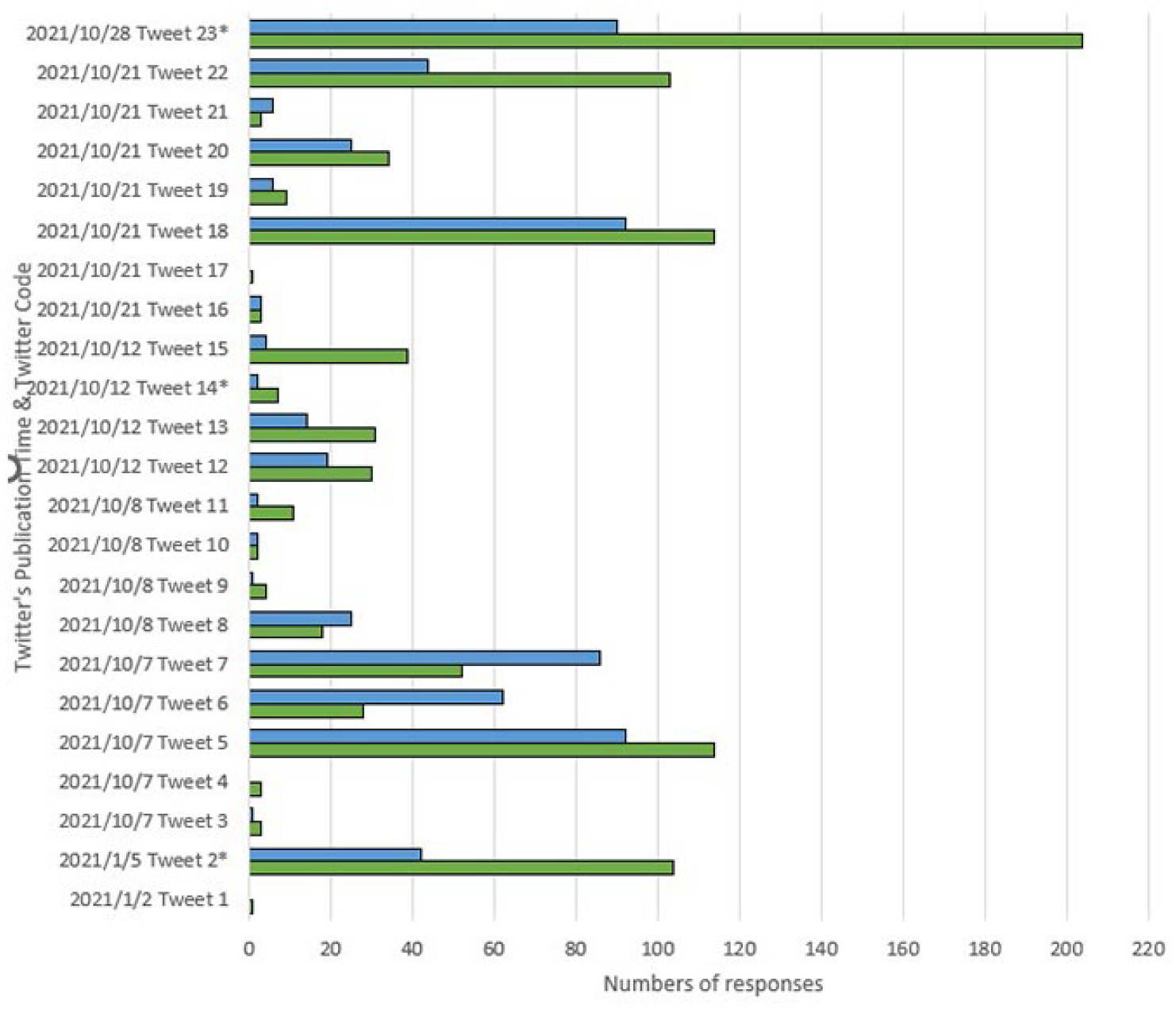
Details of Twitter data collected; *Tweets include weblinks to press releases.
The analytical framework was primarily underpinned by Teun van Dijk’s (2014) theorisation of the sociocognitive approach. Adopting this approach, we foregrounded Sussex’s crisis responses to the Stock incident. We began by identifying such operationalised categories as simplification, vagueness, euphemisation and argumentation to decode their discursive structures. The analytical account articulated how such discursive structures function in specific situation and context models, guiding its social media audiences in making sense of the focal incident to bolster the university’s reputation management. Considering the specifics of the venue where the university’s crisis responses took place, the analysis was simultaneously attentive to how fellow Twitter users reacted to the institutional responses, accounting for the non-linear and interactive pattern of social-mediated discourse production and consumption (KhosraviNik, 2022). In doing so, it illuminated the dynamic power relations between the university and concerned members of the public in the wake of the focal gender-critical controversy.
Sussex’s crisis responses
The sampled tweets, extracted from Sussex’s Twitter account, primarily fell into two categories: a) public statements and b) responses to Twitter users. The former category comprised the majority, with 20 of the sampled tweets falling into this group. Only three belonged to the latter. Additionally, three press releases were published on the university’s official website on 5 January 2021, 12 October 2021 and 28 October 2021, respectively, and they served as extensions to the shorter Twitter statements. These two types of tweets, alongside the press releases, constituted the complete set of Sussex’s public-facing responses to the Stock incident.
Accounting for the timeline of the incident, it becomes evident that Sussex’s crisis responses unfolded in two distinct stages. The first stage commenced on 2 January 2021 and concluded on 6 October 2021. During this period, Sussex predominantly operated as though there were no crises, offering merely two relevant tweets and a press release in January 2021 to celebrate Stock’s OBE award in a business-as-usual manner. Such communicative actions were operated against the ongoing controversies surrounding Stock’s gender-critical ideologies, which had begun to surface in 2018 after she granted an interview to a local newspaper to discuss her views on trans-rights topics that placed her under the media spotlight. From 7 October 2021 onwards, Sussex’s crisis responses entered the second stage, during which the university directly confronted the Stock incident and issued a total of 21 tweets, as well as two press releases, within a mere three-week period. This paradigm shift signified that addressing the reputation risks arising from the incident had become a top priority in the university’s communicative actions. Sussex’s second-stage responses abruptly ceased following Stock’s resignation, as the university redirected its efforts towards rebuilding its reputation and attempting to allow the controversy to fade into the background.
Entextualising the gender-critical dispute through the freedom-of-expression argument
The dataset revealed that entextualisation emerged as a crucial discursive strategy employed by Sussex to substantiate its official position in the Stock incident. As per Jay Blommaert (2005), entextualisation is a dual process, encompassing both decontextualisation and recontextualisation. This discursive strategy enables a discourse to be taken out of its original context, rendering it a ‘seemingly coherent, unambiguous, effective, and memorable’ unit, which is tailored for specific communicative objectives (Petintseva, 2019: 10). Entextualisation is implicated with asymmetrical power dynamics, as it depends on an individual’s ‘access to the original resources’ and their ‘ability to extract [such] resources [. . .] to create a meaningful text’ (Teng and Chan, 2022: 424). To some extent, this concept holds the potential to enrich Teun van Dijk’s (2014) sociocognitive analysis, highlighting how the actions of decontextualisation and recontextualisation are discursively substantiated to assist Sussex in mitigating the threat the Stock incident poses to its reputation.
In the context of Sussex’s initial-stage crisis responses, the entextualisation-centric aspect of the university’s communicative actions was exposed through the following excerpt retrieved from its press release dated 5 January 2021.
Press release 1 [5 January 2021]: She has publicly defended the rights of academics to discuss contentious ideas, including her own current research, which addresses philosophical questions about biological sex and gender.
The press release was crafted with a specific situational model, in which Sussex intended to use this statement to elucidate the university’s official stance in endorsing its own staff member’s reception of a national award. Adhering to journalistic conventions (Richardson and Wodak, 2009), the composition of the text consciously refrained from using overly emotive language, thereby distancing the university from overt, opinionated commentary. Yet, within the fifth, single-sentence paragraph, the discursive structure of the passage manifested a calculated expression that Sussex adopted to recreate a contextual model to interpret the nature of the Stock incident. This was an attempt to minimise the cognitive efforts required for audiences comprehend it through the university’s preferred scope.
As Aleardo Zanghellini’s (2020: 1) analysis reveals, Stock’s gender-critical ideologies not only contradict established and rational uses of practical reason but also pose a risk of inciting hatred against the trans community. Yet, employing the phrase, ‘contentious ideas’, to simplify her trans-exclusionary views, the passage prompted audiences to recognise the Stock incident as an acrimonious row between extreme groups. The simplification was accompanied by a lexical choice, using the verb, ‘defend’, to depict Stock’s actions. In doing so, the passage placed her in a passive, rather than an aggressive position, marginalising critical accounts of the incident as a controversy ignited by the gender-critical scholar herself, due to her forceful advocacy of trans-exclusionary ideas.
In particular, within the discursive structure of the passage, the freedom-of-expression argument was simultaneously redefined as boundless and universally applicable, stripping away the essence of the concept as a foundation for a reasoned exchange of intellectual ideas. This discursive pattern further sidelined critical examination of Stock’s gender-critical ideologies within the context of trans-rights debates. It enabled Sussex to pursue a favourable communicative situation to validate its official pro-Stock position, while relocating the gender-critical controversy, using the framework of legal debates, to move beyond the current dispute. On this note, Sussex’s discursive practices exhibited a degree of alignment with the contextual model sought by conservative individuals and advocacy groups operating under the gender-critical banner, who also selectively invoked the freedom-of-expression argument to advance their trans-exclusionary agendas in broader trans-rights debates (Pape, 2022).
From the above extract, it became evident that Sussex was already cognisant of the discriminatory nature of Stock’s gender-critical ideologies from the very beginning. However, the university did not fully appreciate the reputation risks linked to the gender-critical controversy during this phase. As a result, its public-facing communications showcased a stylised repetition, characterised by a business-as-usual posture. Without avoiding references to Stock’s personal handle, its Twitter postings entextualised the gender-critical dispute, aiming to rationalise its official pro-Stock stance on one hand while also seeking a degree of reconciliation with her critics on the other.
Press release 1 [5 January 2021]: It is no secret that Professor Stock’s current research has both supporters and detractors. This diversity of opinion, whilst difficult at times, is vital for a healthy university and our progress as a society.
Placing the conversation in a more desirable situation for the institution, the discursive structure of Sussex’s first press release, as manifested in the above extract, attempted to prevent the university’s stance-taking from hijacking its capacity to inform dialogues with audiences with strong views on the focal issue. This attempt was largely realised upon a referential instance, where Stock’s gender-critical work was rebranded as ‘research’ that ‘has both supporters and detractors’ to account for trans-exclusionary and pro-inclusive audiences’ differing cognitive paths to comprehending the message. Yet, the associated lexical choice, which described those against Stock’s views as her ‘detractors’, constituted an additional layer of value-based meaning-making, subtly reaffirming the university’s actual, uneven-handed institutional position. The subtle institutional position was, in part, swayed by the timing of the postings at the first stage, during which the OBE award placed Stock in the position of strength in trans-rights debates as a result of the government’s endorsement.
Deviating from the business-as-usual stance, Sussex, however, began addressing the gender-critical controversy ignited by Stock on 7 October 2021 through the publication of two threads, consisting of a total of five individual tweets. The institutional reaction was triggered by student-led de-platforming campaigns against Stock, which garnered nationwide media coverage and pressured the university into taking action (Wong, 2021).
Tweet 3 [7 October 2021]: We were extremely concerned to see the harassment towards our staff member and took immediate action in response to this, which we continue to do. We are deeply committed to being a safe and inclusive university. Tweet 5 [7 October 2021]: In response to issues on our campus, our VC Adam Tickell has said: We are investigating activity on our campus which appears to have been designed to attack Professor Kathleen Stock for exercising her academic freedoms.
As the de-platforming campaigns gained momentum on campus, Sussex posted two tweets primarily alerting its students and employees to the safety and well-being risks associated with on-campus protests against Stock. These tweets were composed in accordance with the advice of PR professionals, who recommended using warning messages as a form of crisis response to demonstrate organisations’ concern for their stakeholders (Coombs, 2015). However, the lexical choice of Sussex’s warning messages, which indiscriminately labelled all student-led de-platforming campaigns as ‘harassment [. . .] designed to attack’ Stock, reframed the situation by disregarding alternative interpretations, thereby legitimising the university’s official narrative. In this regard, Sussex’s institutional stance remained steadfast in its support for Stock, despite widespread criticisms of her propagation of gender-critical ideologies from both within and beyond the academic community (Zanghellini, 2020).
Tweet 8 [8 October 2021]: Today our VC spoke on @BBCr4today about the importance of freedom of speech, and the need for universities to find spaces for people to talk and listen [in] complex areas. Listen here from 2hr 41mins.
During the second stage, Sussex’s justification of its institutional stance continued to rely on an entextualisation-centric discursive strategy. In line with this approach, the university’s Twitter postings were characterised by a recurring pattern, offering vague lexical references to the gender-critical scholar under focus. The absence of explicit references once again bolstered Sussex’s efforts to entextualise the gender-critical dispute through the freedom-of-expression argument, marginalising critical scrutiny of its broader repercussion to position the institution in a desirable communicative situation. However, a subtle, yet significant change observed at this stage was that Sussex’s Twitter postings began to acknowledge concerns raised by pro-inclusive students and staff members regarding Stock’s trans-exclusionary ideologies, even though their warning messages still rejected the legitimacy of any de-platforming campaigns against her. This subtle shift in Sussex’s second-stage crisis responses highlighted how the university gradually moved towards performing a degree of neutrality in trans-rights debates, to engage audiences with polarised views, as increasingly more members of its campus community expressed objections to its official pro-Stock stance.
It is important to note that Sussex’s crisis responses never occurred in isolation. To engage a large audience on social media, Sussex’s Twitter postings specifically operated within the context of social-mediated communication, where its interactive nature meant that the university had limited control over audiences’ actions. During the initial stage of the gender-critical controversy, as Sussex attempted to maintain a pro-Stock stance without alienating pro-inclusive audiences, many follow-up comments within the threads expressed dissatisfaction with the university, reflecting their perception of the institution’s position as illegitimate in broader trans-rights debates.
User-C2-31: @SussexUni I will be sure to advise prospective LGBTQ students not to attend the University of Sussex. It’s very clear that your institution provides a safe space for bigotry.
As evident above, such commentaries often employed emotionally charged language to vehemently reject Sussex’s choice to support Stock in its Twitter statements. These comments challenged Sussex’s business-as-usual approach, countering the university’s entextualisation efforts by reasserting the focal issue within the context of trans-rights debates. Such critical comments undermined the effectiveness of Sussex’s carefully orchestrated crisis responses, ultimately setting the stage for the university to face more significant damage to its reputation as student-led protests against Stock intensified on its campus at a later stage of the incident.
Performing a degree of neutrality at a rhetorical level to evade institutional responsibility
A significant shift in paradigm was evident in Sussex’s Twitter postings from early October 2021, at which point the university primarily aimed to distance itself from any collateral responsibility for Stock’s gender-critical ideologies. This paradigm shift was intended to avoid further antagonising pro-inclusive students and staff protesters, who had developed a cognitive alignment between the university and the gender-critical scholar during the initial stage of the incident due to its official stance. It was notably reflected in the discursive structure of Sussex’s Twitter postings, where euphemisation was appropriated to substantiate the university’s performance of neutrality in broad trans-rights debates. As Teun van Dijk (2008) notes, euphemisation is a figure of speech that primarily serves to allow one to avoid confrontations in specific communicative situations. It entails a performative dimension, which distances a communicator from overtly opinionated commentating to engage audiences with strong views in contentious debates. In the current incident, the use of euphemisation allowed the university to maintain its support for Stock, while downplaying such support to delegitimise a cognitive alignment between the institution’s actions and the gender-critical scholar’s views in pro-inclusive audiences’ eyes.
Tweet 12 [12 October 2021]: We have acted, and will continue to act, firmly and promptly to tackle bullying and harassment, defend the fundamental principle of academic freedom, support our community, and continue to progress our work on equality, diversity, and inclusion. Tweet 13 [12 October 2021]: We care deeply about getting this balance right. There are a range of very strong views and opinions held across the university on a whole variety of issues and topics, including how we support our trans and non-binary community particularly at this time.
As demonstrated above, tweets 12–13, posted within the same thread, conveyed a comprehensive message aimed at engaging both supporters and critics of Stock. The former leaned towards the first group by emphasising the importance of defending Stock’s freedom of expression, while the latter aligned with the second camp by simultaneously reiterating the university’s concern for trans members of its campus community’s wellbeing. These Twitter postings, centred around the concept of ‘balance’, constituted a rhetorical level of performance, highlighting the neutrality of the university’s official stance in broader trans-rights debates. Such a neutrality performance was reminiscent of the tactics often employed by mediators to facilitate the construction of agreements between two conflicting parties (Chavez, 2018). To bolster this performance, the Twitter postings utilised verbs with positive connotations, such as ‘support’ rather than ‘oppose’, to deliver further emotional appeals. This allowed the university to assume the role of a mediator, aligning with groups at opposite ends of the opinion spectrum to position its institutional decision on a moral high ground beyond the specifics of the focal incident. However, the controversies surrounding Stock’s propagation of gender-critical ideologies were once again vaguely described as ‘strong views and opinions’. This calibrated lexical choice emerged as a stylised underexplanation of the repercussions of platforming Stock, attempting to limit the cognitive pathways for audiences to critically evaluate her gender-critical ideologies.
Remaining committed to the rhetorical performance of neutrality, Sussex’s second-stage crisis responses skilfully employed a variety of contextual models to reframe the focal gender-critical dispute, all in an effort to foster reconciliation with pro-inclusive audiences while steadfastly maintaining its official stance.
Tweet 14 [12 October 2021]: As a community, we need to come together and talk about what is happening at the moment and look at the way forward. We will be doing this in the coming weeks, and this will be led by our newly appointed Pro-Vice-Chancellor for Culture, Equality, and Inclusion. Tweet 15 [12 October 2021]: Our recently published paper ‘Inclusion, Freedom of Expression and the Spirit of Sussex,’ details our approach to these complex issues, and how we ensure we lead the way in academia and inclusion.
Tweets 14–15 offered an illustration of how EDI advocacy offered such contextual grounds for the university to transcend any critical scrutiny of its institutional actions in the Stock incident. Both tweets, retrieved from the same thread, centred around the recent appointment of a dedicated managerial staff member and the publication of related policy documents to remind audiences of Sussex’s past and present goodwill and EDI-advocacy actions. The discursive structure of the text mimicked what Theo van Leeuwen (2008: 116) called scientific rationalisation, presenting seemingly compelling evidence to increase the persuasiveness of the message at a cognitive level. Yet, juxtaposing such terms as ‘inclusion’ and ‘freedom of speech’, the underlying message was intentionally kept vague, opening itself up to both gender-critical and pro-inclusive audiences’ alternative interpretations. Instead of signalling any specific modifications to the institutional stance, such tweets emphasised the university’s futuristic plans. In doing so, Sussex once again sought to encourage audiences’ cognitive assessments of the subject matter outside of the context of the ongoing gender-critical controversy, showcasing the university’s attempt to move beyond the controversy.
Given Twitter’s 280-character posting limit, the aforementioned tweets included a link to a press release, which was published on its official website. Notably, the role of speaker in the statement was assumed by Sussex’s newly appointed Interim Pro-Vice-Chancellor for Culture, Equality and Inclusion, rather than the Vice-Chancellor.
Press release 2 [13 October 2021]: These debates signal the tensions between philosophical, and theoretical critiques of legal and policy-related issues set against a backdrop of lived experiences, directly impacting members of our community. They are real and felt examples of some of the points I have raised about understanding alternative points of view, their relative merits and where they might fall below moral, ethical, or legal standards.
The strategic selection of a new representative allowed the statement to maintain a degree of separation from the university’s current leadership, aimed at repositioning the institution to re-engage pro-inclusive audiences who had been hostile towards the institution at this stage of the incident. In line with the tweets, the press release framed the arguments presented by both gender-critical feminists and pro-inclusive activists as having ‘relative merits’. In doing so, Sussex’s performance of neutrality was once again substantiated at a rhetorical level, rather than in its actions, as on-campus protests revealed polarised opinions among its internal stakeholders. The lexical choice of this passage, consistent with most of the sampled tweets within this cluster, avoided explicitly naming any specific individuals involved in the dispute. By emphasising the importance of ‘moving forward’ from the current incident, the responses consistently avoided institutional responsibility for the consequences of the gender-critical controversy, in an attempt to allow the issue to subside and recover from the damage it had inflicted on the university’s reputation.
During the second stage, Sussex’s paradigm shift towards reputation rebuilding was a result of its rhetorical performance of neutrality being a doomed-to-fail endeavour. The hostile reactions from the public were primarily due to the deeply entrenched viewpoints held by both the gender-critical and pro-inclusive segments of its audience, making reconciliation an insurmountable challenge.
User-Q8-2: I am so disappointed that our VC is more concerned with speaking to the press than he is to trans and non-binary students who have been incredibly distressed. As the SU we do not support the statements made by the university, you can read ours. User- C23-44: @SussexUni Well I am devasted at this news, sadly your support of @Docstockk was much too late, you allowed her to be victimised, harassed and bullied.
While Sussex endeavoured to contextualise the Stock incident, follow-up commentaries from Twitter users continued to undermine these efforts, primarily by refocusing public attention on the core of the Stock incident within the broader context of trans-rights debates in society. This pattern of public intervention was once again evident in their follow-up comments, which directly engaged with the university’s Twitter postings. As shown above, the first tweet, apparently from a member of the student body, raised objections to Sussex’s institutional position in light of its perceived pro-Stock stance. The second, seemingly composed by a concerned member of the public, accused the university of offering insufficient support for the gender-critical scholar, as student-led de-platforming campaigns against her gained momentum. These seemingly contradictory reactions opened up cognitive dissonance, informed by inconsistencies between Sussex’s rhetoric and actions. For members of the pro-inclusive camp, the university appeared to express concerns about harassment directed at a staff member but failed to address the potential harassment arising from Stock’s continuous public comments directed at trans individuals. Sussex’s tweets indicated the protection of rights, including those related to sex and gender realignment, yet seemingly privileged Stock’s communication as protected. However, for those supporting Stock, Sussex did not garner their sympathy either, as the termination of Stock’s career at the university due to student-led actions on the platform suggested inadequate protection in their eyes. Both sides opposed Sussex, indicating that neither was swayed by the university’s rhetorical performance of neutrality.
In the context of trans-rights issues, distinct opinion factions with strong gender-critical and pro-inclusive agendas have emerged in broader societal debates (Halberstam, 2018). These debates are set against the backdrop of persistent sex essentialism, which remains well-received amongst a sizeable group of the general public (Hines, 2020), despite compelling evidence that has raised serious questions concerning its legitimacy on both scientific and sociopolitical grounds (Ainsworth, 2015; Hildebrand-Chupp, 2020; Hines, 2020; Zanghellini, 2020). With no prospect of reaching a consensus, both camps have expressed their views openly on this matter beneath Sussex’s Twitter postings, transforming the threads into a venue for more extensive trans-rights debates. In this process, clashes between the two factions have emerged as discursive struggles, effectively challenging the university’s reputation-centric approach to crisis responses. This situation illustrates the specifics of social-mediated communication, where its non-linear, interactive mechanism empowers individual members of the citizenry to propagate counter-narratives outside of institutional control (KhosraviNik, 2022). This undermines higher education institutions’ fence-sitting posture in trans-rights debates, calling for increased transparency in their decision-making in gender-critical controversies unfolding from within and taking substantial actions to address concerns raised by members of their campus community.
Concluding remarks
In this article, we present a sociocognitive analysis of the University of Sussex’s public-facing crisis responses to the gender-critical controversy ignited by its staff member, Kathleen Stock. The analysis reveals that the university’s Twitter postings employ an entextualisation-centric discursive strategy, simultaneously decontextualising and recontextualising the Stock incident through the freedom-of-expression argument to create a more favourable communicative situation for its crisis responses. While generally adopting a pro-Stock stance, the university also maintains a degree of neutrality at a rhetorical level to distance its institutional position from the gender-critical scholar’s gender-critical ideologies. In doing so, the university aims to avoid a cognitive alignment between the two to prevent antagonising pro-inclusive audiences on one hand and evade institutional responsibility for the consequences of the controversy on the other. However, such crisis responses are largely consistent with trans-exclusionary voices in the broader trans-rights debates, which prioritise the freedom of expression of certain privileged groups over the rights of the marginalised (Pape, 2022), despite the university’s apparent stance against overt anti-trans discrimination.
The heated trans-rights debates on campus have prompted both internal stakeholders and the public’s attribution of institutional responsibility to Sussex, pressuring the university into taking measures to counter issues caused. Reflecting the global polarisation of public opinion on trans rights (McLean, 2021; Zanghellini, 2020), the incident has created large factions populated by supporters or critics of Stock, turning it into a complex case to address, considering the ideological divide it opens up within the university’s campus community. Yet, as a particular type of institution, public universities are socially responsible for promoting equality, diversity and inclusion (EDI), which are recognised as core values of the higher education context (Catalano, 2015; Linder, 2019). On-campus gender-critical controversies have, therefore, offered a test case to examine the extent to which British higher education providers remain committed to EDI advocacy for the marginalised trans community at a time when sex-essentialist and trans-exclusionary strongholds remain entrenched in society (Jones and Slater, 2020). On this note, Sussex has failed the test, as its crisis responses demonstrate overwhelming foci on mitigating damage to its reputation over social justice.
Sussex’s fence-sitting stance in the gender-critical dispute has not effectively addressed the reputation crisis facing the university, which represents its paramount institutional agenda in its orchestrated crisis responses. As evident beneath Sussex’s official tweets, fellow Twitter users have actively contributed their counter-narratives of the central incident to the threads. In this process, members of both the pro-inclusive and gender-critical camps have engaged in a paradoxically consistent pattern of discursive practices, which have relocated the focal incident within the context of trans-rights debates, despite their differing agendas in such debates, to undermine Sussex’s crisis responses. Constantly generating original content of their own, these social media users’ discursive practices reflect the specifics of social-mediated communication, where the decentralised paradigm of social interactions has empowered ordinary citizens to challenge entrenched power dynamics in the public sphere (Castells, 2009). This communicative situation undermines the effectiveness of organisations’ reputation-centric responses, calling for increased transparency in their decision-making and action-taking to recognise the diverse cognitive pathways taken by audiences in discourse production and consumption within the social-mediated environment.
While based on a single case, the current research does not aim to provide overgeneralised findings. Instead, drawing on Sussex’s experiences, we present a critical evaluation of how a British higher education institution responds to the gender-critical controversy ignited by its staff members. Reiterating the need for making CDS researchers’ subjective intervention transparent (Wodak, 2009), we define the Stock incident as a gender-critical controversy, attributing the responsibility for the current dispute to the gender-critical scholar herself. Explicitly devising a critical lens, we contextualise our interpretation of the dispute against broader trans-rights debates as the backdrop, aiming to hold her former employer accountable. Employing the sociocognitive approach, the analysis delineates how the institutional responses are constructed upon specific discursive structures, allowing the organisation to avoid its institutional responsibility. Meanwhile, it highlights how such efforts are undermined by fellow Twitter users’ counter-narratives within social-mediated communication. The findings underscore the necessity for the higher education sector to take substantial actions to address issues arising from trans-rights debates, rather than relying solely on crisis responses to mitigate associated reputation risks. We recommend that future studies continue in this research direction to illuminate the broader implications of trans-rights debates in higher education beyond the PR context, to hold universities accountable for their communicative actions and social responsibilities.
Footnotes
Acknowledgements
We wish to thank Editor of Discourse and Communication, Teun A. van Dijk, and anonymous reviewers for their constructive comments on an early version of the article. Our appreciation also extends to Hsueh Ying Can, Erhan Xie, Yirong Xu, Xinyue Yu, Qingwen Zhao, Zhiyi Zhao, and Suheng Zhu for their assistance with the data collection and coding.
Declaration of conflicting interests
The author(s) declared no potential conflicts of interest with respect to the research, authorship, and/or publication of this article.
Funding
The author(s) received no financial support for the research, authorship, and/or publication of this article.