




Abstract
With increasing competition and metrics focusing on teaching quality (e.g. the teaching excellence framework or TEF), there is a spotlight on learning and teaching (L&T) in policies and practices within universities. Bodies at national and institutional levels focus on disseminating policy ideas on L&T which are oriented to government priorities. This article focuses on how policy itself is discursively constructed in selected L&T policy documents and explores the means of the recontextualisation of policy discourses. I discuss the following three findings: (1) the construction of policy as ‘embedded within processes and practices’, (2) shifts in genre and discursive strategies as policy ideas become short guidelines and (3) the role of ‘discursive mechanisms’ in forcing engagement with policy ideas. Through an analysis of discursive strategies and recontextualisation, I demonstrate the seeming insecurity around policy compliance and show how constructions of L&T are never value-free.
Keywords
Introduction
This study is situated within the current, fiercely competitive higher education environment in England. With less than 10% of the population attending university in the 1980s (Foskett, 2011), the sector underwent a sharp increase in student numbers during the late 1980s and 1990s; partly due to former polytechnics achieving university status in 1992. The Blair government’s symbolic target of a 50% participation rate 1 by 2010 was reached in 2018 (Department for Education, 2019). This trend, often referred to as ‘massification’ (attributed to Trow, 1973), was accompanied by lower government funding. Universities sought other sources of income and undergraduate tuition fees were introduced in 1998 with the most significant rise in 2012 to £9000 per year. Although a hierarchy has always existed in the sector based on reputation, this has intensified due to a focus on university rankings produced in commercial league tables such as The Times & The Guardian, and the metrics that contribute to such rankings; for example, the national student survey (NSS), research excellence framework (REF) and, more recently, the teaching excellence framework (TEF) 2 (Boliver, 2015; Marginson, 2018). Intense competition, increased by a variety of factors including the total removal of the cap on undergraduate numbers in 2015/2016, has led to shifts of students across the sector from lower to higher ranked HEIs 3 (Bekhradnia and Beech, 2018); placing particular pressures on the former.
Learning and teaching (L&T) has gained prominence due to a focus on the ‘student experience’ (the term first attributed to Harvey et al., 1992), as a result of competition for students and their fees. This focus on the student is further signalled through the change in regulator from HEFCE 4 to the Office for Students (OfS) in 2018. Not only with its name but also through its modified remit to increase access and open the market for higher education to new providers, OfS’s objectives also include providing students with ‘a high quality academic experience’ and ‘value for money’ (OfS, 2018: 1). The introduction by HEFCE in 2017 of the TEF, which awards gold, silver or bronze to HEIs for their teaching quality, has increased this focus on L&T despite criticisms of the criteria used on which to base judgements. The notion of ‘teaching quality’ is problematic since TEF metrics comprise student views of their experience through NSS data, as well as information on dropout and employment rates, but do not attempt to directly consider the quality of the teaching (Ashwin, 2017).
Nevertheless, the incentive to address teaching quality is, in theory, particularly attractive to lower ranking universities which cannot compete on the basis of research and have a reputation for devoting more attention to learning, teaching and assessment given the diversity of their intake (see McLean et al., 2017 for evidence of this). These developments have led to a renewed interest in L&T as an area for research and policy as well as a focus for academics. AdvanceHE (the Higher Education Academy (HEA) 5 from 2003 until 2018) is the most visible body involved in shaping L&T in the United Kingdom. It produces numerous publications with perhaps the most influential being the 2011 UK professional standards framework (UKPSF) used in teaching accreditation schemes which increasing numbers of academics are required to engage with. At the institutional level, university academic development units (ADUs) 6 have become more prominent with their L&T focus and professional development for academics. They are also a key channel for implementing university policies given their involvement in teaching accreditation schemes; usually HEA-approved institutional ones (Shaw, 2018). Staff engagement with the HEA fellowship scheme is often a key performance indicator (KPI) 7 which is encouraged through appraisal and presented as a pre-requisite for promotion thus encouraging academics to engage with literature on L&T; particularly that from the HEA.
Policy documents on L&T have a clear role in articulating and legitimising a vision of quality teaching. If quality is to be evaluated and accredited, it means conceptualising what constitutes a good university education, good teaching and the roles that students and lecturers should take. These are not transparent representations or value-free (cf. Bernstein, 2000) but are instead situated within the current HE environment. The question arises of in whose interests are such constructions of L&T and whether we should accept uncritically the ideas that delegitimate certain ways of teaching and legitimate others. Another issue is how such ideas are embedded in practices and what kinds of discursive mechanisms exist to enforce compliance with such ideas.
The discourse analysis of policy texts in this article focuses on the following three findings revolving around the notion of implementing or ‘embedding’ policy: (1) the discursive construction of policy itself within the policy documents as ‘embedded within processes and practices’, (2) the shifts in discursive strategies and genre features as long documents become short guidelines for practice, that is, become policy and (3) the workings of discursive mechanisms which encourage such ‘embedding’ and force academics to engage with policy. I discuss what the construction of policy itself indicates about the higher education environment and show how policy discourses are recontextualised.
Learning and teaching: connections between policy and practices
The data in this article are drawn from a larger study, the author’s doctoral research, on the discursive construction of people and phenomena in policy documents on L&T and their connection with practices in one post-1992 HEI in England. Four key documents from the HEA form the core of policy text analysis. These comprised four of the HEA’s six policy agendas: employability, partnership, assessment, internationalisation. Three of the texts are long discussion documents in which the policy proposals are outlined and discussed. 8 They formed the basis of much shorter, more widely circulated, four-page frameworks as discussed below. In addition, selected salient texts were analysed to examine intertextuality between national and institutional levels. These included a government white paper, a HEFCE strategy document, the university strategy document and academic framework on L&T.
The study is situated within critical discourse studies (CDS); specifically, the discourse-historical approach (DHA) (Reisigl and Wodak, 2001, 2015). The DHA embraces detailed analysis of discursive strategies thus answering the call to provide detailed textual analysis of policy (Ashwin and Smith, 2015; Fairclough, 2013; Saarinen, 2008). It also provides a multifaceted view of context including intertextual/interdiscursive relations across texts in time and space and considers the wider socio-historical context to inform the analysis. This makes it suitable for tracing discourses between different layers of policy documents; for example, from national policy to institutional policy. Its openness to ethnographic-inspired approaches lend it to the analysis of interview data too (cf. Krzyżanowski, 2011). In the study, students and lecturers from one set of postgraduate programmes in one department were interviewed regarding their experiences of L&T on the programmes. These were text-mediated interviews based around marked assignments and modules guides. The incorporation of data from interview accounts and documents, and the analysis of recontextualisation between policy texts and interview data, enabled connections to be explored between what policy says and how people construct their experiences and practices.
Like all CDS approaches, the DHA is open to dialogue with other disciplines in order to investigate the problem in question (cf. Hasan’s (2005) ‘exotropic’ theories). There are particular theoretical complementarities between the DHA and Bernstein’s work on the sociology of pedagogy. They share the following concerns: problems as starting points, openness to theoretical dialogue, a focus on inequality and interest in the principles and mechanisms through which the workings of power are obscured. In addition, the DHA provides the tools to analyse how language works to obscure the ideological.
A focus of my wider study is how pedagogy and curriculum content evolve from the ‘discipline-as-research’ to ‘discipline-as-curriculum’ (Ashwin, 2012: 87) and the influences from the wider context on what is taught and how. Bernstein’s ‘pedagogic device’ provides the principles for exploring these influences from agents in the recontextualising fields whether government or institutional. During a process of recontextualisation, ‘instructional discourse’ (the subject) is always embedded within a ‘regulative discourse’ (values) and the latter dominates (Bernstein, 1990: 183). That is, what is taught and how is never value-free. The recontextualising field comprises the official recontextualising field (ORF) and the pedagogic recontextualising field (PRF). The former consists of government and its agencies; the latter may include university departments of education, education journals and arguably today, ADUs and everyone involved in developing L&T. The position of the HEA might be debated since it involves academics as consultants but given its orientation towards government priorities, I would place it more within the ORF. A further way of conceptualising this is to suggest that despite operating at institutional level, actors such as those in ADUs are aligned with the ORF (see for example, Lim, 2017). One of their primary concerns is likely to be the implementation of institutional, and thus government, policy, for example, agendas such as employability. This is facilitated through ‘discursive mechanisms’, discussed further below, which enable engagement with policy ideas. Teaching accreditation schemes are an example of such mechanisms.
Taking a critical, interpretive approach to policy-making means recognising that policy is made as it is put into practice (Johnson, 2013; Levinson et al., 2009; Yanow, 2015). Agency and degrees of resistance are possible but it is also necessary to recognise the mechanisms which enforce engagement. Work focused on policy enactment and practices around policy includes the notions of policy drivers, levers, steering and instruments (see Hyatt, 2013) as well as policy trajectories (Ball, 1994) and policy technologies (Ball, 2017). The concept of levers, viewed as functional mechanisms such as target setting in education (Hyatt, 2013), is relevant to my concerns. Likewise, in Ball’s earlier five-part ‘trajectory’ framework, the element of ‘context of practices/effects’ with its focus on interpretation and recreation and in his later policy technologies’ framework the concept of ‘performativity’, are both relevant to the ways in which policy connects with practice through a variety of indirect mechanisms. While recognising the usefulness of the lever metaphor, I employ the broader term recontextualisation since conceptualisations in Bernstein’s work and the DHA are both relevant to my purposes 9 and I choose the term ‘discursive mechanism’ to mean specific processes and practices in which the person must engage discursively. That is, taking the teaching accreditation scheme as an example, academics are responding to texts and creating their own texts; recontextualising policy discourses in the process.
As noted earlier, policy studies are sometimes criticised for their lack of detailed textual analysis. A strength of the DHA is the attention to such detailed linguistic analysis interpreted within analysis of the wider context. Analysing policy texts for the discursive strategies used to legitimate the policy proposals can illuminate the underlying discourses/ideologies. Also key is tracing policy discourses across different spaces and texts to explore how policy ideas move (Barakos and Unger, 2016; Johnson, 2013). The DHA has been employed in several studies on language policy (e.g. Lawton, 2016; Savski, 2016; Unger, 2013) as well as policy more broadly (Wodak and Fairclough, 2010).
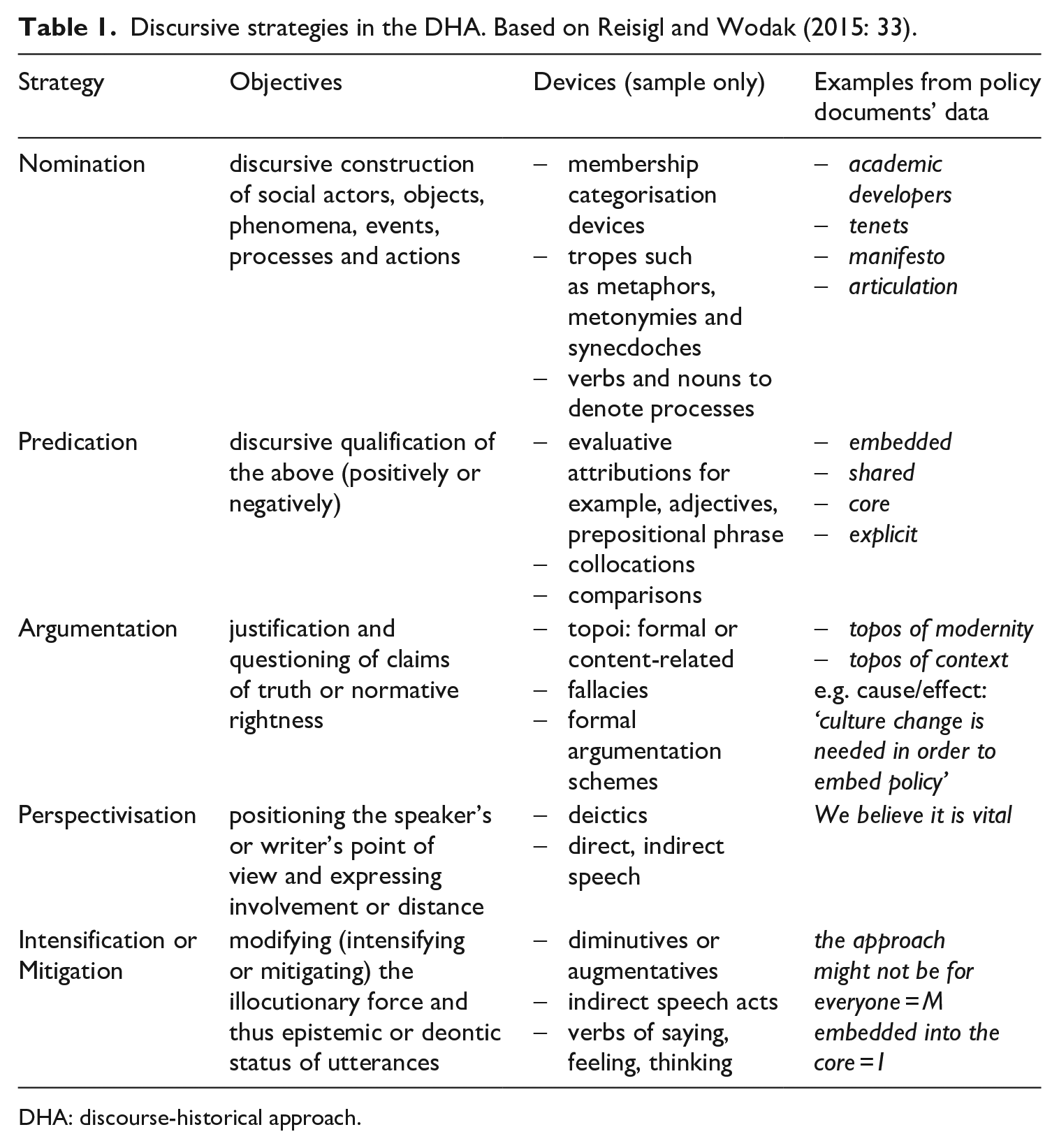
The discourse analysis in this study follows a process typical in the DHA of identifying the themes/contents in a section of text; the discourse topics. Since this is an interpretive approach, labels are the analyst’s own. This is done across texts to note the common topics. For example, regarding policy, there are the topics of embeddedness, articulation, explicitness, rewards and recognition (for embedding policy) and shared language. Analysis of discourse topics is followed by what is sometimes termed micro-analysis (Reisigl and Wodak, 2001); a detailed analysis of discursive strategies drawing on the DHA’s typical analytical tools. In Table 1, I illustrate these with examples relating to the construction of policy.
Discursive strategies in the DHA. Based on Reisigl and Wodak (2015: 33).
DHA: discourse-historical approach.
These operate at different levels. For instance, a predication may be embedded within an argumentation scheme. In the following example, the predications (in italics) are situated within an argumentation scheme of effect-cause: ‘A 21st-century education’ requires ‘a radical rethink in assessment practices’ (HEA, 2012: 8–11). Certain strategies may be more salient than others depending on the genre of text. In the policy discussion documents, argumentation schemes and predications are particularly prevalent; perhaps unsurprising given that justifying the policy proposals is a key aim. Detailed analysis of topics and discursive strategies enables conclusions to be drawn about macro-strategies evident across texts. Although useful to identify broad macro-functions such as legitimation or transformation (Reisigl and Wodak, 2001), topic-related macro-strategies are the main focus in the study. These are conceived of as a collection of discourse topics and discursive strategies (Unger, 2013) and this enables conclusions to be drawn around the construction of key actors such as students/lecturers, a university education, L&T and policy itself. In this case, through such macro- and micro-analysis across the four HEA texts, I identify the macro-strategy of ‘policy as embedded within processes and practices’ as detailed below.
The concept of recontextualisation is particularly pertinent to studies aiming to connect policy and practices. Studies have explored links between policy from international/European level to national level and individual institutions (Lawton, 2016; Wodak and Fairclough, 2010) to consider how recontextualisation of policy occurs in different ways, at different paces and levels of acceptance/resistance. Examining policy documents at national and institutional levels and then exploring links with L&T practices is a key aim of the wider study. Thus, taking a DHA approach, as relevant to the project, there follows intertextual/interdiscursive analysis between texts and analysis of the wider context; moving between these and the analysis of discursive strategies in order to interpret the findings.
Analysis of intertextuality could include the tracing of actors or certain forms of argumentation between texts. For example, the argument that ‘articulating learning’ leads to employability is found in HEA documents, institutional documents and interview data. Analysis of interdiscursivity commonly considers the overlapping of discourses (Reisigl and Wodak, 2015). In the field of higher education, discourses about the economic context and employability overlap; drawing on some of the same discourse topics such as competition, partnership and value for money. The importance of these concepts lies in the ways that discourses/topics/arguments/actors may appear in a variety of contexts and be used strategically. In the wider study, texts from government and institutional levels were analysed for intertextuality and interdiscursivity to see if policy is constructed in a similar way or how it changes. The notion of policy being embedded found in HEA documents was especially salient in the university’s L&T framework in which, for example, employability was to be ‘embedded into the core of the curriculum’. In fact, a clear discursive connection exists between HEA policies and institutional L&T guidelines.
The analysis below, however, focuses on the discursive strategies in HEA long discussion documents around embedding policy; the genre changes between these texts and HEA short framework documents used in HEIs and the ‘discursive mechanisms’ that facilitate such embedding of policy. I show how such strategies facilitate engagement with policy ideas.
Findings around the macro-strategy of ‘policy as embedded in processes and practices’
Discursive strategies around ‘embedding’
Policy texts are clearly designed to persuade. However, a notable feature of HEA discussion documents is their combination of attempting to convince while stressing that universities can adapt as they see fit. They approximate an academic genre by exploring the literature, acknowledging complexity and not wishing to be seen as too prescriptive. The importance and urgency of the proposed ideas are communicated through the use of intensification, for example, ‘Interest in the idea has proliferated in policy and practice in the UK and internationally [. . .]’ (Healey et al., 2014: 12), while mitigation is widely used to suggest opportunities for HEIs to adapt and find their own way of doing things: We acknowledge that a partnership approach
However, as discussed below, the discursive strategies of predication and argumentation, the latter involving topoi in particular, are used to argue for policy needing to be ‘embedded’ into processes, structures and practices within universities.
Topoi are of interest since they obscure the ideological character of a claim through evaluation of actors and phenomena. They are conceived of as ‘quasi-argumentative shortcuts’ (Wodak, 2011: 43), which provide a warrant to support a claim without the evidence for this warrant being provided or detailed. It is not always possible to assess the truth of a particular warrant. However, understanding how policy ideas are legitimated is key. They may be formal topoi such as the topos of authority, for example, ‘Feedback from Different models [. . .] can be briefly described as ranging between a ‘
Through the use of contrasting predications, ‘entirely embedded’ versus the negatively evaluated ‘bolt-on’, embedded is constructed as the ideal option.
Furthermore, the notion of embedding is reinforced through a formal argumentation scheme of cause-effect. It works two ways. First, it is argued that culture change in universities is needed in order to embed the policy proposals effectively. This is primarily aimed at recalcitrant academics but the following example addresses, and questions, the role of student unions: A partnership approach [. . .] raises questions about the extent to which and how it is possible for students’ unions to balance this
In this extract, the topos of opposites of ‘politically-oriented critical role’ versus ‘working in new ways’ is used to delegitimise the former. This is followed by a formal argumentation scheme of cause-effect (here effect-cause) in which, to paraphrase the above, embedding ‘partnership’ needs a new, non-confrontational relationship between students’ unions and HEIs. The second way the cause-effect scheme works is the argument that policy needs to be embedded in order to ‘evaluate’ the approach properly and assess its impact (e.g. Pegg et al., 2012).
Embedding is also supported through the continual referral to the discourse topic of a shared language: It [the policy framework] provides a shared point of reference and common language to discuss and
The focus on shaping policy and practice suggests that adopting a shared language will lead to shared values. The use of the topos of opposites earlier is part of a macro-function of construction which aims to construct ideas in readers’ minds through definition. The implication is that if we all use the same terms, conceptualisations and what constitutes good practice, then we will all have the same values; thus attempting to ensure that policy ideas are being embraced. Yet, it also suggests a narrowing of acceptable language and ideas. It does raise the question, however, of whether academics who use the language of policy actually support the ideas or are using the language for instrumental reasons such as to gain teaching accreditation (see Macfarlane and Gourlay, 2009; Peat, 2015)
In addition to the discursive strategies, elements of these policy document genres (what Reisigl and Wodak, 2015 refer to as the macro-structure of the text) contribute to this intended embedding of a ‘shared language’, and thus, the ideological impact. Some texts use glossaries with terms defined in the context of that policy idea. In the following definition of ‘activity’ within policy on internationalisation, the emphasis on shared ‘values’ is highlighted: Activity: the contribution that an individual or group can make to the process of internationalising HE,
Some texts have an annotated bibliography which includes references to articles that explicitly support the proposals with intertextual links to points in the policy proposals (italicized below). Clearly only references in support of the ideas are included. The example below describes these sources as ‘in support of the tenets’; the use of ‘tenets’ suggesting that the policy proposals are accepted principles forming part of a belief system related to assessment: 4.1 Core texts in support of the tenets Boud, D. and Falchikov, N. (2006) Aligning Assessment with long-term learning. Assessment and Evaluation in Higher Education. 31 (4), 399-413. This paper highlights the need for assessment reform to support graduates in their future lives. It is suggested that through changes in learning and assessment practices, students can become assessors within the context of participation in practice. [. . .] (HEA, 2012: 50)
Other texts use self-review tools with questions and rating scales to judge the extent of readers’ adherence to the particular policy ideas. The implication is that inadequate answers will lead to realignment towards the policy goals. In the following introduction to the review tool regarding assessment, the underlying assumption is that change is likely to be needed; evident in the predication ‘radical change’ and the rating scale in which anything below a 5 is negatively evaluated as unsatisfactory: This part can be used by senior managers to address strategic institutional issues for In focusing on each stimulus question below: • Rate the extent of evidence, in which 1 = none or very little, 2 = some but insufficient, 3 = just adequate, 4 = considerable • What evidence is there to support your rating? Consider and provide evidence of existing policy or practice. • What further evidence is needed? Develop appropriate actions (e.g. in relation to enhancements) based on the ratings indicated (i.e.
Although these tools may have the aim of self-reflection and continuous improvement, they also encourage the conclusion that existing practice is never good enough (cf. Fanghanel, 2011). Such genre elements, in addition to the discursive strategies outlined earlier, contribute to the legitimisation of the deliberately selective ideas contained within the policy documents.
Becoming policy: shifts in genre
When does a text become policy? Although it is difficult to capture the drafting process and conversations around a text unless one is involved, it is possible to see changes between texts that incorporate essentially the same content but one has become a ‘framework’ to guide practice. As discourses move from one field of action to another, in this case from the field of L&T policy creation and discussion towards academics and ADUs at institutional level, a new kind of genre is required. The change from long HEA discussion documents to short HEA framework guidelines demonstrates how policy becomes made in that the latter represent the user-friendly, short guide for academics to refer to when demonstrating their commitment to ‘good practice’ in L&T. The shifts in discursive strategies and other genre elements, described below, indicate that this has become policy which can be applied.
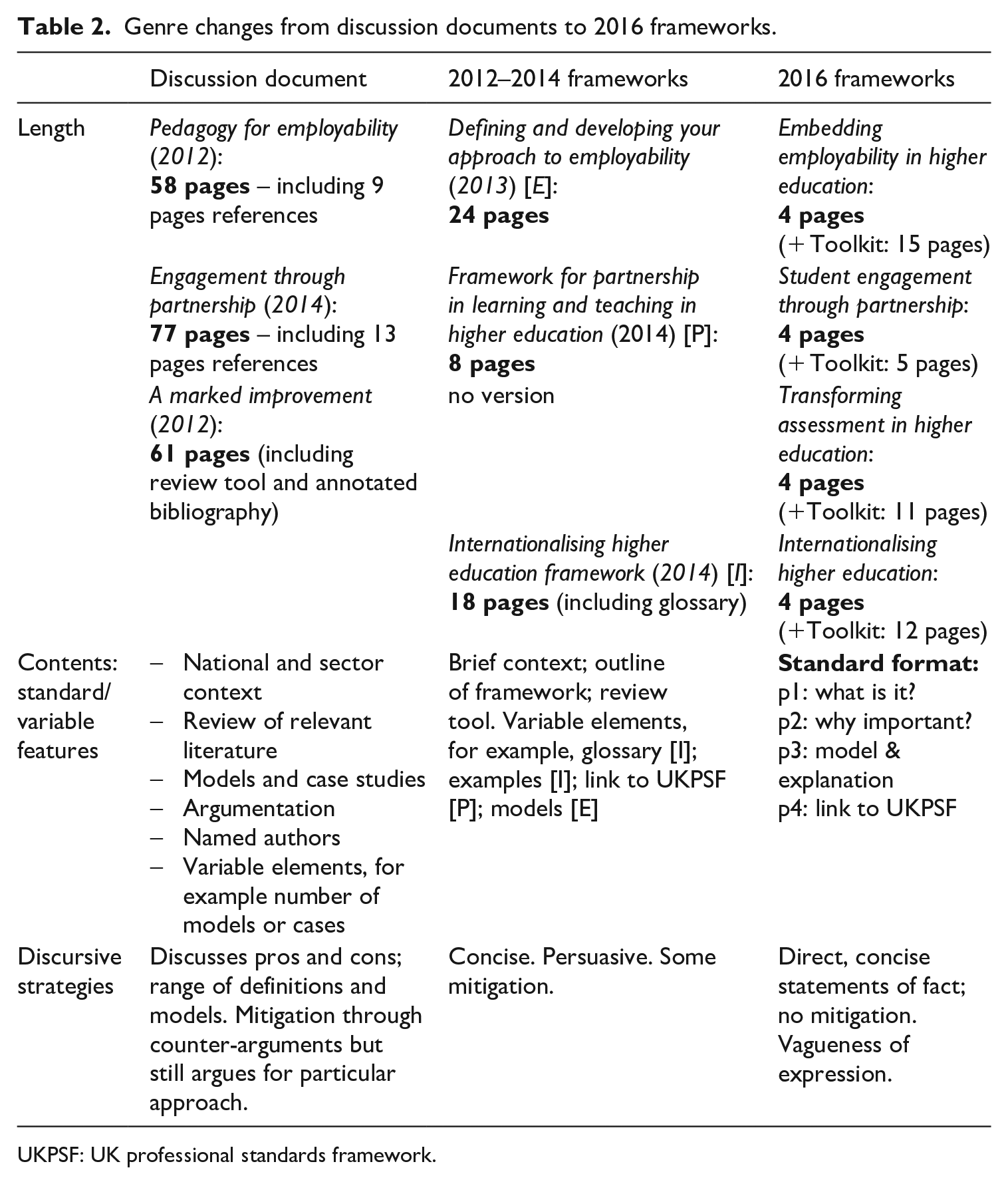
This usability is evident in a number of changes. The first versions of the frameworks (2012–2014), based on the discussion documents, exhibited more variation. There is a notable move towards standardisation in the most recent, 2016 versions of the frameworks which are all four pages long with the same sections and format: p1: what is it? p2: why important? p3: model & explanation p4: link to UKPSF
This indicates another change in the 2016 frameworks whereby each has an explicit link to the UKPSF which forms the basis for the teacher accreditation scheme (HEA Fellowship). The significance of this is discussed in the following section. Furthermore, each framework is accompanied by a ‘Toolkit’ which is a tool for self-review in the form of a series of leading questions, noted earlier, such as ‘How are student engagement and/or partnership described in institutional policies and strategies?’ and ‘To what extent does the culture and ethos of the organisation/institution emphasise partnership in learning and teaching?’ (HEA, 2016: 2). The genre shifts between discussion documents and the short 2016 frameworks are illustrated in Table 2.
Genre changes from discussion documents to 2016 frameworks.
UKPSF: UK professional standards framework.
Besides the variety of document lengths and format in the discussion documents and earlier frameworks, there are other differences. Whereas the longer discussion texts had named authors, the 2016 frameworks do not; thus attaining the status of accepted policy rather than ‘the view of the author’.
In terms of discursive strategies, a clear change involves the level of mitigation. The long documents are more dialogic, exploring ideas around a topic. In one sense, they resemble a more academic genre with review of literature, some level of discussion of counter-arguments (though soon rejected). In the short frameworks, the ideas are stated as truth or what must be done; all mitigation is absent. Examples of this in relation to ‘partnership’ approaches and student involvement in course design are given below: [. . .] when appointing students as course design consultants there - for example, through inquiry based learning – there are fewer restrictions on membership, and all staff and students involved - Partnership approaches - Partnership approaches
Despite this form of directness in saying what should be done, there is an increasing vagueness of expression with regard to the rationale for doing so. In earlier discussion documents, more concrete reasons are given as a basis for policy proposals. This is evident in the example below of ‘the case’ for partnership communities. I underline the contrasting specific reasons versus the move towards vagueness in the 2016 framework:
• to design and deliver engaging student learning experiences;
• to develop a sense of community and belonging;
• to develop student and staff knowledge and capabilities;
•
•
•
This recognises that engaged student learning is key to learning gain and achievement, and that
(Healey et al., 2014: 19)
Student learning
•
• to enhance employability through developing high level knowledge, behaviours and skills;
•
Staff engagement
• to renew engagement with L&T enhancement;
• to transform thinking about L&T practices as collaborative processes;
•
Transformation
• as a powerful alternative to traditional relationships in higher education;
• to prompt reflection on implicit assumptions about learning processes and the people within them;
• to open up new spaces for learning, dialogue and inquiry.
Sustainability
•
In the earlier document, specific reasons such as the ‘alternative to consumerist models’ and the notion of partnership as a ‘sophisticated and effective approach’ to the issue of student engagement as well as ‘to align with national policy’ are cited. Problems are alluded to in ‘challenges’, ‘constructive alternatives’ whereas these are mostly erased in the later framework and the emphasis is on empowering/facilitating language such as ‘enable’, ‘enhance’, ‘renew’ and positively evaluated outcomes; for example, ‘engage deeply’, ‘a sense of belonging’. This facilitating form of ‘managing actions’ has been noted by Mulderrig (2011) and vagueness as a discursive strategy, more broadly, by Van Dijk (2006) and Mulderrig (2012) among others.
The 2016 frameworks thus present a seemingly uncontroversial picture of accepted good practices. Analysis of the differences between the genres of the long discussion document and the short framework reveal ways in which texts acquire the status of policy guidelines ready for use. The long documents are explicitly acknowledged as the basis for the short frameworks and the latter are essentially a distillation of the former. However, it is the move towards certainty over what is true and what should be done, combined with vagueness over the rationale, that are the most marked differences.
‘Rewards and recognition’ for those embedding policy: Discursive mechanisms to encourage policy engagement
A discourse topic which appears across the policy texts is ‘rewards and recognition’ for those embracing the policy ideas: (Healey et al., 2014: 33)
As with policy ideas, these rewards are to be ‘embedded’. While ‘rewards’ such as Teaching Fellowships or promotion are presented as an incentive, they are essentially useful tools to encourage alignment with policy ideas. The embedding processes leading to such recognition require academics’ engagement with what I call ‘discursive mechanisms’, outlined earlier, with teaching accreditation schemes, appraisals and other accountability mechanisms seen as processes in which evidence of academics’ embracing of good practices is required. These are discursive since they involve texts (written or spoken) and the use of relevant discourses/discursive strategies. As discussed earlier, the short frameworks represent a user-friendly guide for practice. They are used particularly in the process of gaining HEA Fellowship; the teaching accreditation scheme. This is a pre-requisite for promotion in some HEIs; particularly since the introduction of the TEF. Academics apply for an appropriate level of accreditation and are required to produce a reflective account detailing ways in which their practice is informed by ideas outlined in the UKPSF. They are encouraged to draw on the HEA frameworks as well as higher education literature more broadly.
This mechanism of embedding is facilitated by explicit intertextual links between HEA frameworks, the UKPSF and the HEA Fellowship application. While such links may be unsurprising given these all originate from the HEA, it is the facilitating nature of the links and the consequences that are of interest. Intertextuality is achieved in the following way. On the final page of the 2016 frameworks, it states how it links to the UKPSF and specifically which points of it. The example below is from the Student Engagement through Partnership framework and the underlined elements are the three core dimensions of the UKPSF. A1, K2 (and others) below are the specific points in the UKPSF that the ideas in the Partnership framework relate to. Intertextual links between the three documents are highlighted in italics: How does this framework align with the UK Professional Standards Framework (UKPSF)? Staff and students (who have roles in teaching and supporting learning) may want to consider how engagement through partnership can offer an effective approach to HEA invites lecturers, teachers, learning support staff and graduate teaching assistants to evidence their use of this or other HEA frameworks in applying for HEA Fellowship in recognition of their commitment to professional practice. (HEA, 2016: 4)
Academics refer to ideas in this policy framework to ‘evidence’ their good practice in their reflective accounts and these often include reference to the UKPSF categories, for example, A1, V2, to show that they are covering all the dimensions required to achieve Fellowship. The explicit intertextual links facilitate this ‘tick-box’ approach to accreditation (cf. Botham, 2018; Peat, 2015) and encourage academics to adopt the ‘shared language’ of the frameworks; inevitably limiting the type of activity they highlight in their accounts. Thus, their practice becomes framed in terms of HEA conceptualisations of good pedagogy.
The discourses in HEA frameworks are found in HEIs’ own texts such as academic frameworks and strategy documents. In the university under study, the notions of ‘embedding’ as well as specific policy proposals such as employability and partnership are evident: ‘The curriculum
Such discursive mechanisms result in the same language and the same practices being perpetuated without any critical examination of the basis for doing so. Certain terms become reified (Peat, 2015) such as ‘employability’, ‘partnership’ and ‘co-creation’. Academics’ practices not only become framed in terms of these concepts but they also start engaging in activities in order to demonstrate their allegiance to such values. This is not simply a control over language but also a potential narrowing of what it is possible to think and to be. Although lecturers may embrace these ideas for instrumental reasons or engage with them at the level of innovative practices, the view of language as constituting social practice raises the issue of the impact of such discursive practices.
Discussion
It is no surprise that policy is designed to be put into practice and that genres and discursive mechanisms are created to facilitate this. However, two elements of the findings stand out. First, there is the amount of meta-discussion around policy itself and how it needs to be ‘embedded’. This suggests an insecurity by policy makers and, in turn, HEIs. They may believe they have a sceptical audience. Second, there is the amount of explicit intertextuality provided to academics to allow them to take a tick-box approach to exhibiting good practice in L&T. This suggests an urgent need for compliance in the light of the TEF and HEIs’ focus on the ‘student experience’.
The notion of Bernstein’s regulative discourse, discussed earlier, contributes to an understanding of such an approach. Policy texts and institutional guidelines are concrete examples of how regulative discourse operates in that they provide the values in which a subject is embedded; in this case, values around what constitutes good L&T practices. This is not simply about trends in education but are reasons linked to the current environment. They are solutions to perceived problems. For example, as noted earlier, ‘partnership’ is presented as a solution to the perceived difficulties in engaging students. ‘Embedding’ policy is a solution to dealing with a sceptical academic audience. There is arguably an increasing amount of regulative discourse coming from higher education agencies which are not independent of government and its policy agendas (see Bernstein, 2000). In Bernstein’s terms, this concerns the ORF (the state and aligned agencies) and the PRF (ADUs, academics, departments of education) and the blurring of the two. It has been argued that agencies either part of or aligned with the ORF are having an increasing influence (see for example, Lim, 2017; Loughland and Sriprakash, 2016). The HEA appears aligned with the ORF in the sense that it is addressing, as well as informing, government policy agendas on higher education. Likewise, many ADUs, and academics with L&T roles act as ‘mid-level policy actors’ (Singh et al., 2013: 468) with an increasing focus on delivering institutional policy (Shaw, 2018); much originating from the HEA. Thus, there seems little independent, critical exploration of L&T.
The question arises whether there is the possibility to resist not only the discourses but the discursive mechanisms which many academics feel pressure to engage with in order to make progress in their institutions. Given that many HEIs require participation, resisting the mechanisms themselves is difficult. Therefore, beyond individual attempts at resistance within texts, perhaps a wider discussion should be encouraged at institutional level with those involved in L&T in order to critically examine discourses, discuss the reality within programmes, disciplines and departments and encourage an honest conversation about pedagogy.
The practices examined earlier need to be interpreted within the current context of fierce competition in the higher education sector in the United Kingdom. In an early, influential examination of discursive practices within a marketised higher education sector, Fairclough (1993) highlighted increasingly entrepreneurial academic identities with a shift towards self-promotion. Bernstein (2000) discussed the increasing influence of the state, decrease in autonomy of academics and the consequent range of identities available to academics and students within different political environments including a market/neo-liberal one. The notion of responsibility shifting from society to the individual (Holborow, 2015), as part of a neoliberal audit culture of accountability, results in a focus on continuous self-improvement or ‘quality enhancement’ (Fanghanel, 2011); sometimes described in foucauldian terms as ‘self-surveillance’ (Davies and Bansel, 2010: 17). This is evident in the practices of academics participating in an increasing amount of self-development, including in L&T, in order to progress or simply retain their position. Consequently, it is unsurprising that academics engage with discursive mechanisms involving policy discourses. However, the impact is clearly not the same for every person and every institution since the recontextualisation of policy occurs at different paces (Wodak and Fairclough, 2010). As Bernstein (2000) noted, less elite institutions, as well as some subject areas, are more likely to be oriented to the market and more permeable to outside influences. Likewise, senior academics may be able to resist such institutional imperatives more than newer academics.
Conclusion
It has been shown that policy on L&T is constructed as in need of embedding in practices; indicating an insecurity over compliance. Clear shifts in genre and discursive strategies have been noted as policy ideas become user-friendly guidelines for academics and ADUs. Such strategies obscure the ideological character of policy ideas presented as theory-free good practice. As well as indicating particular discursive strategies in the field of L&T and their links to the current higher education context, the analysis demonstrates how policy ideas are recontextualised in key genres which then have a central role in discursive mechanisms; thereby influencing practices. Although the focus of this article was on discursive strategies around ‘policy’ itself, the discourses around academics, students, L&T and a university education are also a cause for concern. This article contributes to work which highlights the benefits of detailed textual analysis of policy and the importance of tracing the recontextualisation of discourses through layers of context. A further contribution is to add to studies within higher education using a CDS approach and, in particular, to examine the field of L&T which is an under-researched area using a discourse-analytical approach.
Footnotes
Acknowledgements
I would like to thank the anonymous reviewer for their helpful comments on an earlier draft. All oversights in this final version are, of course, my own.
Declaration of conflicting interests
The author(s) declared no potential conflicts of interest with respect to the research, authorship, and/or publication of this article.
Funding
The author(s) received no financial support for the research, authorship, and/or publication of this article.
Notes
Author biography
 sociology of pedagogy. She has a book chapter in Critical Policy Discourse Analysis, Edward Elgar Publishing Limited, published December 2019.