



Abstract
Social media websites, such as Facebook and Twitter, are starting to become places where people present and evaluate various events. Moreover, these websites influence value perception of their users and readers. The article discusses the refugee crisis in Europe and initiatives like ‘Refugees Welcome Netherlands’ and ‘Refugees Not Welcome Netherlands’ that have been launched to help or oppose refugees. It aims to analyse the formation of the discourse on refugee integration in social media in the Netherlands and its impact on individuals’ attitudes towards refugees. The article uses statistics, images and social media posts to provide deeper insights on the topic. The study also highlights Dutch government’s approach to refugees and their integration and Government’s concern about growing intolerance towards immigrants. The study is relevant to shed light on how political decisions and public opinion condition refugee integration processes in the host society.
Keywords
Introduction
The refugee crisis in Europe has become a challenge in recent years, and initiatives such as ‘Refugees Welcome Netherlands’ have been launched to initiate various actions to help refugees who have arrived, as well as to raise public awareness and involvement to promote refugee integration. On the other hand, another initiative named ‘Refugees Not Welcome Netherlands’ takes an opposing stance against refugees in response to Europe’s worst humanitarian crisis in 60 years (Organisation for Economic Co-operation and Development, 2017). This study therefore seeks to explore the dynamics of social initiatives, with a particular focus on the ‘Refugees Welcome Netherlands’ campaigns, their communication content and the potential of the latest information and communication technologies to address the challenges faced by refugees.
Research conducted in the aftermath of the civil war in Syria in 2011 which triggered the influx of refugees in Europe (Bakker et al., 2017; De Poli et al., 2017; Greussing and Boomgaarden, 2017) shows that negative attitudes towards refugees became prevalent in European countries as refugees were stigmatised, demonised and discriminated. While the role of the media and far-right groups in fostering negative attitudes in society is debated, not enough attention is paid to the impact of social media in shaping individuals’ attitudes and in creating and sustaining positive or negative images of refugees in Europe.
The aim of this study is to analyse the formation of the discourse on refugee integration in social media in the Netherlands. In order to achieve the aim of the study, the following objectives are set: (a) to analyse the formation of refugee integration discourse on social media on the basis of contemporary communication concepts; (b) to formulate a methodology to investigate the formation of refugee integration discourse on social media on the basis of the analysed communication theories; (c) to show, on the basis of the theoretical models and the formulated methodology, the formulation of a refugee integration discourse on the Twitter platform.
In 2015, 58,880 asylum applications were submitted in the Netherlands. Most of the refugees were from Syria, Eritrea, Iraq and Afghanistan. By 2016, the Netherlands had accepted 20,239 refugees (Ministry of Justice and Security, 2016). Meanwhile, the total number of asylum seekers in 2020 was 19,132 (29,435 in 2019) (Ministry of Justice and Security, 2020). Refugee status has been granted to four 975 persons (six 940 in 2019) (Statista, 2020b). According to 2019 statistics, a total of 31,694 Syrian refugees with refugee status were living in the Netherlands. The Netherlands ranks 10th among the countries in the world that host the largest number of Syrian refugees (Statista, 2020a). The Netherlands is characterised by its effective asylum policy and its openness to immigrants, but during the refugee crisis in Europe, anti-refugee attitudes increased and they were supported by right-wing political forces (van Klingeren et al., 2015). The Dutch government expresses its concern about the growing intolerance in the field of immigration. Opinion polls show that the majority of the population agrees that too many refugees are arriving in the Netherlands and that taking in refugees is a heavy economic burden. Nevertheless, 87% of respondents are in favour of more support for political refugees, 56% for family reunification migrants and 45% for economic migrants. However, 58% of Dutch people do not think that the Netherlands should accept more refugees. Thus, on the one hand, there is support for accepting political refugees, but on the other hand, there is a preference that the state should not accept more refugees (Wennekers et al., 2019). Due to this conformist environment, the Dutch case study may be relevant to shed light on how political decisions and public opinion condition refugee integration processes in the host society.
Methodology
Quantitative and qualitative research methods are used in order to analyse the content of Twitter pages, to analyse the formation of refugee discourse in Netherlands, to compare how various representations affect social discourse, and to set refugees’ self-representational possibilities. The Qualitative content analysis is based on five categories of discourse Referential/Nomination; Predication, Argumentation; Perspectivization; Intensification/Mitigation described by Austrian linguist Wodak (2015).
Literature review
Research findings (Berry et al., 2016; Parker, 2015; Sajjad, 2018) show that the use of ‘labels’ (immigrant, refugee, asylum seeker, etc.) condition government decisions in the implementation of asylum policies (and politicians remain the main source of news in presenting refugees). This study uses quantitative and qualitative content analysis to deconstruct the representation of refugees and present the socio-cultural context of integration. For this reason, in the case of the social initiative ‘Refugees Not Welcome Netherlands’, it is assumed that Twitter users are involved in processes of stigmatisation, marginalisation or stereotyping of refugees in the Netherlands. Research also seeks to answer the question of how public discourse leads to issues of inclusion and exclusion of refugees in society.
Some scholars (Bocskor, 2018; Lafazani, 2018) have highlighted the link between the representation of refugees and the securitisation process. Negative representations can lead to the acceptance of restrictive migration or asylum policies by the host society. Moreover, the host society often ‘encounters’ refugees through intermediaries such as the media. For this reason, it is assumed that the (un)successful integration of refugees is linked to the public discourse, and that the discourses (economic, humanitarian, security, integration, etc.) created in the media (in this case social media) contribute to the negative or positive experiences of refugees in the integration of their host society, that is, the Netherlands.
Social media does not only ‘tell’ the truth or ‘show’ facts, but also acts as a mediator that shapes the worldview of users. The images presented in social media (e.g. social groups presented through stereotypes) can influence the values or behaviour of the participants in the discourse. On this communication platform, biased information is incorporated by presenting opinions and arguments. Social exclusion related to the status of refugees as a minority, negative attitudes towards asylum seekers (asylophobia), and Islamophobia call for a rethinking of the ‘power’ of the media in shaping public discourse (Heins and Unrau, 2018; Kirkwood et al., 2013). The humanitarian refugee crisis in Europe is leading to a controversial debate, but the focus on economic migrants and security threats diverts attention from the real issues of discrimination, racism, Islamophobia or xenophobia in societies that host refugees. The recent xenophobic attacks on refugees in Europe have sparked political and academic debates on the causes of such violence in the West (Benček and Strasheim, 2016; Grzymala-Kazlowska and Phillimore, 2018; Wessendorf and Phillimore, 2019), and thus on the question of refugee integration.
When presenting the European refugee crisis in the discourse, asylum is often evaluated in the context of ‘deservingness’ rather than legal provisions, since ‘refugees continue to be considered the object of racism, portrayed as “others” who must prove that they are worthy of protection’ (Holzberg et al., 2018: 547). A connection between ‘subject positions’ and ‘symbolic boundaries’ is noticeable. The main characters describe the subject i.e. the position of the refugee through contrast or comparison with different groups of people. The analysis of the discourses in which the refugee is the subject, highlights that the different ways of talking about refugees shapes the political decision-making process. For this reason, refugees can be represented as a threat to the security of the host state, impostors or victims in need of assistance (Moen-Larsen, 2020; Sajjad, 2018). Symbolic boundaries also emphasise the subject’s position such as who is threatened by refugees. In this way, a certain distinction is created or maintained between internal (Dutch, etc.) and external (in this case, refugees) groups.
It is noteworthy that there is not much research that analyses the role of social media in the context of a humanitarian crisis. Alencar (2018) emphasises in his scientific publication (Refugee Integration and Social Media: A Local and Experiential Perspective) that the refugee crisis and the problems of refugee integration stimulated the process of developing mobile apps. The article presents a qualitative study involving 18 refugees from Syria, Eritrea and Afghanistan. The main aim of the study is to investigate the causes and effects of social media use in different areas of refugee integration in the Netherlands. The results reveal that social websites are useful for improving linguistic and cultural competences. However, social media role in shaping the discourse of discrimination and marginalisation of refugees is no less significant. Kreis (2017) in his article ‘#refugeesnotwelcome: Anti-refugee Discourse on Twitter’ (#refugeesnotwelcome: Anti-refugee Discourse on Twitter) examines the refugee crisis discourse on the social media platform Twitter (100 Tweets using hashtag (English Hashtag) ‘#refugeesnotwelcome’ (English #refugeesnotwelcome). The results of the study show that Twitter users express negative attitudes towards refugees and use exclusionary’ rhetoric. It is assumed that such trends are caused by events in Europe (nationalist and far-right groups characterised by xenophobic attitudes occupy ruling positions and create a socially acceptable discourse of racism) (Kreis, 2017).
Since the labels are also related to political meanings, this can lead to a problematic representation of the refugees. In this way, the aim may be to create a bureaucratically acceptable refugee status that reflects state control by promoting ‘categorical fetishism’ (Sajjad, 2018). Thus, the analysis of the politics of labelling reveals that a complex mechanism of ‘construction’ of labels for migrants. Refugees are often associated with social and cultural threats, and security issues pose challenges to stable order in nation-states, focusing on Europe’s humanitarian crisis and illegal immigration. Today, migrants find themselves caught between two metaphors: victim and threat (especially when refugees are associated with being Muslims). It is assumed that certain contradictions have arisen due to labelling (e.g. victim vs terrorist), and the insecurity of migrants in Europe is increasingly institutionalised with the interference of state institutions, creating future foundations for humanitarian crisis, constructing a certain category of migrants as belonging and not belonging discourse for Europe (‘ourselves’ vs ‘foreigners’).
However, the theoretical model presented in this study is intended to analyse the discourse of refugee integration through social media and to identify the opportunities provided by social media. In the case of the social initiative ‘Refugees Not Welcome Netherlands’, it is assumed that the users of the social website Twitter are involved in the processes of stigmatisation, marginalisation or stereotyping of refugees in the Netherlands. In addition, political communication and other social sciences pay insufficient attention to the analysis of integration discourse issues (e.g. interactivity and quality). Modern mass media are transforming the possibilities of news dissemination and public engagement, changing the balance of power between different actors and their ideologies.
The representation of refugees in social media
In this study, the quantitative research method is used to analyse the content on social media platforms. The goals of the quantitative analysis are – to compare and then draw results on how the refugees are presented in completely different Twitter discourse ‘Refugees Welcome Netherlands’ and ‘Refugees Not Welcome Netherlands’ and how those different presentations affect opinions of users regarding stereotypes. Quantitative and qualitative research methods are applied to the content of this social networking page. The comparison of the content in both Twitter discourses (These are search results for the keywords Refugees Welcome Netherlands and Refugees Not Welcome Netherlands) allows to draw out differences and similarities. Quantitative content analysis of social media communication is also used with Python programme.
Number of short messages (tweets) (posts with positive, neutral, negative rhetoric);
Text (as additional or basic information);
Number of replies;
Average number of likes/retweets;
Number of photos, videos and links;
Rhetoric of tweets, replies and retweets;
Characteristics of photos, videos (visual aspect).
These categories are analysed according to five categories of discourse analysis described by Wodak (2015): Referential/Nomination; Predication; Argumentation; Perspectivization; Intensification/Mitigation (see Supplemental Annex 1). These categories are common to all texts but they have a set of theoretical points that are designed to analyse empirical details in communication, such as speech or text elements. The texts and visual information is then formed by using these theoretical points. This in return allow the study to get deeper insights on the information and to make better conclusions about it.
Period of the research: 2 years (December of 2015–January 2018)
In 2015, the number of refugees seeking asylum in the Netherlands was 58,880. The vast majority of refugees were from Syria, Eritrea, Iraq and Afghanistan. By 2016, the Netherlands had received 20,239 refugees (Ministry of Justice and Security, 2016). In 2018, 20,353 requests for temporary protection were submitted (2956 refugees from Syria, 1301 from Turkey, 1284 from Eritrea), including 4845 children (Asylum Information Database, 2018). The Netherlands is characterised by an effective asylum policy and a society open to immigrants. However, since 2015 there has been a growing public concern about the refugee crisis, immigration and integration. In addition, only 25% respondents indicate that they have a positive assessment of the Dutch migration policy, and the refugee crisis is identified as the main reason for negative attitudes (NLTimes.nl, 2016). Anti-refugee attitudes are also supported by right-wing political forces (van Klingeren et al., 2015). Due to this conformist environment, the Dutch case study may be appropriate to explore how society reacts to different representations of refugees in the media and refugee integration processes. The research methodology takes into account the fact that the Netherlands has a high index of media freedom. This gives media institutions the opportunity to decide how to present the ongoing refugee crisis in the country and a certain ‘power’ to shape public opinion.
According to a 2018 survey, 55% of respondents in the Netherlands tend to agree with the provision of assistance to refugees, while 33% strongly agree (only 8% tend to disagree and only 1% strongly disagree) (Statista, 2018). In light of the data from opinion polls, it is suggested that the support expressed by the population in the Netherlands for refugees is decreasing, which may be linked to the representation of the humanitarian crisis in Europe and refugees in the media (biased reporting on refugees) or to the government’s formulation and implementation of asylum policy.
Research platform
Twitter is characterised by effective network dynamics because it uses three practices: users are given the opportunity to address messages, that is, tweets to other users using the @user syntax; the ability to tag messages by topic by adding hashtags (#), which generate streams of Twitter content based on certain topics; the ability to share (re-tweet) old messages, that is, repost messages that have already been published by other users (Vicari, 2017).
According to the statistics, the number of Twitter users in the Netherlands reached 2.6 million in 2016 and 2017. In 2018, the figure was 2.8 million users. Twenty-six percent of respondents (age group 20–39) say they used the social network Twitter in 2018 (Statista, 2019). The choice of Twitter is driven by the fact that keywords in the search box provide content (search results) that can be filtered by categories such as top, latest, people, photos, videos, news, broadcast.
In the light of the statistics and the arguments presented, Twitter can be considered an effective communication platform in the Netherlands due to its fast reach to a large audience.
In addition, the research sources are selected on the basis of following additional criteria:
Use of the keyword ‘Refugees Welcome Netherlands’;
Number of search results;
Availability of search results (checked for additional content restrictions):
3.1 Language barrier (keywords English); 3.2 The search engine also seeks to find analogies, so the keywords ‘Refugees Not Welcome Netherlands’ are entered into the search engine;
An additional criterion for the selection of keywords is the number of messages, photos, videos and retweets, likes and replies that appear in the search results.
Using the above-mentioned categories, the previously mentioned hashtags #refugeeswelcomenetherlands and #refugeesnotwelcomenetherlands discourse will be analysed in detail. These initiatives are created with the reference to humanitarian crisis in Europe and refugee issues in Netherlands.
Results of quantitative content analysis in social media website Twitter
Analysis is based on five main analysis categories: posts, photos, videos, average number of replies, likes and shares. Quantitative analysis will allow us to understand common aspects of rhetoric in Twitter content regarding Refugees Welcome Netherlands and Refugees Not Welcome Netherlands.
The 200 most recent posts (100 from each Twitter discourse) are analysed as positive, neutral or negative (see Figure 1). Considering the total number of posts on Twitter (both ‘Refugees Welcome Netherlands’ and ‘Refugees Not Welcome Netherlands’), the overall average is 89 messages reflecting negative content out of 200. The Twitter discourse ‘Refugees Not Welcome Netherlands’ shows the highest number of negative posts with 69 (out of 100) (see Figure 1). In contrast, the highest number of positive messages is found in the ‘Refugees Welcome Netherlands’ in the Netherlands’ discourse (51).
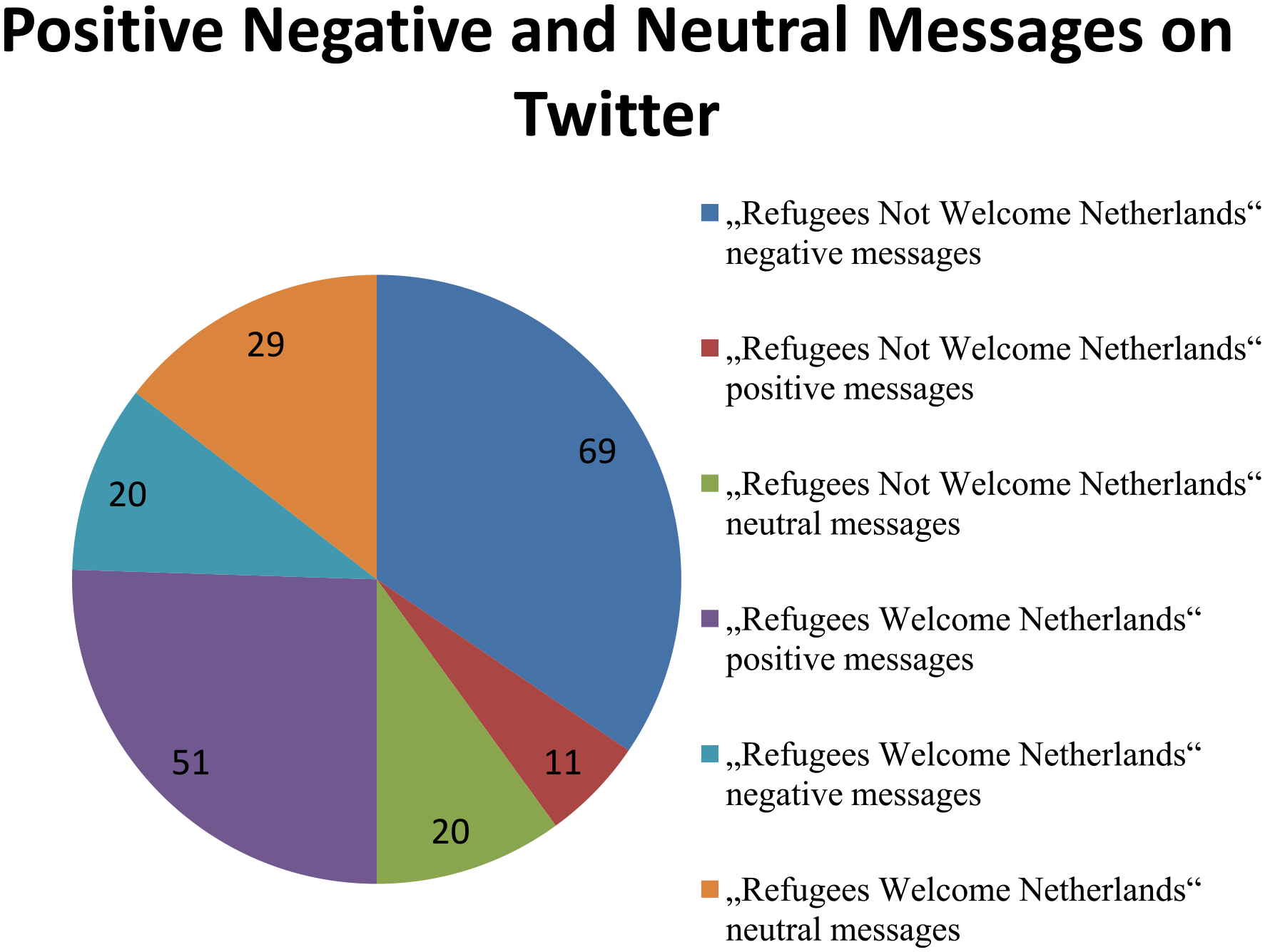
Publications that have positive, negative or neutral rhetoric on social networking website Twitter.
In summary, the results suggest that negative rhetoric can play an important role in shaping the discourse on refugee integration in the Netherlands and in the public perception of refugees as a security or economic threat.
The analysis of the information published on social media sites suggests that the recurring words and combinations of words may be a reference to certain rhetoric, for example, to form anti-immigration or, on the contrary, more moderate attitudes in the context of refugee reception. An initial quantitative (Python) analysis of the texts has led to the creation of four main categories (messages, photos, videos, links), which are the most frequently used words and combinations of words in the texts. The aim is to explore the common rhetorical aspects that shape favourable or hostile attitudes towards refugees and asylum seekers in the Netherlands. The quantitative content analysis examines 20 concepts/word combinations (Figure 2).
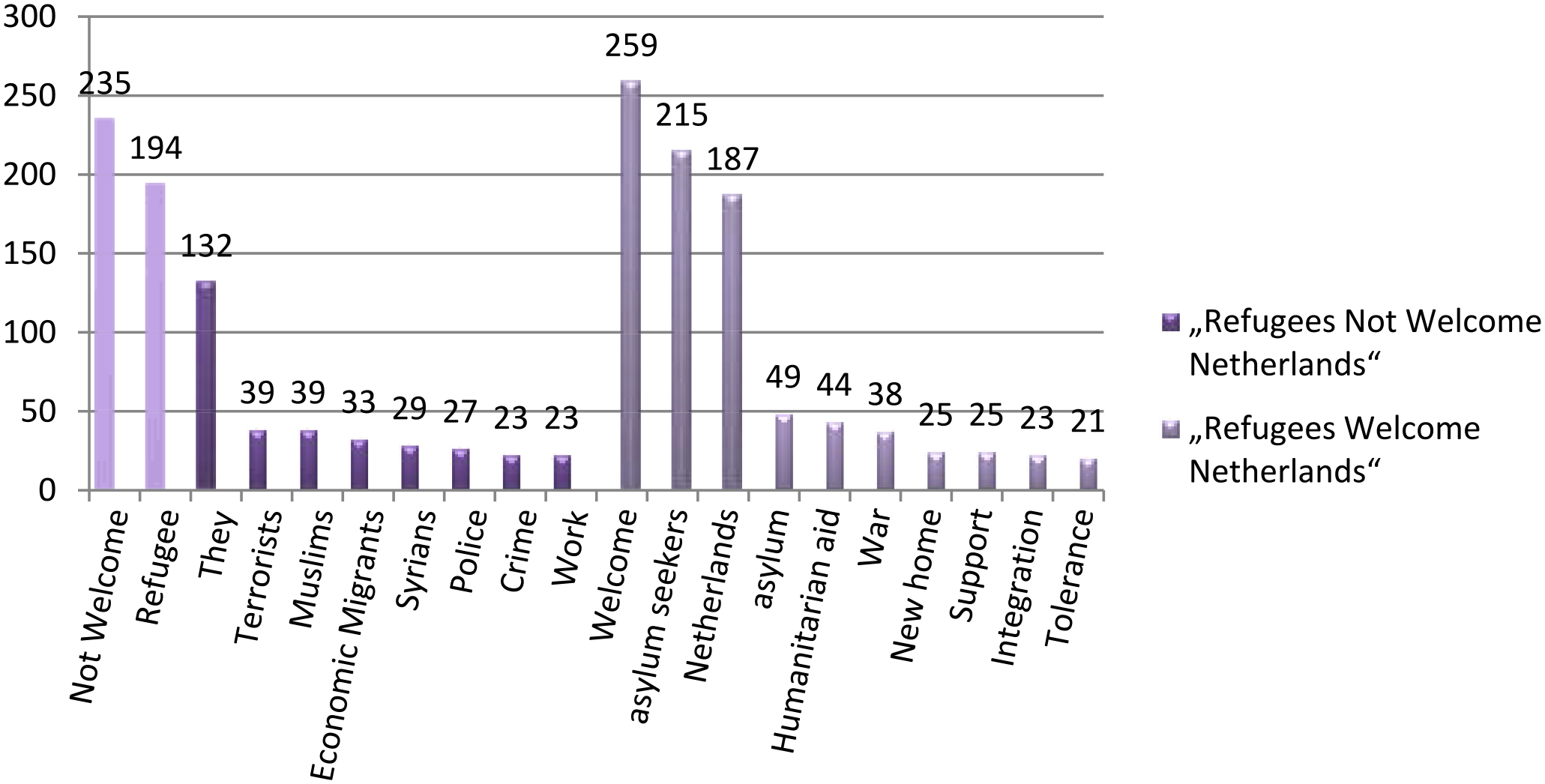
The number of target words in Twitter pages.
The results show that the most frequently used terms in the Twitter discourse ‘Refugees Not Welcome Netherlands’, which presents refugees as a threat to the host society, are ‘not welcome’ (mentioned 235 times in posts, photos, replies and links), ‘refugee’ (194), ‘they’ (132), ‘terrorist’ (39) and ‘Muslim’ (39). Meanwhile, the term ‘economic migrant’ (33) is often mentioned together with ‘work’ (23). The terms ‘crime’ (23) or ‘police’ (27) were not dominant but were consistent with the themes of many publications. The formation of refugee discourse on Twitter is conditioned by a certain rhetoric, suggesting that the use of such terms (e.g. ‘terrorist’, ‘Muslim’, ‘economic migrant’, etc.) may create hostility or foster negative attitudes towards the integration of refugees in their host society.
The results of the quantitative content analysis of Twitter show that the most frequently recurring phrases and concepts in the discourse ‘Refugees Welcome Netherlands’ are ‘welcome’ (259), ‘asylum seekers’ (215), ‘Netherlands’ (187), ‘asylum’ (49), ‘humanitarian aid’ (44) and ‘war’ (38). Meanwhile, terms such as ‘new home’ (25), ‘support’ (25), ‘integration’ (23), ‘tolerance’ (21) are not popular, but are often repeated in messages, photos and replies, suggesting, that more moderate attitudes towards refugees are being formed among Twitter users, with an emphasis on the unrest in Syria, humanitarian principles, the need for aid, the argument of moral duty or humanism, and the choice of terms that are opposite in value to ‘Refugees Not Welcome Netherlands’.
Based on the results of the quantitative analysis of Twitter content, there are two main categories for the qualitative analysis of Twitter content:
Humanitarian discourse in the context of refugee integration,
Security discourse in the context of refugee integration.
Results of qualitative content analysis of Twitter
This chapter presents results of qualitative content analysis. Posts from two different search results on Twitter (‘Refugees Welcome Netherlands’ and ‘Refugees Not Welcome Netherlands’) are analysed according to categories presented by Wodak (2015)
The discourse analysis of both ‘Refugees Not Welcome Netherlands’ and ‘Refugees Not Welcome Netherlands’ shows that the image of the refugee as an economic migrant is repeated, but in the first case, the aim is to draw attention to the negative attitudes formed in society towards refugees as ‘forced migrants’. Analysing migration processes reveals complex political, economic and power dynamics that are justified by the ‘suitability’ or ‘innocence’ of refugees rather than an objective classification of people in need of asylum. On the other hand, the posts on the page ‘Refugees Welcome Netherlands’ are mostly positive with many posts stating that fearing refugees during humanitarian a crisis is unreasonable. The aim is to draw attention to the fact that the problem is much more complex than simply the desire of nation-states to abandon their international obligations. The formed images and stereotypes of refugees ‘distort’ reality by emphasising who should receive protection and who must leave Europe. These competing discourses construct different versions of refugee identity.
Humanitarian discourse in the context of refugee integration
Referential/Nomination
The discourse analysis of ‘Refugees Welcome Netherlands’ emphasises people fleeing difficult living conditions (persecution, war, unrest, etc.), that is, asylum seekers. The emphasis is on the fact that these are not economic migrants, but people who are experiencing persecution and seeking a safe haven. For example, sharing a video of a girl asking for a safe haven where no one can harm her, it says: ‘I am with her. I am happy to support her request for asylum in the Netherlands. This is TRUE persecution as defined in the UN Refugee Convention. But I am very sorry that I also have to warn her: the West is not necessarily safe for Muslims <. . .>’ (see Example 1). 2 The discourse stresses that helping refugees is a moral duty: ‘Even those who wanted the #refugeecrisis to be managed differently feel that those fleeing war are welcome. It is a sense of duty towards other people. #Netherlands’ (see Example 2).
The Twitter discourse (‘Refugees welcome Netherlands’) portrays refugees as potential participants in the labour market, rather than as beneficiaries of the welfare state (in other words, as unemployed). The video asks: ‘How would you rebuild your life after leaving almost everything behind in a war zone? A group of Syrian refugees in the Netherlands earn money by recycling discarded life jackets. . .’ (see Example 3). Refugees living in Amsterdam recycle and sell life jackets. Various job offers also dominate the discourse. For example, sharing the Dutch Research Council’s (NWO) announcement of the launch of a new pilot project, Refugees in Science, which aims to fund 1 year of research for researchers who have fled their home country and want to pursue a scientific career in the Netherlands, it reads: ‘Refugees in the Netherlands with a Master’s degree or a PhD in #linguistics can contact me. I will be happy to help them find a linguistics department at a Dutch university that fits their background’ (see Example 4). In this discourse, the ‘economic refugee’ (#economicrefugee) is perceived as a potential participant in the labour market and therefore does not evoke negative associations: ‘Amazon welcomes you to the Netherlands. Good job to all refugees who have fled war and despair. #economicrefugee’ (see Example 5).
A quantitative content analysis of the search results for the keyword ‘Refugees Welcome Netherlands’ shows that the dominant discourse is humanitarian. It is a discursive communication, presenting arguments that build a logical and rational image of the refugee as a person in need of help and develop critical thinking (drawing attention to the humanistic ‘mission’ of the EU states in relation to refugees as forced migrants).
Predication
In the case of ‘Refugees Welcome Netherlands’, the ‘new’ arrivals are portrayed as people in need of help. In fact, the Twitter page does not directly ask for material help from the public, but rather asks them to join various initiatives, as the lack of human resources (volunteers, activists, etc.) has become apparent. Not only does it ask for help, but it also shows an example of such help: ‘Our “reception” packages are given to refugees arriving in the Netherlands!’ (the photo shows NGO volunteers distributing basic daily necessities to refugees) (see Example 6). The video sharing highlights: ‘#UNHCR #refugees, preparing “reception” boxes and collecting clothes for refugees in Haarlem, the Netherlands’ (see Example 7). In this video, Twitter users can see how various clothes, toys and other useful items for refugees are sorted in a city in the Netherlands.
The discourse presents the experiences of employers who accept refugees in the Netherlands. The article ‘The Netherlands - Most co-workers accept refugees’ shows that ‘according to a recent Randstad survey, 3 out of 5 Dutch co-workers have a positive attitude towards refugees in the workplace’ (see Example 8). The study highlights that employees believe that a multicultural working environment fosters creativity and innovation. The majority of respondents (68%) recognise that the integration of refugees is linked to their integration into the labour market. Fifty percent of the employees surveyed agree that refugees are highly motivated, while a third say that it is difficult to find employees in the Netherlands with the kind of experience that refugees have. The number of respondents to the survey was 810 and they were asked questions about their attitudes towards refugees in the labour market (Staffing Industry Analysts, 2016). Success stories are also told about the help refugees have received after arriving from Syria: ‘I came from Syria but I have integrated so well into Dutch society that I even have red hair #utrecht #refugees are welcome’ (see Example 9).
Qualitative content analysis reveals that refugees are presented as victims. This is one of the most prominent refugee stereotypes in this discourse. However, statements related to humanitarian aid and the dependence of refugees on the help of the host society are intended to encourage support for refugee reception and integration processes. For this reason, it is assumed that this type of discourse may undermine refugees’ motivation to integrate, as they will not be treated as full members of their new communities.
Argumentation
It is noticeable that the messages contain links to articles in various newspapers (about 60% of the short messages). This is discussion-based content, sharing information published by international organisations or movements. For example, sharing an article by Amnesty International, a global movement of more than 7 million people who advocate for a world where human rights are guaranteed for all, entitled ‘The Dutch plan for an EU “refugee swap” with Turkey is a moral bankruptcy’: ‘Denmark robbed them, Sweden expelled them, and the Netherlands is carrying out the swap. Welcome to the #EuropeanUnion. #Refugees’ (see Example 10).
This discourse not only informs the public through the arguments it generates, but also refutes misinformation. In order to refute concerns about whether asylum seekers are economic migrants intending to benefit from state support, the Donate4Refugees Twitter account shares an article describing the situation of refugees: ‘Last year (2015 - author’s note) almost 60,000 refugees arrived in the Netherlands fleeing civil war and sectarian violence. But the small western European country, which is about half the size of West Virginia, did not have enough facilities to meet the needs of asylum seekers. As in other cities around the world, the Dutch government has set up camps, but the living conditions are inadequate and people cannot live in tents permanently. For this reason, in January The Central Agency for the Reception of Asylum Seekers (COA) has announced the housing project competition “A Home Away From Home.” The competition asks participants to create buildings that could become temporary accommodation for refugees or victims of disasters. Also, the building can be used for other purposes in the housing market, such as student accommodation’ (Eckhardt, 2016).
The Twitter platform also uses personal experience to present refugees as potential market participants who are not ‘dangerous’ to society (see Example #3; #11).
Analysing Twitter messages, links to articles and videos shows a discourse of human rights, as the arguments are based on the ideas of humanism and basic human rights. A link to a children’s animation titled You Have Rights states that ‘this is how the Dutch government presents the Netherlands to the world’ (see Example #12). The video presents an interactive presentation of the asylum procedure in the Netherlands (in English and Arabic). However, the discourse also expresses a hostile opinion about the fact that such videos motivate refugees to come and take advantage of the social welfare provided by the state: ‘The situation in the Netherlands is absolutely crazy. The aim of the animation is to tell refugees that they are welcome and have rights. What most people in the Netherlands think: stay away, if you are here, go out and create your own state, not live off the taxes I pay’ (see Example #12).
Data from international organisations are used in the argumentation. The institution of the United Nations High Commissioner for Refugees (UNHCR) is mentioned 20 times in the discourse. Various photos are shared showing initiatives to help arriving asylum seekers in different cities in the Netherlands (see Example #13, #7).
The presentation of refugee issues is based on impartial arguments and references to sources. Analysis of data from international organisations and public opinion polls highlights the discourse around human rights and refugee integration. However, the discourse does not present arguments related to the decisions taken by the Dutch authorities, the asylum policy of the EU (e.g. certain decisions on the closure of the Western Balkans, the refugee (quota) plan, the EU-Turkey agreement, etc.).
Perspectivization
An analysis of the ‘Refugees Welcome Netherlands’ discourse on the social networking site Twitter shows that the authors of the messages are representatives of the host society. In the case of ‘Refugees Not Welcome Netherlands’, the opinions expressed by political actors are used. However, their political attitudes differ, as the discourse on ‘Refugees Not Welcome Netherlands’ emphasises the position of the far-right, which is characterised by its anti-immigration stance. In this case, the views of more liberal voices are used. For example, a video of a Dutch politician speaking in Arabic is shared: ‘We support your right to freedom, justice and security. We will not forget you and you will remain in our hearts. Your pain is our pain. Your sadness is our sadness. Your struggle is our struggle. I say to the Syrians in the Netherlands, welcome’ (see Example 14). The video highlights that the Netherlands took in 117,000 refugees in 2015. The video has been viewed almost 110,000 times. A politician of Turkish origin, together with another Member of Parliament, founded the political party Denk to change the growing mistrust towards migrants and refugees. It is a political party in the Netherlands, but its members identify the party as a movement for migrants’ rights and the creation of a ‘tolerant and solidarity society’, which calls for a ‘racism registry’ (Otjes, 2016). Moreover, in opposition to the Donald Trump, they initiated a social media campaign named ‘The Netherlands protests against #Trump #immigration ban. #Refugees and #immigrants welcome!’ (see Example 15). The photos of the campaign show a protest against Trump’s actions.
NGOs and businesses not only raise concerns about refugees in the Netherlands, but also propose solutions for their integration. ‘The founders of the Refugees Forward Incubator share a message on their account about the jobs they are creating: ‘Welcome to Refugees Forward. We are an organisation based in Amsterdam that helps newcomers to start a business in the Netherlands’ (see Example 16). Meanwhile, Mr Dalhuisen, Amnesty International’s Europe and Central Asia Director, criticises some of the EU’s decisions and calls for action to address the refugee crisis in Europe: ‘Turkey cannot be considered a safe country for refugees. It is not even a safe country for many Turkish citizens. In recent months, refugees have been returned illegally to Iraq and Syria, and refugees from other countries have been waiting for years for their applications to be processed. The scheme to resettle refugees in Turkey to the EU is a good idea, but returning those who cross the border illegally is tantamount to an exchange of human lives. With the banning of one route to Europe in recent years, refugees are inevitably taking another, more dangerous route to seek protection. Offering safe, legal routes to Europe is the only sustainable solution to improving the situation of refugees’ (Amnesty International, 2016).
Refugees and their representatives are also active participants in Twitter discussions. Personal experiences of public support for refugees are shared: ‘My mother was a refugee. She fled Hungary in 1956. She was 11 years old at the time (the same age as my son now). The Netherlands took her family in and gave her a new home. Please take in refugees. Their safety and their future depend on us’ (see Figure 3).
Refugees do not often speak ‘directly’ in the discourse (various articles use interview data to present refugees’ views or experiences in the Netherlands). The messages express the need for humanitarian aid and refugees’ gratitude to the host society: ‘I am a Syrian refugee in the Netherlands. If this country had not taken me in, I would have no future at all. We have dreams too’ (see Example 17). The results of the qualitative content analysis show that refugees are presented in the discourse as a vulnerable group in need of help from the host society. The emphasis is not only on helping refugees who have already arrived, but also on supporting those who are still living in Syria or in refugee camps in Iraq, Jordan and other countries in the Middle East region.
Intensification/Mitigation
An analysis of the Twitter messages and photos highlights the distinction between ‘us’ (members of the host society) and ‘them’ (refugees or asylum seekers). In this case, the pronouns ‘we’ and ‘our’ are used to emphasise the Dutch concern for people in distress (the importance of providing humanitarian aid and thus fulfilling a ‘moral’ duty): ‘We support your right to freedom, justice and security. We will not forget you and you will remain in our hearts. Your pain is our pain. Your sadness is our sadness. Your struggle is our struggle’ (see Example 14). Sixteen messages include the words ‘Help’ (see Example 18; No. 4), ‘Welcome refugees’ (see Example 8) and ‘We are here to help’ (see Example 18). The messages also often take the form of a question-and-answer: ‘How would you rebuild your life after leaving almost everything behind in a war zone? A group of Syrian refugees in the Netherlands earn money by recycling discarded life jackets. . .’ (see Example 3). The aim is to raise public awareness that not all refugees benefit from state benefits, but rather integrate into the labour market, are hardworking and motivated individuals.
The Netherlands’ asylum policy is seen as an example for other countries (i.e. Switzerland) to follow: ‘The Netherlands announced on Wednesday that it is ready to take some of the 32 migrants waiting to disembark from a boat flying the Dutch flag in the Mediterranean Sea, if other countries do the same. Show the Dutch that the Swiss also care about refugees. THANK YOU’ (see Example 19). The message was shared eight times on Twitter. The metaphor of a ‘new future’ dominates the discourse, aiming to point out that refugees leave everything behind in their home countries (homes, property, families, relatives, jobs. . .) and build a ‘new’ future in the Netherlands, where security is a key aspect: ‘<. . .> he can be welcomed warmly in my country and expect a new future’ (see Figure 3), because ‘<. . .> their security and future depends on us’ (see Figure 3). ‘A “new” home is associated with a host country, a “new” environment and a future: ‘<. . .> the Netherlands welcomed her family and gave them a new home. Please accept the refugees. Their safety and future depend on us’ (see Figure 3).
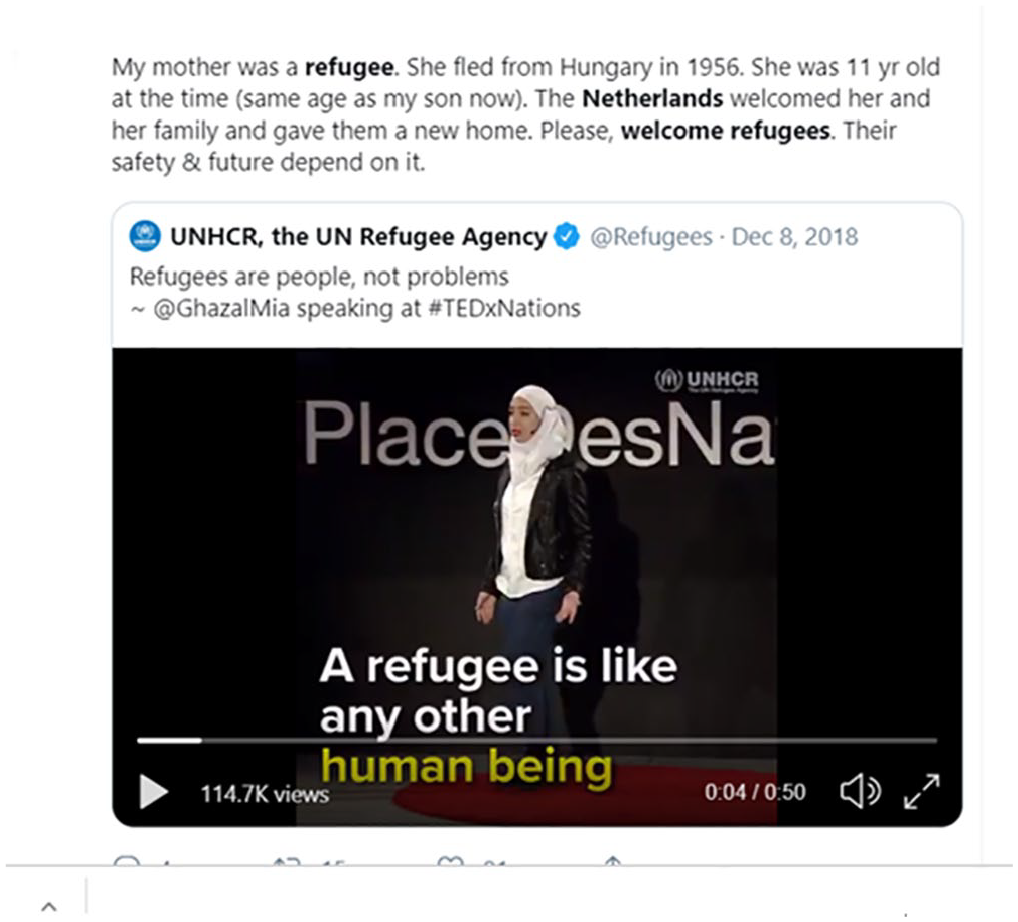
‘Refugees Welcome Netherlands’.
To sum up the qualitative analysis of Twitter discourse ‘Refugees Welcome Netherlands’ The photos, videos and shares published in the discourse are not intended to reinforce or shape anti-immigration attitudes. The discourse refuses to stereotype refugees by providing unbiased information. Refugees tell their life stories and share their hardships, so the discourse creates an impression of ‘authenticity’ and the ‘digital’ narrative (photos, videos, etc.) is important to understand the wider context.
Security discourse in the context of refugee integration
Referential/Nomination
Anti-refugee discourse also does not only use economic or political points, but also uses security context. Anti-refugee security discourse emphasise the terrorist attacks organised by people of refugee origin and their ‘unwillingness’ or ‘inability’ to integrate into the host society. This is used to oppose and deny the need for humanitarian aid to those who have arrived in the Netherlands or other European countries. In addition, arguments related to nationalism and anti-Semitism are used to reinforce and justify negative public attitudes towards refugees.
An analysis of the discourse on Twitter ‘Refugees Welcome Netherlands’ highlights the fact that refugees are portrayed as terrorists and are therefore classified as criminals. Articles describing crimes committed by refugees are frequently shared by this Twitter group: ‘Please read this, righteous Muslim immigrants in the Netherlands terrorising Dutch citizens. Not for refugees’ (see Example 20). Nineteen times the messages focus on terrorism: ‘Given the attacks on Dutch citizens by migrant/refugee Muslims, the growing popularity of Mr Wilders should not be surprising’ (see Example 21). Ten videos (out of the 20 selected for qualitative content analysis) relate to violent acts committed by refugees in the Netherlands: ‘Netherlands: / Witness: “3 people stabbed, attacker slit man’s throat” / Dutch government and mainstream media: “The attacker (Syrian refugee) was a confused man, no terrorism” / Witness: 'The attacker was shouting “Allahu Akbar”’ (see Example No 22).
A video is shared showing Dutch police arresting an attacker, with blood used to create an atmosphere of threat. The discourse also uses cartoons to highlight refugees as terrorists: ‘Bomb Muslims. . . no outrage / Ban Muslims from coming. . . NO OUTRAGE! / US RegimeKetifWar $’ logic. . ..’ (see Example 23). The cartoons depict the then US President B. Obama saying the following words: ‘We have to kill Syrians to prevent Syrians from killing Syrians’ (see Figure 4). Another cartoon depicts a person of a particular religion about to be killed: ‘Before you get killed, let me remind you that he does not practice Islam’ (see Example 24). The discourse generated on the Twitter platform highlights the divide between the native population (Dutch) and the representatives of another culture (Islam).
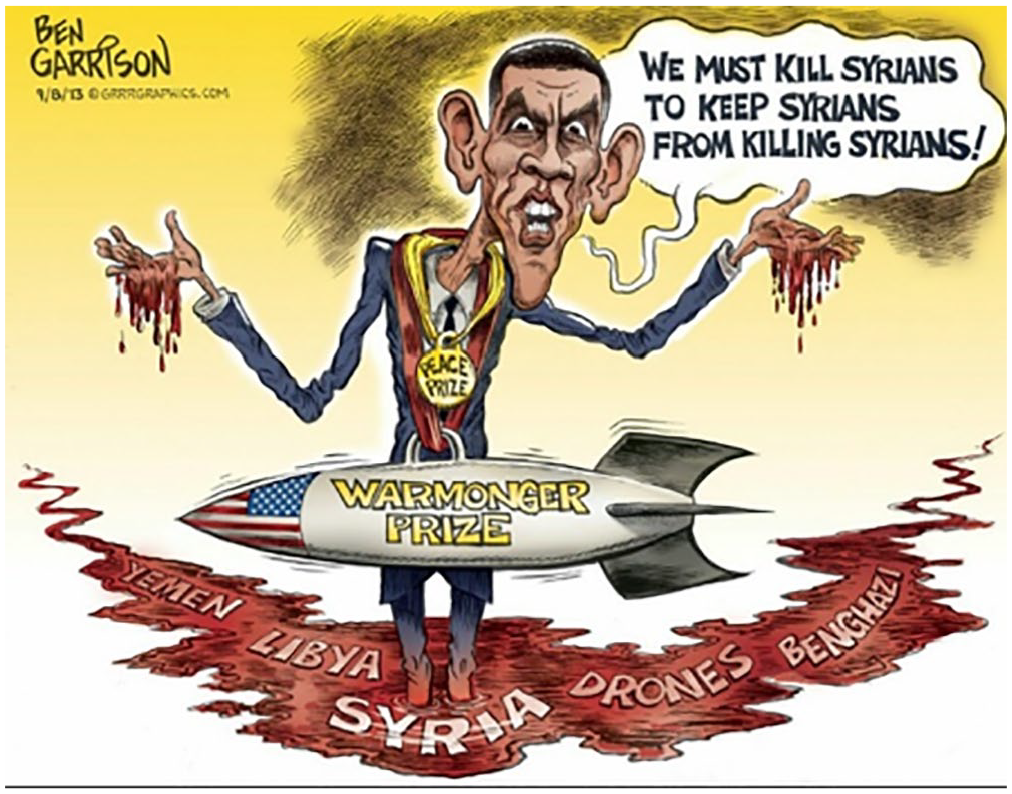
‘Refugees Not Welcome Netherlands’.
Another category that emerges in the Twitter discourse is ‘jihadists’. Messages highlighting crimes refer to Muslims and refugees as jihadists: ‘I was a jihadist like you, but then I shot myself in the kneecap’. (see Example 25). Also included is a photograph of a participant in the Crusades. This creates an allusion to the Crusades of the past, which were aimed at Christian expansion into foreign lands. The publicly proclaimed aims of the Crusades are to help Eastern Christians fight Muslims, liberate the Holy Land, etc. (Asbridge, 2012).
The ‘Refugees Not Welcome Netherlands’ discourse also discusses terrorism issues. It is a storyline that unites two different Twitter discourses. Refugees are identified as terrorists (20 posts focus on terrorism): ‘Dutch police arrest 7 suspects involved in a terror attack when they were planning to attack a “large event” <. . .> Men aged 15-40 pretend to be #asylum seekers and come to the country as refugees to carry out terror attacks on the Western countries that hosted them’ (see Example 26). The Netherlands is described as an Islamic state and the article is shared with the following text: ‘IF THIS IS TRUE THEN THE NETHERLANDS IS NOW AN ISLAMIC STATE! WELCOME ALL ISLAMIC TERRORISTS AND REFUGEES!’ (see Example 27). This is in response to an article about the Dutch Prime Minister’s victory in the elections against Mr Wilders, a candidate with an anti-Muslim policy. The author argues that many of the Prime Minister’s potential coalition partners are in favour of a more pro-refugee policy, and that Mr Wilders may therefore soften his rhetoric in his quest for partnership. Wilders’ unsuccessful electoral performance will weaken the chances of a stronger immigration policy in the country (Birnbaum, 2017).
Qualitative analysis of Twitter content shows that social categorisation is used to present refugees as terrorists, jihadists, Islamists, ‘other cultures’ or ‘other religions’. This discourse creates a dichotomy between ‘us’ (the Dutch) and ‘them’ (refugees). Refugees as an outsider group are associated with negative characteristics and a threat not only to Dutch society but also to other European countries.
Predication
Refugees are associated with a certain threat or danger in their host society. Twitter posts highlight terror attacks: ‘1) Syrian refugee slits 3 throats in The Hague / 2) Syrian refugee shouts: “Allahu Akbar” / 3) Police stopped a terror attack’ (see Example 28). In addition, refugees are associated with terrorist groups such as ISIS (23 mentions of ISIS, compared to 5 mentions of al-Qaeda): ‘ISIS fighter arrested in the Netherlands - came to Europe as a refugee’ (see Example 29).
Twitter posts refer to protests against a planned refugee integration centre: ‘Riots in Geldermalsen, the Netherlands, during a meeting of city officials on a refugee centre <. . .>’ (see Example 30). The police in Geldermalsen arrested 14 people who were involved in the riot. Two officers and several demonstrators were injured. The square in front of Geldermalsen Town Hall looks like a battlefield. A council meeting was held at the town hall on the possible establishment of an asylum seeker centre in Geldermalsen. Hundreds of people gathered to protest against this initiative (Bakker and Bode, 2015). Videos depicting protests against refugees were also shared: ‘IMAGE: Anti-migrant people protesting against a new refugee centre<. . .>’ (see Example 31).
Meanwhile, the ‘Refugees Welcome Netherlands’ Twitter group discourse seeks to counter such protests. Refugee reception or integration centres are seen as an important expression of humanitarian aid. The emphasis is on the fact that in these centres refugees can receive appropriate assistance and integrate more quickly into the society of the host country, in this case the Netherlands. It is pointed out that refugees in the Netherlands are not associated with an increase in crime: ‘No # increase in crime among refugees or other persons in the municipalities in the Netherlands where the asylum seekers’ centres were established. Well done’ @wodc_nl (Research and Documentation Centre – WODC) – author’s note. (see Example 32). It also presents the experiences of refugees in integration centres, where they can feel safe and where they learn Dutch.
‘In the discourse ‘Refugees Not Welcome Netherlands’, refugees are portrayed as people who belong to a different culture and religion, and their integration is therefore a question mark: ‘NO TURKS NO MAROCANS NO ISLAMS CLOSE THE WALLS REFUGEES ARE NOT WELCOME IN EUROPE NOT TO THE RUTTE CABINET111’ (Rutte’s Cabinet III was formed in 2017). The Netherlands: a 13-year (see Example 33). This discourse stresses not only cultural but also religious differences, which make integration difficult: ‘Muslim refugees in the Netherlands: “We are Muslims, not Dutch citizens” So no integration!’ (see Example 34). The link between religion and terrorist attacks is also highlighted, as ‘jihadists’ or ‘Islamists’ ‘women are not allowed to be different’ – old Muslim boy tries to kill his mother because are mentioned frequently.
The analysis based on the ‘Predication’ category shows that unjustified societal fears in the context of security are shaped by connecting refugees to acts such as crimes or terrorist attacks and characteristics related to cultural and religious differences.
All in all, criticism and stereotypes about refugees are the most common opinions to follow. It slowly becomes the field of war of different interests and different representations of refugees.
Argumentation
In the discourse ‘Refugees Not Welcome Netherlands’, it is noticeable that the negative qualities related to terrorism are based on examples from other countries or on personal opinions (opinions based on perceived arguments about the supposed danger to Dutch society). In contrast, the ‘Refugees Welcome Netherlands’ discourse relies on statistical data and research findings from certain organisations to refute these assumptions.
In order to support the argument on the link between refugees and terrorism, the Netherlands refers to the examples of other ‘sovereign’ states: ‘***! No more Violence, theft and killing! We stand with the people of Germany, France, the UK, Sweden, the Netherlands and all the peoples of Europe for national sovereignty. All nations must continue to fight! No more open borders, no more refugees! Stop the evil  agenda of the globalists!’ (see Example 35). The Twitter platform stresses that the quota system or, in other words, the ‘burden-sharing’ plan is not effective: ‘No. From the Netherlands. The Netherlands, Germany and Sweden took in the most refugees. Hungary and Poland are ignoring EU rules! Right? No way!’ (see Example 36). There is also criticism of refugees who do not want to stay in safe countries such as Jordan or Turkey, which raises questions about the need for humanitarian aid and the economic motives of refugees (see Example 37).
In order to highlight the image of the refugee as a threat to the state and public security, statistical data are also used by ‘Refugees Not Welcome Netherlands’ to form arguments. The results of a study conducted by the Social and Cultural Planning Office are also published. Refugees in the Netherlands are identified as having psychological problems (with an emphasis on depression or anxiety): ‘The Netherlands: SPC (Social and Cultural Planning Office – note) study: more than 40% of the 44,000 Syrian refugees who arrived between January 2014 and July 2016 have psychological problems. / 50+% do not want to return to Syria / 20% want to return / 20% have a higher education / 33% have only finished primary school / 78% have no paid job <. . .>’ (see Sample 38). The assumption is deliberately created that refugees with psychological problems may be linked to Islamism, terrorism or other crimes. This is reinforced by the refugees’ alleged ‘reluctance’ to get a job in the Netherlands: ‘There is no need to wait . . . Less than 5% of refugees who arrived two or more years ago are employed in the Netherlands! . . . Why should they?! . . . They are given housing, health care and an allowance that gives them better living conditions than they had at home . . .’ (see Example 39).
‘Refugees Not Welcome Netherlands’ group uses an an additional discourse related to public opposition. A petition was called for: ‘No Migration Pact - No Refugee Pact - National Petition #Canada #Denmark #Dominican Republic #France #Finland #Yellow Vests Protest #Germany #Ireland #Latvia #Lithuania #Mexico #Netherlands #New Zealand #Norway #Sweden #UK #Ireland #Spain #Slovenia’ (see Example 40). The picture shows refugees travelling to European countries and includes a map of the world. The United Nations Global Compact for Migration was signed in Marrakech in December 2018. The argument also uses the parallel of anti-Semitism: ‘<. . .> Is it only a threat if it is connected to electricity? Then tell me, what do you call the anti-Semitism that is active in the Netherlands, in France, in Belgium, etc., and that is driven by refugees from the Arab world, what do you call that?’ (see Example 41).
The data presented is not intended to present a unilateral position, but the negative rhetoric towards refugees is nonetheless prevalent, and can therefore be a favourable communication platform for the formation of anti-immigration attitudes in society.
Perspectivization
When presenting the main actors involved in the discourse on the image of refugees as a threat (‘Refugees Not Welcome Netherlands’), it is not only members of society who are against refugees in the Netherlands, but also politicians who express anti-immigration attitudes. However, positions contrary to this discourse also emerge which emphasises the human rights and humanitarian aid to the victims (‘Refugees Welcome Netherlands’). The ‘fate’ of refugees is presented in a mixed way: they must leave the country or have the right stay in a safe haven in country like the Netherlands.
The sharing of short messages (photos, videos, articles, etc.) is not only limited with the statements of Dutch public figures and politicians (politicians: Wilders, Hoekstra, etc.), but it also uses the statements of political leaders in other European countries which are also facing immigration issue. For example, a statement by the then German Defence Minister Ursula von der Leyen on terrorism in the country was quoted as follows: ‘Despite the sudden militarisation of German society, Defence Minister Ursula von der Leyen said earlier this month that the Bundeswehr (German Armed Forces – editor’s note) would be conducting training for the federal police in preparation for deploying counter-terrorism operations inside the country’ (Durden, 2016). As the German government considers new security strategies in the wake of the two recent terrorist attacks and mass shootings, then German Chancellor Merkel (see Figure 5) were also included in the posts. Also in this discourse, the policy of US President Trump is seen as a role model for the refugee crisis in the Netherlands: ‘Top 5 countries that want to leave the EU. UK, Netherlands, Austria, Italy, Germany. Some because of their leaders, others because of their people. The success of Trump. Countries would like to regain sovereignty and no refugees’ (see Example 42). The analysis of the ‘Refugees Welcome Netherlands’ discourse shows human rights discourse that emphasises representatives of various non-governmental organisations such as Red Cross volunteers (see Example #43).
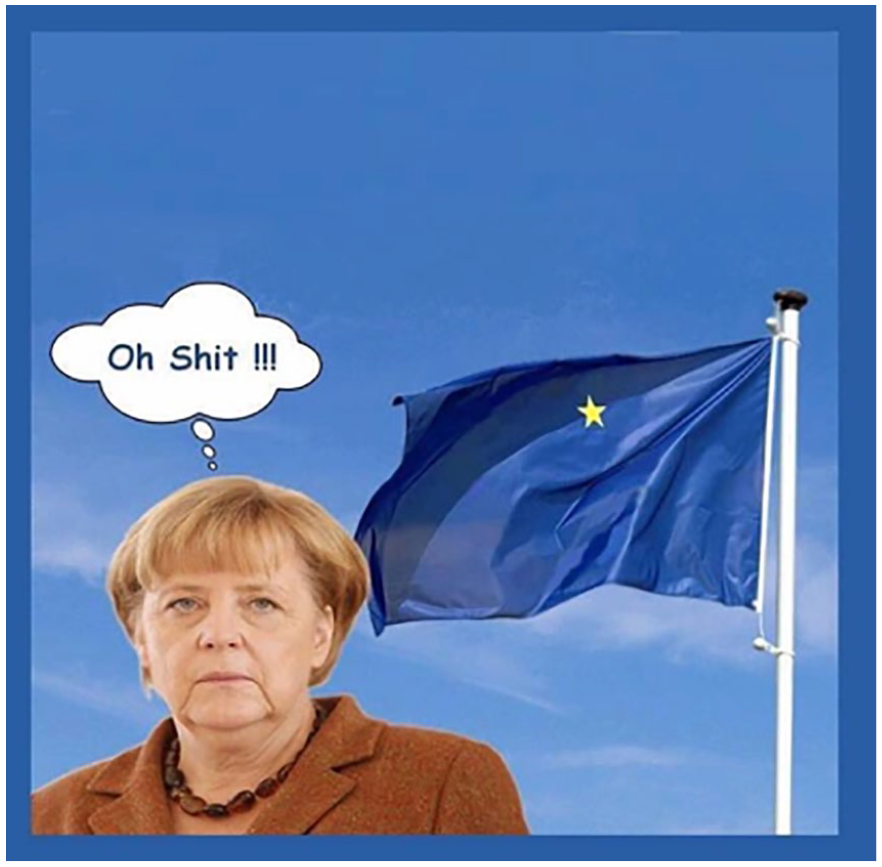
‘Refugees Not Welcome Netherlands’.
Refugees are also part of the discourse: ‘They left me no choice but to flee the country in search of safety and freedom to breathe. I went to the Netherlands and now I live there as a refugee. I will not hide the fact that I was afraid of being kidnapped, tortured and even raped’ (see Example 44). Stories of refugee children are also told, which are important to raise awareness of human rights (neither ‘Refugees Not Welcome Netherlands’ nor ‘The Public Committee Against Forced Immigration’ mention refugee children and what they go through): ‘Farida and Avien like to play in the park and chase butterflies. The two sisters are very close, so they trust each other and “share all their secrets.” They now live in Berlin, Germany, after having fled Syria’ (see Example 45). Stories of refugee children are presented by UNHCR (stories of children from Syria in Switzerland, Germany, the Netherlands and other cities). In addition, Twitter users also express their solidarity with refugees who have lost their homes due to the situation in their country and who need help.
Intensification/Mitigation
The discourse analysis of ‘Refugees Not Welcome Netherlands’ emphasises a context of ‘threat’. The Twitter posts of ‘Refugees Not Welcome Netherlands’ frequently features shocking headlines and videos of crimes: ‘Welcome refugees! A major terrorist attack and many deaths were narrowly avoided in the Netherlands <. . .>’ (see Figure 6). The terrorists were apprehended in September last year. Seven suspects were arrested in the cities of Arnhem and Weert (Takkar, 2019). The Twitter discourse includes pictures of armed Dutch police officers during a terrorist arrest operation. Nineteen times, the messages call for a protest against refugees in Europe and the Islamic ‘invasion’: ‘There is no democracy in the whole world that can help real refugees. Here in the Netherlands, newcomers become privileged and socially supported people. Soon we should fight against Islam as Europeans’ (see Example #46).
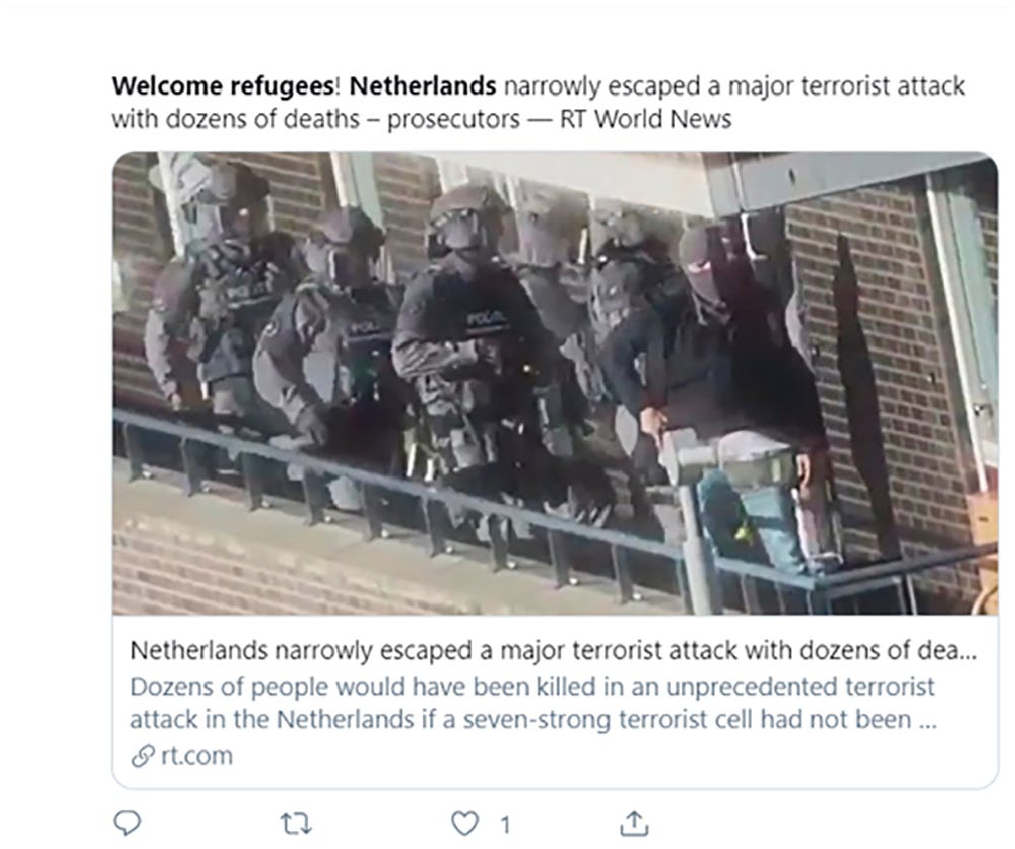
‘Refugees Not Welcome Netherlands’.
The ‘Mitigation’ category (analysing the image of the refugee as a threat) also includes the alternative discourse of ‘Refugees Welcome Netherlands’. This Twitter page is dominated by statements aimed at transforming the image of Muslims/refugees as potential terrorists. Sarcasm is used to counter the negative rhetoric and refugee stereotypes maintained in the discourse. In response to President Trump’s Twitter message (about how we are a great nation that will never accept people who come here illegally), it says: ‘I’m glad you are an expert on all refugees. No one would ever mistake you for a humanitarian, would they? No one could compare you to the people in Germany, in the Netherlands, in the whole of Western Europe, who risked their lives to hide Jews from the Nazis. Go worship the swastika’ (see Example 47). Another Twitter message also stressed that the crimes committed were not ethnic, racial, religious or otherwise: ‘Yes, it’s horrible, but thank goodness a Caucasian-born American has never raped, murdered, or committed any crime! Safe!’ (see Example 47).
‘Refugees Welcome Netherlands’ is also a platform for discussion, where opinions are freely expressed, opposed, defended, denied, etc., and protests are often depicted as a way of drawing public attention to vulnerable people in need of humanitarian assistance. Photos related to the protests are published on the website and users are invited to join such initiatives. It shows participants holding placards with the words ‘Welcome, refugees!’ and a logo created as part of the initiatives of organisations such as the United Nations, the Federation of Red Cross and Red Crescent Societies or Refugees Welcome International (the logo shows family members holding hands as they flee war) (see Example No 48). The discourse also invites participants to donate or join a volunteering campaign (see Examples 49; 50), as the support of members of the host society is important for refugees, especially in the early stages of arrival.
The results of the Twitter content analysis (in the context of the humanitarian crisis in Europe and security) show that, in the case of ‘Refugees Not Welcome Netherlands’, the attributes associated with refugees and migrants lead to negative images and stereotypes (e.g. terrorist, fundamentalist, Islamist, etc.) towards refugees. In contrast, the ‘Refugees Welcome Netherlands’ discourse seeks to create more moderate attitudes among Twitter users by emphasising the participation of refugees and their contribution to the host society, the need for humanitarian aid, the directives of the EU’s asylum policy, or the ‘moral obligation’.
Conclusion
Analysing the politics of labelling in the context of migration raises questions about what is called a refugee, an economic migrant, an illegal migrant, given that any image is related to the manipulation of a specific identity category. Today, refugees find themselves caught between two metaphors: victim and threat (especially when refugees are linked to the threat of terrorism). Such labels often lead to a systematic division of the world between ‘us’ and ‘them’, between an in-group and an out-group, what Said (1978) called the ‘other’, misunderstood, mystical and unknowable Orient. In other words, such images enable the dehumanisation of refugees, as, for example, in the case of Muslim refugees.
The search results for the keywords ‘Refugees Not Welcome Netherlands’ reflect negative attitudes towards refugees, as the most recurring concepts or word combinations are: ‘not welcome’, ‘refugee’, ‘them’, ‘terrorist’, ‘Muslim’ (39), ‘economic migrant’. Search results for the keywords ‘Refugees Welcome Netherlands’ show a more moderate approach towards refugees, as the emphasis is on humanitarian aid, moral values (‘moral duty’) and the implementation of EU asylum policy directives.
A content analysis of the search results for ‘Refugees Not Welcome Netherlands’ shows that most of the headlines, pictures and terms used in the posts are inciting fear, alienating refugees and create tensions between host society and refugees. Refugees are portrayed as economic migrants of dubious status, exploiting social security system, lazy people and dependents of the state. Meanwhile, the Twitter discourse ‘Refugees Welcome Netherlands’ challenges the image of the refugee as a burden. Refugees are represented as victims who have lost their homes as a result of the war and need both material and psychological support. Additional discourses on human rights and integration are also highlighted, as it tries to draw public attention to the fact that an important element of successful integration is the openness and willingness of the host community to accept refugees. However, ‘Refugees Welcome Netherlands’ Twitter discourse also contains words such as ‘terrorism’ and ‘threat’.
A comparison of how different groups of actors are involved in the construction of refugee images shows that, although the identity of the main actors is not clearly revealed, the information in the publications suggests that in the case of ‘Refugees Not Welcome Netherlands’, these are the public figures who are against refugees in the Netherlands, who are shaping the anti-immigration political discourse and who are launching a petition against the UN Global Compact on Migration in 2018. The online platform shares speeches by presidents, politicians (often from far-right populist parties) and journalists, but the information is selectively chosen in order to shape the anti-refugee discourse through the economic burden motif. Refugees are thus denied the opportunity to express their views, as passive participants with no voice.
In contrast, ‘Refugees Welcome Netherlands’ develops an alternative discourse by presenting a counter-view that seeks to dismantle the dominant discourse of ‘security’ and ‘threat’. The myth that almost all refugees are involved in crime, violence or terrorism is challenged.
It is also worth noting that Twitter communication platform provides a comprehensive discussion area where opposing views or arguments can be expressed in the same place and counter-arguments can also be see in the same discussion area.
Supplemental Material
sj-pdf-1-dcm-10.1177_17504813231188499 – Supplemental material for Public discourse on refugees in social media: A case study of the Netherlands
Supplemental material, sj-pdf-1-dcm-10.1177_17504813231188499 for Public discourse on refugees in social media: A case study of the Netherlands by Rūta Sutkutė in Discourse & Communication
Footnotes
Declaration of conflicting interests
The author(s) declared no potential conflicts of interest with respect to the research, authorship, and/or publication of this article.
Funding
The author(s) received no financial support for the research, authorship, and/or publication of this article.
Supplemental material
Supplemental material for this article is available online.
Notes
Author biography
References
Supplementary Material
Please find the following supplemental material available below.
For Open Access articles published under a Creative Commons License, all supplemental material carries the same license as the article it is associated with.
For non-Open Access articles published, all supplemental material carries a non-exclusive license, and permission requests for re-use of supplemental material or any part of supplemental material shall be sent directly to the copyright owner as specified in the copyright notice associated with the article.
