



Abstract
Response is an effective tool for exercising power in humour, since it can make a person seem funny. In the same way, the lack of response can make a person seem unfunny. In this article I argue that failed jokes make a female skiing pundit on TV seem humourless and that this is due to the other interlocutors refraining from giving adequate responses. The material is from a sports programme about cross-country skiing on Swedish Television. The aim of the case study is to find out how power is exercised discursively in humour that fails and to discuss possible implications the rejections may have on notions of gender. The theoretical framework used is a feminist post-structuralist discourse analysis in combination with an analysis of internal and external control mechanisms. The discursive practice of repeated rejections of the female pundit may have consequences for her possibilities in seeming humorous.
Keywords
Introduction
Humour can be a very effective tool for exercising power, for instance through the response given to someone who is trying to make a joke. An affirmative response, such as laughter, may create social bonds and a humorous mood (Trouvain and Truong, 2017: 342), as well as make the person telling the joke seem funny. Rejection as a response, on the other hand, makes the person telling the joke seem unfunny, and creates no sense of co-operation or good ambience (Kotthoff, 2006: 8). Immediate laughter is necessary when telling jokes (Sacks, 1974: 347–348), or the joke will become unsuccessful.
In this article I will present the results of a case study from a sports programme about cross-country skiing that was broadcast on Swedish Television. The aim of the study is to find out how power is exercised discursively in humour that fails and to discuss possible implications the rejections may have on notions of gender. The failed humour in this material does not relate to the quality of the joke but to the response of the other panellists to the person telling the joke, that is, the absence of laughter. The research questions I will answer are the following: How does the rejection of humour occur? How are these rejections produced discursively in the humorous discourse and in the sports discourse?
Humour
Power can be exercised through humour in many ways, particularly since it can serve different functions in conversations. Humour has the power to bring people closer together but also distance them from someone else who is present (Davies, 2017: 482). According to a framework presented by Hay (2000: 716), humour can serve three functions in conversation between friends: one psychological, one power emphasising and one solidarity building. (1) The psychological function relates to handling things that occur in the conversation or using humour as a form of self-defence, while (2) the function of power emphasises power differences and can be used for the joker to negotiate a better power position, that is, to try and suppress others by mocking them. (3) Solidarity building, however, can be a means of creating a sense of belonging within a group, for instance by the friendly mocking of others, but it can also be a way of making others outsiders through social control (Norrick, 1993: 78). In workplaces humour can contribute to creating a sense of collegiality and solidarity as well as being used as a means for exercising power (Holmes, 2000: 179). In conversation, humour is used through anecdotes, wordplay, sarcasm, and jokes, for purposes as entertainment, icebreakers, asking for favours and avoiding awkward silences etcetera (Norrick, 1993: 1).
The function of laughter in humour
Response is crucial to appearing funny, as humour is socially constructed in conversations. The social construction implies that both the joke teller and the audience are a part of how a joke turns out. Laughter is seen as the completion of a joke (Sacks, 1974: 347–348) and an important factor for making it successful. Sacks (1974) claims that the audience may produce a sarcastic groan or mirthless laugh to show they understand the joke, even if they do not appreciate it. Laughter can be seen as the appreciation for having been told a joke rather than an evaluation of its quality (Norrick, 2003: 1344). Used strategically, laughter can create status or modify how an utterance should be interpreted in institutional conversations (Adelswärd, 1989: 129). However, laughter is also described as something that creates good ambience and social bonds between people (Trouvain and Truong, 2017: 342). Hence, laughter is something that helps create amusement or a good mood. Thus, according to Kotthoff (2006: 8), the willingness to show amusement is the willingness to co-operate. Experiments have revealed that when people around us show their appreciation of someone else’s humour by laughing and smiling, we laugh more ourselves (Chapman and Chapman, 1974).
Appearing to be humorous is also important in groups since it is a value that is associated with status and powerful positions. Hay (2000) states that her framework presents two sides of humour that are closely connected: solidarity and power. She therefore concludes that ‘Whenever you attempt humour and it succeeds, your status within the group is positively affected’ (Hay, 2000: 716). Joke telling can be seen as a strategy for creating solidarity, establishing common ground, and creating group membership, since the joke teller and the listener exchange information about each other when a joke is told (Norrick, 1989: 120). Bell (2015) summarises previous experimental research about public speakers and audience response, namely that an audience laughing at someone or laughing with someone both resulted in a higher ranking of the speaker when compared to silence. Hence, she concludes that ‘any type of laughter in response to humor may be more affiliative than no laughter at all’ (Bell, 2015: 142). At the same time, laughter can be a part of the social processes of ridiculing and embarrassing others (Butler, 2015: 43).
Even if laughter can serve different functions in conversation, it is a way of creating co-operation and a sense of belonging in groups that have a common goal.
Failed humour
Humour can fail when it is not given any appreciation. There are many reasons why listeners will not laugh at a joke to show that they are not amused (Norrick, 2003: 1345). One reason may be that the joke is inappropriate, that is, sexist, or racist when joking about non-hegemonic groups (Billig, 2009). In friend groups, the reason may be that it shocks, is not perceived, is refused, or not understood (Priego-Valverde, 2009: 14). Not laughing can also be seen as aggressive, a way of exercising power and resistance to creating solidarity. Hence, Billig (2005: 192) claims that the absence of laughter should be interpreted as rhetorical, as unlaughter. People may choose not to laugh, even if they recognise humour and find it amusing. The absence of laughter can create distance between people, and the fear of people not laughing at your joke is therefore what makes strangers or people with low status avoid joking (Kotthoff, 2006: 8).
People not laughing at a joke is not necessarily an indication of the quality of the joke or the joker not being funny. Instead, the relationship between the participants, together with their mood, plays an important part (Kotthoff, 2006: 8). Failed humour can even harm relationships, since strong reactions to humour can leave the speaker feeling offended and excluded (Bell, 2017: 365).
When people in conversation have different aims, it can lead to them interacting in different modes or discourses. This may result in failed jokes. A person being mocked can for instance choose to reject the joking attempt by interacting in a serious discourse (Priego-Valverde, 2009: 7).
In many cases, laughing is seen as a social action and the reasons for laughing or not laughing may vary.
Power in mediated conversations
Studies on power relations in conversations have been made on mediated conversations in different European countries.
In Danish political panel debates Gomard (2001) claims that female and male politicians are treated differently. The female politicians in the study cannot always achieve powerful positions because they are rejected from the conversation floor, both by the TV host and sometimes even their own party members (Gomard, 2001: 89–91). Male leaders of different parties create alliances with others of higher status, whereas the female leaders allocate turns more equally to everyone. Gomard (2001, s. 90) claims that women are not given the same opportunities as men in politics.
In German-speaking contexts male participants are more likely to achieve an expert position in group discussions on TV, and Kotthoff (1997: 140–143) argues that only those who are presented as experts and confirmed as such in the conversations can achieve expert positions. For example, persons who achieve expert positions are asked questions, talk a lot, offer their own opinions whilst laughing at the opinion of others, and are also rewarded with laughter when joking about others. Kotthoff (1997: 144) thus highlights the fact that gender is a factor that can contribute to shaping power asymmetries in conversation.
In a Swedish humour show, female comedians have inferior possibilities to seem humorous than male comedians (Söderlund, 2016: 193). The comedians make parody of a political debate, and the female and male comedians receive different kinds of responses for their jokes, from the host and from the other comedians. The female comedians’ jokes fail when they are recurrently rejected in a political debate for the opinions they express, whereas the male comedians’ jokes are mostly encouraged in the humorous discourse when their utterances are received as jokes. The asymmetry leads to different possibilities to achieve powerful positions.
The subject of women not being funny is a theme that has been repeatedly discussed in the popular culture (see i.e. Hitchens, 2007), and there seems to be a rhetorical trope and stereotype about women as humourless that is still vivid.
Previous research indicates that negotiations of power positions may be connected to other structures such as gender, and that women and men may not get the same opportunities when it comes to how conversations unfold in public discourses.
Discourse analytical framework
The theoretical framework that will be outlined here is a feminist poststructuralist discourse analysis (henceforth FPDA) (Baxter, 2003) in combination with an analysis of control mechanisms (Foucault, 1981). Discourse is defined here as practices that are organised in such a way that all meanings create a common view of how we see and know the world (Foucault, 1989: 49). Foucault (1981: 52–53) also suggests that discourses are systems in which struggles, and domination occur. Connected to discourse are discursive practices, which are social practices that are produced within discourses, hence, defines them at the same time as they are depending on them (Baxter, 2003: 7). Language is significant for how we perceive actions and practices. Interwoven with discourses are concepts of power, which is here seen as something that runs through all relations and social actions. Thus, power is always exercised, giving some powerful and others powerless positions, as in discursively better placed than others (Baxter, 2003: 8). It is possible for the same individual to achieve both powerful and powerless positions in a conversation, which means that power is seen as fluid, something that can be gained or lost throughout a conversation, rather than something that people possess (Foucault, 1981). Power is negotiated in discourses that can be both competing and interwoven (Baxter, 2003: 1). In institutional and public contexts, as the examples in this paper explores, ‘relationship between discourse and power are arguably more conspicuous’ (Baxter, 2003: 9), since the speakers achievements are also broadcast on TV. In the analyses two discourses have been identified and will be presented below. It is through these discourses power positions are negotiated, gained, or lost.
FPDA has a focus on gender, even if other categories could be of interest and affect power relations. Still, FPDA recognises ‘gender as a potential site of struggle’ (Baxter, 2003: 12). Baxter (2003: 11) argues that post-structuralism supports different causes like feminism if they ‘are small-scale, context-bound, purposeful, critically tuned and short-lived’. Gender (and other) identities, relationships and positions are under constant negotiation in interaction (Butler, 2006: 34). A way of viewing how gender is reproduced is presented by Mills (2002: 71), whose idea ‘acknowledges the force of stereotyping and perceptions of sex-appropriate roles yet sees also that it is possible to challenge and contest those stereotypes or change their meaning or function’. With FPDA the analysis of power positions is interrelated with gender identities. Conversation analysis (henceforth CA) as method enables us to see what happens on a micro-level, which may otherwise pass as unmarked. Nevertheless, micro-level practices reproduce knowledge we have about notions on gender and about the world (Kitzinger, 2009: 97). CA does not recognise notions of gender if they are not made relevant in the conversations, usually through highlighting membership categorisation (Stokoe and Attenborough, 2014). In the conversations in the examples drawn on in this paper, gender is not made relevant through membership categorisation. I still think it is relevant to explore how power is negotiated and how asymmetries created may reproduce notions on gender when discursive practises are contextualised in specific discourses. Gender may or may not be relevant for the participants in the conversation, but in this paper, gender and power are analytical categories. How power is negotiated in context-bound conversations that are broadcast on TV may affect notions of gender in other discourses, but mainly of course, they affect the participants possibilities in the context. Therefore, I apply an analysis of control mechanisms (presented below), which is a way of putting the smaller context in a bigger. Gender implications will be discussed after the analyses.
Discourses identified
The analysis has been inductive, and the analytical categories derive from the material which is from a sports programme on Swedish Television where a host and two pundits discuss cross-country skiing. Two different discourses were identified and analysed in the data. The sports discourse is the dominant discourse, since it is what the TV audience expects to see when watching the show. The discourse is relevant when the interlocuters are talking about cross-country skiing. The sports discourse has historically been dominated by men, both journalistically and based on who consumes and exercises sports in broadcasts (Pfister, 2010: 240). In annual blogposts on international women’s day the sports manager for public service TV in Sweden discusses how gender equal their broadcasts are (Jönsson, 2018). That is an indication of their awareness of inequality in sports on TV.
The other discourse identified is the humorous discourse, which may be challenging to detect analytically since it is multi-layered and may seem both serious and non-serious. I am not specifically interested in which humour techniques are used but, in the analyses, I describe how and why I interpret the utterances as humour. Most humour in the data build on incongruity in language, that is, as irony, surprise, or contrast (see Feinberg, 1969). In this paper humour and jokes are used synonymously to define instances of humour in the conversations. Another aspect of the humorous discourse is that it is also related to gender in how interactions unfold. In friend-groups men have expressed that they avoid joking with women to avoid behaviour that may seem aggressive (Lampert and Ervin-Tripp, 2006). In Finnish school contexts boys stated that they avoid joking with girls because they find that the girls lack a sense of humour: When the boys want to joke around the girls prefer a straight communication (Frosh et al., 2002: 103). A possible conclusion is that joking may sometimes create intimacy between men, and to some extent exclude women (Frosh et al., 2002: 232).
After having identified instances of humour in the material, a selection of examples of failed humour was recognised, indicating when humour seems to fall flat. A definition that Bell uses for failed humour is relevant: ‘any utterance that is intended to amuse, but that, due to interlocutor, environmental, or other factors, is not negotiated “perfectly.”’ (Bell, 2017: 4, italics in original). Humour may fail for different reasons and potential reasons will be commented in the examples.
Conversation analysis
The analysis used is conversation analysis. All transcripts presented are ‘designed to highlight analytically relevant features of talk-in-interaction’ (Hutchby and Wooffitt, 2008: 83). Conversation analysis involves an analysis of interaction turn by turn, thus, utterance by utterance, including intonation and to some extent gestures. All conversations in the data are mainly built on the adjacency pair question-answer. The host is the person posing questions or making comments that the pundits in the studio answer. Therefore, the conversations are to some extent institutional, since power relations are asymmetrical, with the host in the position of leading the conversations.
The analysis focuses on certain aspects of conversation analysis which are outlined here. Since this paper is about humour that fails, the main attention is drawn to interlocutors joking and the kind of response that others give to the person joking. The response a joke receives may indicate a shift in discourses from humorous to serious if it does not acknowledge the joke and instead comments on the utterance. What I have found, interpreted, and will give examples of as rejections of jokes in the data is when the other interlocutors: refrain from laughing (a pause occurs) or only give continuers (i.e. mm, aha or nod). There are also ambiguous outcomes of jokes when a continuer is uttered as a short laugh. In failed humour another area of interest is if the joker uses their next turn to pursue a response when the first response does not acknowledge the joke. The person trying to make a joke can use increments, through a short new turn (i.e. yeah so), which could be a strategy for pursuing a new response when the first response is seen as being inadequate (Eriksson, 2001: 21).
Laughter is also the second pair in an adjacency pair, in which the joke is the first pair (Norrick, 1993: 23). Thus, the absence of laughter is a failure of the second pair and a rejection of the joke. Not producing a second pair may be threatening to the social face of the joker, and people normally tend to avoid face threats in conversations (Atkinson and Heritage, 1984: 53). When rejected, it is also impossible for the person joking to achieve a powerful position as humorous, which is a desirable position in the humorous discourse.
Internal and external control mechanisms
Foucault (1981) discusses different procedures for controlling and delimiting discourse, that is, procedures for exclusion. The outline presented here is connected to external and internal procedures for control and is inspired by Egan Sjölander’s (2020) way of introducing them. Three external control mechanisms are used here. These are as follows: (1) The forbidden speech, which in this analysis is related to privileged and exclusive rights – who has the privilege to speak in a context. (2) Division and rejection which means that discursive divisions form our knowledge and creates hierarchies. Some things are dichotomised in good or bad, normal or unnormal, truth or false, funny, or unfunny. (3) Will to truth is related to wanting to elevate the truth and discard the false within a discourse. Science is, for instance, seen as producer of the truth, and something that societies hold high.
There are also two internal control mechanisms analysed: (1) Commentary means that certain perspectives and points of views, comments, are repeated in a way that may seem harmless but reinforce their positions as ‘the truth’. Some artefacts are even forgotten, but the commentaries about them stay alive and are foregrounded. (2) The organisation of disciplines may say something about how the production of meaning is limited and which organisations are behind those things we hold as truth.
In the analysis, all control mechanisms are related to how the discourses (of humour and the sports) are organised, with the micro-level analysis (CA) as a starting point.
Sports programme about cross-country skiing
The data used in this case study are derived from a sports programme where cross-country skiing is discussed during the FIS Nordic World Ski Championships in Lahti, Finland 2017 (Skidor: VM i Lahtis, 2017). All races begin and end with studio conversations, where the races are discussed by three interlocutors: A male host, André Pops, and two skiing pundits: Johanna Ojala, a former elite skier, and Mathias Fredriksson, a former skier in the national team and multiple medallist. In the studio the pundits sit on a sofa to the right, with the host on an armchair to the left. These pundits have recurringly been experts for cross-country skiing on SVT between the years 2013 and 2020 and the host is also well-known in the context. The pundits’ positions are equal in the context. But since positions, relations and identities are under constant negotiation, as argued with FPDA, they may feel the need to be confirmed and to prove that they belong in their positions as pundits, that is, as knowledgeable.
Since the conversations are mainly about skiing, most interaction takes place within a sports discourse relating to sports. The conversations are for entertainment purposes, and the interlocutors are sometimes interacting in a humorous discourse, when joking. I have analysed seven (out of 26) different studio conversations. These studio conversations have been selected because the conversations are about both women’s and men’s races and distributed across the whole championship, and they contain interaction in a humorous discourse. I argue that the selection is representative, since the format is similar to the broadcasts that run on weekends during the world cup season, which I have followed for many years. Since the pundits have been the same for many years the setting is well-known for the spectators. The humorous interaction between the male host and the male pundit can also be interpreted as a high involvement style since they continue each other’s jokes even if they also challenge each other (Söderlund, 2020). The interaction between the female pundit and the male host, on the other hand, can be seen as a high considerateness style, hence, more distanced. Based on how the joking unfolds in the conversations, social closeness is negotiated between the host and the male pundit whereas between the host and the female pundit social distance is negotiated (Söderlund, 2020). In this paper I will focus on jokes that are rejected or ambiguously negotiated. Since the male pundit’s jokes are never rejected in this material, all examples of rejections are from interactions with the female pundit. In addition, and as comparison, a successful joke from a male pundit is presented. I have translated all the conversations from Swedish into English. The examples represent a selection in the data.
A pause occurs
In the studio they are talking about the Norwegian cross-country skier, Marit Bjørgen, who wins the women’s 30 km race. They also state that Norwegian female skiers take both the other medals in that race, together with all gold medals in the entire World Championship. In example (1), the female pundit is asked to comment on this. Her attempt to joke is then met with a long pause.
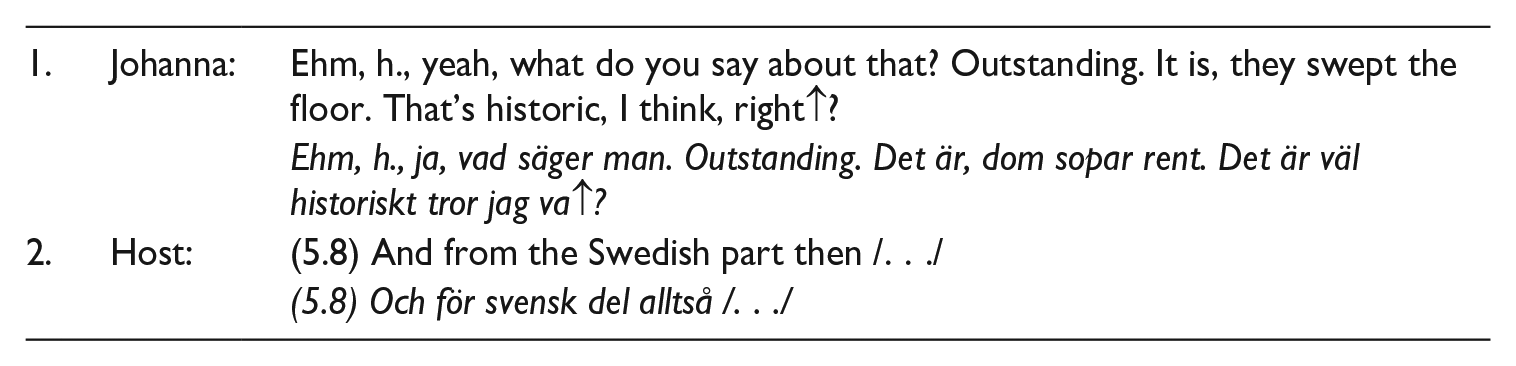
Johanna comments with a sigh that it is outstanding and continues: It is, they swept the floor. That’s historic, I think, right? (line 1). The humorous discourse is actualised with her smiling tone. The construction with I think can be used as a marker for irony or making an understatement (see Burgers and van Mulken, 2017: 387–389). Almost everything about Marit Bjørgen can be interpreted as historic since she is one of the most successful cross-country skiers ever. Sports broadcasts on TV often focus on historic moments from different angles, which can sometimes be seen as comical when it is too extensive. I argue that Johanna is referring to this with comical intent implying that this is another historic moment that needs to be stressed. Her utterance is also formulated as a question, with a rising pitch. Neither the question nor the joke elicits any response. Instead, there is a 5.8 second pause (line 2), which is remarkably long for conversations. After that, the host continues to the next topic, which may indicate that he has not been focused on what she says. Since there is no response, Johanna’s utterance is not negotiated as humorous. Instead, the joke is rejected.
Continuer
Continuers in conversation can be a way of making the speaker feel confident about continuing to speak. However, it is not an adequate response to render a joke humorous.
The host talks about the Norwegian team, and the fact that even if they have had a great championship, the Norwegian men have not won any individual gold medals. This is seen as a setback for them. In example (2) the female pundit responds with a humorous anecdote about how long ago it was that Norway had a result as bad as this, by relating to the moon landing. The female pundit receives a response, but not in a humorous discourse since she only gets continuers.
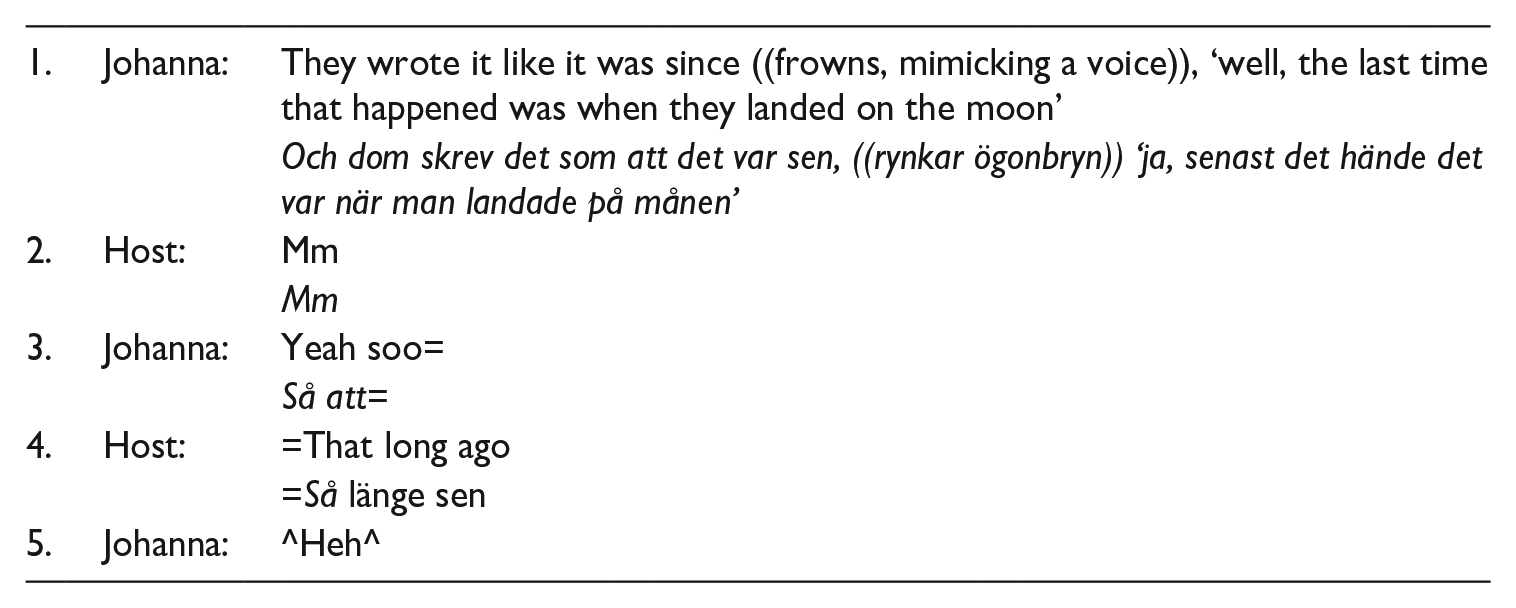
In Johanna’s anecdote, she uses facial expressions to frame her utterance as humorous. She frowns when delivering her punchline and says with a mimicking voice, using a pitch that also signals mirth: Well, the last time that happened was when they landed on the moon (line 1). The reference to the moon landing, which indicates something that happened a very long time ago, creates a contrast or surprise which frames the utterance as humorous. The host’s response to her is a continuer (line 2). Johanna then makes an increment: Yeah soo (line 3), which can be a strategy for giving the host or someone else the opportunity to provide a new, more suitable response to her joke. In Swedish yeah soo (så att) may also be used ironically in a way that suggests that there are still things unsaid for the listener to understand implicitly. Instead of acknowledging the humorous discourse, the host concludes in a serious tone: That long ago (line 4). Johanna laughs (line 5), which could be an invitation for others to laugh or a strategy for her to handle the discomfort of no one else laughing at her joke. Her joke is not negotiated as humorous when the host gives an inadequate response in the humorous discourse. The reasons may be that the joke is not understood or not appreciated.
In another example (3) they are talking about Norwegian Marit Bjørgen who has broken her pole. During the race a person from her team, Hjelmeset, tries to give her a new pole, when a person from the Swedish team, Urban Nilsson, gets in his way at the side of the skiing course. In the studio they discuss how they have seen the team members Hjelmeset and Nilsson fight with the poles during the race.
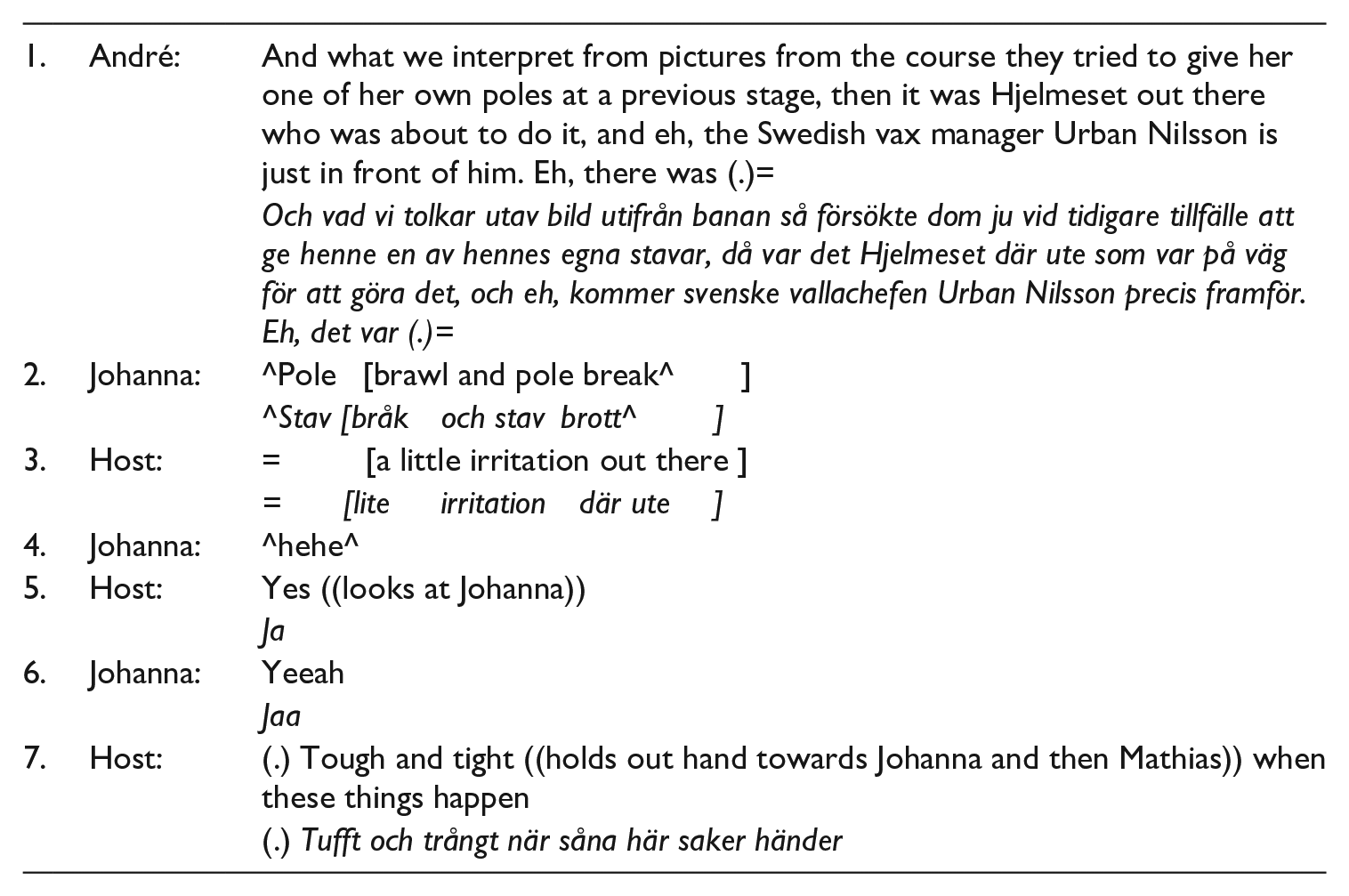
After the host has concluded what they have seen from the racecourse between two men from the Norwegian and the Swedish team, Johanna responds with a wordplay: pole brawl and pole break (line 2). She delivers the wordplay with a laugh and continues to laugh. In Swedish stavbråk och stavbrott has a rhyme to it, which gives it a punning intent. Her turn overlaps with the host’s. The host gives her a continuer yes and looks at Johanna (line 5). Johanna replies: yeaah (line 6). Afterwards, there is a short paus that may indicate that it is unclear who will take the next turn. Without any laughter the host then moves on, with a small alliterating wordplay of his own: Tough and tight when these things happen (line 7). He holds out his hand towards the pundits, first Johanna and then Mathias who takes the turn after this sequence.
Although, the host seems inspired by Johanna’s wordplay, he does not give her any affirmative response for hers, by laughing. Johanna’s humour is not negotiated successfully. It is possible that her joke comes unexpected in this sequence, since it overlaps with the host’s turn and is followed by a pause.
Continuer with a sighing laugh
There is also humour that is ambiguously negotiated. In example (4) they are discussing the women’s upcoming relay. The Norwegian team are always favourites for a victory since they have many strong skiers. The host says that the Norwegian skier Marit Bjørgen will meet the Swedish skier Stina Nilsson on the last leg. Johanna makes a joke about how strong Bjørgen is, which is met with a continuer and a short laugh.
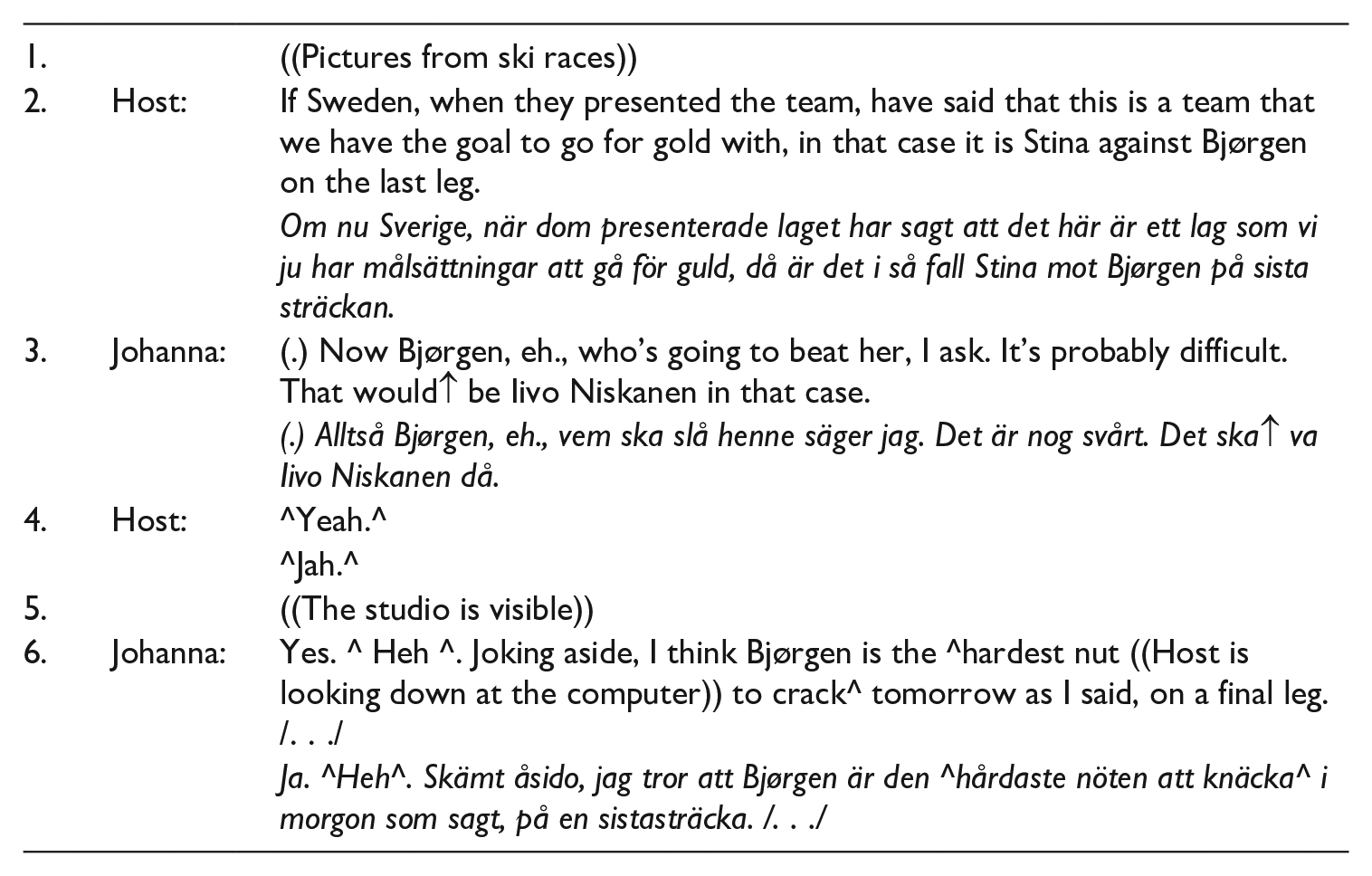
Johanna acknowledges the host’s statement by posing a sort of rhetorical question that she answers herself: Now Bjørgen, eh, who’s going to beat her, I ask. It’s probably difficult. That would be Iivo Niskanen in that case (line 3). Finnish Iivo Niskanen is one of the best male skiers in the championship. Since men and women do not compete against each other, her suggestion is a surprise, also implying how strong Bjørgen is. Moreover, the rising pitch in the middle of her utterance signals mirth, framing the utterance as humour. The host says yeah with a laugh, which is more like a sigh (line 4). This indicates that the host understands Johanna’s joking intent, even if it receives no more response. Instead, Johanna summarises with a yes, laughs shortly herself, and continues joking aside (line 6). Even if her joke is acknowledged by the host, it is not a big acknowledgement. Johanna’s utterance joking aside states that it was a joke, maybe because she is unsure that it has been registered. It is also a way of moving forward in the conversation, maybe as a strategy to avoid losing face. She also laughs herself, which may be a strategy to avoid the silence from the others. When the camera view returns to the studio (line 5), the host is looking down at his computer when Johanna continues, which may indicate that he has not been entirely focused on what she says.
Johanna receives a short laugh in this sequence, even if it is a close case to a continuer since it is more of a sigh during speech. The response indicates that the joke is understood as a joke. Johanna’s position in the humorous discourse is ambiguous since her joke is just acknowledged. Her strategy is also to return to the sports discourse in what will follow.
Laughter occurs
To compare the humour the female pundit uses in the examples (1–4), an example of the male pundits’ use of similar kind of humour will be presented. In this example (5) the host and the male pundit Mathias discuss the Swedish skier Charlotte Kalla and the medals she has won in her carrier so far. They present a list of all her medals in a TV graphic and conclude that if she wins more, they will have to diminish the text to fit them all on the screen.
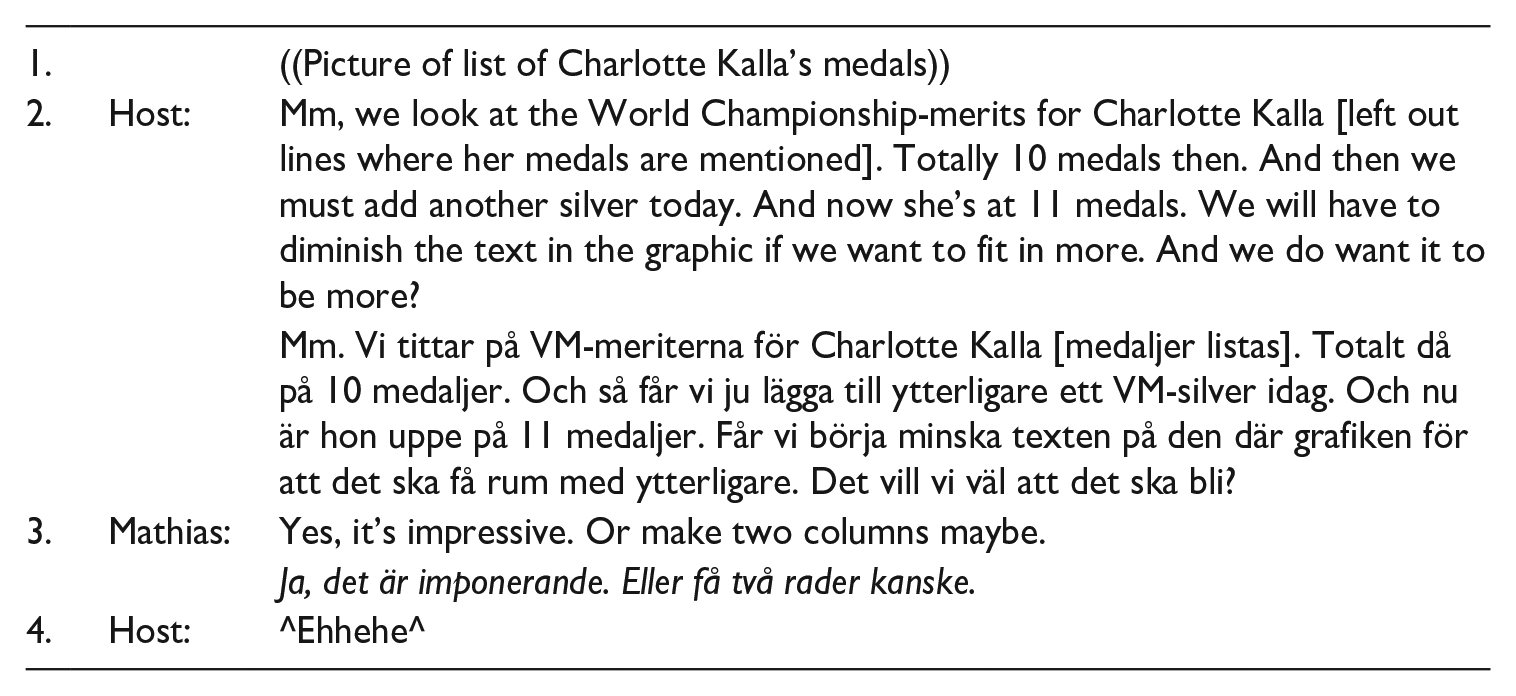
Mathias responds to Kalla’s many medals by saying: Yes, it’s impressive. Then he comes up with another solution to how they could fit more medals on the screen: or make two columns maybe (line 3). The host laughs at this suggestion (line 4), which makes Mathias suggestion negotiated as humorous. It is possible that the humour occurs based on that two columns would increase the space a lot, which indicates a hope for a lot of more medals. The host and the pundit are not visible in picture during this sequence of interaction, so it is impossible to know what else is going on with gestures for instance. The humour is successful due to the host’s response and Mathias ends up in a powerful position in the humorous discourse.
The humour Mathias uses is, like Johanna’s, conversational humour: something we do to light up the spirit, bond and socialise with each other. It is not an obvious joke since it is not verbally cued as humour, maybe it would not even be perceived as a joke if the host had not laughed. Mathias humour attempts never fail in this data since someone always laughs. It makes it possible for him to negotiate for a powerful position where he can seem humorous.
Internal and external control mechanisms in discourse
Discursively the examples can be connected to internal and external control mechanisms (Foucault, 1981) and some of these control mechanisms will now be discussed in relation to the discourses of humour and sports. First, I will analyse the external control mechanisms, starting with some points of the forbidden speech. It is possible to see structures in taking the speech floor in the humorous discourse, which is only activated when they use humour. The male pundit can negotiate for a privileged position as humorous because others joke with him and laugh at his jokes when he has the speech floor (analysed in Söderlund, 2020). The female pundit cannot always negotiate for a privileged position as humorous since she is not joked with to the same extent, and the style of the conversation can be interpreted as high considerateness style (Söderlund, 2020). The analysis presented in this paper is of jokes that fail or are ambiguously negotiated for the female pundit. Even if she can take the speech floor, the responses do not acknowledge her as a joker, as humorous, which means she has restricted admittance to a privileged position on the speech floor in the humorous discourse. Thus, her jokes can be seen as forbidden speech. Since her humour is rejected whereas the male pundit’s is not, there is a division between them, in how they are treated in the humorous discourse.
The first internal control mechanism is commentary. A transferred meaning of comments here could be laughter, as an implicit comment on that something is perceived as humorous. Laughter can reinforce what and who is seen as humorous. Hence, the repeated absence of laughter are comments that something or someone is not seen as humorous, which reinforces a non-humorous persona. A selection of material is used for the analysis presented here, but the material is in many ways representative for how the interaction unfolds, which means it is possible that the interaction has been similar for years. During the cross-country world cup season the programme has been running on Swedish public service TV for many years, with a similar setup. It has a large audience, which means it reaches many spectators. Furthermore, public service TV can be connected to the internal control mechanism organisation of disciplines. Public service TV in Sweden is a big actor in TV broadcasting. How they organise the discourses of sports and humour may affect other discourses. The rejections of the female pundit’ jokes are like repeated comments represented by unlaughter, and they affect her ability to negotiate a humorous persona. These repeated comments may also have repercussions on the view of her as knowledgeable in the sports discourse since receiving no response at all, or just continuers, can undermine what she is saying.
Discursively, gender (and other) identities are under constant negotiation. The pundits negotiate simultaneously for gender and powerful positions, both as humorous and as knowledgeable. In the sports discourse representations of women have historically been limited (Pfister, 2010). Even if women are a part of sports discourses, one can argue that simply adding women to a context does not account for equal opportunities. As Banet-Weiser et al. (2020): 20) puts it: ‘their mere presence doesn’t necessarily challenge the structure that supports, and builds, the table in the first place’. The only woman in this material is undermined in the humorous discourse, and in the friendly banter in the studio she is sometimes excluded from the group when she cannot seem humorous and is not joked with (see i.e. Frosh et al., 2002: 232). It is also possible that the interaction activates the rhetorical trope of the woman lacking a sense of humour (see i.e. Frosh et al., 2002; Hitchens, 2007: 103). Moreover, since this TV show attracts a large audience, this dynamic may also influence notions on gender in other humour and sports discourses in the long run. It can be related to the external control mechanism will to truth (Foucault, 1981) when certain views, dynamics and asymmetries in discourses recur.
Discussion
Power is negotiated in all conversations (Baxter, 2003), and in humour successful jokes can give the joke teller a powerful position (Hay, 2000: 716). On the contrary, someone who is rejected when trying to joke ends up in a powerless position, seeming non-humorous (Kotthoff, 2006: 8). In this article the aim was to find out how power is exercised discursively in humour that fails. In the examples given here the female skiing pundit’s humour is rejected, the rejections comprise both pauses and continuers. The female pundit is recurrently rejected, whereas the male pundit is never unequivocally rejected. Finally, I will discuss how these discursive practices may have implications for how notions of gender are negotiated in both the humorous and the sports discourses.
The reasons the female pundit’s jokes are rejected may be that the host is not focused on what she says (example 1), that he does not understand or appreciate the joke (example 2) or that the joke comes unexpected in the conversation (example 3). On one occasion he seems to understand the joke but does not acknowledge it more than minimally (example 4). All the humour deals with aspects of cross-country skiing and is not apparently socially inappropriate. The female pundit uses for instance wordplay and anecdotes, and she also cues her humour with tonality and laughter, which means it is possible to detect the humorous intent. On the contrary, the male pundit’s humour is not cued as humour, but still interpreted as such (example 5). Bell (2015: 147) claims that ‘at a local level, humor is used in the service of both maintaining and disrupting power relations, depending on the social circumstances’. In this context the rejections create a power asymmetry, and it is possible that the failed humour is a way of controlling the discourse, of who can be interpreted as humorous. The reason for these asymmetries is impossible to know, it may be related to for instance personal relations, the interlocutor’s mood or how they interpret the situation. Bell (2015: 157) also raises the possibility that jokes fail more often in groups with less fixed relationships, than either among close friends or strangers, since they joke in a context where social norms are under constant negotiation.
Using humour in a TV studio may serve the function of creating a good ambience. Nevertheless, to create a humorous ambience, other individuals also need to laugh when jokes are told (Trouvain and Truong, 2017: 342). Otherwise, the ambience they mediate is rather awkward, which is probably not a goal for the programme. However, as the female skiing pundit is rejected when she tries to joke, the mood becomes awkward, due to the other interlocutors. The humour is used as social small talk that also serves as interactional relationship building, a way of creating solidarity (see Norrick, 1989: 120). Hence, joking may help to create a sense of belonging to a group, in this case a group of colleagues commenting and analysing cross-country skiing. Consequently, the female pundit is somewhat excluded from the group when her jokes are rejected (see Bell, 2017: 365). It may also be challenging for her to keep on trying to tell jokes, fail, and still feel the urge to try again, considering the fear that people experience when other people do not laugh (Kotthoff, 2006: 8).
FPDA stresses that no individual is powerful or powerless since power positions are under constant negotiation. And the female pundit’s jokes are not always rejected. At the same time, asymmetries and repeated practices may say something about how the discourses of sports and humour are organised and about who is able to achieve a powerful position in the sports and the humorous discourse. Between the year 2013 and 2020 these two pundits were often the cross-country skiing pundits on public service TV, and the setup was similar, which makes it possible that the conversations have had these asymmetries for a long time. The asymmetries may not be connected to gender for the participants in the interaction on a local level. However, these discursive practices and asymmetries of power relations can be connected to other discourses and to notions of gender. The patterns of rejected women are also repeated in other kinds of panel discussions (Gomard, 2001: 89–91; Kotthoff, 1997: 140) and in Swedish humour shows on TV (Söderlund, 2016). Moreover, the sports discourse has been limited in different ways for women historically (Pfister, 2010).
Rejections may be subtle in the interaction when they happen, but its recurrence creates patterns of how people are treated differently, also in relation to gender (Mills, 2002: 71). Failing to laugh when a pundit in a TV studio makes a joke can be seen as rhetorical (see Billig, 2005: 192) and non-cooperative. The discursive practices say something about how the discourses of humour and sports are organised, which may affect notions of gender. What we do in conversations, especially mediated ones, matters for the discursive production of identities. Gender equality is an important mission for Swedish public service TV (Jönsson, 2018). How female journalists and pundits are treated in the sports discourse can say something about what we expect and from whom, including in relation to gender identities.
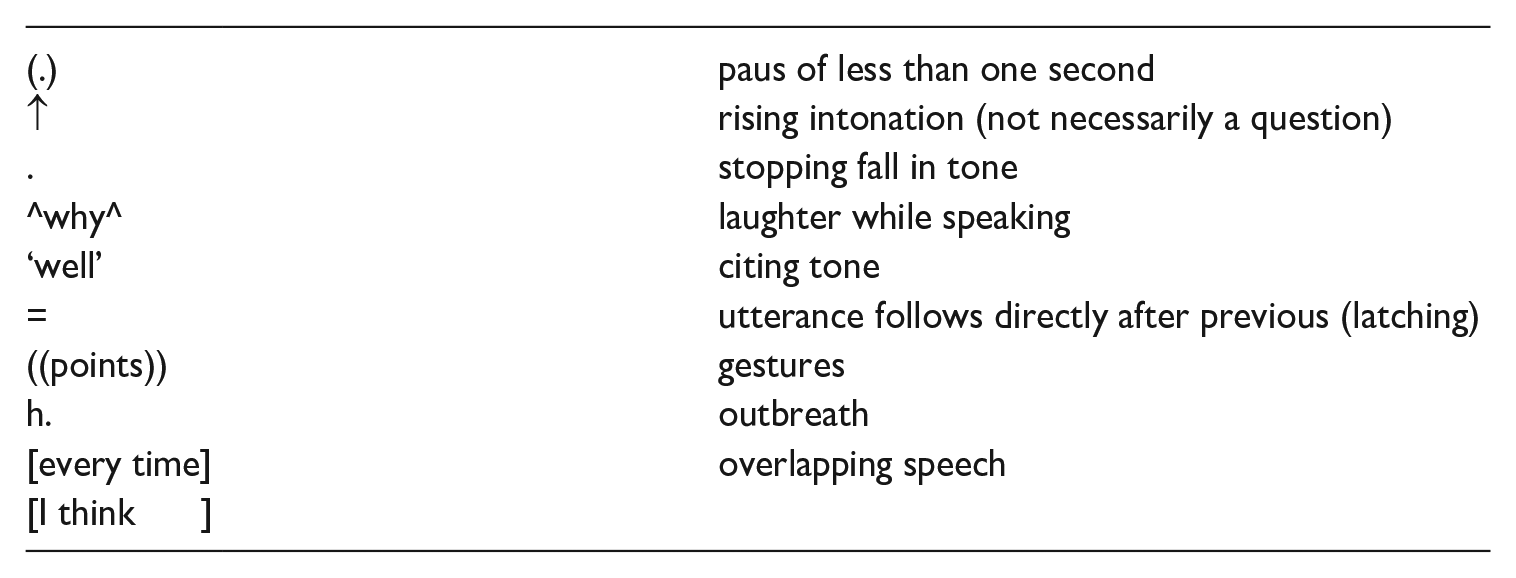
Transcription conventions
Footnotes
Declaration of conflicting interests
The author declared no potential conflicts of interest with respect to the research, authorship, and/or publication of this article.
Funding
The author disclosed receipt of the following financial support for the research, authorship, and/or publication of this article: This work was supported by The Swedish Research Council for Sport Science (grant number D2017-0006).