




Abstract
The lifting of work restrictions for Romanian and Bulgarian citizens in the EU, in January 2014, encountered much resistance both in European political discourse and the media, as these migrants became demonised and presented as social and economic threats. In this article, we show how the Romanian press dealt with such discriminatory discourses against the Romanian migrants. We conduct a thorough Multimodal Critical Discourse Analysis (MCDA) of news items published in Romanian press, prior to the lifting of work restrictions, and we argue that the Roma emerged as the perfect scapegoats that could explain the deviant and unruly behaviours ascribed by some western media to ‘Romanians’. We also show how racism toward the Roma, referred here as Romaphobia, invokes non-racial practices and instead builds on a reverse victimhood narrative. Such discourses relate in a broader sense to well-established discursive practices in Romanian context but also to the political climate across Europe which is marked by increased intolerance toward the Roma. It is the mixture of stereotypical discourses and populist rhetoric that makes racism towards the Roma appear naturalised and increasingly more difficult to challenge.
Keywords
Introduction
Romania’s accession to the European Union was both a time for celebration and turmoil. The idea of an open and inclusive European job market resonated well with the wishes of so many Romanians who sought better opportunities outside Romania. Yet, the reality was different as these migrants were not necessarily welcome, as some countries imposed work restrictions for Romanian and Bulgarian citizens, which limited their chances to the job market. This is also a time when discriminatory discourses against economic migrants from the East, seemed to have escalated (Delanty et al., 2011; McMahon, 2015; Uccellini, 2010). These migrants were no longer regarded as the heroes who set themselves free from the bondage of communism, but as competitors for the existing socio-economic resources (Van Dijk and Wodak, 2000; Van Leeuwen and Wodak, 1999).
Unlike previous countries that joined the European Union, Romania and Bulgaria did not benefit from full European membership, as some EU countries (the UK, Germany, France, Austria, Belgium, Spain, the Netherlands, Malta and Luxembourg) restricted the access of Romanians and Bulgarians to their job markets. These restrictions were only lifted in January 2014 and prior to this date there were intense political campaigns in many countries (the UK, Germany, France and the Netherlands) against Eastern European migrant workers. In the United Kingdom alone, as of 2013, the UK Independence Party (UKIP) had 23,159 appearances in various media to campaign against Romanian migrants (Popescu, 2013). During this time, the Romanian migrants in particular were demonised in European media, as their public image was collectively associated with poverty, begging, social disruption and criminality of all sorts (Comaneci, 2011; Fielder and Catalano, 2017; McMahon, 2015; Vicol and Allen, 2014). The documentary series, The Romanians are coming, aired by the British Channel 4, sparked a lot of controversy and outraged the Romanian communities both in the UK and Romania (Awford, 2015; Boffey, 2015). The series claimed to give insights into the experiences of Romanian migrants who started their new life in Britain. Yet, it acquainted the public with a problematic community, similar to the UKIP’s depictions, or as Romanian media argue, it provided an image that was conflated with that of the Roma (Stanca, 2015). This resulted in a series of counter-campaigns initiated by various Romanian media (Cheregi, 2018), such as ‘Why don’t you come over?’ or ‘Let’s change the story! in the attempt to respond to such negative representation of Romanian migrants. The problematic aspect with these campaigns was that the enhancement of the Romanians’ positive self-representation was done by imputing all the negative traits to the Roma migrants. In this paper, using Multimodal Critical Discourse Aanalysis (MCDA) (Machin and Mayr, 2012), we carry out a detailed examination of news reports published in the two most influential newspapers, Adevarul (The Truth) and Jurnalul National (The National Journal). The aim is to show how these media outlets operated as part of these campaigns in 2013. The analysis points out that this type of reporting builds on Romaphobic discourses (McGarry, 2017), by ascribing all societal ills, especially the negative image of the Romanian migrants in the European Union, to the Roma.
Racism and Romanian ethno-nationalism
It has been increasingly acknowledged that the manner in which race and ethnicity are perceived by audiences is to a large extent based on narratives, images and other symbols reproduced on various media platforms (Brooks and Hébert, 2006; Ferguson, 1998). Scholars have argued that the news media in particular is one of the institutionalised venues where representations of race and ethnicity can be found on a daily basis in ways that can become naturalised, taken-for-granted and neutral (Husband and Downing, 2006; Van Dijk, 1991, 1993). Ideas about race inferiority or superiority have persisted for centuries, yet the arguments to support these beliefs have changed over time depending on the social, cultural, political and economic context (Bennett et al., 2009; Entman and Rojecki, 2001; Husband and Downing, 2006; Krzyzanowski and Wodak, 2008; Van Dijk, 2005). Racism toward the Roma, also known as ‘antigypsyism’ (Hancock, 1997), ‘antiziganism’ (End, 2017), anti-Roma (Vidra and Fox, 2014) or ‘Romaphobia’ (McGarry, 2017) has a long history in Eastern Europe in general, and Romania in particular. In Romanian context, Roma’s inferior status is evident if one follows their history during the slavery on Romanian territories (Achim, 2004), the extermination by the Nazis during the WWII (Kelso, 2013), their oppression during the communism (Ladányi and Szelényi, 2006), and the ongoing violence the Roma experience in contemporary Europe (Matache et al., 2020; Rorke, 2018). While some scholars have rightly linked the current treatment of the Roma with the rise of populism and radical right in many countries in Europe, it is important to emphasise that Romaphobia in Romania is deeply rooted in Romanian ethnic nationalism which dominated the Romanian public discourse of the 1920s onward (Turda, 2015). As Turda mentions, ideas about preserving and survival of a pure Romanian race were widespread in the academic circles in the beginning of the 20th century, and became a political reality in 1940 during the fascist dictatorship of Antonescu, when the Roma along with the Jews found their end in death squads or Nazi concentration camps (Lee, 2019). The current treatment of the Roma must be understood both in relation to the political context and the deep-rooted attitudes and well-established discursive patterns that shaped Romanian public discourse starting with the 20th century (Tileagă, 2006, 2015). The fall of communism was followed by a rebirth of ethno nationalism, when racism and intolerance toward the Roma became rampant (Vamanu and Vamanu, 2013). While this was indeed supported by the sweeping socio-political context and the surge in ultra-nationalism, Romaphobia in Romanian context need to be understood in the contexts of a well-established discursive practices of moral exclusion (Tileagă, 2006). It is this specific context which makes racism and prejudice against the Roma appear commonsensical and hard to challenge.
It has been acknowledged that this manifestation of racism departs from biology, as the primordial marker of difference between groups and brings into focus a more cultural and nationalistic dimension; this is what scholars have defined as ‘new racism’ (Ansell, 2016; Barker, 1981; Dieckmann et al., 1997; Van Dijk, 2000). An important strategy used in such accounts is the open scapegoating of Roma – who are often represented as undeserving recipients of economic, political and cultural favours, while the non-Roma appeared to be unprivileged and suffer injustices because of the Roma. Ideas about white injury, or white victimhood is less documented when it comes to the construction of the Roma in public discourses, it has been widely discussed in relation to other contexts. Modern-day racism has become more subtle and is constructed through less explicit racial codes which often rely on colour blind ideologies (Bonilla-Silva, 2006) or draw on the white injury rhetoric (Cacho, 2000). Such expressions of racism belittle the importance of race when accounting for existing social inequalities, while at the same time portray the whites as victims of racialised groups (Bloch et al., 2020; Rodriguez, 2018). According to Bloch et al. (2020) these are contemporary expressions of the new racism and new nativism and they rely on reversing the victim/villain dichotomy. The reverse racism has been less documented when it comes to Romaphobia.
The Roma in the media
Research on the representation of the Roma in newspapers across Europe presents consistent findings that the Roma are portrayed as a homogenous group which shares common attributes related to criminality, cultural backwardness, insularity and refusal to live by the norms and values of European societies (Catalano and Fielder, 2018; Creţu, 2014; Richardson, 2014; Tremlett et al., 2017; Vidra and Fox, 2014). There is little media coverage about successful Roma citizens or about Roma experiences with social exclusion, marginalisation and the continuous discrimination they still face in many parts of the world (Fekete, 2014; Korando, 2012). In this sense, it has been argued that the media have not helped with the task of integrating the Roma and rather contributed to spreading Romaphobia (McGarry, 2017; Messing, 2014; Tremlett et al., 2017; Waringo, 2006).
Scholars have also discussed that in European public discourse there is a tendency to conflate the Roma and Romanian migrants – perceived to be a homogenous group defined by collective negative attributes (Aldea, 2012; Anstead, 2010; Catalano and Fielder, 2018; McMahon, 2015; Uccellini, 2010). The association of the Romanians with the Roma drew a lot of discontent among Romanians, especially since the Roma were believed to be responsible for the negative image of Romanian migrants in the EU (Aldea, 2012; Comăneci, 2011; Woodcock, 2007).
In our corpus, and in the detailed analysis we present here, such findings are confirmed. But we also find something else which relates to the broader increase in right-wing populist ideology in many countries around the world, including Europe (Fielder and Catalano, 2017; Rydgren, 2017; Wodak and Krzyżanowski, 2017). Scholars have shown that right-wing populist rhetoric has shifted away from articulated ideas about race and ethnicity to rather symbolic politics mirrored by simple and direct narratives, emphasis on buzzwords and exaggerated division between ‘our people’ and ‘others’ (Greven, 2016; Wodak, 2017). More importantly, right-wing populist discourses are discourses of fear of losing jobs, declining economic prosperity, instability, fears of immigration and of the loss of national autonomy and traditions (Wodak, 2019). Corbu et al. (2016) show that in Romanian context, populist ideology, whether right or left, share the same characteristics. These characteristics invoke the focus on the nation (the Romanian people), an anti-elite discourse against corrupt politicians and the media who appear to be non-transparent and overlook the interest of the Romanians, and the division of the society into ‘us’ and ‘them’. It is in this context that we place this specific media analysis, a context where ethnic minorities, such as the Roma become easy scapegoats for all societal frustrations, especially for the injustices suffered by Romanian migrants in the EU.
Method and data
In this paper we use Multimodal Critical Discourse Analysis (MCDA) (Machin and Mayr, 2012), a well-established research tradition under Critical Discourse Studies (Flowerdew and Richardson, 2017) which involves a close critical examination of language and other forms of communication such as news photography, films, tables, graphs, etc, to reveal hidden ideologies that serve certain interests and overlook others (Ledin and Machin, 2018). The analysis draws on the social actor and social action analysis of Van Leeuwen (2008) as applied by Machin and Mayr (2012). Discourse is here defined as recontextualisations of social practice (van Leeuwen and Wodak, 1999). This is a way to theorise the processes in which particular social practices are realised in discourse in instances of communication (van Leeuwen, 2008); it is a way to reflect upon the choices made by the communicator. In accordance with van Leeuwen (ibid) we ask: What parts of the discursive script are deleted, added, substituted, abstracted, re-sequenced? And what kinds of political agendas do these recontextualisations serve, legitimise and naturalise? This allows us to show what kind of discourses or scripts are used in the Romanian press to represent the Roma migrants. MCDA is instrumental in the cases we present in this paper, as it helps us show what are the main discourses in relation to the Roma in Romanian press at this particular time. It also helps us to draw out those specific motivations that lie behind different ways of representation.
The study is based on a broader corpus of 122 news items from the two most read newspapers, Adevarul (The Truth) and Jurnalul National (The National Journal), both available in print and online, and which reported on the Roma migrants in the EU in 2013. The data was collected from the newspapers’ online portal through the available search engines, using keywords such as ‘Roma’, ‘Gypsies’, ‘Romanian migrants’ (25 news item in Adevarul and 97 in Jurnalul National). Both newspapers are privately owned by influential, wealthy Romanians who are/were very active in the Romanian political scene. This bigger corpus was imported into NVivo (a qualitative computer software tool for organising, classifying, sorting and arranging data) and a thematic content analysis was conducted in order to map out the key events and topics covered by these news items. This coding informed us that most of the coverage of Roma in Romanian media is related to four key events: Romania’s application for Schengen membership; the ban on begging in Scandinavia; the camp evictions and deportations of Roma migrants from France; the UK lifting of work restrictions for Romanian migrants. In this paper, we decided to focus on the latter. This smaller sample includes 34 news items and was analysed in detail by the use of MCDA. The selection of 2013 is significant as it helps us capture those reactions in Romanian media prior to the lifting of the work restrictions for Romanian migrants which was scheduled for 1 January 2014. As we mentioned in the introduction section this is a time where intense campaigns against Romanian and Bulgarian migrants were ongoing across Europe. Yet at the same time, Romanian media tried to distance the Romanians from the Roma, even launching campaigns where they asked the citizens to request the legal replacement of the term Roma with its pejorative, tigan (Mădroane, 2012).
In order to demonstrate what characterised the reporting in the two newspapers in 2013 we carry out a detailed analysis of two particular news item. These items involve what we found to be prominent features of the reporting in these two newspapers and demonstrate the most important discourses present in the articles dealing with the lifting of work restrictions in UK. The first case of analysis is a news report published by Jurnalul National on 18 July 2013 with the headline, ‘DISTURBING images featuring Romanian and Bulgarian thieves who rob the passers-by in Paris. The second case of analysis is an article also published by Jurnalul National on 9 March 2013. It has the headline Daily Mail, checkmate for Romania: The DEVASTATING report from Germany which shows that the British are right to fear the ‘Gypsy invasion’, and it covers Roma migrants living in the German city, Duisburg.
Analysis Case I
This article is presented as being sourced from the French publication Paris Match, which reported on Romanian and Bulgarian gangs of pickpockets who were said to operate in the Parisian tourist sites. The same material was published by the British Daily Mail (17 July 2013) to warn Britons about the lifting of work restrictions for Romanian and Bulgarian nationals which was scheduled for January 2014. In fact, the article published by Jurnalul National is a faithful translation of the report published by the Daily Mail.
The headline itself is attention grabbing and conveys a sense of urgency. It reads like ‘breaking news’, especially since the adjective ‘DISTURBING’ is capitalised and the main protagonists are described as ‘Romanian and Bulgarian thieves’ living in France.
In order to get a better understanding of how the news report works, in Table 1, we show the main social actors depicted in the article (in the left column) and their assigned actions (in the right column).
Summary of social actors and assigned actions (Article 1).
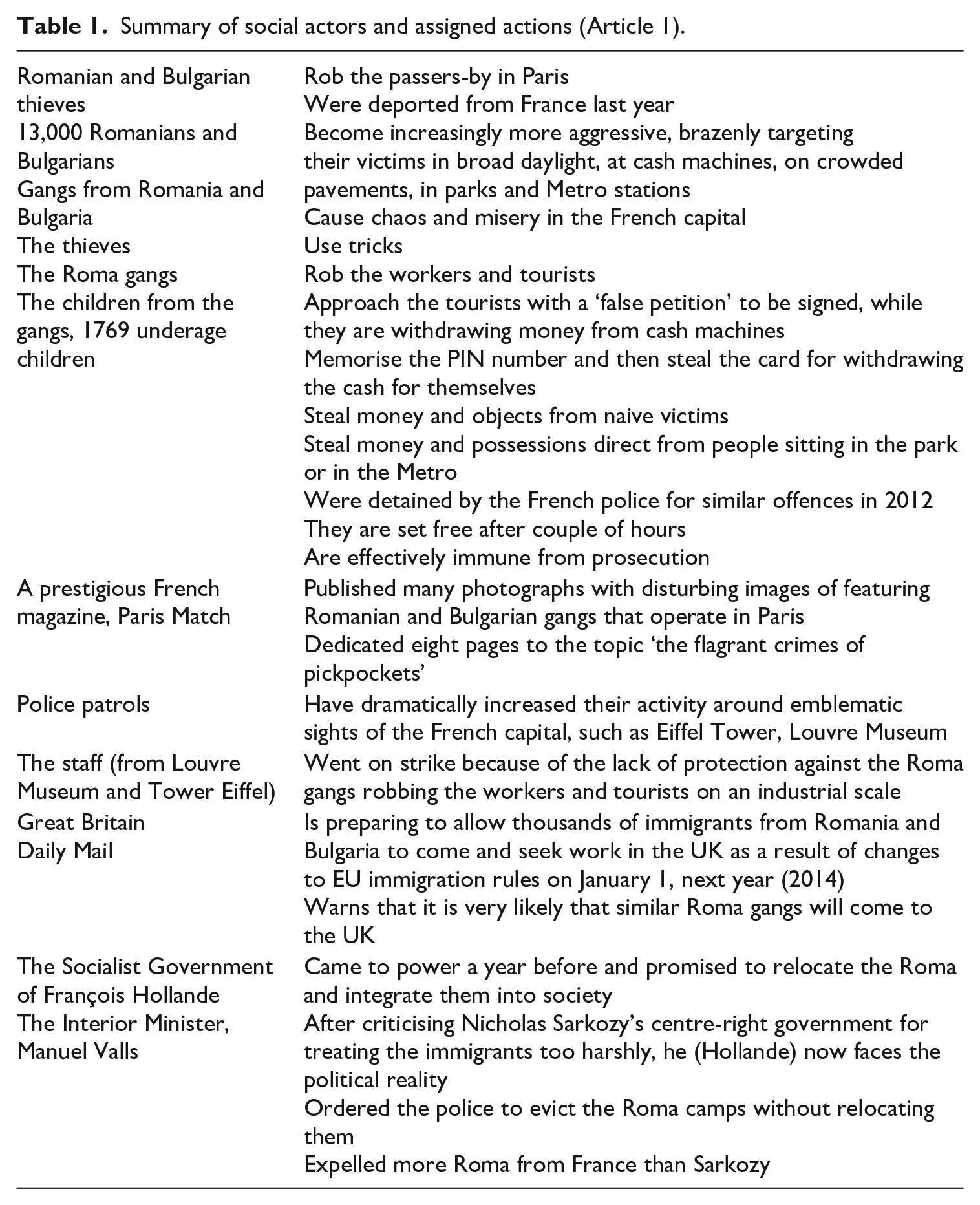
The lead of the article sets the tone of reporting: Extract 1: Many disturbing photographs showing gangs from Romania and Bulgaria who rob victims in Paris were published in the prestigious magazine, Paris Match, which devoted eight pages to them under the headline, ‘The Flagrant Crimes of Pickpockets’. The images show how the thieves became more and more aggressive, brazenly targeting their victims in broad daylight at cash machines, on crowded pavements, and in parks and Metro stations, causing chaos and misery in the French capital.
The main social actors are not introduced as Roma but substituted for ‘Romanian and Bulgarian thieves’, or ‘gangs from Romania and Bulgaria’. These lexical choices are not random as they direct to the unfair conflation of Roma and Romanians one regularly finds in European media (Fielder and Catalano, 2018). These labels definitively invite negative feelings since in Romanian context, similar social actions ‘rob[ing] victims’, [being] aggressive’, brazenly target[ing] victims in daylight, caus[ing] chaos and misery, are stereotypical depictions of Roma (Tileagă, 2006). Beyond creating anxiety these substitutions fuel a sense of Romanian injury [for the unfair ascriptions in European media] believed to be inflicted by Roma’s antisocial behaviour. As we shall see this sense of Romanian victimhood runs throughout the text, It is only in the visual footage that it becomes clear that the protagonists featured by Paris Match are in fact Roma. We come back to these images in the visual analysis.
There is no open resentment for the conflation of Roma and Romanian yet the text indirectly criticises Paris Match lengthy report for labelling the wrong doers as Romanian migrants, especially at a crucial time when Romania was in full process of applying for Schengen membership. While under French law, reporting or collecting data based on ethnicity, race or religion is prohibited, one may argue that, given France’s position as the main opposition to Romania and Bulgaria’s Schengen membership, the lexical choices (‘Romanian and Bulgarian thieves’, ‘gangs from Romania and Bulgaria’) used by the French magazine are not random. In addition, such textual references make the discrimination against the Roma invisible at a time when camp evictions and deportations of the Roma migrants from France to Romania and Bulgaria were systematically conducted across different French cities (Breazu, 2020).
In this article, the negative characteristics initially ascribed to Romanian migrants by Paris Match are simply redirected towards the Roma, as we will see in the next extract and this is recontextualised through discursive additions and evaluations as we show in Extract 2.
Extract 2: And as Britain prepares to allow thousands of immigrants from Romania and Bulgaria to seek work in the UK as a result of changes to EU immigration rules on January 1, next year, there is every chance of similar Roma gangs coming to the United Kingdom, warns Daily Mail according to Agerpres.
1
Extract 2 shifts the focus from Romanian and Bulgarian migrants to Roma. Van Leeuwen (2008) has emphasised the role of addition in the process of recontextualisation, and here these clarify that the protagonists who terrorised Paris are in fact Roma. Most importantly such discursive additions are accompanied by moral evaluations in regard to the good/bad European migrant (Kymlicka, 2016, Wodak, 2015). These evaluations are presented in high modality and intensify the moral panics (‘there is every chance of similar Roma gangs coming to the United Kingdom’). The visibility of Roma across various European countries are said to have larger political implications for Romania’s future as an EU member. The fear of Roma criminality is unreasonably extended beyond France, in this case to the UK, in reference to the lifting of work restrictions on Romanian migrants. The ‘changes to European immigration rules’ are evaluated as being lenient and favouring the Roma at the expense of Romanian who appear to suffer the negative consequences. Beyond their textual functions, these evaluations have cognitive implications, namely that Roma criminality is out of control, and, therefore, stricter regulations need to be applied to prevent their free movement in Europe.
The construction of the Roma as the bad, undesirable migrant is achieved through other kinds of additions, substitutions and repetitions. The lexical choices assigned to the Roma do not envisage a particular group but are assigned as collective markers of Roma identity.
Extract 3: In Paris, a favourite trick of the child gangs is to approach tourists with a fake ‘petition’ to sign while they are withdrawing money from cash machines. Distracted by the approach, the victims do not see the thieves noting their PIN number and then pickpocketing cash cards to withdraw money for themselves. Extract 4: ‘Do you speak English?’ Is another trick used on tourists as the gang members help themselves to money and possessions. Otherwise they just steal cash and valuables directly while people are sitting in the park or Metro.
In the above extracts we find additions crucial for constructing the Roma as the bad migrants (Van Leeuwen, 2008). In previous research on Roma in Romanian media, it was noted that children are not featured in stories about violent actions against the Roma, such as camp evictions or deportations (Breazu and Machin, 2018). Here children are portrayed as active agents in all sorts of criminal activities (‘approach tourists with fake petitions’, ‘memorise PIN numbers’, ‘pickpocket the cash cards’, ‘steal cash and valuables’). These references to Roma’s criminal nature are documented as if one were given a glimpse into these malpractices through the eyes of an insider. In a sense, these attributes cannot be labelled as openly racist, yet they invite anger and hatred, especially since in French media ascribe these to Romanians.
The anti-Roma sentiment is further amplified by adding new elements to this journalistic script. Not only are the Roma said to exploit children for crime, but they also appear to take advantage of the French laws, which apparently do not prosecute children for criminal acts.
Extract 5: Some will have been among those 1769 minors detained by the French police for committing similar crimes in 2012, but even if caught they are released within a few hours. ‘There’s very little we can do with them. As children they effectively have absolute immunity from prosecution’, admitted a Paris police source.
In extract 5 we are presented with a set of reactions from Parisian police officers who confirm that Roma children commit a lot of crime and they [police officers] feel unable to stop it. Getting insights into their internal feelings only amplifies the negative feelings about the Roma. As it emerges from extract 5, although unclear, the police officers’ statements are added to strengthen the idea of Roma criminality. While the authorities seem to be talking about underage criminality in Paris, here, it is somehow implied that the huge numbers of offenders (1769) might refer to Romani children. Statistics in media reporting carry some level of factuality, even though in our case the source is unclear and might be unreliable (Danso and McDonald, 2001). It is also noted that exploiting children for unlawful activities does not appear to be a naive choice for the Roma, since in France ‘children have absolute immunity from prosecution’. The inclusion of their reactions offers moral evaluation: stricter rules are needed to deal with Roma criminality. Again these are not obvious racist references, in a biological sense, yet they are expressions of the new racism (Ansell, 2016; Husband and Downing, 2006) as they invoke social and cultural incompatibilities (e.g. Roma’s violating the social norms, and their unlawful way of making a living). These ascriptions are assigned as collective markers of Roma community in Paris, ignoring that there are also good Roma citizens who do not engage in illicit activities. Such manner of representation only invites negative feelings, especially since it conveys that Roma criminality is uncontrollable, and authorities are unable to cope with that.
Extract 6: Police patrols have had to be dramatically increased around iconic monuments such as the Eiffel Tower and the Louvre museum, where earlier this year staff went on strike because of the lack of protection against organised Roma groups stealing on an industrial scale from workers and tourists.
There are two important issues that need to be considered here. First, Roma’s criminality is said to affect the workers and tourists (‘stealing on industrial scale from workers and tourists’). There is clearly a sense of injury inflicted by the Roma to honest citizens (workers, tourists, inhabitants, staff, neighbours) which further increases the polarisation between the good/bad, productive/unproductive citizens. Second their crimes are represented as outrageous since they are said to be committed in broad daylight, in the most iconic cultural locations such as the Louvre Museum and the Eiffel Tower. These additions are of course not random representational choices but they invite resentment and anger because of Roma’s altering the safety and cultural values of iconic Parisian venues. And such dissatisfactions are mirrored in the representations of the ordinary French citizens who are said ‘to feel abandoned’ and left with no choice but protest: ‘staff went on strike because of the lack of protection against organised Roma groups’. Such media accounts legitimise why Roma are so unwanted in Europe and this justification does not appear to be racially motivated but grounded in Roma’s alleged unconventional lifestyle and criminal nature (Tileagă, 2006, 2015).
This construction of the Roma as a social problem is further emphasised in the discourses of key political figures who are said to have started to understand the problems that the Roma pose for the French society.
Extract 7: But, having criticised the Centre-Right government of predecessor Nicolas Sarkozy for treating immigrants too harshly, Hollande is now facing up to political reality. Interior Minister Manuel Valls has ordered police to dismantle the Roma camps and shanty towns without rehousing them, and he has expelled more Roma from France than Sarkozy did. Last year, nearly 13,000 Romanians and Bulgarians were deported from France, an increase of 18.4% on the previous year.
There are two key political figures featured in the news report: Nicolas Sarkozy the centre-right French president who initiated the controversial camp evictions and deportations of Roma and the socialist Minister of Interior, Manuel Valls, who was first naively reluctant to such measures. What Extract 8 highlights is that even the left started to realise that force and coercive actions are the norm to deal with the Roma as they are said to have adopted even tougher, more aggressive measures (‘ordered police to dismantle the Roma camps and shanty towns without rehousing them’; ‘he [Manuel Valls] expelled more Roma from France than Sarkozy did’). These additions imply that irrespective of the governing system (right or left) the Roma are unwanted, and there is even a sense of celebration that other countries started to grasp of the big problem the Roma are. We remind the readers that France was one of the countries that harshly criticised Romania for discriminating against the Roma and for lack of inclusion policies.
We now look at the photographs that accompanied the news report, which are presented as a link as shown in Extract 2. The link takes the readers to a collection of photographs sourced from Paris Match. These images tend to include at least one participant who represents a generic Roma. For example in Figure 2 (below), we see a heavyset woman with long hair and a dark complexion, holding a brochure in front of a cash machine. Of course, we do not know that she is Roma, but media representations tend to use this type to portray the Roma. It is important to highlight that all the participants shown in these images (1-3) are women and children. This is something that needs emphasis since communication about the Roma is highly gendered. Discourses on criminality are not only in reference to men but also involve, women and girls. This in itself can communicate that even Roma who are minors or women are deeply criminal – not just the men – and also that the Roma have no moral scruples: they even deploy children and women to carry out street crime.
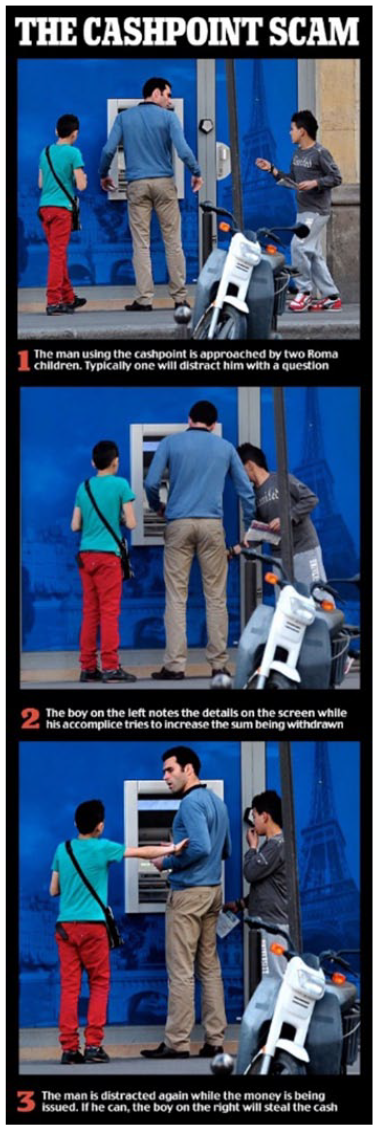
Duped: a Roma woman asks this man to sign a petition while an accomplice picks his pocket (circle).
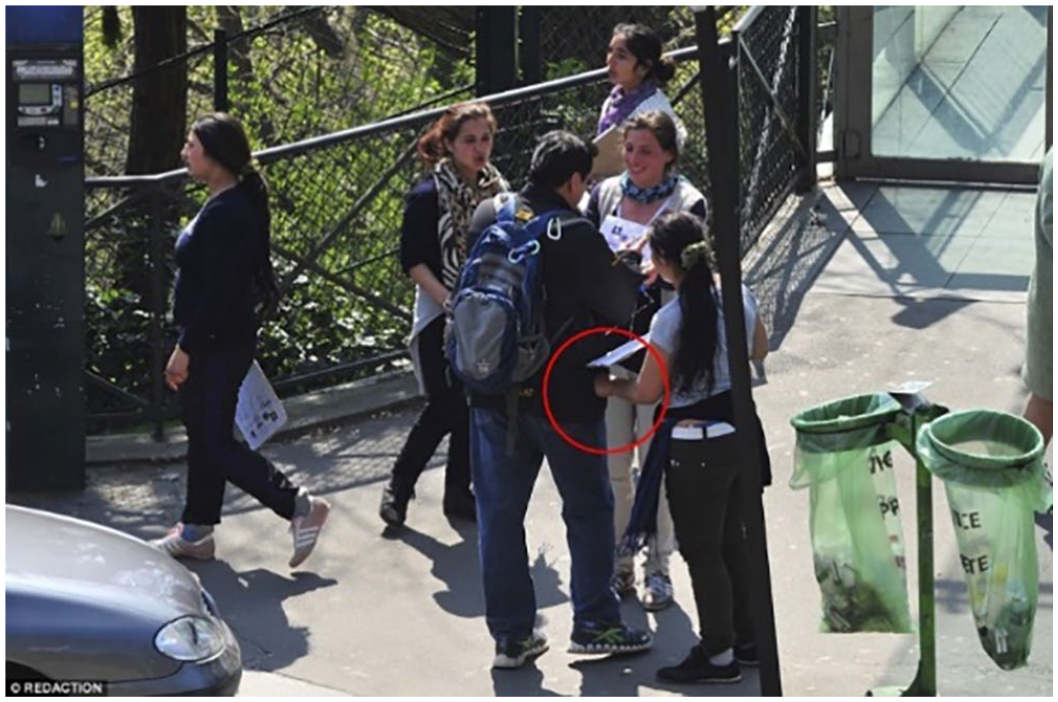
Look out: the woman using the ticket machine has not noticed the girl in the pink shirt who is memorising (circle) her PIN number and waits to steal her cash card.
We can also ask what social actions are indexed in these news photographs (Ledin and Machin, 2018). The photos claim to document a series of incidents of organised theft taking place in busy tourist settings. They are presented in a style which suggests they are a form of evidence, as if collected from careful surveillance work. The language used in the captions suggests that what is being shown is ongoing and has an established pattern (e.g. distracting the victims with a question). The use of red circles and the presentation of a numbered sequence in Figure 3 (below) present this as a form of technical modality. In other words, these techniques break down the events they report into their components and place extra emphasis on salient features for the viewer. These techniques connote a sense of expertise and, therefore, truth (Kress and Van Leeuwen, 2006). The use of the red circles also conveys a sense of dependency on the visual report: we need the eye of the expert to reveal the mischief going on because the act it is showing us is so cunning. So, we see the circle around the hand in Figure 1 to show the pocket being picked. We see the same technique applied to Figure 2: a circle directs our focus to a woman presumably in the act of memorising a PIN. Clearly there is little consistency as to what is being indicated by the red circles, but they create coherence across the images to suggest something of the same order, provided in technical modality and with expertise. The use of numbering in Figure 3 also suggests that the actions have been broken down into the three component parts of the scam. The captions describe what is taking place in high modality (e.g. ‘the boy on the left notes the details on the screen’), adding authority and expertise to the view of the world that we are seeing. The necessity for this technical expertise, of course, is one way that news outlets present themselves as information providers. But it also suggests that the act the image depicts is so organised, so professionally orchestrated, that it requires expert picking apart, such as the newspaper has done, to comprehend the event.
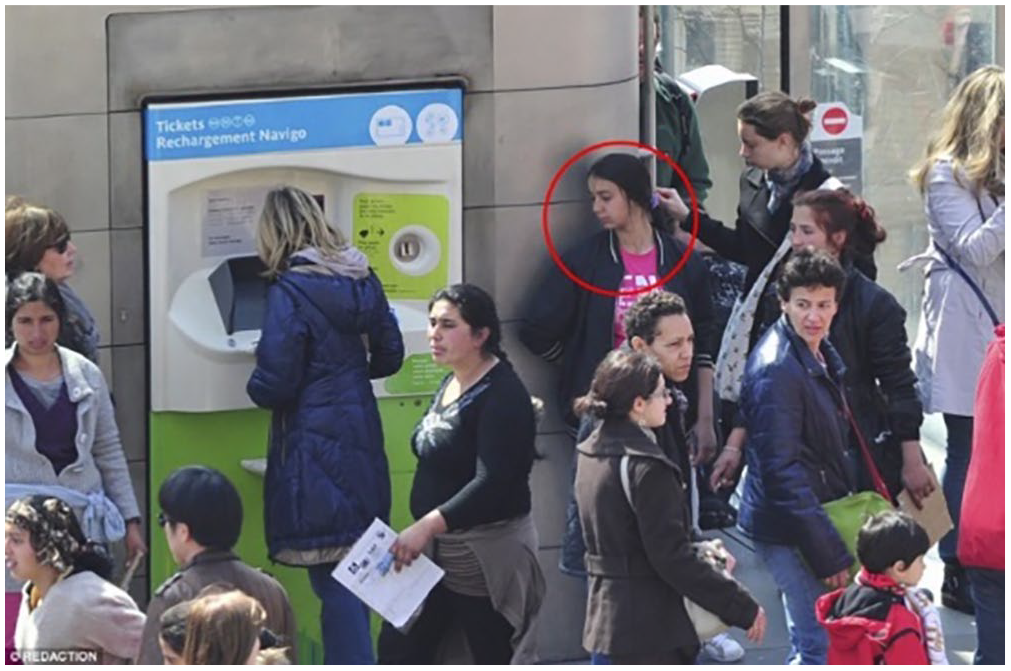
The cashpoint scam.
As regards the indexed actions, we also see behaviour which helps to offer evaluations of what is going on. In Figure 1, we see the girl smiling as she interacts with the victim. In Figure 2, we see her concentrating, although she also appears both highly suspicious and conspicuous. The boys in Figure 3 appear highly brazen, as if they are interfering with the man withdrawing money. The images document a series of scams which point to the wide extent of Roma’s misconduct and to the criminal expertise of the Roma in deceit, manipulation and theft. These reactions show how much the Roma are deeply oriented to these kinds of behaviour.
Analysis Case II
The second news article is also a reproduction of an item published by the Daily Mail, which warned against the policy of lifting the work restrictions for Romanian and Bulgarian migrants. The news article reports on the inconveniences created by Roma migrants in the German city of Duisburg, as another example where the Roma are unwanted because of their bad behaviour.
The headline is dramatic and creates a sense of emergency – another country confirms that the Roma will create problems for Romanian migrants who will seek work in the UK. The use of war metaphor ‘Gypsy invasion’ along with the bold capitalised ‘DEVASTATING report from Germany’ intensify these fears, which are said to be reasonable (‘the British are right to fear the Gypsy invasion’). The conceptual metaphors (Lakoff and Johnson, 2003) from military domain, such as ‘Gypsy invasion’ emphasise the tension and war-like imaginary between the Roma and the non-Roma. The functions of these conceptual metaphors should not be underestimated because as previous research shows (Gabrielatos and Baker, 2008; Lakoff and Johnson, 2003), these patterns of representation have deep ideological effects as they contribute to the exacerbation of Romaphobia.
As with the previous case, the lead of the report (Extract 8) sets the tone for the reporting: Extract 8 400 gypsies from Romania and Bulgaria moved into a tower block in the German city of Duisburg, terrorising their neighbours until they moved. The entire area became infamous, and the price of apartments dropped three times lower. Last week, Link Soeren, the social-democratic mayor of the city, said that Romanians and Bulgarians produce garbage dumps higher than themselves and send their children to steal. The declaration has circulated around the world.
It is first notable that the reader’s attention is directed to the alleged inconveniences created by ‘400 gypsies from Romania and Bulgaria’. We notice how racism is discursively constructed by diverting the attention from the poverty the Roma experience to the alleged inconveniences created by Romanian and Bulgarian migrants. In Extract 8 we see no reference to the marginalised socio-economic positions of the Roma in Europe, which are otherwise well documented in the reports from Europe Agency For Fundamental Rights (FRA, 2016, 2020). van Leeuwen and Wodak (1999) showed that substitutions are important ways through which new meanings are conveyed. So the fact that 80% of the European Roma live on the poverty lines, often in the poorest and most disadvantaged areas is absent from the discourse, and instead substituted with references to the social problems created by the ‘400 Gypsies from Romania and Bulgaria’. Such lexical choices, beyond erasing differences of age, gender, occupations or levels of social inclusion, imply that all 400 Roma migrants are defined by the same collective negative ascriptions. It is also notable that the phrase ‘gypsies from Romania and Bulgaria’ disassociate these 400 people from ordinary Romanians (or Bulgarians). Gypsies, or Roma, is here rather depicted as a group with no particular nationality and should not be conflated with Romanians (or Bulgarians).
As with the previous text, their wrong doings are said to affect the ordinary people, in this case the inhabitants of Duisburg (‘terrorise neighbours’, ‘produce garbage dumps higher than themselves’, ‘send their children to steal’). Roma’s wrong doings are said to have larger implications on the overall German economy (‘the property prices dropped three times’). Similarly with the previous text, it is also a sense, of a naïve, soft liberal left, which does not understand the real ‘problem’ the Roma are: and it becomes more alarming when the left-wing major of Duisburg appears to be ignorant as he attributes these wrong-doings to Romanian and Bulgarian citizens. In Extract 9 we see that the Roma are explicitly blamed for an eventual delay of the decision to lift the work restrictions.
Extract 9 …what is happening in Duisburg shows that the British are perfectly right to fear the Gypsy invasion. It is expected that the Prime Minister David Cameron will eventually be forced to relinquish public pressure and return to the decision of not postponing the lifting of restrictions beyond January 1, 2014.
Here racism is subtly expressed by substituting complex matters (the potential delay in the lifting of work restrictions) for unfounded arguments for the delay (Roma migration represented as invasion). The misbehaving of the Roma migrants in Germany appears to have larger implications for Romania affecting the decision of the UK to give free access to Romanian and Bulgarian migrants to the job market. Such decisions are presented as requested by the ordinary Britons - David Cameron will eventually be forced (by the people) to rethink if Romania and Bulgaria will benefit from the lifting of work restrictions.
A very interesting aspect with this news article is how the Roma migrants are represented through the lenses of the ordinary German citizens. In Table 2 we show a set of reactions of people who testify of the negative impact of Roma migration. The inclusion of reactions has been shown to play an important evaluative role in texts (Van Leeuwen, 2008), especially when the reader is given access to the internal thoughts and emotions of a participant. Here the reader is encouraged to align with the grief of the German people who were forced to move elsewhere because of Roma’s unconventional way of live. In contrast, there are no accounts of Roma suffering or no access to their internal feelings, experiences with racism, lack of jobs or opportunities. As we shall see discourses about the Roma are recontextualised in ways which erase any reference to their being victims of racism but instead construct them as victimisers of ordinary people. In Table 2, we first look at the representation of the Germans in Duisburg.
The German citizens of Duisburg (Article 2).
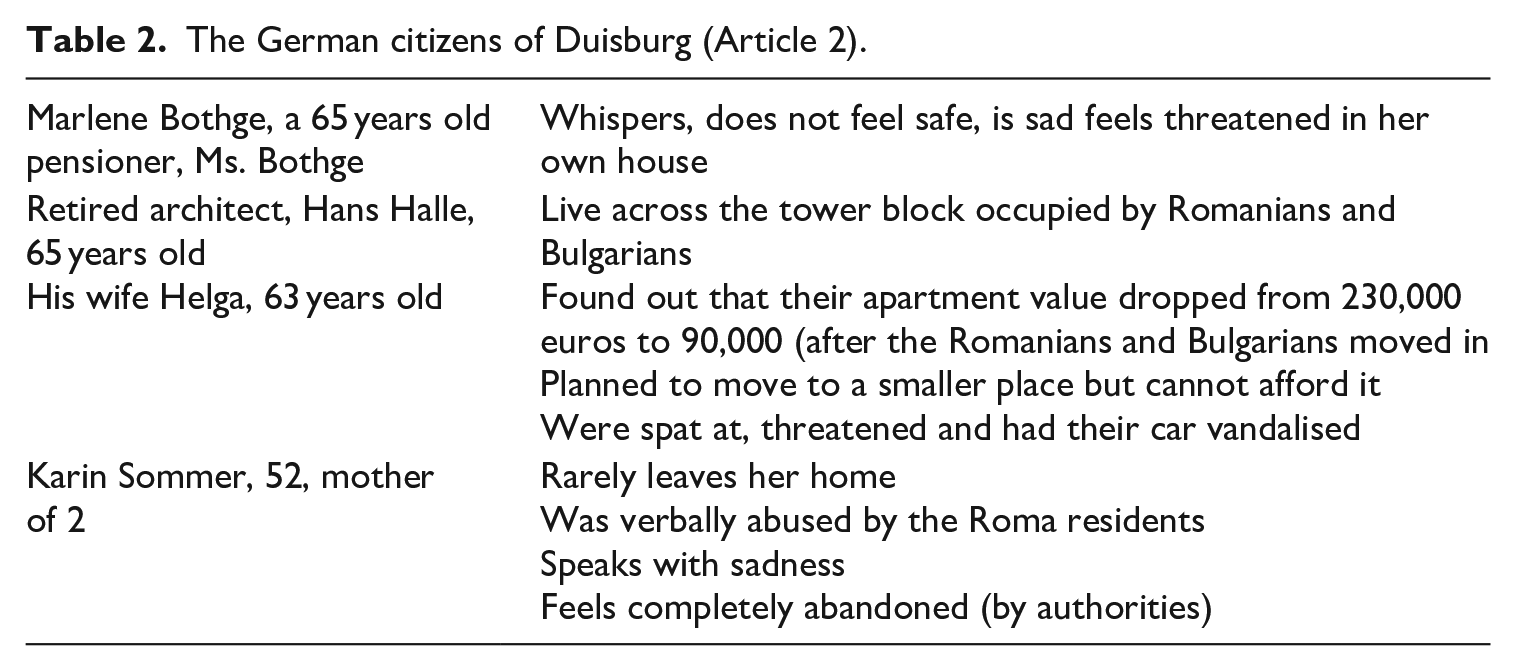
Unlike the Roma who are often presented in terms of collective identifies, there are diverse manners of representing the ordinary citizens. We notice that the German citizens are presented as unique identities, and therefore, individualised by name (Marlene Bothge, Karin Sommer, Hans Halle), age, occupations and kindship (mother, wife, husband). This brings a sense of factuality as if we talked to real people who know the situation in Duisburg. In addition, we are given access to their inner feelings (‘do not feel safe’, ‘feel threatened’, ‘feel abandoned by the authorities’, ‘are sad’) which is a form of synthetic personalisation (Fairclough, 2001). This is a way for the readers to align with the grievance of the ordinary people as they explain how their city has negatively changed due to the arrival of the Roma migrants. And this makes the threat and phobia so real and tangible.
Extract 10 Mrs Bothge explains whispering. They defecate and urinate in the corridors and the stairwells – the adults and the children, she says of the Bulgarians and Romanians. The men play card games outside the flats and, if they need the toilet, they just pull their trousers down and do their business right there. They have working toilets so I cannot understand it. The stairwell became so dirty that I didn’t want my children to visit anymore. There were rats everywhere and the noise was so bad at night. They stripped the corridors of everything. The paintings and plants I had bought to make it look nice, they even took my mop when I left it outside for 15 minutes. Extract 11 The Halles had planned to downsize after their children moved out, but can no longer afford to do so. Mrs Halle says: ‘A year ago this was a normal area but it is now a slum. We feel defeated and we feel angry at the EU.’ The Halles feel terrified in their own home and have been spat at, threatened and had their car vandalised. Extract 12 Mrs Bothge believes these generous child benefits help explain why underage girls have babies. Last spring I heard screams in the neghboring apartment. I called the police. I found out that a 13-year-old girl gave birth.’
The ‘white injury’ rhetoric (Cacho, 2000, Rodriguez, 2018) runs through these accounts of the ordinary Germans. Such accounts thus rely on reversing the victim-villain dichotomy while playing down racism (Cacho, 2000) and it is a form of recontextualisation which is less documented when it comes to the Roma. The othering of the Roma in these extracts is based on a colour blind ideology (Bonilla-Silva, 2015), making reference to the threat Roma pose for the non-Roma by violating the social, moral and economic norms (‘defecate and urinate on the corridors’, ‘stripped the corridors of everything’, ‘turned the place into a slum’, ‘terrified the neighbours with their bad behaviour’, ‘abuse the child welfare system’, ‘underage girls give birth’) – well-established discursive patterns in Romanian contexts (see Tileagă, 2005). On the one hand, these are well-trodden media discourses to represent the Roma, which are part of the new racism (Barker, 1981; Liu and Mills, 2006) on the other hand, these discourses relate to the shift to the right in European politics, where minorities are scapegoated for societal dissatisfactions (Wodak, 2017) – they have no jobs, do not speak German, children do not go to school, they live off child support. We see clearly how the discourse about the Roma incorporates these populist ideas, such as fear of loss of jobs, declining economic prosperity, instability along with a loss of national identity under the flux of Roma migration. We also hear the voices of embittered citizens who blame the EU for having conspired against the ordinary people by allowing the Roma to migrate freely in Europe. It is this combination of the well-trodden discourses with the right-wing rhetoric that naturalises racism towards the Roma. It is implied that it is not their race that is problematic, but their behaviour, culture, lack of skills and economic insufficiency. And the ordinary citizens become the victims of a system that overlooks their interests in favour of ethnic minorities.
We now look at the Roma voices in this news report.
Extract 13 Roberto, 46, who lives in a three-bedroom flat, he admits to claim and receive benefits for all nine of his children, a total of 1.610 euros a month – but insists he’d rather be working. Extract 14 Father-of-four Vasile, 23, is from Romania. He claims he is better off in Germany, even without a job. ‘In Romania, I got 10 euros a month for the children, here I get 200 euros,’ he says. ‘We feel comfortable here.’ Extract 15 Two doors away, single mother-of-four Maria Marin, 35, also has hopes of moving to Britain. She moved to Duisburg with her brother and sister and their families and pays 460 euros a month rent for her three-bedroom flat. As she talks, she shows off a set of gleaming gold teeth. We live off social welfare but it is very little so I go metal collecting to pay my rent. I don’t like it here, it is a miserable city’, she says. ‘I’d love to come to England next year because they have higher child allowance.’
The Roma are represented as families but not in a positive way but rather to show their being numerous. They are individualised as we get to know their names (Vasile, Roberto and Maria) and their ages. Van Leeuwen (2008) showed how additions legitimise certain social practices. We may ask why adding the age of Roma and composition of their families is important. The addition of age is significant for reinforcing stereotypes about Roma communities in relation to early marriages, hyper sexuality, and dependence on social welfare. Vasile is said to be 23 years old and and a father of four children. This is not a way to individualise or humanise the Roma but rather serves as further evidence of their being a social problem. Beyond references to Roma’s belonging to a different social class, such lexical choices reinforce other stereotypical discourses in reference to early marriages, uncontrollable sexual drive, and living off child allowance. Not only do the featured Roma sound inarticulate and irrational but they are also presented as unproductive members of the society, a burden for the tax payers. In terms of recontextualisation we can also talk about deletion and non-represention of different elements of the social practice. Unlike the emotional statements of the ordinary Germans, we are not provided with such insight into Roma’s experiences with unemployment, poverty and discrimination, which make it very difficult to relate to their experiences. In such accounts, one is rather led to sympathise with the ordinary Germans who are represented as the victims of increased criminality, cultural incompatibilities and economic strains.
We now look at the news photography that accompanies this article. There are five photographs attached to the news report which all represent generic Roma (see Figures 4-6). All photographs are accompanied by captions which provide specific evaluations for what is going on in Duisburg. These photographs are meant to document the chaos created by the 400 Roma migrants who settled in Duisburg. Figure 4 shows the so-called ‘Roma gang’ – a bunch of adults and children – socialising in front of the building. The male adults stare at the camera in a threatening way while showing obscene signs. Even children are part of this spectacle, the same disrespectful message being imitated by the young boy in Figure 5. The women are also stereotypical depictions of Roma- one of them seem to be pregnant, which again serves as evidence that the Roma live off child allowance. The other photographs show piles of garbage and cluttered balconies, which make the area look like a public squalor. These news photographs are in fact discourses of fear of the big social problem the Roma constitute and of their primitive and unsanitary lifestyle. They also server as clear evidence as to why the Germans were forced to live the neighbourhood.
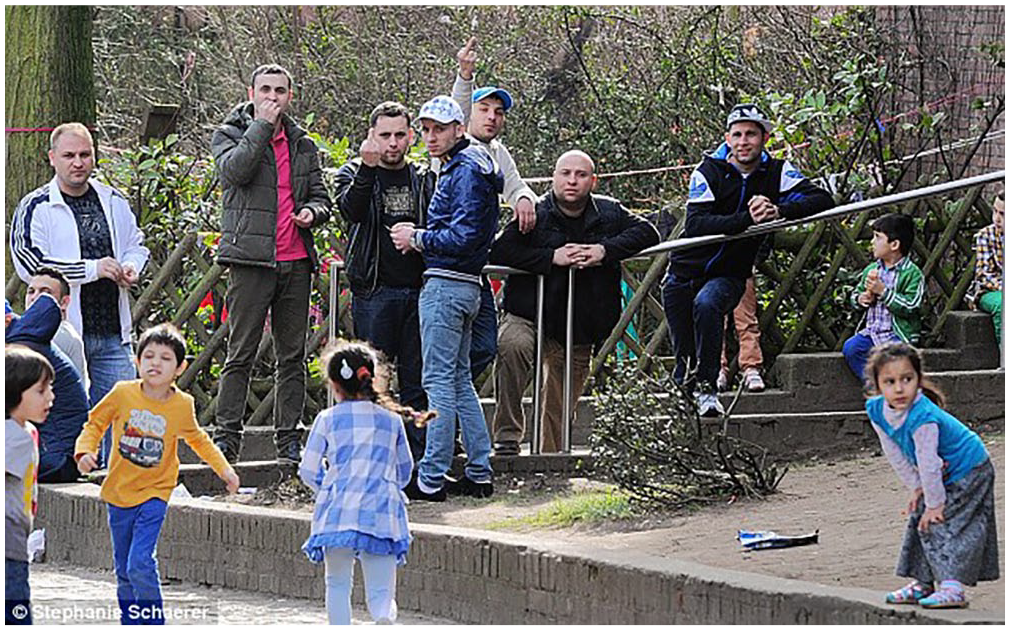
Fared: gangs of Romanian migrants now congregate in areas of Duisburg which has forced German inhabitants out.
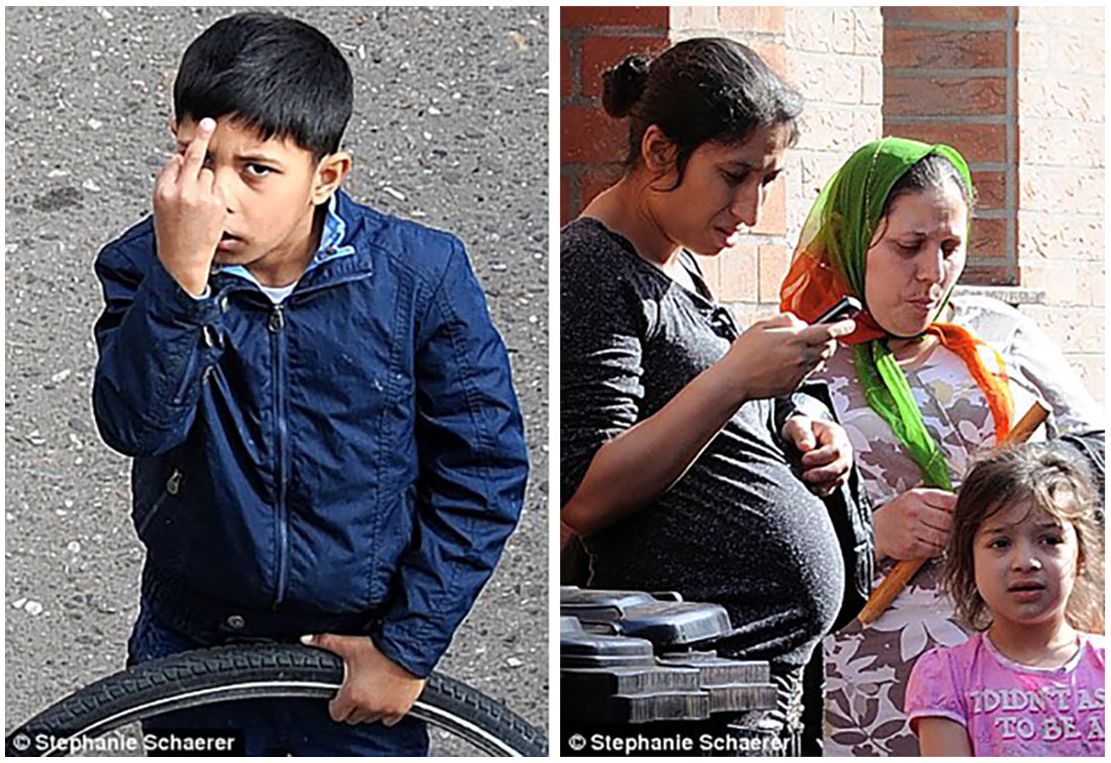
Bad attitudes: this gypsy boy shows his disdain at being snapped, while right, Roma woman maria Marin (in headscarf) would like to come to the UK next yea.
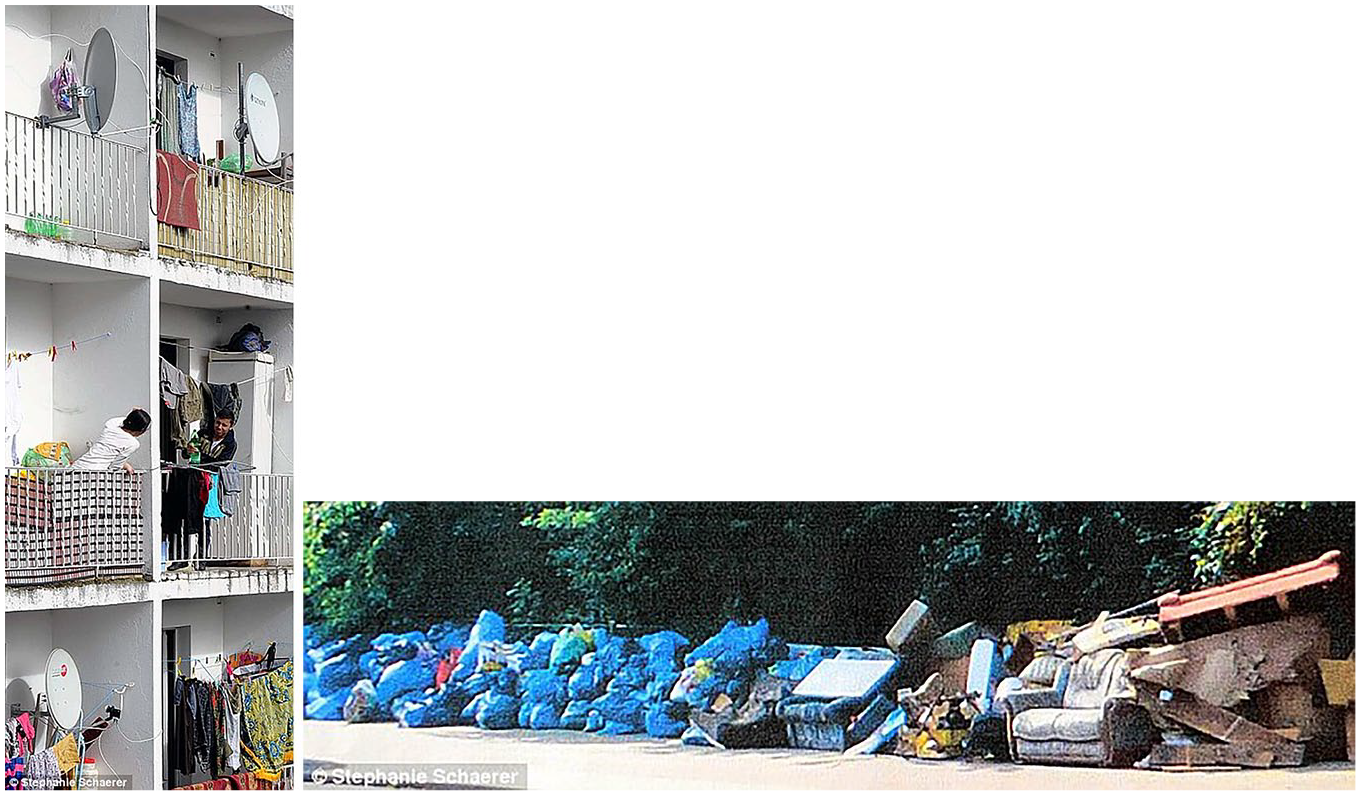
Danger zone: bottles and debris are thrown from overcrowded balconies.
Conclusion
The analysis in this paper needs to be understood in the context of the long history of discrimination of the Roma in Romania (Tileagă, 2006, 2015) and growing populism across the EU (Greven, 2016; Wodak, 2015), where eastern European migrant workers – Romanians and Bulgarians – have experienced themselves discrimination and social exclusion. Scholars show that these populist discourses which focused on fears of the Eastern European migrants were deeply rooted in European public discourse. The two examples presented in this article were sourced from French and German media, which talked about Romanian pickpockets who terrorised Paris or Romanian migrants who drove the Germans out of their own neighbourhood.
What is striking about these Romanian news reports is that the discourse is redirected toward the Roma. The visual evidence serves to emphasise that it is the Roma who caused the chaos both in Paris and Duisburg. Yet racism is not openly communicated but it is rather managed and disguised. The communication about the Roma largely relies on affect – the fear of ‘Roma invasion’, fear of ‘Roma criminality’, fear of ‘Roma traditional lifestyle’. There is not a single instance in the analysed reports where Roma’s otherness is constructed in relation to their biologically being different. The discourses of fear are related to Roma’s trespassing the social, cultural and moral norms, irrespective of age or gender. This representation of the Roma needs to be understood in the context of a long history of racism and well established patters of moral exclusion. The analysis reveals that the Roma appear to be not just socially and culturally different but morally unacceptable (Tileagă, 2015).
Despite the fact that direct racial references are well-concealed, the ideology is obvious. The Roma are represented as unwanted not only in Romania, but also in other countries, such as France or Germany – countries which started to understand the ‘huge problem’ these groups are said to represent. Under a colour blind ideology, discourses about the Roma are fueled with a sense of white [Romanian] injury (Bonilla-Silva, 2015; Rodriguez, 2018), which makes it very difficult to imagine the Roma as victims of discrimination and social exclusion. We see the media craftily recontextualising discourses that would not communicate Romaphobia at a casual reading: We are told for example of a certain Vasile, 23 years of age and father of four children. Such manner of representation indirectly brings into focus other well-trodden discourse in relation to Roma’s hyper sexuality, early marriages, living off child allowance which intensify Romaphobia.
There is nothing in the analysed news reports that provides any clues about the struggles of Roma migrants with finding work or their experiences with social exclusion or marginalisation. We are rather led to believe that they are the group whose unconventional lifestyle is a problem everywhere they migrate. These manner of representation makes racism and discrimination against the Roma invisible in a time when camp evictions and other acts of violence often go unnoticed and become norms to deal with Europe’s poorest and most socially excluded people.
Footnotes
Declaration of conflicting interests
The author(s) declared no potential conflicts of interest with respect to the research, authorship, and/or publication of this article.
Funding
The author(s) received no financial support for the research, authorship, and/or publication of this article.