




Abstract
Young citizens are increasingly being invited to take part in participatory democracy meetings as joint decision-making has grown popular in public administration. The backbone of participatory democracy is that some authority is granted to the citizenry and by drawing on video data (38 hours) from a year-long participatory project, this conversation analytic study shows that the adolescents are instructed to a deontic role rooted in epistemics, benefactive considerations, as well as temporal aspects relating to future citizenship and hope. The institutional representatives perform actions that determine how the adolescents should, in their turn, perform actions of influence. In this way, authority is ascribed through an ambivalent configuration in which compliance with the directives is supposed to establish a strengthened deontic position.
Keywords
Introduction – Participatory democracy in interaction
Young citizens today are increasingly given opportunities to participate in the determination of future political action. Inviting citizens to participate is framed as a solution for a range of societal challenges, ranging from environmental issues, mistrust of authority, and generally deteriorating democratic participation (Tahvilzadeh, 2015). The backbone of participatory democracy is its meetings that comprise social interaction, making it imperative to study how participation is implemented and accomplished in situated interaction. By drawing on data from a longer participatory project, this study explores how deontic authority is interactionally instructed to young citizens. During 5 days of discussions over a 1-year period, 14 to 15-year-old citizens were seated around tables with politicians and public servants to collectively find a vision for how their hometown should be in 2050. Before each day of discussions, the adolescents meet with a youth strategist who prepared them for the upcoming discussions and their role in the process on how the future ought to take shape.
Social deontics as authority to influence in interaction
In this study, the authority that is held by a participant to determine action is operationalized in accordance with a conversation analytic perspective, as the deontic authority (Stevanovic, 2018; Stevanovic and Peräkylä, 2012) that is ascribed and negotiated in interaction. Deontic authority covers participants’ joint recognition of an individual’s rights and obligations to announce, propose, and decide on how some part of the world should be. As Stevanovic and Svennevig put it, deontic authority is about ‘who has the capacity to define what is necessary and desirable, what should, and what should not, be done, in certain domains of action in relation to one’s co-participants, and who has the obligation to do what others tell him or her to do’ (2015: 2). While acknowledging that these rights may be rooted in and influenced by the participants’ formal credentials, the primary interest in the field of social deontics is to consider how authority is constructed and negotiated locally in face-to-face interaction (Stevanovic, 2018; Stevanovic and Peräkylä, 2012). Consequently, a participant’s legitimate authority depends on the construction and joint recognition of deontic authority in interaction.
Separate, but interrelated to deontics, is the domain of knowledge in interaction. Who gets to decide and propose future action is closely tied to who knows what, who should know what and who has the right to know what (Stivers et al., 2011). While deontic authority is about the right to decide how the world ought to be, epistemic authority concerns the rights and responsibilities to say how the world is. Epistemics and deontics are both socially distributed and morally ordered, meaning that participants in interaction are held accountable for transgressions and ill-fitted claims (Stevanovic and Peräkylä, 2014; Stivers et al., 2011).
In order to achieve congruence between what is expected and what is done, it is necessary to have an appreciation of what the situation requires and to adapt one’s conduct accordingly. Related to navigating and adapting in social situations, is the participants’ online maintenance of congruence between status and stance (Stevanovic and Peräkylä, 2012). Deontic stance is a participant’s displayed authority as claimed through an utterance’s design, whereas deontic status is a participant’s more lasting relative and assumed authority (Stevanovic and Peräkylä, 2014). Status is tied to what is considered to be credentials in the current situation and can be derived from the roles and positions possible in the activity at hand, but ‘is continuously modified in the turn-by-turn sequential unfolding of interaction’ (Stevanovic and Peräkylä, 2014: 191). Every action performed then conveys an individual’s local stance, which stands in relation to their assumed status. The congruence between stance and status has been shown to be socially preferable for the maintenance of intersubjectivity and progressivity (Heritage, 2013). This means in practice that if stance and status do not correspond, such transgressions will have to be dealt with by the participants and can be sanctionable in social interaction.
Shaping the future conduct of others
One crucial context where social deontics becomes relevant is the negotiation that says how things in the near or far future should be, including other participants’ future conduct. Changing the future can be achieved through directives such as proposals, suggestions, orders, informings, requests, invitations, advice and so on. What directives have in common is that they ‘induce the recipient to perform some action’ (Couper-Kuhlen, 2014; Shoaps, 2017; Stephenson, 2019; Stevanovic and Svennevig, 2015: 2; Zinken and Ogiermann, 2011). Since directives can carry different deontic strength and temporal range, the next relevant action can be performed adjacent to the first pair part while sometimes being more distal. This is related to the dimension of distance in the field of social deontics in which a difference between proximal and distal deontics is made. Distal deontics concerns participants’ rights to decide ‘their own and others’ future doings’, whereas proximal deontics covers a participants’ ‘rights to initiate, maintain, or close up local sequences of conversational action’ (Stevanovic, 2015: 85f). For instance, when a participant gives another participant some advice, the advice-giver claims proximal rights to influence the recipient’s future doings by putting the recipient in a position to respond. Even though the directive is local in its execution, the participant producing the advice also claims distal rights to have a say in the recipient’s future doings.
A straightforward way to make adjustments in other people’s future actions is to tell someone what to do. In interaction with children, it has been shown that the adult participants possess full authority over their own children and are entitled to direct their children’s future actions without displaying any orientation towards the contingencies of the recipients (e.g. Craven and Potter, 2010). This means that parents can design their directives as bold imperatives. However, depending on the activity at hand, even with children, there appears to be a preference for downgrading one’s deontic stance when displaying a wish or necessity for future action from someone else. For instance, Antaki and Kent (2015) have shown that parents who, from their parental status, could simply demand, still use strategies such as offering two options to children in which one option is less desirable and even a threat. By presenting the option of finishing your dinner or going to your room, the parents display an orientation to the child’s freedom of choice.
In institutional settings, however, there could be egalitarian ideals in the hierarchical structures to which there must be an orientation. For instance, in interaction between a professional and a layperson, in the majority of interactions, an epistemic asymmetry will exist in which the professional has expert knowledge in the given area. In contrast, the layperson has lifeworld knowledge about their own life and experiences tied to it. As the public sector has been showered in recent decades with ideals of participatory governance, there has been a prominent interest in the negotiation of epistemic and deontic authority with regards to being involved in decision-making (Ekberg and LeCouteur, 2015; Landmark et al., 2015; Lindström and Weatherall, 2015; Peräkylä, 1998; Weidner, 2015). Several studies have shown that epistemics plays an important role in involving the subordinate party by dividing knowledge into expertise and experience. The subordinate participant’s deontic authority can be strengthened by means of their experiential knowledge. However, they can also renounce such ascription of deontic authority by pointing to the expert knowledge and the role of the professional participant (e.g. Landmark et al., 2015). Physicians, even by ascribing epistemic primacy to the domain of the patient’s body and lifeworld, induce features that should be considered important for the decision to be made, and thereby exert authority by deciding what is authoritative.
Regarding actions that shape others’ future room for maneuver, the deontic status of students has been shown to be constructed as a way of managing students’ participation by referring to students with different lexical choices, thereby positioning them (Ishino and Okada, 2018). However, more than just positioning someone, actions to induce a mindset can be used to shape the counterpart’s future actions.
Without using the term deontic authority Peräkylä (2002), has shown in medical interactions how participants can be directed towards a certain authority. Physicians instruct the patient on how to interpret the evidence of the diagnosis. This is described as an enactment of dual orientation to which the institutionally superior participant’s authority is oriented while remaining attentive to the institutionally subordinate participant’s agency (Peräkylä, 2002). A parallel study of how ideals of democratic participation unfold in actual mental health rehabilitation interaction, Valkeapää et al. (2019) show that the superior party introduces actions to empower the subordinate participants by introducing guidelines for how to participate and what to bear in mind when making decisions. However, in the actual situations of decision-making, there is a mismatch with regard to the ideals introduced. The superior party exerts authority and dismisses the opportunity for democratic decision-making. In the classroom, the mental health rehabilitation, as well as the doctor’s office, the participatory framework is set and instructed to the subordinate party, and the subordinate party is steered towards a certain way of conceiving of their role.
The distribution and negotiation of deontic rights and responsibilities in interaction is very much connected to how participation is negotiated within institutional structures. Many of the studies presented here have focused on the enactment and social distribution of deontics, negotiation, and the epistemic grounds for altering a participant’s authority. However, how participants who are new to a setting are instructed to a certain deontic role have not been as thoroughly investigated. The current setting of participatory democracy meetings also builds on a promise that the institutions governing society consider it desirable to share their decision-making power with their citizens and carve out a deontic slot so that citizens can participate. Thus, this distribution of influence and the shaping of other participants’ deontic conduct is a perspicuous setting for contributing to our understanding of social deontics.
Data and method
Using a conversation-analytic approach (Heritage, 1984; Schegloff, 1996), naturally occurring data are used to illustrate how deontic authority of young citizens is constructed and instructed in social interaction. Considerations are made for the embodied actions and the material environment. However, in this study, verbal actions are the primary focus of analysis.
The data were collected during a year-long participatory democracy project (2019–2020), and the main participants are four 14 to15-year old adolescents, all of whom were raised in the municipality. They have chosen to voluntarily participate in the project after receiving an invitation from the municipality. The adolescents applied for the position and handed in motivational letters, having been encouraged to do so by a municipal youth strategist. Once they had been accepted, the participants received the institutional title of Young Municipal Developer and were remunerated for each meeting.
The decision-making process comprises five full days of discussions between politicians, public servants and young citizens. The young citizens are individually seated around discussion tables with the other participants and engage in discussions about the future with the goal of formulating a vision for 2050. Each evening before the following day’s discussions, the young citizens meet with the municipal youth strategist for what she refers to as a ‘pep meeting’. All table discussions and pep meetings are audio- and video-recorded (approx. 38 hours), 1 and the data are transcribed according to the conventions established by Jefferson (2004) and then developed multimodally by Mondada (2014).
To study how the young citizens are introduced to their deontic authority, episodes including directives performed by the politicians and public servants, inducing the youngsters to perform directives themselves, are analyzed throughout the first two meetings.
Analysis
The analysis section is divided into two parts: preparation and execution of influence. The first part covers how the young participants, in the first preparatory meeting, are informed about the upcoming process and their part in it, as shown in Examples (1) and (2). The second part covers how the informing and pep talk that took place in the preparatory meeting play out in action when discussing with the politicians and public servants in Examples (3–5).
Preparation: constructing the participants’ deontic status
The following excerpt is from the first encounter between the young citizens and the municipality’s youth strategist. It is the night before the first day of discussions, and the youth strategist has invited the adolescents to inform them and inject pep into them about tomorrow’s meeting and upcoming meetings.
This first example serves to demonstrate how deontic authority is initially introduced. When the excerpt starts, the scope of the vision project and the municipality’s partners have been presented. As we will see, the adolescents’ responses are treated by the strategist as a potential problem concerning their participation in the upcoming meeting, thus making relevant instructions regarding how they should conceive of their role.
PER: Youth strategist Pernilla
LUD: Youth Ludvig
ALV: Youth Alva
AMA: Youth Amanda
Norda: the town
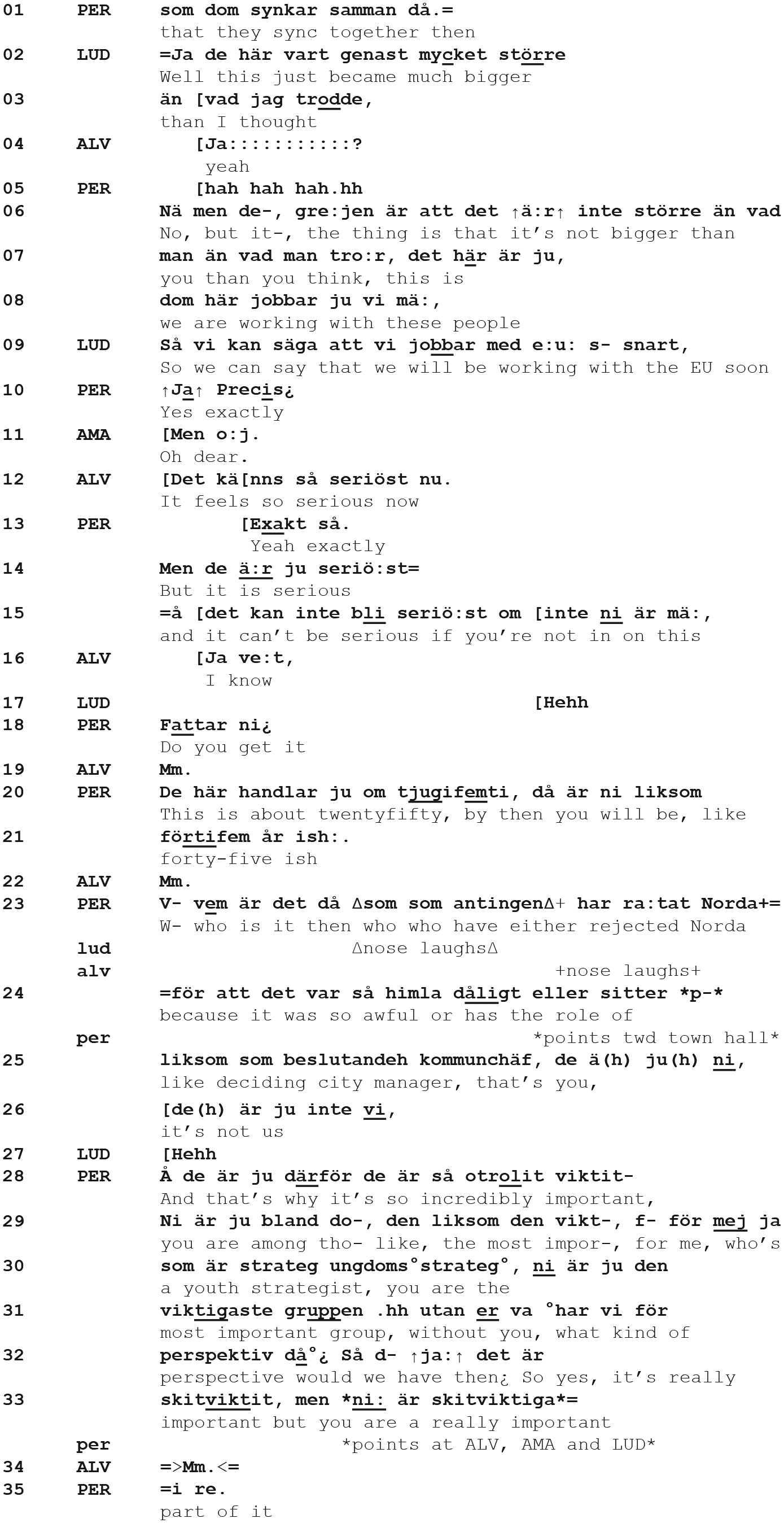
An assessment by the youth Ludvig (line 2) triggers an introduction to the young participant’s role in the project. The assessment that comments on the scope of the project is met with affiliation and agreement by the other youth (line 4), whereas mitigating actions are introduced by the strategist (lines 6–8). The actions done by the strategist in a second position do not treat Ludvig’s first position assessment as a positive display of exhilaration about participating in the following day’s table discussions, but rather displays of concern. By amplifying the seriousness in an emphatic tone, the strategist manages to agree with the substance that it is serious but, at the same time, disaligns with the negative aspects of seriousness ascribed in the previous actions of the adolescents (line 14). The concept of seriousness is introduced by the youth participant Alva (line 12) and later tweaked by the strategist, who uses it to account for why they should participate (lines 14–15). By transforming the negative assessments of seriousness and size from a bad thing into an indicator of what could be interpreted as legitimacy, their participatory function is initially unpacked.
In 2050, Alva, Amanda and Ludvig will be 45 and in this envisaged future it will either be them who rejected their hometown because it was such a terrible place, or it will be them who stayed and became the deciding city manager (lines 23–26). By stating this, the strategist derives the youths’ authority by invoking the possibility that they will be in charge one day (lines 23–26) and Alva and Ludvig receipts their future position by both nose laughing (line 23).
Following the interactional preference for contiguity, the second option is produced as the most salient option but also the most desirable one (cf. Antaki and Kent, 2015). This means that more than making participation a moral issue, the gist of both future scenarios is about the adolescents being tied to the process of changing the destiny of their hometown. They both can and should be involved not only when they have actual influence as middle-aged citizens, but also now. The assertive actions of creating two future scenarios make benefactive considerations relevant (lines 20–26) (Clayman and Heritage, 2014). By setting up the causality of the present and future state of affairs in this way, responsibility is assigned to the youth regarding the likelihood of an undesirable outcome. The temporal aspects of the decisions to be made places the adolescents as being the citizens that will suffer from the decisions to be made. This means that if they care about their own future, they have an obligation to influence the decision-making process. Through this establishment of causality, the influence to prevent this development is also introduced (lines 25–26). This illustrates how deontic authority is distributed and the broad scope of the authority to be performed in this decision-making process.
Making a participant’s future action concerned about the whole of society is similar to studies of workplace meetings in which the organization itself can be made into the beneficiary of a proposed action to strengthen the deontic claim being made (see Svennevig and Djordjilovic, 2015). By taking the stance that the youth participants are the ones to potentially benefit or suffer from the decisions to be made, the strategist is able to present what’s at stake and the tools for how to act in this state of affairs, while strengthening her claim that the adolescents are deontic subjects holding rights and obligations to influence.
Given that the interactional project is about warming up for tomorrow’s upcoming discussion, their future-derived authority remains vague in its implications with regard to actual responsibilities and what actions to perform in the upcoming decision-making process. However, some clues are given as to what their responsibilities are. When informing them about their rights, the pronominal use is, without exception, the second person plural, transforming the young citizens into holders of a collective youth perspective (lines 15, 18, 20, 25, 30 and 33). By making the youth participants the most important group, it is also made clear that they are supposed to contribute with a perspective: ‘you are the most important group, without you, what kind of perspective do we have then¿’ (lines 30–32). This assertion of their importance is just minimally responded to by Alva (line 34) and then continues with yet another assessment of the size in the next example (2, line 33), as the interaction continues.
Building an epistemic preserve from which to draw actions
In the following continuation of example (1), the future-derived deontic authority as the reason for the youths’ present authority will be further substantiated with epistemic terms. Their participation and the youth participants’ perspective have both been assessed as being really important (lines 32–33) by the strategist, and a second assessment follows from Alva, followed by a giggle (line 33).
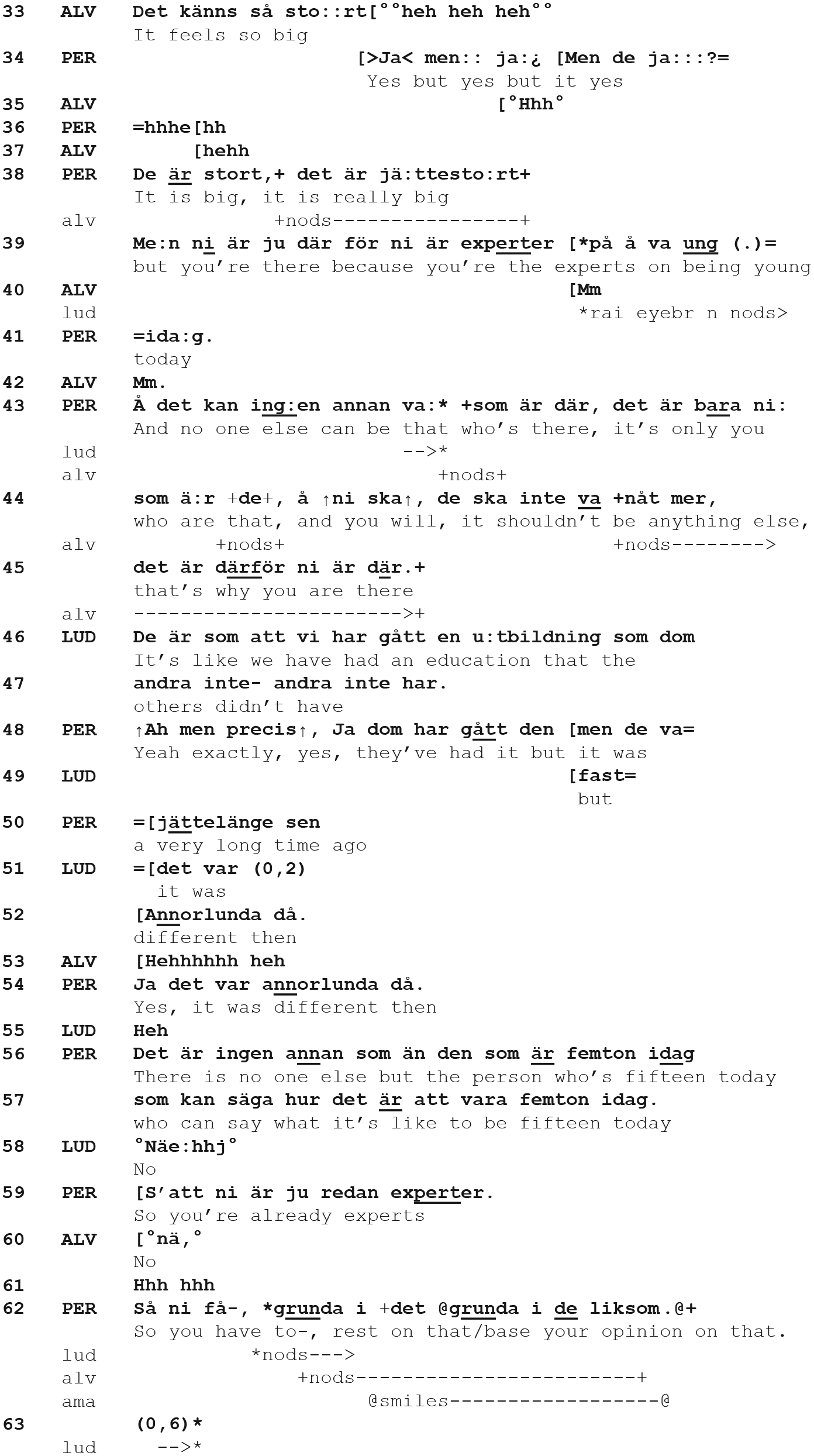
Unlike the first example, the strategist does not turn the object of assessment into something positive but upgrades the youths’ assessments from ‘big’ to ‘really big’ (line 38). Rather than constructing their authority through future-based deontic rights and obligations, epistemic resources are introduced regarding why they ought to participate (line 39). A territorial preserve is constructed over which the adolescents have primary rights and explicitly states that no one else has the same access but them and alludes to it as being a territorial offense if someone who is not 15 years old would say what it’s like to be 15 today (lines 43–44). In this way, the strategist formulates grounds, rooted in epistemics, that carve a specific slot in the participatory framework for the youths. This, in turn, creates an epistemic advantage from which actions can depart. Finally, in this utterance, the strategist connects the statements made more explicitly with the participants’ future actions ‘it shouldn’t be anything else, that’s why you are there’ (lines 44–45).
Since the actions performed by the strategist are declarative, the next relevant action should be an information receipt such as okay. When the strategist is stating the youth’s absolute epistemic advantage, the responses she receives are nods (lines 40, 43, 44 and 45). However, when the strategist finishes her last turn (line 45), Ludvig takes the turn and displays a deontic hearing (Stevanovic, 2011) of the declarative (lines 46–47). He ratifies the epistemic grounding laid out by the strategist of how actions are to be performed in tomorrow’s upcoming discussions through a comparison with education. Ludvig portrays himself and his peers as having received an education that the other participants lack. This training equips them to offer a unique perspective. Pernilla initially affiliates with his comparison (line 48) but adds that the others, the politicians and public servants, have likewise received such an education, that is, they have also been young, but a very long time ago (lines 48–50). Ludvig adds that it is not just a question of access or directness to the same knowledge source but that it is another source altogether. These actions of comparing don’t just claim an understanding of the deontic approach projected by Pernilla but display such an understanding (Macbeth, 2011), as well as compliance with the statements about the youths’ future actions. Pernilla affiliates with Ludvig’s reasoning and emphasizes that no one else but them could know what it is like to be fifteen years old today (lines 56–57), and reaffirms the epistemic advantage with which Ludvig and Alva affiliate (lines 58 and 60).
Given that the future-derived deontic authority (Example 1) is not treated as sufficient to calm the displays of concern, an epistemic grounding is introduced. This groundwork more closely addresses tomorrow’s actions by declaring the youth as being already, with no preparation, knowledgeable, and fit for participation (line 59). The last directive grunda i det ‘rest on that/base your opinion on that’ (line 62) takes a stronger deontic stance and explicitly intertwines the epistemic reservoir with the upcoming conduct. It forms a foundation on which the participants can rest, feel safe and base their conduct. This last directive, in particular, invokes a deontic aspect to the declarative utterances previously made by the strategist. The grunda i det ‘rest on that’-request makes clear in hindsight that the informing was about constructing a deontic mindset and vision to be borne in mind throughout the process (cf. Goodwin, 1994; Peräkylä, 2002).
In this first encounter, as shown in Example (1) and (2), the strategist informs the adolescents of tomorrow’s discussions and why they are fit to participate. The youths’ expert role is accentuated in order to enhance their deontic authority within an otherwise conventional institutional subordination: young with no official power or formal credentials. The next section will analyze how the authority induced plays out in the actual session.
Proposing future action
For progressivity to run smoothly in interaction, a participant’s stance should correspond with their status. It is the day after the pep meeting and a deontic incongruity arises. The handling of this divergent course of action sheds light on the conditions and vagueness of the future-based deontic status, and instructive actions are introduced.
The youth Amanda is sitting at the same table as the City Manager Birgitta and the Politicians Calle and Charlotta. By the time we join the interaction, they have just been given the task of discussing how they should formulate a vision for the future without talking in clichés. The turn is allocated to Amanda with a question (lines 1–2).
AMA: Youth Amanda
BIR: Birgitta, City Manager
CAL: Calle, politician
CHA: Charlotta, politician
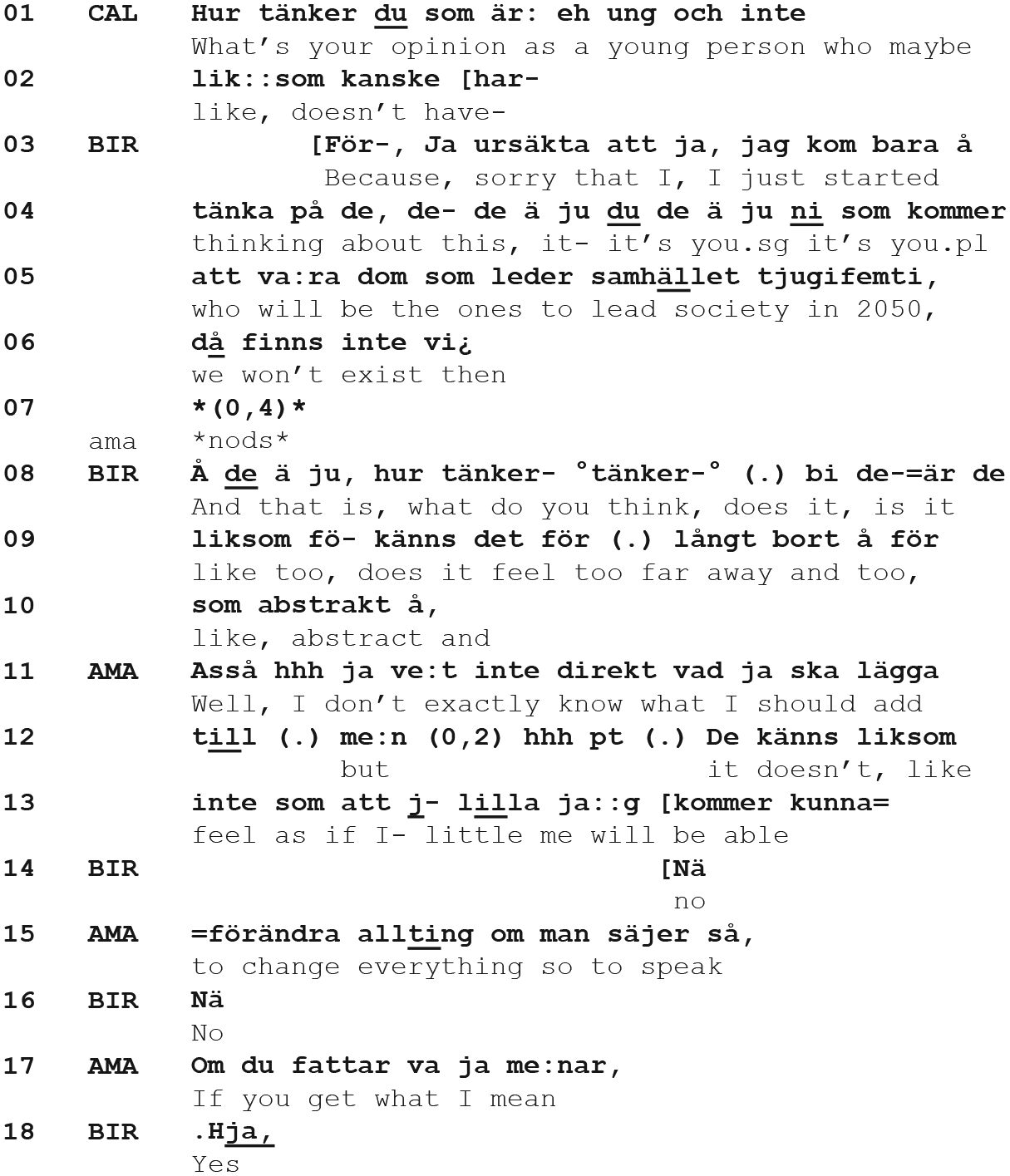
When the City Manager Birgitta derives deontic rights and responsibilities from the young citizens’ future positions (lines 3–6), this is done as a reaction to the opportunity to assert in first position on the basis of being young, as formulated by the politician, Calle (lines 1–2). Having to assert in first position has been shown to be a delicate matter in previous studies (Heritage, 2002), which probably explains why intervening actions are introduced that problematize the conditions for Amanda to share her thoughts. It is therefore reasonable to interpret Birgitta’s interruption (line 3) as oriented to Calle’s question (lines 1–2) as ill-fitted, deontically and epistemically.
The interruption immediately addresses the deontic authority of the youth packaged as an ‘I had a thought’-turn beginning (lines 3–4). These kinds of turn-beginnings have been described in previous studies as ‘on topic’ topic markers doing the job of displaying for the other participants, not an internal state, but that the speaker has something probably lengthier to contribute on the topic and that this contribution is yet to come (see McHoul and Rapley, 2003). This floor work by Birgitta is highlighted here since it does the job of accentuating the urgency of topicalizing and unpacking the local ramifications of being alive in the future.
Birgitta states in a declarative form that ‘it’s you.sg, it’s you.pl who will lead society in 2050, we won’t exist then’ (lines 4–6) and Amanda nods (line 7). The assertion contains a pronominal shift from you singular to the plural form where Amanda, as an individual, is transformed into a member of a category. The content of the assertion is that by the time the public servants and politicians have died, the youth will lead society. More than a contemplation of the transience of life, the construction of Amanda as belonging to the next generation proposes a deontic position. However, it has been acknowledged that by deriving deontic authority from one’s future possible position, the construction can be perceived as abstract and that the future is perhaps too distant to relate to and fishing devices are used to retract Amanda’s thoughts on the underpinnings of her role (lines 8–10).
Amanda says she doesn’t know what to add, but as the account continues it is not a lack of epistemic access nor primacy that constitutes the grounds for the coming renouncement (lines 11–12). When Amanda takes an incongruent stance and treats the earlier actions as an ascription of authority: ‘It doesn’t feel as if I- little me will be able to change everything, so to speak’ (lines 12–15), she offers resistance to the ascription of authority which is further emphasized through a self-repair from ‘I’ to ‘little me’ (line 13). The deontic subject now portrayed, contrary to a future leader of society, is one insignificant individual, with limited abilities and incapable of changing everything (Pomerantz, 1986). While Birgitta affiliates with Amanda’s pursuit of altering the deontic conditions of her participation (line 18), congruence has not yet been achieved. In the following, Amanda will propose her expectations of her deontic conduct in the decision-making process (line 19). This clarification will, however, be contested and instructions on an appropriate stance will follow as the interaction continues.
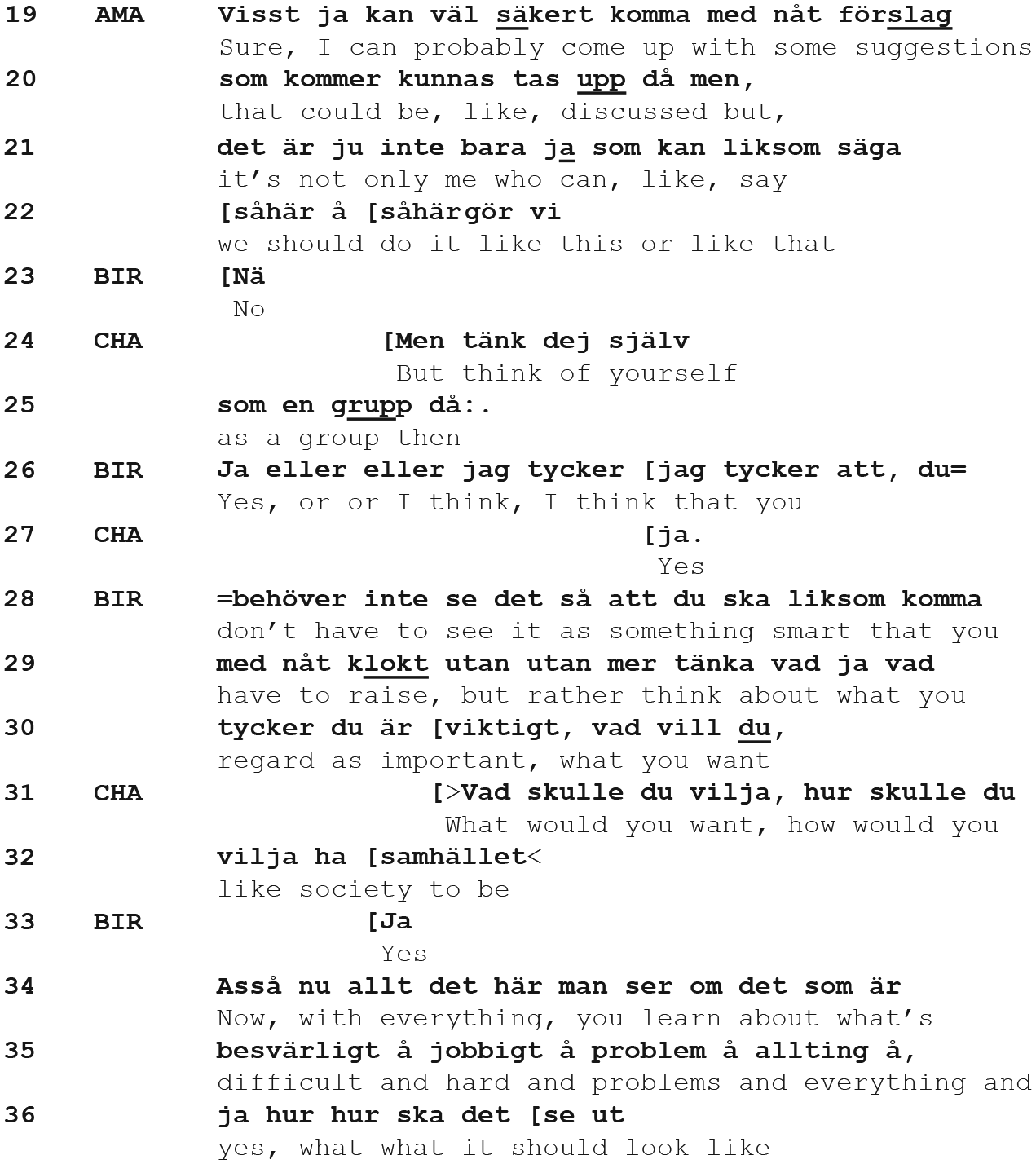
Some aspects of the scope and obligations of Amanda’s deontic authority are brought to the surface as Amanda presents what she can be expected to contribute deontically (lines 19–20). An alternative authoritativeness is presented when Amanda describes herself as one among many who could provide suggestions that could be raised. However, a line is drawn regarding the weight her individual contribution ought to be given, and she downplays her deontic authority to propose future action (lines 21–22). In the same declarative form as the instructive work in the previous example, Amanda declares that she is one among many rather than a spokesperson for a generation, she is indicating that she has downgraded her authority and does not have the full right to announce or decide the course of action regarding how things should be done (line 20–22).
This delineation of authority is treated differently by the co-participants. In stark contrast to the recent work of downgrading and individualizing her deontic outlook (lines 19–22), the politician Charlotta advocates an approach based on category incumbency (lines 24–25). The directive could be interpreted as shifting the focus from running the risk of individual shortcomings by focusing on a group level. However, this is not how the directive is treated in the subsequent turns. The imperative of returning to a category-based outlook is contested by Birgitta (from line 26).
Participatory relevant actions are introduced (from line 28) emphasizing contributions by the youth Amanda based on subjectivity rather than saying something smart. From this point, a deontic landscape is created, highlighting the individual’s appreciation of what is desirable and necessary in society. With the definition of deontic authority as the right to announce, propose or decide how the world should be, the following instruction for how to think when coming up with a proposal is, on the surface, as deontic as it gets: ‘how would you like society to be’ (lines 31–32). However, this seemingly horizonless deontic panorama that has just been painted is soon given a horizon. Directives follow that furnish the opportunities to produce a suitable proposal limited by the suggestion of taking contemporary problems as the point of departure (line 34). The negotiation and clarification of authority is brought to an end as Amanda takes the turn to produce a proposal tailored to the instructions given (line 37).
The proposal
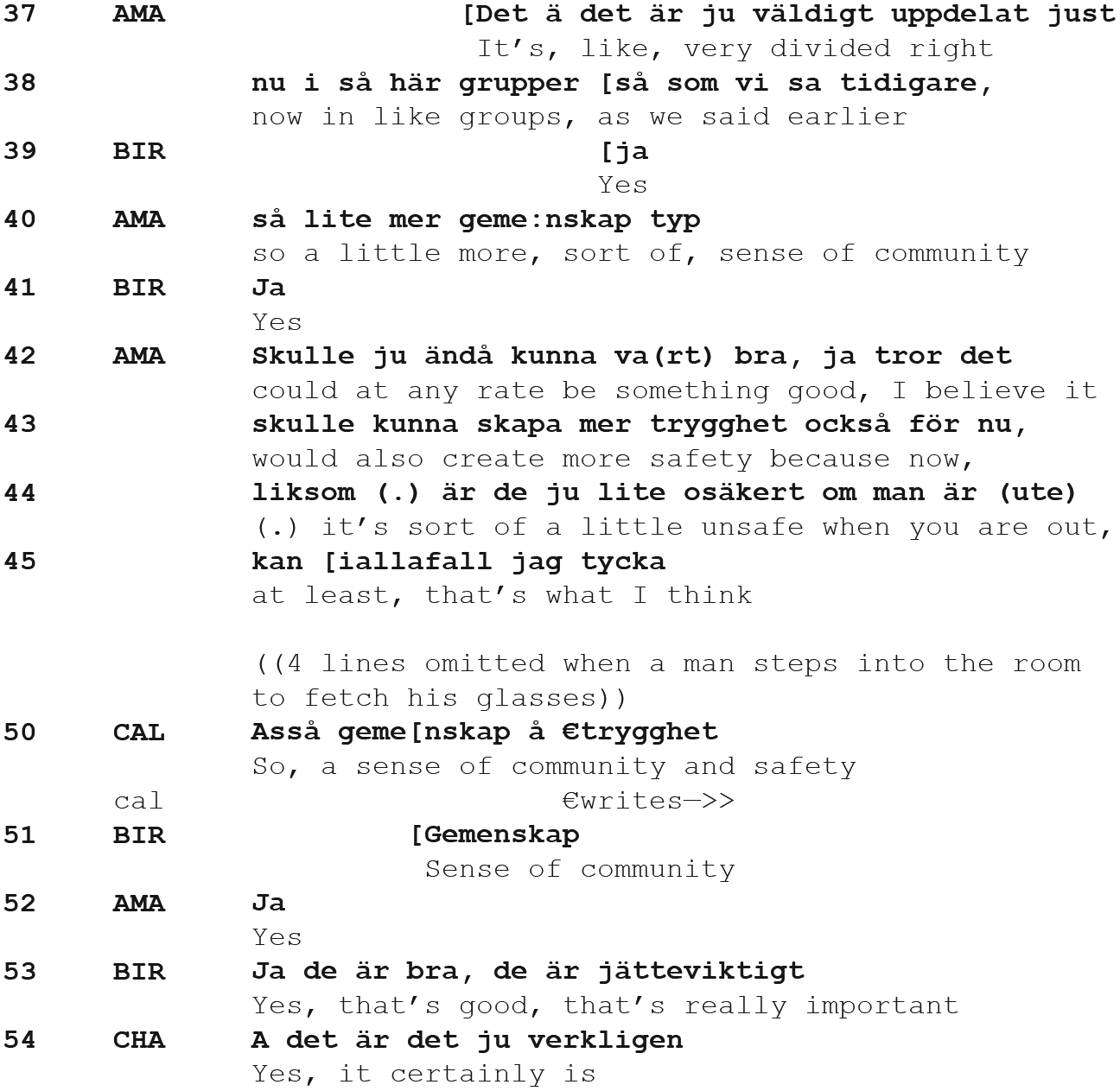
The proposal is made from an individual standpoint and not as a spokesperson for a generation. The problem she identifies is that society is divided into groups (lines 37–38), and this claim of the problem in society is epistemically marked as a commonly known fact by stating that her proposal is something that was stated before.
The proposal ‘so a little more, sort of, sense of community’ is deontically downgraded with the low modality markers ‘a little more’ and ‘sort of’ making the proposal tentative and project the possibility of modification or rejection. After an alignment token from Birgitta (line 41), possible contingencies are added (line 42). An outcome from her suggestion would be safety, something that is needed in society. This claim of how the world is and how it should be is rooted in an increment that locates the claim in a domain of experience and is packaged as an individual appraisal (line 45). In combination with accounting for the positive outcome of the proposal, this illustrates that the deontic claim has been mitigated (Peräkylä, 1998; Stevanovic and Peräkylä, 2012) and could be interpreted as a post-proposal display of uncertainty (Stevanovic, 2015). By adding argumentation to her proposal, Amanda orients to a need to enforce her authority. However, the directives given by the public servants and politicians before the production of the proposal were to base the contribution on personal desires that made the proposal congruent with the previous instructions.
The proposal conforms to the instructions of proximal deontic conduct. Given that the instructions highlighted the perspectives of the youth as the most important participants, contributions like those produced by Amanda should carry some weight. With the proposal out in the air, a discussion based on this suggestion for a better future society would be possible. However, the proposal does not lead to any sort of discussion; the proposal is assessed and written down. Calle sums up the gist of Amanda’s proposal as a ‘sense of community’ and ‘safety’ and visibly writes simultaneously (line 50). The keywords are seconded by Birgitta in overlap and later assessed as ‘good’ and ‘really important’ by Birgitta and upgraded by Charlotta ‘Yes, it certainly is’ (lines 53 and 54).
Since the proposal belongs to a decision not to be carried out in the present, the assessments following and the writing down of the keywords could perhaps be interpreted as displays of a commitment to future action (Stevanovic and Peräkylä, 2012) and therefore as actions of diligence for Amanda as a deontic subject. In such a vein, her proposal is treated as an action loaded with deontic power. It has been written down and therefore made more permanent and traceable in the longer decision-making process they are in. At the same time, the proposal is a product of an extended instruction.
Summary of the proposal making
Examples (4) and (5) show how authority is shaped in action and how proposal-making becomes a vehicle for shaping deontic participation. With Birgitta’s problematization of the vagueness of planning for the future and Amanda’s renouncement of her deontic authority, an alteration in the moral authority and responsibility attributed to her deontic position is achieved (cf. Mondada, 2011). Nevertheless, it is not until Amanda manages to produce a proposal that congruence between stance and status is achieved. As Example (5) shows, Amanda’s proposal is not treated as relevant for further discussion, which illustrates that her participatory role does not cover the details of how her proposal could be realized, that the reasoning in the decision-making process belongs to the domain of the politicians and public servants (cf. Peräkylä, 2002: 227).
While all discussion days and preparatory meetings, as well as some workshops were recorded, the full chain of events in the decision-making process, such as meetings between politicians and public servants after the participatory phase, have not been accessed. It is therefore not possible to trace the full trajectory from proposal to final decision. Still, to end on an optimistic note, 1 year later, when the local government made a final resolution on a vision to lead the way towards 2050, the proposal made by Amanda was included: ‘In Norda there is a sense of community, courage and creativity’.
Results and conclusion
The premise of participatory democracy is the promise that some deontic authority is allocated to the citizenry. At its core, the initiative is a deontic enterprise, and the interest of this article has been the ways in which authority is distributed in practice when involving young citizens new to influence work. The analysis shows that through a considerable amount of instructional actions on the part of the public servants, the young citizens are instructed in how to see and navigate the activity’s epistemic and deontic terrain (Goodwin, 1994; Peräkylä, 2002).
A status from the future as young today
In the literature on deontics and epistemics within the field of social interaction, status comprises a participant’s structural or societal position within a specific domain (Stevanovic and Peräkylä, 2012). Some more apparent features of the participants’ statuses are there, such as age. However, much remains unclear beforehand. The activity offers an exciting setting for investigating how status is instructed in interaction and filled with features and meanings, rather than assumed. In the preparatory activities and interventions that are made when participating in deliberative sessions, the construction of the authority draws on epistemic access to a unique youth lifeworld, benefactive considerations concerning the hometown, as well as temporal aspects about future citizenship and intergenerational succession. The latter two build a foundation based on the assertion that the adolescents will still be around in the future, giving them rights and obligations in the present. The problem of deriving deontic authority based on a person’s future role is that no one has epistemic access to the future, and the ramifications of the future deontic construction remain vague in its present obligations. This dimension of future positions affecting present positions is worth further exploration within the field of social deontics, particularly regarding planning and socialization activities.
Present epistemic basis
With epistemic resources, the young citizens’ abstract future-based rights are ascribed local rights and responsibilities to propose actions. This right to propose and participate in the decision-making process based on their future citizenship is complemented by their present epistemic access to a youth lifeworld. The youth lifeworld is construed as being different from the adult one. Thus, a territorial preserve is constructed, over which the youths have authority and upon which they should base their actions that propose how the world ought to take shape. As young citizens, they are said to possess in-depth knowledge of this domain and are consequently given primacy to make claims and assertions based on it. This is in line with previous research on deontic negotiation in institutional settings, in which deontic authority can be reversed based on an epistemic divide between expertise and experience. The divide provides for the institutionally superior actor to exert their authority to decide at what point the co-participant’s authority and knowledge are meaningful (e.g. Landmark et al., 2015).
Directing other’s future deontic conduct
The different foundations constructed, and the directives as instructions given about how to participate are themselves actions that determine the young citizens’ future conduct. The configuration of shaping the future and how to participate in shaping the future takes place through an elaborate system of inflating the subordinate’s authority while controlling their authority. Previous studies have shown that participants with high deontic status rarely need to command, whereas participants with low status need to inflate their authority by discursive means (Stevanovic and Peräkylä, 2012; Svennevig and Djordjilovic, 2015). In this study, the superior party inflates the subordinate’s authority while delimiting and steering the authority. This is achieved by ascribing authority through an ambivalent configuration in which the compliance with a directive is supposed to establish a strengthened deontic position. As previous research has clearly shown, a participant’s authority is relative to its co-participants and can be placed on a gradient (e.g. Stevanovic, 2013). The instructive work is mostly conducted in the form of directives with high deontic modality. This is true for the preparatory meeting’s Examples (1) and (2), as well as for the instructions for the proposal-making in Examples (3–5).
Similar to the dual orientation described by Peräkylä (2002), and the mismatch in participants role in decision-making as shown by Valkeapää (2019), the politicians and public servants display rights to direct the adolescent’s future actions while acknowledging the adolescents as deontic subjects. Even when the deontic room for maneuver is seemingly horizonless and the participants are instructed to base their suggestions on individual desires regarding what society should look like, the authority to designate this deontic authority lies with the institution. The institution’s actions to boost the youths’ deontic authority appears to constantly circumvent the youth’s subordination by telling them the opposite. Antaki and Kent (2012) state that one factor for telling rather than asking can be the expectancy to instruct or socialize the other party. This is probably true for this setting and can be understood as a form of socialization towards a deontic role within the activity of participatory democracy.
Footnotes
Declaration of conflicting interests
The author declared no potential conflicts of interest with respect to the research, authorship and/or publication of this article.
Funding
The author received no financial support for the research, authorship, and/or publication of this article.