




Abstract
From the beginning of the COVID-19 global pandemic, it became clear that the practices of naming the disease, its nature and its handling by the health authorities, the news media and the politicians had social and ideological implications. This article presents a sociosemiotic study of such practices as reflected in a corpus of headlines of eight newspapers of four countries in the early stages of the COVID-19 crisis. After an analysis of the institutional naming choices of the World Health Organization (WHO) and the International Committee on Taxonomy of Viruses, the study focuses on the changes in newspapers’ naming patterns following the WHO’s announcement of the disease name on 11 February 2020. A subsequent political controversy related to naming in the United States is then examined in reports of The New York Times and The Washington Post as a further illustration of how public discourses and perceptions can rapidly evolve in the context of health crises.
Keywords
Introduction
On 31 December 2019, a cluster of pneumonia cases of unknown etiology were detected in Wuhan City, Hubei Province of China. 1 Given the severity of the disease and the increasing cases reported outside China, the World Health Organization (WHO) declared the outbreak as a ‘Public Health Emergency of International Concern’ on 30 January 2020, 2 and increased the assessment of the risk of spread and risk of impact of the disease to very high at the global level on 28 February 2020. 3 Later, on 11 March 2020, the WHO declared that the outbreak could be characterized as a pandemic. 4 By then, it had documented a total of 118,319 confirmed cases and 4292 deaths worldwide. 5 These figures exceeded 6 million and 371,000, respectively, by the end of May 2020. 6
With the increasingly serious and wide spread of the virus, the names of the disease, which are construed in distinct ways by different name-givers, including the public authorities and the news media, became a key element of communication about the health crisis. As noted by Quinn (2018: 1) with regard to public authorities, ‘the online connected world possibilities for such communication have grown further, in particular with the opportunity that social media presents’; and communication strategies during crises can have ‘unintended side effects’, such as ‘economic harms produced by incorrect information and a range of social harms that can be fueled by myths and rumors, worsening negative phenomena such as stigmatization and discrimination’. Indeed, naming shapes how we see things and how we act towards them. Naming can instigate all kinds of political, social and economic reactions. As researchers working in several areas of discourse and translation studies, we were immediately struck by the delicate implications of these processes taking place around the new virus.
For an outbreak of a new viral disease, there are three names to be decided: the disease, the virus and the species, respectively, by the WHO, expert virologists and the International Committee on Taxonomy of Viruses (ICTV).
7
Since the experts in the ICTV Coronaviridae Study Group (CSG) analyze the classification of the new virus and contribute their expertise to the naming, the ICTV has a key role to play in naming the virus. On 11 February 2020, the ICTV announced ‘severe acute respiratory syndrome coronavirus 2 (SARS-CoV-2)’ as the name of the new virus based upon its genetic relationship to the coronavirus responsible for the SARS outbreak of 2003. The same day, the WHO announced ‘COVID-19’ as the name of the new disease.
8
The rationale behind this decision was summarized by the Director-General as follows: Under agreed guidelines between WHO, the World Organisation for Animal Health and the Food and Agriculture Organization of the United Nations, we had to find a name that did not refer to a geographical location, an animal, an individual or group of people, and which is also pronounceable and related to the disease. Having a name matters to prevent the use of other names that can be inaccurate or stigmatizing. It also gives us a standard format to use for any future coronavirus outbreaks.
9
This study examines how the new virus and the disease were named by the above institutions, and how their choices had an impact on naming patterns among the news media during the first months of the outbreak. It focuses on the headlines of news stories published online in January and February 2020 by eight newspapers generally regarded as influential quality newspapers: The New York Times (‘NYT’) and The Washington Post (‘WSP’) in the United States (US), The Telegraph (‘TTE’) and The Times (‘TTI’) in the United Kingdom (UK), Le Figuro (‘LF’) and Le Monde (‘LM’) in France, and El País (‘EP’) and El Mundo (‘EM’) in Spain. As mirrors of society, priority sources for other media and communication platforms for public authorities and decision-makers, they play a crucial role in tagging new issues and disseminating denominations during health crises. Our sociosemiotic analysis does not delve into the denominations adopted by national authorities or politicians, but goes further to examine an example of how the naming choices by the latter, as echoed in the news media, became a subject of public debate in the US in particular. This example illustrates the evolving naming patterns among newspapers after the WHO’s announcement of 11 February 2020, and more broadly, the dynamic nature of social meaning construction in the context of a health crisis.
Naming as a sociosemiotic operation
Names have been perceived as central to the study of language, shedding light on ‘how humans communicate with each other and organize their world’ (Hough, 2016: 1). Names, as studied in onomastics, are given to numerous ‘animate and inanimate referents’ (Hough, 2016: 12), which are pervasive in a wide spectrum of areas, including but not limited to, place names, names of individuals or groups of people, commercial names, names of ships and animal names (Ainiala and Östman, 2017).
Scholarly work on naming practices points to the key question of whether names merely designate objects or whether they carry broader meanings. Some scholars claim that names do not have meanings and only have reference. For instance, Mill (1974: 24) highlights the identifying and individualizing function of the names by claiming that ‘names are names of things, not of our ideas’. However, others see naming differently. Frege (1960: 61), for example, maintains that a proper name not only ‘designates its reference’ (the object itself) but also ‘expresses its sense’. In other words, names are not merely ‘practical labels’, but they are packed with layers of meaning, including ‘lexical meaning’, ‘proprial meaning’, ‘categorical meaning’, ‘associative meaning’ and ‘emotive meaning’ (Nyström, 2016: 39–40). From a semiotic perspective, names are considered as semiotic signs that can evoke an array of semiotic associations, such as ‘iconic associations’, ‘indexical associations’ and ‘symbolic associations’ (Smith, 2016: 306). So if we call a ship ‘adventurer’, ‘destroyer’, ‘peace’ or ‘American Heart’, these clearly carry such associations.
All sign systems are ideologically loaded by nature (Randviir, 2004). This is the very basis of the view taken in critical discourse studies and in multimodality where, as Machin (2013: 354) argues, semiotic resources, such as words or other forms of representation, can be ‘harnessed by different kinds of interests to disseminate discourses that serve strategic ideological purposes’. Put simply, language does not only describe or label, but ultimately shapes how things are perceived and come to form the basis of how we think things are.
Such views of the loaded nature of language and words are particularly relevant to the study of disease names and, more generally, discourses on health issues and public health crises. Naming a disease, its effects and symptoms can shape how it is understood and addressed, among other actions, through the choice of drugs and treatments (see e.g. Gwyn, 2001). For example, with respect to childbirth, there has long been a concern about the choice between ‘midwife-centered’ home birth and ‘physician-controlled’ hospital birth (Harper, 1994). By naming childbirth with such adjectives as ‘risky’, ‘dangerous’, ‘dramatic’ and ‘painful’, childbirth becomes perceived as a process in need of medicalization (Dahlen and Homer, 2012; Kennedy et al., 2009; Luce et al., 2016). Women then yield to obstetrical practices that intervene into the normal physiological processes of childbirth (Harper, 1994) such as questionable caesarean sections. However, from the first visit to her doctor, the woman may learn to talk about her experiences, understand and interpret bodily changes and the growing baby through naming imposed by medicalization. Much political pressure from midwives has gone into resisting this naming, introducing their own words and terms (Johanson et al., 2002).
Socio-onomastics is one area of the study of naming which calls for attention to where names come from, their origins in particular social, political and cultural contexts, and how they contribute to the interactive construction of perceptions of our everyday world (Ainiala and Östman, 2017: 6–12). The names of things and processes tend to reflect the motivations of individuals, institutions or groups at any time (Machin, 2013). Of course, it is also relevant to note who has the power to make their names public, and to disseminate and institutionalize them. Individuals may be able to name their own boat, but it is national governments, health authorities and news media who lead in giving us the tools and concepts to grasp the nature of a new disease and how we are to react to it. While such naming may always be open to change, in both use and understanding (Cheng et al., 2014), it nevertheless sets the tone for how something becomes discussed across and between whole societies.
COVID-19 and its causative virus: naming by the WHO and the ICTV
A survey of the transcripts of WHO press briefings shows that, before the announcement of the official name on 11 February 2020, the naming of COVID-19 was always a great concern during the WHO meetings, for example, those of 22 and 23 January 2020, and 8 and 11 February 2020. 10 Traditionally, the WHO often links the name of the specific diseases to the causative viruses, such as MERS (the disease) and MERS-CoV (the virus), SARS (the disease) and SARS-CoV (the virus). Nevertheless, with respect to the newly emerging disease, COVID-19 (the disease name) and SARS-CoV-2 (the virus) are not literally linked to each other.
To gain a better understanding of what these two names mean, we need first to unravel the reasons underlying the meanings invested in the names by the ICTV and the WHO. The ICTV CSG followed a phylogeny-based line of reasoning to name this virus, recognizing it as ‘forming a sister clade to the prototype human and bat severe acute respiratory syndrome coronaviruses (SARS-CoVs) of the species Severe acute respiratory syndrome-related coronavirus’ (Gorbalenya et al., 2020: 536). However, from a risk communication perspective, the WHO maintains that ‘using the name SARS can have unintended consequences in terms of creating unnecessary fear for some populations, especially in Asia, which was worst affected by the SARS outbreak in 2003’. 11
A closer look at the institutional purposes and processes of the ICTV and the WHO shows that the ICTV follows a scientific approach to naming the newly emerging viruses, while the WHO’s approach to naming diseases takes into account the cultural, social, national, regional and ethnic factors beyond the scientific sphere of the viruses or the diseases. According to the World Health Organization Best Practices for the Naming of New Human Infectious Diseases (‘WHO Best Practices’), identified in cooperation with the World Organization for Animal Health and the Food and Agriculture Organization of the United Nations, disease names may not include ‘geographic locations’, ‘people’s names’, ‘species/class of animal or food’, ‘cultural, population, industry or occupational references’, or ‘terms that incite undue fear’ (WHO, 2015: 3). The use of such terms may endow the disease names with a blaming or associative character, which may point to nothing inherent in the disease, and then cause unnecessary negative impacts on ‘trade, travel, tourism or animal welfare’, or cause offense to ‘any cultural, social, national, regional, professional or ethnic groups’ (WHO, 2015: 1).
For example, the so-called ‘swine flu’, now officially named ‘H1N1’, triggered a crisis in the pork industry and caused a mass slaughter of pigs in Egypt, even though it is thought to not be transmitted by pigs (see Enserink, 2009). The disease name ‘Middle East respiratory syndrome’, 12 proposed by the ICTV and adopted by the WHO, is also stigmatizing for people from the Middle East, against the organization’s own guidelines, even if the abbreviation ‘MERS’ hides the geographical origin (see Enserink, 2013).
Another illustrative case listed in Table B of the WHO Best Practices is that of the 1918 influenza pandemic, popularly known as ‘Spanish flu’. While there are several views on the origin of the outbreak, the main hypotheses point to viral activity in northern France, northern China and particularly the United States (see recent evidence-based review by Worobey et al., 2019). As noted by the American College of Physicians, the use of the nickname was due to the fact that Spain was a neutral country in World War I and ‘its press was freer to report details of the pandemic than press in combatant countries who did not want to reveal information about deaths and sickness to enemies’. 13 However, the word ‘Spanish’ used as a descriptor in the disease name misleadingly associated Spain with the severe influenza outbreak in 1918 (see e.g. Phillips and Killingray, 2003).
In other words, doing no harm should be a priority in naming diseases (Fukuda et al., 2015: 643). In the case of the disease name ‘COVID-19’ given by the WHO and the virus name ‘SARS-CoV-2’ assigned by the ICTV, other scholars have highlighted the social impact of naming choices by experts. In a letter to Nature, Shu (2020) warned against the potential discriminatory effects of the use of ‘China coronavirus’ and ‘Wuhan coronavirus’ in scientific journals. Likewise, on 19 February 2020, a group of virologists in China suggested ‘renaming SARS-CoV-2 as human coronavirus 2019 (HCoV-19)’ in order to avoid confusion with SARS-CoV and enhance consistency with the name given to the disease by the WHO (Jiang et al., 2020: 949). They argue that the inclusion of ‘SARS’ in the virus name may evoke an allusion to the SARS outbreak in 2003 and cause panic and ‘adverse effects on the social stability and economic development in countries where the virus is causing an epidemic, perhaps even around the world’ (Jiang et al., 2020: 949). This also illustrates that naming must be situated in specific institutional practices, purposes and processes.
Disease and virus naming by the news media: a global crisis in the making
Mainstream news headlines: the tip of the iceberg
It is long established by academic research that the contents of news are not neutral in mirroring social reality. They play a part in constructing that reality (see e.g. Conboy, 2012; Kress, 1983). News outlets are, for the most part, commercial organizations that must attract clicks and advertising revenue in the era of the Internet. Advertising and copy sales have always been the main ways newspapers have generated income, and this can lead to the need for attention grabbing, or emotionally stirring headlines and story formation, simply shaping stories through fairly well-established techniques called ‘news values’, which engage readers (Conboy, 2012: 88). This can mean putting complex events into simple, easy-to-follow dramatic narratives, perhaps with a clear good and evil; or it can mean giving all stories a local or national-centric angle.
News is also highly reliant on official sources such as political leaders and experts, who may also shape the kinds of naming and terminology used by the journalists pressed to add more clickable stories to their websites. Such politicians and experts may have their own agenda in naming in part motivated out of self-presentation and public relations concerns. Those who speak to journalists on behalf of institutions and organizations have the primary role of positive representation as well as supplying information (Lloyd and Toogood, 2015). Hence, the naming choices reported from these sources must be partly viewed as shaped by a combination of news production needs, self-image motivations and political interests. How things like crime, conflicts, disasters and also diseases, their handling and treatment are named by news outlets must be placed into these processes. In the end, such naming can prove highly influential. It often comes from press releases and political comments or is established as journalists create and swap their own buzzwords (Conboy, 2012; Harcup and O’Neill, 2001).
In the context of public health debates, ‘media production needs to be considered in its broadest terms, not simply as ‘discourse’ manufactured in newsrooms, television studios and other media institutions, but as the outcome of specific networks, occupational practices, technologies and structural contexts with embedded ideological assumptions’ (Henderson and Hilton, 2018: 373). During a virus outbreak in particular, the role of the news media can be especially critical in disseminating specific terminology not only about the virus and the disease, but also in connection with public health measures for prevention or contention (for example, hygiene, drugs, lockdown, quarantine, etc.). As highlighted by the WHO guidelines for emergency risk communication, both social and traditional media ‘should be part of an integrated strategy with other forms of communication to achieve convergence of verified, accurate information’ in the context of health crises (WHO, 2017: ix).
The news media are thus expected to provide a key platform for informing the public about health authorities’ decisions and other related institutional measures, for example, with regard to social or economic aspects. When the mass media coverage ‘emphasizes rapidly changing, contradictory and conflicting information, especially that which differs from official information from authorities’, this can contribute to uncertainty and ‘lack of trust in authorities and in the actions that they recommend’ (WHO, 2017: 13). As also highlighted by the BBC’s guide for the media on communicating in public health emergencies, there is ‘evidence that the media can play an important role during public health crises by providing reassurance, promoting calm and motivating people to take action to improve their situation’ (Hutchinson and Dalton, 2018: 5).
Consistency with official information from health authorities, including names of diseases and treatments, is assumed to be normal practice among the mainstream news media traditionally perceived as reliable. In an increasingly fragmented landscape of (mis)information sources, including real and fake news, the eight newspapers selected for this study (see Introduction) are deemed to be representative of this type of leading news media. Regardless of their ideological orientation, they are generally respected for the high quality of their journalistic practices, and trusted as sources of factual information. As they mirror and influence political debate and public beliefs more broadly, their portrayal of diseases, including their naming practices, can set the trend for other media outlets.
Here, the focus will be placed on the naming patterns during the early stages of the virus outbreak. To what extent did the selected quality newspapers follow WHO Best Practices before and after the official name of the disease was announced on 11 February 2020? Did inappropriate names associated with the virus vary significantly between newspapers, countries and languages? Did the WHO announcement have an impact on naming patterns? Was the COVID-19 neologism rapidly embraced by the same newspapers? To answer these questions, we will examine online news stories as a most typical informative journalistic genre, and more particularly, the virus and disease names used in the headlines.
A newspaper headline serves as a cognitive shortcut attracting readers’ attention, but often in a loose way, by simplifying the content of the full text through the use of short formulations that have ‘news values’ for the readers (see Dor, 2003; Ifantidou, 2009; Saxena, 2006). News can involve a discourse strategy of ‘packaging information in news headlines in such a way that news items are presented as more interesting, extraordinary and relevant than might be the case’ (Molek-Kozakowska, 2013: 173). As expressed by Van Dijk (1988: 256), headlines do not only have ‘practical functions in the routines of newsmaking’, but also ‘embody the news values and ideologies that underlie the decisions [on] what is important and relevant in the mass-communicated reconstruction of reality’. This is essentially why headlines were chosen for naming analysis as the ‘tip of the iceberg’ of news media discourses during the early phase of the COVID-19 outbreak.
Naming patterns: the impact of the WHO recommendations
With a view to comparing the naming patterns of the eight selected newspapers during the early stages of the outbreak, all news headlines containing the terms ‘virus’ (in connection with COVID-19), ‘coronavirus’ or ‘COVID-19’ in January and February 2020 were retrieved online. 14 While the latter term only emerged in the final period covered by the corpus, the other two keywords were chosen as common ways of referring to the outbreak and its causative virus in the three international languages and the four countries selected. The news stories compiled include all news articles or reports, of any size and from any newspaper section, that are primarily aimed at providing information. The priority was to identify genres associated with presenting facts about the outbreak, including decisions by leaders and input by experts, and excluding opinion articles.
While total neutrality and objectivity are virtually impossible in any article, informative genres were selected for their comparability in the common pursuit of ‘the truth’ or ‘the facts’, and therefore for their crucial contribution to building cognitive frames when the virus was most unknown and factual information was most needed. However, not only descriptive articles about the virus and its spread were selected, but any news stories where the virus was mentioned in the headline. Most of these stories were published in the national and international news sections. News articles from the business, sports, science or technology sections, for example, were also included, as news stories increasingly reported on the consequences of the health crisis in a diversity of areas.
In order to measure the impact of the WHO announcement of 11 February on naming patterns, news stories published until and after that date were counted separately. A total of 1244 news headlines from period 1 (i.e. 42 days between 1st January and 11 February 2020) and 1524 from period 2 (i.e. 18 days between 12 and 29 February 2020) were validated for corpus analysis (see Table 1). The total figures show the acceleration of references to the virus in news headlines, from a daily average of 3.70 news stories in period 1 to 10.58 in period 2. The frequency of these headlines varied significantly among newspapers, between 2 to 3 news stories per day in LM, EP and EM and 6 in LF in the first period, but the growth in the number of headlines was proportionally very similar across these sources. They roughly tripled in all the newspapers in the second period, which points to a comparable increase in topicality as cases of COVID-19 started to spread outside China.
News headlines containing ‘coronavirus’, ‘virus’ (in connection with COVID-19) or ‘COVID-19’ in January and February 2020.
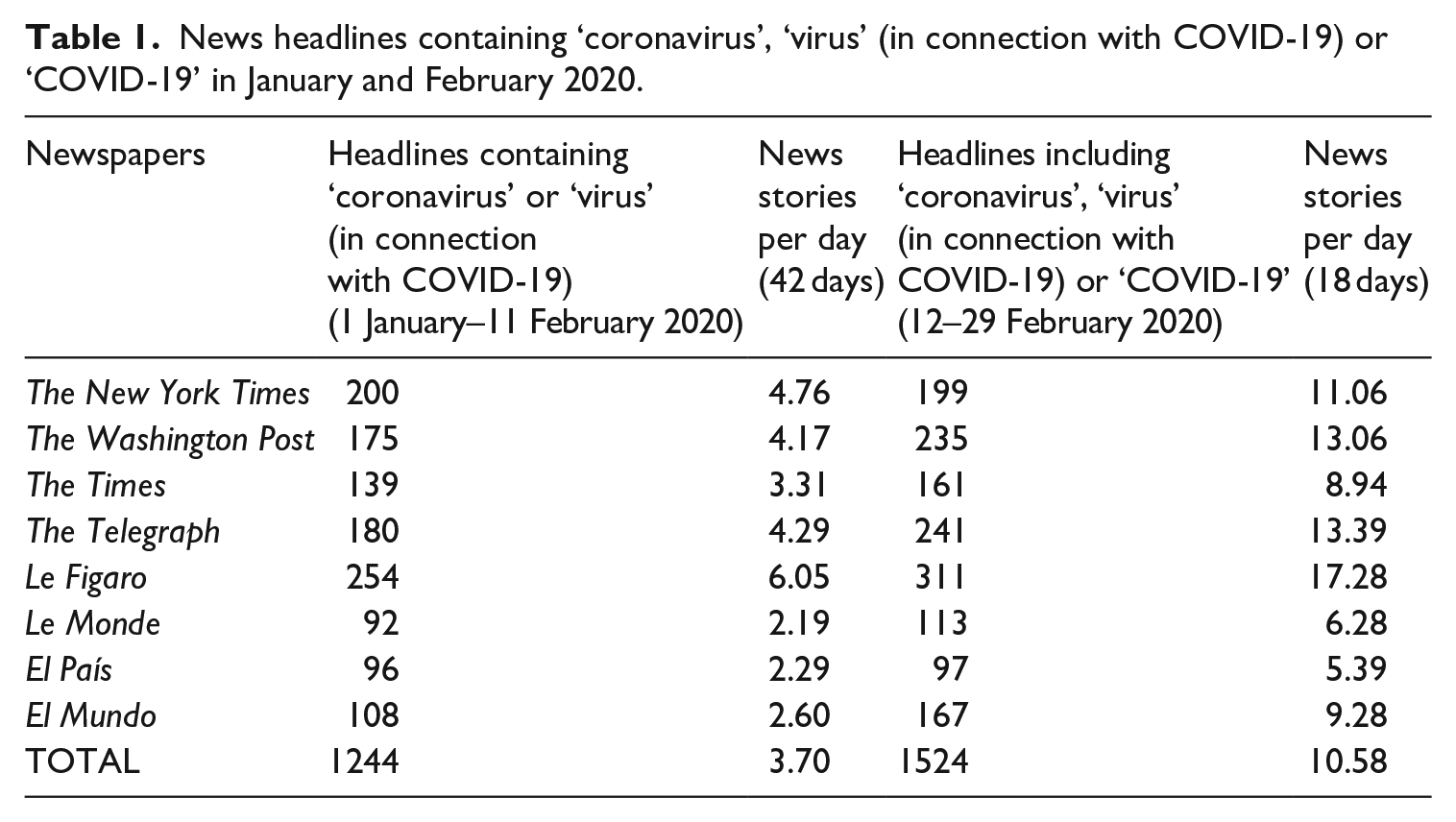
A comparison per country reveals that only in the case of French newspapers there is a stark contrast between the two selected periodicals, with figures almost three times higher in LF in comparison with LM. This could be partly due to the fact that LF seems to archive ‘flash’ or breaking news more systematically than other periodicals. Overall, this newspaper registered the highest number of headlines containing the keywords (565), followed by TTE (421), WSP (410), NYT (399), TTI (300), EM (275), LM (205) and EP (193). Interestingly, both LM and EP are generally associated with center-left political positions, as opposed to more common center-right views in LF and EM in France and Spain, respectively, while TTE and TTI (UK) can be categorized as conservative, and NYT and WSP (US) as liberal. It must also be noted, however, that our corpus is indicative of media attention and naming patterns based on our three selected keywords, and it is not intended to provide an exhaustive account of all news articles on the topic. Other virus or disease identifiers included less frequently in headlines, such as ‘disease’ or ‘epidemic’, were not considered for the purpose of our comparative analysis.
In the examination of keyword occurrences before and after 11 February 2020, we focused on identifying naming practices that did not conform to WHO Best Practices. Two groups of inappropriate uses were detected: references to geographic locations associated with the origin of the virus (‘Wuhan / China / Chinese virus’ or ‘Wuhan / China / Chinese coronavirus’) and qualifying adjectives that incite fear (‘deadly’ or ‘lethal’). In a few cases, both were combined, for example, in ‘deadly Chinese coronavirus’ (NYT and WSP) and ‘coronavirus mortal de Wuhan / mortal coronavirus de Wuhan’ (EP and EM). Table 2 provides an overview of all the occurrences of inappropriate names over the periods considered.
Inappropriate names of the COVID-19 causative virus and occurrences of ‘COVID-19’ in news headlines in January and February 2020.
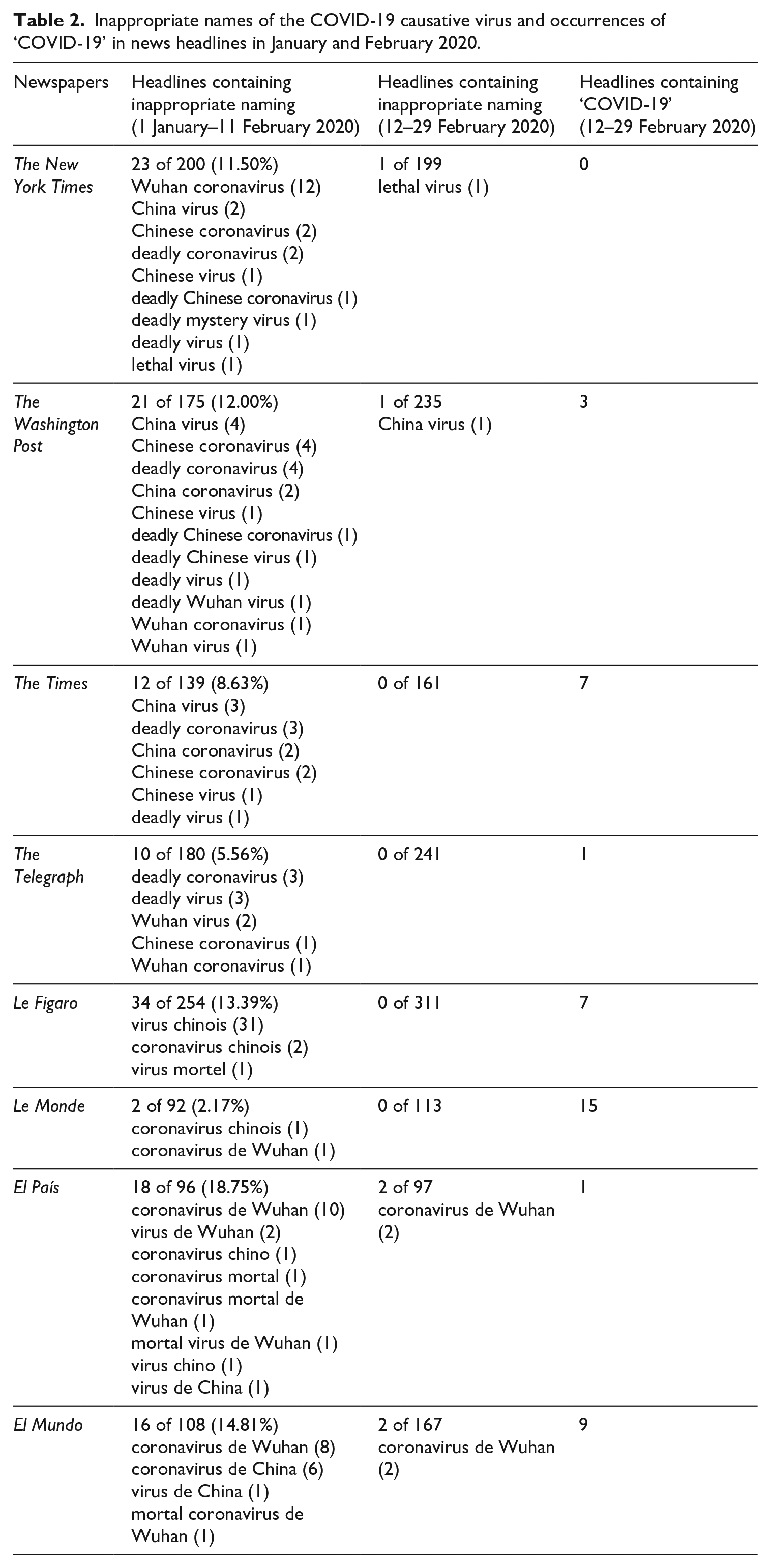
The most significant commonality in the findings is the drastic reduction of inappropriate naming in all the newspapers after the WHO announcement, from a maximum proportion of 18.75% (or 18 occurrences) in EP headlines in period 1 to a maximum of two marginal occurrences in period 2 in the same newspaper. In relative terms, the two Spanish newspapers registered the highest frequency of inappropriate uses in period 1 (EP was followed by EM with 14.81%). However, in absolute terms, the largest number of occurrences in this category was found in LF (34), followed by NYT (23) and WSP (21). The lowest figures correspond to the UK newspapers (12 in TTI and 10 in TTE) and, especially, LM (only 2 occurrences). These three newspapers score percentages of 2% to 9%, as opposed to a range between 11% and 19% in the case of the other five. Once again, the most striking difference within a country is found between LF and LM in France (13.39% vs 2.17%).
Except for the remarkably low incidence of inappropriate names in LM (one occurrence of ‘coronavirus de Wuhan’ and one of ‘coronavirus chinois’), the data thus suggest that potentially stigmatizing or alarming naming practices were not exceptional in the quality press in the first period. From a qualitative perspective, each occurrence of this kind of naming could contribute to building social perceptions and implicit associations about the virus and the disease at a time of marked instability before the WHO’s neologism recommendation. Inappropriate uses would be more in line with content simplification patterns characteristic of other sensationalist media (not covered by this study) than with public health authorities’ recommendations for emergency risk communication. This seems to apply, in particular, to the use of ‘deadly’ in English-speaking newspapers, whose audiences are probably more acquainted with the dramatic terminology employed in tabloids. The adjective ‘deadly’ modified ‘virus’ or ‘coronavirus’ in 8 (WSP), 6 (TTE), 5 (NYT) and 4 (TTI) headlines in English, compared to three cases of ‘mortal’ in EP and one in EM, and one occurrence of ‘virus mortel’ in LF. According to the WHO Best Practices, it is the adjective ‘severe’ that is ‘appropriate to use for diseases with a very high initial case fatality rate (CFR), recognising that the CFR may decrease as an event progresses’ (WHO, 2015: 3). This adjective was actually included in the full scientific name of the COVID-19 causative virus established by the ICTV on 11 February 2020: ‘severe acute respiratory syndrome coronavirus 2 (SARS-CoV-2)’.
Only in TTE headlines was the reference to the virus as ‘deadly’ the most recurrent collocation among inappropriate uses. In the other newspapers, references to geographic location were more common, with some significant variations: the association with ‘Wuhan’ was most frequent in EP (14), NYT (12) and EM (9), while references to ‘China’ or ‘Chinese’ predominated in WSP (13), TTI (8) and, in particular, LF (33). The latter is the only newspaper where all references to geographic location were expressed with a single adjective, ‘chinois’, which can be considered the most stigmatizing of the three modifiers, as it denotes a nationality. Collocations including ‘Wuhan’, albeit not conforming to WHO guidelines, make a more specific link to the city where the first cases of the disease were reported, whereas collocations including ‘China’ represent a broader generalization. In other words, even among inappropriate uses based on geographic location, a scale of more or less careful denominations can be established in light of the information available to public authorities and journalists during the first period of unstable naming.
In the case of the European newspapers, the virus denomination was often employed as a thematic tag or news series identifier in headlines, that is, the name of the virus was used to contextualize the specific piece of information that was then summarized after a colon. The term ‘coronavirus’ was the most frequently used in such cases, together with ‘coronavirus de Wuhan’ in EP and ‘virus chinois’ in LF. 15
The impact of the WHO’s naming recommendation of 11 February was also apparent in the way these identifiers were systematically replaced by more neutral terms, without any qualifiers. For instance, in EP, ‘coronavirus de Wuhan’ became simply ‘coronavirus’ (with two exceptions probably due to inattentive replication of previous uses), while LM started introducing ‘COVID-19’ as an alternative to ‘coronavirus’. In fact, LM also stood out for the frequency of the new official term in its headlines in period 2: 15 (13.27%), as opposed to 9 in EM (5.39%), 7 in TTI (4.35%) and LF (2.25%), and 3 or less occurrences in the other newspapers. In the case of NYT, after the news story announcing the WHO decision on 11 February, 16 no subsequent news headlines in February included the term ‘COVID-19’.
While other instances of the neologism could be embedded in the article texts, its low frequency in the headlines shows that the newspapers were generally slow in embracing and disseminating the new name, while the descriptive denomination ‘coronavirus’ became increasingly widespread. These findings also suggest that the WHO announcement was more effective in reminding the media about its guidelines to prevent inappropriate naming than in achieving immediate adherence to the new name for the disease. The potential factors behind the patterns found in each newspaper (for example, the more appropriate naming in LM before and after the announcement) would deserve separate attention.
Naming in the spotlight: the politics of names
After the official names for the disease and its causative virus were released, inappropriate names were dramatically reduced in the news headlines of the mainstream media observed, but not necessarily among other social and political actors who are regularly quoted in the news. Their naming choices are reproduced and framed through reported speech techniques that can hardly be neutral. The need to engage target audiences and generate clicks, among other factors, may condition how politically-motivated names adopted by sources are presented. In fact, such sources often provide information in forms that are tailored to how journalists are most likely to employ them (Lloyd and Toogood, 2015: 86–87).
From a sociosemiotic perspective, as the situation with COVID-19 progressed, and particularly after 11 February 2020, conflicting naming among politicians would be expected to encapsulate several layers of motivations. The official policies of naming and the politics of naming, both constructed through social discourse, can thus be regarded as closely related. In the broader context of political debate about the pandemic, the tension between scientific-evidence-based health recommendations, on the one hand, and economic and political interests, on the other, became particularly apparent in leaders’ communication strategies across nations. At the international level, the debate in the US was particularly sensitive because of the dynamics of global power relations. It provided a relevant example to illustrate the politics of naming and, more specifically, to examine the stance of NYT and WSP in reporting political speech, as political references to the virus and the disease attracted heightened media attention.
The week of 16 March 2020, at a critical point of the outbreak, NYT and WSP reported on the controversy triggered by the US President’s use of the term ‘Chinese virus’ on Twitter and in subsequent speeches. In Trump Defends Using ‘Chinese Virus’ Label, Ignoring Growing Criticism (published in NYT on 18 March), 17 Katie Rogers, Lara Jakes and Ana Swanson reported how the US President explained the rationale of his labeling during his briefing of 18 March (‘It’s not racist at all. It comes from China, that’s why’; ‘I didn’t appreciate the fact that China was saying that our military gave it to them’). They then refer to the WHO Best Practices as ‘more stringent guidelines for naming viruses’ released by ‘public health officials’ in 2015 in order to ‘avoid names that might result in discriminatory behavior against places or ethnic groups’ (they include a link to the guidelines, but do not quote the title). They also mention anti-stigmatizing naming recommendations by ‘medical historians and public health experts – including some in Mr. Trump’s administration –’ as credible sources.
Two days later, in a report published in WSP (Trump has no qualms about calling coronavirus the ‘Chinese Virus.’ That’s a dangerous attitude, experts say.), 18 Allyson Chiu summarized the same events and criticism, and highlighted the issue of coronavirus-related discrimination against Asian Americans. She reminds that ‘the World Health Organization and the Centers for Disease Control and Prevention have repeatedly encouraged people to call the disease caused by the novel coronavirus by its scientific name, COVID-19’. And she recognizes that: ‘In the early days of the outbreak, the terms ‘Chinese coronavirus’ and ‘Wuhan coronavirus’ showed up in media reports’, including her own newspaper. 19 The previous week, on 11 March, the US President had used the term ‘foreign virus’ when he announced a travel ban on 26 European countries. 20 In his speech of 30 March, just after the US became the country with the largest number of COVID-19 registered cases in the world, he added no adjectives to ‘virus’ or ‘coronavirus’, and his only reference to China was: ‘China sent us some stuff, which was terrific’. 21
While we have focused on the interplay between institutional, political and media discourses in the US context, many other examples of implicit blaming, critique or distancing techniques with regard to specific countries (versus images of victimization, support or self-confidence towards the perceived ‘ingroup’) were observed in other media and languages around the world as the pandemic unfolded, often reflecting nationalist attitudes accentuated by the global turmoil on many societal fronts. Such phenomena, which fall beyond the scope of this study, illustrate that media discourses are not a ‘mere conveyor’ of the news content but an arena of expressing the ‘views and intentions of the institutions and organizations that support and control’ the media discourses (Mey, 2017: 17). In this context, as keenly noted by Vanguri (2016: 1), ‘when a namer is granted the ability to shape our shared reality, naming is an ideological process that always encompasses social groups’.
In sum, the signifying power of virus and disease names, which are perceived to be much more than simply ‘identifier signs’ (Danesi, 2007: 49), lies in various connotative meanings ascribed by different namers. As with other lexical choices, these naming practices may reveal, or contribute to, embedded viewpoints and argumentation strategies (e.g. Prieto-Ramos, 2004: 97; Van Dijk, 2000: 56). Therefore, they should be construed on the basis of a variety of underlying institutional, cultural, social and political reasons for the meaning-making process.
Concluding remarks
The evolving labeling choices in the news headlines of the eight newspapers examined during the first stages of the COVID-19 outbreak show that naming is a socially situated behavior, and that this social construction of meaning is particularly dynamic in the context of new social phenomena. Our study illustrates the impact of domain-specific institutions in disseminating new labels and standards for these phenomena, more specifically, health authorities during health crises. While the ICTV followed its evidence-based naming policy for establishing ‘severe acute respiratory syndrome coronavirus 2 (SARS-CoV-2)’ as the name of the new virus, the WHO attempted to make the disease name ‘emotionally neutral and objectively descriptive’ (Hough, 2016: 11) by avoiding the use of terms related to geographical locations and the term ‘SARS’. After the WHO announced the new name ‘COVID-19’ on 11 February 2020, stigmatizing and alarming virus denominations previously found in leading mainstream newspapers of various ideological orientations (although at a remarkable marginal level in LM) almost disappeared from the same news outlets.
The analysis of news reporting in the US over a subsequent political controversy about naming the virus further illustrates how the voice of health authorities and experts can play a vital role in critical discourse self-awareness. In the case of NYT and WSP, this process involved a self-correcting turn from employing inappropriate names to exposing stigmatizing denominations by political leaders, as the WHO name for the disease gradually permeated the media and the spread of COVID-19 became a truly global crisis rather than a ‘foreign’ regional one. The ways in which related political views are echoed and decision-makers’ speech is portrayed also contribute to shaping public discourses and reactions at a more local level. As put by Mary Hui (2020), the ‘contention over how to label the new coronavirus underscores how in the combustible mix of a public health crisis and geopolitical rivalries, names do far more than convey information. They draw battle lines[;] a fierce struggle is underway to command the pandemic’s narrative’. 22
Overall, in revisiting and shedding light on the nature and social implications of naming, and by unveiling what is at stake in the case of the COVID-19 pandemic, this paper points to emerging patterns for future studies of a similar kind, particularly at a time when firm understandings and clear established knowledge are not yet in existence. As the economic consequences of the international lockdowns, as well as the misjudgments of individual governments, come to light and are presented to the public, naming processes, and finger-pointing discourses at large, should continue to be critically scrutinized. As illustrated here, naming choices can carry powerful resonances of the tensions between political and technical considerations in handling a pandemic where information flows in real time and at unprecedented levels of interconnection between communication channels worldwide. Scholars in critical discourse studies will be keenly interested in monitoring these naming processes and their bearing on how we judge and act in times of crisis.
Footnotes
Acknowledgements
The authors are grateful to Teun A. van Dijk (Pompeu Fabra University) and Jan-Ola Östman (University of Helsinki) for their comments and insights.
Declaration of conflicting interests
The author(s) declared no potential conflicts of interest with respect to the research, authorship and/or publication of this article.
Funding
The author(s) received no financial support for the research, authorship, and/or publication of this article.