




Abstract
We explore the lexical choices made by authors published in Administrative Science Quarterly (ASQ), a major academic journal in business and management studies. We do so via a corpus constructed from all the articles published in ASQ from its first publication in 1956 up until the end of 2018. Specifically, our focus is on lexical items that represent social actors. Our findings suggest that, compared with earlier work, recent articles typically ascribe greater status and prestige to organizational elites. Relatively contemporary papers are also more likely to use language that obfuscates or ignores unpalatable aspects of organizational life, such as power asymmetries, hierarchy and control through identity regulation. We suggest that these changes in word choices can be understood to reflect a wider trend towards neo-liberal rhetoric – a rhetoric increasingly pervading contemporary social life more generally.
Introduction
In determining the need for money or people, the administrator defines his problem, estimates his situation, calculates his alternatives, makes a choice, and thus in fact makes a decision. (Litchfield, 1956: 21) The personalities of chief executive officers (CEOs) affect not only their own individual behavior but also the behavior of the firms they lead . . . For CEOs, the choice to acquire involves many decisions, such as whether, what, when, and for how much to acquire. (Malhotra et al., 2018: 370)
Both the excerpts above come from articles published in the academic management journal Administrative Science Quarterly (ASQ) – a journal among the oldest and most prestigious in the academic field of business and management. 1 We include them at the start of our article because they illustrate the marked difference in the tone of work from early issues of ASQ when compared with contemporary material from the same journal – a difference apparent even from a superficial reading. In particular, we note the use of the term administrator in the first excerpt and CEO in the second. These words have very different semantic auras, but seemingly refer to social actors carrying out similar activities.
Such evident differences were the inspiration for this article, in which we provide a detailed investigation into the nature – and wider significance – of the changes in the word choices made by ASQ authors over the years. To undertake the investigation, we used an approach based on corpus linguistics (CL), having created a corpus from every article appearing in the journal between 1956 (ASQ’s first publication date) and the end of 2018.
The sub-discipline of business and management studies widely known as Critical Management Studies (CMS; Alvesson and Willmott, 1992) provides us with the primary intellectual resources for performing a critical reading of the ASQ corpus. CMS, like Critical Discourse Analysis, is critical insofar as it takes neither social structures nor discursive representations for granted, but assumes a dialectical relationship between them. CMS is concerned in particular with revealing and resisting the power asymmetries inherent in standard management practices – practices that might conventionally be assumed to be merely technical in nature.
In this context, CMS has long drawn attention to the important role that representational practices play in extending the everyday power of organizational elites. Both mundane representational practices (e.g. informal conversations by the photocopier) along with more formal ones (e.g. academic publications) are understood to be implicated in such power dynamics. Indeed, scholarly (and other) writing in management studies has been seen as a new ‘identity resource’ (Beech et al., 2008: 964) – a resource which academics and practitioners may embrace or resist. What follows from such an understanding of academic writing is that, as the nature of the writing changes over time, identities are likely to change too, albeit in a complex dialectical relationship.
It is against this background that the article reports on our conclusion about changes in word choices made by business academics. We will focus in particular on which organizational actors they refer to, and how. The representational practices of business academics are important, not least because, as McDonald (2017) has shown, top academics in the field have been highly influential in shaping the attitudes and beliefs of the people who run organizations; though it is likely that the beliefs and attitudes of top managers have been equally influential on business researchers as well. Our contention is that discursive constructions in management journals are part of a complex symbolic order within organizational life that permeates the taken-for-granted assumptions of organizational actors – academics and practitioners.
The aim of this study – of charting the representational practices of business academics over time – guided our choice of ASQ as exemplifying such changes. As one of the world’s longest established, most prestigious and widely cited academic business journals, the lexical choices made by authors in ASQ seem likely to have been highly influential in the wider field of business and management studies. It is important to state at the outset that our study brings together the expertise of a corpus linguist with that of a specialist in business and management studies. The interdisciplinary nature of our study was central to its aims – a linguist working alone would likely have been unable to navigate the nuances of business research, just as a non-linguist would have been unable to apply the theory and method of CL effectively.
The article proceeds as follows. After analysing the wider socio-political background to the neo-liberal changes in society, including in organizations, we set out our method and our key findings. In the discussion, we show the significance of the main lexical changes and their impact both on management studies as a discipline and management practice.
The wider socio-political background
Guiding our study is the widely accepted view (widely accepted, at least in more progressive circles) that around the late 1970s, something momentous started to happen across the West – a phenomenon that many commentators have subsequently called neo-liberalism (Davies, 2017). And ever since the 1980s, we have witnessed the seemingly ineluctable triumph of the people who run business over rivals such as the unions and the regulatory state. Their triumph has endured, after a financial meltdown in the first decade of the 21st century; and even today, it continues to affect all our lives profoundly.
Our initial expectation was that in parallel with these relatively easily measurable economic developments, there have also been rather more subtle changes. One of these seems likely to have been a gradual drift in the language we use to talk about the nature of work and of our working lives (Learmonth and Morrell, 2019; Mautner, 2010). We understand this drift in language to be ideological. By an ideology, we mean ‘a stream of discourse that promulgates, however unwittingly, a set of assumptions about the nature of the objects with which it deals’ (Barley and Kunda, 1992: 363). In other words, we expect discourse – including academic discourse – to have gone in the same direction as the economic changes: regardless of individual authors’ intentions, much academic writing in business and management may have both reinforced the advantages enjoyed by the people in charge while becoming increasingly euphemistic about the problems faced by ordinary organizational actors.
As representative of a much wider stream of CMS-style literature, we have chosen to focus on studies central to our empirical concerns. That is, on studies that show how the representation of what, at first glance, might appear to be relatively ‘neutral’ ways of representing aspects of organizational life can be understood to have important constitutive effects that are in line with the effects of neo-liberal rhetoric more broadly. Such broader effects might include, say, the redefinition of job insecurity as free agency or the portrayal of billionaire tycoons as regular guys. This sort of rhetoric tends to hollow out classical notions of organizational politics, reducing debate about alienation and exploitation to problem solving and team building (Learmonth and Morrell, 2017; Lears, 2015). In the next subsections, then, we draw attention to concepts particularly relevant in this context: teamwork and leadership. Both correspond to terms that occur in our corpus, with team and leader being among the 100 most frequent nouns.
‘Teamwork’ as control
It has been possible to link the discourse of teams with the managerial elites’ definitions of organizational realities, at least since the seminal work of Fox (1966). In setting out alternative ways of seeing organizations as unitary or pluralistic, Fox (1966) asked, ‘[w]hat is the closest analogy to the enterprise – is it, or ought it to be, analogous to a team, unified by a common purpose, or is it more plausibly viewed as a coalition of interests?’ (p. 2). He himself expressed a preference for the pluralistic frame of reference, asserting that organizations are best thought of as temporary coalitions of competing interest groups. Fox (1966) did, however, recognize that the discourse of teams ‘represents a vision of what industry ought to be like which is widespread among employers, top managers and substantial sections of outside public opinion’ (p. 3). Furthermore, because of its unitarist resonances, routinely representing organizational life in the language of teams tends to write out other available ideas about organizations. It is, for example, a tacit denial of what Ezzamel et al. (2001) refer to in a Marxian sense as the ‘structured antagonism between capital and labour’ (p. 1058), because the common-sense reading of teams implies that everyone is playing for the same side and aiming for the same goals.
Fox’s (1966) insights have been supplemented by arguments with greater emphasis on how talk of teams can be a powerful way for individuals to do identity work (Alvesson and Willmott, 2002). This means that the discourse of teams can act as a positive, if perhaps seductive, resource in the construction of individual and collective identities. For example, Mueller et al. (2000) note that describing joint activity as teamwork often connotes ‘collaboration, conviviality, comradeship and commitment’; the term thus ‘seems to carry a nearly irresistible appeal to social, moral and individual imperatives that are difficult to deny’ (p. 1388). At the same time, however, internalizing the need to be a team player is also likely to encourage forms of self-surveillance that are clearly in line with traditional managerial concerns with commitment, motivation and so on (Barker, 1999; Ezzamel and Willmott, 1998; Sewell, 1998). In other words, the discourse of teams is in line with neo-liberal rhetoric in that it takes for granted managerial prerogatives and imperatives.
The language of leadership
As for the terms leader(s) and leadership, the critical literature suggests that the practice of describing organizational elites as leaders is not merely a matter of convenience or fashion – it too is interest-serving (Alvesson and Kärreman, 2016; Ford and Harding, 2007; Learmonth and Morrell, 2019; McCann, 2015). Hendry (2013) shows how many people probably think of what it must be like to be a manager – the more traditional term for such elites: For most managers, management is basically a job . . . Few people become managers . . . out of a sense of vocation. It is not something they do out of a burning desire to express themselves, to contribute to society or humanity, or to take a stand on issues that matter to them. A successful manager . . . might well be proud of her achievements, but being a manager . . . is rarely in itself a source of great pride . . . . It is a job, and a good and respectable job, and for many people an interesting and/or remunerative one, but at the end of the day it’s just a job. (pp. 96–97)
In contrast, Petriglieri and Petriglieri (2015) point out how today’s dominant cultural image of the organizational leader is rather different: The image of leadership that predominates is of an individual ascending to, or occupying, a position of hierarchical power, competently adapting to his or her environment, and wielding his or her influence to achieve financial (or otherwise measurable) results and, in so doing, rising further up the ladder. . . . [thus, this image] portray[s] leaders as ‘crafters of their own fortunes’ . . . in a world where success – usually defined as promotions and profits – hinges on making the right decisions in high-stake situations . . . a worldview in which individualism and heroism prevail. (p. 631)
From this point of view, it is arguable that when we call one person a leader and another person a manager, we are not just naming them differently. While managers might often be imagined as bureaucrats, leaders can be seen as admired by their followers, shareholders and market analysts alike; imagined too, as being able to transform organizations and those who work for them as they pursue their visionary strategies (Wilson, 2016).
In summarizing this section, we are arguing that ‘labels’ for social actors, whether leader, team member or a range of others discussed below, are not merely labels, but they typically convey (or gloss over) identities and power asymmetries, as well as legitimize certain constructions of roles and functions. Indeed, two common threads run through discourses like teams and leadership that strongly suggest they are very much in line with wider neo-liberal rhetoric. The first is the effect of glamourizing organizational life – an effect making it more likely that individuals will internalize the discourses as part of their repertoire of personal identities. The second is related – the effect that less palatable aspects (such as hierarchy and power asymmetries between elites and others) are obfuscated or actively ignored. In particular, the discourse of teams and leadership both imply that happy relationships predominate between the so-called team members, or between the leaders and their followers. Having mapped out the socio-political and conceptual territory in which our study is located, let us now turn to the method employed.
Method
The empirical part of our research design was aimed at exploring key lexical choices made in academic management writing, and how these changed over a period of about 60 years. Our study is a diachronic, computer-assisted, critical study, investigating a large dataset which comprises a corpus of approximately 16 million words made up of articles from ASQ. The evidence gleaned from the corpus – such as frequencies and collocational patterns – will be related back to and interpreted against relevant strands of literature in organization studies such as those above. Although the use of CL in discourse research is now well-established (Mautner, 2019), it is not yet part of the mainstream methodological canon of organization studies. That said, there have been studies in this discipline that use the method or related approaches (e.g. O’Reilly and Reed, 2010; Stenka and Jaworska, 2019). Indeed, Pollach (2012) provides an insightful overview of the method for organizational scholars, a literature review of its use in organization studies, along with a demonstration example using a text corpus of company letters to shareholders.
The ASQ corpus was initially built in 2014. The basic building process was relatively straightforward, if laborious: using EBSCO-Host, each article and book review in every issue of ASQ since its first publication in 1956 was downloaded and saved (initially on to a Word file in TXT format). For the earlier material, the ‘HTML full text’ was downloaded, though since 1990, PDF files were downloaded and converted to TXT files when HTML files were unavailable. Information such as author details, abstracts and reference lists, along with figures and images were removed prior to saving; also, any text appearing in the journal other than articles and book reviews (e.g. ‘notice to contributors’, ‘errata’, ‘news and notes’, ‘from the editors’) was not downloaded. The final corpus was constructed from these basic building blocks – that is, individual articles and book reviews. The files were saved in such a way that any section of text could easily be identified to the year of publication as well as to the original source document. These TXT files were then converted to a format suitable for loading into Sketch Engine (2019). They were also cleaned up, partly manually and partly with automated search-and-remove functions, to eliminate non-words created by line-end hyphens as well as characters misread by the conversion software. The corpus was updated at the end of 2018, so the version used for this article covers the period 1956–2018 inclusive. It comprises 3547 articles and book reviews – a total of 15,885,378 words. Furthermore, to facilitate comparisons across time, we compiled six subcorpora of roughly equal length within Sketch Engine: material from the 1950s/1960s being one subcorpus along with subcorpora for the 1970s, 1980s, 1990s, 2000s and 2010s.2,3
The salience of social-actor labels and other key terms
To gauge the salience of different social-actor labels in the corpus, we began by using Sketch Engine’s wordlist function. This can be used to filter results by major word classes and thus to draw up a list of all nouns in each of the six subcorpora. Focussing on the top 100 nouns, we first picked out all the items referring to people and then, in a second round, selected only those that denoted categories of organizational actors (e.g. worker, employee, leader), discarding, for the time being, those referring to collectives (e.g. group, team and people). We also decided to ignore those that were so generic so as not to belong to any specific social domain (such as individual or person); or seemed more closely aligned with a social domain different from the one we were focussing on (such as student); or were clearly part of the meta-discourse of scholarship (such as author and participant) rather than referring to organizational actors as such.
Across all six subcorpora, manager and employee are the only ‘words of interest’ that are located consistently among the 100 most frequent actor words. For manager, the relative rank is even higher (at least among the top 35), and employee is among the top 50 in all the subcorpora but one (the 2000s). We highlight the following:
Manager is outranked by member, however, in all subcorpora except the 1990s, and there, the difference is minimal (ranks 16 and 17 for manager and member, respectively). We took this as a clear signal that member would need closer attention than its apparently non-domain-specific nature originally suggested.
Contrary to our initial expectations, leader appears only once among the top 100, in the 1970s (in 94th place) – the first sign that leader and manager will be shown to ‘behave’ quite differently in our corpus.
Very much in keeping with our initial expectation – because the term makes unpalatable organizational hierarchies explicit – the position of worker is in steady decline over time, dropping from rank 54 in the 1950s/1960s to 78th in the 1980s and 88th in the 1990s. In the most recent 20 years, it no longer features among the top 100 nouns.
Similarly, we had felt that administrator would be disappearing over time because it implies a relatively lowly status for elites. And, in fact, it only makes it to the top 100 once, in the oldest subcorpus. Even then, it ranks low down, in 93rd place.
CEO, now the label par excellence for the man or woman at the top, does not appear in the corpus until the 1980s. By the 2010s, however, it has become the highest ranked actor word in the top 100 noun list.
Thus, across the six subcorpora, there are three constants, member, manager and employee; and two notable exits, administrator and worker. There is also a notable entrance, CEO, which, once it has entered usage in the 1980s, moves steadily upwards until it becomes the most frequent social-actor label in the 2010 corpus.
The next step was to look at the normalized frequencies (per million words) of three kinds of items:
Social-actor labels that the previous round had identified as words of interest because they were among the top 100 most frequent nouns in at least one of the subcorpora and had a recognizable semantic connection with the domain of organization and management: administrator, manager, leader, employee, worker, CEO and member.
Social-actor labels that were outside the top 100 on the wordlist of nouns, but that our review of the socio-political background suggested would be relevant for understanding the social domain in question, in particular with a view to hierarchical relationships between actors. We thus added foreman, superior, supervisor and subordinate.
Items of various word classes that the literature review led us to believe were thematically connected to social actors in organization and management: corporate, entrepreneur, entrepreneurial, bureaucracy, bureaucratic, bureaucrat, authority, hierarchy, market, staff and team.
Table 1 gives the normalized frequencies for these terms in the decade-by-decade subcorpora.
Normalized frequencies of selected words of interest (per million words; rounded figures).
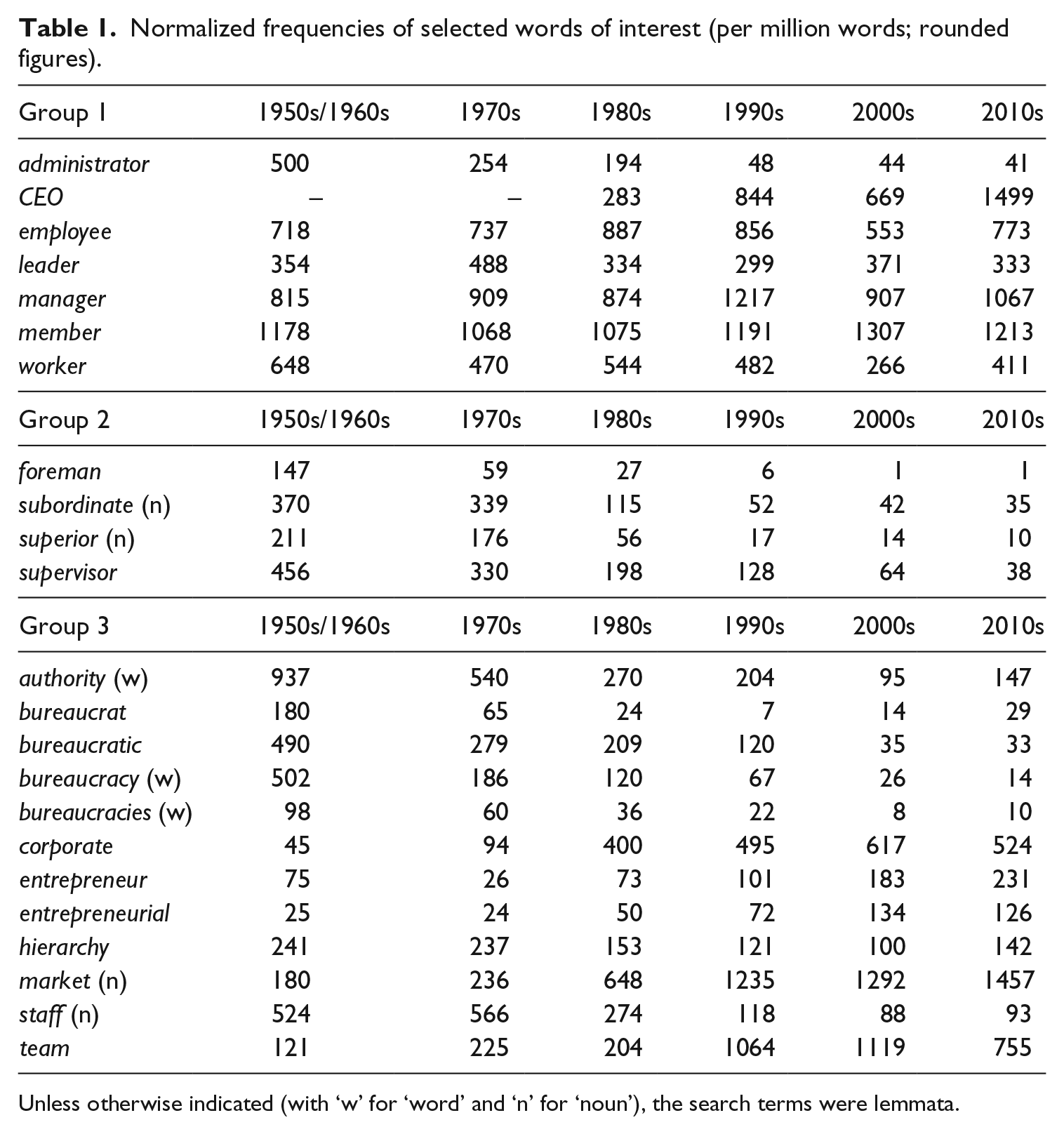
Unless otherwise indicated (with ‘w’ for ‘word’ and ‘n’ for ‘noun’), the search terms were lemmata.
In reviewing the figures for each group, we can see that in group 1, the frequencies per million words for administrator and CEO mirror the results for frequency rank reported earlier; we have a steep decline for the former, and a steep rise for the latter (Figure 1).
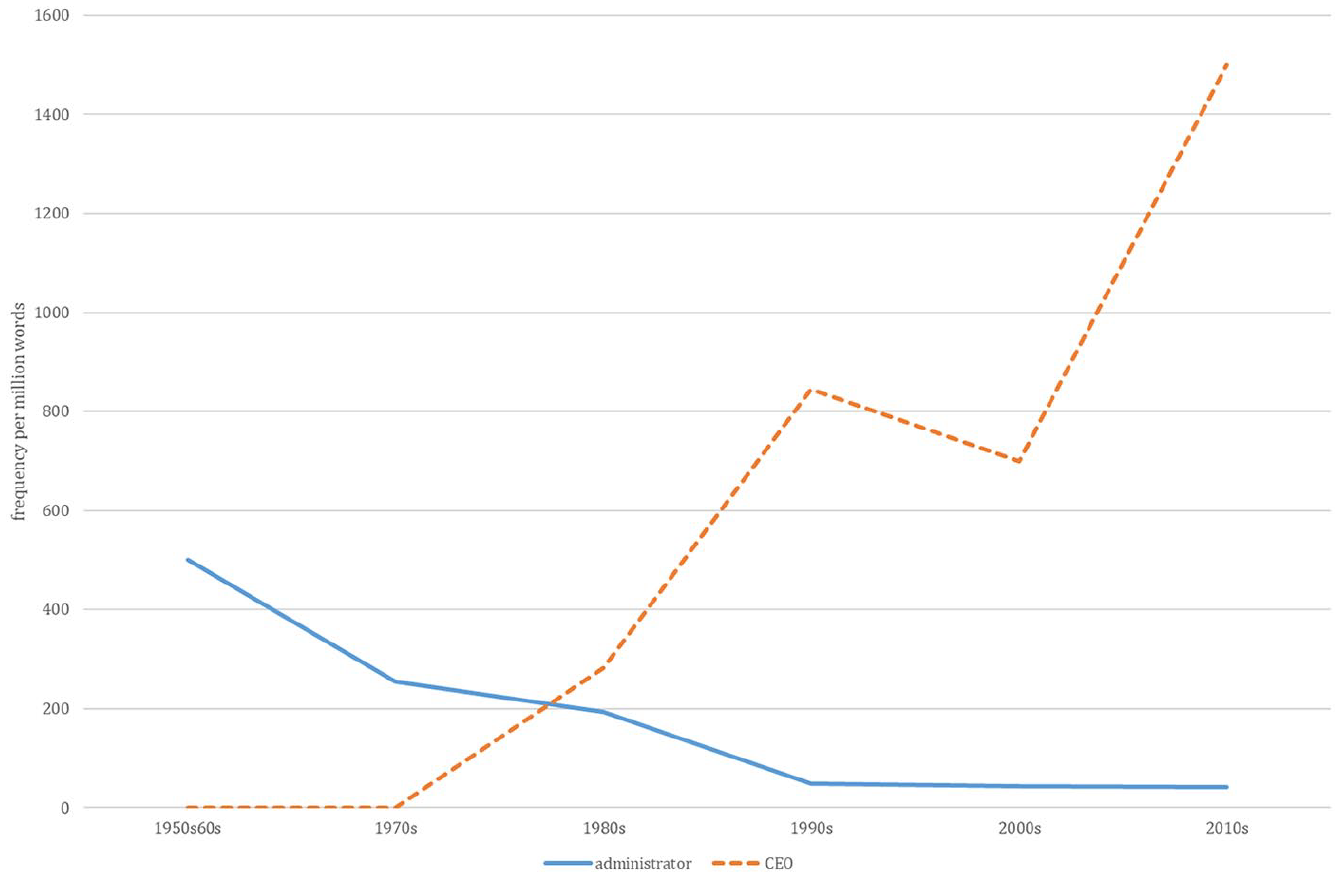
Frequency per million words of administrator versus CEO across time.
Four of the other nouns in group 1 – employee, leader, manager and member – by and large exhibit continuity through time. This does not seem too surprising in the case of employee and member, which are both ostensibly more neutral labels than worker or administrator and are thus likely to be affected less by changes in values and attitudes, both in organizational practice and in academic reflections on it.
Moving on to group 2 in Table 1, we can see that four social-actor labels are in sharp and indeed linear decline over time. Three make a hierarchical relationship explicit, namely supervisor, subordinate and superior (the latter two we searched for specifically with the restriction that we wanted occurrences of nominal usage only). Another one is perhaps associated with traditional forms of (male-dominated) work organization, namely foreman (Figure 2).
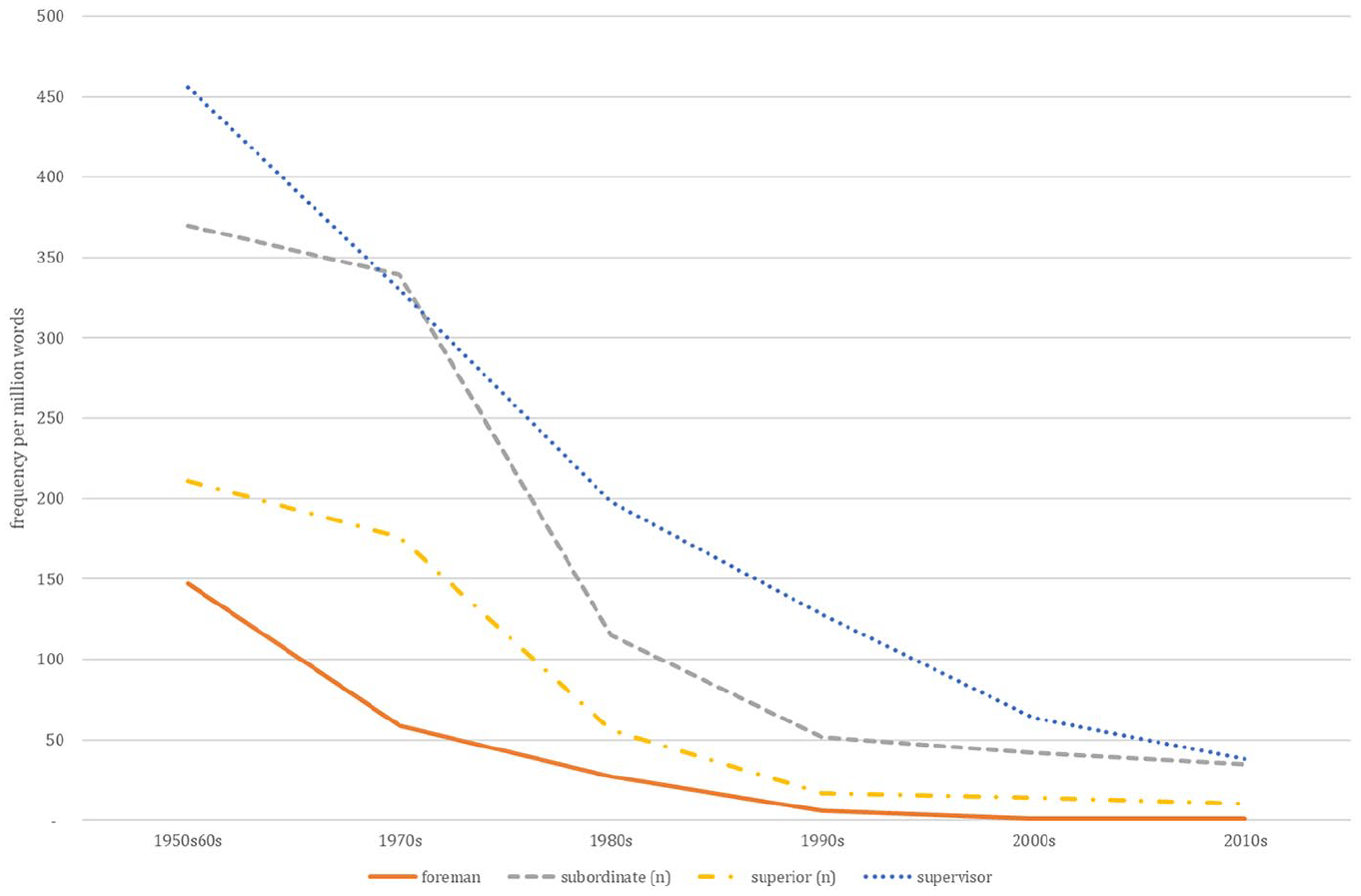
Frequency per million words of foreman, supervisor, subordinate and superior.
Group 3 includes a cluster of words that we considered might be indicative of wider social trends. That is, away from the representation of organizations as bureaucratic structures and towards representing them more via neo-liberal ideologies. And indeed, the patterns are quite consistent, although they are not always unbrokenly linear. Authority, bureaucrat(ic), bureaucracy and hierarchy have declined – in some cases quite markedly – whereas corporate and market have risen, both of these lexis from the wider repertoire of neo-liberalism (Mautner, 2010; Figure 3).
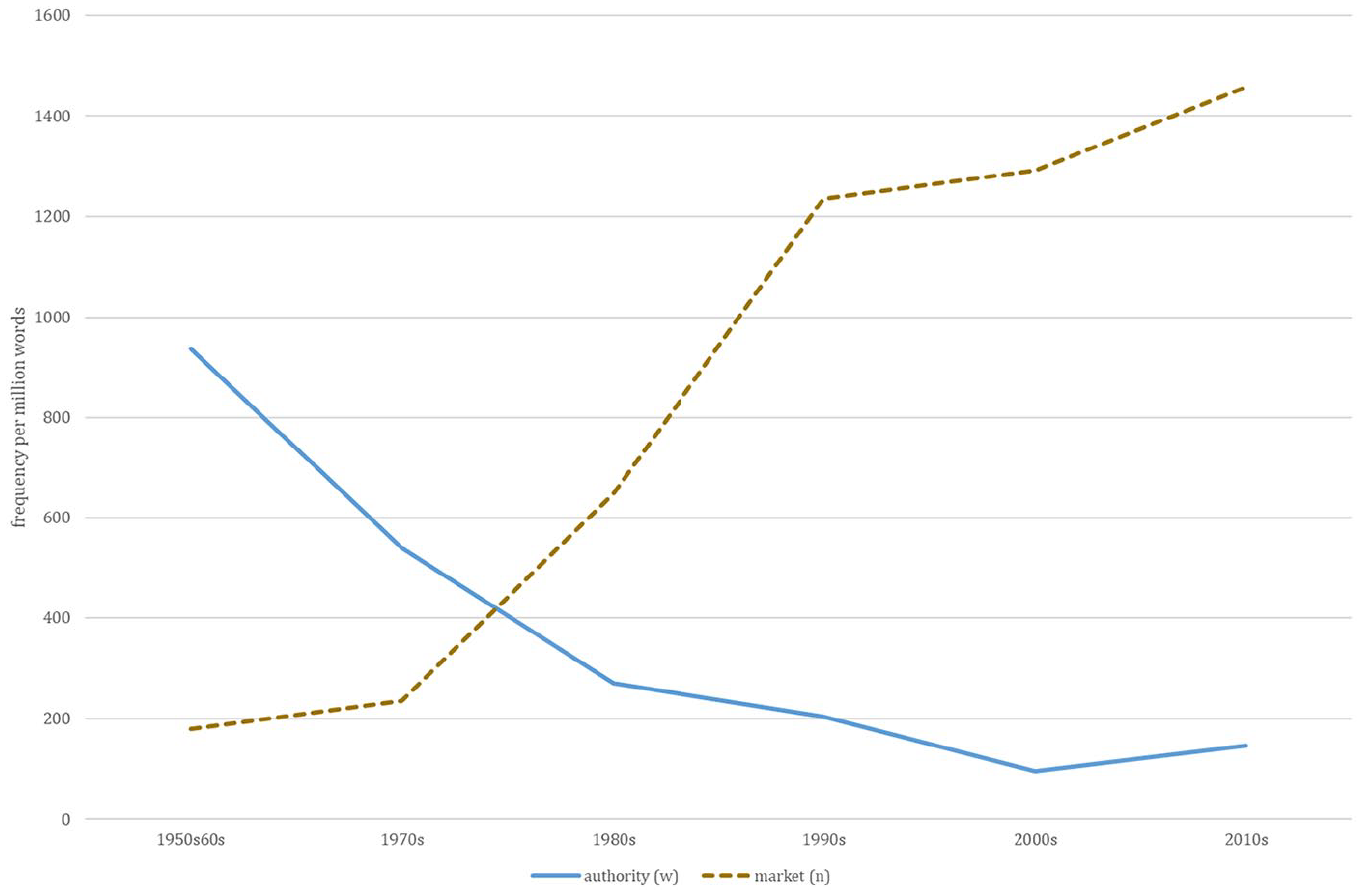
Frequency per million words of authority versus market across time.
Furthermore, staff and team are particularly interesting. It seemed puzzling at first why staff – ostensibly such a neutral word – should have declined, and team gone up. We found the answer as we were trying to solve the puzzle over member, which was high frequency but did not change over time. The second strongest collocate of member in the 1950s/1960s was staff (topped only by faculty), whereas in later subcorpora, member became the preferred partner for team (See Figure 4).
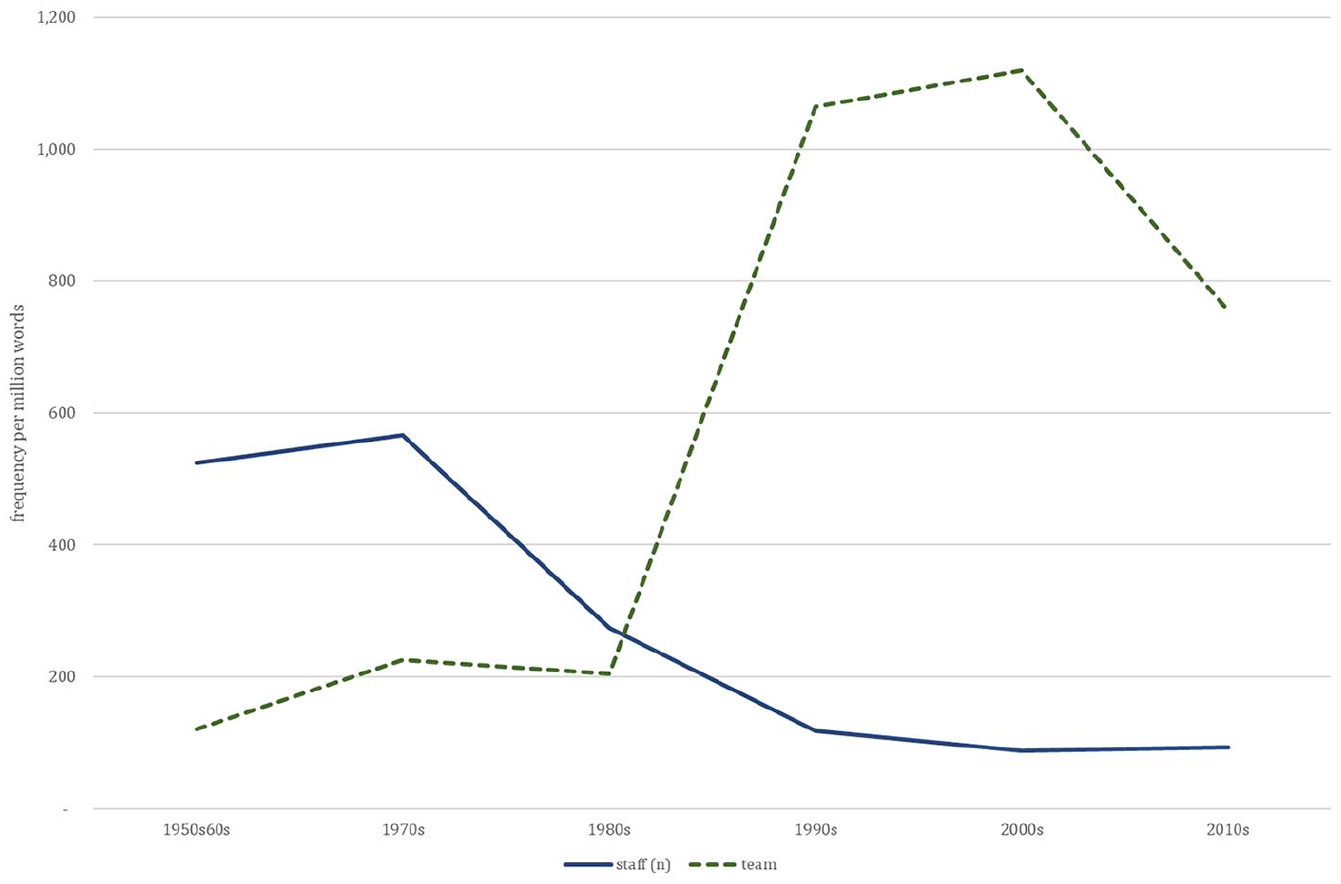
Frequency per million words of staff versus team across time.
We interpret this change as indicating a shift in how subordinates are represented. Staff points to a hierarchical employment relationship, whereas team might be taken to suggest equality. It clearly makes a big difference whether a boss refers to people reporting to them as staff members or as team members. This finding leads us straight to the next section, which deals with collocations.
Collocations
In one journal article, it is impossible to build a detailed ‘collocational profile’ (Mautner, 2007: 52) of every social actor involved. In what follows, therefore, we restrict ourselves to those terms whose frequencies ran contrary to our expectations. The frequencies of virtually all the social-actor labels show a consistent pattern that is in keeping with our original assumption that language would broadly migrate towards a neo-liberal consensus. To recap, words that express or imply traditional forms of organizing have been in decline (e.g. administrator, bureaucrat, subordinate, supervisor, worker), whereas those associated with the new, neo-liberal work order have been on the rise (e.g. entrepreneur, market, team). However, the exceptions are manager and leader. In accordance with the dominant ideological trajectory identified in the literature, we would have expected manager to decrease and leader to increase in frequency over time. Yet their frequencies of occurrence show little variation over time.
To unravel why these two social-actor labels were exceptions, we decided to adopt the more qualitative lens provided by collocation analysis. We began by generating concordances for both lemmata separately for each decade. Using Sketch Engine’s ‘collocation tool’, and setting a span of three words to the left and the right, we extracted the words most closely associated with the nodes (according to the LogDice 4 scores). This is what we found:
Across the whole period investigated, there is practically no overlap between the strongest collocates of leader and manager. (The function word who is the only item that appears among the top 10 for both words.) The picture changes slightly when we concentrate on adjectival collocates immediately to the left of the node (see point 3 below), but the fact remains that for all their semantic relatedness, leader and manager clearly have very different collocational profiles.
Indicative collocates for manager – in the 1950s/1960s – include several words that specify the manager’s function or geographical responsibility (city, departmental, plant, marketing, district, production) as well as assistant and top. From the 1970s onwards, top actually heads the list of collocates, and more adjectives indicating a hierarchical position come in as well (lower-level, middle-level, middle and senior).
Among the 10 most frequent collocates, those for leader in the earliest subcorpus include community, business, political, union, labour (as well as civic, legislative, military and party in the top 20), thus showing the word’s association with the public domain in the widest sense. Followers is among the top 10 as well. Notably, so is charismatic. In the 1980s and the 2000s, team heads the list; in the 1990s, it still occupies rank three. In the 2010s, however, the strongest collocate is corporate.
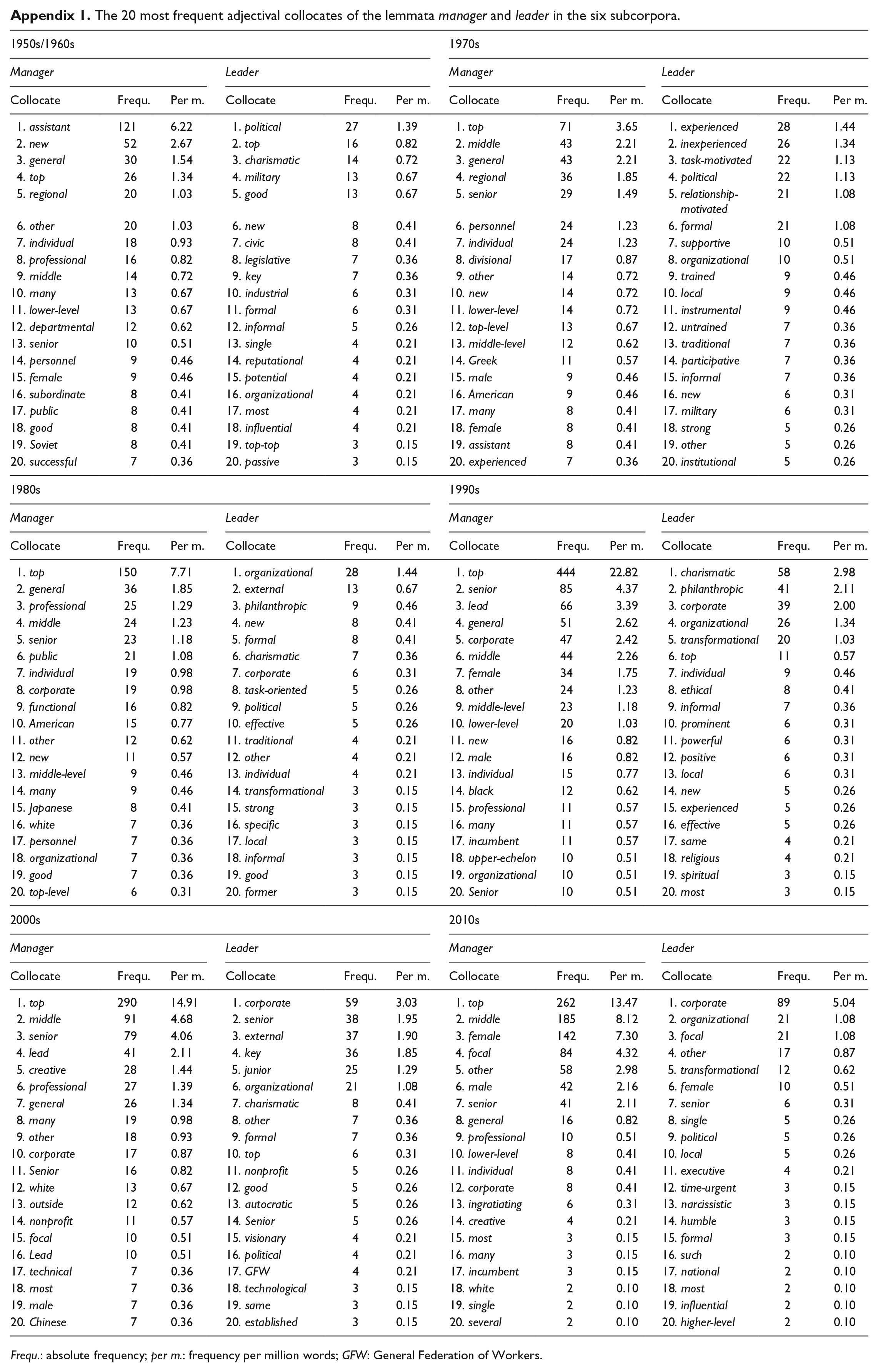
In a next step, we narrowed our search to the node words’ immediate left context, and specifically to adjectives in that position (see Appendix 1 for the details). In the oldest subcorpus, the most frequent adjectival collocate for manager is assistant, and top for all other decades. For leader, the most common adjectives are political in the 1950s/1960s, experienced in the 1970s (followed immediately by political), organizational in the 1980s, charismatic in the 1990s and corporate in the 2000s and 2010s. With the exception of political, none of the ‘public domain’ adjectives that are among the top 20 adjectives in the oldest corpus (military, legislative and civic) retain that position in the most recent one. It appears that the traditional use of leader for the world of politics has by the 2000s migrated into the organizational and corporate world.
Within the top 20 adjectival collocates, another tendency emerges. Those that modify manager on the whole carry less evaluative semantic loads than those that modify leader. In fact, the only overtly evaluative adjectives to collocate with manager are creative, experienced, good, successful and – as the only negative one – ingratiating. For leader, by contrast, the list is considerably longer and includes the positive adjectives charismatic, good, effective, ethical, experienced, humble, philanthropic, powerful, positive, prominent, strong, supportive and visionary; the negative ones to modify leader are inexperienced, narcissistic, passive and untrained. Thus, whereas manager is predominantly a purely functional label without any need to explain or justify the title, the semantics of leader is more malleable.
Finally, the ‘Word Sketch Difference’ comparison of manager and leader across the whole corpus showed that where manager was the subject, the verbs that emerged as particularly typical were describe and report, whereas for leader as subject the distinctive verbs were initiate, achieve and encourage. However, when we built ‘word sketches’ on a decade-by-decade basis, attempting to obtain a more fine-grained picture of the types of activity that these actors were typically associated with, there was no pattern or systematic difference.
Discussion and conclusion
In this final section, we address the following four questions: (a) What do we learn about the method employed that might be of wider interest to scholars doing similar work? (b) What do the results mean in terms of furthering our knowledge of the socio-political background in which elite scholarly writing takes place? (c) What is the significance of our findings for critically evaluating social scientific writing as a discursive practice? (d) Are our findings likely to be relevant to organizational actors who may think of their identities using the terms we have discussed, for example, as managers, leaders or team players?
Reflections on method
First of all, a few comments on method are in order. In discourse studies, CL has been shown to be a valuable addition to the toolbox – particularly in cases like ours where the dataset in question is far too big to even contemplate the qualitative analysis of complete texts. Even a close-up study of concordance lines would have been too unwieldy, given that we were interested not only in a small number of words relevant for a particular social domain, but in quite a range, and not in one, but six different subcorpora, spanning nearly 60 years. By restricting the analysis instead to the computer-supported compilation of frequencies and selected collocational patterns, we were able to come to grips with a corpus that would otherwise have been intractable due to its sheer size. But of course, as always, the biggest strength of a method is also a potential weakness. Data aggregation comes at a price.
The bird’s eye view that we obtained affords little or no insight into the detailed mechanics of meaning-making as it unfolds in situated discourse. We may catch glimpses of such processes on the basis of the traces they leave in lexical choices, but what is generally hidden from view is the sentence-by-sentence progression of arguments. By the same token, a CL approach will not be the method of choice when the aim is to unpack discursive strategies that are elusive precisely because they are not associated with specific lexical items, but manifest themselves linguistically in diverse and unpredictable ways. (As far as the latter problem is concerned, the workaround suggested by Lutzky and Kehoe (2017) is a compelling solution for investigating the realization of a particular speech act, but this was not a viable option for us, given our much broader remit.)
There is no perfect solution to these grand epistemological challenges. Awareness is crucial however, and in that spirit, we have exercised caution in assessing the evidence, making sure that any interpretative claims were commensurate with what the corpus data suggested. In fact, in discourse studies generally, ‘proof’ may be too much to ask, and one has to settle for plausibility instead.
The socio-political background of elite scholarly writing
It is perhaps unsurprising that we have found the social-actor labels used by ASQ authors to have changed over time; after all, some changes are only to be expected over such a long period. What we were more surprised by, however, was just how consistently our initial expectation about the neo-liberal drift in language has been supported.
Today, for example, elite actors are consistently portrayed in much more flattering terms by ASQ’s authors than they were in the 1950s. As we have shown, terms for elites which now have negative semantic auras (such as bureaucrat or administrator) and were relatively common in the 1950s and 1960s have virtually disappeared by recent times. CEO, on the other hand (a term not used at all until the 1980s), has become one of the commonest nouns in the periods covered by the later subcorpora. Similar upward trends are also apparent (if not quite as marked) with other positively loaded words describing elites – entrepreneur and corporate, for example. Equally noticeably however, there has been a decline in terms suggesting that these elites might wield direct, coercive authority. The use of labels like superior, supervisor and subordinate, for example, have all dropped considerably in the last few decades – as indeed has the use of the abstract noun authority itself. At the same time though, there has been a rise in terms that can be read to suggest forms of control in which ordinary staff members internalize norms useful to elites. The most notable term of this kind is team – a term that was very uncommon in the 1950s has come to be used by ASQ’s authors, apparently in a more-or-less routine manner, by the end of the last century and into the 21st century.
From other corpus-based research, we know that broadly similar changes have occurred within discursive practices outside academic writing. For example, Perren and Dannreuther (2012) traced ‘the shifts in the discursive constructs of the entrepreneur that underlie political practice’ (p. 603) using a corpus made up of debates in the UK parliament over a 40-year period. They show how there has been a ‘surge in use of the entrepreneur in political discourse’ (Perren and Dannreuther, 2012: 606) in this context. In the 1950s, the term went virtually unmentioned, whereas during the first decade of this century UK parliamentary debates mentioned entrepreneur over 2000 times. Similarly, O’Reilly and Reed (2010), using a corpus consisting of UK government policy documents, establish that the frequency of leadership increased 11-fold when two 10-year periods (before and after 1997) are compared. All these variations, it seems to us, are very much in line with what one might expect from the neo-liberal changes widely observed in society at large.
In the ASQ corpus, the case of leadership and leader appears to be an anomaly, however, at least in terms of normalized frequencies, where the two terms vary little over time and with no discernible pattern. What we might have expected to occur, based upon the critical literature in the leadership field, would have been for leader to have gradually displaced manager – in a manner comparable with the case of staff and team (see Figure 4). This is because the connotations surrounding leader (like those of team) are much more positive than those surrounding manager (or staff) and so, one might speculate, leader should have become the routine term for an organizational elite in a neo-liberal world.
Yet this is not so, at least not for ASQ’s authors. To explain the apparent anomaly, we need to move beyond normalized frequencies. Here, there is some evidence that this more routine use of leader might be occurring nevertheless. For example, the analysis of the adjectival collocates discussed in the last section suggests that, whereas in the 1950s and 1960s, leader was a term reserved mainly for describing actors in political (rather than organizational) domains, this had changed by the 21st century. Today, leaders in ASQ are most likely to be described as corporate. This same term, corporate, is also commonly used to modify manager. Indeed, it seems unlikely that there is any significant difference between an actor referred to as a corporate leader – and a corporate manager – other than aesthetic preference or even habit. Perhaps another consideration may well be that the Leadership Quarterly (LQ), a journal launched in 1990, has had the effect of syphoning off authors from ASQ to LQ – at least, those authors who prefer to represent elites as leaders. It is also a possibility that the increasing use of the term CEO since the 1980s has masked the changes in the ways in which both manager and leader are deployed. In any event, CEO shares with leader a similarly highly positive semantic valence that is more likely to be flattering to organizational elites than mere manager.
Social scientific writing as a discursive practice
However naively, it can often be assumed that scholarly research is (or should be) insulated from the effects of the social and cultural changes that occur outside the ivory towers of universities. In this view, social scientists are imagined to be merely observing cultural change, rather than being caught up in it themselves. In other words, it is generally assumed that science advances over time, such that ‘true’ knowledge replaces ‘wrong’ knowledge.
We hope that this article provides an antidote to this view. It has shown how, as academics, we are inevitably enmeshed (however unwittingly) in the wider discursive nets that provide us with the only ways available to us of making sense of our reality (Potter, 1996). In other words, our analysis demonstrates that research is inescapably socially and culturally contingent. We hope, therefore, that creating more awareness of the contingent nature of social scientific research will encourage greater reflexivity about lexical choices in such writing. Of course, as academics we must use terms that have currency with readers. We are not therefore suggesting any criticism of today’s ASQ authors simply for calling organizational elites CEOs (and not, say administrators, as their predecessors may have done). After all, these elites must be called something, and any term we choose (be it CEO, administrator, or our own preferred term elite) is inevitably freighted with cultural and semantic baggage. It seems likely that scholars (like everyone else) more or less unwittingly imbibe the wider cultural milieu to make decisions about which terms to select (administrator or CEO? market or hierarchy?) in their writing.
Nevertheless, as George Orwell (2013 [1946]) once commented in his essay Politics and the English Language, ‘[t]he invasion of one’s mind by readymade phrases . . . can only be prevented if one is constantly on guard against them’ (p. 16). In other words, we would encourage the practice of stopping and thinking about the lexical choices we make, even in what may appear to be the straightforward matter of naming social actors. If certain terms become entirely normalized as the readymade way to speak about those in power, then their very taken-for-grantedness will tend to have the effect of reinforcing their constitutive impact – and so the power of those actors about whom we write.
Business scholarship and its effects on organizational actors
We are aware, of course, that in examining lexical choices in an academic journal, there is no direct connection to the ‘real world’ of organizational practice. That said, there is a lot of evidence to suggest that at least some of the writing of top business academics does trickle down – to influence people who work in business – just as the people who work in business influence the work of academics in business schools. Sometimes, this bidirectional influence can happen more or less directly; for example, through MBA teaching (Grey, 2004) or via the popularization of business research. Indeed, McDonald (2017) has recently charted how the work of leading scholars at Harvard Business School (HBS) has created many of the modern buzzwords surrounding the current fascination with leadership in business. Both authentic leadership and emotional intelligence – two extremely popular ideas in current business circles – originated in the research of professors at HBS, for example.
On the other hand, there is also considerable evidence that business academics are as influenced by business practice as they influence it. There certainly are fads and fashions in management studies – many of which parallel the fads and fashions originating in management practices (Abrahamson and Fairchild, 1999; Oswick and Noon, 2014). Indeed, Schulz and Nicolai (2015: 47) have shown empirically that popular magazines designed for managers’ consumption are a ‘significant influence on the scientific discourse in management research’, providing scholars with what they call ‘feedback effects’ (p. 44). It is beyond the scope of this current article to provide an analysis of the precise feedback effects between ASQ and the world ‘out there’. Nevertheless, it seems likely that many of the discursive shifts we have identified as reflecting our increasingly neo-liberal society originate in the priorities (and anxieties) of organizational elites as much as those of academics.
Footnotes
Appendix
The 20 most frequent adjectival collocates of the lemmata manager and leader in the six subcorpora.
| 1950s/1960s |
1970s |
||||||||||
|---|---|---|---|---|---|---|---|---|---|---|---|
|
Manager
|
Leader
|
Manager
|
Leader
|
||||||||
| Collocate | Frequ. | Per m. | Collocate | Frequ. | Per m. | Collocate | Frequ. | Per m. | Collocate | Frequ. | Per m. |
| 1. assistant | 121 | 6.22 | 1. political | 27 | 1.39 | 1. top | 71 | 3.65 | 1. experienced | 28 | 1.44 |
| 2. new | 52 | 2.67 | 2. top | 16 | 0.82 | 2. middle | 43 | 2.21 | 2. inexperienced | 26 | 1.34 |
| 3. general | 30 | 1.54 | 3. charismatic | 14 | 0.72 | 3. general | 43 | 2.21 | 3. task-motivated | 22 | 1.13 |
| 4. top | 26 | 1.34 | 4. military | 13 | 0.67 | 4. regional | 36 | 1.85 | 4. political | 22 | 1.13 |
| 5. regional | 20 | 1.03 | 5. good | 13 | 0.67 | 5. senior | 29 | 1.49 | 5. relationship-motivated | 21 | 1.08 |
| 6. other | 20 | 1.03 | 6. new | 8 | 0.41 | 6. personnel | 24 | 1.23 | 6. formal | 21 | 1.08 |
| 7. individual | 18 | 0.93 | 7. civic | 8 | 0.41 | 7. individual | 24 | 1.23 | 7. supportive | 10 | 0.51 |
| 8. professional | 16 | 0.82 | 8. legislative | 7 | 0.36 | 8. divisional | 17 | 0.87 | 8. organizational | 10 | 0.51 |
| 9. middle | 14 | 0.72 | 9. key | 7 | 0.36 | 9. other | 14 | 0.72 | 9. trained | 9 | 0.46 |
| 10. many | 13 | 0.67 | 10. industrial | 6 | 0.31 | 10. new | 14 | 0.72 | 10. local | 9 | 0.46 |
| 11. lower-level | 13 | 0.67 | 11. formal | 6 | 0.31 | 11. lower-level | 14 | 0.72 | 11. instrumental | 9 | 0.46 |
| 12. departmental | 12 | 0.62 | 12. informal | 5 | 0.26 | 12. top-level | 13 | 0.67 | 12. untrained | 7 | 0.36 |
| 13. senior | 10 | 0.51 | 13. single | 4 | 0.21 | 13. middle-level | 12 | 0.62 | 13. traditional | 7 | 0.36 |
| 14. personnel | 9 | 0.46 | 14. reputational | 4 | 0.21 | 14. Greek | 11 | 0.57 | 14. participative | 7 | 0.36 |
| 15. female | 9 | 0.46 | 15. potential | 4 | 0.21 | 15. male | 9 | 0.46 | 15. informal | 7 | 0.36 |
| 16. subordinate | 8 | 0.41 | 16. organizational | 4 | 0.21 | 16. American | 9 | 0.46 | 16. new | 6 | 0.31 |
| 17. public | 8 | 0.41 | 17. most | 4 | 0.21 | 17. many | 8 | 0.41 | 17. military | 6 | 0.31 |
| 18. good | 8 | 0.41 | 18. influential | 4 | 0.21 | 18. female | 8 | 0.41 | 18. strong | 5 | 0.26 |
| 19. Soviet | 8 | 0.41 | 19. top-top | 3 | 0.15 | 19. assistant | 8 | 0.41 | 19. other | 5 | 0.26 |
| 20. successful | 7 | 0.36 | 20. passive | 3 | 0.15 | 20. experienced | 7 | 0.36 | 20. institutional | 5 | 0.26 |
| 1980s |
1990s |
||||||||||
|
Manager
|
Leader
|
Manager
|
Leader
|
||||||||
| Collocate | Frequ. | Per m. | Collocate | Frequ. | Per m. | Collocate | Frequ. | Per m. | Collocate | Frequ. | Per m. |
| 1. top | 150 | 7.71 | 1. organizational | 28 | 1.44 | 1. top | 444 | 22.82 | 1. charismatic | 58 | 2.98 |
| 2. general | 36 | 1.85 | 2. external | 13 | 0.67 | 2. senior | 85 | 4.37 | 2. philanthropic | 41 | 2.11 |
| 3. professional | 25 | 1.29 | 3. philanthropic | 9 | 0.46 | 3. lead | 66 | 3.39 | 3. corporate | 39 | 2.00 |
| 4. middle | 24 | 1.23 | 4. new | 8 | 0.41 | 4. general | 51 | 2.62 | 4. organizational | 26 | 1.34 |
| 5. senior | 23 | 1.18 | 5. formal | 8 | 0.41 | 5. corporate | 47 | 2.42 | 5. transformational | 20 | 1.03 |
| 6. public | 21 | 1.08 | 6. charismatic | 7 | 0.36 | 6. middle | 44 | 2.26 | 6. top | 11 | 0.57 |
| 7. individual | 19 | 0.98 | 7. corporate | 6 | 0.31 | 7. female | 34 | 1.75 | 7. individual | 9 | 0.46 |
| 8. corporate | 19 | 0.98 | 8. task-oriented | 5 | 0.26 | 8. other | 24 | 1.23 | 8. ethical | 8 | 0.41 |
| 9. functional | 16 | 0.82 | 9. political | 5 | 0.26 | 9. middle-level | 23 | 1.18 | 9. informal | 7 | 0.36 |
| 10. American | 15 | 0.77 | 10. effective | 5 | 0.26 | 10. lower-level | 20 | 1.03 | 10. prominent | 6 | 0.31 |
| 11. other | 12 | 0.62 | 11. traditional | 4 | 0.21 | 11. new | 16 | 0.82 | 11. powerful | 6 | 0.31 |
| 12. new | 11 | 0.57 | 12. other | 4 | 0.21 | 12. male | 16 | 0.82 | 12. positive | 6 | 0.31 |
| 13. middle-level | 9 | 0.46 | 13. individual | 4 | 0.21 | 13. individual | 15 | 0.77 | 13. local | 6 | 0.31 |
| 14. many | 9 | 0.46 | 14. transformational | 3 | 0.15 | 14. black | 12 | 0.62 | 14. new | 5 | 0.26 |
| 15. Japanese | 8 | 0.41 | 15. strong | 3 | 0.15 | 15. professional | 11 | 0.57 | 15. experienced | 5 | 0.26 |
| 16. white | 7 | 0.36 | 16. specific | 3 | 0.15 | 16. many | 11 | 0.57 | 16. effective | 5 | 0.26 |
| 17. personnel | 7 | 0.36 | 17. local | 3 | 0.15 | 17. incumbent | 11 | 0.57 | 17. same | 4 | 0.21 |
| 18. organizational | 7 | 0.36 | 18. informal | 3 | 0.15 | 18. upper-echelon | 10 | 0.51 | 18. religious | 4 | 0.21 |
| 19. good | 7 | 0.36 | 19. good | 3 | 0.15 | 19. organizational | 10 | 0.51 | 19. spiritual | 3 | 0.15 |
| 20. top-level | 6 | 0.31 | 20. former | 3 | 0.15 | 20. Senior | 10 | 0.51 | 20. most | 3 | 0.15 |
| 2000s |
2010s |
||||||||||
|
Manager
|
Leader
|
Manager
|
Leader
|
||||||||
| Collocate | Frequ. | Per m. | Collocate | Frequ. | Per m. | Collocate | Frequ. | Per m. | Collocate | Frequ. | Per m. |
| 1. top | 290 | 14.91 | 1. corporate | 59 | 3.03 | 1. top | 262 | 13.47 | 1. corporate | 89 | 5.04 |
| 2. middle | 91 | 4.68 | 2. senior | 38 | 1.95 | 2. middle | 185 | 8.12 | 2. organizational | 21 | 1.08 |
| 3. senior | 79 | 4.06 | 3. external | 37 | 1.90 | 3. female | 142 | 7.30 | 3. focal | 21 | 1.08 |
| 4. lead | 41 | 2.11 | 4. key | 36 | 1.85 | 4. focal | 84 | 4.32 | 4. other | 17 | 0.87 |
| 5. creative | 28 | 1.44 | 5. junior | 25 | 1.29 | 5. other | 58 | 2.98 | 5. transformational | 12 | 0.62 |
| 6. professional | 27 | 1.39 | 6. organizational | 21 | 1.08 | 6. male | 42 | 2.16 | 6. female | 10 | 0.51 |
| 7. general | 26 | 1.34 | 7. charismatic | 8 | 0.41 | 7. senior | 41 | 2.11 | 7. senior | 6 | 0.31 |
| 8. many | 19 | 0.98 | 8. other | 7 | 0.36 | 8. general | 16 | 0.82 | 8. single | 5 | 0.26 |
| 9. other | 18 | 0.93 | 9. formal | 7 | 0.36 | 9. professional | 10 | 0.51 | 9. political | 5 | 0.26 |
| 10. corporate | 17 | 0.87 | 10. top | 6 | 0.31 | 10. lower-level | 8 | 0.41 | 10. local | 5 | 0.26 |
| 11. Senior | 16 | 0.82 | 11. nonprofit | 5 | 0.26 | 11. individual | 8 | 0.41 | 11. executive | 4 | 0.21 |
| 12. white | 13 | 0.67 | 12. good | 5 | 0.26 | 12. corporate | 8 | 0.41 | 12. time-urgent | 3 | 0.15 |
| 13. outside | 12 | 0.62 | 13. autocratic | 5 | 0.26 | 13. ingratiating | 6 | 0.31 | 13. narcissistic | 3 | 0.15 |
| 14. nonprofit | 11 | 0.57 | 14. Senior | 5 | 0.26 | 14. creative | 4 | 0.21 | 14. humble | 3 | 0.15 |
| 15. focal | 10 | 0.51 | 15. visionary | 4 | 0.21 | 15. most | 3 | 0.15 | 15. formal | 3 | 0.15 |
| 16. Lead | 10 | 0.51 | 16. political | 4 | 0.21 | 16. many | 3 | 0.15 | 16. such | 2 | 0.10 |
| 17. technical | 7 | 0.36 | 17. GFW | 4 | 0.21 | 17. incumbent | 3 | 0.15 | 17. national | 2 | 0.10 |
| 18. most | 7 | 0.36 | 18. technological | 3 | 0.15 | 18. white | 2 | 0.10 | 18. most | 2 | 0.10 |
| 19. male | 7 | 0.36 | 19. same | 3 | 0.15 | 19. single | 2 | 0.10 | 19. influential | 2 | 0.10 |
| 20. Chinese | 7 | 0.36 | 20. established | 3 | 0.15 | 20. several | 2 | 0.10 | 20. higher-level | 2 | 0.10 |
Frequ.: absolute frequency; per m.: frequency per million words; GFW: General Federation of Workers.
Acknowledgements
The authors would like to acknowledge the corpus linguistic expertise and technical assistance provided by the following colleagues: Gaurish Chawla, Matt Gee, Ursula Lutzky, Alexander Meisl and Lisa Pfeiffer. They are also grateful to Amanda Potts for her advice and input during the early stages of the project.
Declaration of conflicting interests
The author(s) declared no potential conflicts of interest with respect to the research, authorship, and/or publication of this article.
Funding
The author(s) disclosed receipt of the following financial support for the research, authorship and/or publication of this article. This work was supported by the British Academy (SG-132727). Professor Mautner also acknowledges the support provided by a 2019 Durham International Fellowship for Research and Enterprise which enabled the completion of this paper.